
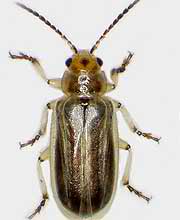
From the Cortez Journal (Kimberly Benedict):
The evening forum, held at the Calvin Denton Room at Empire Electric, was presented by the Dolores Conservation District in partnership with Colorado State University Extension. “Our main focus is to hear from everybody what you want to be doing with tamarisk in the county,” said Steve Miles, of the Dolores Conservation District. “We really want to hear input as to what you want to see the conservation district do.”[…]
Miles, Clark Tate, with the Tamarisk Coalition, and Dan Bean, of the U.S. Department of Agriculture, gave brief presentations on the progress of tamarisk eradication in the west, focusing on the use of tamarisk beetle biocontrol. First released in 2001 in experimental sites, tamarisk beetles are now widespread throughout Colorado and Utah. The small beetles are native to China and Kazakhstan and were part of a $1 million USDA project aimed at finding a biocontrol agent for tamarisk. “The tamarisk biocontrol project started in the ’70s with a look at tamarisk and the problems and potential for developing agents for control,” Bean said. “At the time their was a belief you could not control trees and shrubs with an insect so they shelved it. In the late ’80s they reconsidered.”
Tamarisk beetles do not kill plants directly, they consume the foliage resulting in stressed plants that have difficulty greening after a few seasons, according to Tate. The beetles have left a wake of dead tamarisk in their path in Nevada, resulting in a 75 percent mortality rate. “We are seeing a lot of stressed out tamarisk,” Tate said. “It is hard to tell if they are actually dead, but just looking at them, they are very, very stressed. It is time to start thinking about the void that is going to be created.”