From The New York Times (Kirk Johnson):
…in this depressed corner of western Colorado — one of the first places in the world that uranium, nuclear energy’s primary fuel, was ever dug from the ground in industrial scale — the debate is both simpler and more complicated. A proposal for a new mill to process uranium ore, which would lead to the opening of long-shuttered mines in Colorado and Utah, has brought global and local concerns into collision — jobs, health, class-consciousness and historical memory among them — in ways that suggest, if the pattern here holds, a bitter national debate to come.
Telluride, the rich ski town an hour away by car and a universe apart in terms of money and clout, has emerged as a main base of opposition to the proposed mill, called Piñon Ridge, which would be the first new uranium-processing facility in the United States in more than 25 years if it is approved by Colorado regulators next month…
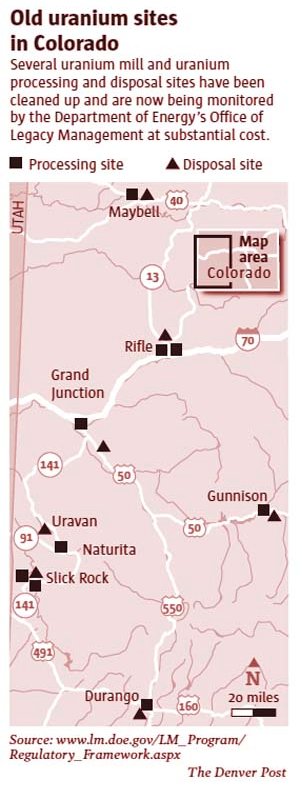
Here in Naturita and the cluster of tiny communities in and around the Paradox Valley, where the mill could be built (cumulative population about 2,000), people disagree not just about the wisdom of the mill, but about whether uranium, laid down here in tufts of volcanic ash more than 100 million years ago, was a blessing or a curse. Minerals found in association with uranium, especially vanadium, which is used in hardening steel, sparked the first real rush in the 1930s; uranium for bombs and energy then followed in a stuttering pattern of boom and bust into the 1980s, when the nation’s nuclear energy program mostly went into mothballs.
Opponents say that the nostalgia many residents here cherish about the boom years is the product of willful forgetfulness about the well-documented cancer deaths and environmental destruction the uranium mines produced. They also say that the mill company is cynically exploiting the idea of a return to simpler times.
“They say it’s going to be different this time around,” said Craig Pirazzi, a carpenter who moved to the Naturita area from Telluride a few years ago and is now a member of the Paradox Valley Sustainability Association, which opposes the mill. “But our opposition to this proposal is based on the performance of historic uranium mining, because that’s all we have to go on — and that record is not good.”
Supporters, meanwhile, say that the opponents of Piñon Ridge are guilty of promulgating ignorant fears about something they do not understand.
Even the question of who has a right to speak up has become a point of contention. Is the mill purely a local concern in a sparsely populated area, or a broader regional issue that would affect people much farther away, through, say, radioactive dust particles that might be thrown aloft?
More coverage from The Denver Post (Bruce Finley):
The federal governments’ and utilities’ failure to encourage nuclear energy “just about requires us to look overseas (for funding),” Gary Steele, Energy Fuels’ vice president for investor relations, told The Denver Post. “You have to go where the market is. Just pick an Asian country.”
Energy Fuels has hired a Hong Kong agent to solicit bankers in China and elsewhere. “The product we provide is essentially totally fungible and can be used at any nuclear facility in the world,” said chief executive Steve Antony. “We’d like to see it used here in the United States.”[…]
Only one conventional uranium mill operates in the U.S., near Blanding, Utah, forcing nuclear power plants to import most of their fuel from abroad. Energy Fuels proposes to build its Piñon Ridge mill in Colorado’s Paradox Valley near Naturita, an agricultural area, drawing water from the Dolores River.
More coverage from The Telluride Daily Planet (Matthew Beaudin):
A new report estimates that the employment impact of the mill near Paradox, Colo., will be small and its socioeconomic impacts more bad than good. The report comes on the heels of another filing that asks the Colorado Department of Public Health and Environment to not approve the mill on the grounds that the company that plans to build it hasn’t prepared for less-than-perfect environmental scenarios. Those reports were prepared for a local environmental group, Sheep Mountain Alliance, which has stood in solid opposition to the idea of revitalizing the uranium industry in an area once famous for it. SMA and other opponents question its environmental impacts and aren’t sure the jobs created will be significant.
There is another side to the uranium story, though, and one that isn’t going quietly: That of those who grew up in the boom towns now busted. Those who say the mill should at least have a fighting chance. Those who say the economies need the opportunity. “I kind of feel that the articles that are coming out of the are pretty one-sided. We as an area know both sides,” said Naturita’s Tammy Sutherland, who lived in the little boom-town of Uravan. Her father and grandfather both worked for Union Carbide, the company that ran Uravan. That town has since been kneaded back into the earth itself, its buildings torn down and its radioactive history buried. Today, it isn’t much more than a fence and a sign warning the passerby of radioactivity…
…it’s that economic impact that a new study debates, and it could be smaller than anticipated, according to a consulting firm. According to the report, prepared by Missoula, Mont.-based Power Consulting, the local economic impact on the West End of Montrose County would be “quite modest.” The firm estimates that the mill would create only 116 jobs, “multiplier impacts” included. Other models predicted much more: 315 well-paying jobs according to Energy Fuels and 600 according to a Montrose-County commissioned study. Why is the Power estimate so small? “First, the rural West End does not have the commercial infrastructure to hold and circulate the spending associated with the mill, regional mines, and employee spending. Most of the expenditures will immediately leak out of the local economy to the larger trade centers such as Grand Junction in Mesa County,” it reads. The paper goes on to say that “none” of the uranium mining is likely to take place near the mill. “Energy Fuels will draw on its mines in Mesa and San Miguel counties in Colorado and Grand and San Juan Counties in Utah. The mining and haul jobs are unlikely to be primarily filled by residents of the Montrose West End,” it reads. The mill will provide about 85 jobs within its confines, according to estimates. The Power report claims it’s “unlikely” that a bulk of those jobs would go to currently unemployed workers in the West End.
More nuclear coverage here and here.
Like this:
Like Loading...