
CU Denver: New desalination method treats wastewater and produces hydrogen

A picture named saltworksdesalinationprocess.jpg

From Sify.com:

Researchers at the University of Colorado Denver College of Engineering and Applied Science have discovered a way to simultaneously desalinate water, produce hydrogen and treat wastewater. “Ships and their crews need energy generated on-site as well as fresh drinking water. Thus, the Navy is very interested in both low energy desalination and renewable energy production,” said Zhiyong (Jason) Ren.

Ren and his team with the University of Colorado Denver discovered, after six months from the initial hypothesis to completion, that they could produce hydrogen gas, which is collectable and storable, thus making improvements in the technology of water purification.

More coverage from Science Daily. From the article:

A recent study by Logan group at Penn State University also demonstrated similar findings in that the energy contained in hydrogen gas not only can offset the energy used for the desalination process but has surplus that can be used for downstream processing.

Next steps for Ren and his team will include using real wastewater to test the efficiency as well as optimizing the reactor configuration to improve system performance. “This discovery is a milestone for our new research group,” said Ren. “We are very excited about our findings and will continue working to improve the technology.”

More water treatment coverage here.
Drought news

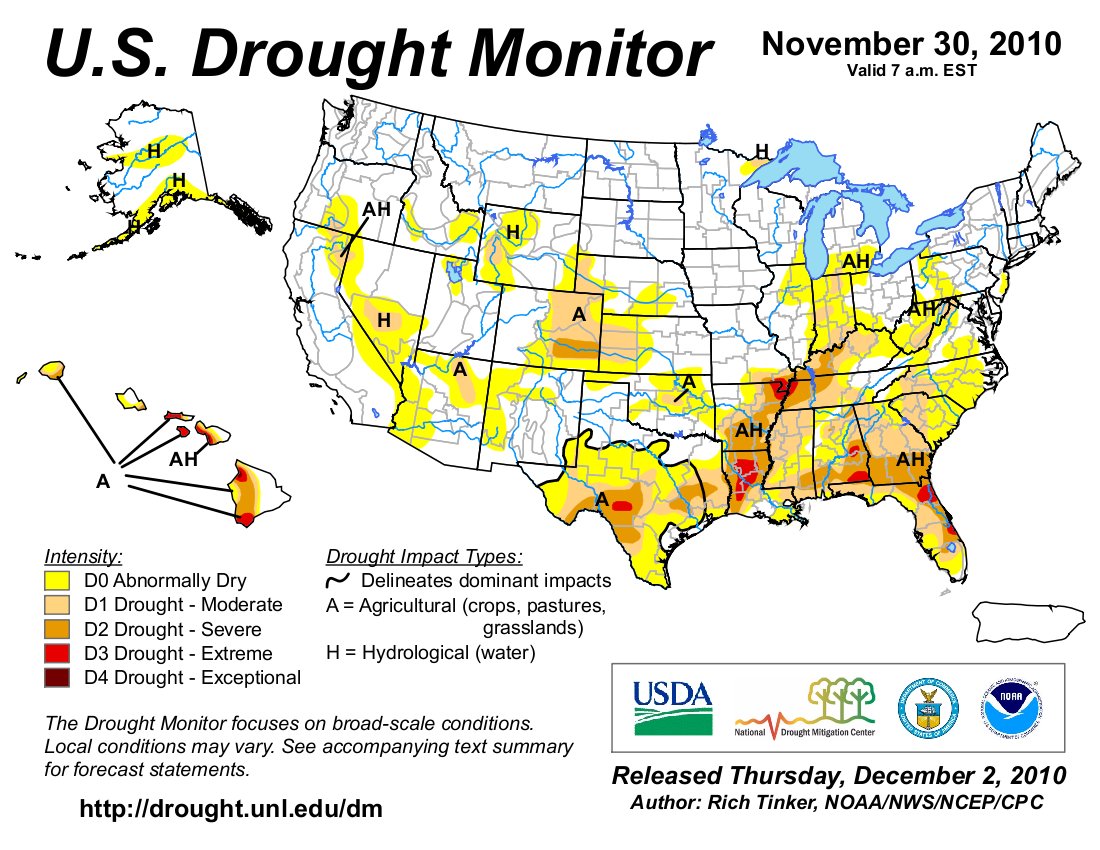
A picture named usdroughtmonitor11302010

From the Colorado Connection (Matthew Krueger):

The US Drought Monitor released updated data on November 30, 2010 which upgrades the moderate drought in southeast Colorado to a severe drought in some cases.

Little to no significant precipitation has fallen across the area since early August. Snowfall for Colorado Springs and Pueblo is far behind this season, and almost non-existant for some parts of the state so far for the 2010-2011 season. Conditions have been steadily deteriorating with fire danger remaining a concern. The Lower Arkansas Valley has been officially put in “severe drought” status as a result.

The airport at Colorado Springs has recorded just over half of its normal yearly precipitation. Pueblo is only slightly better.

Energy policy — nuclear: Powertech lawsuit update

A picture named uraniuminsituleaching.jpg

From the North Forty News (Dan MacArthur):

In its lawsuit, Powertech seeks to overturn state rules that it contends are unreasonable and unconstitutional. It also asserts that legislators’ involvement in the rule-making process violated constitutionally mandated separation of powers. Fort Collins state Reps. John Kefalas and Randy Fischer were among those participating. The suit was filed Nov. 1 against the Colorado Mined Land Reclamation Board and Mike King, executive director of the Colorado Department of Natural Resources. The state must respond within 20 days after being served with the suit…

Powertech president Richard Clement said the company is proceeding with plans to apply for a mining permit sometime in 2011. Clement acknowledged his earlier statement that Powertech could live with the new state rules. But, he said, the Canada-based company was compelled to challenge the process because “there were a lot of inconsistencies in the way it was handled.”

The new rules principally apply to in situ leach mines such as the one proposed by Powertech. In situ mining involves pumping water underground to dissolve uranium. The solution then is pumped to the surface, the uranium extracted and the water returned underground. The rules require in situ leach operations to restore groundwater to its original quality or to standards set by the state. Applicants must also provide detailed baseline hydrology information and environmental protection plans and prove that the proposed mining technology has been used at five other locations without damaging groundwater quality.

More nuclear coverage here and here.

Poudre River: Rainbow trout habitat improvement experiment recap

A picture named rainbowtrout.jpg

From the North Forty News (Cherry Sokoloski):

In August, the DOW and volunteers removed 1,400 brown trout, or 90 percent of the estimated population, from a 0.6-mile section of the Poudre River downstream of the Poudre Unit hatchery, then moved the browns to a different location. At the same time, the agency planted thousands of rainbows in the section where browns were removed and in a control section where browns were not removed. Special antennae at either end of each section have tracked movement of fish by reading tags implanted in the stocked rainbows. The relocated browns were also tagged, and Fetherman discovered that some of them made it back to the removal area.

The DOW planted 4,000 rainbows using strains that are resistant to whirling disease, which wiped out wild rainbows in the Poudre in the 1990s. Half the ‘bows were Hofer-Harrison crosses, and the rest were Hofer-Colorado River Rainbow hybrids.

In late October, Fetherman and others did a fish count in both the removal area and the control area, to check on populations of browns and rainbows. The results were significant. “In the short term, the removal was successful,” a smiling Fetherman said. In the control area, where browns were not removed, only 503 rainbows remained – 26 percent of the planted fish. In the removal area, however, the DOW counted 1,185 rainbows, or 60 percent of those planted.

This initial success suggests that, as hoped, stocked rainbows can succeed when competition from browns is removed. Fetherman thinks it’s likely that removal of the browns gave the rainbows a toehold in the territory before competing browns moved back in…

In addition, Fetherman found evidence that browns do prey upon the rainbows. Nine browns that were captured in October had rainbow tags in their stomachs.

More restoration coverage here.

Implementing the Endangered Species Act on the Platte Basin Water Commons

A picture named whoopingcranes.jpg

Here’s a review of David Freeman’s new book, from Dan MacArthur writing in the North Forty News. From the article:

…after coming to CSU in 1967, he immersed himself in regional water issues. Freeman systematically studied the 109 “wonderfully successful irrigation associations in northern Colorado” and developed close working relationships with many of the long-time icons in the close-knit water community. “Water is the most sociological thing on Earth,” said Freeman, postulating that he may be the only sociologist who owns a water-measuring flume.

Freeman applied his characteristic obsessive persistence and thoroughness in his book. In it, he details the exhausting 12-year process resulting in an agreement to restore and preserve habitat for three birds and a fish designated as endangered species – the whooping crane, interior least tern, piping plover and pallid sturgeon. The effort brought together environmentalists, state and federal officials and representatives from Colorado, Wyoming and Nebraska. These strange, suspicious and sometimes outright hostile bedfellows were united only by the need to cooperatively develop a recovery plan lest a less desirable one be imposed.

Freeman was there from the beginning in 1994 when governors of the three states agreed to talks until an agreement was reached and ultimately signed into law…

“Implementing the Endangered Species Act on the Platte River Water Commons” is published by the University Press of Colorado. It is available for $45 plus shipping and handling by calling 800-627-7377.

More endangered/threatened species coverage here.

Wellington: Boxelder basin floodplain update

A picture named floodplain.jpg

From the North Forty News (Cherry Sokoloski):

Phase I of the project, which will enlarge Clark Reservoir and widen the Inlet Canal flowing into the reservoir, should be mostly complete by the end of 2011, according to Larimer County engineer Martina Wilkinson. The $4 million project will be bid out in two separate contracts, she said…

When Phase I is complete, more than 200 homes in Wellington plus Eyestone Elementary and Wellington Middle School will no longer be in the Boxelder floodplain. The requirement for flood insurance in that area will “go away” once floodplain maps are revised, Wilkinson said, likely sometime in 2012.

On Dec. 16 at 10 a.m., the county commissioners will hold a work session to discuss Boxelder fees and boundaries.

More stormwater coverage here and here.