Peter Binney joins Merrick & Company

A picture named prairiewaterstreatment.jpg

Here’s the release from Merrick & Company:

Peter Binney, PE, has joined Merrick & Company as the firm’s National Director of Sustainable Infrastructure, it was announced by Ralph W. Christie, Jr., PE, Chair, President, and CEO. In this new role, Binney will be responsible for expanding Merrick’s water infrastructure business across the U.S. and leading Merrick’s sustainable infrastructure practice through the firm’s 12 offices. As a nationally and internationally recognized expert in the water industry and sustainability, he has been instrumental in the soon-to-be completed national sustainable infrastructure certification and rating system being developed by the American Consulting Engineers Council, the American Society of Civil Engineers, and the American Public Works Association.

“Having Peter on board at Merrick is exciting. Over the past several years, our water and sustainability practices have grown and Peter’s expertise will propel the firm forward as a national expert in the field,” said Christie. “I have known Peter over the years as a real professional who is dedicated to providing the best infrastructure solutions to serve clients and society. I am pleased to have him joining our employee-owned company.”

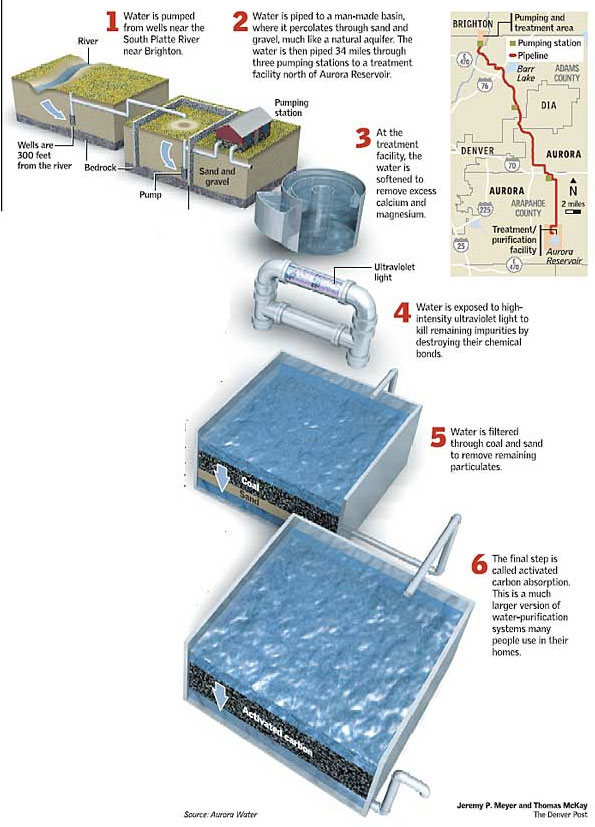
His expertise includes water management and development, sustainable infrastructure rating and performance, mediation and resolution of issues on complex public infrastructure projects, and a comprehensive understanding of public water utilities. His contribution to the community and to the water industry was recently recognized by the City of Aurora, when the city named its new $660 million water treatment plant for him. The Peter D. Binney Water Purification Plant was opened in October, 2010 after a five-year concept to commission schedule. Binney was the director of the City of Aurora, Colorado’s water utility during the planning, design, and construction phase of this trend setting a sustainable project.

Binney’s entire career has been focused on water and sustainable infrastructure. His past leadership positions include Director of Sustainable Planning for Black & Veatch and National Director, Water Resources for CH2MHill, where he spent 20 years in water resources. Binney is an active member of the American Water Works Association, the International Water Association, and the American Society of Civil Engineers. He holds a Masters of Science, Water Resources Engineering from the University of Colorado, Boulder. He also has a Masters of Engineering and a Bachelor of Engineering from the University of Canterbury, Christchurch, New Zealand.

Thanks to American Surveyor for the link.

Dolores River watershed: BLM Wild and Scenic River suitability study public meetings December 6-7 and December 14-15

A picture named doloresrivercanyon.jpg

From the Montrose Daily Press:

The Dec. 6 and 7 meetings will address the relationship between endangered fish and the Wild and Scenic River Act. The discussions will focus on the eligible segments of the Dolores River and tributaries in the Uncompahgre Field Office. The Dec. 14 and 15 meetings will address fish and riparian outstanding and remarkable values. The discussions will focus on the upper eligible segments of the San Miguel River.

More Dolores River watershed coverage here and here.

Energy policy — nuclear: Powertech gets the EPA go ahead for pump test

A picture named denveraquifer.jpg

From The Greeley Tribune:

“The permit places specific, rigorous conditions on the re-injection of groundwater that will be temporarily withdrawn from the Upper Fox Hills formation during an aquifer pump test,” said Steve Tuber, EPA’s assistant regional administrator in Denver, in the release. “The safeguards associated with this permit, some of which are the result of public comments, will ensure that groundwater in formations below the Centennial site is protected.”

More nuclear coverage here and here.

CWCB: Next Water Availability Task Force meeting January 18

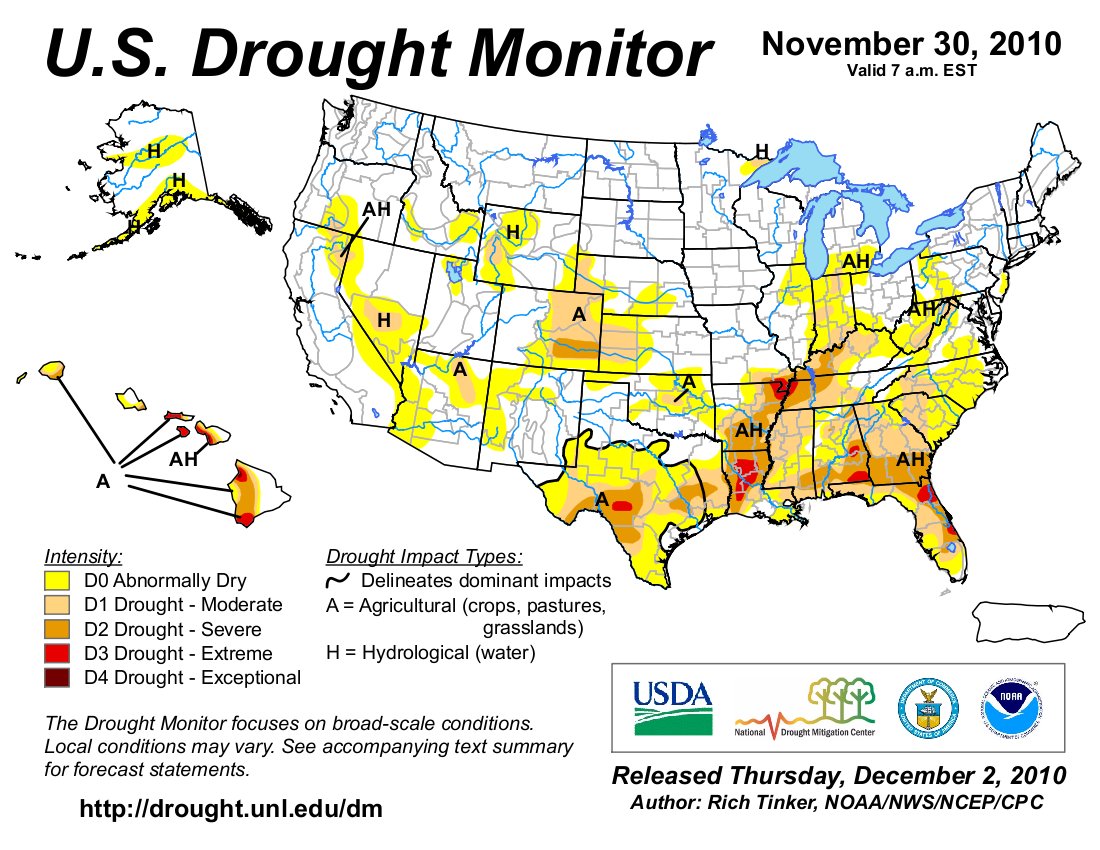
A picture named usdroughtmonitor11302010

From email from the CWCB (Ben Wade):

The next Water Availability Task Force (WATF) is scheduled for Tuesday, January 18, 2011 from 9:30-12pm at the Colorado Division of Wildlife, 6060 Broadway, Denver, CO, in the Bighorn Room.

Interbasin Compact Committee meeting recap: Strategies to take the pressure off agricultural water

A picture named ibccroundtable.jpg

From the Cortez Journal (Joe Hanel):

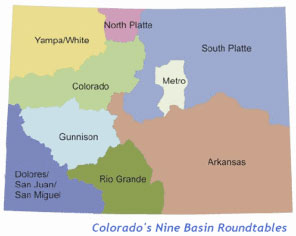
The group’s 32-page report is the first glimmer of a possible statewide strategy for water supply, after more than a century of fighting among the state’s regions. The Interbasin Compact Committee began meeting five years ago to hash out a solution for a state that has too little water for its future residents. Its 32-page draft report is still a work in progress, and members expect to refine it over the next year with public input.

What motivates the group is the status quo: Unless Colorado makes big changes, cities will continue to buy out water rights from farmers, resulting in a dry-up of farms and the withering of the rural economy…

The draft report calls for several controversial actions:

Statewide codes for plumbing and landscaping.

Annual payments to communities that see large transfers of water to a different basin.

State participation in new projects that might transfer water from the Western Slope to the east.

Restrictions on land use to reduce the demand for water by growing cities and suburbs.

The changes amount to greater powers for the state government over areas that currently belong to local governments, like building codes and development patterns…

The report identifies four general ways to find enough water: new projects for use in both Western and Eastern Colorado, completion of projects already on the drawing board, conservation, and transfers of farm water to cities. A mix of all four will be needed, according to the report…

The idea of having the state fund and direct new dams is worrisome, said Jim Pokrandt, chairman of the Colorado River Basin Roundtable. “On the West Slope, are we going to get run over because most of the people and most of the politicians are on the Front Range?” Pokrandt asked.

I tried to snag a copy of the report that the IBCC distributed but it is not ready yet. Eric Hecox said in email, “The report changed quite a bit from the draft we went into the meeting with. We’re hoping the final will be done by 12/15.”

More coverage from the Associated Press (Stephen K. Paulson) via The Aspen Times. From the article:

Jim Pokrandt, representing the Colorado River Basin committee, said water is no longer a local issue and the state should regulate it as it does utilities. “If water is truly a scarce resource, that’s the logical conclusion,” he said.

Former state Agriculture Commissioner Don Ament, a farmer who attended the water basin meetings but has no official role, said the report does little to solve problems in conservation, loss of agricultural land and finding new water sources. He said the state already has a major role with the Colorado Water Conservation Board, which oversees and provides funding for water projects statewide and has the authority to carry out most of the report’s suggestions. “This report just gets us back to right where we were before,” Ament said.

More IBCC — basin roundtables coverage here.

NIDIS Webinar Schedule Update: La Nina Update and Long Range Climate Forecast — Tuesday, Dec. 7th

A picture named typicallaninanoaa.jpg

From email from the Colorado Climate Center (Henry Reges):

Due to high demand for long range climate forecasts, climatologist Dr. Klaus Wolter of NOAA-ESRL in Boulder, CO will join us on Tuesday, December 7th at 10AM to share his long range climate forecast and La Nina update for the Upper Colorado River Basin. Dr. Wolter is an expert on El Niño/La Niña patterns and how they affect our weather patterns in the Western U.S. He will provide his insight and expert opinion on the current strong La Nina pattern we are experiencing and how it may affect our weather over the next several months. His forecasts are used to guide water planning and decision making across the Western U.S. and his forecasts are held in the highest regard.

Please join us at 10 AM on Tuesday, December 7th for an exciting discussion on current conditions and future outlook!

Register here:
http://ccc.atmos.colostate.edu/drought_webinar_registration.php

Trout Unlimited and the Pagosa Area Water and Sanitation District agree to settle Dry Gulch lawsuit and have worked out the terms for a proposed decree

A picture named pagosahotsprings.jpg

From The Durango Herald (Patrick Young):

The agreement, coming after an hours-long negotiation moderated by Sen. Bruce Whitehead, D-Hesperus, effectively ends years of dispute between the districts and the environmental group. “There was a willingness, I think, and a desire for both parties to come together,” Steve Hartvigsen, director of the Pagosa Area Water and Sanitation District, said Saturday.

Though the districts originally requested water rights for 35,000 acre-feet, the agreement gives them the necessary water rights to construct a reservoir no larger than 11,000 acre-feet. In return, Trout Unlimited agreed to drop its opposition to the districts’ water rights request. The next step in the process is to put the terms of the agreement in writing and, once the draft is agreed upon by all parties, it will go to the water division for approval by the division engineer before going to the district water court for final approval…

Both Hartvigsen and [Trout Unlimited attorney Drew] Peternell acknowledged Whitehead’s integral role in bringing the parties together and ultimately as moderator of the negotiations. “A big thanks to Sen. Whitehead,” Hartvigsen said. “Without him there, I can’t say that we would have come to an agreement, not that we didn’t want to.”

More Dry Gulch Reservoir coverage here and here.

Lamar: Arkansas River Compact Commission annual meeting December 14

A picture named arkansasriverbasinwikipedia.jpg

From Fox4KC.com:

Arkansas River Compact Administration will review a compliance update over water at its annual meeting…Also on the agenda at its Dec. 14 meeting in Lamar, Colo., is a review of John Martin Reservoir operations, committee reports and updates from state and federal agencies.

More Arkansas River basin coverage here.

Energy policy — nuclear — ‘Dirty Secrets: the Health Effects of Uranium Mining — New Research’ talk today in Telluride

A picture named conventionaluraniummill.jpg

From The Telluride Daily Planet (Matthew Beaudin):

[Doug Brugge, a professor of public health and community medicine at Tufts University] is in town this week to discuss the issue in a talk titled “Dirty Secrets: the Health Effects of Uranium Mining — New Research.” The discussion is free at 6 p.m. Monday at the Palm Theatre and comes at a particularly relevant time, as Montrose County Commissioners gave their approval of a uranium mill to be built in the lonely reaches of western Montrose County, between here and Moab, Utah, in the fall of 2009.

Now, the Colorado Department of Public Health and Environment is reviewing the proposal and will issue a final decision sometime in January. The mill’s approval would be the first in 25 years and has become a polarizing issue around Telluride, a town founded on mining that is now dependent on tourism. Those near the planned mill and from communities that participated in the first atomic boom generally support the idea and say their towns need jobs desperately while some Telluriders have taken a hard line, believing the environmental and health risks are too great.

Brugge is from the Southwest — he grew up in Gallup and Albuquerque, N.M. — but didn’t align his research with the region because of his roots, he said. Once he left school, he visited the reservation with his father. At the time, Brugge was working in environmental health and saw a Navajo newspaper story on the issues in uranium mining, which had cast a long shadow over the Navajo Nation.

More nuclear coverage here and here.