
Energy policy — hydroelectric: Colorado State University, Applegate Group Collaborate on State Grant to Investigate Hydropower in Irrigation Canals

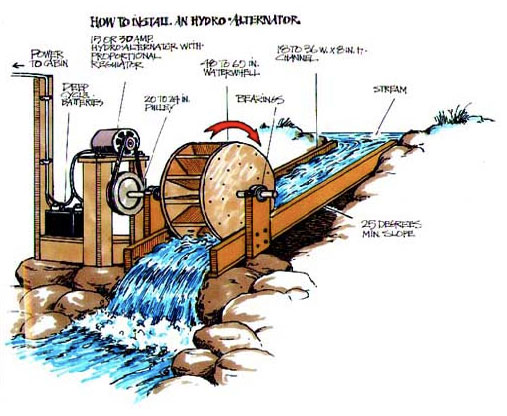
A picture named microhydroelectricplant.jpg

Here’s the release from Colorado State University (Emily Narvaes Wilmsen):

Three million acres of irrigated land in Colorado could be an untapped source of hydropower and a revenue source for irrigation companies.

A Colorado State University engineering professor is collaborating with an engineering firm, Applegate Group Inc., to review the potential power that could be generated by “low-head” turbines in irrigation canals.

Lindsay George, water resource engineer in the Glenwood Springs offices of Applegate, and Dan Zimmerle, a research scientist and adjunct mechanical engineering professor at Colorado State, received a $50,000 grant this year from the Colorado Department of Agriculture to study canals in Colorado. The grant is part of the Advancing Colorado’s Renewable Energy (ACRE) Program to promote energy-related projects beneficial to Colorado’s agriculture industry.

Water in irrigation canals moves fast enough to produce anywhere from 100 kilowatts to two megawatts of power. Two megawatts of power is enough energy to supply power to about 850 typical homes.

In the study, the researchers are examining turbines that could generate power from an elevation drop in an irrigation channel of five feet to 30 feet such as water diversion structures or chutes. They’re also investigating how to connect that power to the traditional electric grid.

Zimmerle and George are now conducting an inventory of irrigation canals in Colorado and surveying roughly 250 ditch companies and individual ditch operators around the state. The survey is available to ditch operators at http://www.applegategroup.com/news/low-head-hydropower-survey-available.

Zimmerle will speak about the project on Feb. 16 in Berthoud at a full-day workshop, “Low Head Hydroelectric Opportunities for Ditch and Reservoir Companies,” sponsored by the Ditch and Reservoir Company Alliance. DARCA is a resource for networking, information exchange and advocacy among mutual ditch and reservoir companies throughout Colorado.

“DARCA is very much interested in projects that will enhance the financial viability of its member ditch companies,” Executive Director John McKenzie said. “The introduction of these types of distributed power projects will help develop additional revenue streams for Colorado ditch companies.”

“That type of infrastructure allows for the potential of low-head hydropower,” Zimmerle said. “There are extensive irrigation systems in Colorado, so we’re identifying where hydropower could be applied in those irrigation channels.
“A large part of the cost for small generating plants is the cost of running a distribution line to generating plants,” he said. “There are good places in the irrigation system that will generate significant amounts of power. But we need to explore this issue with utilities – the approval process, interconnection standards and potential revenue.”

Hydropower generated from irrigation ditches is known as low-head hydropower or hydrokinetic power – what the Federal Energy Regulatory Commission (FERC) defines as projects that “generate electricity from waves or directly from the flow of water in ocean currents, tides or inland waterways.”

Interest is growing in that type of power because technology is improving, George said: “FERC has a Memorandum of Understanding with the state of Colorado to streamline the permitting process for low-impact hydropower projects in existing canals.

“Hydrokinetic turbines produce a small amount of power and are going to be practical in certain situations,” she said. “With our study, we expect to report a total amount of power that could be produced using low-head and hydrokinetic turbines in our irrigation canals that should help irrigation districts in planning their projects.

“New low-head technologies have potential at sites previously considered unfeasible for hydro development because of a lack of significant elevation drop,” George said. “Irrigation canal drop and check structures, as well as existing diversion dams and outflows, may provide the drop necessary to implement these new low-head hydro technologies.”
Applegate Group, with offices in Denver and Glenwood Springs, is an engineering and consulting firm with expertise in water planning, water rights engineering, water policy and development of water infrastructure.

More hydroelectric coverage here and here.

Moffat Collection System Project: CDOW impact report

A picture named grossdam.jpg

From the Greeley Gazette (Mike Bauman):

Ken Kehmeier, [CDOW] senior aquatic biologist for the Platte River Basin, told commissioners that Denver Water’s Moffat Firming project would result in reduced stream flows and increased temperatures in the Williams Fork, Fraser and Upper Colorado River systems. According to Kehmeier, the lower flows would increase sedimentation in the affected reaches of these rivers and reduce their ability to support aquatic insects and fish life.

On the East Slope, the additional diversions would send more water through the Moffat Tunnel, down South Boulder Creek and into an enlarged Gross Reservoir in Boulder County, Kehmeier said. The project would create a larger reservoir for recreation, however, longer periods of high flows in South Boulder Creek above Gross Reservoir would reduce its ability to support trout and other aquatic wildlife, he said…

Kehmeier noted that Denver Water could opt to divert an additional 16,000 acre feet, mainly through Roberts Tunnel and South Platte basin through the southern part of its system without getting a new federal permit. That would likely cause significant impacts to Dillon Reservoir and the high-value trout fishery along the South Platte River, Kehmeier said, and it would not give the Wildlife Commission an opportunity to negotiate mitigation for the increased diversions.

More Moffat Collection System Project coverage here and here.

Energy policy — nuclear: The Sheep Mountain Alliance plans to deliver an environmental analysis of the proposed Piñon Ridge mill to the Colorado Department of Public Health and Environment today

A picture named pinonridgesite.jpg

From The Telluride Daily Planet (Matthew Beaudin):

Hilary White, Sheep Mountain Alliance’s executive director, faulted Energy Fuels, the company hoping to build the mill, for sidestepping concerns. “I think that they probably took more time on some parts of the application than others,” she said, claiming issues such as worst-case scenarios and air transport of toxic dust were ignored. “They shrugged them off. … The application was incomplete when they first completed it, and it continues to be incomplete. The state should deny it on those grounds, as well as others.”

Fraink Filas, who speaks on behalf of Energy Fuels and is the environmental manager there, had yet to see the report and thus could not comment.

[Stratus Consulting of Boulder, Colorado] found fault in the application in several main areas: water supply, waste containment and management and unmapped plans for dealing with future problems at the mill site. It’s estimated that the mill will require 144 gallons of water per minute. The only nearby sources for water are the San Miguel River and the Chinle-Moenkopi aquifer beneath the site, which is estimated to put out 100-175 gallons per minute under an “optimistic” projection, according to the report. “We do not believe that Energy Fuels and their contractor… have adequately addressed questions of water supply over the proposed 40-year mill life,” it reads…

Stratus and others are also worried that the ponds, which are required to be lined, may leak into groundwater beneath the site. Energy Fuels has said it would monitor the ponds for leakage with devices and install netting and equipment to keep birds from getting into the ponds. “Given the history of other mine sites, we believe that Energy Fuels should plan for contaminant releases to surface drainages and groundwater and include multiple control measures as part of the permitting process,” the report reads.

The consultants also faulted Energy Fuels, and the mining industry as a whole, on a failure to address future and unseen problems and plan for remediation. “Energy Fuels and its contractors presented a plan with an engineered solution for all aspects of the milling process. Impoundments will be lined, the ground surface will be graded, it will be a zero discharge facility, and after 40 years, they will implement their closeout plan and walk away,” the report reads. “They have assumed that these engineered solutions are failsafe and that no additional contingency planning is necessary.”

More nuclear coverage here and here.