Snowpack news

A picture named snowpackcolorado12142010

From the Summit Daily News (Janice Kurbjun):

As of mid-December, the Colorado River Basin snowpack is up more than 67 percent compared to last year, information from the United States Department of Agriculture’s Natural Resources Conservation Service Division shows. Compared to average figures for the basin, which includes the Blue River watershed and extends to western Colorado, the snowpack is up about 25 percent above average for this time of year. For all SNOTEL sites in Summit County (areas where the division has automatic snow survey equipment installed), last year’s mid-December snowpack was well below average, but this year the situation has reversed. Copper Mountain’s SNOTEL average is to have snow with the liquid equivalent of 4 inches. As of Dec. 13, the snow water equivalent is at 7.4 inches…

[NRCS spokesman Mike Gillespie] said the Upper Rio Grande Basin is at 43 percent of average and the San Miguel, Dolores, Animas and San Juan River basins are at 71 percent of average.

USDA Requests Proposals for Water and Land Conservation Projects

A picture named montezumatunnel.jpg

Here’s the release from the U.S. Department of Agriculture:

Agriculture Secretary Tom Vilsack today announced USDA is seeking proposals for projects that will bring partners together to help farmers, ranchers and private nonindustrial forest landowners implement beneficial water and land conservation practices.

“Farmers, ranchers and owners of forest land play pivotal roles in protecting and enhancing natural resources,” Vilsack said. “Our goal is to support projects that will improve the health of the natural resources on their land and bring the environmental and economic benefits of conservation to their local communities.”

The requirements for submitting project proposals for the Agricultural Water Enhancement Program (AWEP) and the Cooperative Conservation Partnership Initiative (CCPI) can be viewed at http://www.regulations.gov. USDA’s Natural Resources Conservation Service (NRCS) will provide financial and technical assistance to eligible producers in approved project areas.

Through AWEP, NRCS provides support for projects that conserve and improve water quality, use irrigation water efficiently, mitigate the effects of drought and climate change and take other actions that benefit water resources. NRCS enters into partnership agreements with federally recognized Indian Tribes, state and local units of government, agricultural and forestland associations, and nongovernmental organizations to help landowners plan and implement conservation practices in designated project areas.

Twenty-eight projects approved for AWEP in fiscal year (FY) 2010 are supporting water conservation efforts in 9 states. For example, in central Colorado, satellite and Internet technology funded through AWEP allows farmers to monitor water-use data in real-time. This information helps them decide how much water to use on their crops, when to apply irrigation water and what type of irrigation equipment will work best for their operations.

Through CCPI, NRCS and partners assist producers in implementing conservation practices on agricultural and nonindustrial private forest lands. NRCS leverages financial and technical assistance with partners’ resources to install soil erosion practices, manage grazing lands, improve forestlands, establish cover crops, reduce on-farm energy usage and other conservation measures. CCPI is open to federally recognized Tribes, state and local units of government, producer associations, farmer cooperatives, institutions of higher education and nongovernmental organizations that work with producers.

Twenty-six projects in 14 states were approved for CCPI in FY 2010. NRCS and Trout Unlimited in Virginia’s Shenandoah Valley are using CCPI to restore brook trout habitat and improve water quality in the Chesapeake Bay. The goal is to install nearly 26,000 feet of fencing to prevent livestock from entering streams within the bay’s watershed. This action is expected to improve nearly 10 miles of stream habitat. The project also will restore 20 acres of streamside vegetation to keep pollutants from entering waterways and stabilize soils on 2 miles of stream banks to prevent sediment from clogging waterways downstream.

Proposals for AWEP and CCPI projects must be received by NRCS by January 31, 2011. Visit www.nrcs.usda.gov/programs/awep and www.nrcs.usda.gov/programs/ccpi web pages to learn more.

2010 represents the 75th year of NRCS “helping people help the land.” Since its inception in 1935, NRCS has advanced a unique partnership with state and local governments and private landowners delivering conservation based on specific, local conservation needs, while accommodating state and national interests.

More conservation coverage here.

Thirsty Energy, Scarce Water: Interdependent Security Challenges

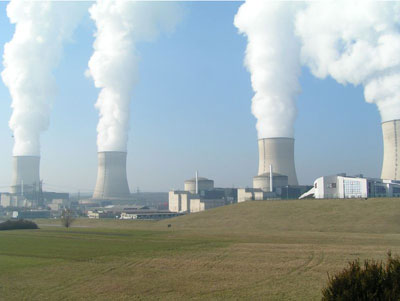
A picture named nukeplantcattenomfrance.jpg

This in-depth look from the Journal of Energy Security (Steven Solomon) starts out saying:

From the invention of the waterwheel 2,000 years ago, to the modern, coal-burning steam engine that powered the 18th century Industrial Revolution, and the giant, multipurpose hydropower-irrigation-flood control dams pioneered at Hoover that helped transform 20th century global civilization, water and energy have been coupled in a matrimony of ever-deepening interdependence. Today their marriage interweaves so inextricably through the spinal nexus of 21st century infrastructures that achieving energy security depends critically upon freshwater sufficiency—and water security turns upon ample, and increasing amounts, of affordable energy.

Click through and read the whole thing. Thanks to Loretta Lohman for the link.

Here’s the link to his book.

More energy policy coverage here.

Southern Delivery System: Rocky Mountain Environmental Labor Coalition challenge to the project’s 401 certification is today

A picture named arkansasfountainconverge.jpg

From The Colorado Springs Gazette (Daniel Chaćon):

ā€œWe have asked in our papers that the commission set aside the certification or remand it, which means send it back to the Water Quality Control Division for further review based on the various issues we’ve raised,ā€ Susan Eckert, a Littleton-based attorney representing the Rocky Mountain Environmental Labor Coalition, said Monday. The coalition, which describes itself as a non-profit dedicated to the protection of the environment and worker interests in the Rocky Mountain region, filed the appeal along with [Pueblo County District Attorney Bill Thiebaut] in June. Among their assertions is that SDS, as presently configured, will not comply with all applicable state water quality requirements.

[Colorado Springs] Utilities spokeswoman Janet Rummel said SDS has ā€œextensive mitigation requirementsā€ that ā€œfully addressā€ the issues cited in the appeal.

More Southern Delivery System coverage here and here.

Moffat Collection System Project and Windy Gap Firming Project update

A picture named windygapreservoir.jpg

From KUNC (Kirk Siegler):

Over the years, Denver Water has built four trans-mountain diversions, five canals and 16 reservoirs to serve its 1.3 million customers. Northern Water relies on 110 miles worth of canals and even a tunnel beneath Rocky Mountain National Park to pump western slope water to its 13 reservoirs. Both agencies have pending projects to expand this footprint…

“This project allows us to take the water that we are currently entitled to take under the Windy Gap Project,” says Jeff Drager, Northern Water’s project manager overseeing the Windy Gap Firming Project. He says making the water more “firm,” or more reliable, means the water customers along the northern Front Range will be able to count on that water year in and year out…

These concerns set the backdrop of a State Wildlife Commission meeting on the two water projects last week in Colorado Springs. A relatively-unknown state law requires the commission to sign off on mitigation plans for water projects like these, which get passed on to federal regulators who have the final say on any proposal. “The number one concern of the Grand County Commissioners, and they said to say this very loudly, is to protect the aquatic environment,” said attorney Barbara Green, who represents the Grand County Commission. “That is their number one concern about these two projects.”[…]

Division of Wildlife biologist Ken Kehmeier said from 1985 to 2010, lower flows have led to some uninvited visitors, wiping out two mayfly and six stone fly insects that trout depend on. “We have chironomids and some muelids that are now dominant groups in some of these areas, these two species are generally indicators of water quality problems,” Kehmeier said. Which could have implications for all of us. So officials with Denver and Northern water say they’re working together to ensure that their projects’ impacts will be negligible.

Northern’s Jeff Drager says his agency’s plans could actually help the river, by carefully taking less water during dry months, and allowing more to flow down the western slope during peak runoff periods.

More Moffat Collection System coverage here and here. More Windy Gap coverage here and here.

2010 Colorado election transition: Hickenlooper is looking at IBCC recommendations

A picture named coloradocapitolfront.jpg

From The Pueblo Chieftain (Patrick Malone):

…Gov.-elect John Hickenlooper said he is receptive to adopting water-efficiency standards for state agencies and departments…

ā€œThat’s what we did in the city,ā€ Hickenlooper said. ā€œWe started asking, ā€˜Who uses large amounts of water in our city government that we could talk to first?’ ’’ Hickenlooper said that was a change that he implemented as mayor of Denver, and it worked. A chart generated by Denver Water showed that between 1990 and last year Denver reduced its water consumption considerably. Most of the water efficiency was achieved between 2000 and 2010. Hickenlooper became mayor in 2003. At its peak, Denver was devouring more than 220 gallons per person per day. As of last year, that measure had declined to 145 gallons…

ā€œIn some of these big issues, like water, I think you have to look at every agency in state government and ask everybody, ā€˜How are you going to cut your water consumption by 15 or 20 percent?’ ā€

More 2010 Colorado elections coverage here.

La NiƱa/snowpack update

A picture named usdroughtmonitor12012010

From The Pueblo Chieftain (Chris Woodka):

Chances of snow [for Pueblo County and the Arkansas Valley] are 10 percent to 40 percent Wednesday through Friday, but the 10-day forecast is calling for below normal precipitation…

Most of the storms that have moved through the country for the last four months have missed Pueblo as a strong La Nina — cooling of the Pacific Ocean — continues. Storms tend to move further north, as last weekend’s pounding of the Midwest illustrates.

Snowpack in the mountains is spotty as well. North of Leadville, more than 3 feet of snow remains at Fremont Pass, according to Natural Resources Conservation Service Snotel tracking. But elsewhere in the Arkansas River basin, snow is sparse. At St. Elmo, southwest of Buena Vista, about 17 inches were reported Monday. Further south and east, the snow pack thins out. On Pikes Peak, where traces of white can be seen, only about 2 inches is measured at the NRCS site. At Hayden Pass near Villa Grove, only 1 inch was reported. Cooper and Monarch ski areas both reported a base of 34 inches with 7 inches of new snow over the weekend, while Wolf Creek Pass only has a 27-inch base with no new snow. The Arkansas River basin is at 76 percent of normal for snowpack, as measured by snow water equivalent, while the Rio Grande basin was at 54 percent as of Monday.

From The Denver Post (Kieran Nicholson):

While winter weather has a firm grip on the northern and central Colorado mountains, Denver and the Front Range remain mild and dry, a pattern unlikely to change in a hurry. Several Colorado ski resorts are boasting of early-season bases already measuring 40 inches and deeper, but Denver has seen just a “trace” amount of precipitation for the month of December so far…

“This pattern doesn’t change too much over the next 10 days,” said Bernie Meier, a meteorologist and spokesman with the National Weather Service in Boulder.Denver and the Front Range may get “a little light precipitation here and there, but nothing significant.”