South Platte basin groundwater irrigators are looking to the state legislature for some relief for strict augmentation requirements for wells

southplattealluvialaquifer.jpg

High water tables and free river for much of the past couple of years have farmers crying foul over the shut down of 440 wells in the South Platte alluvium in 2006. The State Engineer shut the wells down to protect senior rights holders when the irrigators failed to acquire sufficient augmentation water under current rules. Here’s a report from Eric Brown writing for The Greeley Tribune. From the article:

The affected wells have remained shut off since 2006 because those wells either don’t have augmentation plans — a way of later adding water to the South Platte River to make up for the depletions caused by well pumping — or they don’t have the water supply to fulfill their augmentation plans.

When the wells were ordered to be shut off a few years ago, augmentation requirements also became more stringent — requiring well pumpers to have augmentation plans in place that could meet the needs of a drought year. As noted by Randy Ray, executive director with the Central Colorado Water Conservancy District (CCWCD), many farmers can’t afford to have such a stringent plan in place. “It definitely puts them in a tough spot,” he said. The shutdown or curtailed wells lie within the augmentation subdistricts of the CCWCD…

Because of the hardships endured by the farmers, ag producers in the area — as well as various farmers organizations, such as the Weld County and Colorado farm bureaus — are asking for legislative changes. They’re specifically asking that the Colorado Division of Water Resources — also referred to as the Office of the State Engineer — be given more flexibility in controlling those wells — certainly during times like these, when the South Platte River Basin is full and senior water right holders aren’t at risk of being deprived of their water.

Giving the state engineer’s office more flexibility was a topic of discussion at the Colorado Farm Bureau’s Mid-Summer Meeting in Greeley back in July, and the Weld County Farm Bureau recently listed it as one of its top issues to bring up at the Colorado Farm Bureau’s Annual Meeting in November. At the November meeting, the CFB will vote to adopt a set of policies, which will later be looked at by the CFB Board of Directors…

Gege Ellzey, president of the Weld County Farm Bureau, noted that the local bureau has brought up various water issues to the Annual Meeting before, but the issue concerning the state engineer’s office will be the only one concerning water this year. She said the water issues brought up in previous years have been Weld County-specific, and the policy of giving the state engineer’s office more flexibility would be more of a statewide issue — and hopefully looked at more closely by the CFB.

More coverage of the events in 2006 here. More South Platte River basin coverage here.

Restoration: Nestlé Waters North America plans to apply for a permit to restore the old fish hatchery at their Ruby Spring pumping facility to a more natural state

nestlehaffeepipelinec.jpg

From The Mountain Mail (Cailey McDermott):

The restoration work was a condition of the permit agreement with Chaffee County.

Bobbi McClead, natural resource manager, said a special permit is needed from the U.S. Army Corps for construction in a wetland environment, and the plan is to apply soon for the permit…

The plan is to remove all man-made structures from the wetland area to create a more natural habitat and an educational site for school use. The upper pond will be expanded with an island for fowl habitat, and the ponds will be lined with geotextile liner. The liner will help filter, drain and protect the ponds…

The Ruby Mountain spring area is between 16 and 18 acres, she said. McClead said she expects the reclamation project to be completed in 2012 with the bulk of the construction occurring in spring during low groundwater flows. She said there is a large variability of underground flows, which can range from 500 to 2,000 gallons per minute. There are two pump houses on the property, but only one is operational. McClead said the older pump house is used as a backup if needed. She said Nestlé is permitted to pump up to 122 gallons per minute per day from the operating well, but it runs continually at 110 gallons per minute to keep the water moving. McClead said they are only taking a “portion” of what would naturally be lost, so there is “no depletion of water over time.”

More Nestlé Waters North America Chaffee County Project coverage here and here.

Colorado Water 2012 launches their website

denveraquifer.jpg

Say hello to the Colorado Water 2012 website. They’re hoping to, “Engage all Coloradans in a statwide celebration of water, past, present and future,” according to the website. You can also follow the group on Facebook and Twitter.

More Colorado Water 2012 coverage here.

The Woodmoor Water and Sanitation District is acquiring the JV Ranch for renewable sources

denveraquifer.jpg

From The Tri-Lakes Tribune (Lisa Collacott):

The water district has been working to acquire renewable water from the JV Ranch east of Fountain Creek and board members will decide at their Oct. 13 board meeting if they will finalize the purchase and the issuance of bonds to finance the purchase. If approved, the district expects to close on the purchase in late October or early November.

Jessie Shaffer, general manager for the water district, discussed the purchase and what impact it will have on water bills at two recent public meetings on Sept. 27 and 29. A third meeting is scheduled for Oct. 8.

The cost of the ranch’s decreed water rights, which is 3,500 acre-feet annually, is expected to cost between $25 and $31 million, dependent on the outcome of water court. Bonds will be used to finance the purchase of the ranch however that means an increase on customer’s water bills. They can expect to see a rate increase as early as January 2012…

Shaffer said the average residential customer pays $75.21 in the winter and $206.82 in the summer. In 2012 they can expect to pay $106.69 in the winter and $240.08 in the summer…

The next public meeting will take place at 8 a.m. Oct. 8 at the Mozaic Restaurant located at the Inn at Palmer Divide. The public is also welcome to attend the Woodmoor Water and Sanitation District’s board of directors meeting Oct. 13.

More Denver Basin aquifer system coverage here.

The Littleton/Englewood wastewater treatment plant hosted a ‘Clean Water Exposition and Open House’ for students on Wednesday

littletonenglewoodplantbrowncaldwell.jpg

From the Littleton Independent (Tom Munds):

The Littleton/Englewood Wastewater Treatment Plant hosted the event to mark World Water Monitoring Day that celebrated the 39th anniversary of the Clean Water Act. Schools around the area were invited to take part in the event and the charter school’s sixth-grade classes accepted. When they arrived, the students were divided into two groups. While one group was testing the water and searching for “critters” living in the South Platte River, the second group visited the wastewater treatment plant to view displays and demonstrations about a variety of water quality subjects After about an hour, the groups traded places.

More South Platte River basin coverage here.

Loveland budget calls for 6% increase in water rates

lakeloveland.jpg

From the Loveland Reporter-Herald (Tom Hacker):

Loveland councilors during a City Hall study session got their first look at next year’s budget proposal, one that also includes pay raises for city employees. A 6 percent increase in monthly water charges, plus a 5.6 percent rise in electricity costs that reflects increases that Platte River Power Authority plans, would add a little over $4 to the city’s average monthly residential utility bill. The utility increases are components of a strategy to stave off a projected $3 million to $3.5 million deficit in 2013 and beyond, a plan that Loveland’s money managers say will keep the city on track for a decade of balanced budgets…

With the water and power increases, the average monthly residential bill would rise from $123.65 to $127.96. Fees for trash and recycling collection, wastewater and storm drainage would remain unchanged.

More infrastructure coverage here.

Douglas County Conservation District presents Rural Water Authority of Douglas County

douglascounty.jpg

Here’s the release from the Douglas County Conservation District via the Castle Rock News Press:

The Douglas County Conservation District invites you attend the celebration of over 50 years of service to the Douglas County residence at our Annual Meeting of Landowners. This year our meeting will be held on Oct. 12 at 6:30 p.m. at The Lowell Ranch south of Castle Rock located at 2330 E. Frontage Road.

The presentation will be given by the Rural Water Authority of Douglas County. The Rural Water Authority of Douglas County was created to serve the rural water users of Douglas County in providing an adequate, sustainable and reliable water supply. A brief business meeting will be conducted before the presentation.

The District will also be awarding a $500 college scholarship to Patrick Taggart to use toward his tuition to assist in pursuing a degree in Agriculture. Pine Cliff Ranch will also be recognized as the District’s Conservationists of the year for 2011.

Please join us for an enjoyable evening with complimentary finger foods, desserts, coffee, and apple cider, along with great information, awards recognitions and door prizes. It will begin at 6:30 p.m. at The Lowell Ranch located at 2330 E. Frontage Road south of Castle Rock. Please RSVP by October 11th at 303-688-3042 ext. 100 or by email at pam.brewster@co.nacdnet.net.

More Denver Basin aquifer system coverage here.

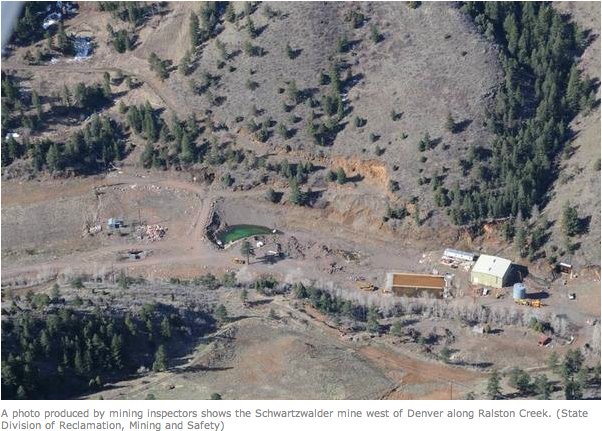
Denver District Judge Robert Hyatt rules in favor of Colorado Mined Land Reclamation Board with regard to the Schwartzwalder Mine

schwartzwalderminedivisionofreclamationminingandsafety.jpg

From The Denver Post:

The decision by Denver District Judge Robert Hyatt cited “an ample evidentiary basis” for the Colorado Mined Land Reclamation Board’s findings…State inspectors several years ago discovered the problem: that uranium in the mine shaft reached up to 1,000 times the state standard, with contaminants rising to the rim of the shaft. It wasn’t until April 2010 that mining regulators ordered Cotter to remove the contamination by draining the mine. On Tuesday, state health officials ordered Cotter to divert creek water away the mine and find the source of the contamination.

More nuclear coverage here and here.