Here’s the link to the board memo page with the agenda.
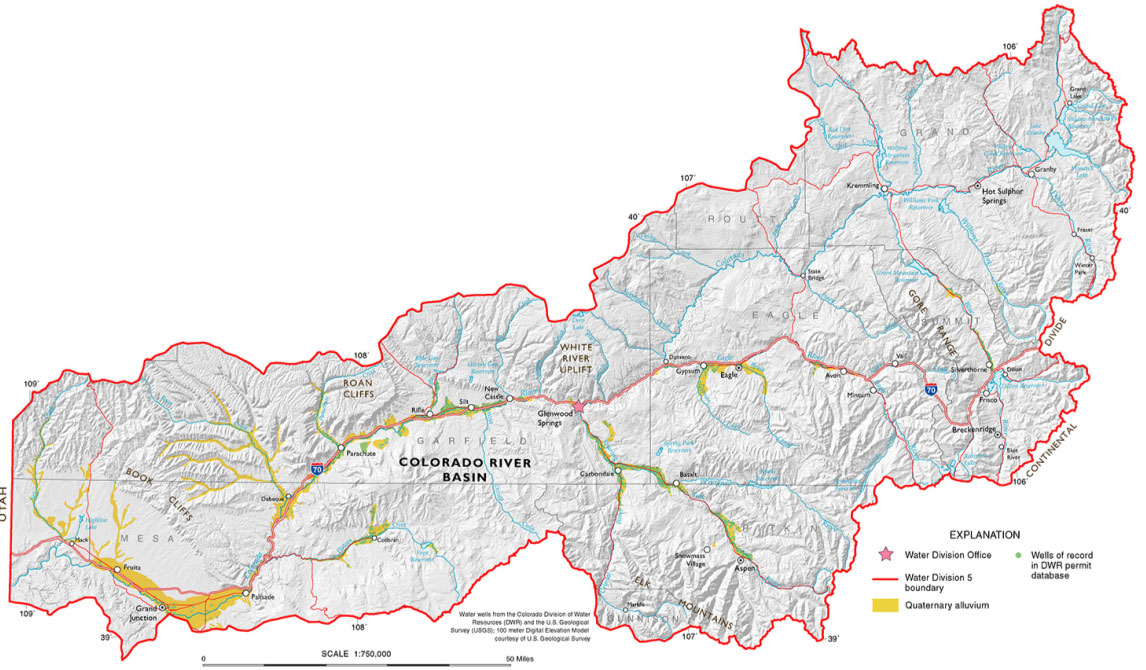
More Colorado River basin coverage here.

Here’s a report from the Lone Tree Voice (Chris Michlewicz). Click through for the photo slidshow. Here’s an excerpt:
The Denver Water project was delayed two days because of the rainy weather Oct. 8, but sunny skies helped more than 50 workers as the concrete pour got underway just north of Eagle Ridge Elementary School. More than 120 cement trucks backed up to the edge of a deep pit that was excavated in advance of the pour. More than 1,400 cubic yards of concrete will be used on the tank, which is being built adjacent to an existing underground tank near Chaparral Road and Sagebrush Trail. Several community meetings were intended to help surrounding residents understand the size and scope of the project, which is scheduled for completion next summer…
“Because of the current limited storage capacity at the site, Denver Water has made it a priority to increase storage in Lone Tree,” an announcement from the water provider says. The concrete foundation, estimated at 280 feet in diameter, required two concrete batch plants to shut down to other customers for the entire day.
More coverage from Bruce Finley writing for The Denver Post. From the article:
It is the first of eight projects in a $120 million rehabilitation of metro-area plumbing.
Denver Water maintains at least 30 of these underground reservoirs, some holding as much as 25 million gallons, with the system storing 350 million gallons overall. The hidden tanks are a crucial part of making sure that clean water comes out when when 1.3 million Denver Water customers turn on their faucets — even if a pipeline ruptures or a water plant has to shut down.
Paying the $120 million for the fixes over the next decade is expected to boost water bills, which already are increasing by about 5.5 percent a year.
Denver Water officials said there is no way around the re-plumbing because inspectors who went inside emptied reservoirs found enough cracks and infiltration to warrant repairs.“It’s a big deal. We have to do it. This is the least intrusive we can get,” said Denver Water’s engineering director Robert Mahoney. “This eliminates the risk of us not getting our water.”
Here’s a slideshow, Journey of water, from Denver Water about their system.
More infrastructure coverage here.
Here’s the release from the University of Colorado at Denver:
The National Science Foundation (NSF) has selected a team of University of Colorado Denver researchers to be part of the new Sustainable Cities – People, Infrastructures and the Energy-Climate-Water Nexus project. Professor Anu Amaswami, PhD., is leading the project, which includes 20 U.S. universities, two national labs and three international partners. The $750,000 grant aims to bring together scientists from all over the world whose work will lead to greater progress and wider exposure for new developments in sustainable cities.
Professor Ramaswami is the director of the Center for Sustainable Infrastructure Systems (CSIS), which will manage the project. CSIS is in the College of Engineering and Applied Sciences and aims to design and analyze sustainable urban infrastructure and integrate new, sustainable technologies with the general public.
The NSF has a new emphasis on science, engineering and education for sustainability. One of its focus areas is to create what the NSF is calling Research Coordination Networks (RCN) that study sustainability. Sustainable Cities – People, Infrastructures and the Energy-Climate-Water Nexus is one of 94 RCNs funded on sustainability. The focus of CU Denver’s RCN is on reducing energy use, carbon emissions and mitigating climate-risks to water supply and public health in cities.
Ramaswami’s co-principal investigators are Larry Baker (University of Minnesota), Larry Bank (City College New York), Marian Chertow (Yale), and Paty Romero-Lankao (National Center for Atmospheric Research). A unique aspect of this RCN is broad-based integration of urban ecology, industrial ecology, atmospheric sciences, infrastructure engineering, architecture, urban planning, behavioral sciences, public affairs and public health toward the goal of sustainable cities. This grant seeks to develop harmonized methods, open datasets and shared curriculum on the topic of sustainable cities across 20 U.S. universities.
The project is scheduled to last four years, starting in January 2012. CU Denver’s CSIS team is fortunate to lead a fantastic group of faculty collaborators from across the U.S. and the world to coordinate work on the over-arching theme of sustainable cities.
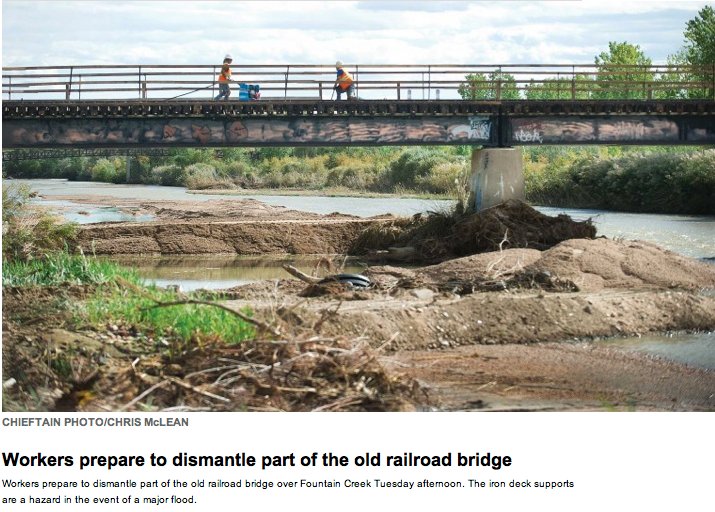
From The Pueblo Chieftain (Chris Woodka):
Edward Kraemer & Sons will perform the work under contract with the Union Pacific Railroad, and completion is expected in a few weeks, said Daryl Wood, stormwater utility supervisor for the city of Pueblo. The bridge is located just upstream of the confluence of Fountain Creek at the Arkansas River. “The lower part of the bridge is the problem,” Wood said.
During a large flood, debris could hang up on the iron deck supports and act as a dam. Water potentially could top the levee system in that area and flood nearby neighborhoods. Last month’s flood, described as a 10-year event, left some tree limbs hung up on the piers of the bridge, but most of the debris passed through and settled somewhere downstream. There were problems with sediment deposits and trees on parts of the pedestrian-bicycle trail along Fountain Creek as well.

Here’s the release from the U.S. Bureau of Reclamation (Steve McCall/Justyn Hock):
Reclamation and their Selenium Management Program partners will host two public forums on selenium in the Gunnison Basin. The forums will be on Monday, October 17 at 6:30 p.m. at the Hotchkiss Memorial Hall located at 175 N. 1st St. in Hotchkiss, Colo. and Thursday, October 20 at 6:30 p.m. at the Montrose Holiday Inn Express located at 1391 South Townsend Ave. in Montrose, Colo.
The goals of the forums are to: 1) discuss with the public and media how selenium affects the water supply and endangered fish in the Gunnison Basin and 2) receive input from the public about plans to reduce selenium in local waterways while protecting existing and future water uses and avoiding potential Endangered Species Act conflicts in the basin.
Selenium is a trace metal found in Mancos Shale, and soils in many parts of the lower Gunnison Basin are naturally high in selenium and salt. When water comes in contact with these soils it can mobilize the selenium, flushing it into our rivers. Selenium concentrations in the lower Gunnison and Colorado Rivers and many of their tributaries currently exceed levels that are deemed safe for sensitive aquatic life, including endangered fish species.
For more information about SMP visit the selenium program website email seleniuminfo@usbr.gov, or call 970-248-0600.
More Reclamation coverage here.

Here’s the release from the United States Geological Service (Joe Ayotte/Katie Lettie):
About 20% of untreated water samples from public, private, and monitoring wells across the nation contain concentrations of at least one trace element, such as arsenic, manganese and uranium, at levels of potential health concern, according to a new study by the U.S. Geological Survey.
“In public wells these contaminants are regulated by the U.S. Environmental Protection Agency, and contaminants are removed from the water before people drink it,” said Joe Ayotte, USGS hydrologist and lead author on the study. “However, trace elements could be present in water from private wells at levels that are considered to pose a risk to human health, because they aren’t subject to regulations. In many cases people might not even know that they have an issue.”Trace elements in groundwater exceed human health benchmarks at a rate that far outpaces most other groundwater contaminants, such as nitrate, pesticides, and volatile organic compounds (VOCs). Most trace elements, including manganese and arsenic, get into the water through the natural process of rock weathering. Radon, derived from naturally occurring uranium in aquifers, also occurs frequently at high levels in groundwater. Human activities like mining, waste disposal, and construction also can contribute to trace elements in groundwater.
Major Findings:
– Arsenic, uranium, and manganese, were the trace elements in groundwater that most frequently exceeded USEPA human-health benchmarks. Arsenic was found above the USEPA human health benchmark in 7% of wells. Uranium was found in 4% above the human health benchmark, and manganese was found in 12%. Long-term exposure to arsenic can lead to several types of cancer, and high levels of uranium can cause kidney disease. In doses similar to some of those found in this study, manganese can adversely affect child intellectual function and, in large doses, acts as a neurotoxin, causing symptoms similar to those experienced by sufferers of Parkinson’s disease. Radon, a product of the decay of natural uranium, also exceeded its proposed EPA maximum contaminant level in 65% of wells tested (300 Picocuries per liter).
Climate and land use are important factors in trace element distribution. Differences in the concentration of trace elements are related to the climatic conditions and land use of the area. Drier areas of the United States saw higher concentrations of trace elements in groundwater than humid regions. Meanwhile, wells in agricultural areas more often contained trace elements than those in urban areas. However, wells in urban areas contained concentrations of trace elements that more often exceeded human health benchmarks.
Basic geology and geochemistry of water samples helps to predict occurrence of trace elements in groundwater. Redox conditions (related to dissolved oxygen) and pH seem to affect which trace elements persist in groundwater. For example, aluminum and manganese occurred more often in samples that were characterized as anoxic and had slightly acidic pH. Anoxic and slightly alkaline samples commonly contained arsenic and molybdenum. Uranium in groundwater occurred over a wide range of pH and redox conditions because of its association with other compounds. Additionally, samples from glacial and non-glacial sand and gravel aquifers consistently had more occurrences of trace elements in groundwater than samples from other aquifers.
The effects of mixtures of trace elements are poorly understood and could cause further health concerns. Further analysis of the data showed that about one-fifth of wells had exceedances of human health benchmarks and that, of those, about 10 percent actually contained two or more trace elements exceeding human health benchmarks. This raises additional concerns because contaminants can act together to be more toxic than each individual contaminant.
These findings are based on over 5,000 samples collected primarily from public and private wells nationwide. This study is part of efforts by the U.S. Geological Survey’s National Water-Quality Assessment Program to monitor the quality of the nation’s groundwater and surface water. Details can be found online.
Human health benchmarks used in this study include U.S. Environmental Protection Agency Maximum Contaminant Levels for regulated contaminants and Health Based Screening Levels (HBSLs) for unregulated contaminants. HBSLs are unenforceable contaminant threshold guidelines developed by the USGS in collaboration with EPA, and the New Jersey Department of Environmental Protection. and Oregon Health Sciences University.
Treated drinking water from public wells is regulated under the Safe Drinking Water Act. Water utilities, however, are not required to treat water for unregulated contaminants. The EPA uses USGS information on the occurrence of unregulated contaminants to identify contaminants that may require drinking-water regulation in the future.
More groundwater coverage here.
From The Aspen Times (Andre Salvail):
The Oct. 5 motion states that Saving Our Streams, a nonprofit group made up of several local landowners that filed its complaint with the court in mid-September, has failed to “allege facts sufficient” to back up its claim.
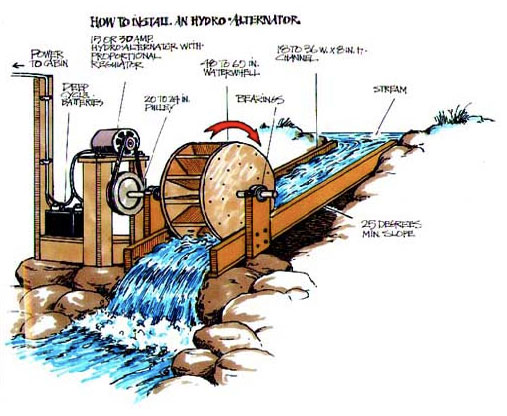
According to the city’s motion, the SOS suit seeks a court judgment that Aspen abandoned one particular component — hydroelectric power production — of the municipal uses that accompany three separate water rights for Castle, Maroon and Midland creeks.
The city’s motion states that the three water rights were granted to various companies in the late 19th century for “municipal customers” and that the city acquired those rights in 1956. Those rights included “hydroelectric generation and domestic purposes” for Castle and Midland creeks, and were confirmed through a court decree in 1949.
The 1949 decree also confirms a water right for a diversion from Maroon Creek “in the amount of 65 cfs [cubic feet per second]” stemming from an appropriation in 1892, according to the motion.
The motion states that the SOS suit “does not identify which plaintiffs own water rights, what water rights they may own or how those water rights are or may be affected with respect to the alleged abandonment of the hydropower component” of the city’s water rights.
Further, “plaintiffs tacitly admit that some of them do not own or control any water rights,” the motion says. “If a plaintiff fails to allege or demonstrate that its rights, status or other legal relations will be affected, the plaintiff has no standing … and a declaratory judgment should not be entered.”
Also, the SOS suit fails to meet the law’s “injury-in-fact requirement” in which the challenged conduct of a defendant causes or threatens to cause injury to the plaintiff’s present or imminent activities.

From the Craig Daily Press (Joe Moylan):
[Jim Pringle, a meteorologist with the National Weather Service in Grand Junction] said back-to-back La Nina patterns are unique and have only occurred on 10 other occasions since 1900. Last year, the country was in a moderate to strong La Nina weather pattern, Pringle said. And 80 percent of the time, the second of consecutive La Nina years usually isn’t as “wet” as the first. “We’re expecting similar storm tracks to last year,” Pringle said. “But, we’re not expecting it to be as severe.”[…]
The NOAA Climate Prediction Center stated in its release that the La Nina pattern is not as strong as it was this time last year. The organization is predicting a weak to moderate winter.

Here’s the link to the registration page. Here’s an excerpt:
Hydraulic Fracturing is a hot topic on the public and water sector’s mind, involving a mix of environmental protection, energy security, and economic development considerations. Many agree natural gas has a bright future as a “bridge” fuel to cleaner, renewable energy. But the “Shale Rush,” prompted by technology breakthroughs in horizontal drilling and hydraulic fracturing over the last decade has raised significant questions about the footprint on the environment, impact to public health, and the roles of various government agencies. Water is a particular concern with potential issues down under, downstream, or downwind. Join the Clean Water America Alliance (CWAA) and American Water Resources Association (AWRA) as they explore the “friction over fracking,” including the growing need for energy security and environmental sustainability to be in balance, rather than in battle, and to keep water in mind through it all. An objective look from different perspectives will be offered to evaluate benefits, risks and opportunity costs, for the water and related sectors.

From the Summit County Citizens Voice (Bob Berwyn):
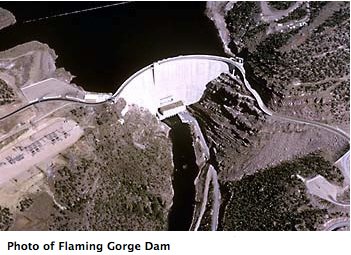
The Regional Watershed Supply Project, first propossed in 2008 by a private water development entity known as Million Conservation Resource Group, would divert water from the Green River via Flaming Gorge Reservoir to the greater Denver area.
Proponent Aaron Million had at first submitted the project for review and approval to the U.S. Army Corps of Engineers, but earlier this year resubmitted it to FERC as a project that would generate hydropower.
The Corps terminated its review in late July. And last week, the FERC said Million must provide more specific information on proposed pump stations for the pipelines, as well as new reservoirs that would also be part of the diversion project. The federal agency also seeks more information on other permits that might be needed as part of the project.
From The Washington Post (Juliet Eilperin) via The Denver Post:
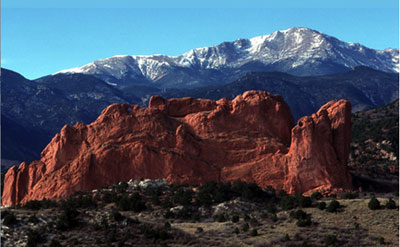
The Land and Water Conservation Fund, which Congress created in 1965, helped pay for this open space [along I-25 near Monument], along with large swaths of land in other areas across the country. But there is a fight looming in Washington as Congress plans to drastically cut the program’s budget, and President Barack Obama, who had accepted cuts in the past, appears ready to oppose them. The White House has warned it will veto the House Interior spending bill, in part because of its cuts to the conservation fund.
Interior Secretary Ken Salazar said in a telephone interview that the bill would bring conservation “as close to zero as it’s been in modern times.” The fund is supposed to receive $900 million each fiscal year out of U.S. offshore oil and gas revenue to pay for federal land acquisitions. But with the exception of fiscal 1998, its funding has consistently fallen well short of that mark. The 2011 operating plan provided $300.5 million, and although Obama asked for $900 million for fiscal 2012, the pending House appropriations bill for Interior allocates just under $95 million…
Roughly half of the Land and Water Conservation Fund’s money goes toward federal land acquisition, while the rest goes to state and local grants that support recreation areas as well as habitat and forest protection. The program is often used to buy isolated parcels of private land within existing parks, refuges and other federal properties, and is combined with matching funds from elsewhere to complete these deals. In part, the program’s obscurity makes it a tempting target for budget cuts. “Nobody’s ever heard of it outside a few dozen people on Capitol Hill,” said Tim Ahern, spokesman for the Trust for Public Land.
Now, the program’s backers are launching a grassroots drive to enlist Republican support for increased funding. Late last month, the Bull Moose Sportsmen’s Alliance posted two billboards aimed at Colorado Republicans: one in Grand Junction praised Rep. Scott Tipton for adding $5 million to the program through a floor amendment, while another in Colorado Springs bashed Rep. Doug Lamborn for trying to zero out the program.
In politically conservative Douglas County, where nearly $2 million from the program helped preserve part of the $105 million worth of land between Denver and Colorado Springs, conservative Republicans have demonstrated a willingness to pay for conservation. County residents paid for $21 million in land preservation through a modest sales tax, while proceeds from a state lottery program and money raised by the Conservation Fund, an environmental group, accounted for the rest of it.
More conservation coverage here.

Mr. Horlacher — who grew up in western Utah and eastern Nevada where the Southern Nevada Water Authority is planning a pipeline to mine the aquifer — is appealing to the other basin states to right the wrong wrought on southern Nevada when the state was only allocated 300,000 acre-feet per year from the Colorado River Compact. Here’s his guest column from The Deseret News. Here’s an excerpt:
How then is it possible that Nevada is allotted only 2 percent of the total Colorado River water? In 1922, the Nevada delegates to the Colorado River Compact negotiations at Bishop’s Lodge, near Santa Fe, demonstrated an amazing lack of vision relating to the development of the sparsely populated southern part of their state. They were reported to be eager to please the California delegation, and they were observed imbibing copious amounts of freely-flowing alcoholic beverages.
So the delegates that drafted the compact were drunk — that explains everything.
More from the article:
What is to be done? Water is a touchy subject in the arid west and always has been. Arizona has never been happy with the Colorado River Compact (even though its tributary rivers to the Colorado were exempted from the contract), and all of the seven states would like very much to have a larger share. But does anyone really doubt that Nevada’s share is absolutely ridiculous?[…]
Here is a modest proposal: In terms of millions of already allotted acre feet of Colorado River water per year, let the fair-minded citizens of the other states of the compact be appealed upon to mercifully redeem Nevada’s folly by simply voting to freely give the following amounts of their allotments to Nevada: Colorado, .10; California, .10; Utah, .05; Arizona, .05; Wyoming, .05. Adding this to Nevada’s present .30 would leave the compact’s seven states with the following allotments: California, 4.30 million acre feet per year; Colorado, 3.78 million acre feet per year; Arizona, 2.75 million acre feet per year; Utah, 1.68 million acre feet per year; Wyoming, 1.00 million acre feet per year; New Mexico, .84 million acre feet per year; Nevada, .65 million acre feet per year.
Gifting these relatively modest amounts of water to Nevada would represent a type of salvation for both southern Nevada and the Great Basin. In times of drought, the amounts would be reduced proportionately. In times of plenty, the amounts would be increased proportionately…
Surely the good people of California, Colorado, Arizona, Utah and Wyoming can be persuaded to make these modest sacrifices in order to resolve this otherwise intractable crisis.
You have the chance to hear a discussion of the Colorado River Compact next Monday in Colorado Springs.
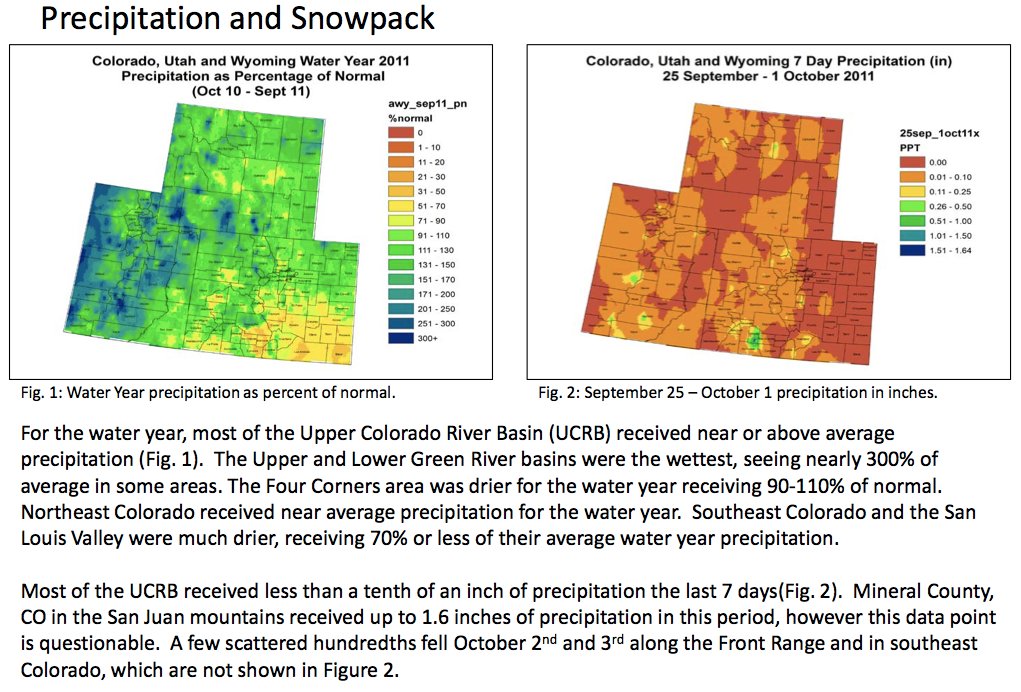
Sorry, last week’s NIDIS update from the Colorado Climate Center got buried in my inbox. Here’s the link to the presentations. Click on the thumbnail graphic to the right for the precipitation summary.
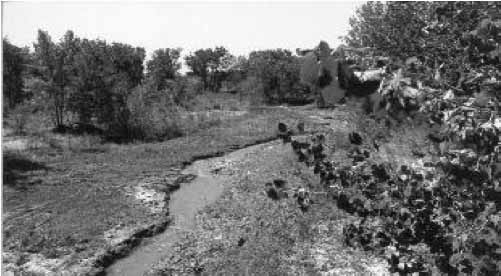
From The Colorado Springs Gazette (John Schroyer):
Colorado Springs would save an estimated $64 million on construction expenses for stormwater retention ponds in the Jimmy Camp Creek watershed, under a new design compiled by the city engineer’s office.
The plan, outlined in a manual that must be approved by City Council by next May, would direct homebuilders to include a series of smaller retention ponds for stormwater runoff as they develop subdivisions, retail parks and the like…
Currently, stormwater runoff is controlled by dozens of much larger ponds, each of which covers about 45 acres. The problem is that with such large bodies of water, it’s hard to prevent large-scale erosion and watershed flooding. With smaller ponds, both of those problems are significantly reduced, said Dan Bare, senior civil engineer for the city.
The ponds — which are basically small dams — trap storm and spring runoff and moderates the flow of the water into local tributaries, such as Fountain Creek, to prevent flooding and erosion as much as possible. The smaller ponds would range from five to 10 acres, and would be much less obtrusive, Bare said during a presentation to city employees on Sept. 15. And because the smaller ponds are easier to maintain, require smaller channels and wouldn’t have to absorb as much runoff all at once as the larger ponds, the city would save millions in capital costs as Colorado Springs grows.
More stormwater coverage here.
Here’s the link to the webpage. From email from the Archive:
Colorado’s Water Heritage Preserved Online
The Colorado State University Water Resources Archive recently completed a year-long project to improve free, online access to materials related to water supply and law in Colorado. Using a $50,000 grant from the Colorado Water Conservation Board (CWCB), the Archive electronically scanned over 30,000 documents and doubled the size of its digital database.
The Water Resources Archive is Colorado’s only repository dedicated specifically to preserving the history of water in the state and the American West. Its online holdings now cover over a century of water history and provide access to the studies, debates, and legislative deals that have made Colorado’s water laws what they are today. Most of the documents in the Archive are unique and unavailable elsewhere. Online access to these materials is intended to aid those who do not have the time or money to travel to Fort Collins to view documents but want to educate themselves about water.
Archival materials documenting groundwater issues and interstate river compacts were the focus of the digitization project. Online patrons can now examine data sheets, reports, letters, and drafts of laws focused on but not limited to the Arkansas, Rio Grande, and South Platte river basins. There are also speeches, meeting minutes, newsletters, and maps. Additionally, several thousand images of dams and waterways in the western United States and around the world are now online. Digitized items can be found by visiting the Water Resources Archive website at http://lib.colostate.edu/archives/water/.
More education coverage here.
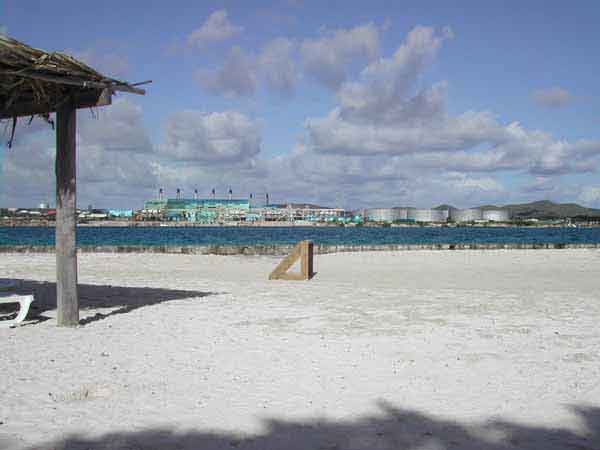
From RenewableEnergyWorld.com (Jerome Muys/Van Hilderbrand):
One approach to reducing greenhouse gases has been more reliance on renewable energy. But energy projects, both conventional and renewable, typically require large amounts of water. That means the long-term physical and legal availability of water resources will play an important role in the siting of renewable energy facilities.
In the U.S., federal programs such as the Endangered Species Act and the push to reserve water rights for parks, wilderness areas and tribal lands are further limiting water availability for development.
To remedy this, two trends are emerging. First is an effort to co-locate renewable energy projects with water reuse, reclamation and desalinisation facilities. Second is a growing interest in new water conservation technologies being developed in Israel and other countries which have a long experience of dealing with water shortages.
More infrastructure coverage here.
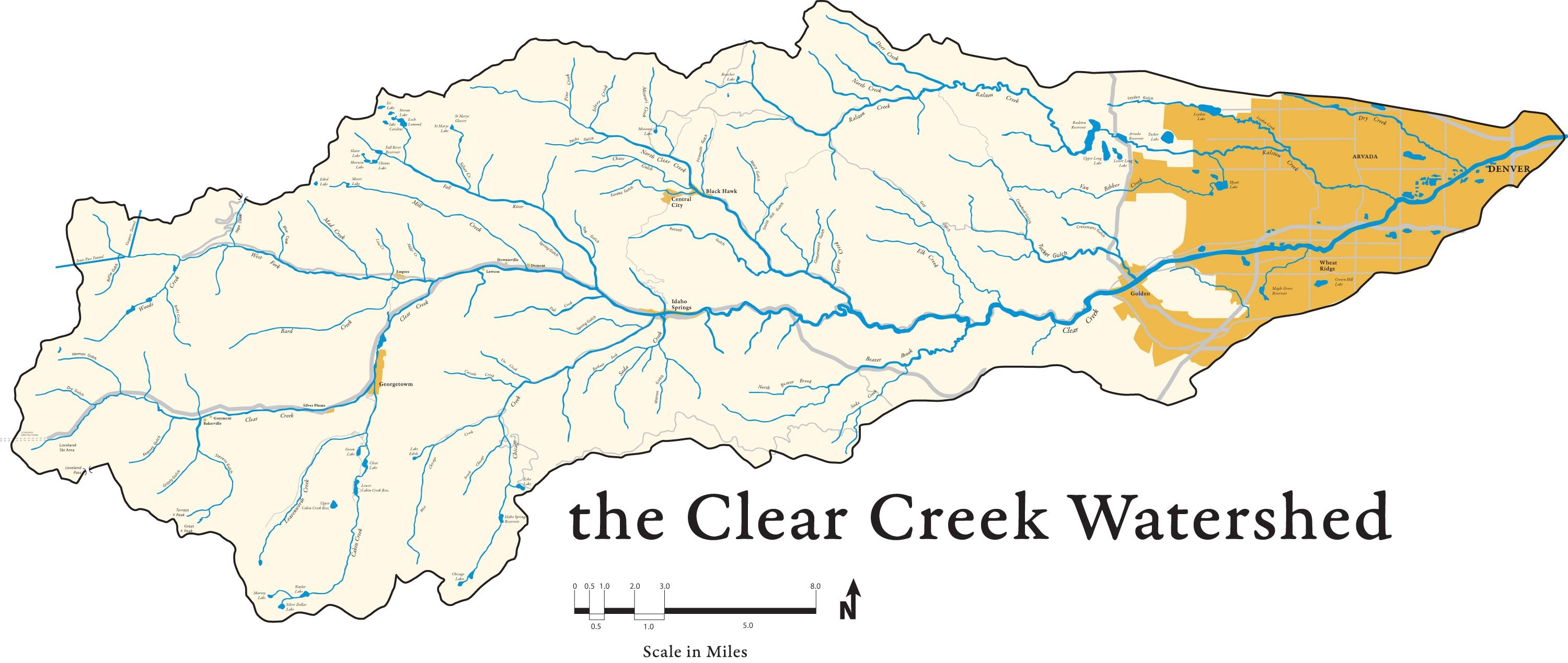
Dr. Ellen Wohl’s book Virtual Rivers: Lessons from the Mountain Rivers of the Colorado Front Range looks at Front Range Creeks currently and tries to reconstruct the past, before the influences of humankind, primarily logging, mining and water diversions. At the recent Clear Creek Watershed Festival history was front and center as well. Here’s a report from Ian Neligh writing for the Clear Creek Courant. From the article:
The festival was hosted by the Clear Creek Watershed Foundation, which dedicates itself to improving the ecological, recreational and economic conditions in the Clear Creek Watershed. The festival educates by offering fun activities as educators look at pieces of the watershed, thereby teaching visitors about the watershed in its entirety…
“This is part of Colorado’s tradition. This is part of our culture. Colorado would not be Colorado, Idaho Springs would not be here, Denver would not be there (if gold hadn’t been found),” Long said.
Down several educational booths, Deb Zack with the Department of Natural Resources Division of Reclamation, Mining and Safety talked with people about the side effects of mining. “We’re here to support the local efforts to educate the public about the hazards of abandoned mines and trying to get the word out about what we do,” Zack said. She and others in her department look for grant money to mitigate abandoned mines on people’s property and to close them off as a free service. “Honestly I work in this area, reclaiming abandoned mines, so I’m interested in meeting a lot of the people who are my neighbors — and people out here know their land better than I ever could,” Zack said.
More Clear Creek watershed coverage here.
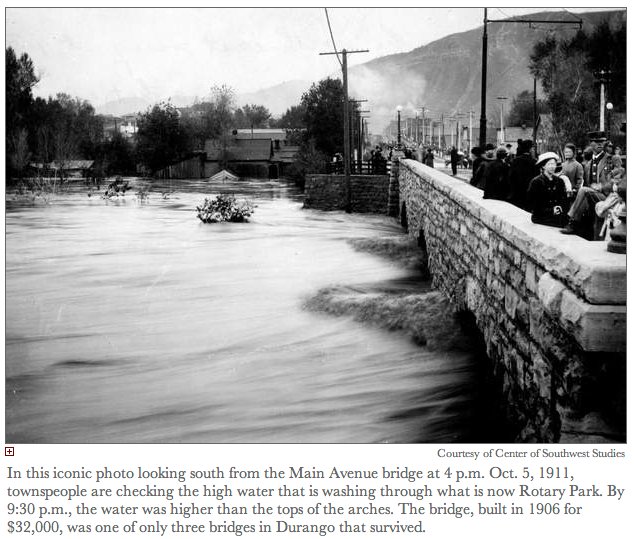
Here’s a look back at the October 5, 1911 flood, Durango’s worst flood in history, from Ann Butler writing for The Durango Herald. Click through to read the whole article and take in the cool photo slideshow. Here’s an excerpt:
Rainfall in semi-arid Southwest Colorado is usually a blessing, but in 1911, it was another story after 36 hours of rain dropped 3.42 inches of rain in Durango and 4 inches in Silverton. The storm centered on Gladstone, north of Silverton, which received a Western Slope record, a jaw-dropping 8 inches, a record that still stands today. The deluge that resulted on Oct. 5 that year was described as the “worst flooding in history of southwestern Colorado,” in the Silverton Standard & Caboose of Oct. 13, 1911. That’s still true today, 100 years later. The Animas River was running at 25,000 cubic feet per second in Durango. The average for that gauge on Oct. 5 is 441 cfs. The “remnant of a tropical storm in the Pacific,” as the state climate office described it, the precipitation was heavy throughout the region, resulting in flooding in every drainage system…
If there was a hero after the flood, it was Otto Mears, nicknamed “The Pathfinder” because he built several toll roads and railroads in some of the most difficult terrain in the San Juan Mountains. The estimated damage to his infrastructure alone was $25,000, about $568,000 in 2011 dollars. “Mr. Otto Mears is entitled to the thanks of the community for his promptness in repairing the damage to his lines,” the Standard said. “It is characteristic of the man, and these lines will add much to the convenience of Silverton and the entire San Juan for a long time before we have any other transportation.”[…]
In 1911, after all the damage reports were in, a writer for the Mancos Times-Tribune took a philosophical approach to the devastating event. “Taken all in all,” he wrote, “the rains this season have inflicted great damage to the farmers and done a great deal of good. We still have enough for all of us to live on, so what’s the use to complain. Most of us can’t stand prosperity, and we will be better people by reason of our having less to squander and spend foolishly. Adversity makes men, but prosperity makes monsters.”
More Animas River coverage here.
From email from the Colorado Water Conservation Board (Ben Wade):
The public comment period will end at 5:00pm on October 29, 2011. We encourage you to review the Guidelines and documents and provide the CWCB with comments. Please direct any questions or comments to Veva Deheza, Section Chief, Office of Water Conservation & Drought Planning, at 303-866-3441 ext. 3226.
House Bill 10-1051, an Act Concerning Additional Information Regarding Covered Entities’ Water Efficiency Plans requires covered entities to annually report water use and water conservation data to the CWCB to be used for statewide water supply planning. The Bill also directs the CWCB to adopt guidelines regarding the reporting of water use and water conservation by covered entities, and to report to the Legislature regarding the Guidelines.
The Draft Guidelines Regarding the Reporting of Water Use and Conservation Data by Covered Entities and Appendices are posted on the CWCB website.
More coverage from Chris Woodka writing for The Pueblo Chieftain. From the article:
There are about 100 entities covered by the 2010 HB1051, which seeks better data reporting on conservation to meet state goals. About 55 of those already have a plan on file, including the state’s largest water utilities, Denver, Colorado Springs and Aurora.
“Right now, conservation plans are usually updated every seven years, but there can be a lot of changes in that time,” said Kevin Reidy, CWCB conservation technical specialist. “More frequent collection of data will provide more accurate information, and it plays into the larger Statewide Water Supply Initiative.”
The CWCB last year discussed how to measure water savings as a part of meeting the municipal water gap identified in SWSI. While the larger utilities have tracked how much water is used more closely since 2002, there is no standardized reporting method. The draft guidelines do not require a particular format for reporting water use, but list required categories as identified in the legislation. For instance, the guidelines look at the water use per household, lawn irrigation practices and precipitation within a service area. Metering and water rate structures are looked at, while system losses and leakage also are taken into consideration.
“It’s important to know where conservation measures are being taken and what kind of conservation is effective,” Reidy said.
More conservation coverage here.

Colorado Supreme Court Justice Gregory Hobbs and Colorado River legal scholar Larry MacDonnell will discuss the Colorado River Compact on October 17. The presentation is the next for the State of the Rockies Project speakers series.
Since it’s been a while since I published one of Justice Hobbs’ poems I thought this would be a good occasion. Here you go:
Stegner
On wheels born Western man
he warned of that mobility
from which he sparng
unbridled optimism and the roarOf the Reclamation Bureau he swore
as a blooming desert Mormon might
swear to God of locusts,
cranky cast iron stove he smoked
more we stoked his heatMatter of lenses, I think,
his were not fit for preaching–
more for teaching in
a living roomThemes that marked him most
One-armed Major’s headlong
river plunge, careless harvest
of the wilderness, natural law
of limits, the good of settling inDied in Santa Fe
not by hanging rope or pistol shot–
myths he fought cantankerous about–
but by Ford or GM truck
like many a Western man struck downHe in the line of duty,
a peace officer,
posting speed control signs
on the borders of our frontier minds:Wanted
A True Civilization
Not A Ruthless Occupation
Disguised As Romantic Myth
Reprinted, with permission, from Colorado Mother of Rivers: Water Poems by Justice Greg Hobbs. Click here to order the book from the Colorado Foundation for Water Education.
A little of Wallace Stegner’s unbridled western optimism has rubbed off on two Colorado College grads, Will Stauffer-Norris and Zak Podmore, who will be traversing the length of the Green and Colorado rivers, Source to Sea down the Colorado River, starting this week. As soon as they hit Green River, Wyoming, they’ll be seeing a lot of the same stuff that John Wesley Powell did on his first trip down the river.
More Colorado River basin coverage here.

From The Durango Herald (Dale Rodebaugh):
Colorado has nutrient standards for only a few problem bodies of water – among them Cherry Creek Reservoir in the Denver area and Fruit Growers Reservoir near Grand Junction – but no statewide standards. Only 17 states do, but none with standards that apply to all streams and lakes as Colorado is proposing.
The [Colorado Nutrient Coalition] is about 40 entities – stormwater dischargers, water-conservation districts, homebuilders and wastewater dischargers – that would fall under nutrient guidelines.
Kane’s briefing was in anticipation of the Oct. 17 release of requirements for water-treatment plant upgrades and nitrogen and phosphorus levels by the Colorado Department of Public Health and Environment’s Division of Water Quality Control. The state Water Quality Control Commission has scheduled a hearing on the issues in March.
Steve Gunderson, director of the Water Quality Control Division, said Friday that the nutrients issue has been his biggest challenge. “I’ve been at this for 10 years,” Gunderson said. “Nutrients is a challenge that hasn’t been dealt with, so we’re trying to figure a way to make progress in the next 10 to 20 years.”
Critics who say the regulations are too stringent abound, Gunderson said. But there are those who like them and environmentalists who say they’re not tough enough.
“You can quibble over science,” Gunderson said. “Our challenge is to find consensus among widely divergent opinions.”[…]
The initial cost of upgrading wastewater treatment plants would cost $3 billion statewide, $74 million in Southwest Colorado. Future upgrades to meet phased-in standards could cost from $5.8 billion to $23.2 billion. Even with upgrades, some plants could fall short…
Nancy Keller, a regulatory compliance officer in the city of Pueblo Wastewater Department, said science supporting the proposed criteria has not undergone peer review. She coordinates the coalition’s work. “Nutrients are very complex, and wastewater plants aren’t their only source,” Keller said. “Temperature, canopy cover, the amount of dissolved oxygen, the pH and sediment can affect algae growth in addition to nutrient levels.”
More wastewater coverage here.
Update (October 10, 5:20 a.m.): The Salt Lake Tribune deep link doesn’t work any longer. You can click here for my screen shot of the photo.
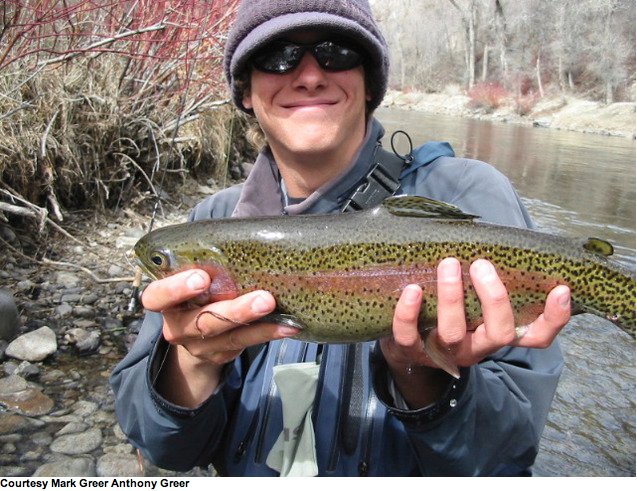
Click on the thumbnail graphic to the right to go to this column by Tom Wharton running in The Salt Lake Tribune. The photo is of a proud fisherman and his recent catch. Mr. Wharton also jabs the Flaming Gorge Pipeline:
…there was the news that the Colorado Water Conservation Board will spend $72,000 to fund an exploratory study to look at the feasibility of taking 81 billion gallons of water from Flaming Gorge Reservoir 560 miles in a pipeline to Colorado’s Front Range. The cost of such a project, opposed by 87 percent of Wyoming voters according to a recent Trout Unlimited poll, would be $7 to $9 billion.
If you fish on the Green River, boat and fish on Flaming Gorge or, for that matter, want to use water from Lake Powell for southwestern Utah via another pipeline, this pipeline should be frightening.

Here’s an in-depth report about the current state of oil and gas exploration and production in Larimer and Weld counties, from Bobby Magill writing for the Fort Collins Coloradoan. Click through and read the whole thing. Here’s an excerpt:
“One thing that’s really concerning me and a lot of people, there are so many pending (oil and gas drilling) permits and approved permits in Weld County and Larimer County, are they reserving future water for fracking purposes, and where are the sources coming from?” said Shane Davis, chairman of the Poudre Canyon chapter of the Sierra Club, which held a public forum on the issue in September. “It’s a very serious question that needs to be addressed.”[…]
“In terms of how it affects the state’s water planning, it still is fairly unclear,” said Eric Hecox, section chief of the Water Supply Planning Section of the Colorado Water Conservation Board. “Although we have a good handle on how much water it takes per well to frack the wells, we have very little information ultimately on how many wells there will be. Making quantitative projections on how much water will be needed is difficult at this time.”[…]
There is great national and international interest in the Niobrara in Colorado, [Tisha Shuler, CEO of the Colorado Oil and Gas Association] said, but the wells that have been drilled so far have produced mixed results partly because of the Niobrara’s complicated geology…
Most of the wells in Weld County are conventional oil wells, which are drilled vertically and require between 250,000 and 1 million gallons of water each per frack job, Shuler said…
Wells tapping the Niobrara shale are horizontal wells. The well bore is drilled vertically thousands of feet beneath the ground until it hits the Niobrara shale, then it angles horizontally into the shale, parallel with the ground. For decades, tapping the Niobrara oil deposit was difficult for drillers to reach because technology that hadn’t advanced enough to make it economically feasible…
Each of those horizontal wells requires somewhere between 1 million and 5 million gallons of water to bore into the Niobrara, according to Colorado Oil and Gas Conservation Commission data…
Shuler cautioned, however, that the oil industry’s water consumption figures sound staggering, but other water consumption by agriculture and cities is much greater. Less than 1 percent of the state’s available water is consumed by the energy industry each year, she said…
The city of Greeley sells about 250 million gallons of water to the oil and gas industry each year, earning the city $1 million in sales to the industry so far this year, said Greeley Water and Sewer Director Jon Monson…
Water regulators in Colorado say the overall impact of the oil and gas industry on the state’s water supply is negligible and shouldn’t have any significant impact on water availability in the future. “In the overall scheme of things, from the water standpoint, it’s a very small fraction,” Hecox said of the industry’s water consumption.
Meanwhile, here’s a blog post from Amy Mall running on the Natural Resources Defense Council’s Switchboard weblog. She has a list of health experts that are warning about the potential health hazards for those living near natural gas production facilities.
Bump and update:
More coverage from Chris Woodka writing for The Pueblo Chieftain. From the article:
The Federal Energy Regulatory Commission issued the notice this week on Aaron Million’s preliminary permit application for hydroelectric power along a proposed 500-mile pipeline from the Green River and Flaming Gorge Reservoir in Wyoming to Colorado’s Front Range.
Western Resource Advocates seized upon the notice as an indication of reluctancy of federal agencies to take on a “hot potato” of a water project, saying the Bureau of Land Management or Bureau of Reclamation should be the lead agency in evaluating the proposal.
“This is yet another indication that the Flaming Gorge Pipeline is nothing more than an empty promise,” said Stacy Tellinghuisen, senior policy analyst for Western Resource Advocates. “We are over two years into the process of evaluating the project, yet fundamental questions are still unanswered.”[…]
“The notice has no impact, actually,” Million said. He characterized the notice as a standard request for more information about the project, a standard procedure in any federal process.
The notice cites two deficiencies in Million’s application:
Identifying owners of the reservoirs to be used in the project, which are the Bureau of Reclamation for Flaming Gorge and Lake Hattie in Wyoming.
Identifying the location of certain features of the project, including the Wild Horse Canyon pumped storage project, nine natural-gas powered pump stations, and four reservoirs that would be built as part of the project.
The notice also states Million would need additional permits from other federal agencies since FERC has jurisdiction over hydroelectric power generation only. FERC also asked for mapping details of elevation changes.
FERC also pointed out it could take up to five years to complete the process. Million was not fazed by any of the requests in the FERC notice, and said he thinks the Flaming Gorge pipeline will progress more quickly as an energy project. “FERC is the only federal agency with a maximum timeline,” Million said. “They get the information and then you move on.”
From the Associated Press (Catharine Tsai) via Forbes:
The Federal Energy Regulatory Commission requested more details Wednesday from a Colorado businessman on his permit application to build a 501-mile pipeline to divert water from Wyoming’s Flaming Gorge Reservoir to southeast Wyoming and Colorado.
The commission also told Aaron Million he may need permits from other agencies for his proposal, which involves hydropower and new reservoirs, because FERC has jurisdiction over only the hydroelectric component.
More coverage from the Colorado Independent (David O. Williams):
The Federal Regulatory Energy Commission (FERC) sent a letter to Fort Collins businessman Aaron Million requesting more information within a month, but FERC officials also appeared to have serious jurisdictional questions.
“Because the Commission would only have jurisdiction with regard to the proposed hydroelectric development, which is only one component of the proposed 501-mile-long water supply pipeline project, construction of substantial parts of the overall project may require permits from other federal agencies,” FERC officials wrote.
Million is on his second federal agency after having pulled his initial application to the U.S. Army Corps of Engineers and resubmitted to FERC after adding the hydroelectric component.

Castle Rock is on the hunt for a renewable supply and the South Metro Water Supply Authority wants to be the provider. Here’s a report from Rhonda Moore writing for the Castle Rock News Press. From the article:
Years after launching plans to invest in the South Metro Water Supply Authority, Denver and Aurora Water Infrastructure and Supply Efficiency project to meet its long-term water needs, the town opened the door for bids from providers vying for a chance at a piece of a pie valued at hundreds of millions of dollars.
The project will be the first investment to get Castle Rock to its goal of weaning itself from underground water and finding a source of long-term, renewable water. Town leaders aim to transform Castle Rock’s water consumption from 100 percent non-renewable, underground wells to getting 75 percent of its water from renewable sources, said Ron Redd, Castle Rock utilities director…
Castle Rock opened the process up for bids after hearing from other water providers interested in a chance to come before town council with a proposal. That process resulted in three bids presented Sept. 14 in a joint meeting with town council and the utilities commission. Each presenter was given 30 minutes at the podium as councilmembers heard from Renew Strategies, owned by a partnership that includes former Gov. Bill Owens, Stillwater Resources, which acts as a broker to match providers with municipalities like Castle Rock and United Water, which serves public water districts such as the East Cherry Creek Valley Water and Sanitation District and the South Adams County Water District.
The Denver, Aurora and South Metro Water Supply Authority WISE project could not meet the mid-September deadline because the draft proposal had yet to gain approval from city councils at Denver and Aurora. WISE will get its 30 minutes at another joint meeting between Castle Rock Town Council and the utility commission. The meeting is open to the public and will be at 6 p.m., Oct. 11, in council chambers at Town Hall, 100 N. Wilcox St.
Here’s a list of the Castle Rock’s potential suppliers from OurColoradoNews.com:
Providers who submitted bids include:
Renew Strategies, owned by a partnership that includes former Gov. Bill Owens.
Stillwater Resources, which acts as a broker to match providers with municipalities like Castle Rock.
United Water, which serves public water districts such as the East Cherry Creek Valley Water and Sanitation District and the South Adams County Water District.
The South Metro Water Supply Authority, a co-op of 15 south metro municipalities and metropolitan districts that includes the town of Castle Rock, Parker Water and Sanitation District, Castle Pines Metropolitan District, Castle Pines North Metropolitan District, Pinery Water and Wastewater District, Roxborough Water and Sanitation District and Stonegate Village Metropolitan District. The authority partnered with the Denver and Aurora water departments to draft the Water Infrastructure Supply Efficiency agreement.
More South Platte River basin coverage here.

From The Fort Morgan Times (Jenni Grubbs):
The new filter media and under-drain system at the water plant was the most expensive of the council’s votes, which allowed expenditures of up to $685,000 for material and installation. “It needed to be done,” Mayor Terry McAlister told the Times of the filter media system upgrade after the meeting.
The council members decided to go with plant Superintendent John Turner’s recommendation of upgrading the filter media system, rather than only fixing the old system repeatedly, which still would have cost several hundred thousand dollars over a number of years. The new system the council voted to get is one that has been proven to be “the gold standard” in such equipment and is used at water treatment plants around the state.

From The Yuma Pioneer (Tony Rayl):
It will be held Thursday, October 13, at the Wray Ambulance Facility, 304 W. Third St., beginning at 10 a.m. Public comment is scheduled for 1 p.m.
New terms will be appointed for the seats belonging to Kit Carson and Phillips counties, as well as the Marks Butte and Arikaree ground water management districts, followed by an election of officers and a review of committee assignments. The district’s Water Activity Enterprise budget for 2012 will be up for consideration and approval at the meeting…
For more information regarding the meeting, please contact RRWCD General Manager Deb Daniel at 332-3552, or email her at rrwcd@centurytel.net.

From the Grand Junction Free Press (Tracy Dvorak):
“Water Law in a Nutshell,” an eight-hour seminar, will be offered Friday, Oct. 14, at Colorado Mesa University’s University Center.
If the course sounds kind of dry (no pun intended), it’s not. See if this list doesn’t beguile you:
• Did you know that priority of water rights is decided partly by who got to the courthouse first?
• Did you know that water rights can be lost if they are not used for a 10-year period?
• Did you know that every ditch, pipeline, and reservoir has an easement over the underlying ground?
• Did you know that a property owner cannot move a ditch without the permission of the ditch owner or a court?
• Did you know that there may not be a right to float a raft across private property?
[Speaker, Delta attorney Aaron Clay], a CU Boulder law grad, has practiced law since 1980. He was the Water Referee for Colorado Water Court, Division 4 (Gunnison, Uncompahgre, and San Miguel River Basins) from 1982 to 2008…
Register by emailing Hannah Holm at hholm@coloradomesa.edu or calling 970-683-1133.
More water law coverage here.
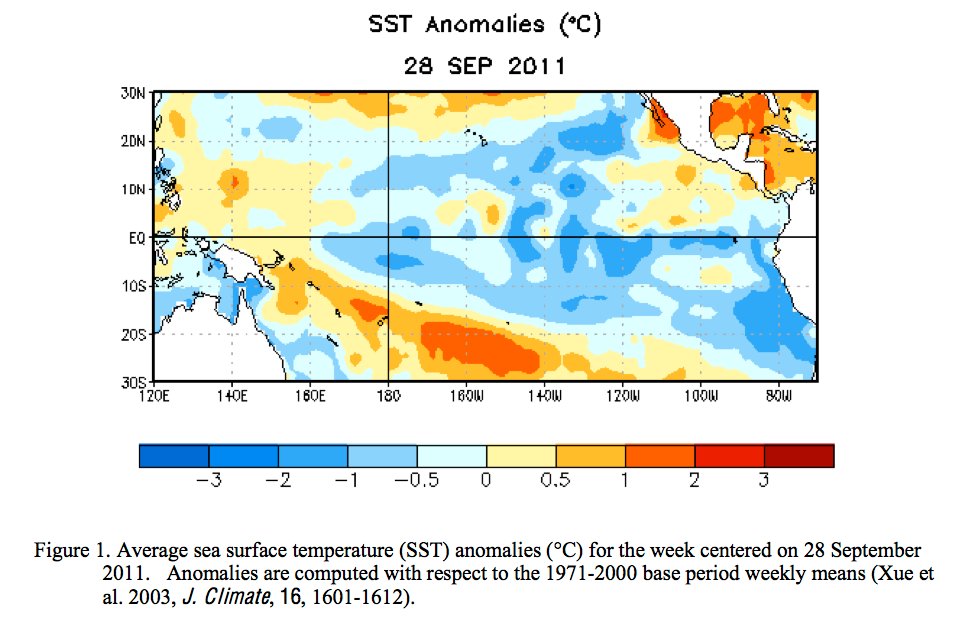
Here’s the current report from NOAA’s Climate Prediction Center. From the report:
La Niña conditions are expected to gradually strengthen and continue through the Northern Hemisphere winter 2011-12.
During September 2011, La Niña conditions strengthened as indicated by increasingly negative sea surface temperature (SST) anomalies across the eastern half of the equatorial Pacific Ocean. The weekly Nino indices continued their cooling trend and all are currently at or below –0.5°C. Consistent with this cooling, oceanic heat content (average temperature anomalies in the upper 300m of the ocean) remained below-average in response to a shallower thermocline across the eastern Pacific Ocean. Also, convection continued to be suppressed near the Date Line, and became more enhanced near Papua New Guinea. In addition, anomalous low-level easterly and upper-level westerly winds persisted over the central tropical Pacific. Collectively, these oceanic and atmospheric patterns reflect the continuation of La Niña conditions.
Currently, La Niña is not as strong as it was in September 2010…
Across the contiguous United States, temperature and precipitation impacts associated with La Niña are expected to remain relatively weak during the remainder of the Northern Hemisphere early fall, and to strengthen during the late fall and winter. It is important to note that the strength of U.S. impacts is not necessarily related to the strength of La Niña across the equatorial Pacific. During October-December 2011, there is an increased chance of above-average temperatures across the mid-section of the country. Also, above-average precipitation is favored across the Pacific Northwest, along with a higher probability for drier-than-average conditions across much of the southern tier of the country (see 3-month seasonal outlook released on 15 September 2011).
Bob Berwyn (Summit County Citizen’s Voice) takes a look at the availability of forecasting tools. From the article:
While last winter’s snowfall broke records in some mountain areas, parts of Colorado where also very dry, notably the southeastern corner of the state, which was under the influence of the same pattern that brought devastating drought conditions to Texas and parts of Oklahoma. The sheer variety of satellite images, radar screens and other online, high-tech forecasting tools is quite astounding.

Wow, everyone who is a fan of Steve Jobs and Apple gear knew the day was coming. Of course it’s still sad and a shock that Steve Jobs has passed.
Few people ever have the chance to reshape their world the way Mr. Jobs did. As a technophile I will miss his innate sense for shepherding innovative and intuitive software and hardware.
I’m writing this using an iMac. In a while I’ll load the Macbook Air up on the bicycle, plug in my iPhone ear buds and head off to work.

From the Associated Press via 9News.com:
Inspectors at Ruedi Reservoir say thousands of inspections have turned up no signs of mussels that have infested other Colorado reservoirs. The Ruedi Power and Water Authority inspectors near Basalt were looking for zebra and quagga mussels.
More invasive species coverage here.

Here’s a release from YSI about efforts to monitor water quality in Grand County:
“Good water quality benefits everyone,” says Jane Tollett, Director of Grand County Water Information Network (GCWIN).
Assessing the health of the Colorado and Fraser Rivers is a tall order for Tollett. There is a limited amount of water, with the Upper Colorado Watershed supplying water to meet both the local needs of residents, ranchers, cold-water fisheries and recreation, along with eastern slope agriculture and the increasing populations along the front range from Denver to Fort Collins.
More Colorado River basin coverage here.

From the National Journal (Coral Davenport):
The 10 Western states that depend on the Colorado River and Rio Grande basins will see acute water shortages in the coming years due to the combination of reduced precipitation as a result of climate change and increased demand, Salazar said, speaking to reporters at a breakfast held by the Christian Science Monitor…
“Climate change doesn’t seem to get any traction in Washington. But if you talk to water managers on the Colorado River, many are Republican, many are Democrat, and they know what they will have to do,” Salazar said. “We should be concerned about water shortages. The answer to the water shortages is how we manage a finite water supply.”
More Colorado River basin coverage here.

From The Pueblo Chieftain (Chris Woodka):
The Water Infrastructure and Supply Efficiency partnership between Denver, Aurora and the South Metro Water Supply Authority was announced Tuesday. The partnership could reduce pressure on agriculture in the South Platte and Arkansas river basins and the need for diversions from the Colorado River.
“I think it’s a step in the right direction,” [John Stulp, water adviser to Gov. John Hickenlooper and chair of the Interbasin Compact Committee] said. “I think it’s a unique way to share water and infrastructure. From what I understand, there is built-in drought protection. There are efficiencies and redundancies that can take pressure off ag communities.”[…]
The WISE partnership will improve South Metro water supplies while maximizing the water resources and infrastructure of Denver and Aurora. The agreement is in a 60-day review period and must be approved by all of the parties. South Metro represents 15 municipal water suppliers in Douglas and Arapahoe counties…
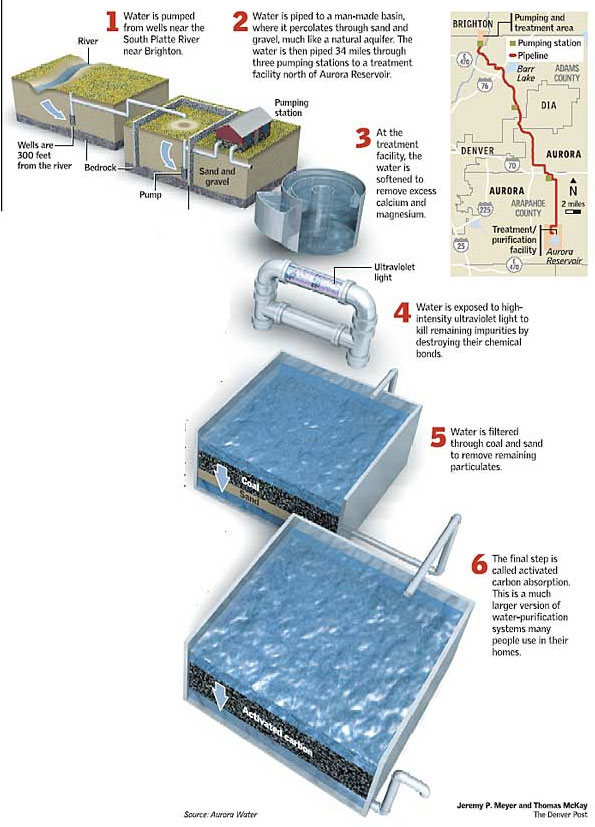
The backbone of the partnership is Aurora’s $659 million Prairie Waters project that allows return flows from treated wastewater in the South Platte River to be recaptured and treated. In Colorado, water from transbasin diversions and some water obtain through water rights transfers can be used to extinction. Aurora has built the first phase of Prairie Waters to treat up to 10,000 acre-feet of water per year, but it can expand to 50,000 acre-feet per year…
There would, however, always be seasonal capacity in the Prairie Waters project to provide additional water for users in the metro area, because the project is scaled to meet peak demands, [Mark Pifher, director of Aurora Water] said. The proposed agreement will sell treated water to South Metro for $5.38 per 1,000 gallons, with minimum guaranteed deliveries of 5,000 acre-feet per year beginning in June 2013. That works out to about $8.76 million annually. After 2020, the amount would increase to 10,000 acre-feet per year. Eventually, systemwide improvements could provide as much as 60,000 acre-feet to South Metro, Pifher said. Denver also would gain a new water supply through recycling its flows through Prairie Waters. In addition, South Metro water users would agree to fund improvements to Denver Water and Aurora infrastructure with $15.4 million over eight years, which is the equivalent to a tap fee. The money would go for interconnections between the Denver, Aurora and other systems. The agreement also includes a $412,000 connection between East Cherry Creek Village and Aurora.
More coverage from Bruce Finley writing for The Denver Post. From the article:
The deal, which would pay Denver and Aurora water utilities $17.4 million a year, is one of the first of its kind in the nation. It lets water agencies that often compete for resources share without merging, and sustain more people without diverting more water from over-subscribed Western Slope rivers. Environmentalists and state leaders swiftly praised the emerging arrangement.
“This type of water-sharing agreement is a critical step toward bolstering water supplies in the southern metro area while better utilizing water resources in Aurora and Denver,” Gov. John Hickenlooper said…
Denver and Aurora would funnel as much as 1.6 billion gallons of purified water a year to suburbs by 2013, increasing to as much as 3.2 billion gallons by 2020. Engineers say necessary new pipelines and hook-ups eventually could send as much as much as 19.5 billion gallons — 60,000 acre-feet a year — to the suburbs. Denver Water, Aurora Water and 13 participating suburbs would have to replumb before the first water could be delivered — which could bloat water bills for residents of Castle Rock, Parker and other communities. Those communities already need more than the maximum amount of water deliverable under the current 22-page contract, said Charles Krogh, past president of the South Metro Water Supply Authority, who represented suburbs through lengthy negotiations. “Our demands now are about 70,000 acre-feet annually,” Krogh said. “This proposal allows us to get in the game for renewable water supplies.”[…]
The replumbing would include a $412,000 hookup between Aurora pipes and an East Cherry Creek Valley pipeline and storage of water in Parker’s new Rueter-Hess Reservoir. To receive water, south metro suburbs would have to install additional pipelines “to connect ourselves all up,” at an estimated cost of $80 million, Krogh said…
South suburbs, if they approve the contract, would be obligated not to divert water from Colorado’s Western Slope.
More coverage from Sara Castellanos writing for The Aurora Sentinel. From the article:
Aurora Water, Denver Water and the South Metro Water Supply Authority have developed a water delivery agreement that, if approved, would provide SMWSA with up to 5,000 acre-feet of water per year by June 2013, increasing to 10,000 acre-feet per year by 2020 as additional pipeline and other infrastructure are built. SMWSA represents 15 water providers in Douglas and Arapahoe counties. The amount of water delivered annually could eventually expand to up to 60,000 acre-feet per year…
The new supply of fully treated water from Aurora’s state-of-the-art Binney Water Purification Facility will provide much welcomed relief to SMWSA and its members, who have been looking for ways to reduce their reliance on non-renewable underground aquifers, Baker said in a release. It also will reduce the need for the SMWSA members to pursue agricultural water rights in the South Platte River basin in the near term.
More WISE coverage here.

From The Pueblo Chieftain (Chris Woodka):
[The]…major water strategies for meeting a looming gap in state water supply [are]: identified projects, urban water conservation, new projects to increase supply and alternatives to drying up agriculture…
The nine basin roundtables, which feed into the IBCC under a 2005 state law that created both, are just beginning to use the portfolio tool developed for the IBCC in 2010. In one case, the North Platte Basin Roundtable wanted to look at what would happen if no more agricultural land were taken out of production. “The results were that it took a very high level of conservation and a new supply to make up the difference,” [water adviser for Gov. John Hickenlooper. Stulp also chairs the IBCC] said. “Obviously, there is no one silver bullet for a state water solution.”[…]
Stulp believes that as more people become familiar with the tool, they will begin to broaden their viewpoint about water development…
The portfolio tool focuses on the urban water gap identified in the CWCB’s Statewide Water Supply Initiative. It takes into account ongoing passive conservation and the potential water needs for energy development. The portfolio tool makes it possible to look at trade-offs including decreases in irrigated acres, depletions to the Colorado River, the size of alternative agricultural transfers, nonconsumptive water availability and the costs of alternatives compared to the status quo…
The Arkansas Basin Roundtable wants to add agricultural water needs [to the planning tool], or perhaps give it its own seat. A committee led by Beulah rancher Reeves Brown met last week to begin planning a study that will model how different scenarios could affect irrigated agriculture in the Arkansas River basin.
More IBCC — basin roundtables coverage here.
From The Denver Post (Bruce Finley):
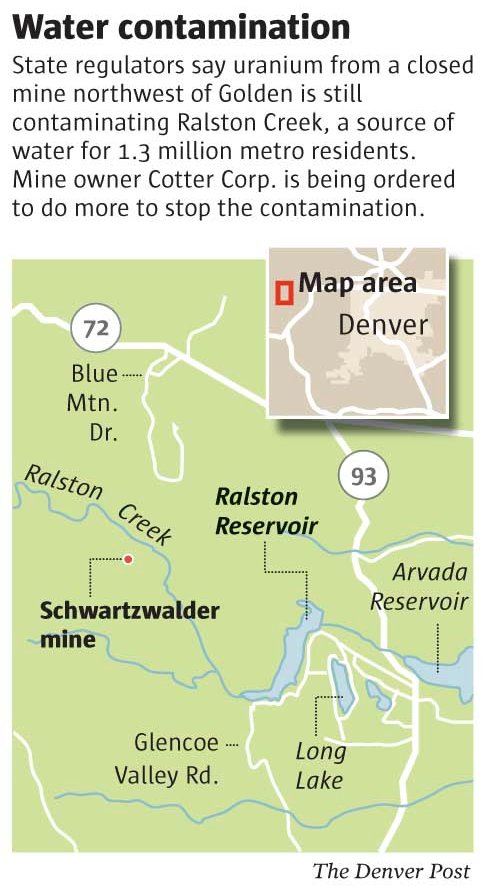
“I want to get this remediated. If Cotter wants to continue to fight this in court, that’s up to them,” said Loretta Pineda, director of Colorado’s Division of Mining Reclamation and Safety. “We’re rapidly losing another construction season. … Cotter could at least be doing work on a diversion.”[…]
Cotter last year filed a lawsuit accusing regulators of abusing their discretion with orders to clean up Schwartzwalder. But Friday, a Denver District Court judge ruled that Colorado’s Mined Land Reclamation Board was correct to order the de-watering of the 2,000-foot mine shaft and impose penalties. Earlier in the week, state health officials ordered Cotter to divert creek water around the mine and find the source of the contamination.
Buoyed by the Friday ruling, state regulators met with state Attorney General John Suthers’ staff Monday about their possible next steps…
In 2007, a state mining inspector detected the water contamination. About two years ago, the state officials began raising concerns, and last year they started pressing for a cleanup. Cotter has argued that toxic groundwater filling its 2,000-foot-deep mine shaft is not connected to Ralston Creek.
The health department order last week would require Cotter to install a concrete wall and to funnel water into a pipe that would carry Ralston Creek around the mine and then, below the mine, back toward Ralston Reservoir. It’s a temporary solution until a pump-and-treat operation is set up…
…state law requires companies to post sufficient bond money to guarantee that cleanup work will be done without falling to taxpayers. But the bond posted for Schwartzwalder is not enough to cover costs of pumping and treating uranium-laced water from the mine, state mining inspector Tony Waldron said. State officials said they’ll press now for a larger bond as well as de-watering of the mine.
From The Pueblo Chieftain (Chris Woodka):
“I think people get interested in water and try to get into it with plans that seem to make sense,” said Neil Grigg, an engineering professor at CSU. “They run into regulation that sabotages their plans, and then have left. A lot of them have come and gone.”
Grigg has just published “Water Finance, Public Responsibilities and Private Opportunities,” a book that explores the worldwide water business from home plumbing to dam building. Many of the issues in the book apply to what is happening in Colorado because of competing uses for a limited supply of water.
Grigg — who has years of experience as a water researcher, policymaker, administrator and consultant — portrays the water industry as a spectrum ranging from a central water authority to a free market, saying water in Colorado falls somewhere in between.
Private developers are planning larger projects than in the past because government resources to build and maintain projects have been depleted. “Large private companies are operating around the world,” Grigg said. “Water has become a commodity, with these companies buying and selling water, and wheeling it to different places.”[…]
A quick Internet search turned up two dozen water marketers in the state, ranging from real estate agents ready to bargain with water rights to entrepreneurs, including former Gov. Bill Owens, who are trying to peddle a single-source supply…
“Global hunger and the aspirations of billions of people for better diets mean that the requirements for irrigation water will not diminish, but will increase.”
More infrastructure coverage here.
From email from Reclamation (Erik Knight):
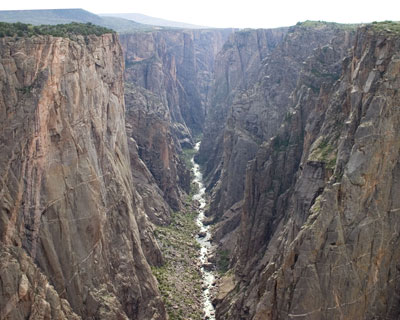
Currently flows in the Gunnison River through the canyon are about 950 cfs. We expect no changes to this flow rate until mid-October when flows will be reduced to accommodate the brown trout spawn. River flows should be around 600 cfs during the time of the spawn. This will continue until the conclusion of the spawn in mid-November at which point flows in the river will increase to around 1000 cfs. Flows through the Black Canyon may increase again in December as releases from the Aspinall Unit will most likely need to be higher than 1000 cfs to lower Blue Mesa Reservoir to the Dec 31st winter target elevation.
More Aspinall Unit coverage here.

From the Vail Daily (Derek Franz):
“If we could get a boat ramp every eight or 10 miles (below State Bridge), that could spread the people out,” Treu said. “Right now, that stretch of river is too long and slow to appeal to many users. With the public access that’s currently available, there are no half-day floats — the trips are very long days.”
That’s why Eagle County has been working on some land deals that would gain public access to points along the Colorado River. Two of the deals have closed, and others are still being worked out…
Eagle County recently started the process to get “in-stream flow protection” and senior water rights to the isolated stretch of the Colorado. In this case, an in-stream flow protection would protect fish habitat by guaranteeing a minimum water flow. Other such protections also have been made for recreational rights, such as whitewater parks. “(The section from State Bridge to Dotsero) is the only section (of the Colorado) that doesn’t have in-stream flow protection,” Treu said. “If this section of river is not utilized, it will seem more acceptable for Denver to claim it.”[…]
“By getting in-stream flow protection, getting more people on that stretch and getting senior water rights, we will have a three-pronged attack,” Treu said. The claims are currently being processed in the Colorado water courts. A ruling isn’t expected anytime soon, however, because the state’s water rights are complex and the courts are slow.
More Colorado River basin coverage here.
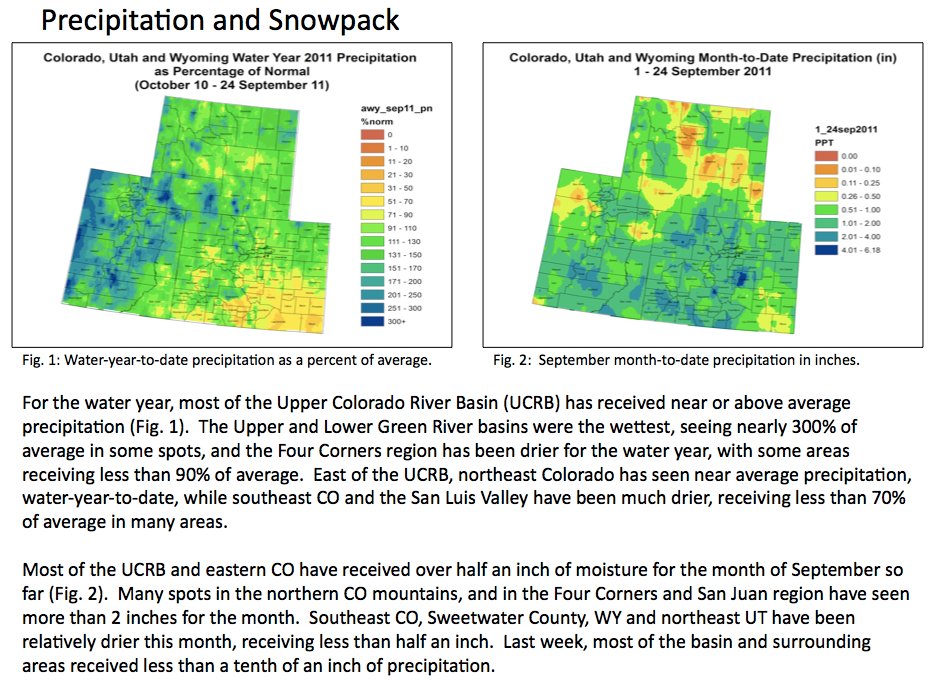
Here’s are the presentations from this week’s webinar, from the Colorado Climate Center. Click on the thumbnail graphic to the right for the precipitation rundown.
From the North Forty News (Jeff Thomas):
State compacts dating from 1922 and 1948 entitle Colorado to water in the Flaming Gorge Reservoir, but “I don’t have the legal ability to go up there and administer those rights,” said Dick Wolfe, Colorado’s state engineer and director of the Colorado Division of Water.
While that ability may seem like just one of the many intricacies involved in a proposed 500-mile pipeline to bring water from southwestern Wyoming to a thirsty Colorado Front Range, it’s a key point that could be decided by Wyoming Gov. Matt Mead, who has already expressed opposition to the project. “He is opposed to the pipeline,” confirmed Renny MacKay, communication director for the governor’s office. MacKay said in a recent interview the governor said he opposes trans-basin diversions in general, and in particular, “I don’t think that Aaron Million’s project is well thought out.”[…]
For Wolfe, being able to administer such water rights is not a trivial matter. The whole project hinges upon Colorado’s ability to take more water out of the Colorado River, which it is entitled to do under an interstate compact with fellow headwater states, Wyoming and New Mexico, and downstream states, such as California and Nevada. As much as 250,000 acre feet of water could be brought to the Front Range by the project, about enough for 1 million new residents with current usage. However, the state engineer’s office also has to protect the rights of other users that draw water from the Colorado, such as the senior rights for the Colorado-Big Thompson project, which already supplies water to much of northeastern Colorado. “The point of diversion doesn’t have to be in the state of use,” Wolfe noted. “But then we have to deal with how to administer that right, and how that diversion gets counted under the compact.”[…]
At a minimum, Wolfe said, the state engineers from both Wyoming and Colorado need to put new rules in place that would allow him to shut down the headgate for the pipeline when it is not in priority — when there’s not enough water in the Colorado to comply with the compact. While both offices noted there is a high degree of cooperation between the headwater states regarding the compact, this is fairly new ground and legislative action may be required.

Here’s the release from the Bureau of Reclamation (Steve McCall/Justyn Hock):
Reclamation has released a draft environmental assessment for a proposed hydropower project at Ridgway Dam in Ouray County, Colo., to the public for review and comment.
The project, proposed by the Tri-County Water Conservancy District, would generate electricity using existing water releases from Ridgway Dam throughout the year. Ridgway Dam is a feature of the Dallas Creek Project, which is a federal Reclamation project designed to provide irrigation and drinking water to Montrose, Delta, and Ouray counties in western Colorado.
The draft environmental assessment is available online at http://www.usbr.gov/uc/ under environmental documents or by contacting Steve McCall with Reclamation at (970) 248-0638 or smccall@usbr.gov.
Reclamation will consider all comments received prior to preparing a final environmental assessment. Comments can be submitted to the email address above or to: Carol DeAngelis, Area Manager, Bureau of Reclamation, 2764 Compass Drive, Suite 106, Grand Junction, CO 81506. Comments are due by November 1, 2011.
Here’s the release from the Bureau of Reclamtion (Lisa Iams):
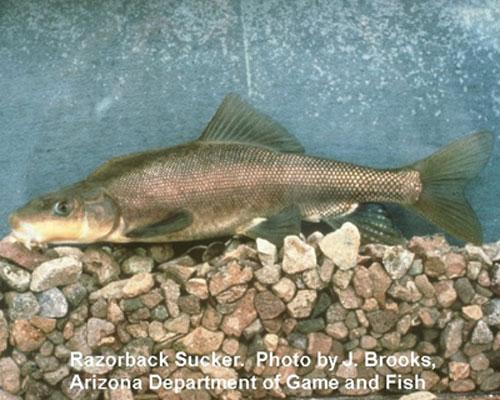
The Bureau of Reclamation has awarded a $3 million five-year contract to Biomark Inc., of Boise, Idaho, for passive integrated transponders (PIT) and related equipment to conduct on-going fish studies throughout the 17 Western states associated with numerous river habitat restoration and endangered fish recovery programs.
“This contract provides another tool to enhance real-time, scientific knowledge about fish behavior that we rely upon to inform our river restoration activities,” Commissioner Michael L. Connor said today. “River restoration work is an important cornerstone of Reclamation’s efforts throughout the West to ensure the sustainability and health of water resources – a key element of the administration’s America’s Great Outdoors initiative.”The use of PIT tags provides a reliable and effective means of identifying and monitoring individual fish utilizing radio frequency identification technology. Once researchers have implanted a PIT tag, (essentially a small microchip) inside an individual fish, it can easily be tracked and monitored utilizing readers and antennae devices. This provides valuable data for biologists to use in accurately calculating population estimates, recording life-cycle information, and gathering survival and recruitment data.
This is the same technology used to identify and track lost pets including dogs and cats. Because each tag contains a unique electronic number, specific individual data can be gathered over time that is vital to the habitat restoration and species recovery programs Reclamation is involved in. Among the programs that will receive PIT equipment through this contract are: the Upper Colorado River Endangered Fish Recovery Program, San Juan River Basin Recovery Program, Middle Rio Grande Endangered Species Collaborative Program, Glen Canyon Dam Adaptive Management Program, Columbia/Snake Salmon Recovery Program, Trinity River Restoration Program, San Joaquin River Restoration Program, Lower Colorado River Multi-Species Conservation Program, Platte River Recovery Implementation Program, and the Gila River Basin Native Fishes Conservation Program.
More endangered/threatened species coverage here.

From The Eagle Valley Enterprise (Derek Franz):
“What we needed and have now is a self-sustaining ecosystem,” said Brynly Marsh, the Adam’s Rib Golf Course superintendent. “We needed things like spawning beds, places for little fish to hide from the bigger ones and deeper pools.” Brush Creek now has more macro and micro-organisms. In this case, macro-organisms are basically insects, or any living thing that can be seen by the naked eye. Micro-organisms are living things that can’t be seen by the naked eye. When all those organisms flourish, so do fish. “The hawks and eagles are also happier,” Cranston said.
When the improvement project started, part of the problem was cattle grazing that harmed the riparian habitat. The first step was to end the grazing along the 3.6 miles of Brush Creek owned by Adam’s Rib before Flywater even came into the picture…
With the cattle gone and Flywater on board, Adam’s Rib developers set to work on their stretch of Brush Creek. They built a total of 66 “structures” in the last two fall seasons. A “structure” is a stream enhancement, which could refer to a reinforced bank or man-made pools, among other things…
The main goal of the in-stream structures is to slow the creek down and create pools for fish to congregate. Boulders were purchased from local excavators to make the structures, so the rock is basically native, Cranston said. Some of the structures are reinforced banks to stave off erosion. Others are more like shallow dams that cover the width of the creek and some entail a grouping of rocks to make a small pool. As many as three structures can be found in one short stretch of the creek.

From the Sky-Hi Daily News (Tonya Bina):
Klancke is featured this month in Field & Stream as one of the magazine’s “2011 Heroes of Conservation,” which highlights individuals involved in grassroots projects to preserve the land, water and wildlife vital to sportsman’s pursuits. Selections are based on factors including leadership, commitment, project growth and results, according to statements from Field & Stream.
Along with five additional honorees, Klancke will be celebrated at a Field & Stream gala event in Washington D.C. on Oct. 11, where he will be presented with a $5,000 conservation grant. He said plans to give the grant to the Grand County chapter of Trout Unlimited with the goal of better educating Denver/Front Range citizens about the Moffat and Windy Gap firming projects, which seek to pull more water out of Grand County rivers…
“The whole award-thing is humbling,” Klancke said. “But it’s not about me; the battle is to save this river.”
More Colorado River basin coverage here.

From the Cortez Journal (Kimberly Benedict):
Calling their plan “A Way Forward,” the group is taking the suggestions offered in a recently completed scientific report to find a way to increase habitat and successful reproduction of the flannelmouth sucker, bluehead sucker and roundtail chub. The overarching goal is to create a healthy, thriving water source in Southwest Colorado that is protected by local stakeholders, not federal designation. “The work that the Lower Dolores group and its legislative committee has been doing pointed to a need to give the fish some help,” said Marsha Porter-Norton, group facilitator. “We commissioned a group of scientists to study these native fish and tell us what actions we could take. They said that yes, we should pursue this now.”[…]
Enhancing the health of the fish is necessary to the protection of the river itself and the multiple-use nature of the waters, said Mike Preston, manager of the Dolores Water Conservancy District and member of the working group. “In recent years there has been a great deal more focus on these native fish species,” Preston said. “The concern about these fish centers on the fact that though they are not a listed (species), they are considered a sensitive species. What would be problematic would be if those species got listed as threatened or endangered. We would potentially lose control of the river with a listing, and that would be putting everyone’s water supply at risk if that occurred.”[…]
Preston said the immediate focus of the group is on what actions can be taken within the framework of spill management to impact the health of the native species.
“The discussion has come to a pretty good consensus on most of the issues and really the outstanding issue is the flows,” he said. “In the past the releases were really aimed at rafting and supporting trout fishing 10 to 11 miles below the dam. What we have to figure out is what is going to benefit the native fish. They have become a greater priority, and we need to determine how to manage flows if our objective is to protect native species, as well as allowing opportunities for trout fishing and rafting.”
Preston said a wide range of stakeholders have been pulled together to work on the project, including the U.S. Bureau of Reclamation, the Colorado Department of Parks and Wildlife, Dolores Water Conservancy District, Trout Unlimited, American Whitewater, the San Juan Citizens Alliance and The Nature Conservancy.
More Dolores River basin watershed here.

From The Pueblo Chieftain (Robert Boczkiewicz):
The 10th Circuit Court of Appeals heard arguments [September 14] on Thiebaut’s contention that a lower court judge should not have thrown out Thiebaut’s lawsuit against Colorado Springs Utilities. The 10th Judicial District covers Pueblo County.
Senior U.S. District Judge Walker Miller concluded in 2007 that Colorado district attorneys do not have authority under state law to use the federal Clean Water Act to sue in federal court. That is what Thiebaut did in 2005 when he sued Colorado Springs. The appeals court will decide whether it will reinstate Thiebaut’s lawsuit…
An attorney for the city argued Wednesday that Miller’s decision should not be overturned. “We urge you to sustain a very thorough and thoughtful order by Judge Miller,” attorney David Robbins told the appellate judges. Robbins said “all the issues were resolved” in a lawsuit against Colorado Springs Utilities by the Sierra Club environmental organization that was very similar to Thiebaut’s lawsuit.

From the Pikes Peak Courier View (Norma Engelberg):
“When we realized the scope of the problem, the project morphed,” said CUSP Operations Director Jonathan Bruno. “There was this interesting (river) diversion downstream on private land that was creating a huge sedimentary plume upstream.” Negotiations with the Sportsmen’s Paradise Homeowners Association began in 2007 and, after four years, the small dam was finally removed Sept. 12…
The dam wasn’t the only issue, however. The river is also impacted by runoff from the 2002 Hayman Fire and by road runoff. “You can see the (alluvial) fans on the side of the river from the roads,” Bruno said. “We’ll be rebuilding vegetative buffers between the road and the river.”[…]
The river improvement project has three goals: improve the physical river channel and trout habitat; restore riparian habitat at Happy Meadows Campground; and provide findings and techniques that can be used on other impaired stream segments…
As part of the work to remove the dam, planners had to replace the diversion with something that wouldn’t allow sediment build up. “They (the homeowners association) still have water rights,” Bruno said. “The new diversion allows water to go to a big pond without backing up sediment.” The preliminary work also involved stockpiling native rocks and local timbers…
After dam removal, crews quickly moved in to begin narrowing the river channel to 45-60 feet — it had been reaching up to 120 feet wide in some places.
More restoration coverage here.

From The Pueblo Chieftain:
The Responsible Bathroom Water Conservation Tour, a marketing campaign by American Standard, will roll through Pueblo this week. The goal of the tour is to encourage water savings by installing modern bathroom fixtures. The mobile marketing campaign will be in Pueblo from 7 to 9 a.m. Thursday at Pueblo Winnelson, 300 Ilex St.
More conservation coverage coverage here.