
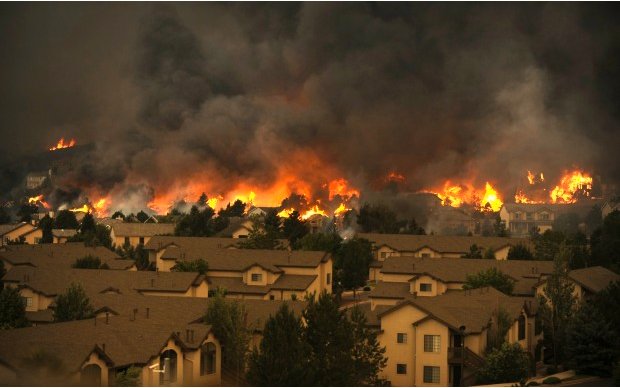
From the Associated Press via The Pueblo Chieftain:
The [Air Force Academy] was telling families to leave two main housing areas, but an area of the 28-square-mile campus that houses cadets wasn’t immediately evacuated. A new class of cadets is still scheduled to report on Thursday. Fire officials had issued a pre-evacuation notice for the academy earlier Tuesday. El Paso County sheriff’s officials have ordered an estimated 32,000 people to leave. Fire information officer Greg Heule said earlier Tuesday that the fire was less than five miles from the southwest corner of the Air Force Academy’s campus. Television images showed homes burning and the Flying W Ranch southwest of the academy said on its website that the ranch had burned to the ground. Colorado Springs Fire Chief Richard Brown said “many, many homes” also have been saved.
Here’s the link to a photo album from The Pueblo Chieftain. Twitter hashtag @WaldoCanyonFire.
More from the article:
Tuesday was the fifth consecutive day with temperatures of 100 degrees or higher in Denver, tying a record set in 2005 and 1989. On Monday, Denver set a record with 105 degrees. The previous record for June 25 was 100 degrees in 1991. Other areas of the state also topped 100 degrees Tuesday, including the northeastern Colorado town of Wray, which hit 108, the National Weather Service said. What the nation is now seeing is “a super-heated spike on top of a decades long warming trend,” said Derek Arndt, head of climate monitoring at the National Climatic Data Center in Asheville, N.C. The U.S. set 107 new temperature records Monday and in the past week has set 782 of them, which are large numbers but hard to put in context because the data center has only been tracking the number of daily records broken for little more than a year, Arndt said.
From The Pueblo Chieftain (Chris Woodka):
Tanker planes based out of the Pueblo Memorial Airport use city water to fight fires, and the U.S. Forest Service picks up the tab. The tankers fly in and out of the airport up to eight hours daily, with each plane carrying between 2,500-3,000 gallons of retardant mix, depending on conditions, said Ralph Bella, Forest Service spokesman. One part retardant is mixed with five parts water, and the water comes from a 3-inch metered hydrant. The rate for the hydrant is 1.5 times the residential rate, or $15.90 for the first 2,000 gallons, and $3.40 for every 1,000 gallons after that, said Terry Book, executive director for the Pueblo Board of Water Works.
From The Colorado Springs Gazette (R. Scott Rappold):
The Waldo Canyon fire has spread to one of the most crucial links in Colorado Springs’ far-flung water system, Rampart Reservoir. The fire destroyed power lines leading to the reservoir overnight Monday, forcing backup generators to kick on, and the flames were three-quarters of a mile away early Tuesday.