
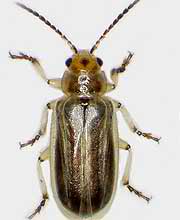
From the Summit County Citizens Voice (Bob Berwyn):
Efforts to control invasive tamarisk plants along the Arkansas River are looking up, thanks to a boost from some unexpected evolutionary adaptations. A small imported but that eats and kills the water-sucking plants has been expanding its range and reproducing more efficiently after adapting to regional cycles of darkness and light. “This is one of the clearest cases of rapid evolution,” said Tom Dudley, who has been involved in the tamarisk control efforts at UC Santa Barbara’s Marine Science Institute Riparian Invasive Research Laboratory. The tamarisk leaf beetle has managed to delay its entry into hibernation to adapt to the shorter days of the southern region of the United States. That adaptation enables the beetle to survive until spring and prolongs the time it has to reproduce.