
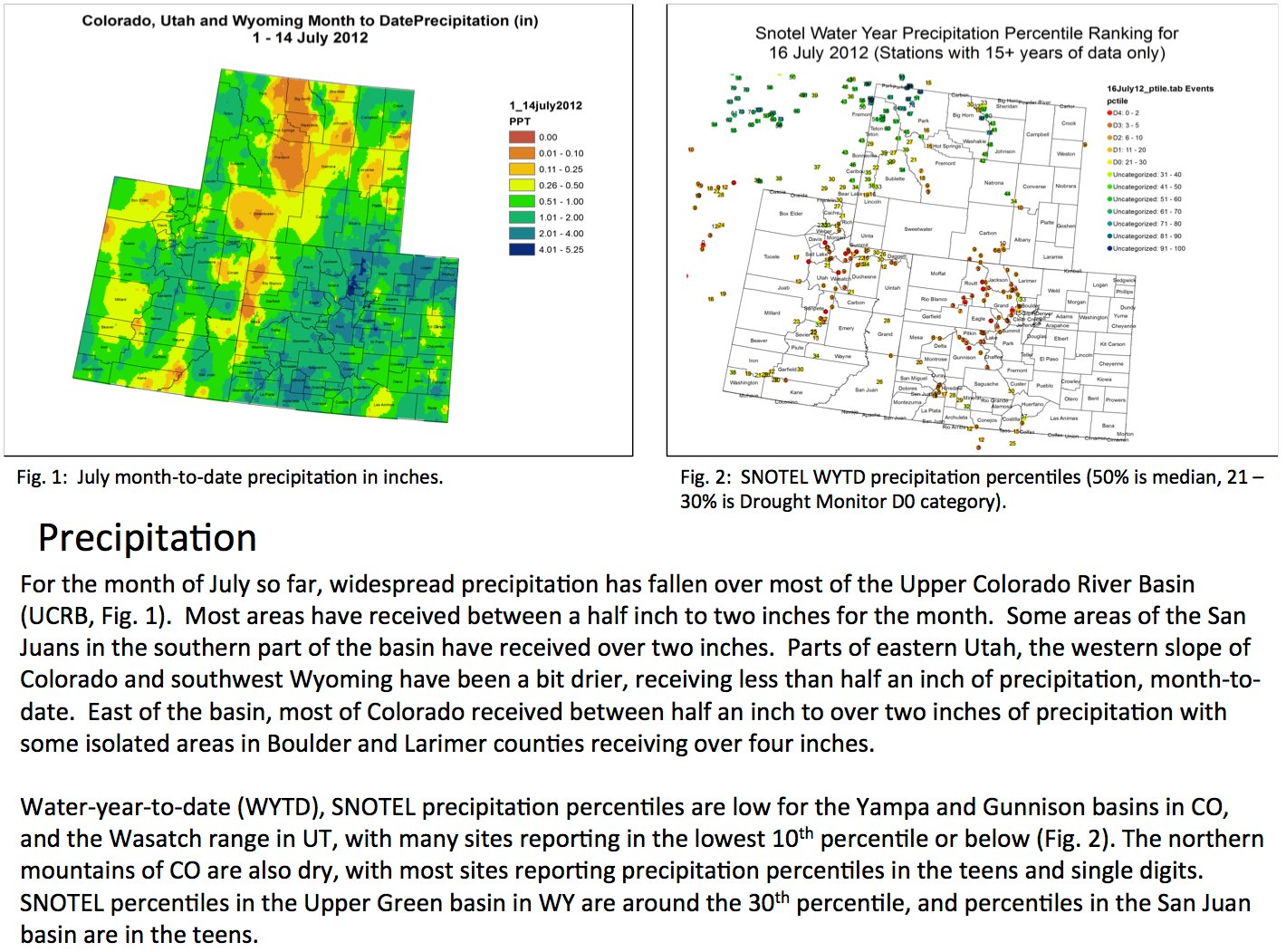

Click here for the summaries from last week’s webinar. Click on the thumbnail graphics for the July month to date precipitation summary and the current U.S. Drought Monitor.
From the Summit County Citizens Voice (Bob Berwyn):
July rainfall through the middle of the month was well above average at many mountain weather stations, with Dillon, for example, reporting 1.94 inches through July 17, more than twice the average .92 inches. Estes Park and Georgetown both reported about triple their average rainfall amounts for the period, but drought conditions still persist across much of the state…
Thanks to the rain, drought conditions were downgraded from exceptional to extreme in southwest Jackson and northwest Grand counties, but even with the monsoon precipitation extreme drought conditions persisted across north-central and northeast Colorado.
Here’s why: In between rainstorms, temperatures remained well above average, resulting high rates of evapotranspiration, continuing to decrease soil moisture. In the hardest-hit areas, about 45,000 acres of crops, mainly wheat, have completely failed. Some farmers in northeast Colorado have abandoned alfalfa fields to save water from corn.
Many dryland crops in northeast Colorado are extremely stressed or have already withered, including millet, considered to be a drought resistant crop. Any millet that did sprout on the plains is now dying. There are numerous reports of ranchers selling off livestock, to an extent not seen since the summer of 2002. Rangeland conditions improved slightly in some areas but pastures are still in critical condition…
Temperatures since June have been running about 6 degrees above average along the Front Range and 3 degrees above average in the rest of the state, and Denver has already hit the 100-degree mark 11 times this year. For the sake of comparison, the city has reached 100 degrees 71 times total in the 140-year climate record dating back to 1872.