EPA recognizes Colorado Springs Utilities as WaterSense Partner of the Year

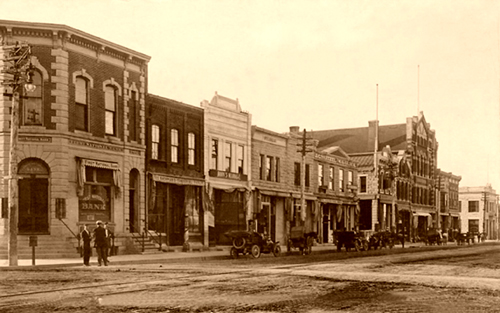
coloradospringstownviewpikespeakcirca1910.jpg

Here’s the release from the EPA (Molly Hooven/Patrice Lehermeier):

Today, the U.S. Environmental Protection Agency (EPA) honored Colorado Springs Utilities as a 2012 WaterSense Partner of the Year. The water provider, which serves more than 210,000 people, earned EPA’s recognition for its exemplary commitment to encouraging water efficiency in the Colorado Springs area. Thanks to their efforts, along with over 2,600 other WaterSense partners nationwide, WaterSense-labeled products have helped Americans save 287 billion gallons of water and $4.7 billion in water and energy bills.

“WaterSense is proud to partner with these champions of water efficiency who share our mission to protect the future of our nation’s water supply,” said Nancy Stoner, EPA’s acting Assistant Administrator for Water. “The 2012 WaterSense Partners of the Year were exceptional in their efforts to support innovative approaches to help people and companies save water and money on utility bills nationwide.”

In 2011, Colorado Springs Utilities engaged consumers and local businesses in the water efficiency movement by offering them personalized ways to get involved. The organization’s YOUtilities YouTube video contest inspired customers to document the ways in which they save water and energy at home. The contest, which aimed to create consumer advocates for water-efficient products and practices, produced a number of informing and entertaining videos for the community to enjoy.

In 2011, a team effort led by Colorado Springs Utilities, along with local builder Wayne Intermill, EnergyLogic, Inc., and 2008 WaterSense Retailer Partner of the Year Ferguson Enterprises, resulted in the first WaterSense-labeled home in Colorado located in the Gold Hill Mesa neighborhood. During the three-week 2011 Parade of Homes, 5,000 visitors explored the WaterSense-labeled home, which also became the first home in Colorado to receive LEED® for Homes certification, ENERGY STAR® qualification, and the WaterSense label. Also last year, Colorado Springs Utilities issued more than 4,500 water-efficiency rebates to customers, resulting in a savings of 23,078,060 gallons of water.

The utility also helped hundreds of commercial kitchens save water by offering them free, water-efficient pre-rinse spray valve nozzles for cleaning dishes. The commercial retrofit program helped facilities save more than 20 million gallons of water in 2011, or one-third of utility’s annual water savings goal.

More conservation coverage here.

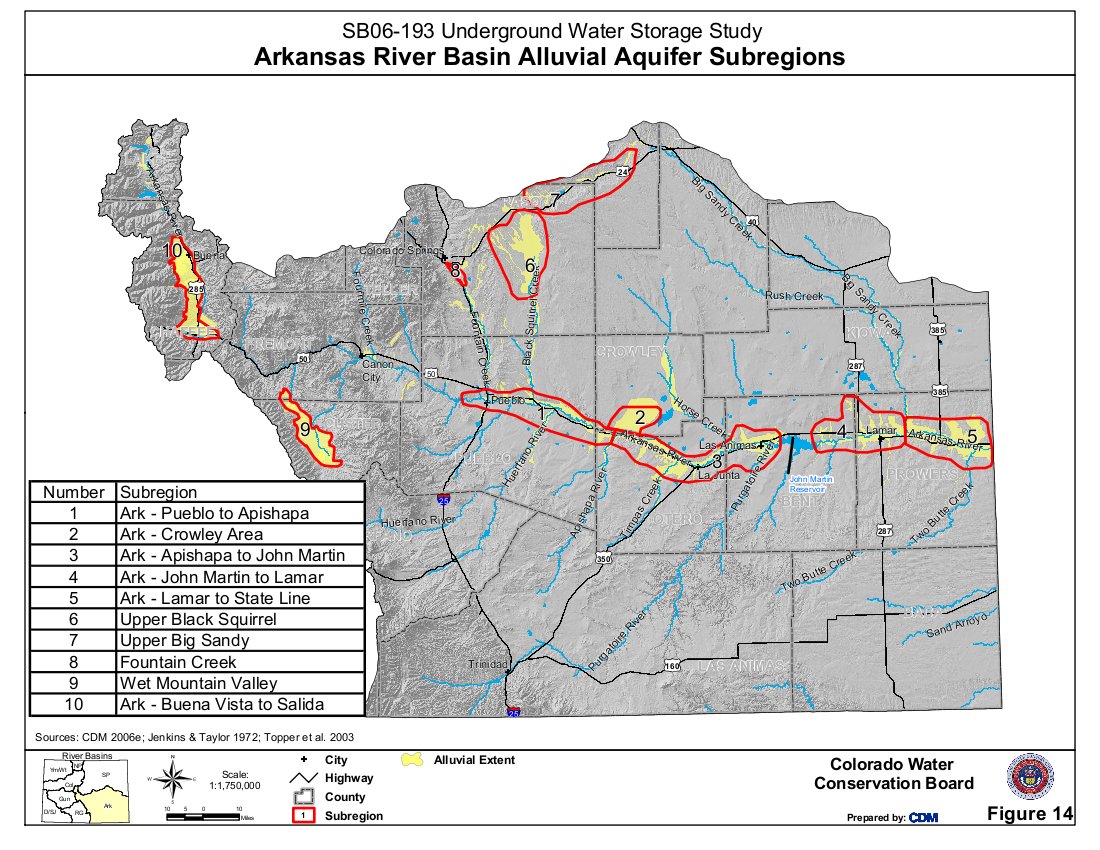
Arkansas Basin: The Arkansas Groundwater Users Association accuse the Lower Ark of competing for the same supplies

arkansasbasinalluvialaquifersubregions.jpg

From The Pueblo Chieftain (Chris Woodka):

A well augmentation group thinks the Lower Arkansas Valley Water Conservancy District is “picking winners and losers” in providing supplemental water.

Lower Ark manager Jay Winner says that’s not the case. The district is trying to protect all water rights — surface or groundwater — in the Lower Ark Valley.

“We have to scrape water together wherever we can,” said Scott Lorenz, manager of the Arkansas Groundwater Users Association. “We operate with the other two groundwater groups with mutual respect, and we don’t go after each other’s water.”

AGUA, the Colorado Water Protective and Development Association and the Lower Arkansas Water Management Association provide replacement water for well owners under 1996 rules, called Rule 14 plans.

The Lower Ark district operates a Rule 10 plan under 2010 surface irrigation rules.

AGUA fears the Lower District is attempting through its ongoing negotiations with Colorado Springs to lock up one of its main sources of replacement flows — return flows from the city. The fears stem from last year’s five-year lease from Pueblo Board of Water Works at more than double the going rate for one-year leases.

“We rely on that water,” Lorenz said. “I oppose taxpayer funds being used to pick winners and losers.”

Winner said negotiations with Colorado Springs will not create competition with the well groups for supply.

“My goal is to get the Rule 10 guys on surface water rights . . .

to be able to use their own water for replacement water,” Winner said.

Like the well groups, the surface irrigators have to pay for management of the program and the cost of water. While state grants helped set up the Rule 10 program, local taxes are not being used.

“It’s all pass-through costs,” he said.

The Lower Ark district provided more than 10,000 acrefeet of water to make up stateline deficits for overuse of water by wells in 2005-06. Otherwise, the burden would have been on well users, Winner added.

More Arkansas River Basin coverage here and here.

Junction City: The annual meeting of the Republican River Basin Compact Administration is October 16

junctioncitykansas.jpg

From the Associated Press via the Salina Journal:

Officials from Kansas, Colorado and Nebraska meet later this month to discuss water-related issues and activities within the Republican River basin.

The Republican River Compact Administration’s annual meeting is Oct. 16 in Junction City. Among the topics up for discussion is compliance with the compact. A work session is also planned Oct. 15.

Both meetings are open to the public.

More Republican River Basin coverage here and here.

Drought news: Some relief but all of Colorado remains in drought #CODrought

usdroughtmonitor10122010.jpg

usdroughtmonitor09202011.jpg

usdroughtmonitor10022012.jpg

Click on the thumbnail graphics for the latest U.S. Drought Monitor map along with the September 20, 2011 and October 12, 2010 maps for some insight into the progression of the current drought.

From the Grand Junction Free Press (Hannah Holm):

Next year’s outlook is uncertain, and water managers are being conservative about putting further pressure on reservoirs. The Uncompahgre Valley Water Users Association decided to cut off water deliveries two weeks early to keep more water in storage for the 2013 growing season.

Reservoir storage levels around the state are low, and more extreme conservation measures are likely next year if winter storms fail to significantly refill them. Grand Valley domestic water providers have warned that another dry winter could lead to mandatory restrictions and higher water rates. According to the Natural Resource Conservation Service, reservoir storage levels at the end of August for some of the state’s major river basins were as follows:

• Colorado River Basin: 64% of average, and 63% of capacity. At the same time in 2011, the basin’s storage levels were at 111% of average.

• Gunnison River Basin: 63% of average, and 52% of capacity. At the same time in 2011, the basin’s storage levels were at 108% of average.

• South Platte River Basin (includes Denver and the northern Front Range): 71% of average, and 44% of capacity. At the same time in 2011, the basin’s storage levels were at a whopping 121% of average.

• Arkansas River Basin (includes Colorado Springs and Pueblo): 63% of average, and 19% of capacity. At the same time in 2011, this basin was already beginning to experience drought, and had storage levels at 85% of average.

Drought conditions and reservoir storage levels on Front Range matter to Western Slope water users, and vice versa, because of the extent to which Front Range water users rely on trans-mountain diversions. On average, about 500,000 acre-feet per year flows from Western Slope headwaters streams (mostly in the Colorado Basin) into the South Platte and Arkansas River Basins to irrigate crops and provide water to cities. An acre-foot is about enough to supply 2-3 households’ domestic water needs for a year.

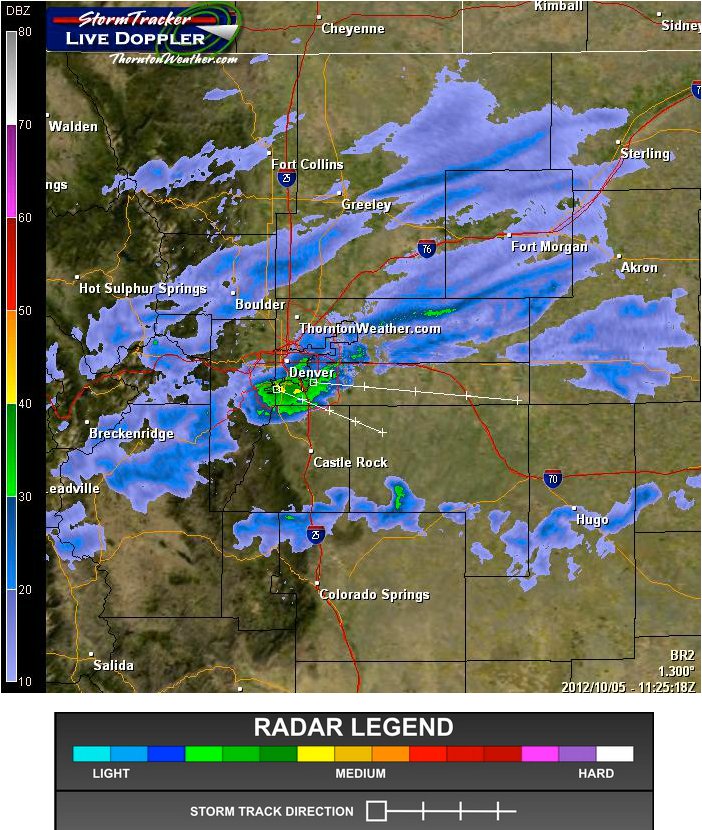
Drought news: Snowy and windy in the Denver area #CODrought

livedopplerradardenvermetro10052012530am.jpg

Click on the thumbnail graphic for the Super Doppler Radar map from ThorntonWeather.com.

Here’s the current (5:30 AM) forecast from the National Weather Service:

Today: A chance of rain and snow, mainly before 1pm. Mostly cloudy, with a high near 46. North wind 5 to 14 mph, with gusts as high as 21 mph. Chance of precipitation is 30%. Little or no snow accumulation expected.

Tonight: A slight chance of rain and snow before 1am, then a chance of snow. Mostly cloudy, with a low around 28. East northeast wind 6 to 13 mph, with gusts as high as 18 mph. Chance of precipitation is 30%. Little or no snow accumulation expected.

Saturday: A chance of snow before 1pm, then a slight chance of rain. Partly sunny, with a high near 43. North northeast wind 5 to 11 mph, with gusts as high as 18 mph. Chance of precipitation is 30%. New snow accumulation of less than a half inch possible.

I’ll be riding into the wind and snow this morning to get to work. Since I’m a diverter in my day job, I love it.

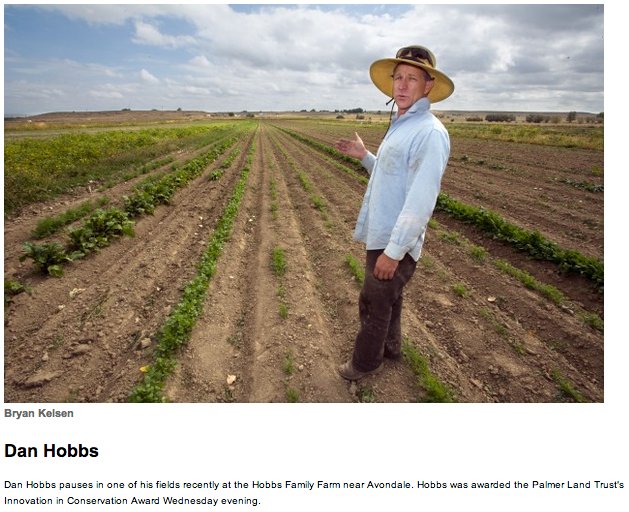
Arkansas River Basin: The Palmer Land Trust honors organic farmer Dan Hobbs for ‘Innovation in Conservation’

danhobbsavondalechieftain.jpg

Here’s a report from Hal Walter writing for The Pueblo Chieftain. From the article:

The Palmer Land Trust honored Avondale area farmer Dan Hobbs with its 2012 Innovation in Conservation Award on Wednesday evening.

Hobbs was recognized for his achievements in strengthening agriculture in the Arkansas River Valley, particularly in the areas of building organic farming alliances and farmto- table infrastructure, as well as securing financial investments and technical assistance for the local farming community.

He farms near Avondale, raising a variety of certified-organic vegetable and seed crops on his Hobbs Family Farm.

The award was presented before an audience of 320 at a Colorado Springs hotel following a local foods dinner featuring vegetables from Arkansas Valley Organic Growers, which Hobbs founded in 2006.

“Things are getting exciting out in the countryside,” said Hobbs in accepting his award. “There is an unprecedented level of synergy and momentum in the Arkansas River watershed. I’m not just talking about a set of neat projects, but thoughtful, long-term thinking, planning and implementation.”

He noted that 10 years ago the audience likely would not have enjoyed a local food dinner at such an event. In fact, vegetables served to the audience were from his and other Arkansas River Valley farms.

Hobbs was nominated for the Award by Jay Frost, who farms and ranches along the Fountain Creek between Colorado Springs and Pueblo.

Other award recipients included Friends of Open Space Award to the Gold Belt Tour and San Juan Skyway National Scenic Byways; and The Stewardship Award to the Rocky Mountain Field Institute.

The Stuart P. Dodge Award for Lifetime Achievement was awarded to Dale Lasater for his dedication to conservation through his Colorado Springs area family ranching operation, Lasater Grasslands Beef.

The Palmer Land Trust celebrated its 35th year of conserving public open, spaces farms and ranches and critical habitat and scenic vistas in 2012. This was the trust’s third annual conservation awards.

Back on April 1st the Chieftain quoted Hobbs, “Our goal [Organic Seed Growers and Trade Association] is to protect farmers from patent infringement charges by Monsanto when their organic crops are contaminated by Monsanto’s genetically altered seed.”

Here’s a post from May, where I published a poem written by Colorado Supreme Court Justice Gregory Hobbs, about about his son’s organic operation. Here’s the poem:

Organic Garlic Offering

Pick a spot of Colorado
sun below the ditch

October morning
plant them firm,

To root your hopes
set them loose

But turn
some water in

July’s the harvesting,
Purple Glazer, Silver White

Music Pink, Romanian Red,
Chesnok Inchelium, California Early,

Heirloom pungent, easy peel
good for salsa, pestos

Eating fresh and clean
saving this good farmland

Reprinted, with permission, from Living the Four Corners: Colorado Centennial State at the Headwaters by Justice Greg Hobbs. Click here to order the book from Continuing Legal Education Inc.

NOAA: The latest ENSO discussion is hot off the press #CODrought

elninolanina.jpg

Here’s the link to the October 4, 2012 ENSO discussion from the Climate Prediction Center:

Borderline ENSO-neutral/ weak El Niño conditions are expected to continue into Northern Hemisphere winter 2012-13, possibly strengthening during the next few months.

During September 2012, the trend towards El Niño slowed in several key oceanic and atmospheric indicators. However, the Pacific basin reflects borderline ENSO-neutral/ weak El Niño conditions. Equatorial sea surface temperatures (SST) remained elevated across the Pacific Ocean, although anomalies decreased during the month as indicated by weekly index values in the Niño regions. The oceanic heat content (average temperature in the upper 300m of the ocean) anomalies also weakened, but continued to show large regions of above-average temperatures at depth across the equatorial Pacific. Interestingly, low-level westerly wind anomalies were evident over the equatorial western Pacific Ocean, which may portend possible strengthening of the subsurface anomalies in the coming months. Despite these winds, the atmosphere was still largely ENSO-neutral, as reflected by the Southern Oscillation index and near-average upper-level and lowerlevel winds across much of the Pacific. Tropical convection increased near the Date Line, which is consistent with weak El Niño conditions, but also remained elevated over eastern Indonesia, which is further westward than expected. Thus, the atmosphere and ocean indicate borderline ENSOneutral/ weak El Niño conditions.

Compared to the past few months, the chance is reduced for El Niño to develop during Northern Hemisphere fall/winter 2012-13 (see CPC/IRI consensus forecast). Due to the recent slowdown in the development of El Nino, it is not clear whether a fully coupled El Niño will emerge. The majority of models indicate that borderline ENSO-neutral/ weak El Niño conditions will continue, and about half suggest that El Niño could develop, but remain weak. The official forecast therefore favors the continuation of borderline ENSO-neutral/ weak El Niño conditions into Northern Hemisphere winter 2012-13, with the possibility of strengthening during the next few months.

This discussion is a consolidated effort of the National Oceanic and Atmospheric Administration (NOAA), NOAA’s National Weather Service, and their funded institutions.

Ridgway Reservoir: The Tri-County Water Conservancy District hopes to start turning dirt on hydro facility this fall

ridgwaydamusbr.jpg

From The Watch (Kati O’Hare):

In about a month, district officials are hopeful they it will be able to break ground on the project, which, upon completion, will create about $1 million annually in revenues and produce enough electricity for 3,000 houses each year.

The 8-megawatt project will contain two turbines and two generators — a 1.8-mw system that will operate in the winter months during lower flows, and a 7.2-mw system for the higher-flow irrigation months.

“Winter flows are significantly less than our summer flows, and we can’t get a generator that would operate efficiently for that wide range,” Tri-County Water General Manager Mike Berry said.

The two different systems, both of which can operate during peak flows, is the most efficient method of capturing energy from the dam, he said.

Tri-County Water has gone through the necessary steps to get the project underway, and is now waiting for the completion of just two items before construction begins: the design plans need final approval from the Bureau of Reclamation, and interconnection agreement — to allow the power that’s captured to be transferred onto the grid — must be reached between Tri-County Water and Tri-State Generation and Transmission.

More hydroelectric coverage here and here.

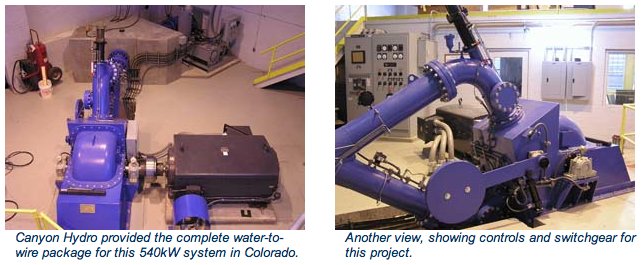
Boulder: Hydroelectric plant scores $1.18 million grant to help defray upgrade costs

canyonhydrosmallhydroelectricplantbouldercanyon.jpg

From The Denver Post (Howard Pankratz):

Originally built in 1910, the facility was in need of the upgrade in order to continue to operate. Without a new turbine and generator, operation of the facility was expected to stop within five years or less, city officials said…

Over the years, the system was owned and operated by numerous companies. In 2001, the city of Boulder purchased the system from the Public Service Co. of Colorado.

The total project cost was approximately $5.15 million and was funded by city water utility funds in addition to the federal grant.

More Hydroelectric coverage here and here.

Grand County Commissioners continue Windy Gap Firming Project hearing to October 30

windygapreservoirnorthernwater.jpg

From the Sky-Hi Daily News:

Grand County commissioners on Tuesday, Oct. 2, continued the hearing for the Windy Gap Firming Project permit to Oct. 30. The decision to continue the hearing was made during the Board of Commissioners regular weekly meeting.

More Windy Gap Firming Project coverage here and here.

Drought news: ‘Greeley has plenty of water to make it through this winter’ — Jon Monson

usdroughtmonitor09252012.jpg

From The Greeley Tribune (Analisa Romano):

City officials asked residents to stop watering their lawns by Monday to save water for next year after drought conditions and wildfires shortened supply in the Poudre Canyon. Normally, officials recommend that residents stop watering by Oct. 14. [Jon Monson] said demand on Monday dropped 30 percent from the previous week — but he said there’s no way to tell how much of that was due to the bout of moisture Greeley saw last week…

He said Greeley has plenty of water to make it through this winter, but water resources could be spread thin if the city experiences another drought.

From The Greeley Tribune (Eric Brown):

The rains that fell on Weld County this week finally gave the green light to many local wheat growers needing to move forward with fall planting, and they brought piece of mind to farmers who had already put their seeds in the ground…

Winter wheat planting in northeastern Colorado is typically well under way by now, starting around the first of September and going into mid-October to grow a crop that’s harvested the following summer. But with fields parched and lacking subsoil moisture that’s critical at planting time, few farmers in Weld County have been moving forward.

Finally, for those needing to plant, 0.80 inches rain gradually dropped over the Greeley area from Monday night to Thursday night — the bulk of which came Wednesday evening, according to the National Weather Service…

A year ago, nearly half of the fields in Colorado had adequate subsoil moisture, and then a pair of storms brought 20-plus inches of snow to Greeley toward the end of October — not long after planting — that helped this past year’s crop get off to a good start. But very little precipitation has come to Weld County since those 2011 snowstorms, with Greeley so far this year experiencing its driest — and hottest — year on record.

From The Greeley Tribune (Eric Brown):

Last month, Greeley recorded 1.32 inches of rain — topping the city’s historic average of 1.12 inches by 19 percent, and standing as the 19th wettest September on record, according to figures provided by the Colorado Climate Center in Fort Collins. But despite last month’s rains, 2012 as a whole still remains the driest year on record for Greeley so far. Through the end of September, Greeley had received 6.12 inches of precipitation for the year ­­— not quite half of the city’s historic average. Prior to September, only two other months this year — February and July — had experienced close to average precipitation amounts, while every other month was well below its historic average.

From the Associated Press via the Fort Collins Coloradoan:

Jim Gammonley is an avian research program leader for Colorado Parks and Wildlife. He says the lack of moisture in Colorado this year may force many birds from the north to migrate elsewhere in search of better conditions.

Governor Hickenlooper on Water Court: ‘we’ve  let the  system run  amuck’

scalesofjustice.jpg

From The Greeley Tribune (Eric Brown):

During a Weld County drought tour that included stops in Greeley and the LaSalle and Gilcrest areas, Hickenlooper said he favors changes to the state’s water court system, stating that “we’ve let the system run amuck,” and referred to water court costs as “insane.”

Hickenlooper further stressed that he wants all sides to come together to find ways for producers to legally use some of the region’s abundant underground aquifer.

“Any time you try to change water law, there’s huge pushback,” he said. “But I think it can be done.”[…]

Hickenlooper and the producers with whom he spoke all said they hope that an ongoing groundwater study in the South Platte River Basin — being conducted by the Colorado Water Institute at Colorado State University — will provide some of the answers that can lead to changes and solve some of the issues producers face…

Hickenlooper reminded farmers he doesn’t have the authority to allow the curtailed groundwater wells to pump out of priority. Hickenlooper said that, according to the state’s attorney general, he lacks the power to override the prior-appropriations system that’s been in place in Colorado for more than 100 years. Hickenlooper also said a number of water attorneys have told him that if he allowed the wells to pump out of priority, the state would face millions of dollars in lawsuits.

Downstream water users also raised concerns this summer about the push to allow the Weld County groundwater wells to pump — fearing it would prevent them from getting the surface flows to which they’re entitled. Farmers told Hickenlooper the 30 days of well-pumping they were requesting this summer would have used less than 1 percent of the groundwater in the aquifer — which some estimate is more than 10 million acre feet. All of the points made led Hickenlooper to discuss the need for more knowledge of the aquifer and cooperation on all sides moving forward.

“Smart people willing to compromise can figure this stuff out,” he stated.

More Water Law coverage here and here.

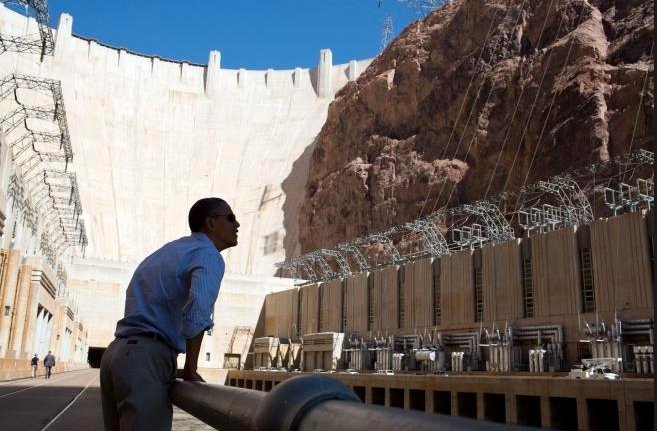
I’ll be live-blogging the Presidential debate tonight on the Denver Post website

presidentobamatransformerdeckhooverdam092012usbr.jpg

Update: Here’s the link where our posts will show up: http://www.denverpost.com/politics

The Denver Post has recruited bloggers to cover the debate. My sources tell me that there will be a link from the Post home page later today. Please come by while you’re watching the debate.

I believe that the Twitter hashtag for tonight is #denverdebate. You can also check out the hashtag #zingerwatch.

More 2012 Colorado November Election coverage here.

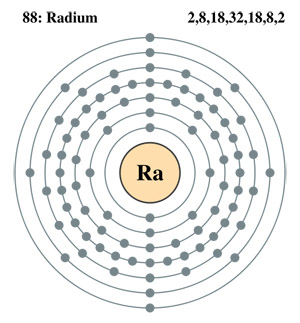
CDPHE tells Castle Rock to develop plan for disposal of radioactive brine that will result from treating water at their new plant

radiumatom.jpg

From the Castle Rock News-Press (Rhonda Moore):

The Colorado Department of Health and Environment notified the town’s utilities department that it must come up with a plan to manage the treatment residuals that will likely contain radioactive materials concentrated by treatment at the plant before March 2013, when the plant is fully operational, said Mark Salley, communications director for the state department. The plant is not creating any residuals at this time because it is still under construction and not operational, Salley said.

The department’s radioactive materials unit provides guidance to facilities where there is a potential for an elevated radioactive material concentration, said Jennifer Opila, radioactive materials unit leader. Opila’s group has provided guidance at 12 facilities in the last two years across Colorado. The department points out that uranium and radium are natural components of Colorado’s geology and will dissolve out of soils and into the state’s water, resulting in elevated levels of radionuclides in groundwater. The treatment process in a water treatment plant removes those contaminants and, when the radium residual levels exceed the state standard, the department’s goal is to ensure the safe removal of the resulting waste, or sludge, without bringing harm to anyone who comes in contact with the residuals, Opila said.

While the levels the state expects to see at the Plum Creek facility do not pose an acute hazard, safety measures at comparable levels would include protective gear such as safety gloves, shoe covering and full clothing covering, she said.

More water treatment coverage here and here.

NSF awards CU-Boulder-led team $12 million to study effects of natural gas development

oilrigssharingaplatformfrontrangeschoolofminesalfredeustes.jpg

Here’s the release from the University of Colorado at Boulder (Joseph Ryan/Jim Scott):

The National Science Foundation has awarded a $12 million grant to a University of Colorado Boulder-led team to explore ways to maximize the benefits of natural gas development while minimizing negative impacts on ecosystems and communities.

Led by Professor Joseph Ryan of CU-Boulder’s civil, environmental and architectural engineering department, the team will examine social, ecological and economic aspects of the development of natural gas resources and the protection of air and water resources. A part of NSF’s Sustainability Research Network initiative, or SRN, the project will focus on the Rocky Mountain region, where natural gas development, as well as objections to it, are increasing.

“We all create demand for natural gas so we have to accept some of the outcomes of its extraction,” said Ryan. “Our goal is to provide a framework for society to evaluate the trade-offs associated with the benefits and costs of natural gas development.”

The SRN team assembled by Ryan includes air and water quality experts, social scientists, human health experts, information technology experts and a substantial outreach and education effort. The SRN team will be advised by an external committee that includes representatives of the oil and gas industry, regulatory agencies, environmental organizations, local governments, academia and Native American tribes. Preparation of the SRN proposal to the NSF was fostered by CU-Boulder’s Office for University Outreach, which supported the creation of the Colorado Water and Energy Research Center, said Ryan.

As part of the effort, Ryan said team members will review industry practices for hydraulic fracturing, which involves pumping pressurized water, sand and chemicals deep down well bores to crack rocks and free petroleum and natural gas for easier extraction. The team will evaluate the current state of drilling technology, the integrity of well bore casings and natural gas collection mechanisms and processes.

Hydraulic fracturing requires large volumes of chemically treated water — most wells require between 3 million and 5 million gallons of water each, say experts. The fracturing fluid left in the ground, as well as the fluid that returns to the surface, known as “flowback,” present potential ecological and health risks if not handled properly, Ryan said.

While oil and gas extractions from hydraulic fracturing also result in atmospheric emissions of some greenhouse gases and volatile organic compounds, natural gas is nevertheless seen by many as a “bridge fuel” that leads away from dirty coal combustion toward cleaner sustainability methods, said Patrick Bourgeron, associate director of the SRN and a fellow at CU-Boulder’s Institute for Arctic and Alpine Research.

As part of the project, a team led by CU-Boulder Professor Harihar Rajaram will be investigating the hydrologic processes tied to potential risks of natural gas and oil extraction, including groundwater and aquifer systems. The team also plans to assess the risk of natural gas and oil extraction to water quality and mitigation strategies that involve improvements in current water treatment technology.

Professor Jana Milford of CU-Boulder’s mechanical engineering department will lead a team monitoring and modeling the potential risks of natural gas and oil development to air quality. Professor John Adgate of the Colorado School of Public Health in Denver will spearhead a team assessing the potential risks of natural gas development to public health.

Other partners on the CU-led NSF project include the Colorado School of Mines, Colorado State University, the University Corporation for Atmospheric Research in Boulder, the National Renewable Energy Laboratory in Golden, Colo., the National Oceanic and Atmospheric Administration, the University of Michigan and California State Polytechnic University Pomona.

Attitudes toward natural gas extraction using hydraulic fracturing vary widely around the West, said CU-Boulder Professor Mark Williams, a co-investigator on the project. One classic Colorado example is Boulder County and adjoining Weld County to the northeast. “The geology doesn’t change, the price of gas doesn’t change and the extraction methods are the same,” he said. “But for the most part, Boulder County opposes hydraulic fracturing while Weld County generally embraces it.”

Ryan said the network’s research findings eventually will be shared with the public through an extensive outreach and education effort led by SRN co-investigator and CU-Boulder Professor Patricia Limerick of the Center of the American West. The effort includes a “citizen science” component in which the public is encouraged to make science measurements, including air quality readings made with portable instruments compatible with smart phones, and share the results with the SRN research team.

“The citizen science aspect of this effort will result in a stronger connection between the public and the science used to make regulatory decisions,” said Professor Michael Hannigan of CU-Boulder’s mechanical engineering department and one of the co-investigators on the SRN project.

Natural gas production, especially the use of hydraulic fracturing, has become the subject of intense controversy, said Limerick. “Some people living in proximity to well sites are understandably worried and anxious, often feeling powerless as they confront a possible threat to their health and to the quality of their lives.

“Environmental advocates find themselves pulled between the climate benefits of natural gas, which releases significantly less carbon in combustion than coal, and the disturbances associated with natural gas extraction,” she said.

Outreach events will include periodic town hall meetings around the West. There also will be SRN meetings involving engineers, natural scientists and social scientists to stay abreast of the latest technologies and evolving socioeconomic factors regarding natural gas production, Limerick said.

“Unraveling complex processes involving Earth systems, especially the coupling of human activities and climate, depends increasingly on partnerships among natural science, philosophy and ethics, economics, social science, mathematics and engineering,” says Marge Cavanaugh, NSF acting assistant director for geosciences.

The CU-led research team and a second team from Penn State were chosen from more than 200 SRN proposals by the NSF as part of its Science, Engineering and Education for Sustainability program. The $12 million award to CU-Boulder is for five years.

More coverage from the Associated Press via The Columbus Republic. From the article:

Ryan says part of the team’s work will include reviewing industry practices for hydraulic fracturing, a process that involves pumping pressurized water, sand and chemicals into rock to free oil and gas.

More coverage from Cathy Proctor writing for the Denver Business Journal. From the article:

CU’s team will examine social, ecological and economic aspects of the development of natural gas resources and the protection of air and water resources. The project will focus on the Rocky Mountain region, which has had natural gas drilling and production for decades. Worries have risen in the last few years among Colorado’s Front Range residents as the state’s oil and gas activity has shifted from the Western Slope to the urban corridor east of the Rockies.

Here’s the release from the National Science Foundation (Cheryl Dybas):

To explore ways of maximizing the benefits of natural gas development while minimizing potential negative effects on human communities and ecosystems, the National Science Foundation (NSF) has entered into a cooperative agreement with a University of Colorado Boulder (CU-Boulder)-led team of scientists, engineers and educators and eight partner organizations.

NSF has also entered into a cooperative agreement with another interdisciplinary team of scientists, engineers and educators; it supports a multi-institution research network on sustainable climate risk management strategies. The network is centered at Penn State University and involves nine other U.S. universities and research institutes.

Known as NSF Sustainability Research Networks, or SRNs, the teams will focus on the effects of natural gas development on air and water resources, and on how to adapt to and mitigate the risks of climate change, while developing new sustainability strategies in an altered world.

The SRN program is part of NSF’s Science, Engineering and Education for Sustainability (SEES) investment.

“Unraveling complex processes involving Earth systems, especially the coupling of human activities and climate, depends increasingly on partnerships among natural science, philosophy and ethics, economics, social science, mathematics and engineering,” says Marge Cavanaugh, NSF acting assistant director for Geosciences.

“The Sustainability Research Networks will enable synergistic and catalytic interaction among these disparate disciplines,” says Cavanaugh, “with the goal of finding answers to the most critical questions about sustainability.”

The SRNs are supported by NSF’s Directorates for Geosciences; Engineering; Social, Behavioral & Economic Sciences; Biological Sciences; Computer & Information Science & Engineering; Mathematical & Physical Sciences; Education & Human Resources; Office of International Science and Engineering; and Office of Polar Programs.

“Due to national economic and energy security priorities, fossil fuels will likely continue to be a significant part of the energy portfolio in the U.S and throughout the globe for the foreseeable future,” says Thomas Peterson, NSF assistant director for Engineering.

“Climate and coastal regions are likely to be at increasing risk, and water resources and air quality may also become more challenged,” he says. “The objective of the SRNs is to contribute to building a sound scientific and engineering foundation for addressing such risks and challenges.”

“Sustainability Research Networks combine the best of our research efforts in social and physical science and engineering into an effort to better understand the complex relationships between environmental change and the human condition,” says Myron Gutmann, NSF assistant director for Social, Behavioral & Economic Sciences.

“The SRNs include combinations of social sciences that will guide the future of our efforts to create a sustainable planet.”

More oil and gas coverage here and here.

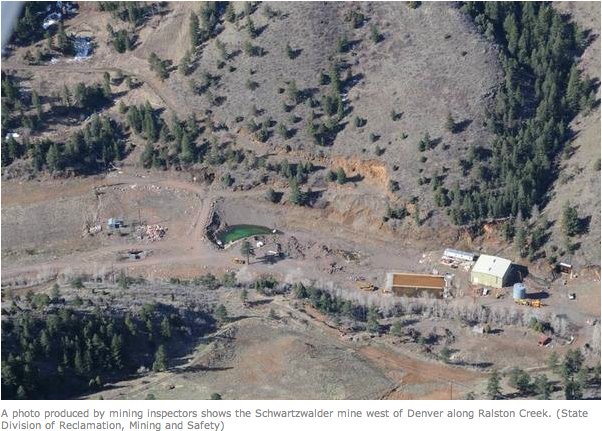
CDPHE and Cotter Corp agree on a plan to end the Schwartzwalder Mine’s pollution of Ralston Creek with uranium — pumping and treating groundwater

schwartzwalderminedivisionofreclamationminingandsafety.jpg

The two parties have agreed on the geology and now believe they can pump enough water to lower the levels of water in the main shaft 150 feet below the Ralston Creek alluvium. The same approach being used at California Gulch; the perpetual pumping and treating of groundwater. Proof that the energy costs for uranium extraction sometimes never end. Here’s a report from Bruce Finley writing for The Denver Post. Here’s an excerpt:

The latest test data show that highly toxic water in the Schwartzwalder mine’s main shaft seeps underground into Ralston Creek, which flows to Ralston Reservoir.

A settlement deal requires Cotter to pump and treat millions of gallons of water and lower the level to 150 feet below the top of that 2,000-foot-deep shaft. This is intended to prevent uranium — in concentrations up to 1,000 times the health standard — from contaminating water supplies.

Cotter also must provide $3.5 million in financial assurance money to ensure cleanup of the mine west of Denver is done and pay a civil penalty of $55,000. Another $39,000 in penalties is to be waived.

The deal, approved by state regulators, ends Cotter’s lawsuits challenging state orders to clean up the mine and the creek. A state judge ruled in favor of regulators and Cotter appealed the decision.

More nuclear coverage here and here.

Governor Hickenlooper asks the Corps of Engineers to expedite the permitting process in Colorado

superhick.jpg

From FoxNews.com (Kelly David Burke):

“More politicians like the governor are getting it these days and saying, look, we simply have to figure out the water piece,” according to Brian Werner, spokesman for the Northern Colorado Water Conservation District. “It has been decades since this state has really built the (water) infrastructure that is needed for the future.”

In a recent letter to Obama, Gov. Hickenlooper wrote, “Colorado is at a critical juncture in forging a more secure future for the development and management of water supplies critical to both our economy and the natural environment that makes our state so great.”

Not everyone is applauding the governor’s stance, however. “If Colorado’s population is going to continue to grow, we need to focus on alternatives to draining and destroying our rivers,” says Gary Wockner, director of the Save the Poudre Coalition. He says those alternatives should include, “water recycling, water conservation, re-using water, better growth management and, especially, working cooperatively with farmers.”

The Cache La Poudre River runs from its origins in Rocky Mountain National Park down a spectacular canyon designated under the federal Wild and Scenic Act. As it leaves the canyon, northwest of Fort Collins, Colo., it runs past a large valley that is the proposed site of a massive new reservoir to be filled with water diverted from the river.

“Well, it’s been proposed in some form or another 20 years ago,” according to Werner, whose agency has been shepherding the Northern Integrated Supply Project. “We’ve been in the environmental permitting process, the formal piece of this for the last 10 (years).”

It’s that lengthy approval process that has the governor concerned. In a separate letter to the Army Corps of Engineers, which is in charge of the environmental review, Hickenlooper writes, “Given the ongoing drought conditions in Colorado and the pressing need for water supplies in both communities and agriculture, we hope that the Corps is making this project a high priority.”

More infrastructure coverage here and here.

‘We have had it good in the Yampa Valley for a long time when it comes to water’ — Todd Hagenbuch

yamparivereofmaybell.jpg

From Steamboat Today (Matt Stensland):

Some of the state’s leading water experts are coming to Steamboat Springs to share their knowledge during a forum Thursday at Colorado Mountain College’s Alpine Campus…

The discussion Thursday will focus on the future and how to meet the legal and financial demands given mounting pressures to supply water to the populated areas east of the Continental Divide.

“We have had it good in the Yampa Valley for a long time when it comes to water, but this summer’s water shortages and the ensuing administration we saw on stretches of the Yampa and Elk rivers is just the beginning,” Routt County Extension agent Todd Hagenbuch wrote in an email Tuesday.

Community Agriculture Alliance Executive Director Marsha Daughenbaugh said she expects the event will be well-attended, especially by CMC students who are studying sustainability. The event is free for CMC and high school students with a school ID, $15 for the general public and $10 for Community Agriculture Alliance members. Registration starts at 5:30 p.m., and the program is from 6 to 9 p.m. People are encouraged to carpool or use alternative transportation because of limited parking at the college.

Daughenbaugh said the focus of the event is not so much to debate the issues, but to focus on financial or legal obstacles the Western Slope may face. That could include the distribution of agricultural water rights for industrial or recreational purposes.

More Yampa River Basin coverage here and here.

Drought news: Snow possible in the mountains #CODrought

The COGCC re-opens setback and water quality rules

derrick.jpg

From Steamboat Today (Tom Ross):

The timetable for the rulemaking process ideally would conclude in early January in advance of the beginning of the new legislative session, Matt Lepore, director of the Colorado Oil and Gas Conservation Commission, said Monday during a hearing in Steamboat Springs.

COGCC member Mike King, who also is the executive director of the Colorado Department of Natural Resources, said he would support going forward with the rulemaking process…

He fended off any notion that the state’s recent lawsuit filed against the city of Longmont over its oil and gas regulations signals that the governor’s office is not looking out for the interests of local communities…

The COGCC met before more than 60 people in a meeting room at the Routt County Justice Center and listened to comments from about 20 people, including 15 Routt County residents. The first nine to speak either were members of the local Citizens Supporting Property Rights group or sympathized with the view that Routt County’s Board of Commissioners is obstructing their right to develop the subsurface mineral rights they own…

Lepore told the oil and gas commissioners that the timetable for the rulemaking process requires a statewide public notice to be published by Oct. 15 to allow the rules to be taken up during a regularly schedule commission meeting Nov. 15. He anticipated an additional special meeting in December followed by a vote on whether to adopt any new rules Jan. 3.

More coverage from Bruce Finley writing for The Denver Post. Here’s an excerpt:

Commissioner DeAnn Craig, an industry consultant, called for weighing costs and benefits before any change is made. “What are we trying to achieve by changing the setback rules?” Craig asked during a commission meeting held in Steamboat Springs. “What risks are we trying to mitigate?”

Requiring greater setbacks of wells from buildings could prevent extraction of oil, she said. “If there’s a loss of value to the owner of these resources, will there be a reduction in taxes?” she asked…

The decision reflects widening public opposition and efforts by more than a dozen municipalities and counties to impose local restrictions as oil and gas drilling moves closer to urban communities. State officials are concerned that unless state rules get tougher, a patchwork of local government rules will create uncertainty and delay.

A proposal floated by COGCC staffers, after 11 sessions with stakeholders, addresses setbacks and calls for mandatory monitoring of groundwater. The proposal doesn’t increase existing setback distances, which allow wells as close as 150 feet from buildings in rural areas and 350 feet in high-density areas. However, the proposal would require more consultation with residents who might be affected by doubling the period for public comment to 40 days for wells proposed within 700 feet of buildings. It also would require companies to mitigate noise, dust, odor, traffic and industrial lighting.

More coverage from Cathy Proctor writing for the Denver Business Journal. From the article:

The state already requires groundwater tests around drilling sites in parts of La Plata and Weld counties. The Colorado Oil & Gas Association, which represents the industry, promotes a voluntary statewide program that the association says covers about 93 percent of the wells drilled across the state. The COGCC is proposing to expand its mandatory program statewide.

The COGCC’s setback proposal increases the minimum possible distance between a well and a building to 350 feet, from 150 feet, unless all landowners within the 350-foot radius give their written consent to the location. It also adds more requirements for operations.

Meanwhile Governor Hickenlooper is standing fast in the State’s lawsuit against the City of Longmont over their oil and gas regulations. Here’s a report from Scott Rochat writing for the Longmont Times-Call via the Boulder Daily Camera. Here’s an excerpt:

Gov. John Hickenlooper said that Longmont would do better to address its oil and gas concerns through agreements instead of regulation, in a return letter this week to 82 town, city and county officials that included Mayor Dennis Coombs.

The 82 had written Hickenlooper last week as a show of support for Longmont, which has been sued by the state over the city’s new oil and gas rules. State officials object to eight different aspects of the regulations, including a restriction on drilling in residential zones…

But Hickenlooper, in a letter dated Wednesday and released Thursday, said the state already had sufficiently strict regulation and that it preferred to work directly with communities, or have them work with the oil and gas companies, to address any local concerns.

“To be clear at the outset, suing Longmont was last — and not a first — resort for our administration,” Hickenlooper said. “This decision was only made after attempts to resolve the State’s concerns were unsuccessful.”

On the same day Longmont adopted its new regulations, it also announced an agreement with the area’s largest drilling company, TOP Operating. In that agreement, TOP agreed to observe several restrictions citywide, including mandatory water quality monitoring and a 750-foot separation, or “setback,” between their wells and any buildings.

Hickenlooper said he was pleased to see the agreement, but that the city’s determination to “harden jurisdictional lines” by adopting its new rules made a legal response necessary.

More oil and gas coverage here and here.

2012 Colorado November election: Rifle city officials pitch sales tax hike as relief for water rate payers

riflegap.jpg

From the Rifle Citizen Telegram (Mike McKibbin) via the Glenwood Springs Post Independent:

Question 2A on the Nov. 6 general election ballot asks Rifle city voters if a 0.75 percent sales and use tax hike should be approved. It would take effect in January and increase the city’s sales and use tax rate from 3.5 percent to 4.25 percent. The added tax would raise an estimated $1.65 million a year. The issue has not led to any organized opposition…

In a memo to City Council, City Manager John Hier recommended that if the sales tax is approved, the city should eliminate a second water rate increase planned for April 2013, and lower the recent increase, “so the combined revenue from the sales tax and new rates will generate only that revenue needed to pay the debt service and increased operation and maintenance cost on the new plant.”

Due to the rock-bottom loan rate received from the state agency, Hier wrote in the memo, “it may be possible to lower … monthly base rates to $23 per month and significantly reduce the … tier rates.”

When the debt on the water plant is paid off, the 0.75 percent sales and use tax will end.

More Rifle coverage here and here.
NWS: Statistical preview of Denver’s October weather

Here’s the link to the preview from the National Weather Service Denver/Boulder office. Here’s an excerpt:

DENVER’S MONTHLY MEAN TEMPERATURE FOR OCTOBER IS 50.9 DEGREES (1981-2010 AVERAGES) AND IS DENVER’S FIFTH WARMEST MONTH OF THE YEAR BEHIND JULY, AUGUST, JUNE AND MAY RESPECTIVELY. THE MONTH STARTS WITH A NORMAL HIGH OF 72 DEGREES AND ENDS WITH A NORMAL HIGH OF 59 DEGREES. FOR LOW TEMPERATURES, THE MONTH BEGINS WITH A NORMAL OF 42 DEGREES AND TRENDS BELOW THE FREEZING MARK TO FINISH WITH A NORMAL OF 31.

THE WARMEST TEMPERATURE EVER RECORDED DURING THE MONTH OF OCTOBER, SINCE RECORDS BEGAN IN 1872, WAS 90 DEGREES AND OCCURRED ON THE FIRST DAY ON THE MONTH WAY BACK IN 1892. THIS IS ALSO THE LATEST 90 DEGREE OR HIGHER TEMPERATURE DENVER HAS RECORDED. THE COLDEST TEMPERATURE EVER RECORDED IN DENVER FOR OCTOBER WAS A FRIGID -2 DEGREES AND OCCURRED ON THE 29TH DAY OF 1917…

ALTHOUGH SEPTEMBER IS THE FIRST MONTH OF THE SNOW SEASON IN DENVER, OCTOBER IS THE MONTH WHEN DENVER AND THE ENTIRE FRONT RANGE BEGIN TO SEE THE STRONG LIKELIHOOD OF COLD PACIFIC STORM SYSTEMS BRINGING THE SEASON’S FIRST REAL SNOWFALL. SINCE SNOW MEASURING BEGAN IN DENVER IN 1882, MONTHLY SNOW TOTALS OF GREATER THAN 0.1″ HAS OCCURRED 100 TIMES WITH 15 YEARS RECEIVING A TRACE AND THE 15 YEARS MISSING OUT ENTIRELY FROM ANY SNOW…

AFTER 7 CONSECUTIVE MONTHS OF ABOVE NORMAL TEMPERATURES IN THE DENVER AREA ALONG WITH BELOW NORMAL PRECIPITATION TOTALS FOR SPRING AND SUMMER PERIOD, THE MID TO LONG RANGE FORECAST MODELS CONTINUE TO INDICATE A BIAS TOWARD THE STABLE DRY WEST TO SOUTHWESTERLY FLOW ALOFT OVER COLORADO. THE CLIMATE PREDICTION CENTER’S LONG RANGE OUTLOOK INDICATES A BIAS TOWARD ABOVE NORMAL TEMPERATURES WITH PRECIPITATION PROBABILITIES HOLDING NEAR SEASONAL NORMALS REGION WIDE.

IBCC: Should Colorado take a more active role in the Flaming Gorge Pipeline?

greenwithenvytrailerscreenshottroutunlimited.jpg

Here’s the meeting summary from email from Heather Bergman. Here’s an excerpt:

After the last meeting, Jacob Bornstein and Tim Murrell conducted research on state involvement in water projects in Colorado and other states in West. Jacob and Tim presented information to Committee members regarding the role of the following states in existing and future new supply projects: Arizona, California, Colorado, Kansas, New Mexico, Texas, Utah, and Wyoming. Following the Committee members’ discussion about this presentation, they considered the pros and cons of the State of Colorado having a role in a potential Flaming Gorge project. This information was provided as research only and was not intended as support for a particular type of state role in a water project in Colorado…

Based on Committee members’ discussion regarding potential options for a State role in water storage projects, most of the group agreed that the State is currently doing well with its overall involvement in water project planning, development, and implementation. However, Committee members discussed potential expansions or improvements that could be made to the State’s function in the areas of leadership, research, and coordinating efforts related to new water projects in Colorado. Several other ideas for how the State could improve its role in water projects emerged during the Committee’s discussion…

More Flaming Gorge Task Force coverage here.

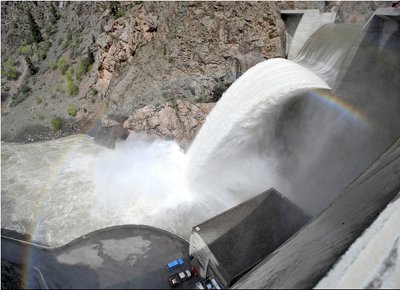
Aspinall Unit update: 300 cfs in the Black Canyon

crystaldamspill052009.jpg

From email from Reclamation (Erik Knight):

Gunnison River flows at the Whitewater gage continue to stay above 1000 cfs and are forecast to remain that way for the upcoming weeks. The baseflow target for endangered fish, as measured at the Whitewater gage, is 790 cfs for the month of October. With tributary flows continuing to support flows in the lower mainstem of the Gunnison River, now seems like a good time to reduce releases from the Aspinall Unit to save the limited storage remaining in Blue Mesa Reservoir. Therefore releases at Crystal Dam will be reduced today, October 1st, by 150 cfs. This will bring flows on the Gunnison River within the Black Canyon down from 450 cfs to 300 cfs. Flows at the Whitewater gage are expected to decline towards 800 cfs after this release change.

From The Grand Junction Daily Sentinel (Gary Harmon):

The U.S. Bureau of Reclamation started banking water Monday for next spring, squeezing releases from Crystal Dam.

Officials with the Aspinall Unit on the Gunnison River reduced flows down the river by 150 cubic feet per second, an amount that will cut flows on the river through the Black Canyon of the Gunnison National Park from 450 cfs to 300 cfs.

“We’ll be down near minimum flows as the river goes through the park,” said Erik Knight, a hydrologist with the bureau’s Grand Junction office.

The bureau usually begins restricting flows Oct. 1, but this year it also has to factor endangered fish downstream into its management of the river.

Tributary flows are contributing enough water to the river below the Gunnison Forks that the river was running at 1,000 cfs at Whitewater.

The change will reduce flows at Whitewater to about 800 cfs.

The bureau is hoping to end December with about 315,000 acre-feet of water stored behind Blue Mesa Dam.

The maximum wintertime storage is 581,000 acre feet and, “We’re well below that,” Knight said.

“We’re just hoping for next springtime” to swell the reservoirs again.

Paonia Reservoir, which is used for irrigation, will begin filling this November.

It generally fills each year and is expected to do so again this winter and spring, Knight said.

“It’s the bigger reservoirs where we have a problem,” he said.

More Aspinall Unit coverage here and here.
Green Mountain Reservoir operations update: 370 cfs in the Blue River below the dam

greenmountainreservoir.jpg

Update: From email from Reclamation (Kara Lamb):

This morning [October 2] around 9 a.m., we made an adjustment to the release from Green Mountain to the Lower Blue, dropping it back by 50 cfs from 370 to 320 cfs.

The reason for the change is to keep in balance with both declining inflows to the reservoir and the declining Colorado-Big Thompson Project diversions that occur further upstream on the Colorado River, out of Granby Reservoir.

Additional changes are possible, depending on downstream demands and weather. But, there is a slight possibility the 320 cfs could hold through the weekend.

From email from Reclamation (Kara Lamb):

This morning, Monday, Oct. 1, we saw releases from Green Mountain to the Lower Blue River bounce back up. Substitution releases from Williams Fork and Wolford Mountain reservoirs decreased today by a total of about 160 cfs. Green Mountain is now releasing that water to its downstream customers. As a result, flows in the Lower Blue increased from 210 to 370 cfs.

More Colorado River Basin coverage here and here.

Fryingpan-Arkansas Project update: 80 cfs in the Fryingpan River below Ruedi Dam

fryingpanarkansasproject.jpg

From email from Reclamation (Kara Lamb):

Today, October 1, at 5 p.m., we curtailed Ruedi releases some more. As water for the Upper Colorado River Endangered Fish Recovery Program wraps up for the year, we continue to reduce releases from the dam. Today’s change dropped releases another 50 cfs, resulting in a flow of about 140 cfs at the gage below the dam. Releases will continue to drop over the course of the week. Changes will be made in 50 cfs increments until we reach about 80 cfs in the Fryingpan.

More Fryingpan-Arkansas Project coverage here and here.
CWCB: September 2012 Drought Update

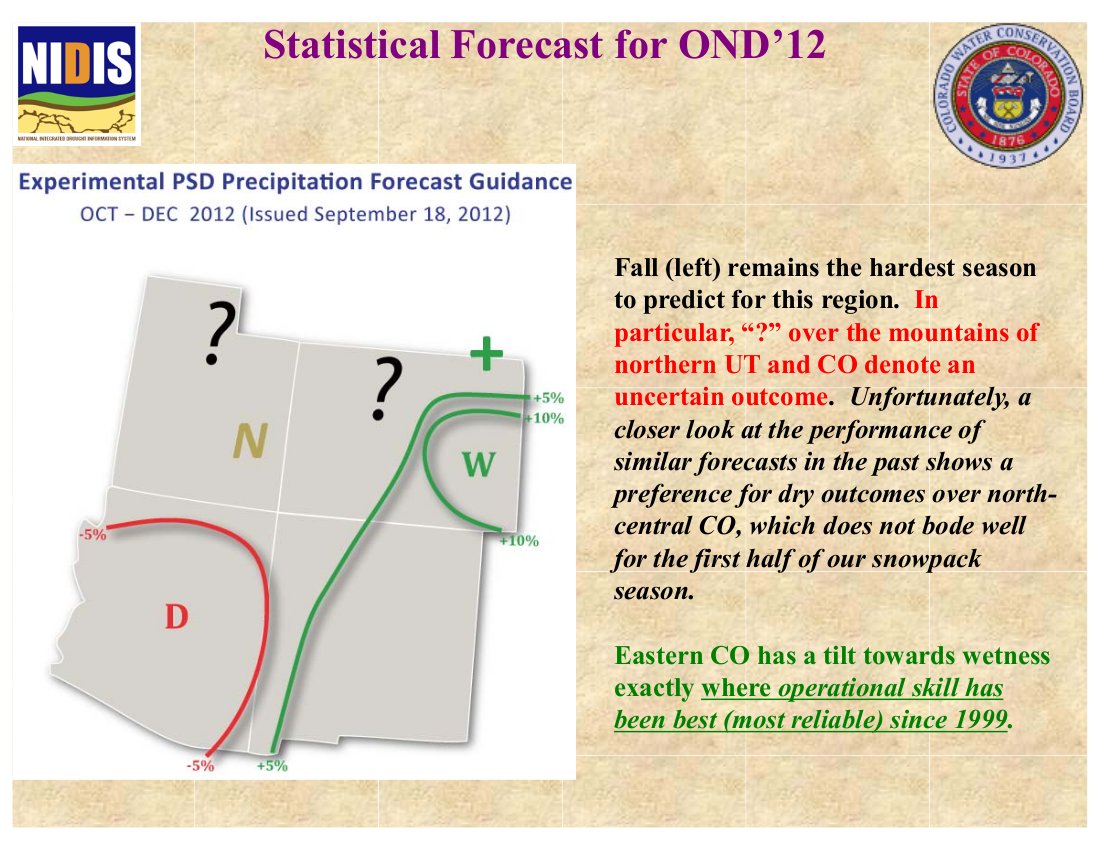
klauswolterforecastoctober2december2012.jpg

Click on the thumbnail graphic for Klaus Wolter’s forecast for October thru December.

Here’s the summary from the Colorado Water Conservation Board (Kevin Rein):

The western slope of Colorado benefited from August and September rains; alleviating but not eliminating drought conditions; while portions of the eastern plains received no measurable precipitation in August and has seen an increase in exceptional drought conditions. Temperatures in August were cooler than June and July, but were still above average. For this calendar year to date, the statewide average temperature of 51.4 degrees Fahrenheit ranks as the 2nd warmest on record (1895-2012).

 Many municipalities have activated their drought stages resulting in both voluntary and mandatory watering restrictions. Highlands Ranch is now utilizing non-renewable groundwater supplies; and Pueblo has begun to utilize their “strategic reserve” and is forecasting that they will have limited water to lease to the agriculture sector during the 2013 growing season. Should drought conditions persist this may result in further impacts to the agricultural sector within the Arkansas River basin.

 Reservoir storage is at 68% statewide. Highest storage levels are in the Yampa/ White River Basin, at 104% of average while the lowest storage in the state is in the Rio Grande River basin at 50% of average. The Yampa/ White is largely dominated by energy producers who are keeping their water in storage in case the drought persist, roughly 2/3 of storage in the major reservoirs of that basin is held by energy producers. Some Front Range providers are reporting system storage levels as low as 33%.

 Surface Water Supply Index values have improved with some areas seeing near normal conditions. This is partially the result of municipal year-to-year carryover in large projects such as the Fryingpan-Arkansas. However, the vast majority of the state remains in the severe drought category with values below -3.

 Many weather stations are on track to set new record low reference evapotransipiration rates, a result of both dry conditions as well as consistently high temperatures throughout the growing season.

 As of the September 25, 2012 US Drought Monitor, 100% of Colorado is experiencing some level of drought classification. D2 (severe) and D3 (extreme) predominate over 80% of the state. 17% of the state is experiencing exceptional drought all of which is isolated to the eastern plains. Conditions over the eastern plains have deteriorated over the last month.

 While dry conditions have resulted in decreased yields, high commodity prices have helped to alleviate some of the impacts and markets remain strong. To date, the state has seen a 40% increase in agricultural exports.

 The latest long term experimental forecast released September 24, shows a chance of increased precipitation over the eastern plains and drier conditions over the four corners region. While conditions have switched to an El Nino, which often favors wetter conditions in Colorado, this El Nino is very weak and is not expected to result in “typical” conditions.

Click here to go to the CWCB website to download all of the presentations.

I live-tweeted the meeting at Twitter hashtag #cwcbwatf.

More coverage from Chris Woodka writing for The Pueblo Chieftain:

Despite occasional rainstorms, 2012 is shaping up to be one of the hottest, driest years on record for Colorado. That could be changing, as long-term forecasts predict the Eastern Plains of Colorado, at least, could see more rain from now until March 2013. But nothing is guaranteed. “Should drought conditions persist this may result in further impacts to the agricultural sector within the Arkansas River basin,” Assistant State Engineer Kevin Rein said in the most recent report from the Colorado Water Availability Task Force.

More CWCB coverage here.

H2O Outdoors — 3 day school in Keystone for High School Students — starts up October 13

h2ooutdoorssummitdailynews.jpg

Here’s the link to the brochure from the Keystone School. Here’s an excerpt:

H2O Outdoors is a three-day, standards based, educational camp held at the Keystone Science School campus. The program, sponsored by Keystone Science School, Colorado River District, Aurora Water and Denver Water, is open to all Colorado high school students.

The aim of the program is to help students understand the issues and questions surrounding Colorado’s water resources and how the decision-making process works in real life. Students will experience firsthand where Colorado’s water comes from, learn about Colorado’s water law while hiking the Continental Divide, and conduct hands-on water quality experiments as they explore and observe their watershed. They’ll also meet experts representing actual stakeholder groups, and collaborate with fellow students to create water management policy recommendations. At the close of the program, students will present their findings during a “town hall” style dialogue.

Keystone Science School provides meals and dorm-style housing for all students and chaperones. Thanks to generous sponsorships from the Colorado River District, Aurora Water and Denver Water, the program is offered at no charge to participants and requires only a nominal administrative fee. Our goal is to create a program with a diverse geographic representation of students across Colorado.

More education coverage here.

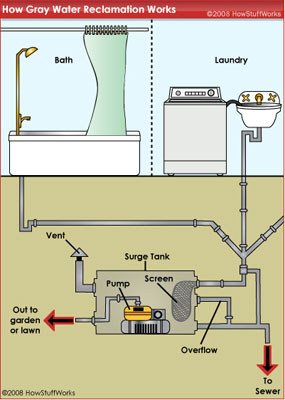
Boulder: Council to consider new agreement to allow testing of graywater system for dormitory

graywatersystem.jpg

From the Boulder Daily Camera (Erica Meltzer):

The city’s Water Resources Advisory Board has already recommended approval of the agreement. The Boulder City Council will consider it Tuesday.

The dorm, which opened in fall 2011, houses 500 students near Baseline Road and 30th Street and received top green credentials from the U.S. Green Building Council, becoming the only residence hall of its size in the nation to earn the Leadership in Energy and Environmental Design platinum rating for its sustainability features. However, the university hasn’t yet been able to take advantage of additional plumbing installed during construction that would allow water from sinks and showers to be captured, filtered, treated and reused for flushing toilets. That’s because case law around water rights in Colorado protects downstream users from the potential loss of water that gets reused instead of being returned to the watershed…

However, that may be less of a concern when graywater is used in toilets — which ultimately send water into the same wastewater treatment system that handles water from sinks and showers — than it is when graywater is used for irrigation, Arthur said.

As part of the agreement, CU will carefully monitor water use in the building and report all that information to the city. Arthur said that will allow city officials to assess the impact of graywater systems on the larger water delivery and treatment system and might provide the basis to lobby for changes to state law…

In the meantime, the city is designating water from the Western Slope that it receives through the Colorado-Big Thompson water project for Williams Village North. Because that water is not from the Boulder Creek watershed, it’s subject to different rules and is eligible for reuse, Arthur said. That way, no downstream users should complain they aren’t getting all the water they are owed.

More graywater reclamation coverage here and here.

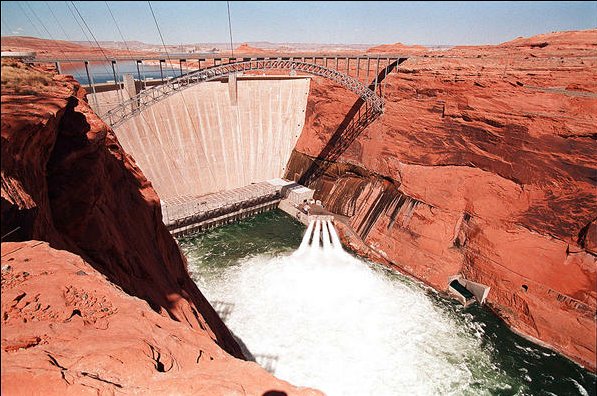
Glen Canyon Dam: Reclamation is considering a high flow release in November for habitat improvement #coriver

glencanyondamdischargetomsmart.jpg

From the Summit County Citizens Voice (Bob Berwyn):

Lake Powell, the key reservoir in the Colorado River system, ended the 2012 water year at just 57.5 percent of full and will continue to drop through the fall, with a steady release of about 8,000 cubic feet per second scheduled through October.

Despite the low-water year, the Bureau of Reclamation is considering implementing a high-flow regime in November, as part of an effort to mimic natural flood conditions on the great River considered essential for maintaining wildlife habitat and potentially reducing erosion of archaeological sites.

The high flows may also enhance riparian vegetation, maintain or increase camping opportunities, and improve the wilderness experience along the Colorado River in Grand Canyon National Park. The protocol is designed to take full advantage of sediment provided by tributaries of the Colorado River as a result of rainstorms and monsoons.

According to BuRec, preliminary sediment estimates appear favorable for a high flow experimental release to occur during the period of November 18 – 25, 2012 should sediment and other conditions warrant.

The total water release for the year from Lake Powell was about 9.46 million acre feet. The inflow during the peak April through July runoff season was just 2.06 million acre feet, which is 29 percent of average and the third-lowest April-to-July period on record, behind 1977 and 2002.

More Colorado River Basin coverage here and here.
2013 Colorado Legislation: Interim water resources committee moves 6 bills forward

burlingtonditchheadgatehistoricalbdrc.jpg

From The Pueblo Chieftain (Chris Woodka):

Five bills to protect water rights, another to change stormwater permit process and two resolutions were approved last week by the interim water resources committee. The actions represent concerns brought to the committee, which includes members of both houses, over the last two months by water users throughout the state. They will be referred to the full Legislature in 2013.

One seeks to address questions of the amount and location of acreage intended to be irrigated by older water rights. When the water rights are changed in court, lawyers argue over the original intent of the irrigator. The new law would change the determination to the maximum amount of land irrigated during the first 50 years after the original decree. It would apply to water rights claimed more than 75 years ago, when it is unlikely that those who claimed the right would still be living to testify about intent.

Other bills involving water rights protection include:

● A remedy for erroneous points of diversion caused by technical errors or refinements in surveys. The bill would allow water rights to be more easily amended.

● A bill to promote conservation of water in designated groundwater basins by avoiding penalizing those who conserve water, while maintaining the volume authorized by a groundwater commission.

● A measure that limits a landowner’s ability to impose restrictions on water rights used on that land. The bill was inspired by the U.S. Forest Service attempt to tie up ski area water rights.

● Deletion of the requirement for a final permit for wells in the Denver Basin aquifers. Another bill would require the state to follow rule making procedures when changing stormwater permits.

That would mean the state providing permit holders a basis for the changes, evidence about why the change is needed and a costbenefit analysis.

The resolutions oppose diverting mineral severance tax revenues from water projects to meet funding needs in other parts of the state budget and oppose the Forest Service water permit requirement for ski areas.

More 2013 Colorado Legislation coverage here.