

From KRDO (Dana Molina):
Residents of the Zinno Subdivision in Pueblo County said they recently received a letter stating their new water restrictions. According to the letter, each household can use only 62 gallons of water a day. Exceeding that limit results in fines. Outdoor watering results in a $1,000 fine. A second violation of outdoor watering restrictions results in a customer’s service being shut off. Residents said these are too strict to follow. “There’s no way I can live in fear every day,” [Melinda Ingo] said. “I have four children. I have to do laundry, I have to do dishes.”
The Joseph Corporation gets its water rights from the Colorado Water Protective and Development Association. In its letter to residents, it says the water restrictions come from the CWPDA.
But according to residents, the problem is how their neighborhood is being treated. A letter from the CWPDA refers to it as a farm unit.
David Stanford, utilities manager at the Joseph Corporation, said the area once was a farm unit. And that tapping into another water source would result in extremely high rates.
From The Mountain Mail (Joe Stone):
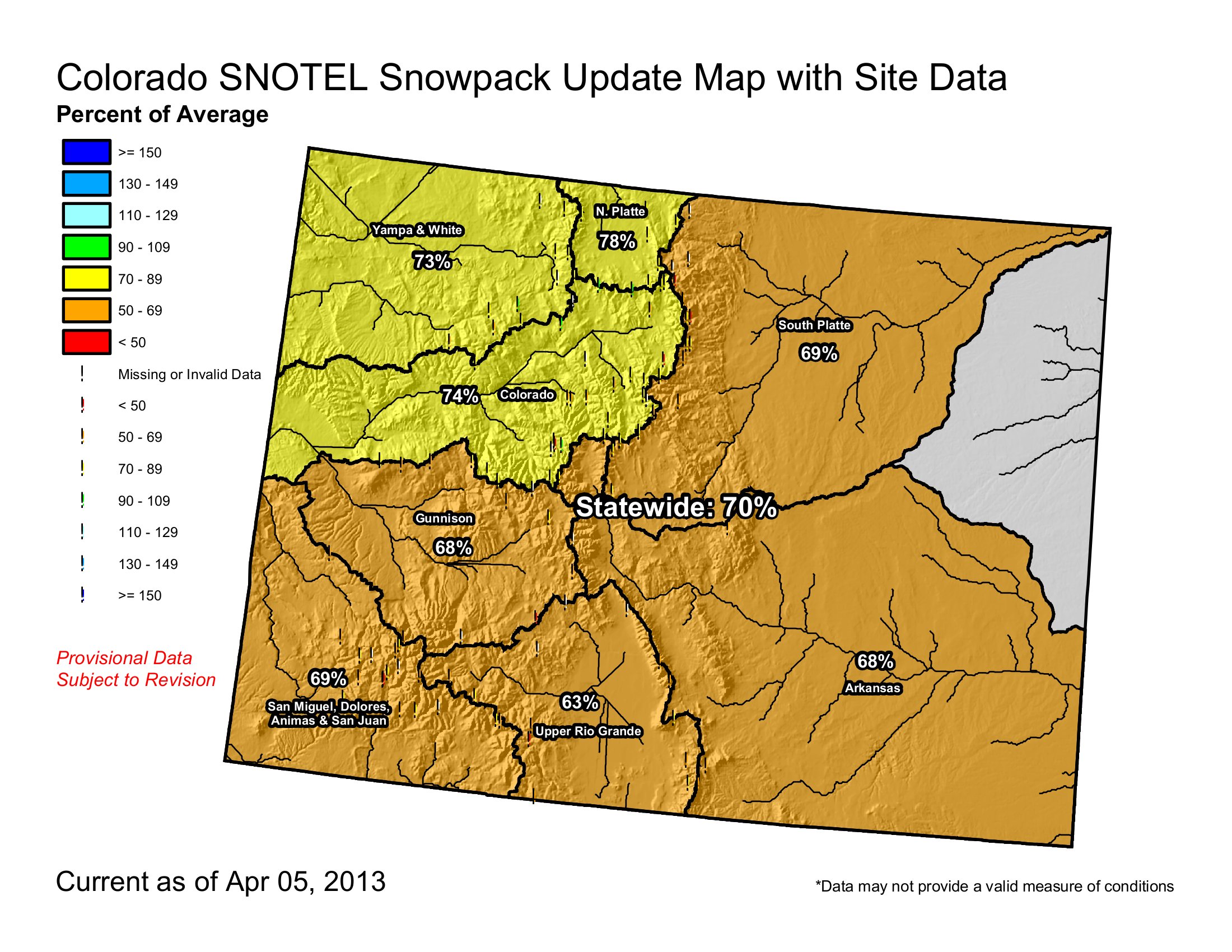
March snowfall increased snowpack in the Arkansas River basin to 74 percent of average, up from 71 percent March 1. Natural Resources Conservation Service data indicate snowpack percentages in the upper Arkansas basin ranging from 66 percent at Twin Lakes Tunnel to 88 percent at Porphyry Creek. While the numbers remain below average, snowpack stands at 122 percent of 2012 levels in the basin.
Reservoir storage in the basin stands at 55 percent of average and 64 percent of 2012 levels.
Phyllis Ann Philipps, state conservationist with the NRCS, said March snowfall “produced a nominal increase” in statewide snowpack, from 73 percent of average March 1 to 74 percent on April 1. Most major basins saw slight improvements to snowpack percentages during March, she said. “While the state snowpack remains well below normal, the good news is that most basins continue to accumulate snow and have yet to reach their peaks for the year.”
However, the southwest portion of the state saw significant decreases in snowpack percentages this month. The Gunnison and Upper Rio Grande basins saw declines of 3 and 11 percent, respectively. The combined San Miguel, Animas, Dolores and San Juan basins lost 12 percentage points. These basins have likely reached their peak snowpack for the year and are headed into the melt phase, Philipps said.
Colorado River basin snowpack, which supplies transbasin diversions into the Arkansas basin, increased from 70 percent to 74 percent of average. The South Platte and North Platte basin snowpacks increased by 6 percent.
The NRCS reports that Colorado receives approximately 20 percent of seasonal snow accumulation during March, but this year’s March snowfall was well below normal. April 8 is the average date of peak snowpack in Colorado, leaving “almost no chance that the snowpack will reach normal conditions before beginning to melt.”
Reservoir storage remains well below average statewide, and all major basins in Colorado are expected to see below-average streamflow runoff this spring and summer.
From The Denver Post (Jordan Steffen):
Heavy snowstorms and cooler temperatures helped boost Colorado’s statewide snowpack to 74 percent of average in March — almost double the levels at this time last year. Snow surveys showed that Colorado’s snowpack increased 1 percentage point from March 1 to April 1, according to the Natural Resources Conservation Service. That marks the third consecutive month that Colorado’s snowpack jumped by a percentage point…
All major basins in Colorado are expected to see below average runoff this spring and summer, according to the conservation service.
Reservoir levels in the state also remain below normal. As of April 1, average reservoir levels are at 71 percent of normal, 5 percentage points higher than this time last year.