

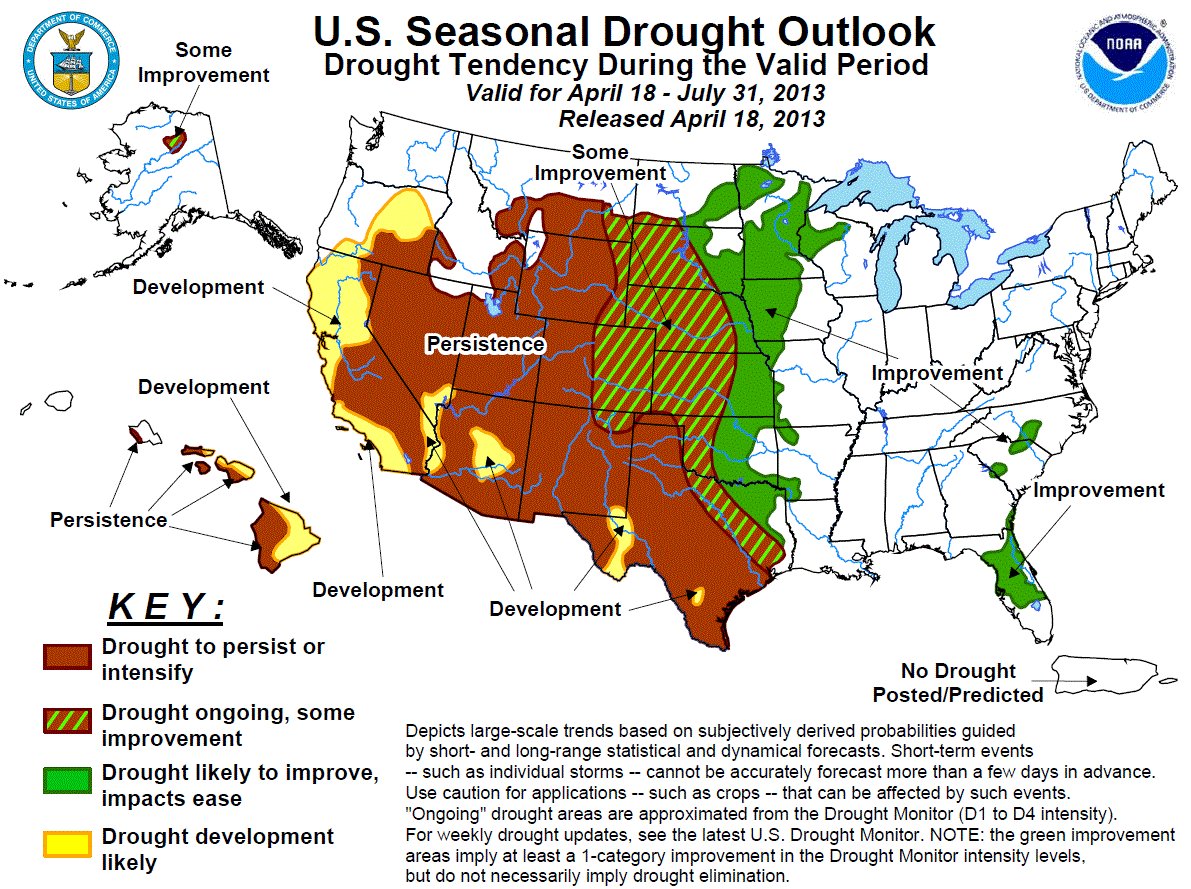
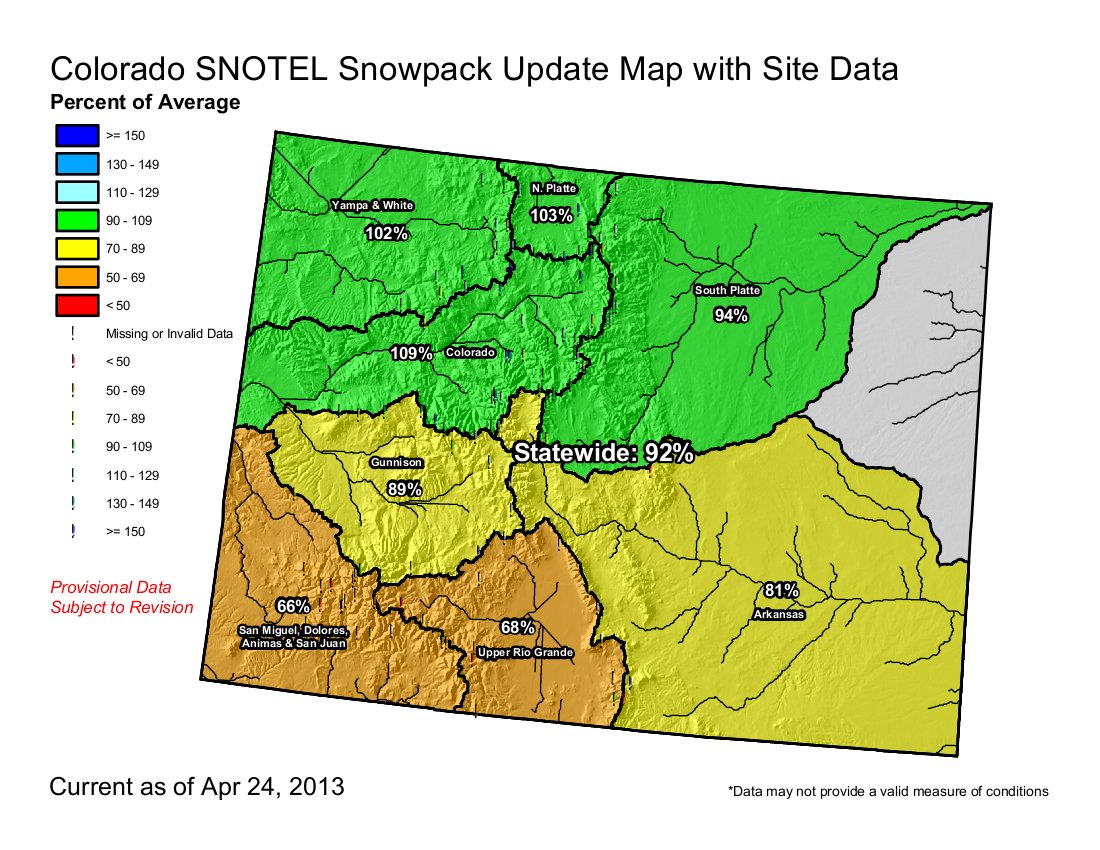
Click on the thumbnail graphics for the current US Drought Monitor, the current drought outlook from the Climate Prediction Center and the current statewide snowpack map from the Natural Resources Conservation Service.
From The Denver Post (Joey Bunch):
On average, Denver Water’s customers use 120 million gallons in March. This year that figure dropped by 16 million gallons. For the first 17 days of April, customers used 40 million gallons less water — 105 million instead of the normal 145 million. That’s more than 21 percent less water used for the early spring period…
Denver’s weather-monitoring site at Denver International Airport has received 20.4 inches of snow in April, a month when it normally gets 9. Closer to the mountains, Wheat Ridge has collected 29.5 inches this month, according to the National Weather Service. In March, Denver received 23.5 inches of snow, helping boost the city’s total for the season to 75 inches, way above the average tally of 57.5, according to the weather service’s data.
From The Wet Mountain Tribune (Nora Drenner):
This week’s snow/water equivalent is 15 inches or 71 percent of average. The average for this time of year is typically 21.1 inches. The current Arkansas River basin-wide snow/water equivalent is 80 percent of average…
The precipitation measurement is yearly snow, rain, hail and sleet. This week’s year-to-date precipitation is 18.8 inches or 79 percent of average. The average for this time of year is 23.9 inches.
The basin-wide year-to-date precipitation is currently 72 percent of average for the Arkansas River Basin, while the snowpack stands at 79 percent of average.
Statewide, snowpack levels are at 90 percent of average, based on the following averages for the state’s eight river basins: Upper Rio Grande 70 percent; San Miguel/Dolores/Animas/San Juan, 71 percent; Arkansas 79 percent; Gunnison, 88 percent; South Platte 88 percent; White/Yampa 98 percent; North Platte 102 percent; and Colorado, 103 percent.
From The Fort Morgan Times (Bruce Bosley):
The South Platte communities from Kersey to Sterling have received from 2.66 to over 3.13 inches total precipitation this year so far. Greeley, Iliff, and Crook weather stations have recorded less total precipitation: 1.44″, 1.78″ and 2.32″ respectively.
These same storms have missed much of the high plains south and east of the South Platte Basin. In this area, Akron and Holyoke have received the most: 1.43″ and 1.38″ respectively. Farms south and east of there have missed many of these storms, getting just a fraction of the moisture during this same period. Yuma, Wray, Burlington, Stratton and Last Chance weather stations have received less than 0.8 of an inch this year.
Dryland winter wheat fields in the High Plains region and further south are struggling to survive. March and April precipitation has helped fields located in the South Platte basin to catch up to seasonal average soil moisture reserves after the lingering effects of the 2012 drought. The lack of precipitation for this same period south and east of the South Platte Basin has further resulted in droughty soils. The freeze injury on the wheat plants is only part of the challenges that fields in this area have to cope with.
Making matters worse for the high plains farmers is that, while wheat is their No. 1 crop, the continued drought may prevent them from planting corn, millet, sunflowers and other summer crops unless they get favorable rains later this month through early June.
Here’s an editorial about Aurora’s water customer reactions to the city’s drought mitigation efforts from The Aurora Sentinel. Here’s an excerpt:
Here’s the problem. For the past decade, as Aurora water and tap rates have climbed ahead, and far ahead, of other metro-area water rates, city officials have assured everyone that the much ballyhooed Prairie Water Project, which cost about $660 million, would “drought harden” the city’s water system, preventing water shortages during lean snow-pack years. The fear of going dry was instilled in city lawmakers after a sustained drought at the turn of the century, prompting a complex marvel that pumps South Platte water miles downstream of Aurora back up to the city.
Here’s the public-relations problems Aurora has painted itself into:
Each time city council members approved water rate hikes, they lauded the Prairie Water project publicly for protecting the city during droughts. In 2010, water rates increased by 7.5 percent over 2009, in 2009 they increased by 8 percent, and in 2008, 2007, and 2006 there was a 12-percent increase. In 2003 and 2004 water rates increased by 15 percent over the previous years to pay for the Prairie Waters project.
It was a lot of rate hikes, and a lot of bragging. Last year, the city controversially agreed to sell water to Andarko for fracking, sell water for bottling, lease water to other cities, and kept bragging about how lucky city residents are for having invested in the Prairie Waters Project.
City residents are feeling so lucky right now as they look at big water bills and big water restrictions, the same restrictions other metro-area cities must endure without the financial burden of the magnificent Prairie Waters Project…
But for most residents, the perception is that Prairie Waters did nothing to “drought harden” the water system, but it did plenty to hike their water bills. They have nothing else to conclude since they’re under the same watering restrictions as their municipal neighbors paying much less for their restricted water…
The reality is, Aurora’s water system and problems are hugely complicated. Even though the city is netting more potentially potable water, it needs more local storage. And the reality is, we don’t have more storage, we can’t afford to build more storage, and the city’s available water situation isn’t as dire as Aurora officials are making it out to be.
From The Grand Junction Daily Sentinel (Dennis Webb):
A Bureau of Land Management official says recent precipitation has boosted the prospects for reseeding efforts taking hold in the area of the Pine Ridge Fire, and he is hoping for more moisture. “This last storm that we got, where we got the snow here in the valley, was very timely because it was starting to dry out,” said Jim Dollerschell, a rangeland management specialist for the BLM in Grand Junction.
Last summer’s Pine Ridge Fire burned some 14,000 acres near De Beque in the largest fire ever within the Grand Junction BLM office’s jurisdiction. Continuing dry weather last year limited seed germination of a temporary, quick-growing cover crop. The BLM this year did aerial seeding involving a variety of vegetation, mostly native, with an eye toward longer-term stabilization. Dollerschell said he visited the area a few weeks ago and some grass seedlings were sprouting. With the recent storms being followed by warmer temperatures, he’s expecting more growth now.
Seeing some germination has been promising. He’s hoping for rain to get through May and June, with the expectation that the vegetation then benefits from monsoon moisture in July and August. “June is a tough month, so dry and hot. If we can get plants up pretty good before that hits, they’ll stand a pretty good chance of surviving,” he said.
The susceptibility to erosion was demonstrated shortly after the fire occurred. A storm resulted in ash and debris reaching the Colorado River. The Clifton Water District shut down its river intake for more than a day. Part of the problem is that a lot of the burned area consisted of solid sagebrush or piñon-juniper forest, without much existing understory vegetation that could grow back after the fire, he said. He said that with the time it will take for the reseeding to take hold, “nothing’s really going to be too stable up there for another year or two.”