
From the North Forty News (Dan MacArthur):
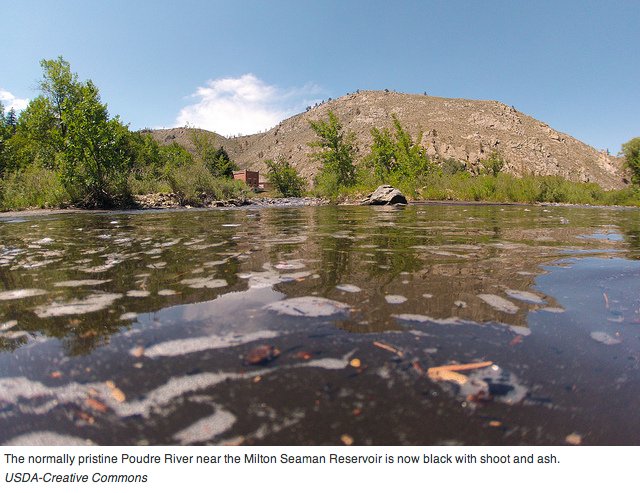
Sponsored by Fort Collins Utilities Services, the July tour took participants through forests scorched by the High Park Fire to learn about the special challenges of treating water laden with ash and sediment flowing from charred slopes.
From there it moved to the top of Cameron Pass, where the Upper Cache la Poudre River watershed begins. A stop at the Gateway Natural Area on the return trip offered the opportunity to identify the microscopic bacteria in the river that could make one dance a more frantic jig were they not intercepted before flowing from our taps.
“Basically the reason (Fort Collins) was founded was water,” explained Clyde Greenwood. The utility and water supply supervisor serves as the utility’s resident historian.
Greenwood said Fort Collins was fortunate in that there were no mines in the Poudre Canyon watershed. A watershed is the territory that drains into a body of water.
“Fort Collins is a unique town with pristine water,” he said…
Fort Collins takes half of its water from the Colorado-Big Thompson project’s Horsetooth Reservoir. The other half comes from the Poudre. As a result of quality problems caused by the fire, water supply engineer Adam Jokerst said last year the city took no water from the Poudre for 100 days and depended solely on Horsetooth. This helped the city avoid water restrictions, but reduced the amount of reservoir water it could carry over to this year.
This year, last-minute heavy snows in the high country, the availability of more C-BT water, and the ability to once again take water from the Poudre allowed the city to avoid restrictions, he said.
The main problem plaguing the city’s water supply, he said, is the lack of flexibility with limited reservoir space. “We kind of live from year to year. If we get storage, our system is pretty robust.”
More Cache la Poudre River watershed coverage here and here.