Snowpack news: Arkansas Basin = 110% of avg (best in state), Upper Rio Grande = 63%

Click on a thumbnail graphic for a gallery of snowpack data from the Natural Resources Conservation Service.

Weekly Climate, Water and Drought Assessment of the Upper #ColoradoRiver Basin

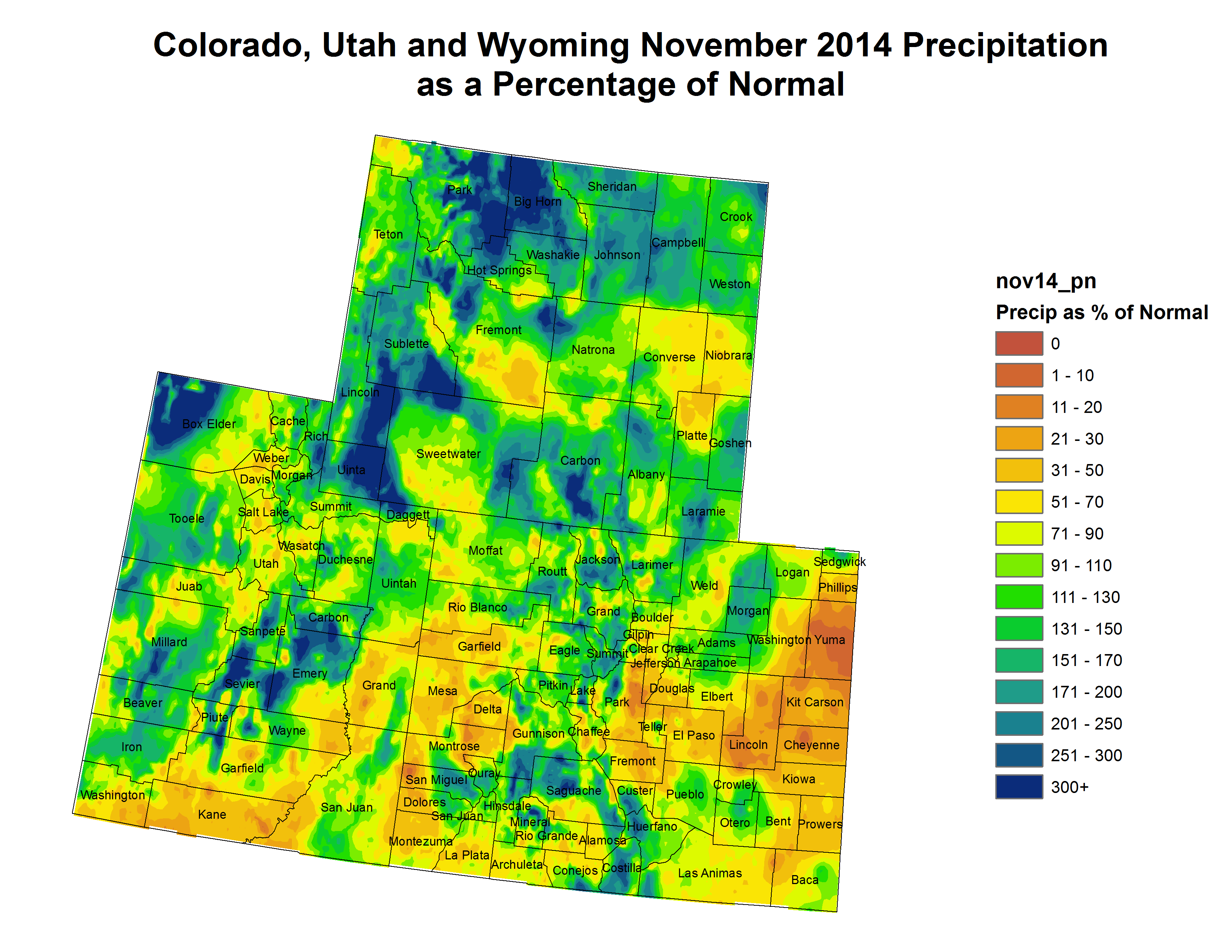
wyutcoprecipitationpercentofnormal112014

Click here to read the current assessment. Click here to go to the NIDIS website hosted by the Colorado Climate Center.

Appreciation: Lessons From the Man Who Stopped Grand Canyon Dams — National Geographic

From the National Geographic (Kenneth Brower):

“If you have to get old, get as old as you can get,” Ansel Adams would often say, raising his glass in a toast to this principle. The great outdoorsman Martin Litton, Adams’s friend and colleague in nature photography and environmental activism, certainly followed that advice. Litton, one of the last of the pioneers who shaped the modern environmental movement, died on Sunday at 97.

It was Litton who first understood the damage that a Marble Canyon Dam would inflict on Grand Canyon National Park. It was Litton who uncovered U.S. Forest Service mismanagement of the giant sequoias of California. It was Litton who knew which stands of redwoods would make the best Redwood National Park, for he had scouted them all by foot. When things began to go wrong in Kings Canyon National Park, it was Litton who alerted the rest of us.

He and a handful of others launched the environmental movement as we know it—or at least how we once knew it—as combative and to be reckoned with. “Passionate, original, tempestuous, stubborn, charming, obnoxious, courteous, inappropriate, dogged, fiery, and impossibly effective,” says Barbara Boyle of the Sierra Club, summing up the man. So go the adjectives now bouncing around the country in Litton’s wake, and in the emails of environmentalists who miss him already.

They describe, it strikes me, exactly those qualities that have gone missing from environmentalism itself. Environmental organizations are much bigger and richer than they ever were in Litton’s heyday. They are also less stubborn and passionate. Many are now run by MBAs, with more and more corporate influence on boards. There is much more preoccupation with fund-raising, much more deal-making with the other side, much less fire in the belly.

Litton’s generation brought us the Wilderness Act, the Endangered Species Act, the Wild and Scenic Rivers Act, the Environmental Protection Act, a great expansion of national parks, and a raft of other good environmental legislation. We could use that sort of explosion again…

Stopping the Dam-Builders

Litton is most famous for his crucial role in some of the first great conservation victories: the defeat of a series of ruinous dams in the Southwest. It was an article Litton wrote as a Los Angeles Times reporter—a story on a pair of dams proposed by the Bureau of Reclamation for Dinosaur National Monument—that started it all.

The dams would have flooded a national preserve and ruined some of the most beautiful desert country we have. The story caught the attention of my father, David Brower, who had just become the first executive director of the Sierra Club, then a small hiking fraternity. He, Litton, and the Sierra Club led a grassroots campaign to kill the two dams proposed for Dinosaur.

It was the first time that American citizens had stopped a big government dam project.

A decade later, the two men led the Sierra Club and other groups in stopping a similar pair of dams in Grand Canyon, which would have flooded a stretch of the Colorado River well into the national park. These victories over the dam-builders catapulted the Sierra Club into prominence, and it quickly became the most powerful conservation organization in the country…

Henry David Thoreau, one of the fathers of environmentalism, spoke of “men with the seeds of life in them.” For the daunting challenges ahead for the ecosystems and landscapes and species of this planet, the environmental movement will need men and women with the seeds of life in them—individuals, visionary, maddening, stubborn, obnoxious, fiery, impolite, fearless people like Martin Litton.

More Colorado River Basin coverage here.

Colorado Springs Fire Department graywater project will not be used for vegetable production

graywatersystem

From the Colorado Springs Independent (Pam Zubeck):

In August 2013, Fire Station 21 opened with fanfare. The building, at 7320 Dublin Blvd., was billed as the city’s premier eco-project, energy-efficient with a graywater system designed to use treated laundry and shower water for a community garden.

But the garden hasn’t been built, and the Colorado Springs Fire Department has dropped the idea of feeding vegetables with second-hand water. Instead, the station’s used water will irrigate, via drip system, the station’s landscaping, and newly installed fresh-water spigots will provide water for gardens yet to be built.

“After consultation with the director of Pikes Peak [Urban] Gardens, and El Paso County Health Department,” Deputy Fire Chief Ted Collas says in an email, “we concluded that greywater cannot be utilized for consumable agriculture.”[…]

“Firefighters come back and wash up after a fire,” he explains. “They’re dealing with people in accidents. There’s body fluids involved. That would go out in the graywater.”

So where did the misunderstanding come from? Well, project architect Jim Fennell points out that graywater can be used to irrigate gardens if done with an underground drip system. He’s spoken with the county Health Department several times, most recently in mid-November, to confirm as much.

That’s true, Stebbins says, but other places have said “under no circumstances” should it be used on edible crops (although subterranean irrigation of orchards is common). And, Stebbins says, “I think we need to err on the side of caution.”

The website greywateraction.org says water can be reused for gardening, including berry bushes, though it advises, “Greywater should irrigate the roots, not be sprayed or dumped onto the plant itself. Greywater is not safe to drink, and thus should not touch the part of a plant someone would eat.”

Given the differences of opinion, Fire Capt. Steve Oswald says the city opted to “take a conservative approach” — using the graywater on landscape greenery only…

Though the water issue caused talks to stall on a community garden at Station 21, Stebbins says he’s happy to discuss moving forward now and predicts that plots will “fill up in a heartbeat,” given there are 30 people on an urban-garden waiting list in the Old Farm area nearby.

Collas says the city hopes to build planter boxes by spring, and has installed four outdoor spigots, which are metered separately from the building, to allow gardeners to be billed for the water. Meantime, Oswald says the city is working on attaining the LEED label, which will take another 60 to 90 days.

More graywater reclmation coverage here.

Longmont approves flood repair micro-loans — Longmont Times-Call

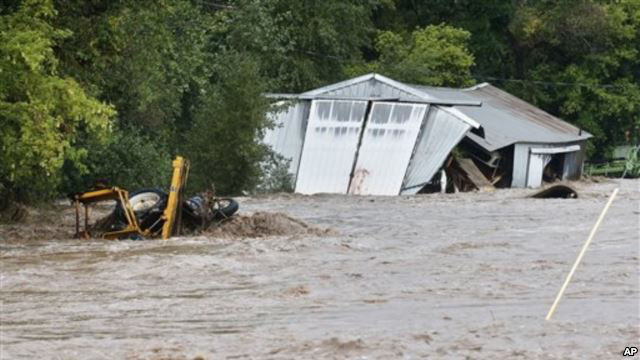
Flooding St. Vrain River September, 2013 via Voice of America

From the Longmont Times-Call (Karen Antonacci):

[Longmont City Council approved] a micro-loan program designed to assist 2013 flood victims who still need financial help…

Besides more low-income housing options, Longmont residents also have a need for a micro-loan program to help fill funding gaps for flood repair and recovery, Fedler told the council.

“These are folks that are coming up $4,000 to $5,000 short sometimes, and these are folks that struggle with credit, or have low incomes, etc., and so going to a bank to borrow the funds isn’t necessarily something they can do,” Fedler said, adding that the micro-loans would apply to people who have already maxed out available sources of funding through charity or other flood recovery programs.

The loan program works with the city and a yet-unnamed bank working to share the risk if a resident defaults on the loan. The city would carry half of the cost, and the bank the other half.

Fedler said the bank cannot be named yet because officials are still negotiating about the micro-loan program.

The program would not have a separate application process and would go out to people who the city identified through other assistance programs. Fedler said she hopes the micro-loan program could begin in early 2015.

Mayor Dennis Coombs and other City Council members expressed concerns that the loans, however small, would go to people who never gained enough financial literacy to handle money…

Fedler assured Coombs and the council that residents going through the micro-loan program would be vetted with credit checks and considered on a case-by-case basis in addition to undergoing financial counseling with the Boulder County housing counseling program.

Council member Brian Bagley said on his first reading of the loan program, he thought it sounded terrible, but he eventually warmed up to what he called an “experimental” idea.

More South Platte River Basin coverage here.

Arkansas Basin ag water changed to other uses at twice the rate of Colorado as a whole

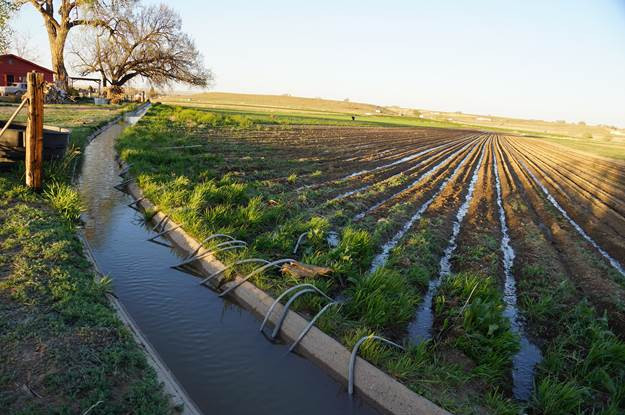
Flood irrigation in the Arkansas Valley via Greg Hobbs

From The Pueblo Cheiftain (Chris Woodka):

Water use for irrigated agriculture in the Lower Arkansas Valley has dwindled at nearly twice the pace for Colorado as a whole over the past 25 years. That information comes from a report issued last week by the U.S. Geological Survey that gives a snapshot of water use in the nation as of 2010.

ā€œIt’s a shame that we’ve lost so much farmland in the Arkansas basin,ā€ said Jay Winner, general manager of the Lower Arkansas Valley Water Conservancy District, which formed in 2002 to protect water resources. ā€œOur friends in El Paso County and Aurora need to understand the value of agriculture to this basin. We can’t become dependent on foreign food the way we have with foreign oil.ā€

The report looks at diversions of streams and groundwater pumping at five-year intervals throughout the United States. It also includes links to data since 1985 that track how water is being used at the county level. Those data show that irrigation water used in Bent, Crowley, Otero, Prowers and Pueblo counties — the primary irrigated farming area of the Arkansas Valley — fell by 35.5 percent. The statewide rate fell 21.7 percent over the 25-year period.

Two factors were at work:

  • The sales of agricultural water rights to Colorado Springs, Aurora and Pueblo decreased irrigation, particularly in Crowley County, where diversions fell to 8.4 million gallons per day (mg/d) from 114 mg/d in 1985.
  • New state well regulations that require replacement of water that is pumped with water from surface sources. In Prowers County, total diversions from both sources were 144 mg/d, down from 445 mg/d in 1985.
  • Bent County irrigation water plummeted by more than 50 percent during the 25-year period, dropping to 134 mg/d from 339 mg/d. Water use held steady in Pueblo and Otero counties, fluctuating along the lines of relative precipitation.

    ā€œA lot of the decrease in Prowers and Bent counties goes back to the Kansas v. Colorado decision,ā€ Winner said. ā€œWe need to have more science behind the discussion in the future.ā€

    Statewide, water withdrawals and use decreased by 20 percent, dropping to 12.3 million acre-feet withdrawn and 11 million acre-feet used in 2010, compared with 15.3 million acrefeet withdrawn and 13.6 million acre-feet used in 2005. (One acre-foot is 325,851 gallons.) Nationally, there was a 13 percent drop in water withdrawals during the five-year period.

    In Colorado in 2010, 88 percent of diverted water was used for irrigation, compared with 90.4 percent in 2005. The share of municipal water shifted upward to 8 percent in 2010 from 6.6 percent in 2005. Most of the rest was used for power generation.

    The proportion of groundwater dropped to 12 percent in 2010 from 16 percent in 2005, probably reflecting a state decision to shut down wells in the South Platte basin.

    More Arkansas River Basin coverage here.

    Norway company develops robot water pipe inspectors collect info on infrastructure integrity — Circle of Blue