Transmountain diversions in the #COWaterPlan drive conversation, consternation

Colorado transmountain diversions via the State Engineer's office
Colorado transmountain diversions via the State Engineer’s office

From Aspen Journalism (Brent Gardner-Smith) via The Aspen Times:

The Colorado River Basin Roundtable last week pushed back against a perception that Western Slope interests have reached an agreement about a conceptual transmountain diversion, as indicated by a draft of the Colorado Water Plan and recent remarks by James Eklund, the director of the Colorado Water Conservation Board.

“It is important that nobody oversells this as a done deal and a clear-cut pathway to a new transmountain diversion,” said Jim Pokrandt, the chairman of the roundtable and the communications director at the Colorado River District. “It is a way to talk about it.”

Pokrandt was referencing a seven-point draft conceptual agreement put out in June by the Interbasin Compact Committee that is now included in the state water-plan draft. The 15-member committee includes representatives from the state’s nine basin roundtables and six other appointees.

The first of the committee’s seven points is that “the East Slope is not looking for firm yield from a new transmountain diversion project and would accept hydrologic risk for the project.”

Or, as Ken Ransford, the secretary of the Colorado roundtable, put it in the group’s October meeting, “This means that the East Slope will take less or perhaps no water in low-snow years instead of drying up a West Slope river.”

An article in The Denver Post on Nov. 11 fueled the perception, some roundtable members said Nov. 24, that an agreement on the concept had already been reached.

“The reality is the Western Slope is seeing available water in wet years for the Front Range to bring over,” Elklund told the Post. They are OK with that as long as there is mitigation or compensatory storage.”

Eklund also told the Post, “Most people I talk with, even in the intense water community, view themselves as Coloradans first and members of river basins second.”

Pokrandt called Eklund’s comments “unfortunate.”

Eklund’s remarks conflict with the view of the roundtable’s executive committee, which said in a recent draft memo that “there is no water remaining from the Colorado River than can reliably be developed for Front Range use without putting Western Slope agriculture and recreation at peril and risking the certainty of current water users.”

On Nov. 19, the Conservation Board’s board of directors, which oversees both the committee and the nine roundtables, unanimously approved the draft water plan, including the committee’s draft conceptual agreement.

And it did so in a chapter called “Interbasin Projects and Agreements.”

“Once finalized, these points of consensus may serve as the foundation for any new future transmountain diversion projects seeking state support,” the draft water plan says about the committee’s seven points.

But Louis Meyer, who represents Garfield County on the roundtable and is the CEO of the engineering firm SGM in Glenwood Springs, said Nov. 24 that it was too soon to roll out the committee’s seven points.

He said they did not have “public buy-in,” they were “exceptionally vague” and agreeing to the points “would result in unintended consequences.”

“How can we go back to all the folks we represent, our constituents, and tell them we support these seven points when we don’t know what it means?” Meyer said.

Eric Kuhn, who sits on the committee and also is director of the Colorado River District, said the seven points were “intentionally vague” and that in hindsight, he wished the committee had not called them a draft conceptual agreement.

“This is not an agreement,” Kuhn said. “It’s really a list of discussion topics.”

Stan Cazier, who represents the roundtable on the committee and supported the seven points being released, said the first point — where the Front Range accepts there may not always be water to divert — could actually be favorable to the Western Slope.

“This is the only thing that I understand is in the Colorado Water Plan, which basically doesn’t give a green light to the other basins to develop anything they want to,” Cazier said. “This kind of puts the brakes on, possibly, what they could do in the future.”

The committee’s draft conceptual agreement, or, if you prefer, its list of discussion topics,” will be on the agenda at a meeting in Grand Junction on Dec. 18, when the Colorado, Gunnison, Yampa/White and Southwest basin roundtables are slated to come together as the West Slope Roundtable.

Editor’s note: Aspen Journalism and The Aspen Times are collaborating on coverage of rivers and water. More at http://www.aspenjournalism.org.

More Colorado Water Plan coverage here.

Interview with the Colorado Farm Bureau president from The Greeley Tribune #COWaterPlan

Greeley Irrigation Ditch No. 3 construction via Greeley Water

From The Greeley Tribune (Kayla Young):

The Colorado Farm Bureau gathered for its annual meeting and banquet last week at the Hyatt Regency Denver Tech Center. After four days of events with Colorado ranchers and farmers, CFB President Don Shawcroft discussed the issues he identified as most important for producers, including water and immigration policy.

Question ­— What were the main topics you heard producers discussing during the event?

Answer — There’s a lot of Colorado Farm Bureau producers that are worried about the statewide water plan and in particular that irrigated agriculture be recognized as valuable, and that the statewide water plan needs to recognize methods and means of keeping water in irrigated agriculture. The statewide water plan has been perceived to be a plan to supply municipal and industrial uses in the coming years through 2050. Statewide there is recognition that there are shortages given what supplies we have and identified and what projects we have identified, there is still shortage. Certainly the target is on agriculture to provide that water. … My concern is that Colorado citizens understand that this prior-appropriations system works. It’s reliable, in fact, for municipalities and for industrial uses. And certainly it’s reliable for agricultural uses.

Q — What does agriculture want to get out of the Colorado Water Plan?

A — We would certainly like to see more emphasis on storage of water. It’s very unfortunate that it is so difficult to store water in the state of Colorado. If we had built the Northern Integrated Supply Project (NISP) when it was proposed or shortly there after, when the first environmental studies had been concluded, that could have been filled several times, in fact. There were several opportunities to fill that project and that would have supplied water during years of drought we’ve had since then. That’s unfortunate. I’ve mentioned before that the greatest thing that could happen in the Colorado Water Plan would be a unification of all of the interests in Colorado to say we recognize this as a semi-arid environment. To be prudent, we must store water in times of plenty in order to have enough, not ample, but enough during times of drought.

Q — Is agriculture worried about water transfers to municipalities?

A — Certainly. Right now, many of those cities and municipalities have adequate supplies identified for the near term. Many of them recognize that if the growth occurs that we anticipate, that there will be shortages farther down the road. Even some of those supplies that have been identified now, if those plans become effective, there is water that is now being used in agriculture that will be moved to municipalities.

Q — What about reports of rising groundwater levels in Weld County?

A — I think one of the things that I recognize and other professionals, and ‘water buffaloes,’ if you will, recognize is that the current process does not allow a specific citing of those artificial recharge ponds. I think there is absolutely a need to recognize that the hydrology is not the same from the beginning of the South Platte, from the Greeley/Kersey area to Sterling. The hydrology changes. … We don’t support a wholesale change in water law. We recognize the Colorado water court, because of decisions made by the Colorado Supreme Court, has to be the venue for any change that goes through. That’s expensive, costly, challenging, but I think there is a call for something to be done and really to be studied and understood.

Q — Will these water issues likely be addressed by the next Legislature?

A — Certainly the state Legislature will take this on in some fashion. There will definitely be some legislation that’s introduced. The specifics of the language will determine what Colorado Farm Bureau policy is and what our position will be. We are very pleased that those who are talking about those concepts are talking to us, and we hope that will continue. We recognize it’s important to sit at the table and understand what the language intends and what it may not say but could in fact be interpreted as in it’s implementation. We recognize that in Colorado water law, and the way it has evolved over time, individual basins can have their own peculiar and particular water law, and that’s a good thing. Just as hydrology isn’t the same from the beginning of the South Platte to the end, the South Platte isn’t the same as the Arkansas, isn’t the same as the Rio Grande or the Colorado, not only in the way things happen in those rivers but also in interstate commerce.

Q — What about our relationship with neighboring states? Are we sending too much water across the state line?

A — Certainly those compacts regarding the Arkansas and South Platte rivers are what they are. There is no doubt that they were in fact agreed upon during what we know now was a period of wet hydrology. We didn’t know that then and those founders certainly did not have a clear vision of what was coming, but they recognized that there was a need for certainty. In spite of whether you disagree or like the compact, it does provide certainty. There is, in fact, more water leaving the state of Colorado and going to Nebraska than what we are obligated to deliver. In order to change that, you have to have storage. … It may seem like a tired song but it’s one we will keep singing. I would love through the state water plan that the state unifies and says we’ve got to have storage in Colorado. It’s an emergency.

Q — What is your reaction to the president’s executive action on immigration?

A — The announcement was disappointing. Beyond the constitutional scholars debating whether he had the authority to do that or not, it’s disappointing because we felt like we were approaching what we believe was a political opportunity to have meaningful reform of the immigration system to provide ample, adequate and legal workers in agriculture. To provide the labor that Americans in the United States are not willing to provide. I think what will happen in the end is undetermined. Will there be adequate workforce for agriculture because of that action? Time will tell. Depending on what Congress does; we have a different kind of Congress come January. What will be their response?; what will legal scholars on both sides of the aisle say can, should, could, ought to be done? It will be an interesting discussion. Our position has always been to have an adequate workforce. The H-2A program really needs to be changed. It needs to be improved. It needs to be such that it’s more accessible for employers to have employees when they need them, where they need them, for the length of time they need them.

Q — Is the H-2A program one of the major causes of labor shortages in agriculture?

A — The difficulty of the H-2A program has been a challenge. Folks have to go through so much red tape to get it done, if they choose to do it for themselves individually. If they hire someone to go through the red tape, then they are going to pay extra. I have a problem that it’s difficult to get done. Livestock producers are in a unique situation. They need someone to go with the sheep or the cattle in the middle of the summer perhaps, work long hours, isolated hours or they may work during calving or lambing season when the hours are long and the work is hard. It’s difficult to find someone who is willing to work, even at the prices they are paying to do that.

More 2015 Colorado legislation coverage here. More Colorado Water Plan coverage here.

Say hello to the Colorado River Research Group #ColoradoRiver

Colorado River Basin including out of basin demands -- Graphic/USBR
Colorado River Basin including out of basin demands — Graphic/USBR

Click here to go to the website. Click here for the summary report. Here’s an excerpt:

Membership in the CRRG is limited to members of the academic community with a long and well-established involvement in Colorado River scholarship. Members in the CRRG do not represent their universities or other affiliations; participants serve as individuals. Participation in the CRRG is at the discretion of the initial cohort of Executive Committee members,

  • Robert Adler, University of Utah (Professor of Law and Dean)
  • Bonnie Colby, University of Arizona (Professor of Agricultural and Resource
    Economics)
  • Karl Flessa, University of Arizona (Professor of Geosciences)
  • Doug Kenney, University of Colorado (Director, Western Water Policy Program)
  • Dennis Lettenmaier, University of California, Los Angeles (Professor of Geography)
  • Larry MacDonnell, University of Colorado (Adjunct Professor of Law)
  • Jonathan Overpeck, University of Arizona (Professor of Geosciences)
  • Jack Schmidt, Utah State University (Professor of Stream Geomorphology)
  • Brad Udall, Colorado State University (Senior Water and Climate Research Scientist)
  • Reagan Waskom, Colorado State University (Director, Colorado Water Institute)
  • Reconstruction of Big Dam almost complete — Loveland Reporter-Herald

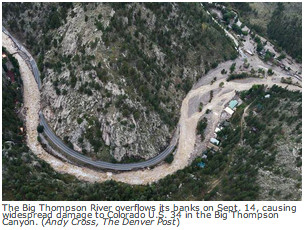
    The Big Thompson River September 14, 2013 via The Denver Post
    The Big Thompson River September 14, 2013 via The Denver Post

    From the Loveland Reporter-Herald (Saja Hindi):

    The 60-foot-plus Nelson Big Dam, just west of Loveland’s water treatment plant, suffered major damage in the 2013 flood, and crews are in the process of not only reconstructing it, but making the dam more durable than it was before.

    The dam was built in 1895 after a flood the year before destroyed another dam nearby. It supplies water from the Big Thompson River that irrigates about 20,000 acres of farmland in Larimer and Weld counties, most of the drinking water for the Johnstown treatment plant and diverts raw water for the city of Loveland to its treatment plant.

    The dam, built on 15 feet of sand and gravel on the old river bed, cost $11,000 to complete at the time, and is considered a historic landmark, with its masonry stone arch shape.

    “When people see it, they don’t really realize it’s not just a little retaining wall in the river. It’s a pretty big structure,” said Gary Gerrard, a board member for the Consolidated Home Supply Ditch and Reservoir Co…

    Although the 1976 flood didn’t have a major impact on the dam, the 20,000 cubic feet per second of water flow going over the dam during the 2013 flood proved to be too much. To put it in perspective, Gerrard said average flows in September are typically around 100 to 200 cubic feet per second. Witnesses said the heavy water flow carried a lot of debris and large objects that struck and damaged the top of the dam.

    Home Supply hired Gerrard Excavating to not only reconstruct the dam but to also complete deferred maintenance, unrelated to the flood — such as replacing the mortar between the rocks, which has eroded, and gate repairs — and constructing an additional spillway to mitigate future floods.

    The Loveland City Council approved contributing funding to the dam repairs, and FEMA has also obligated funds. According to Gerrard, the cost of the project is between $2 million and $2.5 million.

    Larry Howard, city senior civil engineer, said the city agreed to split the cost in half with the company of non-reimbursed flood repairs and maintenance (excluding projects on the dam that are only the company’s).

    “The city has been just a great partner throughout the whole thing,” Gerrard said.

    The dam is not only important to the city for its water diversion, but Howard said it’s also where the city has developed its treatment processes over the years. While Loveland has other sources of water, such as the Green Ridge Glade Reservoir, the dam is their main source of raw water.

    With more than 5-feet of the dam knocked off as well as some of the stones from the arch, crews had their work cut out for them.

    Immediately after the flood, Gerrard, who is also the project’s construction manager, said the goal was to fill all the reservoirs and move the river. Then, crews built concrete abutments, or concrete structures on both sides of the dam to hold the arch secure.

    “The first thing was to get the repairs made to the dam,” Howard said. “That work began last winter after the flooding and was carried on throughout the winter.”

    Construction took a hiatus when flows became too high to allow for work in the spring, but work was continued on the arch during the summer months. After Aug. 1, construction was underway to fill in the rest of the crest with concrete and the stone portion was repaired.

    Howard said the project is unique in that stone construction is rarely seen anymore.

    “The goal from the beginning was to maintain the historical appearance of the dam, and I think we’ve been able to do that,” he said.

    To replace some of the stones, crews were able to get more stones from the Arkins quarry, on North County Road 27, which is where the original stones were from.

    Crews added the new spillway, which is electronically controlled and is brand new technology, Gerrard said.

    “We’re excited to see that work,” he said. “Once that was completed and the rest of the arch was complete, we moved into the Home Supply system,” which included repairing gates and deferred maintenance.

    The reservoirs, he said, were filled early this year, making it easier to manage the river for construction and not diversion.

    Flood-related repairs are planned to be completed this winter, and then re-mortaring between rocks will begin.

    More Big Thompson watershed coverage here.