Colorado transmountain diversions via the State Engineer’s office
FromAspen Journalism (Brent Gardner-Smith) via The Aspen Times:
In letters sent this spring about the draft Colorado Water Plan, both the Roaring Fork Conservancy and the Ruedi Water and Power Authority told state officials that growing Front Range cities should not be looking west for more water.
“In short, there is no more water to develop in the Colorado Basin for a new transmountain diversion,” said Rick LaFaro, executive director of the Roaring Fork Conservancy, in an April 30 letter to the Colorado Water Conservation Board.
And Mark Fuller, executive director of the Ruedi Water and Power Authority, told the water board in an April 14 letter that “the undeveloped water-diversion rights in the upper Roaring Fork and the upper Fryingpan basins continue to be a significant local concern. Development and diversion of these waters would touch off significant controversy, and a state water plan that encourages or facilitates that development would be seen locally as a failure.”
Meanwhile, two of the biggest Front Range water utilities, Northern Water and Aurora Water, have sent recent comment letters in support of new water-storage projects and potential transmountain diversions.
“There is little to no mention of transmountain diversions” in the “water-supply projects and methods” chapter of the draft water plan, said Joseph Stibrich, the deputy director of water resources for Aurora Water, who wrote to the water board April 29.
“The concept is alluded to in the summary of the basin implementation plans, but the option should be recognized upfront in this section,” Stribrich wrote. “A short discussion would be appropriate that at least some of the basins believe transmountain diversions will still be a viable option.”
Aurora Water diverts water under the Continental Divide from both the Roaring Fork and Fryingpan river headwaters, with about 2,600 acre-feet per year coming off the Fryingpan and 2,900 acre-feet coming off the top of the Roaring Fork.
On April 28, Northern Water, which serves eight counties in northeastern Colorado with water, including water from the Colorado River basin, sent a letter to the Colorado Water Conservation Board from Eric Wilkinson, the general manager of Northern, and Jim Hall, a Northern project manager.
Under the heading “Value of Additional Storage,” Wilkinson and Hall wrote in their letter that “the Water Plan should clearly articulate and advocate the value of storage in meeting the water supply gap for a multitude of consumptive and non-consumptive uses.”
The comment letters are just four of the approximately 1,000 unique letters the water board has received as it has developed a draft — and now a final — version of the Colorado Water Plan. The final plan is due on Gov. John Hickenlooper’s desk by Dec. 10.
Agency officials say they have read every comment they’ve gotten, including the 23,000 comments they’ve received as letters or emails, mainly as a result of calls to action by environmental groups.
“We know what the messages are, and we know what you’re interested in, and we also know how you want us to change the plan and we’re working on it,” Kate McIntire, the outreach, education and public engagement coordinator for the water board, said during a May 20 presentation to the board on comments about the water plan.
But as the letters from just four organizations show, there is still an agreement gap in Colorado when it comes to new potential water projects, especially transmountain diversions, and that gap may be difficult to resolve in the water plan. [ed. emphasis mine]
For example, Lofaro told the state in his letter that the Conservancy “does not promote the use of transmountain diversions to meet future water demands without first considering reuse, conservation, and first developing in-basin water supply projects.”
And Fuller said in his letter that even if new dams and reservoirs are built on the Western Slope, downstream demands will prevent more water from being sent east.
“If at some point more water is available in the Colorado Basin, for instance, than is required for immediate domestic, industrial and agricultural uses, the excess water should be seen as a long-term insurance policy for the entire upper Colorado Basin and not as a convenient target for water-needy areas elsewhere in the state.
“The ongoing drought in downriver states such as California and the low-water situations in Lake Mead and Lake Powell indicate that the Colorado River and other waterways on the western side of the Continental Divide will be subject to more pressure from lower in the basin in the future,” Fuller wrote. “New water developments on the Western Slope will act to keep existing transmountain diversions in priority but will not necessarily support additional transmountain diversions.”
In addition to having different viewpoints on how the potential for transmountain diversions should be featured in the Colorado Water Plan, the two entities in the Roaring Fork watershed also disagree about the process the state is using to discuss potential new diversions.
Seven-point draft conceptual agreement framework for negotiations on a future transmountain diversion screen shot December 18, 2014 via Aspen Journalism
Aurora Water points to a draft conceptual framework developed by the Interbasin Compact Committee, which serves as an executive committee for the nine river-basin roundtables in the state, as the best way to proceed regarding a potential new transmountain diversion.
“The IBCC Conceptual Framework … provides the framework whereby new Colorado River Basin supply options could be investigated and potentially developed,” Stibrich wrote in a passage of language that he suggested should be included in the water plan.
But both the Roaring Fork Conservancy and the Ruedi Water and Power Authority see the committee’s conceptual framework differently.
Lofaro told the Colorado Water Conservation Board “a more open process fostering public engagement and comporting with the overall framework of the Colorado Water Plan is necessary to deal with a topic as important as any new transmountain diversion. Instead, the draft conceptual framework lacks public input and is a ‘top down’ product of a small coterie rather than the much wider group of stakeholders envisioned in the governor’s executive order and Colorado law.”
And Fuller told the state that “the IBCC Conceptual Framework must not be characterized as a pathway to future transmountain diversions. Instead, it is a menu of considerations that can form the basis for evaluation of transbasin diversions in comparison with all other alternative methods of meeting future water needs.”
The first version of the final Colorado Water Plan is expected to be made public as part of the packet for the Colorado Water Conservation Board’s next board meeting, which is July 15 in Ignacio. The packet is typically made public at least a week before the meetings.
At that time, the public will be able to see how the board’s staff has incorporated the conflicting comments the agency has received, read and posted at the Colorado Water Plan website at http://www.coloradowaterplan.com under the “Get Involved” tab.
And even after the first version of the final water plan is released in July, the Colorado Water Conservation Board will continue to take comments on it until Sept. 17.
Editor’s note: Aspen Journalism is collaborating with the Glenwood Springs Post Independent and The Aspen Times on the coverage of water and rivers. More at http://www.aspenjournalism.org.
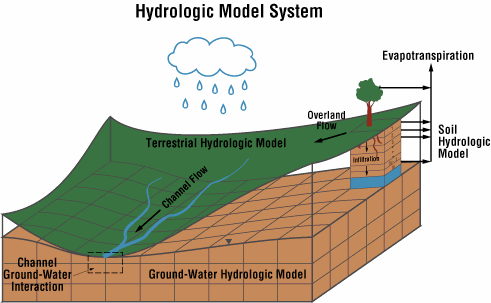
Graphic via Penn State Earth System Science Center
I’m pretty psyched about the class after the first night.
The lecture started with an overview of the things about the water cycle that modelers need to keep in mind.
We also had to pick a catchment to model. I chose the Dolores River near Cisco. We’re going to use Reclamation data for native flow at several gage sites.
In the first day lab we built the VIC model on a Linux instance. Many readers know the joy of working in a Linux shell. I was right at home. I’ll be able to SSH in from my Mac.
I anticipate that Coyote Gulch posting will be erratic and less timely for the next 5 weeks. Please continue to send links — I will get caught up during July.
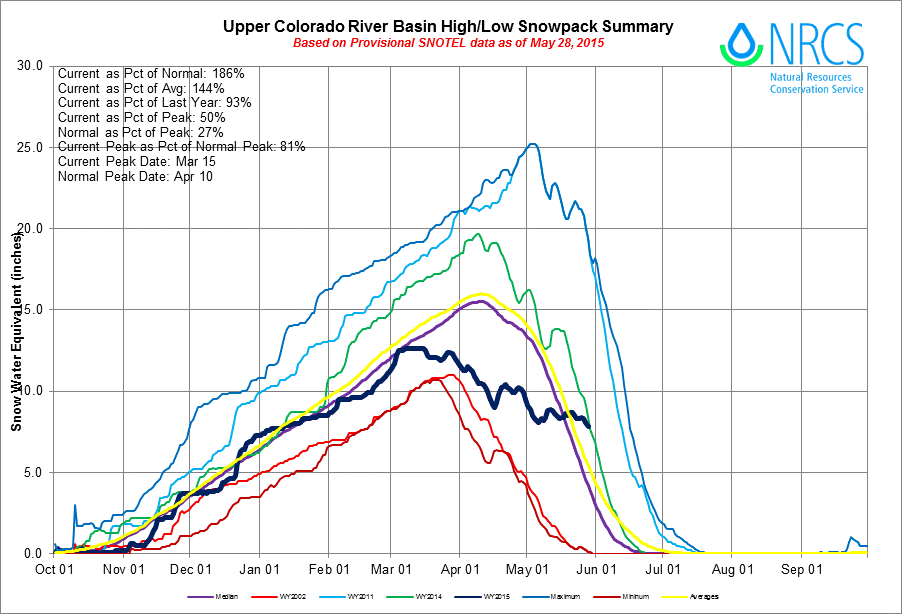
Upper Colorado River Basin High/Low graph May 28, 2015 via the NRCS
Gunnison River Basin High/Low graph May 28, 2015 via the NRCS
San Miguel, Dolores, Animas, and San Juan Basin High/Low graph May 28, 2015 via the NRCS
Yampa and White Basin High/Low graph May 28, 2015 via the NRCS
Click here to read the newsletter. Here’s an excerpt:
WET SPRING FOLLOWS DRY WINTER
The Upper Colorado River Basin suddenly turned cool and wet in late April and May. As a result, snowpack levels stopped their steep declines, though total accumulated moisture for the water year remains below average.
Click here to go to the website for all the inside skinny. From the website:
We are reaching a tipping point. While Colorado has made progress in conserving land and rivers and enhancing outdoor recreation, there is still work to be done, and there is a new problem to address:
Kids today spend half as much time outdoors as their parents did. Colorado may boast the nation’s healthiest adult population, but its youth obesity rate is rising rapidly. Barriers like time, transportation, money, access, and lack of interest and understanding about outdoor experiences keep kids from getting outside and developing the lifelong passion for the great outdoors that is vital for the well being of Colorado citizens, our wildlife and our way of life.
Colorado’s next generation also will live in a state with up to three million more residents, meaning ever-expanding urban areas and increasing pressure on our parks, rivers, trails, open spaces and wildlife habitat.
Sponsored by Governor Hickenlooper, the Colorado Department of Natural Resources, and Great Outdoors Colorado, The Outdoors Summit is an unprecedented gathering of national and state leaders, advocates and visionaries to launch new initiatives to protect, preserve and enhance Colorado’s great outdoors, and to close the widening gap between our youth and nature that threatens their future and the future of Colorado’s way of life and outdoor brand.
Photo via Jon Harvey From the High Country News (Elizabeth Shogren)
“Too many of our waters have been left vulnerable to pollution,” President Obama said in a statement. “This rule will provide the clarity and certainty businesses and industry need about which waters are protected by the Clean Water Act, and it will ensure polluters who knowingly threaten our waters can be held accountable.”
Congressional Republicans and some industry groups attacked the rule as an overreach by the administration that would hurt businesses and job growth.
But EPA administrator Gina McCarthy said given the impacts of climate change on water resources, such as drought in the West, “it’s more important than ever to protect the clean water that we have.”
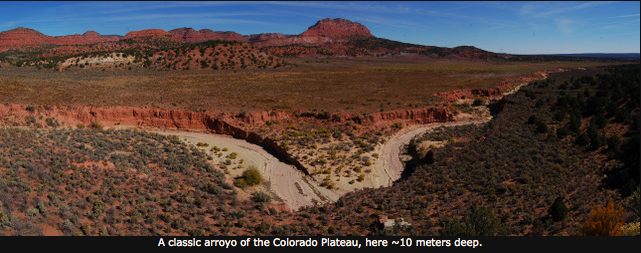
Significantly for the arid West, the rule protects tributaries—no matter how frequently water flows in them—as long as they have signs of flow such as beds, banks and high water marks. Nearby wetlands and ponds also would be protected. Ditches would be protected only if they behave like tributaries…
Some regionally specific water bodies such as prairie potholes and western vernal pools in California would be protected, but most playas would not, according to McCarthy. Playas, flat desert basins that at times become shallow pools, would be covered only if they are within a 100-year floodplain, or are near or flow into a stream, its tributaries or adjacent wetlands…
Opponents and supporters of the rule differed over whether this action expands the scope of the Clean Water Act. Some ephemeral streams, waters and wetlands were federally protected before a 2001 Supreme Court decision, under the justification that migratory birds use them; the new rule, in practice, likely will increase the number of waters and wetlands that receive federal protection…
“For ecologists and people who care about ecosystems, it’s a big victory,” said Ellen Wohl, a professor of geosciences at Colorado State University. “There’s enormous scientific agreement that little streams are very important.”
Streams that do not contain water year-round still play important roles, providing nutrients, sand and organisms for bigger rivers.
“From an environmental perspective, it’s wonderful,” Wohl added. “Scientifically, it’s very obvious these streams need to be protected.”
At issue is whether companies and individuals have to get permits before they pollute, fill in or destroy a waterway or wetland. In the wake of the 2001 and 2006 Supreme Court rulings, decisions about whether permits were necessary often have been subject to lengthy case-by-case consideration. The new rule is supposed to make it clear when wetlands and waterways are protected so case-by-case determinations are needed only rarely.
More Environmental Protection Agency coverage here.
Graphic via Penn State Earth System Science Center
I’m starting a hydrologic modeling class tonight which will last into July. I anticipate that Coyote Gulch posting will be erratic and less timely for the next 5 weeks. Please continue to send links, I will get caught up during July, sitting under the cottonwoods next to an irrigation ditch somewhere.
Upper Colorado River Basin High/Low graph May 28, 2015 via the NRCS
From the Glenwood Springs Post Independent (Randy Essex):
Glenwood Springs, for example, went into the weekend just 0.12 inches of rain from having its wettest May on record, with 5.71 inches having been recorded through Friday.
The rain dampened bigger fire fuels and, with cool nights, protected the lower-than-normal snowpack the region had — even adding some snow at higher elevations, said Dennis Phillips, a meteorologist with the National Weather Service in Grand Junction.
Data from the Natural Resources Conservation Service show that while the Upper Colorado River Basin held just 58 percent of median snowpack at the beginning of May, snow water equivalent of the snowpack by the end of the month matched last year and was well above normal…
“We are set up for a wonderful, long season” of rafting on the Colorado and Roaring Fork rivers, said Ken Murphy, owner of Glenwood Canyon Adventures. “There’s nothing right now that we are concerned about,” he said, adding that the rafting season could run through September.
While the snowpack is lingering nicely, streamflows are below normal. The Colorado River at Glenwood just below the confluence with the Roaring Fork was running 8,580 cubic feet per second, lagging the normal of around 9,600 cfs. Last year, when the Glenwood Canyon bike path was damaged upstream by fast runoff of a heavy snowpack, flow peaked at 22,000 cfs.
The Roaring Fork at Glenwood was running at 1,860 cfs; normal would be closer to 3,100 cfs. The Crystal River flow was about half of normal, at 568 cfs Friday at Redstone.
“Within the last week, stream flows increased at all locations throughout the Roaring Fork watershed, and Ruedi Reservoir is currently 81 percent full,” according to the Roaring Fork Conservancy’s Snowpack and Streamflow report sent out Thursday.
Southern Colorado has been pounded by severe weather in May, but the rain has brought more than just damage and headaches.
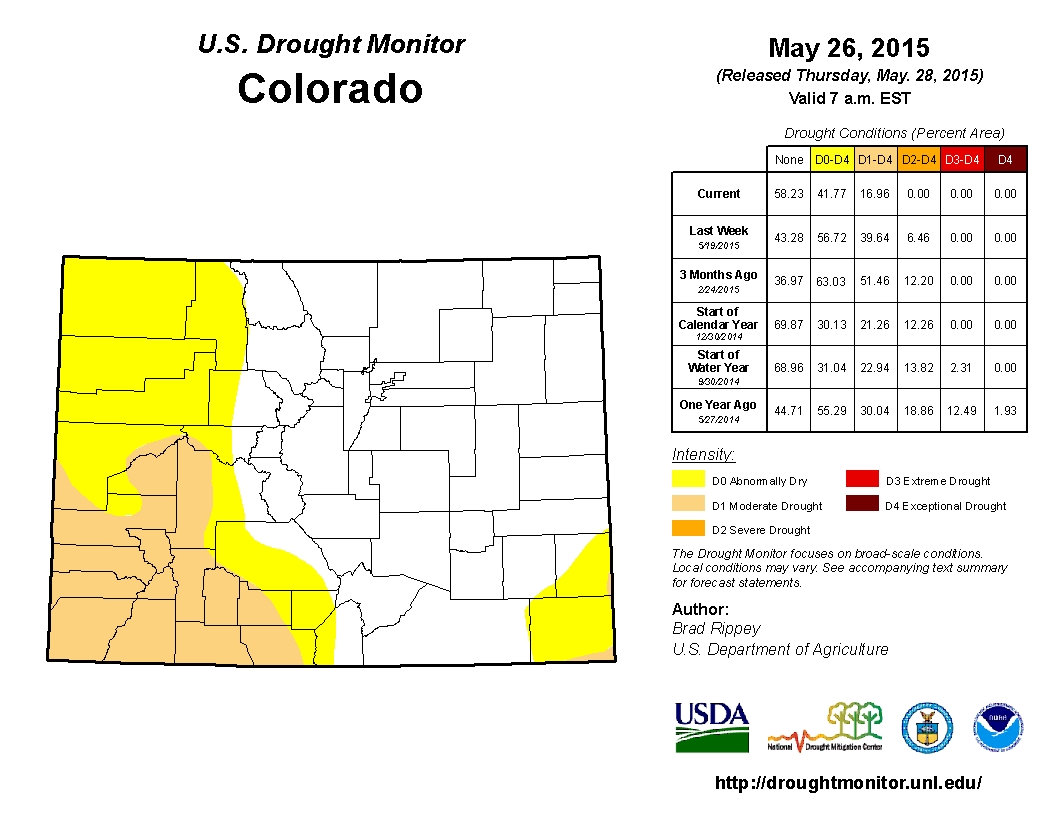
The National Weather Service says most of southeastern Colorado is drought-free. That’s compared to this time last year when the area was either in extreme or exceptional drought.
The NWS said southeastern Colorado is benefiting from the record rainfall in southern Colorado, along with rivers being full…
The NWS said this May is the sixth wettest month for Pueblo since the NWS started keeping record of it in 1888. As for Colorado Springs, May was the wettest month ever for the city.
From the Fort Collins Coloradan (Katie de la Rosa):
Fort Collins received nearly three times the average amount of rain last month, making it the fifth-rainiest May in recorded history.
Last month ended with a total of 6.21 inches over 22 days of rain, according to the National Weather Service in Boulder. There was no measureable precipitation only three days in the month. The average rainfall for May is 2.74 inches. Last year, Fort Collins received 4.76 inches or rain in May.
The record for May is 7.77 inches, which fell in 1901 and 1995.
“What could we do to make that final plan have teeth?”
The first draft of Colorado’s new water plan offered plenty of background information about the state’s water, but didn’t say exactly what can be done to avoid a looming water-supply gap. By 2050, the state could be short billions of gallons per year — twice as much as Denver now uses annually.
A shortfall that big could crimp Colorado’s economy and put even more pressure on rivers and streams that have been nearly tapped out by thirsty cities and farms, Gov. John Hickenlooper said two years ago, when he ordered state agencies to build the first-ever statewide water plan.
Now, just half a year away from the deadline, conservation-minded state planners are polishing up a visionary final draft of the plan, due July 15, for one final public review before going back to Hickenlooper and the State Legislature, to be buffeted by Colorado’s political winds.
Aiming to answer what can be done to prevent a water crisis, Colorado Water Conservation Board experts previewed a new action-plan at a late-May water summit in Sterling — a pep-talk to rally CWCB directors and dozens of other water chiefs from around the state for the final round of planning.
For starters, all the info compiled for the plan shows clearly that conservation alone could fill most of the much-feared water gap, state planners said, referring to an aspirational goal of saving 400,000 acre feet of water each year — about three times the capacity of Cherry Creek Reservoir or the amount of water that would fit in 200,000 Olympic-sized swimming pools.
But it will require more than just fixing leaky faucets and pipes, using modern low-flow toilets and showers and upgrading irrigation systems on farms.
The only way to get there is by instilling “a water efficiency ethic throughout Colorado,” the new action list states.
That may sound vague, but it’s probably the philosophical fountain from which all other actions will flow. If there’s no will, there’s no way. And it’s not clear whether the ballyhooed Colorado water planning effort will break years of political inertia, said Lawrence MacDonnell, a natural resources law scholar at the University of Colorado, Boulder.
MacDonnell led an academic review team that issued a report on the draft plan in April, finding that it offers little in the way of specifics. “As written, the Draft is not really a plan; it is a summary of a process that has identified problems … ” the reviewers wrote.
At this point, the new action list is still full of words like “improve, research, explore, strengthen, consider, monitor, encourage and support.” Nothing seems concrete.
The plan’s bureaucratic tone peaks with this golden nugget: The plan will “establish a process to identify processes” to address the water gap.
“Where’s the beef?” said MacDonnell, acknowledging the difficult political challenges ahead. Even a simple step like requiring retailers to sell only certified water-efficient outdoor sprinklers would be controversial, since many people believe government has no business telling stores what to sell.
“You know how it is in Colorado,” MacDonnell said, referring to a general antipathy toward government control.
In fact, the new action-item list says the state should consider such sprinkler standards as a way to achieve measurable water savings.
But mandating water-efficient appliances would require state lawmakers to act, and the failure of this year’s rain-barrel bill is a clear sign that the Legislature is not exactly racing toward that enlightened water-efficiency ethic mentioned by the plan, MacDonnell said.
“I appreciate the fact that the state is constrained, but a lot more could be done than the draft plan suggests,” said MacDonnell, who served on an academic review panel that combed the first draft.
Similarly, it will take a lot more than just feel-good language to spur a shift in the way farmers and ranchers use water. Upgrading the massive pump, pipe and sprinkler networks used in modern irrigation is not trivial, MacDonnell said.
“It’s an enormous investment, and it’s hard to believe we’re going to come up with that kind of money,” he said.
From what he’s seen so far, the draft plan hasn’t found a way to grapple with the state’s most fundamental water issues, including how to connect land-use planning with water planning.
“What seems to be missing is what’s going to drive action among the thousands of players … What could we do to make that final plan have teeth?” he said.
Even though the big players are at the water-planning table, the effort hasn’t encompassed everyone.
“There are hundreds of these little water-supply organizations. Their immediate problem is trying to get water for their new developments, and they don’t have the resources to take on these issues, like thinking about wildlife or watershed health,” he said. “They’re often profit-driven entitities, or small cities just feeling the pressure of getting water supplies, and they can’t afford to take the big view,” he said.
New water ethic?
That’s why the overarching goal of creating a new water ethic in Colorado is so important, and that’s something that will only happen over time.
A water plan can help guide such transformation, but sometimes, shock treatment is the only thing that works, said University of California, Irvine, social scientist David Feldman, who recently completed a study of how Melbourne, Australia changed its cultural attitude about water during a drought so bad it got its own name — the Millennium Drought.
The greater-Melbourne region is home to about 4.3 million people – not so different from Colorado’s population – and they managed to cut their water consumption in half during a blistering 10-year dry streak, but not without some strict guidance from a regional water czar who had the power to force different water companies to work together, Feldman said. Since the drought, water savings have continued in Melbourne.
“In the American West, it’s hard to instill a conservation ethic without a drought to impel people to do so … and our water rights systems encourage using our water rights, or risking losing them,” he said. Under that structure, there’s little incentive to conserve water, he added.
“To avoid the worst case scenario, its probably best to realize that, here in the West, climate variability and change dictates that we … probably are entering a period where what we have today is the new normal.”