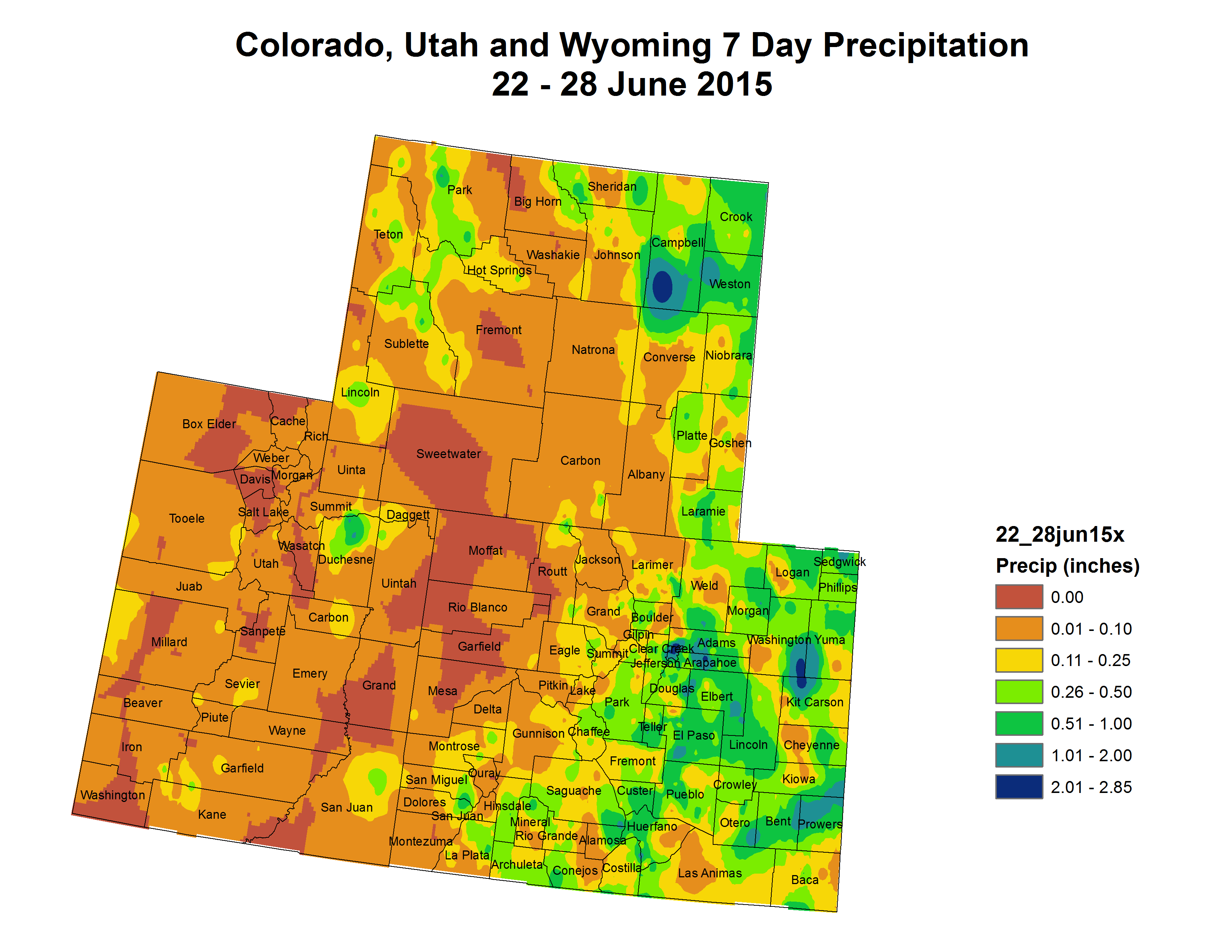
Click on a thumbnail graphic for a gallery of drought data from the US Drought Monitor website. Here’s an excerpt:
Summary
A strong ridge over the west and a deep trough over the east dominated the weather this past week. Record high temperatures were recorded over much of the west, with many locations reaching temperatures in the 110 degree range during the week. The heat along with very dry conditions over the last 30 days has elevated the fire risk over much of the west. From the Midwest into New England, several storms tracked through the region, bringing rain to much of the area. Some areas of the Midwest recorded more than 5 inches of rain in the last week. Along with the rain, cooler than normal temperatures prevailed. Spotty convective precipitation was common in the southeast, where temperatures were above normal this week. Rain in Texas helped to keep this area cooler than normal for the week. Much of the central plains was dry and warmer than normal into the Dakotas…
Great Plains
This was a fairly dry week over the region, with just spotty precipitation along the foothills in Colorado, the Panhandle of Nebraska, and into southwestern South Dakota as well as west Texas. Except for the areas that received the most rain, temperatures were above normal in most places with departures of 2-4 degrees above normal. There were not any changes in the regional drought depiction this week…
West
Record heat and dryness over the region this week as well as over the last month has quickly deteriorated conditions in many areas after a wet May. A large degradation of drought in Montana was made this week with a full category change in the areas of western and north central Montana. In Washington, D2 was pushed to the west and D1 was added in the central portion of the state while in Oregon, D2 was expanded in the southwest and in the northeast into Idaho…
Looking Ahead
Over the next 5-7 days, a significant system will continue to push through the Tennessee River Valley, with the heaviest rains projected to be centered over southern Missouri, northern Arkansas, and Tennessee, where amounts could surpass 5 inches. In general, it looks to be a fairly active summer pattern over the United States, with many areas having the opportunity for rain. The central plains (up to 1.40 inches), southern Rocky Mountains (up to 2.0 inches), and south Texas (up to 1.60 inches) look to be the areas of the greatest precipitation potential. With the rain potential, temperatures over most of the country are expected to be 3-5 degrees below normal. The Pacific Northwest is the anomaly as dry conditions are expected to continue and daytime high temperatures are expected to be 12-15 degrees above normal.
The 6-10 day outlooks show that the best chances for below-normal temperatures are over the high plains and Midwest. The greatest chances of above-normal temperatures will continue to be in the Pacific Northwest and Alaska as well as over much of the Gulf Coast and Florida. The greatest probability of above-normal precipitation will be from the Great Basin into the central plains and up into the northeast. Below-normal precipitation chances are greatest over the Gulf Coast and Florida, the northern high plains, and the Pacific Northwest.
It’s hard to imagine, in the midst of flooded fields and basements, the possibility that Colorado could face a major water shortage sometime in the next several decades.
But Colorado this year is just now coming out of its latest drought, and another is never far away. And Colorado officials expect the state’s population to grow by almost double in the next few decades. That means more water will be needed than Mother Nature can provide.
That’s one of the reasons the state is putting together its first comprehensive water plan, to manage future droughts and future population increases.
In the next several weeks, the Colorado Water Conservation Board will release the next draft of the statewide water plan. It’s been in the works officially for two years, although basin roundtable and other groups have been looking at the state’s water situation since just after the 2002 drought…
James Eklund, director of the CWCB, said it’s easier to plan for the state’s water future when Colorado isn’t in a drought, as opposed to California, which is imposing emergency restrictions. California is in the fourth year of its drought, and that state’s emergency restrictions recently began extending to agriculture…
The heart of the plan is proposals submitted by the state’s nine basin roundtables. The state has eight major basins, so there’s a roundtable for each, made up of representatives from agriculture, recreation, local and domestic water providers, industrial and environmental interests. Five additional members must hold water rights or have a contract for federal water. A ninth roundtable represents the Denver Metro area.
Each basin roundtable submitted what’s called a Basin Implementation Plan (BIP). Denver and the South Platte River Basin Roundtable submitted a joint plan. Suggestions on how to manage Colorado’s water future come from those BIPs.
The draft state plan explains that one of the most controversial issues around water is the diversion of water from the Western Slope to the Eastern part of the state. The South Platte/Denver roundtable BIP said the groups believe in preservation of the state’s ability to use water from the Colorado River. That water is governed by a series of compacts with four “lower basin” states: California, Arizona, Nevada and New Mexico. One of the concerns is that a “compact call” could require the state send more water to those lower basin states, which would put agriculture more at risk in Colorado. Eklund says a compact call is not likely anytime in the next ten years.
The South Platte/Denver BIP notes that the basin is a key economic driver that includes seven of the top ten agricultural-producing counties in Colorado. The BIP estimates the water gap in the South Platte/Denver basin by 20950 at 428,000 acre-feet for municipal and industrial use, and 422,000 acre-feet for irrigated agriculture. Morgan County’s projected gap is the largest in northeastern Colorado, at more than 12,000 acre-feet.
The South Platte/Denver basin faces significant challenges in the lifespan of the plan. That includes competition for water, continued transfers of agricultural water rights to municipalities and industrial water users, and a significant need for more storage. Lack of storage is forcing the area to rely on groundwater, which is water that resides below ground, often in aquifers.
The South Platte/Denver BIP presents a number of solutions for the area and for cooperation with the state’s other basins.
Currently, the area’s growing water demands are met largely by agricultural transfers: selling water rights to other users, mostly municipal and industrial, such as oil and gas. It’s a touchy subject, according to state water czar John Stulp: how to preserve agricultural water rights and at the same time recognize that those rights are private property. The BIP notes this, calling for a system where farmers can “decide for themselves how to manage those water rights while maintaining their right to use or sell” them. That system, at the same time, must include new ways to conduct those transfers to minimize the impact on the rest of the area. Those impacts are frequently economic: once water rights are permanently transferred, the community can suffer through loss of economic activity.
People often point to Crowley County, in southeastern Colorado, as what that looks like. Most of the water rights in Crowley County were sold off in the 1970s to municipal water providers; farming is nearly non-existent and the land has reverted to prairie grassland. The county now relies on a private prison as its major economic engine; fully 45 percent of the county’s population are prison inmates.
While the state has already taken steps to minimize the impact of “buy and dry” for agricultural water rights, the BIP suggests much more can be done. The BIP calls for additional water from the Colorado River, a suggestion that makes Western Slope residents nervous; and additional storage, either in reservoirs or in below ground aquifers.
The BIP also calls for new multi-purpose water storage in the basin area and to look for ways to more effectively use groundwater.
But storage costs money. A lot of money. The statewide water plan estimates a cost of $18 to $20 billion to fully implement the plan. That’s not all going to be paid for by the state: the plan lists more than a dozen financing options, including bonding and public/private partnerships.
The next draft of the statewide plan, due in July, will include legislative recommendations, although Stulp recently said they hope to avoid asking for a lot of new laws to implement parts of the plan. Another draft is likely in September; the final plan is due to the governor in December.
In the meantime, watch for another round of public hearings on the statewide water plan. The legislature’s interim water resources review committee will be part of a statewide tour that will visit each basin area. For the South Platte, that meeting is scheduled for 6 to 8 p.m. Sept. 14 at the Island Grove Event Center in Greeley. The Denver Metro hearing will be from 6 to 8 p.m. Sept. 15 in the Aurora City Council Chambers.
The Colorado Supreme Court ruled on June 29 that the Roaring Fork Club in Basalt is not entitled to new “aesthetic, recreation and piscatorial (fishing)” water rights for a private fly-fishing stream the club created in an existing irrigation ditch.
“The club failed to demonstrate an intent to apply the amount of water for
which it sought a decree to any ‘beneficial use,’ as contemplated by either the constitution or statutes of the jurisdiction,” the court’s decision stated.
The court also found that “the club’s proposed ‘uses’ of the water in question, as expressed in its application, cannot be beneficial within the meaning of the Act because the only purpose they are offered to serve is the subjective enjoyment of the Club’s private guests,” the decision states.
“The flow of water necessary to efficiently produce beauty, excitement, or fun cannot even conceptually be quantified, and therefore where these kinds of subjective experiences are recognized by the legislature to be valuable, it has specifically provided for their public enjoyment, scientific administration, and careful measurement,” the court found.
The court, however, did side with the Roaring Fork Club in a related dispute with its downstream neighbor Reno Cerise, who is a partner in St. Jude’s Co. In its decision, the court rejected claims from St. Jude’s over access to and management of the irrigation ditch in question, and the court awarded the club attorney’s fees in that aspect of the case.
But a majority of the justices on the court said a prior water rights decree issued to the club in 2013 by the water court in Glenwood Springs was now invalid because the water was not being put to a lawfully recognized beneficial use, which is a keystone of Colorado water law.
In a brief against the club’s arguments, attorneys for the Colorado Dept. of Natural Resources told the court it had concerns that using irrigation ditches for private aesthetic purposes could dewater long stretches of streams and rivers.
“Without established limits, such uses can result in complete depletions of stream reaches for unlimited distances to the detriment of the stream reach and its public aesthetic and piscatorial benefits, maximum utilization, and compact development,” the brief from the Dept. of Natural Resources stated.
As it stands now, the decision “effectively prohibits any future direct flow rights to divert water from the stream for aesthetic, recreation or piscatorial (fishery) purposes,” according to Peter Fleming, the general counsel for the Colorado River District, which filed a brief supportive of the club’s case.
Fleming, in an interview, said that while the court’s decision did strip the club of its decree for such uses, it did not apply to other existing water right decrees.
Origins of the case
In 2007 the club applied to divisional water court in Glenwood Springs for formal recognition of a right to divert 21 cubic feet per second from the Roaring Fork River into an existing irrigation ditch for “aesthetic, recreation and piscatorial uses.”
The application for new water rights were in addition to the club’s existing water rights on the ditch, which include an irrigation right.
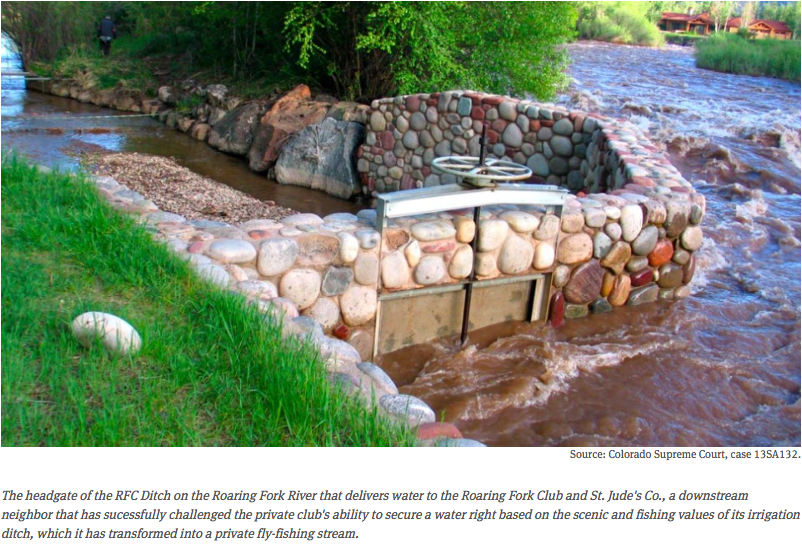
In its application, the club told the water court that in 1997 it had improved an irrigation ditch – the RFC Ditch – which is 14-to-25 feet wide and can move up to 45 cubic feet per second (cfs) of water.
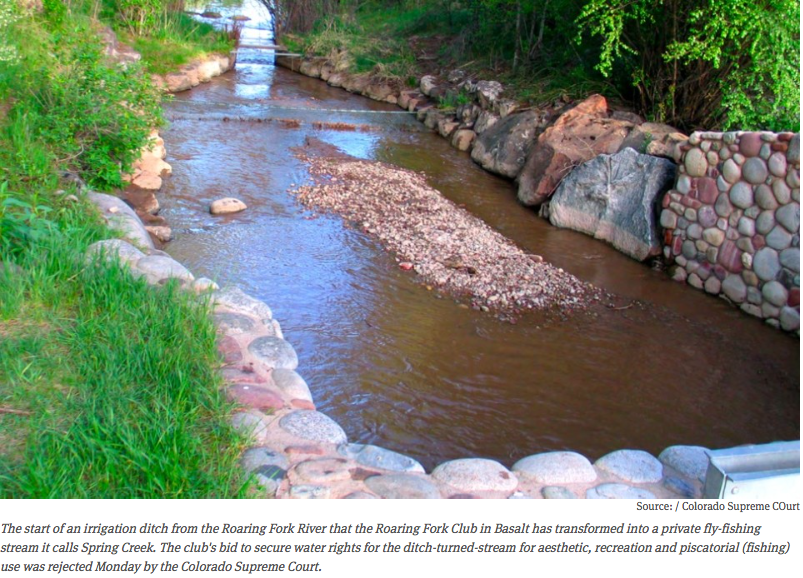
And it said it was now using the ditch, which it dubbed “Spring Creek,” as an “aesthetic and recreational amenity to a golf-course development, as well as for fish habitat and as a private fly-fishing stream.”
On its website, the Roaring Fork Club states that “fishing around the Club property includes private access to eight stocked ponds, a one-mile stretch along the acclaimed Roaring Fork River and the one-mile long ‘Spring Creek’, an offshoot of the Fork that flows through the golf course.”
The club straddles 383 acres on either side of the Roaring Fork River just upvalley of downtown Basalt. It has about 550 members and includes 40 privately owned cabins.
“The club’s fishing, non-fishing, golfing and other members and visitors enjoy the scenic beauty that is Spring Creek, as the visual backdrop of the water feature and the sound of higher flowing water combine to create a unique experience for members, cabin owners and guests alike,” wrote an attorney for the club, Scott Miller, of the Basalt law firm of Patrick, Miller and Noto, in a recent supplemental brief to the court.
Miller’s brief also notes that the irrigation ditch, now a private fly-fishing stream, includes “pools, riffles, drop structures, and spawning beds, all of which enhance the overall aquatic habitat and cold water trout fishery in Spring Creek, and which require flowing water.”
Miller could not be reached for comment on the court’s decision.
But in 2013 St. Jude’s, which also uses the RFC Ditch to receive water downstream of the club, appealed the water court’s issuance of a decree to the club for aesthetic uses to the Colorado Supreme Court, which directly hears appeals from divisional water courts around the state.
“Recognition of aesthetics as a beneficial use would effectively function as a policy decision that the visual enhancement of private property is more important than any uses of junior upstream appropriators, and also more important than maintaining streamflow in the natural stream,” St. Jude Co.’s attorney, Gregory Cucarola of Sterling, argued in a recent brief to the Supreme Court.
After review, seven of the justices on the Supreme Court sided with St. Jude’s, at least as far as its water rights arguments went.
“The water court’s judgment decreeing the club’s new appropriative rights must therefore be reversed, and the decree for aesthetic, recreation and piscatorial uses vacated,” the court ruled.
Aerial view of the Roaring Fork Club (exhibit at trial) via Aspen Journalism
A variety of views
Two justices issued a dissenting opinion in the case.
“The value that Spring Creek creates, as well as the ability to determine the amount of water needed to achieve its purposes, suggests that aesthetic, recreational, and piscatorial uses satisfy the ‘beneficial use’ requirement,” the dissenting opinion stated. “So, is such a flow-through feature “tantamount to a ‘forbidden riparian right,’” as the majority asserts? I think not.”
The dissenting opinion was written by Justice Monica M. Marquez, who was joined by Justice William W. Hood, III.
The Colorado River District released a statement about the court’s decision, after an inquiry from Aspen Journalism, from Peter Fleming, the district’s general counsel.
“The River District is disappointed in the Colorado Supreme Court’s decision in the St. Jude’s Co. v. Roaring Fork Club case that effectively prohibits any future direct flow rights to divert water from the stream for aesthetic, recreation or piscatorial (fishery) purposes,” Fleming said in an email.
“The majority opinion mistakenly characterizes recreational and fishery uses as purely ‘passive’ uses of water. Perhaps more importantly, the opinion creates an entirely new requirement that a water right is valid only if the intended use is achieved through an ‘objectively-active’ means of production.
“As noted in the Court’s dissenting opinion, the majority opinion ‘abolishes a well-established practice of the water courts in granting applications for [aesthetic, recreational, and piscatorial flow-through water rights].’
“Many existing West Slope landowners have invested in such features – a practice that has little or no impact on Colorado’s consumptive use of its Colorado River Compact entitlement,” Fleming said. “The decision will adversely impact the future ability of private land-owners to increase the value of their property through the construction of water features.”
The “ranch owners”
Also filing a joint amicus brief in the St. Jude’s case – in support of the private club – were Roaring Fork Homeowners Association, Inc., Thomas Bailey, Galloway, Inc., Jackson-Shaw/Taylor River Ranch, LLC, Crystal Creek Homeowners Association, Inc., Charles E. Nearburg and Catamount Development, Inc., and the Flyfisher Group, LLC.
The self-described “ranch owners” told the court that together they own 27,000 acres of land in Colorado.
They argued in their brief that “private use of water” actually benefits the public.
“Private use of water for piscatorial and aesthetic purposes benefits the public and the appropriator,” the “ranch owners” brief states. “As noted above, the economy of western Colorado is changing. More and more ranches are being purchased not just for traditional ranching uses, but also for their aesthetics and fish and wildlife values.
“The resulting increase in land values significantly increases the tax base of local governments and the overall health of local economies. Moreover, it is well established in the scientific literature that ditches and man-made streams operated for fishery purposes benefit not just these off channel structures, but the fishery as whole,” the brief said.
The brief also said that “the ranch owners, and many others, have also constructed water features on their properties, such as artificial waterfalls, cascades and waterways that greatly enhance the aesthetics and value of a property. The design of these improvements often requires the services of landscape architects and engineers.”
The ranchers also argue that if private streams are valuable to a landowner, then they are “beneficial” under state water law.
“Just as beauty is in the eye of the beholder, beneficial use is principally in the eye of the (water) appropriator,” the brief states.
County and state don’t support
On the other side of the issue were Pitkin County and the Colorado Department of Natural Resources, both of which filed amicus briefs (Pitkin County, DNR) with the Supreme Court against the Roaring Fork Club’s arguments.
“A diversion into a ditch for private piscatorial, recreational, or aesthetic uses is not a statutorily or Supreme Court-approved beneficial use, but has been recognized by various water courts in unappealed decrees,” a brief filed by attorneys for the department states.
The department’s brief also noted that when it comes to the enjoyment of water, a “more is better” factor raises questions about the potential wasting of water.
“With a ‘more is better’ duty of water unsupported by scientific evidence, subjective private piscatorial and aesthetic uses can result in complete depletions of stream reaches for unlimited distances to the detriment of the stream and its public piscatorial and aesthetic uses, resulting in waste and inefficiency, impairment of existing undecreed exchanges of water, and future exchanges,” the department’s brief states.
Editor’s note: Aspen Journalism is collaborating with The Aspen Times and the Glenwood Springs Post Independent on coverage of rivers and water. The Times published a version of this story online on Tuesday, June 30, 2015.
The fate of the Colorado River is a Latino issue, according to a new video, “We’re in This Together – Save the #CORiver,” released yesterday on Youtube by the environmental organization Nuestro Rio.
The video features a Who’s Who of Colorado Latino politicians — Denver City Councilwoman Debbie Ortega, state Senator Lucia Guzman, Rep. Joe Salazar, and lawmakers from New Mexico, Arizona and elsewhere talking about how Western states need to work together to ensure everybody who depends on the river for water gets it.
“As Latinos make up significant portions of the West, the Nuestro Rio Regional Water Caucus is working to collaborate to preserve the Colorado River because our communities rely on it,” the video states.