How Fort Collins’ biggest brewery reduced its thirst — Fort Collins Coloradan

Photo credit Colorado Brewed.

From The Fort Collins Coloradoan (Jacy Marmaduke):

Anheuser-Busch’s Fort Collins facility reached a water-to-beer ratio of about 2.9 gallons this year, the lowest of the city’s 21 breweries.

Brewery leaders say there’s still plenty of wiggle room for water conservation, especially for a facility that churns out about 10 million barrels of beer each year using only Fort Collins Utilities water from Horsetooth Reservoir and the Cache la Poudre River. That’s a lot of water to make the brewery’s popular beverages, and with the city entering its first weeks of severe drought, the spotlight on conservation is as bright as ever.

“Every year, we’re watching that snowpack,” A-B senior brewmaster Katie Rippel said. “It can turn on a dime. We’ve had a couple good winters in a row — I call it fat, dumb and happy — but it was only a few years ago when that wasn’t the case.”

A-B’s water use decreased 11 percent between 2011 and 2015, thanks in part to a tweak that allows re-use of the water used to rinse the brewery’s towering fermentation tanks.

The brewery didn’t provide its total water usage, but Coloradoan calculations indicate it now uses upwards of 900 million gallons of water each year, equal to the annual water use of about one-sixth of Fort Collins households. The estimate comes from the brewery’s water-to-beer ratio and its 2014 production volume.

Brewer Bill Workman, who designed and implemented the rinsing water change with maintenance technician Tim Burge, came up with the idea after noticing how much water and yeast drained out of the brewery’s massive, multi-story fermentation tanks during rinsing.

Workman, a Berthoud native who’s worked at A-B since the year after it opened in 1988, wondered if all that water could be re-used in earlier steps of the brewing process.

“We were told it couldn’t be done,” he recalled during an interview in the brewery’s upper-level tasting room. “We were like, ‘Wanna bet?’ Katie said, ‘Go find a way.’

Workman and Burge spent close to a year engineering a programming pathway for their idea that wouldn’t sacrifice the quality of the brewery’s two-dozen-odd beers or interfere with other parts of the brewing process.

The change was fully implemented in summer of 2015 and saves about 800,000 gallons of water each year. Other North American A-B breweries are now starting to implement the change and finding comparable water savings.

Other conservation methods have helped the brewery reduce its water use, including installation of low-flow nozzles on every tank, re-use of water throughout the cleaning and bottling process and technology that helps brewers determine when equipment is truly clean, reducing rinse water.

The floor for water use is about 1 gallon of water for every gallon of beer, plus a smaller amount used for cleaning, Rippel estimated.

“Everything else is on the table,” she said, adding the brewery will next look for even more ways to re-use water and cut down on water used during cleaning.

Water conservation means cost savings for the brewery, which pays for its Fort Collins Utilities water like any other customer. It also means something more personal to employees, many of whom have worked in the brewery and lived in the Fort Collins area for decades.

“That’s why we’re trying to minimize our impact: All of us love the area we live in,” Rippel said. “I mean, we want to be good corporate citizens, but it’s more about, ‘I live here, and I’m using the same water to brew that I’m using at home.’ So I’m protecting mine.”

Water usage at other Fort Collins breweries

  • The Nos. 2 and 3 breweries for production, New Belgium Brewing Co. and Odell Brewing Co., respectively use about 4 gallons and 3.6 gallons of water per gallons of beer produced. Economy of scale makes it difficult for smaller breweries to achieve the same water savings as larger producers.
  • The industry average water-to-beer ratio is about 7:1, according to the Brewers Association
  • .

    Wildfire is top threat to Gypsum’s drinking water — Glenwood Springs Post Independent

    Town of Gypsum via Vail.net
    Town of Gypsum via Vail.net

    From The Glenwood Springs Post Independent (Pam Boyd):

    …a new report prepared by the Colorado Rural Water Association for the town of Gypsum has reminded the community that wildfire impact is the top risk identified for its drinking water system.

    Source water specialist Paul Hempel prepared the report for the town.

    “People don’t ever think about water safety, really. Water just comes out of the tap,” said Hempel.

    But water does come from somewhere, and ensuring the safety of their water sources is a prime concern for municipal providers. Source water assessment and protection came into existence in 1996 as a result of Congressional amendments to the Safe Drinking Water Act. The amendments required each state to develop a source water assessment and protection program. In Colorado, the Water Quality Control Division, an agency of the state Department of Public Health and Environment, assumed the responsibility for conducting the program.

    The effort includes four parts:

    • Delineating the source water assessment area for each of the drinking water sources.

    • Conducting a contaminant source inventory to identify potential sources of contamination within each of the source water assessment areas.

    • Conducting a susceptibility analysis to determine the potential susceptibility of each public drinking water source to the different sources of contamination.

    • Reporting the results of the source water assessment to the public water systems and the general public.

    GYPSUM’S THREATS

    Gypsum obtains its drinking water from one intake on Mosher Spring and two intakes on Gypsum Creek. The town supplies drinking water to approximately 7,000 residents with 2,791 connections. The average daily demand on the system is 1.23 million gallons, and the average peak demand is 1.43 million gallons.

    The Gypsum stakeholder group included representatives from the town, Eagle County, the U.S. Forest Service, the U.S. Bureau of Land Management, the Gypsum Fire Protection District, the Eagle River Watershed Council and several local landowners.

    Through the process, Hempel assisted a steering committee as they categorized the potential course of contamination and issues of concern for the town’s water. The identification noted both the probability of impact from various sources as well as the level of risk they presented.

    VERY HIGH AND CATASTROPHIC

    The study revealed wildfire impact to the upper watershed, located on Forest Service property, was the greatest danger to Gypsum’s water supply. The risk level was categorized as “very high” and the impact to the system was classified as “catastrophic.”

    “It is certainly Gypsum’s No. 1 concern” said Hempel.

    But the community isn’t unique in this regard. Hempel noted many mountain communities that get water from surface sources identified similar risks and impacts. While it may be a cliche, it is still true that identifying the problem is the first step toward addressing it.

    In Gypsum’s case, Hempel said the town needs to complete more soils and slope study for the area around its intakes to determine a defensible space. Defensible space is a familiar term for anyone who lives in wooded mountain areas, and it refers to a series of actions that can lessen the chances of wholesale property loss due to wildfire. These actions include everything from cutting back thick brush to laying down gravel or other material to limit fuels around a structure.

    West Fork Fire June 20, 2013 photo the Pike Hot Shots Wildfire Today
    West Fork Fire June 20, 2013 photo the Pike Hot Shots Wildfire Today

    Platte River: Protected species make water projects especially important — The Kearney Hub

    The Platte River is formed in western Nebraska east of the city of North Platte, Nebraska by the confluence of the North Platte and the South Platte Rivers, which both arise from snowmelt in the eastern Rockies east of the Continental Divide. Map via Wikimedia.
    The Platte River is formed in western Nebraska east of the city of North Platte, Nebraska by the confluence of the North Platte and the South Platte Rivers, which both arise from snowmelt in the eastern Rockies east of the Continental Divide. Map via Wikimedia.

    From The Kearney Hub (Lori Potter):

    Nebraska has a unique role among the four partners in the Platte River Recovery Implementation Program, according to Nebraska Department of Natural Resources Director Jeff Fassett.

    “All the (protected) species and all the habitat are in Nebraska,” he said.

    The Central Platte Valley is the target area for least terns, piping plovers and whooping cranes, while pallid sturgeon are in the Lower Platte River.

    All the water options for a proposed program extension, which will focus on reducing river depletions by another 40,000 [acre-feet] or more, are in Nebraska to be as close as possible to the target habitat.

    Fassett said that with a major reservoir project now off the table, new projects will include groundwater recharge, facilities to hold water for retimed releases and water leasing.

    He noted Tuesday at the annual convention of the Nebraska State Irrigation and Nebraska Water Resources associations that initial water projects were completed by all three states toward meeting the program’s first-increment goal to reduce river depletions by 130,000-150,000 [acre-feet].

    However, more recent projects and those being considered for the future are only in Nebraska. “There is hydrologic logic about that,” Fassett said, because projects hundreds of miles from the target habitat are not as effective.

    Nebraska’s benefits include regulatory stability the program provides for the Platte Basin. Projects in Nebraska, Colorado and Wyoming that must comply with the federal Endangered Species Act can do so through the program instead of individually, he said.

    Another issue for Nebraska is its own demands to enhance water in the river. Fassett said state laws for the overappropriated area of the Platte Basin west of Elm Creek require “moving the train backward” to mitigate new water uses since 2007.

    #ColoradoRiver: Inside the Glen Canyon Dam during a high-flow experiment #COriver — #Arizona Daily Sun

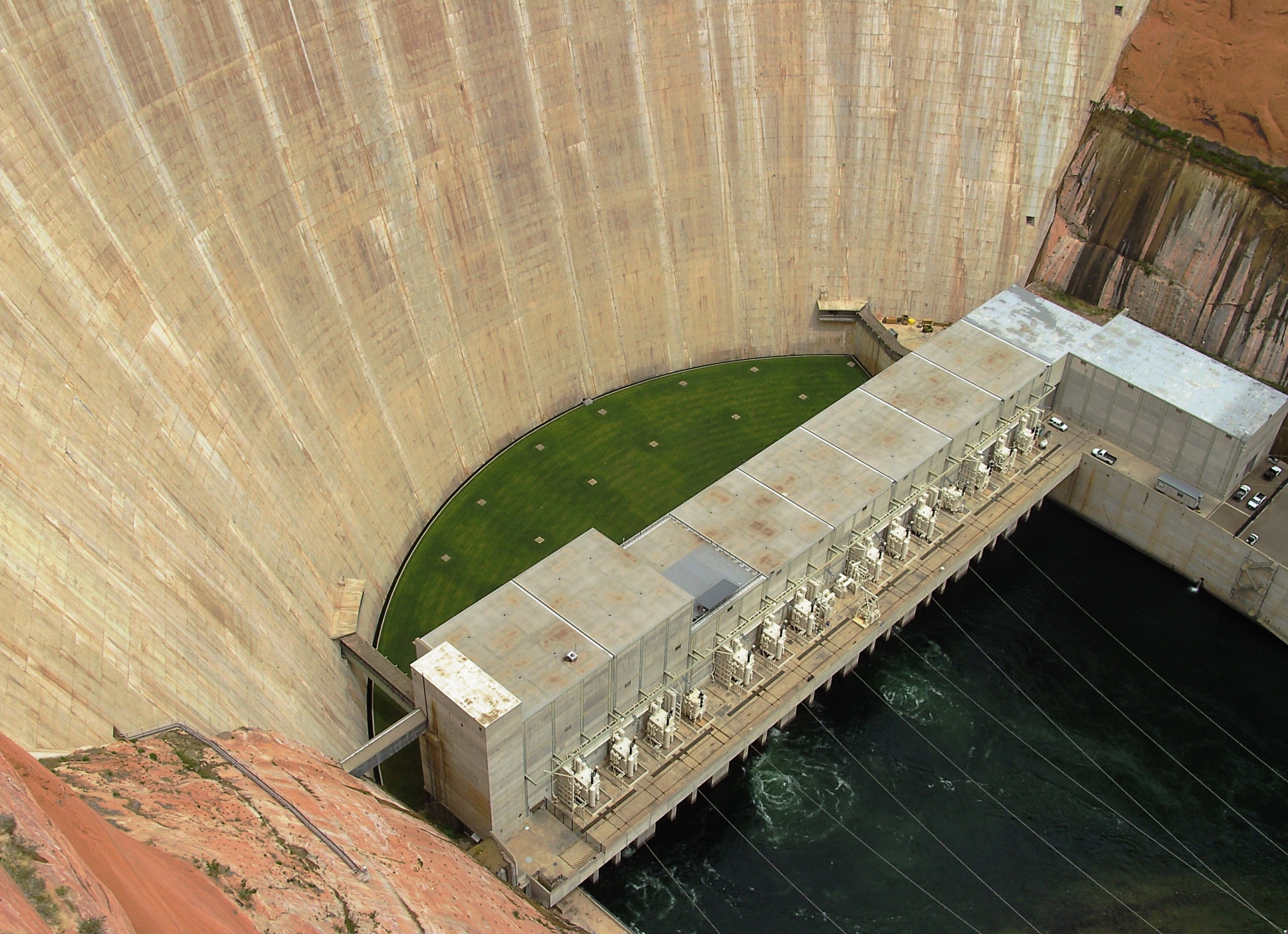
    The generator building of Glen Canyon hydro power plant in Arizona via Wikimedia.
    The generator building of Glen Canyon hydro power plant in Arizona via Wikimedia.

    From The Arizona Daily Sun (Taylor Hartman):

    In an attempt to restore some natural flow to the Colorado River, high flow experiments are conducted from Glen Canyon Dam. Taking tips from Mother Nature, these experiments mimic natural floods that occurred before the construction of the dam. On Monday, November 7, one such experiment began, freeing a large quantity of water from Lake Powell reservoir over the span of five days.

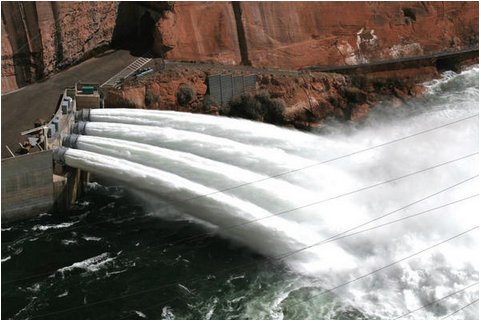
    During the controlled flood, the view from the steel bridge changes: the awakened Colorado River thrashes in the canyon below. Water flows through the hydroelectric generators and erupts from four river outlet tubes, with its roar reverberating off the canyon walls and mist sparkling under the warm November sun. Dazzling white due to immense pressure, 36,000 cubic feet of water bursts from the dam every second. This peak flow is four to six times greater than usual discharge, and lasted for 92 hours.

    While the bridge offers an incredible view of the dam, canyon, river and reservoir, tours bring visitors inside the dam daily. From within the cold walls of the dam, the sound of rushing water is accompanied by the rhythm of generators turning at 150 rounds per minute. During the experiment, these generators still produce hydroelectric power, but less than usual. The Bureau of Reclamation says that all power demands will still be met.

    The ground floor of the dam tour is at river level, and the 710-foot dam is even more impressive when viewed from the bottom. At this level, the sound of water overpowers all other noise, and wild emerald waves crash against concrete and sandstone. As floodwaters leave the dam and travel through Grand Canyon, sediment is picked up from tributary rivers and suspended in the tumultuous flow. The experiment is timed to follow an influx of sand from the Paria River, enabling the flood to redistribute it throughout the river corridor.

    Downstream, the river corridor is cleansed: low vegetation is ripped from riverbanks, beaches are submerged, and sand is suspended and deposited. The flood affects campers and rafters through Grand Canyon. People recreating near or on the Colorado River were encouraged to be on alert, camp on high, stable beaches, and practice leave-no-trace ethics. On the other side of the dam, water level at Lake Powell has dropped more than three feet.

    This flood is the latest release in a series of high flow experiments since 1996. Controlled floods have the potential to enlarge sandbars and beaches downstream of Glen Canyon Dam, which could provide ecological and recreational benefits. These benefits include: improving the habitat of native fish such as the endangered humpback chub, reducing erosion of archaeological sites, restoring vegetation, and increasing the size of beaches.

    As the flood ramps down, the river returns to its usual controlled flow condition. The promising white blast from the outlet tubes subsides, and the buzzing of the generators recaptures the soundscape at Glen Canyon Dam. Scientists will continue to monitor Colorado River conditions in order to understand how this flow affects downstream ecosystem and resources, and to plan future floods. The Bureau of Reclamation says that the occurrence and intensity of future high flow experiments will depend on weather, sediment influx from tributaries, and other resource conditions.

    November 2012 High Flow Experiment via Protect the Flows
    November 2012 High Flow Experiment via Protect the Flows

    2017 #coleg: #Storage has to be on the table — Jerry Sonnenberg #COWaterPlan

    Clear Creek Reservoir
    Clear Creek Reservoir

    From The Sterling Journal-Advocate (Jeff Rice):

    Contacted at his home over the holiday weekend…[Jerry Sonnenberg] said the issues the legislature will be grappling with are becoming more acute as time goes on. And none are more contentious than those facing the committee the popular Sterling farmer will again be chairing. Commonly called the Ag Committee, the panel is actually the Senate Agriculture, Natural Resources, and Energy committee — three areas that can come into conflict when it comes to lawmaking.

    The biggest challenge Sonnenberg sees for that committee in the coming session is getting meaningful legislation out of the Colorado Water Plan. Only one bill, the South Platte storage survey, which Sonnenberg sponsored in the Senate, came out of this year’s session. He believes there will be much more legislation on that issue next year but it will be more contentious.

    “It appears that people only want to implement the conservation part of the (CWP) and not the storage,” Sonnenberg said. “I see the Colorado Water Conservation Board as largely ignoring the whole storage issue.”

    But storage has to be on the table in any bill that reaches the Sonnenberg-led ag committee.

    “You can’t get stuff through my committee until we have a conversation about (water storage,)” he said…

    Sonnenberg is again on the Senate Appropriations Committee, and it’s the one that may actually be dearest to his heart because it’s where he can apply his conservative philosophy of government thrift. That’s not necessarily less spending, but spending where it does the most good, he explained.

    “I’m going to question, where is this money coming from?” he said. “Is this money coming out of education or is it coming out of transportation? Are we robbing Peter to pay Paul? I think those are very important things to watch out for.”

    […]

    The first regular session of the 71st Colorado General Assembly will convene on Jan. 11, 2017.