Local apples were once again pressed into juice for market during a successful pilot project held in a Lebanon orchard last month.
The event, sponsored by the Montezuma Orchard Restoration Project, processed 800 bushels of apples gathered from local orchards.
“It went really well, we generated 2,200 gallons of raw juice that was sold to hard cider makers,” said MORP manager Nina Williams.
The group is studying the feasibility of using a mobile pressing unit to process apples from the many forgotten local orchards that otherwise let the fruit go to waste.
They were awarded a $42,400 planning grant from the U.S. Department of Agriculture to test the idea.
For two days in October, Northwest Mobile Juicing, out of Montana, set up in the Russell apple orchard in Lebanon. The unit can press, pasteurize, and package the juice for market.
For the pilot, the raw juice could only be sold to hard cider companies for fermentation. Additional permits are needed to sell pasteurized apple juice.
“We proved we can get if off the trees for sale to the hard cider market,” Williams said. “If the demand is there we can work through the regulations to sell local juice as well.”
Several orchard owners realized some profits from the project, and were paid 10 cents per pound for apples still on the tree.
A dedicated crew of twenty MORP volunteers spend 300 hours picking the apples in the weeks prior to the pressing. In all, nine apple orchard owners were paid $3,500 for their apples.
One local cider maker and four from Boulder and Denver bought the raw juice. A semi-truck was loaded with the juice for a night run to Front Range cideries.
“They were impressed with the quality,” Williams said. “The juice was a blend of local heritage apple varieties.”
Apple mash produced was hauled off by local livestock owners for feed.
MORP said they broke even on the trial run, and are studying how best to set up a local pressing facility.
“We learned that there is a lot of labor and infrastructure involved besides just the pressing equipment,” Williams said.
Commercial apple operations require warehouses, shipping docks, refrigerated cold storage to store apples, and heavy equipment such as trucks and forklifts.
MORP has been documenting once popular heritage apple varieties from the days when the area was a thriving fruit market more than 100 years ago.
They have brought many of them back to life through careful grafting and propagation techniques, and are encouraging local farmers to plant heritage apple orchards.
“Our big goals is to bring back this genetic diversity to keep heritage apples from going extinct, and to get it so people can have these trees again,” said MORP orchardist Jude Schuenemeyer. “Trees that worked here for over 100 years are really well adapted to this place.”
A recent victory for MORP was the rediscovery of the rare Colorado orange apple in a Cañon City orchard in 2012. For the last several years, local orchardists have been grafting and cultivating this near-extinct apple known for its fine flavor, hardiness, storage qualities, and cider-making potential.
There are dozens of abandoned apple orchards in the county that still produce a good crop, but have a limited market. The juice market is seen as ideal because the apples do not have to be perfect and the ones that fall on the ground can be used as well.
“One of our goals is to get local orchards back in shape by hosting workshops this winter on pruning and orchard management,” Williams said.
FromThe Grand Junction Daily Sentinel (Dennis Webb):
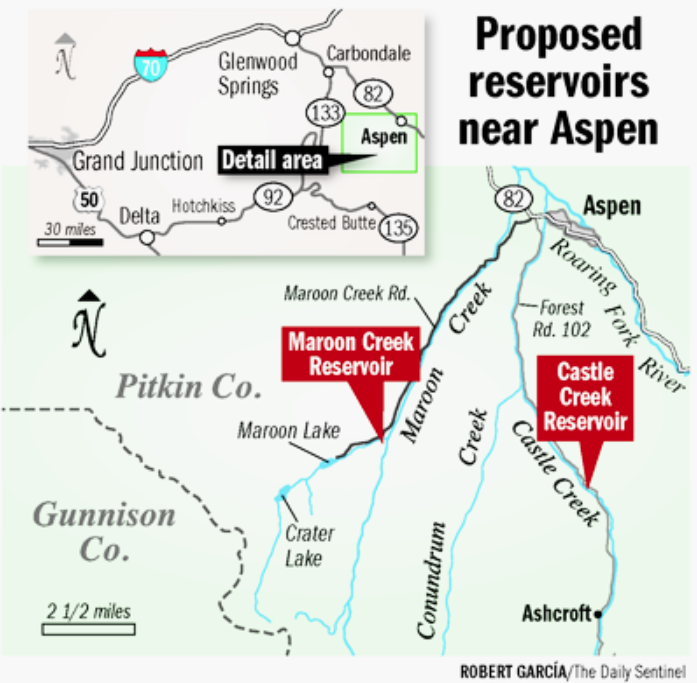
City officials [assure residents and others that], while there’s no proposal to actually build the reservoirs at this time, it would be irresponsible not to continue seeking to preserve the water rights for what may be one of many approaches for meeting future needs.
“Despite the notion that the city is poised to dam Maroon Valley, in reality this filing is an action demanded by state law to protect our rights to your drinking water,” Mayor Steve Skadron wrote in a recent letter to the editor to the Aspen Daily News.
“Without knowing more about viable alternatives for water storage, it would not be prudent water management on our part to give up these water rights. After all, climate and other changes in this region are uncertain and what our needs will look like in 2066 is not something we are poised to gamble away by letting this storage right go.”
Acting on unanimous direction from City Council, the city last week applied to keep for another six years conditional water rights it has held since 1965. Its action has riled up not just local residents but conservation groups including the Carbondale-based Wilderness Workshop, American Rivers and Western Resource Advocates.
“I think if we need to find other places to get water, there’s probably other places to do that than the base of the Maroon Bells,” said Will Roush, Wilderness Workshop’s conservation director.
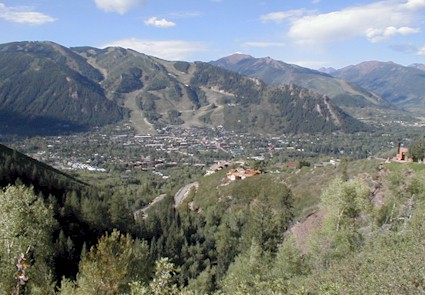
A view from where a dam would stand to form the potential Maroon Creek Reservoir. Photo via Brent Gardner-Smith @AspenJournalism.
The shapely Maroon Bells are two of the most famous of Colorado’s 50-plus Fourteeners, or peaks over 14,000 feet high. Endless photos depict the twin, red-rock, snow-fringed peaks presiding in the back of a green-forested valley, their images reflected by Maroon Lake in the foreground. So many people visit the lake for that view that vehicle access in summer is mostly restricted to buses.
Castle Creek is similarly stunning, providing access to another Fourteener, Castle Peak, as well as the ghost town of Ashcroft, the popular Conundrum Hot Springs and other attractions.
Beyond issues such as aesthetics, the Maroon Bells reservoir would lie largely within the Maroon Bells-Snowmass Wilderness Area, and a small part of the Castle Creek one would be in wilderness. That has attracted the interest of the U.S. Forest Service, which expects to file an opposition letter to Aspen’s filing in water court pointing out that it doesn’t have the authority to allow a reservoir in wilderness.
“Actually, the president of the United States does,” said Scott Fitzwilliams, supervisor of the White River National Forest.
He said he believes the president would have to approve such an action, or sign an act of Congress redrawing the wilderness area lines to exclude such a reservoir.
Fitzwilliams said he’s aware of situations where wilderness areas have been created with a specific exemption allowing for a reservoir. But this situation would be different. Roush said while it’s possible to petition a president for an exception for a new reservoir in an existing wilderness area, this provision of the Wilderness Act has never been used, and he fears that Aspen could set a damaging precedent.
David Hornbacher, Aspen’s director of utilities and environmental initiatives, said that when the city’s water rights moved forward in 1965, the acreage envisioned for the two reservoirs didn’t overlie wilderness. That changed in 1980 when the wilderness area was expanded. Regardless, the Wilderness Act provides a presidential path forward for building reservoirs in wilderness, he said.
That issue wouldn’t be the only one on the Forest Service’s mind if the city proceeded with trying to build the reservoirs.
“Certainly, flooding the Maroon Valley, we would have a host of issues that we would bring to their attention. It’s a pretty popular spot,” Fitzgerald said, chuckling at his understatement.
But while the Forest Service could hold the city responsible for mitigating effects such as flooding wetlands, it would have to let the city exercise its legal rights to store water, within reason, he said.
“There’s a limited amount of authority we can exercise when it comes to a water right,” he said.
The Maroon and Castle creek reservoir dams are envisioned as being 150 and 175 feet high, respectively, enough to swamp more than 200 acres between them.
Roush finds the city’s position on the water rights incongruous with its good record of environmental stewardship on climate change and other issues.
“Maintaining the right to put dams on these two creeks just seems a little bit out of sync with both the City Council itself but also the character of the community,” he said.
But Hornbacher said climate change is a big factor forcing the city’s hand.
“Aspen’s water supply is snow and that is changing,” he said.
The city largely relies on the snowpack-induced river flows from the two valleys now. But with a warmer climate, reflected by an average of 23 more frost-free days in Aspen today than in 1980, that snowpack’s future reliability is in question.
“Essentially what water you do have tends to be melting or leaving the valley earlier (each year) than it has in the past,” he said.
Reservoir storage would not only bolster water supplies each year, but prove valuable in cases of back-to-back drought years.
While the city has had success in implementing water conservation measures, it also is looking to more demand as a result of a growing population, its transition from a winter resort to a more year-round one, and the possibility that second-home owners could use those homes more or convert them to their primary homes, Hornbacher said.
He said it’s important for the city to make decisions today to address the uncertainties and risks of providing a safe, secure and legal water supply in the future.
Conservationists contend the city’s own water supply study this year shows the reservoirs wouldn’t be necessary. Harrison doesn’t think the city’s population ever will grow enough to warrant their construction. She’s unnerved by the due-diligence language in the city’s water rights filing that it “can and will” build the dams. That makes her think the city is leaning toward building them.
“If that’s the case it’s like, are you kidding me?” Harrison said. “There are a lot of people that are outraged.”
Hornbacher hopes that with interest in the issue being high right now, the public can be enlisted to get involved in working with the city on evaluating existing water-supply alternatives and identifying new ones. Council directed city staff to initiate such a collaborative process when it decided to have the city proceed with filing to keep the water rights.
Among the options for consideration are rethinking the size and location of the envisioned reservoirs within the two valleys, as well as how water rights might be affected if the city looked to build them in another valley.
Roush said the Wilderness Workshop would love to work with the city on studying storage, and whether it could be accomplished in other ways, such as in tanks, underground aquifers or through water-sharing with other entities.
“There’s certainly a role for stored water but in places like (Maroon and Castle creeks), they’re certainly inappropriate,” he said of the reservoirs.
The next president could be faced with ordering a first-ever reduction in water siphoned from the river by 333,000 acre feet next August, a report by the Colorado River Future Project contends. That’s an amount equivalent to the water used in 666,0000 homes.
U.S. Bureau of Reclamation officials on Tuesday confirmed the finding. Federal models show a 48 percent chance that, without cuts, lower basin states Arizona, California and Nevada would face shortages starting in 2018.
Anne Castle, President Obama’s former Interior Department Assistant Secretary for Water and Science and now a senior fellow at CU’s Getches-Wilkinson Center for Natural Resources, Energy and the Environment, led a team of five researchers. They interviewed 65 western water policy experts and decision-makers in addition to analyzing federal data.
“This really is a critical time. Action is required. We’re closer to the edge than we ever have been,” Castle said.
The report concludes the next president must prioritize a Colorado River “crisis” within the first 100 days and ensure that key positions dealing with water are filled. A convergence of events related to the river includes an essential not-done deal with Mexico, which has claims on a share of river water, and unresolved claims by Navajo and other Indian tribes.
An imbalance in water use along the river — cities and farmers for a decade have been taking more than the river gives — means future development in the arid West may not be possible because there’s not enough water, Castle said.
“It depends on how you do it. The major municipal suppliers have shown they can reduce per-capita water usage so they can serve more homes with the same amount of water,” she said. “But increasing the draw on the Colorado increases the risk of shortages for every other water user in the Colorado River Basin.”
The CU team sent the report to presidential transition teams for candidates Hillary Clinton and Donald Trump. Clinton officials said they’d like to discuss the findings, but the Trump team has yet to respond…
For a decade, cities and food growers who irrigate 5 million acres have drawn far more than the river gives. This imbalance, combined with recent dry years, has led to a draw-down of Lake Mead, created by Hoover Dam, to record low levels. On Tuesday, federal officials said the water level measured 1,076 feet (9.5 million acre feet), or 37 percent of capacity — right at the threshold for ordering cuts. A draw-down of Lake Mead forces, under legal agreements, a draw-down of Lake Powell, above the Grand Canyon, which imperils hydro-electricity essential for the western power grid.
Drawing down Mead water levels below that threshold triggers, under 2007 legal guidelines for western states, federal intervention to order cuts. The initial cuts starting in January 2018 would reduce water diverted to Arizona (by 320,000 AF out of the state’s 2.8 MAF share) and Nevada (13,000 AF out of the state’s 300,000 AF share).
Federal officials who operate dams along the Colorado River said they agree with the Colorado River Future Project’s conclusions…
“Obviously, the next administration will set its own priorities. However, we agree that follow-through on the activities identified in the Colorado River Future Project Report should be prioritized,” Bureau of Reclamation spokesman Peter Soeth said.
Obama administration officials “have prioritized science-based decision making on the Colorado River, and we are working to reach agreements within the U.S. and with Mexico to address the effects of historic drought and a rapidly changing climate,” Bureau of Reclamation Commissioner Estevan Lopez said. [ed. emphasis mine] “Our efforts to work with stakeholders, tribes, states and our neighbors in Mexico are all designed to reduce risk in the Colorado River Basin — and will provide a foundation for continued engagement and progress on the Colorado River in the months and years ahead.”
[…]
Federal officials would order and enforce the cuts in water use.
“The goal is not necessarily a far more aggressive federal oversight role,” Castle said.
“But what we are noticing is that a confluence of events in the next 12 months will have a big influence on the ability of that river to continue to provide a reliable supply for the river basin that has grown up relying on it.”