FromThe Grand Junction Daily Sentinel (Dennis Webb):
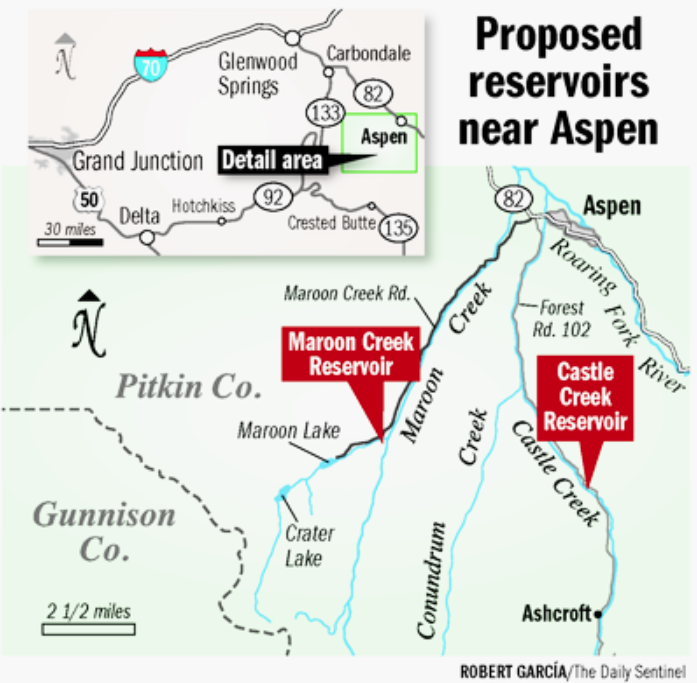
City officials [assure residents and others that], while there’s no proposal to actually build the reservoirs at this time, it would be irresponsible not to continue seeking to preserve the water rights for what may be one of many approaches for meeting future needs.
“Despite the notion that the city is poised to dam Maroon Valley, in reality this filing is an action demanded by state law to protect our rights to your drinking water,” Mayor Steve Skadron wrote in a recent letter to the editor to the Aspen Daily News.
“Without knowing more about viable alternatives for water storage, it would not be prudent water management on our part to give up these water rights. After all, climate and other changes in this region are uncertain and what our needs will look like in 2066 is not something we are poised to gamble away by letting this storage right go.”
Acting on unanimous direction from City Council, the city last week applied to keep for another six years conditional water rights it has held since 1965. Its action has riled up not just local residents but conservation groups including the Carbondale-based Wilderness Workshop, American Rivers and Western Resource Advocates.
“I think if we need to find other places to get water, there’s probably other places to do that than the base of the Maroon Bells,” said Will Roush, Wilderness Workshop’s conservation director.
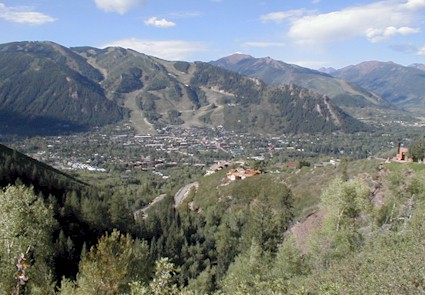
A view from where a dam would stand to form the potential Maroon Creek Reservoir. Photo via Brent Gardner-Smith @AspenJournalism.
The shapely Maroon Bells are two of the most famous of Colorado’s 50-plus Fourteeners, or peaks over 14,000 feet high. Endless photos depict the twin, red-rock, snow-fringed peaks presiding in the back of a green-forested valley, their images reflected by Maroon Lake in the foreground. So many people visit the lake for that view that vehicle access in summer is mostly restricted to buses.
Castle Creek is similarly stunning, providing access to another Fourteener, Castle Peak, as well as the ghost town of Ashcroft, the popular Conundrum Hot Springs and other attractions.
Beyond issues such as aesthetics, the Maroon Bells reservoir would lie largely within the Maroon Bells-Snowmass Wilderness Area, and a small part of the Castle Creek one would be in wilderness. That has attracted the interest of the U.S. Forest Service, which expects to file an opposition letter to Aspen’s filing in water court pointing out that it doesn’t have the authority to allow a reservoir in wilderness.
“Actually, the president of the United States does,” said Scott Fitzwilliams, supervisor of the White River National Forest.
He said he believes the president would have to approve such an action, or sign an act of Congress redrawing the wilderness area lines to exclude such a reservoir.
Fitzwilliams said he’s aware of situations where wilderness areas have been created with a specific exemption allowing for a reservoir. But this situation would be different. Roush said while it’s possible to petition a president for an exception for a new reservoir in an existing wilderness area, this provision of the Wilderness Act has never been used, and he fears that Aspen could set a damaging precedent.
David Hornbacher, Aspen’s director of utilities and environmental initiatives, said that when the city’s water rights moved forward in 1965, the acreage envisioned for the two reservoirs didn’t overlie wilderness. That changed in 1980 when the wilderness area was expanded. Regardless, the Wilderness Act provides a presidential path forward for building reservoirs in wilderness, he said.
That issue wouldn’t be the only one on the Forest Service’s mind if the city proceeded with trying to build the reservoirs.
“Certainly, flooding the Maroon Valley, we would have a host of issues that we would bring to their attention. It’s a pretty popular spot,” Fitzgerald said, chuckling at his understatement.
But while the Forest Service could hold the city responsible for mitigating effects such as flooding wetlands, it would have to let the city exercise its legal rights to store water, within reason, he said.
“There’s a limited amount of authority we can exercise when it comes to a water right,” he said.
The Maroon and Castle creek reservoir dams are envisioned as being 150 and 175 feet high, respectively, enough to swamp more than 200 acres between them.
Roush finds the city’s position on the water rights incongruous with its good record of environmental stewardship on climate change and other issues.
“Maintaining the right to put dams on these two creeks just seems a little bit out of sync with both the City Council itself but also the character of the community,” he said.
But Hornbacher said climate change is a big factor forcing the city’s hand.
“Aspen’s water supply is snow and that is changing,” he said.
The city largely relies on the snowpack-induced river flows from the two valleys now. But with a warmer climate, reflected by an average of 23 more frost-free days in Aspen today than in 1980, that snowpack’s future reliability is in question.
“Essentially what water you do have tends to be melting or leaving the valley earlier (each year) than it has in the past,” he said.
Reservoir storage would not only bolster water supplies each year, but prove valuable in cases of back-to-back drought years.
While the city has had success in implementing water conservation measures, it also is looking to more demand as a result of a growing population, its transition from a winter resort to a more year-round one, and the possibility that second-home owners could use those homes more or convert them to their primary homes, Hornbacher said.
He said it’s important for the city to make decisions today to address the uncertainties and risks of providing a safe, secure and legal water supply in the future.
Conservationists contend the city’s own water supply study this year shows the reservoirs wouldn’t be necessary. Harrison doesn’t think the city’s population ever will grow enough to warrant their construction. She’s unnerved by the due-diligence language in the city’s water rights filing that it “can and will” build the dams. That makes her think the city is leaning toward building them.
“If that’s the case it’s like, are you kidding me?” Harrison said. “There are a lot of people that are outraged.”
Hornbacher hopes that with interest in the issue being high right now, the public can be enlisted to get involved in working with the city on evaluating existing water-supply alternatives and identifying new ones. Council directed city staff to initiate such a collaborative process when it decided to have the city proceed with filing to keep the water rights.
Among the options for consideration are rethinking the size and location of the envisioned reservoirs within the two valleys, as well as how water rights might be affected if the city looked to build them in another valley.
Roush said the Wilderness Workshop would love to work with the city on studying storage, and whether it could be accomplished in other ways, such as in tanks, underground aquifers or through water-sharing with other entities.
“There’s certainly a role for stored water but in places like (Maroon and Castle creeks), they’re certainly inappropriate,” he said of the reservoirs.