Weather and climate experts had a clear message for attendees at the Colorado Farm Show at Island Grove Regional Park on Wednesday morning: Climate change will have real effects on agriculture, politics and public controversy aside.
Brad Udall is a senior water and climate change scientist with the Colorado Water Institute at Colorado State University. He moderated a series of presentations and then a panel discussion on the subject of climate change for about 100 audience members.
“I think all of you understand that climate change is controversial, and it’s highly political,” Udall began. “But I need to tell you that within the scientific community, it is not controversial.”
The climate discussions were two of the many events on the second day of the farm show. Other presentations focused on topics ranging from the future of dairy farming to the basics of genomic testing. The farm show, which regularly brings more than 40,000 attendees during the three days concludes today.
CBS4 Denver Meteorologist Dave Aguilera opened his presentation by explaining the work of the National Ice Core Lab, located in Lakewood. Using ice cores from Antarctica, scientists observe air pockets trapped in ice from the past 800,000 years. Since the Industrial Revolution, carbon dioxide content has increased dramatically, he said.
Aguilera said he wanted to present the bare facts, without telling people what to think or demanding them to react in a certain way.
“I think when this whole thing started, we kind of went about it the wrong way. I think you can’t tell people, ‘Hey, the climate is warming up. Get rid of your car,’ ” he said.
One audience member expressed a concern that while he believes the earth is warming, the specifics of how it will affect people are uncertain. Aguilera agreed, adding people should educate themselves and others so more research can be done to clarify the full effects of climate change.
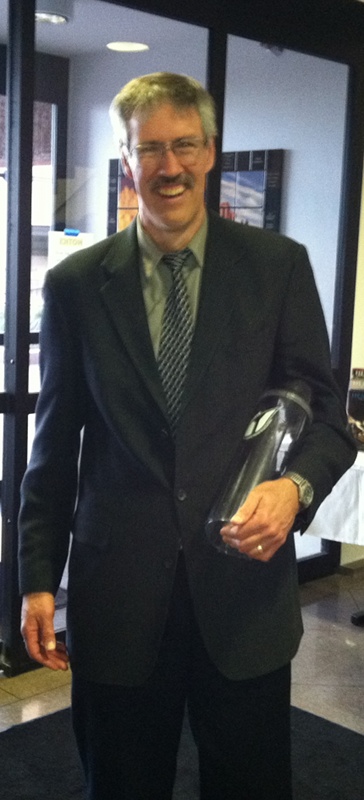
Nolan Doesken — Colorado Water Foundation for Water Education President’s Award Presentation 2011
State Climatologist Nolan Doesken followed with a discussion of Colorado’s climate. Presenting graphs of temperature changes from weather stations throughout Colorado, Doesken noted a warming trend isn’t noticeable at an isolated weather station.
But when data from weather stations across Colorado are averaged, the trend matches the national and global trends of a climate that is getting hotter. Last fall was Colorado’s hottest on record, Doesken said.
During the panel, audience members asked questions about the effect of urbanization on weather stations and how climate change will affect areas where crops can be grown.
A first-timer at the Colorado Farm Show, Rhonda Brandt, said she thought the speakers’ comments were unique. Now a resident of Cheyenne, Brandt grew up on a farm south of Akron.
She said there’s no lack of science on climate change, but a lack of conversation that isn’t muddled by politics. When it comes to the agricultural community, she believes people will prevail over politics.
“I’m confident that the farmers and ranchers will adapt as they need to,” she said. “I hope we can come up with a plan. If something major does happen, that can help the farmers and ranchers do it as a country, rather than relying on them alone. Our food supply depends on it.”
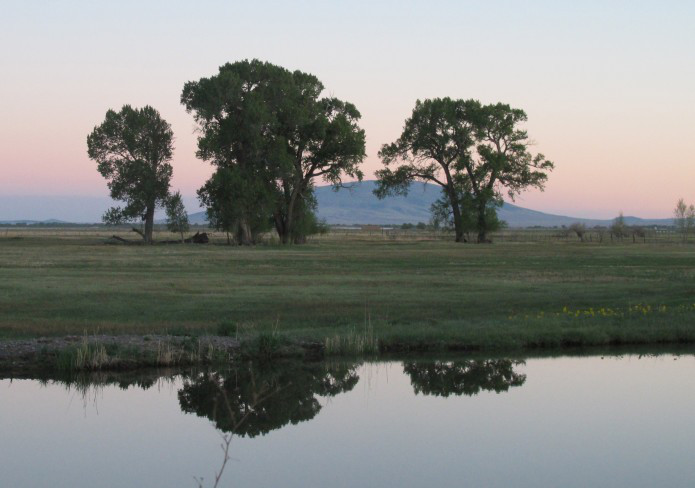
Pond on the Garcia Ranch via Rio Grande Headwaters Land Trust
From Great Outdoors Colorado (Rosemary Dempsey) via The Crestone Eagle:
The Great Outdoors Colorado (GOCO) Board awarded three grants totaling more than $1.4 million to projects across the San Luis Valley. San Luis Valley Inspire, a valley-wide coalition breaking down barriers for kids to get outside, received $1 million in funding as part of the GOCO Inspire Initiative; Rio Grande Headwaters Land Trust (RiGHT) received a $376,500 grant to permanently conserve the La Garita Creek Ranch near Del Norte; and Colorado Parks and Wildlife (CPW) received a $25,000 habitat restoration grant for Rio Grande State Wildlife Area.
The $1 million grant is part of GOCO’s Inspire Initiative, which will invest in places, programs, and pathways to get kids outside in communities across the state. This innovative framework is being looked at as a national model, and each coalition’s approach to the unique challenges of their community will serve as examples to other rural, urban, suburban, or mountain communities across the country.
Youth have led the charge for the San Luis Valley Inspire coalition; this funding will put their plans into action over the next three years. San Luis Valley Inspire will put GOCO funding to work in Antonito, Creede and Saguache, building the Antonito Outdoor Education Center and investing in the creation of the Antonito Adventure Program, improving connections along Creede’s Willow Creek Corridor, the Headwaters Youth Conservation Corps, the Saguache Backyard to Backcountry Program, and the Saguache Youth Conservation Corps.
RiGHT’s grant for La Garita Creek Ranch was part of GOCO’s open space grant program, which funds public and private land conservation. Projects sustain local agriculture and economies, give outdoor recreationists a place to play (or simply enjoy the view), protect wildlife habitat, and safeguard the state’s water supply.
La Garita Creek Ranch is a 460-acre guest ranch outside of Del Norte near Penitente Canyon, an international climbing, hiking, and mountain biking destination. The ranch is also adjacent to Bureau of Land Management (BLM) land and the Rio Grande National Forest.
Conserving La Garita will protect critical water access and habitat for a variety of wildlife species as well as Ute pictographs and other archaeological evidence of early Native Americans. The conservation project will also create new climbing and bouldering access.
CPW’s grant is part of GOCO’s habitat restoration grant program. In 2016, GOCO doubled funding for the program, which restores habitat through projects that remove invasive plant species, protect Colorado’s water supply, mitigate fire fuels, and perform other critical restoration work.
Restoration of the Rio Grande in Rio Grande State Wildlife Area will protect water infrastructure, local agriculture, and wetlands that support threatened and endangered amphibians, fish, birds, and mammals.
To date, GOCO has invested $42 million in San Luis Valley projects and has conserved more than 90,000 acres of land in the valley. GOCO funding has supported Alamosa’s ice rink and Rio Grande Farm Park, Faith Hinkley Memorial Park in Monte Vista, and Center’s Town Park, among other projects.
Great Outdoors Colorado (GOCO) invests a portion of Colorado Lottery proceeds to help preserve and enhance the state’s parks, trails, wildlife, rivers, and open spaces. GOCO’s independent board awards competitive grants to local governments and land trusts, and makes investments through Colorado Parks and Wildlife. Created when voters approved a Constitutional Amendment in 1992, GOCO has since funded more than 4,800 projects in urban and rural areas in all 64 counties without any tax dollar support. Visit GOCO.org for more information.
NASA will host a media day at 9:30 a.m. MST on Feb. 13 to highlight a field campaign designed to advance new remote-sensing techniques to measure the amount of water held in snow, a key factor in calculating water supplies in many parts of the world.
The event will be held at Peterson Air Force Base in Colorado Springs. NASA’s SnowEx project, which is a multi-year campaign to test a variety of sensors and techniques to improve measurements of snow over different terrains, begins in February and will collect a variety of airborne and ground-based measurements. The research team includes more than 100 scientists from universities and agencies across the United States, Europe and Canada.
Reporters will have the opportunity to interview scientists, pilots, and mission managers and tour the Naval Research Laboratory P-3 Orion aircraft that will be used in the campaign. The P-3 is operated by the Scientific Development Squadron ONE, based at Naval Air Station Patuxent River in Maryland.
Media interested in participating in the event should contact Rani Gran via at rani.c.gran@nasa.gov no later than 1 p.m. on Feb. 10. Attendees will need a driver’s license, vehicle registration and proof of insurance to enter the base. The date of the event is subject to change based on flight schedules.
Media interested in a separate escorted trip in February to SnowEx ground sites near Grand Mesa, Colorado, should contact Jennifer Hayes of the U.S. Forest Service at 970-498-1365 or jenniferhayes@fs.fed.us.
More than one-sixth of the world’s population relies on seasonal snow and glaciers for water. As much as three quarters of the water used in the western United States comes from snow. For decades, satellites have measured the area covered by snow but they cannot consistently measure how much water is contained in the snow over all terrains. Better measurements of snow are of significant interest to managers of fresh water availability, natural hazards, winter-dependent industries, and ecosystem impacts.
SnowEx is sponsored by the Terrestrial Hydrology Program in NASA’s Earth Science Division in Washington, and managed by the agency’s Goddard Space Flight Center in Greenbelt, Maryland. The U.S. Forest Service is leading the ground campaign in Grand Mesa and Senator Beck Basin, both in Colorado. A list of SnowEx partners is available online.
NASA collects data from space, air, land and sea to increase our understanding of our home planet, improve lives and safeguard our future. For more information about NASA’s Earth science programs, visit: