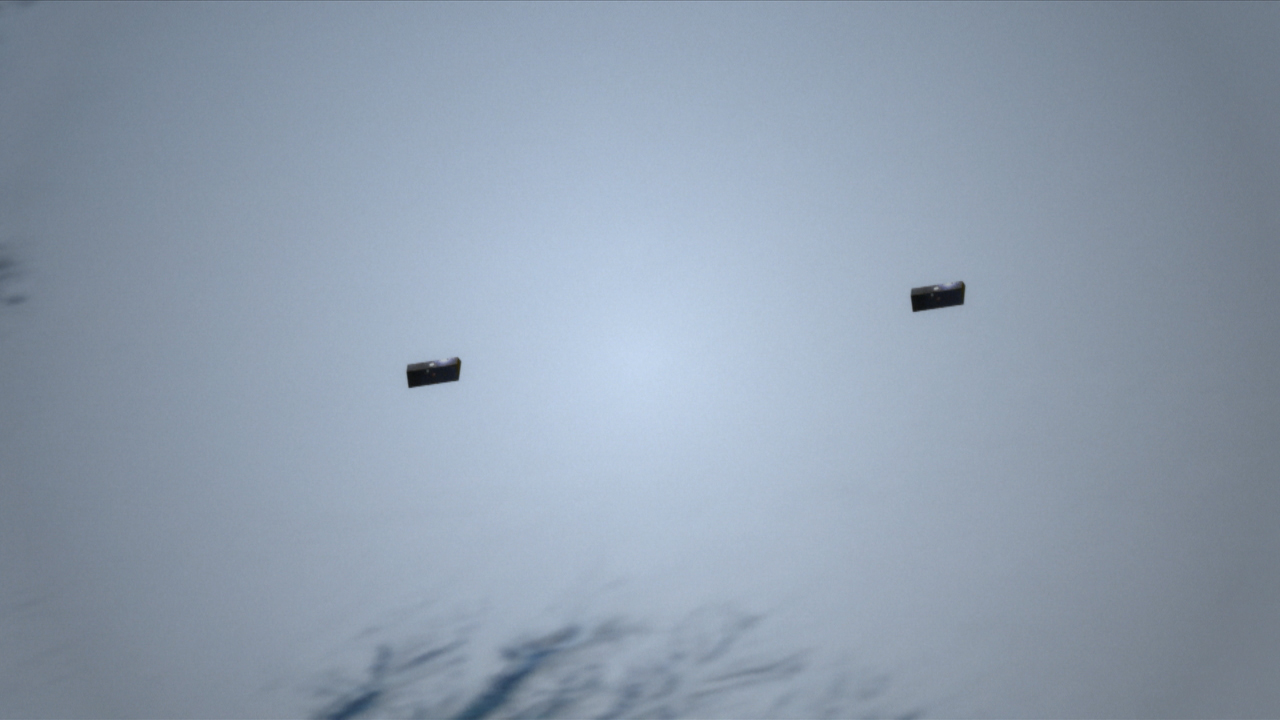
Scheduled to launch no earlier than May 22, the twin satellites of the Gravity Recovery and Climate Experiment Follow-On (GRACE-FO) mission, a collaboration between NASA and the German Research Centre for Geosciences (GFZ), will continue the work of monitoring changes in the world’s water cycle and surface mass, which was so well performed by the original GRACE mission. There are far more than five things to say about this amazing new-old mission; but here are a few favorite facts.
1 Percent (or Less)
GRACE-FO tracks liquid and frozen water by measuring month-to-month changes in Earth’s gravitational pull very precisely. More than 99 percent of our planet’s gravitational pull doesn’t change from one month to the next, because it represents the mass of the solid Earth itself. But a tiny fraction of Earth’s mass is constantly on the move, and it is mostly water: Rain is falling, dew is evaporating, ocean currents are flowing, ice is melting and so on. GRACE-FO’s maps of regional variations in gravity will show us where that small fraction of overall planetary mass is moving every month.
2 Satellites, One Instrument
Unlike other Earth-observing satellites, which carry instruments that observe some part of the electromagnetic spectrum, the two GRACE-FO satellites themselves are the instrument. The prime instrument measures the tiny changes in the distance between the pair, which arise from the slightly varying gravitational forces of the changing mass below. Researchers produce monthly maps of water and mass change by combining this information with GPS measurements of exactly where the satellites are and accelerometer measurements of other forces acting upon the spacecraft, such as atmospheric drag.
3 Gravity Missions, Including One on the Moon
The same measurement concept used on GRACE and GRACE-FO was also used to map the Moon’s gravity field. NASA’s Gravity Recovery and Interior Laboratory (GRAIL) twins orbited the moon for about a year, allowing insights into science questions such as what Earth’s gravitational pull contributed to the Moon’s lopsided shape. The intentionally short-lived GRAIL satellites were launched in September 2011 and decommissioned in December 2012.
4 Thousand-Plus Customers Served
GRACE observations have been used in more than 4,300 research papers to date — a very high number for a single Earth science mission. Most papers have multiple coauthors, meaning the real number of scientist-customers could be higher, but we chose a conservative estimate. As GRACE-FO extends the record of water in motion, there are sure to be more exciting scientific discoveries to come.
5 Things We Didn’t Know Before GRACE
Here’s a list-within-a-list of five findings from those 4,300-plus papers. Watch the GRACE-FO website to learn what the new mission is adding to this list.
• Melting ice sheets and dwindling aquifers are contributing to Earth’s rotational wobbles.
• A few years of heavy precipitation can cause so much water to be stored on land that global sea level rise slows or even stops briefly.
• A third of the world’s underground aquifers are being drained faster than they can be replenished.
• In the Amazon, small fires below the tree canopy may destroy more of the forest than deforestation does — implying that climatic conditions such as drought may be a greater threat to the rainforest than deforestation is.
• Australia seesaws up and down by two or three millimeters each year because of changes to Earth’s center of mass that are caused by the movement of water.
Bonus: The Fine Print
JPL manages the GRACE-FO mission for NASA’s Science Mission Directorate in Washington, under the direction of the Earth Systematic Missions Program Office at NASA’s Goddard Space Flight Center in Greenbelt, Maryland. The spacecraft were built by Airbus Defence and Space in Friedrichshafen, Germany, under subcontract to JPL. GFZ contracted GRACE-FO launch services from Iridium. GFZ has subcontracted mission operations to the German Aerospace Center (DLR), which operates the German Space Operations Center in Oberpfaffenhofen, Germany.
There are possible sources for rain opportunities in these spring/summer months, including anticipated periodic areas of low pressure and the dryline boundary (of instability) on the Plains, and possible rains if the El Nino sets up this summer, and then — the monsoonal flow (of seasonal reversal) up into the southern Rockies, among other storm-inducing features. Meanwhile, until the next rainfall, here’s the current drought impact.
SOUTHWEST COLORADO
For starters, extreme southwest Colorado including Durango are in exceptional drought, according to the Drought Monitor. Areas further north, including Grand Junction are in severe drought. Then further north into Steamboat Springs is classified as “abnormally dry.”
“So far this year, Durango has received just 1.39 inches of precipitation. Normal for this date is 5.21 inches, said Scott Stearns, meteorologist intern at the National Weather Service, Grand Junction, Colo. “The lowest ever was 0.81 inches in 2002, so this year isn’t the worst we’ve ever seen, but it’s close.” The Grand Junction NWS forecast area covers from the Continential Divide near Vail and Aspen, west into eastern Utah.
Grand Junction so far this year has received 2.91 inches of precipitation. Normal is 3.48 inches. The lowest ever received in Grand Junction was 0.77 inches. There’s potentially good news for southwest Colorado. “Some signals we’re seeing indicate the monsoonal moisture may come into our area a week or two earlier than normal, which is a good sign, although not a guarantee,” Stearns said.
“Western Colorado is favored to receive above normal precipitation, which is a change from last month’s outlook for June-July-August,” said Matthew Rosencrans, head of forecast operations, Climate Prediction Center, as he analyzed the latest 90-day outlook.
SOUTHEAST COLORADO
There’s also some hope for summertime rainfall in southeast Colorado, which is strongly needed to bust the current drought.
“The drought is bad,” said Service Hydrologist Tony Anderson at the National Weather Service in Pueblo, Colo. “If we go back to Oct. 1, snow accumulation has been at or near historic lows in the Arkansas River Basin and Rio Grand Basin. According to the U.S. Drought Monitor, central and southeast Colorado have moderate to extreme drought conditions. The southern Sangre de Cristo Mountains are experiencing exceptional drought, which is the worst category.”
Since Oct. 1, (when precipitation really dropped off, also called the “Water Year”) Colorado Springs has received 2.63 inches of precipitation. Average for this time of year is 4.64 inches. Pueblo has received 1.89 inches, compared with the average 4.53 inches.
“The Climate Prediction Center indicates southeast Colorado is moving out of this drier pattern and closer to near-normal. A decent monsoon is indicated for the western Colorado/Utah area, but it’s highly variable regarding who gets rain and where thunderstorms set up each day,” Anderson said. “The CPC Drought Outlook indicates the drought may persist, but shows improvement mid-to late-summer.”
COLORADO LIVESTOCK
A Colorado Task Force overseeing Conservation Reserve Program and fire declarations, met on May 16, noting that because Colorado is a state with federally managed land, some decisions about when to turn cattle out, when to come off the land, when to graze or not, are actually out of the hands of producers, and are related to the environment.
Executive Vice President Terry Fankhauser of the Colorado Cattlemen’s Association told The Fence Post, some stocking rate reductions are taking place in southwestern Colorado.
“So, we have producers who are moving cattle to market early and are going ahead and selling because they’re concerned, if the drought persists they’d have to sell early, and they want to do it before cattle prices could possibly slip,” he said.
He also said that if the drought continues into the summer without much rain, the U.S. Forest Service would likely remove cattle from the federal lands to preserve adequate forage for wildlife.
“This would result in livestock producers finding alternative forage, which may not be available, or could be expensive to find and buy hay,” Fankhauser said.
He was quick to note this decision isn’t affecting the majority, and that many producers are optimistic and believe they’ll be able to push through this. “This thinking is probably appropriate, because after de-stocking, then the cost of re-stocking, as we learned in the 2012 period, can be very costly. We have (cattle association) members from southeast Colorado who have not yet recovered from from de-stocking in 2002 and 2003 and then re-stocking,” he said. Fankhauser said the cow price doubled following that drought.
“I believe that any de-stocking is a personal decision, and so, we work through issues and forecasting with producers so they’ll have ideas to bounce off about how their business is structured. You also have to live through feeding your family,” Fankhauser said. So, they only make recommendations, not decisions.
Some producers, and sale barns in southwest Colorado are having more cow runs than usual for this time of year.
“Remember, not all cattle can be raised at 8,000 feet so you can’t take a Kansas cow and bring it to Colorado and expect each one to survive in the mountains,” Fankhauser said. “A lot of these mountain ranches raise amongst themselves.”
Producers have been adding in oats to supplement alfalfa, which they’ll use for forage/silage to get some value. Fankhauser said there will be a market for hay, which doubled in price this past winter.
The southern half of Colorado is expected to make it through the summer with some irrigation water. “But that area looks like autumn right now; there’s been very little snowpack,” Fankhauser said. “The effect will be anyone down river, who counts on that snowpack.”
“A short-term drought is not going to put someone out of business,” Fankhauser said. “In a longer term drought, there’s stress on families, and if someone is emotionally struggling, we have a Crisis Hotline.”
As Agriculture Commissioner Don Brown recommends on the following website, “The agricultural economic crisis is real. The resulting stress is real. Let’s talk about it.” Call the hotline at (844) 493-TALK or text TALK to 38255 or go to https://www.colorado.gov/pacific/agmain/ag-financial-crisis.
“We think of ranchers as tough men and women, and they are but they’re human too,” Fankhauser said. “We hope this will be a short-term drought.”
SOUTHWEST KANSAS
“The drought has hit extremely hard here,” said southwest Kansas dryland farmers Marieta and Tom Hauser, who farm milo and wheat, and also planted some dryland corn last year for the first time on their farm in Ulysses, Kan. “We had some decent moisture last year, and now we’re right back in it,”
They’ll plant more this year, and are hopeful.
“We hope and pray we get enough rain to bring it up,” said Marieta Hauser, also the director of the Grant County, Kansas Chamber of Commerce, and on the Kansas Farm Bureau board of directors. “Also, the wheat is short this year and thin, but with a little moisture we could have a somewhat decent crop,”
The couple got almost three-fourths of an inch of rain (0.70) a couple of weeks ago, which was the first measurable moisture since October. “People here talk about the Grant County split; storms will rain north and south of us,” she said. “You watch it come, then it doesn’t materialize.”
As the chamber director, Hauser is also concerned that a drought hurts their retail businesses when people don’t have money to spend downtown.
“We also battled the fires and some of our CRP grass caught on fire when a train passing produced a spark, catching dry weeds alongside the track.”
Wildfires burned 30 minutes south and west of Ulysses.
KANSAS COUNTIES
Kansas Gov. Jeff Colyer, MD, issued an executive order March 13, 2018, declaring drought in all 105 Kansas counties due to below-normal precipitation and above-normal temperatures. Twenty-eight counties are classified in emergency status from central Kansas into southern Kansas and southwest Kansas. Twenty-nine counties in central, western Kansas and the east/central parts of the state are in a warning status, and 48 Kansas counties are in a watch status which includes the rest of the state: north/central, northwest, eastern and southeast Kansas.
The complete national map shows the 2018 Secretarial Drought Declarations with extreme drought conditions from central and southern Kansas into all of Oklahoma, south into northwest Texas, then west into southeast and southwest Colorado, New Mexico, Arizona and Utah.
SOUTHWEST KANSAS LIVESTOCK
Right in the heart of southwest Kansas’ hardest hit drought area, David Clawson of Englewood, Kan., the 2017 president of the Kansas Livestock Association said the drought has gotten worse.
“We’re still supplementing on grass,” said Clawson, who has a cow/calf operation. “Livestock still come to our pickups for protein supplements, which tells you the grass doesn’t have enough to feed. It’s greening up, but we haven’t had enough moisture for growth, My neighbors are all in the same boat. We’re anxiously waiting to see if we get enough moisture to recover.”
Over the past 60 days, Clawson has been selling cows. “We’re de-stocking to just hold onto the best cows we can,” he said. “We also went through this in 2011 and 2012 so experience makes it a little easier to deal with. It’s just part of a planned program to give the grass a chance to recover.”
Just to their south, in Oklahoma, Clawson’s neighbors are in the drought area and have had to fight wildfires. “It’s just trying to green-up there,” he said. “We need a few inches of rain spread out over a couple of weeks. We got one of the best showers last night (May 15, with rainfall between 0.40 to 0.80 of an inch) and that’s encouraging, but we need much more.”
NEBRASKA
There are some areas that are now abnormally dry or beginning drought particularly in southern Nebraska, from Omaha westward to the area just east of McCook and then southward. However, an extension agent has some uplifting news.
“We are on the dry side. But one positive aspect, we had enough moisture for planting, and we got good stands,” said Randy Pryor, Nebraska Extension educator/resident in Saline County. “That is, unless you till the ground. We have people who till the ground but had to run pivots this season. However, on the other side of the coin, farmers were able to plant areas that routinely you just cannot plant because they’re usually too muddy,”
Also, in Jefferson and Saline Counties, there wasn’t the “flush of growth” in May that they typically get in cool-season pastures. “We were behind in April because of temperature, and then a growth in May in pastures,” Pryor said. “But, there’s going to have to be timely rains if we’re going to have a decent corn crop. We don’t have a full soil profile of moisture like we are used to in southeast Nebraska. Parts of Jefferson, Gage and Pawnee counties had some good rains, but you still have the ‘have nots.'”
Normally, those Nebraska counties expect an average of 4 1/2 inches of rain in May, which is the highest precipitation month on average in southeast Nebraska. However, official recordings in Saline County, for example in Crete official recorders received 0.41 of an inch, Friend 0.17, and the town of Western 0.93.
Pryor said in southeast Nebraska, they’re used to starting with a full profile of moisture on their silty, clay loam soils, which can mean 8-inches of water 4-feet deep, half of which is readily available for the crop. “Then, in dryland farming, you can figure on 6-feet deep, which would be 6-inches crop available water. We’re more used to that, which gives you resiliency in those times when you don’t have rains in the summer and gets you through a summer dry spell, but this is different when we’re starting out this way. For soybeans, our main concern comes in August to receive timely rainfall.”
Meanwhile, Pryor said Nebraska hay prices have escalated and are almost double, and there’s a drought to the south. “A local producer recently had a third cutting that went for $150 (for a big round) bale.”
Many pastures in these dry areas of southern Nebraska are heavily dependent on cool-season grasses, primarily bluegrass and brome grass.
“The challenge we’re starting to face pretty critically is that unless these grasses get some good growing moisture before Memorial Day, we’re likely to be short of pasture for the rest of the year. Once we get into June, July and especially August, the heat prevents them from growing very well, even when they have a lot of moisture,” said Bruce Anderson, Ph.D., University of Nebraska-Lincoln Extensive forage specialist.
WYOMING
The director of the Wyoming Cattlemen’s Association said that Wyoming is not in a drought. “We’re in pretty good shape,” said William Doenz.
There are, however, abnormally dry to moderate drought conditions reported over southwest Wyoming, and the next one to two weeks are forecast to be warmer than average. But there’s hope on the horizon.
“During these next couple of weeks, there are slightly wetter than average conditions expected, with an active weather pattern of periodic showers,” said Senior Meteorologist Mike Jamski at the National Weather Service in Cheyenne, Wyo.
Keeping a positive outlook can be challenging, but several folks believe it’s a choice.
“The life we’ve decided to live in — agriculture,” Clawson said, “We’ve just gotta have faith.”
“The weather cycles, you go through dry periods, and then there’s rain,” Hauser said. “So we keep at it.”
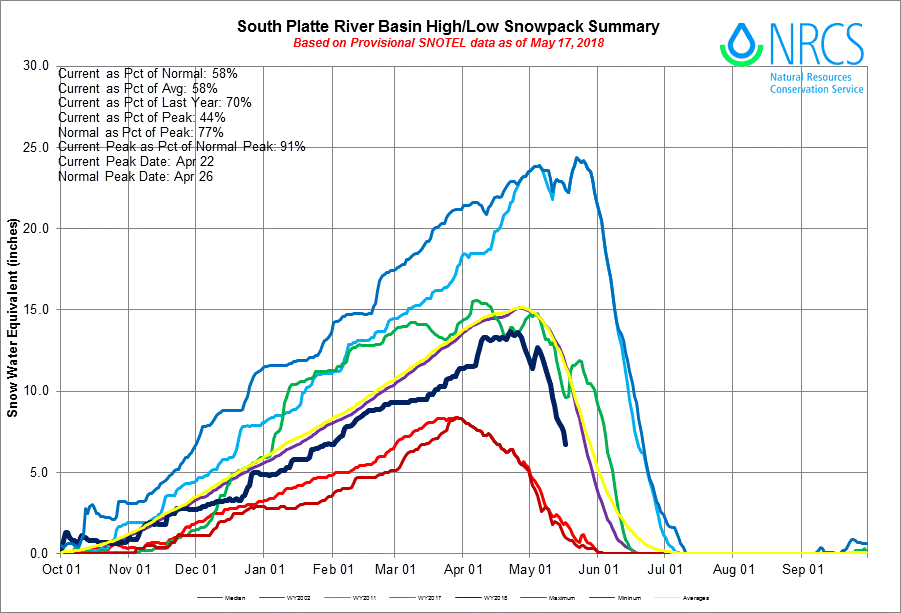
The snowpack up in the mountains, which was below average for most places this year, is melting quickly…
A drought isn’t just affected by the lack of precipitation, being abnormally warm can have an effect on the drought as well. The drought and low snowpack will have an affect our summer water supply…
“Being in a drought now and having less snowpack now means that there will be less water for us as we go into the summer.”
The drought we’re currently in could also have long term effects if we’re dry again next year.
“If we start to continue to be dry and move into a year and a half to two years. that’s where it can really impact us, so it’s good to start conserving water now and to be thinking about that, conserve the water that we have so we can think about the future in case we don’t get those real good rains this summer that help us out or if the snowpack is low enoughnext year it could make it worse for the next year.”
Hopefully this summer brings us some much needed rain.
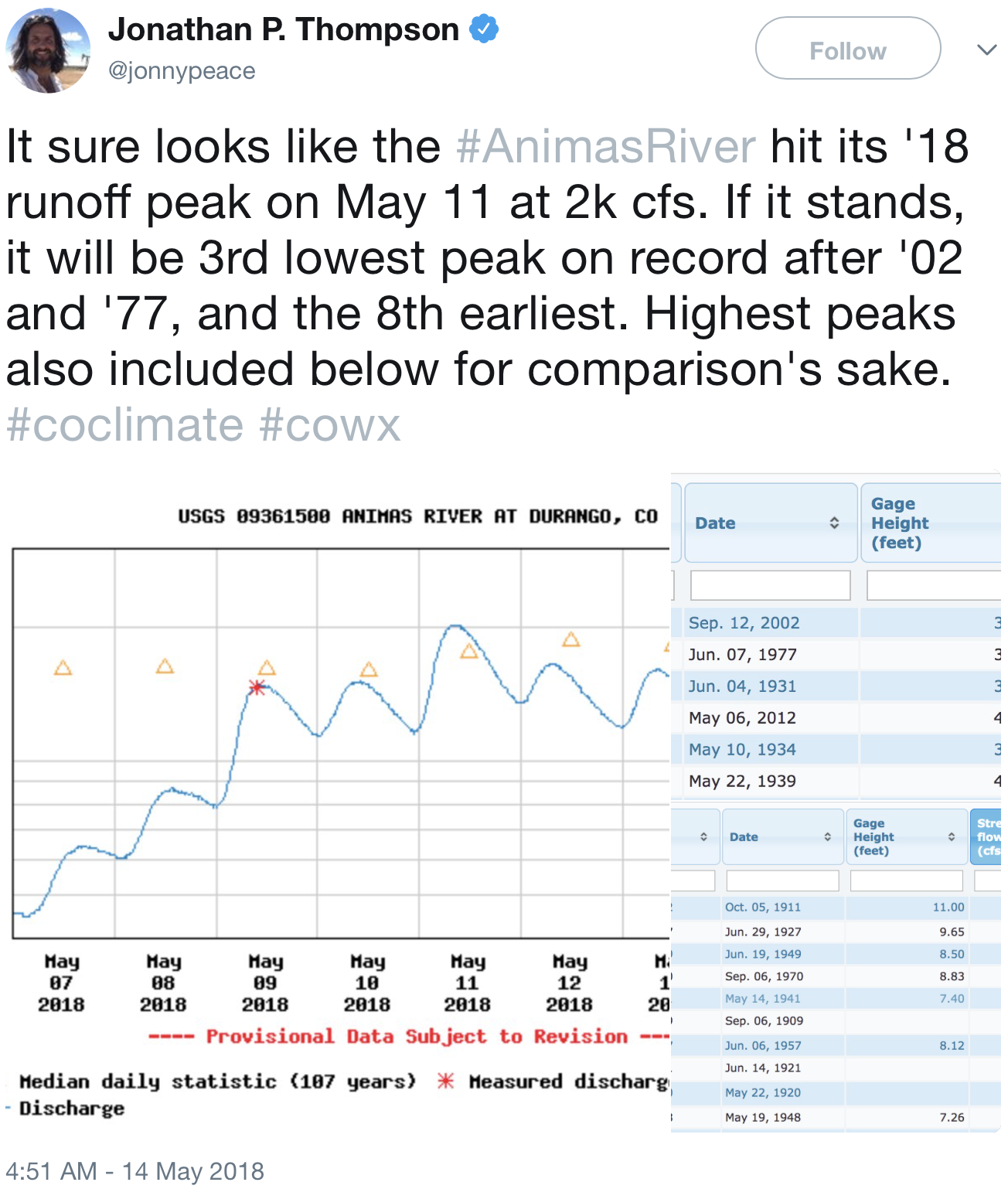
Local rivers seem to have hit peak flows. That isn’t good.
The Colorado River at Dotsero hit its peak seasonal flow Tuesday, May 15. That peak was just more than 3,000 cubic feet per second. The median figure for that date — based on 77 years of data — is about 5,000 cubic feet per second.
This year’s May streamflows aren’t the lowest ever recorded, but the news isn’t good. Still, local water supplies and recreation will survive for the season.
At Minturn Anglers, guide Alex Garnier said fishing on the Eagle River has been good so far this season. The water is clearer than usual, and the flows are low enough to fish in a number of spots…
While the Colorado River has probably hit its seasonal peak, there could be some spikes to come on Gore Creek and the Eagle River.
In an email, Eagle River Water & Sanitation District Communications and Public Affairs Manager Diane Johnson wrote that a string of warm days could accelerate snowmelt in the upper reaches of Gore Creek and the Eagle River. That more-rapid snowmelt could spike flows above current peaks. Those peaks are now running ahead of seasonal medians.
No one wants the snow to come off any faster, though, since snowpack makes up a major portion of the district’s water storage.
“If it stays a little cooler we get to keep (runoff) flowing a little longer,” Johnson wrote.
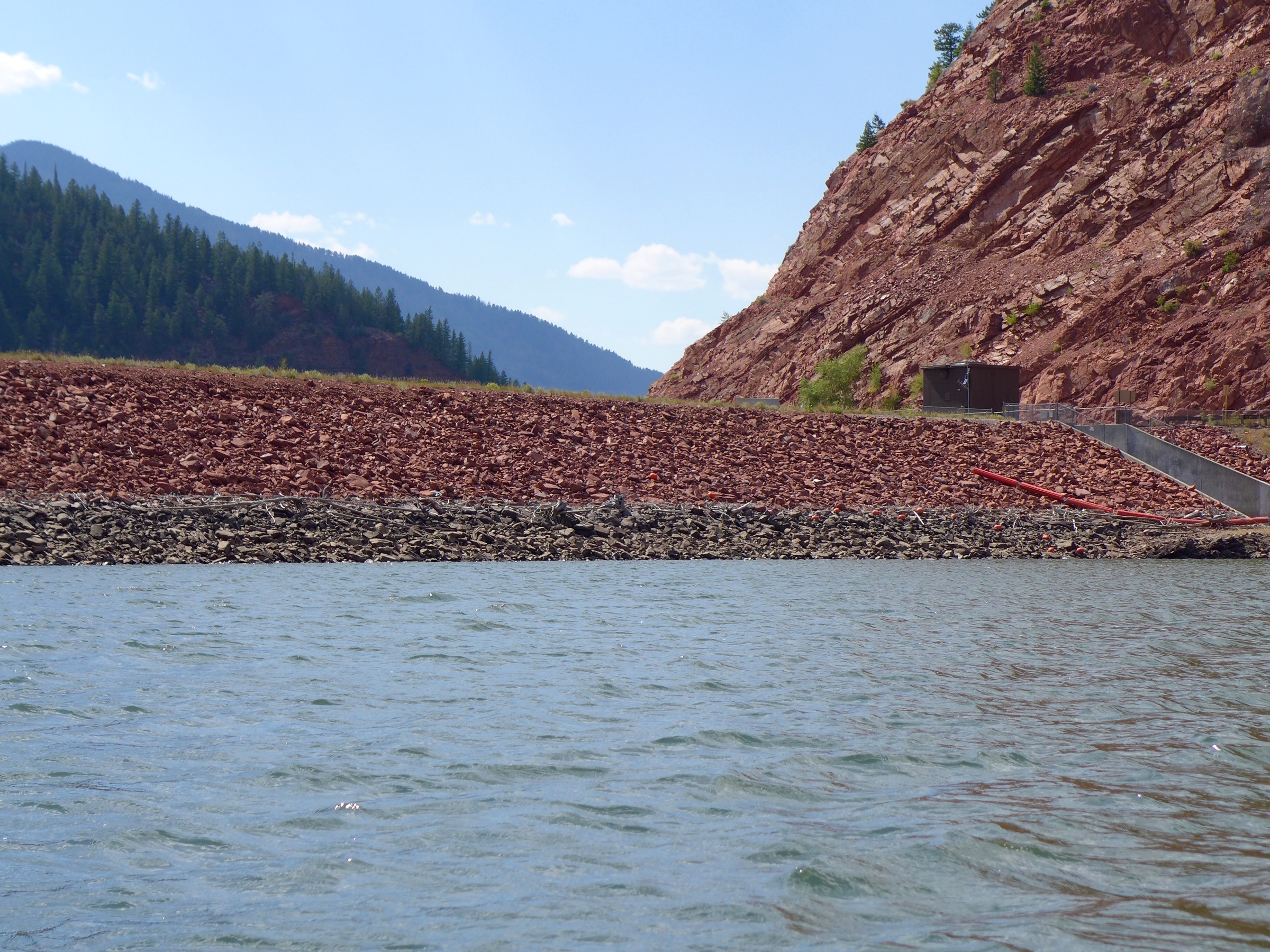
View from the Pitkin County end of Homestake Reservoir. Photo: Brent Gardner-Smith/Aspen Journalism
FromThe Grand Junction Daily Sentinel (Ken Salazar and Tom Gougeon):
Colorado’s iconic mountain ranges, farms and ranchlands, parks, rivers and open spaces are an undeniable part of our shared identity as Coloradans. We live in a state where three in four residents consider themselves conservationists, and 87% understand that Colorado’s open lands and outdoor lifestyle give the state an economic advantage.
That’s why we hope every Coloradan will take a moment to recognize two huge legislative wins achieved this month for conservation in our state – and what together these wins mean for future generations and their quality of life.
The most lauded success happened on May 1, when Governor Hickenlooper signed into law a measure ensuring that Colorado lottery proceeds will continue to be a steady source of revenue for conservation and outdoor recreation through at least 2049. This measure extends and affirms the will of Colorado voters, who in 1992 passed a constitutional amendment that created Great Outdoors Colorado (GOCO), an independent body that annually receives up to half of all lottery proceeds.
Over the past 25 years, GOCO has been the single most important tool for advancing conservation in Colorado. It has funded more than 5,000 projects – including dozens of school playgrounds, over 900 miles of trails, and more than 1,600 parks and outdoor recreation areas – benefitting all 64 Colorado counties, and permanently protecting more than 1 million acres of open space.
For ensuring GOCO endures another 25 years, Coloradans can thank the efforts of a broad, bipartisan coalition of local governments, nonprofit partners, agricultural and business leaders, and thousands of individuals and other advocates who signed on to Keep It Colorado – a campaign to ensure lottery proceeds continue flowing to conservation for future generations.
The second accomplishment was quieter, but also will have significant impact into the future. Last week, in the waning hours of the 2018 session, legislators passed a bill that paves the way for a new, forward-looking approach to conservation in Colorado.
The bill, now awaiting Governor Hickenlooper’s signature, extends a tool that is a strong complement to GOCO funds in the conservation toolbox: a program that rewards private landowners with state tax credits in exchange for voluntarily restricting development on their land – in perpetuity. Since 2000, conservation tax credits have been used to conserve more than 2.2 million acres of private land – majestic vistas, working farms and ranches, forest and river ecosystems – 80 percent of which is now under the stewardship of nonprofit land trusts across Colorado.
For years, a statewide coalition of these land trusts and landowners have been advocating for a number of refinements to the program. The measure will create a new Division of Conservation with a mandate to lead an inclusive workgroup of stakeholders to advance the program in a transparent, effective, inclusive manner.
The opportunity presented by the creation of this new division and visioning process is hard to overestimate. The legislation moves oversight of this critical conservation program from the state’s Real Estate Division to a new body that is, by design, aimed at assessing conservation values more holistically and ensuring the effectiveness and success of the program. This step aligns with the current work of the field that is looking at conservation’s return on investment – not just in real estate value, but more broadly to include the value of ecosystem services (such as carbon sequestration, climate regulation, or water storage and purification), as well as conservation’s economic value to state and local communities. It also comes at a time when land conservation leaders statewide are embarking on the yearlong Conservation Futures Project — supported by the Gates Family Foundation, GOCO, and other funders – to re-envision the role and value of land trust organizations to the communities they serve.
Thanks to these two legislative victories, the state’s conservation partners are positioned for even greater success over the next 25 years. With secure access to the resources, tools, and vision necessary to protect Colorado’s working lands and natural inheritance, both today’s Coloradans and future generations will benefit.
Ken Salazar is former U.S. secretary of the Interior (2009-2013) and U.S. senator from Colorado (2005-2009); he authored the Great Outdoors Colorado amendment while serving as head of Colorado’s Department of Natural Resources.
Tom Gougeon is president of the Denver-based Gates Family Foundation, which for the past two decades has been Colorado’s largest private match source for GOCO-funded land conservation, statewide.
Here’s the release from the Colorado Water Conservation Board (Taryn Finnessey) and the Colorado Division of Water Resources (Tracy Kosloff):
In order to respond to persistent and prolonged drought conditions throughout the southern half of the state and along the western border, the Governor activated the Colorado Drought Mitigation and Response Plan for the agricultural sector on May 2, 2018 , in the following counties:Montezuma, La Plata, Archuleta, Conejos, Costilla, Las Animas, Baca, Prowers, Bent, Otero, Huerfano, Alamosa, Rio Grande, Mineral, Hinsdale, San Juan, Dolores, San Miguel, Ouray, Montrose, Saguache, Custer, Pueblo, Crowley, Kiowa, Cheyenne, Lincoln, El Paso, Elbert, Gunnison, Mesa, Delta, Garfield and Rio Blanco. All of these counties are experiencing severe, extreme or exceptional drought as classified by the US Drought Monitor , and many have already received some level of drought designation from USDA . If present trends continue, other regions and sectors of the state’s economy may also be affected. Those areas will continue to be monitored closely.
■ October 2017 through April 2018 was the 5th warmest and the 5th driest on record for the state as a whole. Some locations throughout southern CO have experienced their driest and/or warmest Oct-Apr period on record.
■ Most regions of Southern Colorado reached their snow accumulation peak two to three weeks early and have experienced rapid snowmelt, resulting in melt out occurring three weeks earlier than normal.
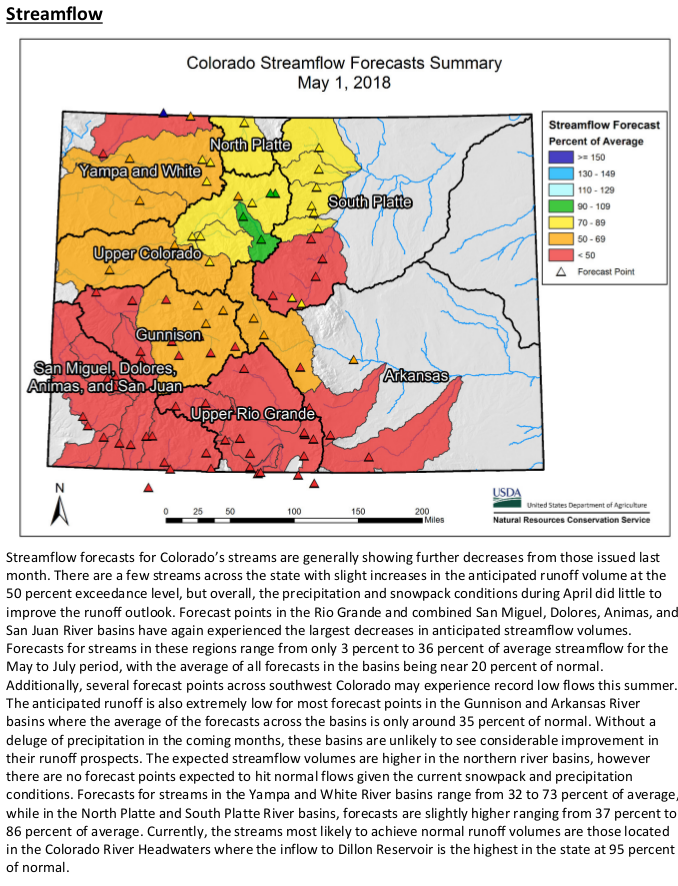
■ Streamflow forecasts in the southern half of the state are extremely low, with multiple sites showing below 15 percent of normal.
■ Demand is increasing and reservoir storage in the most heavily impacted areas, the Southwest basins of the San Miguel, Dolores, Animas & San Juan have seen significant decreases in reservoir storage over the last two months. This combined basin currently has 91 percent of normal storage, the lowest storage levels in the state.
■ Isolated cattle sell off and prevented planting of some acreage has been reported. Due to high hay prices we anticipate additional cattle sell off, and unless conditions improve additional prevented and failed crop acres are likely.
■ Windy, dry conditions fueled fires in April leading to numerous large wildfires on both the west slope and the eastern plains. Current forecasts indicate above average potential for large wildfires through June (see image on reverse side) with late summer fire potential dependent on monsoon conditions.
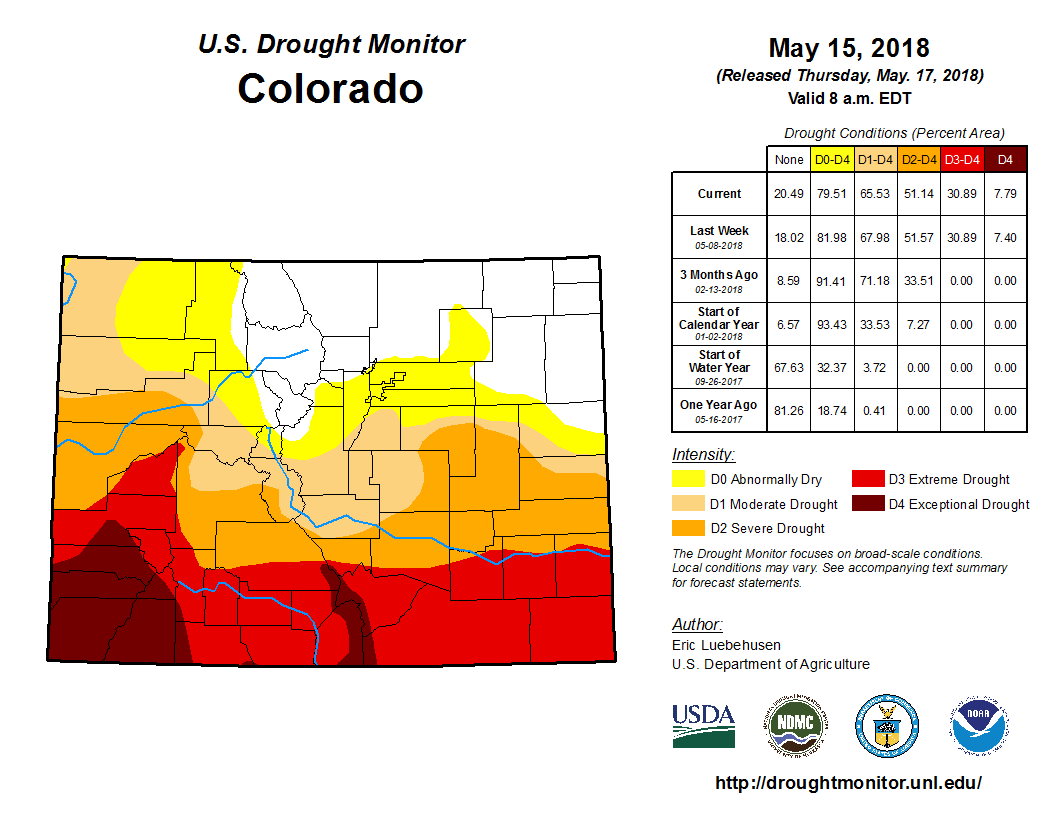
■ As of May 15, exceptional drought, D4, continues to affect southwest Colorado and has also been introduced in the Sangre de Cristo mountains, covering eight percent of the state. Extreme drought, D3, covers 23 percent of the state; severe drought 20 percent and 14 percent is classified as moderate drought. An additional 14 percent of the state is currently experiencing abnormally dry conditions (see image on reverse side).
■ Reservoir storage statewide is at 111 percent of normal, with all but the southwest basins above average. The Arkansas basin is reporting the highest average storage at 129 percent. Front Range water providers mainly draw water resources from areas of the state that received near normal winter precipitation, and are therefore expecting reservoirs to fill, and are not anticipating any water use restrictions outside normal operations.
■ The Surface Water Supply Index (SWSI) values have declined slightly May 1, with much of the western slope classified as extremely dry. These values are largely driven by below average streamflow forecasts. The sub-basin with the highest value includes Lake Granby, a large reservoir.
Click here to read the current assessment from the Colorado Climate Center. Click here to go to the NIDIS website hosted by the Colorado Climate Center.
“Snowpack in the South Platte collection system… is well below average,” said Travis Thompson, a spokesperson for Denver Water.
The other half of Denver Water’s supply comes from the Colorado River Basin which also isn’t running at the level it usually does. The river’s water flows have already peaked, according to the National Weather Service.
Colorado Water Trust told 9NEWS this is extremely early.
“It looked like a very unusual year,” said Andy Schultheiss, Colorado Water Trust’s executive director. “It was a La Nina year and a lot of storms passed to our north. It was looking bad quite early this year.”
The collection systems from both rivers are made up of snowpack which is important when it comes to putting out wildfires, according to Schultheiss.
“People think summer storms help with wildfires but they don’t actually prevent it,” he said. “It’s those snowpacks that infiltrate into the soil that really control wildfires. So, when you have a year like this, when there’s very little snowpack, the potential for a serious wildfire goes way, way up.”
From the Glenwood Springs Post Independent (Jon Nicolodi):
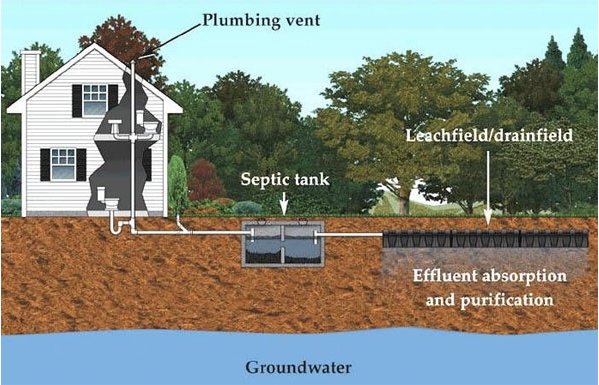
Garfield County is revising its onsite wastewater treatment system regulations following new regulations put forth by the state. Does this impact you? Considering the consequences of a poorly maintained onsite wastewater treatment system, and with approximately 3,500 out of about 17,000 housing units in Garfield County relying on onsite wastewater treatment systems, the answer could be “yes.”
Some homeowners like septic systems because they don’t have a regular sewage bill from their municipality. Instead, they must properly maintain their system, but they have control, and more ownership, of what goes into their system and how much and how regularly they have to pay for maintenance. By only flushing human waste and toilet paper, by properly disposing of chemicals, and by using a compost collection service or backyard system to break down cooking grease and other food waste, all maintenance is preventative. With care and preventative maintenance, septic system owners can save in the long run.
Septic systems go astray, however, when they aren’t cared for. Septic system leakage isn’t a foreign concept to health and environment officials. Toilet water leaking into the ground untreated might make its innocent way down through hundreds of feet of soil before being neutralized by the soil microbes. More likely, the wastewater will leak into a nearby stream, creating algal blooms and wreaking havoc on the balance of water quality in the ecosystem.
If your home isn’t connected to a public sanitary sewer system, you may be utilizing a private drinking water well. This water source may be near your septic system. Phosphorus, nitrogen and bacteria aren’t exactly the constituents of quality drinking water.
The Colorado Department of Public Health and Environment’s Water Quality Control Division adopted Regulation 43 nearly a year ago, and counties have until June 30th of this year to adopt versions of this regulation that are at least as stringent as the state’s. Among other items, the regulation specifies the categories and type of material installed in and around the leach field, and it requires additional inspection of systems to ensure that they meet industry standards.
Septic systems should be inspected at least every three years, and typically pumped free of their settled solids every three to five years. Contact your local county officials to learn what you have on your site, and to learn who to call for a quality service provider. Be thoughtful about what you put down the drain and how much you use your garbage disposal. Mark the free hazardous waste collection day at the local landfill on your calendar. Practice water conservation by installing high-efficiency toilets, shower heads and laundry machines. Take one more step to being considerate of your local streams, and of your own and your community’s drinking water supply.
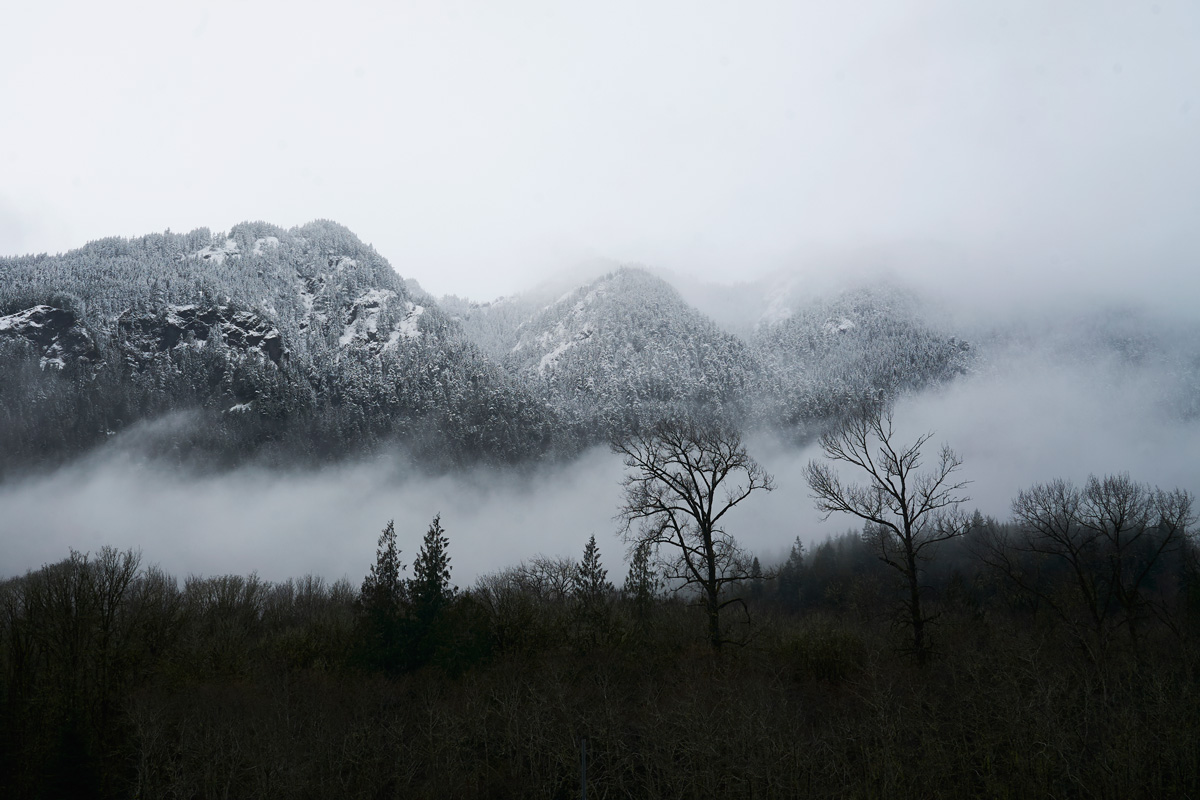
Fog rolls in below snow-dusted peaks on Washington’s Olympic Peninsula. In relatively humid places like the Pacific Northwest, more water melts from the snowpack during the wintertime than in more arid regions. Brooke Warren/High Country News
From the Union of Concerned Scientists blog (Adrienne Alvord):
Despite what’s shaping up to be a summer of uncertainty in DC, with President Trump’s EPA attempting to dismantle a generation’s worth of science-backed environmental protection and climate progress, momentum is building in Washington state to move forward on innovative climate policy.
Washington has a lot at stake. Climate change impacts including increased wildfires, drought, flooding, sea level rise, ocean acidification, and changes to agriculture threaten the state today, and will get much worse unless we take action.
To prevent the worst impacts of climate change, Washington voters and legislators in recent years have considered – but not approved — binding carbon pollution limits and a price on carbon pollution. This year, a proposed ballot initiative measure, Initiative 1631 would create a fee for carbon polluters. It is sure to add to a robust and healthy nationwide discussion about what are the best policies to reduce carbon and prevent the worst impacts from climate change.
Carbon pricing is a way to help incentivize reducing climate pollution while providing revenue to invest in clean energy and fuels and provide transition assistance to workers and communities. The initiative could show how state-level action can be a potent antidote to retrograde motion in DC.
Past progress and approaches to pricing
Washington state, like the entire West Coast, is a leader on forward-thinking climate policy with legislative targets for emission reductions, a greenhouse gas inventory of major emitters, and a Clean Air Rule adopted by the Inslee Administration. The state has not yet instituted an economy-wide carbon price but has considered two approaches previously.
In 2016, Washington debated ballot initiative I732, a carbon tax measure that would have instituted a carbon tax offset by a 1 percent cut in sales tax, a cut to manufacturing taxes, and a low-income tax credit. I732 was intended to be revenue-neutral and to provide a progressive tax rebate. However, the initiative failed decisively at the polls after drafting errors came to light, and other controversies divided climate action supporters . (UCS was neutral on the measure, for reasons we described here.)
In 2017, the legislature considered a measure backed by Governor Jay Inslee, SB 6203 (Carlyle et al) that would have instituted price on fossil fuels that would rise gradually until 2035. The funds were to be used for carbon reduction measures, forestry, water improvements, low-income assistance, community investment, rural economic development, and utility rebates. The bill also exempted so-called “energy intensive, trade exposed” (EITE) industries that could be economic disadvantaged by competition from out-of-state entities not subject to a carbon fee. Despite diverse support from Washington business, labor, environmental, and social justice groups (and thanks to opposition from some industrial, business, and agricultural entities) the bill didn’t advance to a floor vote, in part because 2017 was a short, two-month session that didn’t allow sufficient time to consider the complexity of the measure.
And now a unified proposal from a broad coalition
While the other measures were being debated, a coalition of environmental, environmental justice, business, labor, tribal, public health, faith and other groups under the banner of the Alliance for Jobs and Clean Energy, has been hard at work finding common ground on climate policy. Now, the group has introduced initiative 1631 that incorporates both a polluter-pays carbon fee starting at $15 per ton of CO2 in 2020 and an investment plan for clean energy, forests, water, and healthy communities.
The initiative provides exemptions for certain EITEs and provides rebates to utilities while investing heavily in job assistance for displaced fossil fuel workers and also in tribal and low-income areas. The fee is increased at a rate of $2 per year plus inflation to an estimated level of about $55 and stays at that level if the state is on track to meet its 2035 emissions reduction target of 25 percent below 1990 levels.
The unique design of this carbon fee was arrived at after intensive consultation among many Washington communities, businesses, and groups. It differs from California’s cap and trade program, British Columbia’s carbon tax, and Oregon’s proposed carbon cap and invest policy (similar to California’s, to be taken up in the 2019 legislative session.)
The fact that different jurisdictions are looking at different approaches towards carbon pricing shows that there is latitude among pricing design to meet local needs and conditions. Some programs, like California’s that is linked to Ontario and Quebec, are designed to encourage participation from other jurisdictions, in part to lower costs. Washington’s program would not link out of state, but would provide a level of price certainty in the fee structure that other programs do not have.
For our future, the most expensive thing we can do is nothing
Despite the hard work of a large group of interests who have found a common vision for carbon pricing in Washington, I 1631 is certain to generate intense opposition from the fossil fuel industry and their allies. They will invoke the usual pieties about how yes, climate change is real, but this approach is all wrong. They will say that it’s bad for the economy. Of course oil producers and other fossil fuel interests do not want to help the state transition away from their products and the harm they cause. The fact is that carbon prices are features of several state and national economies, including British Columbia and California, that are thriving.
While carbon pricing is not the only approach to reducing emissions, it does start to internalize the costs of climate pollution and make the needed investments for a safer, healthier future. UCS has long supported carbon pricing and we recognize that there are different advantages to different approaches, along with numerous economic benefits. The greater threats to our economy, not to mention our well-being, are climate change-related impacts that are already costing billions of dollars, devastation of property and the environment, and loss of life. In fact, the most expensive thing we can do is nothing.
From the Geothermal Greenhouse Partnership (Sally High) via The Pagosa Sun:
Geothermal Greenhouse Partnership (GGP) welcomes Colorado School of Mines (CSM) and Colorado Geologic Survey back to Pagosa Springs this week.
CSM’s seventh Geophysics Field Camp builds on previous years’ research into Archuleta County’s geothermal plumbing.
The GGP invites the public to a scientific retrospective of collected data and updated interpretations of the local geothermal resource on
Wednesday, May 23. The workshop is at the Archuleta County CSU Extension building from 6 to 8 p.m. The GGP workshop contains two presentations.
Dr. Andrei Swidinsky and Stephen Cuttler of CSM will present a seven-year retrospective of the geophysical data collected by CSM students. Each year’s field camp adds to our understanding of the underground structure of our geothermal aquifer.
Dr. Paul Morgan is senior geo- thermal geologist at Colorado Geological Survey. In 2017, Morgan published Origins and Geothermal Potential of Thermal Springs in Archuleta County, including Pagosa Springs, Colorado, USA (Revisited). The paper was first presented at the international Geothermal Resource Council’s 2017 conference. The Archuleta County public can hear Morgan’s revised interpretations at the GGP workshop.
The GGP is a 501(c)(3) nonprofit operating an educational park in downtown Pagosa Springs. The nonprofit park demonstrates geothermal direct energy use, year-round horticulture and environmental awareness. Twenty-first century water conservation and geothermal potential are priorities of GGP’s mission.
GGP’s Education Dome is busy with student and volunteer activity, and the Community Garden Dome and Innovation Dome are being constructed. Pagosa Springs Centennial Park’s Riverwalk is the site of the GGP project.
There is no charge for the GGP’s geothermal resource update work- shop, although donations to the nonprofit are accepted. The public is welcome.
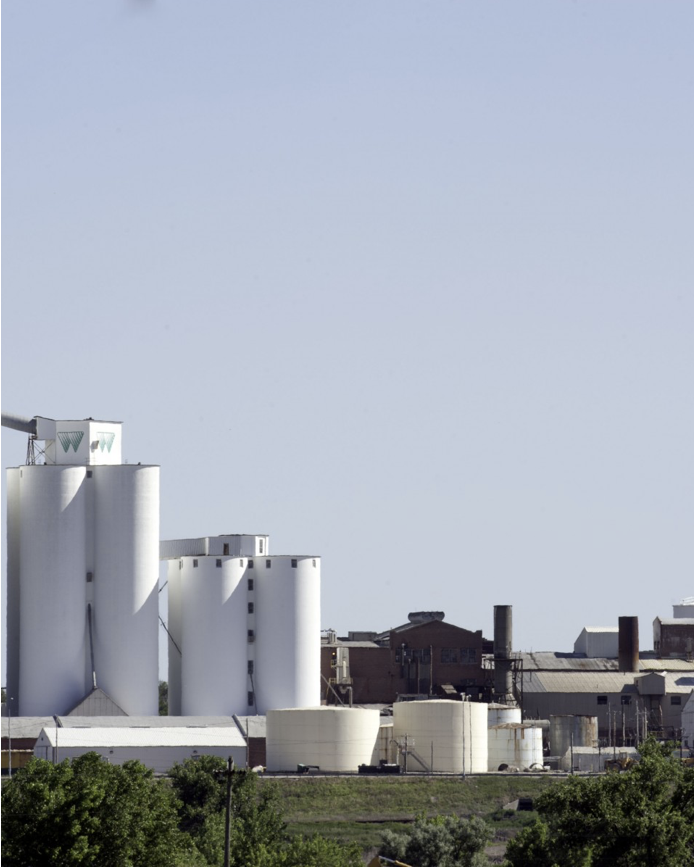
The Western Sugar Cooperative has been fined $2 million as part of a settlement of air, water and solid waste violations and non-compliance found at the company’s Fort Morgan, Colo. plant.
The Colorado Department of Public Health and Environment announced a settlement between the department and Western Sugar in a release Friday.
Violations of Colorado’s Colorado’s Air Pollution Prevention and Control Act included exceeding the state’s regulatory odor limits. Water quality violations include discharges of pollutants, including fecal coliform and sulfide, which significantly exceeded the company’s permit limits. The department also cited Western Sugar for unauthorized spills, and said water quality violations likely contributed to odor issues affecting Fort Morgan residents.
In addition to air and water quality violations, CDPHE says Western Sugar operated two large waste stockpiles of coal ash and precipitated in violation of state solid waste regulations. The piles of the manufacturing by-products are visible from Interstate 76 and Route 52…
Under the terms of the settlement, Western Sugar agreed to:
– Identify and implement wastewater treatment.
– Eliminate and/or properly dispose of waste stockpiles and any new waste generated through its processes.
– Investigate groundwater and soil impacts, and implement corrective measures if necessary.
– Implement and comply with an odor management plan.
– Retrofit existing coal-fired boilers with natural gas burners.
– Establish financial assurance.
– Provide funding for a local water quality restoration project.
– Accept suspension of its environmental permits or licenses if it fails to comply with certain terms of the settlement.
The tank will be able to hold 250,000 gallons of treated water, doubling the town’s water capacity.
“We’ll have 500,000 gallons of water to fight a fire with to drink, to do whatever and if whatever and if we ever had a problem with this tank that’s also subterranean, than we’d have another tank to back us up,” said Palmer Lake Mayor John Cressman.
The tank will cost an estimated $1.3 million, and will be paid for through a low interest loan from the Colorado Water Resources and Power Development Authority.
Fremont Adventure Recreation and the Upper Arkansas Water Conservancy District will host a free screening of “The Arkansas River: Leadville to Lamar,” at 6 p.m. June 1 at Canon City High School, 1313 College Ave.
The film will be followed by a panel discussion with Tim Payne, Fremont County Commissioner; Mannie Colon of Colon Orchards; Blake Osborne of the CSU – Water Institute; and moderators Chelsey Nutter of the Upper Arkansas Water Conservancy District and Ashlee Sack of Fremont Adventure Recreation.
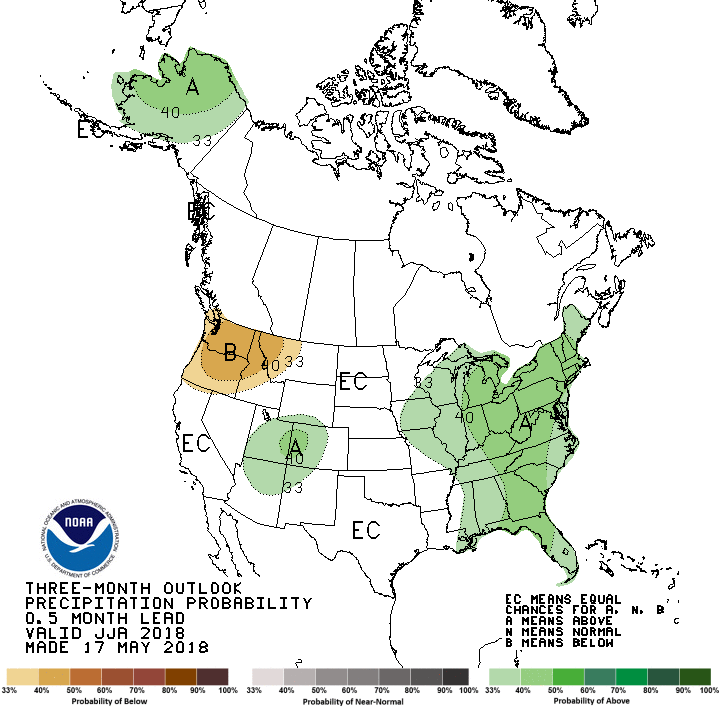
According to NOAA’s Climate Prediction Center, much of Arizona has slight chance for above average rainfall between July and September.
Northeastern Arizona has the best odds for above average Monsoon rainfall. Coincidentally, the worst of the ongoing drought resides around the Four Corners region.
Below average Monsoon rainfall can’t be ruled out, according to the CPC’s latest odds. Southern Arizona has a 67% chance for near or above average rainfall, but only a 33% chance for below normal Monsoon precipitation.
The Monsoon officially begins on June 15th and ends September 30th. Climatology says Tucson’s average Monsoon rainfall is 6.08”.
But climate change is impacting those of us who live in the West. It may not come in the form of “super storms,” but it can be just as devastating. These are three of the most prominent threats of climate change in the West:
Threat #1: Water Supply
Perhaps the most profound and immediate threat from climate change in the West is to our water supply. Our rivers help to sustain our iconic wildlife, feed our communities, power our economies, and offer an escape to play.
Most of our precipitation falls as snow in the mountains, which acts like a water bank for downstream communities. Climate change has shortened the winter – when we stock up on snow – leaving our water supplies uncertain. In turn, our landscape is getting drier, leaving it more vulnerable to severe drought and bigger, more dangerous wildfires. And the effects compound each other: a drier landscape means more dust, and dust causes snowpack to melt and evaporate faster from our mountains, leaving less water flowing into downstream rivers and reservoirs.
West Fork Fire June 20, 2013 photo the Pike Hot Shots Wildfire Today
Threat #2: Wildfires
Our mountains and canyons across the West are known for their gorgeous expanses of forests and grasses. Our prairies offer sustaining agriculture and the poetry of endless blue skies. Historically, natural wildfires have refreshed soil nutrients and maintained the forest ecosystem.
But climate change has changed that natural fire dynamic on Western lands. Since 1970, the annual wildfire season has lengthened by 78 days. Since 1984, the area that burns annually has doubled. The Forest Service estimates that area may double again by 2050. Our forests and grasslands are drier and more susceptible to disease and pests, such as the mountain pine beetle. When they do burn, they burn hotter and longer, endangering ecosystems, wildlife, and homes.
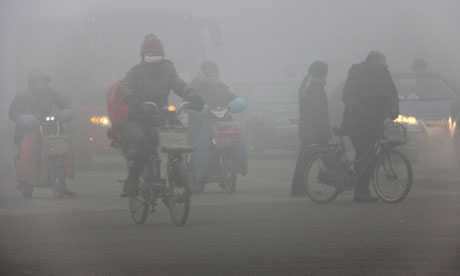
Severe smog and air pollution in Beijing
Threat #3: Our Public Health
We sometimes forget the effect that climate change has on our own health. Higher temperatures can cause air pollution, such as from ozone and dust. People who suffer from asthma, like my son and me, are particularly vulnerable when air quality is low. Smoke from wildfires can make it impossible to venture outside without wheezing. Increased ozone and poor air quality disproportionately impact those who suffer from heart disease, the elderly, the young, and low-income communities. And they make it harder to get outside and enjoy the beauty of the West.
Ski slopes in Colorado and other parts of the West were slow to turn white this now-departed winter. That’s not terribly unusual. For nearly all of the modern resort era, ski hill bosses have periodically summoned Native Americans to speak to the higher powers. Ski areas can announce opening dates months in advance, but weather keeps its own schedule.
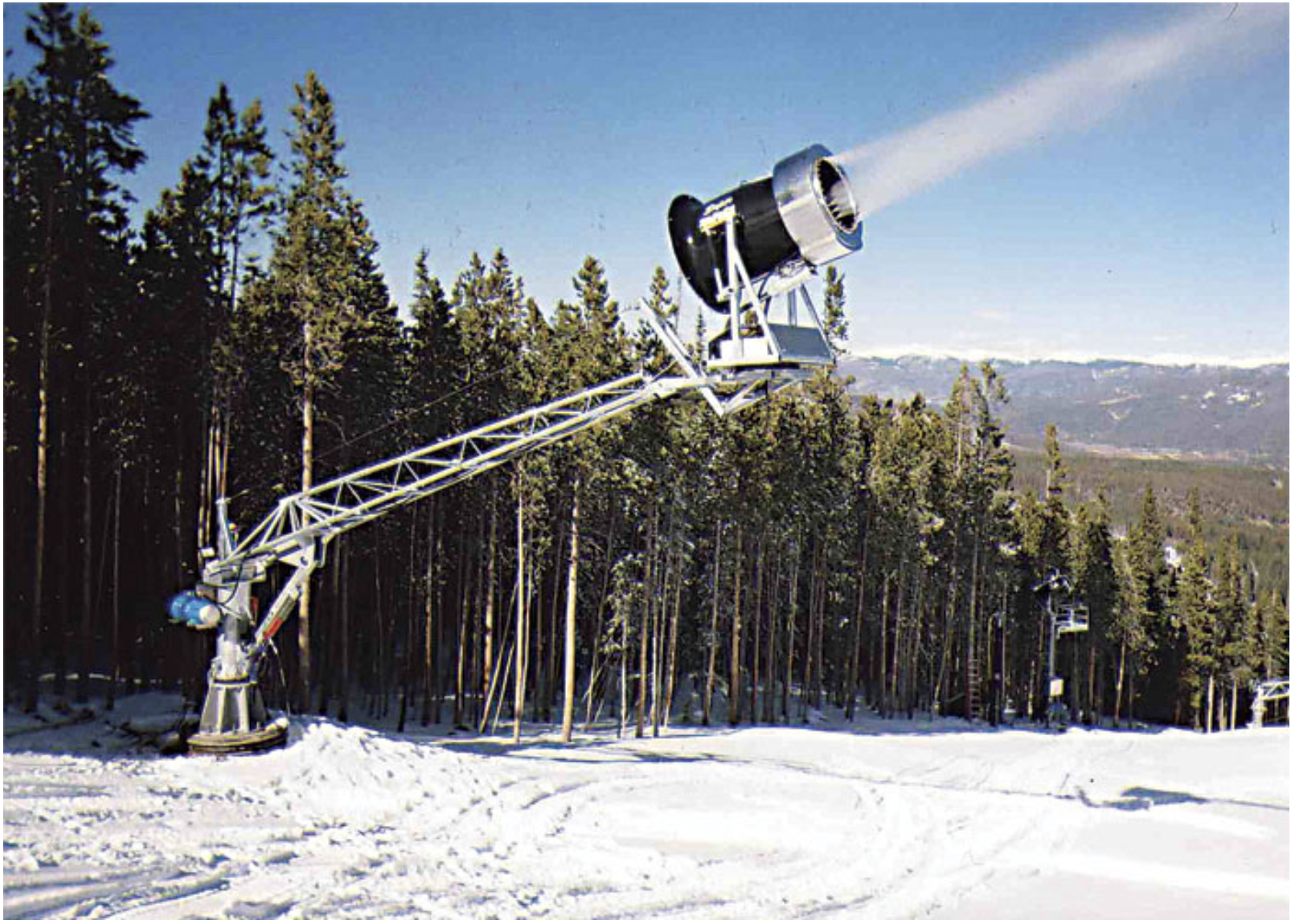
Snowmaking can overcome that varied natural schedule. But even snowmaking failed the Aspen Skiing Co. and many other ski areas in Colorado and elsewhere early in the past season. It was just too warm.
Snowmaking begins at temperatures of 26 degrees F. or less, but the machines can really crank at temperatures of 10 degrees Fahrenheit, observes Victor Gerdin, mountain planner for the Aspen Skiing Co.
“Not only did we have very few days of 26 degrees or less, we had practically no days of 10 degrees in November and December,” he told the Aspen Daily News.
Aspen plans to plow $5.5 million into new snowmaking equipment before next winter at its four ski areas. Some of the new equipment will replace older, less energy-efficient infrastructure. But Aspen also hopes to expand terrain covered by snowmaking, especially so at its money mountain, Snowmass.
Can snowmaking overcome the effect of global warming altogether? No—and some ski areas too low in elevation to sustain cold temperatures are almost certain to fall by the wayside. But for others, snowmaking can provide a crucial margin to sustain operations. The key, says Robin Smith, a snowmaking consultant, is that resorts invest in the most modern equipment, to maximize opportunities during shrinking windows of cold temperatures.
Robin Smith. Photo credit: Allen Best
Smith, who has several dozen clients among ski areas across the country, says some of his customers have lost 30 percent or more of their snowmaking windows in the last decade. “That makes snowmaking tougher,” he tells Mountain Town News.
He foresees significant challenges for lower-elevation ski areas on the East Coast, the Midwest and elsewhere. Aspen, Vail and other higher elevation resorts in the Rockies will still have snow, but will face problems —similar to this year—of increased weather volatility produced by the warming atmosphere.
In a 2016 study, the Environmental Protection Agency projected temperatures in decades ahead for 247 ski areas in the United States. The study concluded that warming temperatures will cut deeply into the 450 hours of sufficiently cold temperatures that ski areas commonly believe they need to make snow in time for Christmas openings. That study, however, did not address the potential savior of automated snowmaking systems, says Smith, of Snowconsult.
This past winter was a challenge for many ski areas in Colorado, California and other regions. The National Oceanic and Atmospheric Administration released a map for December through February showing that much of western Colorado, including Aspen, had “much above average” temperatures.
This fits with what Aaron Smith, a ski patroller at Aspen Highlands, told Auden Schendler, Aspen’s vice president for sustainability, during the early season struggles.
“He said that it wasn’t that there was no snow coming down. It was that when any (solar) radiation hit it, it melted right away,” says Schendler. “That speaks to warmer temperatures I think.”
This fits in with the conclusions of a paper published in February 2017 by Water Resources Research. The authors of the paper declared that the drought of the 21st century in the Colorado River Basin actually had more to do with temperature increases than precipitation declines.
One of the researchers, Brad Udall, of Colorado State University’s Colorado Water Institute, laid out the thesis at a conference in downtown Denver recently. He said that a 20 percent decline in overall precipitation has been recorded in the basin from 2000 through 2017. This is despite a 5 percent increase in moisture content in the warming atmosphere.
“Something very odd and unusual is going on,” Udall said at the inaugural Water in the West Symposium.
“Something very odd and unusual is going on,” Udall said at the inaugural Water in the West Symposium.
Udall’s partner in the research, Jonathan Overpeck, formerly of the University of Arizona and now dean of the School of Environment and Sustainability at the University of Michigan, further fleshed out the study a few days later at the 2018 Next Generation Water Summit in Santa Fe.
The two big reservoirs on the river, Powell and Mead, were full in 1999, he pointed out. Powell was 52 percent full and Mead 39 percent fill as of April 28. Lake Mead, with a surface level now at 1,080 feet, is likely to drop below 1,075 feet, the place where shortage criteria kick in.
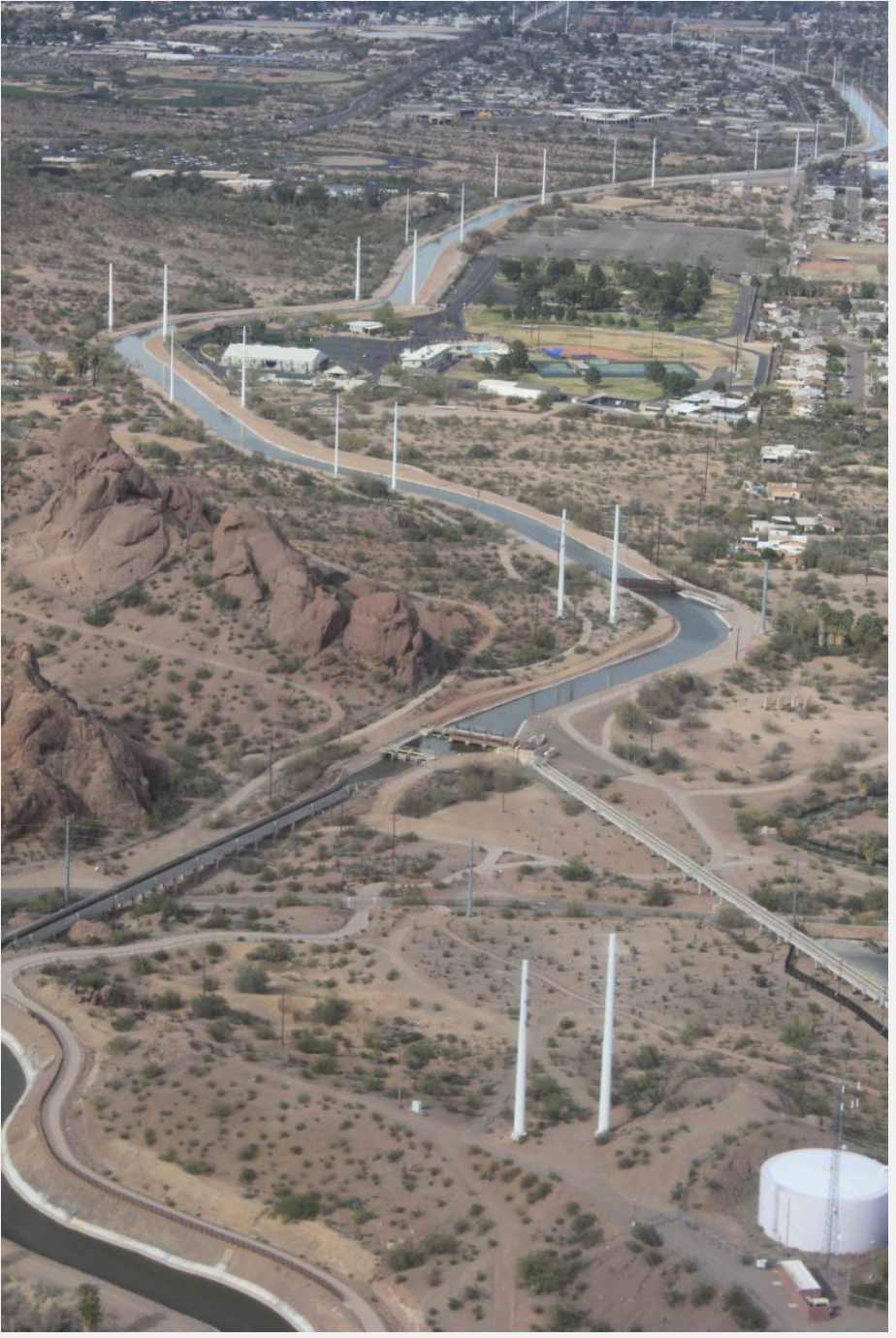
A canal delivers water to Phoenix. Photo credit: Allen Best
“That’s why we’re now starting to see fights over water again,” he said, alluding to a flurry of sharply-worded letters from upper-basin states to the Central Arizona Project. The upper-basin states accuse the Arizona agency of manipulating water demands and supplies for self-gain, at the expense of other water users.
Why are the reservoirs emptying? It’s not drought, as conventionally understood. It’s what Overpeck and Udall call aridification.
“Precipitation in this current drought is a contributor, a secondary contributor. The main cause of this drought is temperature,” said Overpeck.
The warming atmosphere, he explained, demands more moisture. This is accomplished in various ways. Most significant is increased evapotranspiration from soil and plants Precipitation is also sublimated from snow, there is more rain and less snowpack, and the growing season is longer. Plus, of course, there is more evaporation from surface water.
“Stop thinking about drought as precipitation,” he said.
Modeling indicates that if we tamp down emissions that temperatures will rise only 1 to 1.5 degrees C (2.7 to 3.6 degrees F), he said. But at the top end, without changes, warming of 5 to 7 degrees C (9 to 12 degrees F) can be expected.
Might the warming atmosphere produce more precipitation? Overpeck concedes that possibility. Climate models that cover Colorado have suggested a trend toward less precipitation in the Southwest and more precipitation in the northern half of the state. But water experts have warned that the models at this relatively micro-level have great ranges of uncertainty.
But even more precipitation falling from the sky will not result in precipitation that lingers on the ground, said Overpeck.
The Rio Grande Basin may be even harder hit. The river starts in the San Juan Mountains of Colorado, flowing past Taos and Santa Fe. U.S. Senator Tom Udall (a cousin to Brad Udall), speaking at the same conference, suggested more reservoirs are needed in the headwaters of the Rio Grande instead of at Elephant Butte, the big down-stream reservoir that loses so much water to evaporation.
In Denver, Brad Udall said temperature-induced losses in the Colorado River Basin will triple by 2050 and increase almost six-fold by the end of the century.
Earlier this year, Oregon’s Philip Mote and other researchers also fingered rising temperatures in a study of changing hydrology.
This won’t end skiing in the high Rockies, but it does suggest that the warm temperatures that frustrated efforts by Aspen and many other ski areas from making snow last November and December will become more frequent in decades ahead.
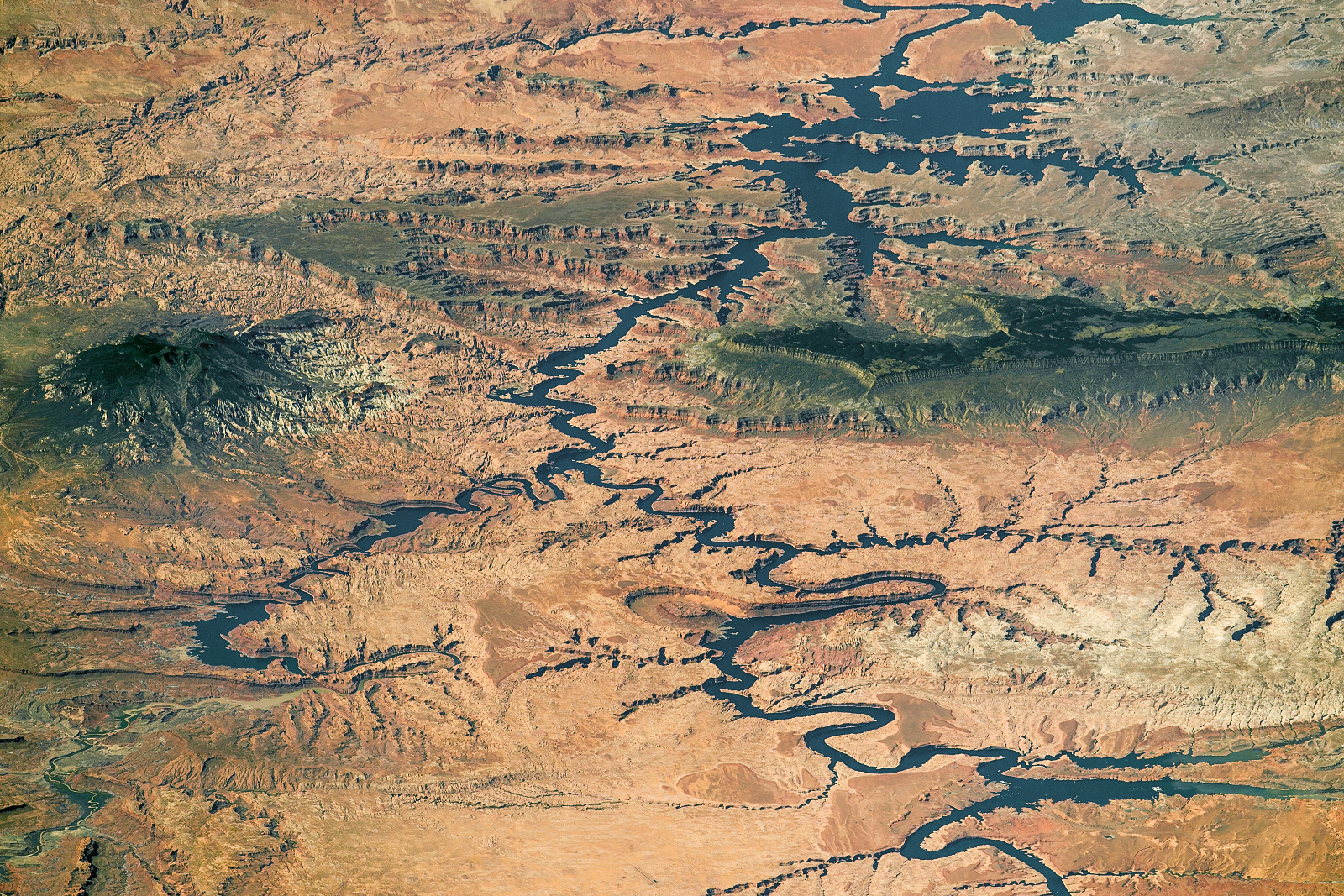
Nearly the full length of Lake Powell on the Colorado River in southern Utah and northern Arizona is visible in this photograph shot by an astronaut aboard the International Space Station, on Sept. 6, 2016. The view is toward the southwest. Water flow is from the lower right toward the top. (Source: NASA Earth Observatory)
Some ski areas will have it worse than others. The EPA study concluded that given the current trajectory for greenhouse gas emissions, most skiing—even with snowmaking—will be gone in the East, Midwest and coastal Far West by 2090. Some of ski areas will be closed even sooner, within 30 years.
Smith, writing in the May issue of Ski Area Management, said he “absolutely believes the temperature predictions” produced for individual ski areas by the EPA study. However, the EPA study failed to account for improvements in snowmaking as well as the durability and resistance to melting of machine-made snowpack, he says.
Can snowmaking compensate? If the United States and other countries contain greenhouse gas emissions in line with the targets identified in the Paris climate accords, the answer seems to be yes, at least until 2050, and for most all resorts well beyond.
“But that’s only if each resort can adopt today’s cutting-edge snowmaking technology on a significant enough percentage of its terrain,” wrote Smith, who previously worked for five years as the North American representative for Italian snowmaking manufacturer TechnoAlpino.
“Automated snowmaking systems will be essential, because the windows of snowmaking opportunity will get smaller, and the available hours will become less. This has been happening already, of course. My clients in the last 10 years have observed 30 percent fewer total snowmaking hours under 28 degrees wet bulb. For clients with full automation, the diminished hours have not shortened their season at all.”
That’s if the world constrains emissions. If not? What if we continue with business as usual?
“Things get more difficult for all areas outside of the Central Rockies and the High Sierras, especially after 2050. We’d need some kind of technological breakthrough I don’t see coming.”
About Allen Best
Allen Best is a Colorado-based journalist. He publishes a subscription-based e-zine called Mountain Town News, portions of which are published on the website of the same name, and also writes for a variety of newspapers and magazines. View all posts by Allen Best →
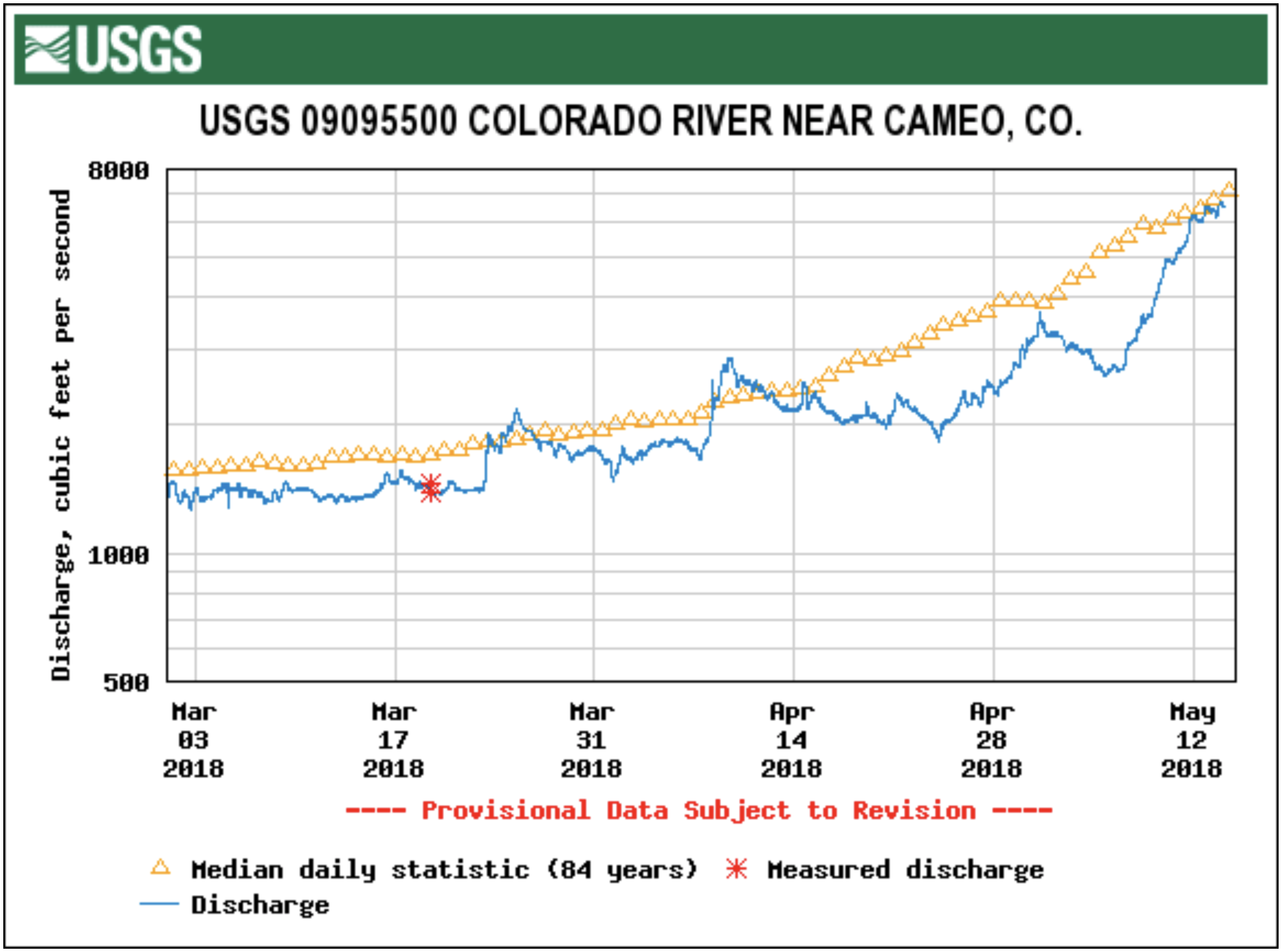
Peak runoff in the Colorado River this year has arrived exceptionally early and with unusual modesty. It’s part of a pattern in the 21st century, one that scientists warn will become even more common in the future.
One measuring site is at Cameo, located amid sandstone cliffs coated with desert varnish two hours downstream from Aspen and Vail and a short distance from Grand Junction. There, runoff in the Colorado River reached 6,650 cubic feet per second on Monday. Unless surpassed by a second surge of runoff predicted for Saturday, it is likely to be the earliest date for peak runoff at the site in 50 years, according to the Colorado River Water Conservation District.
It’s also a runoff of modest flows, the fourth lowest in 85 years of record-keeping at Cameo. The lowest was in 1977, according to the Glenwood Springs-based River District, followed by those of 2002 and 2012—and now 2018.
Winter was warmer and drier than usual, and the last month has been the same: 2 to 4 degrees Fahrenheit warmer than average. Spring precipitation has similarly lagged across western Colorado…
Taking the long view, [Jeff] Lukas notes there’s a lot of “noise” or natural variability in the climate records. But this clustering suggests a changed norm. What used to be the sort of runoff that might occur every 25 years could now, perhaps, be expected about every 10 years.
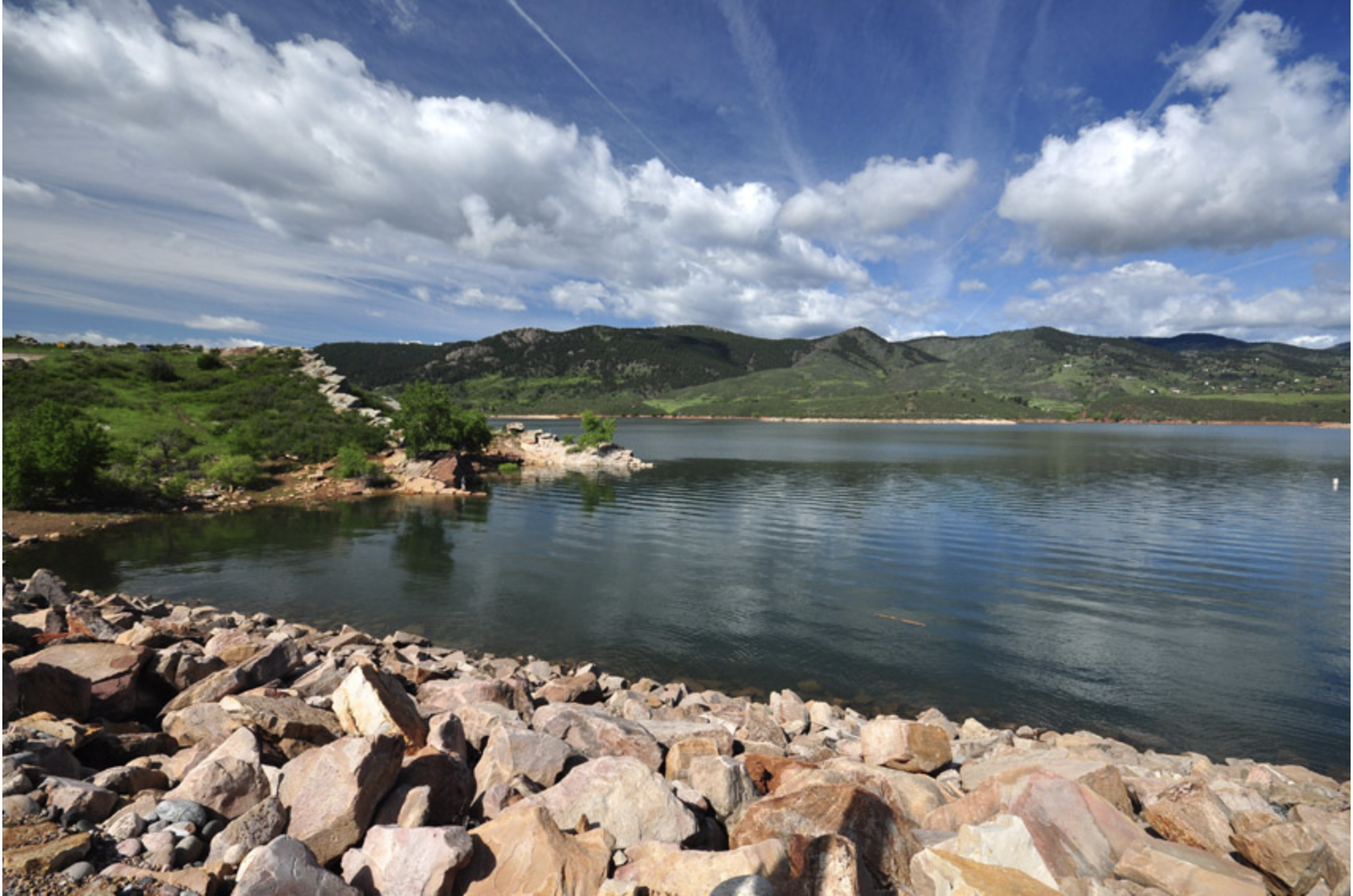
Horsetooth Reservoir looking west from Soldier Dam. Photo credit: Norther Water.
Click here to read the newsletter. Here’s an excerpt:
Northern Water works with partners to prevent spread of nuisance species
Area resource managers will be tightening requirements for launching motorboats, sailboats and personal motorized watercraft at Horsetooth Reservoir and Carter Lake boat ramps in the weeks to come. Both reservoirs are part of the Colorado-Big Thompson Project.
New requirements from the Eastern Colorado Area Office, Bureau of Reclamation, will mean that boat ramps will remain locked except when an inspector is present. People staying in backcountry boat-in campsites and visitors wanting to fish after 10 p.m. should be aware of this change, because boat ramps will be closed from 10 p.m. to 6 a.m. These protective measures are intended to prevent illegal launching without inspection, which could result in introduction and infestation of the reservoirs by invasive aquatic species such as the quagga and zebra mussels.
Boaters should be aware of ramp hours to ensure access to the ramp at the end of their visit. A full schedule is available here.
Northern Water is providing in-kind resources and funding to ensure the success of the program.
A new study from NASA reinforces the idea that droughts are getting worse and could become more frequent in the Western U.S.
The culprit is human-caused climate change.
Droughts aren’t just about precipitation, says NASA scientist and the study’s co-author Benjamin Cook. They’re also about the timing of snowmelt and the wetness of soil, both of which are upended by a warming climate…
“We have pretty clear evidence now that climate change has already begun to make droughts worse or more likely in at least some regions,” he says. “So it’s a now problem, not a future problem.”
Definitions of drought vary. A meteorological drought happens when snow and rain are diminished. An agricultural drought is tied to soil moisture and can be influenced by the type of soil and the crops and vegetation grown. A hydrological drought refers to lessened runoff from snow, which in turn means less water ending up in surface reservoirs.
Here’s the link to my post about the late Kelly Redmond’s commentary, “The Depiction of #Drought,” required reading from professor Fleck.
Synopsis: ENSO-neutral is favored through September-November 2018, with the possibility of El Niño nearing 50% by Northern Hemisphere winter 2018-19.
During April 2018, the tropical Pacific returned to ENSO-neutral, as indicated by mostly near- to- below average sea surface temperatures (SSTs) along the equator. The latest weekly Niño indices were near zero in all regions (between +0.2°C and -0.3°C), except for Niño-1+2, which remained negative (-0.6°C). Subsurface temperature anomalies (averaged across 180°-100°W) remained positive, due to the continued influence of a downwelling oceanic Kelvin wave. Atmospheric indictors related to La Niña also continued to fade. While convection remained suppressed near and east of the Date Line, rainfall near Indonesia was also below average during the month. Low-level winds were near average over most of the tropical Pacific Ocean, and upper-level winds were anomalous westerly over the eastern Pacific. Overall, the ocean and atmosphere system reflected a return to ENSO-neutral.
The majority of models in the IRI/CPC plume predict ENSO-neutral to continue at least through the Northern Hemisphere summer 2018 (Fig. 6). As the fall and winter approaches, many models indicate an increasing chance for El Niño. Therefore, the forecaster consensus hedges in the direction of El Niño as the winter approaches, but given the considerable uncertainty in ENSO forecasts made at this time of year, the probabilities for El Niño are below 50%. In summary, ENSO-neutral is favored through September-November 2018, with the possibility of El Niño nearing 50% by Northern Hemisphere winter 2018-19 (click CPC/IRI consensus forecast for the chance of each outcome for each 3-month period).
From the New Mexico Political Report (Laura Paskus):
“Climate change for the Southwest is all about water,” said Jonathan Overpeck, who has spent decades studying climate change and its impacts in the southwestern United States. Warming affects the amount of water flowing in streams, and the amount of water available to nourish forests, agricultural fields and orchards. There’s also the physics of the matter: A warmer atmosphere holds more moisture, demanding more from land surfaces. Plants need more water, too. “Any way you look at it,” Overpeck said, “water that normally would flow in the river or be in the soil ends up instead in the atmosphere.”
[…]
Past southwestern droughts were notable for declines in precipitation. But today’s droughts are different, he explained. Even in wet years, which will still occur as the climate changes, warmer conditions dry out the landscapes.
“With atmospheric warming, we’re getting what we’re calling ‘hot droughts’ or ‘hotter droughts,’” he said. “That means that they’re more and more influenced by these warm temperatures, and the warm temperatures tend to make the droughts more severe because they pull the moisture out of plants, they pull the moisture out of rivers and out of soil—and that moisture ends up in the atmosphere instead of where we normally like to have it.”
From 1952 until 1956, below-normal rainfall caused “critical water deficiencies in much of the southern half of the Nation,” according to a 1965 U.S. Department of the Interior report. The 1950s drought had widespread impacts on New Mexico’s communities and economy. Today’s drought conditions, which Overpeck explains have been moving around the Southwest for 19 years, are exacerbated by warmer temperatures. The global temperature is 1.8 degrees Fahrenheit higher than it was in 1880, and the Southwest is warming at an even faster rate.
“What we’re seeing now in the drought that’s going on is that it’s more due to temperature increase and less due to precipitation deficit,” he said. And “hot drought” is what we should prepare to face in the future, too.
“More and more so, the droughts will really be defined by hotness, by warm temperatures that just suck the moisture out of the soil, suck the moisture out of our rivers,” he said. “And leaves the droughts an ever more devastating manifestation.”
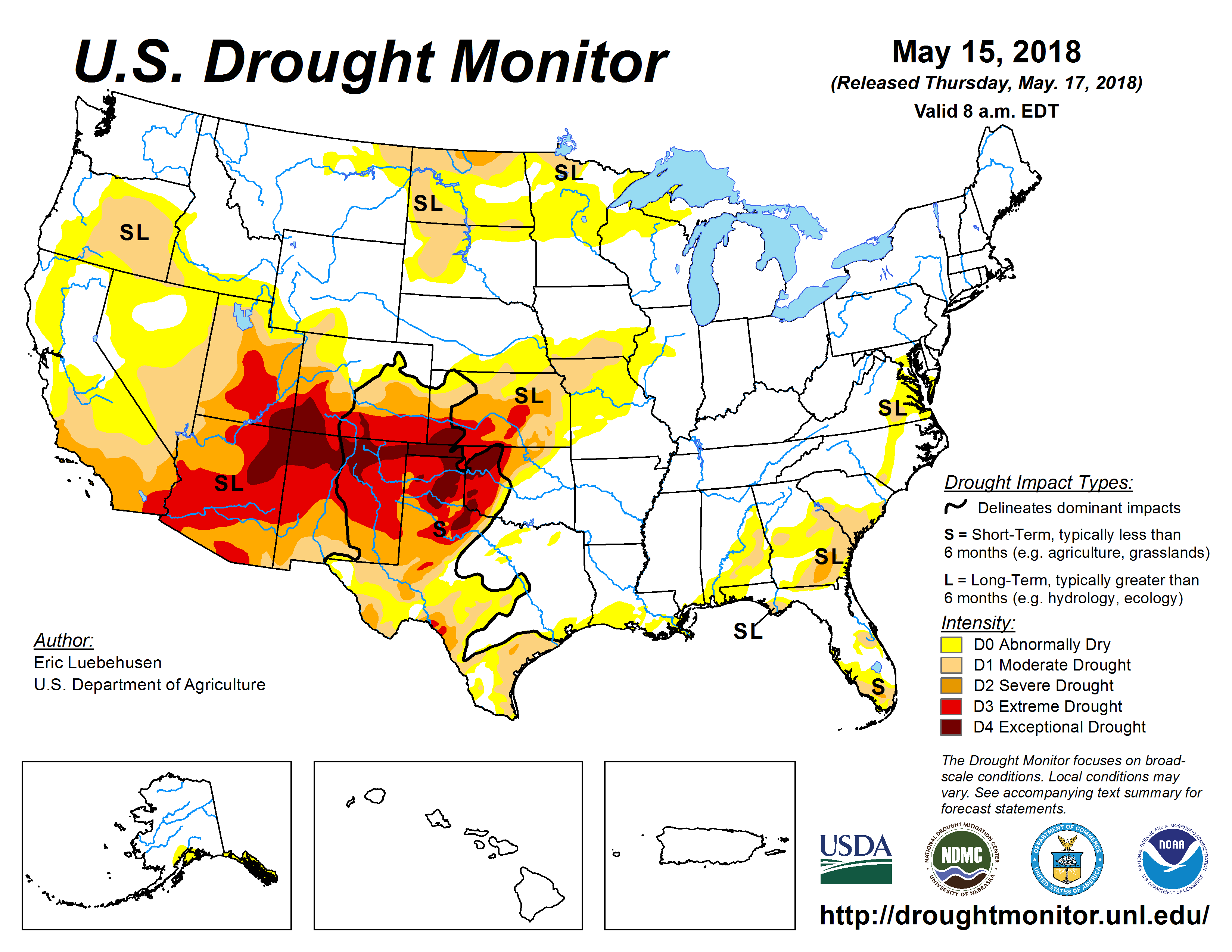
Click on a thumbnail graphic to view a gallery of drought data from the US Drought Monitor.
US Drought Monitor May 15, 2018.
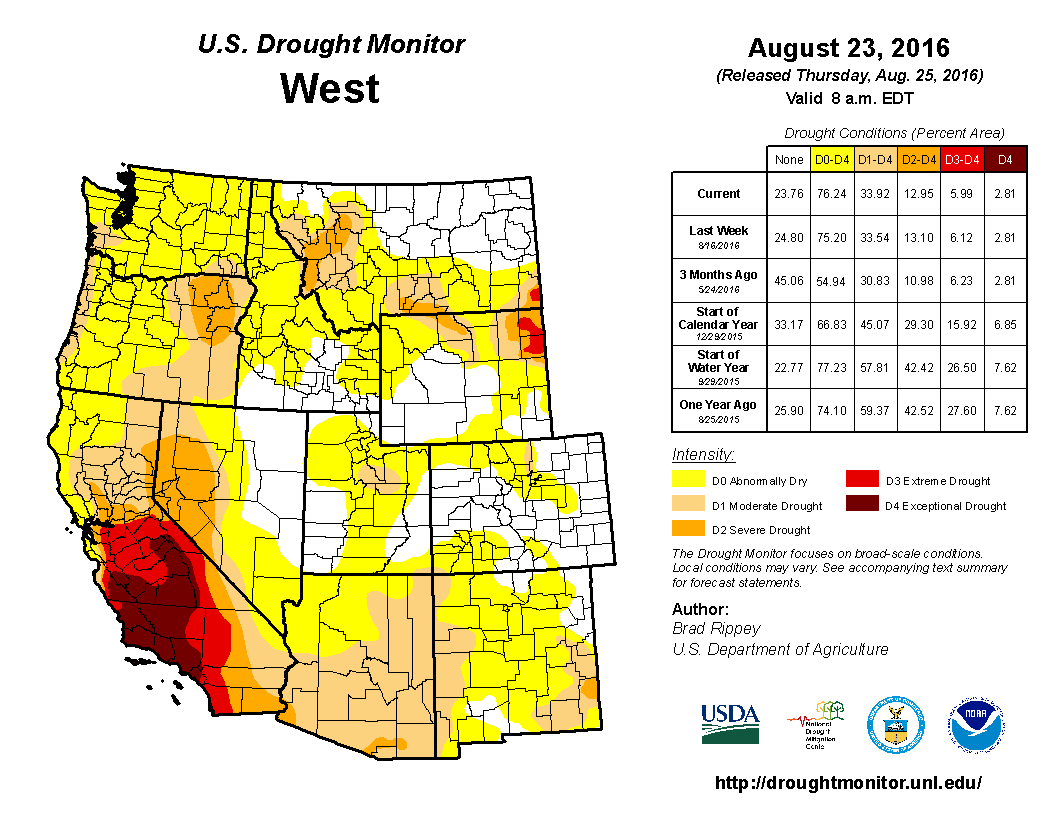
West Drought Monitor May 15, 2018.
Colorado Drought Monitor May 15, 2018.
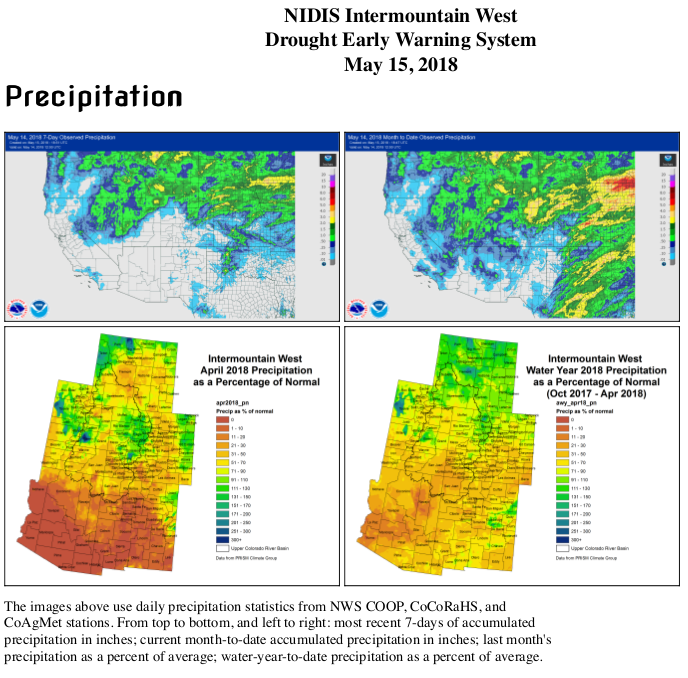
Click here to go to the NIDIS website hosted by the Colorado Climate Center. Here’s an excerpt:
Summary
During the 7-day period ending Tuesday morning, areas of locally heavy rain provided drought relief from the Plains to the East Coast, though much of the Southeast was dry. Toward the end of the time frame, an influx of tropical moisture associated with a slow-moving disturbance generated heavy to excessive rainfall in Florida, with rain associated with this broad area of unsettled weather overspreading the Southeastern and Mid-Atlantic States after the data cutoff for this week’s analysis; any rain that falls after 12z Tuesday (8 a.m., EDT) will be incorporated into the following week’s drought assessment. In contrast, dry, hot weather maintained or exacerbated drought from the southern High Plains into the Southwest. Likewise, despite the generally unsettled weather pattern, pockets of dryness and drought lingered or intensified in the Upper Midwest and northern Plains…
Spotty heavy downpours brought localized drought relief to portions of Oklahoma and Texas, while dry, warmer-than-normal weather prevailed across the rest of the region. Locally heavy showers (2-4 inches) dotted drought areas from central Texas northward into western Oklahoma. Where rain was heaviest, reductions in drought intensity and coverage were made; however, considerable longer-term deficits remained, with the remaining Exceptional Drought (D4) areas reporting less than 25 percent of normal precipitation (locally less than 10 percent) over the past six months. Along the Gulf Coast, Abnormal Dryness (D0) was expanded eastward to reflect increasingly dry conditions over the past 30 to 60 days, while D1 and D2 were added in coastal locales where 90-day rainfall was less than half of normal. Farther inland, Moderate to Severe Drought (D1 and D2) were expanded in western Texas to reflect increasingly dry conditions at both the shorter term (60-day rainfall averaging 10 to 25 percent of normal) and longer time frame (6-month precipitation averaging less than 50 percent of normal, locally less than 25 percent)…
The overall trend toward improving conditions in the south contrasting with increasingly dry weather in the north continued. From northeastern Colorado into central and southern Kansas, areas of moderate to heavy rain (1-3 inches) netted reductions in drought intensity and coverage. The most significant improvements were made in south-central Kansas, where a large area of 2 to 4 inches of rain (locally more) fell on areas of Severe (D2) to Extreme (D3) Drought. Moderate to heavy rain (1-3 inches) was similarly beneficial in northeastern Colorado, trimming the aerial extent of Abnormal Dryness (D0) and Moderate Drought (D1). Farther north, outside of locally beneficial downpours (1-3 inches) in northwestern South Dakota, acute short-term dryness over the past 30 days resulted in expanding D0 across southwestern South Dakota, southeastern North Dakota, and northeastern Montana, while a more prevalent dry signal over the past 90 days (50 percent of normal or less) led to expanding D1 and D2 in northeastern North Dakota…
Outside of beneficial rain and high-elevation snow in the north, pronounced short- and long-term dryness led to drought intensification and expansion across the Southwest. In southern Idaho, Abnormal Dryness (D0) was removed from most locales north of the Snake River, as recent rain and snow have pushed Water Year (to date) precipitation at or above the 35th percentile. However, sub-par seasonal precipitation coupled with increasingly dry conditions over the past 30 days led to the expansion of D0 in northeastern Montana and Moderate Drought (D1) in southwestern Idaho. Abnormal Dryness was expanded westward across central and northern portions of California’s Coastal Range due to a sub-par water year coupled with increasingly dry conditions over the past 30 days (deficits of 2 inches or more, locally less than 10 percent of normal). Farther south, Severe, Extreme, and Exceptional Drought (D2-D4) were increased from southern California into much of New Mexico. Changes were most pronounced in eastern portions of the region, where Water Year precipitation was in the 2nd percentile or lower, particularly across the northern third of New Mexico. Satellite-derived vegetation health data indicated conditions have deteriorated rapidly across the region, with the worst vegetation indices with respect to normal noted from Arizona southeastward into southern New Mexico. Drought Monitor authors are in close contact with local and regional experts from the Southwest, and further detailed analysis will likely result in additional intensification and expansion of drought as the situation is assessed over the upcoming weeks…
Looking Ahead
An active pattern will continue, with three significant areas of wet weather over the next 5 days. Moderate to heavy rain will continue to soak locales from the Appalachians to the East Coast, with totals approaching or topping 5 inches in parts of the Mid-Atlantic. Meanwhile, an area of low pressure will develop over the middle part of the nation, triggering moderate to heavy rain (locally more than 2 inches) from the central Plains into the Dakotas, while a trailing cold front producers similar rainfall amounts over north-central Texas and environs. Finally, a pair of upper-air disturbances will generate periods of rain across the northern two-thirds of the western U.S. Despite the unusually active pattern, dry weather will prevail from central and southern California into the lower Four Corners. The NWS 6- to 10-day outlook for May 22 – 26 calls for below-normal rainfall across central and southern Texas and from the Great Lakes into New England. Conversely, wetter-than-normal conditions are expected from northern portions of the Rockies and Great Basin to the central and southern Atlantic Coast, with the greatest likelihood for abnormally wet weather in the Southeast. Abnormal warmth is expected over most of the nation save for near-normal temperatures in California and New England.
The City of Salida is now encouraging residents to follow the voluntary restrictions “similar to past years”. This includes even street address watering on even numbered days and odd on odd days and not watering between 10 a.m. and 4 p.m.
A year ago no part of Colorado was officially under drought. A few areas were “abnormally dry” including all of Park County and much of the Grand Junction area.
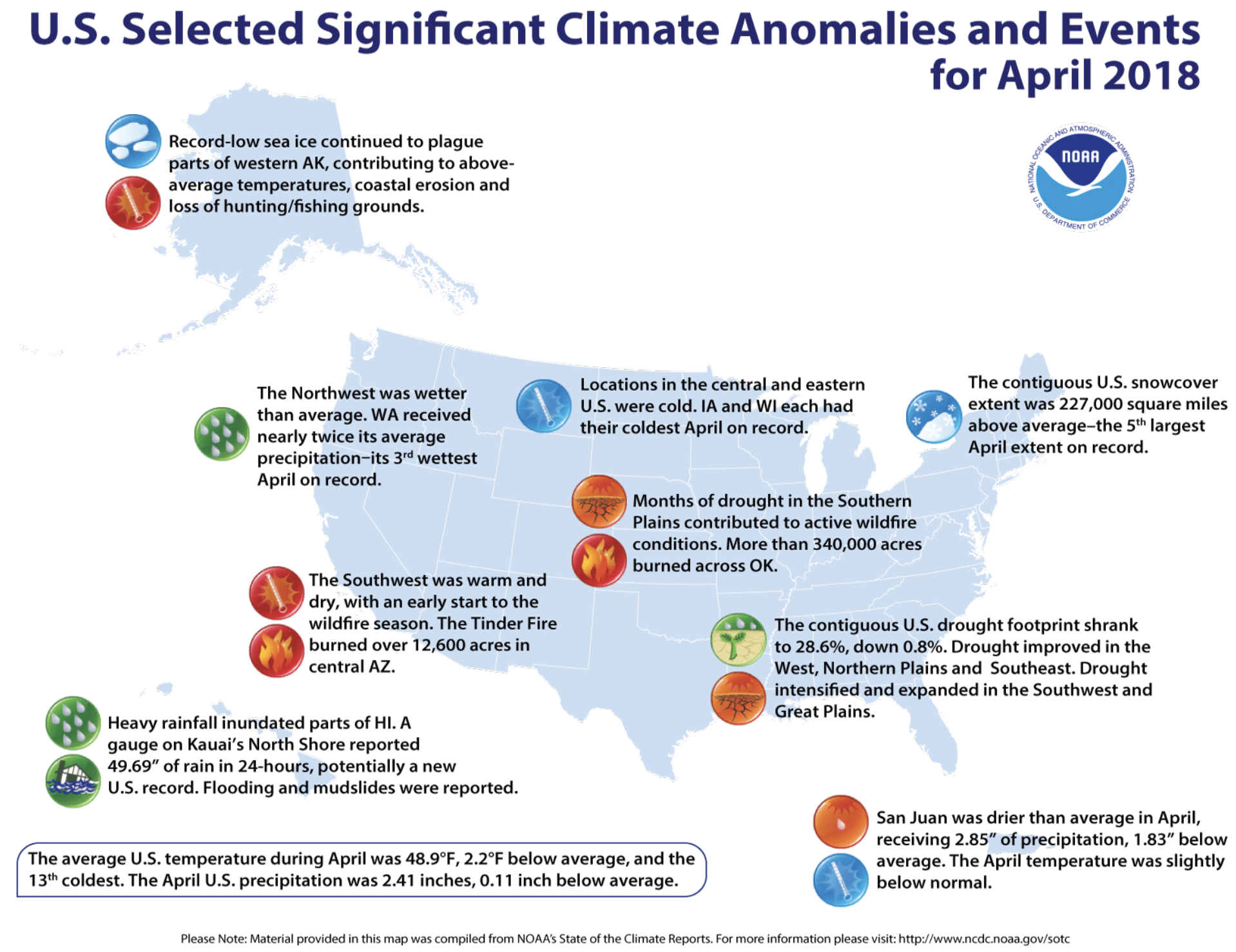
Fast forward to May 2018 and nearly 70% of the state is under some state of drought, making it likely that voluntary water restrictions may become mandatory restrictions in some areas.
With dangerously low snowpack levels across the state, Colorado is facing a severe water shortage. We take a look at what that means for rivers, wildfires, and the future of water use in the West.
To put things in perspective, on April 9—which is historically the peak day for snowpack in Colorado—almost the entire state was sitting at below-average levels. Southern Colorado had it worst. The Upper Rio Grande basin, for instance, boasted a meager 43 percent of its normal snowpack. The Gunnison basin sat at only 57 percent. The Arkansas basin was at 63 percent. Only the North and South Platte River basins approached normal levels.
A month later, little has improved. “We’re staring down a pretty bleak water year,” says Matt Rice, director of the American Rivers’ Colorado Basin Program. And what’s worse, he says, is that “This is absolutely part of a trend.” According to river and conservation scientists, Colorado is in the midst of a drought that dates back to the record-dry year of 2002. Although we have had some wet winters over the past two decades, dry seasons are now becoming “the new normal.” And that’s a problem—not just for our ski resorts, rivers, and lakes, but also for our farmers, cities and our neighboring states…
Ask a climate scientist why water scarcity in Colorado has become so dire, and their most simple answer will likely be a two-part explanation: Climate change and population growth. Over the past several decades, Colorado has seen warmer temperatures with dryer winters and diminished snowpack. It doesn’t help that, since 2000, Colorado has gained approximately 1.3 million residents, all of whom in some way rely on the state’s water sources. “The population growth is very much compounded by climate change,” Rice says. “There is increasing demand on rivers for municipal and industrial water use.”
[…]
Moreover, the Front Range gets about 50 percent of its water—roughly 160 billion gallons—via annual trans-mountain diversions from rivers on the Western Slope. These diversions draw water away from communities and rivers experiencing the most severe drought conditions in Colorado. “We’re all connected, says Bart Miller, Healthy Rivers program director for Boulder-based Western Resources Advocates. “Water use in Denver, in some ways, is having an impact on our West Slope neighbors.” A complicated diversion system, in conjunction with population growth and a changing climate, leaves us facing a stark reality: We’re running out of water.
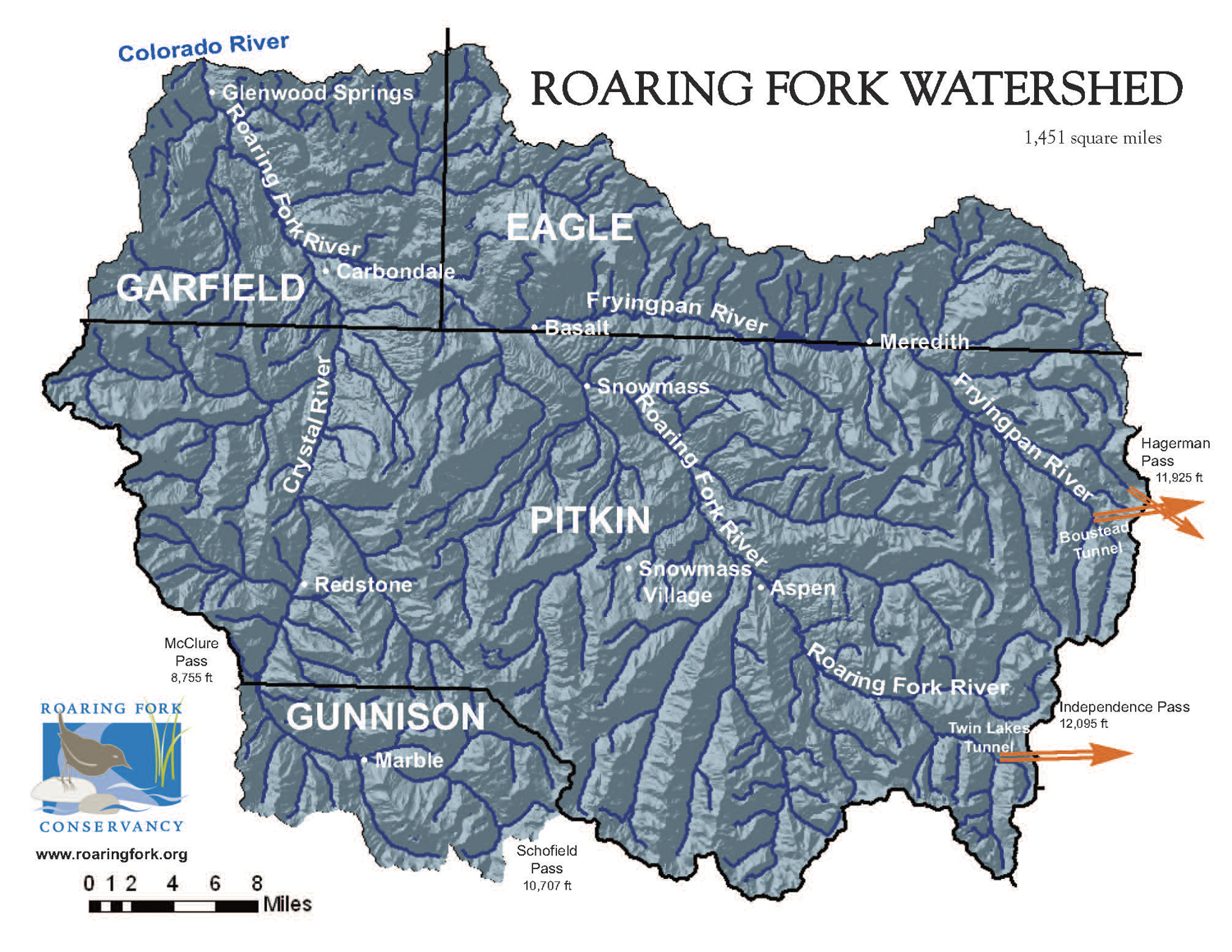
Map of the Roaring Fork River watershed via the Roaring Fork Conservancy
FromAspen Public Radio (Elizabeth Stewart-Severy):
Roaring Fork Conservancy has been studying the creek since 2015, and water quality coordinator Chad Rudow told commissioners Monday that research shows parts of the creek are healthier than the state thought.
“We’re pretty excited and pretty hopeful that at least a section of Cattle Creek will come off of that 303(d) list,” Rudow said.
Roaring Fork Conservancy has submitted its data to the Colorado water quality division, which will analyze it this year.
Garfield County agreed to Roaring Fork Conservancy’s request for $10,000 to continue studying water quality and take steps to improve it. Rudow said the studies have identified some clear trends…
There isn’t just one culprit; diversions, agriculture, septic systems and commercial development all contribute.
Roaring Fork Conservancy is working with landowners to better manage riparian areas and septic systems, and Rudow said continued outreach is key.
Because there are many diversions on Cattle Creek, the stream doesn’t see a typical spring runoff flow, which clears out pollutants and sediments. So Roaring Fork Conservancy is also working with water rights owners to discuss a pulse flow to mimic spring runoff.
Under the Compact, the Upper Basin States are obligated to deliver 7.5 million acre feet (maf) of water downstream to the thirsty Lower Basin states. Unfortunately, this requirement was derived from faulty baseline data as the rainfall patterns that occurred in the years prior were abnormally high and the flows were vastly overestimated. Delivery of this amount of water will be further impacted by warming climate projections that indicate that the region will become drier in the long-term, and we may be in an era of steadily declining river flows along the Colorado. To make matters worse, demand in all of the basin states like Colorado are increasing as populations in the area continue to grow, further stressing the already over-allocated river.
These devastating impacts are evident in the water storage levels within the river’s two largest reservoirs, Lake Powell and Lake Mead, which are measured in order to determine if the Compact obligations are being met. Recently the reservoir levels have dropped to their lowest levels since 1937 and have shrunk to less than half their capacity. Until now, the system has worked, but if the Upper Basin states fail to deliver the mandatory volume of water to the reservoirs then the Lower Basin states could make a “Compact call” forcing the Upper Basin to curtail use of post-1922 water rights from the Colorado. That means Colorado’s growing population, amidst a warming and drier climate, will be forced to use less water so Lower Basin states can receive their legally obligated share.
To address diminishing flows and greater demand for the water, agricultural producers in Colorado’s west slope are participating in a voluntary pilot program that compensates them for temporarily fallowing their crops and letting the water run down the river.
In 2014, facing declining levels in lakes Mead and Powell, the Upper Colorado River Commission (UCRC), the Bureau of Reclamation and four water providers piloted a program in the Upper Basin to test water conservation strategies that could be part of a drought contingency plan. The goal of the Colorado River System Conservation Pilot Program (SCPP) was to demonstrate the viability of proactive, cooperative and voluntary compensated means to reduce the risk of reaching critical reservoir levels needed to protect the Compact entitlements. The program allows farmer and ranchers to voluntarily and temporarily let water run down the river and forego the use of their water to irrigate fields in exchange for compensation. The SCPP also reduces “buy and dry” scenarios where struggling farmers are bought out so developers can have access to their water for neighborhoods or transfer their water to municipalities.
A shining example is the 9,177-acre Porcupine Ridge Ranch in Routt County, Colorado and the latest to take advantage of the UCRC’s program by voluntarily reducing consumptive use of its water rights and fallowing 1,941 acres of their irrigated hay fields, or nearly twenty percent of their ranch. In exchange, the ranch will receive up to $421,650, in addition to the current cattle and hunting leases that remain operative alongside the water fallowing. This is one of the largest awards given to a single property in Colorado and outlines a model of what’s to come, if ranchers and farmers take advantage of the opportunity while they can.
As the Compact nears its 100th birthday, policymakers and landowners alike need to take an honest and accurate view at rainfall rates amidst a warming and migrating population to rebalance water needs and who gets what (and why.) The SCPP is a start in the right direction as it addresses water supply shortages and provides a possible hedge against potential future Compact calls. It also benefits agricultural producers by creating a potential income source by funding voluntary conservation measures while also avoiding buy and dry measures that separate their water from the land.
During April, the average contiguous U.S. temperature was 48.9°F, 2.2°F below the 20th century average, making it the 13th coldest April on record and the coldest since 1997.
Below-average temperatures were observed from the Rockies to the East Coast. Twenty-two states had an April temperature that ranked among the 10 coldest on record. Eight states had their second coldest April on record and two states—Iowa and Wisconsin—were record cold.
Above-average April temperatures were observed across much of the West, with record warm temperatures for parts of the Southwest. Arizona had its second warmest April on record with a statewide temperature 6.3°F above average.
Above-average April temperatures were also observed in southern Florida.
The contiguous U.S. average maximum (daytime) temperature during April was 61.7°F, 1.7°F below the 20th century average, marking the 21st coolest value on record and coolest since 1997. Below-average maximum temperatures were observed from the Rockies to East Coast, with 19 states having a top 10 cold April maximum temperature. Iowa had a record cold April maximum temperature.
The location of record and near-record cold maximum temperature coincided with record-setting April snowfall. Above-average conditions were observed in the Southwest, where Arizona had its second warmest April maximum temperature on record.
Nationally, the April minimum (nighttime) temperature was the seventh coldest on record at 36.1°F, 2.6°F below average. Below-average conditions were observed from the Rockies to the East Coast, where nine states had an average minimum temperature for the month that was record cold with fourteen additional states having much-below-average minimum temperatures. Above-average minimum temperatures were observed across the West.
The Alaska average April temperature was 26.6°F, 3.3°F above the long-term mean. This ranked among the warmest third of the historical record. St. Paul and Cold Bay each had their fifth warmest April on record. Along the state’s west coast, sea ice continued to be much below average, contributing to the above-average temperatures. Some impacts of the low sea ice reported include coastal erosion and loss of hunting/fishing grounds.
During April there were 7,068 record cold daily high (3,778) and low (3,290) temperature records, which was about 2.8 times the 2,563 record warm daily high (972) and low (1,591) temperature records.
Based on NOAA’s Residential Energy Demand Temperature Index (REDTI), the contiguous U.S. temperature-related energy demand during April was 82 percent above average and was the fifth highest value in the 124-year period of record. The below-average temperatures in the Northeast and Midwest contributed to the above-average REDTI.
Precipitation
April 2018 Statewide Precipitation Ranks
The April precipitation total for the contiguous U.S. was 2.41 inches, 0.11 inch below average, and ranked near the median value in the 124-year period of record.
During April, above-average precipitation was observed along the West Coast, Northern Rockies and much of the East. Record high precipitation was observed in parts of the Northwest, with Washington state having its third wettest April on record with 5.53 inches of precipitation, 2.70 inches above average. This was the wettest April for the state since 1996.
Below-average precipitation stretched from the Southwest, through much of the Great Plains, where five states had a monthly precipitation total that was much below average. The dry conditions in the Southern Plains provided ideal wildfire conditions with numerous large wildfires burning during the month. Record-low precipitation was observed in parts of the Southwest and mid-Mississippi Valley.
According to NOAA data, analyzed by the Rutgers Global Snow Lab, the contiguous U.S. snow cover extent during April was 508,000 square miles, 227,000 square miles above the 1981–2010 average. This was the fifth largest April snow cover extent on record for the Lower 48 since satellite records began 52 years ago, and the largest April snow cover extent since 1997. Above-average snow cover was observed for most northern locations in the nation, with below-average snow cover in the Southwest.
Most locations on the Hawaiian Islands had above-average precipitation during April with Lihue having its sixth wettest April and Kula its third wettest. On April 14-15, heavy rain fell across Kauai causing major flooding and landslides. According to preliminary data, a rain gauge near Hanalei, on Kauai’s North Shore, reported 49.69 inches of rain in 24 hours, potentially a new national record. It is pending review by the National Climate Extremes Committee.
According to the May 1 U.S. Drought Monitor report, 28.6 percent of the contiguous U.S. was in drought, down from 29.4 percent at the beginning of April. Drought conditions improved in California, the Northern Plains and the Southeast. Drought also improved in parts of the Alaskan panhandle. Drought conditions expanded and intensified in the Southwest and Central to Southern Plains. The percent area of the contiguous U.S. experiencing D4 – Exceptional Drought, the worst category, expanded to 2.2 percent, the highest since November 2016. D4 drought conditions stretched from the Southwest to Southern Plains.
The dam that forms Ruedi Reservoir, above Basalt on the Fryingpan River. Photo: Brent Gardner-Smith/Aspen Journalism
From email from the Colorado Water Conservation Board (Rob Viehl):
DATE: May 16, 2018
RE: Proposed Acquisition of Contractual Interest in Ruedi Reservoir Water for ISF Use on Fryingpan River, Eagle & Pitkin Counties
The Colorado Water Conservation Board will be considering a proposal from the Colorado River Water Conservation District, acting through its Colorado River Water Projects Enterprise (“CRWCD”) to enter into a one-year renewable short-term lease of a portion of water that CRWCD holds in Ruedi Reservoir for instream flow (“ISF”) use to boost winter flows in the Fryingpan River below Ruedi Reservoir. The Board will consider this proposal at its May 23-24, 2018 meeting in Salida. The agenda for this Board meeting can be found at: http://cwcb.state.co.us/public-information/board-meetings-agendas/Pages/May2018NoticeAgenda.aspx
Consideration of this proposal initiates the 120-day period for Board review pursuant to Rule 6b. of the Board’s Rules Concerning the Colorado Instream Flow and Natural Lake Level Program (“ISF Rules”), which became effective on March 2, 2009. No formal Board action will be taken at this time.
Information concerning the ISF Rules and water acquisitions can be found at:
Bureau of Reclamation Contract: 079D6C0106
Contract Use: Supplement winter instream flows in the Fryingpan River
Contract Amount: 5,000 Acre Feet
Amount Offered for Consideration: 3,500 Acre Feet
Proposed Reaches of Stream:
Fryingpan River: From the confluence with Rocky Ford Creek, adjacent to the outlet of Ruedi Reservoir, downstream to its confluence with the Roaring Fork River, a distance of approximately 14.4 miles.
Purpose of the Acquisition:
The leased water would be used to supplement the existing 39 cfs ISF water right in the Fryingpan River to preserve the natural environment, and used at rates up to 70 cfs to meet the Roaring Fork Conservancy and Colorado Parks and Wildlife flow recommendations to improve the natural environment to a reasonable degree.
Proposed Season of Use:
Water stored in Ruedi Reservoir will be released to the Fryingpan River during the winter time period. The existing instream flow water right is decreed for 39 cfs from November 1 – April 30. The objective of the lease would be to maintain Fryingpan River flows at a rate of 70 cfs to prevent the formation of anchor ice at times when temperatures and low flows could otherwise combine to create anchor ice, which adversely impacts aquatic macroinvertebrates and trout fry.
Linda Bassi
Stream and Lake Protection Section
Colorado Water Conservation Board
1313 Sherman Street, Room 721
Denver, CO 80203
linda.bassi@state.co.us
303-866-3441 x3204
Kaylea White
Stream and Lake Protection Section
Colorado Water Conservation Board
1313 Sherman Street, Room 721
Denver, CO 80203
kaylea.white@state.co.us
303-866-3441 x3240
A 76-year-old fly fisherman who likes to fish near the small town alleges the owners of a nearby home resorted to violence, including firing a gun, to stop him and friends from using the fishing spot.
The lawsuit alleges that Mark Everett Warsewa, the property owner who allegedly fired the gun, contends the riverbed at that spot is his property. Records show he is an appraiser for Fremont County government.
The fisherman, Roger Hill, attached to his lawsuit a hand-written note, which he says Warsewa wrote in 2012, that says: “Guys There are 63 miles of Public Water on the Arkansas River, Use Them! There are no easements on the River in this section. I know, I work for the Fremont County Assessors’s Office, You can and will be charged with trespassing! I have your plate number. I’ll have Sheriff Jim Beicker run it.”
Hill wants a judge to declare the riverbed belongs to the state of Colorado “so he can again safely fish at his favorite fishing spot,” his lawsuit states.
Hill, of Colorado Springs, filed the lawsuit in February in U.S. District Court in Denver. He said he wades into the river from public land.
Linda Joseph is also a defendant. The lawsuit says she and Warsewa, 60, own the property and home nearest the fishing spot, where Texas Creek flows into the Arkansas.
A set of bills deal with new uses for reclaimed water: domestic wastewater that has received secondary treatment by wastewater treatment works, as well as additional treatment needed to meet standards for approved uses. In the past, this water has been restricted to landscaping irrigation and some commercial and industrial uses. Separate bills expand this use to edible crops (HB18-1093), industrial hemp (SB18-038), and marijuana cultivation (HB18-1053).
The bills codify rules promulgated by the water quality control commission by creating three categories of water quality for reclaimed domestic wastewater and the allowable uses for each water quality standard category. The bills require the water quality control division to develop policy, guidance or best management practices for use of reclaimed domestic wastewater.
Only the bill expanding reclaimed water use to edible crops has been sent to the governor. The bills for industrial hemp and marijuana cultivation are still in the legislature.
Another bill, HB18-1199, pertains to aquifer storage-and-recovery plans. HB18-1199 authorizes a person to apply to the groundwater commission for approval of an aquifer storage-and-recovery plan and requires the commission to promulgate rules governing the application process and requirements for a plan.
This bill was signed by the governor.
One last significant piece of legislation was HB18-1151: Colorado Water Conservation Board Approve Deficit Irrigation Pilot Projects. Current laws allows the water conservation board to approve up to 15 pilot projects for agricultural water leasing or fallowing projects. The bill expands the types of projects to include deficit irrigation in water divisions 2 and 3 and within the boundaries of the Upper Gunnison Water Conservancy District. The bill also excludes the determination of historical consumptive use decreases in use resulting from deficit irrigation projects. The bill was set aside this year and may be brought up next legislative session.
Click here to read the paper (Benjamin I. Cook, Justin S. Mankin, Kevin J. Anchukaitis). Here’s the abstract:
Abstract
Drought is a complex and multivariate phenomenon influenced by diverse physical and biological processes. Such complexity precludes simplistic explanations of cause and effect, making investigations of climate change and drought a challenging task. Here, we review important recent advances in our understanding of drought dynamics, drawing from studies of paleo climate, the historical record, and model simulations of the past and future. Paleoclimate studies of drought variability over the last two millennia have progressed considerably through the development of new reconstructions and analyses combining reconstructions with process-based models. This work has generated new evidence for tropical Pacific forcing of megadroughts in Southwest North America, provided additional constraints for interpreting climate change projections in poorly characterized regions like East Africa, and demonstrated the exceptional magnitude of many modern era droughts. Development of high resolution proxy networks has lagged in many regions (e.g., South America, Africa),however, and quantitative comparisons between the paleoclimate record, models, and observations remain challenging. Fingerprints of anthropogenic climate change consistent with long-term warming projections have been identified for droughts in California, the Pacific Northwest, Western North America, and the Mediterranean. In other regions (e.g.,Southwest North America, Australia, Africa), however, the degree to which climate change has affected recent droughts is more uncertain. While climate change-forced declines in precipitation have been detected for the Mediterranean, in most regions, the climate change signal has manifested through warmer temperatures that have increased evaporative losses and reduced snowfall and snowpack levels, amplifying deficits in soil moisture and runoff despite uncertain precipitation changes. Over the next century, projections indicate that warming will increase drought risk and severity across much of the subtropics and mid-latitudes in both hemispheres, a consequence of regional precipitation declines and widespread warming. For many regions, however, the magnitude, robustness, and even direction of climate change-forced trends in drought depends on how drought is defined, with often large differences across indicators of precipitation, soil moisture, runoff,and vegetation health. Increasing confidence in climate change projections of drought and the associated impacts will likely depend on resolving uncertainties in processes that are currently poorly constrained (e.g., land-atmosphere interactions, terrestrial vegetation) and improved consideration of the role for human policies and management in ameliorating and adapting to changes in drought risk.
CRAIG — Three variations of a potential dam that could someday sit astride the main stem of the White River between Meeker and Rangely have been examined by the Rio Blanco Water Conservancy District in Rangely.
Last week in Craig, Steve Jamieson, a principal engineer and president at W.W. Wheeler and Associates, told the members of the Yampa, Green and White river basin roundtable that an 80-foot-tall dam built across the main stem of the White River at Wolf Creek could store 68,000 acre-feet of water.
He said a 104-foot-tall dam across the river could store 138,000 acre-feet.
And a 290-foot-tall dam across the valley floor could store 2.9 million acre-feet of water.
“The maximum you can get here is 2.9 million acre-feet in this bucket,” Jamieson said. “It’s a big bucket, and you can do that with a dam that it’s about 290 feet high. It would be a very efficient dam site, but you need to have the water to fill it.”
A slide being presented by Steve Jamieson of Wheeler a showing the range of dam and reservoir sizes that have been studied for the potential White River Dam on the main stem of the White River 23 miles east of Rangely. The dams range in size from 80-feet-tall to 290-feet-tall and could store between 68,000 AF to 2.9 MAF. The dam sizes were studied as part of Phase 2A of the White River storage project, and the state has provided $500,000 in funding so far to study the project.Steve Jamieson, left, of Wheeler and Associates, and Brad McCloud, right, showing an illustration of where the axis of a 290-foot-tall dam across the White River would be. The big dam would require a 500-foot-wide spillway, which would mean relocating a section of Hwy 64.
Water enough
About 500,000 acre-feet of water a year runs down the lower White River each year, flowing through Meeker and Rangely and into Utah and the Green River.
And between 1923 and 2014, the annual flow in the White River at the Utah line ranged from 200,000 to 1.2 million acre-feet, according to Wheeler and Associates.
The potential White River Dam would be located 23 miles east of Rangely, along Highway 64.
The existing Taylor Draw Dam, which forms Kenney Reservoir on the main stem of the White River, is six miles east of Rangely.
That reservoir was built in 1984 to hold 13,800 acre-feet of water, but it’s gradually silting in, as was expected in a 1982 EIS done for the project. The surface area still “available for recreation,” or boating, is now less than 335 acres, down from 650 acres when the reservoir opened.
The dam’s hydro plant, however, is still generating about $500,000 a year in electricity revenue for the Rio Blanco district in a run-of-river setup.
A slide being presented by Steve Jamieson of Wheeler and Associates and Brad McCloud of EIS Solutions showing the range of dam and reservoir sizes that have been studied with state funding for the Wolf Creek drainage. The dams range in size from 80-feet-tall to 260-feet-tall and could store 41,000 AF to 1.6 MAF. The dam sizes were studied as part of Phase 2A of the White River storage project, and the state has provided $500,000 in funding so far to study the project.
Off-channel too
Jamieson also has been studying an off-channel dam in the Wolf Creek drainage, which is a broad, dry valley on the north side the river, just upstream of the proposed White River Dam site.
The Wolf Creek Dam would be located 3,000 feet back from the river and 170 feet above it.
An 80-foot-tall version of that dam could store 41,000 acre-feet of water, a 119-foot-tall dam could store 130,000 acre-feet, and a 260-foot-tall dam could store 1.6 million-acre feet, Jamieson said.
“This is really good dam site here, I like this,” Jamieson said. “It’s very flexible.”
However, the off-channel Wolf Creek Dam would require that water be pumped up from the river, at a high cost, or delivered via a 40-mile long canal or pipeline starting near Rio Blanco Lake — closer to Meeker than Rangely.
“It’s going to be a very long and expensive canal,” Jamieson said.
The pumping facility for a 90,000 acre-foot reservoir, which was studied in 2014, was estimated to cost $18.2 million build and up to $1.1 million a year to operate.
Jamieson said Highway 64 would need to be moved to accommodate the biggest White River Dam option, which requires a 500-foot-wide spillway on one side of the river valley.
The river itself would also have to be moved during construction.
“You’d be constructing two to three years at least,” Jamieson said. “So what we looked at is actually building a tunnel around into this abutment that we would divert the White River through during construction.”
A slide presented by Steve Jamieson of Wheeler and Associates on May 9, 2018, showing the maximum inundation area of a 290-foot-tall dam on the main stem of the White River. Jamieson presented the slide at the May 9, 2018 meeting in Craig of the Yampa/White/Green basin roundtable.
Gardner-sized
Jamieson said the district started studying the maximum size of the potential reservoirs after Sen. Cory Gardner asked during a site visit, “How big can you make this reservoir?”
During his presentation Jamieson repeatedly referred to Sen. Gardner, using phrases such as “this is the maximum Cory Gardner reservoir.”
A roundtable member asked, “Did the senator promise the money for this?”
The basin roundtables operate under the auspices of the Colorado Water Conservation Board and review grants for water projects.
“No, he did not, unfortunately,” said Brad McCloud of EIS Solutions, a public affairs consulting firm retained by the district. “We asked.”
The Colorado Water Conservation Board also wants to know what the maximum reservoir size is.
“Based on recent comments from some stakeholders, it may be beneficial to build the largest possible reservoir at Wolf Creek,” the scope of work for a 2017 grant from the board to the district states.
It also says “a much larger reservoir … could have additional benefits to the state.”
One of those benefits could be helping the state avoid a compact call on the Colorado River.
“Part of the Phase 2A study is to determine if the project may have the potential to provide Colorado compact curtailment insurance during periods of drought,” the 2017 grant application from the district said.
Since 2013, the district has received three grants totaling $500,000 from the Colorado Water Conservation Board for its White River project, and the potential benefit of compact compliance has been mentioned in all three grants.
The White River near the vicinity of the Wolf Creek drainage. The river sends about 500,000 acre-feet of water a year across the state line into Utah, with flows ranging from 200,000 AF to 1.2 MAF a year. The White drains the western side of the Flat Top Mountains and flows through Meeker and Rangely.
20,000 or 90,000
On Wednesday in Craig, Jamieson downplayed compact curtailment and focused on the district’s goal of creating a 20,000 or 90,000 acre-foot “working pool” of water inside larger potential reservoirs.
For example, it would require a 138,000 acre-foot on-channel reservoir to establish a 90,000 acre-foot working pool for the district, after allowances for a recreation pool and a 24,000 acre-foot sedimentation pool — which would fill in over 50 years.
To establish a need of the stored water, Jamieson cited a 2014 study showing demand in the basin at 91,000 acre-feet in 2065.
That’s on the high end, though.
The low-end need in 2065 was 16,600 acre-feet.
The district filed in water court in 2014 for a 90,000-acre-foot storage right at both the on-channel and off-channel locations.
But Erin Light, the division engineer in Div. 6, told the district in July 2017 “this application continues to contain aspects that are speculative and this is concerning to me.”
She questioned the district’s use of the highest estimates for such potential uses as oil shale production and flows for endangered fish.
The water attorney for the district, Ed Olszewski, responded to Light in August.
He said the district “disputes that any portion of the application is speculative” and the application is intended to be “as flexible as possible.”
As Jamieson wrapped up his presentation, he said the Rio Blanco district plans to “initiate project permitting” in 2019.
“I know we’re very aggressive,” Jamieson said. “We’re making progress.”
Aspen Journalism is covering water and rivers in collaboration with The Aspen Times and the Glenwood Springs Post Independent. The Times and the Post Independent published this story on Monday, May 14, 2018.
The May 1st forecast for the April – July unregulated inflow volume to Blue Mesa Reservoir is 350,000 acre-feet. This is 52% of the 30 year average. Snowpack in the Upper Gunnison Basin peaked at 69% of average. Blue Mesa Reservoir current content is 496,000 acre-feet which is 60% of full. Current elevation is 7478.7 ft. Maximum content at Blue Mesa Reservoir is 829,500 acre-feet at an elevation of 7519.4 ft.
Based on the May 1st forecast, the Black Canyon Water Right and Aspinall Unit ROD peak flow targets are listed below:
Black Canyon Water Right
The peak flow target will be equal to 987 cfs for a duration of 24 hours.
The shoulder flow target will be 300 cfs, for the period between May 1 and July 25.
Aspinall Unit Operations ROD
The year type is currently classified as Dry.
There is no peak flow target in a Dry year category
Baseflow targets will continue to be met throughout the year.
Releases from the Aspinall Unit will be increased by 400 cfs on Monday, May 14th in order to allow the Black Canyon water right to be met. Flows on the North Fork of the Gunnison River are also predicted to be near peak levels at this time. The resulting flow on the lower Gunnison River at the Whitewater gage is estimated to be around 2500 cfs. On Tuesday, May 15th, releases from the Aspinall Unit will be decreased by 400 cfs to return river flow to the pre-peak level.
Pursuant to the Aspinall Unit Operations Record of Decision (ROD), the baseflow target in the lower Gunnison River, as measured at the Whitewater gage, is 890 cfs for May and 1050 cfs for June.
Currently, diversions into the Gunnison Tunnel are 1000 cfs and flows in the Gunnison River through the Black Canyon are 600 cfs. During the 1 day peak flow Gunnison Tunnel diversions will still be 1000 cfs and flows in the Gunnison River through the Black Canyon will be around 1000 cfs. River flows will return to 600 cfs the day after the peak flow. Current flow information is obtained from provisional data that may undergo revision subsequent to review.
“Much of the state experienced lower-than-average snowfall and snowpack,” said Rob White, park manager for the Arkansas Headwaters Recreation Area which encompasses the Arkansas River from Lake County to Lake Pueblo.
“Luckily, the Upper Arkansas River Valley and the Fryingpan-Arkansas Project area received some of the best snow in the state. This means there should be plenty of water for rafters, kayakers, anglers and all the people who enjoy the Arkansas River,” he said.
Whitewater enthusiasts, who make the Arkansas River the most rafted river in the state, received more good news this week from the U.S. Bureau of Reclamation, which manages flows in the river.
The bureau’s May forecast regarding the availability of water for releases in July and August indicates a minimum of 10,000 acre-feet of water will be available for recreational purposes.
As part of the Voluntary Flow Management Program, the bureau will use the water to help maintain flows of at least 700 cubic feet per second from July 1 to Aug. 15 which is the peak of the summer vacation season.
That flow gives the river enough volume to ensure plenty of exciting whitewater rapids for both adrenaline junkies and those seeking a calmer family adventure…
Last year, close to 50 different commercial outfitters along the Arkansas River provided trips for more than 223,00 guests who tested the mild to wild waters of the Arkansas through Pine Creek, the Numbers, Browns Canyon National Monument, Bighorn Sheep Canyon and the Royal Gorge. That is big business for the Upper Arkansas River Valley, resulting in $29 million in direct expenditures and an overall economic impact of $74.4 million, according to the annual report complied for Colorado River Outfitters Association.
“The Arkansas continues to be the most popular river in Colorado with a market share of 38.6 percent of all Colorado rafting use. Market share on the Arkansas has been declining, however, primarily due to increased use on Clear Creek and the Upper Colorado,” the report said…
In a pointed message Wednesday, U.S. Bureau of Reclamation Commissioner Brenda Burman said drought and low flows continue on the Colorado with no end in sight, so it’s up to those who rely on the river to stave off a coming crisis.
“We need action and we need it now. We can’t afford to wait for a crisis before we implement drought contingency plans,” Burman in a written statement. “I’m calling on the Colorado River basin states to put real — and effective — drought contingency plans in place before the end of this year.”
The bureau’s latest projections call for the river to see just 42 percent of its average flow between now and July due to record-low snowpack that has already melted away in parts of the basin.
Federal forecasters now say there is a 52 percent chance that Lake Mead will decline into shortage conditions by 2020. That would force Nevada and Arizona to cut their river use for the first time under shortage rules adopted in 2007.
Nevada, Arizona and California have been working on a plan since 2015 to keep Lake Mead out of shortage by voluntarily leaving more water in the reservoir, but the talks have stalled in Arizona and California, where water users are arguing over how to share the necessary cuts.
Then last month, a war of words broke out among the seven states that share the Colorado after Arizona’s largest water utility revealed a controversial strategy to keep water levels in Lake Mead high enough to avoid any reduction in its share but low enough to require upper-river users to send more water downstream to the lake.
The Central Arizona Project, which supplies water to about 5 million people in Phoenix and Tucson, has since issued a statement saying it “regrets using language and representations that were insensitive” to other river users.
Officials for the utility promised “a more respectful and transparent dialogue in the future” and said they would do their part to finish the drought contingency plan.
The surface of Lake Mead has dropped by more than 130 feet since 2000, when the current drought descended on the mountains that feed the Colorado. According to the bureau, the river basin is in the midst of the driest 19-year period on record and one of the worst drought cycles of the past 1,200 years.
“This ongoing drought is a serious situation, and Mother Nature does not care about our politics or our schedules,” said John Entsminger, the Southern Nevada Water Authority’s general manager and one of several top water officials who signed on to Burman’s call to action. “We have a duty to get back to the table and finish the drought contingency plan to protect the people and the environment that rely upon the Colorado River.”
FromThe Grand Junction Daily Sentinel (Gary Harmon):
Peak flows are expected Sunday on both the Colorado and Gunnison rivers, which will combine to deliver flows of about 8,500 cubic feet per second of water at the Utah state line.
“Definitely, I would say it ranks in the bottom five on record for those peak amounts,” said Brenda Alcorn, senior hydrologist with the Colorado River Basin Forecast Center in Salt Lake City.
This year’s peak at the Cameo gauge is expected to be the fourth-lowest in the 85 years of records kept by the Colorado River Water Conservation District. Only the critically dry years of 1977, 2002 and 2012 stand to be lower than what’s expected this time around.
And it’s early, too.
Should the peak occur on Sunday, it will be the third-earliest ever, according to the River District.
The earliest recorded peak on the Colorado at Cameo was May 10, 1966, when the river was flowing at 8,750 cfs. The latest recorded peak was on July 1, 1957, with flows of 31,400 cfs, according to the River District…
Projections of when the peak, such as it is, will hit remain an imperfect science because of the difficulty of forecasting melting in the high country, especially as it coincides with the timing of releases from reservoirs for the benefit of endangered fish species in the Colorado River basin, Alcorn said.
There could be another bump in the Gunnison about the middle of next week.
“Could there be another, later peak?” said River District spokesman Zane Kessler. “Certainly, depending on weather patterns going forward.”
As it is, though, river managers expect Colorado flows into Lake Powell to be 42 percent of the long-term average, delivering about 3 million acre feet into the lake.
Pump-back storage systems utilize two reservoirs at different elevations. To generate power, water is released from the upper reservoir to the lower, powering a turbine on the way down that is connected to the grid.
In 2014, the Dolores Water Conservancy District released an investor’s memorandum on the potential for a project at Plateau Creek to inform energy companies and investors of the opportunity. The canyon’s steep vertical drop in a short distance makes it a good location.
District General Manager Mike Preston, speaking at Thursday’s board meeting, described pump-back storage plant idea as giant battery that is part of a green energy power grid.
When electric prices are high, the water is released from the upper reservoir through a turbine, and the power is sold to the grid to meet demand. When electric prices are low, the water is pumped back to the upper reservoir through a tunnel, recharging the battery.
Preston recently toured the Plateau Creek site by plane with Carl Borquist, president of Absaroka Energy, of Montana. The company proposed to build a pump-back hydroelectric facility at Gordon Butte, northwest of Billings, Montana…
The Dolores Water Conservancy District holds the water rights for the potential Plateau Creek project, estimated to cost $1 billion, based on the 2014 study. It would require environmental reviews and approval because it would be on San Juan National Forest land. McPhee could be used as the lower reservoir, with a small reservoir built above Plateau Canyon.
The project needs investors before it could get off the ground, but once online, it would generate an estimated $100 million per year in electricity sales. As the holder of the water rights, the district could benefit financially from the deal.
“We have the site, and if we could realize a revenue stream, it would help the district financially,” Preston said.
Shortly after Absaroka Energy’s visit, the district received a letter from Matthew Shapiro, CEO of Gridflex Energy, based in Boise, Idaho, expressing interest in exploring a pump-back storage system at McPhee.
“We recently developed a concept for this site that the district may not have considered before, one which we believe would have greater viability than the prior concept,” he stated. “We believe that the timing for this particular project is promising.”
Pump-back hydroelectric storage is considered a nonconsumptive, green energy power source. Energy companies are potential investors in hydro projects as they expand their portfolios to include green energy. They need supplemental sources to meet demand when the sun does not shine or the wind does not blow.
The Dolores Water Conservancy District had obtained a preliminary permit for a facility at Plateau Creek from the Federal Energy Regulatory Commission, but it was not renewed in 2016 because the project had not moved forward enough.
Mcphee Reservoir
Mcphee Reservoir construction
Mcphee dam
Western San Juans with McPhee Reservoir in the foreground
Utah is still some weeks away from being in the full grasp of summer. But already we are hearing warnings from people whose job it is to know about these things that drought and other weather patterns have several hazards in store for us.
The most immediate and dangerous is the threat of a fire season that will start early — like, now — and be longer and riskier until at least August.
For most people, that means being aware and intelligent. Activities that may seem normal and innocuous — cooking outdoors, target practice, even parking a car in dry grass or tossing a smoldering butt out the window — have the potential to ignite grass and other plants that grew well in a wet winter and spring but will quickly dry out as summer moves in.
Large and dangerous fires last summer in California demonstrate how forest and range fires are not limited to the back country. They can quickly overwhelm urban and suburban areas, causing widespread damage and death.
Experts are also noticing that reported cases of insect-carried diseases, most notably Lyme disease, are up sharply in Utah in recent years. They attribute that to changing weather patterns, which increase the lifespan and geographic range of the ticks that generally are blamed for spreading that malady.
Again, all the individual can do is to be on the watch. Any venture into the woods or other wild areas should include long pants and long sleeves and insect repellent. Symptoms such as a new rash and an sudden onset of flu-like symptoms should signal a trip to the doctor.
And the big picture of the long-term drought that continues to hover over Utah and the West is seen in reports that Mexico, Nevada and Arizona are facing significant cutbacks in their annual allotments of Colorado River water. That’s because the annual runoff from the snows of the previous winter, the primary recharge of the river, is down, because snowfall is down.
It isn’t necessary to accept that changes in our climate are largely caused by human activity (even though they are) to understand that the climate is changing and humans, if they want to continue living here, are going to have to change, too.
That means much greater efforts to conserve water, increasing what people must pay to use it and minimizing anything – like ginormous pipelines or an infestation of dams – that would interrupt its natural flow. It also means being more intelligent about living and building things so that we are less likely to start or feed wildfires.
We’ve seen this coming for a long time, and now it is here. Even if humanity as a whole gets a grip on its carbon-burning ways and stops pushing our climate over the edge, in Utah we will be looking at less water, longer summers and thirstier ticks.
1869 Map of San Luis Parc of Colorado and Northern New Mexico. “Sawatch Lake” at the east of the San Luis Valley is in the closed basin. The Blanca Wetlands are at the south end of the lake.
From Great Outdoors Colorado via The Alamosa News:
The Great Outdoors Colorado (GOCO) board on Thursday announced funding awards for two San Luis Valley projects.
GOCO awarded the City of Alamosa $347,794 for construction of a community park in the Montaña Azul subdivision and awarded Costilla County a $225,274 grant to add approximately 125 acres to Batenburg Meadows, creating permanent access to public lands for residents along Rito Seco Creek. The projects were two of 14 selected for funding from a pool of 59, with funding requested totaling more than triple what was available.
The GOCO Local Park and Outdoor Recreation grant for Alamosa will help complete the first phase of building Montaña Azul Park, pictured above, which currently serves as a stormwater retention area. After development, the 5.6-acre park will continue to store storm water but will also provide close-to-home recreation for residents. The dual-purpose nature of the park makes it the first of its kind for the city.
The park is within walking distance of all Montaña Azul residents, who currently have no neighborhood park and who have cited transportation as a barrier to recreation, and is a short distance from Alamosa Elementary School, which will encourage more children and their families to play.
As part of phase one, centered around development of the eastern half of the park, the city will create an irrigated, youth soccer field, which will allow for multiple uses beyond soccer including football, Frisbee ®, and kite-flying. It will build a concrete basketball court, a quarter-mile walking track with native plantings, a community pavilion and shade structures, and an adaptive, ADA-accessible playground.
Construction will begin in April, and the park is slated to open to the public this fall.
To date, GOCO has invested nearly $7 million in projects in Alamosa County and has conserved more than 10,000 acres of land there. GOCO funding has supported the Alamosa Multi-Use Pavilion and Ice Rink, the Cole Park Skatepark, and the Recreation Inspires Opportunity (Alamosa RIO!) effort to get kids and families outside.
For the Costilla County project, the county has partnered with Colorado Open Lands to acquire 14 parcels comprising 125 acres of land, a particularly rare opportunity to acquire forested land for public use. Expanding Batenburg Meadows was identified by local residents as a top priority, and expanding the park will legitimize and increase public access.
Youth Conservation Camp has long been a rite of passage for generations of Costilla County youth to learn how to fish, get their hunter safety cards, and learn about local wildlife, but the program was in danger of ending due to accidental trespassing. Acquiring the additional 125 acres of land will solve that issue not only for the camp but for local residents who use the area for picnicking, fishing, and collecting firewood and piñon nuts.
Expanding public access along Rito Seco Creek will allow the county to more effectively manage wildfire risk and overall forest health. Permanently protecting the land from subdivision will also conserve wildlife habitat for elk, deer, beaver, and turkey.
In addition to the GOCO grant, $225,000 from the US Forest Service will help Costilla County complete the land acquisitions. Costilla County expects to complete all 14 acquisitions by the end of 2018 and plans to partner with San Luis Valley Great Outdoors to build a trail connecting Rito Seco Park to Batenburg Meadows.
To date, GOCO has invested $10.1 million in projects in Costilla County and has conserved more than 5,000 acres of land there. GOCO funding recently supported the Brownie Hills conservation project, which will create critical public lands access in the area. GOCO grants have also supported the Sangre de Cristo Greenbelt Trail and the county’s outdoor fitness center and exercise park.
Great Outdoors Colorado (GOCO) invests a portion of Colorado Lottery proceeds to help preserve and enhance the state’s parks, trails, wildlife, rivers, and open spaces. GOCO’s independent board awards competitive grants to local governments and land trusts, and makes investments through Colorado Parks and Wildlife. Created when voters approved a Constitutional Amendment in 1992, GOCO has since funded more than 5,000 projects in urban and rural areas in all 64 counties without any tax dollar support. Visit GOCO.org for more information.
 Water Resources Center poised to unite Colorado interests on both sides of the divide.