Denver North High School class of 1969 50th Reunion at the Mount Vernon Canyon Club August 23, 2019. Photo credit: Allen Jimenez
I had a great time at my 50th high school reunion this weekend at Mount Vernon Canyon Club and at Denver North High School. It was amazing to see so many classmates. When I couldn’t remember someone I told them it was because I was always ditching school back then so I mainly knew my fellow juvenile delinquents.
Denver North High School at dusk. Photo credit: Humphries Poli ArchitectsFrom a hallway at Denver North High School August 24, 2019.Wood carving of a Viking ship from the Denver North High Alumni Center August 24, 2019.
Air Force officials released the results of a 2018-2019 Site Inspection at the U.S. Air Force Academy that assessed the potential for Perfluorooctane sulfonate (PFOS) and Perfluorooctanoic acid (PFOA) presence in ground water, surface water, soil and sediment samples stemming from past firefighting activities.
The Air Force Civil Engineer Center confirmed that groundwater samples from several areas on the Academy were found to be above the Environmental Protection Agency (EPA) Lifetime Health Advisory (LHA) levels of 70 parts per trillion for PFOS and PFOA.
PFOS and PFOA are part of a family of synthetic fluorinated chemicals called per-and polyfluoroalkyl substances, used for many years in industrial and consumer products that resist heat, stains, grease and water, as well as in commercial industry and military firefighting foam.
Colorado Springs Utilities supplies the drinking water to the Air Force Academy and has not detected these compounds at its water treatment facilities above the method reporting limit of 10 ppt, including its most recent voluntary sampling conducted in the 1st quarter 2019.
However, because levels above the LHA were found in groundwater on the Academy, drinking water wells south of the base could be impacted.
The Air Force will conduct an Expanded Site Inspection in the coming months to assess potential risk to private wells south of the Academy, primarily in the Woodmen Valley area
“We share community concerns about the possible impacts past use of these chemicals may have on human drinking water sources,” said Col. Brian Hartless, 10th Air Base Wing commander. “We will work closely with AFCEC to protect human health and conduct a thorough inspection to ensure safe drinking water.”
Where Air Force operations are found to have contributed to PFOS and PFOA levels in drinking water above the EPA LHA, the Air Force will take immediate action to ensure residents whose private drinking water wells are impacted have access to safe drinking water.
The EPA established a LHA level of 70 parts per trillion for PFOS and PFOA in drinking water in 2016. The Air Force Academy is one of 203 installations the Air Force identified as a potential Aqueous Film Forming Foam (AFFF) release location.
Air Force Academy firefighter training a quarter century ago released a torrent of toxic perfluorinated chemicals that seeped into groundwater and flowed into Monument Creek, a 15,000-page Air Force report released Friday shows.
A series of tests by Air Force researchers showed groundwater had 1,000 times the level of perfluorinated compounds considered safe by state and federal regulators. Records on the training that used firefighting foam loaded with the chemicals are spotty to non-existent at the academy, the report said, but hazy recollections of the training, which ran from the late 1980s to the early 1990s at the pit, less than 100 yards from the creek, led to the recent tests.
Colorado’s health department on Friday recommended that anyone who uses groundwater south of the academy who hasn’t had their well tested should switch to bottled water. The same holds true for anyone whose wells exceed the EPA’s health advisory of 70 parts per trillion after testing.
About 30 domestic or household wells exist within one mile downstream of the Air Force Academy, according to the Colorado Department of Public Health and Environment.
The Air Force plans to go door-to-door in the affected area to determine if private wells are being used for drinking water, the agency said. In the process, the Air Force plans to take up to 125 drinking water samples from potentially affected private or municipal drinking water wells.
“Our focus is on ensuring no one is drinking water above the EPA’s (advisory level),” the academy said in an email. “In the event any human drinking water sources (are) believed impacted … the Air Force will take immediate measures to provide bottled water or other alternative sources until more permanent mitigation can be installed.”
Colorado Springs Utilities says the chemicals from the academy won’t impact drinking water in the city.
The utility said its wells on and near the Air Force Academy have hardly — if ever — been used. The utility has traditionally relied solely on surface water to supply people on its system. The last time the utility used any wells in its system was around 2002 or 2003, during a significant drought, said Steve Berry, a utilities spokesman. That use was “very limited,” Berry said, though he was unsure whether wells near the academy were used at that time.
FromThe Colorado Springs Gazette (Ellie Mulder, Jakob Rodgers):
Plans are underway to begin testing drinking water wells south of the academy in the Woodmen Valley area after unsafe levels of the chemicals were found at four locations on base, the academy said Thursday.
It was unclear Thursday evening how many people and wells could be impacted.
The discovery of perfluorinated compounds at the academy opened a new front in the region’s battle against chemicals that have fouled an aquifer serving more than 64,000 people just 20 miles to the south, outside Peterson Air Force Base.
And it threatened to push the price tag to remove the chemicals from drinking water here ever higher, beyond the $50 million spent by the Air Force…
Air Force officials stressed that drinking water at the academy wasn’t affected — the base is supplied by Colorado Springs Utilities, which has not detected the chemicals in its water.
Utilities customers south of the academy should not have detectible exposure to the chemicals, said Dave Padgett, the utility’s chief environmental officer.
Unclear, however, is whether residents in that area are using private wells for drinking water and if the wells are contaminated.
Lt. Col. Tracy Bunko, an academy spokeswoman, pledged relief for anyone affected.
“Bottom line, we will do everything we can immediately to ensure people have safe drinking water,” including providing bottled water, Bunko said.
Four sites on the academy were found to have chemical levels higher than an Environmental Protection Agency lifetime health advisory of 70 parts per trillion, said Michael Kucharek, another academy spokesman. He declined to name the location of those sites.
An August 2018 Air Force report, however, suggested four possible test sites during such an inspection:
• the academy’s fire training area;
• a fire station and a spray test area;
• an airfield spray test area;
• the academy’s water treatment plant and nonpotable reservoir.
The Washington County Water Conservancy District can generate sufficient revenue to repay the cost of the Lake Powell Pipeline Project over the coming decades through a series of rate and fee increases, according to a state audit released earlier this week.
However, the audit, released by the Office of the Legislative Auditor General, also notes that much of the water district’s repayment model for the 140-mile pipeline – estimated to run between $1.2 and $1.8 billion – is largely predicated on continuing future growth. It also points out other concerns, such as the impact of possible future recessions and a reduction in water use due to increased water rates.
“It’s nice to have an independent party look at what we’re doing and confirm that the finance plan we have will produce enough revenue to pay for this project,” Ron Thompson, the water district general manager, told St. George News Friday.
However, in response to some of the concerns raised in the audit released Wednesday, Thompson said, “We can’t have a ‘the sky is falling’ attitude in the water community or we’ll completely jeopardize the economy of this county.”
Being in the middle of a desert, Thompson has previously and repeatedly stated water use is one of the foundations of Washington County’s economy and its ability to grow, which underlines the need for the pipeline.
The water district plans to repay the state for the pipeline through increases in impact fees, water rates and property taxes over the coming years and decades.
“The finance model is designed to let growth pay for a significant portion of the project,” Thompson said.
Impact fees are slated to cover 70% of project costs.
As a part of the plan to have impact fees cover the costs, the water district is adding $1,000 annually to its impact fees through 2026. The water district’s impact fees for new construction were set at $7,417 in 2017 and will ultimately rise to $15,448.
Washington County’s impact fees are already among the highest in the state, according to the audit.
Reliance on impact fees is contingent on continuing growth as well, which the audit said, along with other factors, the water district has no control over. If there is a population slowdown, that could also impact the water district’s ability to repay the state.
However, Karry Rathje, public information manager for the water district, said there isn’t so much a worry about the county’s rise in population slowing down as much as it outpacing state projections, which it has on a routine basis.
“While that is a potential risk, we consider the greater and more likely risk to be growing faster than projected – as we have done for the past 50 years – and having an inadequate water supply to support our population and economy,” Thompson wrote in the water district’s official response to the audit. “Growing at a faster rate would increase planned revenue, which is not stated in the audit.”
Wholesale water rates, which the water district has been adding ten cents to annually since 2016 per 1,000 gallons, will eventually rise to $3.84 per 1,000 gallons by 2045. From the original wholesale cost of $0.80 in 2016, the eventual cost will hike water rates an estimated 357%.
Though the audit states Washington County currently has low water rates when compared to other cities in other states, it also states increasing water rates will likely cause consumers to use less, which can impact the amount of revenue the water district anticipates collecting from this source…
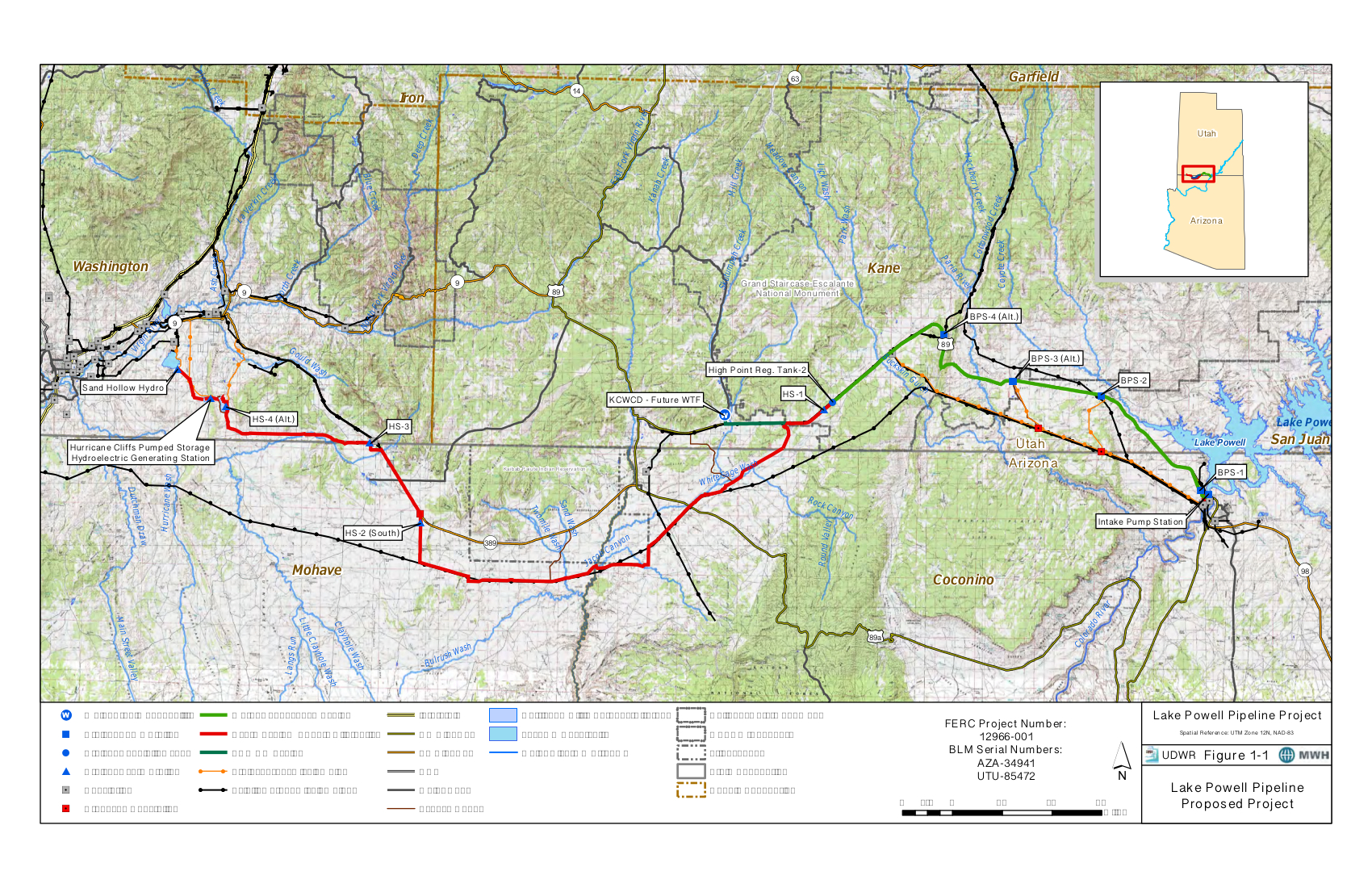
The 140-mile, 70-inch diameter Lake Powell Pipeline will run from Lake Powell to the Sand Hollow Reservoir with a projected route that will snake across the Utah and Arizona border over public and private land, carrying around 77 million gallons a day to 13 communities in Kane and Washington counties.
Local water and elected officials have repeatedly stated the needs for a pipeline due to continuing growth, as well as the economic benefit it is expected to generate in the long run.
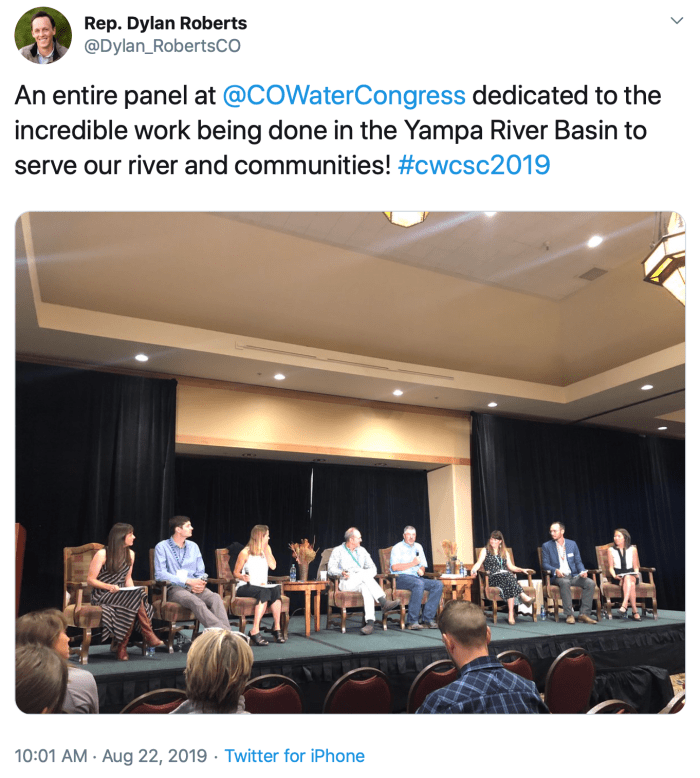
Click here to view the Twitter fest around hash tag #cwcsc2019. I had a great time reading everyone’s Tweets. It is interesting to see what each person takes away from a session and what they feel is important to point out.
Pictured: Jackie Brown, Nancy Smith, Kevin McBride, Mickey O’Hara, Kelly Romero-Heaney, Mike Camblin, Jojo La, Hunter Causey. (Not in order.)
The legislature’s Interim Water Resources Committee met after the conference. Here’s a report from Marianne Goodland that’s running in The Colorado Springs Gazette. Here’s an excerpt:
The Colorado Legislature’s interim water resources review committee, a bipartisan group of 10 lawmakers, began its summer work by relaunching efforts to change the state’s instream flow program.
During the 2019 session, the committee sponsored two bills that would have made some fairly big changes to the state’s instream flow (program, though neither bill made it out of Senate committee…
Instream flow is the water that flows through a stream, river or creek. Programs that manage instream flows do so to protect fish habitats and for recreational purposes.
Colorado’s instream flow program, according to Colorado Water Conservation Board’s Linda Bassi, is intended to “preserve the natural environment to a reasonable degree.”
As the years have gone on, the board has also received permission to improve instream flows within the program.
Bassi explained to the interim water committee at Wednesday’s session, held during the Colorado Water Congress summer conference in Steamboat Springs, that the program was established in 1973 to allow state control over Colorado water and under Colorado’s water rights and prior appropriation system.
The original legislation was also intended to block ballot measures (one was already in the works) that would have allowed for private instream flow programs.
Over the years, the Colorado Water Conservation Board has acquired water rights, often donated, to protect streams, now to the tune of 756 stream miles, Bassi explained, and for 1,700 stream segments around the state.
Some of those water rights are new ones, others are existing and donated, although that doesn’t happen very often, she added.
One of the program’s provisions allows for for temporary water “loans” for three years out of a 10-year period; they can be used on any segment of a stream decreed as part of the instream flow program.
It’s a one-and-done situation; once the three years are up, that water cannot be diverted into the stream by the water provider, nor can the contract be renewed.
Bassi told lawmakers only eight temporary leases have been developed since 2012.