This morning, state leaders gathered to launch #Colorado’s Outdoors Strategy ⚡️ Colorado’s first ever collaborative vision for #conservation, outdoor recreation and #climate resilience — The Nature Conservancy in Colorado

Mrs. Gulch’s landscape April 30, 2025

Mrs. Gulch’s Hawthorn pair April 30, 2025.
Close up of Mrs. Gulch’s Hawthorn April 30, 2025.

And just for grins guess what Coyote Gulch was doing on April 30, 2019?

Farmers Highline Canal near the Tuck Ditch Headgate April 30, 2019. Day 30 of the #30daysofbiking challenge.

Fate of #Littleton’s historic flumes uncertain as City Ditch piping looms: The city grapples with #Englewood’s plan to pipe the ‘oldest working thing’ in Denver — #Colorado Community Media

Smith Ditch Washington Park, Denver

Click the link to read the article on the Colorado Community Media website (Isabel Guzman). Here’s an excerpt:

April 24, 2025

What’s 4-feet deep, 6-feet wide and 26-miles long? The original City Ditch — one of Colorado’s earliest and most influential irrigation canals, constructed between 1864 and 1867 by the Capitol Hydraulic Company to bring much-needed water to the dry, dusty lands of the Denver metropolitan area. This hand-dug canal, also known as Smith’s Ditch, was engineered by Richard S. Little and financed by businessman John W. Smith, according to local historian Larry Borger. It stretched from its headgate near present-day Chatfield Reservoir, above Littleton, and ran roughly 26-to-27 miles northeast to Capitol Hill in Denver, relying solely on a 100-foot drop in elevation to move water without pumps. When it opened in 1867, the ditch enabled the growth of trees, sugar beet crops and neighborhoods, providing Denver with its primary irrigation source for more than 25 years. The ditch also supported a network of more than 1,000 lateral ditches, greening up city parks and supplying water to offshoots that irrigated cropland and street trees. Its construction and operation were so significant that the ditch is often called the “oldest working thing” in Denver, predating paved streets and railroads. Today, the City Ditch is mostly hidden from view. About 2.5 miles of the ditch remain open-channel, while the rest is mostly piped and buried. In Littleton, the portion of the ditch that runs along Santa Fe Drive from Slaughterhouse Gulch Park to the C-470 highway is owned by the City of Englewood. Englewood plans to convert the remaining open channel between Chatfield Reservoir and the Charles Allen Water Treatment Plant into a buried pipe, a move that would end the historic open flow through the area.

The City of Englewood’s City Ditch Piping Project map. Courtesy of the City of Englewood.

Englewood is giving Littleton a chance to save the historic flume structures — man-made, open channels designed to carry water, usually sloping downward and with raised sides above the surrounding ground — at Lee Gulch and Slaughterhouse Gulch Park. Ryan Germeroth and Brent Soderlin, deputy director and director of Public Works & Utilities presented Littleton City Council with options for the Slaughterhouse Gulch Flume — which Englewood would start construction on first this summer — at the study session on April 22.

#Colorado wildfire outlook ‘normal’ — but normal has new meaning in wildfire-prone state: A ‘normal season means about 6,000 wildfires that burn roughly 160,000 acres — Colorado Politics

West Fork Fire June 20, 2013 photo the Pike Hot Shots Wildfire Today

Click the link to read the article on the Colorado Politics website (Kyle Pearce). Here’s an excerpt:

April 28, 2025

Colorado’s fire risk for the upcoming season is average, Gov. Jared Polis said at a news conference Thursday. But average means there will be many wildfires in the state and they will likely be large, fire officials emphasized.

“Today, it’s more a question of when, not if, a fire will affect our community,” Polis said. 

In the short term, there’s heightened wildfire risk in southeast Colorado, then later in the summer, heightened risk in southwest Colorado, fire officials said. Stan Hilkey, the executive director of the Colorado Department of Public Safety, said the “normal” fire outlook should be taken cautiously.

“I want to be cautious by what I mean by normal,” he said. “That means that we’ve had fires and we’re going to continue to have fires. Some will be big and we’re going to be busy, and that’s what normal looks like in Colorado anymore.”

Colorado Division of Fire Prevention and Control Director Mike Morgan added that fire season in Colorado has changed over the years.

“We used to look at fire season as about a four month period and that’s no longer the case,” Morgan said. “We have fire disasters every month of the year in the state of Colorado and we can’t afford to let our guard down.”

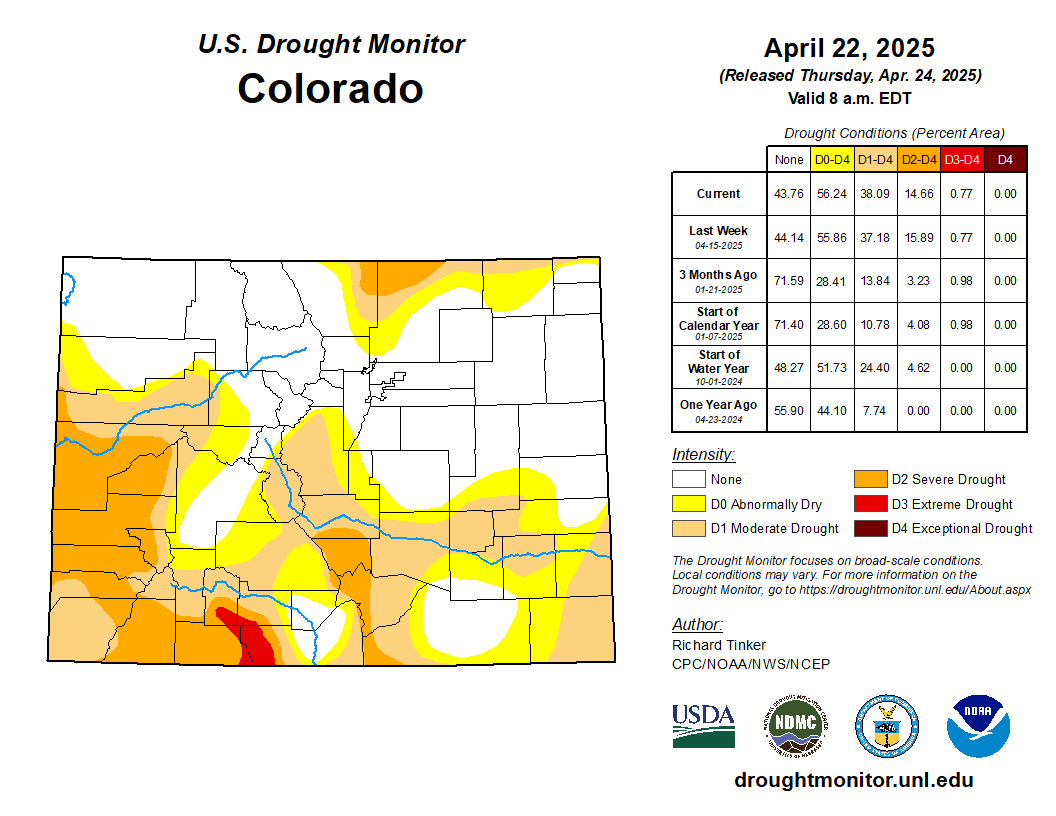
Colorado Drought Monitor map April 22, 2205.

Mexico and U.S. reach deal on #RioGrande water sharing — The Associated Press

Rio Grande and Pecos River basins. Map credit: By Kmusser – Own work, Elevation data from SRTM, drainage basin from GTOPO [1], U.S. stream from the National Atlas [2], all other features from Vector Map., CC BY-SA 3.0, https://commons.wikimedia.org/w/index.php?curid=11218868

Click the link to read the article on the Associated Press website. Here’s an excerpt:

April 28, 2025

Mexico and the United States said Monday they had reached an agreement that involves Mexico immediately sending more water from their shared Rio Grande basin to Texas farmers after U.S. President Donald Trump threatened tariffs and sanctions earlier this month.

“Mexico has committed to make an immediate transfer of water from international reservoirs and increase the U.S. share of the flow in six of Mexico’s Rio Grande tributaries through the end of the current five-year water cycle,” U.S. State Department spokesperson Tammy Bruce said in a statement.

Bruce thanked Mexico President Claudia Sheinbaum for her involvement in facilitating cross-border cooperation…The countries’ joint statement Monday, while lacking specific details of the agreement, said both countries had agreed that the 1944 treaty regulating how the water is shared was still beneficial for both countries and not in need of renegotiation. Under the treaty, Mexico must deliver 1,750,000 acre-feet of water to the U.S. from six tributaries every five years, or an average of 350,000 every year. An acre-foot is the amount of water needed to cover 1 acre of land to a depth of 1 foot.

‘The West will lead’: #Utah, #Idaho, #Wyoming team up on nuclear energy development — Katie McKellar (UtahNewsDispatch.com)

Utah leaders and Idaho National Laboratory Director John Wagner sign a memorandum of understanding at the Governor’s Mansion in Salt Lake City on April 28, 2025. (Courtesy of the Utah Senate)

Click the link to read the article on the Utah News Dispatch website (Katie McKellar):

April 29, 2025

Utah state leaders are taking the next steps in their efforts to make Utah a major nuclear energy development hub and a “national leader” in developing next-generation energy technology, reaching beyond state lines to do it.

It starts with Utah signing two memorandums of understanding with Idaho and Wyoming as part of a strategy to fire up innovation and collaboration in the region.

As part of Gov. Spencer Cox’s “Built Here: Nuclear Energy Summit,” which his office said brought together leaders from across the nuclear energy industry on Tuesday, Cox joined Idaho Gov. Brad Little and Wyoming Gov. Mark Gordon in signing an MOU that calls for the three states to work together coordinating nuclear infrastructure, accelerating nuclear development, and advocating for “commonsense federal policies.”

“The West will lead the next chapter of energy abundance and American prosperity,” Cox said in a statement announcing the alliance. “Today, we brought together industry leaders, investors, and policymakers to chart the course for nuclear energy. Our new compact strengthens our shared commitment to aggressively pursue more affordable, reliable energy across state lines.”

According to Cox’s office, the states agreed in the MOU to collaborate on:

  • Aligning energy policies to support innovation and private investment.
  • Coordinating the development of critical energy infrastructure.
  • Jointly navigating regulatory and environmental challenges.
  • Advocating for federal support of regional energy priorities.
  • Enhancing energy resilience and grid reliability.
  • Expanding workforce development efforts to support the growing energy sector.
  • Ensuring continued delivery of affordable energy to residents. 

The tri-state agreement comes the day after Utah officials and the Idaho National Laboratory — one of 17 national labs in the U.S. Department of Energy complex that’s focused on nuclear research — signed a memorandum of understanding Monday evening after ceremoniously signing a slate of energy bills Utah lawmakers passed earlier this year. 

The MOU between Utah leaders and the Idaho National Laboratory establishes a “formal, long-term collaboration on advanced energy research, workforce development and technology deployment — particularly on nuclear innovation,” according to the governor’s office. 

“This partnership will accelerate Utah’s efforts to become the nation’s nuclear hub,” Gov. Spencer Cox said in a prepared statement issued Monday evening. “By linking our universities, labs, and industry partners with the expertise of Idaho National Laboratory, we are strengthening our ability to serve Utahns with reliable and affordable energy.”

Idaho National Laboratory Director John Wagner, who signed the MOU, said he and other lab officials are “excited to partner with Utah to address urgent energy needs by focusing on advanced nuclear and energy innovation.” 

“This partnership establishes a cooperative framework for scientific, technological and workforce development to help Utah realize an abundant, secure, resilient and competitive energy future,” he said. 

The MOU, according to the governor’s office, creates a “structural, interdisciplinary alliance” between Utah and the Idaho National Laboratory. It envisions Utah as establishing a new institute called the Advanced Nuclear Energy Institute as a “key coordinating hub” between the Idaho National Laboratory, Utah’s system of higher education, the Utah Office of Energy Development, and the Utah San Rafael Energy Lab. 

“By linking the capabilities of INL with the talent and resources of Utah’s higher education institutions, this partnership positions Utah as a national leader in developing the next generation of clean, secure and resilient energy technologies,” the governor’s office said in Monday’s news release. 

This new institute, state officials say, will enable Utah’s universities to collaborate with other organizations to pursue federal research grants. 

“Beyond academic research, the focus is on applied innovation — ensuring resources are used effectively to develop commercially viable, scalable technologies,” the governor’s office said. “This approach will accelerate the deployment of real-world energy solutions and help build a broader, more robust nuclear energy ecosystem in Utah and the surrounding region.”

Through the MOU, state leaders say Utah and the Idaho National Laboratory will work together to: 

  • Accelerate development of “next-generation” nuclear technologies.
  • Enhance scientific research in energy sectors.
  • Strengthen cybersecurity and physical security for energy infrastructure.
  • Build up the workforce needed to meet demands of a future energy economy.

The Utah Legislature’s top Republican leaders both applauded the move as crucial for Utah’s future. 

“Affordable, reliable energy is the driving force behind Utah’s prosperity — powering everything from the lights in Utahns homes to the unstoppable growth of the state’s vibrant economy,” Senate President Stuart Adams, R-Layton, said in a prepared statement. “As energy demands increase and technologies rapidly evolve, we as a state are committed to staying ahead of the curve through strategic partnership that ensures both innovation and stability.”

House Speaker Mike Schultz, R-Hooper, said Utah “is leading the way with smart, strategic investments in our energy future.” 

“This partnership drives innovation and keeps energy reliable and affordable for Utah families and businesses,” Schultz said. “It’s about long-term solutions that protect our economy and strengthen our position as a national energy leader.”

Lots going on in #Kiowa these days: Well project advances — #Colorado Community Media

Kiowa Creek. Photo credit: The Town of Kiowa

Click the link to read the article on the Colorado Community Media website (Nicky Quinby). Here’s an excerpt:

April 29, 2025

The Town of Kiowa has good news to report, including a new Main Street Board and progress towards funding the Water Well Redundancy Project…After some starts and stops, the Kiowa Water and Wastewater Authority is making headway on its Water Well Redundancy Project, thanks in part to Congresswoman Lauren Boebert. On March 20, Boebert visited with Town of Kiowa staff and town trustees…Boebert pledged to write letters supporting road improvement and parks projects, and also agreed to write Kiowa Water and Wastewater Authority a congressional letter of support for the Well Redundancy Project, [Kim] Boyd said. Boyd further explained that the Town of Kiowa currently relies on a single 66-foot alluvial groundwater well to meet the community’s water needs.

“This infrastructure is insufficient for current demands and poses a significant risk in the event of mechanical failure or environmental stress,” she shared. “It limits the town’s ability to grow and sustain essential services, including domestic water supply and fire protection.”

The Colorado Department of Public Health and Environment (CDPHE) mandates that municipal water systems maintain at least two wells to ensure redundancy and protect public health.

#DeBeque seeking federal funding to help secure secondary water source — The #GrandJunction Daily Sentinel

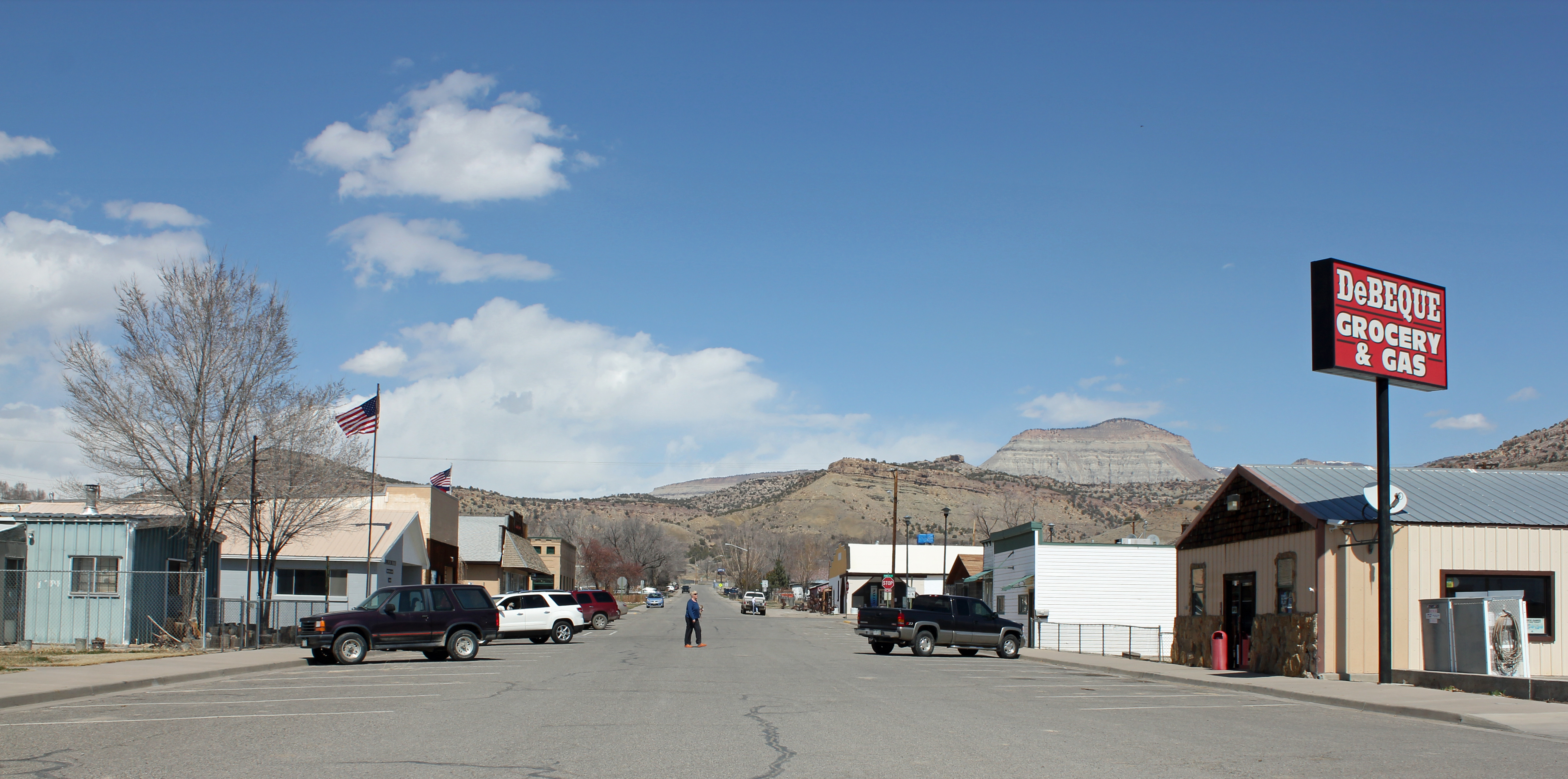
Minter Avenue in De Beque, March 2013. By Jeffrey Beall – Own work, CC BY 3.0, https://commons.wikimedia.org/w/index.php?curid=25467639

Click the link to read the article on the Grand Junction Daily Sentinel website (Dan West). Here’s an excerpt:

April 27, 2025

The town of De Beque is seeking Congressionally directed spending to help it secure a secondary water source, as it currently relies solely on the Colorado River to supply water to the community. De Beque Town Treasurer Katherine Boozell said the town is looking at drilling a well near the town’s Water Treatment Plant. According to Boozell, the well could cost in excess of $400,000 to drill.

“At present, the Town of De Beque relies solely on the Colorado River as its drinking water source,” Boozell wrote in an email. “This dependence leaves the community vulnerable during periods of high turbidity, which occur frequently due to mudslides from wildfire burn scars upstream or sediment disruption caused by storms. When turbidity levels spike, we are forced to shut down intake to our treatment plant because the water is too muddy to process.”

The town does have a tank where it can store treated water, but that is a temporary solution, she said. When the tank is dry, the town is unable to provide treated water until the river’s water conditions improve. This poses a public health risk, she said, making a secondary water source an urgent need…According to a fact sheet about the proposal, a new well would not only improve reliance for the town’s water but also improve the water quality as well.

Why does the #ColoradoRiver seem to vanish at a certain point in Glenwood Canyon? — #Colorado Public Radio

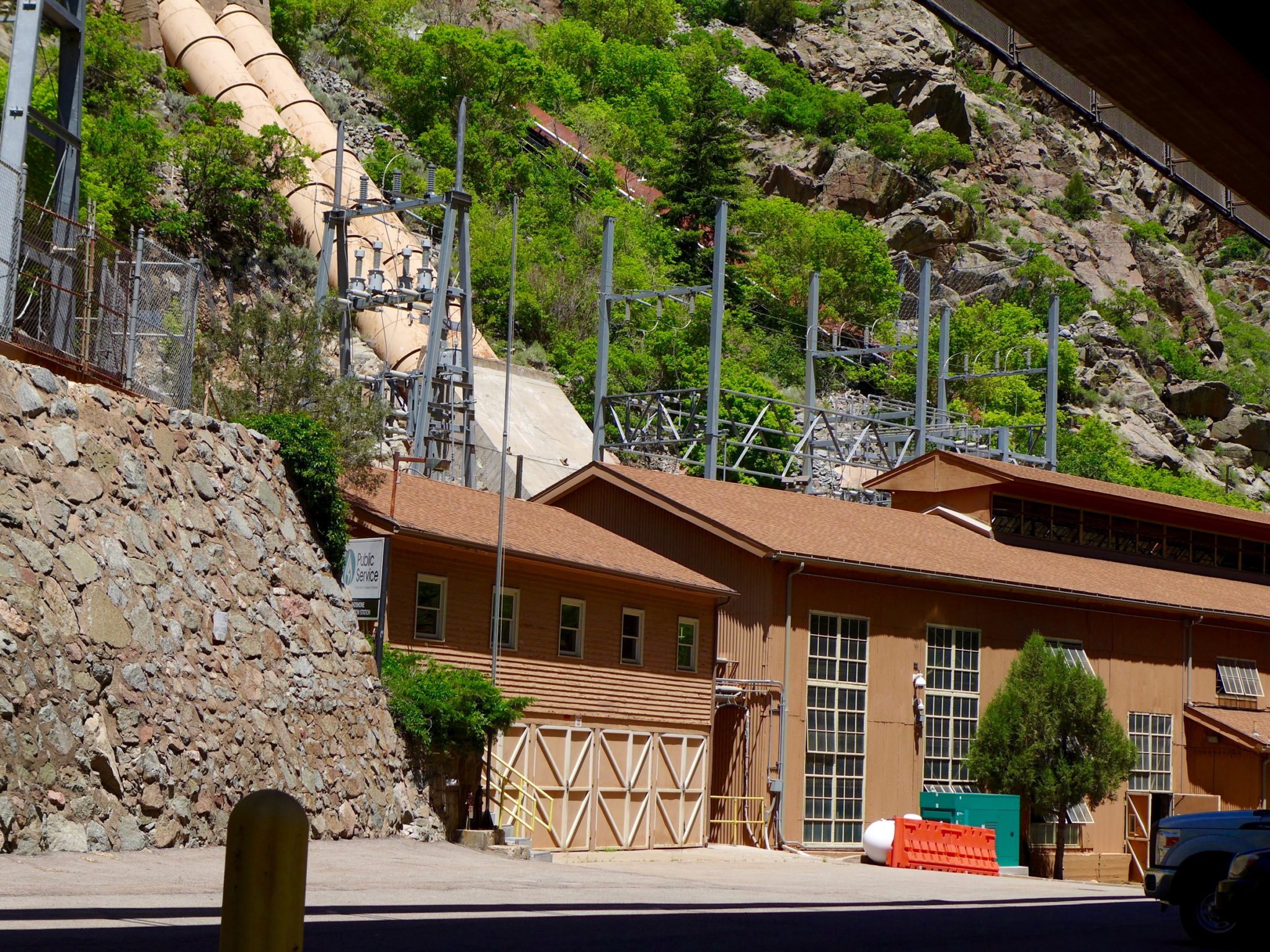
The Shoshone hydro plant in Glenwood Canyon, captured here in June 2018, uses water diverted from the Colorado River to make power, and it controls a key water right on the Western Slope. Photo credit: Brent Gardner-Smith/Aspen Journalism

Click the link to read the article on the Colorado Public Radio website (Tom Hesse). Here’s an excerpt:

April 28, 2025

James Heath, division engineer for the Colorado River Basin for the Colorado Division of Water Resources, says [Avi] Stopper most likely witnessed a roughly two-mile stretch where up to 1,400 cubic feet per second of water takes the scenic route through Xcel Energy’s Shoshone Hydro Electric Generating Plant. If that diversion is happening during high-water months like May, passersby would probably miss it entirely. But in the dead of winter, when river flows can be below 1,000 CFS, the difference can be seen by drivers heading east.

“At certain times of the year, the power plant can divert every single drop of water that’s in the Colorado River and other times a year the stream flow is significant and it’s hardly noticeable what the power plant’s actually diverting off the stream system,” Heath said.

The water rights are considered “nonconsumptive,” which means there’s no water lost in the process. That’s also why the river disappeared and reappeared a short time later on Avi’s drive. Water leaves the river at a diversion dam near the Hanging Lake Tunnel and then reenters the river at the Shoshone plant. Heath said it’s about a 2-mile stretch and there’s little entering the stream during that period. 

“There’s a little bit of gate leakage there at the diversion dam. There are a couple small minor tributaries that come in between the diversion dam and the returns from the powerhouse, but it’s a small trickle at times during the year,” Heath said.

#NewCastle, #Parachute, #DeBeque pitch in on effort to buy Shoshone water rights — The #GrandJunction Daily Sentinel

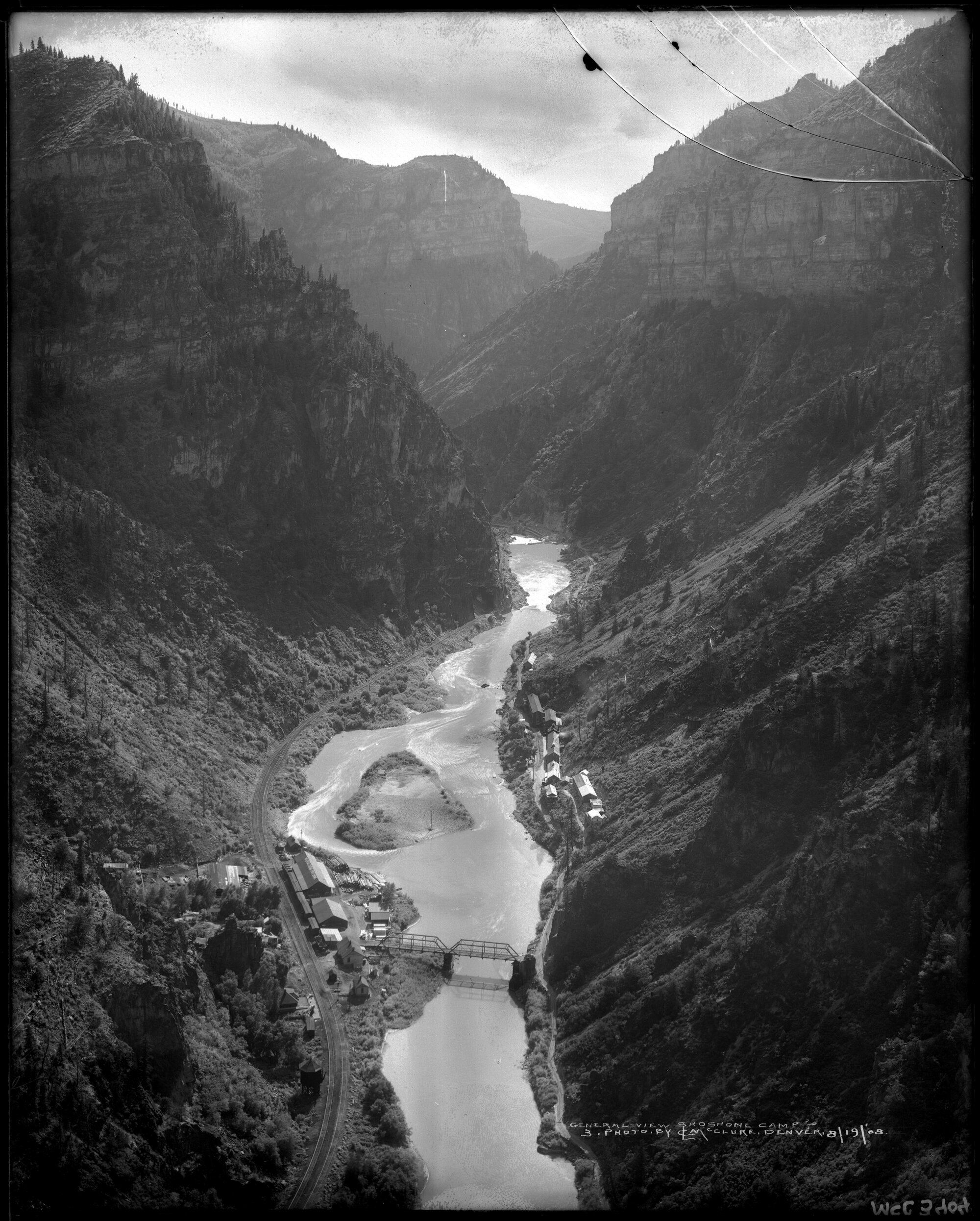
View of Shoshone Hydroelectric Plant construction in Glenwood Canyon (Garfield County) Colorado; shows the Colorado River, the dam, sheds, a footbridge, and the workmen’s camp. Creator: McClure, Louis Charles, 1867-1957. Credit: Denver Public Library Digital Collections

Click the link to read the article on the Grand Junction Daily Sentinel website (Dennis Webb). Here’s an excerpt:

April 27, 2025

The town of New Castle has agreed to contribute $100,000 to the Western Slope’s efforts to buy the historic Shoshone hydroelectric power plant water rights, while the towns of Parachute and De Beque also have agreed to kick in smaller amounts…Parachute will be contributing $25,000 and De Beque, $5,000. The De Beque Plateau Valley Soil Conservation District also is kicking in $5,000…Combined, more than 30 Western Slope local governments, water entities and regional partners have committed over $17 million toward the $99 million purchase. The river district and state of Colorado also have committed $20 million apiece, and the federal Bureau of Reclamation committed $40 million in the final days of the Biden administration. That funding has been frozen by the Trump administration but the river district remains hopeful of eventually receiving it.

Notice of Administrative & Legal Committee Special meeting — #ArkansasRiver Compact Administration virtual meeting Thursday May 8, 2025

Map of the Arkansas River drainage basin. Created using USGS National Map and NASA SRTM data. By Shannon1 – Own work, CC BY-SA 4.0, https://commons.wikimedia.org/w/index.php?curid=79039596

From email from the Arkansas River Compact Administration (Kevin Salter):

April 28, 2025

The Arkansas River Compact Administration (“ARCA”) Administration & Legal Committee will meet at the time noted above via virtual and phone conference call to consider a modified Joint Funding Agreement (JFA) between ARCA and United States Geological Survey (USGS) that will cover the Operations and Maintenance (O&M) for cameras to be installed on the Arkansas River at Las Animas, CO USGS gage.  USGS will cover the installation costs and the O&M for the remainder of the year in which they are installed.  O&M costs beyond the installation year will be ARCA’s responsibility.  The O&M costs would have been $4000 for the current year.  Attached are three documents from USGS related to modifying the JFA.

ADMINISTRATIVE & LEGAL COMMITTEE AGENDA

1.  Approval of agenda………………………………………… Lauren Ris

2.  Modified ARCA-USGS JFA…………………………….. Kevin Salter

3.  ARCA budget considerations………………………. Andrew Rickert

4.  Recommendation on modified ARCA-USGS JFA….. Lauren Ris

5.  Adjournment…………………………………………………. Lauren Ris

Following the Administration & Legal Committee meeting, the Arkansas River Compact Administration will have a Special Meeting to consider the same matter.

ARCA SPECIAL MEETING AGENDA

1.  Call to order & roll call …………………………………… Jim Rizzuto

2.  Approval of agenda……………………………………….. Jim Rizzuto

3.  Consider Administration & Legal Committee recommendations

        on a modified ARCA-USGS JFA…………………… Jim Risotto

4.  Adjournment………………………………………………… Jim Rizzuto

Virtual meeting connection information below

Meetings of the Administration are open to the public and operated in compliance with the Federal Americans with Disabilities Act. If you wish to participate in the Special Meeting you may do so by using the link and/or one of the phone numbers listed below:

1.      Use Zoom information below to access both meetings, online via this link (ARCA Special Meeting will be recorded):

https://kansasag.zoom.us/j/84109597210?pwd=vpkOwwSdPEHFuraBBlnpvHzco8r85R.1