Click the link to read the article on the Summit Daily website (Town of Silverthorne):
November 17, 2025
Starting Jan. 1, 2026, the metered water service rate for a normal rate building from $19.55 per equivalent residential unit per month to $22 per equivalent residential unit per month.
Also effective Jan. 1 2026, the town will increase its water system development fees by $276 per equivalent residential unit. This will bring the one-time fee to connect new development to the town’s water from $9,200 to $9,476.
“That’s really just to keep up with inflation,” Finance Director Laura Kennedy said. “Despite the fact that we are growing as a town, water usage really hasn’t grown as much as we’ve seen the number of units come on.”
Residential storm water management fee will also increase, taking the fee from $7.50 per month to $7.57 per month. The sewer opportunity fee — which is applicable to properties outside of town that receive sewer services from the town or will receive service because of a planned annexation — will increase in 2026 as well from $2,700 to $2,750.
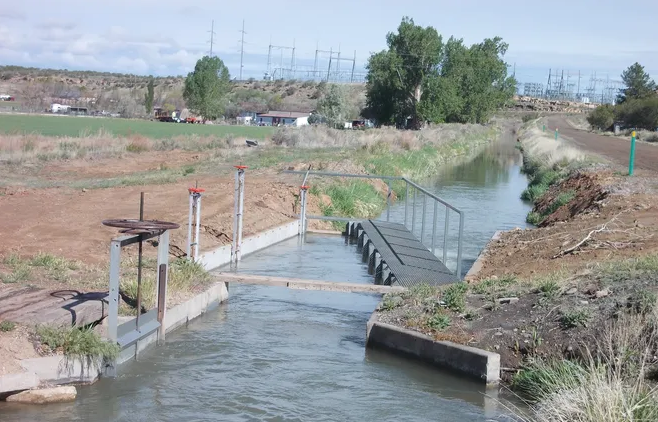
This photo from the Uncompahgre Valley Water Users Association website shows some of its water infrastructure. The association is facing a lawsuit from some of its shareholders who say they aren’t getting a fair share of their irrigation water.
Some shareholders have sued the Uncompahgre Valley Water Users Association, contending they aren’t receiving their fair share of irrigation water and their livelihoods are being harmed…The plaintiffs have been “deprived of consistent and proportional water deliveries during critical irrigation periods since 2022,” which is when new association management took over, the suit says. Over that period plaintiffs also have been deprived of water owed to them based on priority water rights, the suit says.
“These failures have occurred even in years with above-average snowpack and available water. Despite Plaintiffs’ repeated requests to the UVWUA to correct these deficiencies, Plaintiffs continued to receive disproportionate, inconsistent, and insufficient water deliveries during the 2025 irrigation season,” the suit says…The suit says the plaintiffs have experienced problems including weeks without delivery during planting and growing seasons. One plaintiff, Tom Gore, reported going 60 days last year without expected water deliveries. Another, Frank Gilmore, has been able to run only two irrigation pipes simultaneously instead of the normal five and has lost entire cuttings of hay. Delayed irrigation last year left a third of plaintiff Dan Varner’s newly reseeded 34-acre hayfield unproductive, requiring costly reseeding, the suit says. It says the impacts to shareholders have included things such as failed crop rotations, increased cattle feed costs, reduced soil health, and loss of profit from hay and sweet corn yields…
The plaintiffs are shareholders receiving water from the Ironstone Canal system, one of the project’s primary delivery systems. The suit says the association’s delivery practices have deprioritized the Ironstone system and intentionally favored the East Canal system instead. The suit says that last March, Pope admitted in a meeting that the association was intentionally and disproportionately routing water to the East Canal system before delivering to Ironstone System shareholders, contrary to historical practice. It says that in July, Pope also acknowledged that the delivery of 10 cubic feet per second of priority water rights had been mismanaged that irrigation season. Pope said that corrective action would be taken, but as of August, the association had failed to restore full delivery of that water, the suit says. The suit says the association also has failed to regularly maintain association ditches by burning or clearing debris.
The Uncompahgre River flows from Colorado’s San Juan mountains through the towns of Ouray and Ridgway and then into Ridgway Reservoir, which stores water for farms and households downstream. The river is beautiful, but also troubled; runoff from old mines carries heavy metals into the river, and it is pinched into an unnaturally straight and simple channel as it passes from mountain canyon headwaters into an agricultural valley.
As the river moves through the modified channel, it carves deeper into the valley floor and less frequently spills over its bank. As a result, the local water table has dropped, and riverside trees such as cottonwoods have died, impoverishing this important habitat. Water users on the Ward Ditch at the top of the valley were also struggling with broken-down infrastructure, making it difficult to access and manage water for irrigation. This confluence of challenges created a landscape of opportunity for the Uncompahgre Multi-Benefit Project, which addresses environmental problems along the river and water users’ needs, while also improving water quality and reducing flood risks downstream.
Uncompahgre River, Colorado | Hannah Holm
The Project, managed by American Rivers, took an integrated approach to restoring a one-mile stretch of the river, which included replacing and stabilizing the Ward Ditch diversion, notching a historic berm to reconnect the river to its floodplain, and placing rock structures in the river that both protect against bank erosion and improve fish habitat. Meanwhile, ditch and field improvements make it easier to spread water across the land for agriculture and re-establish native vegetation.
Photo credit: American Rivers
Photo credit: American Rivers
In addition to the direct benefits this project delivers for on-site habitat and landowners, the enhanced ability of the river to spread out on its floodplain, both through the ditch diversion and natural processes, also provides downstream benefits. As the water slows and spreads across the floodplain during high flows, its destructive power to erode banks and damage infrastructure downstream is diminished. The same dynamics enable pollutants and sediment from upstream abandoned mines or potential wildfires to settle out before the river flows into the downstream reservoir.
Uncompahgre River, Colorado | Hannah Holm
With construction wrapping up in November 2025, the transformation of this stretch of river and its adjacent floodplain is nearly complete. Fields of flowers and fresh willow plantings are replacing invasive species and dead cottonwoods, and new pools, sandbars, and riffles are providing instream habitat, complementing other organizations’ work to remediate old mines upstream. As a bonus, when the water level is right, the reach has become an inviting run for skilled whitewater boaters.
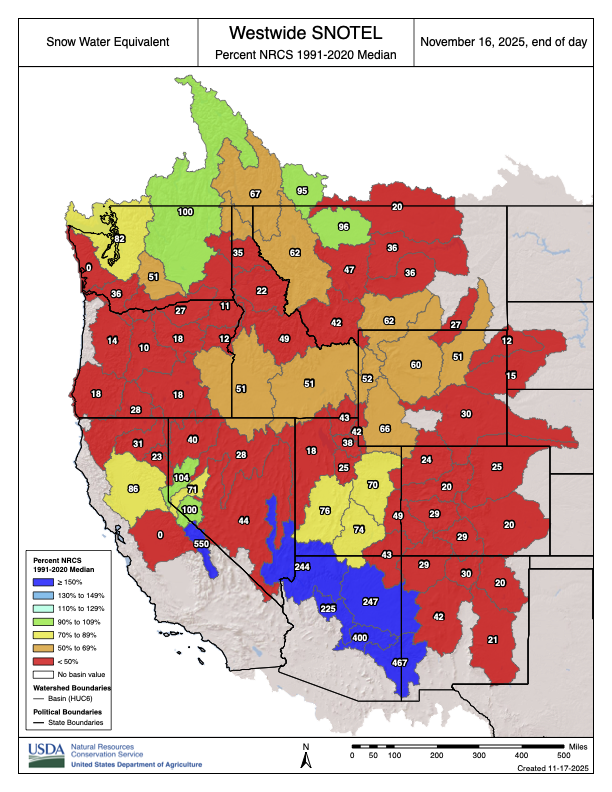
As Colorado’s ski resorts gear up for opening season, forecasters say the state’s snowpack is lagging behind seasonal averages, even as six resorts have already welcomed their first skiers and snowboarders. Three of those six resorts – Breckenridge, Copper Mountain and Loveland Ski Area – all opened their chairlifts last weekend despite one of the driest starts to the snowy season in almost a decade. Statewide, this year’s mountain snowpack ranks as the second lowest since the 1980s; the lowest was 2016. But ski resorts are staying hopeful…And to [Dustin] Schaeffer’s point, forecasters say there’s still plenty of time for conditions to turn around. November marks only the beginning of Colorado’s snowpack season, which typically builds from October through late April.
“Anytime you get off to a slow start to the winter, it’s always a little bit concerning to see,” said Zach Hiris, a meteorologist with the National Weather Service. “But importantly, we’re very early into the snowpack season across the mountains.”
Snowpack is more than just good news for skiers. It also acts as Colorado’s largest natural reservoir, feeding rivers that supply water to millions of people across the West. When snowfall lags early in the season, it can raise concerns about spring runoff, drought conditions and water levels in major basins like the Colorado River.
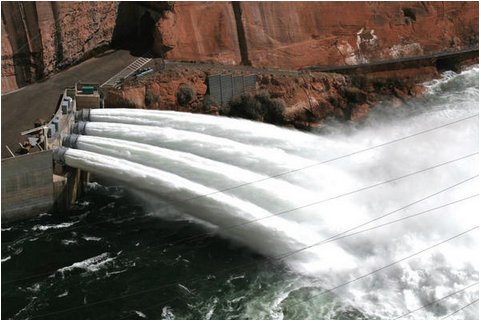
Because of the government shutdown, the Bureau of Reclamation cancels a high-volume water release from Glen Canyon Dam meant to rebuild Colorado River beaches.
Department of Energy research lab announces a funding opportunity to develop cheaper wastewater treatment for coal power plants.
Economic disaster declaration approved for an Illinois county where a harmful algal bloom in July resulted in a ‘do not drink’ water advisory.
The Bureau of Land Management is scheduled this week to publish a final environmental impact statement for a proposed groundwater pipeline in Utah.
Hydropower generation at federal dams in the western states was below average in fiscal year 2025.
And lastly, House Democrats from Illinois ask the EPA to release lead pipe replacement funds.
“Using federal funds as leverage against communities based on political considerations represents a dangerous abuse of power that undermines public trust and puts lives at risk. The longer we wait, the higher the long-term health, educational, and economic costs will climb, with costs being borne disproportionately by low-income and marginalized communities who have the least political power to demand faster action.” – Letter from seven Illinois representatives to Lee Zeldin, the EPA administrator, asking him to release federal funds for lead pipe replacements.
By the Numbers
River Mile 46.5: Estimated location, as of November 14, of the leading edge of the saltwater “wedge” in the Mississippi River in southern Louisiana. The wedge – salt water that pushed upriver due to weak water flow – has retreated 10 miles in the last three weeks.
88: Percent of average hydropower generation at federal dams overseen by the Western Area Power Administration in fiscal year 2025.
November 2012 High Flow Experiment via Protect the Flows
News Briefs
Glen Canyon Dam High-Flow Release Canceled Due to the government shutdown, the Bureau of Reclamation canceled a planned high-volume release of water from Glen Canyon Dam.
“This decision is based on the current lapse in appropriations, which has created uncertainty concerning necessary resources,” said Wayne Pullan, director of the Upper Colorado Basin Region, in a letter dated October 31.
High-flow releases are typically carried out when downstream sediment conditions are ripe for rebuilding Colorado River beaches. The last such release was in April 2023.
Pullan said that conditions in spring 2026 will probably be conducive to a high-flow release.
Illinois Harmful Algal Bloom The Small Business Administration approved an economic disaster declaration for Coles County, Illinois, for a harmful algal bloom in July that resulted in residents being told not to drink their tap water.
The disaster declaration allows small businesses that were hurt by the do-not-drink order to receive low-interest loans. Small businesses in six contiguous counties are also eligible.
Microcystin, a neurotoxin produced by the algae, was found in the treated water above safety limits in the town of Mattoon. The town issued two do-not-drink orders in a week. Businesses closed and residents bought bottled water.
Mattoon’s water comes from Lake Paradise, the source of the algae.
Studies and Reports
Keeping Coal Going The National Energy Technology Laboratory, a Department of Energy research arm, is offering $50 million in federal funding for projects to develop wastewater treatment systems for coal power plants.
It is the largest part of a $100 million funding announcement intended to improve the “efficiency, effectiveness, costs, emissions reductions, and environmental performance of coal and natural gas use.”
For wastewater treatment, the goal is to reduce discharges and generate useful, money-making byproducts.
Applications are due January 7, 2026.
On the Radar
Senate Hearings On November 19, the Senate Committee on Environment and Public Works will hold a hearing on PFAS cleanup and disposal.
Also that day, the Senate Energy and Natural Resources Committee will discuss BLM land use planning.
Utah Rivers map via Geology.com
Utah Groundwater Supply Pipeline The BLM is due to release an environmental impact statement on November 21 for the Pine Valley Water Supply Project, a scheme to pump groundwater in southwest Utah’s Beaver County and move it to neighboring Iron County for municipal supply and irrigation water.
Proposed by the Central Iron County Water Conservancy District, the project includes 15 wells to supply 15,000 acre-feet of groundwater per year, 70 miles of pipeline, and a 200-acre solar field.
Federal Water Tap is a weekly digest spotting trends in U.S. government water policy. To get more water news, follow Circle of Blue on Twitter and sign up for our newsletter.