
Click the link to read the article on the Alamosa Citizen website:
February 15, 2026
The U.S. Bureau of Reclamation has released a February 24-month study showing inflow to Lake Powell declining by 1.5 million acre-feet since January as the federal agency highlights the worsening hydrologic conditions across the Colorado River Basin.
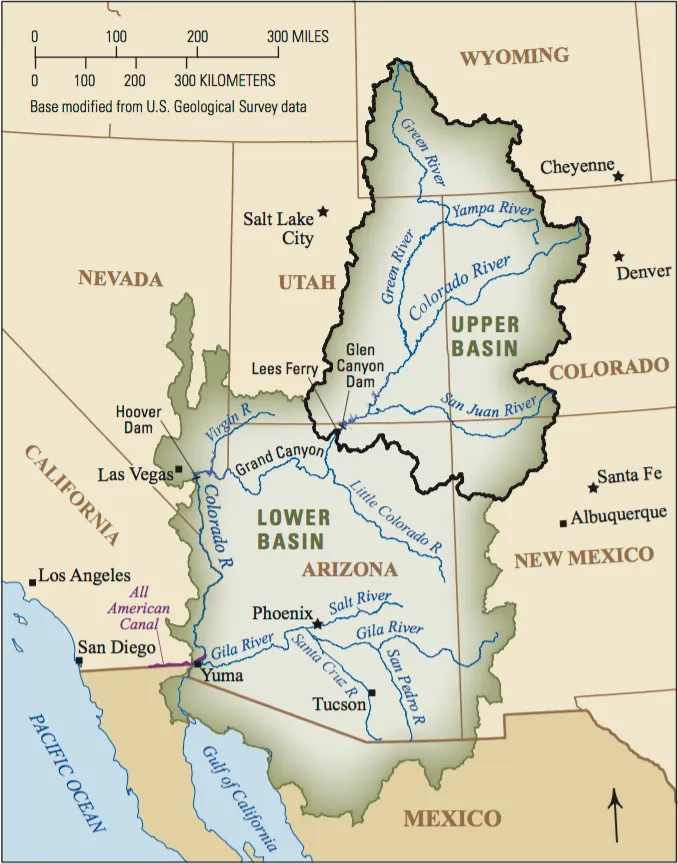
The study of the most probable forecast for the Colorado River under current conditions was released on Friday, just as the seven compact states remained at a stalemate and failed to meet a Feb. 14 deadline for agreement on how to reduce their own usage of water to save the river.
U.S. Interior Secretary Doug Burgum announced on Saturday, Feb. 14, that the federal government is moving forward with finalizing operating guidelines for the Colorado River reservoirs by Oct. 1. His announcement adds pressure to Colorado and the other compact states to find compromise or face guidelines forced onto them by the federal government.
“While the seven Basin States have not reached full consensus on an operating framework, the Department cannot delay action,” the U.S. Bureau of Reclamation said in its announcement that the federal government was moving forward.
The lack of agreement among the compact states and the idea of federal intervention raises the prospect of litigation that would be drawn out and ultimately end with the U.S. Supreme Court. The current Rio Grande Compact dispute between Texas and New Mexico that has taken 12 years to reach a proposed settlement, now filed with the U.S. Supreme Court, gives an indication to the slow-evolving nature of U.S. water law.
“I am disappointed that the seven Basin States could not reach a consensus agreement on the future management of the Colorado River by the U.S. Department of the Interior’s Feb. 14 deadline,” said Colorado Attorney General Phil Weiser, who added that Colorado is prepared for litigation to protect Colorado’s rights and interests.
“Colorado will continue to work with our fellow Upper Division States to provide comments on the federal government’s draft environmental impact statement, which sets forth a range of possible solutions. The Upper Division States will have to cut back their usage of water from the Colorado River — by 40 percent or more — in the face of an historic drought,” he said.
U.S. Sen. John Hickenlooper said the low snowpack this winter is adding an exclamation point to the dire conditions of the Colorado River Basin. “If we don’t address this problem together — head-on and fast — our communities, farms, and economies will suffer,” Hickenlooper said.
“The best path forward is the one we take together. Litigation won’t solve the problem of this long-term aridification. No one knows for sure how the courts could decide and the math will only get worse.”
BLM’s February 24-month study shows a loss of 1.5 million acre-feet is equivalent to approximately 50 feet in elevation in Lake Powell.
“The basin’s poor hydrologic outlook highlights the necessity for collaboration as the Basin States, in collaboration with Reclamation, work on developing the next set of operating guidelines for the Colorado River system,” said Acting BLM Commissioner Scott Cameron. “Available tools will be utilized and coordination with partners will be essential this year to manage the reservoirs and protect infrastructure.”
The water year inflow is now estimated at just 52 percent of average, and as a result, the February 24-Month Study projects, for the first time, that Lake Powell could decline (based on most probable projections) to:
“The basin’s poor hydrologic outlook highlights the necessity for collaboration as the Basin States, in collaboration with Reclamation, work on developing the next set of operating guidelines for the Colorado River system,” said Acting BLM Commissioner Scott Cameron. “Available tools will be utilized and coordination with partners will be essential this year to manage the reservoirs and protect infrastructure.”
The water year inflow is now estimated at just 52 percent of average, and as a result, the February 24-Month Study projects, for the first time, that Lake Powell could decline (based on most probable projections) to:
3,490 ft – minimum power pool in December 2026; below this level Glen Canyon Dam’s ability to release water is reduced and it can no longer produce hydropower.
3,476 ft – in March 2027; the lowest elevation on record since filling further constraining the ability to release water from Glen Canyon Dam.
Colorado River managers estimate that around 4 million acre-feet of cuts are needed to bring the basin back into balance – an amount equal to more than a quarter of the Colorado River’s annual average flow.
“There needs to be unbelievably harsh, unprecedented cuts,” Brad Udall, a senior water and climate research scientist at the Colorado Water Center, told The Guardian media outlet.
“Mother Nature is not going to bail us out,” Udall said.
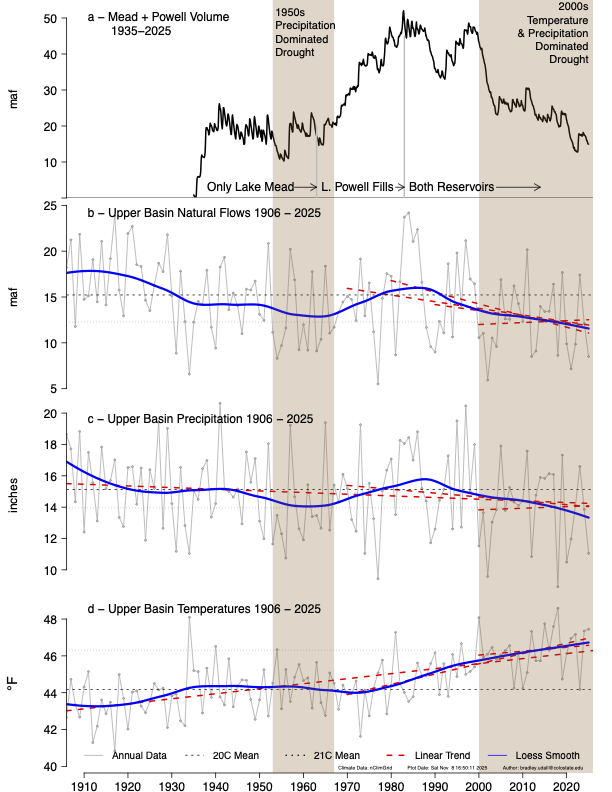
Flows in the Colorado River are down 20 percent over the last century and precipitation has shrunk by about 7 percent with rising temperatures as aridification takes hold across the southwest.
“The chickens are coming home to roost,” Udall said. “Climate models have underestimated how much warming we are going to get, and humans are not stepping up.”
Jack Schmidt, director of the Center for Colorado River Studies at Utah State University, likened the negotiations among the seven compact states to the final scene in “Thelma and Louise.” “Seven people have their hands on the steering wheel driving toward the edge of a cliff — and no one is working the brakes,” he reportedly said.
