Don’t take more than you need: wrangling wasted water on the Western Slope

Erin Light, center, and Shanna Lewis in a pasture with a mule while checking on the Meeker Ditch on July 11. Light has curtailed diversions into the ditch, which she determined was wasting water.

MEEKER – The mule in a pasture east of Meeker along the White River seemed happy to see Erin Light, a state division engineer, and Shanna Lewis, a water commissioner, when they went to take a look at the amount of water flowing through the Meeker Ditch on July 11.

Lewis, who grew up on a Colorado ranch, praised the mule’s beautiful, deer-like coloring and said they’d become friends on her frequent visits to check the ditch.

But the warm equine reception the two enforcers of Colorado water law received differed from the response they sometimes get from ranchers in Division 6, which encompasses the Yampa, White and North Platte river basins, especially when they are visiting a ditch because they think its operator is diverting more water than they need through their head gate.

“I would say I’m more telling than I am curtailing,” said Light, who has been the division engineer based in Steamboat Springs since 2006. “There have only been a few situations where I’ve actually said, ‘That’s it. We’re curtailing you.’ And they’re very obvious situations where they’ve got a lot of water going down the tail end of their ditch, where you can’t argue that this isn’t waste.

“Where the problem becomes in determining waste is that I can go out to a piece of land and say, ‘Oh my gosh, you’ve got 6 inches of water on this land. There’s ducks swimming around. This is wasteful,’” she 
continued. “You can go to the landowner or the irrigator and say, ‘This is waste,’ and they’ll stare you right in the face and say, ‘The hell it is.’”

Division and state engineers working for Colorado’s Division of Water Resources, as Light does, are the only officials who have the authority to determine if waste is occurring on an irrigation system. And their primary response is to curtail wasteful flows at the head gate.

But determining if there is waste in a ditch is a case-by-case exercise. It’s site specific and time sensitive, and it can take time to understand how someone manages their ditch.

There’s no state definition of waste or written guidelines, but in the end it’s a fact-based analysis focused on how much water is needed to irrigate so many acres.

An allowance is also made for customary inefficiencies on a ditch system. Water leaking out of an old ditch, for example, is not considered waste. But beyond inefficiency, which is often a physical issue, there is waste, which is usually a water-management issue.

And waste is a much bigger issue on the Western Slope than on the state’s drier eastern plains, where irrigators have long watched for anyone wasting water.

A field flooded with water from the Yampa RIver this year. Erin Light, the division engineer for Div. 6, said this is an example of diverting more water than is necessary.
A field flooded with water from the Yampa RIver this year. Erin Light, the division engineer for Division 6, said this is an example of diverting more water than is necessary.

Free river, or not

In 2014, Light served the Meeker Ditch with a written curtailment order, and she also told the big Maybell Canal on the Yampa River that they had to stop wasting water.

And she did so even though neither river was “under administration,” the term for the body of water being called out by senior downstream diverters, so both were considered in a “free river” condition.

Nor was there another water right that was being injured by either ditch’s diversions.

Just in the past 10 days, Light’s office has informed rancher Doug Monger that water is being wasted in the irrigation system he manages on his Yampa River Ranch three miles east of Hayden.

Monger is a Routt County commissioner, a member of the Yampa-White Roundtable, and a director on the Colorado River Water Conservation District’s board.

When asked Tuesday, during a break in a daylong strategic retreat at the River District, about Light’s belief that he was wasting water, he responded in a way that she has heard before.

“I don’t know what the hell difference it makes if I’m wasting water or not, it’s going back in the river,” Monger said. “Who the hell cares, if it’s a free river.”

“I know he is wasting water,” Light said Monday of Monger. “And he should be the poster child of what should be done, not what shouldn’t be done.

“About 10 days or so ago, our water commissioner approached a bunch of water users in the ditch system,” she explained. “There are several ditches that combine and co-mingle there.

“They were immediately going, ‘That’s Doug Monger’s responsibility, Doug’s the one controlling that,’ which I take as Doug is the one controlling the head gates,” Light said. “One of our water commissioners, Brian Romig, went to Doug and said, ‘We’ve got a problem here. You’re diverting too much water.’ From what Brian told me, Doug somewhat recognized it. He concurred that he needed to reduce his diversions.”

But Tuesday, Monger was not willing to go that far, saying he understood from the water commissioner only that he was still figuring out how Monger’s ditch works.

“I won’t acknowledge it,” Monger said of the allegation that he was diverting more water than he needs. “And if they start coming up with some scenario on it, we can always get our attorney. “

That was the same initial response that David Smith, the primary shareholder on the Meeker Ditch, had when Light curtailed his ditch in 2014.

But since then, and after spending $40,000 in legal and engineering fees, Smith has come around to see Light’s point.

“I would tell you that Erin and I started out on opposite ends on this thing, but both of us have kind of tried to work our way towards middle ground that we can both agree on,” he said.

Smith was busy this week bringing in hay on his well-tended fields along the White River just west of Meeker — the same fields his grandfather irrigated.

“I’ve had some disagreements with her, but Erin is an intelligent gal,” he said of Light, who has a master’s degree in civil engineering from Colorado State University with an emphasis in hydraulics and hydrology. “We’ve worked with her, and we’ve worked with the people that she has here, and at the end of the day it’s helped all of us, and I think we’re all better educated because of it.”

Well-tended fields along the White River west of Meeker irrigated by the Meeker Ditch. The ditch has been directed to divert less water at its headgate than it used to.
Well-tended fields along the White River west of Meeker irrigated by the Meeker Ditch. The ditch has been directed to divert less water at its head gate than it used to.
Shanna Lewis, a water commissioner in Div. 6, inspecting the Meeker Ditch's measuring flume. Lewis suggested it's easy for outsiders to critique how ranchers manage their water, but that there are a lot of factors, and experience, involved that are not always readily apparent.
Shanna Lewis, a water commissioner in Division 6, inspecting the Meeker Ditch’s measuring flume. Lewis suggested it’s easy for outsiders to critique how ranchers manage their water, but that there are a lot of factors, and experience, involved that are not always readily apparent.

Laying down the law

The Meeker Ditch has a water right dating back to 1883 to divert 20 cubic feet per second (cfs) of water and two other later and smaller rights that allow it to divert 25.95 cfs in all.

The ditch diverts water from the White River just east of Meeker, runs it through Meeker proper, and then to fields west of town. (See map).

In her August 2014 curtailment order, Light said the historic water rights held by the Meeker Ditch represent enough water to irrigate about 1,000 acres, but today only 153 acres are actively being irrigated. And engineers at Resource Engineering Inc. calculated that the Meeker Ditch only needed 6 cfs to irrigate the fields still served by the ditch.

Attorney Kevin Patrick of Patrick, Miller and Noto, a water law firm with offices in Aspen and Basalt, had hired Resource Engineering to analyze the irrigation ditch on behalf of a client who owned commercial property under the ditch.

Since 2004, the property had been intermittently subject to flooding by water leaking from the ditch.

Patrick sent the engineering report and a letter to Light. “The ditch is diverting unnecessary water which is merely being spilled” and “the excessive running of water, over that reasonably required for the reasonable application of water to beneficial use for the decreed purposes and lands, is forbidden” under state law, the letter says.

After investigating the matter, Light found the ditch had been consistently diverting about 20 cfs at its head gate, but was then sending much of the water out of the ditch and down Curtis Creek, Sulphur Creek or Fairfield Gulch, back toward the White River.

Light then curtailed diversions at the Meeker Ditch head gate, which she has the authority to do. And when asked to do so by Smith, she put the curtailment order in writing.

“Colorado statute clearly prohibits the running of water not needed for beneficial use,” Light wrote in her order, dated Aug. 15, 2014.

Light cited a Colorado statute that reads “it shall not be lawful for any person to run through an irrigating ditch any greater quantity of water than is absolutely necessary for irrigating his land, it being the intent and meaning of this section to prevent the wasting and useless discharge and running away of water.”

And she addressed the issue of water being released from the ditch and back to the river.

“Generally when water is being wasted off the end of the irrigated acreage, through waste gates, or at the tail end of the ditch, the head gate should be turned down to eliminate that waste of water,” Light wrote. “In this case it appears that water is being diverted at too great a rate for the lands that are being irrigated, and the rate of diversion is not being reduced to eliminate waste.”

Light’s stance on enforcing waste has the backing of her boss, State Engineer Dick Wolfe.

A photo from the Resource Engineering report documenting waste on the Meeker Ditch in 2014. Water from the ditch is being turned out into Sulphur Creek, while the main flow in the ditch continues through the pipe above the outfall.

Use it or lose it?

Both Wolfe and Light served recently on a committee, convened by the Colorado Water Institute at Colorado State University, that issued a report in February on the widely brandished piece of advice to irrigators to “use it or lose it.”

The report is called “How diversion and beneficial use of water affect the value and measure of a water right” and is subtitled “Is ‘use it or lose it’ an absolute?”

The 11-page report ends with several declarative statements about waste that give further backing to Light’s approach, and that she might well wish to see chained to every head gate on the Western Slope.

“Water that is diverted above the amount necessary for application to a beneficial use (including necessary for transit loss) is considered waste,” states the report.

“Increased diversions for the sole purpose of maintaining a record of a larger diversion are considered waste,” it says, referring to the practice of diverting toward the full amount of a decree in order to bolster the future potential value of a water right.

And, “Wasteful diversions will either be curtailed, or will not be considered as part of the water right’s beneficial use.”

Wolfe, who recently gave a presentation to the Colorado Ag Water Alliance on the “use it or lose it” report, said that Light is not being overzealous in her enforcement of waste.

“She is not going out and as a division engineer purposely looking and being more assertive or aggressive about trying to find where waste is going on,” Wolfe said. “These are ones that just came to our attention.”

Alan Martellaro, the division engineer for Division 5, has not taken the same approach as Light when it comes to curtailing waste.

“To actually actively go look for waste is not something that’s historically been done unless there’s a call on the stream,” said Martellaro, who is based in Glenwood Springs and whose jurisdiction includes the Colorado, the Roaring Fork, and the Crystal river basins. “It just hasn’t been the mode we’ve ever been in.”

Kevin Rein, the deputy state engineer who also served on the “use it or lose it” committee, said issues vary from division to division.

“In Division 6, in the Yampa-White, we’ve had periods of free river without administration for a long time, because it hasn’t been over-appropriated,” Rein said. “That means not being water short. So very often people were just diverting whatever they wanted because, why not? But she’s really directing herself to getting people to measure their diversions and pay attention to duty of water. I think you choose what’s important in your division. That’s important in her division.”

“Duty of water” is essentially how much water someone needs to grow crops on a certain amount of land, without waste. In the Yampa and White river basins, the duty of water is generally held to be that it takes 1 cfs to adequately irrigate 40 acres of land.

After giving a presentation at a water workshop in Gunnison in June about the “use it or lose it” report, Rein was asked why the state doesn’t go around and curtail people who are over-diverting.

“We do, as resources allow,” Rein said. “It’s simply a matter of looking at our water districts where we, maybe, have one water commissioner and maybe a deputy. Maybe if they each had two or three more deputies, then we could do that.”

Light sounds like she could use some help.

“When it comes down to obvious waste,” she said, “I would say we have a tremendous problem with it. I had a long-standing water commissioner — he was with us for 40 years and grew up a rancher — tell me one day, ‘The problem with irrigators today is they don’t go out and move their sets. They just open the head gate wider.’”

“Sets” refers to how irrigators have set various control points, such as check dams and internal head gates, along their ditches.

“That just blew me away,” Light said. “Here’s a longtime rancher living in the community of Meeker his entire life who is more or less telling me that his co-irrigators … just open up their head gate and don’t move sets anymore. To me, that’s where the inefficiency is. Go out, divert less water, and move your damn sets.”

Erin Light, after being asked to pose for a photo at the headgate of the Meeker Ditch. Light has curtailed diversions into the ditch to reduce the amount of water being wasted in the ditch system.
Erin Light, after being asked to pose for a photo at the head gate of the Meeker Ditch. Light has curtailed diversions into the ditch to reduce the amount of water being wasted in the ditch system.

Defending Light

After receiving Light’s written curtailment order in August 2014 on the Meeker Ditch, Smith appealed it to an administrative hearing officer, which was a rare move.

Wolfe said the appeal, which was addressed to him, “is the only curtailment order that I am aware of that has been appealed since I have been state engineer.” He’s been state engineer since since 2007 and has been with the Division of Water Resources since 1993.

An attorney for the Meeker Townsite Ditch Co., which owns the Meeker Ditch, told the state that Light was “attempting to restrict the diversion of water down the Meeker Ditch at a time when the White River is not under an administrative call and at a time when no other water rights owner is affected by the diversion.”

At that point, the state stepped in to defend Light’s curtailment order, and Philip Lopez, an assistant attorney general, prepared an answer to Smith’s appeal.

In his answer, Lopez cited a relatively straightforward statute that reads: “During the summer season it shall not be lawful for any person to run through his irrigating ditch any greater quantity of water than is absolutely necessary for irrigating his land, and for domestic and stock purposes, it being the intent and meaning of this section to prevent the wasting and useless discharge and running away of water.”

And he quoted the Colorado Supreme Court in Fellhauer v. People, where it said, “The right to water does not give the right to waste it.”

As to the matter of Light, or any other division engineer, not being able to curtail waste if there is not a call on the river, Lopez wrote “the division engineer has the authority to curtail [the Meeker Ditch’s] wasteful diversions at any time pursuant to [state law], regardless of whether or not the White River is under administration.”

Lopez did concede, though, that the water rights held by the Meeker Ditch still allowed it to divert water, as long as they did so “without waste.”

That’s an important distinction for Smith, who insists that he wasn’t technically curtailed, only that he can’t waste water when diverting.

“She hasn’t curtailed me to the amount of water that I can use,” Smith said. “All that Erin tells me is that whatever amount of water I have in the ditch, that she doesn’t want us wasting any water.”

Light has a different take.

“We curtailed them,” Light said. “We issued an order to stop wasting. They hired an attorney. They hired an engineer. It went to the hearing officer. They don’t waste anymore.”

The hearing officer in the case denied the ditch’s appeal, indicating it was a matter for water court. But Smith declined to go there.

“We kind of came to a working agreement that we were going to try to work with it, but as far as the laws, there was never a test case,” Smith said.

That may be, but on July 11, when Light and Lewis measured the flow in the Meeker Ditch, it was running at 6 cfs, not 20 cfs as it often used to.

The diversion structure for the Maybell Canal on the Yampa River east of Maybell. The ditch has been working to reduce diversions after the division engineer found it was diverting more water than it needed.

The Maybell Canal

Light has also curtailed another irrigation ditch in Division 6, the Maybell Canal on the Yampa River near Maybell, which she found was similarly diverting more water than it needed.

The canal diverts water from the Yampa into a head gate located in a canyon on the edge of Little Juniper Mountain, about 30 miles west of Craig. (See map).

The Maybell Canal has a senior water right for 42.2 cfs that was adjudicated in 1923 and appropriated in 1899. It also has a junior right for 86.8 cfs that was adjudicated in 1972 and was appropriated in 1946.

The waste on the Maybell Canal was brought to Light’s attention by one of her water commissioners who’d visited the ditch. Light then verbally instructed the canal’s manager to stop wasting water. Mike Camblin, manager of the Maybell Irrigation District, wasn’t happy when he got the curtailment order from Light, but he’s now working to secure funding to make $197,000 worth of improvements to the irrigation system.

On July 13, the Yampa-White-Green basin roundtable approved a $108,000 grant of state funds to help fix several issues on the ditch system. One of those improvements is a modern, automated “waste gate” a mile below the head gate.

Camblin said such a remote-controlled system won’t work at the head gate, which is higher up in the canyon without cell phone service and prone to being washed out by high water.

But he is willing to use the automated gate to reduce sending more water than necessary out the bottom of the ditch, where the water returns to the Yampa River.

The arrangement for the new gate does not entirely please Light, however. She insisted that Camblin agree to send someone up to the head gate within three days after receiving information from the new automated gate that they are over-diverting.

An agreement to that end has been worked out and is poised for adoption, both Light and Camblin said.

“The whole goal is to not only help Erin out but to make us better at what we do,” Camblin told his fellow roundtable members on July 13.

In an interview this week, Camblin said, “At times we were probably taking more water than we need, but that’s what this whole process is about, to cut that down.” He said he is forging a productive working relationship with Light.

“I think it all comes down to communication, especially with Erin and the water commissioners,” he said. “If they get to know us and how our ditch can run better, and we allow them to do that, and we communicate, we can solve a lot of problems.”

Water diverted into the Maybell Canal enters a flume a mile below the headgate and crosses the Yampa River. A remote-operated outlet is to be installed just above the flume in an effort to reduce diversions into the ditch.
Water diverted into the Maybell Canal enters a flume a mile below the head gate and crosses the Yampa River. A remote-operated outlet is to be installed just above the flume in an effort to reduce diversions into the ditch.
The Maybell Canal, towards its end, below the town of Maybell, on July 13, 2016. The ditch is working to waste less water by reducing diversions from the Yampa River.
The Maybell Canal, toward its end, below the town of Maybell, on July 13, 2016. The ditch is working to waste less water by reducing diversions from the Yampa River.

Watch that stick

Dan Birch, the deputy general manager at the Colorado River Conservation District and a member of the Yampa-White basin roundtable, is supportive of the improvements that Camblin is trying make on the Maybell Canal.

“I think Mike’s really trying to do the right thing, and I think he wants to take a look at ways he can manage his diversions better,” Birch said. “I certainly don’t think he’s diverting just for the sake of diverting.”

Birch also cautioned against using a stick to beat back waste.

“You can’t go into a situation and say, ‘Hey, you guys are wasting water, I want you to reduce your diversions,’” Birch said. “You really have to be prepared to go into that situation and say, ‘Hey, look, here’s something that we’re seeing here. Let’s have a conversation. I’m interested in exploring what we might do to improve flow in the river.’”

But Light feels the Maybell Canal needed to be prodded into action.

“What has partially pushed the Maybell Canal to go the direction they have is us really putting our foot down that we’re not going to allow this waste to continue,” she said. “Again, the waste is so blatant. They were diverting about 54 cfs at the head gate, and we estimated about 18 cfs going out the tail end. It’s like, ‘No, you can’t do that.’”

Birch was asked directly if he thought the Maybell Canal would be making its proposed improvements without Light’s enforcement actions.

“That’s a fair question, and my immediate response is probably not,” he said.

While Light has been able to work with both Smith and Camblin, she knows she’s raising the hackles of ranchers in the Yampa and White river basins.

“I don’t think the irrigation community wants to be told they’re wasting,” she said. “I’d love to do more as far as waste, but I do have to tread lightly.”

Editor’s note: Aspen Journalism, the Aspen Daily News and Coyote Gulch are collaborating on coverage of rivers and water. The Daily News published this story on Sunday, July 24, 2016

Denver Water distances itself from risk assessment of Ritschard Dam at Wolford Reservoir

A truck drives out to Ritschard Dam, which forms Wolford Reservoir, on July 13, 2016. The dam has settled two feet downward and moved eight inches horizontally since being built in 1995.
A truck drives out to Ritschard Dam, which forms Wolford Reservoir, on July 13, 2016. The dam has settled 2 feet downward and moved 8 inches horizontally since being built in 1995.

By Brent Gardner-Smith, Aspen Journalism

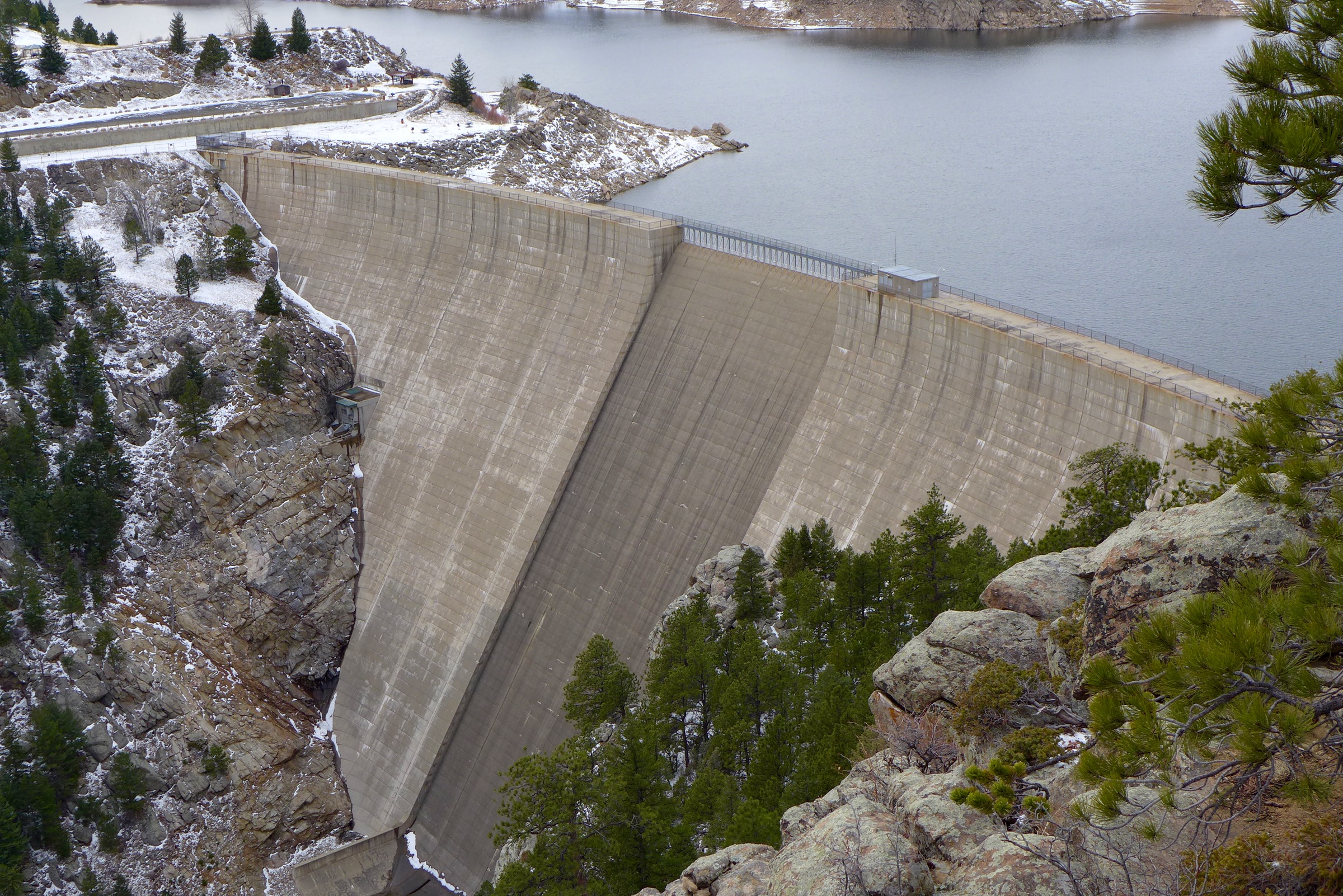
KREMMLING – Denver Water has taken steps to distance itself from a recent risk assessment of Ritschard Dam, which forms Wolford Reservoir five miles north of Kremmling.

The 21-year-old dam has found to be moving slightly and settling more than normal and a risk analysis workshop was held in February by a group of experts assembled by the Colorado River District, which owns the dam and reservoir.

After the risk workshop John Currier, the chief engineer for the River District, wrote a memo to the district’s board saying “a key conclusion” of a consultant review board is that “the dam is safe” and “there is no need for immediate action.”

Currier also wrote in his April 7 memo that the “key parties and participants” in the February risk workshop “included 1) the State Dam Safety Branch, 2) Denver Water, 3) our consultant review board, 4) our engineer, AECOM and 5) River District staff.”

But on May 2, Robert Mahoney, the director of engineering for Denver Water, sent Currier a letter critical of his April memo.

“In the memorandum, you characterize Denver Water as a ‘risk estimator’ and an active participant during the workshop,” Mahoney wrote. “Denver Water takes exception to these characterizations. At no time did Denver Water participate in the workshop as a risk estimator, nor was it ever invited to participate as a risk estimator on the panel.”

Mahoney also said that Denver Water “disagrees with characterizations in the memorandum implying that Denver Water was an active participant and that we concluded and agreed with the findings of the risk estimators. Denver Water’s role in attending the workshop was that of a concerned observer.”

Currier included the letter from Denver Water in a July 7 memo to the River District board. The memo and the letter were made public this week when the public agenda was released for the district’s July 20 board meeting in Glenwood Springs.

Mahoney raised other concerns in his letter as well.

“Based on our observations, the workshop and your memorandum only addressed the probability of a dam failure consequence,” Mahoney wrote. “While the probability of a dam failure appears low, dam failure is not the only potential adverse impact of concern to Denver Water. The probability of cracking in the core of the dam, which could reduce storage capacity, has a much greater range of uncertainty.”

Denver Water currently leases 40 percent of the water in Wolford Reservoir from the River District.

The reservoir can store 66,000 acre-feet of water and on July 14 the dam was holding back 65,240 acre-feet.

When its lease expires at the end of 2020, Denver Water is slated to become a part owner of the water in the reservoir.

“The River District will convey ownership, use and control of 40 percent of storage space and water right in Wolford Reservoir to Denver Water,” according to Jimmy Luthye, a communications specialist with Denver Water who checked Friday on the status of Denver Water’s stake in the facility.

As Jim Pokrandt, director of community affairs at the Colorado River District put it on Friday, “Denver Water currently holds a 40 percent lease. After 2019, it will be a 40 percent owner.”

The upstream side of Ritschard Dam, which forms Wolford Reservoir.

Dam has issues

In his letter, Mahoney also suggested that developing a plan to fix the dam would be “beneficial.”

“According to Mr. Dick Davidson (of AECOM), cracking of the core has a 50 percent annual probability of occurrence starting in 20 years (the time criteria set for the workshop and probability estimation),” Mahoney wrote. “Given this uncertainty, it would be beneficial to develop plans now to remediate Ritschard Dam in the event of a crack.

“Further, based on the information presented at the workshop, Denver Water does not agree that Ritschard Dam is functioning as designed because no dam is designed to function with the degree of movement observed at Ritschard Dam to date.

“As addressed in the April 27, 2016 letter from Bill McCormick, chief of the Dam Safety Branch of the state engineer’s office, Ritschard Dam is in the category ‘of dams with significant issues’ and is on ‘an abnormal trend,'” Mahoney wrote.

Ritschard Dam is 122 feet tall,  1,910 feet wide, and sits across Muddy Creek, which flows into the Colorado River east of Gore Canyon. It was built for the River District in 1995 at a cost of $42 million by D.H. Blattner and Sons of Minnesota.

The dam has an impermeable clay core that is covered on both the upstream and downstream sides with rock fill, including shale rock excavated on site during construction.

In 2008, engineers working for the river district noticed the dam had settled downward by a foot-and-a-half, instead of the expected normal settling of one foot.

They decided to install monitoring equipment, including inclinometers, which measure slope angles.

Engineers for the river district have since installed an increasingly sophisticated array of monitoring devices. And they’ve verified that the dam has settled over 2 feet downward.

The dam has also moved horizontally, by 8 inches, at a location about 40 to 50 feet from the top of the dam.

Mike May, an engineer with AECOM, told the river district board in January 2015 that because of “poorly compacted rock fill,” the dam’s rocky outer shells are still moving, especially the downstream shell, and that the clay core of the dam, which is somewhat elastic, is also moving.

While the dam does not have “a global stability problem,” May said the concern is that if enough movement occurs, it could cause cracks in the clay core.

Water could then find its way into those cracks, start transporting material and widening the cracks, and the dam could eventually be at risk of failing.

Ritschard Dam, which creates Wolford Reservoir on Muddy Creek north of Kremmling, is moving slightly, but steadily. The Colorado River District expects rehabilitation of he dam to be expensive.
Ritschard Dam, which creates Wolford Reservoir on Muddy Creek north of Kremmling, is moving slightly but steadily. The Colorado River District expects rehabilitation of the dam to be expensive.

Abnormal behavior

McCormick, in his April 27 letter referenced by Mahoney, also included Denver Water as part of the risk assessment group.

“At the conclusion of the meeting it was the opinion of the participants, CRD, AECOM, risk analysis consultants John Smart and Larry Von Thun, Colorado Dam Safety and Denver Water that the risk of sudden failure of the dam by any of the failure modes analyzed was remote,” McCormick wrote. “It was also agreed that given that determination the need to continue to actively pursue physical modifications to the dam was not warranted at this time.”

McCormick also said that the results of the risk analysis session “now allow the Colorado River District and Colorado Dam Safety Branch to return to more normal reservoir operations with confidence that public safety is not being compromised.”

However, McCormick also noted that “due to the remaining uncertainty of the deformation behavior we agreed that Ritschard can only be classified as ‘conditionally satisfactory’ and that continuing action with respect to monitoring and observations is required by Colorado River District to operate the reservoir as planned.”

In his letter, McCormick cited a presentation at the risk workshop by Dr. Gavin Hunter, a professor at the University of New South Wales who has researched deformation behavior in 130 embankment dams.

Gavin compared the magnitude of the settlement observed at Ritschard dam with other dams in his data set.

“The displacement observed at Ritschard exceeds the majority of the dams studied, with only half the available data,” McCormick wrote. “Dr. Hunter describes this as ‘an abnormal trend.'”

McCormick also noted that Gavin’s research on the amount of settlement at Ritschard put it in the “region of dams with significant issues” category.

As such, McCormick said the River District should develop a plan for remediation work on the dam.

“We would encourage the Colorado River District to fully appreciate the abnormal and as yet not fully understood behavior of Ritschard dam and put an appropriate timeline on the ‘foreseeable future,’ McCormick wrote. “Based on the analyses done to date one could reasonably anticipate that remediation work will be necessary at some point in the future. We strongly encourage the Colorado River District to continue to plan for such remediation to avoid undue pressure on the operation of that facility as might be caused by a sudden change in the dam’s performance.”

McCormick said Friday that a workshop to develop an “action plan” has been set for the third week of August.

A detail of the rock outer shell on the downstream side of Ritschard Dam.

Long odds

In his April 4 memo, Currier of the River District had written that the district’s analysis indicated that risk of failure of the dam from deformation was 1 in 100 million, while the risk of the dam failing by a “probable maximum flood” causing overtopping – a standard measure of risk – was one in a million.

He also explained why monitoring the dam’s movement was a better approach than trying to stop the dam from moving.

“With the dam failure risk so low, even with twice the current deformation, the estimators concluded that there is really no compelling technical or health, safety and welfare reason to embark on a remediation plan,” Currier wrote. “In fact, from a ‘do no harm’ perspective continued monitoring is equally if not more preferable to active remediation.

“While remediation might put to rest some nagging uneasiness about on-going deformation and when it might end, there is no absolute certainty that it would or should allay that uneasiness.

“In essence, remediation might replace one known uncertainty with a new, unknown, uncertainty. All dam owners are faced with some level of future uncertainty, we just happen to be keenly aware of it by virtue of extensive monitoring and investigation,” Currier wrote.

And in his July 7 memo sent to the River District board, Currier said an additional inclinometer has recently been installed at the toe of the dam to track movement, and that he would be sending Mahoney of Denver Water “a short response clarifying a few matters and inviting Denver’s continued involvement and expertise in the deformation issues.”

Pitkin County awards contract for Basalt whitewater park

Looking up the Roaring Fork River where Pitkin County intends to build a whitewater park with two wave features. Two Rivers Road is to the left in the photo, taken the first week of July, 2016.

By Brent Gardner-Smith, Aspen Journalism

BASALT – Pitkin County has awarded a construction contract worth $770,000 to a company in Durango to build a whitewater park in the Roaring Fork River near Basalt’s Elk Run subdivision.

The in-channel work, to be completed by next February, includes extensive rock work in the channel and on the riverbank and the installation of two wave-producing concrete structures anchored into the riverbed.

The upstream wave is designed to appeal to kayakers, while the downstream wave should also be suitable for stand-up paddlers at some water levels.

After a recent bid process, the county awarded the contract to build the in-channel features of the whitewater park last week to Diggin’ It River Works Inc. of Durango, according to Laura Makar, an attorney with Pitkin County who is overseeing the project. The whitewater park is being managed by the county attorney’s office, as it started as a water-rights effort.

The company has recently built whitewater parks in West Glenwood and Durango. River Restoration of Carbondale, which designed the West Glenwood wave, has designed the Basalt project and its two wave-producing features.

The in-channel work for the Basalt project includes:

constructing temporary coffer dams to channel the flow of the river into a 60-inch bypass pipe to expose the riverbed for construction;

the placement of boulders in the river to form five grade-control structures above the features;

the anchoring of the two wave structures themselves; and

installation of stabilizing boulders along the toe of a steep section of riverbank.

See drawings.

Looking down the Roaring Fork River at the location where Pitkin County intends to build a whitewater park. Two Rivers Road is to the right. The county is planning to build a ramp, a set of stairs and a pedestrian corral between the river and the road.

To the river

The county plans to build a modest level of access features and public amenities as part of the project, consistent with approvals for the project granted by the town of Basalt in 2015.

(See “Exhibit A” from town of Basalt ordinance number 18-2015).

The amenities, for example, do not include viewing platforms on the riverbank as shown in some conceptual renderings by the county during public meetings on the project last year.

The riverside improvements, to be completed by May 1, 2017, include a new ramp, or path, down the riverbank from Two Rivers Road to the downstream end of the whitewater park and a metal stairway down the riverbank across from the entrance to the Elk Run subdivision, at the upper end of the whitewater park.

The downstream ramp is to serve as both a public access path and as an emergency ramp big enough to drive an ATV down if necessary.

The stairway, to be built on the riverbank across from the entrance to Elk Run, may or may not be open to the public and might be used for emergency access only, according to James Lindt, a planner with the town.

The county’s plans also include the creation of five or six parallel parking spaces just downvalley of the whitewater park, on town land on the south side of Two Rivers Road, and the addition of four more parking spaces at Fisherman’s Park, which today can hold about eight vehicles in a small dirt lot next to a picnic pavilion and a bathroom.

The town has also required that the county delineate parking spaces for two or three vehicles with trailers near Fisherman’s Park and resurface the small boat ramp across Two Rivers Road from the park. The county also plans to add boulders in the river to enlarge the eddy at the bottom of the modest boat ramp.

In an effort to make it safer for kayakers and spectators heading to and from the whitewater park, the roadside improvements include a path on the south side of Two Rivers Road, just above the whitewater park, to be formed by two sections of split-rail fence running parallel to the road and the river.

The “pedestrian corral” is designed to safely guide people from the downstream end of the whitewater park back up Two Rivers Road toward Fisherman’s Park, which the county is viewing as the primary put-in for boaters to access the two play waves.

It’s a short float around the corner from Fisherman’s Park to the whitewater park location, but it’s a difficult paddle back up the river, especially in higher water, from the whitewater park location to Fisherman’s Park.

So if a boater parks at Fisherman’s Park and floats down to the park, they will likely need to walk back up through the “corral” when they get out of the river, cross the road at the Elk Run intersection, and then walk on the sidewalk on the north side of the road back to the parking lot at Fisherman’s Park.

Looking up Two Rivers Road as a truck turns into the Elk Run subdivision. The whitewater park is to be built to the right of the view. Fisherman's Park is beyond the entrance to Elk Run, on the left.
Looking up Two Rivers Road as a truck turns into the Elk Run subdivision. The whitewater park is to be built to the right of the view. Fisherman’s Park is beyond the entrance to Elk Run, on the left.

Flashing lights

In an effort to increase pedestrian safety along the busy roadway, the county is also required to install three crosswalks across Two Rivers Road, each with flashing cautionary signs to warn and stop motorists.

The crosswalks are to be located at Fisherman’s Park, at the entrance to the tree farm property about a block down the road, and on the downvalley side of the entrance to Elk Run, at the upstream end of the walking corral. There are currently no marked crosswalks on Two Rivers Road in those locations.

The town intends to discourage accessing the whitewater park from the other side of the river, at the end of Emma Road, past Subway and Stubbies, although there is technically public access to the river from that location on town property. Emma Road is a private road, but it does have a public access easement on it, according to Lindt.

It’s also possible to access the whitewater park from Ponderosa Park, on the south side of the bridge by the 7-Eleven store, where there is public parking and a riverside trail leading up to the whitewater park location.

“The main access to be encouraged is off of Two Rivers Road,” Lindt said.

Construction staging for the project is slated to take place on the Emma Road side of the river, however, and the county is required to leave a dirt roadway for emergency vehicles to use to access the whitewater park when it’s finished.

Exhibit A to the Town of Basalt's ordinance approving Pitkin County's whitewater park.
Exhibit A to the Town of Basalt’s ordinance approving Pitkin County’s whitewater park.

Still Planning

The location for the Basalt whitewater park is not ideal, either in terms of the roadside access or its place on the river, just below a low highway bridge and hard against a steep bank on river-right.

But the choice of location, just above the confluence of the Roaring Fork and Fryingpan rivers and the Pitkin County line, has been driven more by a water rights consideration than the location in the river itself or in Basalt, where the town is working on a riverfront park downstream of the county’s whitewater park location.

Pitkin County officials have consistently stressed that their primary motivation in pursuing the whitewater park is to establish the water rights associated with the park’s wave-producing features, but they also think it will be a good recreational amenity.

“I think that this is going to be a water park that people will use, people will enjoy, and people will be safe while using,” Makar said.

The county is eager to move forward with construction of the in-channel work associated with the whitewater park, and is doing so before a “river recreation plan” and a master plan for Two Rivers Road have been completed by the town. Both plans are cited in the town’s approvals of the whitewater park, but there is not a requirement that they be complete before the county moves ahead.

“Pitkin County doesn’t have control over those planning processes, or control over when those planning processes are complete,” Makar said. “That’s why Pitkin County has gone forward with the instream work and the minimal improvements out of stream. If there were recommendations and changes made by the town of Basalt pursuant to those planning processes, certainly the park could adjust in the future to work with recommendations made by those planning processes.”

For example, there has been discussion of moving Two Rivers Road to the north to create more space to access the river. Lindt said a third public meeting on the river recreation plan will likely be held in August.

A graphic presented at a county meeting held on February 6, 2016 at Basalt town hall. Three variations of the proposed Basalt whitewater park were shown that night. This is the Keep It Simple version that shows the access trail/ramp but no other streamside improvements.
A graphic presented at a county meeting held on February 6, 2016, at Basalt Town Hall. Three variations of the proposed Basalt whitewater park were shown that night. This is the Keep It Simple version that shows the access trail/ramp but no other streamside improvements.
This is Middle of the Road variation of the whitewater park and shows a split-rail fence, but not in a parallel configuration showing a pedestrian corral. (A drawing of the corral has not yet been made public).
This is the Middle of the Road variation of the whitewater park and shows a split-rail fence, but not in a parallel configuration showing a pedestrian corral. (A drawing of the corral has not yet been made public.)
The most elaborate of the three variations, this is called the Events Space variations and shows viewing stands hanging over the riverbank next to Two Rivers Road.
The most elaborate of the three variations, this is called the Events Space variation and shows viewing stands hanging over the riverbank next to Two Rivers Road.

Final plans coming

The county still has to submit a final site plan for the project, which will provide additional details to the parking and pedestrian aspects of the plan, which are being worked on by Loris, a planning firm in Denver. The county must also obtain a construction management plan and a floodplain development permit from the town before construction begins.

Gregory Knott, the chief of police in Basalt, expressed concerns last year during the review process about public access and safety, given the location of the whitewater park along Two Rivers Road.

“Two Rivers Road is not suited to provide parking for individuals utilizing the whitewater park,” Knott said in a referral-comment letter dated Aug. 27, 2015, emphasizing that “parking along Two Rivers Road is not a safe or viable option.”

On Friday, Knott said he is comfortable that the safety measures ultimately included in the town’s October 2015 approval of the park will address his concerns, but also said he still needs to review the final site plan from the county.

The Army Corps of Engineers, which regulates changes to rivers and waterways, issued a 404 permit for the county’s work in the river in 2010, but the initial deadline to complete the work under the permit has expired and the county is currently seeking an extension until February 2018.

Funding for the project has come from the county’s Healthy Rivers and Streams board and was approved by the county commissioners. The $770,000 worth of work awarded last week does not include the cost of roadside amenities. Makar said an estimate for the final project is forthcoming as design work continues.

The steep riverbank on the Roaring Fork River where Pitkin County intends to build a whitewater kayak park. Looking upstream, early July, 2016.

Flow rights

After an expensive water court process the county obtained a conditional water right for the whitewater park and it carries a 2010 priority date.

The right is known as a “recreational in-channel diversion,” or RICD, and county officials see the water right as a way to keep water in the river in the face of future potential transmountain diversions from the upper Roaring Fork.

From April 15 to May 17, the county could call for 240 cubic feet per second (cfs) of water to flow through the park.

Then, from May 18 to June 10, the county could call for 380 cfs.

And during peak runoff, from June 11 to June 25, it could call for 1,350 cfs of water to flow through the kayak park and create the biggest surf waves of the season.

After June 25, the water right steps back down to 380 cfs until Aug. 20, and then back to 240 cfs until Labor Day.

Editor’s note: Aspen Journalism, the Aspen Daily News, and Coyote Gulch are collaborating on coverage of rivers and water. The Daily News published this story on Monday, July 4, 2016.

Twin Lakes Tunnel opens for more transmountain diversions

The east end of the Twin Lakes Tunnel on May 16, 2016.
The east end of the Twin Lakes Tunnel on June 6, 2016.
A graph showing the level of water flowing through the Twin Lakes Tunnel this week. The tunnel began diverting water, after being closed for two weeks, on Tuesday, June 28, 2016.

ASPEN – The unnatural order of things was restored Tuesday as the Twin Lakes Tunnel began diverting water to the east again from the headwaters of the Roaring Fork River, after having been closed for two weeks.

The tunnel was closed temporarily after constraints in water rights required that it stop diverting from the Fork, Lost Man and Lincoln creeks, and other tributaries in the headwaters.

The tunnel under the Continental Divide had been diverting about 620 cubic feet per second (cfs) before diversions were stepped down over a three-day period from June 14 to 16, when the tunnel closed.

The reintroduced native flows down the Fork and Lincoln Creek added noticeable intensity to the river as it made its way through the Grottos, Stillwater and Slaughterhouse reaches near Aspen.

One of the constraints on the legal rights of the tunnel is that when the Colorado Canal in Ordway can divert freely because there is plenty of water in the lower Arkansas River, it cannot demand water from the Roaring Fork.

But the spring runoff has slowed, pinching the supply of water available to the canal from the Arkansas. As such, it can now legally call for water from the Roaring Fork.

“The Colorado Canal is being called out, so we can start diverting the tunnel under the direct flow portion of the right,” wrote Kevin Lusk, the president of the board of the Twin Lakes Reservoir and Canal Co. and a principal engineer at Colorado Springs Utilities, in an email Tuesday.

The other constraint was that the Twin Lakes Reservoir and Canal Co. had filled its storage allotment of 54,452 acre-feet of water in Twin Lakes Reservoir.

With that “bucket” filled, and the Colorado Canal still in priority, the tunnel had to be closed.

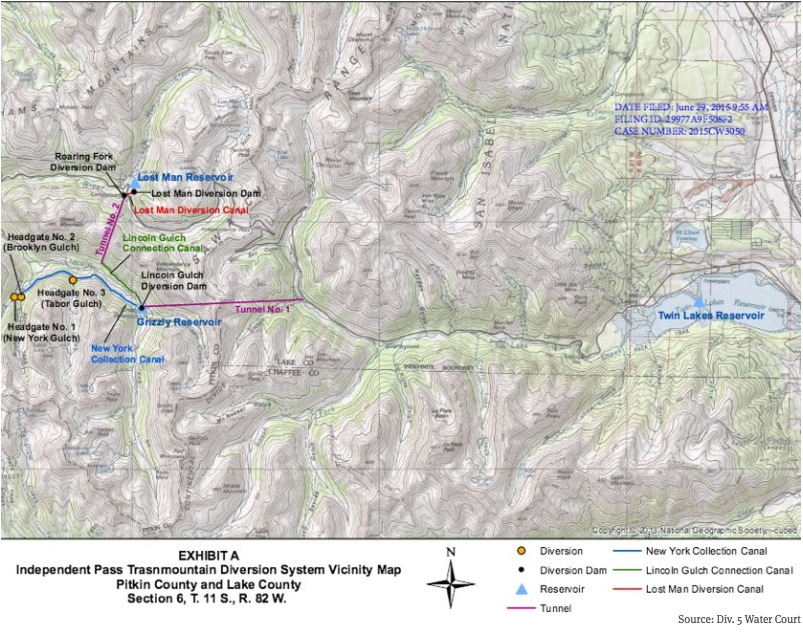
Not all of the water diverted from the Fork’s headwaters goes to the Colorado Canal, however, as the Independence Pass Transmountain Diversion System, of which the Twin Lakes Tunnel is the key component, now also helps meet water needs in several Front Range cities.

The diversion system is technically owned by the Twin Lakes Reservoir and Canal Co., which is based in Ordway. But Aurora, Colorado Springs, Pueblo West, and Pueblo own almost all of the shares in the company.

On Tuesday, the Twin Lakes Tunnel, which begins at Grizzly Reservoir on Lincoln Creek, was opened back up and about 200 cubic feet per second began flowing east, primarily from Lincoln Creek and the creeks in Brooklyn, New York, and Tabor gulches.

In response, levels in the Roaring Fork River near Aspen fell sharply.

The river at Difficult Campground, for example, was flowing at 390 cfs at 6 a.m., Tuesday morning, but had fallen to 244 cfs by 8 p.m.

And the measuring gauge on Stillwater Drive, just below the North Star Nature Preserve, showed the river flowing there at 510 cfs at 6 a.m. and at 311 cfs by 8 p.m.

On Wednesday, Lusk said that new calls for water from various shareholders in the Twin Lakes Reservoir and Canal Co. mean that water from Lost Man Creek and the main stem of the Fork would soon be added to the flow of water being sent east through the tunnel.

Lusk said he expected the tunnel to continue diverting water through the summer.

This marked the second year in a row the Twin Lakes Tunnel was forced to cease diverting due to wet conditions on the east side of the pass.

During most of the time the Twin Lakes Tunnel was closed, diversions continued to flow as usual through the Bousted Tunnel, which sends water east from the headwaters of the Fryingpan River, as well as from Hunter, Midway, and No Name creeks near Aspen.

Around 800 cfs has been flowing through the Bousted Tunnel for most of June.

And according to the Pueblo Chieftain, the total diversion from the Fry-Ark project so far this year is about 51,000 acre-feet of water.

Add that to the approximately 25,000 acre-feet diverted so far by Twin Lakes, and it means about 76,000 acre-feet has been diverted from the Roaring Fork River watershed so far this year, not counting what may have been sent through the Busk-Ivanhoe Tunnel, which also diverts from the upper Fryingpan.

Ruedi Reservoir, by comparison, can hold 102,373 acre-feet.

Editor’s note:
Aspen Journalism, the Aspen Daily News, and Coyote Gulch are collaborating on coverage of rivers and waters. The Daily News published a version of this story on Thursday, July 30, 2016.

City of Aspen to discuss possible dams on Castle and Maroon creeks

A rendering from Wilderness Workshop of a potential Maroon Creek Reservoir, which would hold 4,567 acre-feet of water behind a 155-foot-tall dam. The rendering was prepared by a professional hydrologist and is based on plans submitted to the state by the city.

By Brent Gardner-Smith, Aspen Journalism

ASPEN – Officials at the city of Aspen intend to hold at least one public meeting this summer to discuss the conditional water rights it holds that are tied to potential dams on upper Castle and Maroon creeks.

The city’s next diligence filing for its conditional water rights for the two dams and reservoirs is due in Division 5 water court in Glenwood Springs by Oct. 31. It’s highly unusual in Colorado for a city, or any other entity, to hold a public meeting on a pending diligence filing.

David Hornbacher, city of Aspen director of utilities and environmental initiatives, said that while holding a public meeting is indeed “different,” he is acting at the direction of the city council.

“These are important questions,” he said. “And it’s very much about looking into the future and how do we ensure Aspen has what it needs to continue to thrive and be the place that it is, and what’s the best approach.”

Paul Noto, a water attorney with Patrick, Miller and Noto, which specializes in water law and has represented many clients in the Roaring Fork River watershed, said it was “very unusual” for a city to hold a public hearing about a pending diligence filing.

“I’ve never heard of it, although that’s not to say it’s never occurred,” Noto said. “I’ve just never heard of it.”

 A rendering from Wilderness Workshop showing the potential Castle Creek Reservoir. The rendering was developed by a professional hydrologist and i sbased on engineering plans filed by the city.
A rendering from Wilderness Workshop showing the potential Castle Creek Reservoir. The rendering was developed by a professional hydrologist and i sbased on engineering plans filed by the city.

15-story dams?

If built as currently described by the city’s plans, which were first presented to a water court judge in 1965, the Maroon Creek reservoir would store 4,567 acre-feet of water behind a 155-foot-tall dam just below the confluence of East Maroon and West Maroon creeks.

While only about a third of the size of Paonia Reservoir, which can hold 15,553 acre-feet when full, a Maroon Creek reservoir would still cover 85 acres of U.S. Forest Service land about a mile-and-a-half below Maroon Lake.

It would also inundate portions of both the East Maroon Creek and West Maroon Creek trails in the Maroon Bells-Snowmass Wilderness.

The Castle Creek reservoir would hold 9,062 acre-feet of water behind a 170-foot-tall dam located about two miles below the historic town site of Ashcroft.

It would inundate 120 acres of mostly private land between Fall Creek and Sandy Creek and flood a small piece of Forest Service land within the Maroon Bells-Snowmass Wilderness.

Both reservoirs would be located in Pitkin County.

Since 1965, the city has told the state eight different times it intends to build two large dams in pristine locations in the upper Castle and Maroon creek valleys, and it is on the record that the city intends to file a diligence application this fall. In its September 2009 diligence filing the city told the water court “it has steadily applied efforts to complete” the reservoirs “in a reasonably expedient and efficient manner.”

A court official, known as a water referee, agreed.

“To date, the city of Aspen has not needed to construct the storage structures as it has devoted considerable resources to reducing per capita water consumption,” the unnamed referee wrote. (Please see related story).

A rendering from Wilderness Workshop showing how a Castle Creek Reservoir might look on a seasonal basis after water has been drawn done to meet downstream needs.

Private and public meetings

Hornbacher said this week he will hold one private meeting with stakeholders in early July about the dams and at least one public meeting in July or early August, “depending on the level of public interest.”

After presenting information about the water rights and taking questions and suggestions at the meetings, Hornbacher said he would report back to the council in a work session in August or September to get its direction by the Oct. 31 filing deadline.

He said council could direct staff to proceed with the diligence filing and try and keep the water rights on the books for another six years.

Or it could direct staff not to file, or to file a modified application.

Hornbacher said a modified application could mean filing on one dam and reservoir, but not both, or it could mean filing on both reservoirs but changing their size and shape.

It’s not unheard of for entities to walk away from conditional water rights. The Colorado River District made the decision to abandon rights for two large dams on the Crystal River in 2013. And over the last five years, the district has stepped away from a number of other conditional water rights.

Among the stakeholders Hornbacher plans to invite to a private meeting are Wilderness Workshop, Roaring Fork Conservancy, U.S. Forest Service, and Pitkin County.

Wilderness Workshop first reported the city’s decision to hold public hearings in a newsletter it sent to members on June 1. The headline of the article read, “Potential dams on Maroon and Castle creeks still on the books” and a subhead read, “A diligence filing this fall would keep them alive; WW says, ‘No way!’”

The city of Aspen intends to hold at least one public meeting on the conditional water rights it holds for two large dams, one on upper Castle Creek and one on upper Maroon Creek, shown here in this 2012 file photo, with the Maroon Bells visible in the background. The dam on Maroon Creek would be 155-feet-tall and store 4,567 acre-feet of water.

Proving diligence

Typically, owners of conditional water rights need to demonstrate to the court they meet the “can and will” doctrine – that they can build the proposed water supply project and that they will build it.

The city may also need to meet standards developing in the wake of a Colorado Supreme Court decision in Pagosa Area Water & Sanitation Dist. v. Trout Unlimited.

Alan Martellaro, the Division 5 engineer based in Glenwood Springs, told the city in May, in response to a separate conditional water rights application it filed, that “the applicant [the city] must demonstrate that speculation is overcome per the criteria in ‘Pagosa.’”

“The applicant must demonstrate the proposed appropriation can and will be diverted and put to beneficial use for each of the proposed uses: a) within a reasonable planning period; b) using normal population growth assumptions; and c) the amount claimed is necessary and unappropriated water is available,” Martellaro wrote.

In past filings, the city has left the state with the distinct impression that it intends to build the two reservoirs, especially in the face of the uncertainty of climate change. But it has also left citizens with another impression – that it is simply protecting its water rights, not warming up bulldozers in view of the Bells.

Noto, the Aspen water attorney, says “you can’t have it both ways.”

“It’s a really important point,” Noto said. “You either are moving forward toward completing your project, which is essentially the standard for keeping your water right, or you’re not. And there’s no in-between.”

Noto has represented clients in the past who successfully opposed the city’s proposed hydropower plant on Castle Creek, but said he is not currently representing a client regarding the city’s pending diligence filing.

As such, Noto was willing to talk on the record in the role of citizen and as an experienced local water attorney.

He said he doesn’t agree with the city’s reasoning that a hotter future may increase the need for the reservoirs.

“I don’t buy it,” he said. “To use climate change as a pretext for damming the Maroon Bells and damming upper Castle Creek is not appropriate.”

The city of Aspen recently completed a raw water availability study that concluded that Aspen has sufficient water to meet future municipal demands, but in one of out of 20 years it might have trouble meeting its goal of keeping instream flows of at least 14 cfs in Maroon Creek and 13.3 cfs in Castle Creek.

The language in the water availability study leaves open the door for the city to suggest that building dams on the upper sections of the creeks could help meet its instream flow goals on the lower sections of the creeks.

A map produced by Pitkin County from a map on file with the state of the city of Aspen's proposed Maroon Creek Reservoir, located just below Maroon Creek Lake, shown to the left as the smaller of the two bodies of water. The map was commissioned by Aspen Journalism and confirmed in 2012 as accurate by city officials.

Good planning?

“What we’re talking about is trade-offs,” Noto said. “Is maintaining an instream flow worth building large dams at the Maroon Bells and upper Castle Creek? Absolutely not. There are other ways that the city could meet the instream flow such as eliminating some irrigation during times of shortage. There are better ways to meet your goals than building big dams. And the people aren’t going to stand for it.”

Noto was asked if he could see a reason why the city should hold on to its conditional water rights on Castle and Maroon creeks.

“I don’t see it,” he said. “I can’t, for the life of me, envision a scenario where it would be good planning or good policy to dam Maroon Bells and to dam upper Castle Creek.”

Wilderness Workshop told its members in its June newsletter that it would be working “to convince the city to abandon the rights to these reservoirs (and we’ll need your help).”

American Rivers is also on the record as opposing the city’s plans to build dams and reservoirs.

“We are absolutely and always will be opposed to new reservoirs on Castle and Maroon creeks,” said Matt Rice, director of the Colorado River Basin Program for American Rivers. “They contradict the values of Aspen and the state of Colorado — values we will fight for.”

American Rivers is a national nonprofit dedicated to river restoration and protection, which fought vigorously against the city of Aspen’s Castle Creek hydro power plant.

Rice said whether or not American Rivers will oppose the city in water court if it does decide to file a diligence application is a strategic decision to be made down the road.

“We think the city’s willingness to have an open, transparent process with citizens is a good thing, if indeed that’s what it is,” Rice said. “There needs to be a sincere and open examination of these projects and what people would be giving up if they were developed.”

Editor’s note:
Aspen Journalism, the Aspen Daily News, Coyote Gulch are collaborating on the coverage of rivers and water. The Daily News published this story on Monday, June 20, 2016.

Twin Lakes Tunnel closes, the Grottos erupts in whitewater

The Roaring Fork River bounding down the Grottos on Thursday, June 16, 2016, after the Twin Lakes Tunnel was closed.

By Brent Gardner-Smith, Aspen Journalism

ASPEN – For the second time in two years the native flows to the upper Roaring Fork River have been restored as the Twin Lakes Reservoir and Canal Co. has had to curtail its diversions and close the Twin Lakes Tunnel, which since June 6 had been moving 600-plus cubic feet per second of water under the Continental Divide.

After the tunnel was closed Thursday afternoon and the upper Roaring Fork River had regained the natural flow of its two biggest tributaries – Lost Man and Lincoln creeks – the river bounded down the slick granite in the Grottos area and erupted in a frenzy of churning whitewater.

The Grottos on June 13, and on June 16

The Roaring Fork River, Grottos, on Monday morning, June 13, 2016.
The Roaring Fork River, at the top of the Grottos section, on Monday morning, June 13, 2016, with the Twin Lakes Tunnel diverting over 600 cfs.
Roaring Fork RIver, Grottos, at about 6 p.m. on Thursday, June 16, 2016, at the upper indicator rock.
The Roaring Fork River, at the top of the Grottos section, at about 6 p.m. on Thursday, June 16, 2016, after the Twin Lakes Tunnel had closed.

Twin Lakes Reservoir and Canal Co. began diverting the headwaters of the Roaring Fork in earnest this year in late May. It ramped up diversions through the Twin Lakes Tunnel to above 600 cfs on June 6 and kept them in the 610 cfs to 620 cfs range until Tuesday, June 14, when the diversions in the tunnel were reduced by about half.

By Wednesday, flows in the tunnel were around 250 cfs and were turned down to a trickle of 4 cfs by Thursday afternoon.

Twin Lakes Reservoir and Canal Co. first reduced the flow of water to the tunnel on Tuesday by letting the natural flow of Lost Man Creek run into the Roaring Fork River again, instead of diverting it to the entrance to the Twin Lakes Tunnel, which begins at Grizzly Reservoir.

The flows of Lost Man Creek added about 250 cfs into the main stem of the upper Fork as it ran past Lost Man campground.

Flows in the main stem of the Roaring Fork River on Tuesday, June 14, 2016 below the diversion dam on the upper Roaring Fork. The flows, shown heading toward Aspen, include about 250 cfs from  Lost Man Creek and  the portion of the main stem of the Fork that was previously being diverted.
Flows in the main stem of the Roaring Fork River on Tuesday, June 14, 2016, below the diversion dam on the upper Roaring Fork. The flows, shown heading toward Aspen, include about 250 cfs from Lost Man Creek and the portion of the main stem of the Fork that was previously being diverted.

Then on Thursday afternoon, Twin Lakes Reservoir and Canal Co. took the next step and closed the tunnel. That sent another 200 cfs or so down lower Lincoln Creek, which runs into the Fork just above the Grottos.

Just after 5:30 p.m. on Thursday, Lincoln Creek quickly went from a clear and docile stream that could be easily walked across to a turbid river flowing strong enough to lift a man off his feet.

Lincoln Creek, before and after

Lincoln Creek, before the Twin Lakes Tunnel was closed on June 16, 2016.
Lincoln Creek, at about 5 p.m. on Thursday, June 16, 2016, before the freshly turned out water from Lincoln, New York, Brooklyn, and Tabor creeks came rushing downstream instead of being diverted through the Twin Lakes Tunnel.
Lincoln Creek, after 5: 30 p.m. on Thursday, June 16, 2016, after the Twin Lakes Tunnel was closed. A surge of turbid pushy water came down Lincoln Creek and reached the Fork about 5:30 p.m. on June 16.
Lincoln Creek, around 5: 30 p.m. on Thursday, June 16, 2016, after the Twin Lakes Tunnel was closed. Minutes earlier the stream could be easily walked across, but the increased flow above was enough to lift a man off his feet while crossing.

The 4-mile long Twin Lakes Tunnel is now expected to remain closed for two to three weeks and the recent hot weather may keep the water rising in the Fork as the last of the high elevation snowpack comes off.

Rising Stillwater

On Friday, a cold and swiftly moving Roaring Fork had risen above its banks in portions of the North Star Nature Preserve, flooding some areas but not to the extent of the high water in June 2015.

Last year on June 18 the Fork reached a peak flow of 1,680 cfs, as recorded by the gauge “Roaring Fork River Near Aspen, CO,” located at Stillwater Drive just east of Aspen proper.

Yesterday at 4:30 p.m., as the tunnel was closed, the Fork at Stillwater was flowing at 597 cfs.

But by midnight, with the strong flow from Lincoln Creek added, the Fork had climbed to 817 cfs.

It then hit a high of 927 cfs at 7:45 a.m. on Friday morning, before falling back to 857 cfs by 2:30 p.m. Friday.

The riverside cabin in the Stillwater section of the Roaring Fork did not appear to be flooded on Friday, June 17, 2016, but the river was lapping the edge of the porch. One year earlier the river had made itself at home and put about a foot of water in the cabin.

By midday Friday, the swelling river was licking the porch of a small cabin on the banks of the Fork in the Stillwater section, but unlike last year, it had not yet flooded the inside of the cabin and a nearby art studio.

The river, however, had risen high enough to flood portions of the North Star Nature Preserve and other land along the river. So far, the high water had not produced flooding in scale with the dramatic size of last year’s “Lake North Star.”

Water in the Stillwater section of the Roaring Fork River swelled over the river's banks on Friday after the Twin Lakes Tunnel was closed for two-to-three weeks on Thursday. The river hit 927 cfs early Friday morning. Last year on June 18 it hit 1,680 cfs.
Water in the Stillwater section of the Roaring Fork River swelled over the river’s banks on Friday after the Twin Lakes Tunnel was closed for two to three weeks on Thursday. The river hit 927 cfs early Friday morning. Last year on June 18 it hit 1,680 cfs.

Turn Tunnel Off

The Twin Lakes Tunnel is the key component of the Independence Pass Transmountain Diversion System, which was constructed in the 1930s and is owned and operated by Twin Lakes Reservoir and Canal Co.

Notably, the company does not own and operate Twin Lakes Reservoir, as it sold the reservoir on the east side of Independence Pass to the Bureau of Reclamation and the reservoir is now managed as part of the Fry-Ark project.

The Twin Lakes Reservoir and Canal Co., did, however, retain the right to store 54,452 acre-feet in Twin Lakes Reservoir, which can hold a total of 147,500 acre-feet, or about a third again more than Ruedi Reservoir.

But under its water rights, after Twin Lakes Reservoir and Canal Co. reaches its storage allotment in Twin Lakes Reservoir as it did this week, it has to stop diverting if the Colorado Canal can still divert 756 cfs directly from the lower Arkansas River.

It’s rare that two of the constraints in the water rights held by Twin Lakes Reservoir and Canal Co. overlap and it has to stop diverting West Slope water, but it happened last year and again this year.

And both times were a reflection of the high levels of water in the lower Arkansas River basin.

If flows in the lower Arkansas drop, then the Colorado Canal will likely be called out by a senior diverter and Twin Lakes Reservoir and Canal Co. can again divert water from the headwaters of the upper Roaring Fork and send it directly to the canal.

The Colorado Canal is near Ordway, CO, where Twin Lakes Reservoir and Canal Co. is based. Most of the shares in the company are owned by Front Range cities, which receive the majority of the water normally diverted from the upper Roaring Fork.

Tunnel Diversion Graphics

A graph showing the stair-step reduction in diversions through the Twin Lakes Tunnel between Tuesday, June 14 and Thursday, June 16, 2016.
A graph showing the stair-step reduction in diversions through the Twin Lakes Tunnel between Tuesday, June 14, and Thursday, June 16, 2016.
A graph showing the rate of diversions through the Twin Lakes Tunnel since early May. It shows the steady diversions above 600 cfs between June 6 and June 14, 2016.

Grottos, Broad View

Roaring Fork River, Grottos, on Monday morning June 13, 2016, with diversions into the Twin Lakes Tunnel at over 600 cfs. While impressive at this level, the whitewater frenzy that resulted after the tunnels were closed was far more intense.
Roaring Fork River, Grottos, on Monday morning June 13, 2016, looking downstream, with diversions into the Twin Lakes Tunnel at over 600 cfs. While impressive at this level, the whitewater frenzy that resulted after the tunnels were closed was far more intense.
Roaring Fork River, Grottos, at 5 p.m. Thursday, June 16, 2016, before flows from Lincoln Creek came into the Fork.
Roaring Fork River, Grottos, at 5 p.m. Thursday, June 16, 2016, looking upstream, before flows from Lincoln Creek came into the Fork.
The Fork, in frenzy, through the Grottos, on 6.16.16.
The Fork, in frenzy, through the Grottos on June 16, 2016.

Grottos, Middle Indicator Rock

Roaring Fork River, Grottos, at about 10 a.m. on Monday, June 13, 2016.
Roaring Fork River, Grottos, at about 10 a.m. on Monday, June 13, 2016. A view of the middle indicator rock.
Roaring Fork River, Grottos, at about 5 p.m. on Thursday, June 16, 2016, before the flow of Lincoln Creek was added to the Fork.
Roaring Fork River, Grottos, at about 5 p.m. on Thursday, June 16, 2016, before the flow of Lincoln Creek was added to the Fork. View of the middle indicator rock.
The Roaring Fork River, through the Grottos, late on Thursday, June 16, 2016, after the Twin Lakes Tunnel had been closed.
The Roaring Fork River, through the Grottos, late on Thursday, June 16, 2016, after the Twin Lakes Tunnel had been closed. A view of the middle indicator rock.

Grottos, Lower Indicator Rock

Roaring Fork River, Grottos, on Monday morning June 13, 2016, before flows from either Lost Man Creek or Lincoln Creek were added to Fork and the Twin Lakes Tunnel was diverting about 600 cfs.
Roaring Fork River, Grottos, on Monday morning June 13, 2016, before flows from either Lost Man Creek or Lincoln Creek were added to the Roaring Fork and the Twin Lakes Tunnel was diverting about 600 cfs. Lower indicator rock.
Roaring Fork River, Grottos, at 5 p.m. on Thursday, June 16, 2016, before flows from Lincoln Creek were added to the Fork.
Roaring Fork River, Grottos, at 5 p.m. on Thursday, June 16, 2016, before flows from Lincoln Creek were added to the Fork. Lower indicator rock.
Roaring Fork River, Grottos, about 6 p.m. on Thursday, June 16, 2016, after flow from Lincoln Creek was added to the Fork.
Roaring Fork River, Grottos, about 6 p.m. on Thursday, June 16, 2016, after flow from Lincoln Creek was added to the Roaring Fork. Lower indicator rock.

Lincoln Creek, log indicator

Lincoln Creek, just above its confluence with the Roaring Fork River, minutes before a surge of about 350s cfs came down Lincoln Creek and reached this location,.  Taken about 5:20 p.m. on Thursday, June 16, 2016.
Lincoln Creek, just above its confluence with the Roaring Fork River, minutes before a surge of about 350 cfs came down Lincoln Creek and reached this location. Photo taken about 5:20 p.m. on Thursday, June 16, 2016.
Lincoln Creek, just above the confluence with the Roaring Fork, minutes after a surge of 350 cfs swept through the location after being turned out when the Twin Lakes Tunnel was closed. Shortly after 5:30 p.m. on Thursday, June 16, 2016.

State looking to increase funding for water projects

A headgate on an irrigation ditch on Maroon Creek, a tributary of the Roaring Fork River.

By Brent Gardner-Smith, Aspen Journalism

PUEBLO – To counter a sudden and sharp reduction in severance tax revenue from the oil and gas sector, the Colorado Water Conservation Board (CWCB) has proposed a five-year, $175 million funding plan for water-supply and river-restoration projects.

If approved by the state Legislature next year, the agency’s plan would bolster the amount of money that regional basin roundtables, and the CWCB board, have on hand to give out as grants in support of water projects and proposals.

Such funding has helped complete a number of projects within or near the Roaring Fork River watershed since 2006, including $40,000 for a feasibility study of a potential 18,000-acre-foot Kendig Reservoir south of Silt, $60,000 for repairs to the East Mesa Ditch irrigation system in the Crystal River watershed, and $100,000 to help the Snowmass Water and Sanitation District improve its water-metering program.

The Colorado basin roundtable, which meets every other month in Glenwood Springs, has approved an average of $820,000 a year in water-project grants through the state’s Water Supply Reserve Account (WSRA), which has been funded with severance tax revenues. In all, the roundtable has approved $8.2 million worth of grants since 2006.

The WSRA program as a whole has approved about $75 million in grants over the past 10 years, and has been funded at about $8 million annually with severance tax revenue. That stream of revenue has come from oil and gas companies in Colorado, but is subject to large year-to-year swings from both the cyclical nature of the industry and how companies choose to take advantage of tax deductions.

One factor in the severance tax equation — tax deductions — changed this spring when the Colorado Supreme Court ruled that oil and gas companies can, in fact, deduct certain expenses that the Department of Revenue had previously ruled against. The ruling means the state has to rebate $125 million, or more, to the industry.

The court ruling came when severance tax revenues were already expected to drop.

The CWCB had been ratcheting down the amount of severance tax revenue it expects to see flow into the WSRA accounts this year, which are divided between the nine basin roundtables and a statewide account administered by the CWCB board.

In January, the roundtables were advised to expect a 25 to 50 percent drop in severance revenues this year. And as of this month, they’ve been told to expect zero money from severance tax dollars next year.

“For this year, ‘16-’17, we’re not looking at any money coming into the WSRA accounts, statewide or basin,” said Brent Newman, a program manager at CWCB who works in a support role with several roundtables.

With the drying up of severance tax revenue, the amounts available to the roundtables for grants are restricted to the money they now have on hand.

The Colorado basin roundtable has $473,327 to spend between now and July 1, 2017, which is when CWCB is hoping its new funding plan will come to fruition.

At its meeting in May, the Colorado basin roundtable members tightened their belts and denied one application for funding and approved three other projects, but only granted half of the requested amounts in each case.

OLYMPUS DIGITAL CAMERA

Four buckets of money

The funding plan put forth by the CWCB includes four types, or buckets, of funding.

One $50 million bucket consists of $10 million a year over five years to fund the WSRA program at the level it generally has been funded since 2006.

“We’re trying to make up the deficit in severance tax revenue,” Newman said.

But if severance tax revenues do return to prior levels, the money would still go into the WSRA accounts, along with the newly designated funds. This means funding for the WSRA program as a whole could rise as high as $20 million a year, which would be a dramatic reversal of fortune for the regional roundtables and the CWCB.

A second $50 million bucket — filled at the rate of $10 million a year for five years — would allow the CWCB board to directly make grants to support programs and initiatives described in the 2015 Colorado Water Plan, such as water-efficiency programs and education and outreach efforts.

A third $50 million bucket would consist of a one-time cash infusion into a loan repayment guarantee fund. This money would be used to fund future water-supply projects that have a number of municipal and governmental entities behind them.

The credit ratings of many smaller cities and districts are lower than those of large water providers and cities, and that can increase risk to lenders and make it harder to get big loans for projects. But if the state guarantees that the loans will be repaid, it should make it easier to get new projects built.

Newman said funds from this proposed bucket could help proposals such as the Windy Gap Firming Project, which would allow additional diversions from the West Slope to be stored in a new East Slope reservoir.

There are 13 different entities on the northern Front Range that are supporting the Windy Gap project.

“Some have an awful credit rating, some have a great credit rating,” Newman said, speaking in general terms about water projects with various entities involved. “By guaranteeing these bonds from a state fund, it brings everyone up to the same credit rating, and makes it a lot easier for multiple partners to work together on a project. And it actually cuts out millions of dollars in costs.”

Alan Hamel, a CWCB board member representing the Arkansas River basin, supports the proposed funding plan, including the loan repayment guarantee fund.

“It will really help smaller communities with their projects,” he said.

Newman and Hamel made their remarks on June 8 in Pueblo at a meeting of the Arkansas roundtable’s executive committee. That roundtable is especially interested in CWCB’s funding proposal because it only has $185,000 in its account for the next 12 months, and it has approved an average of $1.2 million a year in water projects and plans over the past decade.

The fourth bucket in the CWCB’s funding plan includes $25 million, at $5 million a year for five years, to fund projects and plans designed to improve the environment, and recreational values, of the state’s rivers and streams.

This funding, up from about $1.5 million a year over the past two years, will go to help fund river management and restoration efforts, such as the recently completed Crystal River management plan and the forthcoming Roaring Fork River management plan.

In all, it adds up to $175 million being put forth over five years to move forward on the projects and ideas described in the Colorado Water Plan.

“All of this is very conceptual,” Newman said. “The [CWCB] is going to be beating this up for the next couple of months before we have a final funding plan in place.”

Gears on the top of the dam that forms Lost Man Reservoir, part of the diversion system on the upper Roaring Fork River headwaters.

Money in hand

The money for the project is coming from the CWCB itself, which has been loaning money to various entities to build water projects for years. As those loans have been repaid over the years, the CWCB has kept the money in a fund. Now it plans to tap that pool of money to fill the four buckets described above.

Newman said the CWCB was in a unique position of having funds to work with “because of the good stewardship of our loan funds over the past several decades.”

“We’re in this position of having, and it’s weird to say this in public, too much money to loan out,” Newman said in Pueblo. “We have a really healthy loan program, and it’s not just dependent on severance tax. We’ve given out some really big loans that are starting to be paid back in installments every year now. So we have these perpetual funds that are cycling back.”

Since it has the funds on hand, and is watching severance tax revenue dry up, CWCB board members in May asked staff to put a plan together that would help implement the ideas in the Colorado Water Plan and in the various regional basin plans developed over the past two years.

The authorization to spend the money in CWCB’s proposed funding plan has to come from the state Legislature as part of its annual review and approval of the CWCB’s “projects bill.”

If the Legislature approves the funding plan, the funds would not be available until July 2017, at the start of the state’s next fiscal year, which means many of the nine basin roundtables are looking at a lean 12 months ahead.

Between now and the end of the year, the CWCB staff and board will continue to discuss and fine-tune the conceptual $175 million plan. The CWCB will next discuss the plan at its July meeting in Steamboat.

Editor’s note: Aspen Journalism, the Aspen Daily News, and Coyote Gulch are collaborating on coverage of rivers and water in Colorado. The Daily News published this story on Wednesday, June 15, 2016.

Lost Man Creek finds its way back to Roaring Fork River

Flows in the main stem of the Roaring Fork River on Tuesday, June 14, 2016 below the diversion dam on the upper Roaring Fork. The flows shown heading toward Aspen, about 250 cfs, include  flow from  Lost Man Creek and  the main stem of the Fork.
Flows in the main stem of the Roaring Fork River on Tuesday, June 14, 2016 below the diversion dam on the upper Roaring Fork. The flows shown heading toward Aspen, about 250 cfs, include flow from Lost Man Creek and the main stem of the Fork.

by Brent Gardner-Smith, Aspen Journalism

ASPEN – On Tuesday, June 14 the Twin Lakes Reservoir and Canal Co. turned out the flow of Lost Man Creek into the main stem of the Roaring Fork River, instead of sending it under the Continental Divide to Twin Lakes Reservoir.

Lost Man Creek is a major tributary of the upper Roaring Fork River and nearly its entire flow is typically diverted through the Twin Lakes Tunnel.

The creek flows out of sweeping high country valley and runs into Lost Man Reservoir. It’s then diverted into a canal and dumps into the main stem of the Roaring Fork River behind a dam.

That dam doesn’t form a reservoir, but instead diverts water from both Lost Man Creek and the Fork into a tunnel under Green Mountain and then, after another stretch of canal, into Grizzly Reservoir.

Once water from Lost Man Creek and the main stem of the Roaring Fork reaches Grizzly Reservoir it joins water from Lincoln, New York, Brooklyn and Tabor creeks and normally flows into the Twin Lakes Tunnel. The water in the tunnel daylights into Lake Creek and flows down to Twin Lakes Reservoir in Twin Lakes, Colorado.

From Twin Lakes Reservoir, all of the water collected and diverted by what’s officially known as the Independence Pass Transmountain Diversion System is sent to Aurora, Colorado Springs, Pueblo West, Pueblo and fields in the lower Arkansas River basin.

But due to constraints in its water rights, Twin Lakes Reservoir and Canal Co. is being forced to curtail its diversions from the Indy Pass system, which means in all, 600 cfs of native flows will be turned out Wednesday and will flow either into the main stem of the Fork or upper Lincoln Creek, which flows into the Fork just above the Grottos.

On Tuesday, just flows from Lost Man Creek and the Fork were turned out from the diversion system, adding about 250 cfs to the Fork as it flowed past Lost Man Campground.

On Wednesday, the flows from the Lincoln Creek side of the system will be added to the released native flow of water heading downstream toward Aspen.

The Twin Lakes Tunnel, which has been diverting over 600 cfs since June 6, is set to be closed at noon Wednesday, according to Kevin Lusk, the president of the board of Twin Lakes Reservoir and Canal Co. and a senior engineer with Colorado Springs Utilities, which owns 55 percent of the water diverted from the upper Fork.

The Twin Lakes Tunnel is expected to be closed for two to three week and the return of native flows to the Fork – for the second year in a row – may flood the North Star Nature Preserve and create what some locals called “Lake North Star.”

Last year, when the Twin Lakes Tunnel closed, the Fork peaked at the “Roaring Fork Near Aspen” gauge at 1,680s cfs on June 18.

Tuesday evening, flows in the Fork at “Roaring Fork Near Aspen” gauge, at Stillwater Drive, were at 640 cfs, up from 400 cfs before the flow of Lost Man Creek was returned to the Fork.

With the addition of Wednesday of about 350 cfs coming down Lincoln Creek, the flows at Stillwater Dr. could reach the 1,000 cfs range. The Fork, at its confluence with the Colorado River in Glenwood Springs, was flowing at 4,150 cfs on Tuesday night.

Hot and sunny weather expected over the next week in the Aspen area will also likely drive up the flow in the river.

Lost Man Creek, on June 14, 2016, flowing out of the high country near Independence Pass in the upper Roaring Fork River basin. Just below this point the creek reaches Lost Man Reservoir.
Looking upstream from the dam across Lost Man Creek that forms Lost Man Reservoir, on Tuesday, June 14, 2016.
The canal that moves water from Lost Man Reservoir, under SH 82, and into the main stem of the Roaring Fork River, just above a river-wide diversion dam across the Fork.
A view from the dam across the main stem of the Roaring Fork River - just above Lost Man Campground - and the entrance to the tunnel under Green Mountain. That tunnel normally leads the water to Grizzly Reservoir and to the Twin Lakes Tunnel.
Flows in the main stem of the Roaring Fork River on Tuesday, June 14, 2016 below the diversion dam on the upper Roaring Fork. The flows, shown heading toward Aspen, include about 250 cfs from  Lost Man Creek and  the portion of the main stem of the Fork that was previously being diverted.
Flows in the main stem of the Roaring Fork River on Tuesday, June 14, 2016 below the diversion dam on the upper Roaring Fork. The flows, shown heading toward Aspen, include about 250 cfs from Lost Man Creek and the portion of the main stem of the Fork that was previously being diverted.
The flows in the half-mile-long section of Lost Man Creek between Lost Man Reservoir and the Roaring Fork River. The tail end of Lost Man Creek has been reduced to a trickle for decades. Above Lost Man Reservoir, the creek is too deep to wade across safely. Below the reservoir, it's easy to step over.

Flows in upper Roaring Fork River could double with curtailed diversions

A little under 600 cfs of water flowing out of the east end of the Twin Lakes Tunnel on June 6, 2016. A similar amount of water could be heading west down Lincoln Creek and the Roaring Fork River next week if the Twin Lakes Reservoir and Canal Co. closes the tunnel due to constraints on its water rights.
A graph showing the level of diversions through the Twin Lakes Tunnel so far in June 2016. The 618 cfs flowing through the tunnel could be turned back into the river within a week.

ASPEN (Brent Gardner-Smith) – The Twin Lakes Reservoir and Canal Co. has alerted Pitkin County officials that it soon intends to stop diverting about 600 cubic feet per second of water through the Twin Lakes Tunnel near Independence Pass.

The non-diversion of water from the headwaters of the Roaring Fork River, which could begin by midweek and last up to three weeks, could double forecasted flows in the Stillwater section of the Fork just east of Aspen, depending on weather and runoff levels. That may inundate the popular North Star Nature Preserve.

“We may see a couple of weeks or more where we are not taking anything through the tunnel, and hopefully that doesn’t cause too much flooding on that side,” said Kevin Lusk, a senior engineer with Colorado Springs Utilities and the president of the board of the Twin Lakes Reservoir and Canal Co.

The Roaring Fork, as measured at Stillwater Drive east of Aspen on a federal gauge, was flowing in the 500-to-750 cubic-feet-per-second (cfs) range on Friday.

Also on Friday, there was 618 cfs of water being diverted east through the Twin Lakes Tunnel and under the Continental Divide, bound for Front Range cities and fields near Ordway, in the lower Arkansas River basin.

The North Star Nature Preserve, with the Roaring Fork River still mostly within its banks, on Saturday, June 11, 2016. The view could change if th Twin Lakes Reservoir and Canal Co. turns back the 600 cfs it is diverting through the Twin Lakes Tunnel.
The North Star Nature Preserve, with the Roaring Fork River still mostly within its banks, on Saturday, June 11, 2016. The view could change if the Twin Lakes Reservoir and Canal Co. turns back the 600 cfs it is diverting through the Twin Lakes Tunnel.

Doubling the flow?

If Twin Lakes does turn off the diversion tunnel by midweek as expected, the Fork could be flowing in the 1,100-to-1,200 cfs range, instead of the 500-to-550 cfs range, as forecasted by the Colorado River Basin Forecast Center.

The current forecast, which assumes the Twin Lakes diversions are in place as usual, shows the Roaring Fork at Stillwater reaching a seasonal peak flow of 755 cfs today. Flows are then forecast to drop to the 500-to-550 cfs range by Wednesday. (The river actually beat the forecast and reached 773 cfs on Friday).

This would be the second straight year that Twin Lakes has stopped its diversions from the Roaring Fork headwaters due to plenty of water in the Arkansas basin.

Last year, Twin Lakes was diverting 528 cfs when it suddenly closed the tunnel on June 4.

A couple of days later, it diverted about 200 cfs for a brief time to try to reduce flooding of an old cabin along the river, and then, out of options, it left the tunnel closed until July 20.

A graph showing the levels of diversion through the Twin Lakes Tunnel in May, June and July of 2015.

Last year’s non-diversion of water by Twin Lakes helped push the Roaring Fork at Stillwater to a peak flow of 1,680 cfs on June 18.

The only minor damage caused in Pitkin County by last year’s high water was to the little cabin. And to the delight of paddlers on the Stillwater section of river, the high water also formed “Lake Northstar” on the North Star Nature Preserve.

A cabin dating to the mid-1960s in the Stillwater section of the Roaring Fork River was flooded in June 2015, with standing water in the living room and in a nearby art studio.
A large portion of the meadow in the North Star nature preserve east of Aspen was flooded in June 2015, allowing boaters in the Stillwater section of the Roaring Fork River to expand their horizons.

Non-diversions rare

It’s rare for Twin Lakes to stop diverting water, but it has constraints in its water-right decrees that can, in wet years, force it to stop moving water from the West Slope.

Twin Lakes operates what is formally known as the Independence Pass Transmountain Diversion System. It gathers water from the Roaring Fork River and from Lost Man, Grizzly, Lincoln, New York, Brooklyn and Tabor creeks, and delivers the water to Grizzly Reservoir.

From Grizzly Reservoir, the water is sent through the 4-mile-long Twin Lakes Tunnel, under the Divide, into Lake Creek and down to Twin Lakes Reservoir, on the east side of Independence Pass.

The Twin Lakes Reservoir and Canal Co. is controlled by various municipal shareholders in the company, with Colorado Springs owning 55 percent of the shares, Pueblo 23 percent, Pueblo West 12 percent, and Aurora 5 percent. There are also other minority shareholders still using the water from the system for agriculture.

One constraint in Twin Lakes’ water rights, which date to 1936, is tied to the Colorado Canal, which diverts water from the lower Arkansas River under a relatively junior water right.

If the demands of the Colorado Canal can be met with “native” water from the Arkansas, then Twin Lakes cannot divert water from the West Slope to fill the canal.

This year, there is a lot of water running down the Arkansas, and so the canal does not need supplemental water from the West Slope, at least not yet.

The east end of the Twin Lakes Tunnel on June 6, 2016. The four-mile long tunnel brings water from Grizzly Reservoir to Lake Creek, Twin Lakes Reservoir, and on to Front Range cities and fields.

Storage constraint

The other water-right constraint relates to how much water Twin Lakes can legally store in Twin Lakes Reservoir.

Once Twin Lakes, the company, has stored 54,452 acre-feet of water in Twin Lakes, the reservoir, the company has to stop diverting water from the Roaring Fork basin for storage.

Normally by the time Twin Lakes has reached its storage limit, the flow in the lower Arkansas has dropped and the Colorado Canal gets called out by senior diverters, so Twin Lakes can send supplemental water to the canal, allowing the Twin Lakes Tunnel to divert all summer.

But due to this year’s weather and snowpack, the constraints on Twin Lakes’ water rights have again come together, forcing the tunnel to be turned off as soon as the storage limit is reached, especially as the weather forecast suggests runoff into the Arkansas will remain high.

The Colorado Canal in March 2016.

Timing uncertain

If cool and wet weather were to materialize over the next few days, however, cit ould delay when Twin Lakes reaches its storage limit and has to stop diverting. It could be midweek, or it could be next week.

And how long the tunnel stays closed depends on a range of factors, Lusk said, including weather, flows into the Arkansas, and the operation of Twin Lakes Reservoir.

Valerie MacDonald, Pitkin County emergency manager, said officials with Twin Lakes have done a much better job this year than last year in communicating about the likelihood of a non-diversion.

She also said local public safety officials are prepared to respond to high water and that concerned property owners can find information about flood readiness on the Pitkin County website.

Editor’s note: Aspen Journalism, the Aspen Daily News, and Coyote Gulch, are collaborating on the coverage of rivers and water. The Daily News published this story on Saturday, June 11, 2016.

A map of the Independence Pass Transmountain Diversion System, as submitted to Div. 5 Water Court by Twin Lakes Reservoir and Canal Co.

Keeping water in the Crystal River

A section of the lower Crystal River in late summer 2012. Irrigators and other water users in the Crystal River valley are working toward ways to leave water in the river during moderate droughts.

CARBONDALE — In an effort to leave more water in the lower Crystal River in dry years, a growing number of irrigators in the watershed are considering entering into non-diversion agreements and are reviewing ways to deliver water to their crops more efficiently.

The agreements would be a product of discussions surrounding the recently released Crystal River Management Plan, which sets a goal of adding 10 to 25 cubic feet per second of water into the river during moderate and severe drought years.

The additional water could come from paying irrigators to reduce their diversions by 5 to 18 percent, depending on conditions, and by helping irrigators improve irrigation ditches and installing sprinkler systems.

The plan also calls on the town of Carbondale to fix the leaky irrigation ditches it uses to move water from the Crystal River through town and for the town to find ways to get its customers to use less raw water in dry years.

And apparently there is progress quietly being made on the plan’s recommendations.

“We’re really hopeful about this approach and it has had a pretty good response from the folks that we’ve had the opportunity to speak about it with in the agricultural community,” said Seth Mason, the principal hydrologist at Lotic Hydrological in Carbondale, who was the primary consultant on the river management plan.

The plan also cites the potential benefits of a 3,000-acre-foot reservoir at the confluence of Yank Creek and North Thompson Creek, although it notes such a reservoir would cost $9.75 million and it’s not clear who would pay for it.

Today there are 25 water diversions on the main stem and tributaries of the Crystal River and together they can pull up to 433 cfs of water from the river system.

In really dry years, the diversions can leave a section of the lower Crystal disturbingly dry, even if the water is being used to keep fields near Carbondale refreshingly green.

Just how many ranchers and farmers in the Crystal River Valley are now actively weighing their water options is uncertain, as the process to develop the river management plan in concert with local irrigators has largely been conducted in private.

But the acknowledgement section of the Crystal River Management Plan released Thursday does list 12 irrigation ditches among the organizations that “informed and advised” the team that developed the new river management plan.

“A long list of individuals and organizations informed and advised the Project Team throughout the planning process,” the plan states, including “Crystal River water rights holders and agricultural producers, including representatives from the Sweet Jessup Canal, East Mesa Ditch, Lowline Ditch, Ella Ditch, Helms Ditch, Pioneer Ditch, Bowles and Holland Ditch, Rockford Ditch, Carbondale Ditch, Weaver and Leonhardy Ditch, Kaiser and Sievers Ditch, and Southard and Cavanaugh Ditch … ”

No names of any individual ranchers, farmers or ditch company shareholders are included in the plan, but the ditches that are acknowledged account for the majority of diversions from the lower Crystal.

Bill McKee, a rancher and irrigator on the Crystal, has been actively involved in talking with local ranchers about the river management plan and he voiced his support for the plan’s recommendations at Thursday’s public presentation at the Carbondale library meeting room.

“In all our discussions, it’s seen as a good time to strike while the iron is hot,” McKee said.

A slide from Lotic Hydrological as presented to the Colorado River District on May 23, 2016. The slide summarizes key points in the new Crystal River Management Plan.

Drought sparked plan

The planning process for the Crystal River Management Plan started after the drought of 2012 left a section of the Crystal River between Thompson Creek and the state’s fish hatchery, just upvalley of Carbondale proper, with only 1 cubic foot per second of water flowing in it below several diversion structures. That year represented at least a one-in-20-year drought.

(On Saturday, May 28 at 10 a.m. the Crystal was flowing at 851 cfs near the fish hatchery).

“It is a fairly large river channel,” Mason said Thursday. “You can imagine that a channel that size is a pretty astounding sight when there is no water in it.”

During 2012 staffers at the Roaring Fork Conservancy and Colorado Water Trust began talking with ranchers about ways to leave more water in the river.

The Trust eventually reached short-term agreements with seven irrigators to leave water in the river in 2013, which was shaping up to be another drought year. Late-season rains negated the need for the agreements, but the work of the Trust helped provide a foundation for ongoing discussions that shaped the current plan.

The Conservancy then contracted with Mason to develop a technical study of the Crystal River and eventually brought in CDR Associates of Boulder to work with stakeholders. Public Counsel of the Rockies, an Aspen-based nonprofit, also joined the planning process and helped raise funds to pay for the plan.

The process has taken two-and-a-half years and cost over $300,000, said Rick Lofaro, the executive 
director of Roaring Fork Conservancy.

Before the plan was unveiled Thursday it was vetted by some irrigators, a number of whom are now in active discussions with the Colorado Water Trust about non-diversion agreements, according to Mason.

“There are ongoing conversations that I can’t say too much about,” said Mason, who was able to characterize the conversations both among irrigators and the town as “positive.”

A non-diversion agreement is a tool the Water Trust uses to give irrigators and other water users the option to leave water in rivers under certain conditions and terms, without going through a water court process to change an existing water right.

“Such agreements, which used to present risk to water users under Colorado water law,​ are now protected by ​[state] Sen. Gail Schwartz’s bill that passed in the 2013 legislative session, ​Senate Bill 19,” said Amy Beatie, executive director of the Water Trust.

(Please see a related story, “City considers 10-year agreement to 
leave more water in the Roaring Fork.”)

A slide from a recent presentation by Lotic Hydrological to the Colorado basin roundtable. The graphic illustrates the drying up of the Crystal in 2012 and four threshold questions posed by stakeholders during a recent river management planning process.

Private process

Mason helped clarify the situation for many local ranchers with a graphic that illustrates extremely low flows on the lower Crystal in late summer of 2012 in relation to various irrigation ditches.

He also developed a detailed scientific study of the Crystal River watershed and a model that could show what would happen in the river under various scenarios.

During the planning process, it became clear to Mason and other project team members that many local ranchers were not comfortable attending public meetings that included a bevy of professionals from various organizations.

“We did have other folks in the room at a couple points and that did not go the way we wanted it to,” Mason said. “We had some negative reactions to that and we’re very protective of the process. We wanted to make sure that the agricultural community knew that this process wasn’t a process run by folks who didn’t care about their livelihoods or their importance to the local community.”

The project team also learned that there were some threshold questions that needed to be answered.

One question was whether the periodic lack of water in the Crystal was really “the largest constraint on the ecological function,” as Mason put it.

By studying many different aspects of the river, including sediment flows, Mason concluded that yes, having enough water in the lower Crystal River is a key factor in its ecological health.

Another important question posed by stakeholders was, “How much water is enough to make a difference?”

In answering that question, Mason found that using the state’s instream flow right of 100 cfs in summer on the Crystal below Avalanche Creek as a planning goal was unacceptable to local ranchers.

“The agriculture community was not interested in talking about the state’s instream flow as the benchmark for ecosystem health,” Mason said.

He explained that the 100 cfs figure, which the state adopted in 1975 as the amount of water needed to protect the environment of the Crystal “to a reasonable degree,” was tied to average conditions, not drought conditions, and was therefore unlikely to be met in a really dry year.

What was acceptable to water users was working toward a “moderate,” but not “optimal,” level of flow between between Thompson Creek and the fish hatchery during one-in-five-year and one-in-ten-year droughts.

They also, notably, did not set a goal of reaching moderate flows in a one-in-20-year drought, such as 2012.

Mason concluded that during a severe one-in-10-year drought, an “optimal” flow level in the targeted stretch of river was 55 cfs, and a “moderate” flow level was 44 to 55 cfs.

During a one-in-five-year drought, he found the optimal flow level was 58 and moderate flow level ranged from 46 to 51 cfs.

To fill the expected gap between low river levels and the targeted moderate flow levels, the plan calls for 25 cfs to be left in the river from non-diversion agreements in a 1-in-10-year drought, and for 10 to 15 cfs to be left in the river in a one-in-five-year drought.

The plan states that stakeholders “indicated tolerance for moderate ecosystem risk under average to moderate drought conditions.”

A slide from Lotic Hydrological that illustrates the targeted flow rates for dealing with moderate and severe droughts on the lower Crystal River.

Range of options

After developing a solid scientific foundation and a model to help answer “what if” questions, Mason then developed options for each major irrigator on the Crystal.

These ditch-by-ditch options are not included in the plan, but Mason has been working with willing irrigators to help them understand how a non-diversion agreement might work for them, especially if they are joined by other water users.

The plan also calls on the town of Carbondale to take steps to reduce its diversions from the river, along with the agricultural community.

“Carbondale does have a few big ditches that move quite a bit of water from the river,” Mason said. “That water supports all the lovely large trees that we see down here that wouldn’t be here normally.”

Those steps include lining more of the town’s irrigation ditches to prevent leaking of water and using market forces to curtail use of raw water in dry years.

The new Crystal River Management Plan could be a potential model that could be used to develop other stream management plans, as the state’s recently released Colorado Water Plans calls for such plans on 80 percent of the state’s rivers.

James Eklund, the director of the Colorado Water Conservation Board, which produced the state water plan, complimented the planning process in the Crystal River valley.

“Our quick read says that this plan is based on sound science, examined viable alternatives, and engaged many stakeholders,” Eklund said Friday when asked for comment. “Continued collaboration with water users is required in order to implement effective solutions, but the Crystal River is headed in the right direction.”

Editor’s note: Aspen Journalism, the Aspen Daily News and Coyote Gulch are collaborating on coverage of rivers and water. The Daily News published this story on Sunday, May 29, 2016.

Glenwood Springs paddling toward whitewater parks, but rapids ahead

Looking up the Colorado River from the mouth of the Roaring Fork River. One of three proposed whitewater parks would be built in the river just upstream of the pedestrian bridge.

By Brent Gardner-Smith, Aspen Journalism

GLENWOOD SPRINGS — In its effort to secure water rights for three proposed whitewater parks on the Colorado River, the city of Glenwood Springs has reached formal or conceptual agreements with a list of opposing parties in the water court case, including Denver Water, but it’s still facing opposition from Aurora and Colorado Springs.

“We have a number of parties that have already settled,” said Mark Hamilton, an attorney with Holland and Hart representing Glenwood. “And while there are still some significant question marks, we think the process so far has been productive and continues to be productive.”

Since December 2013, the city has been seeking a recreational in-channel diversion (RICD) water right tied to three whitewater parks on the popular Grizzly-to-Two Rivers section of the Colorado River, at No Name, Horseshoe Bend and the upper end of Two Rivers Park.

The two wave-forming structures in each of the three whitewater parks would operate under a common water right that could call for 1,250 cubic feet per second of water from April 1 to Sept. 30, 2,500 cfs of water for up to 41 days between April 30 and July 23, and 4,000 cfs on five consecutive days sometime between June 30 and July 6.

The 1,250 cfs level is the same as the senior water right tied to the Shoshone hydropower plant, which is upstream from the three proposed whitewater parks. Glenwood officials have previously said, however, that 2,500 cfs is a better level for boating and floating than 1,250 cfs, and the city wants the flows of 4,000 cfs for five days around the Fourth of July to hold expert whitewater competitions.

But Aurora and Colorado Springs, both as individual cities, and together as the Homestake Partners, have told the water court that Glenwood is seeking more water than it needs.

“Glenwood has ignored the law limiting a RICD to the minimum flow necessary for a reasonable recreation experience, and instead has reverse-engineered its proposed RICD to tie up half the flow of the mainstem of the Colorado River,” the Front Range cities said in a June 2015 statement filed with the court.

And the cities, which own conditional water rights upstream of Glenwood, said that the city’s proposed water right “would dramatically and adversely affect the future of water use in the Colorado River drainage, if not the entire state.”

Hamilton has met twice this year with representatives of Aurora and Colorado Springs, most recently on April 22 in Denver, to see if a deal can be worked out on how much water is appropriate.

“We’re talking,” said Joe Stibrich, the water resources policy manager at Aurora Water. “But, we’ll see where it goes.”

“There are ongoing negotiations and discussions that seem to be productive at this time,” said Kevin Lusk, principal engineer at Colorado Springs Utilities. “Whether or not we can reach agreement, of course, is really up to how those discussions go.”

A status conference with the water court referee is set for June 23. The referee could then decide to send the application up to James Boyd, the judge who hears Division 5 water court cases in Glenwood Springs, or the parties in the case could ask for more time to keep talking before heading to trial.

“We are actively communicating with Colorado Springs and Aurora concerning the possible development of additional call reduction provisions in order to protect future yield to their systems,” Hamilton said. “And we remain hopeful that a stipulated decree may be able to be entered after completion of these ongoing negotiations.”

Glenwood has recently worked out a “call reduction provision” with Denver Water.

“There has been a lot of progress on our end with the RICD discussions,” said Travis Thompson, a senior media coordinator at Denver Water. “In fact, in the collaborative spirit of the Colorado River Cooperative Agreement (CRCA), Denver Water has agreed to allow Glenwood Springs to exceed 1,250 cfs under certain conditions.”

In the CRCA, signed in 2013, Denver Water agreed not to oppose a future recreational water right application if it did not seek flows greater than 1,250 cfs. But given that Glenwood is also seeking 46 days at 2,500 cfs and five days at 4,000 cfs, above the relatively consistent flow of 1,250 cfs, Denver did file a statement of opposition in this case.

Glenwood and Denver have now agreed that Glenwood would reduce its call for the whitewater parks to 1,250 cfs if continuing to call at a higher rate, such as 2,500 cfs, would limit a potential future water project that is described in the CRCA as providing 20,000 acre-feet to the East Slope.

Staff at Denver Water approved such an agreement with Glenwood on March 9, according to Thompson, and Hamilton said a copy would soon be filed with the court.

A map filed by the city of Glenwood Springs showing the locations of three proposed whitewater parks. The city is seeking non-consumptive recreational in-channel diversion (RICD) rights tied to six rock structures built in the river, two in each of the three parks.

Other opposers

Glenwood enjoys the support of three “opposers” in the case: American Whitewater, Western Resource Advocates and Grand County, as the entities have filed statements “of opposition in support,” which is an option in Colorado’s water courts.

And Glenwood has now filed formal agreements in water court that it has reached with five other true opposers with a range of issues: Glenwood Springs Hot Springs & Lodge Pool, Inc., BLM, Grand Valley Water Users Association, Orchard Mesa Irrigation District, and Ute Water Conservancy District.

The Glenwood Hot Springs Lodge & Pool is concerned about the project disrupting the deep Leadville limestone aquifer that provides its hot water.

But they’ve reached an agreement with the city that allows them to review construction plans for the wave structures at the Two Rivers Park location and requires the city to monitor the resulting wave structures for five years to watch for scouring of the riverbed, among other provisions.

And an agreement between Glenwood and the BLM was filed with the court in June 2015. It says that if the city needs to cross BLM property to create a whitewater park in Horseshoe Bend then the city will go through the required federal land use process.

The city has also signed a memorandum of understanding with CDOT that moves issues coming from the use of land at the No Name rest area on I-70 out of water court and into a future potential land-use application.

“One of the conditions is that the city will have to work with CDOT as they move forward with building the whitewater park, as the (No Name) location falls in CDOT right-of-way,” said Tracy Trulove, a communications manager for CDOT. The agreement has yet to be filed with the court.

A graphic presented to the Glenwood Springs city council in December showing the size and timing of the city's water right application on the Colorado River. The large dark blue block at the bottom represents a seasonal base line flow of 1,250 cfs. The smaller block on top represents 46 days at 2,500, the narrow dark blue spike is 5 days at 4,000 cfs.
A graphic presented to the Glenwood Springs city council in December showing the size and timing of the city's water right application on the Colorado River. The large dark blue block at the bottom represents a seasonal base line flow of 1,250 cfs. The smaller block on top represents 41 days at 2,500, the narrow dark blue spike is 5 days at 4,000 cfs.

District support

The city is also close to finalizing agreements with the Colorado River District, the town of Gypsum, and the West Divide Water Conservancy District, according to Hamilton.

Peter Fleming, general counsel for the Colorado River District, which represents 15 West Slope counties, said staff at the district is now comfortable with proposed settlement language in the Glenwood case.

And he said once the district’s initial goals in a RICD case are met, the district often stays in the case on the side of the applicants “in order to support the right of its constituents to use water for recreational purposes that will support and/or enhance the local economy.”

“We anticipate that such participation may be necessary in the Glenwood Springs RICD case,” Fleming said.

At the end of the list of opposers is the Colorado Water Conservation Board, a state agency whose board of directors in June 2015 recommended against the proposed RICD after concluding it would “impair Colorado’s ability to fully develop its compact entitlements” and would not promote “the maximum beneficial use of water” in the state.

“While we stand by our initial decision on this RICD, we’re encouraged that the applicants are actively seeking resolution with stakeholders and hope they will resolve the issues we raised,” James Eklund, director of the Colorado Water Conservation Board, said this week.

Eklund said the CWCB staff will likely reconsider Glenwood’s proposal after it has reached agreements with other opposing parties in the case, and if staff is satisfied, bring the proposed decree back to the board.

“Water for recreation in Glenwood Springs and around Colorado is essential and we want to make sure all RICDs strike the right legal, design, and safety balance,” Eklund said.

Editor’s note: Aspen Journalism and the Aspen Daily News are collaborating on coverage of water and rivers in Colorado. The Daily News published this story on Saturday, April 30, 2016.

Denver Water official says more West Slope water projects ‘not on our radar’

The dam that forms Gross Reservoir, located in the mountains west of Boulder. Photo: Brent Gardner-Smith/Aspen Journalism

By Brent Gardner-Smith, Aspen Journalism

LOVELAND – Mike King, the new director of planning for Denver Water, said at a recent meeting that beyond additional transmountain diversions through the Moffatt Tunnel into an expanded Gross Reservoir near Boulder, Denver Water doesn’t have other Western Slope projects on its radar.

King served as executive director of Colorado’s Department of Natural Resources from 2010 until January of this year, when he took the planning director job with Denver Water.

After speaking to a luncheon crowd of close to 200 at the Northern Water Conservancy District’s spring water users meeting in Loveland on April 13, King was asked from the audience “How much more water does Denver Water need from the Western Slope?”

“I think if we get Gross Reservoir approved, the answer is for the foreseeable future, you know, we need to do that first,” King said.

King is a native of Montrose, son of a water attorney, and has a journalism degree from CU Boulder, a law degree from the University of Denver, a master’s in public administration from CU Denver and 23 years of state government experience.

“And I can tell you that the reality is, whether it is from a permitting perspective or a regulatory perspective, the West Slope is going to be a very difficult place,” King continued. “If there is water available, it is going to be a last resort. And I so think that the answer is, that won’t be on our radar.”

Denver Water is seeking federal approval to raise the dam that forms Gross Reservoir, in the mountains west of Boulder, by 131 feet. That would store an additional 77,000 acre-feet of water and bring the reservoir capacity to 118,811 acre-feet. Ruedi Reservoir, by comparison, holds 102,373 acre-feet.

The $360 million project would provide 18,000 acre-feet of firm yield to Denver Water’s system and result in an additional 15,000 acre-feet of water being diverted from the West Slope each year. On average, Denver Water’s 1.3 million customers use about 125,000 acre-feet of West Slope water each year.

The water to fill an expanded Gross Reservoir would mainly come from tributaries of the Fraser and Williams Fork rivers, via the Moffat Tunnel, near Winter Park.

Beyond the Gross Reservoir project, King explained that any future Denver Water projects on the West Slope would need to fit within the confines of the Colorado River Cooperative Agreement, signed by Denver Water and 17 West Slope entities in 2013.

The CRCA, says that “if there is more water, it only comes after the West Slope says they agree with it and it makes sense,” King said. “That sets the bar so incredibly high and gives them the ultimate ability to say, ‘This is good for the West Slope.’

“And so I just don’t think Denver Water is going to be looking to the West Slope,” King continued. “I think anybody who manages natural resources, and water in particular, will never say ‘never’ to anything, but I think it is certainly not on our radar.”

Not on Denver Water’s radar, perhaps, but it is worth noting that Denver Water is the only major Front Range water provider to have signed the cooperative agreement with the West Slope.

When asked what he thought of King’s remarks about West Slope water, Eric Kuhn, the general manager of the Colorado River District said he thought the comments reflect “the concept that if Denver takes more water from the West Slope it could undermine the security/reliability of what they already take.”

Kuhn’s comment relates to the possibility that if Denver Water diverts too much water from the Western Slope, it could help trigger a compact call from the lower basin states, which could pinch Denver’s transmountain supply of water.

Editor’s note: Above is a recording of Mike King, the director of planning for Denver Water, speaking after lunch in front of about 200 people at Northern Water’s spring water users meeting, a public meeting held at The Ranch event center in Loveland on Wednesday, April 13, 2016. The recording, made by Aspen Journalism, begins shortly after King had begun his remarks. It is 26:34 in length. At 8:20, King discusses the development of the Colorado Water Plan. At 22:40, King answers a question about the governor’s endorsement of the Windy Gap project and another phrased as “How much more water does Denver Water need from the Western Slope?”)

A buoyant crowd

Earlier in the meeting engineers from Northern Water — which supplies water to cities and farms from Broomfield to Fort Collins — told the mix of water providers and water users from northeastern Colorado that they could expect an average spring runoff this year, both from the South Platte and the Colorado Rivers.

They were also told that Northern Water was making progress on its two biggest projects: the Windy Gap Firming Project, which includes construction of Chimney Hollow Reservoir near Berthoud; and NISP, the Northern Integrated Supply Project.

NISP includes two new reservoirs, Glade and Galeton, to be filled with East Slope water from the Cache La Poudre River, which runs through Fort Collins and into the South Platte River.

Just before lunch, John Stulp, the special policy advisor on water to Gov. John Hickenlooper, read a surprise letter from the governor endorsing the Windy Gap project, which would divert an additional 9,000 acre-feet of water each year, on average, from the upper Colorado River and send it through a tunnel toward Chimney Hollow.

Windy Gap is part of the Colorado-Big Thompson Project, which diverts on average 260,000 acre-feet a year from the Western Slope.

The Windy Gap project does include environmental mitigation measures for the sake of the Colorado River, and has approval from the required state agencies and Grand County, but it still needs a permit from the U.S. Army Corps of Engineers.

Looking east toward the Chimney Hollow Reservoir site, which is just this side of the red ridge. On the other side is Carter Lake Reservoir and beyond that, the Loveland area.
A graphic from Northern Water showing the lay out of Windy Gap Firming Project.

A political risk

After lunch, King shared some insights from his old job as head of the state’s department of natural resources.

“I think it’s important that you understand what the development of the state water plan looked like from the governor’s perspective and the state’s perspective,” King told his audience.

As head of DNR, King had oversight over the Colorado Water Conservation Board, which was specifically tasked by the governor in late 2013 to produce the state’s first-ever water plan, and to do so in just two years.

King said that he, Stulp and the governor knew that a water plan in Colorado could be “the place where political careers went to die.”

“So the thing we had to make sure that came out of this, knowing that we weren’t going to solve the state’s water issues in two years, was that we had to do this in a manner that politically, this was viewed as a big win, and that future governors and future elected officials would say, ‘We need to do this again and we need to continue this discussion,’” King said.

“Not because the governor needed a political win,” King added, “but because to have the next stage of the water plan, to have the discussion in five years, you can’t have an albatross around this, and I think we were able to do that, and so we’re very proud of that.

“If we had a political mushroom cloud, no one would have ever touched the Colorado Water Plan again,” King continued. “That meant we aimed a little bit lower than maybe we would have liked, and I’ve gotten this at Denver Water, talking about lost opportunities in the Colorado Water Plan. Maybe we did aim just a little bit lower than we should have.”

King said the state was not able to “reconcile the inherent conflicts” in the various basin implementation plans, or BIPs, that were put together by regional basin roundtables as part of the water planning process.

And he acknowledged that the plan has been criticized for not including a specific list of water projects supported by the state, and for reading more like a statement of problems and values than a working plan.

“One of things that has been driven home to me time and time again in the two months that I’ve been at Denver Water is that planning is not something you do every five or six years,” King said. “Planning is a continuous process.”

King also said that there were some “tremendous successes” in the water plan, including the basin implantation plans, or BIPs, even though they sometimes conflicted.

“We got BIPs from every single basin,” King said. “The basins turned over their cards and said ‘This is what we need.’ So now we have a major step forward.”

The "wedge-wheel" graphic that summarizes the approach of the Colorado Water Plan.

Other plan elements

King said other successes in the Colorado Water Plan include the stated goal of conserving 400,000 acre-feet of water by 2050 and a nod to changing land use planning in Colorado.

King said tying land use to water availability “was something we never discussed in Colorado because it infringed on local control and it was just kind of a boogieman in the room.”

But he pointed out that “the vast majority of the basin implementation plans said, expressly, ‘We need to have this discussion’ and ‘We need to start tying land use to water availability,’” King said. “That’s a good thing. That’s a major step forward.”

When it comes to land use and Denver Water, King said driving down the per capita use remained a high priority and that if Denver proper grows, it is going to grow up through taller buildings, not by sprawling outward.

King also said Denver Water was working to manage, and plan for, the already apparent effects of climate change, especially as spring runoff is now coming earlier than it used to.

“We know that the flows are coming earlier, we know that the runoff is coming earlier,” King said, noting that reality is causing Denver Water to plan for different scenarios and ask questions about storage and late summer deliveries of water.

“For us, the most immediate thing is, is that we know it’s getting warmer,” King said. “In the last 20 years we’ve seen that, the way the [run offs] are coming earlier. We know we’ve had catastrophic events that are incredibly difficult for us to manage. And so we’re trying to work through that.”

Editor’s note: Aspen Journalism, the Aspen Daily News and Coyote Gulch are collaborating on coverage of rivers and water. The Daily News published this story on Wednesday, April 20, 2016.

Who owns the water in Ruedi Reservoir? The list includes, indirectly, ancient fish.

There are three main types of water in Ruedi Reservoir.

By Brent Gardner-Smith, Aspen Journalism

BASALT — Knowing who owns, or controls, the water in Ruedi has become of greater public interest since 2013, when all of the water in the reservoir was sold, as the new ownership regime could change how much water is released from the reservoir in any given year.

And how much water is released from Ruedi has implications for the quality of the trout fishing on the lower Fryingpan River and the health of four species of endangered fish in the Colorado River below Palisade.

Given that, we thought it worth figuring out who owns the water in Ruedi, and the resulting list, signed off on by the Bureau of Reclamation, is below.

There are three types of water in Ruedi. The first is “fish water,” or water held in storage in Ruedi until it is released to benefit struggling populations of native fish in the Colorado River between Palisade and Grand Junction, in what’s known as the 15-mile reach.

The fish water is released from Ruedi and sent down the Fryingpan River, which flows into the Roaring Fork River in Basalt, which in turn flows into the Colorado River in Glenwood Springs.

The second type of water in Ruedi is “contract water.”

This is water that has been sold by the Bureau of Reclamation to recover the costs of building and operating the reservoir.

Contracts for annual delivery of water from Ruedi 
vary in size from 12,000 to 15,000 acre-feet (AF) and there are now over 30 individuals and entities with water contracts.

When these Ruedi water owners are called out by senior downstream water rights holders, most significantly the large diverters near Grand Junction collectively known as “the Cameo call,” then they can ask Reclamation to release their “augmentation” water in Ruedi instead of stopping their normal use of water from their local sources.

In practice, this does not happen very often. But in a dry year, it could be important to many of the contract holders.

The third type of water can be viewed as “reservoir water.”

This is water not generally released from the reservoir, and includes the “dead” pool, the “inactive” pool, the “recreation and regulatory” pool and the “replacement” pool in Ruedi.

Ruedi was built, in part, to provide a “replacement” pool for the big upstream diversions of the Fry-Ark project, but these various “reservoir” pools are not a big factor in shaping the amount of flow out of the reservoir.

An angler in the Fryingpan River last fall, when the river was running about 300 cfs.

2015 flows

The question of how much water was flowing out of Ruedi, and who owns it, became an issue for many anglers on the lower Fryingpan River in September and October last year, when the river was consistently flowing at about 300 cubic feet per second.

At that level, the river can be hard to wade across, and local fly-fishing guides began to get complaints from some regular customers, who prefer levels in the 230 to 250 cfs range.

The river was high last year because 24,412.5 AF of water was released from Ruedi to help the endangered fish. This was an increase from 2014 and 2013, when 15,412 AF and 10,412 AF was released, respectively, as fish water.

There are three sub-pools of fish water in Ruedi, totaling 15,412.5 AF.

The first pool is 5,000 acre feet of fish water under contract to the CWCB and provided to the U.S. Fish and Wildlife Service for use in the 15-mile reach.

The second pool of fish water contains 5,412.5 AF. This pool is under contract to the Colorado River District, which acts as a custodian for the water on behalf of Western Slope interests.

The third pool contains another 5,000 AF and remains under the control of Reclamation, which considers it available for use in four-out-of-five years, or 80 percent of the time.

This third pool of fish water is, in essence, “extra” water that is provided by Reclamation to help the fish when conditions in Ruedi allow.

So while there is a total of 15,413.5 AF of fish water in Ruedi, only 10,413.5 AF of it is counted in our tally under the heading of “fish water.” We list the third pool of 5,000 AF, under the heading of fish water, but it is actually included in the “reservoir water” category.

A view of Ruedi Reservoir showing the face of the dam, the spillway, the building that houses a hydropower plant, and an overflow outlet just above it. The pool just below the outlets often has the biggest fish on the river lurking within it.

Contract water as fish water

In addition to the 15,413.5 AF of fish water released in 2015, there was also 9,000 AF of contract water released as fish water, which was a new development for both Ruedi and the lower Fryingpan River.

The 9,000 AF of contract water released as fish water was part of a 12,000 AF pool of water bought in 2013 by Ute Water Conservancy District in Grand Junction.

Ute Water bought its 12,000 AF for $15.6 million, or $1,300 an AF, to use as a back-up source of water. But last year it entered into a lease contract with the CWCB, at $7.20 an AF, so that the water could be used instead to benefit the endangered fish.

After Ute Water and CWCB finalized a lease arrangement in August to release up to the full 12,000 AF, only 9,000 AF could be released by the end of October without bringing flows over 300 cfs in the lower Fryingpan.

This year, though, Ute Water and CWCB hope to get an earlier start on releasing the full 12,000 AF as fish water, on top of the three pools of fish water totaling 15,412.5 AF.

If they succeed, that could mean 27,412.5 AF of water could be released from Ruedi as fish water, and flows in the Fryingpan could again be in the range of 300 cfs.

Given the discussion of water in Ruedi, a lingering question is, how much of the other contract water can be turned into fish water?

Bob Rice, a contracts specialist at Reclamation, said some of the water in contracts held by the Colorado River District could potentially be used for fish water, but it is currently unlikely that they will be.

While other contracts may also include the flexibility for the water to be used for “piscatorial,” or fish, uses, almost all of the water held by other contract holders is limited to use within their individual jurisdictions, and not in the 15-mile reach. The 12,000 acre-feet owned by Ute Water is a rare case, as the 15-mile reach is within their boundary.

So while more contract water may not turn into fish water in the future, it is the case that a fair amount of contract water could also be released along with fish water, at the request of the owners of the water. And that could bring the river up.

A map showing Ruedi Reservoir, the Fryingpan River, and the 15-mile reach on the Colorado River near Grand Junction.

The list

Here’s the list of who owns water in Ruedi, by acre-feet.

Some entities have multiple contracts for water in Ruedi. In those instances, we have added up the AF in each contract and combined them and included the amount of AF in each contract in parenthesis.

Ownership of Water in Ruedi Reservoir

Fish Water

5,000 AF Colorado Water Conservation Board, for 15-mile reach
5,412.5 AF Colorado River District, for 15-mile reach

Subtotal: 10,412.5 AF

(5,000 AF) (CWCB, for 15-mile reach, available 4-out-of-5 years. It’s often used as fish water, but technically it is in the “reservoir water” pool).

Contract Water

12,000 AF Ute Water Conservancy District
11,413.5 AF Colorado River District (500, 530, 700, 4,683.5, 5,000)
6,000 AF Exxon Mobil Corp.
2,000 AF Colorado River District (tied to 5,412.5 fish water as “insurance” water)
1,790 AF Basalt Water Conservancy District (300, 490, 500, 500)
1,250 AF Battlement Mesa Metropolitan District
600 AF West Divide Water Conservancy District (100, 500)
550 AF City of Rifle (200, 350)
500 AF Town of Basalt (200, 300)
500 AF City of Glenwood Springs
500 AF Snowmass Water and Sanitation District
500 AF Town of Carbondale (250, 250)
400 AF Mid-Valley Metropolitan District (100, 300)
400 AF City of Aspen
400 AF Town of New Castle
400 AF Garfield County
330 AF Summit County
300 AF Town of Silt (83, 217)
200 AF Town of Palisade
185 AF Ruedi Water and Power Authority
150 AF Wildcat Ranch Association (50, 100)
140 AF Wildcat Reservoir Company
125 AF Town of DeBeque (25, 100)
100 AF Crown Mountain Park and Recreation District (38, 62)
100 AF W/J Metropolitan District
75 AF Town of Parachute
43 AF Starwood Water District
35 AF Thomas Bailey
30 AF Elk Wallow Ranch LLC
21 AF Owl Creek Meadows
20 AF Westbank Ranch Homeowners Association
15 AF Owl Creek Ranch Homeowners Association
15 AF Ted and Hilda Vaughan
Subtotal: 41,087.5 AF

Reservoir Water

28,000 AF replacement pool
21,778 AF recreation and remaining regulatory pool
1,032 AF inactive pool
63 AF dead pool
Sutotal: 50,873 AF

Total Water

102,373 AF

Aspen’s deep well application draws interest in water court

The Roaring Fork River, looking upstream from No Problem Joe Bridge, in February 2016. This stretch of river runs along a proposed deep well site.

by Brent Gardner-Smith, Aspen Journalism

ASPEN – Six statements of opposition have been filed in water court regarding the city of Aspen’s application for several new water rights, including rights for water from a well that may be drilled 3,000 feet down to reach a major underground aquifer.

The city is seeking rights for the new well, as well as increased diversions of 1.5 cubic foot per second from the Roaring Fork River into the Riverside Ditch, and a storage right of 1.5 acre-feet of water in Snyder Pond, which is in Snyder Park on Midland Ave.

Aspen has also filed an augmentation and exchange plan that involves releasing up to 7.85 cfs of water from the 400 acre-feet of water the city owns in Ruedi Reservoir on the Fryingpan River.

Such back-up water plans can protect junior water rights in the event of a call for water from holders of senior downstream water rights.

The city filed its application on Dec. 31, 2015.

Attorney Paul Noto of the water law firm of Patrick, Miller and Noto, filed a statement of opposition on March 31 on behalf of five entities, including The Wonderful Company, which is owned by Stewart and Linda Resnick.

The Resnicks, said by Forbes to be worth over $4 billion, own an estate east of Aspen that the Pitkin County assessor estimates is worth $15.8 million.

Along with the Wonderful Co., there are four other parties represented by Noto in the case: the Stage Road Homeowners Association; Russell B. Wight, Jr.; Mountain Queen, Inc.; and Rocky Mountain Property II Trust.

In his sparsely worded statement of opposition, Noto suggests his clients’ concerns include the use of the proposed underground water, the use of water from Ruedi Reservoir and the use of an unspecified irrigation ditch that he claims the city “has no ownership in.”

Also filing a statement on March 31, the deadline to do so, was a collection of entities controlled by Daniel Och, the CEO of Och-Ziff Capital Management Group, who owns a home on Willoughby Way.

The entities are called Red Mountain Willoughby Associates, LLC, RMWW Holdings, LLC, RMWW Holdings 25 QPRT, and RMWW Holdings 30 Year QPRT.

“Opposers are the owners, users and beneficiaries of water rights that might be adversely affected by the granting of the application filed herein,” the statement of opposition from the Red Mountain entities states, without raising specific issues with the city’s application. Attorney Mark Hamilton of Holland and Hart filed the statement.

The Stillwater Ranch Open Space Association, the Duroux Ditch Co., the Basalt Water Conservancy District, and a state agency, the Colorado Water Conservation Board, also each filed a statement of opposition in the case.

The Stillwater Ranch Open Space Association is tied to a neighborhood of luxury homes, upstream of the Aspen Club.

The Duroux Ditch Company owns and manages the Duroux Ditch, which diverts water from Hunter Creek and sends it across Red Mountain to Willoughby Way.

The members of the Duroux Ditch Co. include Och, Will Mesdag, a former partner in Goldman Sachs and the founder of Red Mountain Capital Partners, LLC, and Bennett Goodman, a senior managing partner at the Blackstone Group and founder of the company’s GSO Capital Partners.

Christopher Geiger, an attorney with Balcomb and Green representing the Duroux Ditch Co., noted in his statement of opposition that the city must prove that its claimed water rights “are not speculative.”

Gleaning a party’s true intent from a statement of “opposition” can be hard to do, as statements don’t always signal litigious intent. Such statements can be filed as a means to learn more about a proposed new water right or to simply monitor a case.

But attorneys do sometimes suggest project-specific concerns in their statements of opposition.

“Applicant claims a tributary underground water right that is not fully augmented and is thus contrary to law,” was one point made in the filing by attorney Noto.

Noto’s mention of a “tributary underground water right” refers to the city seeking the right to drill down to reach an ancient aquifer sitting in a layer of Leadville Limestone below Aspen.

A map from the city's water rights application showing the location of the potential Queen Street Aspen Well.

Deep Well

The Aspen Queen Street Well is proposed for a site just off Queen St., in the Prockter Open Space, which borders the Roaring Fork and is across Neale Ave. from Herron Park.

The city is seeking the right to draw 3.3 cfs from the deep well primarily as a back-up water supply, but its application also seeks a long list of potential uses, including the production of geothermal energy.

The city also wants to increase diversions from the Roaring Fork River and into the Riverside Ditch, by 1.5 cfs. Today the ditch, from its head gate near the Aspen Club, winds through residential areas near Riverside Drive, goes under Highway 82, and then passes through Snyder Park.

The city said it intends to use 1 cfs from the additional diversions into the Riverside Ditch to fill, re-fill and freshen Snyder Pond, which is used to irrigate Snyder Park, and to use .5 cfs to irrigate the Prockter Open Space and neighboring Herron and Newbury parks.

But the new water right would also include many other potential uses.

A map from the city's water rights application showing Newberry and Herron parks and Prockter Open Space.

Aug plan

In a proposed augmentation plan, the city proposes to back-up its new water rights when needed by releasing water from Ruedi Reservoir. Ruedi water would protect the ongoing use of the Queen Street Well, as well as the other elements in its application, in the face of a downstream call.

The state, however, has concerns about the city’s proposed water rights.

In its statement of opposition, the CWCB said, “the proposed plan for augmentation and exchange may not replace depletions in the proper time, place and amount, which could injure the CWCB’s instream flow water rights.”

The CWCB holds an instream flow right of 32 cfs in the Roaring Fork between Difficult Creek and Maroon Creek and a right of 30 to 55 cfs, depending on the season, between Maroon Creek and the Fryingpan River.

“Terms and conditions should be included in the decree to ensure that the proposed change will not injure the CWCB’s instream flow water rights,” the statement of opposition from CWCB said.

The city is aware of the concerns of the CWCB and other water rights owners.

Phil Overeynder, an engineer with the city who oversees long-range water planning, said in February that the burden will be on the city to show that its use of water from a new Queen Street Well will not harm any other water rights.

A status conference in the case, number 2015CW3119 in Division 5 water court in Glenwood Springs, has been set for April 28.

Editor’s note:
Aspen Journalism and the Aspen Daily News are collaborating on coverage of rivers and water. The Daily News published this story on Monday, April 11, 2016.

Please also see: “City of Aspen files for a water right tied to a deep new well”

East Mesa Ditch owners open to leaving water in Crystal River

A graphic from the Snapshot Assessment of the Roaring Fork Watershed , a report done by Seth Mason of Lotic Hydrological. The graphic shows how a section of the Crystal River below several major diversions can be nearly dried up.

GLENWOOD SPRINGS – The East Mesa Water Co. has told the Colorado basin roundtable it could potentially leave in the Crystal River about a third of the water it now diverts in late summer if enough improvements are made to its 8.5-mile-long irrigation ditch.

Today about 30 to 40 percent of the water sent into the antiquated East Mesa Ditch is lost to evaporation and ditch leakage. But adding pipes and improving structures could reduce those water losses and allow more water to flow down the often de-watered lower Crystal River.

The East Mesa Ditch has a senior 1902 water right to divert 31.8 cubic feet per second from the Crystal, as well as a 1952 right to divert another 10 cfs. The diversion structure for the ditch is nine miles south of Carbondale, on river right.

“A 30 percent savings could mean, potentially, 10 (cubic) feet of water back into the Crystal River system,” said Richard McIntyre, the treasurer of East Mesa Water Co., during a grant application presentation to the Colorado roundtable on March 28.

The ditch company is currently seeking $60,000 from the roundtable to improve three sections of the ditch as part of a $114,000 project planned for this year.

McIntrye, representing the 12 owners in the East Mesa Water Co., also read a prepared statement to the roundtable as part of the grant presentation.

“The ditch company believes that there are avenues becoming available to us that may assist in easing some pressures on the Crystal River system and benefit the shareholders as well,” McIntrye said. “However, before we are able to intelligently assess and address the issues it is essential that we make our delivery system efficient.”

The biggest shareholders in the East Mesa Ditch include McIntrye, Paul and John Nieslanik, Tom Bailey of the Iron Rose Ranch, Hal Harvey, Tom Turnbull and Willa Doolan. Marty Nieslanik is the president of East Mesa Water Co.

“Although we have made concentrated efforts to rehabilitate the infrastructure on the ditch recently, it remains in poor to satisfactory condition,” McIntrye continued.

McIntrye said the ditch company was developing a five-year plan to “rehabilitate failing aspects of the ditch” and a 10-year plan to “pipe much, or even all” of the ditch.

Last year the Colorado roundtable gave East Mesa Water Co. $60,000 to help fund what turned out to be a $760,000 project to repair a 450-foot-long tunnel and install 1,200 feet of pipe in the ditch. East Mesa also received a $300,000 grant from the Natural Resources Conservation Service for the work.

“With irrigation efficiencies made by managing shareholders, combined with an effective delivery system, we hope to be a contributor to resolving the pressing issues that we all face in maintaining substantial water flows in the Crystal River and beyond,” said McIntrye, concluding his prepared remarks.

The lands irrigated by the East Mesa Ditch are shown in purple, according to a technical report from Lotic Hydrological called Water Rights Allocation and Accounting Model Development for the Lower Crystal River.

‘The four questions’

A member of the roundtable then asked McIntyre if East Mesa was involved in the ongoing process to develop a stream management plan for the Crystal River.

“We’ve attended a lot of the meetings,” McIntrye said. “And over years of attending those meetings we keep asking the four questions, as they obviously want some of our water: one, when do you want the water; number two, how much water do you want; number three, what’s the water worth to you; and number four, who is going to pay us? And it’s been impossible to get any one of those questions really answered, but we still attend the meetings.”

McIntyre said East Mesa is forming an association of diverters on the Crystal River to gather information on its own and to possibly present an offer to the community.

There are 12 irrigation ditches on the lower Crystal River and collectively they divert about 171 cfs of water from the river each day during irrigation season, according to Ken Ransford, the secretary of the Colorado roundtable.

The Colorado Water Conservation Board holds an instream environmental flow right of 100 cfs on the Crystal, but the river often drops far below that level in late summer, at least in the section below the bigger irrigation ditches,

East Mesa is the second largest diverter on the Crystal, behind the Sweet Jessup Canal.

According to Ransford, the East Mesa ditch has diverted an average of 9,626 acre feet of water annually from 1952 to 2014. In 2014, it diverted 8,774 acre feet.

According to records gathered and maintained by the Colorado Department of Natural Resources, East Mesa irrigates 383 acres of hay fields, which Ransford notes in his minutes of the March 28 roundtable meeting works out to “25 acre feet for each of the 383 irrigated acres.” In a follow-up email, Ransford notes it typically only takes two acre feet of water to grow an acre of hay.

The East Mesa Water Co., in its grant application to the roundtable, says the ditch has a service area of 740 acres.

And it says the hay grown on that 740 acres is worth about $500,000 annually, assuming a yield of four tons per acre and a hay price of $170 a ton.

The ditch company, however, also says there is more value in how the hay fields look to tourists than in the hay itself, saying the economic value is “closely related to recreation and tourism.”

“The effect on overall commerce would be significant if one of the most scenic views in the valley, that approaching Mt. Sopris, were to be brown and dry rather than green and lush because this ditch failed,” East Mesa’s grant application states.

The proposed $114,000 ditch improvement project pitched to the Colorado roundtable last week includes replacing the measuring device at the headgate and replacing two failing sections of the ditch where it crosses Nettle and Thomas creeks. East Mesa says the improvements could save 150 acre feet of water a year.

The 12 shareholders in the ditch company plan to put up $19,000 of the $114,000 project and are hoping to get a $35,000 from a grant from the Colorado River District and $60,000 from the Colorado roundtable.

The roundtable gets its funds from the state’s Water Supply Reserve Account program. In turn, that account is funded with oil and gas severance taxes, which are down sharply this year.

The Colorado roundtable now has $353,327 in its account for 2016. On March 28 the roundtable was presented with four grant requests totaling $263,500, including the $60,000 request from East Mesa.

A next steps meeting has since been set for April 11. The roundtable is expected to vote on East Mesa’s application at its May meeting.

Editor’s note: Aspen Journalism is collaborating with the Aspen Daily News and Coyote Gulch on coverage of rivers and water in Colorado and the West. The Daily News published this article on Monday, April 4, 2016.

A sweet spot for fish water: water for ancient fish a bother for veteran anglers

The crest of the dam across the Fryingpan River that forms Ruedi Reservoir, which can hold 102,373 acre-feet of water. Photo courtesy Bureau of Reclamation.

BASALT – Anglers, and almost certainly fish, can sense how much water is running down a river at any given time.

Last summer and fall, for example, some fly-fishermen who regularly wade in the Fryingpan River below Ruedi Reservoir thought there was too much water flowing out of the reservoir, as the river was running at 275 to 300 cubic feet per second. At that level, the river can be hard to cross in places.

Flows were up in the Fryingpan last year because a record amount of water was being released from Ruedi for the benefit of the 400 or so remaining Colorado pikeminnow living in 15 miles of the Colorado River between Grand Junction and Palisade.

Yet there still wasn’t enough water in the river for the pikeminnow last summer, despite a total 24,412 acre-feet of water released from Ruedi and sent down the Fryingpan, Roaring Fork and Colorado rivers. The “fish water” sent out of Ruedi last summer and fall may have helped the native fish struggling to survive in the heavily depleted Colorado River, but it still wasn’t enough on many days in August, September and October to reach the target flow level of 1,240 cfs set by biologists.

The same water sent downstream to make ancient fish in the Colorado River happier made veteran anglers on the Fryingpan River crankier. A similar scenario may play out again this summer, as up to 27,412 acre-feet of “fish water” is poised to be released from Ruedi this year to benefit the fish in the Colorado. On its way down, the water could cause late summer and early fall flows to rise again in the Fryingpan to 250, 300 or 350 cfs.

Ruede fish water releases by AF and CFS

A graph from USFWS showing the flow target of 1,240 cfs in 15-mile last August, September and October, actual flow in blue, and what flow would have been without releases of fish water from various upstream reservoirs. In short, the fish water helps meet the target flows, but it is still not enough. Source: USFWS

Experienced anglers

“My perfect flow for the ‘Pan, where everything is gravy, dry-fly fishing is perfect, and older people can get around, is 220 cfs,” said Marty Joseph, manager of Frying Pan Anglers. “Three hundred cfs is on the high side, especially for the older guys.”

A big part of “wadability” is “crossability,” or whether someone can get across the river to fish a better hole without the water rising above their waist and sweeping them off their feet.

“There are a lot of spots on the river, especially where I like to fish, where its crossable at 250 cfs with a client,” Joseph said. “But at 300 cfs, you can’t cross at that same spot.”

Last year’s flow, especially the steady 300 cfs that ran down the ‘Pan in late September and early October, caught the attention of many of his regular clients.

“We do get most of our experienced guys at the end of season, and a lot of them are older, and a lot of them are very particular, and they’ve been coming here for 10 or 15 years, and then all of a sudden they see this hike in the flows, and they’re having trouble with that,” Joseph said.

140730_fishing_JC

Frustrating flow

At least 10 of his clients wrote letters to him complaining about the high flows, and those letters recently were sent to the Colorado Water Conservation Board, which has a role in sending fish water out of Ruedi.

“We enjoyed our time at Taylor Creek cabins again this fall,” wrote one client to Frying Pan Anglers, “but, I should let you know that fishing was not very good attributed to the very high flows (300 cfs) in the Frying Pan (sic) River. These flows prevented us from wading in many areas of the river we are accustomed to fish. This was disappointing and frustrating.”

Frying Pan Anglers is one of the two larger fly-fishing guide services in Basalt. The other is Taylor Creek Fly Shops.

An economic analysis commissioned in 2014 by the Roaring Fork Conservancy found that anglers spend $3.3 million a year on fly-fishing trips to Basalt, factoring in their total spending from fishing equipment to guides to lodging.

A survey included with the analysis found that “wadeable flows on the river” was the second highest concern of visiting anglers after “insect hatches.” Of those surveyed, 37 percent said they would spend more days on the Fryingpan if the number of days when the river was flowing over 250 cfs was reduced.

But the flow levels out of Ruedi could be going up in the future.

A view of Ruedi Reservoir showing the face of the dam, the spillway, the building that houses a hydropower plant, and an overflow outlet just above it. The pool just below the outlets often has the biggest fish on the river lurking within it.

Water flavors

There are three types of water released each summer and fall from Ruedi, a major storage reservoir for the Colorado River Basin opened in 1968 with a capacity of 102,373 acre feet. The first is a base flow, which in the absence of other water is 110 cfs. On top of that can be a fairly steady flow of “fish water” released at a rate that has varied over the last five years from 100 to 189 cfs. Last year, the flow rate of the fish water from Ruedi did not go above 175 cfs.

And on top of the layer of fish water can be a relatively thin layer of “contract water.” That’s water released in accordance with contracts the federal Bureau of Reclamation, which built the reservoir, has with 30 different owners. These pools of stored water are not often released, but the contracts do range from as little as 15 to much as 12,000 acre feet and collectively total 39,000 acre feet, so there is potential for significant future releases.

The dam manager working for the Bureau of Reclamation looks for the sweet spot on the Fryingpan and tries to deliver enough fish and contract water to meet demands while also keeping the river at a level that works for anglers. But that may be harder to do in the future, as there is more fish water than ever in Ruedi, and all of the available contract water has been sold, which means more people may call for it to be released, especially in the late summer and fall.

A map showing the location of the 15-mile reach.

Sweet spot

Officials with the U.S. Fish and Wildlife Service value water in Ruedi because it only takes two days for it to get to the critical reach where the pikeminnows and other endangered fish enjoy “feeding, breeding and sheltering.”

Over the years, officials have developed a pool of 15,412.5 acre feet of fish water in Ruedi. Then last year, the Colorado Water Conservation Board gave Fish and Wildlife another pool of water by leasing 12,000 acre feet from Ute Water Conservancy District, a water provider in Grand Junction.

Ute Water bought 12,000 acre feet of water in Ruedi in 2013 for $15.6 million to use as a back-up supply. It’s the biggest pool of contract water in the reservoir. And rather than leave it there, Ute Water entered into a lease with the CWCB to use it as fish water in 2015.

The CWCB, in coordination with Fish and Wildlife, then released 9,000 acre feet of the 12,000 acre-foot pool in September and October. It would have released more if not for its self-imposed limitation of flows not to exceed 300 cfs.

Ute Water plans to lease 12,000 acre feet to the CWCB again this year to send down the Fryingpan River and on to the Colorado River to benefit the fish. Between the existing 15,412.5 acre feet of fish water in Ruedi, that could bring up releases to 27,412.5, which the ancient native fish might appreciate.

Danielle Tremblay of Colorado Parks and Wildlife holding a Colorado pikeminnow collected on the Colorado River in Grand Junction. An apex predator in the Colorado, pikeminnows used to be found up to six feet long and weighing 100 pounds.

Big, old fish

The Colorado pikeminnow, which is considered an indicator species for ecosystem health in the 15-mile reach, “evolved as the main predator in the Colorado River system,” states a 1999 programmatic biological opinion, or PBO, that guides recovery efforts for the fish.

“It is an elongated pike-like fish that during predevelopment times may have grown as large as 6 feet in length and weighed nearly 100 pounds,” the PBO states.

One pikeminnow with a radio tag was tracked swimming up the Colorado River nearly 200 miles from Lake Powell to the 15-mile reach above Grand Junction between April and September 1982, a year of very high flows.

Another endangered fish, the humpback chub, likes to live in deep fast-moving water. About 1,800 to 1,900 wild native chub are still making a go of it in the Black Rocks and Westwater sections of the Colorado, downstream from Loma.

Two other species, the razorback sucker and bonytail, have had a tougher time over the years, although hatchery-bred suckers are now said to be doing fairly well.

A razorback sucker fresh from the Colorado River.
A graph, courtesy of the Colorado River District, showing the releases of fish water in 2015 from four Western Slope reservoirs: Green Mtn, Ruedi, Wolford and Granby. The graph shows that flows from Ruedi, in blue, were fairly steady last summer and fall.

Of AF and CFS

To make up for low flows in the Colorado where the fish live, a total of 1.3 million acre feet of water since 1998 has been sent downstream from regional reservoirs. Of that total, 329,032 acre feet came out of Ruedi and flowed down the Fryingpan. On its way, the water has apparently helped, not hurt, the trout stream, but it has compromised wadability.

Complaints about flow levels have been recognized in previous environmental reviews on the impacts of storing and releasing fish water in Ruedi. And the benchmark to try and hit was 250 cfs.

But a recent modeling effort by Colorado Parks and Wildlife suggested 300 cfs was also an acceptable wadability level, and that level was used last year to guide releases on the Fryingpan.

“We have done some surveys in the past, and using modeling, came up with 300 to 350 cfs is where you significantly lose wadablity in the river,” said Kendall Bakich, a wildlife aquatic biologist with Colorado Parks and Wildlife. “But angler experience is a little different than what a model can say, so that’s where that 300 target came from.”

But on March 21, after reading the letters to Frying Pan Anglers, officials from the CWCB and the Fish and Wildlife Service said at a meeting in El Jebel that they will try to keep releases to the 250 cfs level this summer.

“Our board said that staff should work with the Bureau of Reclamation and angling interests to try and accommodate to the extent practicable angling concerns so that releases of water under the water lease agreement shall not cause the flows to exceed 250 cfs,” said Ted Kowalski, a section chief of the CWCB, referring to the CWCB’s recent approval of renewing the lease with Ute Water for the 12,000 acre feet of water.

It’s not a firm cap, though, and if necessary to meet the goals of the endangered fish program, releases could go to 300 cfs, and the river to 350 cfs after tributary flow is factored in.

Joseph at Fryingpan Anglers said the fishing wasn’t bad at 300 cfs, and that experienced guides can still find good spots to wade with clients. But Joseph has his concerns.

“My worry is this year they say 300 is acceptable and next year it’s going to be 350, and two, four, five years, it is going to 400 cfs,” Joseph said. “They’re slowly just going to keep moving on it.”

That’s also a concern of some local officials.

“One of the fears that we’ve had from the very beginning here, and one these days it’s going to come true, its that the Fryingpan is going to be converted from a gold medal trout fishery, with a occasional high releases, to a sluiceway that does basically nothing but deliver water downstream,” said Mark Fuller, the director of the Ruedi Water and Power Authority, which recently sent comments on the issue to the CWCB.

Personnel from U.S. Fish and Wildlife Service electrofishing on the Colorado River. The results from monitoring  fish populations on the Colorado between Rifle and Lake Powell is now of regional interest.
Personnel from U.S. Fish and Wildlife Service electrofishing on the Colorado River. The results from monitoring fish populations on the Colorado between Rifle and Lake Powell is now of regional interest.

Fish Patrol

Fuller and regional water managers understand the value of working to keep the endangered fish alive in order to avoid enforcement of the Endangered Species Act.

“The 500-pound gorilla in the room is the PBO,” said Larry Clever, general manager of Ute Water, referring to the 1999 programmatic biological opinion.

The PBO requires that progress be made on sustaining the endangered fish. If not, an extensive environmental reviews known as “section 7 consultations” may be required under the ESA for all new or improved water projects on the upper Colorado River system.

“If those four endangered fish don’t make it, everybody has a section 7, for everything,” Clever said. “And, oh, we did one on a pipeline expansion. It cost $2.4 million. If the PBO goes south, we’re all in trouble.”

A USFWS employee holding a smallmouth bass, caught via electrofishing, that just swallowed a native bluehead sucker. Non-native fish eating  young native fish is a big obstacle to developing healthy populations of native fish.
A USFWS employee holding a smallmouth bass, caught via electrofishing, that just swallowed a native bluehead sucker. Non-native fish eating young native fish is a big obstacle to developing healthy populations of native fish.

The Upper Colorado River Endangered Fish Recovery Program has been managing regional efforts to see what can be done for the fish both in the spring, when peak flows of at least 15,660 cfs are important to the fish, and in the late summer and early fall.

The goal is to stabilize populations through a variety of methods, including river flows, removing predatory non-native fish that eat young native fish and improving native fish passage around diversion dams.

As the 2016 runoff season approaches, water managers up and down the Colorado River are poised to again coordinate, via a weekly conference call, the release of fish water from reservoirs in the upper Colorado River basin.

They’ll do so for the sake of the remaining 400 adult Colorado pikeminnows, and their optimistic offspring, who desire at least 810 cfs of water in the fall, if it is a dry year, and 1,260 cfs if it is a normal year.

And for visiting anglers, they’ll also work to keep flows in the Fryingpan near 250 cfs.


Editor’s note:
Aspen Journalism and the Aspen Daily News are collaborating on coverage of rivers and water. The Daily News published this story on Sunday, March 27, 2016.

CWCB approves releases of 300 cfs from Ruedi Reservoir in 2016

A graph showing CWCB releases in October and September 2015 as compared to total releases from Ruedi Reservoir in the same time frame. The graph illustrates how CWCB;'s water, leased from Ute Water, made up the total release levels. Note also that the 9,000 acre-feet of water released by CWCB was only part of the 24,412 acre-feet of water from Ruedi delivered to the 15-mile reach.
This graphic from CWCB compares flows from Ruedi Reservoir in 2015 with flows in the 15-mile reach in the Colorado River, along with the target environmental flow of 1,240 cfs.

LA JUNTA – The directors of the Colorado Water Conservation Board have given their staff the go-ahead to let 12,000 acre-feet of water out of Ruedi Reservoir this year to benefit endangered fish in a 15-mile reach of the Colorado River above Grand Junction.

The board’s unanimous approval to renew a one-year lease with the Ute Water Conservancy District came last week in a meeting in La Junta. The approval includes the condition that releases from the dam should not go above 300 cubic feet per second, or bring overall flows in the lower Fryingpan River above 350 cfs.

And after hearing of complaints by clients of Basalt-based fly-fishing outfitters about last year’s releases, also at the 300 cfs level, the CWCB board additionally gave its staff the flexibility to try and keep the release levels at or below 250 cfs to make it easier for wading anglers.

A meeting with local stakeholders about the CWCB’s planned releases from Ruedi this year is set for today at 4 p.m. in El Jebel at the Eagle County building.

Two CWCB officials are expected to attend the meeting: Ted Kowalski, the head of CWCB’s interstate, federal and water information section; and Linda Bassi, the section head of the agency’s instream flow program.

In a memo written in advance of the CWCB board meeting, Kowalski and Bassi had noted that last year’s releases from Ruedi “by most accounts, worked very well for everyone involved.”

But on March 15, two days before the Ruedi lease was on the CWCB’s agenda, Marty Joseph, the manager of Frying Pan Anglers in Basalt, sent the agency a list of 32 clients upset about conditions last year on the Fryingpan River during the first year of CWCB releases from Ruedi.

“The ideal flow for our older clients is around 220 cfs, please take this into consideration for future water flows on the Frying Pan (sic) River,” Joseph told the CWCB in an email on March 15. “We only started collecting emails for about three weeks before our season was over last year (Oct. 5, 2015). We could easily have had 10 times more if we started it at the beginning of the season.”

Joseph’s email was followed the next day by an email to Bass at the CWCB from Warwick Mowbray, also of Frying Pan Anglers. He sent in ten letters from clients complaining about the flows. He said he had requested comments from clients back in October about the high flows at the request of Jana Mohrman, a hydrologist with the U.S. Fish and Wildlife Service.

One client told Frying Pan Anglers, “this past August, the flow rate at the beginning of my stay was 25O cfs then increased to just over 300 cfs and then dropped to around 28O cfs. The fishing was adversely affected by both the high flow and the numerous fluctuations in the rate.

“Additionally, for the first time while fishing the Frying Pan River, I lost my balance and fell in the river,” the client said. “This occurred on a number of occasions. I felt that wading my normal sections of the river were unsafe due to the high flow rate. If the high flow rates experienced this past summer become the norm for the Frying Pan, it is likely that I will find another location for my fishing trips.”

Another client said that their trip to the area “was especially disappointing as my son and I took our eight-and-half-year-old grandson wading for the first time. With the 300 (cfs) flows, only place on the whole twelve-mile stretch of the ‘Pan’ was a few feet from shore at the shallows at the dam where it was safe enough for him.”

See letters one, two, three, four, five, six, seven, eight, nine and ten.

A USGS graph showing flows on the Fryingpan River, at Rocky Ford below the dam, from July 1 to Nov. 1, 2015. The gauge records direct releases from Ruedi dam, as seen in the linear nature of the flow rate.
A graph showing the releases from Ruedi Reservoir in summer and fall 2014. Releases were relatively close to 300 cfs, but did reach the steady 300 cfs level. The graph also shows flows were much higher in Oct. 2015 than Oct. 2014.

Flow numbers

It should be noted that the CWCB’s releases of water were only one factor in the overall flow in the lower Fryingpan River last summer and fall.

Last year, for example, releases from Ruedi Reservoir, which is managed by the Bureau of Reclamation, generally ranged from 275 to 300 cfs from early August to mid-October, according to the USGS gauge just below the Ruedi dam.

But the releases of water controlled by CWCB came only in parts of September and October and never contributed to more than 170 cfs of the total river flow, according to the CWCB.

For example, from Sept. 3 and 20, the CWCB sent 6,000 acre-feet down the Fryingpan, at the rate of 170 cfs.

And between Oct. 6 and 17, the CWCB sent another 3,000 acre-feet downstream, also at 170 cfs.

The CWCB is not the only entity releasing water from Ruedi to reach target flow levels in the 15-mile reach. As a graphic presented by Kowalski notes, a total of 24,412 acre feet was released from Ruedi last year to flow to Grand Junction.

But beyond the nuances of whose water was being released by the Bureau of Reclamation for what purpose, the perception by some anglers was that the river was higher than usual, especially in the fall.

Acknowledging anglers

During his presentation to the CWCB board on March 17, Kowalski acknowledged the recently-arrived complaint letters from anglers about flows in the Fryingpan.

“If there are ways that we can accommodate angling interests, we will do so,” Kowalski said, noting it will be easier to do this year if it is drier than last year.

But Kowalski said any concessions to anglers would be a lessor priority for the agency than meeting CWCB’s “intended purpose of the full 12,000 acre feet being dedicated to the 15-mile reach.”

Kowalski also noted that Ruedi is, after all, “a water supply reservoir.”

“We are paying state dollars for specific purposes, and the endangered species purposes are important to the state and to water users within the state,” Kowalski said. ”Nevertheless, we want to be sensitive to the local concerns and we’re looking forward to the meeting and a spirited discussion.”

The CWCB plans to pay $7.20 an acre foot to lease the 12,000 acre feet of water owned in Ruedi by Ute Water. The water can be used for instream flow purposes, and the CWCB holds an instream flow right of 581 cfs in the 15-mile reach.

Russ George, who represents the Colorado River basin on the CWCB board, favored keeping release levels at 300 cfs, despite the concerns of some anglers.

“First of all, I don’t know who it is that can’t fish with a little bit more water,” said George, who is now chair of the CWCB board. “Twenty-five cfs is not a lot of water in that river. So I’m a little confused, but that’s probably because I’m a poor fisherman.

Jay Skinner, an instream flow specialist at Colorado Parks and Wildlife, told the CWCB board the flows were not having an impact on the quality of the fishery on the lower Fryingpan.

“My understanding of that whole issue of the 250 to 300 cfs is more ‘fishability’ than its impacts on the fishery itself,” Skinner said.

But the water from Ruedi is apparently helpful to the fishery in the 15-mile reach and, secondarily, to the major water providers and managers in Colorado and the upper Colorado River basin.

Humpback chub graphic

Helping ancient fish

The program’s goal is to maintain populations of four species of large native fish, the Colorado pikeminnow, razorback sucker, bonytail, and humpback chub. A key part of the effort is keeping flows in the 15-mile reach at 1,240 cfs or higher.

The program also helps protect the status of 1,216 water-diversion projects in Colorado and their collective ability to move 2.1 million acre-feet of water a year off the river.

If the ancient warm-water fish species in the 15-mile reach above Grand Junction start to disappear completely, lawsuits regarding compliance with the Environmental Species Act could lead to reduced diversions on the river.

“The program serves as the environmental compliance for hundreds of diversions and water storage projects in the upper basin,” Kowalski said.

In 1988, regional water interests began to collaborate on the Upper Colorado River Endangered Fish Recovery Program.

And while non-native fish eating young native fish remains a primary obstacle to growing populations, there are signs the recovering program is making a difference.

For example, in 2015, 1,331 small “young-of-year” Colorado pikeminnows were collected from Colorado River backwaters, according to the 2015-2016 report on the program.

“This was the highest catch in this reach of river in 30 years,” the report said.

And, Kowalski noted, the U.S. Fish and Wildlife Service, in its annual review of the program, recognized last year’s lease of water from Ute Water as contributing to the effort.

Bonytail graphic Colorado pikeminnow graphic Razorback sucker

Editor’s note: Aspen Journalism and the Aspen Daily News are collaborating on coverage of rivers and water. A version of this story was published by the Aspen Daily News on Monday, March 21, 2016.

Water from Ruedi may again be released for endangered fish in 15-mile reach

Holding water. The Ruedi spillway and dam on the Fryingpan River above Basalt.

BASALT – The Colorado Water Conservation Board is poised to approve a second round of water releases from Ruedi Reservoir for the benefit of endangered fish in a 15-mile reach of the Colorado River above Grand Junction.

Like last year, the CWCB wants to release up to 12,000 acre-feet of water from Ruedi and send it down the Fryingpan, Roaring Fork and Colorado rivers to help struggling populations of Colorado pikeminnow, razorback sucker, ponytail, and humpback chub.

The CWCB signed a lease with the Ute Water Conservancy District in August to release the district’s 12,000 acre-feet, a back-up supply of water that it owns in Ruedi.

In September, 6,000 acre-feet of water was released from Ruedi, and another 3,000 acre-feet of water was released in October.

In an effort to maintain both fishing in the Fryingpan and hydropower production at the Ruedi dam, the flow rate did not exceed 300 cubic feet per second during the two months of releases, or cause the Fryingpan to go above 350 cfs.

The CWCB paid Ute Water $64,800 for the 9,000 acre-feet of water it actually used against its 12,00 acre-feet lease agreement. The price offsets what the U.S. Bureau of Reclamation charges Ute Water for managing the water in Ruedi.

Ute Water provides water to over 80,000 people in Palisade, Clifton, Grand Junction, Fruita, Loma and Mack. The district’s main water sources are on the Grand Mesa.

It paid $15.6 million in 2013 to the Bureau of Reclamation for the 12,000 acre-feet in Ruedi. It’s a back-up or emergency water supply for Ute Water that can also be used for instream flow purposes.

Concluding in a March 17 memo that last year’s release program “by most accounts, worked very well for everyone involved,” CWCB staffers are now proposing entering into a second one-year lease for Ute Water’s 12,000 acre-feet of Ruedi water.

At a CWCB board meeting Thursday in La Junta, CWCB staffers will seek approval for a lease with the same terms as last year, or 12,000 acre-feet for $86,400. The agency has $435,000 to spend for instream flow purposes from its Conservation Species Trust program.

The 2016 lease between CWCB and Ute Water includes the same release limit of 300 cfs and the same river-flow cap of 350 cfs below Ruedi.

CWCB staffers are set to meet with local stakeholders in the Eagle County Building in El Jebel on Monday, March 21, at 4 p.m. to talk about this year’s “lease and release” program.

The meeting is, somewhat awkwardly, four days after the lease is to be considered by the CWCB board of directors.

Mark Fuller, director of the Ruedi Water and Power Authority, which is coordinating Monday’s meeting in El Jebel, said it wasn’t possible to schedule a meeting before this week’s CWCB meeting.

Ruedi Water, Pitkin County and the city of Aspen have all told the CWCB they have concerns about the release program, including that it might set a precedent for higher flows in the lower Fryingingpan, which could crimp recreation.

Higher flows in the river make wading trickier for anglers, and releases drop the water levels in the reservoir, making it harder to launch and take out boats.

The lower Fryingpan River in March.

CWCB pleased

In their March 17 memo, CWCB staffers said last fall’s release of 9,000 acre-feet “resulted in higher flows in the 15-mile reach and provided some operational flexibility for the U.S. Fish and Wildlife Service and operators of other reservoirs that release water in late summer to benefit the endangered fish habitat.”

The CWCB, a state agency charged with both water-supply planning and environmental protection, holds an instream flow right of 581 cfs in the 15-mile reach, which starts at the river-wide roller dam in lower DeBeque Canyon above Palisade.

“This reach is sensitive to water depletions because of its location downstream of several large diversions,” a CWCB memo from May 2015 states. “It provides spawning habitat for these endangered fish species as well as high-quality habitat for adult fish.

“Due to development on the Colorado River, this reach has experienced declining flows and significant dewatering during the late summer months, and at times, there are shortages in the springtime,” the memo adds.

The CWCB’s release program has the support of the Colorado Water Trust, Western Resource Advocates, The Nature Conservancy and Trout Unlimited.

But Ruedi Water also expressed concern about how the program may change long-standing water management practices on the lower Fryingpan.

The authority, in a May 2015 letter to CWCB, said the benefits of helping endangered fish “must be balanced with protection of existing economic, recreational and environmental values that have been fostered by Ruedi Reservoir management practices over the last 40-plus years.”

Editor’s note: Aspen Journalism and the Aspen Daily News are collaborating on coverage of rivers and water. The Daily News published this story on Monday, March 15, 2016.

East slope water officials join west slope water study

How much water reaches the Westwater stretch of the Colorado River, and then Lake Powell, is taking on increasing importance to Colorado water officials. A new study is underway to look at much more water is available to develop on the Western Slope, and it's caught the attention of east slope water officials. Photo: Brent Gardner-Smith/Aspen Journalism
How much water reaches the Westwater stretch of the Colorado River, and then Lake Powell, is taking on increasing importance to Colorado water officials. A new study is underway to look at much more water is available to develop on the Western Slope, and it’s caught the attention of east slope water officials. Photo: Brent Gardner-Smith/Aspen Journalism

PUEBLO – A big question in Colorado is how much water is left to divert and use from the Colorado River before levels drop too low in Lake Powell to make hydropower and deliver water downstream. The answer to that question is of interest not only to water-planning roundtables on the west slope, but on the east slope as well.

Last week, three east slope roundtables, the South Platte, Metro and Arkansas, chose members to sit on a technical advisory committee that is preparing a study on how much water is left to develop on the Western Slope while still keeping the Glen Canyon Dam functioning as it does today.

The roundtable members from the east slope are all senior officials at major water providers including Denver Water, Aurora Water, Colorado Springs Utilities and Pueblo Board of Water Works.

The level of officials eager to join in on what started as a west slope study of the issue is an indication of how important is the question, and the potential answers.

The west slope water study, known as the “risk study,” was originally conceived in December 2014 at a meeting of the four west slope roundtables, which include the Colorado, Yampa, Gunnison, and Dolores, San Miguel and San Juan (or Southwest) roundtables.

The west slope roundtables, especially the Yampa and the Gunnison, found they were not in agreement about future water development on the Western Slope, but they did agree on the need for more information.

“They needed to have a better understanding of what’s going on, on the river,” said Eric Kuhn, the general manager of the Colorado River District, during a Feb. 23 meeting of the Interbasin Compact Committee in Broomfield.

The IBCC includes representatives from each of the state’s nine basin roundtables and serves as a statewide water policy advisory board.

Upon recently learning of the west slope study, the three east slope roundtables asked to be included, which the west slope then agreed to.

“We always intended that this would be open and transparent, and open to the east slope roundtables,” Kuhn told the IBCC members, explaining that the original plan was to invite the three non-voting out-of-basin members serving on the Colorado and Gunnison roundtables to participate in the study.

But those out-of-basin seats, originally set up in 2005, have fallen out of use on the roundtables, so it was agreed to ask the east slope roundtables to choose their own committee members.

And the South Platte, Metro and Arkansas roundtables each met last week and did just that.

The Colorado River in Cataract Canyon, just above Lake Powell, where water officials are keeping a close eye on water levels. Photo: Brent Gardner-Smith/Aspen Journalism

Committee members

The South Platte roundtable assigned three people: Kevin Lusk, a senior engineer from Colorado Springs Utilities and the president of the Twin Lakes Reservoir and Canal Co.; Jim Yahn, the manager of the North Sterling Irrigation District and a South Platte representative on the IBCC; and Jerry Gibbens, a project manager and water resource engineer at Northern Water.

The Arkansas roundtable also selected three members: James Broderick, executive director of Southeastern Colorado Water Conservancy District; Brett Gracely, manager of Colorado Springs Utilities; and Terry Book, executive director of Pueblo Board of Water Works.

And the Metro roundtable assigned four members: Mark Waage, manager of water resources planning at Denver Water, who is also an IBCC member; Joe Stribrich, planning director at Aurora Water and an IBCC member; Eric Hecox, executive director of the South Metro Water Supply Authority and Kerry Sundeen, a principal engineer and consultant at Wilson Water.

At the IBCC meeting on Feb. 23, Waage thanked the west slope roundtables for allowing east slope participation in the study.

“I think there just was a period of ‘what are they doing, what’s going on,” Waage said. “And the fact that you guys are open to including us is really helpful.

“We would really like to deal with this issue on a statewide basin if we can and in concert with the four other upper basin states,” Waage added. “The east slope feels pretty strongly that that’s our best position. And we ought to always seek that approach rather than a east versus west kind of thing.”

The Colorado River District is managing the study and is seeking state funding on behalf of the participants to help pay for it.

The four west slope roundtables each have approved $8,000 in state funding from their basin accounts, totaling $32,000.

The River District and the Southwest Water Conservancy District have each agreed to put in $10,000, for a total study cost of $52,000.

The Colorado Water Conservation Board is expected to approve the $32,000 in state funding at its next regular meeting on March 16 in La Junta.

A flow map of Colorado's river helps illustrate why so much attention is paid to the Colorado River.
A flow map of Colorado’s river helps illustrate why so much attention is paid to the Colorado River.

Tied to framework

The main question the study will seek to answer is, “What is the likelihood of the elevation of Lake Powell going below 3,525 feet under selected water supply and water demand scenarios?”

The cited level of 3,525 feet in elevation is just above the “minimum power pool” level in Lake Powell of 3,490 feet.

If water levels fall below that, then the upper basin states will have trouble delivering enough water to lower basin states to meet their collective obligation under the Colorado River compact.

And a “curtailment” call could then come up the river and some of the biggest water providers on the east slope could be forced to stop diverting west slope water.

“We need to keep in mind that 20 to 25 percent of our consumptive use of Colorado River water is on the east slope,” Waage said. “The majority of those post-compact rights that would be curtailed are on the east slope.”

And that’s why the study is called the “risk study,” as in what’s the risk of triggering a compact call by taking more water out of the Colorado River?

Kuhn said the study is tied to point number four in the conceptual framework, which was developed last year by the IBCC to guide negotiations over a potential new transmountain diversion project.

Point four, as cited in the Colorado Water Plan, says that “a collaborative program that protects against involuntary curtailment is needed for existing uses and some reasonable increment of future development in the Colorado River System, but it will not cover a new TMD.”

In other words, before the state’s water sector builds a new transmountain diversion, it should figure out how it’s going to keep enough water in Lake Powell.

“Those are lots of variables here, so this isn’t a simple effort,” Kuhn told the IBCC about the risk study. “There’s hydrology, demand levels, what’s happening in other states. So you’ve got four or five different variables and there are lots of permutations of different outcomes.”

Kuhn said the study would build on information gathered as part of several other ongoing exploratory efforts.

One effort is a water banking investigation, now 10 years in the making, that is looking at ways ranchers and water providers could use less water in a drought.

An offshoot of that effort is an ongoing two-year “system conservation” pilot program to pay Western Slope ranchers and others to leave water in the upper Colorado River system to flow toward Lake Powell.

Kuhn said the exploratory efforts are important because “at some point in order to maintain reservoir levels in Lake Powell, in order to maintain the system, in order to accomplish framework point number four, which is to avoid a curtailment, we’re going to have to reduce our demands,” Kuhn said.

A third ongoing effort is “contingency planning,” which is studying how to use water released from federal upstream reservoirs, including Flaming Gorge and Blue Mesa, to keep Lake Powell at a certain level.

“What this four-basin roundtable study will do is collect what we’ve done, and educate people on what it is we’re doing, and what the trade-offs are,” Kuhn said.

Jeris Danielson, the manager of the Purgatoire Water Conservancy District and an Arkansas roundtable member, asked Kuhn if the west slope intended to postpone discussion at the IBCC level of a new TMD until the risk study was complete.

Kuhn said the study should be finished by the end of the summer, and that it made sense to develop a common understanding about how the Colorado River works before talking about a new TMD.

“You’ve got to bring the experts, the people who work in this business, up to a common level of understanding before they can have a common platform to help educate everyone else,” he said.

Editor’s note: Aspen journalism and the Aspen Daily News are collaborating on coverage of rivers and water in Colorado. The Daily News published this story on Monday, March 14, 2016.

Colorado water officials discuss statewide tap fee

water tap

BROOMFIELD – State water officials at the Colorado Water Conservation Board are looking for $100 million a year from a new and reliable source of public funding to help build water projects and programs in Colorado over the next 30 years.

“A dedicated statewide funding source of some kind, outside of existing funding, is probably going to be needed in order to make some of this reality,” Tim Feehan, a deputy director at the CWCB, told the members of the Interbasin Compact Committee on Feb. 23.

One such source of funding could be a statewide water tap fee.

James Eklund, the director of the CWCB, described to the committee members the conversations he’s had recently with state Rep. Don Coram, a Republican who represents District 58 in the southwestern part of Colorado, about a potential statewide tap fee.

Eklund said conceptually the tap fee could be set at, say, 25 cents for every thousand gallons of water used in a household or business.

“It wouldn’t take very much to yield several tens of millions of dollars pretty quickly,” Eklund said.

He added that because Rep. Coram, a fiscal conservative from a rural part of the state, was even willing to discuss the idea of a tap fee gave it credence.

“It’s probably more ripe than I probably would have given it credit for,” Eklund said, before inviting the assembled IBCC members to have a candid conversation about the concept.

The 27-member Interbasin Compact Committee includes 18 representatives from regional river-basin roundtables, two legislative appointees, and seven governor’s appointees. It functions as a statewide advisory board on water issues.

Jay Winner, the director of the Lower Arkansas Water Conservancy District and an IBCC member, was candid.

Winner said he once talked to Mark Waage, manager of water resources planning at Denver Water, about such a statewide tap fee concept. He said that Waage told him, “Jay, you are not going to tell my customers what they will be paying for water, thank you.”

Waage, who sits on the IBCC, then asked state officials where the money from a statewide tap fee would go.

“I’m just trying to understand,” Waage said, “if I am charging my customers a state tap fee, how much of that money is going to go to their water system and how much of that is going to go to somebody else’s water system, or a different water project altogether?”

Feehan of the CWCB responded by saying, “That’s a very good question. Some of it would. And some of it might not.”

Statewide funding sensitive

An effort by the CWCB to secure statewide funding for water projects and programs failed at the polls 13 years ago.

Referendum A, or the Colorado Water Projects Bond, was put on the November 2003 ballot by the state legislature after the drought of 2002. It would have allowed the CWCB to borrow $2 billion for private and project water projects, including environmental and recreational projects, at a borrowing cost of $4 billion.

The arguments against the proposal included that it was too much debt, it did not include specific projects, and that a new public source of funds for water projects was not necessary. Colorado voters rejected the proposal, with 67 percent voting no. The question failed to pass in a single Colorado county.

But the CWCB still sees a need for a statewide source of reliable funding for water projects.

The CWCB released its Colorado Water Plan in November 2015 and the plan cites a need for $20 billion worth of water projects and programs, including river restoration, to meet an estimated gap between supply and demand of 560,000 acre-feet of water by 2050.

Of the $20 billion needed, state officials believe local and regional water providers, such as Denver Water or Northern Water, will raise and spend about $14 billion on water projects.

And they say the CWCB’s existing source of about $100 million in revenue annually will provide $3 billion for projects and programs over the next 30 years.

That brings funding for projects to $17 billion.

But a new source of funds, at another $100 million a year, would produce another $3 billion, raising the statewide spending on water projects and programs to $20 billion, according to CWCB officials.

Feehan told the members of the IBCC that the revenue the state receives now for water projects comes mainly from severance taxes tied to oil and gas drilling, and those taxes are highly variable year-to-year and hard to predict.

For example, in fiscal year 2009, the state received $319 million in severance tax revenue. The next year, it got $36 million.

The severance tax revenue is first split between the state’s Dept. of Local Affairs and the Dept. of Natural Resources, or DNR. Then the CWCB gets half of the tax revenue given to DNR in order to provide loans and grants for water projects.

In fiscal years 2014 and 2015, the state received $259 million and $271 million in severance tax revenues. But 2016 revenues from severance taxes are forecast to be only $62 million.

“So that’s some extreme volatility that you’ve got to deal with when you are trying to actually plan and wrap money around the projects and programs that CWCB does,” Feehan said.

Feedback mixed

At the meeting last week in Broomfield, the IBCC members were asked to break into small groups and discuss the concept of a statewide source of funding, including a tap fee.

Also meeting with them were members of a funding committee put together by the CWCB. Serving on that committee, which met about seven times last year, are representatives from a number of water districts in the state, including Ute Water, Southeastern Water, Northern Water and South Metro Water.

After the small group discussions, Mike Brod, executive director of the Colorado Water Resources and Power Development Authority, and a member of the funding committee, reported back to the IBCC. He said the discussion at his table included the observation that a statewide funding question might be more successful if it funded areas of state government other than just water.

And specifically in regard to the idea of a statewide tap fee, Brod said, “I don’t know that we had a lot of support for that particular item.”

Sean Cronin, the director of the St. Vrain and Left Hand Water Conservancy District, then shared a funding idea he’s had with the IBCC.

Cronin, who is also the former chair of the South Platte basin roundtable, lives in Loveland and said he voluntarily pays a $7 monthly fee to the city utility’s “GreenSwitch” program because it “feels good” to purchase renewable energy.

He said perhaps water utility customers in Colorado would volunteer to pay an additional fee as part of a “blue tap” program tied to water projects and programs.

“We could generate real millions of dollars on a purely voluntary basis if 20 percent of ratepayers paid into it at a buck a month,” Cronin said.

Cronin said the discussion at his table then went into exactly what the money would be used for, which would need to be worked out.

“But if it was voluntary, it gets away from some of the fears and concerns around mandatory statewide tap fees,” he said.

Jeris Danielson, an IBCC member from the Arkansas basin roundtable, said his group also discussed the idea of selling naming rights to reservoirs.

“We could have Fat Tire Reservoir up in Fort Collins, or New Belgium Lake,” he said. “Maybe that would generate some revenue.”

Eric Hecox, the executive director of the South Metro Water Supply Authority, reported back that his discussion group didn’t talk about specific fundraising mechanisms, but focused on the bigger picture.

“If we are going to look for additional funding sources, we need to be able to tell the story of why that is needed above and beyond our current funding,” he said.

And a concern raised in Hecox’s group was about the new money being spent on the buying and drying of ag lands, where water is moved off of farms to urban uses.

“The biggest concern was that it can’t just be used to fund additional buy-and-dry-type projects,” he said.

T. Wright Dickinson, a rancher whose family owns the Vermillion Ranch in Brown’s Park along the Green River, had earlier in the meeting warned his fellow IBCC members that a statewide funding source might not be popular if it wasn’t structured correctly.

“We have to maintain a balance of power in this funding deal between municipalities, environment and agriculture,” Dickinson said. “And if either one of these gets ahead of it, it’s just one buzzard feeding on the other one’s carcass. And I’m not going to be part of that. If we’re not very careful in that balance of power, you’re just buying ag water to solve the problem.”

Dickinson added, “I understand and respect the administration’s desire to move its agenda along as expeditiously as it can. But I well remember Referendum A and how easy any one of these things are killed by the rumor mill. And if I have to, I’ll start part of the rumor.”

Repayment guarantee fund

The CWCB is exploring other ways to help facilitate water projects and river programs in Colorado than just a statewide tap fee.

One area that Feehan said the state is working on is a guaranteed repayment fund that the state could use to help big regional water projects secure better interest rates.

Feehan said the idea is that for some regional projects, some of the participants, such as small water districts, don’t have top-notch credit ratings and bond rating companies will use the lowest credit rating of any participant to rate a whole bond offering.

But a state guaranteed repayment fund could bring up the collective bond rating given to a big project, saving significant financing costs.

The state would put up about ten percent of any project to offset the “weakest link” in a deal with a number of entities, Feehan said.

Don Carlson, the assistant general manager, operations division, at Northern Water, told the IBCC that a guaranteed repayment fund could make a big difference on two regional water storage projects working there way through state and federal approval process.

Carlson, who sits on the CWCB’s funding committee, said there were 13 different participants in the Windy Gap project, and 15 participating entities in the Northern Integrated Supply Project, or NISP. The entities ranged from small water district to larger cities, such as Loveland and Greeley.

“When we sign a construction contract for Windy Gap Firming, a $350 million project for construction, we have to have all that money in the bank at that time,” Carlson said, making it like “herding cats” to secure the financing for all the entities involved.

“They all have different sources of money,” he said. “The best thing would be if we could pool all them together in a single bond issue.”

Carlson said the NISP project would cost about $600 million.

“So in round numbers, there’s a billion dollars out there that has to be raised for those two projects alone,” he said.

The credit ratings for the participants in the Windy Gap project vary from BBB to AA, Carlson said, and the lower BBB rating would cost $1 million more than an AA rating on the Windy Gap project.

“That’s real money that can saved,” he said. “I think this guarantee repayment fund would be a tremendous benefit. At least in our case, in northern Colorado for these two projects, I think it would be very beneficial for them.”

Feehan told the IBCC the repayment fund was a high priority for the CWCB.

“That’s something that we’re definitely going to move forward on, specifically for some of these projects and future projects that may come online,” he said.

Green bonds and foundations

Another idea supported by the funding committee set by the CWCB is the idea of “green bonds,” or “mission-driven money” that is loaned at lower interest rates if it is tied to, say, environmental restoration.

Carlson told the IBCC how such funding could be put to use.

“When we go through these permitting processes, of course there’s lots of mitigation that needs to be taken of,” he said. “And the participants are more than willing to pay for that. That’s just part of the deal.

“However, once we get through all the federal and state mitigation requirements, we also have to satisfy some local agreements and concerns, just to get local acceptance. So we end up providing some environmental enhancements for these projects.

“A good example would be up at Fort Collins. The Poudre River is very important to the city up there. Our studies show that NISP really isn’t going to cause much of a problem, but we still need to get their buy-in, their approval, and their acceptance of the projects.

“So we are going to have to spend a lot of money to enhance the river in many different ways. So the green bonds would be a help to those participants.

“Like I said, they don’t mind paying for the project and to mitigate their impacts, but for these enhancements that benefit the whole community, or even statewide, they would like that to be paid for by the people.”

Feehan said the state is looking at developing about $10 million in green bonds.

Meanwhile, Eklund said he recently met with a number of nonprofit organizations and foundations to discuss ways they could more involved with funding water projects in the state. He said today only three percent of all national philanthropic resources are devoted to funding natural resource projects.

“We’re far outstripped, outpaced, as an issue area to fund by philanthropic giving or foundational giving by education and health care and things like that,” Eklund said.

While not naming any names, he said the leaders of foundations he met with were open to the idea of funding water projects in Colorado, at least after an initial educational meeting.

“Hopefully down the road here, you will start to see more investment in Colorado water in a variety of different areas,” he said. “The hope is we can capitalize on our status as a headwaters state and our ability to be innovative. And hopefully they will grab hold of that in the foundation community and support it a little bit more than the relatively paltry amount that is devoted to natural resources spending from their camp.”

Expanding CWCB authority

Another effort underway is to change state law to allow the CWCB to loan money for projects that include a water treatment component. Today, the agency is restricted to loaning or granting money to raw water projects.

And increasingly, projects like the WISE project on the Front Range include a mix of treated and raw water components.

Hecox, of the South Metro Water Authority, said restrictions on the CWCB’s financing capability added another layer of complexity to the WISE project, which was centered on expanding an existing pipeline used for treated water and using it to also supply raw water to cooperating water districts and cities.

Eric Kuhn, the general manager of the Colorado River District, said the restrictions on the CWCB to only work on raw water supplies stems from fear in the 1980s by rural state legislators that water treatment projects would take up all of the CWCB’s time and money.

But he said, things have changed, noting “It’s really not that simple anymore, especially with re-use and things like the WISE project.”

Kuhn also said the West Slope supports re-use projects on the Front Range, as such projects allow the Front Range water providers to wring more use out of water diverted under the Continental Divide.

Editor’s note: Aspen Journalism is collaborating with the Aspen Daily News and Coyote Gulch on coverage of rivers and water in Colorado. The Daily News published a version of this story on Monday, Feb. 29, 2016.

City of Aspen files for an underground water right 
for a deep new well

A map from the city's water rights application showing the location of the potential Queen Street Aspen Well.
A view of the Prockter open space parcel on the north bank of the Roaring Fork RIver above the No Problem Joe bridge. The city of Aspen has filed a water rights application to drill a deep well to reach an underground aquifer, first reached as part of a potential geothermal energy project.

ASPEN – The city of Aspen has applied for an underground water right for a new well across from Herron Park on Queen Street, where it drilled a test well in 2011 and 2013 searching for a geothermal energy source.

The city drilled down 1,520 feet and found that while the water sitting in an underground aquifer in the Leadville Limestone formation was warm, at 90 degrees, it was not hot enough for a geothermal project.

Hot or not, the city still found a significant source of water, that it may want to tap someday.

“There is a very substantial quantity of water available,” said Phil Overeynder, a water resources engineer with the city of Aspen.

A report prepared by Rocky Mountain Water Consulting, LLC in 2008 for the city about the geothermal potential suggested as much.

“Regionally, the Leadville Limestone is recognized as a major aquifer, which has the capacity to yield hundreds to thousands of gallons per minute (gpm) to wells,” the report stated.

The report also cited a 1935 study that reported “as much as 3,250 gpm (7.24 cubic feet per second) were pumped from the underground mine workings beneath Smuggler Mountain during peak runoff,” back when silver miners in Aspen were trying remove the water in mine shafts that reached 1,200 feet below the river.

As the city finished its test well in 2013, it found water flowing up from the deep underground aquifer at 30 pounds per square inch, suggesting it would not take much pumping to secure a steady flow of water.

Under state regulations the well the city previously drilled is a “monitoring well,” meaning it can be used to test water, but not for municipal pumping purposes.

The Roaring Fork River just downstream of Herron Park and Queen Street. The city has filed for a water right for a new well on Queen Street that could deplete the Roaring Fork River, and a state agency wants to see an augmentation plan for the well to protect instream flows in the river.

Water could backstop Castle and Maroon supplies

The city filed its water rights application in Division 5 water court in Glenwood Springs on Dec. 31, 2015.

It’s seeking a conditional right to take 3.3 cubic feet per second (cfs) from a new “Aspen Queen Street Well” that would be drilled as deep as 3,000 feet down if necessary.

The well would be located 200 feet from the existing monitoring well in the parking lot next to the Prockter Open Space parcel, which borders the north bank of the Roaring Fork River just above the No Problem Joe Bridge in central Aspen.

The city spent $300,000 on drilling the existing monitoring well. The drilling process, which included drilling two holes, was loud and caused significant consternation among residents in the immediate neighborhood, which includes a number of high-end rental properties.

The city’s application says a new well could still be used for geothermal purposes in accordance with another water right decreed in 2008, but the water is mainly envisioned as a back-up source of municipal water supply.

“It could be that in some of the scenarios with climate change we could be looking at the need to have other sources of supply to back up Castle and Maroon creeks, either in an emergency or drought,” Overeynder said, noting that the new well and potential back-up supply is part of the city’s longterm water planning outlook.

The city’s main sources of water today are Castle and Maroon creeks, both of which have stream-wide diversion dams across them that send water toward the city’s water treatment plant above the hospital.

The city’s water rights application says that the new well water “will be available to address emergencies such as damage or failure of surface diversion infrastructure, fire-fighting needs, and impairment of water quality or quantity at surface diversion structures as a result of fire, avalanche, drought or other conditions.”

On Saturday, February 20, 1993, avalanches thundered across upper Castle and Maroon creeks and almost completely blocked the flow of water in the creeks. The city ordered residents to conserve water to make its remaining 24-to-48 hour supply of water last, according to the Associate Press.

Then Pitkin County Sheriff Bob Braudis was quoted by the AP as saying “I think we have adequate water in the system. If not, if it dries up, our biggest concern is structure fires. We won’t have any water for structure fires.”

The application also says the well water may be put to a wide variety of other uses, “including but not limited to geothermal heat, domestic, fire protection, commercial, industrial, snowmaking, recreational, [fisheries], wildlife, irrigation, freshening, aesthetic, water quality purposes … , augmentation, replacement and substitution, exchange, recharge and storage for subsequent use.”

The application notes that the potential well’s source is “underground water in the Leadville Limestone formation” and that the water is “tributary to the Roaring Fork River.”

Given that the underground water is connected to the flow of the Roaring Fork River, the burden is on the city to show that its new water right would not damage existing water rights.

“We are going to have to be able to demonstrate that our use of that supply, even if it is intermittent or emergency use, still protects all the other water rights holders around us, including the instream flow,” Overeynder said.

The Colorado Water Conservation Board, or CWCB, holds a 1976 instream flow right to 32 cfs of water in the Roaring Fork River between Difficult Creek and Maroon Creek. That level of water is meant to “protect the environment to a reasonable degree.”

New water rights in the Roaring Fork drainage typically have to show a source of augmentation, or back-up, water that can be used to protect senior rights in the event of low flows.

The city addressed the need for an augmentation plan in its water rights application and pointed to a number of sources that could be used in such a plan, including 400 acre feet of water it owns in Ruedi Reservoir.

That water could offset a call from senior water rights holders, at least below the confluence of the Fryingpan and Roaring Fork rivers in Basalt.

The CWCB filed a statement of opposition Feb. 19 in the city’s water court case. Such filings can be routine, but the state does express concern about the city’s suggested augmentation plan.

“The proposed plan for augmentation and exchange may not replace depletions in the proper time, place and amount, which could injure CWCB’s instream flow water rights,” the CWCB’s statement of opposition says.

The city’s application also includes a request to divert an additional 1 cfs of water out of the Roaring Fork River into the Riverside Ditch, on top of its current right to divert 3 cfs. The water would be used to irrigate the Prockter Open Space, Herron Park and Newbury Park, among other uses. And the city seeks the right to store 1.5 cfs of water in Snyder Pond, which is in Snyder Park on Midland Ave.

The window for other parties to file statements of opposition in the case (2015CW3119) has been extended, due to a public notice mistake, until March 31.

Editor’s note: Aspen Journalism and the Aspen Daily News are collaborating on coverage of rivers and water. The Daily News published this story on Saturday, Feb. 27, 2016.

Prior coverage by the Aspen Daily News of the city’s geothermal efforts:

City didn’t know about drilling firm’s Colorado licensing issue

State is seeking 
court sanctions against city’s
 drilling firm

Drilling is done, but questions still remain on geothermal well

City’s geothermal drilling project nears completion

City will restart geothermal test

City geothermal drilling project delayed again

Geothermal test drill abandoned, for now

Aspen looks to geothermal as energy source

South Platte basin roundtable applauds a bill to study dams

A map putting the South Platte River basin into context, from the South Platte Basin Roundtable's basin implementation plan.

By Brent Gardner-Smith, Aspen Journalism

LONGMONT — The members of the South Platte basin roundtable gave a hearty round of applause recently to the idea of studying the feasibility of a new dam on the lower South Platte River.

The applause was given to state Rep. J. Paul Brown after he described a bill he has introduced in the legislature to spend $250,000 on a study to find out how much water has flowed down the South Platte River and into Nebraska over the last 20 years in excess of the amount required by the river compact.

“In 2015, more than two million acre feet of water that were delivered to Nebraska by the South Platte River could have been stored and used in Colorado,” Brown’s bill, HB 16-1256, states.

“I’m a sheepherder from the West Slope, southwestern Colorado,” Brown told the roundtable on Feb. 9. “But water storage is near and dear to my heart. And being up here and seeing that water going down into Nebraska on the South Platte last spring was just criminal as far as I’m concerned. And I think that we needed to figure out a way of harnessing that water and putting it to use.”

Brown is a Republican and represents House District 59, which includes Archuleta, Gunnison, Hinsdale, La Plata, Ouray and San Juan counties.

His proposed study would include a list of locations of possible dam sites along the mainstem and tributaries of the South Platte between Greeley and Julesburg, which is near the Nebraska border.

For each location, the study would describe the amount of water that could be stored there, an estimated cost of a reservoir on the site, and cost-benefit analysis of each potential project.

The Colorado Water Conservation board would be charged with developing the study, along with the state engineer’s office.

A graphic showing how water use in Colorado differs on either side of the Continental Divide.

Less WS water?

Brown’s bill cites the numerous benefits that could come from a big dam on the South Platte, including helping to meet the state’s projected gap between water supply and demand, reducing the practice of “buy and dry,” and allowing for more groundwater pumping.

A new water storage facility could also be of potential interest to some on the Western Slope, as the bill claims a dam on the South Platte could “reduce the need to import water from one basin to another basin through a transbasin diversion.”

“It would take pressure off of the Western Slope water,” Brown told the roundtable, though he also conceded there is doubt about that on the Western Slope.

“I think there’s some concern on the Western Slope that if we built a dam down on the South Platte that we’d need to use West Slope water to fill it, and that’s not what we want to do,” Brown said. “What we want to do is capture water that falls over here and runs out of the state, store that water, and we can do that, we just need to roll up our sleeves and do it.”

The study is to be completed by Nov. 30, 2016, and a summary is to be submitted to the legislature.

The money for the study is to come from the severance tax funds received by the CWCB. Those funds are now expected to drop significantly this year due to a slump in the state’s oil and gas industry.

“Our predecessors had some plans for water storage,” Brown told the South Platte roundtable. “That fell through. We need to start thinking about it again and take care of that. I think it’s the most important issue facing Colorado today.”

One of the roundtable members then asked Brown, “Representative, what can we do to help you up here?”

Brown responded that South Platte roundtable members could talk to local elected officials and ask them to support his bill.

Rep. Bob Rankin, a Republican who represents House District 57, which includes Garfield County, is a co-sponsor of the bill.

Brown filed a similar bill last year that died in the appropriations committee. It called for $150,000 from the general fund for a study of potential dams at the Narrows Project near Fort Morgan or the Tamarack Ranch State Wildlife area. It also originally called for a $790,000 study on the feasibility of a pipeline to bring water to Colorado from the Missouri River basin.

Whether Brown’s latest bill receives the support it needs remains to be seen. James Eklund, director of the CWCB, is not in favor.

One, the request for $250,000 to pay for the study has come in after the completion of CWCB’s process to select projects for its annual “projects bill” in the legislature.

And two, Eklund said a dam on the mainstem of the lower South Platte is not a viable option given the parameters of the environmental management programs set up by the U.S. Fish and Wildlife Service for the lower South Platte River in Nebraska.

Editor’s note: Aspen Journalism and the Aspen Daily News are collaborating on coverage of statewide water issues in Colorado. The Daily News published this story on Thursday, Feb. 18, 2016.

South Platte roundtable wants in on West Slope water study

The bathtub ring in Lake Powell in October 2014.

By Brent Gardner-Smith, Aspen Journalism

LONGMONT — An official body representing South Platte River water users wants a say in a pending study of how much more can be diverted from Western Slope rivers before Lake Powell drops to a level that stops the turbines in Glen Canyon Dam and makes it harder to meet downstream flow obligations.

“Since we’re involved with the Colorado-Big Thompson project, the largest transmountain diversion in the state, we’re very interested in the results of this study,” Jim Hall, a senior water resources engineer at Northern Water, told his fellow members of the South Platte Basin Roundtable on Feb. 9 in Longmont.

The West Slope water study has been proposed by the Colorado River District and the Southwest Water Conservancy District in coordination with the four West Slope basin roundtables — the Colorado, Gunnison, Yampa-White and Southwest roundtables.

And while the study is meant to answer questions about water availability for the West Slope groups, the information produced will likely be of interest to water providers from San Diego to Greeley.

“I’ve heard input from East Slope roundtable folks that, more than anything, they just want to be engaged in the process and be involved,” said Joe Frank, the South Platte roundtable chair and director of the Lower South Platte Water Conservancy District.

The East Slope roundtables include the South Platte, Metro, Arkansas, North Platte and Rio Grande.

Officials in Aspen may also be interested in the result of the study, as the city’s municipal electric utility gets a small share of its power from Glen Canyon Dam.

Additionally, the Roaring Fork and Fryngpan rivers are at the heart of the broader issue, as local water either flows downstream toward Lake Powell or is sent east to the Front Range through transmountain diversions and subject to the terms of the Colorado River compact.

Chris Treece, the external affairs manager for the Colorado River District, told the South Platte roundtable on Feb. 9 if Lake Powell drops so low it can’t produce hydropower, it also means the dam will not be able release enough water to meet its rolling 10-year obligation under the compact.

“The earlier crisis point, and I don’t think that’s overstating it, is when Lake Powell falls to a level that is below the point where power can be produced through the dam,” Treece explained to the roundtable, after being asked to describe the reasons for the West Slope water study.

“That inevitability leads, without a reverse in the hydrology, to compact administration because when the water levels are low enough that they cannot be released through the power plant, through the turbines, the other release points from Lake Powell are insufficient to release 8.23 million acre feet every year,” Treece said.

“So that means we will get to a point where we are below the 75 million acre-feet, absent a change in the hydrology, absent several good years that really break the drought,” Treece said, referring to how much water is to be released on a ten-year rolling average. “So we’re looking at that and just trying to figure out, what is the water availability?”

“Compact administration” would send a call up the river from California and other lower basin states for those in the upper basin with post-1922 water rights, including large Front Range water providers, to stop diverting water from the Colorado River basin, which includes the Roaring Fork Valley.

The prospect of a “compact call” has also put the Yampa-White and Gunnison roundtables at odds over how best to respond. The Yampa basin wants to reserve the right to dam and divert more water, but if it does, the Gunnison basin is concerned it will hasten such a call.

“The issues framing the need for technical data include the Yampa-White’s call for a ‘development carve-out’ and the Gunnison’s position that development of any sort, any place poses a risk to all current users,” states the proposal for the study, which was prepared by the Colorado River District.

“The purpose of this first phase of technical data development is not meant to answer all of the questions surrounding Colorado River development but to get the four (West Slope) roundtables to a common platform to have fruitful discussions,” the proposal also states. “It is meant to create a starting line.”

Can water be stored on the Western Slope without dropping levels too low in Lake Powell?

Study questions

The first question the study proposes to answer refers to a pivotal level of water in the current operating guidelines for Lake Powell and the Glen Canyon Dam.

“What is the likelihood of the elevation of Lake Powell going below 3,525 feet under selected water supply and water demand scenarios?” the study will seek to answer.

The cited level of 3,525 feet is just above “minimum power pool” level of 3,490 feet.

On Feb. 12 the reservoir was at 3,595.46 feet in elevation, or 46.55 percent full. The reservoir, managed by the Bureau of Reclamation, can hold 24.3 million acre-feet of water when full at the 3,700-foot level. By way of comparison, Ruedi Reservoir, on the Fryingpan River above Basalt, can hold about 100,000 acre-feet.

“Evaluate how often and by how much water users in the upper basin and specifically Colorado would have to reduce demand to maintain Lake Powell elevation above 3,525 feet,” is the second task in the study.

The third task is to “provide an indication of the ‘risk’ to existing Colorado River water users (West Slope and transmountain diversions).”

Southwestern Water and the Colorado River District have each agreed to contribute $10,000 to the study and the four Western Slope roundtables are being asked to put in $8,000 each.

The proposal for the study is expected to be reviewed in March by the Colorado Water Conservation Board, which oversees the roundtables’ spending. The study is to be prepared by Hydros Consulting in Boulder.

A map of Colorado showing the urban areas of the state in red.

South Platte wants in

“I guess we feel like we should be involved in the work, in support of it,” Hall from Northern Water said at the roundtable meeting. “And it’s only fair that the East Slope roundtables, as they are big users of Colorado River water, should contribute financially and also participate in working with consultants as far as looking at this issue, which is perhaps the number one issue within Colorado water right now.”

Kevin Lusk, who represents El Paso County on the South Platte roundtable and is a principal engineer at Colorado Springs Utilities, seconded Hall’s suggestion.

Lusk is also the president of the Twin Lakes Reservoir and Canal Co., which diverts water from the upper Roaring Fork River basin via a tunnel from Grizzly Reservoir.

“I think it’s a great opportunity to work together to look at these critical issues,” Lusk said. “It’s been on the top of everybody’s mind, that has a transmountain diversion, for years. I just think it is very important to work together to figure where this thing is going and what we can do about it. And I think having some East Slope folks at the table can help make sure that the right assumptions are made.”

Treece, of the Colorado River District, found himself in the position of being offered money for a study.

“There isn’t a study out there that can’t be grown,” Treece said, to knowing laughter from the roundtable members, most of whom are water managers and owners.

But, he also said, “We’re funded right now.”

Treece told the roundtable members he had talked with representatives of the Front Range Water Council, which include Denver Water and Aurora Water, about the study at the Colorado Water Congress convention in late January.

“We’re not trying to create or maintain an exclusive study or hold back any of the information,” Treece said. “We recognize that everybody has an interest in this.”

Nonetheless, the South Platte roundtable later directed its chair, Frank, to talk with Colorado roundtable chair Jim Pokrandt, also of the Colorado River District, and seek a seat on the study’s technical committee and to offer again to help fund the effort.

While not included in the roundtable’s motion, there was also a brief discussion of the South Platte roundtable possibly asking the CWCB, when it reviews the proposal, to directly invite the S. Platte roundtable to help fund the study.

Arkansas water managers want to talk more about transmountain diversions

Pueblo Reservoir, where much of the water diverted from the Roaring Fork and Fryingpan river winds up, at least for awhile.

By Brent Gardner-Smith, Aspen Journalism

PUEBLO — Two members of a committee dedicated to the “equitable division of the state’s waters” from the Arkansas basin want to talk about moving more water from Western Slope rivers to thirsty towns and farms east of the Continental Divide.

“I think the discussion needs to be pushed,” said Jeris Danielson, who is director of the Purgatoire River Water Conservancy District in Trinidad and a former Colorado state water engineer.

Danielson is one of two representatives from the Arkansas basin roundtable on the 27-member Interbasin Compact Committee, set up by the Legislature in 2005 (HB 05-1177) to bring together stakeholders representing all the state’s river basins to talk about the “equitable division” of water in Colorado.

Jay Winner, the other Arkansas roundtable member on the IBCC, also spoke about his desire to keep transmountain diversions on the table when the committee meets next.

“I think it’s time we have that hard conversation,” said Winner, who is the director of the Lower Arkansas Water Conservancy District.

Winner and Danielson made their comments at an Arkansas roundtable meeting in Pueblo on Feb. 10.

After the meeting, Winner said the IBCC was set up to talk about transbasin and transmountain diversions— where water is collected in one drainage and sent underneath a ridge of mountains to another — and should use its recently drafted “conceptual framework” to do just that.

The framework spells out the conditions a new transmountain diversion would have to meet to gain support on the Western Slope, including not increasing the risk of a compact call from states on the lower Colorado River.

“My take on the IBCC was that it was to have those difficult conversations for the benefit of Colorado,” Winner said. “And it seems the IBCC at times has turned into a coffee and donuts club. We sit around, talk about a lot of warm and fuzzy stuff. But the IBCC is about that adult conversation.”

Many IBCC members may feel they just had the “adult conversation” as they spent the last two years talking about transmountain diversions while developing the conceptual framework. (See related story).

But Winner is not fazed.

“We’re supposed to be talking about water, we’re not the finance guys,” said Winner. He was referring to the fact that the next IBCC meeting, in Broomfield on Feb. 23, is slated to focus on funding options for new water projects in Colorado.

The IBCC includes two members from each of the state’s nine basin roundtables, plus six governor’s appointees, two legislative representatives and one director of compact negotiations, also appointed by the governor.

High country diversion

Water to the east

When two IBCC members from the Arkansas roundtable say they want to talk about transmountain diversions, it’s worth listening, especially for the Roaring Fork River watershed.

Each year an average of 57,000 acre-feet of water is taken out of streams in the Hunter Creek and upper Fryingpan River basins via 16 diversion structures. The water is collected and sent east through the Boustead Tunnel, the core of the Fry-Ark project, to Turquoise Reservoir near Leadville.
And an average of 41,000 acre-feet of water from the headwaters of the Roaring Fork is sent each year through a tunnel under Independence Pass, to Twin Lakes Reservoir and beyond.

An increasing amount of the water from the Fork and Pan is owned by and used in cities, including Aurora, Colorado Springs, Pueblo and Pueblo West. But most of it is still used on fields stretching east of Pueblo on either side of the Arkansas River.

On the way down the Arkansas, the water also helps float the basin’s rafting and fishing economy.

The 2015 Arkansas basin implementation plan makes it clear that “new transbasin diversions” are on the table.

“The unmet demands for both municipal and agricultural future demands will have to be met from better management of existing supplies including reuse of transbasin water supplies to the maximum potential along with consideration of new transbasin diversions from an IBCC approved project,” the Arkansas plan states.

The Twin Lakes Reservoir in Twin Lakes, Colorado plays a key role in moving water from the Roaring Fork and Fryingpan rivers to cities on the Eastern Slope.

Checking with Southeastern

Jeris and Winner, during their brief IBCC committee reports at the Arkansas roundtable meeting, did not go into specifics about what they wanted to discuss.

And James Broderick, who sits on the Arkansas roundtable executive committee with Jeris and Winner, said he wasn’t sure what the two IBCC members were referring to.

“My guess is they are referring to transmountain diversions globally, not specifically,” said Broderick, who is also the executive director of Southeastern Colorado Water Conservancy District, which controls the water rights tied to the Fry-Ark project.

Southeastern holds conditional water rights in the upper Fryingpan basin on Lime and Last Chance creeks, in what the district called in a 2010 plan the “unbuilt portions of the Northside Collection System.”

Asked if Southeastern was working on developing those conditional water rights, Broderick said, “We’re looking at our conditional water rights, as we do all the time. Those are pieces that were originally negotiated and are still viable.”

Southeastern’s strategic plan for 2010 to 2015 does include as objectives “maximize Fry-Ark diversions to the limit of Southeastern’s water rights” and “ensure conditional water rights are absolute.”

The cover of the Arkansas Basin Roundtable's Basin Implementation Plan, completed in April 2015. Each of the basin roundtables developed a "BIP," but the Ark's is one of the most in-depth and complete.

A plan with a man

The Arkansas roundtable is now the first of the nine basin roundtables to secure a state grant to hire a professional water manager for a year.

It received the $98,000 grant from the Colorado Water Conservation Board in September and asked Gary Barber, an experienced Arkansas basin water developer and manager, to work on projects included in the 2015 Arkansas basin implementation plan.

An appendix to the plan includes 576 possible project description sheets, but the plan itself refers to “over 200 projects. “
It also declares that “new, interbasin supplies are a potential alternative to long-term agricultural dry-up” and that “new storage vessels are needed to meet all demands.”

But Winner said that Barber has not been directed to work on new transbasin projects.

“He’s not working on any transmountain diversion,” Winner said. “He is just working on what’s in the basin implementation plan and trying to get these smaller projects put together.”

“We have a lot of these aging infrastructure projects,” he added. “They could help meet the gap if they could actually fix their problems. Our big problem is finding the dollars to fix problems.”

Holding water. The Ruedi spillway and dam on the Fryingpan River above Basalt.

So, uh, TMD?

Asked if he had a specific new transbasin diversion project in mind that he wants to discuss with the IBCC, Winner said, in a bit of curveball, “I do not believe there will ever be another transmountain diversion.”

“I remember Fryingpan-Arkansas,” said Winner. “I remember the protesting going on back then, in the ‘70s. It was ugly. What would it be like today if you tried to do a transmountain diversion? But I do believe the IBCC can start looking at projects.”

Winner suggests, for example, that a new dam on the lower South Platte River to store East Slope water would be beneficial to the state.

“I don’t think we need a transbasin diversion, but I think we need to better utilize what we have running into the state of Nebraska,” Winner said. “So I’d like to see the IBCC put their minds together and figure out a big project that could possibly solve problems that we have here in the state of Colorado.”

Winner also said he understands the West Slope’s perspective on transmountain diversions.

He went to high school in Kremmling and worked for three summers laboring to build Ruedi Reservoir, as his father was a manager on the Fry-Ark project, which was built between 1964 and 1981.

“I lived in Aspen when Aspen was nothing but a hippie town,” Winner said. “I understand what happened on the Western Slope. Not that long ago, the East Slope came to the West Slope and ran everybody over. We need to get past that. And we need to look at what’s going to be the best benefit for the state of Colorado.”

“And although the West Slope would love to say, ‘We got ours, leave us alone,’ the West Slope still needs the East Slope,” Winner added. “A lot of the dollars come from the East Slope.“

And even before Winner lived in Aspen, that sentiment was heard in the community.

In an editorial on June 9, 1961, The Aspen Times came out in support of the Fry-Ark project, after railing against it for years.

This was at a stage in the project when a large compensatory West Slope reservoir was to be built on the Fork just east of Aspen, not up on the Fryingpan as Ruedi Reservoir is today.

“We in Aspen are not living in a vacuum,” concluded the editorial, which was either written by Bil Dunaway as editor or George Madsen as assistant editor. “We enjoy the benefits of many government projects. We are also sensitive to the welfare of the state as a whole. It would be selfish to oppose the Fry-Ark project because it results in more benefits to others than it does to us. But we feel the benefits to us, both direct and indirect, would be considerable.”

Editor’s note: Aspen Journalism, the Aspen Daily News and Coyote Gulch are collaborating on coverage of water and rivers in Colorado. The Daily News published this story on Tuesday, Feb. 16, 2016, as did Aspen Journalism.

Basalt water case could 
affect state’s pot industry

A view of the High Valley Farms grow facility, just east of the town of Basalt.

By Brent Gardner-Smith, Aspen Journalism

BASALT – Can Colorado ‘lawfully’ grant a new water right to grow its marijuana?

If officials in Division 5 water court in Glenwood Springs rule it’s illegal to grant a water right to grow marijuana, it could shut down the pot industry in Colorado, an attorney for High Valley Farms, a Basalt-based marijuana growing facility, has told the court.

“If this court were to determine that, contrary to the findings of the state engineer, the use of water for marijuana facilities is not a beneficial use, the entire industry, which reportedly employs almost 16,000 residents, would be shut down,” wrote Rhonda J. Bazil, an attorney in Aspen for High Valley Farms LLC.

High Valley Farms supplies marijuana to the Silverpeak store in Aspen. The grow site and the retail store are commonly owned and Jordan Lewis is CEO of both Silverpeak and High Valley Farms.

High Valley Farms applied in August 2014 for water rights to grow 2,000 to 3,000 pot plants in a 25,000-square-foot facility between the Roaring Fork River and Highway 82, across from Holland Hills and next to the Roaring Fork Club.

(Since the original application was filed, it has been amended, and High Valley’s request is now best reflected in a proposed decree dated Nov. 13, 2015).

In response to both the original and amended High Valley Farms applications, a water court referee who initially reviews applications asked High Valley to answer the question of whether a water right to grow marijuana in Colorado can be “lawfully” granted when the plant is illegal under federal law.

Other marijuana-growing operations in Colorado have typically gotten their water by using existing water rights, and not by applying for new rights specifically to grow pot, as High Valley Farms has done.

For example, a grower might have bought land that came with water rights, or may have leased water from a district or city with existing water rights.

Whether the High Valley Farms case implodes the pot industry or not, the case is on track to set legal precedent.

“Because this is reportedly the first case of its type in Colorado, the court has asked that High Valley address whether marijuana cultivation is a beneficial use under under” state law, Bazil wrote in her answer, filed in November.

“This is a critical issue to the entire industry,” she told the court. “If marijuana cultivation is considered to be an unlawful use of water under state law, the constitutional amendment would essentially be invalidated.”

The passage of Amendment 64 in 2012 changed the state constitution and allowed for the legal production and sale of marijuana in Colorado.

The provision of state law that the court and Bazil are now parsing is CRS 37.92-103(4), a core tenant of Colorado water law.

“‘Beneficial use’ means the use of that amount of water that is reasonable and appropriate under reasonably efficient practices to accomplish without waste the purpose for which the appropriation is lawfully made,” the statute reads.

It’s the word “lawfully” that is in question in the case.

As in, can an appropriation of water in Colorado to grow pot be “lawfully made” given it’s still illegal under federal law to grow weed?

The answer matters, because if it’s not a “lawfully” made appropriation, it’s not a “beneficial use” of water.

Bazil told the court that imposing the federal Controlled Substances Act “onto the beneficial use statute in relation to Amendment 64 would result in every marijuana cultivation facility in this state being operated illegally whether they are providing their own water supply or are operating with water from a municipality.

“To follow this argument to its logical conclusion, the state of Colorado would have to suspend all marijuana retail, cultivation, testing and manufacturing facility licenses because there would not be any water available from any source,” Bazil wrote. “This would be an absurd result.”

But Bazil also told the court, “Fortunately, there are regulations, case law and statutes that support the position that marijuana cultivation is a beneficial use of water in Colorado.”

Bazil makes three main arguments:The state water engineer has said it’s okay to use water to grow pot plants; The federal Bureau of Reclamation has also said it’s okay to water pot plants in Colorado, as long as you don’t use water taken directly from a federal facility; the federal government has ceded general management of water rights to the states.

The High Valley Farms facility sits between the Roaring Fork River and Hwy 82, across from Holland Hills, just upvalley from Basalt. It seeks to use water from the Fork and a well in a potentially precedent-setting case.

Ref’s question

In response to High Valley’s application, the court’s water referee, Holly Kirsner Strablizky, posed the “lawfully made” question as part of a “summary of consultation” report from the division engineer.

In such reports, the division engineer typically describes their own concerns and also those of the water court referee, if they have any, without disclosing who has which concerns.

So while the marijuana question has technically been raised in a report from the division engineer, it’s understood by those close to the High Valley Farms case that the referee has posed the question.

“The applicant must explain how the claim for these conditional water rights can be granted in light of the definition of beneficial use as defined in C.R.S. § 37-92-103(4),” report states. “Specifically, beneficial use means ‘the use of that amount of water that is reasonable and appropriate under reasonably efficient practices to accomplish without waste the purpose for which the appropriation is lawfully made.’ (emphasis added).”

Krisner Strablizky does not discuss court cases before her. And Bazil did not return several requests for comment.

There has been one statement of opposition filed in the water court case, by the Roaring Fork Club, which is just downstream of the High Valley Farms facility.

Attorney Scott Miller of Patrick, Miller, & Noto in Basalt, who represents the club, said their interest in the case is not about the marijuana question but only in the relatively straightforward request to physically use water.

High Valley Farms seeks a right to use 0.5 cubic feet per second of water from the Roaring Fork River in the grow facility, the right to store .61 acre-feet of water in underground tanks, and the right to use up to 7.56 acre-feet of water a year in its operations from an onsite well.

The operation would use 5.82 acre-feet of water a year at the facility’s current size and up to 7.56 acre-feet if expanded to 37,500 square feet.

What appears to be an underground water tank, yet to be buried, next to the High Valley Farms grow facility in Basalt. High Valley Farms LLC has applied for the right to store water in an underground tank.

Whose call?

Now that Bazil has made High Valley Farms’ case, the water court referee has several options.

She could accept the arguments from High Valley Farms and the matter could end there.

She could, without making a ruling, refer the case to Judge James Boyd, who presides over Div 5 water court.

Or she could reject the legal argument, and then High Valley Farms could appeal to Boyd.

If the judge eventually rules against it, High Valley Farms could appeal directly to the Colorado Supreme Court.

A case management memo filed by Kirsner Strablizky after a Jan. 28 status conference with Bazil and Jason Groves, another attorney for the Roaring Fork Club, tees up the next step in the case.

“Applicant (Bazil) stated that she and opposer (the club) are working together to finalize details regarding the proposed ruling,” Kirsner Strablizky wrote, suggesting the physical water issues in the case may be relatively straightforward.

The court asked whether, once stipulated, does the applicant desire for the referee or judge to determine whether the application is for a beneficial use,” Kirsner Strablizky also wrote, which means Bazil was asked if she preferred whether the referee or the judge rules on her argument.

“The applicant stated that the referee should process it as she feels fit,” Kirsner Strablizky wrote.

The Roaring Fork River, looking downstream, with two men standing on an irrigation headgate, river left, at the Roaring Fork Club. The High Valley Farms facility is just upstream, river right, and not in the photo.

The argument

In her answer to the court’s question, Bazil was upfront that High Valley Farms filed its application “to provide water for commercial and irrigation uses inside a greenhouse in which marijuana is grown.”

“Like most other commercial agricultural products grown in Colorado, marijuana cultivation requires supplemental irrigation,” she notes.

Then Bazil describes various green lights, if you will, along the road of her argument.

First, she points out the state water engineer’s office does not object to using water to grow pot instead of, say, strawberries.

Bazil cites a fact sheet issued in October 2014 by the state engineer called “Well and Water Use in Regards to Amendment 64 and Cultivation of Marijuana” in which “the state engineer is treating marijuana like any other cultivated plant.”

Then she directs the court to the Colorado Retail Marijuana Code developed by the state Dept. of Revenue.

“In addition to the regulations confirming the appropriateness of the use of water in marijuana facilities, the regulations specifically require that an adequate supply of water he provided to marijuana facilities,” Bazil writes, adding it’s important to note that two state agencies have now issued rules for using water in grow facilities.

In terms of federal policy, Bazil cited a policy adopted by the Bureau of Reclamation, which she says “reinforces Colorado’s right to use water for marijuana cultivation.”

The bureau’s policy, Bazil writes, ”prohibits the use of reclamation facilities or water in a manner that is inconsistent with the Controlled Substances Act, but the policy specifically excludes “non-contract water commingled with contract water in non-federal facilities.’

“In other words, water may be used under state law for marijuana cultivation as long as the water is not stored in a federal reservoir and the water is not a Bureau of Reclamation water right,” Bazil explains.

High Valley Farms is seeking water rights for exchange and augmentation from two water districts, to better protect its access to water rights in times of drought.

It seeks the right to 2.3 acre feet of water from the Basalt Water and Conservancy District’s Troy and Edith Ditch, and not from Ruedi Reservoir directly, and .9 acre-feet from the Colorado River District’s Wolford Reservoir.

Both sources of augmentation water are from non-federal sources of water, and so are consistent with the Bureau policy, Bazil notes.

She also cites a 1952 federal law, the McCarran Amendment, by which the federal government ceded authority to manage water rights to the states.

“In short, state law governs the adjudication of water rights,” Bazil wrote.

Editor’s note: Aspen Journalism, Aspen Daily News and Coyote Gulch are collaborating on coverage of rivers and water. More at Aspen Journalism.org.