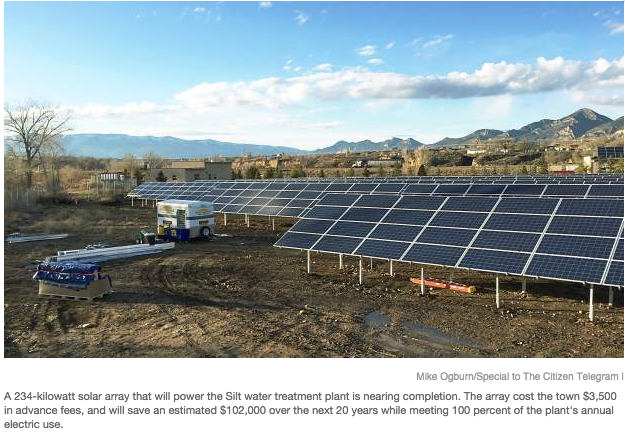
Report: Blocking the Sun — @EnvAm

Click here to read the report. Here’s an excerpt:

Executive Summary

Solar power is clean, affordable and popular with the American people. The amount of solar energy currently installed in the U.S. can power one in 14 American homes; that amount is expected to triple within the next ve years.

The growth of American solar energy in the past decade has been the result of smart solar-friendly state policies like net metering and tax incentives for solar infrastructure, putting clean energy within nancial reach of millions more Americans. The recent appointment of officials favored by electric utilities and fossil fuel interests to key positions within the Department of Energy and other federal agencies makes the preservation of strong solar policies in the states more important than ever.

In 2017, utilities continue to chip away at key state policies that put rooftop solar on the map in the United States, making it harder for Americans to invest in clean energy.

This report documents 20 fossil fuel-backed groups and electric utilities running some of the nation’s most aggressive campaigns to slow the growth of solar energy in 12 states, including eight attempts to reduce net metering bene ts and seven attempts to create demand charges for customers with solar power. Citizens and policy-makers must be aware of the tools that utilities are using to undermine solar energy across America and redouble their commitment to strong policies that move the nation toward a clean energy future.

A national network of utility interest groups and fossil fuel-backed think tanks has provided the funding, model legislation and political cover to discourage the growth of rooftop solar power.

• The Edison Electric Institute, the trade group that represents U.S. investor-owned electric utilities, launched the current wave of attacks on solar in 2012. Since then, EEI has worked with the American Legislative Exchange Council to create model legislation to repeal state renewable electricity standards and attack net metering.
• The American Legislative Exchange Council also provides utility and fossil fuel interests with access to state legislators, and its anti-net metering policy resolution has inspired legislation in states like Washington and Utah.
• The Koch brothers have provided funding to the national fight against solar by funneling tens of millions of dollars through a network of opaque nonpro ts. The Koch-funded campaign organization Americans for Prosperity (AFP) has carried out anti-solar organizing exorts.
• The Consumer Energy Alliance (CEA) is a Houston-based front group for the utility and fossil fuel industry, representing companies like Florida Power and Light, ExxonMobil, Chevron and Shell Oil. CEA has spent resources and shipped representatives across the country to help utilities fight their battles in states like Florida, Indiana, Maine and Utah.
• The state industry group Indiana Energy Association successfully lobbied on behalf of the state’s biggest electric utilities to end net metering, replacing it instead with a new solar policy that limits consumer compensation for generating rooftop power.

At the state level, electric utilities have used the support provided by national anti-solar interests, as well as their own ample resources, to attack key solar energy policies.

• In Florida, Florida Power and Light, Gulf Power Electric, Tampa Electric Company and Duke Energy, the largest utility in the U.S., spent millions of dollars funding the front group, Consumers for Smart Solar, which was the primary backer of a failed 2016 ballot initiative that would have restricted rooftop solar growth. In 2017, Florida Power and Light drafted language for a new bill to restrict solar growth in Florida.
• Two major Arizona utilities – Arizona Public Service and Salt River Project – have success- fully pushed for anti-rooftop solar policies. Arizona Public Service, the biggest utility in Arizona, has also been accused of improperly cultivating in influence with the state commission that regulates utilities and funneling dark money into recent commissioner elections.
• In Utah, Rocky Mountain Power tried once again to eliminate net metering and charge additional fees to its 20,000 customers that generate rooftop power. Public outcry from ratepayers and the solar industry forced Rocky Mountain Power to settle, grandfathering all current solar customers into net metering.
• In Texas, El Paso Electric renewed its past attempt to create a separate, and more expensive, rate class for solar customers. In 2015, the utility spent $3.1 million on filing and negotiating fees, an amount ultimately charged to ratepayers, before dropping the proposal, only to pick it up again this year.
• In 2015, Nevada Energy successfully campaigned the Nevada utilities commission to eliminate net metering, a move that e ectively halted the growth of rooftop solar in its service territory for two years. After widespread public protest, state legislators e ectively reinstated net metering in 2017.

As of mid-2017, there were at least 90 ongoing policy actions in U.S. states with the potential to a ect the growth of rooftop generation, such as limits on net metering or new utility fees that make solar power less a affordable.

State decision-makers should resist utility and fossil fuel industry in influence, and reject policies such as

• Elimination of, restrictions on, or unfair caps on net metering;
• Discriminatory surcharges or tariffs for solar customers;
• Utility rate designs that discourage solar adoption;
• Unnecessary regulatory burdens on solar energy; and
• Rollbacks of renewable electricity standards.

In addition, state leaders should embrace ambitious goals for solar energy and adopt policies that will help meet them, including:

• Considering the bene ts of distributed solar energy to the grid, to ratepayers and to society in any rate making or policy decisions about solar energy;
• Implementing strong net metering and interconnection standards, which enable many customers to meet their own electricity needs with solar power;
• Encouraging community shared solar projects and virtual net metering, which can expand solar access to more customers;
• Enacting or expanding solar or distributed renewable carve-outs and renewable electricity standards;
• Enabling financing mechanisms to allow for greater solar access to businesses and residents;
• Allowing companies other than utilities to sell or lease solar to residents and businesses; and
• Making smart investments to move toward a more intelligent electric grid that will enable distributed sources of energy such as solar power to play a larger role.

Policymakers should also uphold our country’s commitment to reduce carbon pollution. Solar power will play a major role in any strategy to reduce global warming pollution and the carbon footprint of the energy we generate and consume.
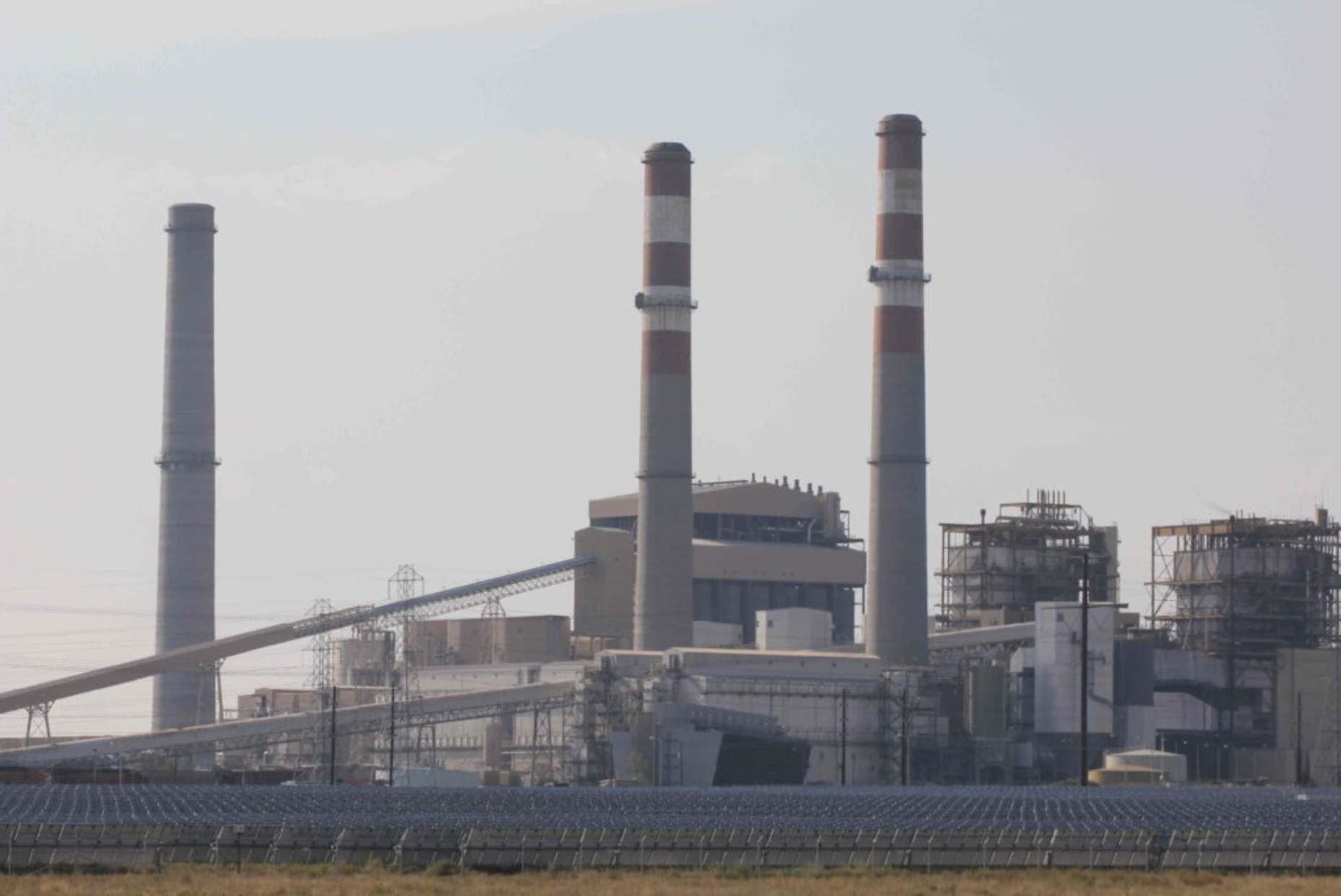

As coal plants close, more calls for 100% renewable goals — The Mountain Town News

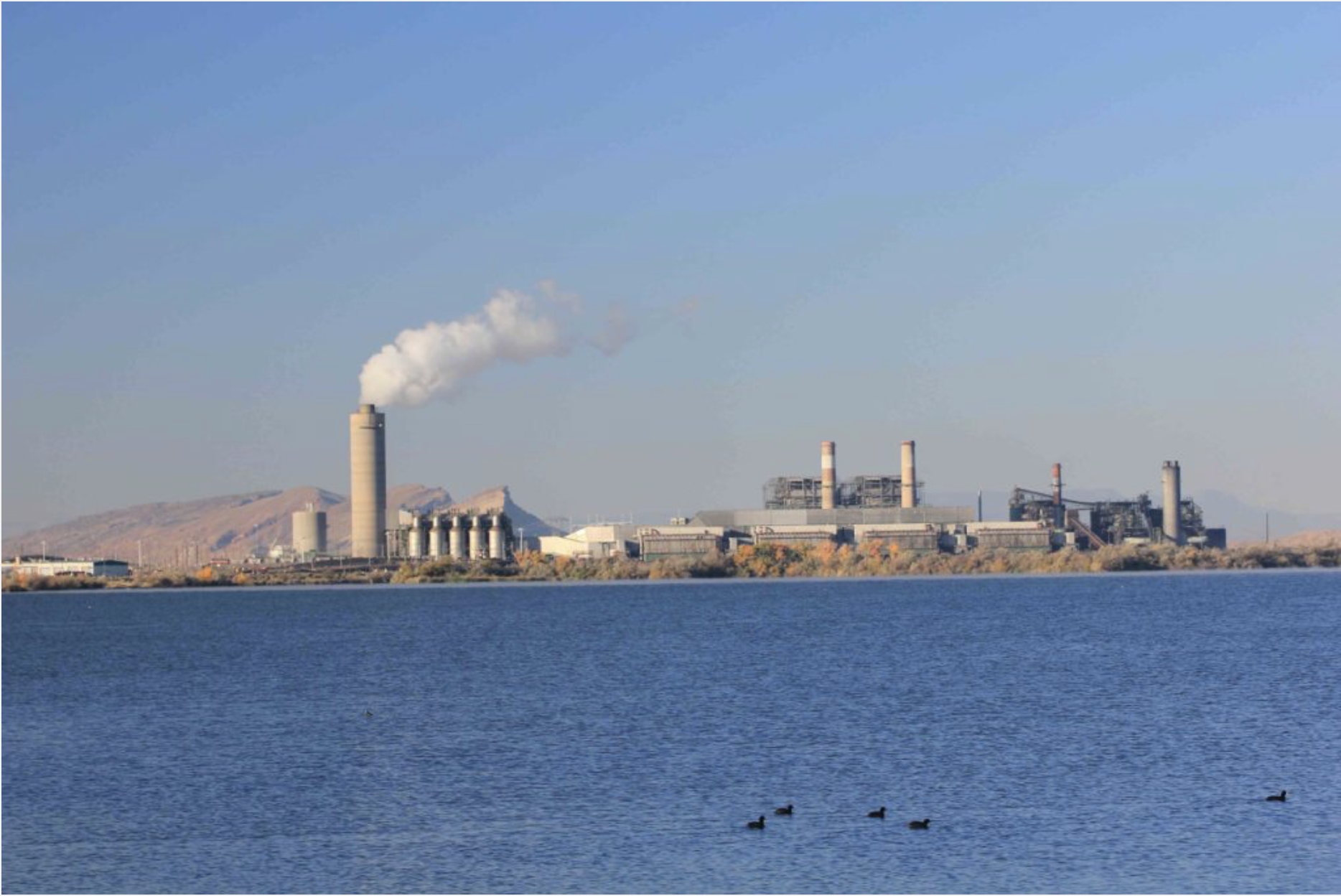
Xcel Energy proposes to close two of its coal-fired generating units at Comanche, indicated by smokestacks at right. The stack at left, for the plant completed in 2010, provides energy for a portion of Aspen and for the Roaring Fork and Eagle valleys. In the foreground is the largest solar farm east of the Rocky Mountains at its opening. Photo/Allen Best

From The Mountain Town News (Allen Best):

Xcel decision fortifies calls for 100 percent renewables

The Sierra Club has been pushing Durango to commit to 100 percent locally produced and renewable electricity by 2050.

The argument of petitioners, reports the Durango Herald, is that in addition to cutting carbon emissions, the local, renewable energy would create local jobs and stabilize energy rates as the cost of fossil fuels continues to rise.

The petition in Durango fits in with a broad pattern across the country of calls for municipalities to embrace goals of 100 percent renewables during the next few decades. In Utah, for example, Salt Lake City, Moab, and Park City have all embraced that goal. In Colorado, so have the Front Range communities of Fort Collins, Boulder, and Pueblo.

That goal no longer seems so far-fetched. Major, investor-owned utilities have been rapidly investing in renewables not because they have to, but because of tumbling prices for wind, but also solar. Cost of utility-scale storage has also started sliding.

Last week, Colorado’s largest utility, Public Service Co., a subsidiary of Xcel Energy, announced that it would seek approval of state regulators to retire two coal-fired generating plants at Pueblo, which began operations in 1972 and 1974. The retirements, if approved by the Colorado Public Utilities Commission, will mean Comanche I and II will be retired a decade earlier than previously scheduled.

Xcel wants to replace the lost power with some natural gas-fired electricity but mostly with renewables, with up to 1,000 megawatts of wind and 700 megawatts of solar. It wants to move fast, too, to take advantage of federal tax credits that are scheduled to expire in 2020.

Cost to consumers will stay the same or more likely go down, explained David Eves, the utility’s president of Colorado operations. Reduced greenhouse gas emissions are a bonus.

After the switch, Xcel expects its will be at 55 percent in carbon-free generation. This year, it will be completing conversion of a coal-fired power plant in Denver to natural gas. It had also converted a plant in Boulder last year.

Xcel delivers power to Colorado’s Summit County, where Breckenridge elected officials recently heard from a local group that wanted a commitment to 100 percent renewables, first in city operations and then a few years later in the community at large. Town officials weren’t ready to commit, lacking a clear path to achieve these goals. This was a week before the Xcel announcement.

Mark Truckey, a town planner in Breckenridge who is a member of the local 100 percent group, called the Xcel announcement “huge.”

“This has to speak volumes about how the cost is coming down,” he said. Yet he concedes it’s not exactly clear how Breckenridge can achieve what his group advocates.

In Utah, it’s the same story. Rocky Mountain Power last week reached a deal with solar advocates about a transition. The utility, which serves Park City, has a plan for adding more wind generation from southern Wyoming and upwards of 1,000 megawatts —the equivalent of a giant coal-fired power plant—in solar generation from Utah.

It used to be that renewables came with a price premium. As the Xcel and Rocky Mountain Power cases illustrate, that has changed. Aspen also proves the case.

Aspen gets more than half of its electricity from wind turbines just north of I-80 in the Nebraska panhandle. Photo credit The Mountain Town News.

Aspen Electric was an early adopter. The utility serves half to two-thirds of Aspen. More than a decade ago it invested in two wind turbines in Nebraska. It has also invested heavily in hydroelectric. As a municipality, it is also eligible for electricity from the giant dams of the West.

Several years ago it was able to achieve 100 percent renewables. Despite the renewables—or maybe because of them—residential customers in Aspen pay 20 percent less per kilowatt-hour than co-op members such as those serving Durango.

The rest of Aspen, including the ski area, gets its electricity from Holy Cross Energy. If moving briskly toward renewables, Holy Cross still gets a substantial amount of its electricity from another coal-fired power plant at Pueblo. Although news as of 2010, it increasingly looks archaic.

Solar panels have become abundant on rooftops. Even so, solar delivered just 2 percent of Colorado’s electricity in 2016. Solar energy proponents expect that will change. Costs of panels have declined 64 percent in the last five years, points out the Summit Daily News, citing the Colorado Solar Energy Industry Association. Too, utilities like Xcel, Rocky Mountain Power, and Tri-State Generation and Transmission are increasingly investing in giant farms of solar panels.

Tri-State provides electricity for the co-operatives that serve the Colorado mountain towns of Winter Park, Grand Lake, Crested Butte, and Telluride. The power for Durango also comes from Tri-State through La Plata Electric Association.

Last year, 53 percent of Tri-State’s electricity came from coal, although 27 percent came from renewables, and more is coming on line all the time, says Lee Boughey, spokesman. He points to 75 megawatts of wind generation from southeastern Colorado that will go on-line later this year.

About 4 percent of Durango’s power comes from local renewable sources, but a major solar plant on the Southern Ute reservation has also been added, reports the Durango Telegraph.

Volunteers help to construct the solar system at a low-income, rental-housing subdivision in La Plata County. Photo/LPEA

Can Durango get to 100 percent renewables, as the Sierra Club petition seeks? La Plata hasn’t said no, although there are many challenges. Most illuminating is a white paper from the co-op’s chief executive, Mike Dreyspring. The paper describes the evolution of markets that will allow slow-cost electrons from renewable sources to be moved around the grid to match demands. That other changes are poised to disrupt old business models—including the centralized power generation of the last half of the 20th century.

Locally produced power, called distributed generation, “shifts the balance sheet risk from owners of central station bulk power generation assets to DG owners,” the paper says. “The traditional, vertically integrated electric utilities that adapt to this changing market place will financially thrive.”

Another way of saying this is that yes, the train is out of the station. It’s just a matter of accommodating the new renewables. Whether 100 percent renewables is possible is a discussion for another day.

This story was published in the Sept. 5 issue of Mountain Town News, an e-mail based newsmagazine first distributed to subscribers. Please consider subscribing or donating.

Denver: Clean Energy Means Business Corporate Summit, November 7-8, 2017

History Colorado Center

From The Denver Business Journal (Cathy Proctor):

“A growing number of organizations and institutions are interested in solar, and it’s not necessarily about sustainability,” said Henderson, who also is the president of the board of directors of the Colorado Solar Energy Industries Association (COSEIA), a trade group for the state’s solar sector.

“They’re seeing the opportunity to reduce operating costs and impact the bottom line,” he said.

To that end, COSEIA has organized the Clean Energy Means Business Corporate Summit, to be held Nov. 7-8 at the History Colorado Center in downtown Denver.

The two-day summit is aimed at executives and energy management professionals interested in using clean energy to lower operations costs and support sustainability efforts.

“You can go renewable and reduce your operating costs, but people are surprised by that. They want to learn more about it,” Henderson said.

Since 2012, businesses in the U.S. and Mexico — including IKEA, Google, Apple, Kaiser Permanente, 3M and Microsoft — have purchased nearly 9,000 megawatts of renewable energy supplies, according to the Business Renewables Center in Boulder, part of the Rocky Mountain Institute.

Three reasons for optimism about climate change — The Mountain Town News

Coyote Gulch’s Leaf connected in the parking garage in Winter Park, August 21, 2017.

From The Mountain Town News (Allen Best):

Despite Trump, train has already left the station, says former Obama aide

U.S. President Donald Trump has initiated steps to withdraw the United States from the Paris climate agreement and end the Clean Power Plan. But a former advisor to President Barack Obama was anything but gloomy recently as he cited three major reasons for optimism.

Brian Deese said one reason was that economic growth has been decoupled from growth in carbon emissions. This was discovered as the United States emerged from the recession. Obama was in Hawaii when Deese informed him of the paradigm shift that had been observed.

Brian Deese photo credit Wikipedia.com.

“I don’t believe you,” Obama said, according to the story Deese told in a forum on the University of Colorado campus that was sponsored by the Center for Science and Technology Policy Research.

Chastened, Deese double-checked his sources. He had been right. Always before, when the economy grew, so did greenhouse gas emissions. Now, the two have been decoupled. This decoupling blunts the old argument that you couldn’t have economic growth while tackling climate change. The new evidence is that you can have growth and reverse emissions.

The second reason for optimism, despite the U.S. exit from Paris, is that other countries have stepped up. Before, there was a battle between the developed countries, including the United States, and China, Indian and other still-developing countries. Those developing countries said they shouldn’t have to bear the same burden in emissions reductions.

But now, those same countries — Chna, India and others — want to keep going with emissions reductions even as the United States falters. They want to become the clean-energy superpowers.

“China, India and others are trying to become the global leaders in climate change. They see this as enhancing their economic and political interests,” he said. “They want to win the race.”

That same day, the Wall Street Journal reported in a front-page story that China plans to force automakers to accelerate production of electric vehicles by 2019. The move, said the newspaper, is the “latest signal that officials across the globe are determined to phase out traditional internal combustion engines that use gasoline and diesel fuels in favor of environmentally friendly vehicles powered by batteries, despite consumer reservations.”

The story went on to note that India has a goal to sell only electric vehicles by 2030 while the U.K. and France are aiming to end sales of gasoline and diesel vehicles by 2040.

In the telling of the change Deese said this shift came about at least partly as the result of an unintended action — and, ironically, one by the United States. Because of China’s fouled air, the U.S. embassy in Beijing and other diplomatic offices in China had installed air quality monitors, to guide U.S. personnel in decisions regarding their own health.

Enter the smart phone, which became ubiquitous in China around 2011 to 2012. The Chinese became aware of a simple app that could be downloaded to gain access to the air quality information. In a short time, he said, tens and then hundreds of millions of Chinese began agitating about addressing globalized air pollution, including emissions that are warming the climate.

A third reason for optimism, said Deese, is that Trump’s blustery rhetoric has galvanized support for addressing climate change. Some 1,700 businesses, including Vail Resorts, have committed to changes and 244 cities, representing 143 million people, have also said they want to briskly move toward renewable energy generation.

To this, Deese would like to add the conservation community, by which he seemed to mean hunters and fishermen. “In the United States, we need to reach people where they are, and communicate to them how they are being affected by climate change,” he said.

He also thinks scientists need to step up to advocate. “Use your voice,” said Deese, now a fellow at the Harvard Kennedy School. “The rest of the world is there.”

#ClimateChange: “We are stealing from other living things” — David Radcliff #ActOnClimate

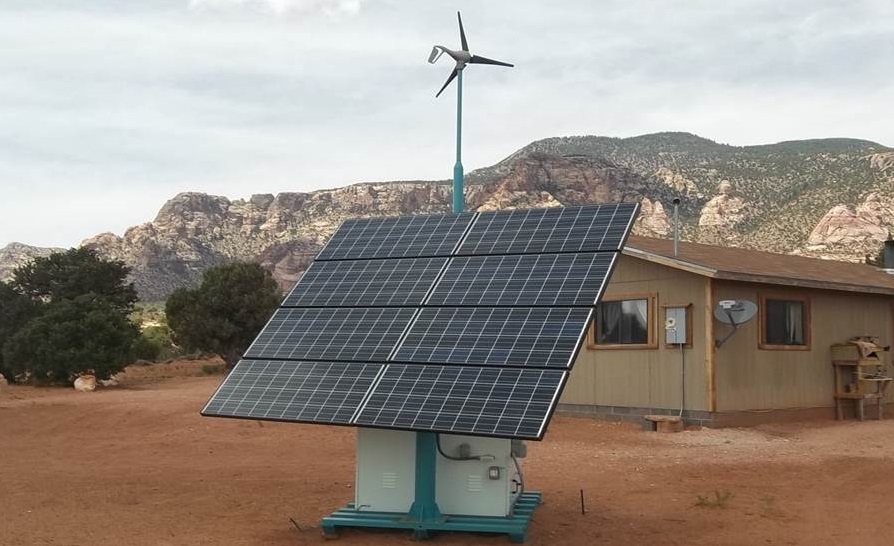
A residential solar hybrid unit. Photo from Navajo Tribal Utility Authority via Energy.gov.

Here’s a report about religious groups in Colorado and New Mexico working to abate the climate crisis from Sarah Tory writing for The High Country News. Click through and read the whole article. Here’s an excerpt:

Last year, [Pastor Jim Therrien] joined the Interfaith Power & Light campaign, “a religious response to global warming” composed of churches and faith communities across the U.S. Since 2001, the network had expanded its membership from 14 congregations in California to some 20,000 in over 40 states. The group provides resources to churches and other faith communities for cutting carbon emissions — helping install solar panels, for instance, and sharing sermons on the importance of addressing climate change.

Therrien says he is merely “following the Scripture.” In the process, however, he has joined a growing environmental movement that brings a religious dimension to the problem of climate change…

Here at his hardscrabble New Mexico parish, Therrien continues to practice what he preaches. On a hot day in July, he herded 28 visitors into the mission’s two white vans for a drive out onto the Navajo Nation. The group, mostly Easterners, ranged in age from 8 to over 60 and had traveled to the Lybrook mission as part of a weeklong fact-finding trip. Like Therrien, many were members of the Church of the Brethren, a Protestant denomination with a history of activism. More recently, their focus had shifted to environmental issues — especially climate change.

“It’s concerning that our government is pulling back from what we should be focusing on,” one of them, Jim Dodd, told me. Recently, the giant Larsen Ice Shelf had broken off from Antarctica, and Dodd was worried. “Villages already at sea level are going to get flooded,” he said.

Leading the group was David Radcliff, director of the New Community Project, a Vermont-based organization. “It’s a fairness issue for the rest of God’s creatures,” he told me. Radcliff has led “learning tours” around social and environmental justice issues for church groups, most recently, to the Ecuadorian Amazon.

Radcliff, a small, wiry man with an intense blue gaze, wore a white T-shirt with a very long slogan on the back. “Earth is a mess,” it said, and “God’s not amused.” If you aren’t satisfied, it added, “do something about it.”

For Radcliff, discussing the facts of climate change isn’t enough. That’s where religion comes in. “At a certain point, you have to talk about the consequences, and past that it becomes a conversation about morality,” he said. Take moose in the Northeast: They are dying from tick infestations exacerbated by a warming climate, caused by humans taking more from the Earth than they need, he said. “We are stealing from other living things.”

Morgan County Commissioners give green light to #solar farm #ActOnClimate

Photovoltaic Solar Array

From The Fort Morgan Times (Paul Albani-Burgio):

The Morgan County Commissioners voted 3 to 0 Tuesday to approve a conditional use permit and variance for the construction of a solar farm on 20 acres of land near the intersection of County Road 21 and County Road N southeast of Fort Morgan.

The farm is being built by Starlight Energy Corporation on land owned by Peter V. and Karen V. Anderson. Commissioner Mark Arndt said Starlight is proposing to sell the electricity that is generated from the farm to the Morgan County Rural Electric Association to provide power for Morgan County residents but a power purchase agreement has not been finalized. Arndt said Starlight has also talked about Fort Morgan Light and Power as a possible buyer of the electricity that will be generated.

The facility is expected to generate about 2 megawatts of solar power per year and a half of a megawatt of natural gas power. Though the number of homes powered by a megawatt of solar energy depends on average sunshine, electricity consumption, temperature and wind in a given area, it is estimated that one megawatt can power about 650 homes.

Starlight Energy CEO Brian Bentley said the company was hoping to have the solar farm constructed and operational in the first quarter of 2018. Bentley said a portion of the facility that will generate natural gas when not enough solar power is being generated should be operational by the fourth quarter of this year.

The solar industry is creating jobs nearly 17 times faster than the rest of the US economy #ActOnClimate

Solar panels, such these at the Garfield County Airport near Rifle, Colo., need virtually no water, once they are manufactured. Photo/Allen Best

From the Climate Reality Project:

In 2016, jobs in the United States solar industry increased nearly 17 times faster than the rate of the overall economy. This was part of a global trend of jobs growing in renewable energy.

Republished from Futurism. Licensed under CC by NC 4.0/Desaturated from original.

The data shows it: We don’t have to choose between good jobs and the future of our planet. A new report released by the International Renewable Energy Agency (IRENA) reveals that solar jobs in the US (and around the world) are expanding rapidly.

As of November 2016, the American solar industry employed 260,077 workers – an increase of 24.5 percent from 2015. When you crunch the numbers, that means the solar industry is growing just shy of 17 times faster than the American economy as a whole. That’s incredible progress.

So in what areas of the industry are these jobs? The lion’s share (241,900) were in solar photovoltaic (PV). According to IRENA, the worldwide growth in solar PV jobs had to do with “declining costs and supportive policy frameworks in several countries around the world [that] led to a record year for solar in 2016.”

In addition to photovoltaic, an additional 13,000 American solar jobs were in solar heating and cooling, and the remaining 5,200 were in concentrated solar power (CSP).

In terms of job function, more than half of all solar jobs in the US were in installation. Another 15 percent were in manufacturing, with 13 percent in project development, 12 percent in sales and distribution, and a final 6 percent in other areas, including research and development.

It’s important to remember: Not only is the solar industry booming – but the jobs pay well, too. As costs for materials continue to drop, solar jobs remain a well-compensated area for blue-collar workers. Bryan Birsic, CEO of Wunder Capital, said, “It seems to be one of the few areas of high-paying, blue-collar jobs – and you don’t have to learn to code.”

Another sign of improvement? The solar labor force is becoming more diverse, with the number of women workers at 28 percent in 2016, up from 19 percent from 2013. This means more women have jobs in solar than in the conventional energy industry, although women in solar still lag behind their representative 47 percent of the US economy.

A RENEWABLE FUTURE

Solar isn’t the only thriving industry in the US economy right now – the wind industry put about 102,500 people to work in 2016. In fact, wind turbine technician is the single fastest growing occupation in the United States. IRENA projects the industry will grow to 147,000 jobs by 2020.

Here’s the reality: jobs in dirty energy are on the decline as fuel sources become more scarce and less expensive options become available. But people laid off from the fossil fuel industry can find safer, well-playing jobs in clean energy. And as prices continue to drop, all of us can expect to see more and more jobs in clean energy. That’s good for our economy and for our planet.

@SenBennetCO: #Colorado Leading the Way in Community Solar

Graphic via Idaho Power.

Here’s a blog post from Colorado Senator Michael Bennet:

As Washington careens from manufactured crisis to inane distraction, global temperatures continue to rise, and the need for more jobs and higher wages increases. More and more, it falls on communities to take the lead in fighting climate change and expanding our clean energy economy.

Solar power offers one of our best opportunities to do so. Despite wild swings in our national politics, solar power has grown by an average of 70 percent each year over the last decade, while the cost of installation has fallen by nearly as much.

Despite these gains, nearly half of U.S. households and businesses cannot host a solar power system, either because they rent, share the space, or have a layout unsuitable for installation. Solar can never reach its full potential until we find a way to reach these consumers.

Our best answer is community solar.

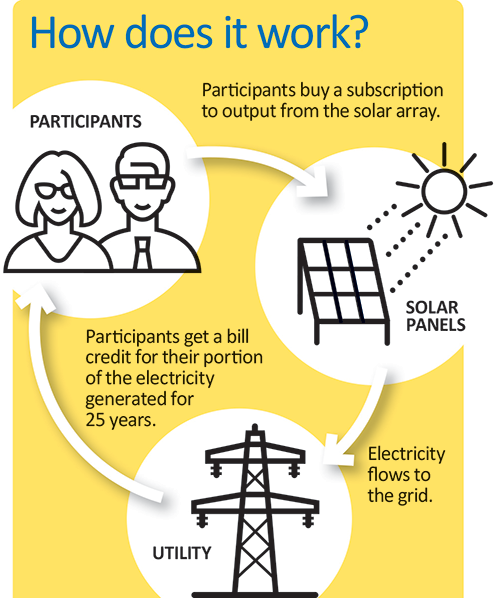
In essence, community solar allows more Americans to enjoy the benefits of clean energy without having to install rooftop panels on their home or business. It does that by converting an unused or marginal space into a solar field and then allowing locals to buy a share of its energy production to offset their consumption.

With community solar, those who cannot afford solar installation, don’t own their home, or live or work somewhere that can’t accommodate a solar system, can still choose clean, renewable energy.

Community solar is one of the most promising developments in renewable energy. It expands access to clean energy resources and helps households and businesses save on their electricity bills. Colorado is leading the way in this new model, but we have only begun to realize its promise.

That is why this week, I introduced legislation to make permanent a Department of Energy program to promote community solar, especially in low-income communities.

The bill also encourages the federal government — the largest employer and consumer in America — to participate in community solar projects.

I have seen the promise of community solar in Colorado. We were the first state to pass legislation on community solar, and in just a few years, we have installed enough community solar to power thousands of homes across our state. Today, over 7,000 Coloradans work in solar, many in community solar projects. For us, this is not some Bolshevik fantasy; it is a proven and profitable enterprise.

One of my favorite places is Pueblo. The Pueblo County School District is the lowest funded district in the state. It’s also the largest, in terms of geographic size. So it was an unlikely candidate to become the first District in the state to source 100 percent of its electricity from solar.

It didn’t have the capital for a major installation. Plus, a lot of schools in the district lacked the right layout for rooftop panels.

That’s where the Clean Energy Collective came in. Working with the District, the Collective built Roofless Solar arrays in town. Now, kids study with lights powered by the sun. Teachers fire up projector screens charged by clean, renewable energy.

In the first year alone, the District saved $35,000. Over the life of the program, those savings will exceed $2 million dollars.

That’s enough to buy a Chromebook for seven out of ten kids in the District. It’s enough to pay all 32 employees at Prairie Winds Elementary for a year.

Stories like this are why community solar has boomed across Colorado.

In the end, this is not just about individuals having a financial stake in a particular solar project; it’s about all of us having a stake in the future, recognizing that — when we come together as a community — we can seize opportunities we once thought were out of reach and make smart investments for tomorrow.

As global temperatures rise and renewable energy provides more job opportunities, we turn to communities for the clean energy leadership we need, now more than ever.

Pagosa Springs sixth grade student renewable energy day

San Juan River from Wolf Creek Pass

From The Pagosa Springs Sun (David Smith)

Meeting this demand with fossil fuels will be increasing dif cult as reserves become depleted. More important, we know that massive burning of fossil fuels damages our environment. Renewable energy sources, such as solar and wind, provide an inexpensive and clean alternative to burning fossil fuels.

To prepare the next generation for this change, Kristin Hentschel, Pagosa Springs Middle School sixth-grade science teacher, orga- nized a Renewable Energy Day.

This project was funded by a $1,000 grant from the Foundation for Archuleta County Education (FACE).
The 120 sixth-grade students were divided into eight groups which visited eight renewable energy projects. Parents and com- munity scientists manned each of the eight stations.

At the end of the day, the stu- dents wrote about their experiences…

“I liked all the stations. This was perfect.” — Daniel B.

Gov. Hickenlooper town hall recap

From The Prowers Journal (Russ Baldwin):

“Colorado basically has the number one economy in America,” the governor remarked, stressing that the demands for agricultural products will remain one of our economic mainstays as it did to help the country out of the Great Depression decades ago. Hickenlooper acknowledged the disparity of growth between the Front Range and rural areas of the state, explaining that he wants to see more technological growth in rural areas including more access to broadband capabilities in the smallest towns in the state.

The governor addressed changing technologies as well, “Automation has begun to eliminate a lot of jobs in the U.S.,” he explained, adding that this change can foster tremendous wealth in some companies which flows upwards to the top 1% earnings bracket. “I’d like to see a way to recoup some of that wealth. I believe the top 1% has an obligation to help create and develop new industries; not as a hand-out, but as a way of sustaining job growth for new sectors of the economy.” The governor also mentioned employing the new Jumpstart program which can provide tax incentives to new businesses after they have been in operation for several years…

John Stulp gave a brief description of future water demands in Colorado, given the state’s growing population. “We’re going to see as many people move to the state over the next 30 years as there will be born from current residents,” he explained, saying that will double the current 5,000,000 residents by the year 2050. Stulp said this will call for more efficient uses of energy and conversation measures as well as planning ahead for additional water storage throughout Colorado.

Regarding the development of more solar and wind power in Colorado, Governor Hickenlooper said it is remarkable that for the first time in almost 50 years, the country will be in a position to be a net exporter of energy by 2018. He said we are facing a challenge with the construction of transmission lines in the region. “The city doesn’t build them, the county doesn’t either. It has to go through the Public Utilities Commission and that is a long and involved process and they are held responsible for making the most cost-effective decisions for their customers.” The governor said he believed the state will see increased construction and use of wind and solar power in the years to come.

The meeting was attended by numerous elected officials as well as representatives of local government and civic organizations. When asked if the topics covered in the public meeting were any different from an earlier private meeting the governor held with some of those officials, the Prowers County Commissioners said some other topics included the on-going issues with conservation easements and the impact CDPHE rulings would have on small communities with regard to maintenance of their landfills.

Southwestern utilities back down from rooftop solar fight — @HighCountryNews @ClimateReality #ActOnClimate

Denver, June 8, 2015. Photo credit Climate Reality Project.

From The High Country News (Elizabeth Shogren):

Not long ago, major electric utilities in much of the Southwest seemed bent on chasing rooftop solar companies out of the region. They saw the booming industry as a threat to their profits and sought rate changes that would make solar panels less financially attractive to homeowners. The electric companies advocated slashing the compensation those customers get for sending their excess power to the grid and adding new fees to their electric bills.

Because the electric companies are monopolies, state regulators have to approve such changes. In late 2015, the Public Utility Commission of Nevada set new rates that were so unfavorable to solar customers that they nearly snuffed out the residential solar business in the state. The number of households applying to connect solar panels to the grid dropped from a peak of nearly 3,000 in August 2015 to just 14 in July the next year. The biggest solar installation companies left the state, laying off thousands of workers.

But that’s not the end of the story. The public was outraged, and its objections resulted in a surprising shift: gradual rollback of the commission’s anti-solar decision…

Apparently big electric companies are learning that given the broad popularity of solar in the sunny desert region, they will have to accommodate rooftop solar instead of trying to kill it. This reflects the growing political might of the solar industry as it’s seen as a key job creator in much of the Southwest.

Please consider coming by the Community Building at Thornton’s Community Park on May 16th. I’ll be speaking about the climate crisis as part of the Climate Reality Project. Children are welcome. We’ve already baked in a lot of uncertainty about the future for them. The presentation revolves around three questions: Should we act; Can we act; and, Will we act? I’ll bring you up to date on the engineering effort around renewable energy.

Details:

  • What: Climate Change is Water Change: Colorado Update
  • Where: Thornton Community Park Community Building (Near the swimming pool), 2211 Eppinger Blvd, Thornton, CO 80229
  • When: Tuesday, May 16, 2017, 6:00 PM – 7:30 PM
  • About the Climate Reality Project:

    With glaciers melting, seas rising, and 14 of the 15 hottest years on record coming this century, the threat of climate change has never been clearer. But with solar, wind, and other clean energy solutions becoming more affordable and accessible every year, neither has the way forward. And with 195 countries signing the historic Paris Agreement to cut greenhouse gases the world is finally united in working to seize the promise of renewables and create a safe, sustainable, and prosperous future powered by clean energy.

    What’s in the way? Powerful fossil fuel companies and their government allies spreading fear and misinformation.

    Led by Vice President Gore and CEO Ken Berlin, we’re here to change that. We connect cutting-edge digital media, global organizing events, and peer-to-peer outreach to share the truth about climate change and the solutions in our hands today with people everywhere. And with our more than 10,000 Climate Reality Leader activists building support for pro-climate policies at every level, and millions joining us to accelerate the global transition to clean energy, we have the chance to stop climate change and together create a future we can be proud of. We’re not about to waste it.

    Colorado Coal Country Sees Economic Salvation In Solar, Organic Farming — @NewsCPR

    West Elk Mine. Photo credit Division of Reclamation Mining & Safety

    From Colorado Public Radio (Grace Hood):

    Workers at the last mine standing in the region, West Elk, met President Donald Trump’s executive order with cautious optimism. But travel to the west central Colorado region, it’s clear that the area isn’t banking on coal coming back to what it used to be. And the decline is clear. It’s meant a few empty storefronts in Paonia, a drop in Delta County School District students, and fewer fully ensured health care patients in the region.

    And there’s another challenge: In contrast to big coal producers such as Wyoming and the Appalachia region back East, federal grant dollars to ease the transition away from coal aren’t flowing as freely into Colorado. That’s according to Democratic state Sen. Kerry Donovan, who represents Delta County.

    “I think what’s unique about Colorado is it’s not thought of as coal country, Donovan said. “Those federal programs have focused on the more traditional West Virginia, Appalachia communities that we think of as coal country. So I think in Colorado it’s going to fall more on the shoulders of the state.”

    […]

    With planning help from state economic developers, Delta County Economic Development Inc. drew up its future plans in 2016. Here’s a look at the key items.

    • Solar: With the help of training school Solar Energy International, the North Fork Valley could see more rooftop solar. Delta County’s high poverty rate has translated into low demand for rooftop panels. With Solarize Delta County, SEI plans to make the energy more accessible and affordable by spurring more local investment. SEI has also launched efforts to retrain coal workers, although SEI Director of Operations Kris Sutton said the effort has been slow going in the short term: “If coal miners here want to pursue solar jobs. They’re going to have to probably move,” Sutton said, referring to the fact that most solar installation jobs are along the Front Range.
    • A specialty food manufacturing incubator: Delta County School District, which runs the region’s technical college, purchased a 22,000 square foot building that will eventually house classrooms, a commercial kitchen and a warehouse. Entrepreneurs could get classes, marketing assistance and a space that helps them create food products out of regional produce from the valley, including organic foods, Ventrello said. “It’s value added. Rather than just selling tomatoes, can you make a high end salsa?”
    • Organic food: In Hotchkiss, Big B’s Juices has evolved from from a shed that sold organic fruit to an outfit that sells juice and a hard cider line across the country. Ventrello says the incubator could help existing businesses like Big B’s expand their business, and hire more folks including out-of-work miners. Shawn Larson, who moved to the area from Utah in 2010 to help start Big B’s hard cider line says every extra job helps. ““We sell products nationwide. You know, we have that reach, but also affect our community,” he said.
    • Recreation and tourism: In its economic blueprint, the county’s economic development group plans to beef up its Gunnison Riverfront property with more access points for water sports, trails and picnic areas. It also calls for a hotel and conference center to make the city more of a destination for travelers.
    • Broadband: Delta-Montrose Electric Association will spend up to $125 million on high-speed broadband internet to the region in the coming years, which includes the towns of Paonia and Hotchkiss. Paonia was one of the first towns to be fully wired with the broadband. Mayor Charles Stewart said it will be one key to recruiting new businesses and drawing more residents to the region. “People like those amenities. When you can say to folks, ‘Yes, you can live in the North Fork and still have high-speed internet access,’ that’s a positive,” said Stewart.
    • Other renewables: It’s not just individual homeowners that could see more solar in Delta County. The region’s electricity provider, Delta-Montrose Electric Association, is also seeking to add more solar and hydroelectric power to its grid. Meantime, regional economic development leaders like Tom Huerkamp are eyeing the region’s shuttered mines and seeing another economic opportunity: generating power from methane that naturally vents from shuttered underground mines. “If we tap the old coal mines, this community has the ability in the next maybe five to 10 years to disconnect from the grid,” Huerkamp said.

    Record 2016 Renewable Energy Levels Came 23% Cheaper Than 2015 — Clean Technica #ActOnClimate

    From Clean Technica (Joshua S. Hill):

    Specifically, according to the United Nations Environment Programme (UNEP), global investment in renewable energy for 2016 came in at $241.6 billion, 23% less than in 2015, but nevertheless helped to deploy 138.5 gigawatts (GW) of new renewable energy capacity (excluding large-hydro), a figure up 8% from the 127.5 GW installed in 2015. The new report UNEP report, Global Trends in Renewable Energy Investment 2017, found that the total investment level was the lowest it has been since 2013, due in large part to falling costs, rather than a drop in demand.

    “Ever-cheaper clean tech provides a real opportunity for investors to get more for less,” said Erik Solheim, Executive Director of UN Environment. “This is exactly the kind of situation, where the needs of profit and people meet, that will drive the shift to a better world for all.”

    U.S. coal use falls 9 percent in 2016 #ActOnClimate

    One of the generating units at the power plant at Kemmerer, Wyo., is being shut down this year to reduce emissions that are causing regional haze. 2009 photo/Allen Best

    From Climate Central (Bobby Magill):

    …it was little surprise when the federal government reported this week that U.S. coal use fell 9 percent in 2016, even as Americans consumed more energy overall. The U.S. used more natural gas and renewables last year than ever before, while oil use and even nuclear power were on the rise, too…

    Coal use fell last year for the third year in a row — after slight increases in 2012 and 2013 — and has been steadily declining in the U.S. since it peaked a decade ago, according to U.S. Energy Information Administration data…

    Part of the problem for coal, however, is that Americans aren’t as hungry for electricity as they used to be, thanks in part to more energy efficient buildings and appliances…

    Cheap prices along with federal mercury emissions regulations became big incentives for electric companies to build natural gas power plants and shut down their coal-fired power plants, or run them using natural gas instead of coal.

    The fallacy of Trump’s vow to restore the coal economy — The Mountain Town News

    One of the generating units at the power plant at Kemmerer, Wyo., is being shut down this year to reduce emissions that are causing regional haze. 2009 photo/Allen Best

    From The Mountain Town News (Allen Best):

    Trump vows to bring back coal, but coal has lost favor for many reasons

    With coal miners at his side, President Donald Trump last week signed an executive order that seeks to undo the Obama administration’s Clean Power Plan.

    In coal towns, there was rejoicing. The plan requires a gradual switching of power sources to reduce greenhouse gas emissions 32 percent by 2030. Unless carbon capture and storage technology advances rapidly, this puts coal at a great disadvantage.

    Coal plants were already closing in droves. They’ve been losing out to cheaper natural gas, which has fewer greenhouse gas emissions and can be dispatched in a matter of minutes, unlike coal plants, which take about a day to crank up. This makes natural gas a better fit with renewables, whose prices have tumbled dramatically in the last five years.

    But coal plants in the Rocky Mountains have also been closing because of their dirty environmental footprint, not even considering greenhouse gas emissions. The sulfur dioxide and other emissions contribute heavily to regional haze, also called smog.

    For example, PacifiCorp announced it would close one of its generating units at its power plant at Kemmerer, Wyo., located south of Jackson Hole. The plant provides power for Park City. The reason: the electricity wasn’t needed, because of improved energy efficiency, and to upgrade the plants to reduce pollutants was too expensive.

    In northwest Colorado, Tri-State Generation and Transmission and other electrical providers have agreed to shut down a 427-megawatt power plant at Craig by 2025. This is 42 miles west of Steamboat Springs. Again, the problem is regional haze and other environmental pollutants.

    The Four Corners power plant, in northwestern New Mexico. Photo/Allen Best

    In New Mexico, it’s the same story. There, two units of the San Juan Generating Station are to be shut down by the end of this year, notes the Durango (Colo.) Herald.

    The Herald says Public Service Co. of New Mexico is deciding whether the remaining units at the San Juan complex will operate beyond 2022.

    The New York Times today makes the same point in this story by Coral Davenport: “Coal is on the Way Out at Electric Utilities, No Matter What Trump Says.”

    At the Colorado Solar Energy Industries Association conference, former Colorado Gov. Bill Ritter pointed to action at state and local levels, along with that of private companies, all aiming to clean up energy sources. Among those pushing are a variety of Republican governors in an organization called the Conservative Energy Network.

    “What this makes me believe is that no matter what happens at the federal level for the time being, there are opportunities,” said Ritter.

    Wyoming didn’t join that coalition, even if Gov. Matt Mead continues to prod his state into making changes.

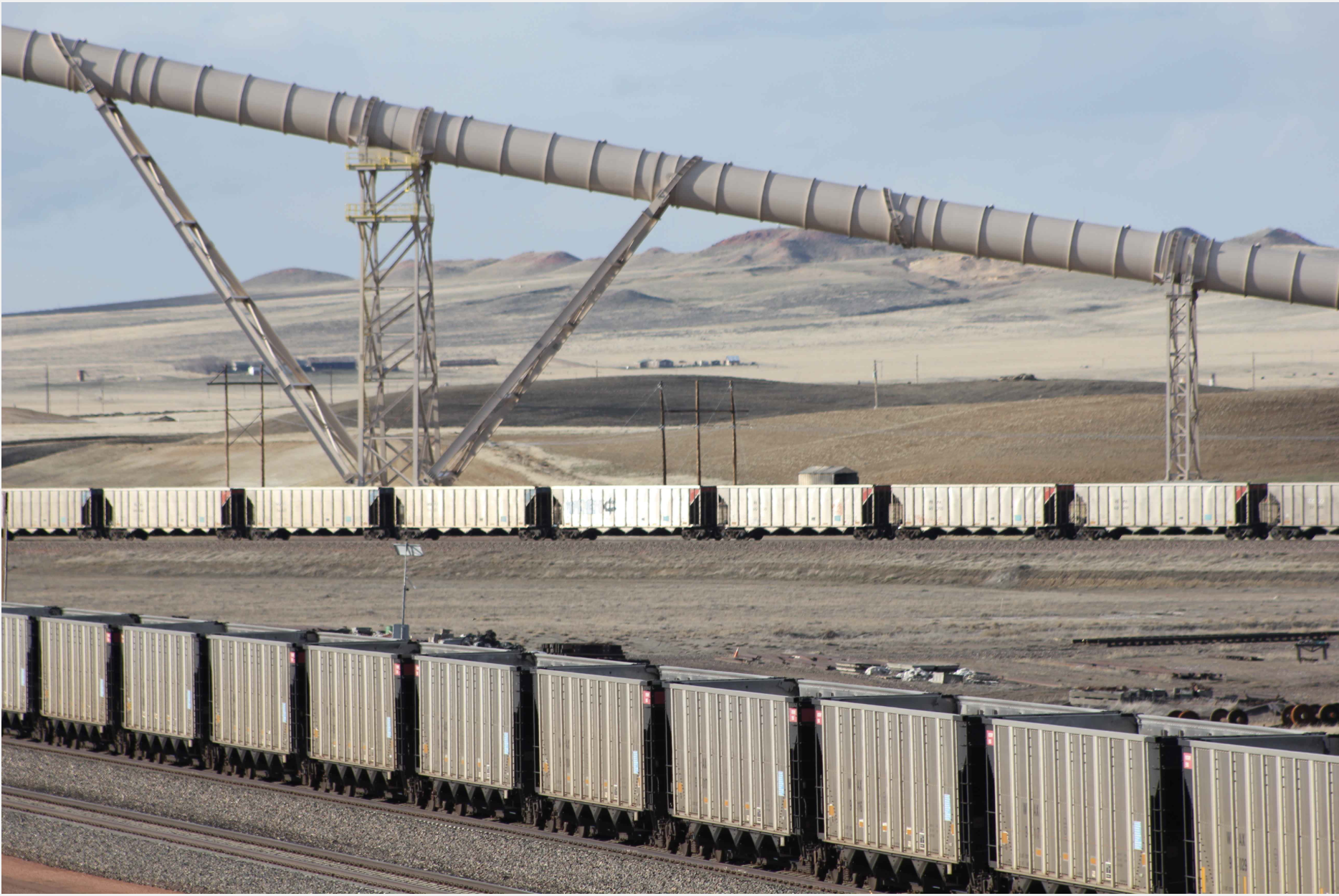
    Coal trains await loading in the Powder River Basin of Wyoming. Photo/Allen Best

    Jonathan Schechter, writing in the Jackson Hole News & Guide, while pondering his own mortality, wants Wyoming to similarly quit denying that the day for the end of coal is drawing nigh. Wyoming has been living high as the go-to source for low-sulfur coal since the 1980s. You can still see mile-long coal trains grinding their way through Denver’s booming LoDo section on their way to plants as distant as Texas, Mississippi and even, for a time, Florida.

    Nearly 40 percent of the nation’s coal-fired power plants closed between 2006 and 2016, and most remaining plants are on the verge of functional obsolescence. In 20 years, Schechter observes, nearly 90 percent of the plants will be 40 years old or older. As these plants close down – likely to be replaced by natural gas and renewables – “so too will the market for Wyoming’s coal, and with it the economic benefits coal has bestowed upon our state.”

    Wyoming has no income tax. That simple fact, as much as the amazing sight of the Teton Range, may explain why Jackson Hole rivals Aspen for billionaires per capita. “When the day comes that income is taxed, Jackson Hole will start to become home to a much different demographic,” Schechter concludes.

    As for Trump’s vow to bring back coal, the logical question in the face of all this evidence is, will the president also promise to bring back cheap gas, like the 18.9 cents per gallon of his youth?

    The economics of solar energy #ActOnClimate @ClimateReality

    Solar panels, such these at the Garfield County Airport near Rifle, Colo., need virtually no water, once they are manufactured. Photo/Allen Best

    From EcoWatch (Emma Gilchrist):

    The solar industry was responsible for creating one out of every 50 new jobs in the U.S. last year and the country’s fastest-growing occupation is wind turbine technician—so no matter one’s feelings on climate change, the renewable energy train has left the station, according to a new report.

    “It’s at the point of great return. It’s irreversible. There is no stopping this train,” said Merran Smith, author of Tracking the Energy Revolution 2017 by Clean Energy Canada. “Even Donald Trump can’t kill it.”

    More than 260,000 Americans are now employed in the solar industry, more than double the 2010 figures. Meanwhile, the top five wind-energy producing congressional districts are represented by Republicans…

    “Global trends show some renewable energy technologies have reached ‘grid parity’ with fossil fuels—thanks to falling technology costs—meaning no financial support is required to make their cost equal to, or cheaper than, their fossil fuel competitors,” reads the report.

    The European Union led the pack, with 86 percent of its new electricity capacity coming from renewable sources in 2016.

    In 2016, China added 30 GW of new solar capacity—or roughly enough solar panels to cover three soccer fields every hour, according to the report.

    By 2015, renewable electricity employment is estimated to have grown to 6.7 million direct and indirect jobs globally, with solar PV the leading technology, employing nearly 2.8 million people. It is estimated that in 2015 Canada was home to 10,500 jobs in wind and 8,100 in solar PV.

    The cost of renewables is expected to continue to come down, leading to further job creation. Between 2015 and 2025, the International Renewable Energy Agency projects generation costs for onshore wind to fall another 26 percent, while offshore wind generation costs fall 35 percent and utility-scale solar PV costs drop 57 percent.

    I will speaking about the climate crisis in Thornton on Monday. Click here for the details.

    Roundtable on renewable energy recap — The Guardian

    Wind farm Logan County

    From The Guardian (Martin Wright):

    What impact will the climate-sceptic, coal enthusiast President Trump have on the prospects for renewable energy? How will Brexit affect the UK’s renewable sector? And what’s driving the growth of clean energy in Asia? These were key questions for participants at a Guardian roundtable on the future of wind and solar power, supported by Julius Baer.

    And the answer to the Trump question? Precious little impact at all. The sheer strength of the renewables sector – driven by plummeting costs and a growing appetite among consumers and business alike – means it will continue to thrive despite the new administration’s doubts. That was the near-unanimous view of the participants. And it might even win over the president himself, as his business brain engages with the potential of clean energy on the one hand, and coal’s lack of it on the other.

    Gina V Hall, investment director at The Carbon Trust, predicted that “a lot of the talk about bringing back coal jobs will start to fade. The rhetoric will be put aside in the face of the facts.” And the most persuasive fact of all is market logic. With renewables approaching grid parity (costing the same as electricity bought from the mains supply), their momentum is becoming unstoppable.

    Many of America’s most powerful companies, such as Apple and Google, are strongly committed to clean energy, said Hall, “and they’re not going to let the government get in the way of what they want to do.”

    Several participants at the roundtable pointed to the fact that clean energy enjoys strong bipartisan support. As Laura Cozzi from the International Energy Agency commented, over half of the renewable capacity installed recently is in Republican-governed states. Such support might even help secure the future of the tax credits that presently help underpin new investments in the sector, said Anja-Isabel Dotzenrath of E.ON Climate and Renewables.

    “The word ‘renewable’ doesn’t feature in Trump’s America First plan – but it is full of talk of exploiting the country’s natural resources, delivering low-cost energy and creating jobs. Well, wind and solar can do all that.” And they have the potential to do a lot more, particularly in the rustbelt areas Trump is committed to helping.

    The jobs argument is particularly powerful, given that more US citizens are employed in solar power than in generating electricity through coal, oil and natural gas combined. As Clark MacFarlane, CEO of Siemens Wind Power UK, put it: “Trump’s core policy is more jobs. So why do anything to destroy American jobs, especially ones delivering low-cost energy?”

    Investors in the US are wary of being caught on the wrong side of history, said Martin Wright, chair of the Renewable Energy Association. “A lot of them are starting to view fossil fuels like tobacco – as a pariah sector.” And they don’t want to be left with stranded assets, stuck in coal as the market moves decisively away from it. By contrast, the falling prices of solar and wind make it increasingly appealing. Environmental economist Paul Ekins, of University College London, summed it up: “The markets will trump Trump.”

    […]

    Growth in China and India
    The real growth story in wind and solar, of course, is happening not in Europe or the States, but Asia, with both China and India investing heavily. So what’s driving that?

    It’s partly the same story of falling costs, with China eyeing huge export markets – in solar in particular. But there’s also growing local demand, driven by two things – energy access and health. “Public health concerns in China are changing energy policy fundamentally. There’s no going back now,” said Helena Molin Valdés of the UN Environment Programme.

    Anil Raj, co-founder of Indian solar business OMC Power, pointed out that air quality is front-page news there. “People worry about pollution in European cities, but they are like sanatoriums compared to New Delhi. Politicians spend a lot of time there, and they can’t help but see and feel it too, and that’s why things are happening.”

    But, he added, the need for energy access will always be the prime driver. “There are two narratives around energy. A developing-world narrative and a carbon-reduction one.” For the former, energy access is king. “We have 350 million people living off grid in India. If we needed to burn coal [to connect them], we would do that.” So it is fortunate, he continued, that fossil fuels are not the solution: “The cheapest and fastest way of connecting [off-grid people] in India is via renewables.” Sarah Chapman, CEO of Faro Energy, said that’s increasingly true in Latin America too.

    Energy storage next big thing
    So is everything in the renewables garden rosy? Not for Ekins. “We’re not getting nearly enough investment to meet the Paris target [of keeping the global temperature rise to two degrees above pre-industrial levels].” Other panellists echoed his concerns.

    So how can the process be sped up? “We need to design the power markets of the future to favour renewables,” said Cozzi. That will become all the more important as technologies such as smart grids and improved battery storage come into play. Wright argued for simplification, moving away from incentives based around specific technologies to a system in which if you’re producing renewables – or enabling storage of renewable power – you get paid for it, regardless of technology.

    And, he added, the government shouldn’t be shy of setting some tough rules to drive progress: “Look at the buildings industry. If you hadn’t had some tough regulation there, you wouldn’t have indoor toilets or double glazing.” Householders need incentives to do the right thing, he argued: “So why not link stamp duty to SAP [energy-efficiency] ratings?”

    All panellists agreed that the sheer speed of technological change would continue to disrupt the energy market – and, in the long term at least, renewables should be the clear winner. As battery technologies improve, so wind and solar will become even more appealing, overcoming the intermittent nature of such power sources (the wind doesn’t always blow, the sun doesn’t always shine), by storing the electricity they produce for when it’s needed. “Storage will give us the next generation of energy billionaires,” predicted Ekins.

    Put all that together, and the logic of renewables becomes irresistible, said Wright. “It’s not a case of doing it to save the planet any more. People are seeing this as a business opportunity. It’s as simple as that.”

    I will be speaking about the climate crisis and the great message about renewable energy on March 29th and April 3rd.

    Senate confirms Zinke as Interior Secretary

    Loveland: Solar to replace hydro from damaged Idylwilde dam

    Idylwilde Dam via Loveland Water and Power
    Idylwilde Dam via Loveland Water and Power

    From TheDenverChannel.com (Kurt Sevits):

    The city of Loveland has finished work on a large-scale solar power installation that aims to replace the damaged Idylwilde hydroelectric dam.

    The dam, built in 1917, was badly damaged in the Sept. 2013 floods that devastated the Front Range corridor.

    Loveland received about $9 million in disaster recovery funds from the Federal Emergency Management Agency to construct the new Foothills Solar and Substation project, which the city says is capable of producing more power than the dam.

    The Idylwilde Dam’s hydroelectric facility was capable of producing 900 kilowatts of electricity before it was removed. The new solar project, on the other hand, has a capacity of 3.5 megawatts, more than tripling the output of the dam.

    City officials said the solar project is expected to produce about 6,813 megawatt hours of electricity each year — enough to power about 574 homes.

    To produce as much power as possible, the array uses solar tracking technology, which allows the panels to move throughout the day so they’re always facing the sun.

    Boulder-based Namaste Solar designed and built the solar array.

    The city said the project is the first energy-producing facility to receive approval through FEMA’s “Alternate Project” program, which permits the use of federal money for new construction when restoring a damaged building isn’t considered to be in the public interest.

    $5.1 million of the FEMA funds were used to build the solar array. The remainder will be used to construct an electric substation on the site. It’s expected to be completed in the spring.

    #Solar watering systems: “You store water instead of electricity” — Vance Fulton

    Photo via SolarPumps.com.
    Photo via SolarPumps.com.

    From The Craig Daily Press (Michael Neary):

    Solar-powered water systems let livestock drink more easily and take pressure off ponds and streams

    [Vance Fulton], an engineering technician with the Natural Resources Conservation Service, described the way solar energy provides an effective way for landowners to transport water to their livestock.

    “Especially around here, (landowners) have found that solar is a much more efficient way to pump water than the old windmills,” Fulton said.

    And now, with the birth of the Sage Grouse Initiative, the solar-powered systems are receiving increasing amounts of federal support. Fulton said the systems have received funding through the Farm Bill for decades — but for the last several years, SGI has targeted more money for the solar-powered projects in places where the sage grouse is affected, such as Moffat County.

    Surprising as it may seem at first glance, the creation of multiple water sources for cattle helps sage grouse too.

    The system often works this way: A solar panel powers a pump that drives water through an underground pipeline, and the pipeline delivers the water to troughs at various points in the land so that animals can drink. The pump often fills up a storage tank for a backup water supply, as well.

    The system, as Fulton explained it, creates an efficient means of supplying water to animals on the land. By creating several water sources, the system also eases stress on the ponds, puddles and streams where animals may gather to drink. That benefits a host of creatures — including the sage grouse.

    Chris Yarbrough, formerly a biologist with the Rocky Mountain Elk Foundation, who is now regional habitat biologist for Idaho Fish and Game, explained how a water system such as this can help sage grouse. If there’s only one pond on a ranch, he said, that’s where the cows will congregate.

    “That area will probably get overgrazed, and you’ll probably get a lot of weeds — things that aren’t good for wildlife,” he said.

    But water troughs scattered throughout the land can attract animals to different spots, easing the pressure on a pond or a stream.

    “The grasses and (other plants) then have a chance to grow,” he said — something that’s good for sage grouse and lots of other species, as well.

    Yarbrough said much of the funding to install solar pumping systems in Moffat County is generated by the SGI, launched by the Natural Resources Conservation Service in 2010.

    Fulton said the NRCS works with about 20 landowners in Moffat County on solar watering systems, and he noted there may be others using solar power, as well. It’s a number that’s far larger, he said, than it was about a decade ago, before the SGI.

    One of the Moffat County landowners who uses solar-powered system is Doug Davis, who has a ranch called Davis Family Farm LLC that lies in the eastern part of the county.

    “We discovered a very good water source up high, and because it’s up high you can use gravity flow,” Davis said.

    Davis explained that the solar panel on this ranch pumps water from the well into a storage tank — and from that storage tank, gravity allows the water to flow through pipes to troughs throughout the property. Davis said that, on another property, he uses the solar-powered pump to push water directly to the troughs.

    windmillgreghobbs

    Either way, Davis said he’s glad to be using solar energy. He used to use windmills, which could be tough to maintain and less reliable.

    “Windmills are much higher maintenance, and the wind does not blow as consistently as the sun shines,” he said. “Solar, which has turned out to be a low-maintenance, relatively low-cost proposition for us, is a winner.”

    As Fulton walked through Davis’s land on that sunny July day, he pointed to some small nuances in the equipment, including strategically placed fencing to protect the plumbing from the animals drinking from the troughs, and a “small animal escape ramp” to let otherwise trapped animals climb to safety.

    Fulton said the solar-powered system works without batteries, which means that energy is transferred directly to the pumps. It also means that the amount of energy may vary from day to day, depending on the supply of sunlight at a given time. That’s where the agility of the pumps comes into play.

    “These pumps are able to work on variable voltage,” he said. “They’ll even continue to pump on a slightly cloudy day.”

    Storing water during the sunny days, Fulton said, creates a water supply to use on the cloudy ones.

    “You store water instead of storing electricity,” he said.

    Fulton said, too, that advances in technology — in the pumps and the solar panels — have made the system even better than it used to be.

    “It got more dependable, more efficient through the years,” he said — a sign that the sun soaking ranches throughout the county will be put to good use for many more years to come.

    #ClimateChange: Renewables overtake coal as world’s largest source of power capacity — The Financial Times

    From The Financial Times (Pilita Clark):

    About 500,000 solar panels were installed every day last year as a record-shattering surge in green electricity saw renewables overtake coal as the world’s largest source of installed power capacity.

    Two wind turbines went up every hour in countries such as China, according to International Energy Agency officials who have sharply upgraded their forecasts of how fast renewable energy sources will keep growing.

    “We are witnessing a transformation of global power markets led by renewables,” said Fatih Birol, executive director of the global energy advisory agency.

    Part of the growth was caused by falls in the cost of solar and onshore wind power that Mr Birol said would have been “unthinkable” only five years ago.

    Average global generation costs for new onshore wind farms fell by an estimated 30 per cent between 2010 and 2015 while those for big solar panel plants fell by an even steeper two-thirds, an IEA report published on Tuesday showed.

    The Paris-based agency thinks costs are likely to fall even further over the next five years, by 15 per cent on average for wind and by a quarter for solar power.

    It said an unprecedented 153 gigawatts of green electricity was installed last year, mostly wind and solar projects, which was more than the total power capacity in Canada.

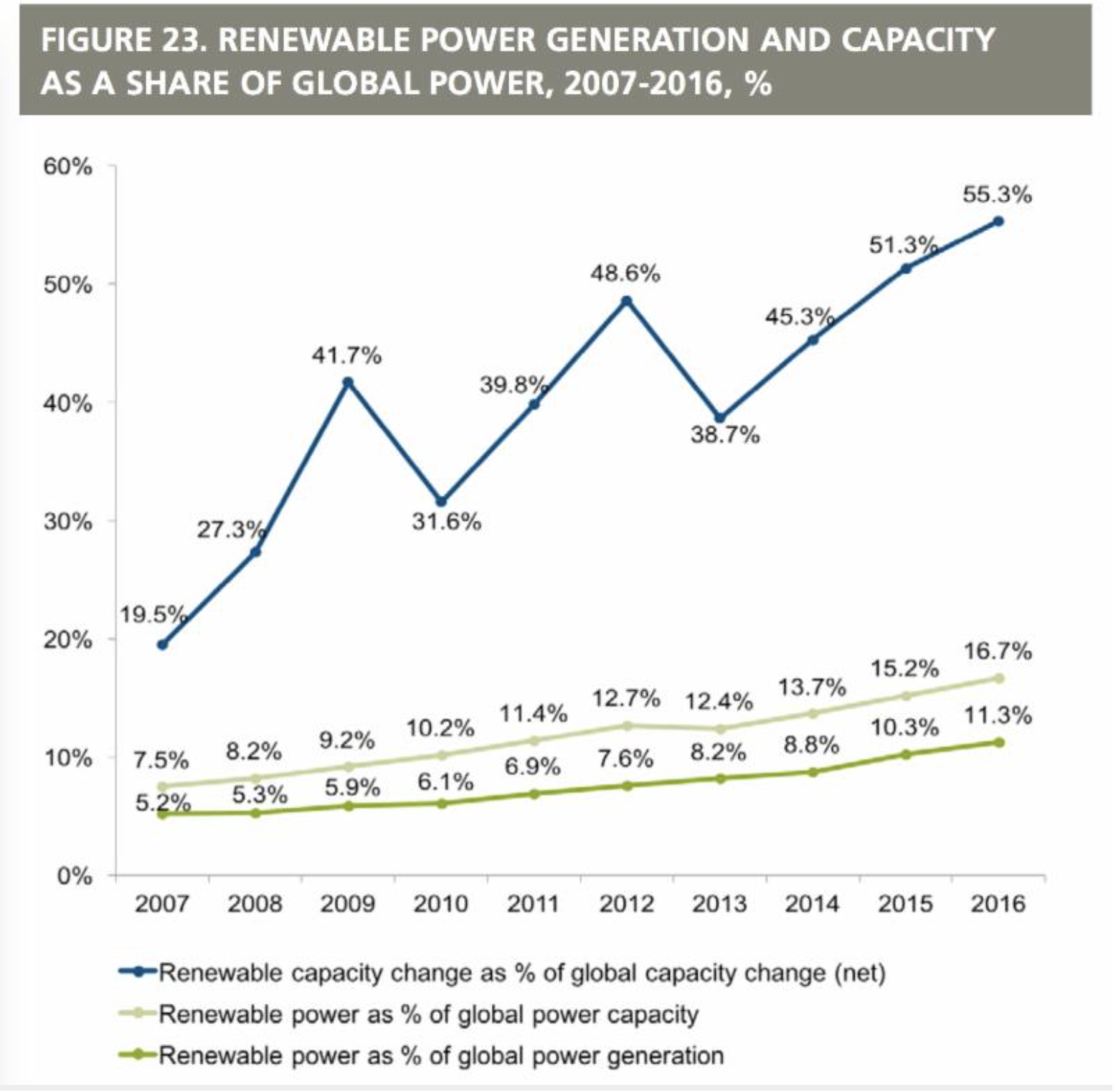
    This was also more than the amount of conventional fossil fuel or nuclear power added in 2015, leading renewables to surpass coal’s cumulative share of global power capacity, though not electricity generation.

    A power plant’s capacity is the maximum amount of electricity it can potentially produce. The amount of energy a plant actually generates varies according to how long it produces power over a period of time.

    Because a wind or solar farm cannot generate constantly like a coal power plant, it will produce less energy over the course of a year even though it may have the same or higher level of capacity.

    Coal power plants supplied close to 39 per cent of the world’s power in 2015, while renewables, including older hydropower dams, accounted for 23 per cent, IEA data show.

    But the agency expects renewables’ share of power generation to rise to 28 per cent by 2021, when it predicts they will supply the equivalent of all the electricity generated today in the US and EU put together.

    It has revised its forecasts to show renewables’ capacity will grow 13 per cent more between 2015 and 2021 than it had thought would be the case just last year, mostly because of stronger policy backing in the US, China, India and Mexico.

    Paolo Frankl, head of the IEA’s renewable energy division, said efforts to address climate change were only part of the reason for this policy drive.

    Air pollution worries were also spurring growth in countries such as China, a renewable energy juggernaut that alone accounts for close to 40 per cent of capacity growth.

    NREL’s new chief talks about the path to a carbon-neutral future — Denver Business Journal

    Click here to read the whole interview. Here’s an excerpt:

    “We need to innovate and do research on all different forms of energy,” [Martin Keller] said. “It would be a mistake to write off any — as long as the energy is carbon neutral. That’s the biggest thing, [because] burning fossil fuels is changing the environment.”

    Keller took the reins at NREL, part of the network of laboratories run by the U.S. Department of Energy, at the end of November 2015. He hails from a sister DOE facility in Tennessee, the Oak Ridge National Laboratory, where he served as the associate laboratory director for energy and environmental sciences.

    He succeeds Dan Arvizu, who announced plans in March 2015 to retire from the lab after more than 10 years as its director.

    #ClimateChange: Boulder’s clean energy pledge was driven by a lack of state and national leadership — The Colorado Independent

    From The Colorado Independent (Kelsey Ray):

    Boulder aims derive 100 percent of its electricity from renewable energy sources by 2030. By the Sierra Club’s measure, that makes Boulder the 17th city nationwide to commit to the ambitious climate goal.

    Mayor Suzanne Jones announced the plan last week during a clean energy event in Denver put on by environmental groups. She said the commitment is good news in the fight against climate change, but that Boulder’s motivation stems largely from an unfortunate lack of action at the state and national levels.

    “The story here is that cities are having to lead because there isn’t national leadership, and frankly there’s limited state leadership,” she told The Independent.

    The need for state and local government action has been a focus of environmentalists since the Paris climate conference. As Jones tells it, Boulder aims in the future “to push for better state policies and programs through the legislature, and (to) work with the administration to try to move the ball forward.”

    Boulder’s clean energy goal has been in the works since May, when council members agreed in theory to commit to 100 percent renewable electricity. The goal for 2030 will become official, in the form of a finalized citywide climate commitment, this December. In the meantime, the city’s staff has been directed to develop a roadmap to make the commitment possible.

    One such staff member is Jonathan Koehn, Boulder’s regional sustainability coordinator. Koehn said the commitment to 100 percent renewables is a sub-strategy for meeting the city’s larger goal of reducing overall greenhouse gas emissions by 80 percent by 2050. The same goal was set statewide in 2008 via an executive order by then-Gov. Bill Ritter, but Gov. John Hickenlooper’s 2015 climate plan made no mention of it — or any other measurable, quantifiable goals.

    Koehn is quick to point out that Boulder’s latest commitment is only to clean electricity, and thus doesn’t mean the city will suddenly stop using oil and gas. Boulderites will still use natural gas to heat their homes, and the city’s public transportation system will still run on fossil fuels. But powering the electric grid with renewables will better prepare Boulder for the inevitable uptick in electricity use that future changes — like a shift to electric cars and buses — will undoubtedly bring.

    “If we want to move people off of fossil fuels, we want to do it when the electricity supply is as clean as it can be,” said Koehn.

    The plan also doesn’t mean that Boulder will stop using carbon-powered electricity. It will stay connected to the state’s larger grid, which, like the city does now, uses a mix of renewable and fossil fuels to smooth out the supply during peak demand times. But by 2030, Boulder will produce enough renewable energy for its own use, leading to the same net impact as if it used only its own, separate grid.

    This commitment to generating enough electricity to cover total use differs from that of Aspen, which is currently known as one of three U.S. cities to already run only on renewables. Aspen actually still gets about half of its electricity from coal-fired power plants and simply offsets the difference by purchasing renewable energy credits from out-of-state utilities, like a wind farm in Nebraska. Boulder is committed to actually creating renewable energy, not just paying for it.

    Boulder’s energy staff will spend the next several months hammering out the details of its climate commitment plan. Then, according to a memo released from the May 10 meeting, a finalized “comprehensive energy transition strategy” will be expected in 2017, when the city has a better sense of whether it will municipalize its utility or renew a contract with Xcel Energy.

    Both Jones and Koehn admit that transitioning to a 100 percent renewable electricity supply won’t be easy, but say it’s both necessary and economically sound. [ed. emphasis mine]

    Said Koehn, “People can continue to shake their heads at this, but we know that this is where our society needs to go in terms of stabilizing our climate.”

    Jones added, “The wonderful thing about this is that moving to 100 percent renewable energy is not only the right thing to do, but it’s the right business choice.”

    Business voices come out in support of Clean Power Plan — GreenBiz #keepitintheground

    Solar panels, such these at the Garfield County Airport near Rifle, Colo., need virtually no water, once they are manufactured. Photo/Allen Best
    Solar panels, such these at the Garfield County Airport near Rifle, Colo., need virtually no water, once they are manufactured. Photo/Allen Best

    From GreenBiz (Barbara Grady):

    Tech titans Apple, Google, Microsoft and Amazon as well as global brand companies Ikea, Mars, Adobe and Blue Shield Blue Cross Massachusetts told a U.S. court Friday that they need the federal Clean Power Plan for economic reasons.

    In two separate Amici Curiae briefs filed in U.S. Circuit Court supporting the EPA’s plan for reducing carbon emissions from the nation’s power plants by 32 percent, the corporate giants said without a “national carbon mitigation plan,” they face “undesirable business risk,” energy price volatility and higher costs.

    With these arguments, the businesses seem to have flipped prospects for the Obama administration’s centerpiece climate change policy, which only a month ago looked dim after the U.S. Supreme Court ruled to delay its enforcement.

    Since the eight companies collectively employ about 1 million people, account for nearly $2 trillion in market capitalization and are major energy consumers — the tech companies alone use 10 million megawatt hours of electricity a year — they have clout.

    Their briefs refute some claims made by 27 states that are plaintiffs in the State of West Virginia, et al vs. U.S. Environmental Protection Agency case challenging the Clean Power Plan as an overreach of federal authority by the EPA in a way that would harm jobs and raise electricity prices.

    Among the companies’ most interesting refutations? Their expansion plans depend partly on how they can procure low-carbon electricity.

    “I believe the extension of tax credits for solar and wind energy is a game changer” — Barbara Boxer

    From USA Today (Bill Theobald) via the Fort Collins Coloradan:

    The annual spending bill negotiated by congressional leaders is stuffed with millions in additional funding for Western needs — from fighting wildfires to fixing national parks and helping deal with the drought.

    In addition, a companion bill would extend tax breaks for solar and wind power.

    Both bills are expected to be approved by the House and Senate in the next few days.

    The budget legislation would fund the government for the rest of the fiscal year that ends Sept. 30. It would reauthorize the popular Land and Water Conservation Fund for three years and appropriate $450 million for the fund to be spent through the Department of Interior and the Forest Service.

    The fund has provided $17 billion through its 50-year lifetime to fund more than 40,000 local recreation projects and to buy about 5 million acres of public lands, mostly in the West…

    Funding in the budget bill is $50 million more than President Obama requested, a 47 percent increase from last year. More than 50 percent of the money will go for local and state recreation projects.

    Alan Rowsome of The Wilderness Society had said Congress would be snatching “defeat from the jaws of victory” if it failed to permanently reauthorize the fund and increase the amount that could be spent.

    For wildfires, the legislation includes $4.2 billion for wildfire fighting and prevention programs within the Department of the Interior and the Forest Service. That’s $670 million more than last year and includes $1 billion in firefighting reserve funds.

    This provision is sure to disappoint members of the House and Senate — mostly from the West — who have been pushing legislation to revise funding for fighting wildfires. Fighting the most severe fires, under these proposals, would be paid for like other natural disasters such as tornadoes and come from emergency funds.

    That would eliminate the need during several recent severe fire seasons to transfer money into firefighting from other activities, including efforts to reduce the number and severity of fires. The bill includes $545 million for hazardous fuels reduction, an increase of $19 million from last year.

    Other provisions of interest to the West in the budget legislation include:

  • National Park Service. The service gets $2.9 billion, up $237 million, including $94 million to reduce the massive maintenance backlog at the parks and to mark the service’s centennial anniversary in 2016.
  • Drought relief. While no comprehensive drought package is included, $100 million is appropriated for the Bureau of Reclamation to address severe drought in the West.
  • Tax breaks include five-year extensions of the production tax credit for wind energy and the investment tax credit for solar energy.
  • Sen. Barbara Boxer of California said the ITC would create about 61,000 jobs in 2017 and retain another 80,000 solar jobs. The American Wind Energy Association estimated extending the PTC would add more than 100,000 jobs in four years in the wind industry.

    “I believe the extension of tax credits for solar and wind energy is a game changer,” Boxer said.

    Solar array powering Battlement water plant — The Glenwood Springs Post Independent

    Solar panels, such these at the Garfield County Airport near Rifle, Colo., need virtually no water, once they are manufactured. Photo/Allen Best
    Solar panels, such these at the Garfield County Airport near Rifle, Colo., need virtually no water, once they are manufactured. Photo/Allen Best

    From the Glenwood Springs Post Independent (Heather McGregor):

    Bill Nelson and Michelle Foster, members of the Battlement Mesa Metro District board, cut a bright yellow ribbon Thursday to celebrate the completion of a solar array that will power the district’s water treatment plant.

    “I am pleased with the fact that we have clean energy involved here. Solar is a wonderful source of energy,” said Nelson.

    The array of 1,422 panels, rated at 440 kilowatts, will power all of the water treatment plant’s electrical demand on a yearly basis. Battlement’s is the fourth water plant in Garfield County to be net-zero for electricity, along with plants in Rifle, Silt and Carbondale.

    “Solar energy is good for Garfield County,” said Garfield County Commissioner Mike Samson, noting that solar arrays create employment and pay for themselves with energy production.

    “Renewable energy diversifies and builds the economy,” said Stuart McArthur, Parachute Town Administrator and chair of Garfield Clean Energy.

    Exxon, Keystone, and the Turn Against Fossil Fuels — The New Yorker (Bill McKibben)

    The grass roots, Washington DC via the Washington Post
    The grass roots in Washington, DC via the Washington Post

    From The New Yorker (Bill McKibben):

    The fossil-fuel industry—which, for two centuries, underwrote our civilization and then became its greatest threat—has started to take serious hits. At noon today [November 6, 2015], President Obama rejected the Keystone Pipeline, becoming the first world leader to turn down a major project on climate grounds. Eighteen hours earlier, New York’s Attorney General Eric Schneiderman announced that he’d issued subpoenas to Exxon, the richest and most profitable energy company in history, after substantial evidence emerged that it had deceived the world about climate change.

    These moves don’t come out of the blue. They result from three things.

    The first is a global movement that has multiplied many times in the past six years. Battling Keystone seemed utterly quixotic at first—when activists first launched a civil-disobedience campaign against the project, in the summer of 2011, more than ninety per cent of “energy insiders” in D.C. told a National Journal survey that they believed that President Obama would grant Transcanada a permit for the construction. But the conventional wisdom was upended by a relentless campaign carried on by hundreds of groups and millions of individual people (including http://350.org, the international climate-advocacy group I founded). It seemed that the President didn’t give a speech in those years without at least a small group waiting outside the hall to greet him with banners demanding that he reject the pipeline. And the Keystone rallying cry quickly spread to protests against other fossil-fuel projects. One industry executive summed it up nicely this spring, when he told a conference of his peers that they had to figure out how to stop the “Keystone-ization” of all their plans.

    The second, related, cause is the relentless spread of a new logic about the planet—that we have five times as much carbon in our reserves as we can safely burn. While President Obama said today that Keystone was not “the express lane to climate disaster,” he also said that “we’re going to have to keep some fossil fuels in the ground rather than burn them.” This reflects an idea I wrote about in Rolling Stone three years ago; back then, it was new and a little bit fringe. But, this fall, the governor of the Bank of England, Mark Carney, speaking to members of the insurance industry at Lloyds of London, used precisely the same language to tell them that they faced a “huge risk” from “unburnable carbon” that would become “stranded assets.” No one’s argued with the math, and that math indicates that the business plans of the fossil-fuel giants are no longer sane. Word is spreading: portfolios and endowments worth a total of $2.6 trillion in assets have begun to divest from fossil fuels. The smart money is heading elsewhere.

    Which brings us to the third cause. There is, now, an elsewhere to head. In the past six years, the price of a solar panel has fallen by eighty per cent. [ed. emphasis mine] For years, the fossil-fuel industry has labored to sell the idea that a transition to renewable energy would necessarily be painfully slow—that it would take decades before anything fundamental started to shift. Inevitability was their shield, but no longer. If we wanted to transform our energy supply, we clearly could, though it would require an enormous global effort.

    Don’t you just love renewable energy capital markets moving the polluters out of the picture?

    Here’s a report about the impending bankruptcy of Arch Coal from Elizabeth Shogren writing for The High Country News. Here’s an excerpt:

    There’s no question that the president’s Clean Power Plan and his other air pollution regulations cloud the future of the industry. But coal’s bleak present has much more to do with other factors; chief among them the low price of natural gas and bad business decisions that the country’s biggest coal companies made in recent years. “These are undoubtedly difficult, if not unprecedented, times for the coal sector,” Glenn Kellow, chief executive officer of Peabody, the world’s largest coal company, reportedly said on the company’s recent earnings call.

    Both Arch Coal and Peabody Energy paid billions of dollars to acquire metallurgical coal mines when prices of this type of coal, which is used to make steel and other metals, were soaring. The price has since collapsed, leaving the companies swamped in debt and their stock prices a small fraction of what they used to be. In Arch’s case, it spent $3.4 billion in 2011 to buy International Coal Group, Inc., acquiring 13 mines in the eastern United States. At the time, the only company more invested in metallurgical coal was Alpha National Resources, (remember that name), which was buying Massie Energy for $7.1 billion. That same year, Peabody shelled out $5.2 billion for metallurgical coal mines in Australia.

    The companies borrowed to buy these metallurgical coal mines, with the expectation that Asia, especially China, would gobble up all the metallurgical coal they could produce. What they didn’t count on was the price of metallurgical coal spiraling downward due in part to increased supplies of metallurgical coal from other countries and slower growth in China. Now U.S. metallurgical coal sells for less than half what it did in 2011.

    Arch’s debt comes due next year. Scrambling to avoid bankruptcy, Arch tried to get creditors to renegotiate its debt, but the effort collapsed at the end of last month. Peabody has until 2018, and yet its stock has fallen from more than $1,000 in 2011 to less than $13 this fall.

    The West is largely a bystander to this high drama, except that the companies that produce the most coal in the West are caught in the middle of it. Profitable mines owned by these companies in Wyoming’s Powder River Basin likely still will operate under whatever slimmed-down companies emerge from bankruptcy or under new ownership. But underground mines, where it costs more to extract the coal, may be less lucky. Peabody’s Twentymile mine in northwestern Colorado reportedly already has experienced significant reductions in production.

    Mines in the West are not immune from the other main factor vexing the coal industry: low natural gas prices. Coal’s share in electricity production dropped from 50 percent in 2005 to 39 percent in 2014, and natural gas overtook coal as the biggest electricity producer for two months this year. The Energy Information Agency expects an 8 percent decrease in total coal consumption in 2015 compared to 2014, mainly driven by electric companies shifting to low-cost natural gas. Retirement of coal-fired power plants due to the Obama administration’s Mercury and Air Toxics Standards contributed, but to a lesser degree, according to the Energy Information Agency. “The big story here is gas and how cheap it is,” says Robert Godby, associate economics professor at the University of Wyoming who focuses on coal.

    Why so few water markets in the West? — The Mountain Town News

    The Four Corners Generating Station in northwestern New Mexico draws water from the San Juan River. 2014 photo/Allen Best
    The Four Corners Generating Station in northwestern New Mexico draws water from the San Juan River. 2014 photo/Allen Best

    From The Mountain Town News (Allen Best):

    Water intensity of energy but also why the West has so few water markets

    The value of water depends upon context. To somebody in a desert, absent a drink for three days, nothing could be more valuable. In a flood, the value of the water would lie in its absence.

    In Western states, where scarcity more generally prevails, we’re still fumbling with how much value to assign water. Stacy Tellinghuisen brings this observation to her work in evaluating water issues at the nexus with energy for Western Resource Advocates, an environmental non-profit. WRA in 2011 issued a report “Every Drop Counts: Valuing the Water Used to Generate Electricity.”

    Stacy Tellinghuisen
    Stacy Tellinghuisen

    In a conference call sponsored by The Biomass Monitor, Tellinghuisen said that one of the few water markets exists in northern Colorado. There, in the area north from Denver, many cities and farms get water diverted from the Colorado River via an elaborate diversion structure called the Colorado-Big Thompson project. Completed after World War II, the C-BT was intended to provide water to expand agriculture. Now, the water has mostly been purchased for municipal use in the Boulder-Greeley-Fort Collins area.

    Water prices spiked between 2000 and 2008, said Tellinghuisen, reviewing the report that WRA did several years ago. “The price increased significantly, and that was largely due to significant drought in 2001 and 2002, combined with additional population growth in the region,” she said.

    “I think that trend is a really relevant when you think about climate change and continued municipal growth across the West,” she added.

    Why does this more highly developed market exist in northern Colorado? And why is it absent elsewhere?

    Tellinghuisen explained that she thinks it’s because of the unusual nature of the C-BT. The project was finished at one time, water becoming available in the form of shares. This is in contrast with water availability in so many other places governed by the doctrine of prior appropriations. Appropriation dates vary greatly, as do allotments and other factors.

    Tap fees are one way of measuring the value of water. They are the costs of getting the right to hook into the water-delivery infrastructure of a city or other jurisdiction. In theory, tap fees would be more-or-less uniform across a metropolitan area, just as the price of bread varies only marginally from one store to the next. In practice, said Tellinghuisen, there is great variability. She cited the example of Denver, which charges $5,000 for a tap fee, as compared with one of Boulder’s suburbs, where the cost is $25,000.

    Even within individual cities, water can be valued very differently. Southern Nevada Water Authority has specified rates for existing users. How then to explain the current efforts by Las Vegas to extend pipelines hundreds of miles away to tap aquifers along the Nevada-Utah border? The cost of that water would necessarily be much higher.

    Water consumed in generating electricity also varies greatly. Coal-fired power plants used significant quantities, typically 500 to 600 gallons per megawatt of production, while nuclear power plants use on the order of 700 gallons per megawatt. Combined-cycle natural gas plants use less, 180 to 200 gallons per megawatt.

    Dry-cooling techniques for fossil-fueled generation can reduce water use by up to 90 percent, and more electrical production now comes from natural gas, instead of coal, resulting in a net reduction in the water footprint of energy.

    In the renewable sector, biomass plants vary greatly, between 400 and 500 gallons per megawatt. Wind and solar use virtually none, except for concentrated solar—which uses a lot of water.

    Solar panels, such these at the Garfield County Airport near Rifle, Colo., need virtually no water, once they are manufactured. Photo/Allen Best
    Solar panels, such these at the Garfield County Airport near Rifle, Colo., need virtually no water, once they are manufactured. Photo/Allen Best

    Recent years have brought greater awareness of the water intensity of various forms of electrical production. Investor-owned utilities, the primary providers of electricity in Colorado and other states, are governed by state-appointed public utility commissions, and those utilities in recent years have begun describing water impacts in the resource-planning documents they are required to submit to regulators.

    Arizona Public Service was among the first to begin disclosing water impacts, but others now do so, too. Statutes delegating authority to PUCs provide authority to consider water, said Tellinghuisen, but there’s also a broadening understanding of the water-energy nexus among energy companies and government regulators.

    Why does it matter?

    “It comes back to a zero-sum game,” said Tellinghuisen. Virtually all rivers in the West are tapped out. For expansion of water use for one purpose, other water uses must be curtailed. While there are laws that govern the transfer, meaning a new power plant couldn’t just seize water, causing cities and farms to go dry, it is part of societal choices. WRA obviously thinks that the minimal water use of renewables is a major argument for increased renewables.

    Silt water plant to be powered by sun — Rifle Citizen Telegram

    Silt water plant solar array photo via the Rifle Citizen Telegram
    Silt water plant solar array photo via the Rifle Citizen Telegram

    From the Rifle Citizen Telegram (Heather McGregor):

    Crews are setting foundations, erecting racks and installing solar panels in a wave of activity at the Silt Water Treatment Plant. The 234-kilowatt solar array is slated to be in service and powering the plant by Dec. 31, according to Katharine Rushton, commercial sales associate for Sunsense Solar.

    The new solar array will offset 100 percent of the plant’s electrical use on an annual basis.

    It’s being financed with a power purchase agreement and renewable energy credits from Xcel Energy, so it cost the town just $3,500 in upfront fees.

    The solar system will save the town an estimated $102,000 over the next 20 years, or about 15 percent of the plant’s total annual electric costs, and it will lock in electric rates for 20 years.

    Work on the project started Nov. 3. It’s the first of three major solar energy systems being installed in Garfield County in 2014 and 2015 by Sunsense, a Carbondale solar developer and contractor. Together, the systems will add up to 1 megawatt of renewable energy capacity.

    Next up after the Silt project are arrays that will power the Battlement Mesa Metro District water treatment plant and Roaring Fork High School in Carbondale.

    The Silt array includes 756 solar panels, each capable of generating 310 watts of electricity. A bank of eight inverters will convert the direct current electricity to alternating current, so the power can be used by the plant’s equipment or fed back onto the Xcel Energy power grid.

    Facing a tight, two-month timeline, the crews are closely following each other for all three phases of building the ground-mounted array, Rushton said.

    The foundation contractor, Lyons Fencing of Rifle, set the footers. The Sunsense crew erected the framework and solar panels, and is now finishing off the electrical wiring. Expert Electric of Rifle is handling the alternating current aspects of the project.

    Sunsense is also partnering with Garfield Clean Energy to install an energy data logger at the plant as part of the project. It will measure electricity use and solar production in 15-minute intervals for display on the Garfield Building Energy Navigator website.

    More water treatment coverage here.

    The Atlantic: A 200,000-mile ‘canyon of fire’ erupts through the atmosphere of the sun

    Greeley’s wastewater treatment plant wins awards for energy efficiency

    Wastewater Treatment Process
    Wastewater Treatment Process

    Here’s the release from the City of Greeley:

    Greeley’s Water Pollution Control Facility (WPCF) recently received statewide recognition for sustainability and energy reduction from the Colorado Environmental Leadership Program and the Colorado Industrial Energy Challenge. The awards ceremonies occurred on October 17 in Denver.

    For its energy reduction programs, the WPCF received the Partner of the Year award from the Colorado Industrial Energy Challenge (CIEC). The wastewater plant reduced energy use from 2011-2012 by 11.5 percent. Greeley received the top honor and only six other organizations were recognized. The program acknowledges achievements in energy efficiency for large industrial facilities with more than $300,000 in annual energy costs.

    The second award is from the Colorado Environmental Leadership Program (CELP).The WPCF received a Bronze Award for its efforts to reduce energy use at the wastewater treatment plant. The CELP is a voluntary program that encourages and rewards superior environmental performers that go beyond the requirements of environmental regulations and move toward the goal of sustainability.

    The WPCF has recently implemented several projects that have contributed to the decrease of energy use. The 2011 installation of high-speed turbo blowers improved aeration at the plant, increased energy efficiency, and lowered energy costs. In 2012, 2,106 solar panels were installed making it the largest solar farm in Weld County. Greeley’s Water and Sewer Department will continue to find ways to make the WPCF and other facilities more energy and cost efficient.

    Greeley recently scored some grant money from the state. Here’s the release from the City of Greeley:

    Gov. John Hicklooper announced today that 21 municipal wastewater and sanitation districts throughout Colorado will receive a total of $14.7 million in state grants to help with the planning, design and construction of facility improvements to meet new nutrient standards. The City of Greeley’s Water Pollution Control Facility will receive a total of $80,000 for planning and $1 million for design and construction.

    “Greeley is in the forefront of water quality and water management. This grant simply helps the City do its job with less cost to residents,” stated Greeley Mayor Tom Norton.

    Excessive nutrients harm water bodies by stimulating algae blooms that consume oxygen, kill aquatic organisms and ultimately lead to smaller populations of game and fish. While nutrients are naturally occurring, other contributors include human sewage, emissions from power generators and automobiles, lawn fertilizers and pet waste.

    “Coloradoans in rural and urban areas will benefit from these new water standards that improve and protect our water,” Hickenlooper said. “This grant funding will help communities offset the costs of bringing their systems into compliance. In addition, the grants announced today will help ensure safe and healthy water for wildlife, agriculture, recreation and drinking water purposes.”

    The state’s Water Quality Control Commission adopted new standards in September 2012 to help prevent harmful nutrients, such as nitrogen and phosphorus, from reaching state waters. The new regulation requires certain larger domestic wastewater treatment facilities to meet effluent limits for nutrients.

    The Nutrient Grant Program will help wastewater facilities with the costs of planning for, designing and implementing system improvements. Funding for the program was made available through HB13-1191 “Nutrient Grant Domestic Wastewater Treatment Plant,” sponsored by Reps. Randy Fischer and Ed Vigil and Sens. Gail Schwartz and Angela Giron.

    There are about 400 municipal wastewater systems in Colorado. The new nutrient standards apply to about 40 systems and will have the greatest impact on the waters of the state.

    More wastewater coverage here and here.

    CWCB: State of Colorado Receives Partners in Conservation Award

    coloradoriverbasin.jpg

    Here’s the release from the Colorado Water Conservation Board (Ted Kowalski):

    The State of Colorado, as well as the other cooperating partners in the Colorado River Supply and Demand Basin Study (“Colorado River Basin Study” or “Basin Study”), were presented today with the prestigious “Partners in Conservation Award” by the Department of the Interior. This award was presented by Deputy Secretary David Hayes in recognition of the cooperation between these different entities on one of the most pressing natural resources issues in the Unites States–the future of the Colorado River basin.

    The Colorado River Basin Study is the most comprehensive effort to date to quantify and address future supply and demand imbalances in the Colorado River Basin. The Basin Study evaluates the reliability of the water dependent resources, and also outlines potential options and strategies to meet or reduce imbalances that are consistent with the existing legal framework governing the use and operation of the Colorado River. To date, the Basin Study has published a number of interim reports and appendices, and the final report of the Basin Study is scheduled to be published by the end of November, 2012.

    Jennifer Gimbel, Director of the Colorado Water Conservation Board, and Ted Kowalski, Chief of the Interstate, Federal and Water Information Section of the Colorado Water Conservation Board accepted the award on behalf of the State of Colorado. “The Basin Study reflects the cooperative spirit in which the Colorado River Basin States have worked since the adoption of the 2007 Interim Guidelines,” Gimbel said.“Colorado and the other Basin States, the tribes, the federal government, and the many diverse stakeholders must continue to work together in order to address the difficult water imbalances facing the southwestern United States in the next half century. It is clear that there are no silver bullets, but rather we must explore and develop multiple options and strategies in order to meet our projected future water supply/demand imbalance.”

    More Colorado River Basin coverage here.

    Freshwater Use by U.S. Power Plants: Electricity’s Thirst for a Precious Resource (2011) — Union of Concerned Scientists

    coalfiredsteamturbinschematic.jpg

    Here’s a guest commentary about the report, running in The Denver Post (Alice Madden/Peter C. Frumhoff). Here’s an excerpt:

    Electricity generation from coal and nuclear plants requires water — a lot of water compared to other fuel sources — to cool the steam they produce to make electricity. In Colorado, coal plants consumed some 80,000 acre-feet of water for cooling in 2008. That’s enough water to supply the city of Boulder for four years, or Denver for four months.

    Colorado’s water consumption rates in energy production were highlighted in a recent report of the Energy and Water in a Warming World Initiative, a research collaboration between the Union of Concerned Scientists and a team of more than a dozen national scientists, including local experts at the University of Colorado, National Renewable Energy Laboratory and Western Resource Advocates.

    For most conventional coal plants, the bottom line is this: To keep the lights on, keep the water coming. It’s easy to ignore this dependence when there’s plenty of water. But in a water-constrained future, is heavy reliance on coal the best choice when we have smart water energy choices?

    Although extracting natural gas via hydraulic fracturing is placing growing demands on water resources, an efficient natural gas plant consumes far less water than a coal plant. And some, like the Front Range plant in Colorado Springs, cool with air instead of water.

    By contrast, wind and solar photovoltaics use virtually no water, making them smart energy choices for water-constrained states. Fortunately, Colorado has had impressive growth in both. That’s thanks in part to the Renewable Portfolio Standard law that requires investor-owned utilities Xcel Energy and Black Hills to produce at least 30 percent of the energy they generate from renewable sources by 2020, a goal both companies will meet easily. The remaining utilities, which provide about 40 percent of the state’s energy, must only meet a 10 percent RPS and rely heavily on coal.

    Here’s the link to the report: Freshwater Use by U.S. Power Plants: Electricity’s Thirst for a Precious Resource (2011). Here’s the executive summary:

    Across the country, water demand from power plants is combining with pressure from growing populations and other needs and straining water resources—especially during droughts and heat waves:

    • The 2011 drought in Texas created tension among farmers, cities, and power plants across the state. At least one plant had to cut its output, and some plants had to pipe in water from new sources. The state power authority warned that several thousand megawatts of electrical capacity might go offline if the drought persists into 2012.

    • As drought hit the Southeast in 2007, water providers from Atlanta to Raleigh urged residents to cut their water use. Power plants felt the heat as well. In North Carolina, customers faced blackouts as water woes forced Duke Energy to cut output at its G.G. Allen and Riverbend coal plants on the Catawba River. Meanwhile the utility was scrambling to keep the water intake system for its McGuire nuclear plant underwater. In Alabama, the Browns Ferry nuclear plant had to drastically cut its output (as it has in three of the last five years) to avoid exceeding the temperature limit on discharge water and killing fish in the Tennessee River.

    • A 2006 heat wave forced nuclear plants in the Midwest to reduce their output when customers needed power most. At the Prairie Island plant in Minnesota, for example, the high temperature of the Mississippi River forced the plant to cut electricity generation by more than half.

    • In the arid Southwest, power plants have been contributing to the depletion of aquifers, in some cases without even reporting their water use.

    • On New York’s Hudson River, the cooling water intakes of the Indian Point nuclear plant kill millions of fish annually, including endangered shortnose sturgeon. This hazard to aquatic life now threatens the plant as well. Because operators have not built a new cooling system to protect fish, state regulators have not yet approved the licenses the operators need to keep the plant’s two reactors running past 2013 and 2015.

    • Proposed power plants have also taken hits over water needs. Local concerns about water use have scuttled planned facilities in Arizona, Idaho, Virginia, and elsewhere. Developers of proposed water-cooled concentrating solar plants in California and Nevada have run into opposition, driving them toward dry cooling instead.

    This report—the first on power plant water use and related water stress from the Energy and Water in a Warming World initiative—is the first systematic assessment of both the effects of power plant cooling on water resources across the United States and the quality of information available to help public- and private-sector decision makers make water-smart energy choices.

    Our analysis starts by profiling the water use characteristics of virtually every electricity generator in the United States. Then, applying new analytical approaches, we conservatively estimate the water use of those generators in 2008, looking across the range of fuels, power plant technologies, and cooling systems. We then use those results to assess the stress that power plant water use placed on water systems across the country. We also compare our results with those reported by power plant operators to the U.S. Energy Information Administration (EIA) for 2008.

    We examine both the withdrawal and consumptionof freshwater. Withdrawal is the total amount of water a power plant takes in from a source such as a river, lake, or aquifer, some of which is returned. Consumption is the amount lost to evaporation during the cooling process. Withdrawal is important for several reasons. Water intake systems can trap fish and other aquatic wildlife.

    Water withdrawn for cooling but not consumed returns to the environment at a higher temperature, potentially harming fish and other wildlife. And when power plants tap groundwater for cooling, they can deplete aquifers critical for meeting many different needs. Consumption is important because it too reduces the amount of water available for other uses, including sustaining ecosystems.

    While our analysis focuses on the effects of water use by power plants today, we also consider how conditions are likely to change in the future. In the short run, our choices for what kind of power plants we build can contribute to freshwater-supply stress (by consigning an imbalanced share of the available water to power plant use) and can affect water quality (by increasing water temperatures to levels that harm local ecosystems, for example). Over a longer time frame, those choices can fuel climate change, which in turn may also affect water quantity (through drought and other extreme weather events) and quality (by raising the temperature of lakes, streams, and rivers). Population growth and rising demand for water also promise to worsen water stress in many regions of the country already under stress from power plant use and other uses.

    More coal coverage here and here.

    ‘Water Wranglers’ is George Sibley’s new book about the Colorado River District #coriver

    georgesibleyfromgardsibleyorg.jpg

    waterwranglersgeorgesibley2012.jpg

    Here’s the link to the web page where you can order a copy. Here’s the pitch:

    Water Wranglers
    The 75-Year History of the Colorado River District:
    A Story About the Embattled Colorado River and the Growth of the West

    The Colorado River is one of America’s wildest rivers in terms of terrain and natural attributes, but is actually modest in terms of water quantity – the Mississippi surpasses the Colorado’s annual flow in a matter of days. Yet the Colorado provides some or all of the domestic water for some 35 million Southwesterners, most of whom live outside of the river’s natural course in rapidly growing desert cities. It fully or partially irrigates four-million acres of desert land that produces much of America’s winter fruits and vegetables. It also provides hundreds of thousands of people with recreational opportunities. To put a relatively small river like the Colorado to work, however, has resulted in both miracles and messes: highly controlled use and distribution systems with multiplying problems and conflicts to work out, historically and into the future.

    Water Wranglers is the story of the Colorado River District’s first seventy-five years, using imagination, political shrewdness, legal facility, and appeals to moral rightness beyond legal correctness to find balance among the various entities competing for the use of the river’s water. It is ultimately the story of a minority seeking equity, justice, and respect under democratic majority rule – and willing to give quite a lot to retain what it needs.

    The Colorado River District was created in 1937 with a dual mission: to protect the interests of the state of Colorado in the river’s basin and to defend local water interests in Western Colorado – a region that produces 70 percent of the river’s total water but only contains 10 percent of the state’s population.

    To order the book, visit the Wolverine Publishing website at http://wolverinepublishing.com/water-wranglers. It can also be found at the online bookseller Amazon.

    More Colorado River District coverage here.

    Steamboat Springs: Colorado Water Congress Summer Conference August 15 – 17

    steamboatsprings.jpg

    Here’s the link to the registration page. Here’s the description of the event (Meg Meyer):

    The 2012 Colorado Water Congress Summer Conference will include water and energy interests once again as we combine forces and explore areas of common interest. The theme of the conference is The Balance of Power. We will spin the concept several different ways as we look at the balance of political power, the balance of governance, and the balance of energy and water sources.

    Immediately preceding the CWC Summer Conference, the Colorado Coal and Power Generation group will hold an all-day event at the Holiday Inn in Craig on Tuesday, August 14th which will include a golf tournament and evening barbeque.

    In addition, the Interim Water Resources Review Committee will meet in Steamboat, Tuesday afternoon, for their first substantive meeting to prepare for the 2013 legislative session.

    The CWC Summer Conference will be held August 15th through August17th at the Sheraton in Steamboat Springs.

    We will have three workshops on Wednesday morning covering topics of drought and current weather conditions, public trust, and endangered species. We will try something a little different this year with the conference kicking off with a luncheon on Wednesday. General Sessions will follow on Wednesday afternoon. An evening open public forum will held on Wednesday at 7:30 pm (attendance is optional for water and energy professionals).

    We will have networking breakfasts on Thursday or Friday – a light continental breakfast will be served, but no formal speaker. The hotel restaurant or other local venues are available for those that prefer a heartier breakfast. General Sessions will be held on Thursday from 9:00 to 12:00. On Thursday afternoon, we will offer a couple of tours or you may want to use this time to catch up on other business. The POND Committee is also planning outdoor activities. We will have a reception on Thursday evening at 5:00. The Friday morning format will be similar to Thursday and the conference will conclude with a box lunch.

    State of the Rockies Project: Will and Zak release a new video — ‘A Paddler’s Perspective on the Colorado River Delta’

    willorzakcoloradoriverdelta2012stateoftherockies.jpg

    Here’s the link to the video. Will and Zak paddled from the headwaters of the Green River to the Colorado River Delta as researchers for Colorado College’s State of the Rockies Project.

    More Colorado River Basin coverage here.

    Aquate Group reservoir covers lessen evaporation and generate solar energy in Israel

    watercyclewikipedia.jpg

    Here’s the release from the Aquate Group:

    ISRAELI COMPANY RESOLVES NATIONAL RESOURCE CHALLENGES IN GENERATING RENEWABLE ENERGY

    Aquate Group Ltd. signs landmark agreement with Chevrat Moshve Hanegev to increase national water resources, enable increased agricultural production in the Negev, and generate clean energy without exploiting land

     Aquate’s infrastructure investment will total approximately NIS 300,000,000 (U.S. $80 million)

     Through Aquate’s reservoir enhancement services the four Chevrat Moshve Hanegev reservoirs can increase their total water availability by 900,000 cubic meters of water each year

     Aquate’s infrastructure will add 1500 dunams [now defined as exactly one decare (1000 m²)] of irrigated agricultural land in the Negev

     Aquate’s infrastructure, which is installed only on a reservoir’s water surface, will preserve over 460 dunams of land from exploitation

     Aquate’s infrastructure will provide 16 megawatts of clean solar energy capacity

    Aquate Group Ltd. (“Aquate”) and Chevrat Moshve Hanegev have entered into an unprecedented long-term cooperation agreement this week under which Aquate will provide Israel’s largest agricultural company with Aquate’s reservoir enhancement and clean energy infrastructure and services. Under the agreement, Aquate’s services will increase the volume and quality of water available for irrigation from Chevrat Moshve Hanegev reclaimed water reservoirs.

    Aquate regional companies provide water reservoir enhancement and clean energy infrastructure and services throughout the world. Under this initial agreement in Israel, Aquate plans to invest NIS 300 million ($80 million). This investment by Aquate will increase the total amount of water available in the Chevrat Moshve Hanegev reservoirs, improve water quality in the reservoirs, enable the irrigation of new land devoted to agriculture, and prevent overuse of open areas.

    Shimon Tal, Israel’s former Water Commissioner, Director of Aquate Group Ltd., and President of Aquate’s operations in Israel remarked, “Israel’s numerous irrigation reservoirs are critical to supporting agricultural production in Israel as well as to reducing pressure on supplies of drinking water. The services Aquate is providing Israel will produce clean electricity on a large scale and enhance the capacity of these reservoirs to support agricultural production without interfering with the operation of the reservoirs. The Aquate team has experience planning and installing cover systems on hundreds of reservoirs around the world, and that experience spans over more than thirty years. By implementing existing knowledge and methods in the design and installation of reservoir covers, we can provide a system-wide solution that will preserve and enhance the original designation of the reservoirs for agriculture.”

    Aquate provides reservoir enhancement services by installing on water reservoirs a proprietary flexible floating cover, durable for twenty-five years or more, that incorporates photovoltaic cells and water quality monitoring and treatment systems. The company will begin installing reservoir enhancement and clean energy infrastructure and services in Israel this year.

    “We believe that this cooperation is one of the most important ones we have undertaken,” said Ilan Peretz, CEO of Chevrat Moshve Hanegev. “For our company, Aquate’s reservoir enhancement infrastructure and services will prevent income loss that we have suffered in the past due to declining water quality and evaporation. At the local and national level, the Negev and Israel will benefit from increased agricultural outputs and an increase in water availability. Of equal importance, our farmers can proudly play a leading role in achieving the country’s ambitious renewable energy goals without having to relinquish precious farm land to do so.”

    According to Barak Yekutiely, the Chairman and CEO of Aquate Group Ltd., “We believe this is the right approach to predictable development of large scale renewable energy sources that reduce dependence on fossil fuel generated electricity while increasing food and water supplies and preserving green open spaces. Aquate provides proven solutions that enhance and maintain national resources – in Israel’s case significantly increasing national water resources and agricultural output and protecting rather than exploiting scarce land for clean energy generation.”

    * Aquate Group Ltd. develops sustainable assets on a global basis through regional operating companies that provide both climate change mitigation and adaptation services. Aquate’s regional operating companies deliver two primary services: reservoir enhancement to reservoir owners and operators and clean energy generation for electric utility companies. Through the delivery of these two bundled services, Aquate provides additional climate change mitigation and adaptation benefits such as reducing the need to build new power generation facilities on scarce agricultural land; promoting biodiversity; and stimulating increased agricultural production through greater availability of water at higher quality levels.

    ** Chevrat Moshve Hanegev is Israel’s largest agricultural company and is a partnership between 34 Moshavim which cultivate over 150,000 dunams. The company was established in 1958 and specializes in field crops (wheat, potatoes, peanuts, sunflower, chickpeas, corn and carrots), citrus fruits, almonds, pomegranates and more.

    More coverage from GreenProphet.com (Shifra Mincer). From the article:

    At Watec Israel, an international conference and exhibition on water technologies, renewable energy and environmental control, hosted from November 15-17 this year in Tel Aviv, Israeli national water company Mekorot agreed to a 20-year lease of a 100,000 square meter reservoir to Israel-based Aquate Group. Aquate specializes in floating reservoir covers that prevent a significant amount of the water from evaporating while providing a platform for renewable energy generation.

    According to Aquate, the 20-year project with Mekorot will save 4 million cubic meters of water from evaporating and will create about 6 MW of clean power for the Israeli grid. Aquate will bear the operations and maintenance costs of the project.

    “Signed in the national level and alongside national committees for assessing best options for green growth, this agreement may position Israel as a leading national actor that quantifies the economic costs of alternative solutions as well as conventional solutions with the aim of maximizing national long-term economic benefits,” said Aquate Group Marketing Communications Director Maya Ben Dror.

    More conservation coverage here. More solar coverage here.

    Energy policy: Renewable energy installations are increasingly being co-located with water reuse, reclamation and desalinisation facilities

    arubadesalination.jpg

    From RenewableEnergyWorld.com (Jerome Muys/Van Hilderbrand):

    One approach to reducing greenhouse gases has been more reliance on renewable energy. But energy projects, both conventional and renewable, typically require large amounts of water. That means the long-term physical and legal availability of water resources will play an important role in the siting of renewable energy facilities.

    In the U.S., federal programs such as the Endangered Species Act and the push to reserve water rights for parks, wilderness areas and tribal lands are further limiting water availability for development.

    To remedy this, two trends are emerging. First is an effort to co-locate renewable energy projects with water reuse, reclamation and desalinisation facilities. Second is a growing interest in new water conservation technologies being developed in Israel and other countries which have a long experience of dealing with water shortages.

    More infrastructure coverage here.

    Colorado College State of the Rockies Project releases ‘Conservation in the West’ survey: Westerners favor environmental protection

    A picture named topographywesternus.jpg

    Here’s the release from the State of the Rockies Project:

    Majority of Western Voters Believe Environmental Protections, Strong Economy Can Co-Exist

    First-ever “Conservation in the West Survey” measures voters’ environmental attitudes in Colorado, Montana, New Mexico, Utah and Wyoming

    COLORADO SPRINGS, CO — A new bi-partisan poll of inter-mountain West voters shows that a strong majority (77 percent) believe that environmental standards and a strong economy can co- exist. The findings, from the first-ever “Conservation in the West Survey,” reveal differences and many points of agreement among voters on issues such as conservation, regulations, renewable energy and other environmental issues.

    The poll, conducted by Lori Weigel at Public Opinion Strategies (a Republican firm) and Dave Metz at Fairbank, Maslin, Maullin, Metz & Associates (a Democratic firm), measured environmental attitudes of 2,200 voters in the five Western states January 23-27, 2011. The survey is being released by the Colorado College State of the Rockies Project, which, for the past eight years, has worked to increase public understanding of vital issues affecting the Rockies through annual report cards, free events, discussions and other activities.

    “This research underscores an interesting and important trend in these five states,” said Walt Hecox, Ph.D., professor at Colorado College and director of the State of the Rockies Project. “While there are differences of opinion on a range of issues, there are true common values shared between each state, including a commitment to protect the important natural resources that make this region so unique.”

    “Particularly interesting is the emergence of renewable energy sources – such as solar and wind power – as a much more attractive option over traditional fossil fuels,” added Hecox. (According to the results, voters indicate more positive impressions of solar and wind power as energy sources than they do for coal or oil.) “Voters see renewable energy as producing jobs, and they have ambitious goals for using more of these sources to supply their states’ overall energy needs.”

    [Click here for] some of the key findings. To view the executive summary or entire report, please visit:

    http://www.coloradocollege.edu/StateoftheRockies/conservationinthewestsurvey_e.html

    More coverage from David O. Williams writing for the Colorado Independent. From the article:

    Conducted by both a Republican and Democratic polling firm and produced for the Colorado College State of the Rockies Project, the “Conservation in the West” survey found that voters thought the average percentage of their state’s electricity coming from renewable resources should be about 65 percent.

    Generally expressing more positive impressions of solar and wind power than coal or oil (with the exception of Wyoming residents), 77 percent of all those surveyed felt environmental standards and a strong economy can co-exist. And 65 percent said they disagree that renewable energy is “too unreliable to be a significant part of our energy supply.”

    And a majority of voters in all five states (70 percent), which also included New Mexico, Montana and Utah, said it’s “time to start replacing coal with other energy sources like wind and solar power.”

    From The Denver Post (Bruce Finley):

    The “Conservation in the West” survey, commissioned by Colorado College and released this morning, also found that two thirds of voters believe current laws protecting air, land and water should be strengthened or better enforced. Even when offered an economic rationale for relaxing environmental standards, 77 percent of voters surveyed said standards that apply to major industries must be maintained. Only 18 percent favored relaxing standards in an effort to boost the economy and generate jobs. The survey indicates most voters consider environmental protection and a strong economy to be compatible goals.

    A majority in every state where voters were surveyed – Colorado, Montana, New Mexico, Utah and Wyoming – said they favor replacing coal with other energy sources such as wind and solar power. And 54 percent indicated they’d be willing to pay at least ten dollars more per month to increase the use of renewable energy to generate electricity in their state.

    Energy policy — solar: Water requirements dictate solutions in the San Luis Valley

    A picture named solarenergyphotovoltaic.jpg

    From The Pueblo Chieftain (Matt Hildner):

    In Alamosa County, where three plants have secured power purchase agreements with Xcel Energy since 2009, companies have chosen to use photovoltaic technology largely because of its low water requirements. “The water has been one of the main determining factors to go with photovoltaic over some other types of solar plants,” said Craig Cotten, the division engineer in the valley for the Colorado Division of Water Resources…

    The water needs for the photovoltaic plants have been met by the San Luis Valley Water Conservancy District, which normally provides augmentation water for business and residential developments. The augmentation water is used to replace the depletions to the system caused by the new uses and ensure senior users are not injured. Mike Gibson, the district’s manager, said supplying the photovoltaic plants was no different than how it supplies its other clients, with the exception that additional agreements were needed with ditch companies to move the water to the plants. Moreover, the district also struck agreements with neighboring landowners to build recharge pits, where the replacement water filters back into the aquifer.

    When solar companies began flooding the San Luis Valley with proposals that never made it off the drawing board, a number of them called for utilizing concentrated solar power, also known as solar thermal technology. Those types of plants gather the heat from the sun and use it to heat water to power a turbine. In the cases where those plants deploy a water cooling system, the need for water is large. And in the valley where all the water is already tied up, local water managers were uneasy with the proposals…

    California-based SolarReserve had submitted a proposal to Saguache County that had originally called for their plant near Center to use up to 1,200 acre-feet per year. The company told the county in October that it would switch to a dry-cooling system, although it would still require up to 300 acre-feet per year. It has yet to offer details to the county on how it will get that amount of water.

    More solar coverage here and here.

    Energy policy — solar: Central City Town Council approves solar installation for the water treatment plant

    A picture named centralcity.jpg

    From the Weekly Register-Call/ Gilpin County News (Lynn Volkens):

    The Aldermen approved a purchasing agreement with Sun Spot Solar, LLC to install and maintain solar panels at the Boodle Mill site to power the City’s water treatment plant which is adjacent to the Boodle. 312 panels, each about 3’ x 5’ will cover approximately 6,000 square feet of surface area. The solar system is designed to generate 135,000 Kilowatt hours per year (Kwh/yr), 125% of the monthly average energy consumption needed to operate the water plant. The 70 Kilowatt system will cost $285,000 which the City will pay to Sun Spot over a five year period. The City expects to save 57% in energy costs over the five year period ($10,499 per year, totaling $52,494). At the end of the five year period, the City will purchase the system for $9,975 (3.5% of the installation cost). Energy costs, after purchasing the system, are reduced to $0.00 (based on current consumption). The life cycle of the system is 20-25 years. The water plant remains connected to XCEL as a back-up so the plant will never be without power, however, while the solar panels generate energy, all excess power reversed the XCEL energy meter at the plant and build up a credit that the City can use if needed. With this system the City will pay a fixed rate of approximately 6.5 cents kwh ($7,935 annually) compared to the 2010 XCEL rate of 15.056 cents kwh…

    Last October the Council directed the City Manager to look into outsourcing day-to-day operations of the City’s water system. The Council considered two companies and ultimately selected Ramey Environmental Compliance, Inc. (REC) to take over operations of the water plant, pumps, reservoirs and general water distribution system. REC is a Colorado certified operator. The City will pay REC $8,050 per month until the contract is terminated, which can be done by either party with 30 days’ notice. REC is to provide a certified operator daily who is to prepare a hand written report and each visit. The operator will also assist in budget preparation. Operations had been handled by an employee of the City’s Public Works Department. That employee will return to duties with that department.

    Thanks to Loretta Lohman at Nonpoint Source Colorado for the link.

    More solar coverage here and here.

    Rio Grande roundtable meeting recap

    A picture named riograndebasin.jpg

    From The Pueblo Chieftain (Matt Hildner):

    The basin’s projected water demand is expected to rise from 19,900 acre-feet in 2008 to between 28,450 and 34,000 by 2050…

    The [draft state report on future statewide water needs] calculates that population would grow in the basin from 49,000 now to 88,000 in 2050, based on formulas used by the Colorado State Demography Office. The draft said the Rio Grande basin may see increased demand from industry for water in the future because of oil and gas and solar energy development, although it did not quantify the demand as it did for other industries in other parts of the state. Mike Gibson, the roundtable’s chairman, said the demands of solar power on the valley’s water supply would be minimal compared with agriculture. He cited a proposal from Tessera Solar, which is one of a number under review by Xcel Energy, that would consume 10 acre-feet per year to run a 200 megawatt concentrated solar plant near Moffat. He noted that a 120-acre field of potatoes would consume 164 acre-feet annually while a similarly sized field of alfalfa that sees two cuttings would consume 310 acre-feet in a year.

    More Rio Grande Basin coverage here.

    American Recovery and Investment Act funds Colorado projects

    A picture named fountainpavementdrawing.jpg

    From The Denver Post (David Olinger):

    Elsewhere, many of the state’s highest-priority drinking-water and wastewater projects went unfunded, including some classified as acute health hazards. That’s because to be eligible, projects had to be ready to start construction by next month. And the available dollars, $62 million, amounted to less than 2 percent of the money sought by Colorado cities, towns and districts to improve their sewer and water systems. “It’s a drop in the bucket,” said Steve Gunderson, water-quality director at the Colorado Department of Public Health and Environment. One of the biggest challenges, he said, was finding projects that also could meet a federal requirement to earmark 20 percent of the money for “green infrastructure.”

    Among wastewater-treatment projects, a $1.5 million loan for solar panels in Pueblo got the green tag. Among drinking-water projects, the state gave a green light to systems with leaking pipes.

    Energy policy — solar: A Carbon-Neutral Energy Supply for Each Individual

    A picture named meltwaterlake.jpg

    From the Telluride Daily Planet (Lisa Christadore):

    Massachusetts Institute of Technology’s Henry Dreyfus Professor of Energy, Daniel Nocera, is tackling the alternative energy dilemma head on. He has designed a system that mimics photosynthesis to generate hydrogen fuel in the laboratory just as plants do in nature. On Tuesday, Nocera will present the Pinhead Town Talk, “Personalized Energy: A Carbon-Neutral Energy Supply for Each Individual (x 6 Billion People).” He will illuminate how his revolutionary invention captures sunlight and creates enough energy to potentially meet the entire world’s needs by 2050.

    More energy policy coverage here.