Gaps narrowing between high-speed EV chargers on #Colorado’s highways: Ironically, sale of EVs has faltered in 2026 even as drivers now are within 30 miles of fast-charger on 83% of federal and state highways — Allen Best (BigPivots.com)

DC Fast Chargers at Walmart. Photo credit: Allen Best/Big Pivots

Click the link to read the article on the Big Pivots website (Allen Best):

September 7, 2026

Colorado has nearly 500 fast-charging EV stations compared to 2,350 gas and diesel stations.

EV drivers will not find an EV fast charger on every street. However, state officials say Colorado is fast approaching the time where EV drivers can travel between the state’s four corners — not just along the Front Range and major interstates — and be confident of being relatively close to a fast-charging station. This, say state officials, represents a milestone.

“Public investment has helped make it possible to establish charging in locations that are essential to a truly statewide network but can be more difficult for the private market to serve on its own,” said Shoshana Lew, the executive director of the Colorado Department of Transportation, in a press release.

Gaps have been fast receding since 2020. Today, 83% of Colorado’s state highway network is within 30 miles of a DC fast-charging station, more than double the 40% six years ago.

Now, a new round of state funding is focused on providing drivers confidence they will be no more than 30 miles from a fast-charging station on federal highways.
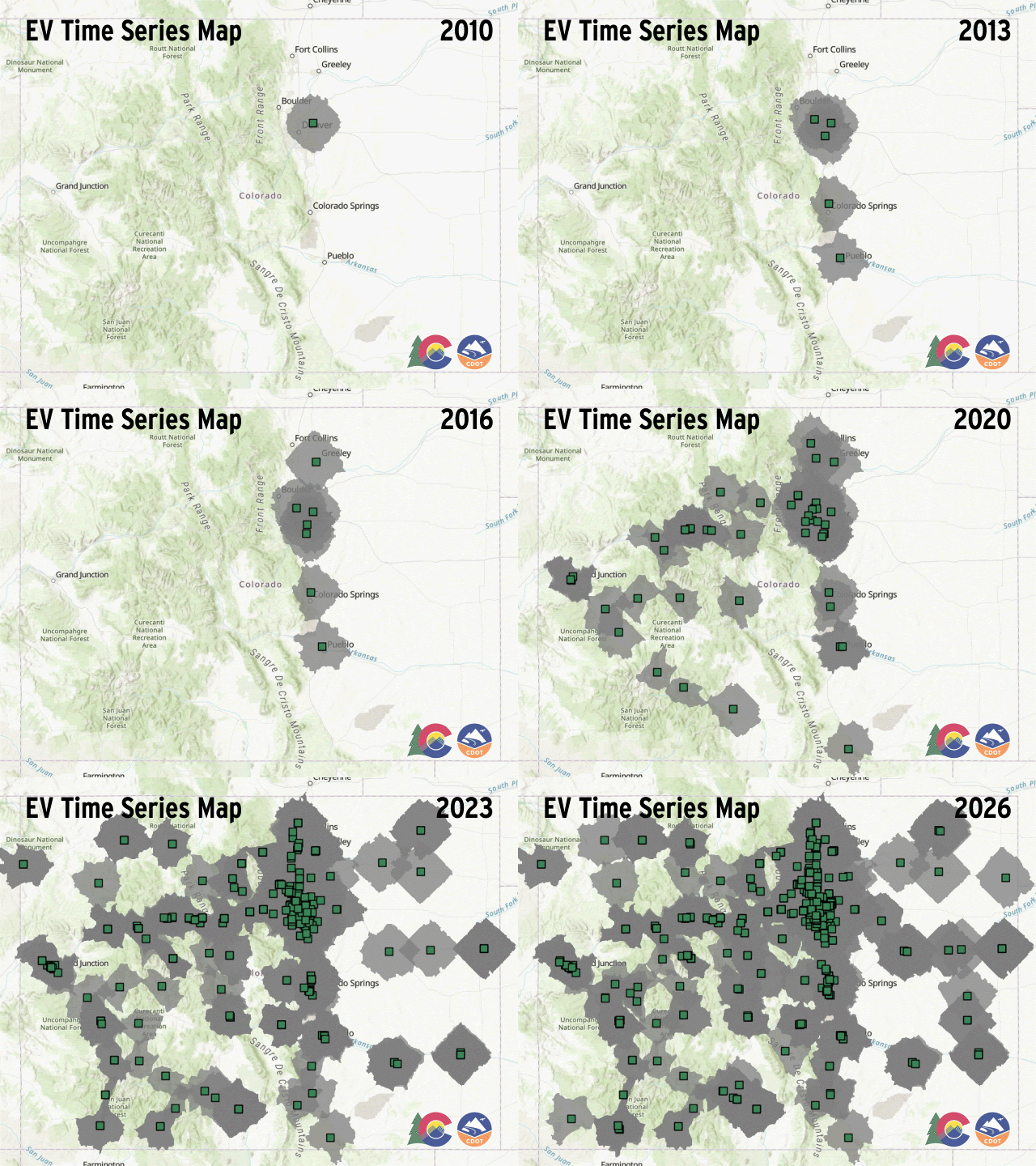
Animation of DC Fast Charger build-out in Colorado. Credit: CDOT Note: Tesla and Rivian DC Fast charging facilities are not on this map and they are available to other EV brands. One exception that I know of — the Cortez location is a joint Tesla/Colorado Energy Office operation.

Decline in sales

Ironically, the boom in sale of new EVs has slackened. New battery-electric vehicle registrations declined 55% this year through June compared to the same period in 2025, according to the Colorado Automobile Dealers Association’s 2026 second quarter report.

Colorado in the final months of 2024 led the nation in the percentage of sales adoption rate for EVs and plug-in hybrids. At one point, about a third of new car sales in Colorado were battery-electric, plug-in hybrids or hybrids. In 2025, sale of electric-only vehicles began slowing in favor of plug-in hybrids.

This most recent decline can be explained in part by the end of generous state and federal tax-based discounts to buyers. Tax credits of up to $6,000 offered by Colorado in 2025 dropped to $750 in January. The federal tax credit of $6,000 ended in September 2025.

Also relevant is that car sales altogether have slowed 15% in Colorado. This decline in EV sales is part of that broader decline.

Travis Madsen expects EV sales to recover.

“The investment Colorado is making recognizes that the future of road transportation will be electric,” said Madsen, the director of transportation programs for the Southwest Energy Efficiency Project, an environmental advocacy organization. “These investments are smart. Coloradans will save a ton of money, because it’s cheaper to drive an EV than an internal combustion engine vehicle.”

Madsen also expects improving incentives will be part of the discussion when Colorado legislators gather again in January for the 2027 session. Too, he suspects that a shift in the political makeup of Congress and perhaps the presidency in 2028 may result in restored federal tax incentives.

In addition, Madsen suspects the introduction of new models of bare-bones pickup trucks will spur sales. One new pickup, called Slate, comes in at $25,000 and will have a range of 205 miles. Ford’s Fathom will sell for a bit less than $30,000. Ford says the Fathom will have a range of 300 miles, but some auto writers seem skeptical. EV Charging Stations, for example, said an optional higher-capacity battery may be necessary to get this range.

Colorado currently has 217,000 registered EVS and plug-in hybrids among its 5.54 million cars, pickups and vans, according to the Alliance for Automotive Innovation. The state has a 2030 goal of 940,000 and a 2035 goal of 2.1 million.

A lot of federal help

Federal funding of $56.5 million administered through the National Electric Vehicle Infrastructure, or NEVI, program, has bolstered Colorado’s efforts to create its EV fast-charging network. So far, 17 of the fast-charging locations supported by the federal program have opened, but another 33 are under development.

Several of the EV fast-charging gaps on the lesser traveled highways of Colorado’s lightly populated eastern plains have been narrowed in the last year with the help of this federal program. For example, somebody driving southeast from Limon on Highway 287 toward Lamar or east on Highway 24 to Kansas would have had no way to charge an electric vehicle until fast-charging stations were added in 2025 at both Eads and Kit Carson. Wray also gained a station.
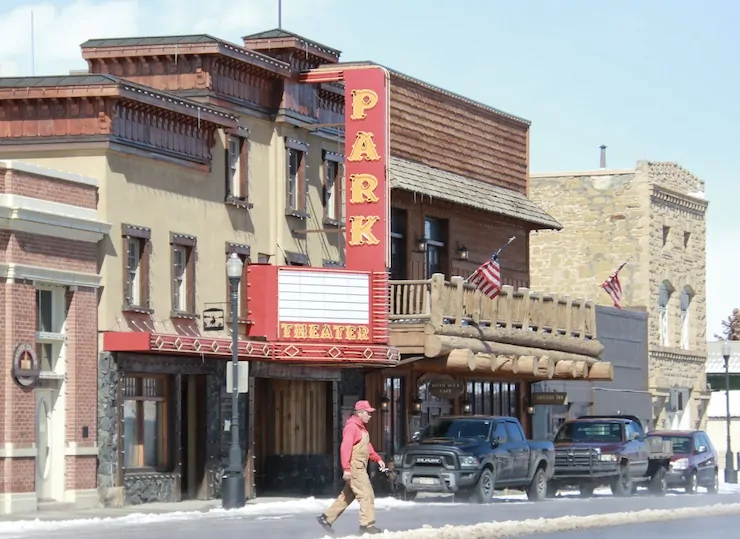
Walden, seen here during Christmas 2020, is in line to get an EV fast-charger. Photo/Allen Best

Another gap was filled in southwestern Colorado for drivers traveling the 80 miles from Durango to the Four Corners Monument. That station is at Cortez.

Other stations installed with help of the federal program are operating in Frisco, Longmont, Monument, Seibert, Grand Junction, Limon, Montrose, Maybell, Sterling, Durango, Lyons, Pagosa Springs and Walsenburg.

Now CDOT and the Colorado Energy Office are evaluating applications from the ninth round of the DCFC Plazas Grant Program. The state expects to have $14 million available. In this funding round, the state introduced a “gap incentive” of $174,000 per charging port aimed at attracting projects to high-priority communities and segments with persistent charging gaps:

  1. Bennett/Strasburg,
  2. Cheyenne Wells,
  3. Fraser/Winter Park,
  4. Gunnison,
  5. Holly,
  6. Ignacio / Southern Ute Reservation,
  7. Julesburg,
  8. Saguache,
  9. Walden,
  10. Wellington.

See details here.

State officials did not provide information about how much state money has been used to expand this fast-charging network. Also unclear is how the fast-charging stations installed by Tesla figure into this statewide matrix of fast-chargers. Nearly every major EV brand now has access to Tesla’s supercharging network.

Achieving scale

The goal all along in this effort to electrify transportation has been to achieve scale.

A website at the Colorado Department of Transportation shows the slow and then accelerating spread. First the stations were entirely along the Front Range. The first fast-charger in a rural area was installed in 2017, at a location in the San Luis Valley, followed by more along the interstate highways and then secondary highways. The expansion has been particularly rapid since 2020.

“Colorado has reached the point where we are no longer simply building the foundation of an EV fast-charging network — we are filling in the remaining gaps and making that network increasingly useful for travel throughout the state,” said CDOT’s Lew.

“Widespread EV adoption in Colorado would not be possible without convenient access to charging all across the state, from the Eastern Plains to the Western Slope and everything in between,” said Will Toor, executive director of the Colorado Energy Office.

Sifting through the numbers, though, the International Council on Clean Transportation in April released a report that paints a slightly less rosy picture of Colorado’s fast-charging infrastructure. “Meeting Colorado’s EV goals will require significant continued investment in charging infrastructure,” the council said.

The council said existing state and federal grants and utility investments, if made, could cover about 84% of non-home DC fast-charger needs through 2035.

And there is also this. Charging stations still take more time and are somewhat less assured, especially when traveling beyond Colorado’s borders. Consider the story of Florence resident Steve Andrews, an EV driver (Bolt) for many years.

In driving to Wisconsin this year, he will use an internal-combustion engine. Driving his Bolt, with its range of 250 to 300 miles, he says, would take close to a day longer. [Note: He could have rented a Tesla from Turo. This was the option I chose because my Leaf, like the Bolt, was not a road EV.]

Just how the charging infrastructure will evolve is anybody’s guess. It currently takes maybe 30 minutes to juice up a depleted battery, compared to 5 minutes to gas up a car or 10 or more minutes to fill the 36-gallon tank of a hulking pickup like a Ford 250 or 350.

In both cases the fast-chargers and the gas dispensers are located adjacent to shopping convenience stores. Operators make their money selling potato chips and soft drinks while also offering rest rooms.

Madsen said high-speed charging technology may evolve in uncertain ways. China already has very-fast-charging that can fill a depleted battery in 9 minutes, but that technology is not yet available in the United States.

“The way it works right now is you need to stop for 15 to 20 minutes, 30 minutes if you get a really big charge. It therefore makes sense to put these (charging stations) at places where drivers can spend time taking care of their other needs.”

U.S. 160 between Trinidad and Springfield in southeastern Colorado carries little traffic, even on a Fourth of July weekend. Photo/AllenBest

Highways with few travelers

Colorado — luckily — still has places where you need to think ahead no matter what kind of car you are driving. Consider U.S. 160, which connects Trinidad and Springfield, in the state’s southeastern quadrant. The landscape is delightfully sparse. You can drive 20 minutes or more, even on a holiday weekend, without encountering another vehicle. It’s you and the cows and likely pronghorn, too.

That 122-mile stretch of highway currently has one place to buy gasoline or diesel. It has no place to charge your EV, whether slowly or fast. It’s not among the “gaps” identified in state transportation planning. Probably, it will stay that way for a while.
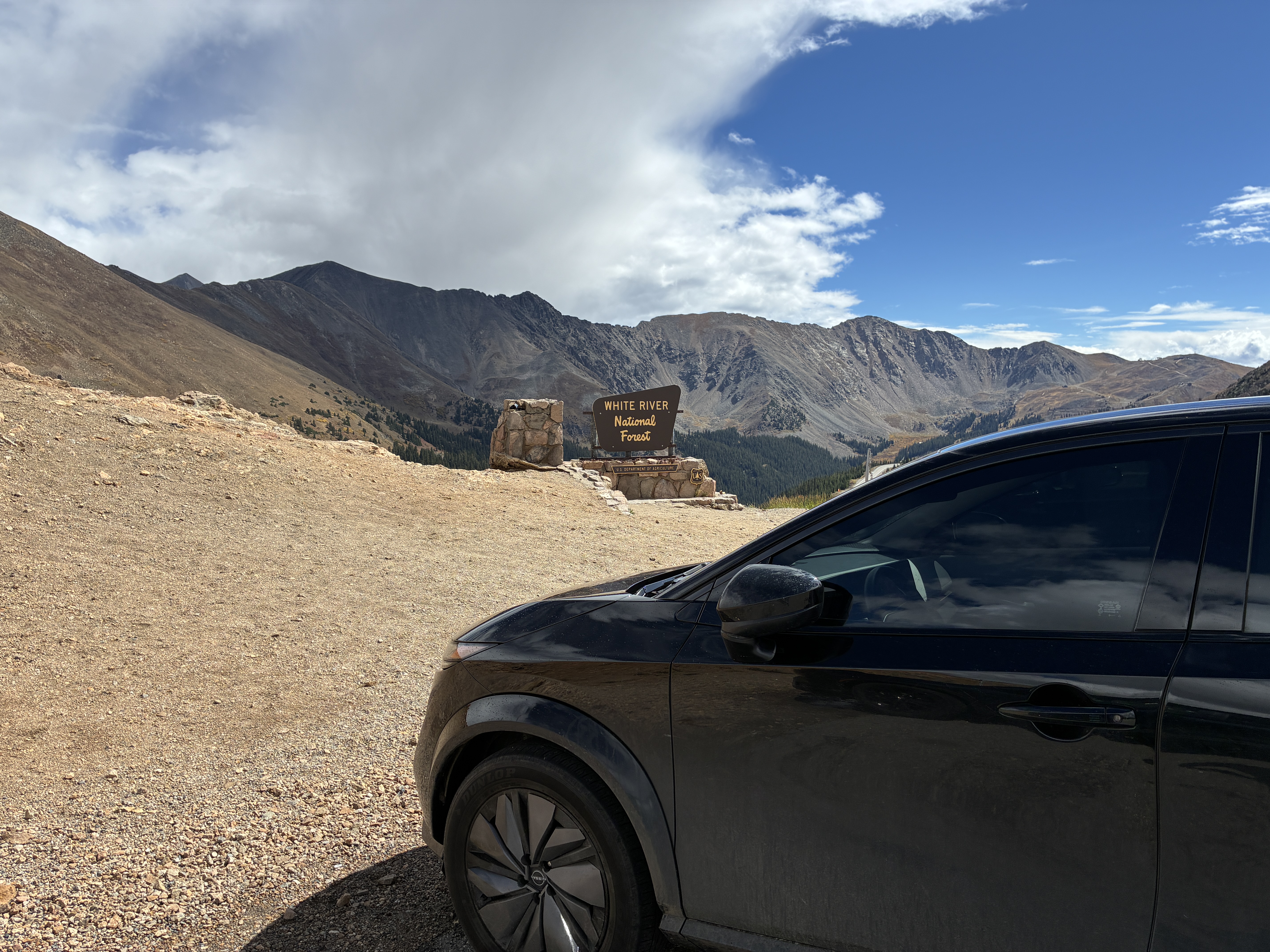

Coyote Gulch’s Ariya at the summit of Loveland Pass September 19, 2026.

Here’s the link to my last post from my first road trip in my excellent road EV. I charged at ChargePoint, Tesla, Tesla/Colorado Energy Office, Rivian, and Ionna chargers.

A new legal path for stream restoration in #Colorado runs into old water conflicts: Projects repair degraded headwaters, but downstream users have concerns — Heather Sackett (AspenJournalism.org)

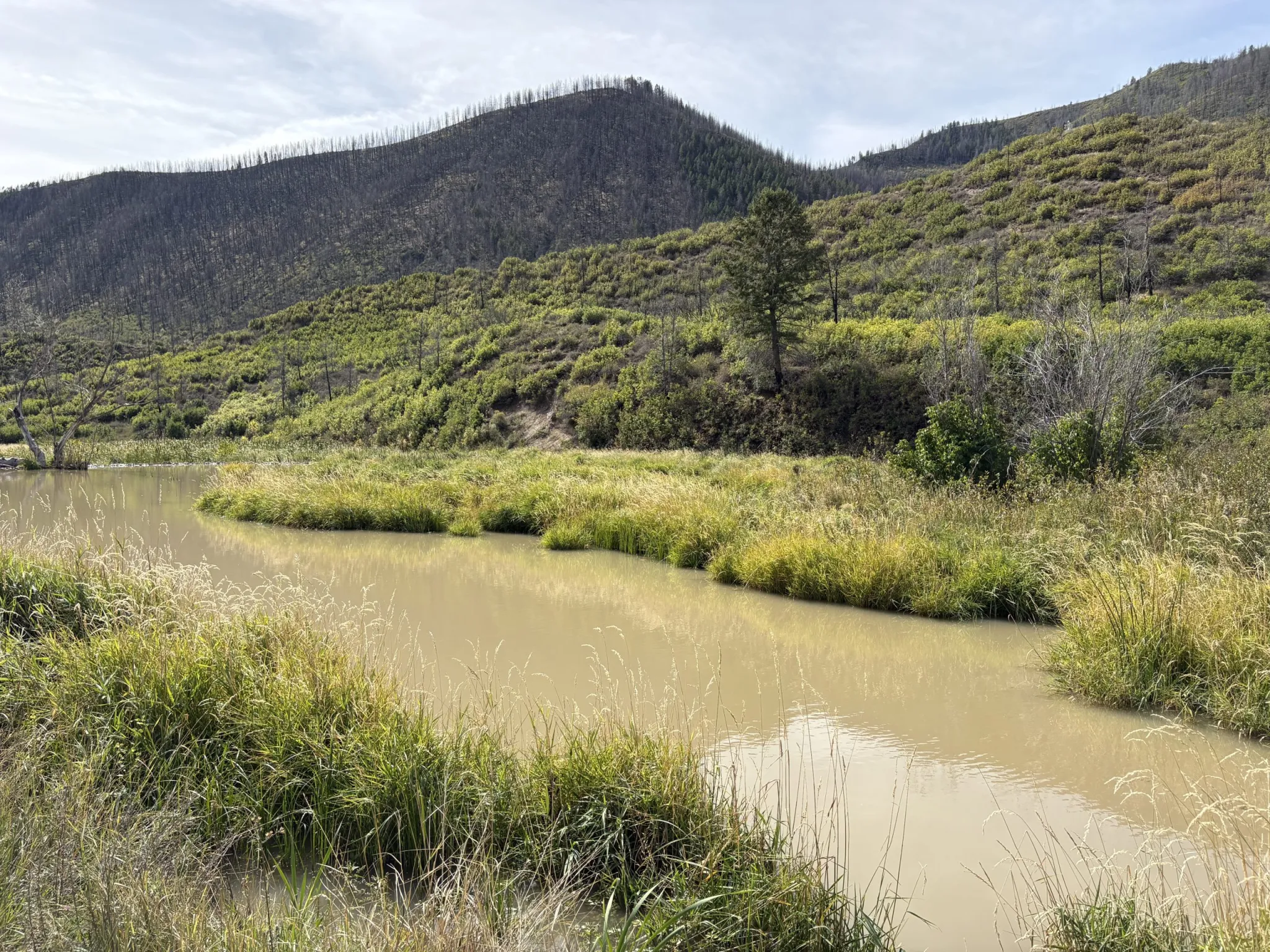
Abby Burk with Audubon Rockies leads a tour of a flagship stream restoration project on Dry Fork Creek in Western Colorado. The project, located on High Lonesome Ranch, is one of the first completed under SB 270. CREDIT: HEATHER SACKETT/ASPEN JOURNALISM

Click the link to read the article on the Aspen Journalism website (Heather Sackett):

September 30, 2026

After the 2020 Pine Gulch Fire scorched 95,000 drought-stricken acres of High Lonesome Ranch in Garfield and Mesa Counties, the rainstorms that followed eroded hillsides and washed mud and rocks into the Dry Fork Creek valley bottom.

“It was a major impact to operations here,” said High Lonesome’s General Manager Travis Brooks. “The wildlife habitat obviously was erased, populations disappeared… The flooding, the debris flows, the devastation that comes after the fire is almost as bad as the fire itself and we’re still seeing the effects of that.”

Brooks has overseen work to repair the riparian corridor and control erosion; now the area is green and wildlife – including beavers – have returned to the watershed. The area’s recovery is due, in part, to a piece of 2023 legislation that cleared the way for minor stream restoration projects in Colorado. High Lonesome Ranch is the site of one of the first of these types of projects completed since the passage of Senate Bill 23-270.

In 2023, Colorado lawmakers recognized the need to restore the environmental health of the state’s waterways, especially after wildfires. The legislation allows minor stream restoration projects to take place without being subject to water rights administration, provided they meet certain criteria. But this is uncharted legal territory and early projects are highlighting old tensions between water rights holders and proponents of stream restoration.

The Dry Fork Creek project, which is wrapping up its third and final year of work on High Lonesome Ranch, was spearheaded by Audubon Rockies. 

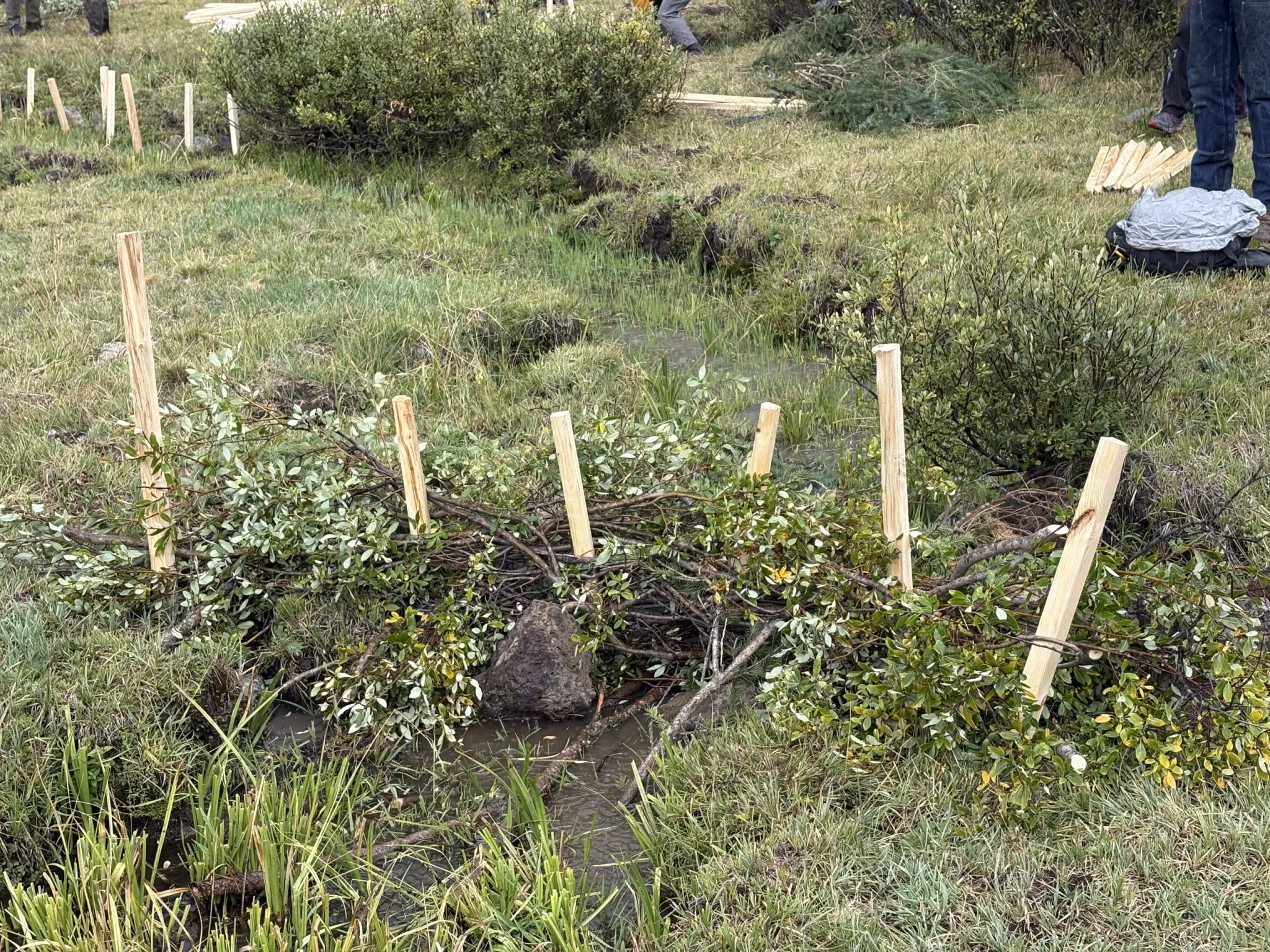
Over three years, crews installed about 200 simple, porous structures over two miles of stream, with the goal of trapping sediment, slowing the flow of water, raising the water table and rewetting the sponge of the floodplain. The structures, sometimes called Beaver Dam Analogues for the way they can mimic beaver activity, are built by weaving willows and tree branches across the channel between posts hammered into the streambed. 

The official name for these low-tech, process-based restoration methods is Post-Assisted Log Structures, and they can turn a deeply incised, V-shaped stream with steep banks into a wider, gently sloping, U-shaped streambed. The structures act as speed bumps for the torrents that wash down the valley during summer storms and can improve watersheds that have been degraded by fire as well as human activities like road building and cattle grazing.

“I really do believe that we’re improving the water quality out here by doing this work, which is helpful to everybody downstream,” Brooks said. “I think that’s the biggest takeaway.”

On a sunny day in late September, Abby Burk, Western Rivers program director for Audubon, led a tour of the flagship project, showing how stream restoration is put into practice under the new legislation.

“All of these different types of structures are really looking at arresting sediment, holding sediment, spreading water on the landscape and slowing it down so that we can have a bit more of a connected floodplain,” Burk said.

Beavers have recolonized part of the Dry Fork Creek valley after restoration work. The burn scar from the 2020 Pine Gulch Fire is visible on the hillside. CREDIT: HEATHER SACKETT/ASPEN JOURNALISM

Putting policy into practice

Senate Bill 23-270 allows for six categories of minor stream restoration activities, such as stabilizing the banks or reconstructing a channel of a natural stream system. If a project falls under one of the six categories, it is presumed to not harm other water users and can move forward with little scrutiny from state officials.

Environmental groups that worked on the legislation had originally wanted to set a size standard for stream restoration based on the historical footprint of the floodplain before it was degraded. But opponents, some of whom were agricultural water users, argued this area was too large and ill-defined, and floated the idea of placing a cap on how much new surface area of water that projects were allowed to create. Their concern was that projects could create more surface area for evaporation and reduce streamflows. 

That’s a problem because in Colorado’s system of water law where the oldest rights get first use of rivers, water is usually already spoken for by someone downstream. Without SB 270, stream restoration proponents could have to go through an expensive and lengthy process to buy into an augmentation plan, which replaces the water consumed by evaporation.

The final bill represented a compromise between the two sides, and required that these minor restoration projects don’t back up water past the “ordinary high-water mark” of the stream. 

“I think this is an elegant compromise,” said Burk, who helped shape the bill. “We landed at a bipartisan solution that was unanimously supported.”

Immediately after the passage of the bill, stream restoration proponents were disappointed in the final version. But in the three years since, SB 270 seems to be providing the necessary legal and political cover for groups to move forward with low-tech, process-based projects, with several underway on the Western Slope. 

“We started taking more time to process it and read it, and then we actually realized, you know, I think we actually got something pretty good here that we’re going to be able to do some great stuff with,” said Jackie Corday, a natural resources consultant who worked on the bill and the Dry Fork Creek project.

Clay Ramey with the U.S. Forest Service works on a stream restoration project with volunteers at the headwaters of Middle Thompson Creek in August. The project installed about 40 post-assisted log structures, designed to repair degraded streams. CREDIT: HEATHER SACKETT/ASPEN JOURNALISM

Downstream conflicts

As more groups take on projects under SB 270, it means the bounds of the legislation will be tested as potential conflicts arise with downstream water users.

On a Saturday in late August, the National Forest Foundation and Roaring Fork Outdoor Volunteers kicked off another restoration project, installing about 40 PALS in the White River National Forest in the headwaters of Middle Thompson Creek, a tributary of the Crystal River. The area was identified as a prime spot for stream restoration in a beaver inventory conducted in 2023 and 2024 by the U.S. Forest Service and funded by Pitkin County.

“Ideally, the changes in the channel that these [structures] provoke, and the changes in the vegetation will be enough to make those areas attractive to beaver again and beaver will just recolonize the site,” said Clay Ramey, a fisheries biologist with the White River National Forest.

The Forest Service is planning another, similar project next year in the headwaters of Four Mile Creek, one drainage over from Thompson Creek. But the size and scope of the proposed project has raised concerns from a local water conservancy district. The Rifle-based West Divide Water Conservancy District owns several small reservoirs and provides supplemental irrigation water and augmentation water for domestic water users.

West Divide says the project could impact water supply for its planned expansion of Martin Reservoirs. It contends the work would increase both the surface area of the stream, which causes evaporation, and the water consumed by wetland vegetation.

In a January letter to the state Division of Water Resources Division 5 Engineer Tyler Benton, the conservancy district said that the 152 structures planned over three phases is outside the scope of what is allowed by SB 270 and asks state officials to assess the project’s potential for injuring water rights holders. 

“It’s not the healthiest stream by any stretch and so some restoration efforts are in order,” said West Divide board member Chris Treese. “But we don’t want those efforts to result in an impact to our water rights or any other water rights downstream that are within the West Divide district.”

This post-assisted log structure was installed on the headwaters of Middle Thompson Creek in August. The stream restoration project aims to rewet the sponge of the degraded watershed. CREDIT: HEATHER SACKETT/ASPEN JOURNALISM

More data needed

Part of the source of the disagreement comes from a lack of data about how exactly these types of projects that mimic beaver activity influence how water moves through valley bottoms. 

Joel Sholtes, a water resources engineer and instructor at Colorado Mesa University, is aiming to answer that question. In August he was awarded a three-year $15,000 grant from Pitkin County Healthy Rivers to study how beaver activity alters ecosystems in the North Thompson Creek area. The sites with beavers can be a reference point to compare with areas restored by humans. 

Sholtes will take seasonal measurements to try to better understand how much water beaver ponds detain, how it changes throughout the year and the differences in stream conditions between areas with resident beavers and those without. Sholtes’ early findings on a long-term study of headwaters across the state show that restoration projects do not produce large or sustained reductions in streamflow.

“The evolution and passing of SB 270 became contentious, and that conversation brought to bear a lot of knowledge gaps that we have related to stream restoration in headwaters,” Sholtes said. “There’s just not a big, robust body of literature, so the study’s number one effort is to address that in whatever ways we can. It’s not going to answer the question definitively, but it’s going to bring more data and nuance to the conversation.”

The Forest Service is monitoring and measuring the streamflows at the Four Mile project site to see what they are dealing with and the effects of their work – information West Divide is also interested in – with the intention of installing the first structures next summer.

For now, Burk says SB 270 is a good tool to accomplish 75% to 80% of the stream restoration projects that happen in Colorado. Most of these fall under three of the legislation’s six categories: stabilizing the streambanks with natural materials that allow water to flow downstream and don’t back up water past the ordinary high-water mark; stabilizing an intermittent stream by installing porous structures into the banks; and installing structures or reconstructing a stream channel for recovery from a wildfire or flood. 

“This was designed for a subset of projects that are the majority to go forward because of the ecological and community benefits and watershed benefits,” Burk said.

A working group led by Burk and Corday has also created a training manual for best practices that groups can use to make sure their projects stay within the bounds of SB 270.

Abby Burk with Audubon Rockies stands in front of a post-assisted log structure, part of a restoration project on Dry Fork Creek. The project is one of the first completed under new state legislation that allows for minor stream restoration activities. CREDIT: HEATHER SACKETT/ASPEN JOURNALISM

Communication with DWR essential

So what happens when restoration proponents believe their project fits within these parameters, but downstream water users argue the project goes too far? 

Division of Water Resources officials have a limited role in refereeing these types of disagreements. Project proponents are not required to get approval from state officials and state officials do not have the authority to approve or deny projects. But as the administrator of the state’s water rights, DWR officials could still force a project to be removed if they determine it is harming downstream water users or require the project to get an augmentation plan from a water court that replaces the water it uses. 

In the case of the Four Mile project, Division 5 Engineer Tyler Benton wrote in a February letterto Ramey that he does not have sufficient information to determine if the project would harm downstream water users, but that the Forest Service should communicate with the local DWR water commissioner to ensure the project complies with the law.

Both Burk and Ramey stressed the importance of communication and transparency with DWR officials to ensure the projects are in compliance with SB 270 from the beginning. Ramey said the water commissioner has visited both the Middle Thompson and Four Mile sites and is familiar with the projects. 

Back at High Lonesome Ranch, beavers have moved back into the restored area and created ponds, amplifying the humans’ restoration work. Brooks said the project fits with the ranch’s philosophy of conservation and regenerative ranching, and he has aspirations of doing more work to revitalize the property’s other fire-damaged drainages in the future.

“The beaver activity that we saw is a big indication that we’re doing something right,” Brooks said. “Wildlife are coming back and utilizing the space the way a healthy riparian system should be utilized.”

#Drought news October 1, 2026: Many areas experienced beneficial rainfall, with #Colorado, #Kansas, and #Nebraska being beneficiaries of the east-Pacific “El Niño” tropical connection #ENSO

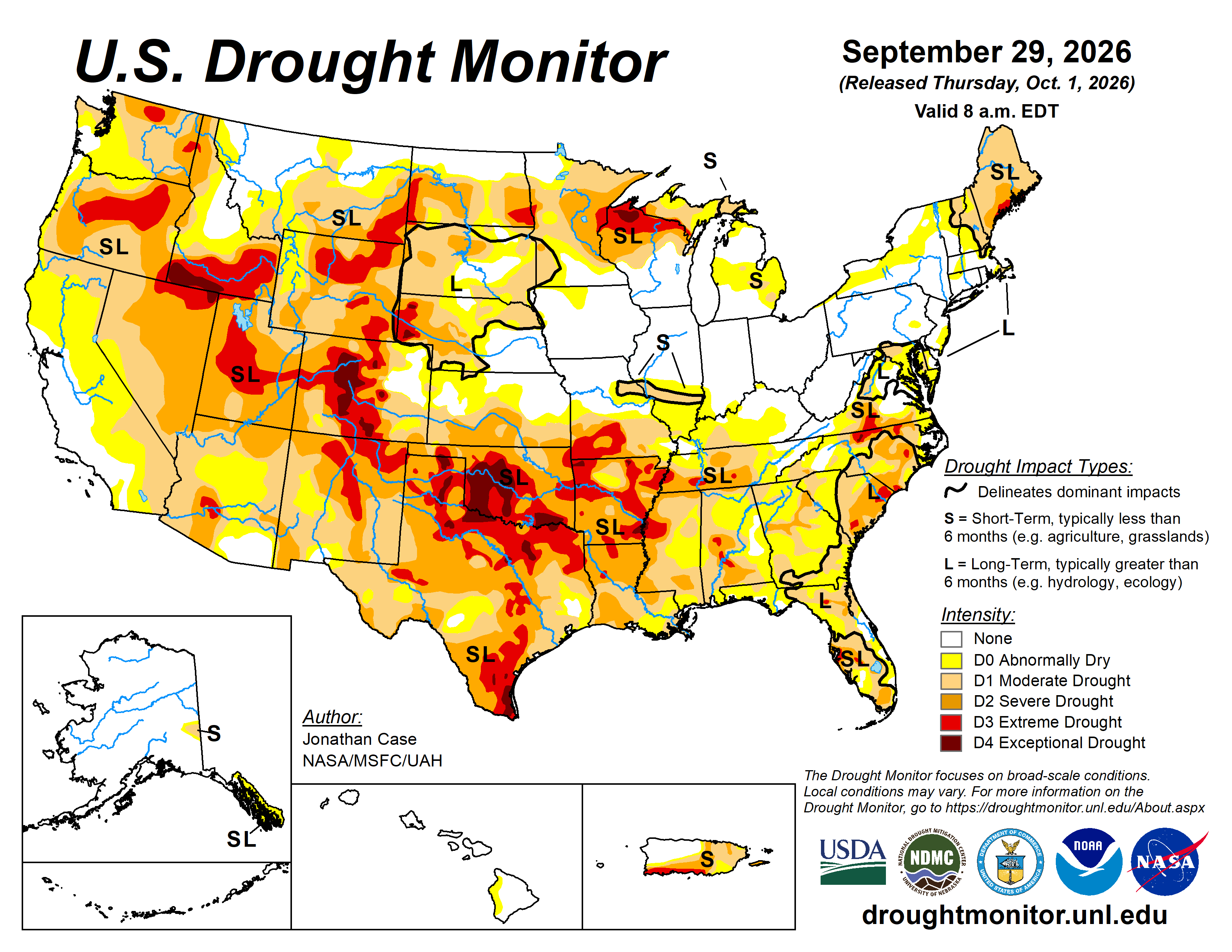
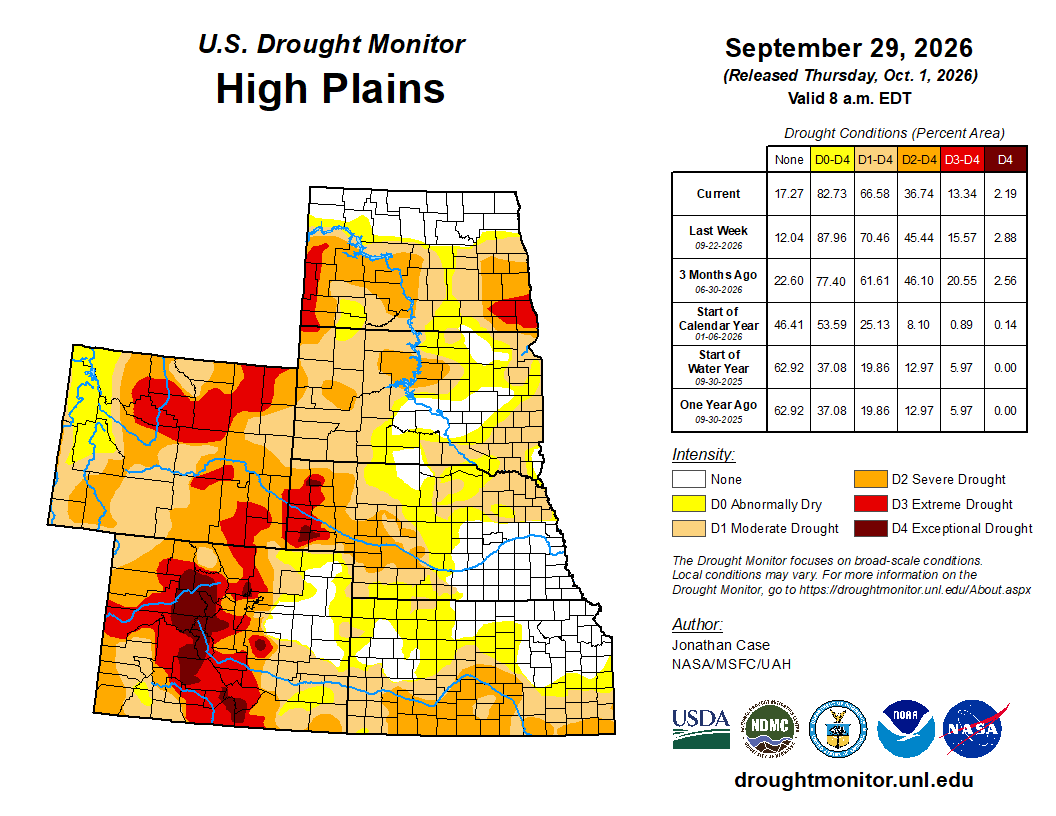
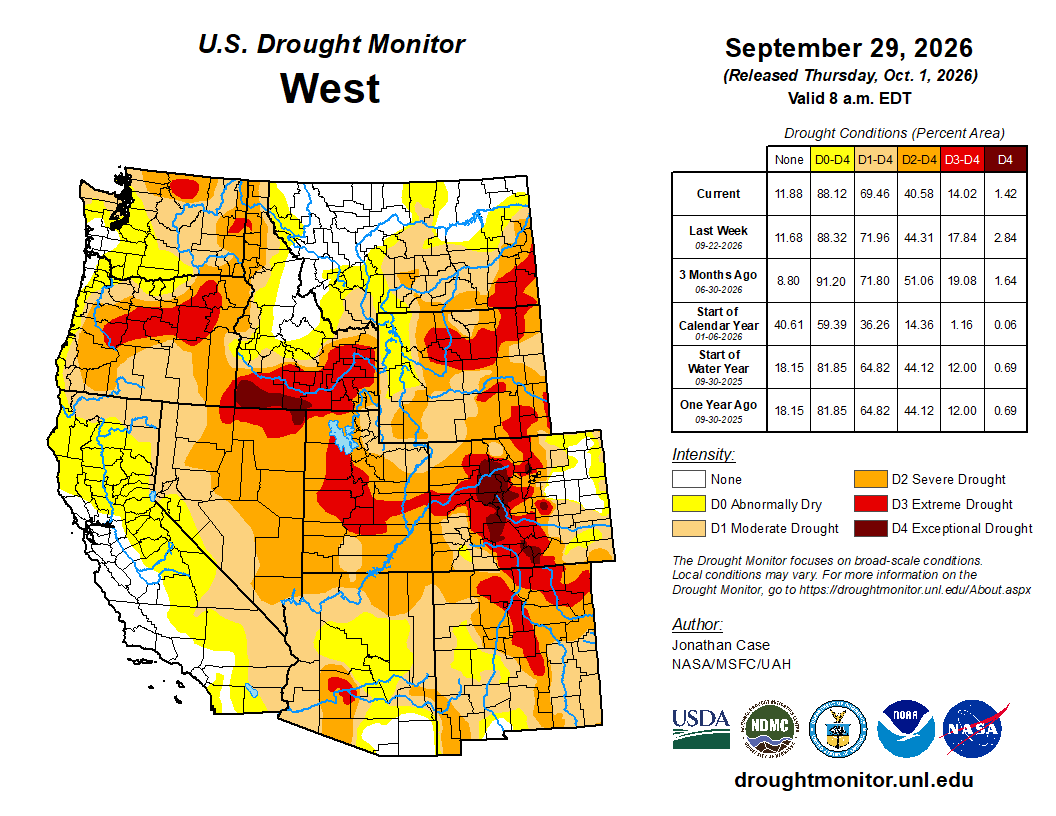
Click on a thumbnail graphic to view a gallery of drought data from the US Drought Monitor website:

Click the link to go to the US Drought Monitor website. Here’s an excerpt:

This Week’s Drought Summary

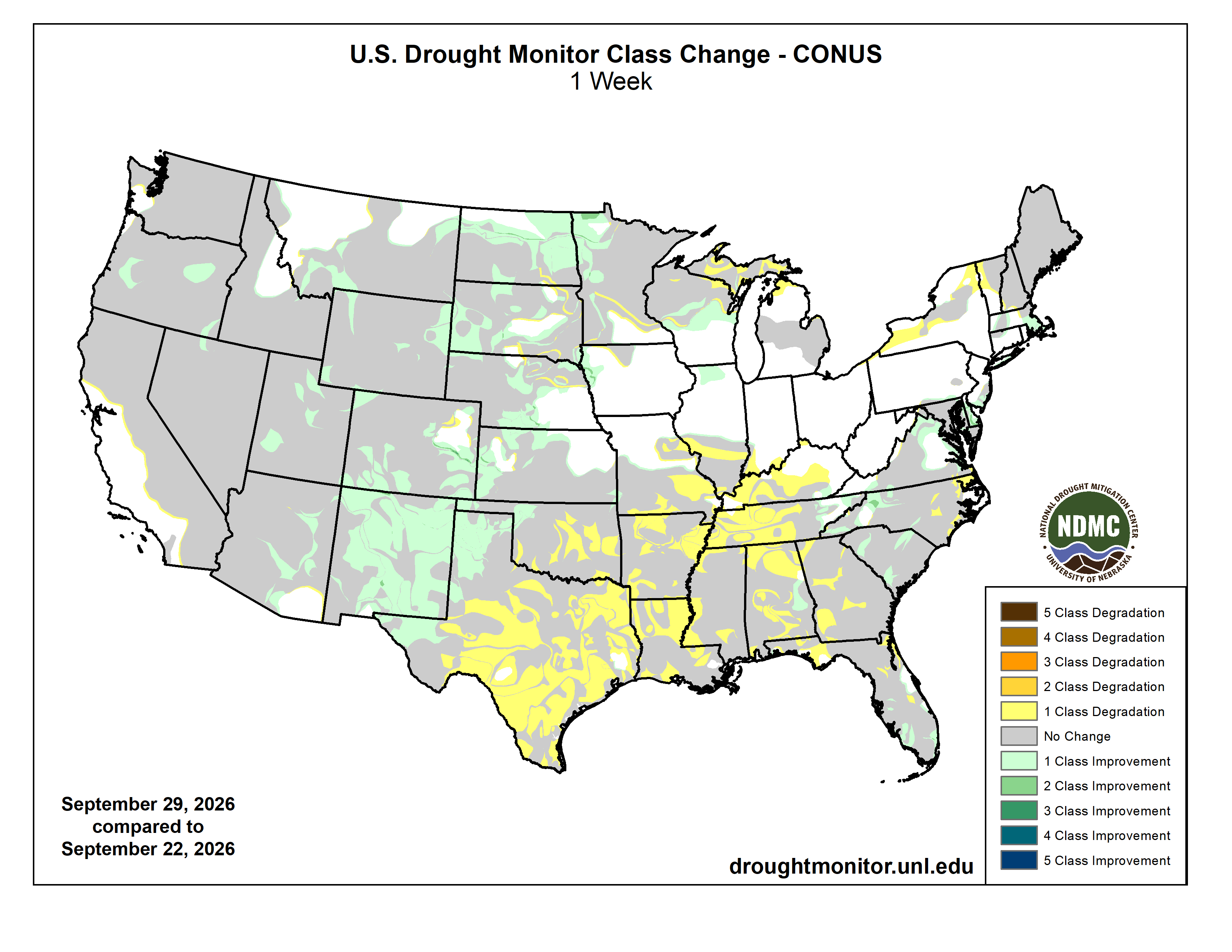
This week featured a dynamic and changeable drought environment across the country, partially thanks to the rapidly intensifying El Niño resulting in much above-average temperatures in the eastern Pacific waters. These warm ocean temperatures have been fueling numerous hurricanes in the East Pacific; three of which indirectly impacted the Unites States. Hurricane Nolo affected parts of the Hawaiian Islands with heavy rains, although mainly impinged on the east-facing slopes that are not in any drought or unusually dry conditions. Meanwhile, moisture from Hurricanes Odalys and Polo both contributed to a near-record moist environment over the normally dry Desert Southwest. Very heavy rains fell on much of New Mexico, and parts of Arizona, Utah, and Colorado both early in the period and again on Monday and Tuesday when Hurricane Polo curved northeast into the Baja of California and tracked into southern New Mexico. Weekly rainfall totals were very impressive across the Southwest, with totals reaching 5-10 inches, accounting for a large portion of the annual rainfall in some places. The heaviest rains fell across eastern New Mexico into northwestern Texas, helping to alleviate drought conditions. Beneficial rains also extended into southern and eastern Colorado into western Kansas and Nebraska, leading to drought relaxation. Coastal New England and the Mid-Atlantic states experienced a substantial Nor’easter that produced heavy rain, gusty winds, and storm-surge flooding from Delaware and New Jersey up to New York’s Long Island and southeastern Massachusetts.

The south-central and southeast states were not so fortunate this past week, however. Continued unseasonably hot dry conditions prevailed across the rest of Texas and Oklahoma eastward into the Tennessee River Valley, leading to worsening drought conditions in many states. The combination of persistently hot weather with virtually no rainfall during much of August and September has led to rapid onset drought in much of Texas and Oklahoma, resulting in widespread severe, extreme, and exceptional drought coverage, which again intensified this past week. Intensifying dryness and drought also prevailed across Arkansas, Louisiana, Mississippi, Alabama, Tennessee, and Georgia. And for those residing up north, the upper peninsula of Michigan and northern Wisconsin continues to suffer with worsening drought as precipitation was again meager there this past week. Outside of the Southwestern states, the remainder of the western U.S. had fairly steady-state drought conditions this past week, with only a few improvements occurring in the northern Rockies and in Oregon…

High Plains

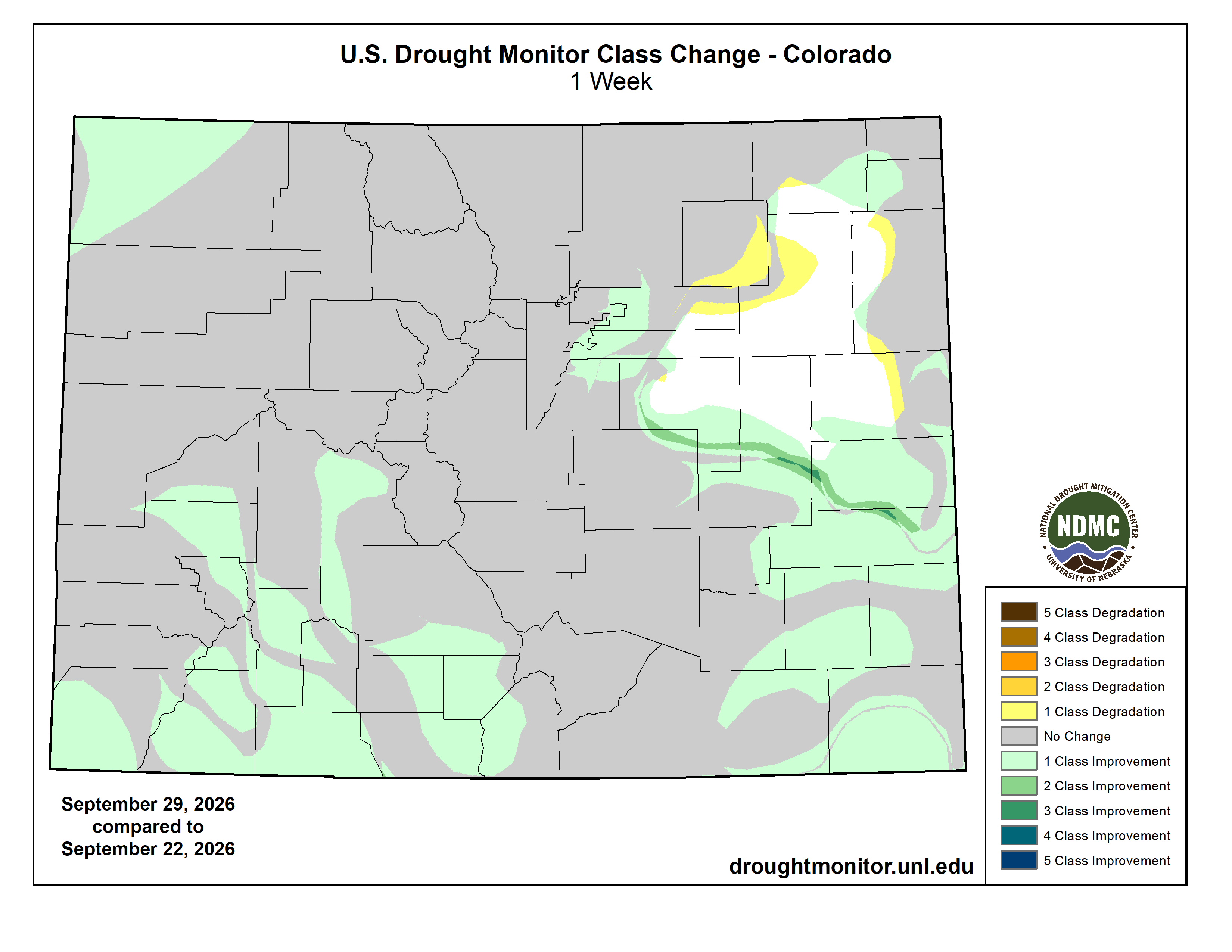
The High Plains states experienced almost exclusively drought improvements this week, as many areas experienced beneficial rainfall, with Colorado, Kansas, and Nebraska being beneficiaries of the east-Pacific “El Niño” tropical connection. Despite temperatures being up to 6 or more degrees above average, the plentiful rainfall has contributed to drought improvement in many areas this week. Northern and eastern North Dakota also experienced substantial reduction in drought coverage and intensity as heavy rain fell near the Canadian border…

Colorado Drought Monitor one week change map ending September 29, 2026.

West

Outside of Arizona, New Mexico, and Colorado, which experienced deep and substantial drought-busting rainfall this past week, the western states generally had unchanging drought conditions. The Pacific Northwestern states of Washington and Oregon began experiencing the first of its fall rainy systems, helping to ease drought pressure across western Oregon, where drought was downgraded in a couple spots. Drought and dryness also improved in southwest Montana and northwest Wyoming this past week…

South

The southern states have taken the brunt of recent drought intensification since August, which continued this past week across most of Oklahoma and Texas. Worsening drought also occurred across most of Arkansas, Louisiana, Mississippi, and Tennessee. Virtually no rain fell this past week in this region except for far western Texas, the Oklahoma Panhandle, and eastern Tennessee. Combined with temperatures of 6-12 degrees above average, the lack of rainfall contributed to the rapid intensifying drought. Most of central and eastern Texas, Oklahoma, and Arkansas are under severe, extreme, or exceptional drought classifications. Louisiana, Mississippi, and Tennessee are quickly degrading as well into severe to extreme drought conditions due to the September heat wave and continued lack of rainfall. Much of Texas and Oklahoma need to receive 20 to 25 inches of rainfall over a 3-month span to break out of the present drought. The lone exceptions to the drought worsening were in far western Texas and the western Oklahoma Panhandle, where several inches of rain fell as eastern Pacific tropical moisture associated with Hurricanes Odalys and Polo moved across the region. Far eastern Tennessee experienced temperatures around 3 degrees below normal along with the plentiful rainfall resulting in no drought conditions…

Looking Ahead

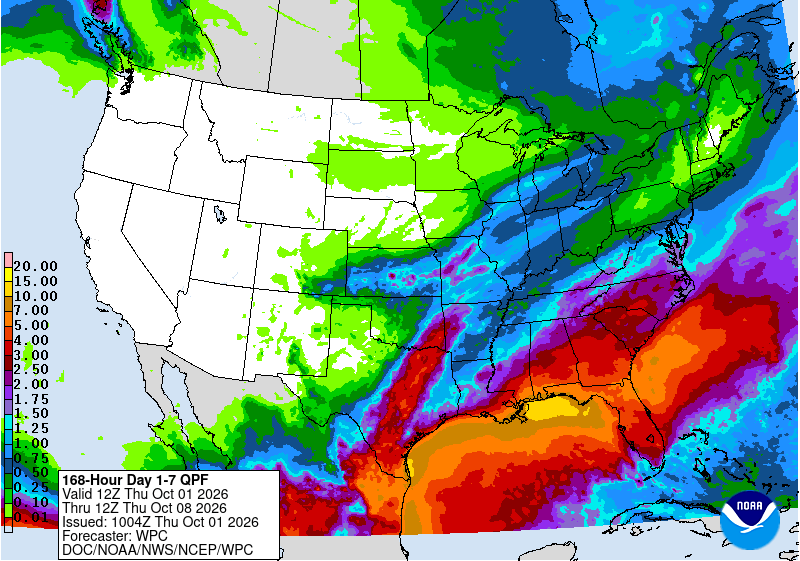
Ongoing substantial rain was falling Tuesday morning at the onset of the new U.S. Drought Monitor week, from Arizona and New Mexico into the Central and High Plains. This excessive rainy system connected to Hurricane Polo is projected to continue eastward this week into the High Plains, Midwest, and South regions. The Weather Prediction Center has moderate threats for excessive rainfall from the Southwest into Texas, Oklahoma, northward into Nebraska and Iowa. Drought-busting rains may be possible across the South as this weather system evolves this week. Looking into the next week, the Climate Prediction Center’s 6–10-day outlook indicates that well-above average temperatures will shift into the western states, along with below normal precipitation chances. Meanwhile, above average precipitation chances are projected from southern Texas into the southeastern states, including Florida. Above average precipitation chances are also projected for southeastern Alaska, with near neutral rainfall forecasts.

US Drought Monitor one week change map ending September 29, 2026.