Supreme Court wrestles with who should pay for #ClimateChange: The Supreme Court’s decision on a #Colorado lawsuit could shape dozens of efforts to make fossil fuel companies pay for #climate damages — Austin Corona (Grist.org)

Click the link to read the article on the Grist website (Austin Corona):

October 6, 2026

The Supreme Court opened its 2026-2027 term Monday with a climate case: a lawsuit brought by Boulder, Colorado, against ExxonMobil and Suncor, a Canadian oil company, over the costs of a warming planet. The case is one of dozens across the country in which local governments have sued fossil fuel companies for their role in driving climate change and are seeking compensation as they now deal with its effects. The Supreme Court’s decision could decide the fate of all those other cases and the idea that oil companies must pay for the damages their products caused.

The justices gave no clear signs of how the court will rule, but over the course of two hours of questioning, they did demonstrate unison on one point: It is a hard and consequential task to identify who is legally liable for the impacts of climate change. 

Although Boulder’s case was first filed in Colorado courts, oil and gas companies asked the Supreme Court to step in, arguing that important climate change matters shouldn’t play out at the state level. Instead, they say, the issue belongs to Congress and the White House. Boulder wants the court to send the case back to Colorado, where it can proceed. 

Eight justices — Justice Samuel Alito removed himself from the case — attempted repeatedly to cast the case into something legible and simple. Multiple times, justices from both sides of the ideological spectrum asked attorneys, ā€œWhy make this argument so complex?ā€ Yet they seldom openly agreed on what the simpler argument would be. The consequences for oil companies weighed heavily on some parts of the discussion, while the consequences for communities dealing with a warming planet went largely unexplored.

Some judges attempted to describe it as a case about reducing emissions — a framing that aligns closely with what ExxonMobil and Suncor argue. If Boulder’s case is an attempt to reduce greenhouse gas emissions through state court, it opens the possibility that a state court could police activity all over the country, and even the world. No state law could be appropriate to apply to the cumulative impact of global pollution, the companies argue.

ā€œThis case involves an unprecedented effort to use state law to regulate global conduct,ā€ said Kannon Shanmugam, the attorney representing oil companies.

Several justices seemed to agree with that general picture. Kavanaugh said he could see no difference between allowing a state court to order oil and gas companies to pay damages for climate-related harms and allowing a state to effectively regulate greenhouse gas emissions all over the world. He told Boulder’s attorney, Kevin Russell, that he was downplaying the effect this case could have on oil companies, arguing it could ā€œbankruptā€ some of them. In his closing arguments, Shanmugam reinforced the idea that the chaotic consequences of the case could reach the scale of climate change itself. 

ā€œBoulder could tag me … when I am in Colorado in two weeks and sue me on a nuisance claim for refilling my car and thereby contributing to global climate change,ā€ he said. 

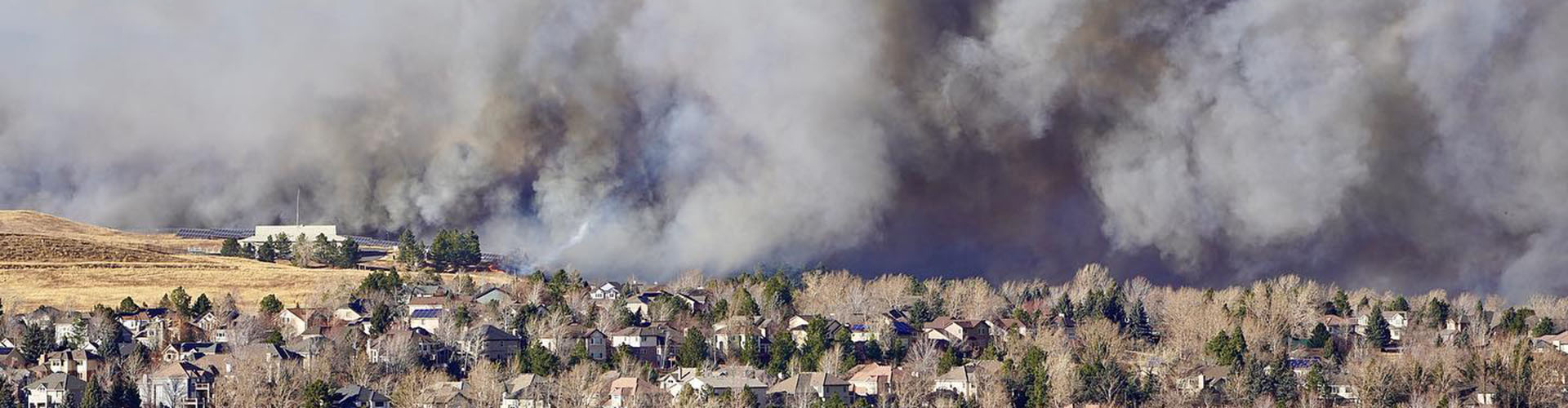
Marshall Fire December 30, 2021. Photo credit: Boulder County

Ironically, these questions were far from what Boulder claimed it wanted to do with its case. The city hasn’t asked to stop companies from producing oil and gas, or to stop those who burn them from sending greenhouse gases into the atmosphere. Rather, it wants oil companies to pay for deceiving the public into thinking those products weren’t producing large-scale harms through climate change. 

Justice Elena Kagan argued Boulder’s case was similar to suits that states brought against cigarette companies in the 1990s, seeking compensation for health care costs linked to tobacco consumption. The companies weren’t required to stop selling cigarettes, but to roll back their pro-cigarette marketing and fund awareness campaigns around the effects of smoking.

ā€œThis is not an effort to reduce emissions,ā€ said Russell. ā€œUnder our deception theory, they can continue to produce as much fossil fuels as they like and contribute to as much air pollution and greenhouse gas emissions as the market will bear when consumers are properly informed about the consequences of that decision.ā€

ā€œIt doesn’t prohibit them from engaging in the conduct. It requires them to internalize a portion of the cost of their activities by paying for some of the damage,ā€ Russell said later.

Kavanaugh called Russell’s phrasing ā€œcavalier,ā€ saying that those costs could be significant to oil and gas companies. Some firms, including Suncor, have told their shareholders the accumulating climate cases against them could affect their bottom lines. 

An Exxon gas station lies only blocks from the Supreme Court building on Massachusetts Avenue in Washington, D.C. Exxon Mobil is one of the defendants in Boulder’s climate case. The Heritage Foundation, a conservative think tank, looms behind the station. Austin Corona / Grist

If the case is allowed to proceed in Colorado courts and Boulder wins, it could open the floodgates for other cases, Shanmugam argued: ā€œMore [suits] are being filed by the week … so given the extraordinary magnitude of these cases, where, in each of these cases, plaintiffs are seeking billions of dollars of damages, we need an answer to this question sooner rather than later.ā€

Justices typically hear opening arguments and ask questions at the beginning of the court’s term and then take months before publishing a decision. This thread was only one of several they teased apart during the arguments, including arguments over states’ regulatory authorities under the Constitution and the intent of the Clean Air Act. Judges could use a range of rationales for their ultimate ruling, each of which would affect other climate suits against oil companies differently because those suits depend on different legal bases.

ā€œStates and local governments are trying to recoup costs related to harms from climate change in a lot of different types of lawsuits,ā€ said Erika Kranz, an attorney with Harvard Law School’s environmental and energy law program. Whether these other cases ā€œrun into trouble will depend on how justices write their decision.ā€

It’s also possible justices send the case back to Colorado, either by deciding the Supreme Court isn’t the right place for it or by voting 4-4, which would leave Boulder able to carry on with its state-level lawsuit. (Alito has not explained why he removed himself from the case, though he has faced accusations that his investments in oil and gas companies not related to the case made his participation inappropriate.)

Kranz and Chris Winter, executive director of the Getches-Wilkinson Center at the University of Colorado Law School, said it’s hard to know whether that emphasis showed the court was leaning toward the oil companies, but it suggested that at least some justices were deeply concerned about the case’s potential financial consequences for the industry.

Boulder’s lawyers must now convince them that this risk to oil and gas companies was beside the point, Winter said. To do that, Boulder will have to overcome justices’ claims that it’s trying to reduce emissions through the court.

ā€œThere’s a lot of concern from the oil industry, from corporate actors, and from the conservative justices about the significant consequences of these cases,ā€ Winter said. ā€œOne way to get at that is to equate this case with previous cases, which were much more directly about regulation of pollution.ā€

Colorado statewide annual temperature anomaly (°F) with respect to the 1901-2000 average. Graphic credit: Colorado Climate Center

Native nations sue over Endangered Species Act changes: Environmental work being done by tribes across the country will be made more difficult now that the Trump administration has more narrowly defined ā€˜harm.’ — Anna V. Smith (High Country News)

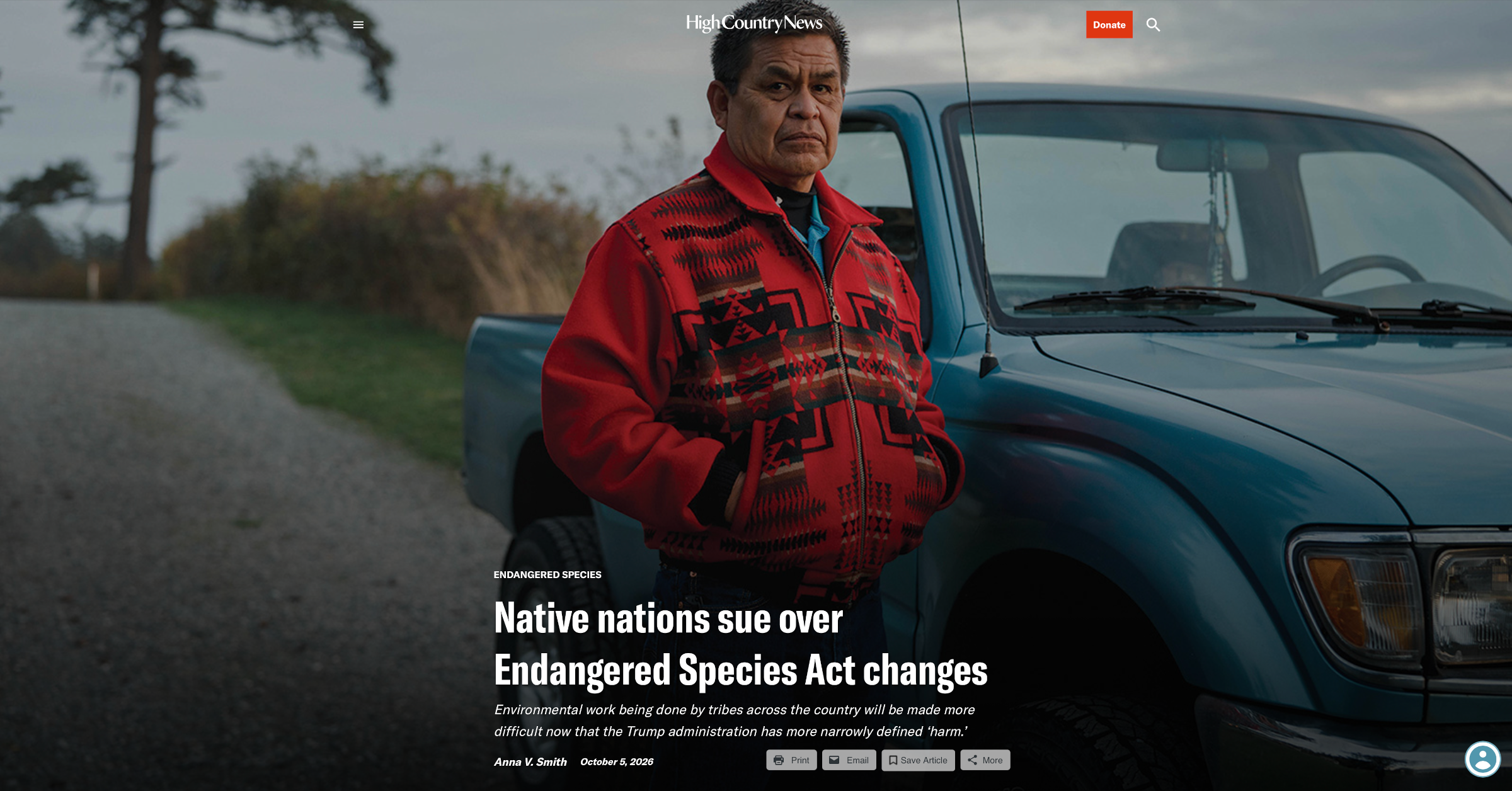
Steve Edwards, chairman of the Swinomish Tribal Community at Lone Tree Point, on the Swinomish Reservation in Washington. Jovelle Tamayo

Click the link to read the article on the High Country News website (Anna V. Smith):

October 5, 2026

The Smokehouse Tidal Marsh project on the Swinomish Indian Reservation, which began in 2022, will turn 250 acres of former agricultural land into estuaries and wetlands. It’s one of many tribal community projects aimed at restoring endangered and threatened populations of Puget Sound chinook salmon, Puget Sound steelhead, bull trout and southern resident killer whales in the Skagit River Watershed. A primary cause of decline for each of these species is habitat loss and degradation caused by development and agriculture.

ā€œOver the past 150 years or so, there’s been significant damage to the habitat, and (the habitat is) what salmon needs,ā€ said Swinomish Tribal Indian Community Chairman Steve Edwards, who has fished in the area for over 50 years. 

In July, the Trump administration dealt a massive blow to tribal efforts when it finalized changes to the federal government’s interpretation of the 1973 Endangered Species Act. Previously, the definition of ā€œharmā€ to a species included the habitat and resources a species needs to survive. Now, agencies will interpret ā€œharmā€ to mean only the intentional killing or harming of an individual of a species, dramatically narrowing the reach and scope of the law formerly focused on ecosystem-wide protection.

On July 14, the same day the rule change was finalized, the Swinomish and Squaxin Island tribes sued the federal government over its ā€œradical reinterpretationā€ of the law, arguing that the Trump administration’s changes ignored over 50 years of congressional intent and Supreme Court case law.  

ā€œSquaxin’s cultural and economic well-being depend upon the health and sustainability of Pacific Salmon and other freshwater and marine resources, which play a central role in the daily lives of Tribal members,ā€ the tribes wrote in the lawsuit. 

Chairman Edwards told High Country News that federal agencies never responded to the Swinomish Tribe’s request for government-to-government consultation, despite the United States’ trust obligation to Native nations. 

ā€œSquaxin’s cultural and economic well-being depend upon the health and sustainability of Pacific Salmon and other freshwater and marine resources, which play a central role in the daily lives of Tribal members,ā€ the tribes wrote in the lawsuit. 

Chairman Edwards told High Country News that federal agencies never responded to the Swinomish Tribe’s request for government-to-government consultation, despite the United States’ trust obligation to Native nations. 

ā€œIt feels almost like we’ve been betrayed by our federal trustees,ā€ Edwards said of the change, which he said diminishes their treaty rights. ā€œIt’s super disturbing that we had to fight this fight.ā€  

Many Native nations opposed the changes in public comments when they were proposed in 2025. They highlighted the lack of tribal consultation, as well as the devastating impacts the new interpretation could have on the recovery of imperiled species, many of  which have cultural, spiritual and relational meaning and importance to tribal citizens. 

The change could also disrupt fishing communities’ economies and deprive those who rely on salmon for subsistence. 

While the majority of the comments came from Native nations in the Pacific Northwest and were related to salmon, others came from tribes like the Pueblo of San Felipe, which cited impacts on the monarch butterfly and Suckley’s cuckoo bumblebee. The Fallon Paiute-Shoshone Tribe voiced concern for the Dixie Valley toad, which the tribe considers a relative. 

ā€œIt is obvious that removing water from a species that needs water to survive harms both individual members of the species and the species’ population,ā€ wrote Fallon Paiute-Shoshone Tribe Chairwoman Cathi Williams-Tuni, about the change and the potential impacts of a nearby proposed geothermal project. 

That geothermal project was halted in 2022 after the toad was listed as endangered, but the Trump administration’s changes could allow it to resume. 

ā€œThese harms in Dixie Valley would be catastrophic, permanently ruining the Tribe’s sacred site and ending the ability to use the springs for medicine and ceremonies,ā€ said Williams-Tuni in public comments. 

The tribes asked the court to prevent the regulatory changes from moving forward, which took effect Sept. 14, and requested a decision declaring the changes unlawful and reverting to the previous definitions of ā€œharm.ā€ Although they hope for a timely response, the tribes are prepared for the lawsuit to take months to resolve.

The rule change is advantageous for developers and industry, who may no longer need to consider or mitigate broader habitat impacts of their actions. Previously, if an activity would destroy habitat in a way that harmed a protected species, the business responsible would have to go through a permit process that normally triggered tribal consultation. Under the new changes, such permits would be required much less frequently, effectively cutting tribes out of the process. The changed definition will also require proof that the harm was intentional, which  is something difficult to prove in the legal system, according to Bob Anderson, Oneida Indian Nation visiting professor of law at the Harvard Law School and a member of the Bois Forte Band of the Minnesota Chippewa Tribe. 

ā€œCompanies won’t have any incentives to negotiate with the government or environmental groups or tribes about how their activities are going to affect the listed species,ā€ Anderson told HCN.

The change could also impact large-scale agreements on rivers with ESA-listed species, according to Anderson. Currently, river systems like the Klamath, Elwha and Columbia all require water to be released from their dams at certain times of year to support the migration and spawning cycles of endangered or threatened salmon, in accordance with the ESA. The new interpretation throws existing agreements and laws into question and would make salmon recovery exponentially harder. 

ā€œWe’re not even close to delisting these species,ā€ said Kayeloni Scott (Nez Perce and Spokane), executive director of theĀ Columbia River Snake Campaign, a coalition of conservation groups, businesses and the Nez Perce Tribe. ā€œOur goal is abundance — healthy and abundant populations — that’s a whole other level, a whole other tier. Even getting to delisting, we’re pretty far off.ā€Ā 

Anderson believes that the tribes and environmental groups’ legal arguments are strong but added that they involve a level of political risk, given the administration’s reputation for being highly retaliatory. One striking example is that of the Miccosukee Tribe of Indians of Florida, which joined a lawsuit against the administration in July 2025 over the construction of an immigration detention center in the Everglades. That December, President Donald Trump vetoed an unrelated bipartisan bill that would have returned land to the tribe, citing the tribe’s opposition to the detention center as his reasoning for the veto, calling the Miccosukee Tribe ā€œunaligned with my Administration’s policy of removing violent criminal illegal aliens from the country.ā€

ā€œThat’s a real message there to plaintiffs that they’re going to retaliate against you,ā€ Anderson said. ā€œYou’re locking horns with the federal government.ā€

Despite the latest development, Edwards’ priority is upholding the nation’s sovereign rights for future generations. He says the tribe will not stop its restoration work. 

ā€œIt does impact our sovereignty,ā€ Edwards said of the change to species protections. ā€œGenerations down the road, I want (Swinomish citizens) to be able to exercise their treaty rights like I have done in the past.ā€

We welcome reader letters. Email High Country News at editor@hcn.org or submit a letter to the editor. See our letters to the editor policy.

This article appeared in the October 2026 print edition of the magazine with the headline ā€œTribes sue over ā€˜harm’.ā€ 

U.S. Supreme Court justices appear skeptical of allowing Boulder climate lawsuit to proceed: Case could be turning point in efforts to hold fossil fuel industry accountable — Chase Woodruff (ColoradoNewsline.com) #ClimateChange

An aerial view of a Boulder County neighborhood that burned in the Marshall Fire, on Dec. 31, 2021. (Hart Van Denburg/CPR, pool)

Click the link to read the article on the Colorado Newsline websilte (Chase Woodruff):

October 5, 2026

The U.S. Supreme Court’s conservative majority Monday appeared broadly sympathetic to fossil fuel companies’ argument that allowing two Colorado local governments to sue them over climate change in state court would be a ā€œrecipe for chaos.ā€

Attorneys for both sides in Suncor v. Boulder, along with the Trump administration, presented oral arguments in a two-hour hearing, the first of the Supreme Court’s 2026-27 term. The case originated in Colorado in 2018, when Boulder’s city and county governments sued Exxon Mobil and Suncor Energy, seeking monetary damages under state tort law for their role in contributing to climate change.

Despite being filed eight years ago, the case has yet to proceed to trial, as the fossil fuel companies have repeatedly tried to have it dismissed or moved to federal court by arguing that the Constitution and federal clean-air laws preempt such state-level proceedings.

As justices waded into a thicket of jurisdictional issues raised by Suncor and Exxon when they petitioned the nation’s highest court to weigh in last year, Chief Justice John Roberts noted the ā€œpractical matterā€ of what could happen nationwide if Boulder’s case is allowed to proceed.

ā€œPresumably if you prevail, the next day, a municipality in every single state will file a lawsuit, probably copy your pleadings, and then there’ll be at least 50 … causes of action filed,ā€ he told the attorney representing Boulder. ā€œHow would you think that will work out on the ground?ā€

With more than 30 similar lawsuits already filed by state and local governments across the country, environmental advocates say the outcome in Suncor v. Boulder could be a turning point in efforts to hold the fossil fuel industry accountable for climate change.

Justice Elena Kagan, the most senior of the court’s three liberal justices, compared the wave of climate litigation to state-level efforts against tobacco companies in the 1990s and against opioid manufacturers in the 2010s. She asked the attorney for Suncor and Exxon if those lawsuits should have been preempted, too.

Kannon Shanmugam, representing the companies, said the tobacco litigation involved ā€œa more traditional misrepresentation claimā€ and consumers ā€œsuffering injury quite directly.ā€

ā€œI’m waiting to see the distinction,ā€ Kagan replied. ā€œBecause this complaint talks a lot about misrepresentations that are made by the defendants.ā€

Climate change in Colorado

In a statement Monday, Boulder County said that its case seeks to hold the companies ā€œresponsible for knowingly contributing to climate alteration while concealing the dangers of their products.ā€

The Suncor v. Boulder proceedings come after another unprecedented summer of record heat, extreme drought conditions and destructive wildfire activity impacting Boulder and other Colorado communities, as human-caused climate change, mostly the result of fossil fuel combustion, pushes average global temperatures to dangerous new highs. In December 2021, Boulder County was the location of the Marshall Fire ā€” the most destructive fire in Colorado history, and one in which scientists say climate change was a factor.

ā€œFaced with these rising costs, we ask, is it fair for communities to shoulder these costs alone? We believe it is not,ā€ Boulder County’s statement said. ā€œFor decades, the companies producing and selling fossil fuels knew that their products contribute to a changing climate. These companies are asking the Court to help them evade responsibility.ā€

Alito absent

Absent from Monday’s oral arguments was Justice Samuel Alito, one of the Supreme Court’s most conservative members. Alito recused himself from further proceedings in the case last week, after environmental advocates had called for him to step aside because he owns stock in at least two oil companies.

Alongside the two parties to the case, Sarah Harris, U.S. deputy solicitor general, appeared before the court on the Trump administration’s behalf, asking the justices to side with the fossil fuel companies. In an unusual move, the administration filed an unsolicited brief in support of Suncor and Exxon’s initial petition to the court shortly after it was filed in August 2025.

ā€œWe agree with petitioners: interstate air pollution is an inherently federal area, and Congress hasn’t authorized this suit in the Clean Air Act,ā€ Harris told the justices.

Though he posed multiple questions to Shanmugam about the companies’ legal arguments, conservative Justice Brett Kavanaugh appeared to agree, saying that the court had multiple precedents making it ā€œcrystal clearā€ that issues involving interstate air and water pollution are subject to federal preemption.

ā€œWe don’t have to reinvent the wheel,ā€ Kavanaugh said. ā€œBecause we’ve said this multiple times — and Congress, presumably, when doing the Clean Air Act and doing the Clean Air Act amendments, has relied on this court’s precedents, establishing that this kind of pollution is a federal law matter.ā€

Attorney Kevin Russell, representing Boulder, reiterated that the plaintiffs’ case against Suncor and Exxon goes beyond an attempt to merely regulate greenhouse gas emissions.

ā€œThe deception claims, I think, are far outside anything the Clean Air Act is designed to deal with,ā€ Russell said. ā€œThe Clean Air Act doesn’t give the EPA authority to figure out what is the ideal amount of emissions … or the right mix of fuels, or the right level of economic activity. It is a much more precise mandate that is limited to putting a cap on the amount of emissions from particular point sources.ā€

But both Kagan and Roberts sounded skeptical of Boulder’s position that its litigation isn’t seeking to regulate emissions.

ā€œEverything depends on this idea that the defendants are responsible for excessive emissions,ā€ Kagan said.

ā€œIsn’t your suit an attempt to evade those (Clean Air Act precedents)?ā€ asked Roberts. ā€œIt’s an effort to reduce emissions. The fuel production itself doesn’t have the sort of universal harm that we’re talking about.ā€

As Monday’s hearing began in Washington, climate activists gathered at a rally in Boulder, where Mayor Aaron Brockett, survivors of the Marshall Fire and other speakers urged the Supreme Court not to issue a ruling that lets the fossil fuel industry off the hook.

ā€œOur community and many others have suffered terribly from worsening wildfires, floods and drought because of the deception of big oil companies, who knew that burning fossil fuels would overheat our planet, but chose to obfuscate the truth to prioritize their profits,ā€ Micah Parkin, an advocate with climate group 350 Colorado, said in a statement. ā€œBoulder deserves to have our day in court to hold these corporations accountable for the costs our community is having to bear.ā€

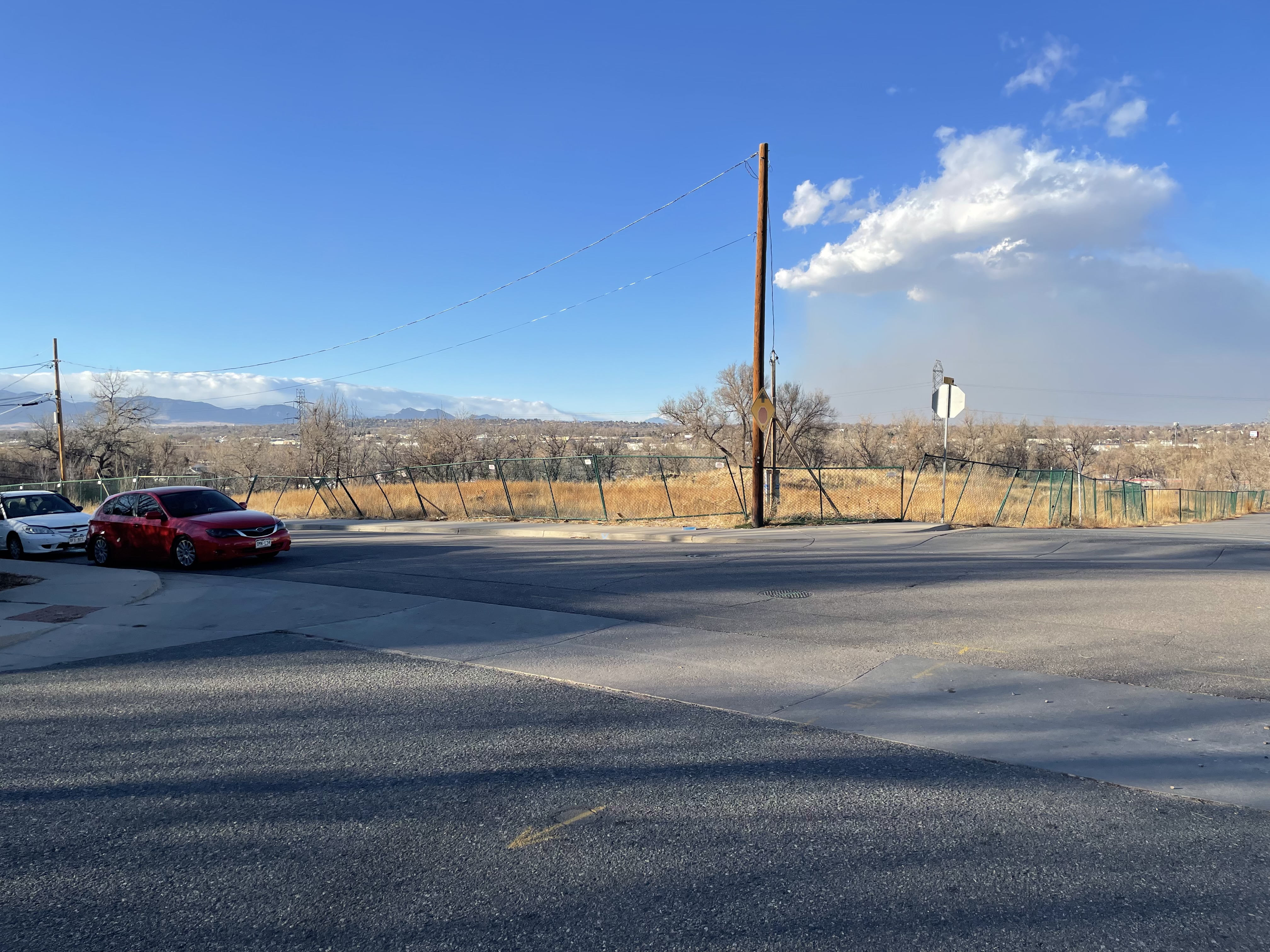
Looking towards Boulder at the Marshall Fire December 30, 2021 From 53rd and Stuart in Adams County. Note the atmospheric mountain wave, where winds accelerate down the slope of mountains, extend only a short distance downwind from the mountains, then subside further downwind and blow in the opposite direction, much like the backward flowing current behind a rock in a swift river.

Colorado Parks & Wildlife increases fish habitat with 220 boulders — The Mountain Mail #ArkansasRiver

Click the link to read the article on The Mountain Mail website (Cailey McDermott). Here’s an excerpt:

September 29, 2026

In a continued effort to improve fish habitat and areas of rest for trout, Colorado Parks and Wildlife added about 220 native boulders to the sides of the Arkansas River in four sections between the bridges on CR 166 and CR 175.Ā  Sean Shepherd, CPW area wildlife manager, said the project has been in the works for about four ears and is a continuation of work after the removal of the low-head dam, which Shepherd said was Phase 1.Ā  Doing the actual in-river placing of boulders had a short timeline. They started Sept. 8 and had to be done by Sept. 30, as spawning season officially starts Oct. 1. The crew finished Sept. 28. Improving the connectivity through this section of river will support all stages of aquatic life, especially brown and rainbow trout, he explained.

Map of the Arkansas River drainage basin. Created using USGS National Map and NASA SRTM data. By Shannon1 – Own work, CC BY-SA 4.0, https://commons.wikimedia.org/w/index.php?curid=79039596

Denver just saw its fourth-warmest September on record, sixth in a row without snow — The #Denver Post #snowpack

Click the link to read the article on The Denver Post website (Lauren Penington). Here’s an excerpt:

October 1, 2026

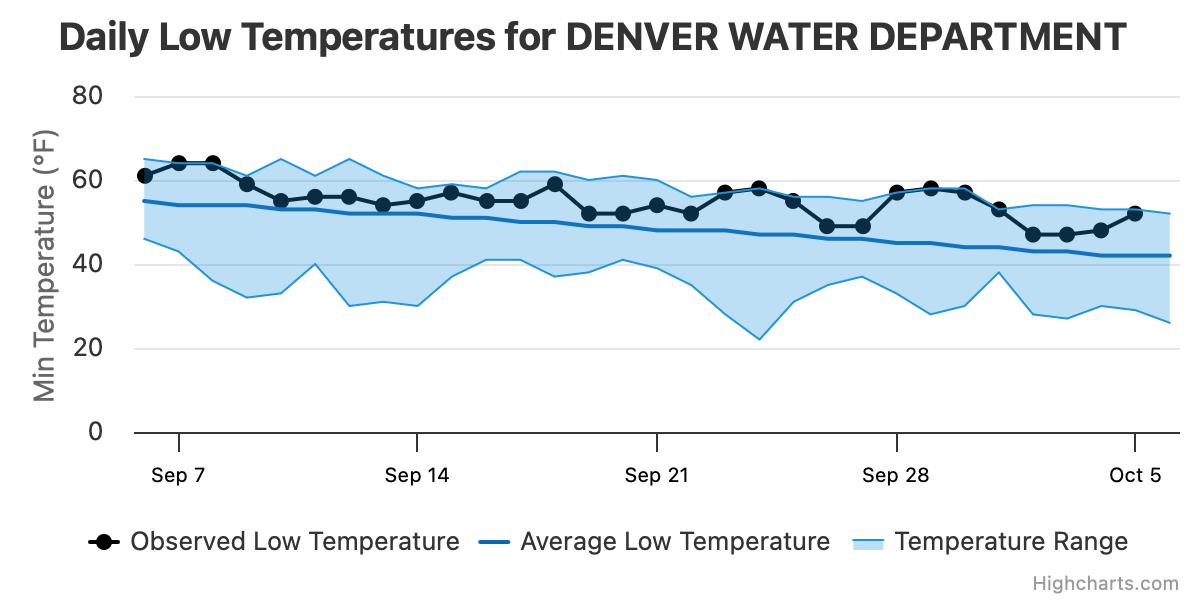
Another month of unusually warm temperatures cemented September as theĀ fourth-warmest on record for Denver, and theĀ sixth in a row without snow, according to the National Weather Service. Denver’s average temperature last month was 69.2 degrees, more than 4 degrees above the city’s normal September average of 64.8 degrees and just short of the 70-degree record set in 2024,Ā according to weather service data.Ā  The coldest September average on record was 54.7 degrees in 1912…

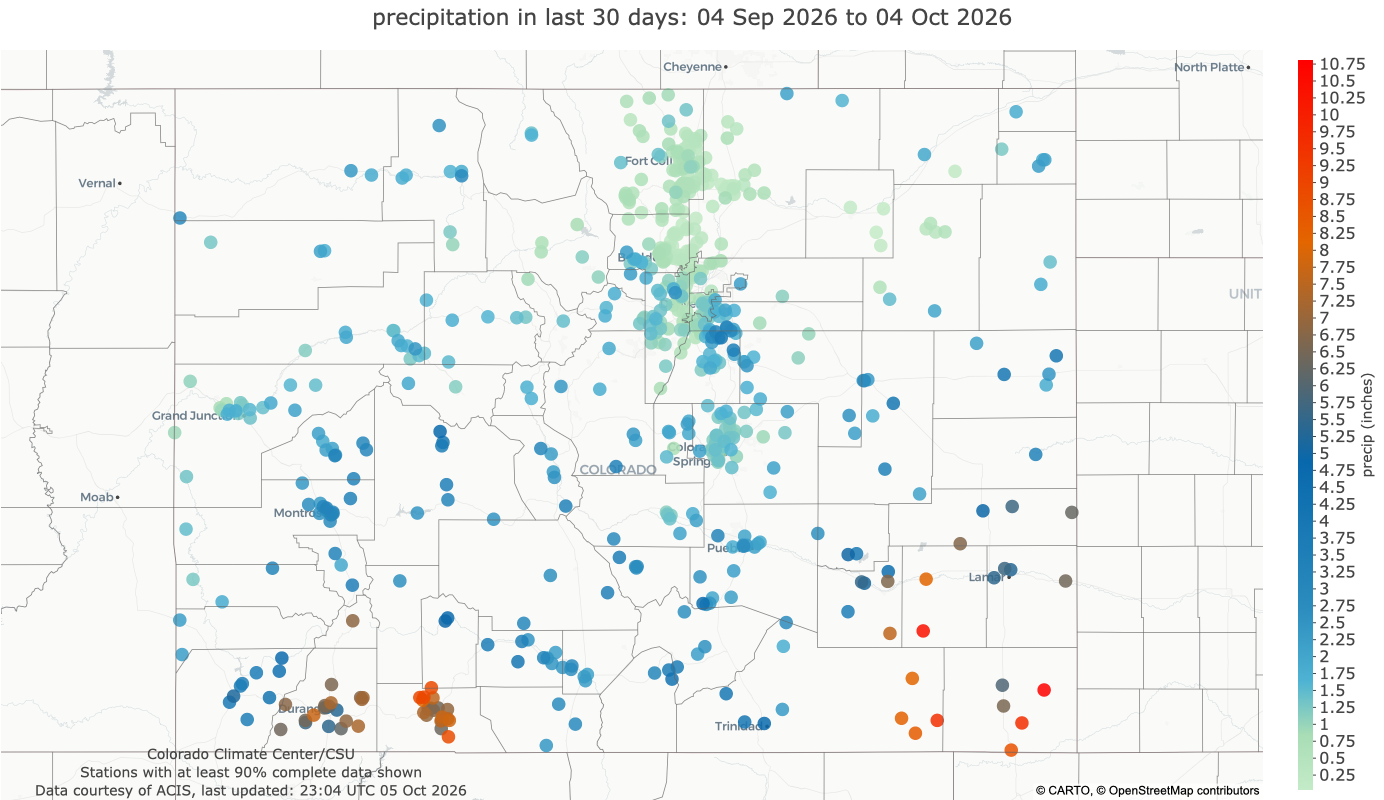
Despite the warmth, about 2.23 inches of precipitation fell in the city in September, weather service meteorologists said. None of it was snow, marking Denver’s sixth snowless September in a row. Denver has recorded measurable snowfall only once in September in the past 20 years, with 1 inch of powder stacking up in 2020, according to weather service records. The city documented traces of snow in 2014 and 2012, but the rest of Denver’s Septembers since 2006 have been snowless.

CoCoRaHS precipitation map for Colorado for the past 30 days. Credit: Colorado Climate Center