Click the link to read the article on the Denver Water website:
October 12, 2026
Denver Water’s collection and service areas continue to face severe drought conditions, with historically low snowpack. Denver Water depends on mountain snowpack for its water supply, which serves 1.5 million people in Denver and surrounding suburbs.
As a result, on March 25, 2026, the Denver Board of Water Commissioners declared a Stage 1 drought, seeking a 20% reduction in water use to preserve water levels and avoid even stricter mandatory restrictions later this summer. On April 8, 2026, the board approved the implementation of temporary drought pricing, starting with May water use and reflected in June bills, to signal the premium value of water during droughts and help incentivize customers to save water.
On Aug. 26, 2026, the board amended its Stage 1 drought resolution to prohibit lawn watering as of Oct. 1. The ban on lawn watering and all spray irrigation remains in effect until the board determines how and when lawn watering can resume. That means sprinklers need to remain off in spring of 2027, pending an official resolution from the Board of Water Commissioners.
Customers are warned of heavy fines for lawn watering or using spray irrigation after Sept. 30. Penalties for violating the ban begin at $500 for single-family customers.
Snowpack and water supply update
- In Denver Water’s collection system, the 2025-26 snowpack peaked more than a month earlier than normal and at the lowest levels observed in the past 40 years:
- Colorado River Basin: Snowpack peaked March 18, 2026, at 58% of normal, the second-earliest date and second-lowest peak on record. (Typical peak date is April 24.)
- South Platte River Basin: Snowpack peaked March 17, 2026, at 42% of normal, the second-earliest date and the lowest peak on record. (Typical peak date is April 26.)
- Snowpack and melting conditions were unprecedented, with accelerated spring melting that started in mid-March. Customers need to save water to stretch supplies.
- Streamflow forecasts called for runoff levels to be 10-40% of normal in 2026.
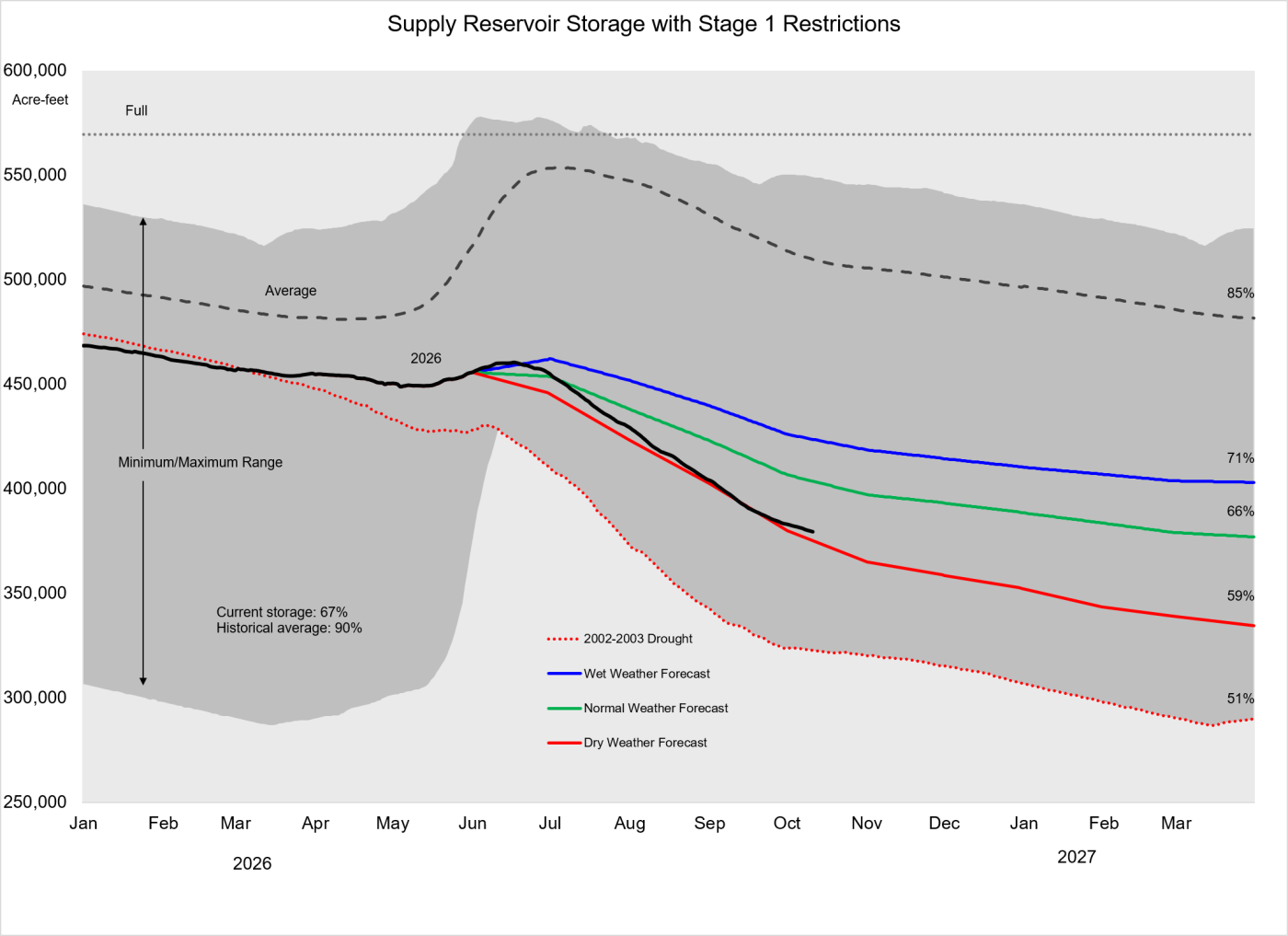
- Reservoir storage conditions are below average. As of Oct. 12, 2026, reservoirs were 67% full, versus an average of 90% full for this time.
Water use and conservation update
- Quote from Greg Fisher, Denver Water’s manager of demand planning:
- “Our customers did a great job shutting off their sprinkler systems in response to our Oct. 1 cutoff for lawn watering. Water use Oct. 1 through Oct. 11 was 34% below the five-year average,” said Greg Fisher, Denver Water’s manager of demand planning.
- “This is a good start to preserving our critically important water supplies, because Denver Water’s reservoir storage levels are currently at 67% full, well below the average of 90% for this time of year.
- “We’re all hoping for a good winter, but it’s extremely unlikely that we’ll see enough snow — and more importantly, a robust spring runoff — to fully fill our reservoirs next year. Every customer’s conservation efforts remain especially important as we work together to stretch our storage supplies heading into the winter.”
- Customers can do their part by making water-efficient upgrades, indoors and outdoors, including rethinking their yards. These steps preserve water supplies and create more adaptable and drought-resilient landscapes that fit naturally into our climate. Read on TAP: Simple strategies to save water at home.
- Customers are reminded of the ban on lawn watering and spray irrigation as of Oct. 1.
- Trees, shrubs and perennials may be watered any day with a hand-held hose with a shut-off nozzle or low-volume, non-spray irrigation (such as a drip system). They may not be watered with spray irrigation.
- Denver Water will not be issuing watering exemptions for new turf installations.
For its part, Denver Water has proactively reduced its spending, taking steps that include enacting a hiring freeze and reviewing maintenance and other projects to see which ones could be deferred. We are also looking into other ways to increase supply by activating agreements that allow us to capture additional water that is typically unavailable during normal conditions.
This year marks the fifth time since 2000 that Denver Water has issued a Stage 1 drought, and the first since 2013. Prior to 2013, the board declared a Stage 1 drought in 2002, 2003 and 2004.
Denver Water has many resources for homeowners looking for inspiration and information about landscapes that fit naturally into our dry climate. Click here for conservation and efficiency tips for outdoor irrigation and to get more details on ways to ColoradoScape your property, including through rebates for turf removal and a DIY guide for landscape changes, among many other potential water-saving steps.
Updates about Denver Water’s reservoir levels, customer water use and snowpack can be found in the Water Watch Report, which is updated weekly in the spring and summer.
