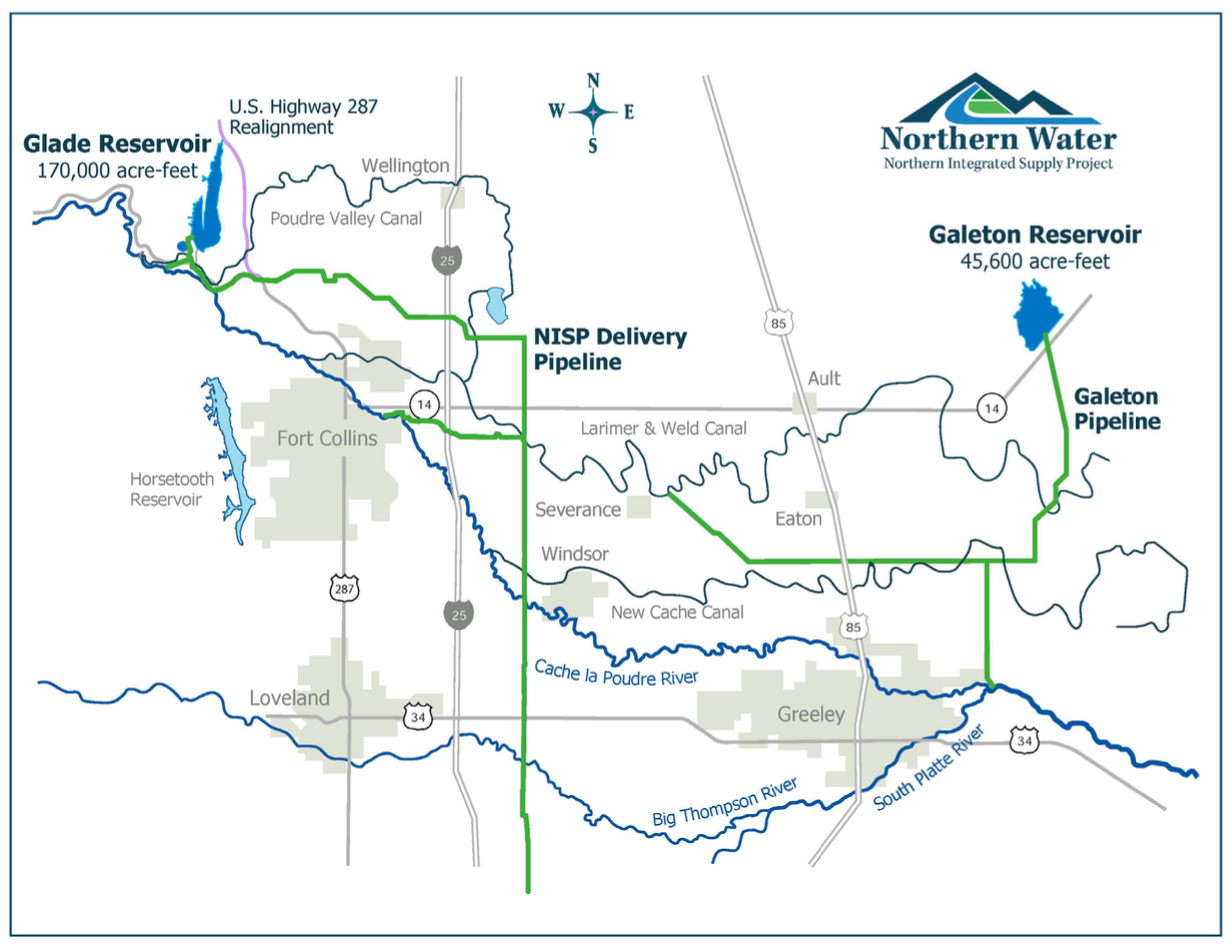
The Northern Integrated Supply Project, currently estimated at $2 billion, would create two new reservoirs and a system of pipelines to capture more drinking water for 15 community water suppliers. An environmental group is now suing the Army Corps of Engineers over a key permit for Northern Water’s proposal. (Save the Poudre lawsuit, from Northern Water project pages)
From email from the City of Fort Collins:
October 15, 2026
For decades, the City of Fort Collins has been working on the Halligan Project to provide water storage to meet Fort Collins Utilities’ customer demands into the future and provide drought security and resilience. The U.S. Army Corps of Engineers has not yet issued the final permit, and it has become increasingly doubtful the agency will issue an approval. Meanwhile, rising construction and permitting costs have made it increasingly difficult financially. Given these circumstances, the City had a responsibility to investigate other options.
On Oct. 20, City staff will present factors driving a recommendation to City Council to pivot to a different water storage project. Discussion points will include Halligan Project permitting challenges, water storage needs, financial impact analyses, environmental considerations, and overall recommendations to City Council. The City Council materials and agenda will be posted by end-of-business on Oct. 15 at this link.
The City plans to host an informational meeting so community members have a chance to learn what’s next and ask questions. When the date is finalized, we will send another email with the details.
Within three months of the U.S. and Israeli strikes on Iran on Feb. 28, 2026, the average price of gasoline for American drivers climbed from US$2.94 to $4.35 a gallon. If there was ever a moment for Americans to switch to electric vehicles, this was it.
I study car buyers and their preferences, and there is an important distinction between what consumers want and what they can actually buy. Sales reveal what cars people actually bought, but not necessarily what they actually wanted.
When the supply of some kinds of cars can’t keep up with demand, prices rise, and that’s exactly what happened for electric vehicles in 2026.
An industry in retreat
In 2026, hybrids and all-electric vehicles faced the same jump in demand from the oil crisis. While there were plenty of hybrids available to meet that demand, the same was not true for EVs.
However, EV production had been in retreat since the tax and spending law President Donald Trump signed in July 2025 ended federal tax credits for EVs. Buyers had been able to get up to $7,500 for new EVs and $4,000 for used ones, but that ended after Sept. 30, 2025.
Buyers, for their part, rushed to beat the tax credit deadline, pushing EVs to 11.3% of new vehicle sales in September 2025. But by November 2025, after the tax credits ended, their share dropped to 4.3%.
As 2026 progressed and gas prices began to rise, so did EV demand. New EV inventories declined, shrinking from about 130 days of supply in the first quarter of 2026 to 78 days by August – just two days above the supply level of gas-burning cars.
Discounts on new EV models shrank too. My analysis of online listings from marketcheck.com shows the median new EV was listed 9.8% below sticker price in February. By April, the median discount was 6.6%, and 4.7% in June. That’s a sign that dealers saw rising demand, not inventory to clear.
A run on used electric vehicles
Before the war, prices for used electric vehicles were still drifting down in the wake of the expired used EV federal tax credit. After the war began, they climbed 13% through late June 2026. For a typical used electric vehicle, that’s about $3,500 more.
But the data doesn’t support the claim that electric vehicle sales stalled in 2026 because Americans don’t want them. Rather, the sales stalled because there weren’t enough EVs available to buy – and there were plenty of hybrids as an alternative.
The distinction matters because automakers have treated a change in the policy landscape as a change in consumer demand, leading to shortages with real costs.
The average new car now sells for about $50,000 and the average new electric vehicle for about $55,000, according to Kelley Blue Book, a company that tracks car prices.
The current situation leaves drivers exposed to the volatility of oil prices with fewer alternatives. The U.S. is the world’s largest oil producer, yet a war in the Persian Gulf raised gas prices significantly in just three months. Oil trades on a global market, so American drivers pay global prices.
Electric vehicle sales haven’t caught up. Argonne’s data show 86,000 of them sold in August, fewer than the 101,000 sold in May, while hybrid sales stayed above 216,000 a month all summer.
A look ahead
Rather than move to increase electric vehicle supply and make them more affordable, federal policy continues to hinder the U.S. electric vehicle sector.
The fuel economy rule released Sept. 28, 2026, loosens efficiency requirements for gas-powered vehicles and in 2028 ends a system that let automakers that beat the standards – mostly EV makers – earn credits for exceeding them and sell those to automakers that fell short. That means automakers will have fewer regulatory incentives to produce EVs going forward.
Chinese EV manufacturing is growing, but the U.S. market is mostly closed to those products and the companies that make them, and may get even more closed. Kevin Frayer/Getty Images
As long as gas stays expensive, the gap between the electric vehicles Americans want and the electric vehicles dealers can sell them is likely to remain. Decisions such as ending the tax credit, rolling back fuel economy standards and banning Chinese technology all make it harder to build them, which means Americans will continue to have fewer affordable electric vehicles to choose from.