I am still astonished that I can fill up my car with sunshine
— Dan Ilic (@danilic.bsky.social) 2026-10-20T03:29:30.906Z
Day: October 20, 2026
How climate change is messing with the West’s weather: Record fires, floods and weather whiplash makes for a region of extremes — Jonathan P. Thompson (High Country News) #RioGrande #ColoradoRiver #COriver #aridification


Click the link to read the article on the High Country News website (Jonathan P. Thompson):
October 19, 2026
On July 11, the Rio Grande dried up at the streamflow gauge about 18 miles upstream from Truth or Consequences, New Mexico. It was notable, because this stretch of riverbed was once actually underneath Elephant Butte Reservoir, the state’s largest reservoir and an important storage facility for downstream irrigators. But by this summer, two decades of drought had reduced Elephant Butte to just 1.7% of its 652 billion-gallon capacity, leaving behind a mudflat that soon became a dry, dusty riverbed. By September, however, the previously barren riverbed was flowing at more than 3,000 cubic feet per second. Elephant Butte’s surface level rose by several feet, and the green chile-growing communities of the Lower Rio Grande Valley experienced severe flooding caused by record-breaking rainfall boosted by a hurricane in the Pacific.
In many ways, this contrast of extreme dryness with surprising amounts of drenching moisture provides a snapshot of the 2026 water year, which ended on Sept. 30. In the Colorado River and Rio Grande watersheds, it was marked by both intense drought and record-breaking rains that inspired devastating wildfires later followed by catastrophic floods. One of the driest 10 months on record was bookmarked by record-breaking rainfall.
In short, the 2026 water year was one of the weirdest ever experienced by much of the West. And climate change’s fingerprints are all over it.
The water year started off on a rainy note, especially in the San Juan River Basin in southwestern Colorado, the source of one of the Colorado River’s largest tributaries. Remnants of a tropical storm dumped over 6 inches of rain in about 48 hours at Wolf Creek Pass, near the headwaters of the San Juan and Rio Grande. This caused the San Juan River to swell to more than 8,000 cubic feet per second, jump its banks, and wreak havoc and destruction on the town of Pagosa Springs. It also boosted the surface elevation of Navajo Reservoir on the Colorado-New Mexico border by some 50 feet.
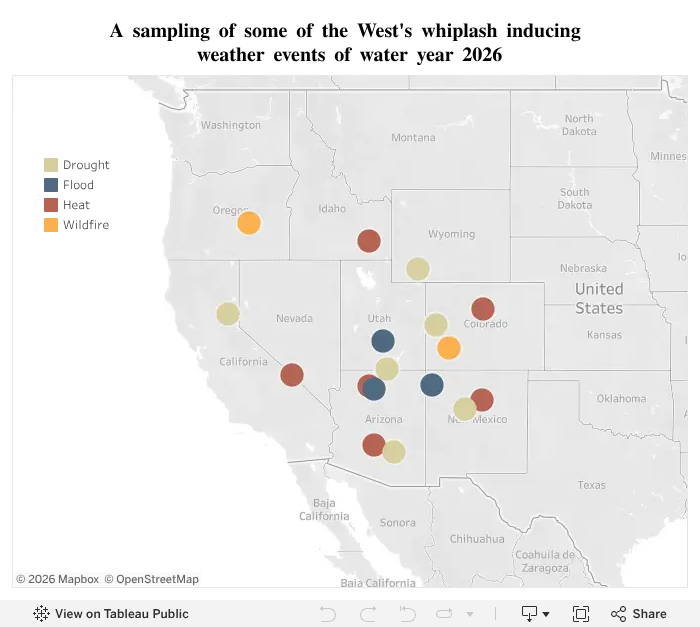
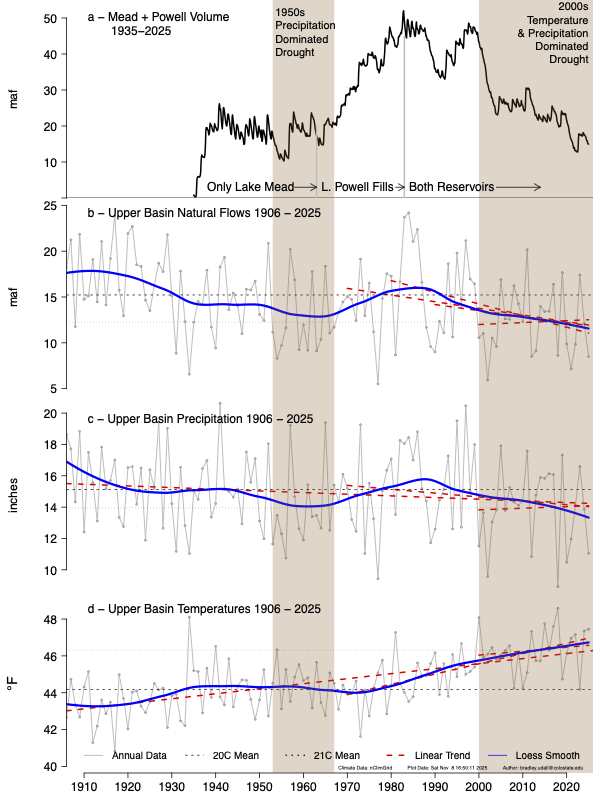
It all seemed to bode well for the winter to come. If that amount of moisture were to fall as snow, it would provide a deep base for skiers and for the following spring’s runoff, which is what keeps the nation’s second-biggest reservoir, Lake Powell, from going dry. But this year, the snow failed to fall like it normally would, even in the depths of winter. When it did fall, it tended to melt, sometimes even before it reached the ground.
Part of the problem was timing: The abundant precipitation came too early to fall as snow. But the biggest factor was temperature. National Oceanic and Atmospheric Administration data reveals that most of the West experienced its warmest autumn and winter on record. The only exception was the Pacific Northwest, which had its second-warmest autumn and winter in 130 years. The result was that even places that received near-normal precipitation accumulation and weren’t technically in a drought suffered through one of the most severe snow droughts in recorded history.
The West’s streams and rivers — and therefore its reservoirs and irrigation ditches and municipal water systems — depend on snowmelt for at least 80% of their flows. A bad snow year leads to scant runoff, which in turn drains reservoirs. In September, Lake Powell reached its lowest level since the 1960s, setting off alarms across the region for the tens of millions of people that rely on it.
Droughts — even snow droughts — aren’t unusual in the West. Nor are extreme weather fluctuations. But this year’s drought was one of the most severe in over a century. A peer-reviewed paper published this summer out of the Colorado School of Mines determined that it was almost certainly the result of human-caused climate change.
The authors found that across the West as a whole, the 2026 snow drought was about four times more likely to occur in the current climate than during the 1850-1900 comparison period. In the Upper Colorado River Basin, where the drought was most severe, these dire conditions were about 14 times more likely to occur in our current climate than in pre-industrial times.
That doesn’t mean we should expect severe snow droughts every year from here on out. But as global temperatures continue to increase, Westerners should gird themselves for more extreme, increasingly weird, and very often destructive weather.
Note: This story was updated to include charts for the snow water equivalent in the upper Colorado River region from 2026.
We welcome reader letters. Email High Country News at editor@hcn.org or submit a letter to the editor. See our letters to the editor policy.
#Arizona joins #ColoradoRiver fight in federal court — The Deseret News #COriver #aridification
Click the link to read the article on The Deseret News website (Leah Bowers). Here’s an excerpt:
October 16, 2026
Arizona Department of Water Resources Director Tom Buschatzke said the litigation pathway was never the preferred alternative. “We were not successful in coming to an equitable outcome among all seven states,” he added…
The core of the department’s decision — and the source of contention between the states — is how the water conservation efforts are split. The four Upper Basin states (Utah, Colorado, New Mexico and Wyoming) face no mandatory water reductions — they are subject to voluntary conservation goals. The three Lower Basin states (Arizona, California and Nevada), however, could be required to cut their water usage by up to 3 million acre-feet…Even between the three Lower Basin states, the cuts are not spread evenly. Arizona is expected to accept 61% of the cuts, California 35% and Nevada 4%…
“Such reductions could effectively dry up the Central Arizona Project as well as many of our on-river communities,” said Buschatzke. “It would more than double the water cuts agreed to in the Lower Basin Agreement. Arizona believes that taking its action now provides the best path forward for protecting Arizona water users.”
Arizona claims the new guidelines “failed to deliver” the water that Lower Basin states are owed: “Like Nevada, Arizona believes the federal government’s new operating framework ignores basic elements of the law of the river,” said Buschatzke. “It could result in cuts to the state apportionment that would devastate Arizona’s economy.”
[…]
A multistate compact adopted in 1922 designates 1.5 million acre-feet to Mexico, 7.5 million acre-feet to the Upper Basin states, 7.5 million acre-feet to the Lower Basin states and 1.5 million acre-feet to evapotranspiration. That totals 18 million acre-feet in the Colorado River each year. However, some experts say much of the conflict the Southwestern states live with now is due to bad math from the beginning of the law — claiming there was never 18 million acre-feet of water to divide in the first place.

#Arizona moves to join #ColoradoRiver lawsuit alongside #Nevada — KJZZ #COriver #aridification
Click the link to read the article on the KJZZ website (Alex Hager). Here’s an excerpt:
October 16, 2026
Arizona has filed to join a lawsuit against the federal government over its new plan for managing the Colorado River. The federal plan would cut Colorado River supplies for Arizona, California and Nevada by about 20% through 2028, and could cut them by about 40% after that. The lawsuit, originally filed by Nevada in August, argues that the plan is too harmful to water users in those states. Arizona would take the largest cuts under the new federal plan, and state officials have openly criticized it. By filing a motion to intervene in Nevada’s lawsuit, they are arguing that the federal water plan is not only unfair, but illegal.
“Arizona believes the federal government’s new operating framework ignores basic elements of the law of the river and could result in cuts to the state apportionment that would devastate Arizona’s economy,” said Tom Buschatzke, director of the Arizona Department of Water Resources.
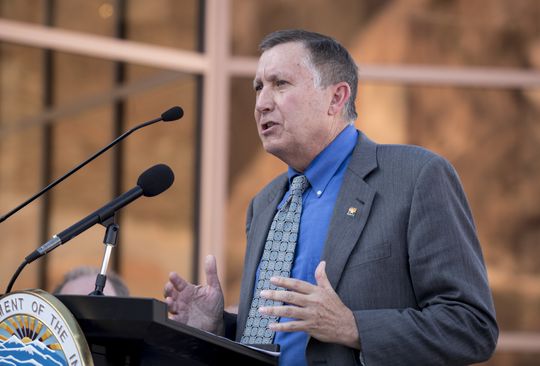
The lawsuit is not the so-called “nuclear option” that could bring Colorado River matters before the Supreme Court. That would likely require one state to sue another. Arizona has laid out its case to sue if it determines that upstream states are not sending a legally-required amount of water downstream, but has not yet done so…The lawsuit Arizona filed to join on Friday does something different. Nevada’s original suit claims that the federal government violated procedural laws while creating its new plans for managing water. The Bureau of Reclamation, the federal agency which operates reservoirs and dams across the West, is required to fill out a lot of paperwork alongside big decisions about water management. Within that paperwork, Reclamation has to explain how its new strategy might impact the environment, people and businesses that are connected to the river system. Nevada’s lawsuit — and Arizona’s motion to join it — argues that Reclamation did not do enough to consider the extent of that impact.
Halligan Reservoir – The Best Option for #FortCollins — John Sanderson #PoudreRiver #SouthPlatteRiver
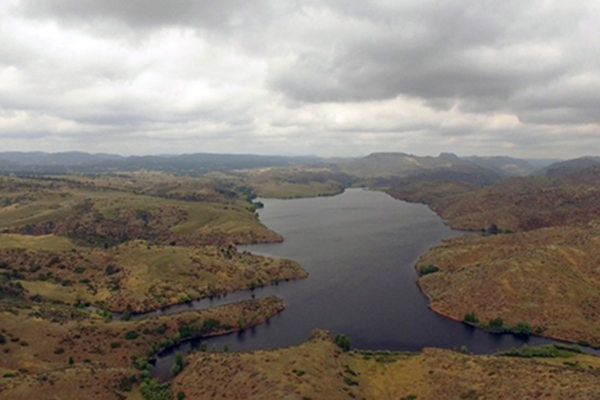
Below is the memo sent by John Sanderson to the Fort Collins City Council:
NOTE: Post edited to correct the title and last name of Chris Pletcher, General Manager of the Fort Collins – Loveland Water District.
October 12, 2026
Dear City Council and Utilities Leadership,
Thank you for the thoughtful and committed work you do to keep Fort Collins the city we love. Because I know you are committed to community and sustainability, I want to share with you an important perspective on the October 20, 2026 Council agenda item “Resolution/Ordinance-1st Reading – Water Storage Agreements, Re-appropriation of Project Funds, and Withdrawal of Permit Application.”
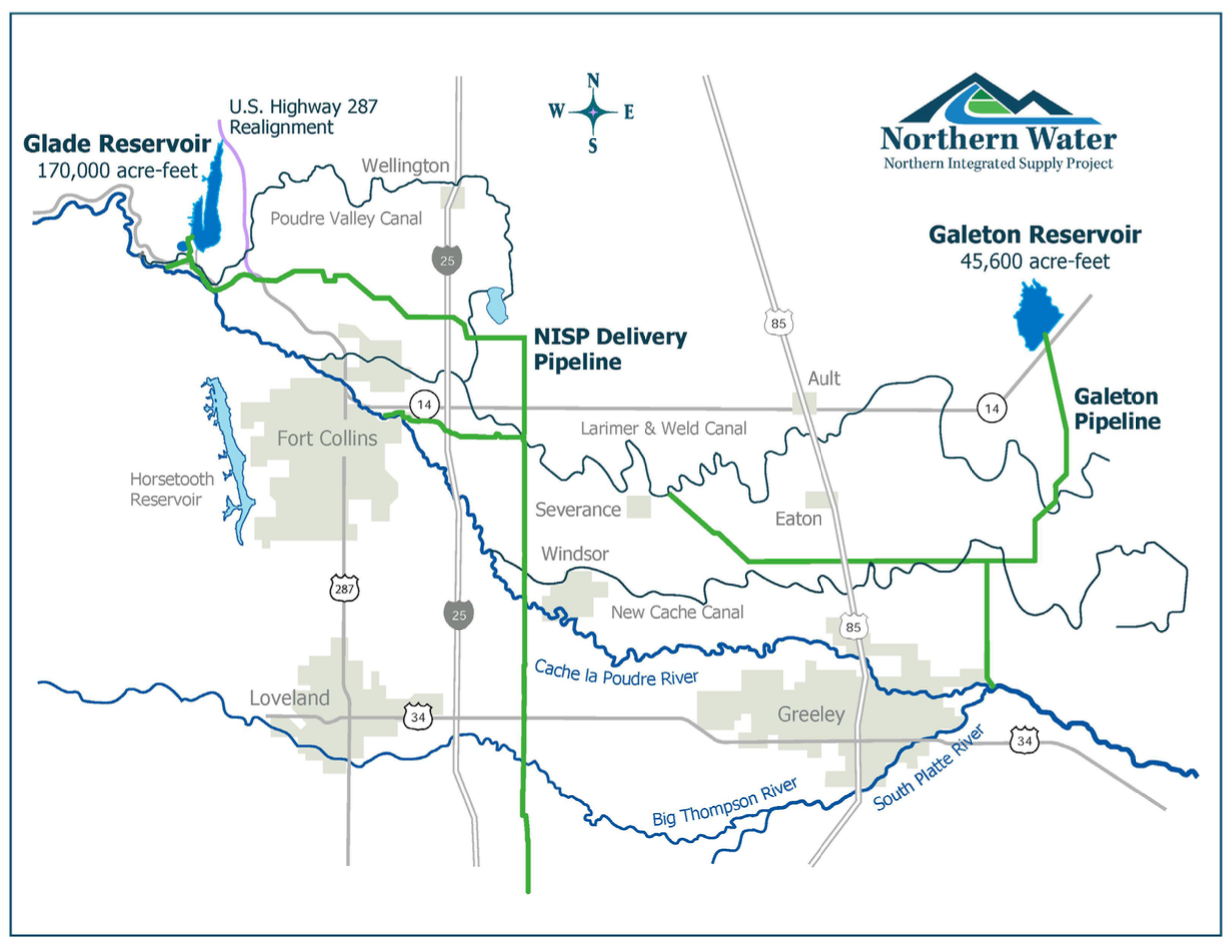
This ordinance is a major step toward abandoning the Halligan Water Supply Project after 20 years and $50 million of rate-payer investment with a plan to join the Northern Integrated Supply Project (NISP). This is a major decision that is being advanced inconsistent with our City’s values. Specifically, this decision is being advanced with little transparency (the ordinance itself does not even mention “Halligan”) and no public engagement.
My request: Postpone the vote on this ordinance and create a transparent process for citizen input to this decision.
I make this request because, once made, this decision is likely irreversible. If the City does abandon Halligan, there is good reason to believe the outcome would be bad for rate payers, bad for water reliability, bad for community, and bad for the environment.
Here is why:
1) Cost. According to Utilities Finance Director Joe Wimmer, Fort Collins has already spent $50 million on the Halligan Water Supply Project.¹ According to the project website, the total cost is estimated at $308 million to store 8,200 acre-feet of water.² To our south, the Fort Collins-Loveland Water District was slated to get less water from NISP (8,100 acre-feet) for more money (at least $400 million).³ In April, Fort Collins-Loveland withdrew from NISP, saying “participation no longer aligns with the District’s responsibility to provide reliable, cost-effective water service.”⁴ The Fort Collins-Loveland District Chief Chris
Fletcher[General Manager of the Fort Collins – Loveland Water District, Chris Pletcher].said, “major spenders like Fort Collins-Loveland are being asked to risk unlimited costs with no promise of delivered water amounts.”⁵ Echoing a similar sentiment, when the City of Evans pulled out of NISP in late 2025, Evans’ City Manager Cody Sims said, “The unfortunate reality is the costs have grown beyond what is sustainable for our community, potentially putting an unacceptable burden on Evans’ water utility ratepayers.”⁶Utilities staff has explained to me that there is not a one-to-one comparison between Fort Collins joining NISP and the Fort Collins-Loveland District abandoning NISP. Nonetheless, there is no denying that NISP is now a $2.7 billion dollar project.⁷ Steadily rising costs have compelled 6 of the original 14 NISP participants to withdraw from the project.⁸ As with all water projects, these costs will continue to rise, calling into question any suggestion that abandoning Halligan for NISP would be more affordable for Fort Collins Utilities customers.
2) Reliability. Halligan allows Fort Collins to maximize the value and reliability of an existing water portfolio that already includes many highly reliable (“senior”) Poudre River rights. In contrast, NISP will depend on much less reliable (“junior”) water rights that would be a greater risk as our climate continues to warm. This leads me to ask: Why should Fort Collins stop investing in infrastructure designed around its own long-held, reliable water rights and instead rely on a regional project built around a less-reliable water supply?
As important, Halligan is shared with only one other user (North Poudre Irrigation Company), whereas NISP is a much larger, more complicated, multi-participant project in which Fort Collins will have a much smaller role in managing, begging more questions: Why would Fort Collins abandon a project that is almost entirely in our sphere of control for one that is largely outside our control? And why would we mix up our highly reliable rights with much less reliable rights that, for example, would have yielded no water this year and future dry years?
NISP’s uncertain reliability was expressed by Fort Collins-Loveland District Chief Fletcher when he noted that the project came with “no promise of delivered water amounts.”
3) Environment. The Halligan website states, “The City of Fort Collins has a strong stewardship ethic that provides the foundation for the management of current and future water use in the Poudre Basin.” By replacing a dam that already exists on the North Fork of the Poudre, the Halligan project will improve streamflow conditions along ~16 miles of river. This opportunity to improve conditions exists because the existing dam that Fort Collins will replace has had serious negative impacts on the North Fork of the Poudre for over a century, including:
a. Current streamflow does not meet the basic needs of fish and wildlife.
b. High flows, needed to maintain river health, currently are sporadic and unnatural.
c. Fish can reproduce only within certain temperature bands. Current Halligan management does not support native fish reproduction.
With the expansion of Halligan, future water management is designed to address these negative impacts and to improve the environment. The Fish and Wildlife Mitigation and Enhancement Plan, developed for the Halligan project over years of work by the City and its partners,⁹ describes how the Halligan Project will use science-based recommendations that will return positive results for the environment, going above and beyond what is required by law.
4) Community and Collaboration. The Halligan website says that the City is “also taking into account what the surrounding communities have said . . . ” City staff have worked diligently for more than 20 years with partners who have an interest in the North Fork of the Poudre and the landscapes that surround it. Withdrawing the Halligan permit now rejects that community and collaboration. Fort Collins can best honor its responsibility to current and future residents by investing in a water strategy that is community-based, financially accountable, and aligned with the city’s own environmental and growth priorities.
Notably, Attachment B of our City’s One Water Action Framework¹⁰ reports that two seasoned water professionals with the City were asked, Which of the City’s past, ongoing, or planned projects do you think would be the best role model projects to showcase the City’s commitment to a One Water approach and mindset? Their answer: Halligan.
5) Save the Poudre’s Guidance is Untrustworthy. Like many in Fort Collins, I am strongly aligned with Save the Poudre’s sentiment that we should do what we can to maintain a healthy Poudre River. But their motives and their guidance are suspect as they have urged Fort Collins to abandon Halligan and join NISP.
Regarding Halligan, their comments about Halligan’s impacts are misleading, and they completely ignore the potential for Halligan to improve river conditions.
Regarding NISP, Save the Poudre says, “NISP and its Glade Reservoir would be enormously expensive, it isn’t needed, and it would cause great harm,”¹¹ a position they have maintained for 20 years. It turns out, however, that a $100M settlement fund from NISP¹² has compelled Save the Poudre to not only stop opposing NISP but to urge Fort Collins to join NISP.¹³ One thing is certain about this settlement: if NISP is not built, Save the Poudre does not get $100M. Several things are uncertain about this settlement; most notably, unlike with Halligan where positive environmental outcomes are built into the plan, the NISP Settlement Agreement contains no guarantee of positive outcomes, only a “representative list” of projects that are highly speculative and in the best of circumstances will be difficult to complete.
The City, rate payers, the environment, and the river have waited more than 20 years for the Halligan Project. We have spent $50M on the project to date with good results: the project is in its last stages of planning and permitting, with construction expected to begin soon. It would be a waste of money, and a disservice to rate payers and the environment to let this slip through our hands.
My preference is that you simply vote “no” on this ordinance. If you do not want to vote “no,” I urge you to postpone the vote on this ordinance and create a process for citizen input to this decision.
¹ Fort Collins council signals support for steep 2027-28 utility rate increases. The NoCo Herald. October 2, 2026.
² Halligan Water Supply Project. City of Fort Collins.
³ $2B northern Colorado dam complex likely losing its largest customer as Fort Collins-Loveland drops out. Water Education Colorado. August 13, 2025.
⁴ UPDATE: FCLWD Officially Withdraws from the Northern Integrated Supply Project. Fort Collins-Loveland Water District. April 21, 2026.
⁵ Major customer pulling out of $2 billion Northern Colorado dams. The Colorado Sun. August 8, 2025.
⁶ 3rd Colorado city drops out of $2.7 billion NISP dams. The Colorado Sun. October 17, 2025.
⁷ Northern Colorado water projects’ cost soars to $2.7 billion, scaring a key customer as builders scramble to cut plan. The Colorado Sun. August 27, 2025.
⁸ Northern Water wins some, loses some on its $2.7 billion dams project. The Colorado Sun. June 10, 2026.
⁹ Halligan Water Supply Project FINAL Fish and Wildlife Mitigation and Enhancement Plan, with memo describing
¹⁰ One Water Action Framework, City of Fort Collins
¹¹ NISP (Northern Integrated Supply Project) – Save The Poudre
¹² NISP-Settlement-Final-not-signed.pdf
¹³ Save The Poudre – Conserve, Protect, Restore the Poudre River