Click the link to read the article on The Deseret News website (Leah Bowers). Here’s an excerpt:
October 16, 2026
Arizona Department of Water Resources Director Tom Buschatzke said the litigation pathway was never the preferred alternative. “We were not successful in coming to an equitable outcome among all seven states,” he added…
The core of the department’s decision — and the source of contention between the states — is how the water conservation efforts are split. The four Upper Basin states (Utah, Colorado, New Mexico and Wyoming) face no mandatory water reductions — they are subject to voluntary conservation goals. The three Lower Basin states (Arizona, California and Nevada), however, could be required to cut their water usage by up to 3 million acre-feet…Even between the three Lower Basin states, the cuts are not spread evenly. Arizona is expected to accept 61% of the cuts, California 35% and Nevada 4%…
“Such reductions could effectively dry up the Central Arizona Project as well as many of our on-river communities,” said Buschatzke. “It would more than double the water cuts agreed to in the Lower Basin Agreement. Arizona believes that taking its action now provides the best path forward for protecting Arizona water users.”
Arizona claims the new guidelines “failed to deliver” the water that Lower Basin states are owed: “Like Nevada, Arizona believes the federal government’s new operating framework ignores basic elements of the law of the river,” said Buschatzke. “It could result in cuts to the state apportionment that would devastate Arizona’s economy.”
[…]
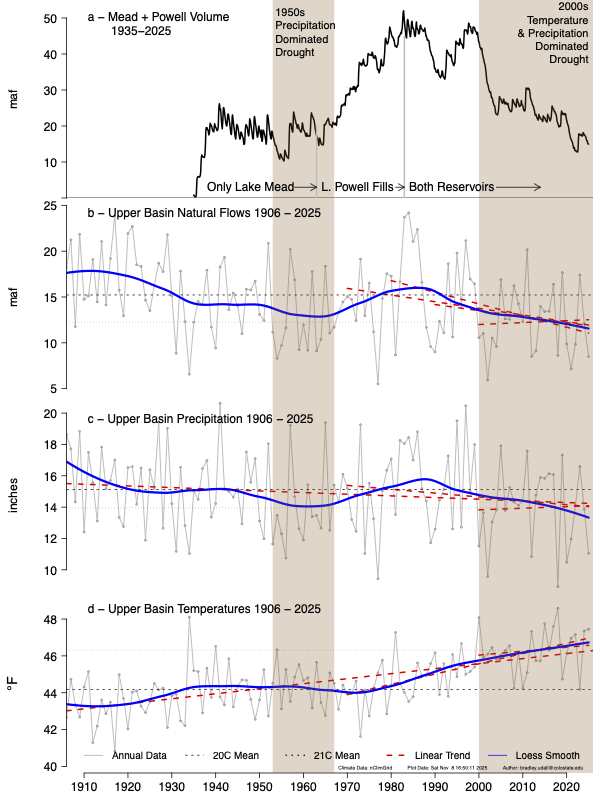
A multistate compact adopted in 1922 designates 1.5 million acre-feet to Mexico, 7.5 million acre-feet to the Upper Basin states, 7.5 million acre-feet to the Lower Basin states and 1.5 million acre-feet to evapotranspiration. That totals 18 million acre-feet in the Colorado River each year. However, some experts say much of the conflict the Southwestern states live with now is due to bad math from the beginning of the law — claiming there was never 18 million acre-feet of water to divide in the first place.
