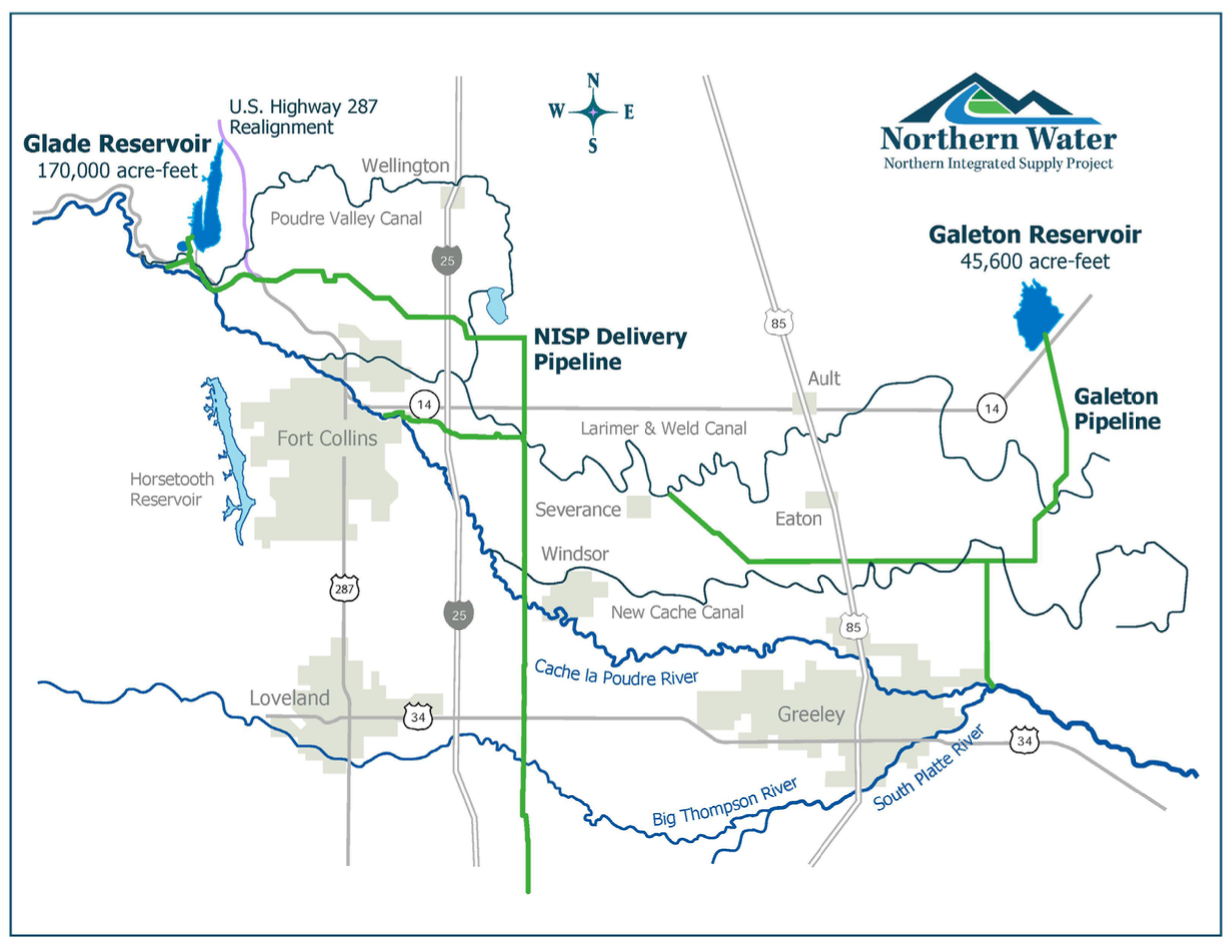
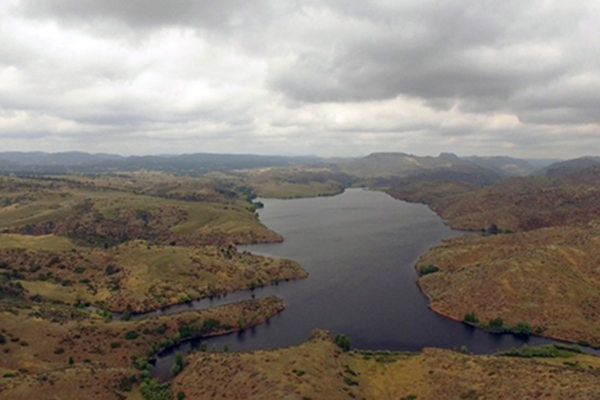
Below is the memo sent by John Sanderson to the Fort Collins City Council:
October 12, 2026
Dear City Council and Utilities Leadership,
Thank you for the thoughtful and committed work you do to keep Fort Collins the city we love. Because I know you are committed to community and sustainability, I want to share with you an important perspective on the October 20, 2026 Council agenda item “Resolution/Ordinance-1st Reading – Water Storage Agreements, Re-appropriation of Project Funds, and Withdrawal of Permit Application.”
This ordinance is a major step toward abandoning the Halligan Water Supply Project after 20 years and $50 million of rate-payer investment with a plan to join the Northern Integrated Supply Project (NISP). This is a major decision that is being advanced inconsistent with our City’s values. Specifically, this decision is being advanced with little transparency (the ordinance itself does not even mention “Halligan”) and no public engagement.
My request: Postpone the vote on this ordinance and create a transparent process for citizen input to this decision.
I make this request because, once made, this decision is likely irreversible. If the City does abandon Halligan, there is good reason to believe the outcome would be bad for rate payers, bad for water reliability, bad for community, and bad for the environment.
Here is why:
1) Cost. According to Utilities Finance Director Joe Wimmer, Fort Collins has already spent $50 million on the Halligan Water Supply Project.¹ According to the project website, the total cost is estimated at $308 million to store 8,200 acre-feet of water.² To our south, the Fort Collins-Loveland Water District was slated to get less water from NISP (8,100 acre-feet) for more money (at least $400 million).³ In April, Fort Collins-Loveland withdrew from NISP, saying “participation no longer aligns with the District’s responsibility to provide reliable, cost-effective water service.”⁴ The Fort Collins-Loveland District Chief Chris Fletcher said, “major spenders like Fort Collins-Loveland are being asked to risk unlimited costs with no promise of delivered water amounts.”⁵ Echoing a similar sentiment, when the City of Evans pulled out of NISP in late 2025, Evans’ City Manager Cody Sims said, “The unfortunate reality is the costs have grown beyond what is sustainable for our community, potentially putting an unacceptable burden on Evans’ water utility ratepayers.”⁶
Utilities staff has explained to me that there is not a one-to-one comparison between Fort Collins joining NISP and the Fort Collins-Loveland District abandoning NISP. Nonetheless, there is no denying that NISP is now a $2.7 billion dollar project.⁷ Steadily rising costs have compelled 6 of the original 14 NISP participants to withdraw from the project.⁸ As with all water projects, these costs will continue to rise, calling into question any suggestion that abandoning Halligan for NISP would be more affordable for Fort Collins Utilities customers.
2) Reliability. Halligan allows Fort Collins to maximize the value and reliability of an existing water portfolio that already includes many highly reliable (“senior”) Poudre River rights. In contrast, NISP will depend on much less reliable (“junior”) water rights that would be a greater risk as our climate continues to warm. This leads me to ask: Why should Fort Collins stop investing in infrastructure designed around its own long-held, reliable water rights and instead rely on a regional project built around a less-reliable water supply?
As important, Halligan is shared with only one other user (North Poudre Irrigation Company), whereas NISP is a much larger, more complicated, multi-participant project in which Fort Collins will have a much smaller role in managing, begging more questions: Why would Fort Collins abandon a project that is almost entirely in our sphere of control for one that is largely outside our control? And why would we mix up our highly reliable rights with much less reliable rights that, for example, would have yielded no water this year and future dry years?
NISP’s uncertain reliability was expressed by Fort Collins-Loveland District Chief Fletcher when he noted that the project came with “no promise of delivered water amounts.”
3) Environment. The Halligan website states, “The City of Fort Collins has a strong stewardship ethic that provides the foundation for the management of current and future water use in the Poudre Basin.” By replacing a dam that already exists on the North Fork of the Poudre, the Halligan project will improve streamflow conditions along ~16 miles of river. This opportunity to improve conditions exists because the existing dam that Fort Collins will replace has had serious negative impacts on the North Fork of the Poudre for over a century, including:
a. Current streamflow does not meet the basic needs of fish and wildlife.
b. High flows, needed to maintain river health, currently are sporadic and unnatural.
c. Fish can reproduce only within certain temperature bands. Current Halligan management does not support native fish reproduction.
With the expansion of Halligan, future water management is designed to address these negative impacts and to improve the environment. The Fish and Wildlife Mitigation and Enhancement Plan, developed for the Halligan project over years of work by the City and its partners,⁹ describes how the Halligan Project will use science-based recommendations that will return positive results for the environment, going above and beyond what is required by law.
4) Community and Collaboration. The Halligan website says that the City is “also taking into account what the surrounding communities have said . . . ” City staff have worked diligently for more than 20 years with partners who have an interest in the North Fork of the Poudre and the landscapes that surround it. Withdrawing the Halligan permit now rejects that community and collaboration. Fort Collins can best honor its responsibility to current and future residents by investing in a water strategy that is community-based, financially accountable, and aligned with the city’s own environmental and growth priorities.
Notably, Attachment B of our City’s One Water Action Framework¹⁰ reports that two seasoned water professionals with the City were asked, Which of the City’s past, ongoing, or planned projects do you think would be the best role model projects to showcase the City’s commitment to a One Water approach and mindset? Their answer: Halligan.
5) Save the Poudre’s Guidance is Untrustworthy. Like many in Fort Collins, I am strongly aligned with Save the Poudre’s sentiment that we should do what we can to maintain a healthy Poudre River. But their motives and their guidance are suspect as they have urged Fort Collins to abandon Halligan and join NISP.
Regarding Halligan, their comments about Halligan’s impacts are misleading, and they completely ignore the potential for Halligan to improve river conditions.
Regarding NISP, Save the Poudre says, “NISP and its Glade Reservoir would be enormously expensive, it isn’t needed, and it would cause great harm,”¹¹ a position they have maintained for 20 years. It turns out, however, that a $100M settlement fund from NISP¹² has compelled Save the Poudre to not only stop opposing NISP but to urge Fort Collins to join NISP.¹³ One thing is certain about this settlement: if NISP is not built, Save the Poudre does not get $100M. Several things are uncertain about this settlement; most notably, unlike with Halligan where positive environmental outcomes are built into the plan, the NISP Settlement Agreement contains no guarantee of positive outcomes, only a “representative list” of projects that are highly speculative and in the best of circumstances will be difficult to complete.
The City, rate payers, the environment, and the river have waited more than 20 years for the Halligan Project. We have spent $50M on the project to date with good results: the project is in its last stages of planning and permitting, with construction expected to begin soon. It would be a waste of money, and a disservice to rate payers and the environment to let this slip through our hands.
My preference is that you simply vote “no” on this ordinance. If you do not want to vote “no,” I urge you to postpone the vote on this ordinance and create a process for citizen input to this decision.
¹ Fort Collins council signals support for steep 2027-28 utility rate increases. The NoCo Herald. October 2, 2026.
² Halligan Water Supply Project. City of Fort Collins.
³ $2B northern Colorado dam complex likely losing its largest customer as Fort Collins-Loveland drops out. Water Education Colorado. August 13, 2025.
⁴ UPDATE: FCLWD Officially Withdraws from the Northern Integrated Supply Project. Fort Collins-Loveland Water District. April 21, 2026.
⁵ Major customer pulling out of $2 billion Northern Colorado dams. The Colorado Sun. August 8, 2025.
⁶ 3rd Colorado city drops out of $2.7 billion NISP dams. The Colorado Sun. October 17, 2025.
⁷ Northern Colorado water projects’ cost soars to $2.7 billion, scaring a key customer as builders scramble to cut plan. The Colorado Sun. August 27, 2025.
⁸ Northern Water wins some, loses some on its $2.7 billion dams project. The Colorado Sun. June 10, 2026.
⁹ Halligan Water Supply Project FINAL Fish and Wildlife Mitigation and Enhancement Plan, with memo describing
¹⁰ One Water Action Framework, City of Fort Collins
¹¹ NISP (Northern Integrated Supply Project) – Save The Poudre
¹² NISP-Settlement-Final-not-signed.pdf
¹³ Save The Poudre – Conserve, Protect, Restore the Poudre River