
Click the link to read the article on the H2O Radio website (Frani Halperin):
October 6, 2026
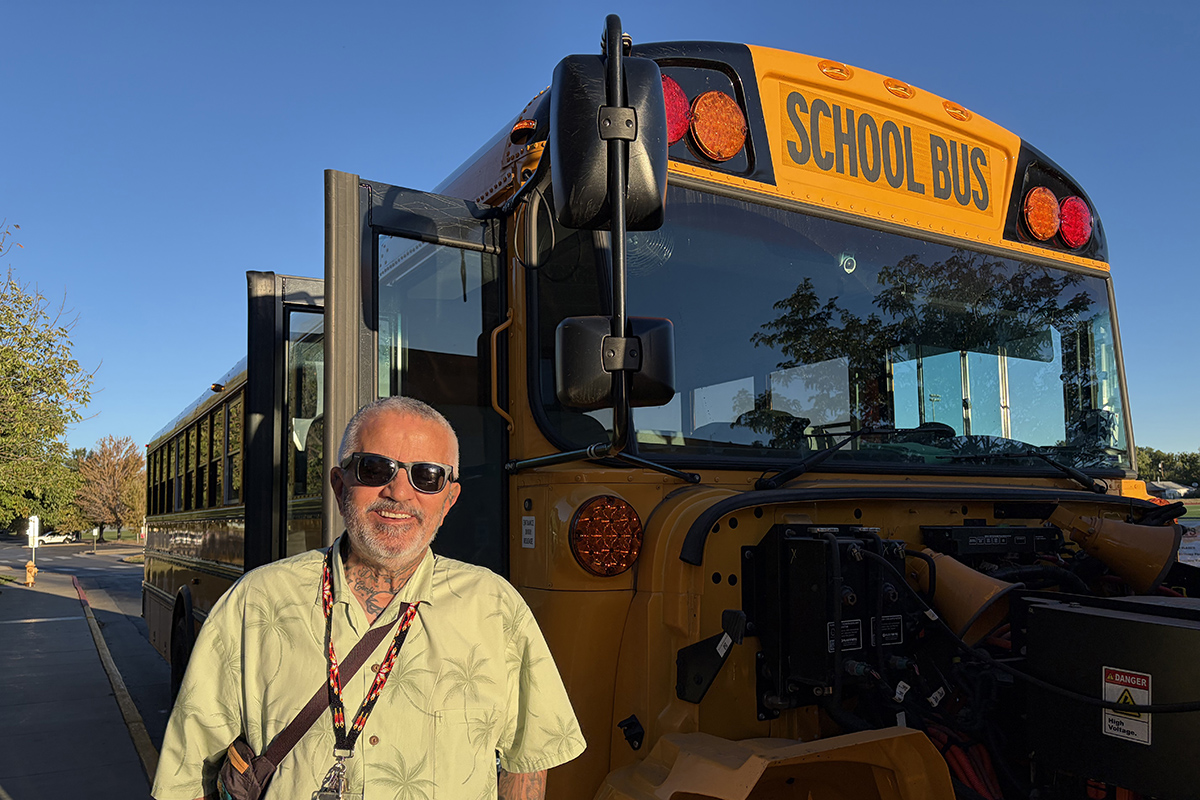
When Thomas Lujan turns the ignition switch on his school bus, he doesn’t hear a thing. Nothing‘s wrong. In fact, everything is going just right. On this September morning, instead of driving a noisy diesel bus, he’s off to collect students in one that’s electric.
Arriving at his first stop, Lujan has high fives and a big smile for children as they board his bus. They’re en route to the Peak To Peak Charter School, a K-12 public school in Lafayette, Colorado, north of Denver. The bus is one of four electric buses the school operates—something Lujan loves to brag about. “They’re very nice to drive. They’re very quiet. They’re limited as far as the range goes, but other than that, they’re great buses and the kids seem to like them.”
Four years ago, Peak To Peak Charter School made the choice to adopt electric buses because they would be more affordable, align with their values to pilot innovative technology, and support their preference not to have to store fuel on site, according to Tracey Sutton, the transportation coordinator. Most school districts that own buses have a shop and a yard where they maintain and refuel their buses. Going electric meant Peak To Peak could avoid this type of infrastructure.
They also had a goal to reduce the amount of diesel fumes that students (as well as staff) were breathing in. That’s an improvement not lost on the kids themselves, who say gas buses were “loud and smoky” and “smelled horrible.”
About 30 miles to the south, Nate Cohen is hoping his students will feel the same way. He is the assistant director of transportation for the Cherry Creek School District that operates south of Denver. This month, they too added electric buses to their fleet with a goal of reducing the emissions their buses were putting into neighborhoods they serve.
Cherry Creek Schools is counting on the new buses to reduce noise pollution. Cohen says we all know when something drives by our houses. Was it a school bus? A garbage truck? A moving van. “You know, it was something,” he says, but now these buses are “just creeping through neighborhoods.” They’re also anticipating how the quiet inside the bus will affect students. “We’ve been told and we’re excited to experience that student management issues decrease significantly because students are not having to yell over the engine, yell over all the noise.”
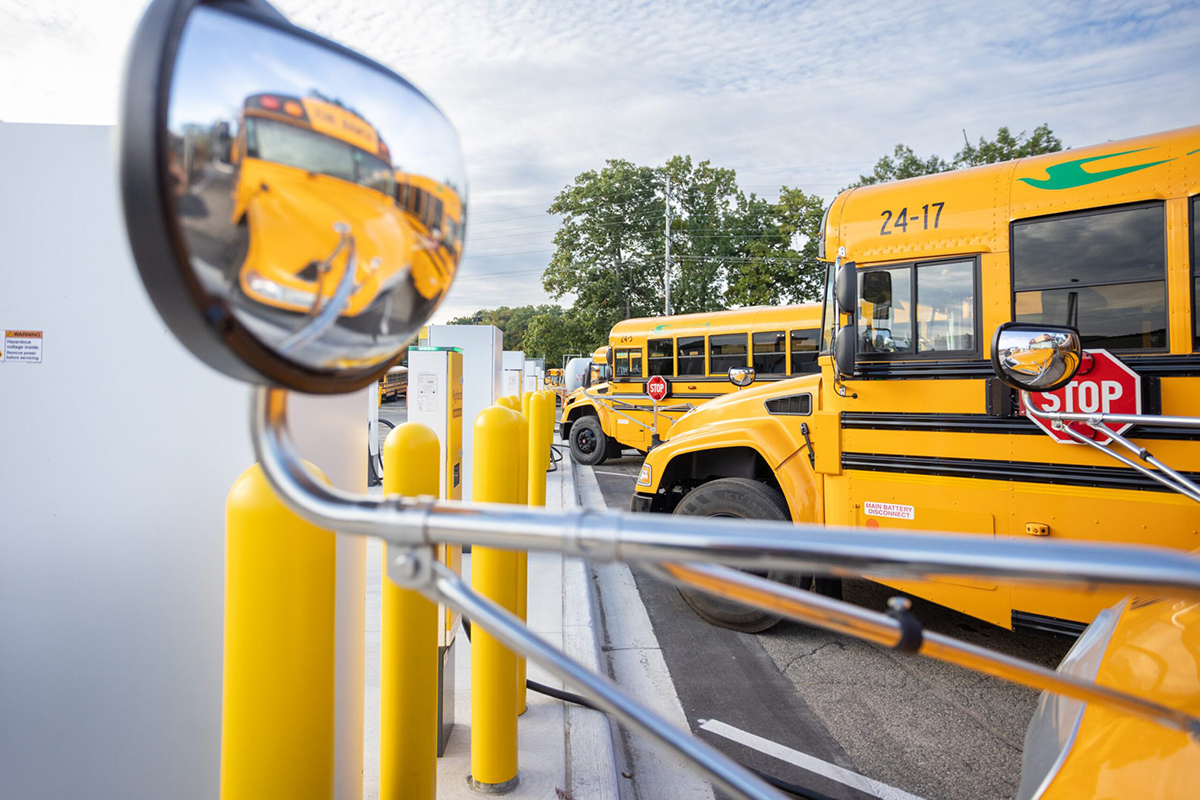
Vehicle-to-Grid (V2G)While Cherry Creek School District is just dipping their toe into fleet electrification—adding only six buses to a fleet of more than 300—they are also testing the waters of an added technology that Peak To Peak has yet to try—bidirectional charging. That’s where power flows both ways from a utility to charge a bus or from the bus back to the utility to add to the grid.
Cherry Creek Schools took advantage of grants from Xcel Energy, a provider for the Denver metro area, to make the numbers work on bringing on EV buses. Mark Ingram, the director of transportation for Cherry Creek Schools, said a grant from Xcel “paid for the entire cost of all six electric buses. So, we got $2.4 million in rebates; each bus costs $400,000.” They also got an extra $750,000 in rebates for bidirectional charging capabilities.
That helps Xcel to stabilize the grid, so it can meet demand when it’s highest—on weekday evenings when people are home cooking dinner, watching TV, or just having lots of lights on. “In the long term,” Cohen says “that means either not having to build more power plants or the ability to take power plants offline. It just gives them a more stable approach where they can charge us during off-peak hours when they have that capacity, and then when they need additional capacity, we’re able to provide that to them.”
The typical day in the life of a Cherry Creek Schools bus will start with the bus “waking itself up” and if it’s cold, perhaps warming up the cabin while it’s still connected to the grid. After a driver’s inspection, it’s on the road for about two hours and returns to the depot around 9:00 a.m. The bus will then charge until it leaves for the afternoon routes to take students home. After 5:00 p.m., the buses will send energy back to the grid. After the peak demand for electricity ends, the buses will perform a slow charge overnight.
Driving Resilience
Here’s where the partnership with Xcel gets interesting. Not only are the buses able to power the grid when demand is high, but because they are batteries on wheels they could also be driven to an outage location and supply energy.
“An average school bus might have a 200- or 250-kilowatt-hour battery pack. That’s adequate to go back up a high school gymnasium or a community center or an assisted living facility for days,” says Duncan McIntyre, the CEO of Highland Electric Fleets, the company that bundled the equipment, training, and financing that allowed both Peak To Peak and Cherry Creek transition to electric buses. “If your community has 50 electric school buses, which might be cheaper to operate than 50 diesel school buses, there’s this added benefit of being able to drive them around and back up buildings,” McIntyre added.
McIntyre says this so-called “vehicle-to-grid” technology can provide cleaner power than generators that run on diesel to keep facilities a community deems as critical, such as a hospital, functioning. He adds that buildings would need a simple retrofit to install a bidirectional charger and a smart panel to accept the power, but then you have “an incredibly resilient system that can be deployed at a moment’s notice.”
That’s an idea that has more school districts kicking the tires on EV buses as diesel prices spike and climate-driven extreme storms and wildfires affect the grid. McIntyre says “Even with a natural gas heavy grid, the environmental footprint is a huge improvement. An electric motor is much more efficient at converting a unit of power into a unit of propulsion than a combustion engine. It has very few moving parts and is very efficient.”
If a utility has a lot of solar and wind energy, it can generate a lot of power, but it needs to be stored in batteries, so how about in a bus? McIntyre says school buses sit idle for 92 percent of the hours in a year. “So, it’s an incredible opportunity to use the batteries to integrate renewables into the grid, flatten the load curve, and reduce rates for ratepayers.”
Highland Electric Fleets will have a couple thousand school buses in over 100 cities by the end of this year with many of those in Colorado, something Nate Cohen of Cherry Creek Schools calls a “win for the environment, a win for our neighborhoods, and a win for students.”
And it’s a way that electric buses are schooling cities on how to be resilient. 💧
H2O Radio stories are written by humans. We do not use AI in our journalism.