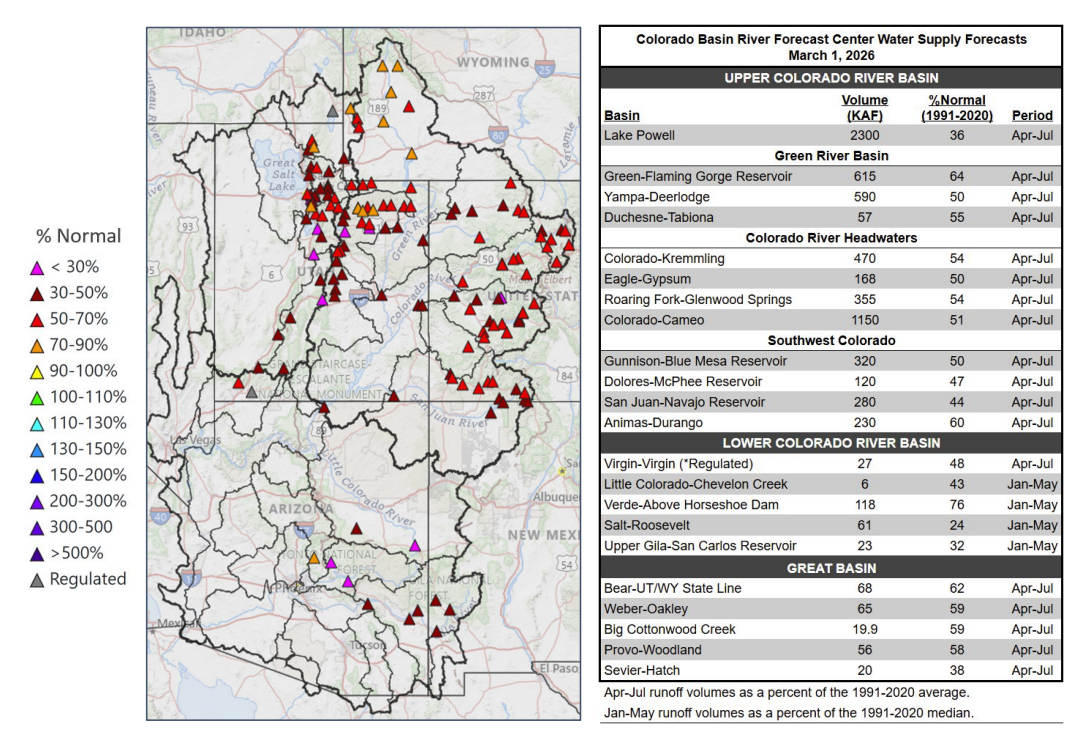
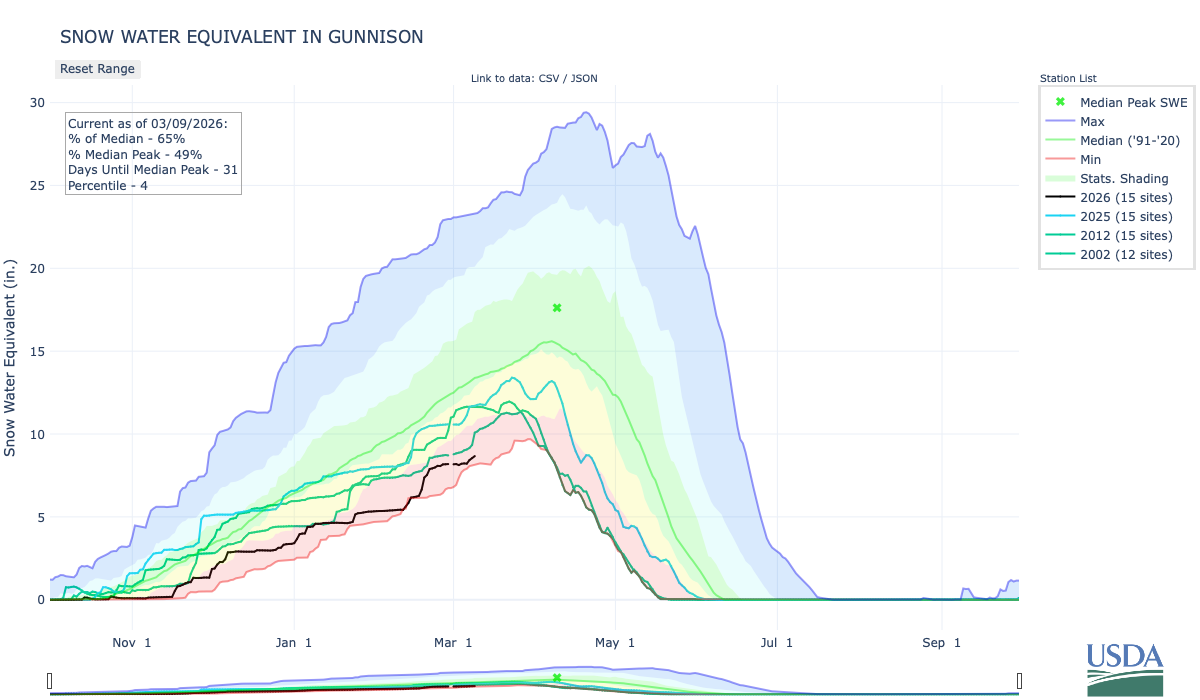
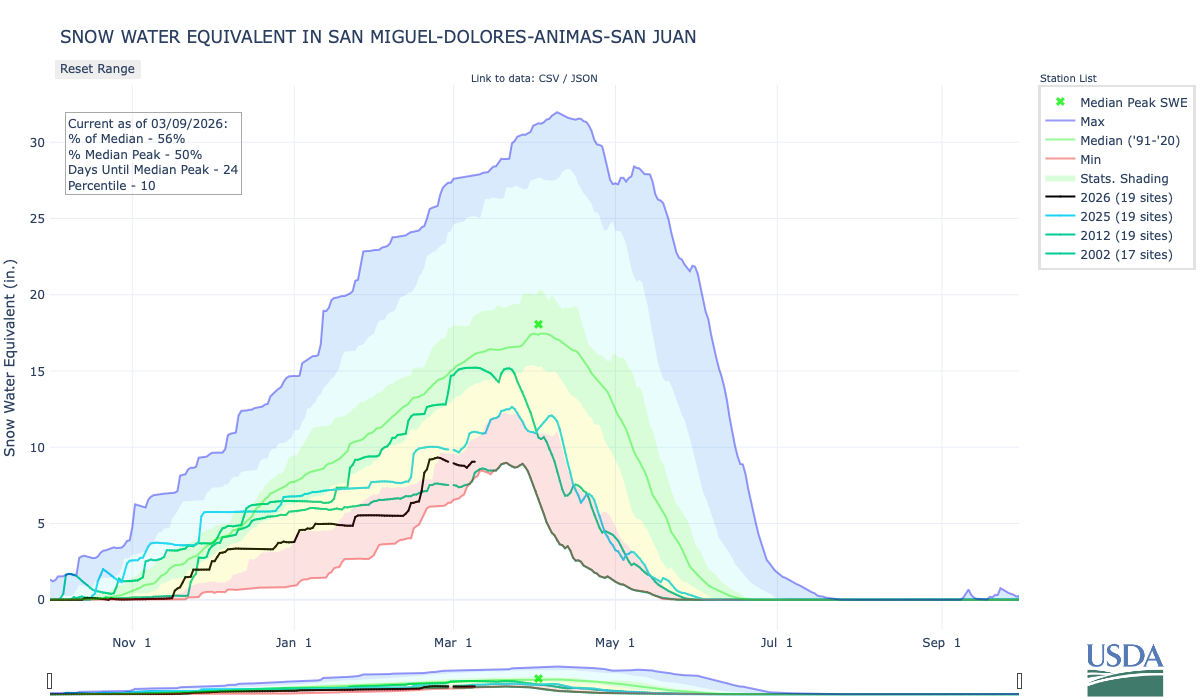
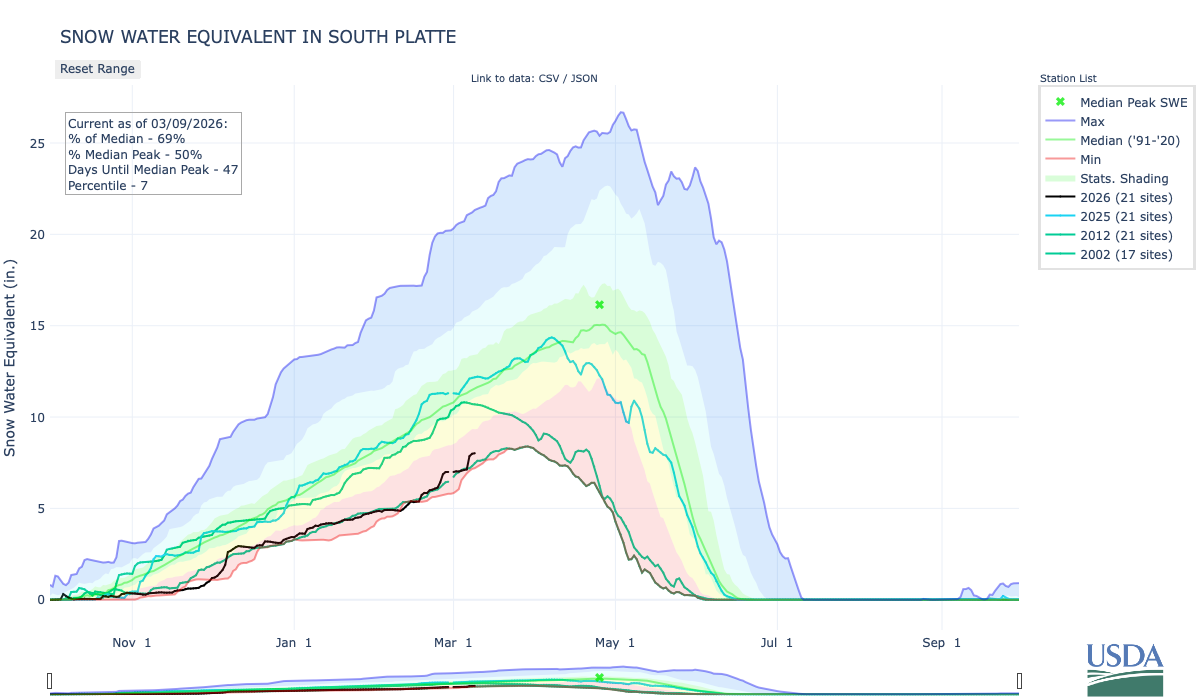
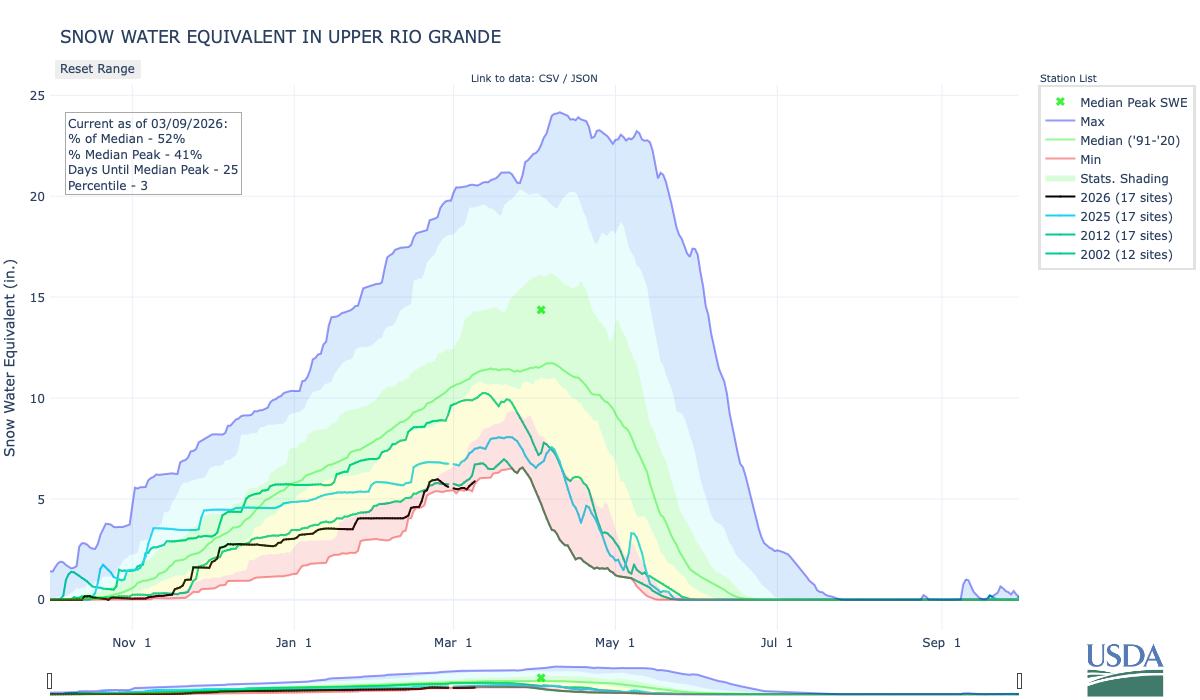
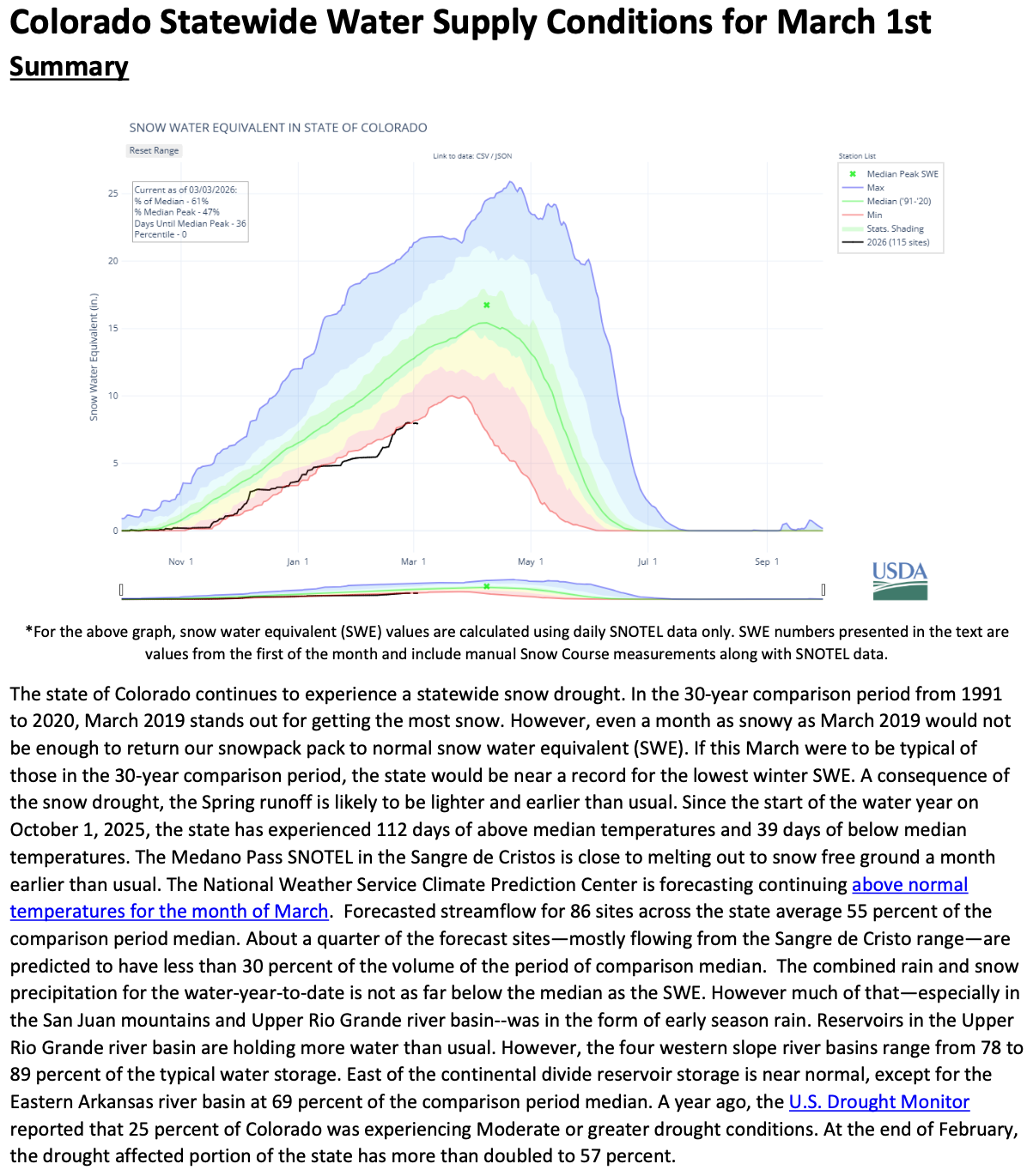
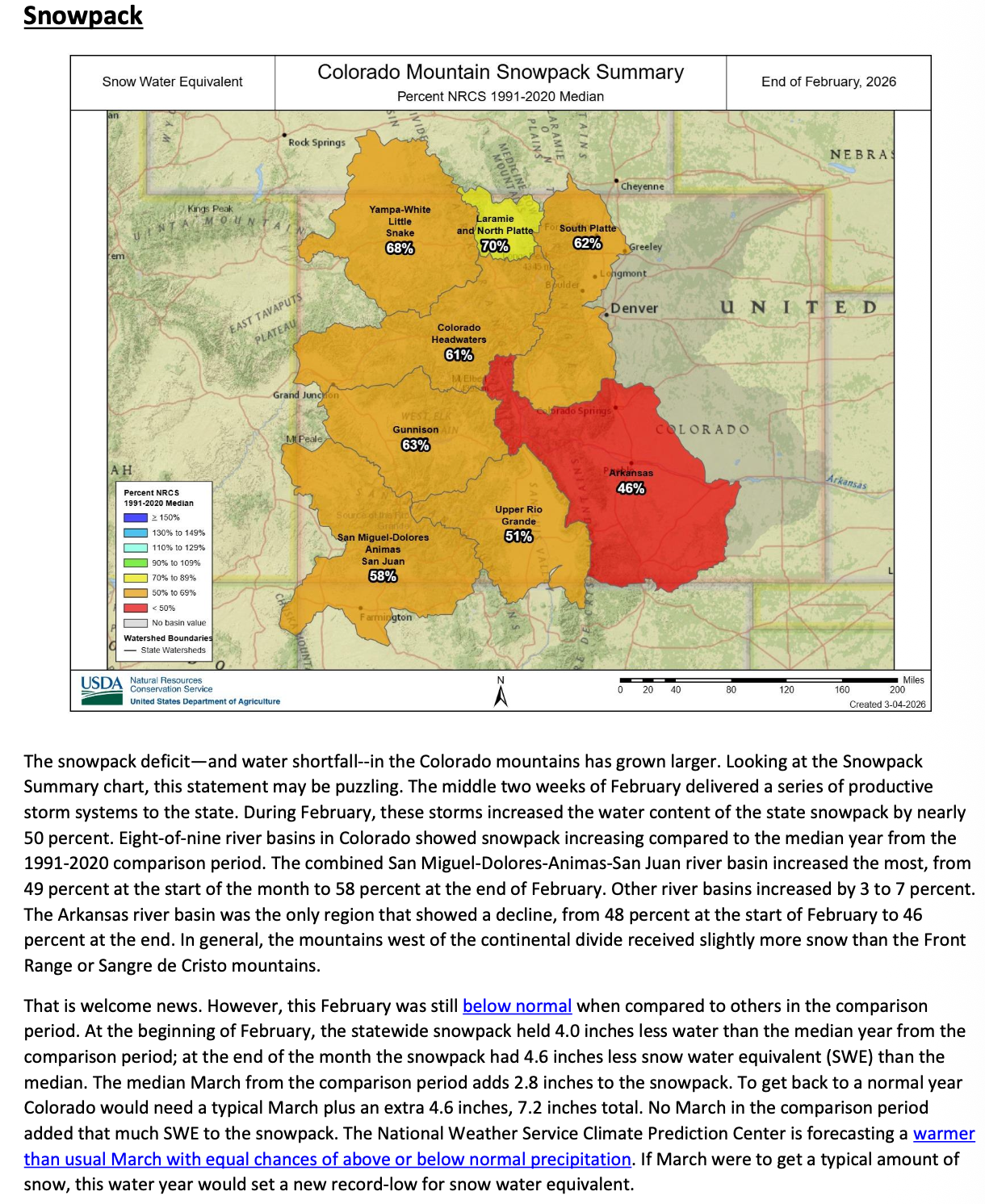
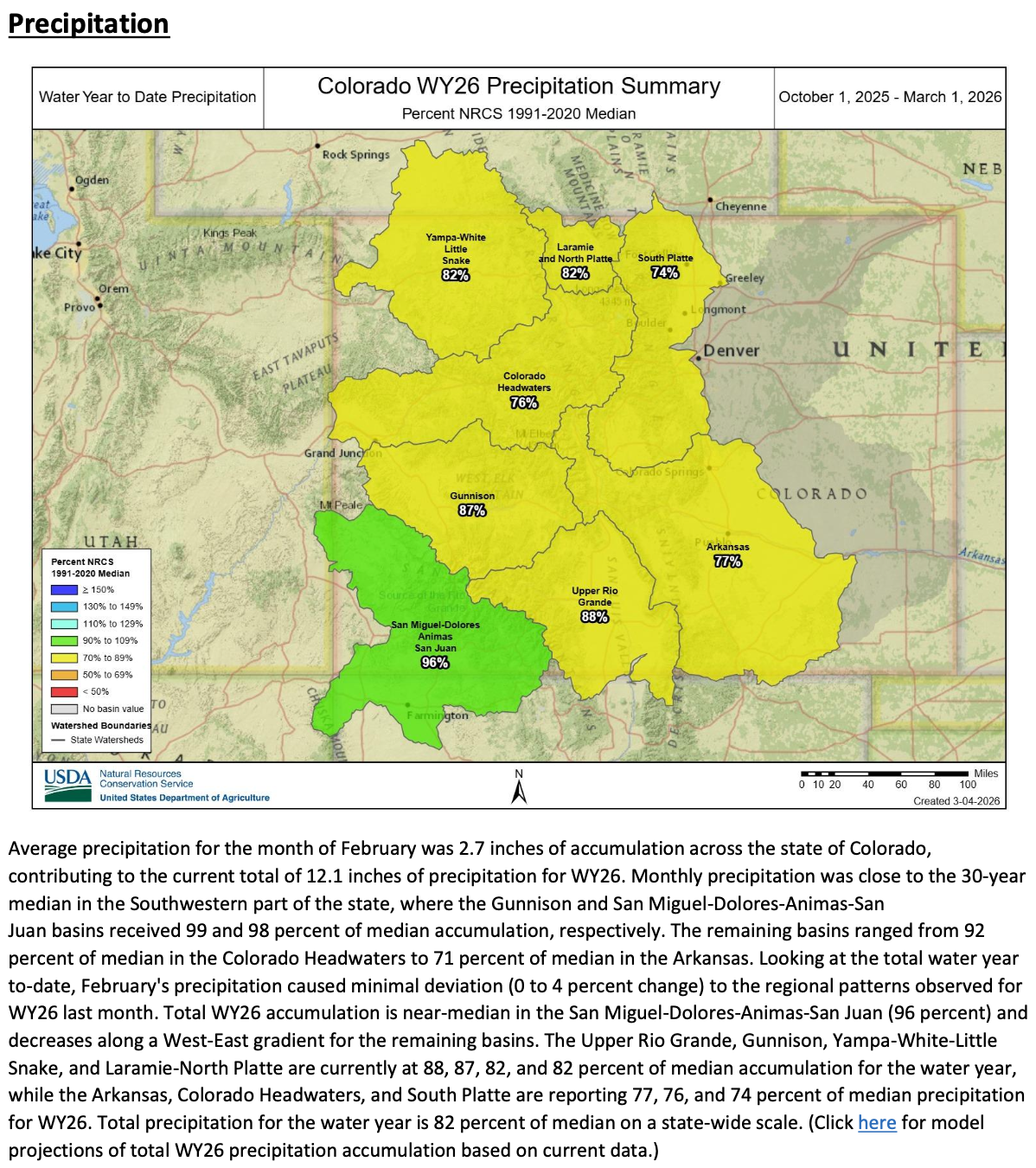
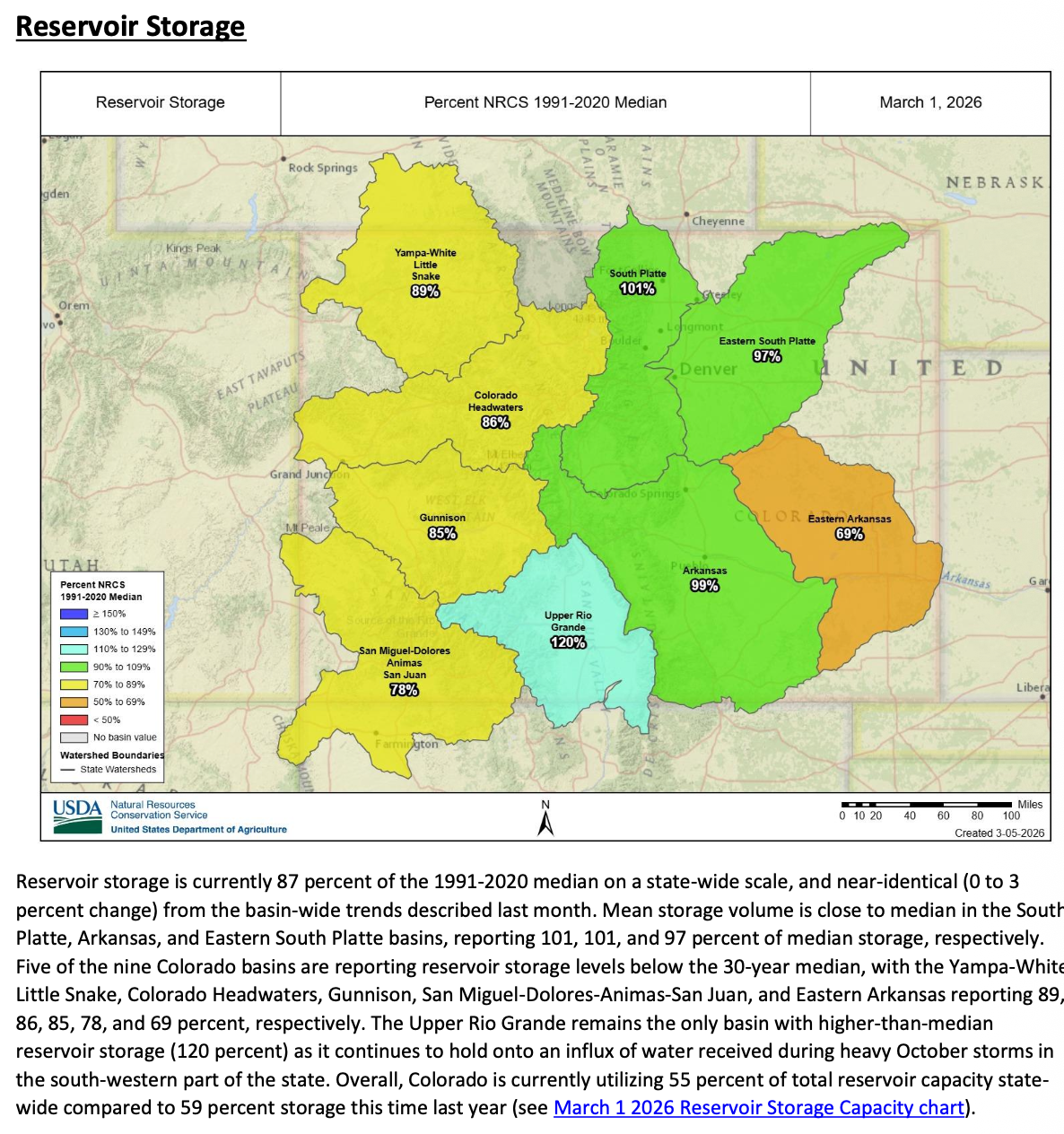
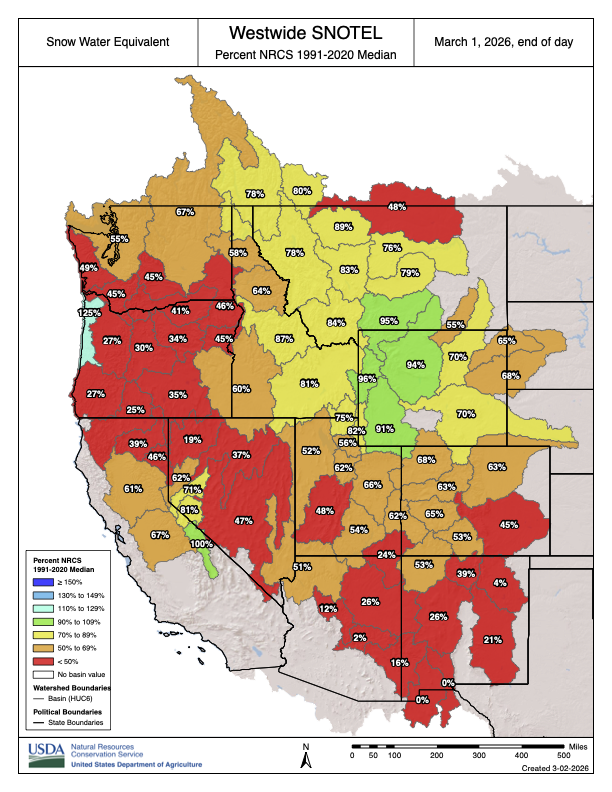
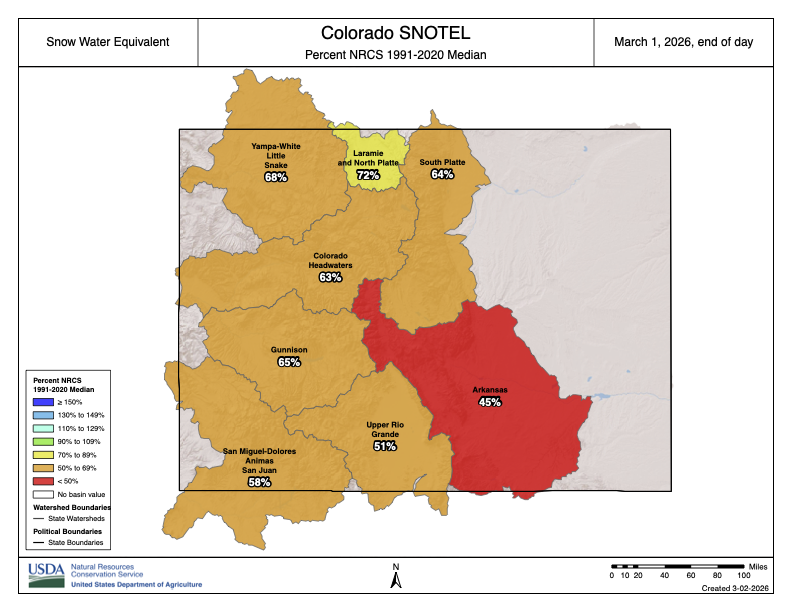
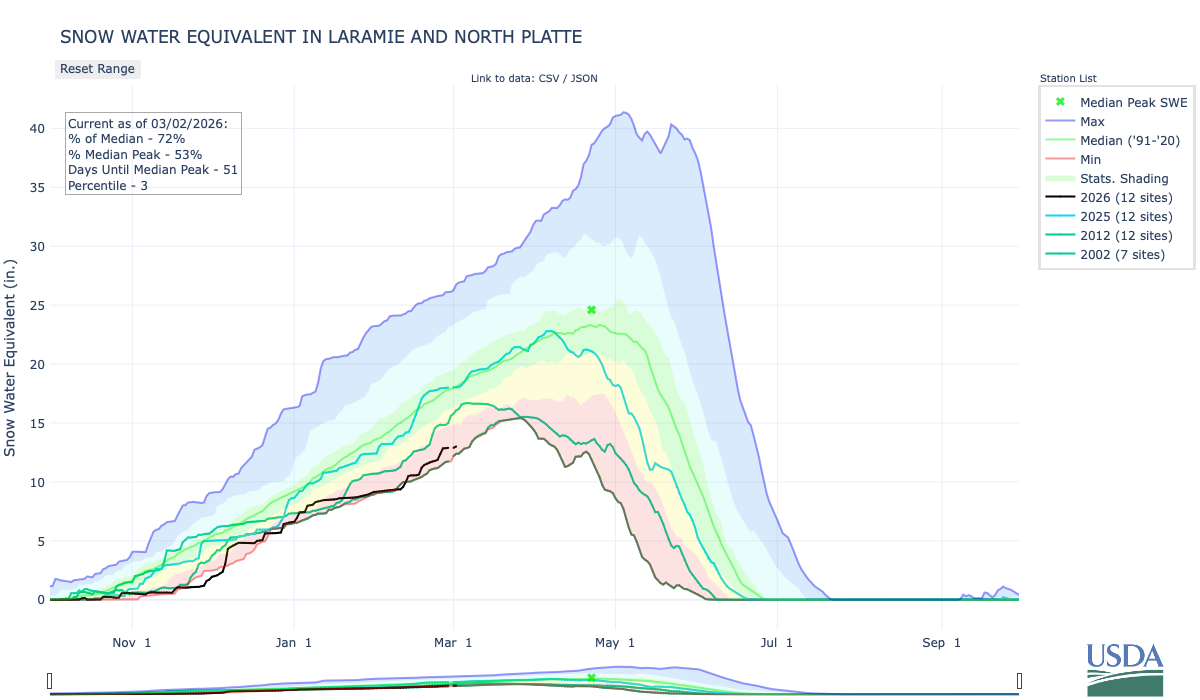
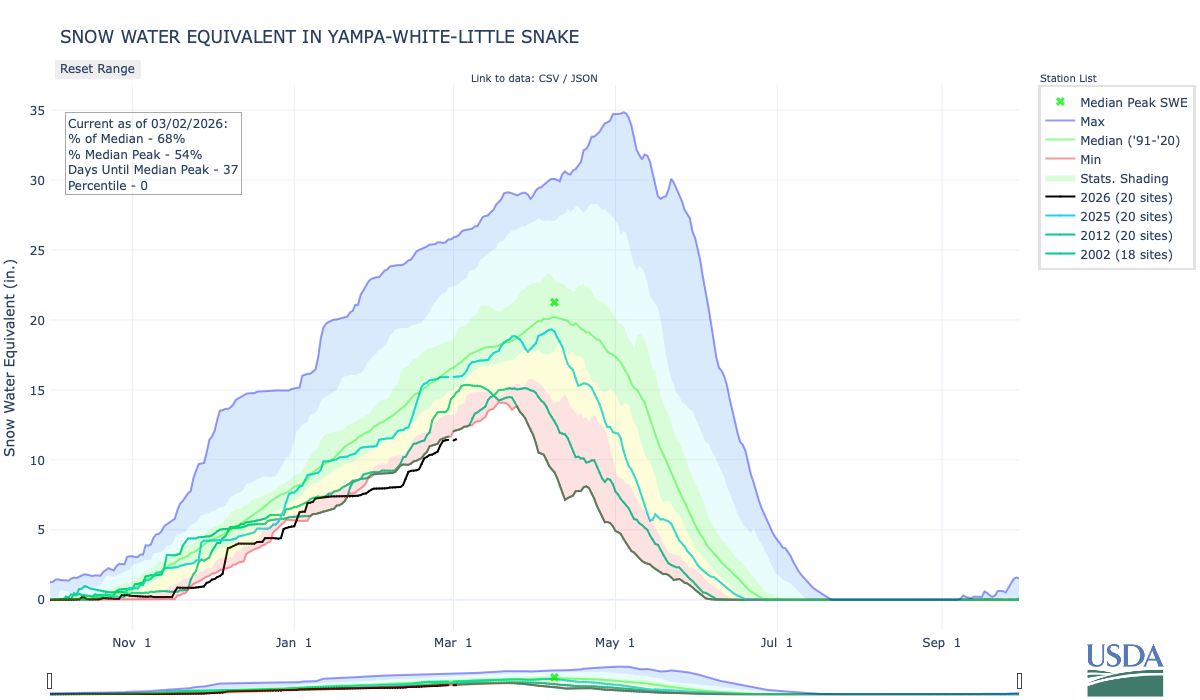
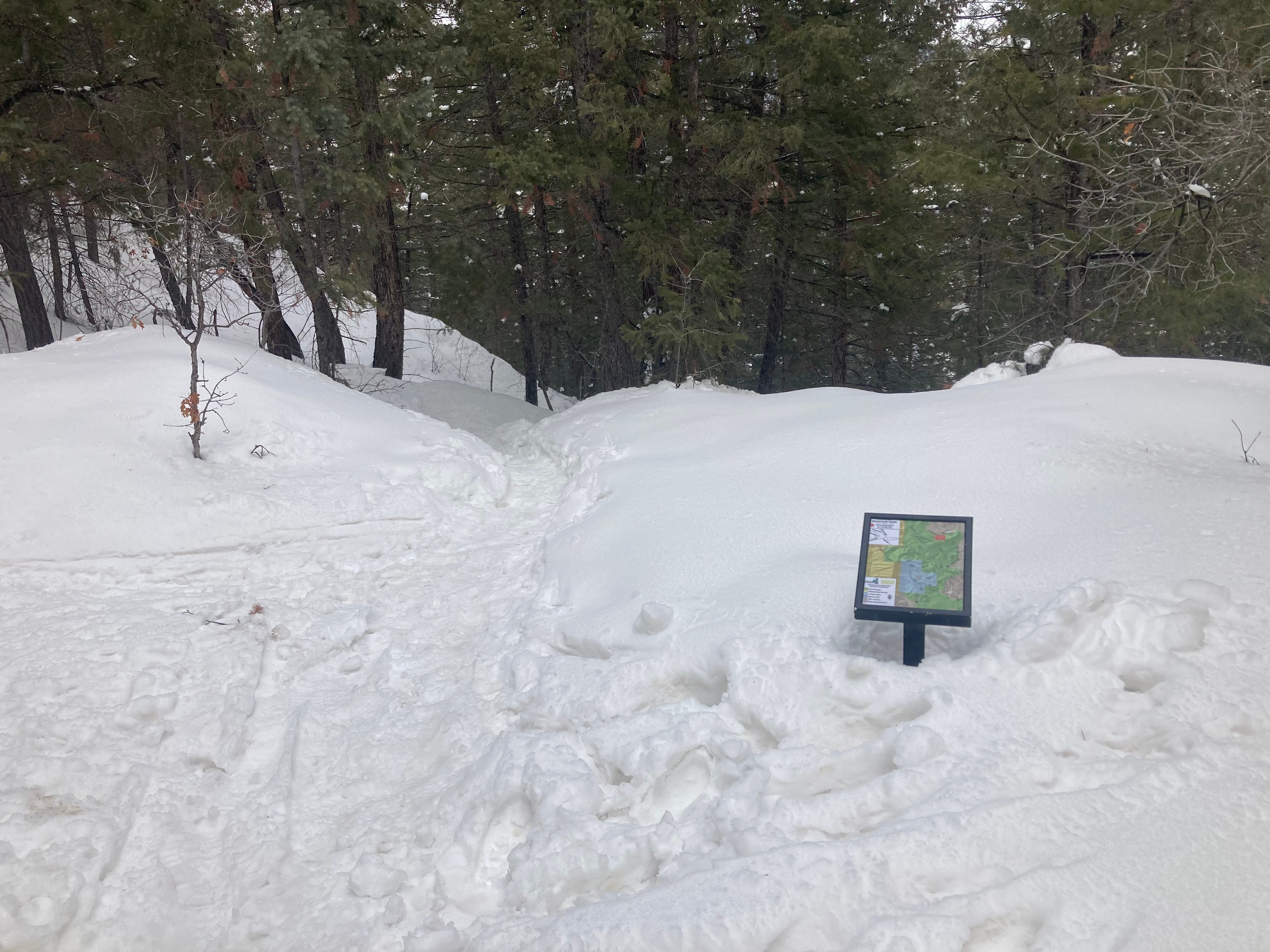
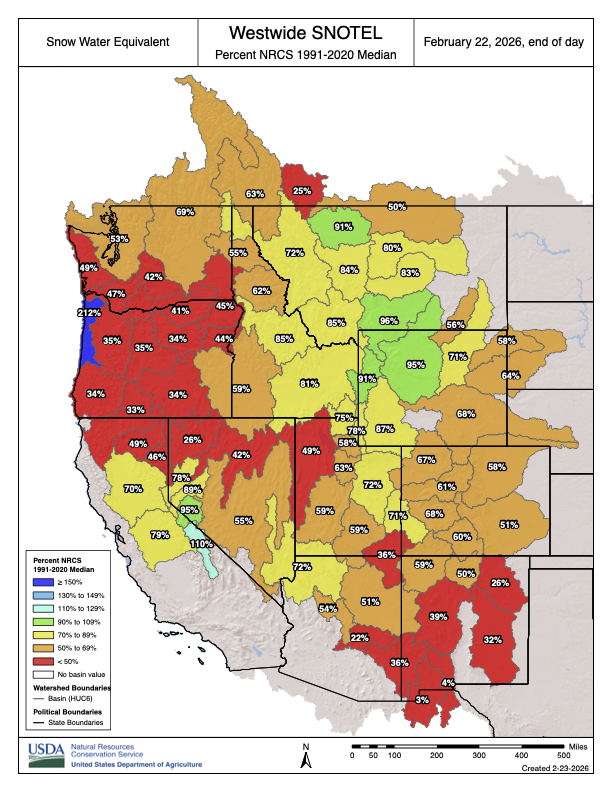
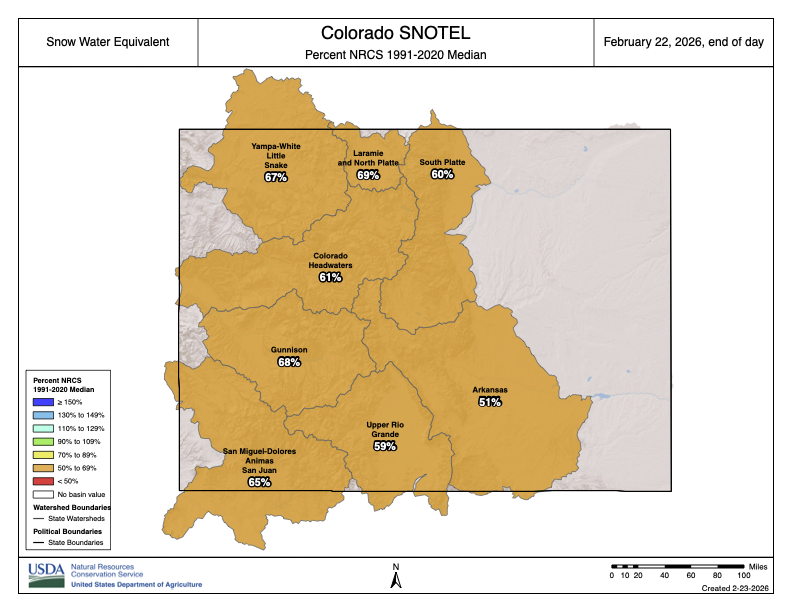
A chart from the Colorado Basin River Forecast Center shows projected water supplies for the Colorado River basin compared to normal in 2026. (Provided by Colorado Basin River Forecast Center)
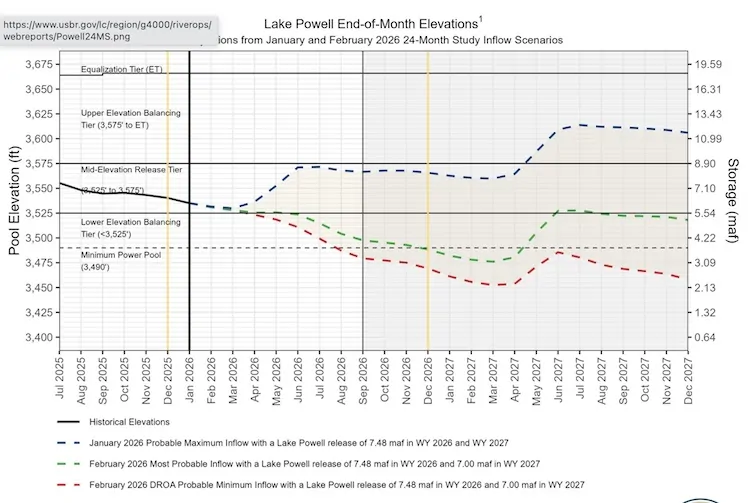
“Right now the hydrology that we have in front of us puts us in a very, very precarious situation,” said Gene Shawcroft, Utah’s Colorado River negotiator. Utah just wrapped up its warmest winter on record. Salt Lake City broke its previous maximum average winter temperature by 2 degrees Fahrenheit — a significant increase, according to the Colorado Basin River Forecast Center. While the state received similar precipitation compared to last year, much of that fell as rain, leading to the worst snowpack since 1981 in parts of the state. Now, the water supply outlook is “well below normal,” according to the center. The Bureau of Reclamation’s latest most probable forecast for Lake Powell shows it sinking below “power pool” — 3,490 feet — by December. At that level, water can’t make it through the turbines at Glen Canyon Dam that generate hydropower and keep the lights on across Utah and six other states. Powell could hit that dangerous low even sooner, though. The bureau’s most recent forecast was based on the Colorado Basin River Forecast Center’s February report. Since then, the center’s projection for water flows into Powell has dropped by 100,000 acre-feet. The bureau’s most probable forecast can also be optimistic. The agency’s minimum probable forecast, which shows a dry scenario that would statistically happen only 10% of the time, sometimes aligns more with reality. Last year, the April 2025 minimum probable study forecasted Lake Powell to hit 3,535 feet in elevation by the end of February 2026. The lake currently sits at 3,530 feet. The bureau’s latest minimum probable forecast shows the lake dropping below 3,490 by the end of August.
“It’s safe for us to assume that, unless Mother Nature is uncharacteristically generous, that Lake Powell elevations are going to fluctuate at elevations that we’re not comfortable with,” Wayne Pullan, Upper Colorado regional director for the bureau, said at a Glen Canyon Dam meeting last week…
To prop up Powell, the bureau will likely rely on another popular Utah reservoir: Flaming Gorge. The reservoir that straddles the border of Utah and Wyoming has the best water outlook in the basin, at 64% of normal, according to the forecast center. The Upper Green River, which flows into Flaming Gorge, is the “lone bright spot” for snow water equivalent — the amount of water snow holds…Under a 2019 plan, the bureau may form an agreement with Utah and the other states in the Upper Colorado River Basin — Colorado, New Mexico and Wyoming — to release water from Flaming Gorge and a few other reservoirs, such as Blue Mesa in Colorado, to maintain hydropower at Glen Canyon Dam. That’s what happened the last time forecasts showed Powell dropping to a dangerous low level in 2022. A record wet winter followed that dry year, though, boosting the reservoirs.
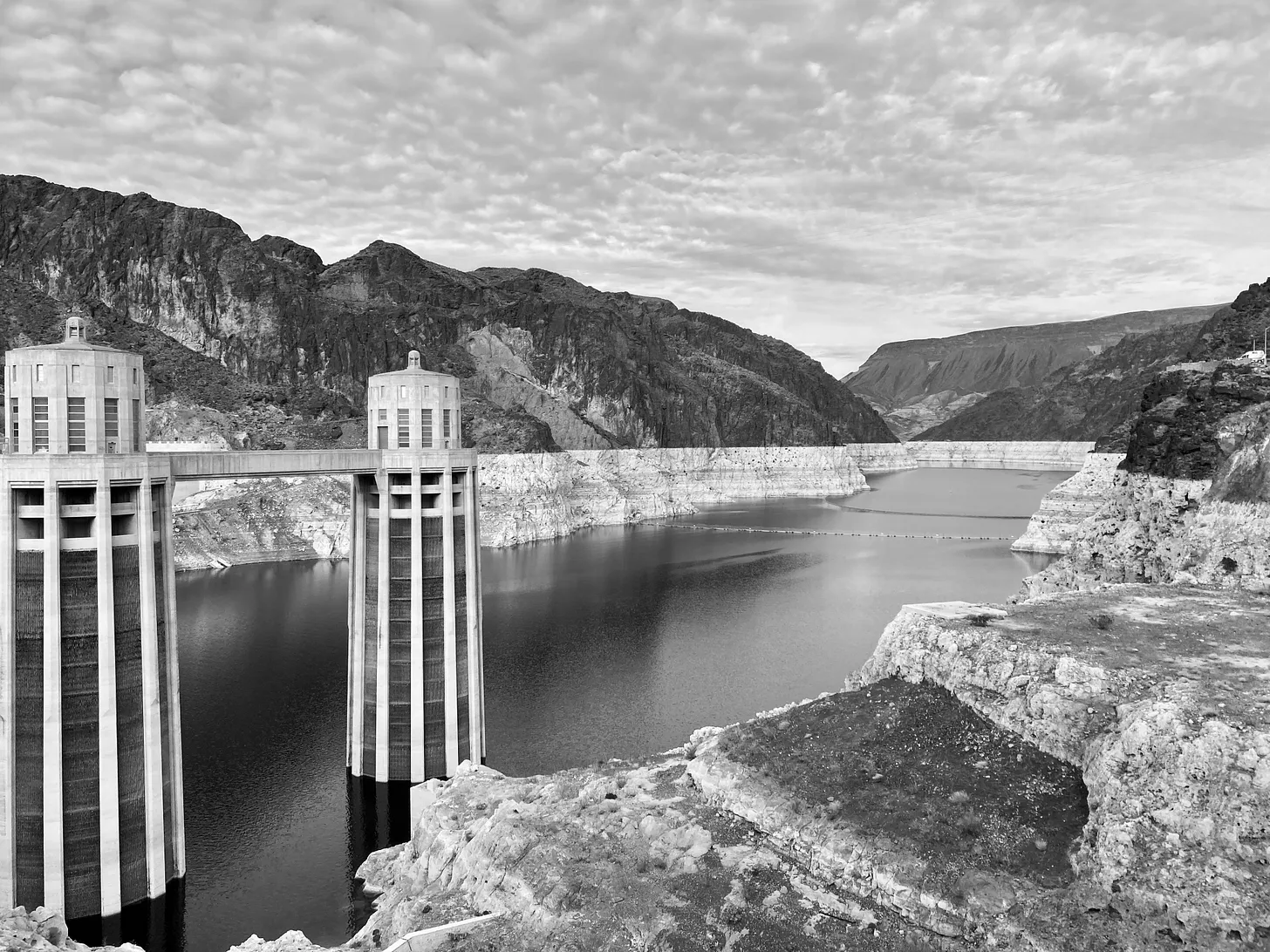
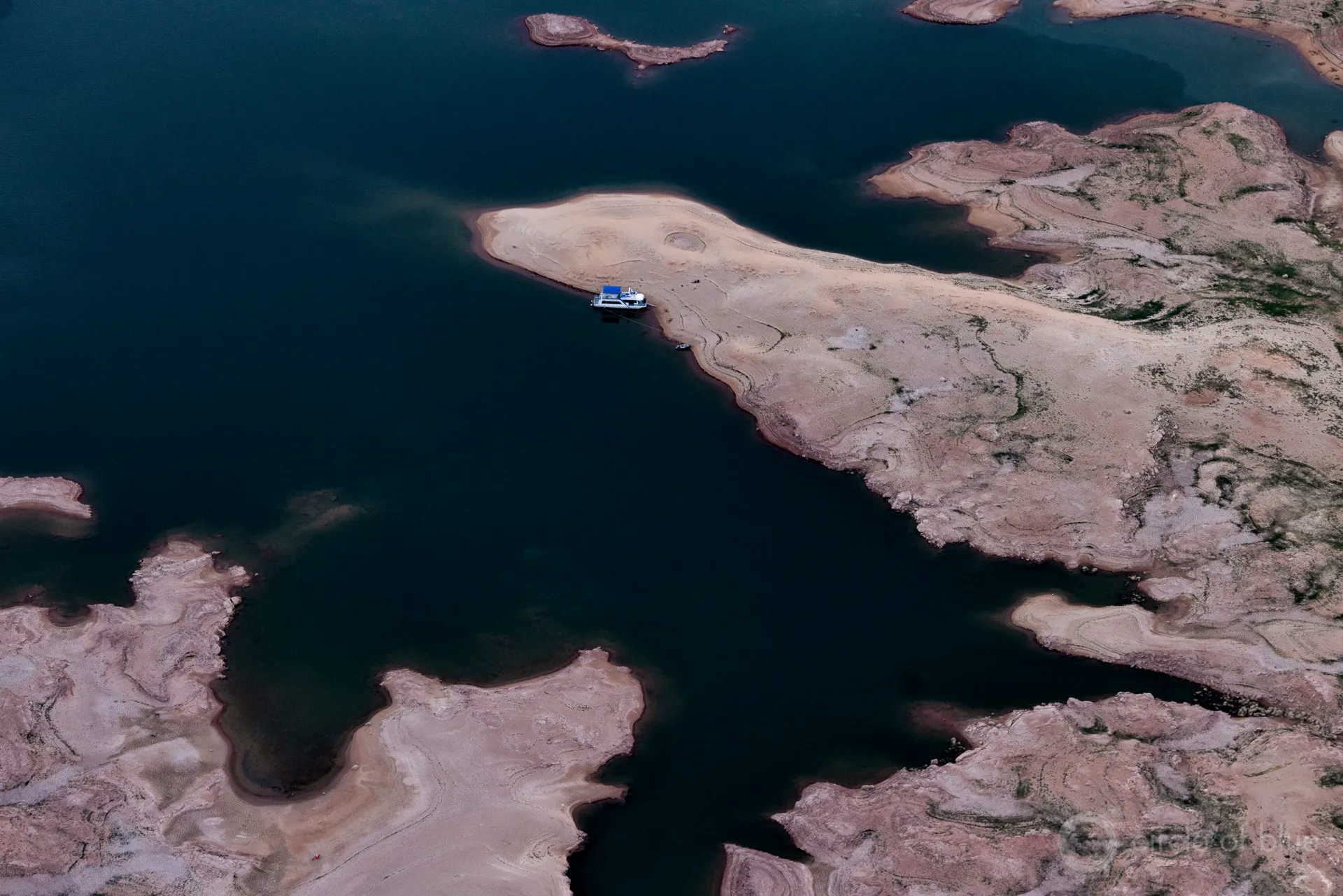
Lake Mead and the big “bathtub ring” as seen from next to Hoover Dam. Jonathan P. Thompson photo.
Click the link to read the article on the KUNC website (Scott Franz):
March 6, 2026
The sluggish Colorado River negotiations have entered a new phase: Long and fiery letter writing.
Politicians, water negotiators and environmental groups recently submitted hundreds of pages of comments on the Interior Department’s playbook for how to manage the waterway. There are currently five possible options to deal with the river in the absence of a deal between the seven states in the basin.
The alternatives were published in January and could result in a variety of scenarios, ranging from significant water reductions in lower basin states to creating new incentives for states to conserve water.
And after the states missed two deadlines for reaching an agreement themselves on how to share and conserve the water, it’s becoming increasingly likely the federal government will piece together its own plan before the current guidelines expire in August.
Public comment on the Interior Department’s menu of alternatives ended Monday. And leaders from both the upper and lower basins are blasting them.
The state is generally calling for a plan that forces states in the lower basin to cut back more of their water use in the face of drought.
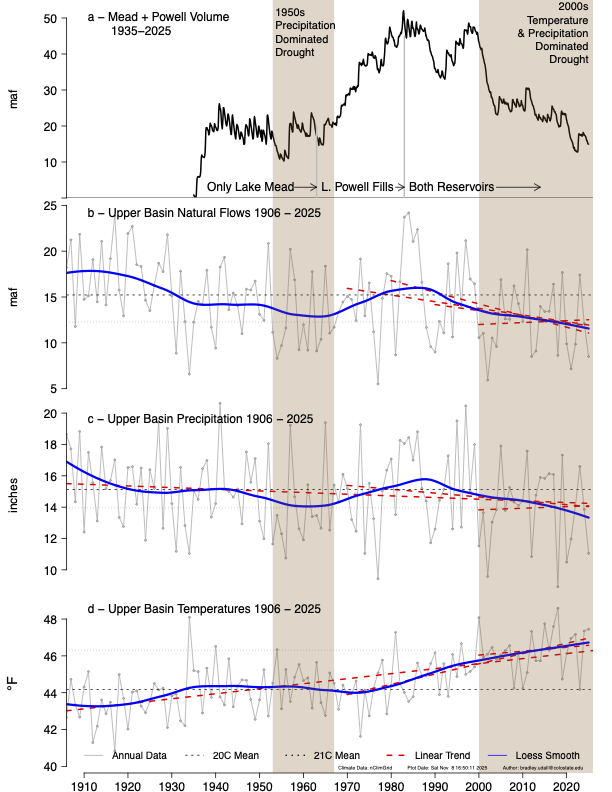
Udall/Overpeck 4-panel Figure Colorado River temperature/precipitation/natural flows with trend. Lake Mead and Lake Powell storage. Updated through Water Year 2025. Note the tiny points on the annual data so that you can flyspeck the individual years. Credit: Brad Udall
“The Colorado River has changed dramatically over the last two decades, and our operating rules need to change with it,” Colorado River Commissioner Becky Mitchell said in a statement. “The current rules have not done enough to protect Lake Powell and Lake Mead, and it’s clear that a future management framework must better respond to today’s reality.”
Mitchell said the river is nearing a crisis point. She wrote that under current operating guidelines for the two reservoirs, which have been in place since 2007, Interior has been releasing water to the lower basin “based on demand, largely ignoring worsening hydrology and dropping reservoir levels.”
Downriver in Arizona, leaders are also blasting the Interior’s list of proposals, saying they would result in disproportional and severe water cuts to the lower basin states.
“Arizona’s agriculture, semiconductor and advanced manufacturing, aerospace and defense industries rely on the Colorado River,” the delegation wrote. “Reductions of the magnitude contemplated in the (feds playbook) would reverberate across rural communities and throughout the domestic food supply chain.”
The lower basin states of California, Arizona and Nevada are calling for mandatory water cuts in the upper basin states of Colorado, New Mexico, Wyoming and Utah.
Leaders in those states have countered that they already enact water conservation measures during times of drought.
A coalition of conservation groups, including The Nature Conservancy and Trout Unlimited, also weighed in on Interior’s draft proposals. They wrote that stabilizing the Colorado River in the face of drought “depends on early, proactive management; flexible and coordinated use of storage; meaningful Tribal participation; and integration of ecological integrity and mitigation into operational considerations.”
“Frameworks that delay action, rely on rigid rules, or institutionalize emergency operations consistently perform worse under the hydrologic conditions the Basin is most likely to face.
The Interior Department plans to review the public comments and identify which option it prefers to manage the reservoirs sometime this spring.
Environmental groups have warned negotiators in the seven states against taking their fight to court, saying that path could hold up conservation plans that are needed to protect places like the ecosystem of the Grand Canyon.
General Manager of the Colorado River Water Conservation District Andy Mueller speaks at the district’s annual seminar in 2018. Photo credit: Brent Gardner-Smith/Aspen Journalism
The general manager of the Colorado River District says that despite blown deadlines, a deal between states is still possible and needed to deal with the crisis regarding the river’s management. But Andy Mueller says time is running short to do so with an existing agreement due to expire later this year and drought and Lower Basin overuse of the river putting water levels in Lake Powell at perilously low levels.
“The best alternative from our perspective is still to have the seven states find an agreement that provides certainty. It’s really hard to do that in the middle of a really terrible drought. It’s a multi-decadal drought,” Mueller said…
Udall/Overpeck 4-panel Figure Colorado River temperature/precipitation/natural flows with trend. Lake Mead and Lake Powell storage. Updated through Water Year 2025. Note the tiny points on the annual data so that you can flyspeck the individual years. Credit: Brad Udall
Mueller said everyone has been good at pushing off the crises in the Colorado River. But the buffer at Powell and Mead in terms of stored water has disappeared due to the Lower Basin’s overuse and failure to account for system loss, and a changing river hydrology coming amidst warming temperatures, and as a result “we don’t have that buffer anymore, so it truly is hitting a crisis,” he said. The river has been beset by long-term drought for much of this century, reflecting what some refer to as aridification resulting from a warming climate…While Mueller remains hopeful that the states will continue to talk and keep the federal government from having to act on its own, the government needs to be prepared to move forward, he said. He said the next-worst alternative it is analyzing, which is called the basic coordination alternative but he considers to be the federal authorities’ alternative, imposes cuts first on Arizona, and specifically its Central Arizona Project as a junior water right in the Lower Basin. Mueller said that alternative also says the goal will be to deliver at least 7.5 million acre feet a year from Powell. He said that under most reasonably foreseeable hydrologies, that will put Powell’s infrastructure at risk. The water level would be in danger of falling below the intake tubes used to make power, which would leave the dam’s bypass tubes as the only way of getting water out of Powell and down into Grand Canyon. Those tubes have proven structurally problematic, subject to what is known as cavitation when a lot of water is moving through them, which has resulted in damage to them. Mueller said Reclamation has done a lot of work to try to repair them but no one he has talked to wants to rely on those tubes to get water below the dam..,Mueller said the federal alternative says that, to keep levels in Powell high enough to keep producing power and delivering water to the Lower Basin, it might have to take unspecified actions in the Upper Basin.
“Everybody in the Upper Basin, everybody in western Colorado should be very concerned about that statement because the question is, what do they mean by that?” he said.
He said that if the environmental impact statement is going to refer to contemplated actions, by law it needs to identify them and analyze their environmental and socioeconomic impacts. Because it doesn’t, the entire EIS process is legally flawed when it comes to the alternative most likely to be adopted by the federal government, and if it goes that route it could get sued not just by Arizona, which is facing the biggest cuts, but by the Upper Basin, Mueller said. He said the unspecified actions probably would start with massive releases of water from primarily Flaming Gorge Reservoir but also Blue Mesa and Navajo reservoirs.
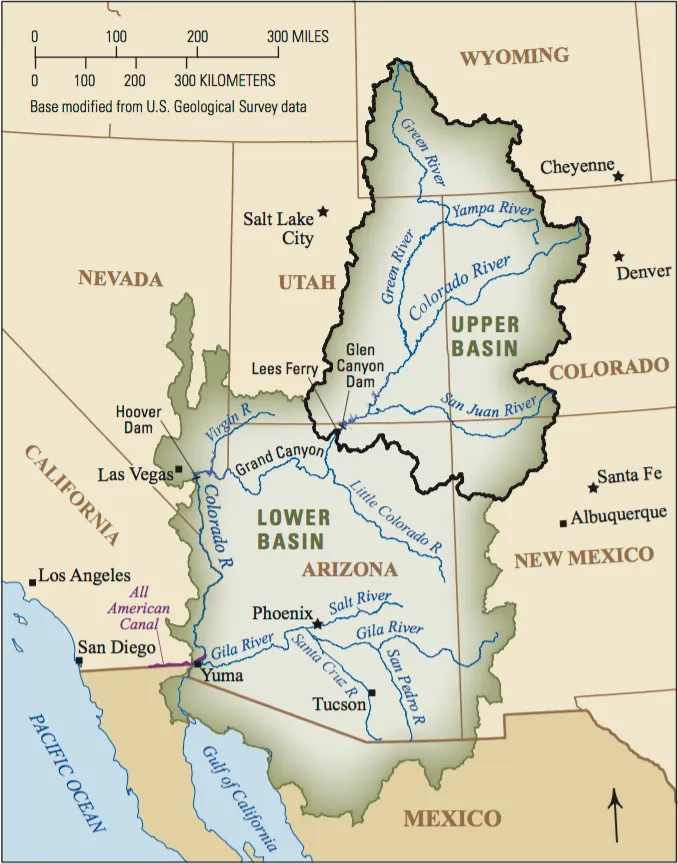
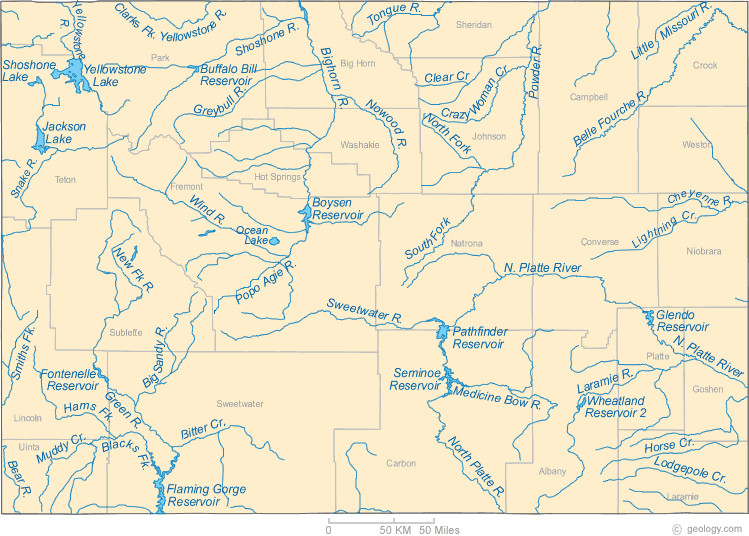
Map of the Colorado River drainage basin, created using USGS data. By Shannon1 Creative Commons Attribution-Share Alike 4.0
Click the link to read the article on The Denver Post website (Elise Schmelzer). Here’s an excerpt:
March 9, 2026
Extended warm weather across the Colorado River basin may reduce the amount of water delivered during the spring runoff to just a third of normal, according to federal forecasters. Modeling released late last week showed the river system on track to deliver a scant 2.3 million acre-feet to Lake Powell, one of the river system’s largest reservoirs. That’s 36% of the median of 6.4 million acre-feet recorded between 1991 and 2020. If the forecast comes true, it would be the fifth-lowest inflow to Lake Powell since the reservoir’s establishment in 1963, according to the National Weather Service’s Colorado Basin River Forecast Center.
“It’s not a pretty picture here,” Cody Moser, a hydrologist with the center, said of the basin’s snowpack during a briefing on the forecast Friday.
A chart from the Colorado Basin River Forecast Center shows projected water supplies for the Colorado River basin compared to normal in 2026. (Provided by Colorado Basin River Forecast Center)
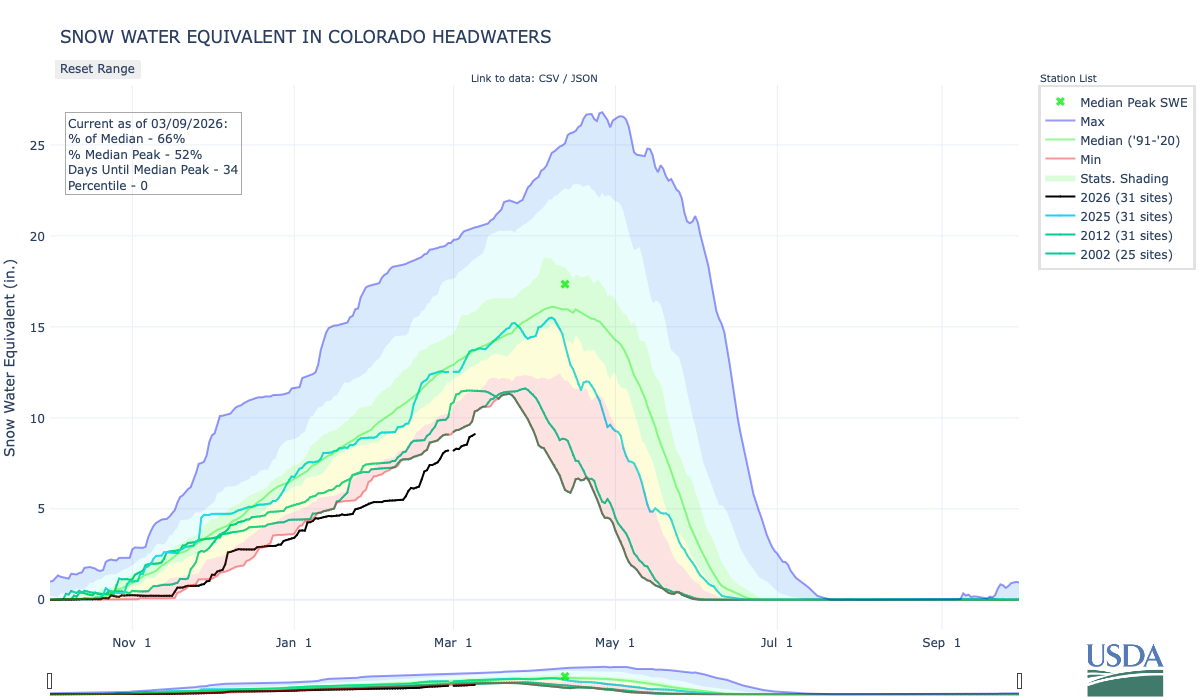
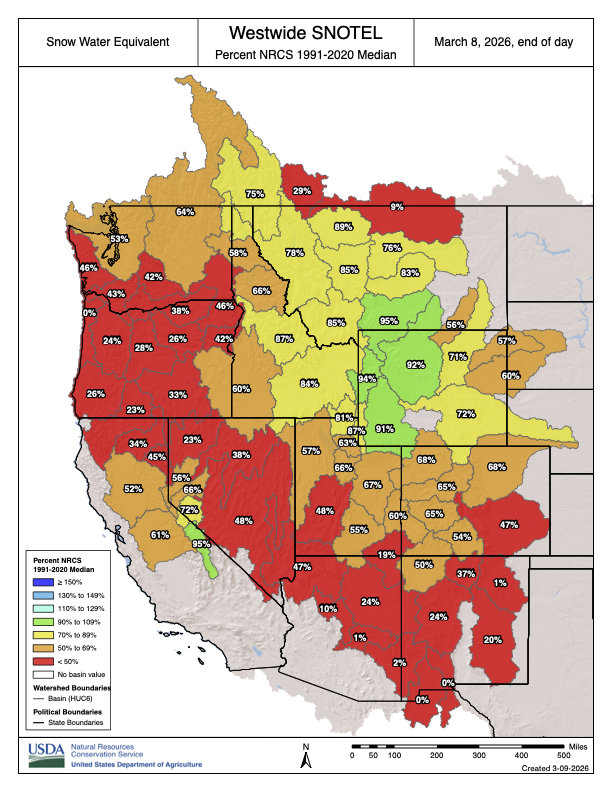
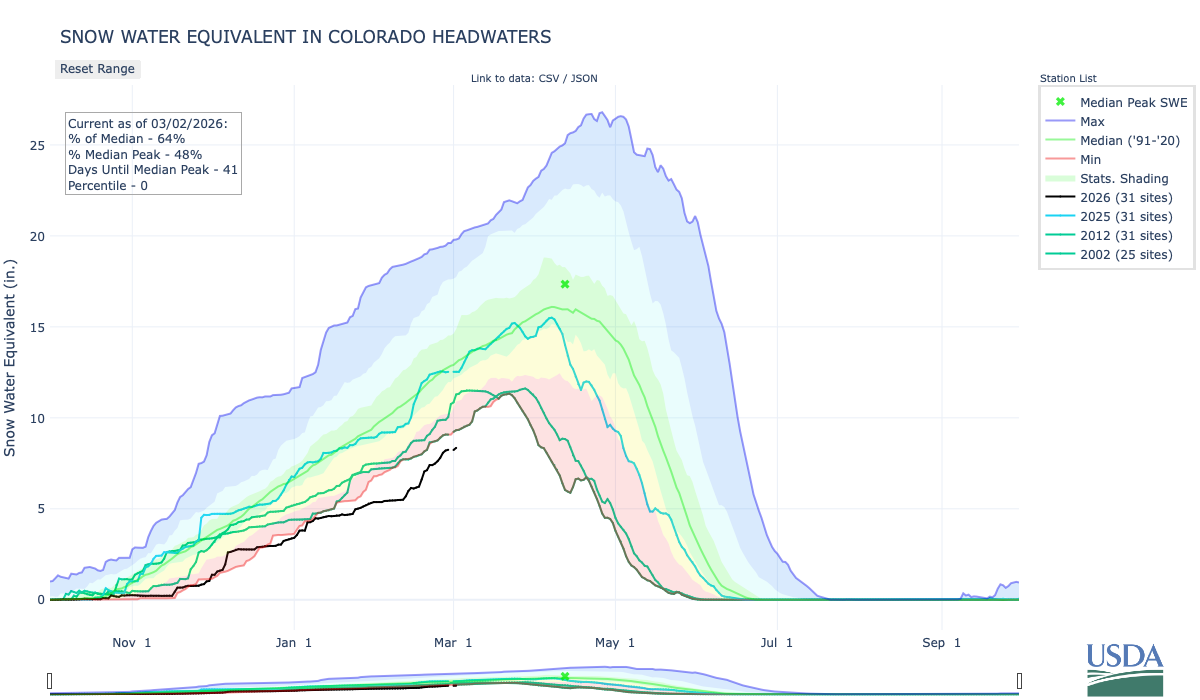
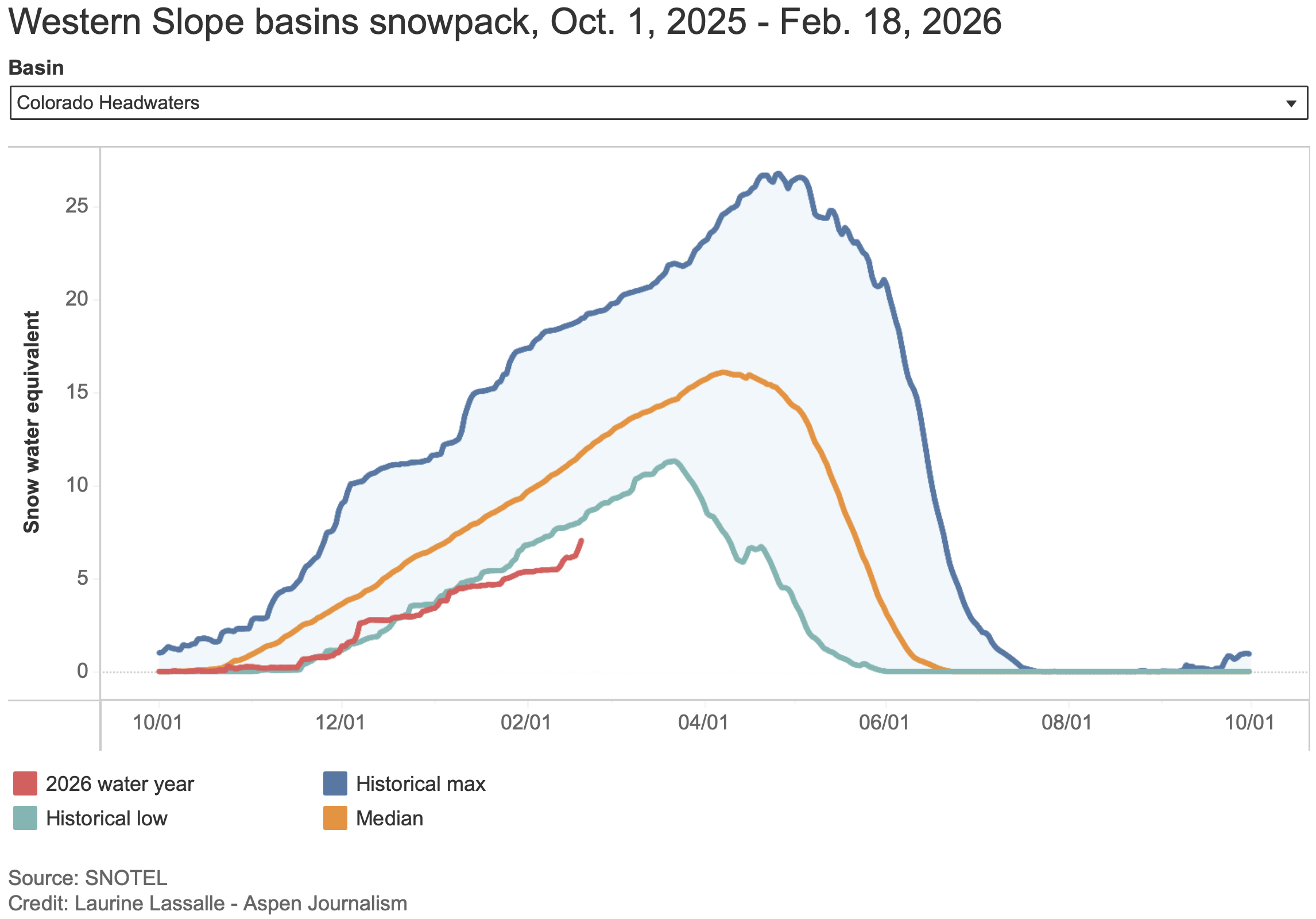
Already, federal officials predict water levels could fall so low at Lake Powell by August that water will no longer flow through the intake tubes for Glen Canyon Dam’s hydroelectric turbines. Lake Powell at the beginning of March was 24% full, while Mead — which is in Nevada and Arizona — was 34% full. Much of the Colorado River’s water begins as snow in Colorado’s mountains, which have been plagued by record-low snowfall this winter. The Colorado River headwaters’ snowpack sat at 66% of the median for this time of year on Monday — the lowest recorded level since measurements began in 1986.
“The Colorado headwaters are the worst this water year; they’re well below normal,” Moser said, noting that many winter storms missed the area.
Click the link to read the analysis on the NOAA website:
March 9, 2026
Key Points:
February was the fourth warmest and fifth driest on record for the contiguous U.S. (CONUS) in the 132-year record.
Winter (December 2024–February 2025) ranked as the second warmest for the CONUS and was the driest in 45 years.
Arizona, New Mexico and Utah each broke their previous warmest-winter record by more than 2°F.
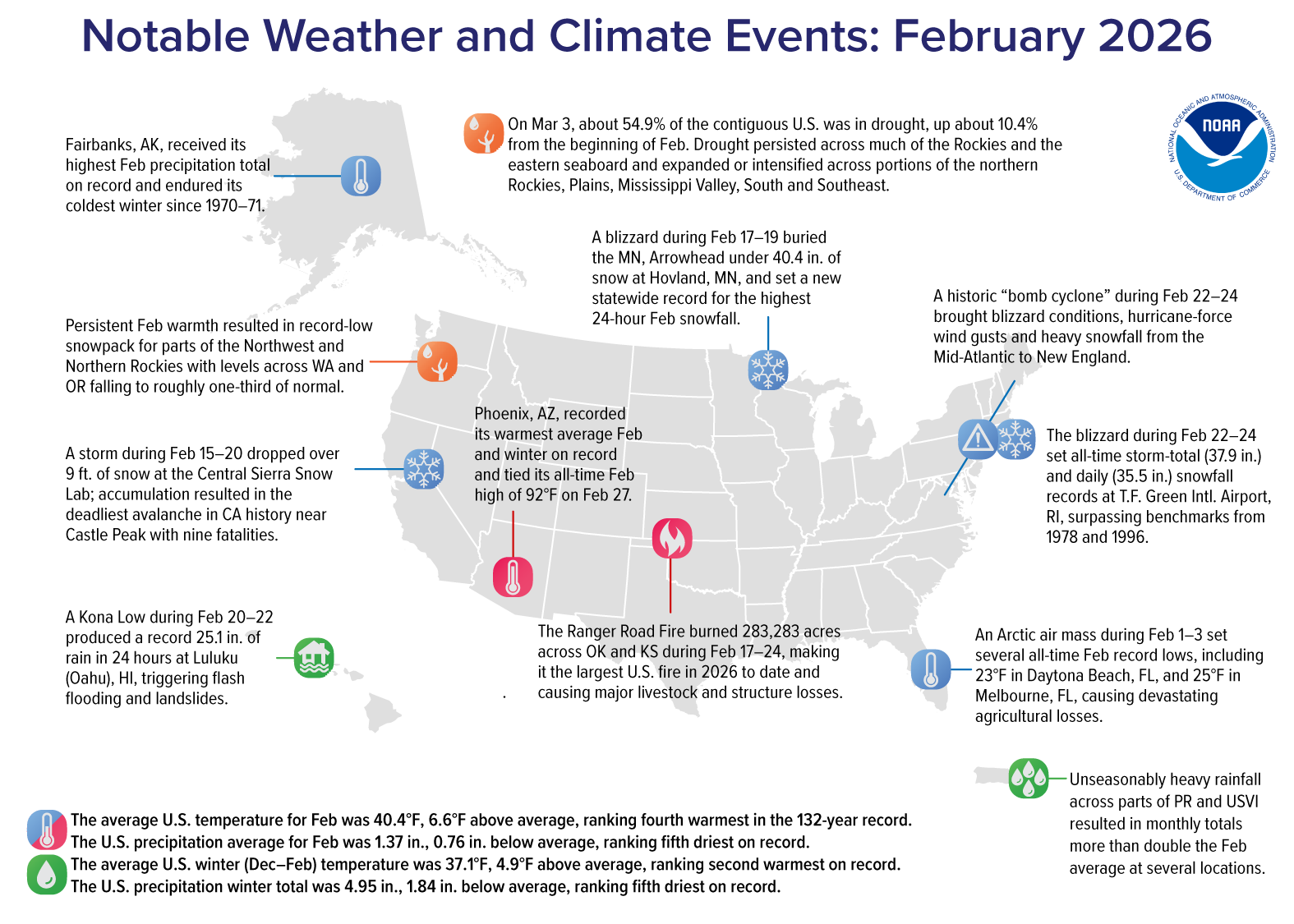
A historic “bomb cyclone” during Feb 22–24 brought blizzard conditions, hurricane-force wind gusts and heavy snowfall from the Mid-Atlantic to New England.
Alaska saw a particularly cold winter, recording much-below-average temperatures across parts of the central Interior.
Drought conditions expanded by more than 10% in February to cover more than half of the CONUS.
Map of the U.S. notable weather and climate events in February 2026.
Other Highlights:
Temperature
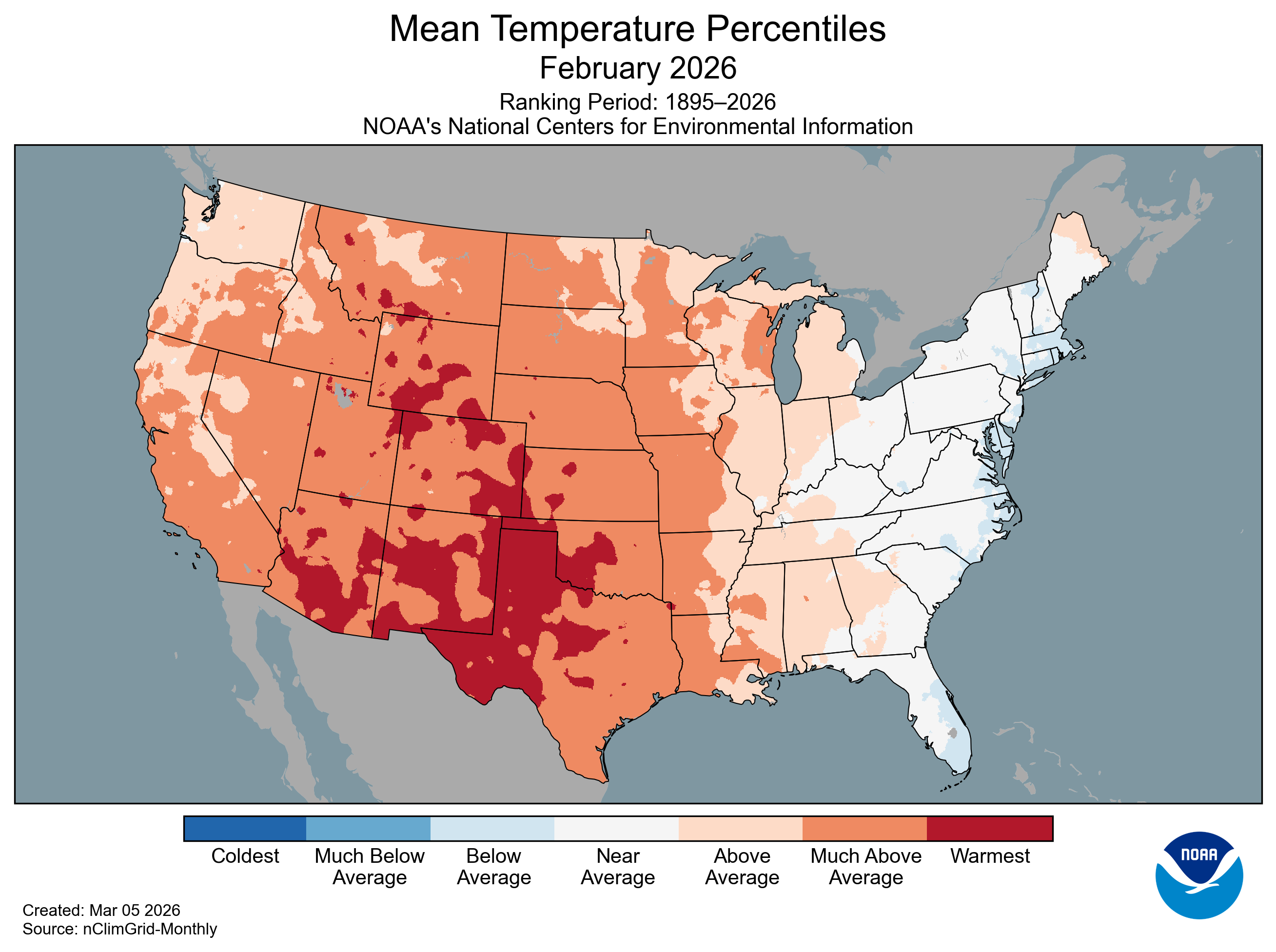
The CONUS average temperature during February was 40.4°F, 6.6°F above the 20th-century average. Extensive portions of the country west of the Mississippi River experienced much-above-average temperatures, while portions of the eastern seaboard observed below-average temperatures that ranked in the lowest third of their historical records. Seven states experienced one of their two warmest Februaries on record, including Arizona, New Mexico, Colorado and Oklahoma, which each set new statewide records.
February 2026 U.S. Mean Temperature Percentiles Map.
The CONUS average temperature for meteorological winter (December–February) was 37.1°F, 4.9°F above the 20th-century average, ranking as the second-warmest winter in the 131-year record. Based on average temperatures across NOAA climate regions, the West and Southwest each experienced their warmest winter on record, while the Northwest, Northern Rockies and Plains as well as the South each ranked second warmest. In contrast, the Northeast climate region was cooler than average, ranking in the lowest third of its historical record.
Nine states recorded their warmest winter on record, with an additional five experiencing their second warmest. Daytime high temperatures were particularly notable, with the CONUS averaging 48.3°F—5.6°F above average—marking the warmest winter for daytime highs in the 131-year record and the first time the seasonal average exceeded 48°F. Eleven states also recorded their warmest winter for average maximum temperatures. At the county level, 585 counties—home to more than 116 million people, or roughly one-third of the U.S. population—experienced their warmest winter on record for daytime highs. Illustrating this exceptional warmth, Dallas/Fort Worth International Airport recorded 16 days with maximum temperatures of at least 80°F, the highest seasonal total on record (since 1898) and about 60% above the previous record set in 2016–17.
Despite the widespread warmth, eight states stretching from Ohio to Massachusetts experienced below-average winter temperatures that ranked in the lowest third of their records.
The Alaska statewide temperature in February was 4.0°F, 0.8°F below the 1925–2000 average and ranked in the middle third of the 102-year period of record for the state. Much of mainland Alaska had below-average temperatures, contrasting with above-average conditions in southeast Alaska, the Aleutians and the lower Alaska Peninsula. Alaska’s average temperature for winter was 0.8°F, 2.8°F below the 1925–2000 average, ranking in the coolest third of the record. Much of the Alaska Interior recorded below- to much-below-average temperatures for the season, with Fairbanks Airport recording its coldest winter since 1970–71.
The Hawaiʻi statewide average temperature during February was 63.2°F, 0.2°F above the 1991–2020 average, ranking in the middle third of the 36-year record. For winter as a whole, the statewide average temperature was 64.4°F, 0.7°F above average, placing it in the warmest third of the record.
Precipitation
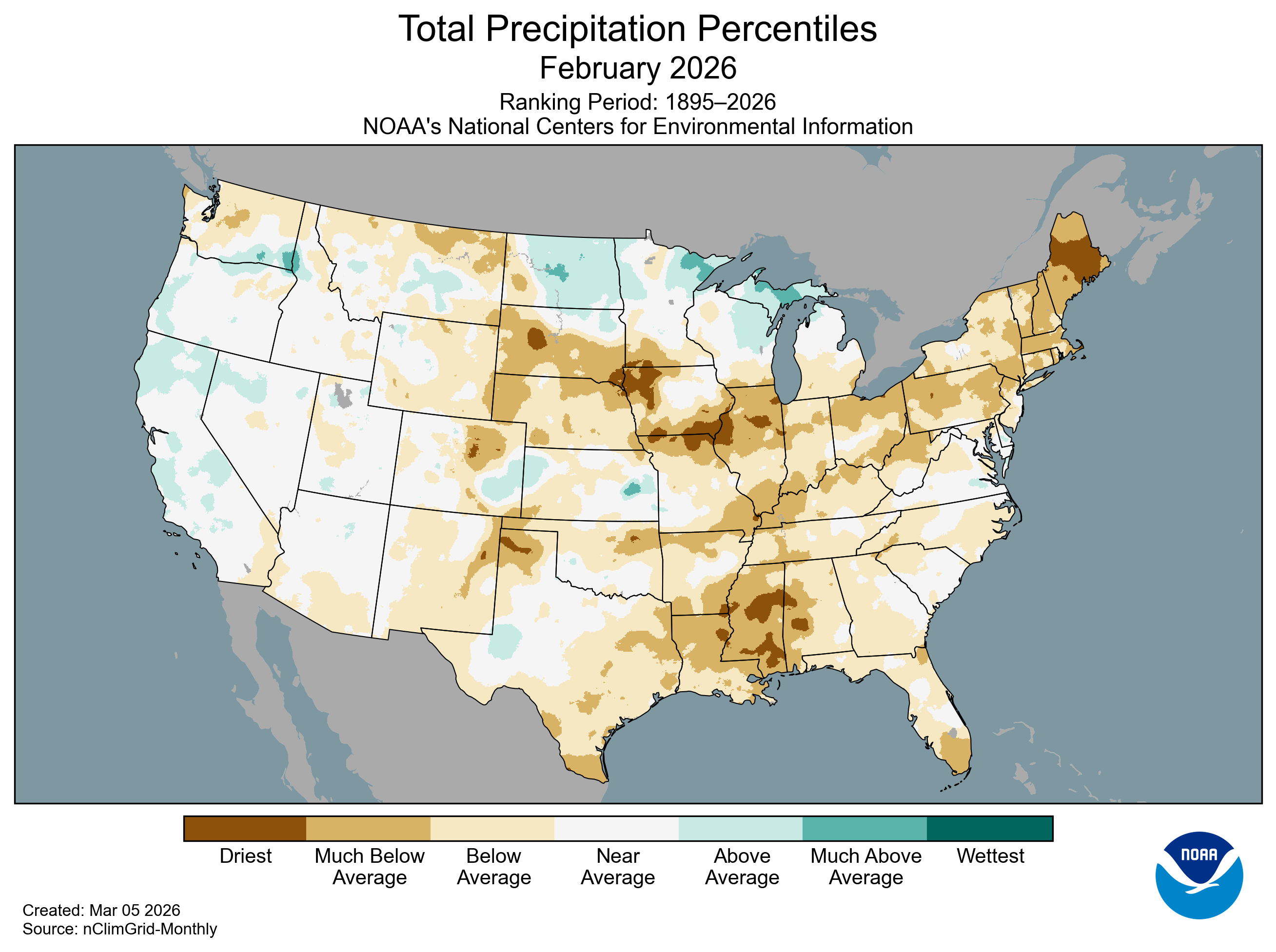
February precipitation for the CONUS was 1.37 inches, 0.76 inch below the 20th-century average and the driest since 2002. Significant precipitation deficits stretched from the northern Rockies and central Plains through the Midwest, Ohio Valley and Northeast, and from parts of the Southwest and southern Plains across much of the Deep South and Southeast. In total, 11 states recorded one of their 10 lowest February precipitation totals, including Mississippi, which broke its 1947 record receiving less than 30 percent of its average February precipitation. In contrast, above-average precipitation was largely confined to a narrow corridor from the northern Plains into the Upper Great Lakes, with isolated areas across parts of the West and Northwest.
February 2026 U.S. Total Precipitation Percentiles.
A historic blizzard on February 22–24 brought heavy snowfall and hurricane-force winds to portions of the Northeast. Providence, RI, reported its largest snowstorm on record, while several other cities recorded February totals not seen in more than a decade. The storm was classified as a major snowstorm based on NOAA’s Regional Snowfall Index (RSI), which estimates that snowfall affected more than 115 million people—about one-third of the U.S. population—including about 28 million people who received over a foot.
The CONUS received an average of 4.95 inches of precipitation during winter, 1.84 inches below the 20th-century average, ranking as the fifth-driest winter in the 131-year record. Large portions of the central and eastern U.S. experienced much-below-average precipitation—18 states recorded one of their 10 driest winters on record—while much of the western U.S. had near-average totals. A notable exception was Michigan’s Upper Peninsula, which received much-above-average to record winter precipitation.
Alaska’s average monthly precipitation in February ranked in the middle third of the 102-year period of record. For winter as a whole, precipitation across Alaska was also near average.
The Hawaiʻi statewide precipitation total during February was 8.11 inches, 3.01 inches above the 1991–2020 average, ranking in the wettest third of the 36-year record. Several records were set during the month as powerful Kona Lows delivered extreme rainfall, including over 25 inches in a single day on Oahu and a 72-hour total surpassing 30 inches on the Big Island. For winter as a whole, the statewide precipitation total was 16.22 inches, 0.33 inch below the 1991–2020 average, placing it in the middle third of the record.
Drought
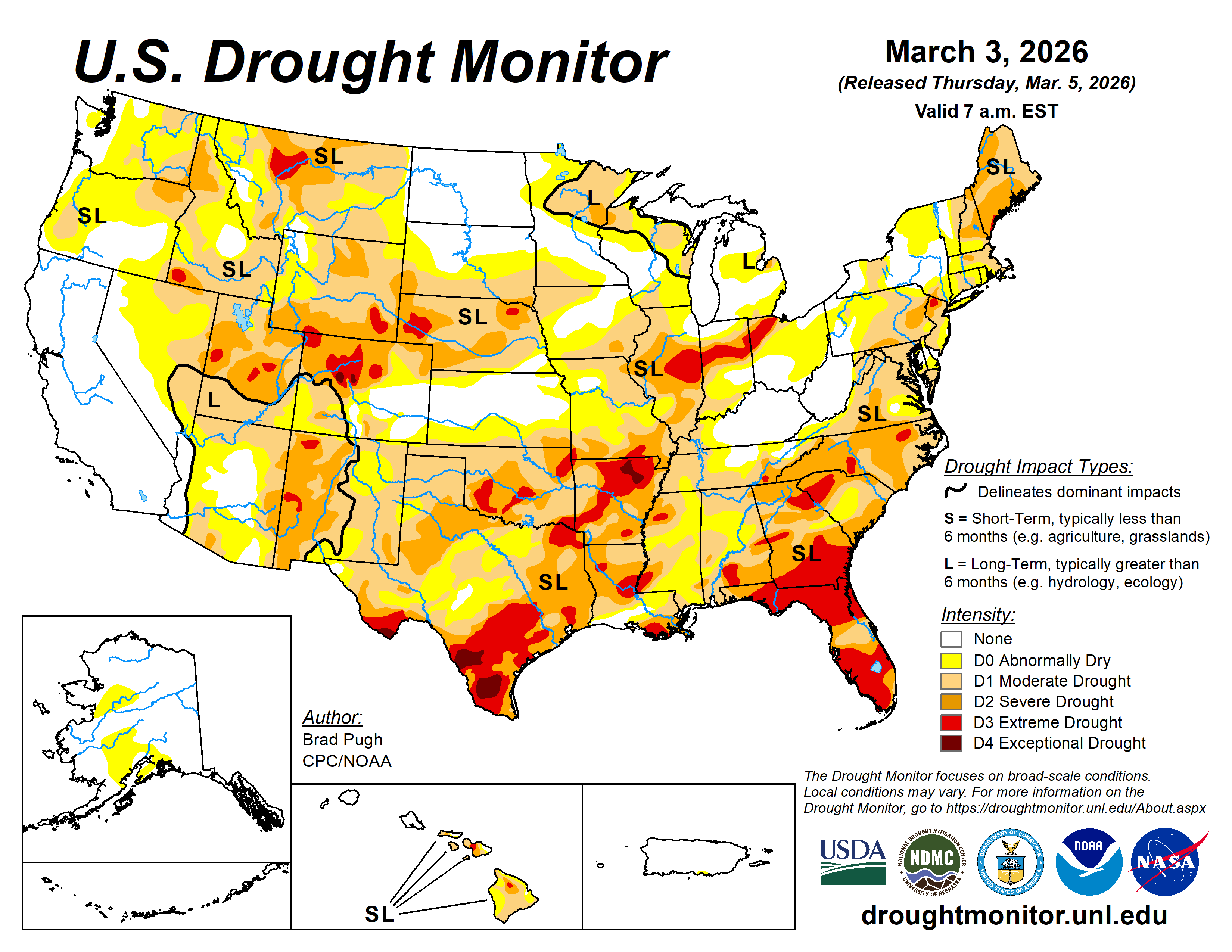
According to the March 3 U.S. Drought Monitor report, about 54.9% of the CONUS was in drought, an increase of about 10.4% from the beginning of February. Drought persisted across much of the Rockies and the eastern seaboard and expanded or intensified across portions of the northern Rockies, Plains, Mississippi Valley, South and Southeast.
Monthly Report
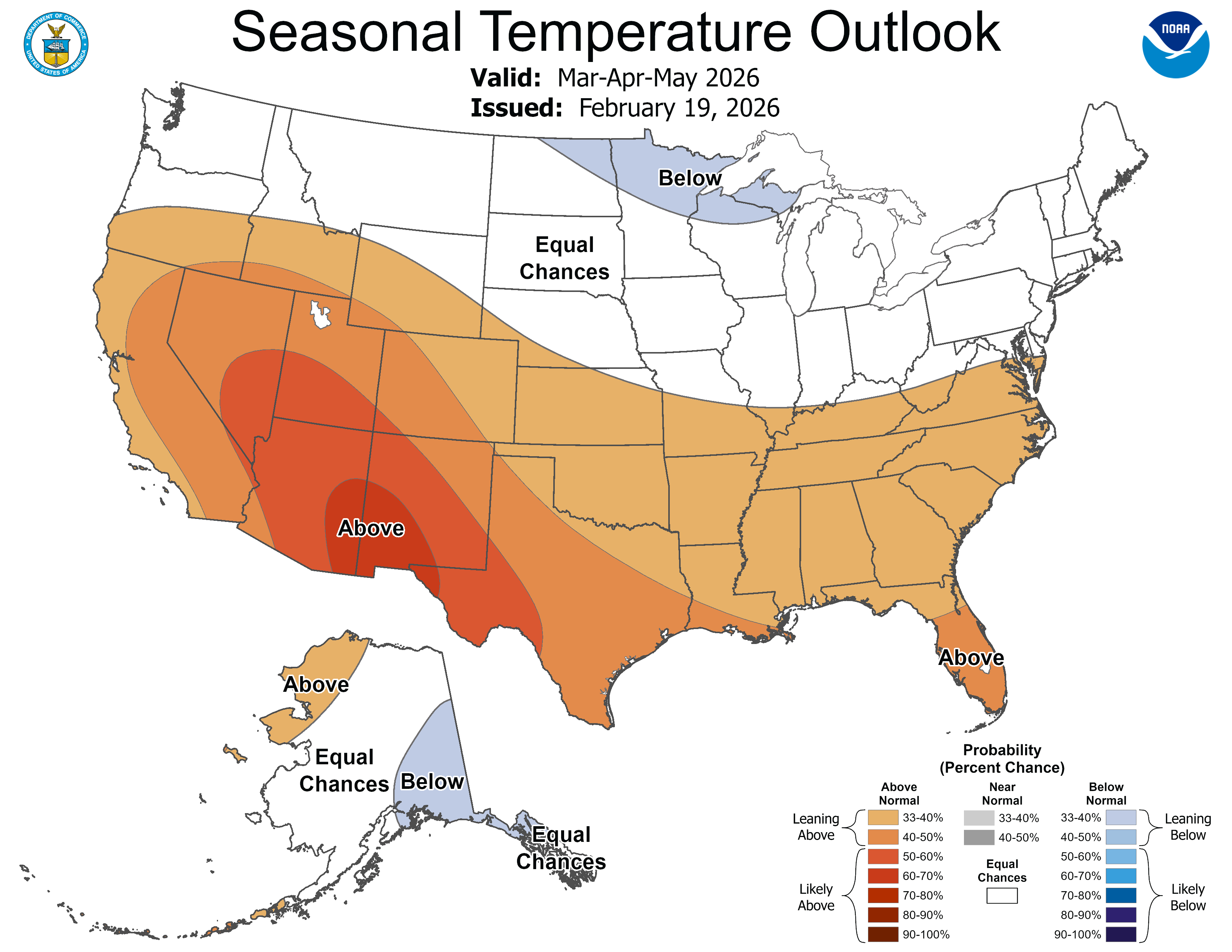
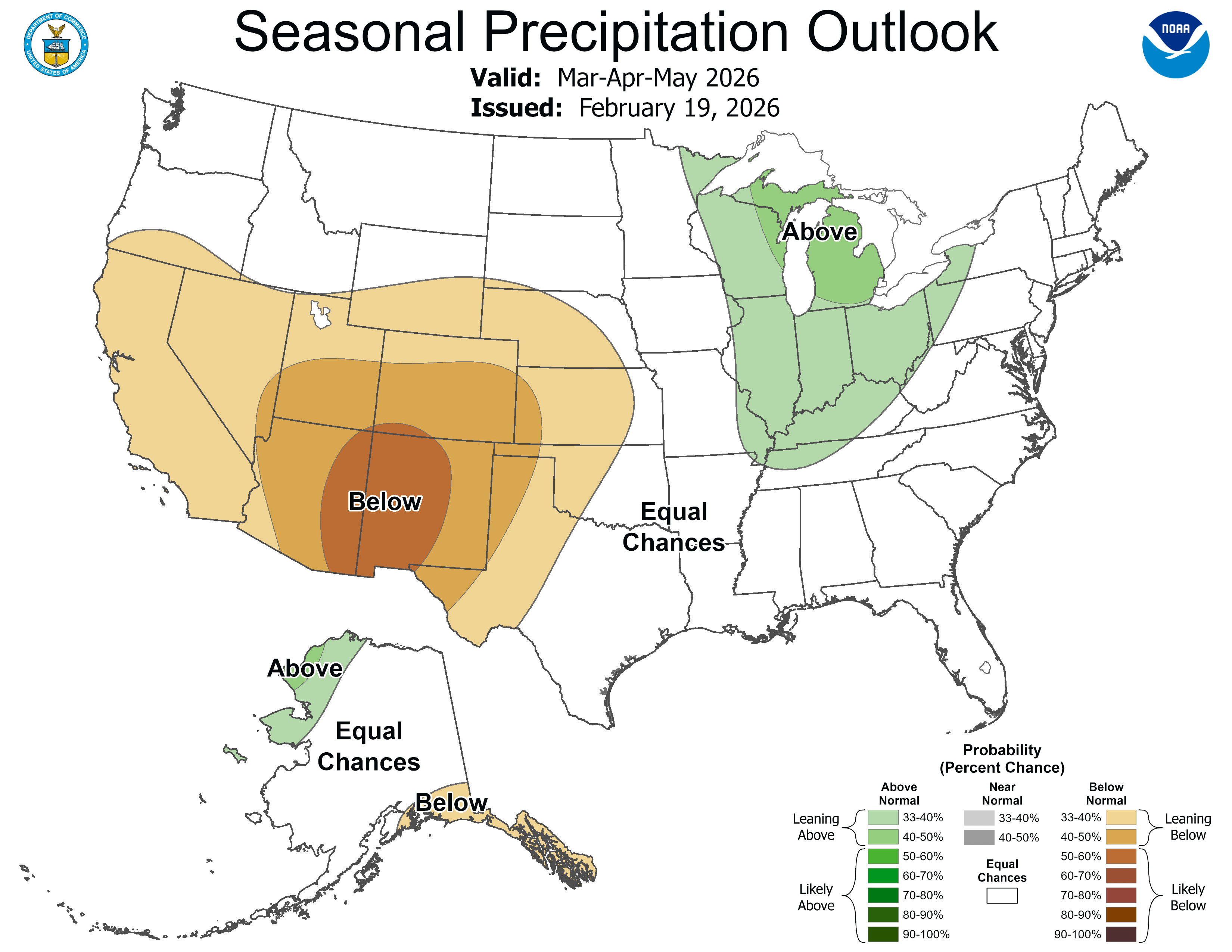
Most of the CONUS is favored to see above-average temperatures in March, with the highest probabilities (exceeding 60–70%) centered over the South and Southeast, while Alaska is forecast to experience below-average temperatures, particularly in the Alaska Interior. Above-average precipitation is likely for a broad swath extending from the southern Plains through the Mississippi Valley and into the Great Lakes. Drier-than-average conditions are favored for much of California and Florida. Visit the Climate Prediction Center’s Official 30-Day Forecasts for more details.
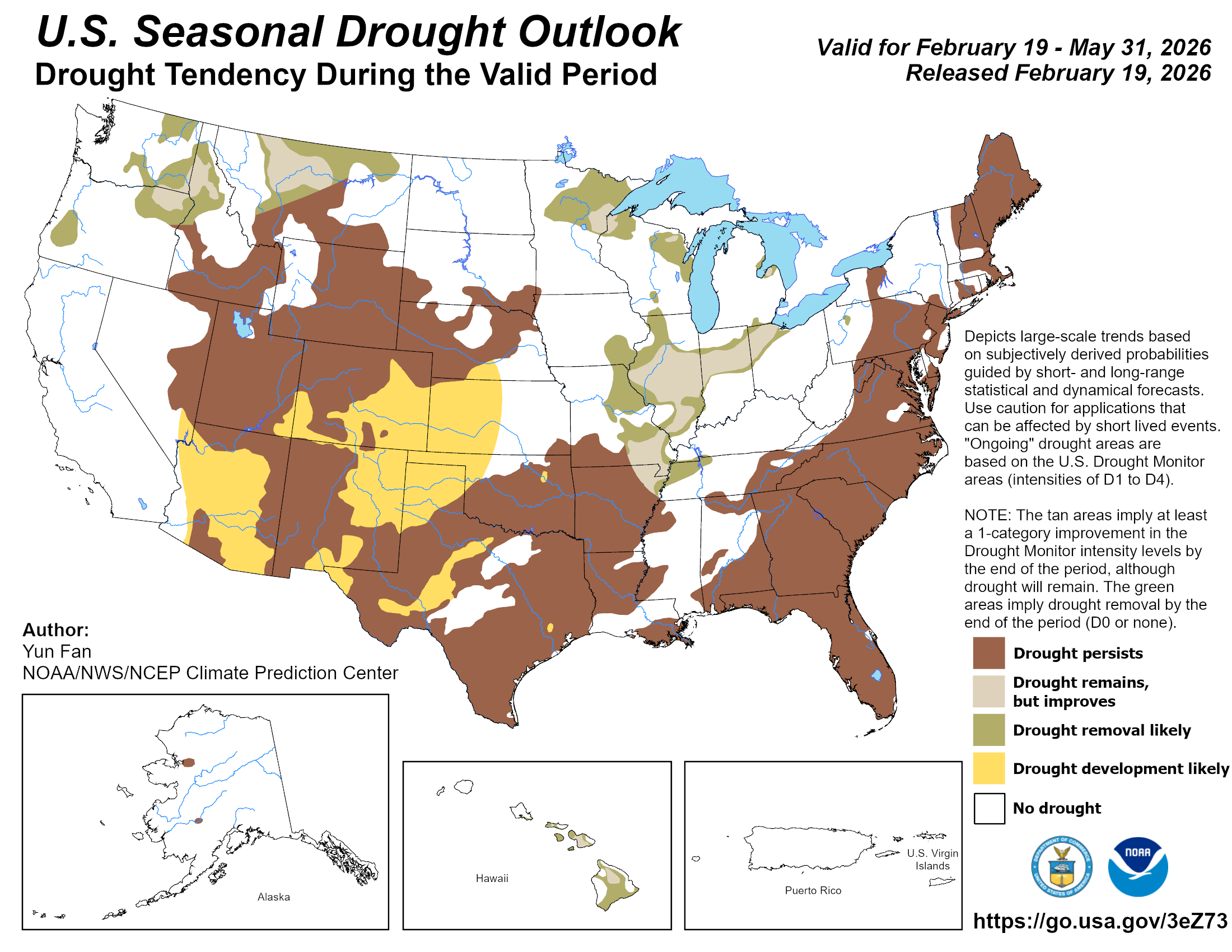
Drought is expected to persist across much of the interior West, Southwest and High Plains, along with the eastern seaboard. However, significant improvement or drought removal is forecast for parts of the Southern Plains, across much of the Mississippi Valley and Hawaiʻi. Visit the U.S. Monthly Drought Outlook website for more details.
Significant wildland fire potential is above average across a wide region including the southern Plains, the Gulf Coast and the Southeast, extending northward into Virginia. For additional information on wildland fire potential, visit the National Interagency Fire Center’s One-Month Wildland Fire Outlook.
For more detailed climate information, check out our comprehensive February 2026 U.S. Climate Report scheduled for release on March 12, 2026. For additional information on the statistics provided here, visit the Climate at a Glance and National Maps webpages.
Click the link to read the article on the AZCentral website (Brandon Loomis). Here’s an excerpt:
March 7, 2026
Key Points
A warm, dry winter has resulted in a disappointing snowpack across the intermountain West, affecting the Colorado River’s water supply.
Projected inflow to Lake Powell is at a near-historic low, complicating efforts to manage water shortages among states.
Arizona’s local water supplies, on the Salt and Verde rivers, are in better condition than last year, though still below average.
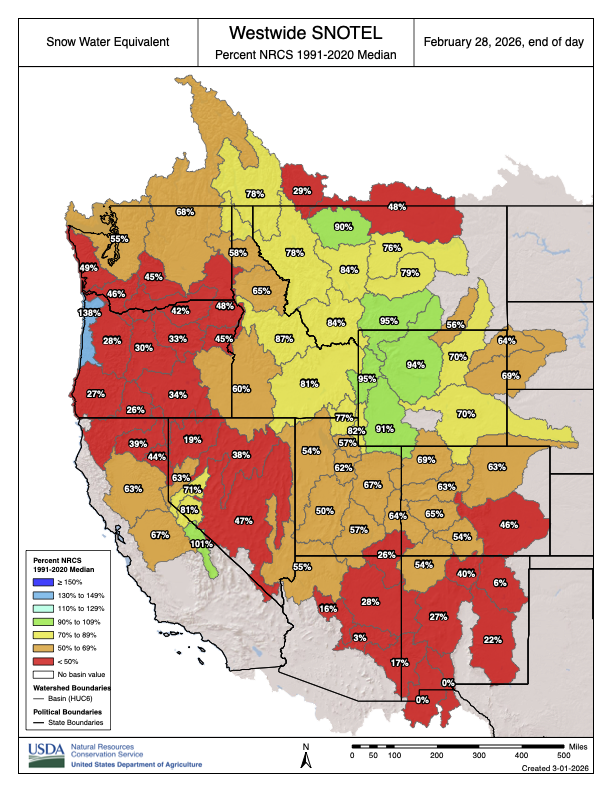
The federal government’s Colorado Basin River Forecast Center’s March report noted much of the drainage, especially in the mountains of Colorado and Utah, had experienced their worst snowpack since at least 1981. When meteorological winter ended on March 1, both Phoenix and Salt Lake City had broken records for maximum mean winter temperatures by 2 degrees Fahrenheit. The warmth that pervaded the West had melted much of the existing snowpack or caused it to fall as rain instead, encouraging evaporation and plant uptake and reducing the amount that will reach reservoirs this spring and summer.
“It’s not a pretty picture here,” forecast center hydrologist Cody Moser said while reviewing a color-coded watershed map emblazoned with red to indicate vast areas projected to deliver relatively little runoff.
The result, as of early March, was a projected Colorado River inflow to the critical storage pool in Lake Powell of just 2.3 million acre-feet, or 36% of the 1991-2020 average. If that projection holds up, it would be the lowest April-July boost for Lake Powell since the disastrous year of 2002 firmly entrenched this age of megadrought...This profound snow drought comes at an especially awkward time, compounding a quarter-century of regional aridification that has drained the nation’s two largest reservoirs to precarious depths. Lake Powell started March at just 24% of capacity, with much of that water functionally unavailable to flow downstream to Lake Mead and the Southwest because it’s below Glen Canyon Dam’s hydropower and bypass intakes. Lake Mead began the month at 34% of capacity. Both began this century essentially full. The lack of storage complicates the U.S. Bureau of Reclamation’s efforts to adopt new dam-operating and shortage-sharing guidelines without triggering a lawsuit from states and water users. Unless they do that by October, the current rules imposing cutbacks on Arizona and others will lapse, potentially worsening the shortage. Yet Arizona has panned the options that the agency initially studied because, officials say, they unfairly target the state for bigger losses while not enforcing the Colorado River Compact’s call for upstream states to let a minimum amount of water pass through.
Coyote Gulch’s Leaf in Byers Canyon, cut by the Colorado River, on the way to Steamboat Springs August 21, 2017.
Click the link to read the article on the Sky-Hi News website (Ali Longwell). Here’s an excerpt:
March 8, 2026
The state of Colorado, Upper Colorado River Commission, the Colorado River Water Conservation District, the Southwestern Water Conservation District and several Front Range water providers were among those that submitted comments, asking for the Bureau to finalize an agreement that legally fulfills all water rights while making bold and sustainable changes that align with the hydrologic reality of the river.
“The Colorado River has changed dramatically over the last two decades, and our operating rules need to change with it,” said Becky Mitchell, Colorado’s water commissioner and lead negotiator in the post-2026 operations, in a statement. “The current rules have not done enough to protect Lake Powell and Lake Mead, and it’s clear that a future management framework must better respond to today’s reality. Colorado’s comments provide constructive, legally grounded recommendations to bring the system into balance.”
[…]
Since the reservoirs’ current operational guidelines were set in 2007, the Colorado River Basin has experienced deepening drought conditions, declining inflows to the reservoirs and shrinking storage in Powell and Mead. As of March 1, Lake Powell and Lake Mead were 25% and 34% full, respectively. As the upper and lower basin states sought to reach a consensus on the post-2026 guidelines for the reservoirs, disagreements were rooted in where cuts needed to be made to deal with these worsening conditions. Through the deadline for consensus, the Lower Basin states offered up some cuts and pushed for basin-wide water use reductions. The Upper Basin states, however, have pushed back, claiming they already face natural water shortages driven primarily by the ups and downs of snowpack. In February, the upper division said this winter’s critically low snowpack will result in natural reductions “greater than 40% of the proven water rights” across the four states. In the draft, the Bureau recognizes that with “critically low storage in Lake Powell and Lake Mead, significant hydrologic variability and the anticipation of drier future conditions,” an agreement must strike a balance between “potentially profound impacts of water-delivery reductions” and “the need to maintain reservoir storage.”
The latest Upper Colorado River Commission and Colorado comments to the Bureau of Reclamation called on the federal agency to root the post-2026 guidelines on what the river actually supplies. In its comment, the state of Colorado said that the “failures of the current set of guidelines developed in 2007 have driven the current crisis on the Colorado River.”
“We can no longer rely on the management strategies of the past to solve the challenges of the present and future,” said Lauren Ris, director of Colorado’s Water Conservation Board.
Udall/Overpeck 4-panel Figure Colorado River temperature/precipitation/natural flows with trend. Lake Mead and Lake Powell storage. Updated through Water Year 2025. Note the tiny points on the annual data so that you can flyspeck the individual years. Credit: Brad Udall
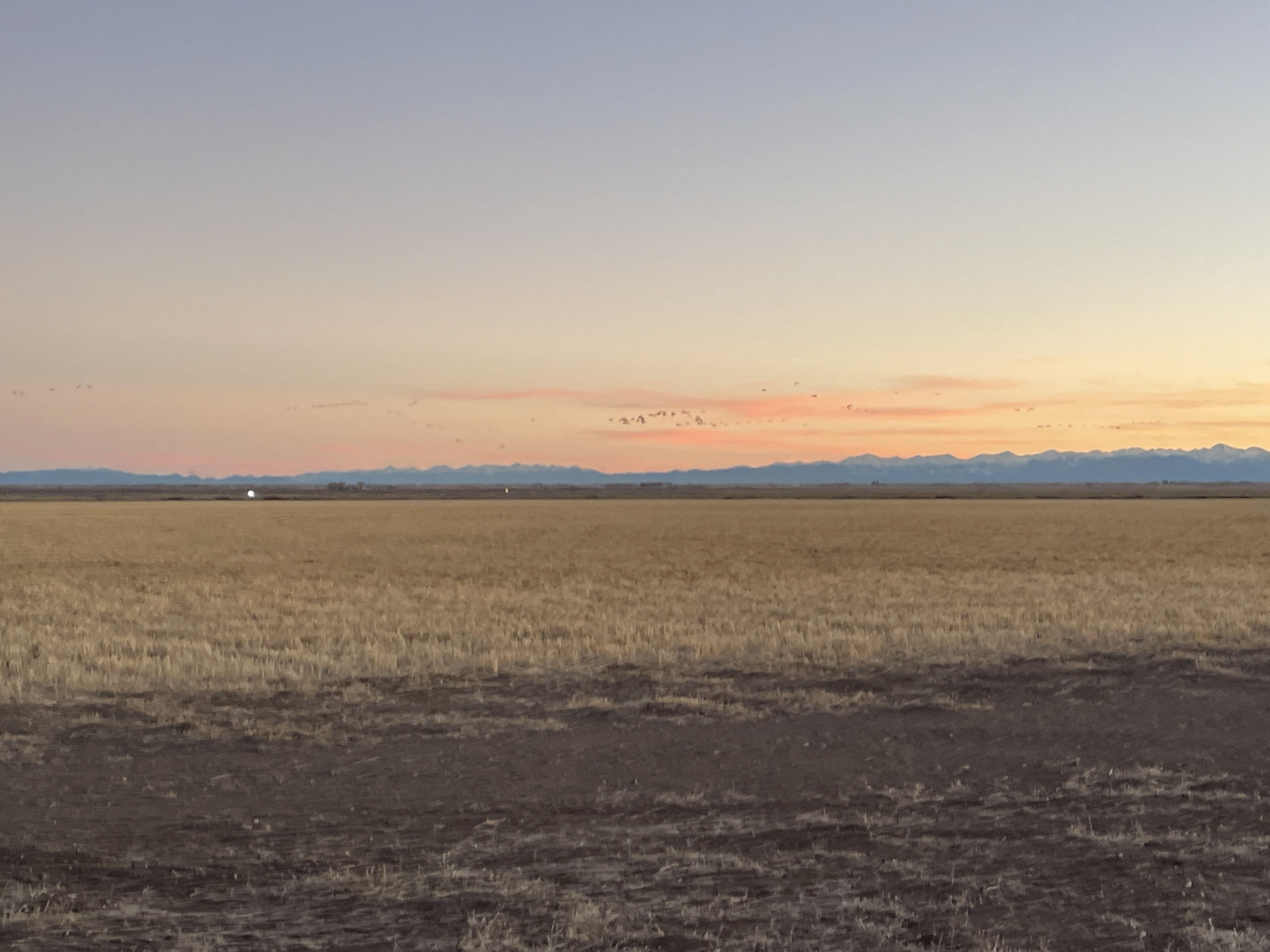
Sandhill Cranes just before sunrise March 8, 2026, Sange de Cristo Mountains in the distance.
We woke up to clear skies and very cold temperatures (6°F) for Sandhill crane viewing on March 8, 2026. The Sandhills spend the night on the ground, usually in shallow water as they do not perch, and then start stirring and looking for a good breakfast spot like the field in the foreground in the photo above.
Video of Sandhill cranes in the early morning on March 8, 2026, San Juan mountains in the background. Sound up!
Charging during the festival was easy as pie at the Colorado Welcome Center in Alamosa. For the trip home I charged in Salida (excellent food at Mojo’s Eatery) and Bailey. Charging to and from the San Luis Valley from Denver is convenient and reliable. There is no reason any longer in Colorado to drive a vehicle with a tailpipe and pollute the atmosphere.
Here’s a writeup from The Alamosa Citizen:
Monte Vista saw big crowds for the 43rd annual Crane Festival. The Outcalt Event and Conference at Ski Hi Complex was teeming with people participating in the crane tours and nature work sessions. The retail vendors reported healthy sales. The sandhill cranes themselves didn’t disappoint. The majestic long-legged creatures were in the tens of thousands in the fields around the Monte Vista Wildlife Refuge. The cranes will stick around a bit longer.
Video of Sandhill cranes at breakfast. After flying around looking for breakfast great numbers of Sandhills settle down for breakfast March 8, 2026. Sound up!
Click the link to read the release on the NRCS website:
March 6, 2026
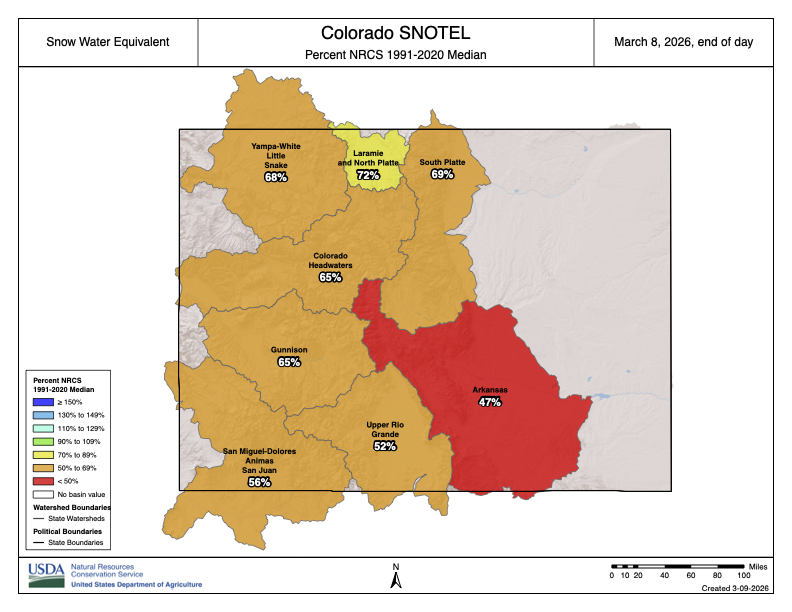
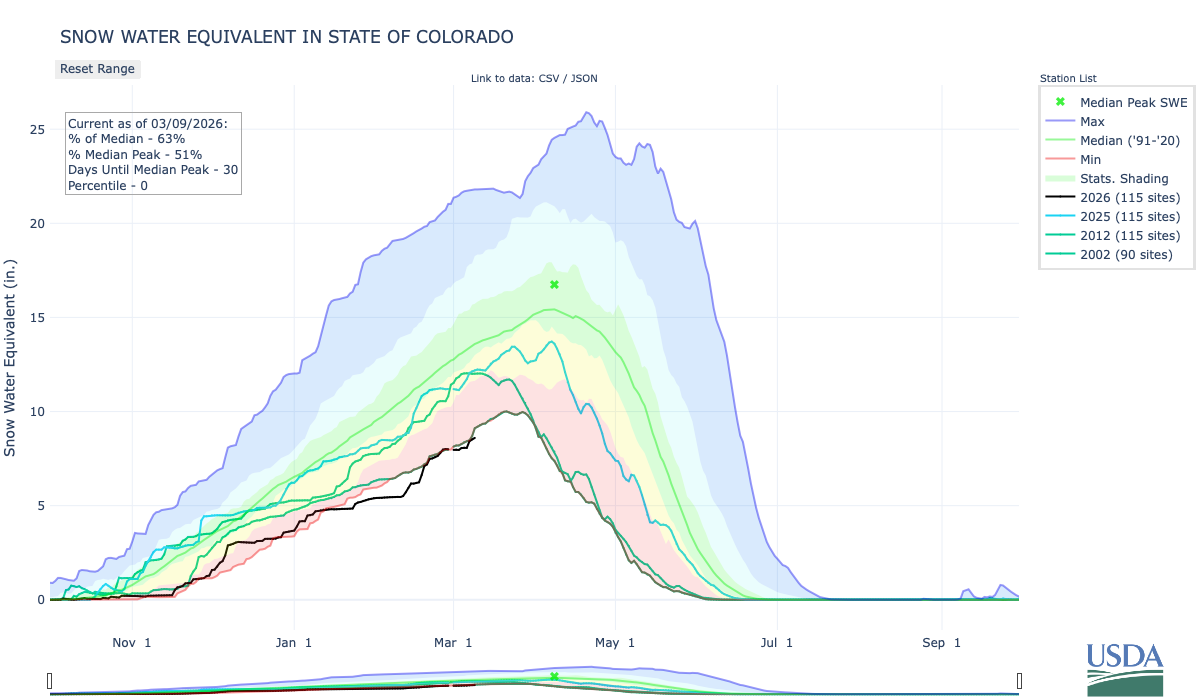
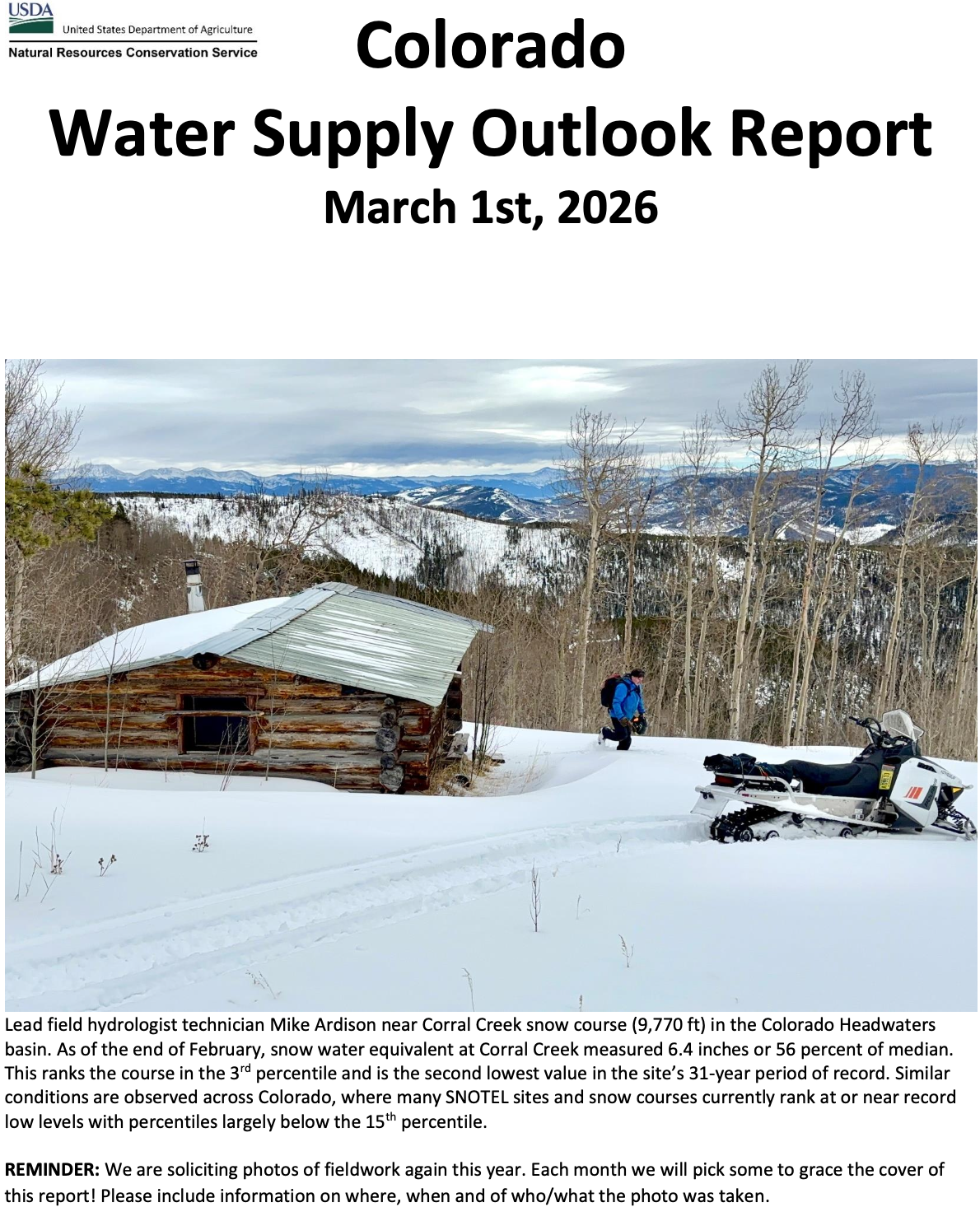
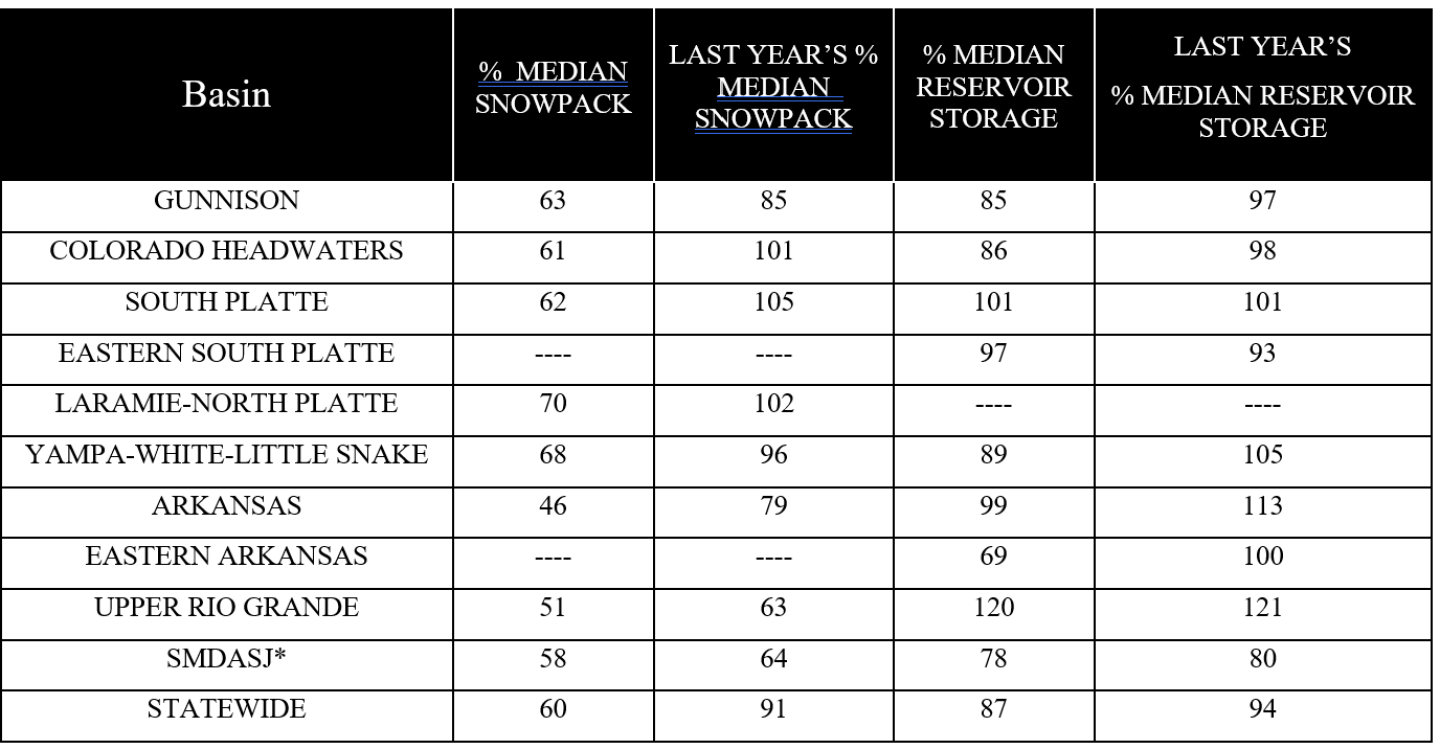
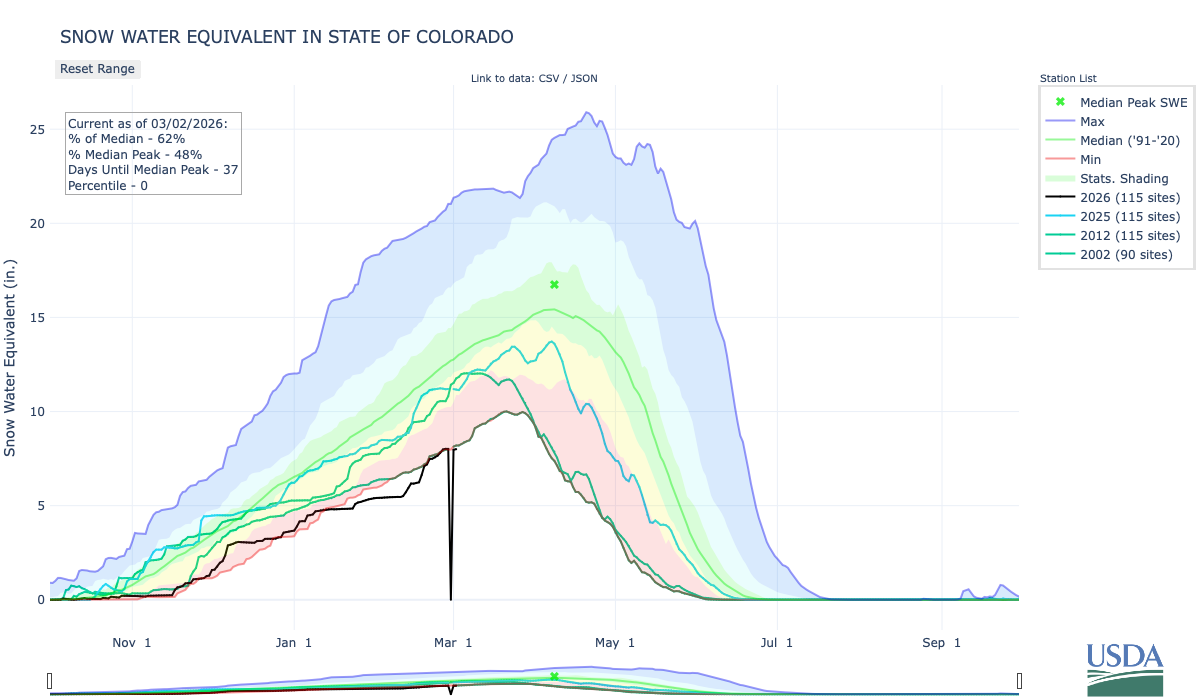
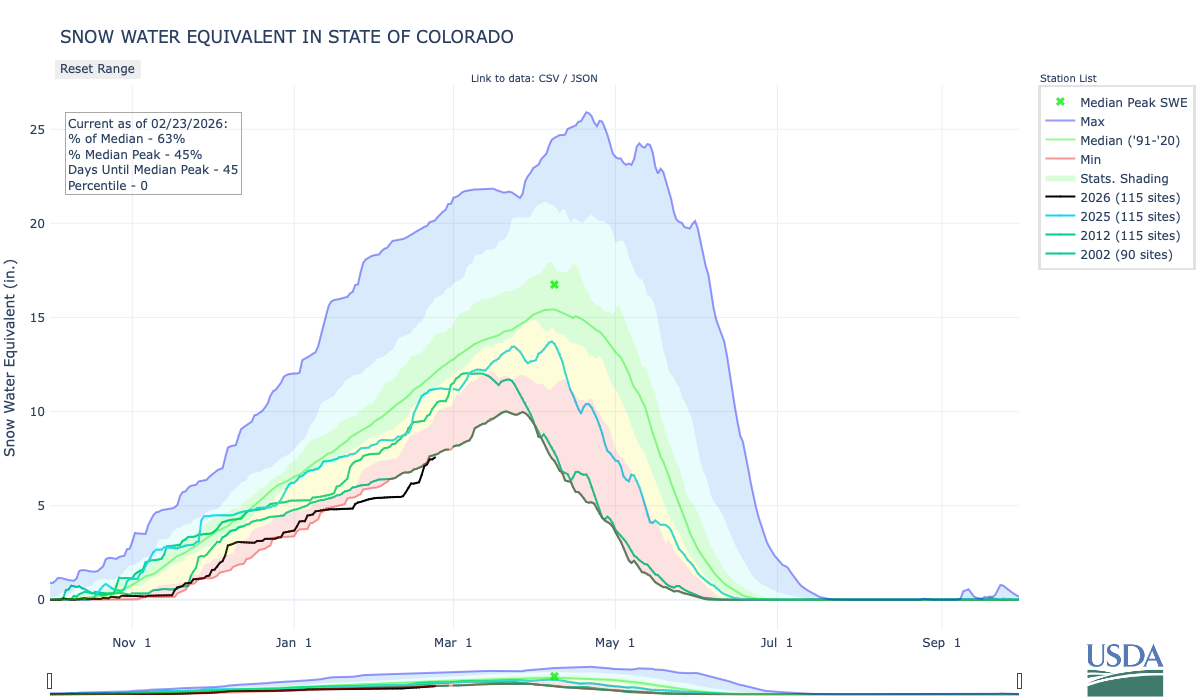
February storms increased Colorado’s snowpack from 53 to 60 percent of median. Warm early season conditions and limited snowfall from November through January slowed seasonal accumulation, leaving runoff forecasts below normal entering March.
Statewide snow water equivalent (SWE) improved during February following multiple storm systems, increasing seasonal accumulation from 53 percent of the 1991-2020 median earlier in the month to 60 percent of median by month’s end. Climatologically, February contributes about 17 percent of total seasonal SWE, while March contributes approximately 16 percent, together accounting for roughly one-third of the seasonal snowpack buildup. March and April typically represent the final opportunity for material snowpack recovery prior to the onset of melt. Median March accumulation is 3.015 inches, meaning a near normal March alone would not bring snowpack back to median levels.
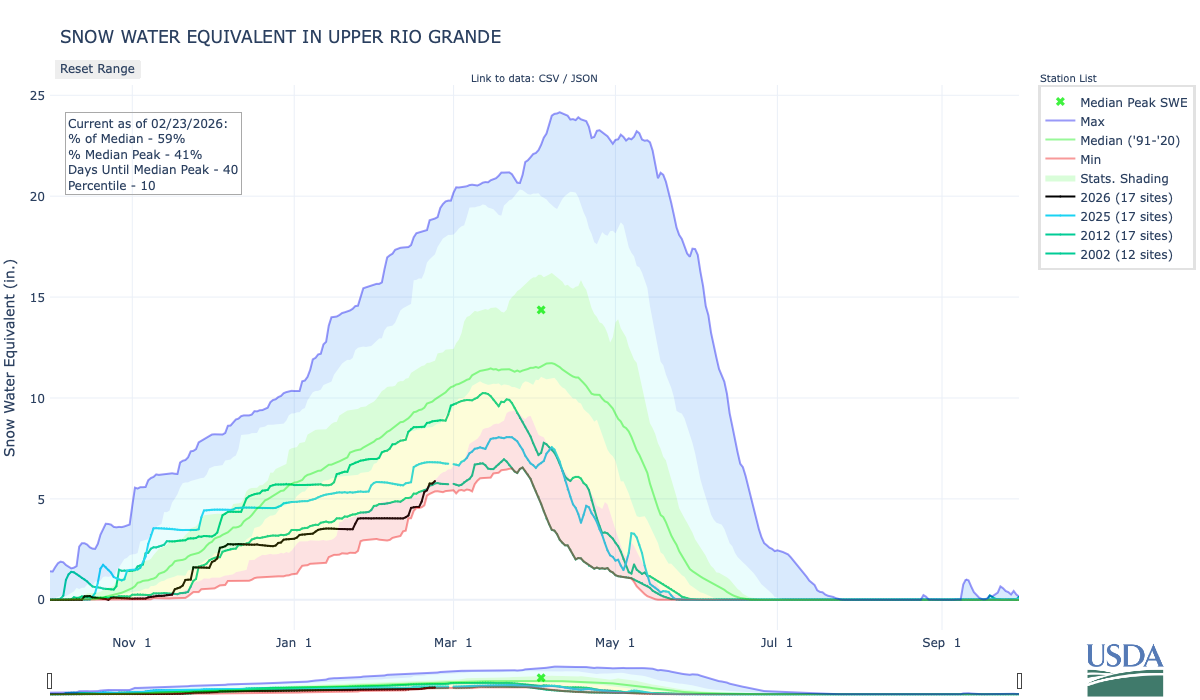
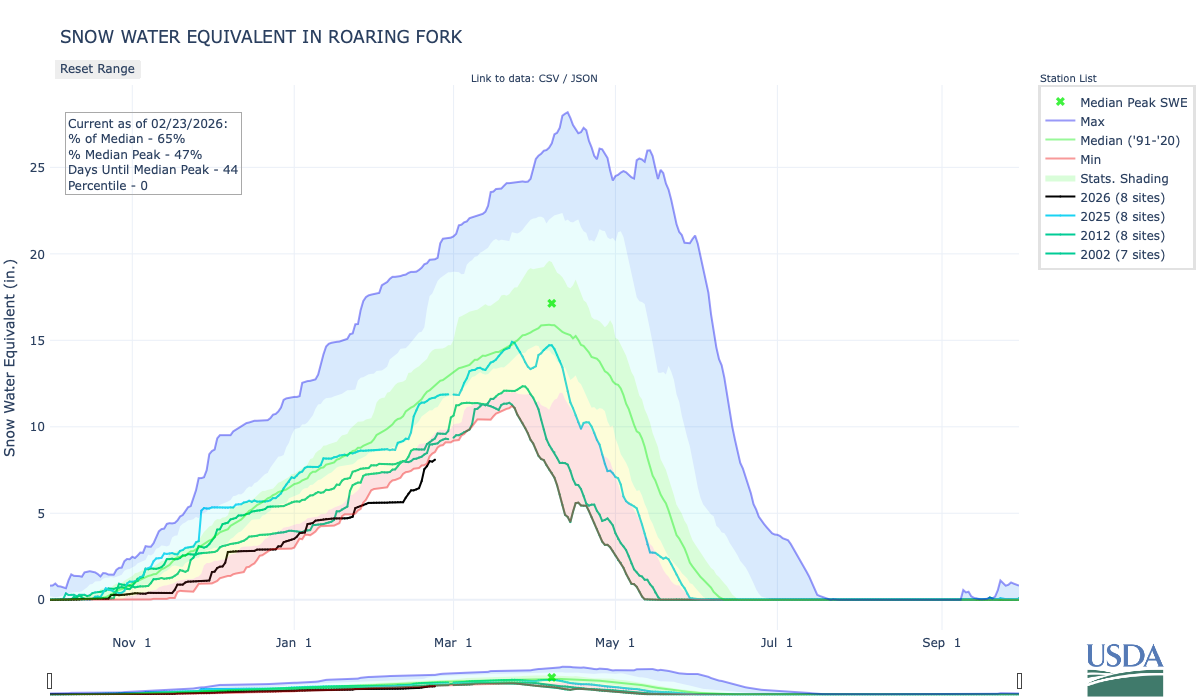
Through February, 82 percent of median precipitation has produced only 62 percent of median SWE, reflecting a lower-than-normal conversion of precipitation into stored mountain snowpack. Much of this divergence occurred early in the water year. Historical median October SWE accumulation is approximately 1.27 inches statewide, while water year 2026 accumulated only 0.39 inches despite receiving 3.46 inches of precipitation. This corresponds to roughly about a 1:9 precipitation to SWE ratio. Early season rainfall, particularly in October within the San Miguel-Dolores-Animas-San Juan (SMDASJ) basins, generated immediate runoff contributions rather than delayed meltwater. The approximately 12-foot rise at Navajo Reservoir reflects this front-loaded response. While beneficial for near term storage conditions, such inflows do not provide the sustained release characteristics of snowmelt driven hydrographs. As a result, reservoir storage metrics may appear relatively stable in aggregate (87 percent of median statewide), yet the underlying water supply outlook remains sensitive to late season snow accumulation.
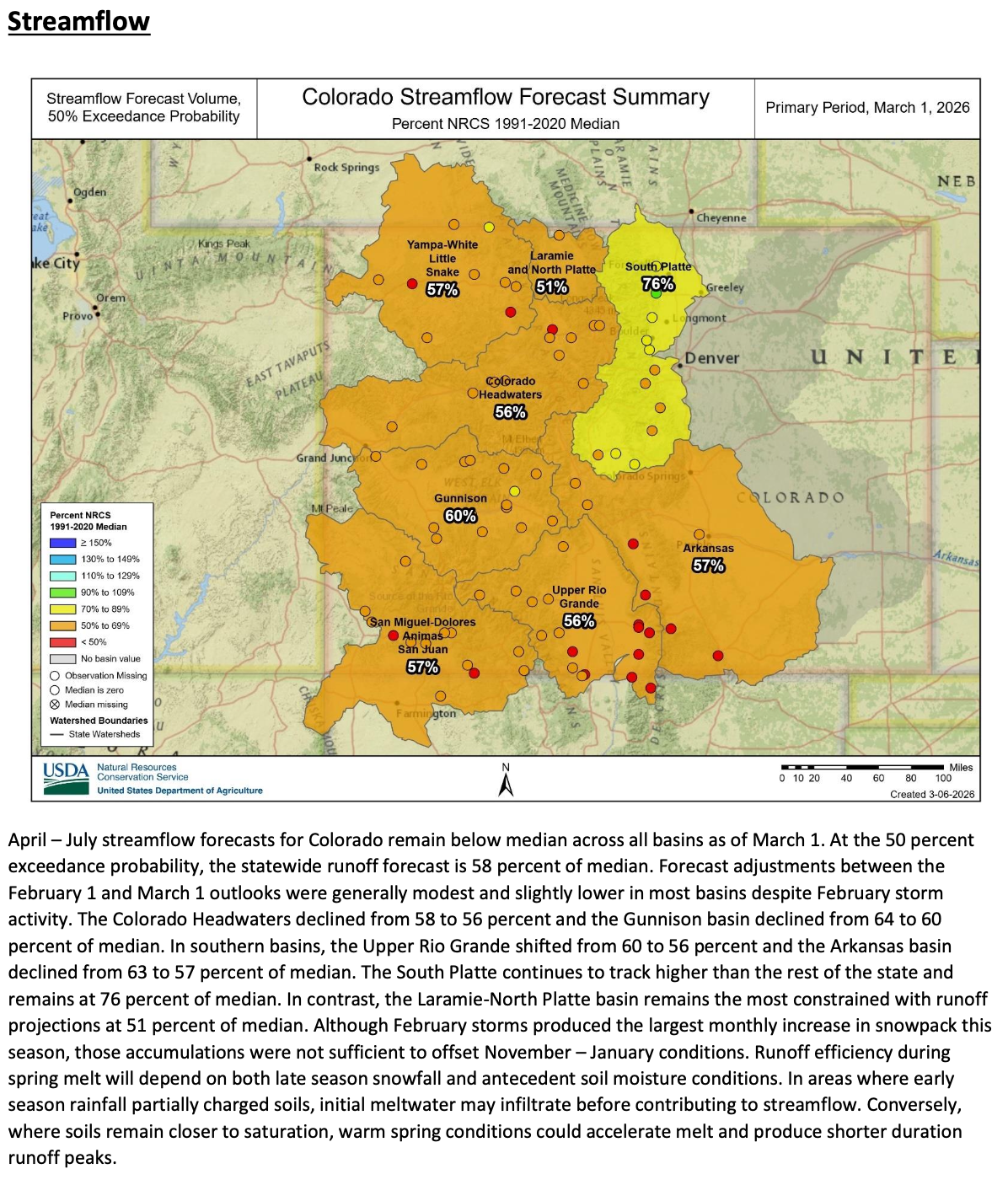
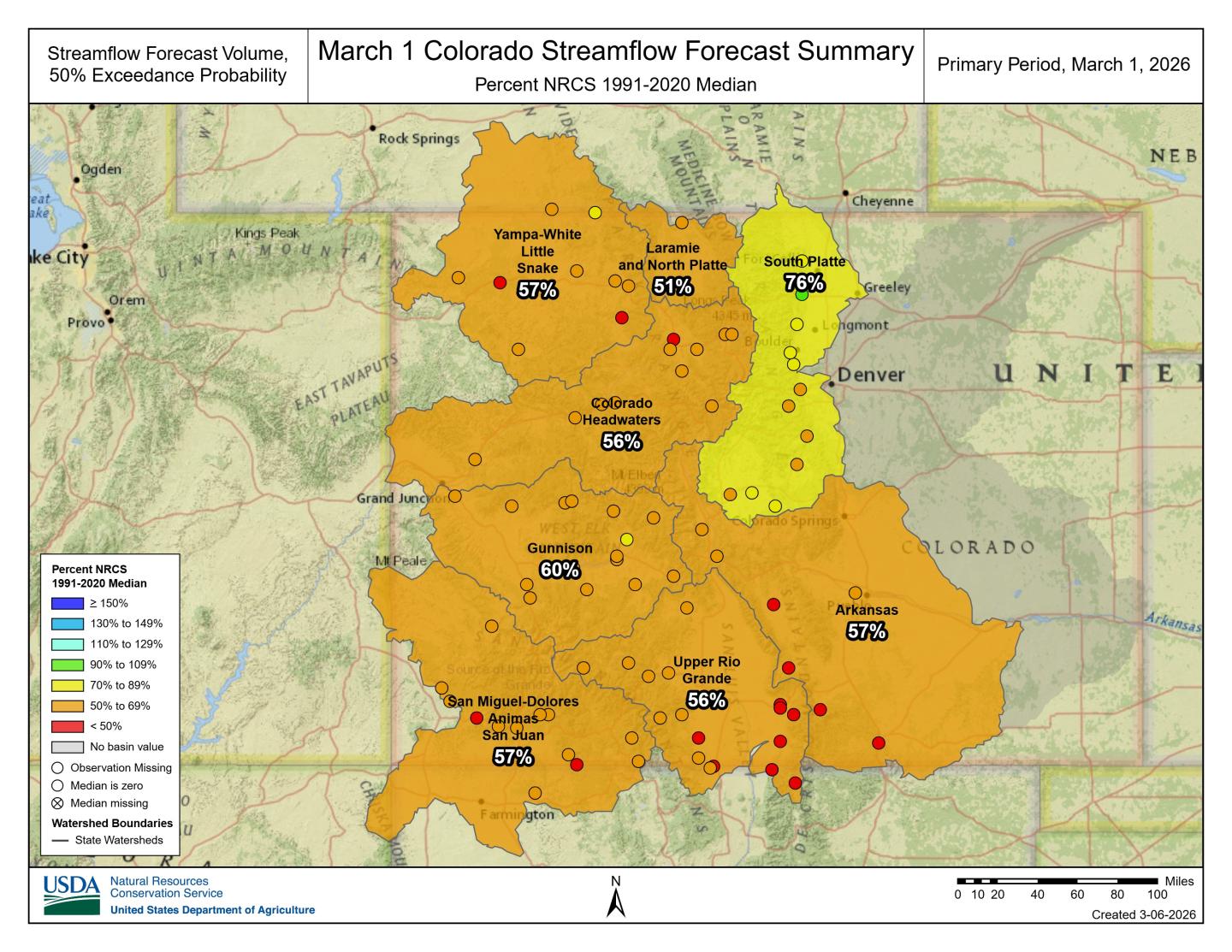
Figure 1. Colorado basin level April-July streamflow forecasts at the 50 percent exceedance probability as of March 1, 2026.
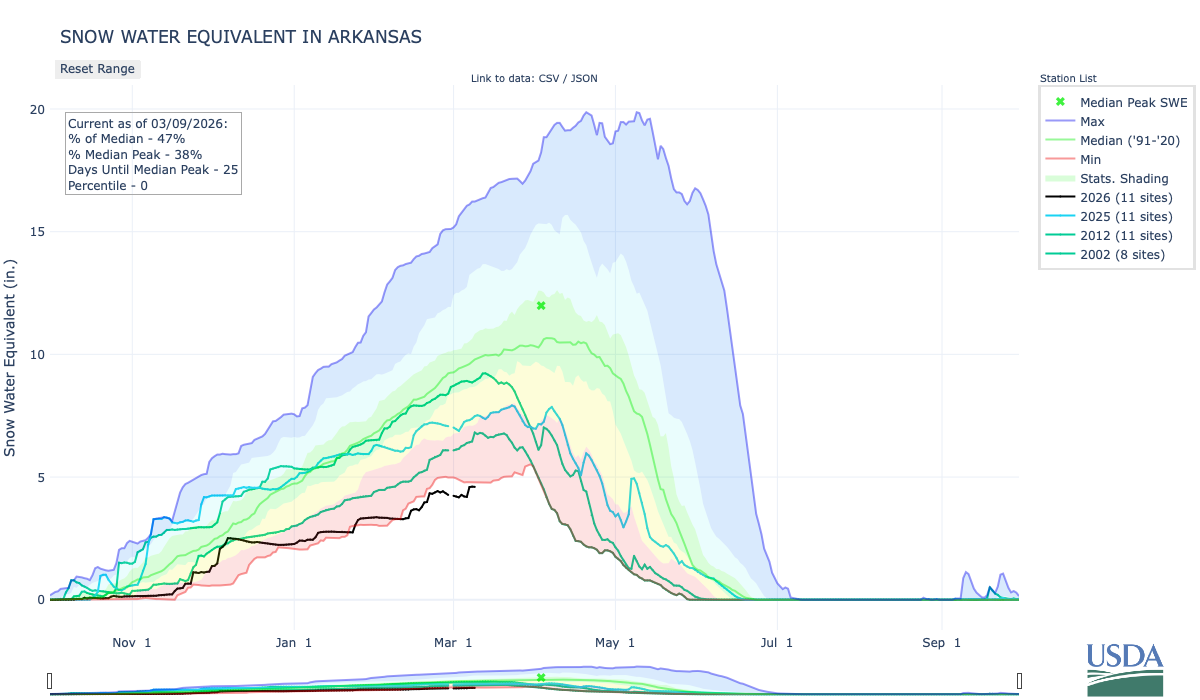
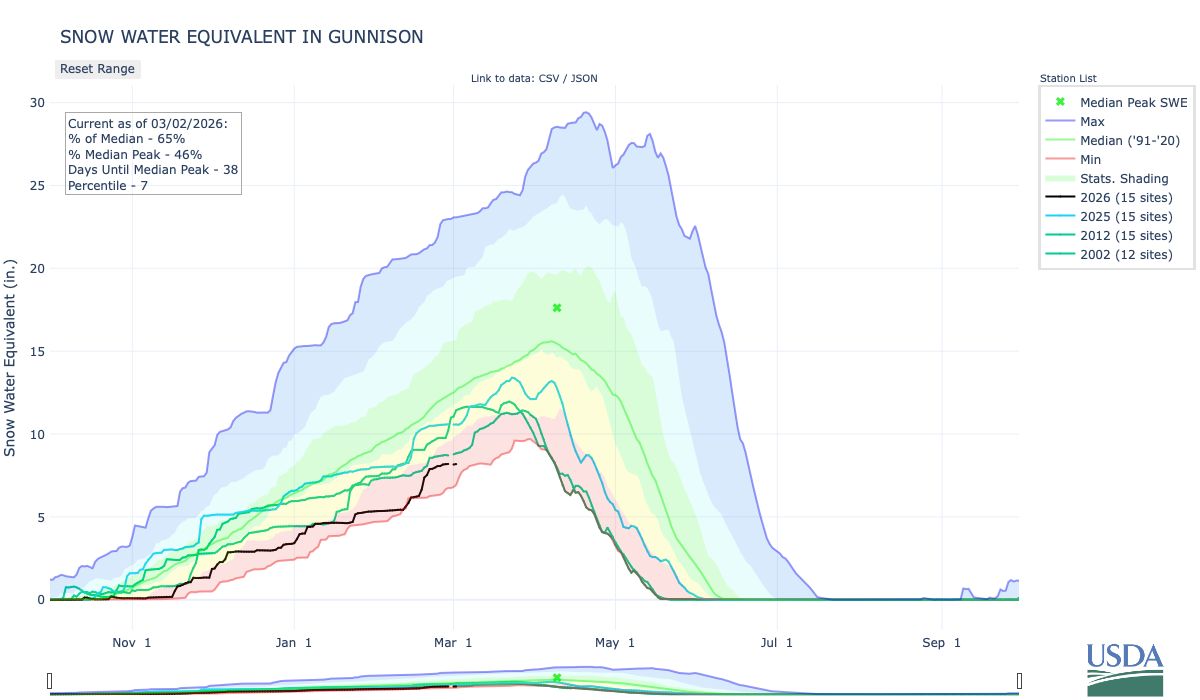
Basin level streamflow forecasts reflect the limited hydrologic response to February storms (Figure 1). While February produced the largest monthly additions to snowpack this season, those accumulations were not sufficient to offset November – January shortfalls. As a result, forecast improvements were modest and uneven across the state. At the 50 percent exceedance probability, the statewide median April-July forecast is 58 percent of median. Most basins experienced downward adjustments between the February 1 and March 1 forecasts, including the Colorado Headwaters (58 to 56 percent), Gunnison (64 to 60 percent), Upper Rio Grande (60 to 56 percent), and Arkansas (63 to 57 percent). The South Platte continues to track higher than the rest of the state and remains at 76 percent of median. In contrast, the Laramie-North Platte basin remains the most constrained with runoff projections at 51 percent of median. Taken together outlooks indicate that February snowfall moderated forecast declines but did not materially shift the statewide water supply outlook. Without sustained accumulation through March and April, forecasts are likely to remain below typical levels for the 2026 water year. In southern basins such as the SMDASJ and URG, a meaningful portion of annual precipitation also occurs during the North American monsoon. Historical distributions show that roughly 30 percent of annual precipitation falls between June and September and contribute to late season reservoir inflows but typically arrives after the primary snowmelt driven irrigation demand period.
Another consideration is soil moisture antecedent conditions. Early rainfall events partially recharged upper soil profiles in southern basins. However, if late season snowfall remains limited, runoff efficiency during melt could decline as soils absorb a portion of the initial meltwater. Conversely, where soils are near saturation, a rapid melt scenario under warm spring conditions could compress the runoff window and increase short duration flow peaks while limiting volume. The timing and persistence of cold conditions through March will therefore influence both peak SWE and runoff shape.
On March 3, 2026, the Pagosa Springs Town Council, which also sits as the board of the Pagosa Springs Sanitation General Improvement District (PSSGID), gave town staff direction to continue in its current relationship with Roaring Fork Engineering, while also engaging in a new separate contract to design and build a new wastewater treatment facility plant downtown. The council also gave town staff direction to explore the possibility of declaring its sewer system “a state of emergency.”
[…]
Roaring Fork has identified four major project goals for the downtown treatment facility:
Design a wastewater treatment facility which can serve the entire town population, including the ability for future expansion for either acceptance of a larger service area or PAWSD sewage.
The wastewater treatment facility should be a community-centric facility, which includes the ability for students and community members, to interact with the site safely and learn more about wastewater treatment and operations.
The building should be LEED (Leadership in Energy and Environmental Design) certified, integrate into the natural landscape (green roof ), include renewable energy when possible and be designed by a local architect who understands the community’s infrastructure.
The treatment processes should be progressive, forward-thinking and regulatory resilient, energy-efficient, and long-term sustainable for a small community to operate. This shall include the ability to treat wastewater to nonpotable reuse standards for localized irrigation on properties nearby.
With little progress in the Colorado River negotiations, some water experts are looking to a conservation program — featuring pools of invisible water and some accounting magic — as a possible path forward.
The seven Colorado River states, including Colorado, remain deeply divided over how to manage the nation’s largest reservoirs, lakes Mead and Powell, after the current management rules expire this fall. But other water users have put forward several innovative ideas for how to manage the water supply for 40 million people after 2026 as the basin’s two-decade drought continues.
One idea, known as a conservation pool, is generating a lot of conversation. Some water experts say it’s the wave of the future. A path toward, finally, some agreement among basin states.
Others say it’s a flawed concept that could hurt economies, especially in rural, agricultural areas.
“They hold great promise. They do incentivize conservation. They do create tremendous operational flexibility,” said Kathryn Sorensen, director of research at Arizona State University’s Kyl Center for Water Policy. “I think people want to see them go forward. They just also know that there’s some things that need to be fixed.”
Under a conservation pool program, water users in Colorado River states would cut back on water use, track the saved water, store it in Lake Powell on the Utah-Arizona border and/or Lake Mead on the Arizona-Nevada border, and use it to help create a more secure water supply in the river basin.
Colorado River officials are worried about the state of the basin. The river’s average flow has declined, and scientists have attributed 10 trillion gallons in water loss to higher temperatures and climate change. Lakes Mead and Powell, which together make up about 92% of the reservoir storage capacity for the entire basin, are each around one-third full.
A pool of conserved water in Lake Mead and Lake Powell could help maintain higher water levels in the reservoirs and defer drastic cuts, Stephen Roe Lewis, governor of the Gila River Indian Community in Arizona, said during an early February meeting.
It could help bring the two subbasins — the Upper Basin and the Lower Basin — closer together in their negotiations, he said.
“In our view, it offers really the only path forward that we can see that addresses the core challenge of risk each basin is facing, and provides a shared tool to manage uncertainty … in the years ahead,” Lewis said.
So how would it work?
There are lingering questions around who can participate in such a program, who would control the pool, how (and whether) people would be paid to conserve, and how the water would be used.
In Colorado, the conservation pool idea would likely start with a water user, say, for example, a farmer who grows hay near Kremmling on the Western Slope.
Colorado River water users, like farmers and ranchers, have legal rights to use water for specific purposes, at certain times and from certain places. The legal water-sharing system, called prior appropriation, gives older, more senior, rights priority. In dry years, these senior rights get water first, while more recent, or junior, rights holders might get cut off earlier than usual.
This system, however, doesn’t incentivize conservation, Sorensen said. But conservation pools would change that.
The Kremmling farmer might normally divert 5 acre-feet of water each summer, sending it through rotating sprinklers to saturate soils and grow crops.
One acre-foot is enough to cover an acre of cropland a foot deep, or roughly the annual water use of two to three urban households.
Colorado River Basin. Credit: USGS
When that farmer joins a conservation program, he or she might decide to cut their use down to 3 acre-feet one summer by not growing crops on certain fields.
The difference, 2 acre-feet, would be “conserved” water, but where does it go? Under the current water-sharing system, it would simply flow downstream, and any downstream farmer could use it on their fields.
This was one of the inherent problems in the Upper Basin’s recent pilot conservation program. In 2023, Colorado farmers and ranchers received almost $1 million to cut their use by about 2,000 acre-feet. In 2024, the estimated cuts totaled about 14,200 acre-feet and the cost was about $7 million.
Under a conservation pool program, Colorado farmers could rest assured that their conserved water would actually end up in Lake Powell.
The problem is that Upper Basin states don’t actually have ways to track that water — yet.
To reach Lake Powell, Colorado and its sister states would need to be able to shepherd conserved water past headgate after headgate, through different water districts and divisions — each with their own systems for managing water — and across state lines before it would reach Lake Powell.
“There are challenges for sure,” said John Berggren, regional policy manager for the healthy rivers department at Western Resource Advocates. “But you can overcome those challenges, and there’s a broader need to, which is to actually stay out of the courts and have an agreement.”
Once water reaches Powell, different groups want it to be used for different purposes. The Colorado River District, for example, says they will only support the idea if the water protects Upper Basin states from forced water cuts that could happen under water law if the basin’s supply falls to extreme lows.
“We do think a conservation program in the Upper Basin could be part of the solution and part of our future, but these programs should be designed and implemented in a thoughtful manner that minimizes and mitigates negative impacts,” said Raquel Flinker, the district’s director of interstate and regional water resources.
Berggren and other environmental groups are pushing for conservation pool water to be used to help Colorado River ecosystems in the Grand Canyon. The dam impacts sediment flow and water temperatures downstream from Lake Powell, which helps non-native fish species thrive and outcompete native fish.
The Bureau of Reclamation could take to their computers and “move” conserved water between Lake Mead and Lake Powell in the accounting books to make more of those releases, he said.
The art of invisible water
Many of the conservation pool ideas aim to keep the water “invisible” when the Bureau of Reclamation decides how much water to release from each massive reservoir.
The conserved water would physically be in a reservoir to keep the water levels from falling too low. At certain elevations, the dams can’t generate electricity or release water for millions of people across the West.
But when Reclamation officials look at the water accounting records, they would ignore the conserved water when calculating how much water to release and what kind of water shortages the basin states could face in dry years.
This approach would address one of the critical flaws in a similar program that has been happening in the Lower Basin since 2007, experts said.
That Intentionally Created Surplus program allows water users in Arizona, California and Nevada to cut their use and keep the water in Lake Mead to be used at a later date. In some cases, they can even divert water from other watersheds and import it into the reservoir, Sorensen said.
One of the biggest flaws of the Lower Basin program was that it artificially kept the physical water levels at Lake Mead higher than they would have otherwise been. Water levels have dictated Lower Basin shortages for the past 20 years, and the higher levels insulated the states from deeper water cutbacks, which delayed steps to adapt to the overstressed water supply in the basin.
The new conservation pools would try to correct this and expand the effort. Upper Basin, Lower Basin and tribal water users could also conserve water and use that water to help flows in rivers, protect infrastructure, and many other uses, Berggren said.
“That’s new. We didn’t have that ability before. That’s why it’s innovative,” he said.
The wave of the future?
The Department of the Interior in January laid out five options for managing the river. Three included some form of a conservation pool.
“Conservation pools are the way of the future for the Colorado River Basin,” Berggren said. “They allow for so much more flexibility in managing our reservoirs, managing our water. You’re able to respond to changing conditions quicker.”
Not everyone agrees. The Colorado River District said conserving up to 500,000 acre-feet of water in Colorado and other Upper Basin states, which is proposed in the federal options, would shrink agricultural land use and require water cuts in cities and towns.
“Conservation at this scale would have significant and potentially permanent adverse consequences, including economic impacts to communities,” Flinker of the Colorado River District said.
But — and this is a big caveat — the conservation pool concept cannot move forward without support from all of the basin states.
To set up a conservation pool program, states would need to launch new water-tracking systems. Someone would have to compensate the people conserving water. The way federal officials track, store and release water in the immense reservoirs would change.
And under its current legal authority, the federal government cannot move forward with conservation pools without risking expensive lawsuits that would tie up water management for years. But with a seven-state agreement, the feds could take action.
Arizona and Colorado, which often find themselves on opposite sides of Colorado River discussions, are open to the conservation pool idea.
The concept has merit, Tom Buschatzke, Arizona’s top water negotiator, said during an Arizona Reconsultation Committee meeting Feb. 2.
It is “something we should continue to pursue because I do believe that just formulaic attempts to deal with how you split up the water have been failing us so far,” he said.
Colorado and its sister states in the Upper Basin — New Mexico, Utah and Wyoming — have been consistently willing to do a conservation program that involves saving water in a pool within Lake Powell and potentially other upstream reservoirs, Becky Mitchell, Colorado’s top negotiator said.
“The particulars of the program and potential pool would depend upon the operational framework and/or other components of a seven-state consensus,” she said.
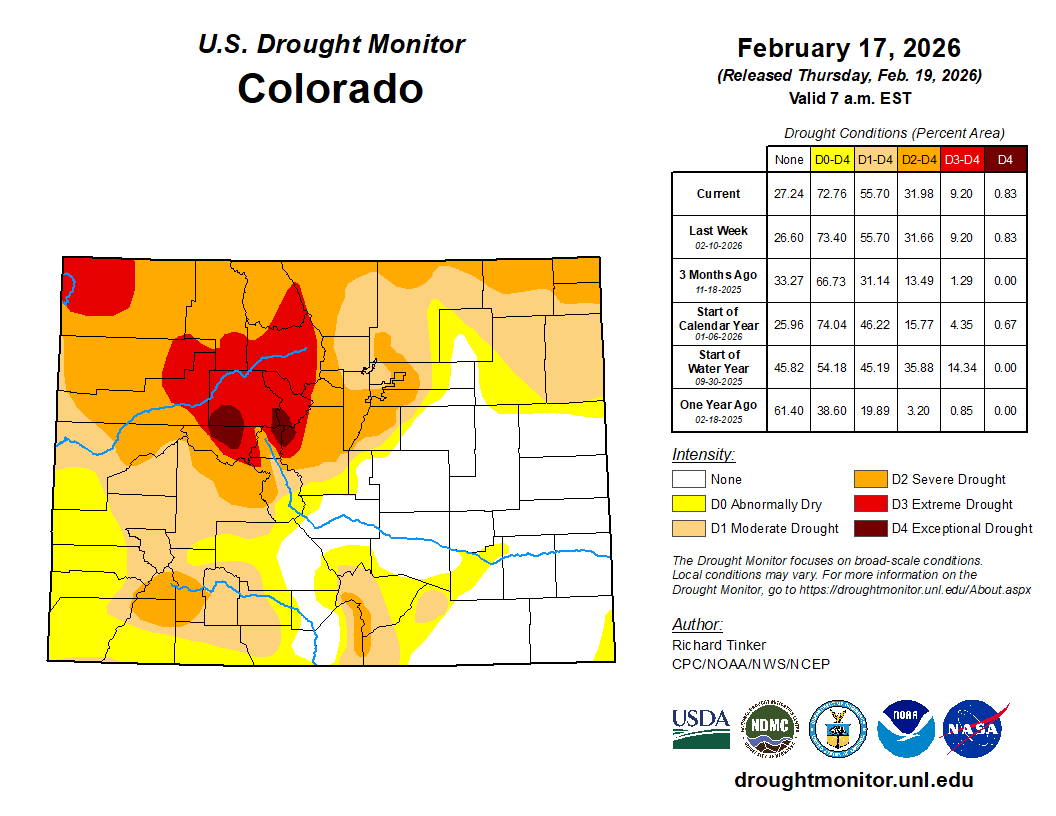
Since the beginning of December 2025, drought expanded and intensified across the Lower Mississippi Valley and Southern Great Plains which is typical during a La Nina winter. Much needed precipitation at the end of February led to small improvements across parts of the Southeast and also at least briefly stabilized the drought status for this region. Widespread severe to extreme drought is designated for much of the Carolinas, Georgia, southeastern Alabama, and Florida. A longer-term drought continues to affect the Mid-Atlantic and portions of the Northeast. The unusually dry winter persisted across the Midwest through the end of February with additional degradations made this past week. These worsening drought conditions extend west to the Central Great Plains along with the Central to Northern Rockies. Below-normal snowpack remains a major concern for the West heading into the spring. Drought coverage decreased in Hawaii during the past few weeks, while Alaska and Puerto Rico remained drought-free…
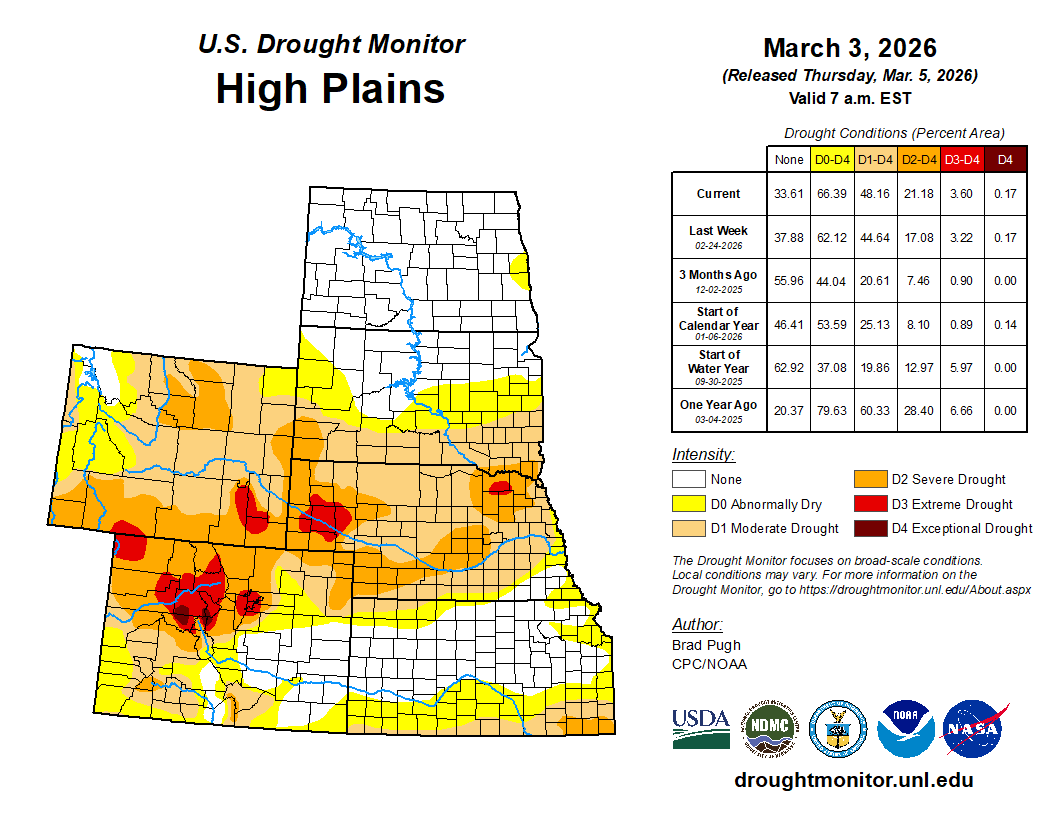
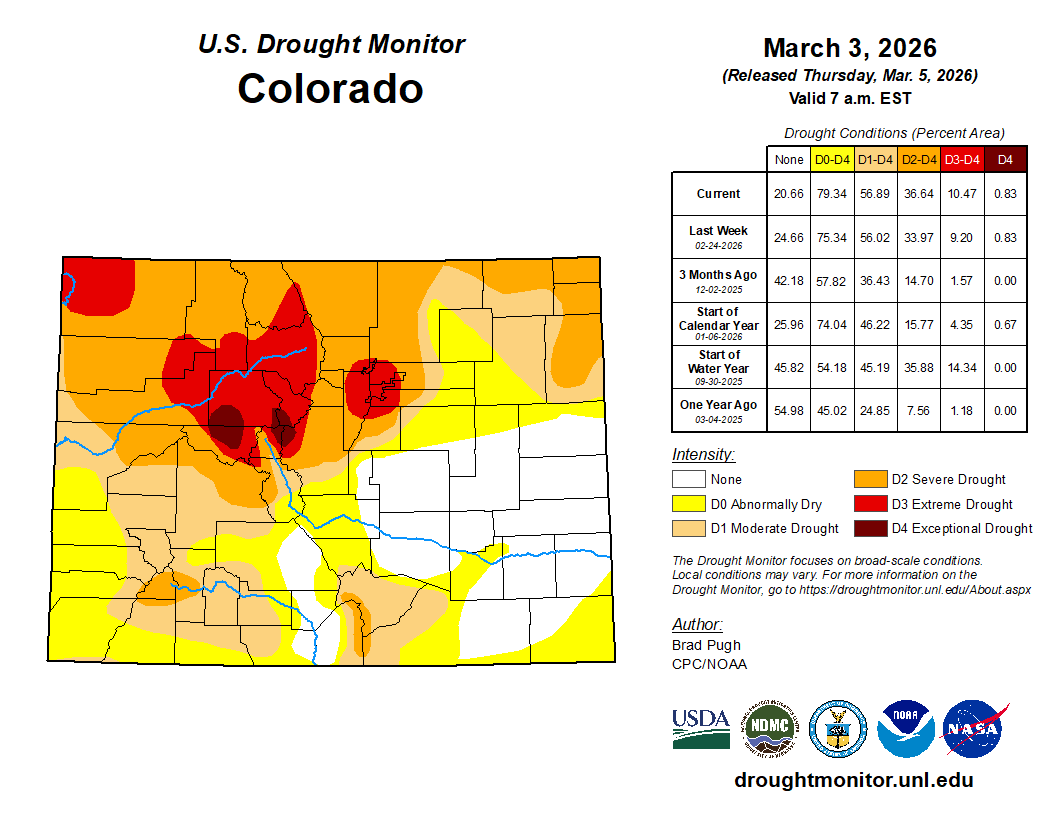
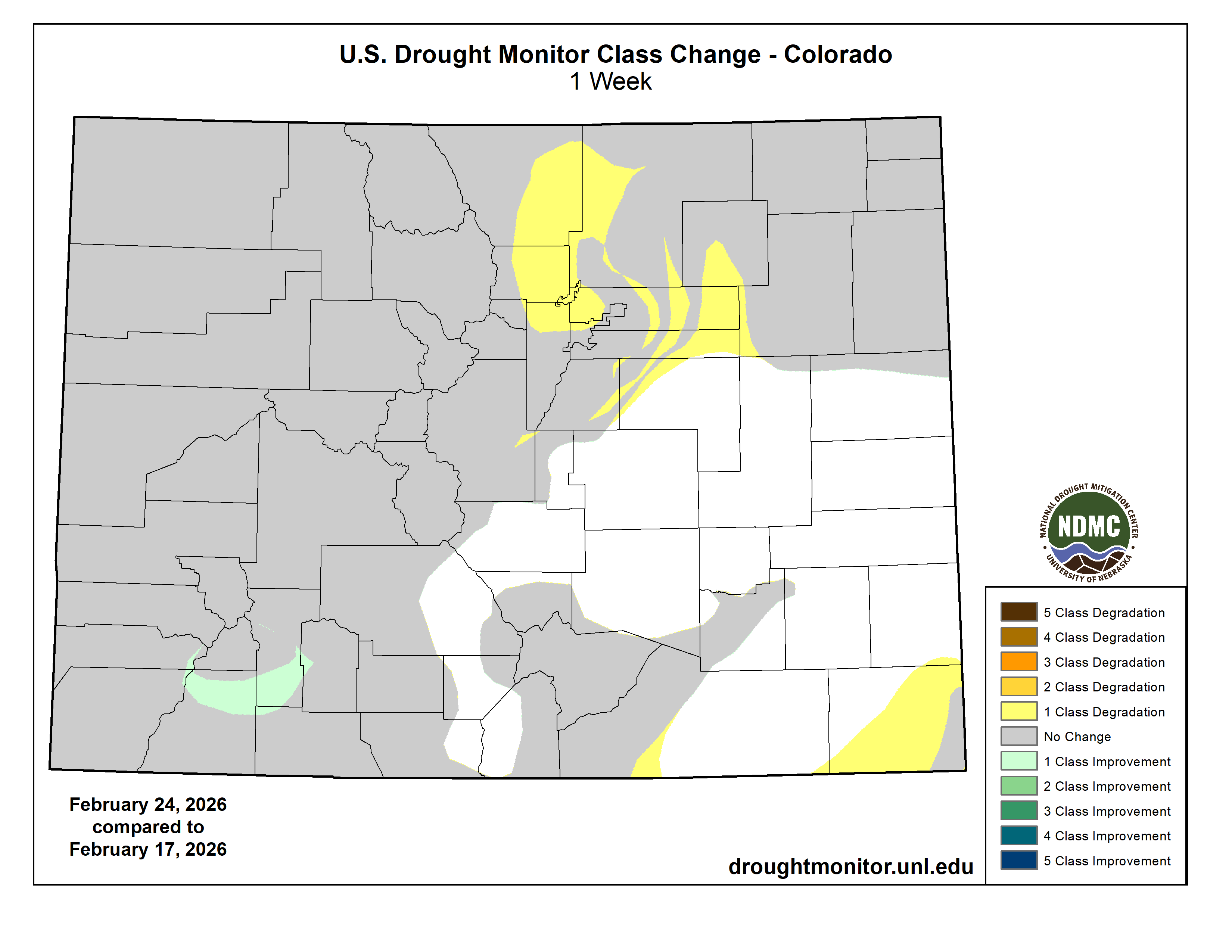
Although late winter is a relatively dry time of year across the Central Great Plains, periods of unseasonably warm temperatures and enhanced winds this past month led to intensifying drought across northeastern Colorado and Nebraska. 30-day temperatures averaged 6 to 10 degrees F above normal throughout the Great Plains. A 1-category degradation was made this past week to parts of Kansas and South Dakota. Widespread drought of varying intensity remains designated for much of Colorado and Wyoming. As of March 3, snow water equivalent is less than 70 percent of normal across the Central Rockies…
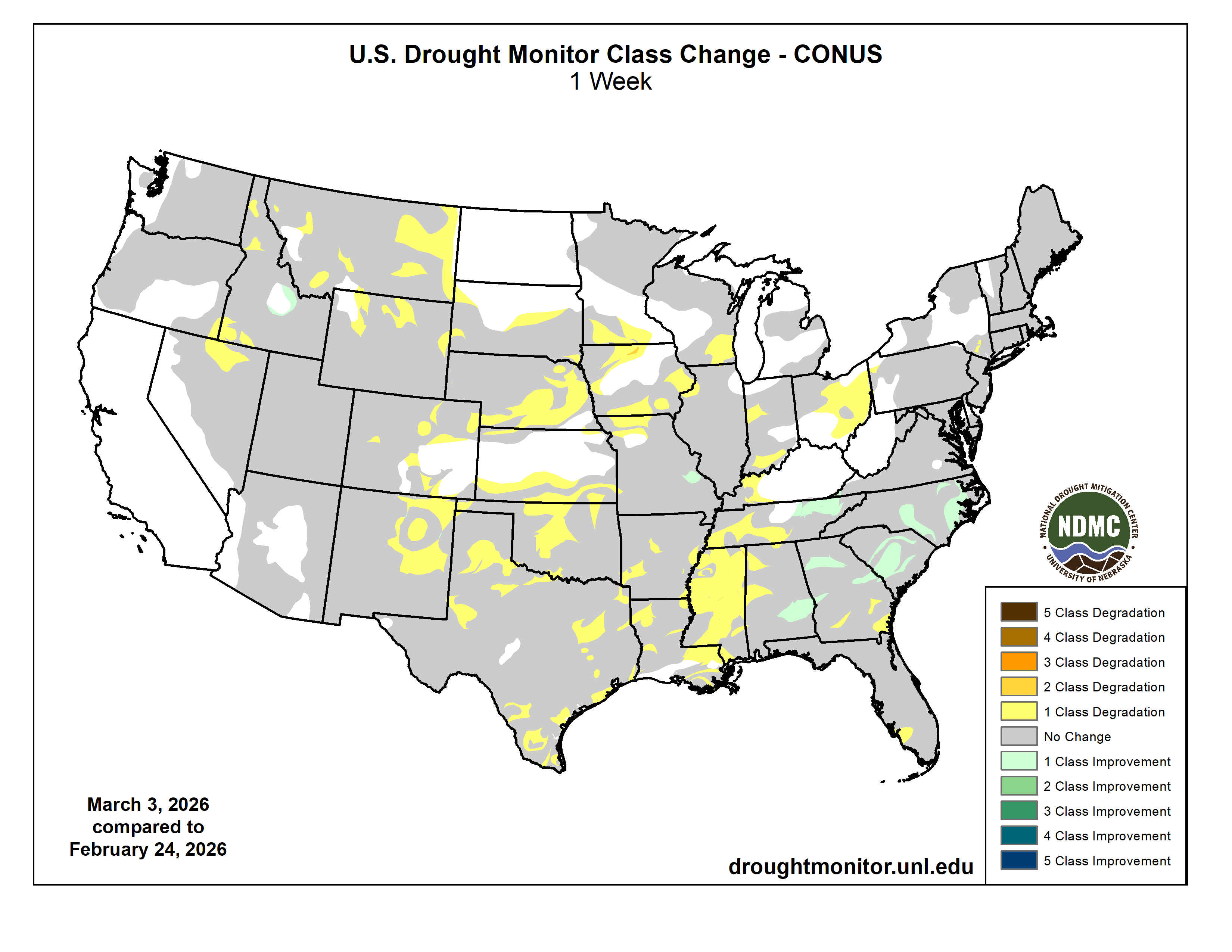
Colorado Drought Monitor one week change map ending March 3, 2026.
Water-year-to-date precipitation (October 1, 2025 to March 2, 2026) averaged below-normal for the Great Basin which led to a slight increase in moderate (D1) coverage across northeastern Nevada this past week. Following a drier- and warmer-than-normal February, a 1-category degradation was also made to parts of Montana. A 1-category degradation was also warranted for parts of Idaho, reflecting the below-normal precipitation and low snowpack this past winter. Even for areas of the West that have received above-normal precipitation since the beginning of October 1 such as the Northern Intermountain West and Northern Cascades of Washington, snow water equivalent (SWE) is running below normal. The low snowpack throughout much of the West is a major concern heading into the spring. As of March 3, SWE is less than 50 percent of normal from the Cascades of the Pacific Northwest southward through the Great Basin and Four Corners region. Although California remains drought-free, SWE is 59 percent of normal statewide according to the California Department of Water Resources…
Heavy rainfall (1 to 3 inches, locally more) resulted in a small 1-category improvement to parts of northeastern Tennessee. For the Lower Mississippi Valley and Southern Great Plains, drought continued to expand and intensify through the end of February and beginning of March. The major change this past week was a widespread 1-category degradation to Mississippi and also north-central Oklahoma. Since the beginning of December, precipitation has averaged less than 50 percent of normal across much of the Lower Mississippi Valley and Southern Great Plains. Impact reports from north-central Oklahoma include poor wheat conditions and surface water supply shortages. An expansion of moderate drought (D1) was also warranted for northeastern New Mexico. In addition to the drier-than-normal winter, 90-day temperatures have averaged 2 to 6 degrees F above normal. The lack of winter precipitation combined with periods of unseasonably warm temperatures and enhanced winds led to an increasing coverage of severe (D2) to extreme (D3) drought from the Mississippi River west through Oklahoma and Texas…
Looking Ahead
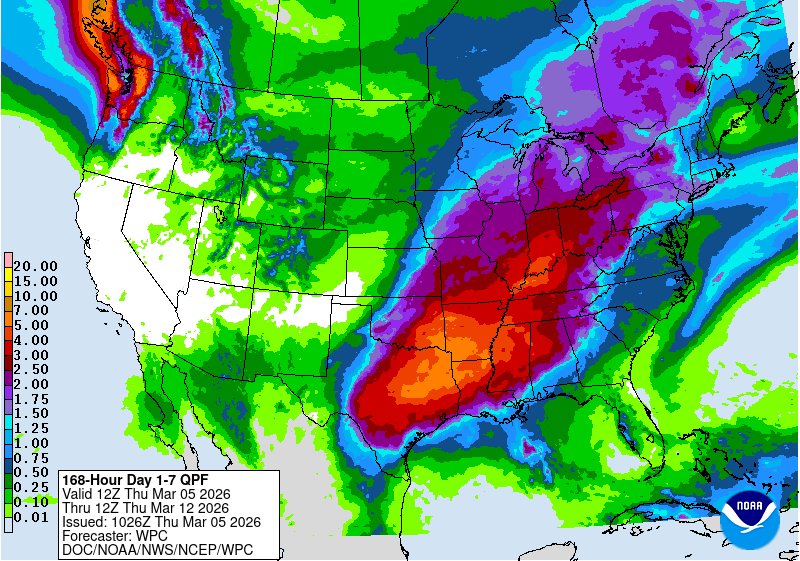
A major pattern change is underway which will promote multiple low pressure systems tracking across the Great Plains and Midwest during early to mid-March. The Weather Prediction Center (valid March 5-9) depicts a swath of heavy precipitation (1 to 3 inches, locally more) from eastern Texas and southeastern Oklahoma northeast through the Lower to Middle Mississippi and Ohio Valleys. This heavier precipitation is forecast to extend into parts of the Northeast, but little to no precipitation is expected from Virginia south to Florida. Much-needed snowfall is expected across the Northern to Central Rockies, while dry weather prevails across California and the Southwest. Much above-normal temperatures are forecast across the southeastern and central U.S. where daily record highs may be broken from March 5 to 9.
The NWS 6-10 day outlook (valid March 10-14) calls for an increased chance of above-normal temperatures for the East, Middle to Lower Mississippi Valley, Southern Great Plains, Southwest, and California. Below-normal temperatures are more likely from the Pacific Northwest east to the Northern Great Plains. Below-normal temperatures are strongly favored for Alaska. The 6-10 day outlook favors above-normal precipitation from the Mississippi Valley to the East Coast. Above-normal precipitation probabilities decrease west across the Great Plains. Above-normal precipitation is also favored for the Pacific Northwest and Northern Rockies. Near to below-normal precipitation is favored across Alaska, while large above-normal precipitation probabilities are forecast throughout Hawaii.
US Drought Monitor one week change map ending March 3, 2026.
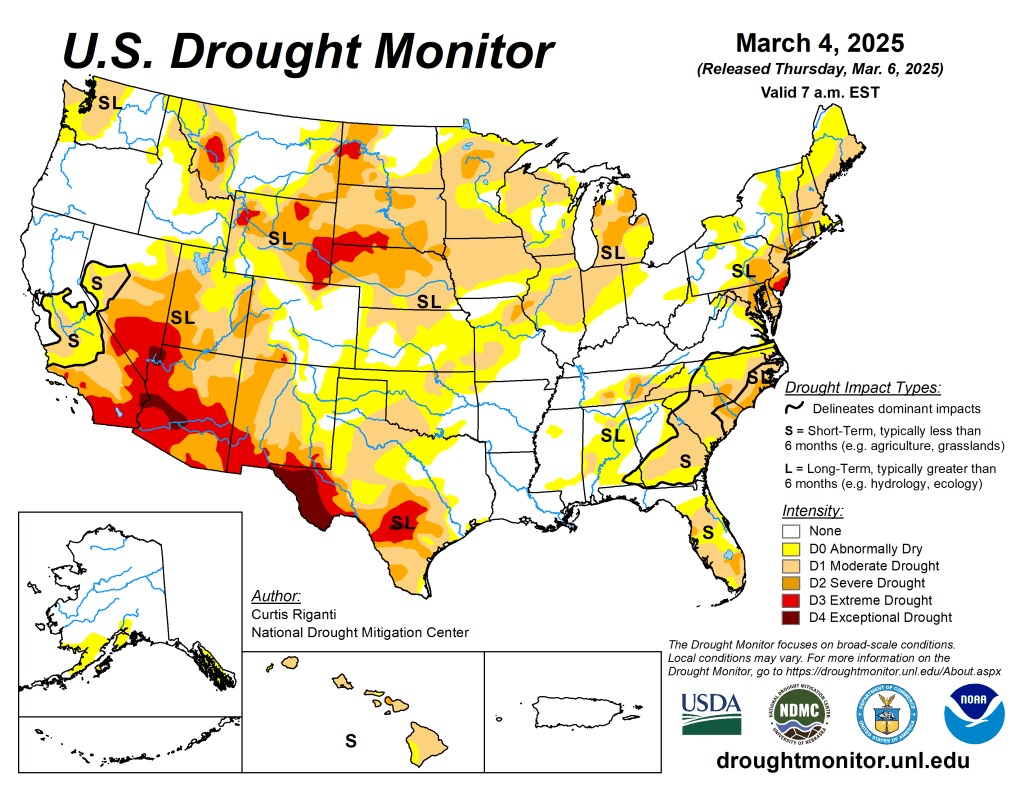
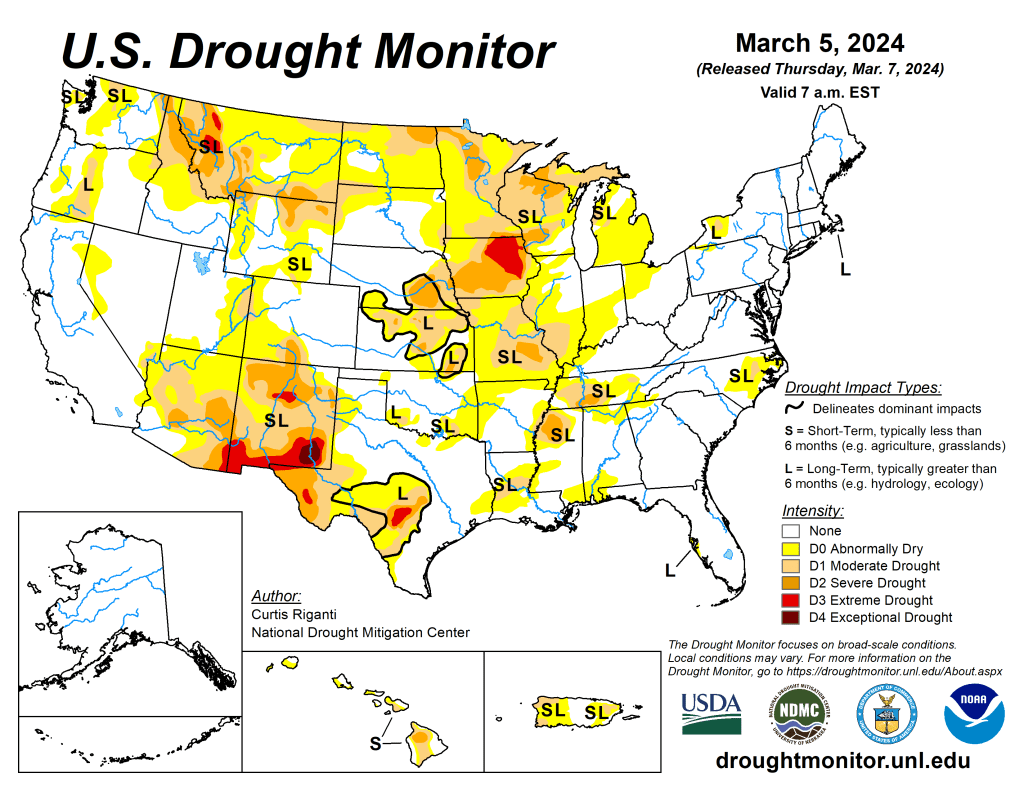
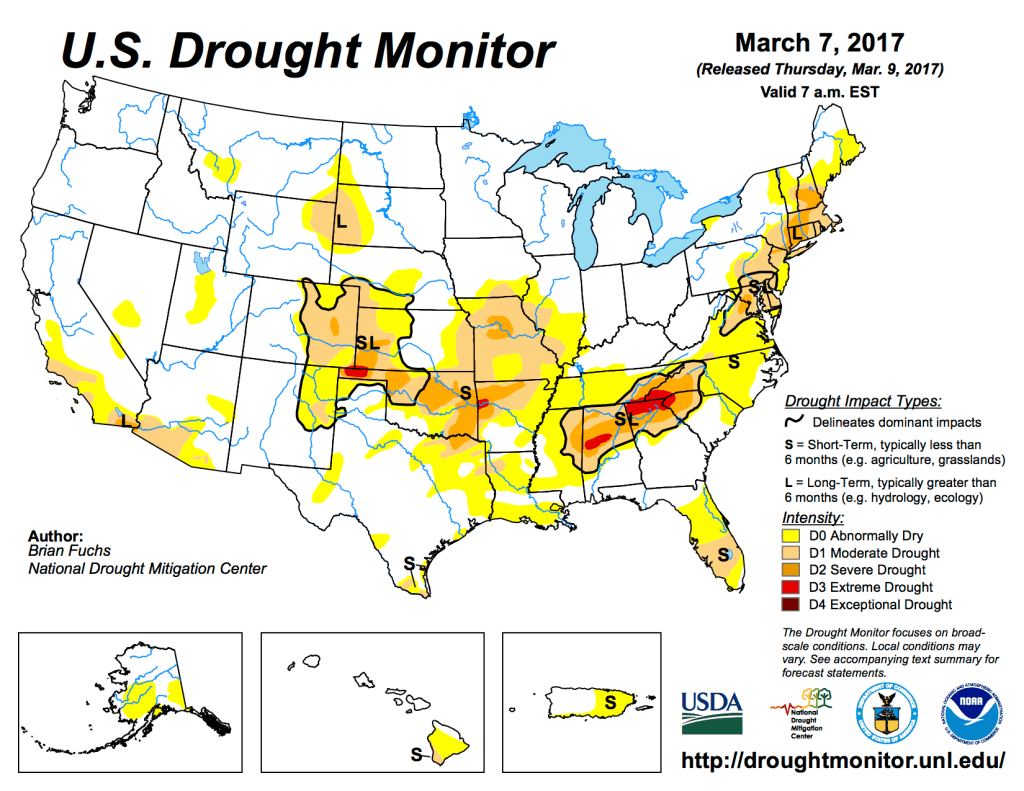
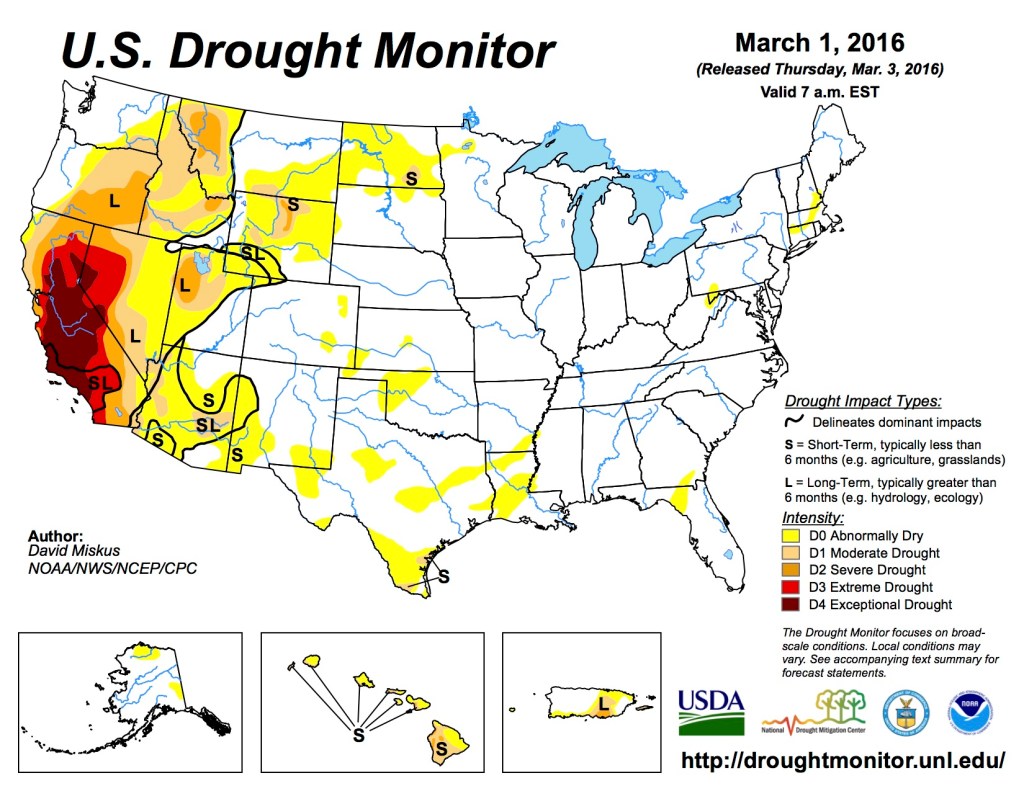
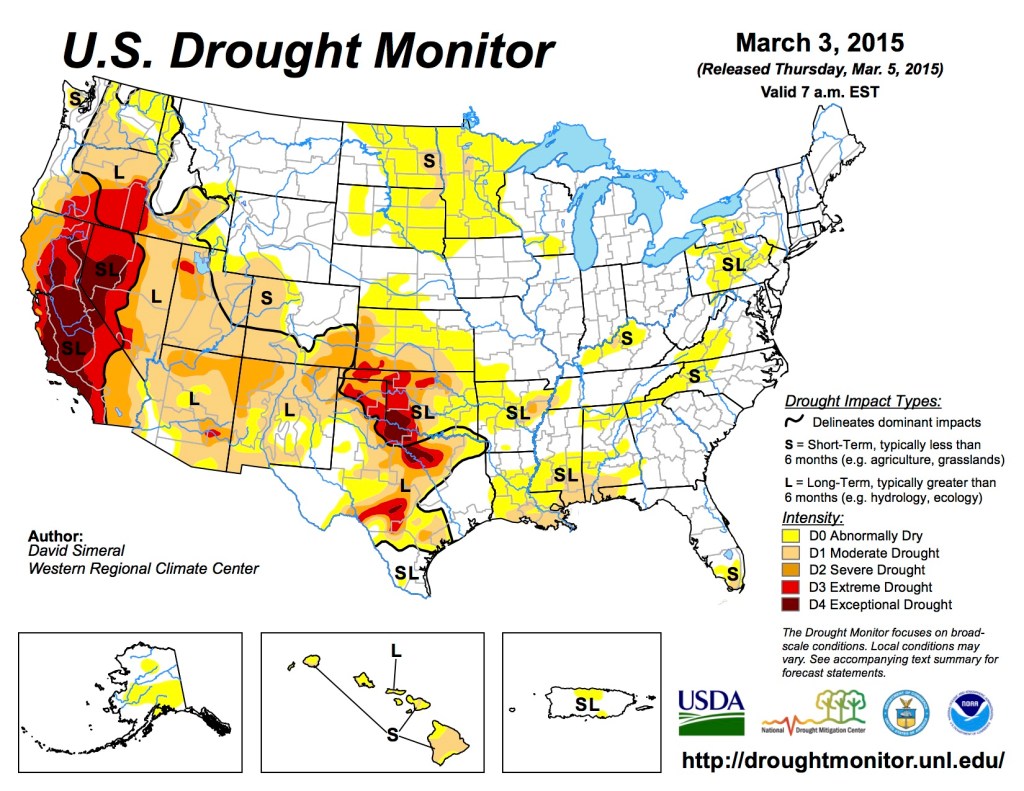
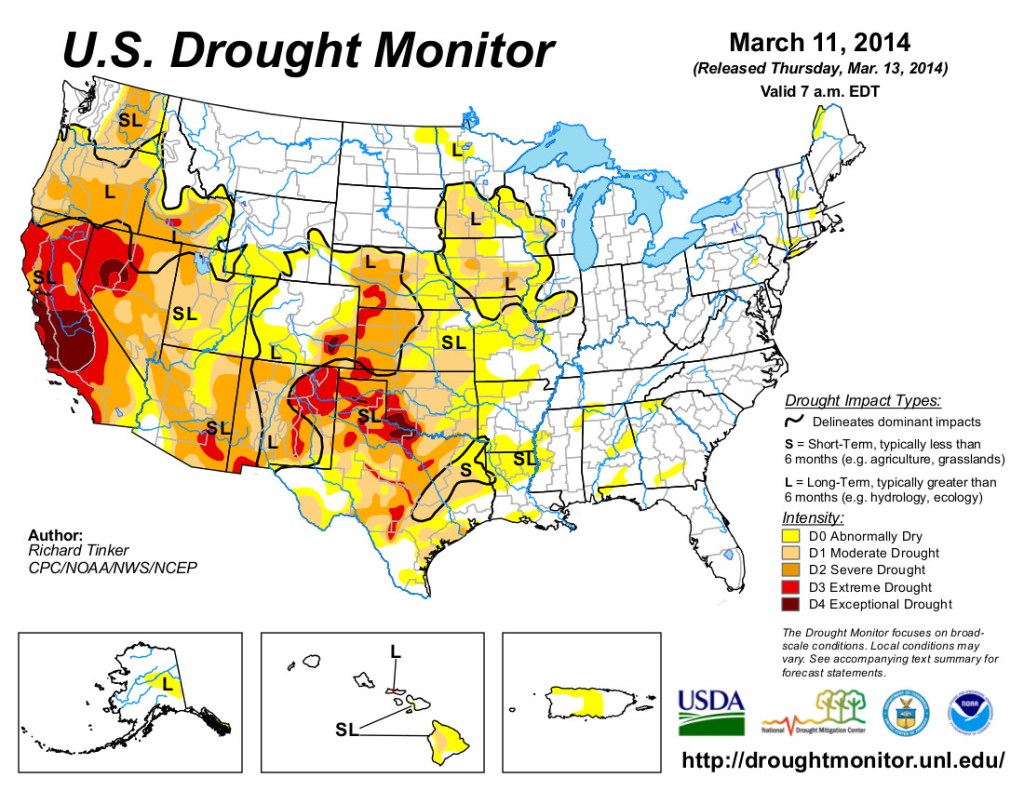
Just for grins here’s a slideshow of US Drought Monitor maps for the past few years.
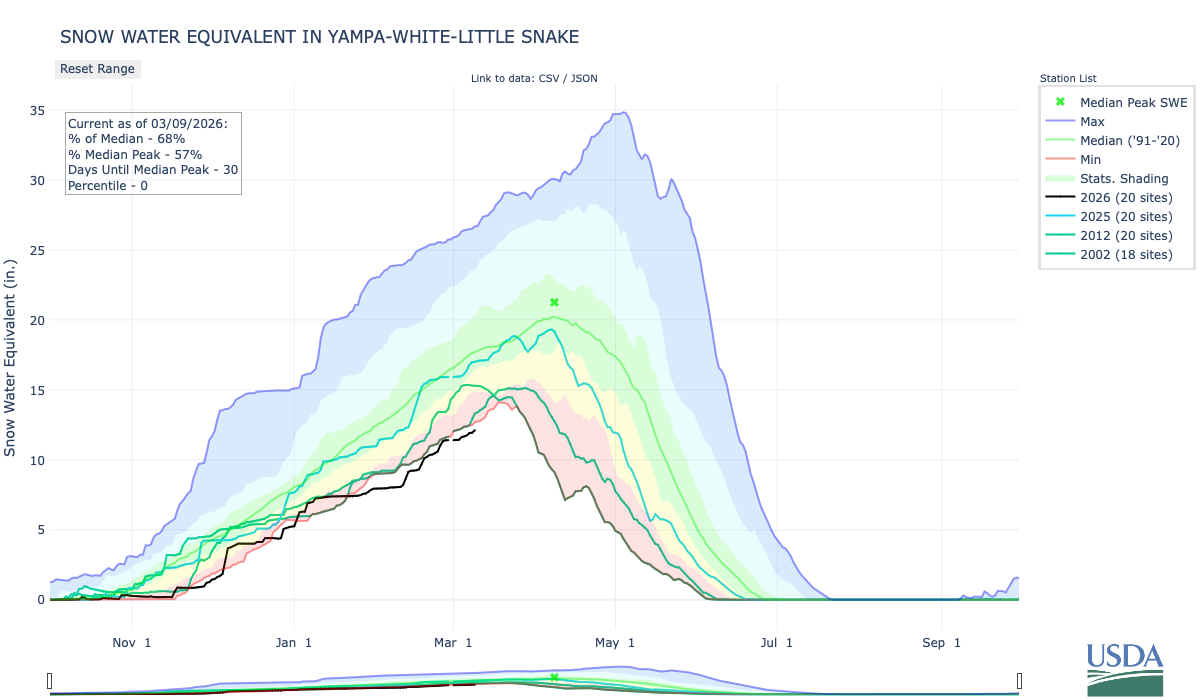
Snowpack finally saw some above average gains last week. Snowpack across our Upper Colorado River basin monitoring sites now sits at 64 percent of median and South Platte sites are at 67 percent of median for this time of year (up from 54 and 58 percent respectively). #cowxpic.twitter.com/dunWiam1sx
The Bureau of Land Management’s Mineral & Land Records System seems like a strange place to get trolled. But I think it just happened. I was looking through the MLRS to try to get an idea of whether insanely high gold and silver prices, and relatively strong uranium prices, had inspired companies or speculators to stake new mining claims n southwestern Colorado and southeastern Utah, when I came across something that seemed almost satirical.
Late last year, Kimmerle Mining Company staked four 20.66-acre lode claims in Garfield County, Utah, on the east slope of the Henry Mountains (just east of Mt. Pennell). The claim’s names? Trump I, Trump 2, Trump 3, and Trump 4.
The Kimmerle family, of Moab, control hundreds of mining claims across southeastern Utah. But they generally don’t mine them, except, it seems, to make a point.
The Kimmerles are the ones who staked mining claims on a mesa just east of Hideout Canyon inside Bears Ears National Monument just months just before the Obama administration withdrew the area from new mining claims. After Trump shrunk the monument to exclude the White Canyon area in 2017, and just before Biden restored the boundaries in 2021, Kimmerle Mining staked five new claims in the area and acquired additional claims from another mining company. Kimmerle Mining promptly filed for a permit to do exploration work there, but the BLM said they had to demonstrate the claims “validity,” or show that they contained “valuable minerals.” The process for doing so would cost up to $100,000.
Shortly thereafter, Kimmerle joined the state of Utah’s lawsuit seeking to eviscerate the national monument, claiming that its establishment had caused him to lose out on mining profits.
No word on whether the firm plans on drilling or mining its Trump claims, but at least we know these folks’ political leaning.
There have been a handful of other notable mining claim locations in the area in the past six months, including:
Platoro West Inc., located in Durango, staked twelve 20.66-acre lode claims southeast of Ouray, Colorado, in the Bear Creek drainage near Darley and Engineer Mountains. The company is registered under the name of William Sheriff, who was recently named executive chairman of Verdera Energy, which has interests in in-situ uranium mining in New Mexico.
CCKC Inc., of Philadelphia, located three 20-acre placer claims in Dolores County along the Dolores River upstream of Rico.
Roughead Resources of Moab (but which has also been associated with a Houston address) staked fifteen 20.66-acre lode claims in the Lisbon Valley of southeastern Utah near the Mi Vida Mine and the Lisbon Valley Copper Mine. At the same time, the company also staked dozens of claims in Beaver County, Utah.
Fermi Metals of Cocolalla, Idaho, staked twenty-three 20.66-acre claims on the southern slope of the La Sal Mountains, just north of the settlement of La Sal. This is near Energy Fuels’ La Sal Complex uranium mines.
Geobrines International, of Littleton, Colorado, staked twenty-five 20-acre placer claims in Grand County, Utah, along I-70 between Green River and Cisco. This adds to a cluster of previously filed claims in the same area. They are probably looking to do lithium extraction.
Utah Brine Corporation, of Omaha, Nebraska, staked seventy 20-acre claims southwest of the community of La Sal in the Lisbon Valley. UBC appears to be a subsidiary of Omaha Value Inc., which has partnered with an Australian critical materials firm Neometals on its Utah Brine Project, which aims to extract lithium and potash.
Antimony Canyon Sovereign Reserve Inc, a division of Australia firm American Tungsten & Antimony, staked nineteen 20.66-acre lode claims near Antimony, Utah, in Garfield County. The plan is to develop an antimony mine here.
In other mining news:
Metallic Minerals has been eyeing and drilling into a copper deposit in the La Plata Mountains of southwestern Colorado. While actual mining may be a long ways off, concerned locals are already coming together to keep an eye on the project and push back, if necessary. The La Plata Mountains and Public Lands Coalition now has about 225 members from the region, according to Dan King, the coalition’s administrator. Metallic Minerals’ proposal was just one of the catalysts for the coalition, and its mission is much broader and more regional in scope.
Gold and silver prices have shot up tremendously over the last year, probably due to the Trump-effect on the economy and the U.S. dollar, which is stuck at a ridiculously low exchange rate. Gold is now around $5,000/oz, while silver is hovering around $100/oz., compared to just $30 when Trump took office. Uranium’s doing well, too, sitting consistently in the $80/lb to $90/lb range.
Which is to say, mining companies suddenly have a lot more incentive to invest in reopening existing, idle mines or even building new ones (assuming they have faith that the high prices will endure). So far, however, it doesn’t seem to have sparked a surge in new mining activity. Even the Revenue-Virginius silver mine near Ouray, which is purportedly ready to produce ore, remains idle.
The uranium sector does appear to be emerging from its long slumber, but mostly in the form of exploratory drilling, smaller companies selling claims to bigger ones, and staking mining claims on the increasingly sparse sections of public land that aren’t already claimed. Anfield continues work on constructing its Velvet-Wood mine in the Lisbon Valley, but it’s still a ways away from production (and its Shootaring mill is still mothballed and unlicensed).
Energy Fuels is about the only firm actually producing conventional ore. According to their SEC filings, they pulled about 1.5 million pounds of uranium from the Pinyon Plain mine near the Grand Canyon and 155,000 pounds from their La Sal Complex in 2025. Their White Mesa Mill recovered 1 million pounds of uranium, which is a heck of a lot more than in the past, but still is far short of the facility’s 8-million-pound annual capacity. Despite all of this, the company still lost $86 million in 2025.
Meanwhile, the silver and gold mining corporations raked in massive profits, including:
Canadian corporation Barrick, which owns major gold mines in Nevada (Fourmile and Nevada Gold Mines) reported an attributable EBITDA of $8.16 billion last year, the “highest shareholder returns” in the company’s history.
Newmont (which jointly owns Nevada Gold Mines with Barrick) reported an adjusted EBITDA of $13.5 billion.
Kinross, owner of Bald Mountain and Round Mountain in Nevada, Fort Knox and Manh Choh in Alaska, and Kettle River-Curew Project in Washington, reported adjusted net earnings of $2.2 billion
Rio Tinto’s “profit after tax attributable to owners of Rio Tinto (net earnings)” $10 billion.
SSR Mining, which owns a big mine in Nevada, only had a net income of $362 million; but that compares to 2024’s loss of $350 million.
Speaking of commodity prices and profits: American oil and gas companies are poised to make out like bandits thanks to the Trump-Netanyahu war on Iran.
Iran produces some oil and gas. But more importantly, it borders the Strait of Hormuz and has threatened any oil and gas tankers that try to pass through it, effectively closing the passage. That could stanch the flow of oil and gas to the global market, causing prices to rise. The West Texas Intermediate, or WTI, crude oil price has shot up to about $76, the highest it’s been since before Trump took office. This will cause gasoline prices to climb, but also make drilling in the U.S. more profitable, and could spur companies to start using the stockpile of public land drilling permits they’ve amassed over the last year or so.
Liquefied natural gas tankers also are unable to get through the Strait to European markets, which will cause prices of the fuel to skyrocket. It could also force European countries to turn to U.S. LNG exporters, which could echo back to natural gas producing states like New Mexico and Wyoming (and also may increase U.S. natural gas prices if the conflict drags on).
Glen Canyon Dam Must Be Modified to Avoid Draconian Water Supply Disruptions
A guest post by Ron Rudolph
Glen Canyon Dam with the river outlets in use as part of the high-flow experimental release. The outlets are only used occasionally and are not engineered for sustained use. Usually, all of the releases go through the penstocks and the hydroelectric turbines. But that won’t be possible if the lake drops below the level known as minimum power pool. Jonathan P. Thompson photo.
Glen Canyon Dam, which impounds the Colorado River to form Lake Powell, is a single point of failure that poses an unacceptable risk to the functioning of the entire river system. Modifying the dam to allow more water to pass through or around it is an essential component of any plan for allocating the river’s dwindling supply.
The dam’s structural flaw limits the amount of water that can pass from Lake Powell downstream to Lake Mead. Lake Mead, the nation’s largest reservoir, is the primary repository of water for the Colorado River’s so-called Lower Basin states: California, Arizona, and Nevada. A paucity of water released from Lake Powell would eventually force reductions in the amount of water extracted from Lake Mead, diminish drinking water supplies for millions, harm agricultural productivity throughout the southwest, and embroil the federal government, seven states, more than two dozen Tribal Nations, Mexico, and others that share the river’s water in a cascade of costly court cases.
The back of Glen Canyon Dam circa 1964, not long after the reservoir had begun filling up. Here the water level is above dead pool, meaning water can be released via the river outlets, but it is below minimum power pool, so water cannot yet enter the penstocks to generate electricity. Bureau of Reclamation photo. Annotations: Jonathan P. Thompson
Due to Glen Canyon Dam’s physical limitations, when the elevation of Lake Powell reaches “minimum power pool” or lower, the only way to release water from the dam is through its river outlet works.1 The persistent drought in the southwest, and continued demand for the river’s reduced water supply, makes it highly likely Lake Powell will fall to minimum power pool this year. The U.S. Bureau of Reclamation estimated this month that Lake Powell could fall to minimum power pool by late July, and remain there or lower through 2027.2
The Bureau of Reclamation’s latest forecast for the Colorado River predicts Lake Powell will “most probably” drop below the critical minimum power pool level before the end of this year, jeopardizing Glen Canyon Dam’s structural integrity. In the worst-case scenario, it would do so before summer’s end. This could force the feds to operate the dam as a “run-of-the-river” operation to preserve the dam’s infrastructure and hydropower output, which would significantly diminish downstream flows and threaten Lower Basin water supplies.
In addition, the agency’s February forecast estimates that under “most probable inflow” conditions, Lake Mead would drop below elevation 1,040 in June. If conditions do not improve by the agency’s August forecast, mandatory reductions in water use would be required in Arizona, California, Nevada, and Mexico.3 If the annual amount of water let out from Lake Powell is restricted to the dam’s outlet works, it would result in less water reaching Lake Mead than any year this century, and could trigger even larger reductions in Lower Basin water consumption.4 Releasing water from reservoirs upstream from Lake Powell could forestall the reservoir reaching minimum power pool, however, that is a non-sustainable solution, that fails to address Glen Canyon Dam’s fundamental plumbing problem.
In January, the Bureau of Reclamation’s draft environmental impact statement — Post-2026 Operational Guidelines and Strategies for Lake Powell and Lake Mead —proposed several options for managing the Colorado River for the next 20 years. None of the alternatives includes remedying Glen Canyon Dam’s structural flaws.
The Bureau’s proposals have been criticized by some of the largest consumers of Colorado River water who have signaled a willingness to challenge the agency in court. For example, the Metropolitan Water District of Southern California, which serves nearly 19 million people, noted the Bureau’s proposed alternatives “would likely lead to lengthy litigation.”5 The Central Arizona Project, the second largest consumer of Colorado River water, has identified several “legal deficiencies,” including non-compliance with the Colorado River Compact, and failure to adequately disclose and analyze the environmental, economic and socioeconomic impacts.6
Depending exclusively on the river outlet works to release sufficient water through Glen Canyon Dam is bound to fail, like relying on rainfall to grow crops in Arizona or southern California. The Bureau has warned relying on the outlet works would risk water supply disruptions to those who depend on Lake Powell and Lake Mead.7 The Director of the Bureau’s Technical Service Center has advised against using the outlet works as the sole means for releasing water from the dam,8 as previous high-capacity use of them for only 72 hours caused structural damage, which required nine months to repair. Despite the remedial effort, the Bureau concluded the repairs will not prevent future damage.9 The dam’s design flaw led the Arizona Department of Water Resources to conclude the structural limitations of Glen Canyon Dam must be alleviated.10
The calculus for equitably apportioning the diminishing water in the Colorado River is extremely complicated. But one variable in the equation is as obvious as the bathtub ring surrounding Lake Powell: a new system for conveying water sustainably through or around Glen Canyon Dam must be built. Without it, risks to the Colorado River system, and the communities, agriculture and ecosystems reliant on it, will escalate, as will pressure to impose compulsory reductions in consumptive uses throughout the basin.
Ron Rudolph, a former assistant executive director of Friends of the Earth, spent 35 years in various engineering companies, including MWH Global, CH2M Hill, Jacobs Engineering, and Cardno with a career focused on infrastructure development and environmental remediation.
1 U.S.Bureau of Reclamation, Technical Decision Memorandum, Establishment of Interim Operating Guidance for Glen Canyon Dam During Low Reservoir Levels at Lake Powell, March 26, 2024, page 9
3 When Lake Mead drops below elevation 1,040, a “Level 2 Shortage Condition,” mandatory reductions in water use by Arizona, California, Nevada, and Mexico are required by the 2007 Interim Guidelines for managing Lake Powell and Lake Mead, and the 2019 Lower Basin Drought Contingency Plan
4 The Bureau’s guidance for maximum release of water from each river outlet work (ROW) at minimum power pool elevation is 3,185 cubic feet/second (cfs). The agency has determined only three ROWs would be available simultaneously. If three ROWs operate at full capacity, they would release 9,555 cfs. 1 cfs sustained for a year = 724.acre-feet/year. 9,555 x 724.45 = 6,922,000 acre-feet/year. The maximum releases are specified in USBR, Technical Decision Memorandum, Establishment of Interim Operating Guidance for Glen Canyon Dam During Low Reservoir Levels at Lake Powell, March 26, 2024, page 2. The determination that only three ROWs would be available simultaneously in based on USBR, Near-term Colorado River Operations, Final Supplemental Impact Statement, March 2024, page 2-3. The least amount of water released this century was 7 million acre-feet in 2022, based on data from U.S. Bureau of Reclamation, Colorado River Accounting and Water Use Report: Arizona, California and Nevada, 2000-2024
5 Statement of Metropolitan Water District’s General Manager, Shivaji Deshmukh, January 9, 2026
6 Patrick Dent, Assistant General Manager, Water Policy, Central Arizona Project, Report on Post-2026 Draft Environmental Impact Statement, February 5, 2026
7 U.S. Bureau of Reclamation, Near-term Colorado River Operations, Final Supplemental Impact Statement, March 2024, page 1-9, footnote 10
8 USBR, Technical Decision Memorandum, Establishment of Interim Operating Guidance for Glen Canyon Dam During Low Reservoir Levels at Lake Powell, March 26, 2024, page 9
Central Arizona Project map via Mountain Town News
Click the link to go to the Central Arizona Project website Colorado River Operations where you can find links to the relevant documents with respect to the DEIS.
On behalf of the Central Arizona Project and twenty-two Arizona Participating Entities that rely on the Colorado River, I am submitting the attached comments that express our deep concerns regarding the Draft Environmental Impact Statement (DEIS) for the Post-2026 Operational Guidelines and Strategies for Lake Powell and Lake Mead and the devastating impacts the alternatives therein would impose on Arizona.
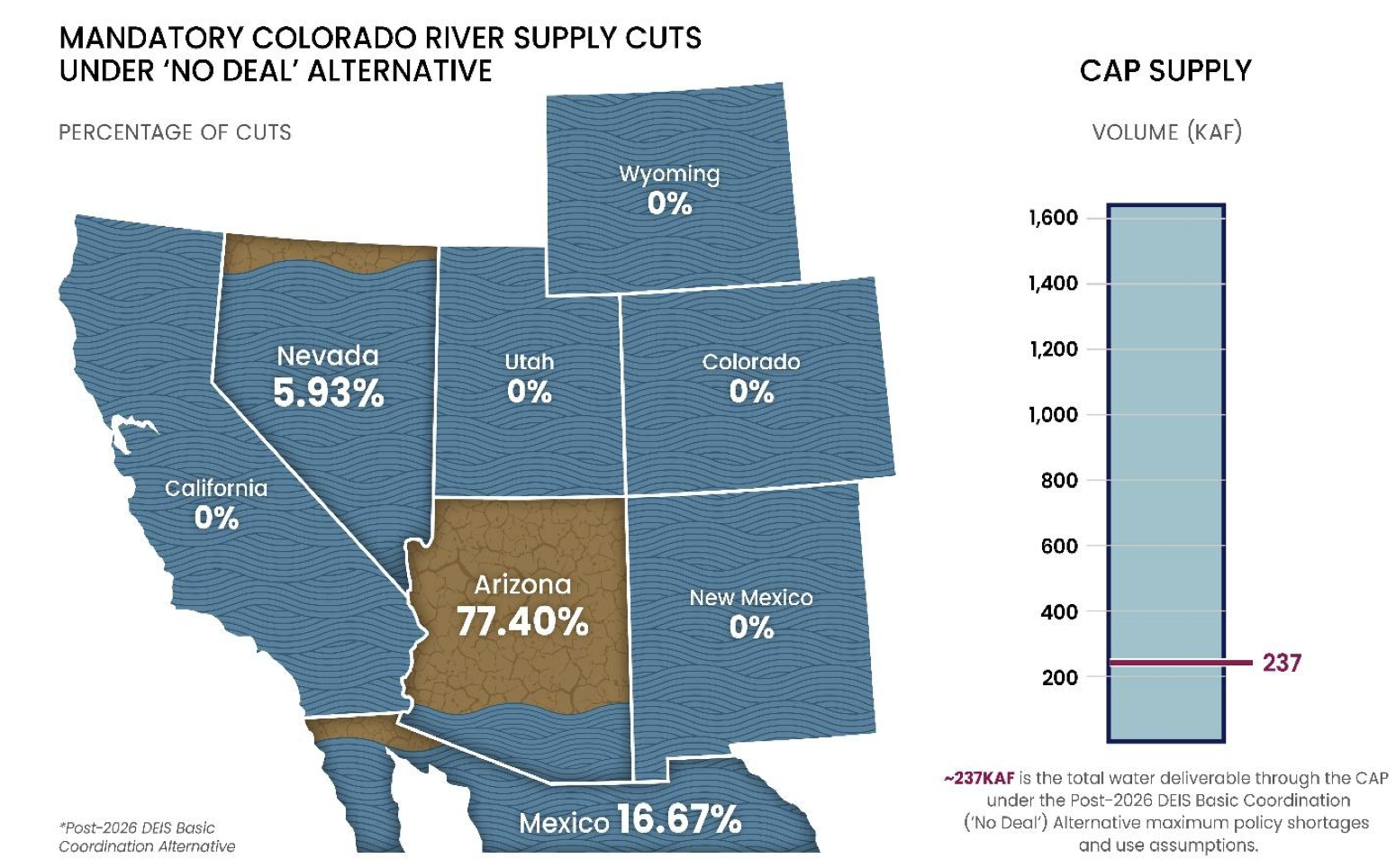
All the alternatives proposed in the DEIS disproportionately harm Arizona and are unacceptable. Specifically, the Basic Coordination alternative proposed in the DEIS that Reclamation claims could be imposed without Arizona’s consent all but severs much of Central and Southern Arizona from Colorado River supplies that have been relied upon on for four decades, betraying the promise of sustainable water supplies that underly Arizona’s economy and potentially causing “widespread impacts on social and economic conditions. . . .”that may forcecities and townsto“haul water . . . as an alternative to support continued services.”1 Arizona will not tolerate devastation and destabilization, particularly when the DEIS allows other Basin States to increase their water use.
The waters of the Colorado River are foundational to the economy and people of Central and Southern Arizona, supporting 6 million Arizonans, many tribal communities, a thriving advanced microchip manufacturing industry, and critical mineral and agricultural production. Arizona has cultivated a flourishing desert society over the past 40 years through careful and prudent use of Colorado River water supplied by the Central Arizona Project—more than doubling the State’s population while managing at the same time to use less water. The DEIS alternatives threaten to tear apart a generation of careful water management and topple the architecture supporting Arizona’s economy which is home to the heart of the American semi-conductor manufacturing and AI infrastructure industries.
The DEIS alternatives are not just a failure of policy but also include fatal legal deficiencies, and we respectfully request that the Department of the Interior withdraw the document. The United States must implement a decision that is consistent with the Colorado River Compact of 1922 (Compact), the Law of the River, and wise water policy—the DEIS fails on all counts. The enclosed comments highlight several critical flaws in the DEIS, including but not limited to:
Inconsistency with the Compact and the Law of the River: Absent agreement by the Basin States, the operating criteria for the Colorado River must comply with the foundational authority on the Colorado River: the Compact. All subsequent statutes, regulations, contracts, and other agreements are subject to compliance with the Compact and the DEIS ignores this foundational issue by proposing alternatives that would result in a breach thereof.
Failure to Analyze Upper Basin Delivery Obligations: The DEIS fails to consider or model the impacts of Upper Basin delivery obligations due to a Compact deficiency, including required releases from Colorado River Storage Project Act Upper Initial Units and curtailment in the Upper Basin necessary to prevent a breach of the Compact. This analysis is particularly important at this time, as a breach of the Upper Basin’s Compact delivery obligations could occur within the next 12 months.
Failure to Analyze the Devastating Socioeconomic Impacts to Arizona: The DEIS fails to analyze the widespread destabilizing social and economic impacts on Arizona that would be caused by the deep cuts to Arizona’s Colorado River supplies proposed in the document and could cause Arizona’s economy to lose over $2.7 trillion.
Failure to Evaluate Reasonable Alternatives: The range of alternatives is too narrow and neglects to evaluate the reasonable and feasible Lower Basin Alternative which would equitably share cuts needed to stabilize the Colorado River System among all seven Basin States and Mexico.
Illegal Implementation of the so-called “Junior Priority” on the Central Arizona Project: Arizona never agreed and the law does not make the Central Arizona Project a junior user to the Upper Basin. The DEIS fails by proposing deep cuts to Arizona’s water supplies without Compact compliance or required reductions to the Upper Basin. Further, the “junior priority” described in the Colorado River Basin Project Act and used to distribute the DEIS cuts to the Lower Basin is a facially unconstitutional imposition on Arizona’s sovereignty and illegally attempts to make Arizona a second-class citizen among the other Lower Basin States.
For these reasons and others described in the attached comments, the current DEIS does not provide the “hard look” at environmental consequences required by law. Proceeding with this document is highly likely to lead to legal challenges and long-term environmental damage that has not been analyzed.
We welcome the opportunity to work with the Department of the Interior to ensure the revised DEIS is robust and legally durable. Arizona has been a willing partner in attempting to negotiate a consensus solution to the management challenges facing Colorado River operations and continues to stand ready to find a compromise with the Secretary, the other Basin States, and additional Colorado River stakeholders based on shared sacrifice and a recognition that everyone must reduce their uses to stabilize the system. A revised DEIS is essential to comply with NEPA and properly inform the public and decision-makers and to avoid protracted litigation.
Map of the Colorado River drainage basin, created using USGS data. By Shannon1 Creative Commons Attribution-Share Alike 4.0
Interior Department overhauls its environmental review procedures.
GAO says NOAA, which has oversight authority, should do a better job of tracking cloud seeding and other weather modification.
Senate passes a bill to allow southern Nevada’s water authority to build a water-supply pipeline beneath a national conservation area.
EPA staff decreased 7 percent in the nine months through June 2025, GAO found.
Army Corps directive aims to speed up infrastructure work, prioritize projects.
House Democrats from the D.C. region ask Congress to fund the repair of a major sewer pipe break.
And lastly, Bureau of Reclamation officials outline options for propping up a shrinking Lake Powell.
“I think it’s safe for us to assume that unless Mother Nature is uncharacteristically generous, that Lake Powell elevations are going to fluctuate at elevations that we’re not comfortable with.” – Wayne Pullan, Bureau of Reclamation Upper Colorado regional director, speaking about the possibility that Lake Powell drops low enough later this year that Glen Canyon Dam cannot generate hydropower.
7 Percent: Decrease in EPA staff between September 2024 and June 2025, according to a Government Accountability Office audit.
10: States that have weather modification programs, typically cloud seeding to induce rainfall, according to a GAO report.
News Briefs
Interior NEPA Changes The Interior Department overhauled its environmental review procedures, aligning them with recent court decisions, congressional action, and Trump administration priorities.
The final rule sets page limits (150 pages in most cases, up to 300 for actions of “extraordinary complexity”) and time limits (generally two years) on environmental impact statements.
The new rules do not require public comment on draft environmental impact statements. The only mandatory opportunity for public comment is after the department issues a notice that it intends to prepare an EIS.
Reviews already in progress, those with “applications that are sufficiently advanced,” will be held to the previous standard.
Illustration from the report, “Antique Plumbing & Leadership Postponed” from the Utah Rivers Council, Glen Canyon Institute and the Great Basin Water Network. Courtesy of Utah Rivers Council
Lake Powell Options Officials at the Bureau of Reclamation, the federal agency that manages Colorado River dams, outlined several actions they are considering in the coming months to boost water levels in a rapidly shrinking Lake Powell, which could drop to a record low later this year that would halt hydropower production from Glen Canyon Dam for the first time.
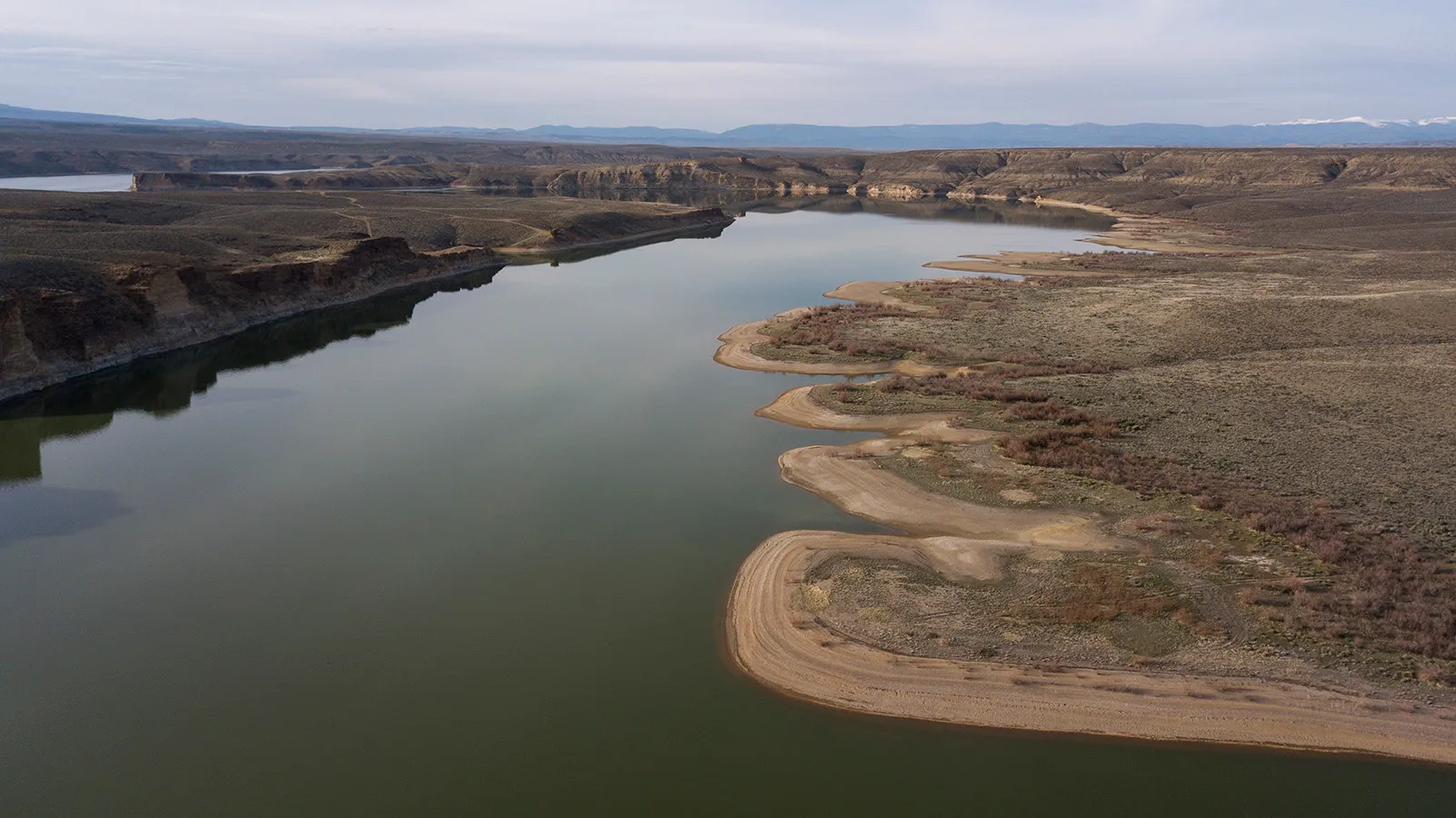
The Colorado River’s second-largest reservoir behind Lake Mead is entering one of the most difficult periods in its six-decade history. The basin is drying due to a warming climate. Powell is just a quarter full, and projected to drop lower this year. Winter has been a dud, with warm temperatures and a historically bad snowpack in the Colorado mountains that feed into the reservoir.
Reclamation officials discussed their options during a meeting last week of the Glen Canyon Dam Adaptive Management Work Group, an expert committee that advises on the dam’s ecological impacts.
A 2024 decision allows Reclamation to “consider all tools that are available” to keep Powell from dropping below 3,500 feet, an elevation that provides a little wiggle room for maintaining hydropower production. Powell today sits at 3,531 feet.
The tool from the 2024 decision is Section 6(E), which grants Reclamation the authority to restrict water releases from Powell to as low as 6 million acre-feet. The planned release this year is 7.48 million acre-feet, so the Section 6(E) authority represents a potential 20 percent reduction.
A cut of that magnitude might not be necessary because Reclamation has another tool it can use in tandem.
That option is releasing more water from Flaming Gorge and other smaller reservoirs located higher in the watershed. This is called a DROA release after its authorizing document. Pullan said this action, which states in the lower basin are advocating for, is being discussed and the volume of those releases would be determined in the spring, around April or May.
Southern Nevada Water Pipeline The Senate passed a bill that allows southern Nevada’s water provider to tunnel beneath Sloan Canyon National Conservation Area in order to build a pipeline to increase the water-supply system’s reliability. The bill now goes to the president’s desk.
Studies and Reports
‘Army Mode’ for the Army Corps Adam Telle, head of the Army Corps of Engineers, issued a collection of directives aimed at reducing paperwork and speeding up water infrastructure construction.
In one memo, Telle called for an “Army Mode” mobilization. He ordered a bottom-up approach whereby officials will select at least 20 projects nationally to prioritize. The list is due March 20.
A separate memo lists seven focus areas for infrastructure work. In descending order of importance: human life and safety, economically or strategically important infrastructure, efficient navigation and supply chains, human property, aquatic ecosystems, state-level infrastructure, and municipal infrastructure.
In yet another memo, he said that project investigations – part of the planning phase – should take no more than three years and $3 million.
Cost of Natural Hazards for the Defense Department The Defense Department lacks data to understand fully the costs of natural hazards to its installations, according to a Government Accountability Office report.
The GAO made five recommendations, including resilience planning, data collection standards, guidance, and procedures. The Defense Department agreed with all of them.
Weather Modification The GAO also looked into NOAA’s tracking of activities to induce rainfall or otherwise change the weather.
Thanks to a 1972 law, NOAA has oversight authority over weather modification and any entity that shoots silver iodide into clouds to make it rain is required to file a report with the agency. Solar geoengineering, which attempts to reduce air temperatures, is far less common but also covered under this authority.
The GAO found that NOAA’s database is incomplete, inconsistent, and unreliable. One fifth of interim and final reports had at least one error, the GAO estimates.
“Consequently, NOAA is not fully aware of the extent of weather modification activities that have occurred and are occurring within the U.S., how they are being conducted, or potential effects,” the GAO concluded.
On the Radar
How to Sue the EPA The EPA is proposing to change the process for filing citizen lawsuits, moving from mail delivery to electronic submissions.
Public comments are due March 26. Submit them via http://www.regulations.gov using docket number EPA-HQ-OGC-2024-0557.
Water Infrastructure Funding In the wake of a large-diameter sewer line rupture along the Potomac River, House Democrats from Maryland, Virginia, and the District of Columbia wrote to leaders of the House Transportation and Infrastructure Committee asking for funding for repairs.
The letter also asked for the Army Corps of Engineers to prioritize a study of a backup drinking water source for the capital region, which relies on the Potomac.
“Unlike other major metropolitan areas, the region lacks a secondary water supply, which would provide critical redundancy in the event of a future crisis.”
Federal Water Tap is a weekly digest spotting trends in U.S. government water policy. To get more water news, follow Circle of Blue on Twitter and sign up for our newsletter.
Map of the Colorado River drainage basin, created using USGS data. By Shannon1 Creative Commons Attribution-Share Alike 4.0
Corn in Baca County. Photo credit: Allen Best/Big Pivots
Click the link to read the article on the Big Pivots website (Allen Best):
February 28, 2026
Study being completed will help guide decisions about continued mining of groundwater in the Springfield area. Ogallala will be gone within 20 years, but deepest formation could last a century.
Before center-pivot sprinklers powered by rural electrification in the mid-20th century, farmers in Colorado’s southeastern corner necessarily relied upon what came from the sky for water. HIgh-capacity pumps, first used in the Springfield area during the late 1940s allowed the farmers to go underground, to more lucratively plumb a series of aquifers and deliver far-higher crop yields.
The Ogallala — also called the High Plains — is the water-bearing geologic formation nearest the surface, followed by the more water-rich Dakota and Cheyenne formations. Underlying both is a far larger reservoir yet called the Dockum Group.
How long will that water last? A new report commissioned by Colorado, still in rough draft stage, finds that a little more than 2,000 wells mine these formations in Baca County and a portion of adjoining Prowers County. The vast majority of the water, 97%, irrigates alfalfa, corn and other crops. Remaining water goes to hog farms, stock ponds, and domestic wells for farmhouses as well as municipal supplies in Springfield and several even smaller towns.
An average 157,000 acre-feet were mined annually from these subterranean deposits from 2020 through 2024. To put that into perspective Denver Water delivers an average 232,000 acre-feet to the 1.5 million residents in Denver and adjoining jurisdictions.
The answer to the question about how long the water will last has not been fully answered. At current rates of pumping, the Ogallala will be gone by 2045, according to this draft study. The next two deeper formations, Dakota and Cheyenne, have been depleted more rapidly but have more water.
The deepest water, in the Dockum, could last a century or more. It depends partly on the quality of water extracted at greater depths. There seem to be some unknowns about this. Cost of extraction is also a factor. Deeper wells cost more money to drill. It also takes more electricity to pump water to the surface. Would crop prices justify the added expenses?
Pueblo can be seen in the upper left-hand corner of this map, and the southern high plains district is designated by lavender.
With those asterisks in mind, the study estimates nearly 33 million acre-feet of water can be economically recovered from the four water-bearing geologic formations in that southern high plains groundwater district.
On average, Colorado consumes 5.3 million acre-feet of water per year, although some of that water gets reused. Think of runoff from farm fields or treated sewage that reenters streams and rivers. When that is added up, Colorado’s total diversions hit 15.3 million acre-feet. This southern plains basin bordering Kansas and Oklahoma is just a small part of Colorado.
Unlike Colorado’s rivers, which are mostly derived from snowmelt and rainfall, the groundwater recharges but much more slowly than the extraction. This study estimates an annual recharge of 32,000 acre-feet compared to the 157,000 acre-feet withdrawn.
Apart from the river valleys, dryland areas of southeastern Colorado were among the last places homesteaded in Colorado. First came the settlements of Denver, Colorado Springs, and Boulder with their access to water from the mountain streams and rivers and proximity to the mountain mining camps. Very quickly, water was diverted to create farms.
Homesteading of the high plains began about 30 years later. By then, the buffalo were gone, and the last battle with Native Americas had occurred in 1869 at Summit Springs. Settlement near Springfield, Walsh and other Baca County towns continued through the 1920s. Peak settlement occurred in about 1930, before the weather turned hotter and drier and the skies filled with dust. Baca County during the decade of the Dust Bowl and the Great Depression lost more than a third of its population.
Baca County since then has continued to lose population as farm sizes have grown. While groundwater extraction has provided a modicum of prosperity, the county ranked 57th among Colorado’s 64 counties in per-capita income as of 2022.
The hydrogeology that is believed to exist in this basin can be seen in this west-east profile. Some formations, including the Graneros and Kiowa shales, contain no water and act as barriers.
The Colorado Ground Water Commission — created in 1965, before groundwater became a common word — has legal purview over extraction. The commission can set limits on the allowable rate of depletion.
The southern high plains district limits new wells within a half-mile of existing high-capacity wells. But it is still possible to get a permit for a new well. That is in dispute. Some think the basin needs to be “closed,” to bar future wells and hence prolong the life of the aquifers.
This groundwater basin in southeastern Colorado is very different from the Republican River Basin of northeastern Colorado in one crucial way. The aquifers do not deliver water to a river subject to a multi-state compact. The Cimarron River nicks the extreme corner of Colorado, but testimony to the poverty of water in this “river” is provided by those traveling to Santa Fe in the 19th century. Nearly all followed the Arkansas River, not the Cimarron, despite the latter route being much shorter.
In contrast, a compact struck in 1943 governs flows in the Republican River. It arises far from Colorado’s mountains and is instead nourished by water seeping out of the Ogallala in places like Holyoke and Yuma and Burlington. Mining of groundwater in the basin to grow crops reduced flows to the extent that Kansas sued Nebraska, which in turn sued Colorado. Now, farmers in the basin are trying to reduce their withdrawals by voluntary retirement of 25,000 acres from active irrigation. The 19,000-plus acres retired so far have been induced by financial incentives that tap federal but also state funds.
Without a compact to force reduced pumping in southeastern Colorado, the state can adopt its own rules.
Residents of southeastern Colorado appear to be somewhat conflicted about whether new rules governing withdrawal are needed and what they should look like. Baca County’s Herald Plainsman in March 2023 reported on a “highly charged” meeting in Springfield called by the state’s Division of Water Resources. Tracy Kosloff, the deputy state engineer, explained that a group from the community had requested a rule change in the previous year.
Their intent was to block the issuance of new permits for high-capacity wells. Kosloff asked for the community to come to a consensus, if possible.
No consensus was evident at that meeting. at least according to the Plainsman Herald report. One speaker said that “without high-capacity wells, there will be no people left in the county.” Tim Hume, who is the region’s representative on the Colorado Ground Water Commission, said that without irrigation, two thirds of the people in the room would not be there. He also noted that one of the 67 monitoring wells had actually shown higher levels in the previous 20 years. But another speaker, Jack Dawson, said to keep irrigation going for quite some time, there was a real need to start conserving water.
With aid of a special $250,000 appropriation by state legislators, the Division of Water Resources commissioned a study by Wilson Water Group and HRS Water Consultants to provide new estimates of how much water remains that can be recovered economically. These consultants are also creating a planning tool to allow groundwater basin users to evaluate future groundwater use scenarios.
At a meeting scheduled for March 16 in Springfield, the consultants hope to glean insight from farmers about what constitutes economically viable extraction. How deep into the Dockum can they go and hope to be able to make money? How much water treatment is required and feasible? The big question is whether new rules will be needed to limit extraction.
Also to be determined are the goals under future conditions. How fast should the groundwater be mined? Or should there be limits beyond those few already in place? The consultants are to submit a final report before the end of 2026.
What comes of this new knowledge? It’s possible — maybe even likely — that some residents of southeastern Colorado will then file a petition with the Colorado Ground Water Commission to adopt new rules restricting extraction. This study sets up the facts for helping make that decision of whether to do so, and if so, how.
The draft study says a range of viewpoints can be expected. Some stakeholders will favor the status quo. Others might favor restricted pumping from specific aquifers or even from new wells, conceivably all wells. Expansion of irrigated acreage cold be curbed — although in some cases land has been taken out of irrigated production already.
Also relevant is the shifting climate. The study mentions climate change just once, noting that hotter or drier conditions may occur in 50 years, affecting crop irrigation requirements. Already, however, the hotter temperatures of southeastern Colorado cause crops to need a third more water than those grown 200 miles north.
The most direct parallel to a ban on new wells in southeastern Colorado would be a similar ban on new wells in the upper Crow Creek drainage northeast of Greeley near the Wyoming border. The alluvial, Fan and White River aquifers within the designated basin were declared over-appropriated effective April 14, 2017.
Hydrogeology of Colorado’s southeastern corner has been studied several times. First was a studyby the U.S. Geological Survey in conjunction with the Colorado Water Conservation Board completed in 1954. It recorded springs and creeks and pumping from wells for house and towns and stock ponds, with some of the records gleaned by New Deal workers in the 1930s. It made no attempt to quantify groundwater storage volume. Aquifer mining was non-existent in that area as high-capacity pumps had been created less than a decade before.
A 1967 study by R.W. Beck and Associates did attempt to quantify the groundwater resources. It estimated that groundwater extraction of 13,200 acre-feet in 1950 had grown by 1964 to 118,700 acre-feet.
The study projected that groundwater extraction in the basin would grow to 276,000 acre-feet by 2017. It is somewhat less. That study also projected that population of Baca County would grow to 4,700 by 2017. Actually, it declined to 3,500.
That study made no mention of the Dockum, the formation now believed to have the most water, based on well logs and other lines of evidence.
That study also recommended creation of a groundwater management district to assist in “development” of the extraction. That district was created.
Southeastern Colorado’s groundwater was also part of a six-state study of the Ogallala Aquifer in 1983.
Most recent were two related reports in 2002 by McLaughlin Water Engineers. This new study differs in a substantial way in that it uses data deeper than the 200 feet of the Dockum and hence increases the volume of water that may potentially be extracted. It also employs newer tools to figure out what exactly is going on down there in the dark, although exactly how much sharper insight this report delivers is not yet clear.
The Division of Water Resources also has conducted three studies in this century that define a steady but not dramatic decline of the aquifers in southeastern Colorado.
Last week, the Colorado River District submitted comments and specific recommendations to the Bureau of Reclamation on the recently released Post-2026 Operational Guidelines and Strategies for Lake Powell and Lake Mead Draft Environmental Impact Statement (DEIS). In its comments, the River District calls for future operational decisions that reflect hydrologic realities, address Lower Basin overuse, and move the Colorado River System beyond constant crisis management.
“A core part of our mission is safeguarding, for all Coloradans, the waters of the Colorado River to which our state is entitled under the various laws, agreements and compacts that govern the river,” said Raquel Flinker, Director of Interstate and Regional Water Resources at the Colorado River District. “Our water users have adapted to the reality of variable hydrology. We are living with a river that has 20% less water and this trend is expected to continue. It is past time that our neighbors in the Lower Basin learn how to live within the means provided by the river.”
“What is very clear in these proposals is that we still have a basic math problem,” said Colorado River District General Manager Andy Mueller. “Every year, around 1.5 million acre feet of Colorado River water disappears due to evaporation and transit loss in the Lower Basin, yet this amount is unaccounted for in the Bureau’s water deliveries. If we want to move out of crisis response mode, every proposal must begin by reducing consumptive use in the Lower Basin by this amount every single year before discussing shortages. If we had fixed the math to align with the laws of nature twenty-five years ago, we would have almost 30-million-acre feet of storage still available in the system today.”
The River District’s letter includes 13 specific recommendations organized around several key themes. First, it calls for post-2026 operations that align demand with available supply and put hydrologic reality, not predictability for the Lower Basin, at the center of decision-making. The River District urges Reclamation to evaluate alternatives that perform under critically dry hydrology, provide a fair, transparent analysis of actions and impacts, and clearly disclose Upper Basin shortage risks in the main body of the analysis.
The letter also stresses that Lower Basin use must be reduced by roughly 1.5 million acre-feet at all times, defined as system losses rather than “shortage,” and that Upper Basin conservation assumptions and scale must be re-evaluated. In addition, the River District calls for clear, durable guidelines and definitions, including fully defining and analyzing “gap water” and “additional Upper Basin actions,” and for CRSP initial unit water to remain in Lake Powell. Finally, it raises Law of the River concerns, including that inter-basin transactions must not be allowed.
The River District’s full comment letter is available here:
Reclamation formally published the DEIS on January 16, 2026, opening a 45-day public comment period. The Bureau of Reclamation must consider public feedback when developing a preferred alternative for management of the system, and the basin states will continue their negotiations alongside this process with the hope of reaching a seven-state consensus. The current guidelines expire at the end of September 2026.
Rancher Greg Higel usually opens a barn door for his cows to enter during the cold winter nights. Lately he’s been leaving the cows out at night because “the less you mess with them, the better off they are.”
The February weather has been warm enough not to mess with the cows.
The last two Februarys – 2025 and 2026 – have seen the daily maximum temperature average 50 degrees-plus in Alamosa, according to National Weather Service data. That has never happened before in the Valley’s climate history.
National Weather Service records as far back as 1948 show only the past two Februarys so warm that ranchers like Higel, who are in the midst of their calving season, worry less about their cows at night and more about their grassfields and what the warm winter means for the ground itself. Included in that are overnight temps averaging in the double digits and frequently in the 20s.
“I don’t think it’s good for the farm ground,” Higel says. He was hopeful the heavy October rains that had flooded his meadows would leave water frozen in the fields through the winter months. But the water hardly froze and the worry now is the anticipated light spring runoff and available water for the grass growing season ahead.
Of the 28 days in February this year, 20 have seen the daily maximum temperature exceed 50 degrees.The highest temperature for the month was 65 degrees on Feb. 25, following 64 degrees on Feb. 24, which established a new high for the date.
February 2025 was just as warm and warmer, with an average daily high temperature of 52.8 degrees. It was a year ago when the phenomenon of average 50-degree weather days was first noted after the mercury hit 60 degrees on 5 of the first 7 days of last February.
Suffice it to say, if it is this warm in February in the high mountain desert, the snowpack is going to suffer. The Upper Rio Grande Basin enters March measuring 55 percent of median on a snowwater equivalent index, which is what worries irrigators.
And it’s not just ranchers and farmers who should be paying attention.
Adam Moore, supervisory forester with Colorado State Forest Service, says trees around the home need watering when the winter months are this warm. The constant threat of wildfire is another reason to pay attention.
“The SLV and the plains are still facing red flag warnings. There have been large grass fires in Oklahoma and Kansas. The conditions for those fires are not much different than what we have in the SLV. Just like the red flag warnings all year long, wildfire preparedness should occur all year,” he says.
Just don’t get too far ahead. Gardeners should stick to the normal planting times, with mid-April being the earliest for any tree planting.
“Don’t let the warm weather fool you and plant early,” Moore says. “We still stand the chance of late frosts.”
Tell that to Tomas Miera.
“I’ve been riding all winter. My goodness, today is going to be like 64,” he says, standing in his front yard in a short sleeve shirt, shorts and shining his Harley Davidson. “I’m going for a ride later on.”
Back in the late 1990s and early 2000s, when I lived in Silverton, Colorado, elevation 9,318 feet, we often experienced a “January thaw.” It was a period of a few sunny, warm days between storms that usually fell in January but could also occur in February. If you could find a south-facing deck that was protected from the wind and free of dangling, skull-piercing icicles, you could sit out in shirtsleeves, soak up some vitamin D, and maybe even get a little bit of a suntan. Then winter, below zero temperatures, and super snowy San Juaners would return, finally and grudgingly departing sometime in late May.
A pretty big swath of the Southwest is about to experience a February thaw of its own, according to National Weather Service forecasts, including in these hot spots:
Phoenix’s mercury could climb into the low- to mid-90s this weekend [February 28 – March 1, 2026], with overnight lows in the 60s.
Durango, Colorado, is expecting to hit 66° F on Sunday (with lows staying above freezing).
It will be prime bike-riding weather in Moab, where the highs could climb into the low 70s.
And even Silverton will get up into the 50s, with the overnight lows dipping only a few degrees below freezing — bad news for the snow.
Denver is under a red flag warning for fire danger today, and will see temperatures in the high 60s.
During a “normal” winter, this wouldn’t be alarming in the slightest. In fact, it would be a welcome respite from winter. Now it threatens to wipe out any indication that it even is winter by potentially erasing the snowpack gained during last week’s storms. The Upper Colorado River Basin’s snowpack is exactly at the same level as it was on this date in 2002. Ohhh boy, if those March storms don’t arrive it’s going to be a long, dry summer.
As a deal between the seven Colorado states for how to divvy up massive consumption cuts seems less and less likely, Arizona is getting a bit more aggressive.This week the Protecting Arizona’s Lifeline Coalition launched a PR campaign, complete with videos, attempting to pressure the Upper Basin states to let more water flow downstream to its Lower Basin neighbors.
Arizona is understandably worried: The Central Arizona Project’s water rights are junior to most of the other large users in the Lower Basin, meaning they would be among the first to take cuts if there were a shortage. The window for a dramatic improvement in Upper Basin snowpack is rapidly closing, thereby increasing the likelihood of a shortage later this year.
The campaign includes a series of videos with various officials making their case. There are also a few educational ones that do a nice job of explaining the Colorado River Compact, and are really worth a watch. However, I should warn you that they are coming from a Lower Basin perspective, meaning they interpret one clause of the Compact, Article III(d), significantly differently than the Upper Basin states. And yet, that’s what their entire argument relies on.
That clause states that the Upper Basin must “not cause the flow of the river at Lee Ferry to be depleted below an aggregate of 75 million acre-feet” for any 10-year period.
The Upper Basin sees this as a “non-depletion obligation,” meaning it blocks them from exceeding their 7.5 MAF/year allocation if it causes the Lee Ferry flow to fall below a 7.5 MAF/year average. The Lower Basin sees it as a “minimum delivery obligation,” meaning that the Upper Basin is obliged to send an average of 7.5 MAF past Lee Ferry no matter what, even if that means draining all of its reservoirs and drying out its fields and cities.
In a comment on Tuesday’s dispatch, reader Steve Harris suggested a story on the U.S. Customs and Border Protection fast-tracking a 200-mile segment of border wall through Big Bend National Park.
This is a super important issue. And it’s not only in Big Bend: The entire border wall is an environmental disaster, slashing through biologically diverse, beautiful country and cutting off migratory routes and movement for mountain lions, javelina, coyotes, ocelot, deer, desert bighorns, and even jaguars. Keep in mind that it’s not just a fence, it’s a giant piece of infrastructure that requires bulldozing all the vegetation and even blasting through the landscape. Besides that, we taxpayers are forking out billions of dollars for something that isn’t all that great at doing what it’s supposed to do.
For me it’s especially heartbreaking to see the wall cut through the borderlands south of Tucson, down in the Patagonia Mountains. Many years ago my dad took my brother and I along some little road through there right up against the border, which at the time was just a barbed wire fence. It was incredible country, so quiet and mostly humanity-free.
The stakes are equally as high in the Big Bend area, where both ecological and cultural treasures are at risk. Unfortunately I’ve never been to Big Bend, and it’s a little ways outside the region I normally cover, so I’m not going to try to pretend to know what’s going on there. But a lot of other smart folks have written about it and are trying to block the new stretch of wall, so I’ll share some of that here:
Border Patrol map of existing, planned, and awarded segments of wall, including the stretch through Big Bend — which consists of about 100 miles of actual physical wall plus segments of “detection technology” in the most rugged areas.
The Texas Observer has a good story on the wall plans and the way the “Big Beautiful Bill” not only allocates $46.5 billion to build the monstrosity, but also erased existing protections for some areas.
Environmental groups and environmentally-oriented media outlets are making a pretty big stink over the confirmation hearings for Steve Pearce, Trump’s pick to lead the Bureau of Land Management. There’s a good reason for this: Pearce is well known for his hostility toward the BLM and the public lands it oversees, and he has also indicated a desire to sell off public land — a stance he failed to renounce during this week’s hearings.
Pearce is a bad choice for this job. But is it worth spending a lot of resources to get him ousted? Probably not.
If the Senate does not confirm Pearce, then the administration will just find some other bozo to do the job, which in this case is basically a middle manager tasked with carrying out the agenda of Interior Secretary Doug Burgum. Burgum, in turn, is merely executing the Trump administration’s, i.e. Project 2025, policies.
Which I have to say is disappointing and sad. Before he was a cabinet member, Burgum seemed like a reasonable enough guy. Sure he has ties to oil and gas interests, but he also appeared to be a Teddy Roosevelt Republican — an old school conservative and conservationist who valued public lands. He even managed to garner the endorsement of outdoor retailer REI’s board along with that of the hook and bullet crowd.
Instead, he has prostrated himself to the extractive industries, embraced coal mining and oil and gas drilling, and shattered environmental protections for public lands left and right. His distinguishing features as a cabinet member have been his unwavering sneer-like grin and his tendency to fawn over Trump — and coal.
***
Your energy and outrage might be better spent on convincing Congress to shoot down Sen. Mike Lee’s, R-Utah, attempt to use the Congressional Review Act to revoke the Grand Staircase-Escalante National Monument management plan. If the “resolution of disapproval” passes both chambers of Congress with a simple majority vote, it would erase the plan and bar the Bureau of Land Management from issuing another plan that is “substantially the same” in the future.
Republicans in the current Congress used the CRA — which allows Congress to revoke recently implemented administrative rules — to do away with resource management plans in Alaska, Montana, and North Dakota. That’s in spite of the fact that RMPs are not considered “rules,” according to a January 2025 opinion by the Interior Department’s Solicitor. National monument management plans aren’t rules, either, but that’s not a hindrance for Lee.
This wouldn’t change the boundaries of the monument, but would likely cause management of the area to revert back to the 2020, Trump I-era plan. That plan was not only less protective than the newer one, but only applied to a much smaller area, since in 2017 Trump had significantly shrunk the national monument. Revoking the current management plan, then, would leave vast areas of the monument in a sort of management limbo.
It would also open the door to revoking other national monument management plans (e.g. Bears Ears), allowing the GOP to carry out Project 2025’s goal of shrinking or eliminating national monuments in a less visible, more underhanded manner.
Just a couple reminders from a few years ago that it does snow, and it will snow again — just maybe not this spring. Jonathan P. Thompson photos.
The estimated 30- to 40-acre utility-scale battery energy storage facility planned by Jupiter Power to be built in 2027 southwest of the Hayden Power Station would look similar to this facility completed in 2024 in Houston. Jupiter Power/Courtesy photo
A utility-scale battery energy storage facility was approved last week by the Colorado Public Utilities Commission with the project planned for construction southwest of the Hayden Power Station within the town limits of Hayden. Megan Castle, communications director for the Public Utilities Commission, said the 400 MW project was approved as part of 10 total bid projects accepted by the state commission. The project in Hayden will be led by Jupiter Power, a developer and operator of utility-scale battery energy storage systems with corporate offices in Austin, Houston and Chicago. The proposed energy storage facility would be located on a 72-acre site on Routt County Road 51 near the Hayden power plant and Yampa Valley Regional Airport and would connect by a new transmission line to the Mount Harris substation southeast of the main Hayden station. The stored energy would be sold to Xcel Energy through a Power Purchase Agreement, said Michelle Aguayo, senior media relations representative at Xcel.
“This project is a Power Purchase Agreement, where another company builds and maintains the project, and we purchase the power produced,” Aguayo said Tuesday.
Hayden Town Manager Mathew Mendisco said municipal leaders are excited about the forthcoming facility, and that Jupiter Power staff already has worked through the preliminary application process with the town and is expected to submit a formal application later this year. Mendisco said the town leadership is happy to have more light industrial development to continue to boost the local tax base.
“Development like this is always good,” Mendisco said. “The energy sector has been part of our economy for many years, and this fits right in. We are excited to have land near the airport developed, and we think this seems to be a good fit.”
A “real” winter storm rolled through Pagosa Country last week, leaving behind 1-2 feet, or more, of fresh snow in spots around the county. Meanwhile, Wolf Creek Ski Area reported nearly 5 feet of new snow, with a total of 59 inches falling from Feb. 17 through Feb. 21. According to reports entered into the Community Collaborative Rain, Hail and Snow (CoCoRaHS) network five-day period ranged from 15.8 inches downtown up to 18.6 inches uptown. The highest totals were seen in the northern part of the county, ranging from 24 inches near Lake Hatcher up to 31.5 inches along the Mineral County border. As of Feb. 25, the ski area reported a year-to-date snowfall of 164 inches with a midway depth of 82 inches and a summit depth of 89 inches…
According to the Natural Resources Conservation Services (NRCS), as of Feb. 24, the San Miguel, Dolores, Animas and San Juan River basins were measured to be at 64 percent of its 30-year median snowpack. The statewide snowpack as of Feb. 25 was at 63 percent. A post by Shawn Prochazka from Pagosa Weather notes that the snowpack in the basins jumped from 42 percent to 60 percent during last week’s storm. “That’s an impressive jump this late in the season,” Prochazka writes. As of 11 a.m. on Wednesday, Feb. 25, Wolf Creek Pass, at 10,930 feet, had a snow water equivalent of 14.7 inches. The current amount is 64 percent of that date’s median snow water equivalent…
Colorado Drought Monitor map February 24, 2026.
According to the U.S. Drought Monitor’s most recent map released on Feb. 19, which was valid as of Feb. 17, 100 percent of Archuleta County is in an “abnormally dry” drought stage, with 47.89 percent of the county (the northern half) in a “moderate drought” stage. The far northwestern portion of Archuleta County — 2.17 percent of the county — is in a “severe drought” stage.
Just when you thought the GOP’s assaults on public lands couldn’t get any worse, the Trump administration launched a new blitzkrieg on environmental protections.That includes eviscerating the National Environmental Policy Act, the federal law requiring agencies to analyze, mitigate, and avoid impacts of major federal projects and projects on public land.
Interior Secretary Doug Burgum this week announced the “rescission of more than 80% of Interior’s prior NEPA regulations.” The changes, which includes limiting public comment, are aimed at streamlining permitting across the board, much as the department did with its “emergency permitting procedures” for oil and gas, uranium, coal, and critical minerals projects on public lands.
Associate Deputy Secretary Karen Budd-Falen, who is in hot water over potential ethics violations, lauded the changes, saying in a statement: “These reforms will help unleash American energy, strengthen rural communities ,and deliver real results faster for the American people.” As long as they are fossil fuels, that is, since Interior has put a de facto blockade on solar and wind developments on public lands.
Burgum finalized the NEPA rules a few days after opening 2.1 million acres of previously protected public lands in Alaska’s Dalton Corridor to new mining claims and oil and gas drilling.
***
An oil and gas drilling and hydraulic fracturing operation in the Greater Chaco Region near where the BLM plans to sell more leases this August. Jonathan P. Thompson photo.
The Bureau of Land Management is, thankfully, still taking comments on proposed oil and gas leases, though it’s not clear that they will pay them any heed. You have until March 23 to give your two cents on the Farmington Field Office’s plan to auction 12 parcels covering about 16,856 acres this August. The parcels are on the checkerboard, with the biggest block of them about 20 miles east of Chaco Culture National Historical Park.
This week confirmation hearings begin for Steve Pearce, Trump’s pick to lead the BLM and oversee some 245 million acres of public land.
Pearce is a hard-right Republican, former congressman from New Mexico, and no friend of public lands or environmental protections. Pearce’s political career was infused with hostility toward the agency he has been nominated to oversee. Pearce has opposed new national monument designations, is a fan of drilling public lands, has tried to weaken or eliminate the Endangered Species Act, lied about wolves in an effort to defund the Mexican wolf recovery program, received a 4% score from the League of Conservation Voters.
A few months ago we would have considered his confirmation a slam-dunk, since at the time most Republicans were still willing to debase themselves to any degree to curry favor with Trump. But with Trump’s approval rating plummeting as he suffers from more frequent cognitive mishaps and more revelations of his involvement with Jeffrey Epstein, the Senate may not be so friendly to Pearce.
***
The News:The National Park Service “expands access,” a.k.a. limits or eliminates timed-entry reservation systems, at Arches, Yosemite, Glacier, and Rocky Mountain National Parks, sparking fears that unmanageable crowds will once again overwhelm the popular parks.
The Context: In the wake of the first wave of the COVID-19 pandemic, when Zoom boomers flooded Western communities and the masses descended on the surrounding public lands, people became increasingly concerned about the resulting crowds at national parks and at popular non-park trails and sites. Not only did the crowds risk damaging the parks’ resources, but they also potentially screwed up the visitors’ experiences.
In Arches National Park, for example, cars backed up at the entry gate for close to a mile, parking lots were crammed with vehicles and trail-jams weren’t uncommon, and on especially busy days park officials had to actually shut the gates and turn folks away — even those who may have traveled from abroad to see Delicate Arch.
To ease the pressure, the National Park Service in 2022 instituted a timed-entry reservation system during the busiest months of the year. This limited the number of people entering the park, but it also ensured the ones that made a reservation that they wouldn’t be turned away. The system led to a sharp drop in visitation during its first year, though the number of people entering the park averaged around 4,000 per day. But it has climbed every year since, including in 2025 when other Canyon Country parks saw visitation decline.
Still, some locals, presumably those of the quantity over quality variety, pushed back, saying the new system was diminishing visitation and hurting the local tourism industry. Last fall, Grand County Commissioner Brian Martinez asked the park service to revoke the timed-entry system and to build up the park’s infrastructure to enable it to maximize visitor numbers. The Trump administration’s park service apparently listened, and now timed-entry is no more.
You wanna know how old I am? I’m old enough to remember, way, way back to the days of yore, when federal officials and gateway-town chambers of commerce were wringing their hands in concern over a nationwide decline in visitation to national parks. Over a 13-year period, visitor numbers to 58 “nature-based” national parks—Arches, Yosemite, Yellowstone, …
🐓 Regulatory Capture Chronicles 🦊
Trump’s apparent disdain for clean air (and a healthy public) was manifested in recent weeks as the administration not only rolled back the EPA’s “endangerment finding,” which authorizes it to regulate greenhouse gas emissions, but also the Biden-era mercury toxic air standards.
Mercury emissions are an environmental and public health hazard. The Four Corners-area coal plants once kicked out more than four thousand pounds of mercury each year, along with thousands of pounds of selenium and copper and hundreds more pounds of lead, arsenic, and cadmium, not to mention sulfur dioxide, nitrogen oxide, and other pollutants.
Aquatic Mercury Cycle. Graphic credit: USGS
Those emissions have decreased considerably over the years as federal regulations kicked in and as coal plants were shuttered altogether. Still, the Four Corners plant puts out about 150 pounds of mercury each year, along with varying quantities of other toxic metals. Most of these pollutants are then deposited in the surrounding water, on the land, and on homes. For years, rain and snow falling on Mesa Verde National Park have contained some of the highest levels of mercury in the nation, and elevated levels have even been found on Molas Pass, just south of Silverton. The mercury is then taken up by bacteria in lakes and rivers, which convert it to highly toxic methylmercury, which then enters the food chain. Mercury messes with fishes’ brains, and even at relatively low concentrations can impair bird and fish reproduction and health. It’s not so good for the people who live near the plant, drink the water, or eat those fish, either.
Because most existing coal plants in the West already complied with the Biden regulations, Trump’s rollback isn’t expected to have a significant effect in most cases (unless power plants dismantle existing pollution-control equipment). However, it is expected to allow the Colstrip coal plant in Montana — one of the nation’s worst polluters — to continue to operate (the operators complained that compliance with the Biden rule would have forced it out of business).
The San Juan Generating Station back when all four units were still operating, and spewing mercury and other nastiness on the area and its residents. The plant was shuttered in 2022 and has mostly been demolished. Jonathan P. Thompson photo.
🐐 Things that get my Goat 🐐
I probably shouldn’t put this here, but geez, really? Aren’t we over the whole “The West is a big empty space that we can clutter up with our myths and technology and nuclear waste” complex? I guess not. I’m sure this guy, who is clearly from somewhere that is not the Western U.S., means well. But he needs to figure out that the West’s “empty” spaces are actually full of life and beauty and, well, space, which most of us value quite highly.
Granted, the spaces shown in this guy’s pictures do look like they may have been extensively grazed, but that does not mean they are appropriate places for a bunch of damned power- and water-guzzling data centers and their associated energy facilities.
A new study has shown that it is possible, in some cases, to build large-scale solar systems without destroying the desert on which they sit.
The Gemini Solar Project in southern Nevada is one of the nation’s largest such facilities, covering about 5,000 acres of desert land. During its construction in 2022, the developers refrained from the full “blade-and-grade” site preparation that is typical, and instead worked to minimize disturbance and leave some areas of vegetation and soils completely intact.
A group of researchers from the Desert Research Institute and the U.S. Geological Survey surveyed the plant population — with a focus on the rare and sensitive threecorner milkvetch — before and two years after construction. Their hypothesis was that the facility would detrimentally affect the plant, and that the areas nearer the panels would see the biggest impacts.
What they found is that not only did the milkvetch survive, but it actually thrived “within the novel environment created at Gemini.” The plants found after construction were larger and more fecund than those found off-site. “Our results suggest that the altered environment created by panel arrays did not alter threecorner milkvetch survivorship at Gemini.”
It’s just one study focused on one solar installation and one plant. But it does suggest that, if done correctly, utility-scale solar development does not have to be a desert’s death knell.
In related, but less sunny news: Lawmakers from a handful of states have proposed bills that would make it easier for residents and businesses to install plug-in or balcony solar panels. While these panels don’t generate a ton of electricity, they are relatively inexpensive and, as the name indicates, are pretty simple to hook up. They are common in parts of Europe, especially Germany, and are gaining popularity in the U.S. since the Trump administration has killed most federal rooftop solar subsidies. The legislation is mostly aimed at allowing folks to plug these things in without a permit or go-ahead from the utility.
Last year, Utah, of all places, actually passed one of these bills. But so far this year plug-in solar legislation has died in Wyoming and in Arizona, after utilities expressed concerns. Come on! The California bill seems to still be alive.
Parting Note
I’ll be leading a couple of workshops and giving a talk at this year’s Entrada Institute “Writing from the Land” on May 14-16 in Torrey, Utah. Check it out:
City Council approved a $44,000 feasibility study last week that will explore where a new surf wave could be optimally built along the Animas River in Durango. The nonprofit Animas River Surfers proposed the feasibility study and a partnership with the city to get it done. It raised $13,000 to contribute to the study. The city budgeted $40,000 plus a 10% contingency from the 2015 sales tax fund for the study, which City Council approved last week along with budget appropriations for a wide scope of other projects. Parks and Recreation Director Scott McClain said it has received proposals for the study, and the chosen consultant will identify possible locations for a surf wave and narrow them down to one. The consultant will engage with commercial organizations and Animas River users during the study…City spokesman Tom Sluis told The Durango Herald the city hasn’t yet hired a consultant to conduct the feasibility study and it will be another week or so before a consultant is selected.
State Highway 133 crosses the Crystal River several times as it flows downstream to its confluence with the Roaring Fork River in Carbondale. Some proponents of a federal Wild & Scenic designation are pushing for a quick timeline while others want a more cautious approach. CREDIT: HEATHER SACKETT/ASPEN JOURNALISM
Colorado lawmakers are asking themselves: Can they bring more data centers to the state while ensuring the power-hungry facilities don’t burden ratepayers and the environment? Dueling bills in the legislature both claim to have the answer. One would push Colorado to join the ranks of many other states that offer tax breaks to incentivize data centers — the backbone of today’s technology landscape. The other would impose more stringent regulations on the industry to protect consumers and the environment from potential harm. As the debate unfolds, some Western Slope leaders are raising concerns over what the push for data centers could mean for their communities’ most valuable resource — water…
Researchers say a large-scale data center can use up to 5 million gallons of water per day to cool down its systems. That’s enough water to serve a town of between 10,000 and 50,000 people daily, according to reporting by the Washington Post. If Colorado chooses to entice more of the thirsty facilities to set up shop, largely in metro areas, Western Slope leaders say that could mean more water being diverted from mountain communities in an era of severe drought…“We’ve struggled for a couple generations with the water of the Western Slope, which is where the water is in Colorado, moving eastward,” said Eagle County Commissioner Matt Scherr. “This is setting up even more fights with our Front Range friends than I think is necessary.”
Colorado River “Beginnings” where the snow accumulates. Photo: Brent Gardner-Smith/Aspen Journalism
Click the link to read the article on the InkStain website (John Fleck):
February 27, 2026
It is hard to know where to begin. The Department of the Interior’s Post-2026 Colorado River draft environmental impact statement, and the deep questions it raises, is an “everything including the kitchen sink” sort of process.
But at its root, the question it raises is simple: Tell us what you’re going to do.
It is easiest to quote the Draft EIS itself on the central question: “In critically dry periods, all alternatives have unacceptable performance.” Roger that. Tell us what you’re going to do.
In the short run, with a meager snowpack and no clear explanation of how federal and state managers are going to operate the reservoir system, the basin’s dams and diversions now, we have no clear picture of what will happen in 2026. Tell us what you’re going to do.
Some specifics
The ad-hoc collective that Allen Best dubbed “the Traveling Wilburys of the Colorado River” – Anne Castle, Eric Kuhn, Jack Schmidt, Kathryn Sorensen, Rin Tara, and me – took yet another stab at offering our suggestions in comments we submitted yesterday to Interior’s P26 EIS process.
I’ve been mentally largely elsewhere lately, finishing up the book and managing my health (I’m doing great! Thanks for asking!), so I mostly show up at the last minute on these things to dub my vocals, but my friends are very kind and inclusive, and they do good work. In particular, stuff like this full of both useful NEPA-speak and also substance:
As I said: Tell us what you’re going to do.
As I said: Tell us what you’re going to do.
This one’s on you, Secretary Burgum. We do offer suggestions, but if you don’t like ours, then tell us your alternative: Tell us what you’re going to do.
This one has seemed for a long time like a no-brainer to me:
Really?
This one’s on my Upper Basin leaders: Really?
Again, Secretary Burgum: Tell us what you’re going to do.
The colossal failure of the Colorado River Basin leadership is on display in this simple sentence from the draft EIS: “In critically dry periods, all alternatives have unacceptable performance.” [ed. emphasis mine]
You’ve spent the last few years telling us what you can’t do. It’s on you now: Tell us what you’re going to do.
(Lots more in the full comments, it’s a useful primer on the current state of play.)
Map of the Colorado River drainage basin, created using USGS data. By Shannon1 Creative Commons Attribution-Share Alike 4.0
Helen Silver has helped lead a statewide effort to improve soil-moisture monitoring and to make data widely available. She is co-director of the Integrated Rocky Mountain-region Innovation Center for Healthy Soils. Photography: Matthew Staver.
CSU scientists have installed dozens of new soil moisture monitoring sensors across the state, increasing capacity by 60%, and have received additional funding to install more sensors this year.
Researchers have also launched a new web-based platform that allows anyone to view both historical and real-time statewide soil moisture data.
Interest in soil moisture is skyrocketing, and the data is useful to farmers, foresters, scientists, water managers, weather forecasters and others.
Colorado State University is leading an effort to track a critical but unseen resource in Colorado: water stored in soil. This statewide effort to enhance soil moisture monitoring is producing important insights that can help everyone from farmers to weather forecasters better predict water supplies, understand the risk of wildfire and assess the impacts of drought.
“Soil moisture is one of the most under-monitored natural resources, yet it is a foundational driver of ecosystem services and risk management,” said Helen Silver, co-director of CSU’s Integrated Rocky Mountain-region Innovation Center for Healthy Soils, or IN-RICHES, which is helping to lead the work. “Because soil moisture data are both scarce and difficult to access, this project addresses both challenges by expanding monitoring infrastructure while making the resulting information openly available and usable for land managers, policymakers and researchers.”
In Colorado, estimates suggest that the amount of water stored in soils is more than twice the amount that flows on the surface. As the Western U.S. faces growing challenges with water availability due to drought, climate variability and competing demands, there is heightened interest in better understanding and monitoring this critical resource. The work is being done in collaboration with the Colorado Climate Center and the CSU’s Department of Computer Sciences.
Historically, soil moisture monitoring in Colorado has been concentrated in high-elevation mountains, with croplands and forests underrepresented. This imbalance has limited the ability of land managers and others to fully understand soil-water dynamics across areas where water scarcity, wildfire risk and agricultural drought are most acute.
Aimed at filling this critical gap, the federal government allocated $1.45 million to CSU in spring 2023 to lead an expansion of the number of in-ground sensors, create a publicly available platform to increase access and expand other precipitation monitoring efforts. From May to October, a team of researchers installed 64 additional sensors at underrepresented sites across the state, expanding Colorado’s monitoring capacity by roughly 60%. This project was known as the Colorado Open Soil Moisture Monitoring Network. CSU recently received additional funding from the state’s Colorado Water Plan Grant Program to install another 15 sensors this year.
An above-ground apparatus is connected to below-ground moisture sensors that help scientists understand the amount of water stored in soils. Photo credit: Colorado State University
Beneficial collaboration
There are several entities monitoring soil moisture in Colorado, including the U.S. Department of Agriculture’s Natural Resources Conservation Service, which operates snow telemetry, or SNOTEL, sites; the Roaring Fork Observation Network, supported by the nonprofit Aspen Global Change Institute; and the CSU-run Colorado Agricultural Meteorological Network, which operates automated weather stations capable of tracking soil moisture.
Quench is the first centralized tool for viewing all available soil moisture data, including historic data, in Colorado.
“The integration of soil moisture data into a single platform is a monumental advancement,” said Megan Machmuller, IN-RICHES co-director and a research scientist in CSU’s Soil and Crop Sciences Department. “This publicly accessible tool will streamline comparisons across the state, providing critical insights for managing water resources and proactively addressing risks.”
Expanding the soil moisture network and launching Quench involved input from dozens of water managers, farmers and ranchers, researchers, and state and local officials. Elise Osenga, who works for the University of Colorado in partnership with the National Oceanic and Atmospheric Administration’s National Integrated Drought Information System, said she appreciated the collaboration. “There’s so much interest in soil moisture, especially in the Western U.S., because of recent intense droughts,” Osenga said. “But a lot of people aren’t really sure where to find that information.”
She added, “This work is beneficial not just for the information itself, but also as a model of collaboration; CSU did a great job of reaching out to different groups to develop this platform.”
Eric Schroder, a soil scientist with the U.S. Forest Service, is looking forward to sharing Quench with Forest Service personnel in Colorado. “The ability to easily access real-time soil moisture data from multiple partner networks and explore historical trends to see how conditions are changing over time will support and improve our ongoing management of USFS lands in Colorado,” Schroder said.
Schroder emphasized that the Forest Service relies on soil moisture data to support disaster preparedness and to inform ongoing land and water management operations, including fire prediction, controlled burn operations, drought forecasting, landslide risk, flood risk, reforestation initiatives and timber management.
In addition to installing new sensors, the CSU team plans to continue to upgrade Quench, eventually integrating satellite-based soil moisture data and other features.
Helen Silver | Co-director of IN-RICHES
Soil science • Soil water dynamics • Drought and water resilience • Soil data systems
Helen Silver is an environmental policy expert focused on soil health, water and sustainable food systems in the Rocky Mountain West, bridging science, law and data to support farmers, land managers and climate resilience efforts.
The Quench Open Knowledge Platform brings data collected from in-situ soil moisture sensing stations across a range of monitoring networks into one easy-to-use platform. Users can view current conditions, compare trends across regions, and access satellite-derived soil moisture data.
Colorado has started preliminary planning for a multiagency drought task force to help cope with what most experts fear will be a summer seriously low on water and high on wildfire risk.
The task force would include agencies focused on water, agriculture and emergency management, among others, according to Emily Adrid, water planning and climate impact specialist at the Colorado Water Conservation Board. Her comments came at a meeting of the state’s Water Monitoring Committee this week. When the task force could launch hasn’t yet been determined.
The last time such a task force was called into action was in the 2020-21 drought, according to the board. If needed, the task force can work with ad hoc groups and the governor’s office to coordinate release of state emergency funds.
Colorado measures its water supplies using a calendar that runs from Oct. 1 through Sept. 30, a period known as the water year.
The first four months of the 2026-27 water year are the warmest in 131 years, said Russ Schumacher, state climatologist at Colorado State University’s Colorado Climate Center.
“This is breaking the record by a huge margin,” Schumacher said.
And there is little if any relief in the spring forecasts.
“We might hope for a miracle this spring,” he said, “but this is not what’s in these forecasts.”
Statewide reservoir storage levels are holding steady above 80%, but streamflow forecasts indicate Colorado is likely to receive just 63% of its normal water flows, and possibly less, according to the Natural Resources Conservation Service in Lakewood.
In response, cities will also coordinate efforts to alert the public to the potential for water and fire emergencies. Their hope is that a unified approach to watering restrictions will reduce water use.
The city of Westminster is among cities gearing up for an ultradry summer. Drew Beckwith, the city’s water resources manager, said getting plans in place early and encouraging everyone to share the same message will be critical this year and next.
“We haven’t had a big drought since 2002,” Beckwith said. “We’re all out of practice.”
Even if major spring snowstorms occur that could lessen water shortages and fire risks, 2026 is still expected to be strikingly dry and warm.
And that is not as worrisome as the prospect of a follow-on drought in 2027, Beckwith said.
“It’s not the one-year drought that is our Achilles’ heel,” he said. “It’s multiple dry years in a row when things get concerning. Since we don’t know what next year’s snowpack is going to look like, we don’t want to not do anything. Instead, we’re saying, ‘Hey, we don’t know what’s going to happen so let’s all get on the same page now.’”
A moutain pine beetle chewing on a tree. (Credit: Colorado State Forest Service)
Click the link to read the article on the CU Boulder Today website (Yvaine Ye):
January 28, 2026
Colorado’s warm and dry winters have tipped the balance in a long-running ecological tug-of-war.
The mountain pine beetles, native insects to the Centennial State, have recently exploded in numbers in the Front Range after a decade of relatively low populations. The mild winter temperatures have allowed more beetle larvae to survive, while the lack of water has weakened pine trees’ natural defenses against the bugs.
Already, thousands of pine trees along the U.S. 285 and I-70 corridors are turning brown. The devastation prompted Gov. Jared Polis to sign an executive order in December to slow the spread of the beetles.
“A very high level of tree mortality, especially among ponderosa pines, is likely to continue for the next decade,” the order warned.
But the insects are not the antagonists of the story, said Samuel Ramsey, assistant professor in the Department of Ecology and Evolutionary Biology and the BioFrontiers Institute.
Samuel Ramsey looking at a beehive in his lab. (Credit: Patrick Campbell/CU Boulder)
“They are doing exactly what evolution has primed them to do, and they are just able to do it to the maximum because of the ways that climactic contexts have shifted. That is our fault,” he said.
The impact extends beyond tree loss. For the Front Range, a densely populated region already under persistent wildfire threat, dead trees can exacerbate risk.
To unpack what’s behind the outbreak and what may come next, CU Boulder Today sat down with Ramsey to chat about its causes, the outlook for Colorado’s forests and steps people can take to limit the damage.
The Mountain pine beetles are native to Colorado. Why are they causing problems now?
As the climate has shifted, it has knocked the beetles out of their normal balance with the trees. Because the weather has been warm for longer stretches of time, these beetles are able to produce an additional generation of babies, in addition to the dozens of offspring they usually produce.
An adult mountain pine beetle. (Credit: Colorado State Forest Service)
How do the pine beetles attack trees?
The mountain pine beetles are smaller than a grain of rice. When a single pine beetle attacks a tree, it actually can’t do much damage. So, when a pine beetle locates a tree, it will release a smell that tells all the pine beetles in the area to come and attack it. When 1,000 pine beetles all attack the same tree, some get through and lay eggs in the tree. Once inside, the beetles will gum up the tree’s vascular system, cutting off its water and nutrient supply.
Do trees have a defense mechanism for keeping beetles out?
They did in the original climactic circumstances, such as secreting sap to push out the beetles. But when there isn’t enough water, they can only produce a small amount of sap, and that is not enough to fend off thousands of beetles that just keep coming at them.
With the warm weather, pine beetles are also maturing faster. That means the trees are starting their battle against the beetles earlier than they had planned. The trees are also fighting later into the season because of the additional generation of beetles.
How bad will this round of the outbreak be?
I’m not a prognosticator, so I cannot tell you that this is going to be a terrible year. But the data is pointing in the direction. In the past, when we have had the same set of circumstances, we have had a banner year for mountain pine beetles. It is estimated that out of more than 4 million acres of pine forests across the state, more than 80% were damaged by the beetles between 1996 and 2013.
This winter has been really warm. That means that more pine beetles are going to survive the winter. So starting this year, their population will be large enough to likely overcome the defense of a lot of these trees. We could have dead stands of pine trees just sitting there ready to welcome the next wildfire.
Are mountain pine beetle outbreaks unique to Colorado?
The mountain pine beetles are distributed in many parts of North America, but Colorado kind of has a perfect storm of circumstances. We have these issues with a warmer winter. Really high winds can help these pine beetles move farther distances when they’re flying. In addition, the wind can drive wildfires. Together, those factors make the risks here especially high.
Are there any actions individuals can take to reduce the damage?
There are ways that we can lean into our agency here.
If you have a pine tree in your yard, you need to make sure that it has adequate water by watering it and reducing competition for water from other plants around it.
If you are getting firewood, get it and burn it locally. It’s a really, really bad idea to move firewood, because you could inadvertently help spread the beetles.
If you’re seeing mountain pine beetles in your area, and you haven’t seen that before, contact your local forest service office.
The pheromone packets people used in the past might not be the best solution, because they won’t stop an infestation, and sometimes they can make the problem worse by drawing more beetles to an area than would’ve arrived otherwise.
As the climate continues to warm, these sorts of ecological issues are going to happen more often. So we need to make sure that instead of only treating the symptoms of climate change, we are reducing the amount of carbon that is going into the atmosphere.
Climate tipping points are key thresholds in Earth systems like oceans, ice sheets, and forests, where warming can push the climate into a new state. Once crossed, these changes can be hard to reverse and can start a chain reaction that affects ecosystems, weather extremes and the global climate. Credit: ESA
By Bob Berwyn
February 11, 2026
This article originally appeared on Inside Climate News, a nonprofit, non-partisan news organization that covers climate, energy and the environment. Sign up for their newsletter here.
If you think of Earth’s climate system as a backyard swing that’s been gently swaying for millennia, then human-caused global warming is like a sudden shove strong enough to disrupt the usual arc and buckle the chains.
And if humans keep heating the planet with greenhouse gas pollution, the climate swing could lock Earth into a hothouse trajectory, as parts of the system feed on their own momentum, even if emissions are reduced later, an international team of scientists warned Wednesday in a new paper published in the journal One Earth.
Their analysis covers 16 key Earth systems, including oceans, ice sheets and forests, that are likely to destabilize if the planet continues to warm. If large parts of the Amazon rainforest and tropical coral reefs die, they absorb less carbon dioxide, triggering a dangerous chain reaction of warming.
If Earth’s climate starts on a hothouse trajectory, it would represent a “global tipping point” as the heating sustains itself even if greenhouse gas emissions drop, said lead author William Ripple, a distinguished professor of ecology at Oregon State University and a leading researcher on climate tipping points.
In the backyard, that’s the moment when the push is so hard that the swing hesitates at the top, just long enough to show that the ride may not be under control anymore and the chains are being tested.
“What typically took thousands of years is now happening in decades,” Ripple said, adding that human-caused warming is already nudging the climate system out of 11,000 years of relative stability with good conditions for farming and societal development.
Earth could be entering a period of unprecedented climate change on a one-way trajectory, in which processes such as ice-sheet collapse can continue even if the average global temperature is stabilized, he said.
In a new paper, William Ripple, an ecologist and climate researcher at Oregon State University, warns that human-caused warming could put Earth on a hothouse trajectory. Credit: Courtesy of William Ripple
Recent observations suggest that the climate may be responding more strongly than some models predicted, Ripple added. “We are concerned that policymakers and the public may not yet be aware of these recent developments.”
In late January, another group of leading climate scientists urged policymakers to adopt a climate goal of limiting human-caused warming to 1 degree Celsius above the pre-fossil fuel era, which is more ambitious than the 1.5 to 2 degrees Celsius target set in the Paris Agreement. They’ve also recently reported that Earth is losing its reflective sheen, which amplifies warming, and that key ocean currents are changing in ways that destabilize the entire global climate system.
But it’s not clear if the scientific warnings are making a difference in “a post-truth era in which too many people prefer pleasant lies over unpleasant truths,” said Reinhard Steurer, a professor of climate policy and governance at the University of Natural Resources and Life Sciences in Vienna who studies how climate science and policy interact. He said that new studies outlining disastrous scenarios are unlikely to have much impact in the current political climate, but that researchers should keep speaking out, and not surrender to “techno illusions or hopium.”
The authors of the new paper stressed that a self-sustaining hothouse trajectory is not the same as a Hothouse Earth state, which would be when the global climate rebalances at a much hotter average temperature.
No Good Analog Climates
Instead of offering a single new climate forecast, the paper synthesizes decades of research revealing how different parts of the climate system influence one another. When one part of the system is destabilized, they wrote, it can amplify stress in others, pushing the planet along a self-reinforcing warming pathway.
Earth has had hothouse climates in the ancient geological past. But the authors of the new paper said there may not be a parallel to what’s happening now, at least not during the past 3 million years, co-author Johan Rockström, co-director of the Potsdam Institute for Climate Impact Research, said via email.
“The reason is that our starting point is a WARM state. So, we are going from WARM to HOT,” he wrote. This may mean “getting stuck” at a global mean surface temperature of 4 to 6 degrees Celsius above pre-industrial levels, he added.
That amount of warming goes beyond current expectations and would devastate ecosystems and communities globally. Many other current climate projections suggest that, under current policies, warming would level off somewhere between 2.7 and 3 degrees Celsius.
Human-caused warming is happening much faster than any other warming documented in the paleoclimate record, and it’s also unprecedented because it’s driven by a single dominant force, Rockström added: human greenhouse gas emissions. Under these conditions, research has documented that Earth is already losing some of the natural buffers that dampened climate swings in recent millennia.
“We now see worrying signs that the Earth system is losing resilience,” Rockström said. Recent extremes, he added, are a sign that the climate system “may respond more strongly to the same amount of warming than it did before.”
The authors wrote that the magnitude and pace of recent climate extremes “have surprised scientists, raising questions about how well current climate projections capture risk.”
One warning sign is the recent acceleration of warming, from about 0.18 degrees Celsius per decade from 1970 to 2014, to about 0.26 degrees Celsius in the last decade; another is the reduced carbon uptake in tropical, temperate and boreal forests. And, Rockström added, “Earth is getting darker, due to multiple factors,” including melting ice, tree lines moving closer to the poles in the Northern and Southern hemispheres and changing cloud patterns due to increased evaporation and moisture in the atmosphere.
The recent acceleration of warming was also noted recently by climate scientist James Hansen, a former NASA researcher who has accurately projected the planet’s global warming trajectory for several decades.
In a climate bulletin published last week, Hansen wrote that a current shift toward a warm tropical Pacific Ocean phase could push Earth to a new temperature record this year or next, potentially surpassing 2 degrees Celsius above the pre-fossil-fuel era benchmark sometime in the 2030s.
“Don’t be too pessimistic as the evidence for high climate sensitivity grows,” Hansen wrote in his Feb. 6 update. “Realistic understanding of the climate situation, and public recognition of that, is the essential first step toward successfully addressing climate change.”
The science shows that climate stability is no longer guaranteed, Rockström said. Choices made this decade, he said, could shape the Earth System for generations.
Evening light hits the bluffs above the Green River at Fontenelle Reservoir in June 2021. (Ryan Dorgan/WyoFile)
Click the link to read the article on the WyoFile website (Dustin Bleizeffer):
February 18, 2026
Historically bad snow and water conditions raise stakes for Colorado River basin states as feds prepare to intervene.
Wyoming water officials are desperately hoping to avoid a federal intervention into the high-stakes deadlock among Colorado River stakeholders seeking a compromise on shared water appropriation cuts.
Wyoming and the six other Colorado River basin states blew through another deadline Saturday to come to an agreement, raising the possibility that the U.S. Bureau of Reclamation will dictate a new drought response plan — a situation that could dash cooperation and spawn intense legal entanglements, observers say.
Making matters worse is an intense “snow drought” so far this winter that’s compounding a “mega drought” across much of the seven-state basin region that’s lingered for more than two decades. It’s so dry that federal water managers warn Lake Powell — for the first time in 63 years — could drop 50 feet, low enough to no longer produce hydroelectric power at the Glen Canyon dam, according to the Bureau’s latest projections.
The intense situation was a topic of discussion Tuesday as a legislative committee considered a bill — Senate File 84, “Voluntary water conservation program.” The Wyoming State Engineer’s Office hopes it will give the state some negotiating leverage and protection over the state’s share of Colorado River-bound water.
Jim Magagna, the executive vice president of the Wyoming Stock Growers Association, speaks at a September 2025 Wyoming Game and Fish Commission meeting in Lander. (Mike Koshmrl/WyoFile)
“Our governor traveled back and met with other governors in D.C. and gave a somewhat favorable report,” Wyoming Stock Growers Association Executive Vice President Jim Magagna told the Senate Agriculture, State and Public Lands and Water Resources Committee. “The day after that, the state engineer in Arizona announced that they’re willing to go to court and fight to the death to get the water they think they’re entitled to from the upper basin, [which includes Wyoming].
“I would love to be able to sit here and tell you this is totally unnecessary,” Magagna said, adding he’s in favor of the bill. “Unfortunately, the scenario we’re facing in the Colorado River today is that we do believe that the state needs to show some good faith in attempting to address some of those water issues.”
The committee also heard from representatives of Wyoming’s prolific trona and soda ash producers, who rely on water that is subject to the Colorado River Compact.
“We have 2,300 employees at risk in southwest Wyoming if we don’t find a solution,” Jody Levin told the committee, speaking on behalf of the trona industry and the Wyoming Mining Association.
Divvying up shrinking water
Water forecasts were already so dire in January that the Wyoming State Engineer’s Office warned that Colorado River water managers will likely call for a significant drawdown of Flaming Gorge Reservoir this spring. The reservoir, straddling the Wyoming-Utah border, is one of the primary backups in the upper Colorado River system to ensure operational water levels at Lake Powell.
Flaming Gorge’s function as a backup is merely one piece of a complex Drought Response Operations Agreement among Colorado River stakeholders, and it expires later this year. Renewing the DROA, along with other binding agreements that dictate appropriations throughout the river system, requires determining how to share a shrinking water resource that serves 40 million people from the Cowboy State to Mexico. Though Wyoming and other Colorado River stakeholders say they prefer their own compromise over a federal one, they have yet to strike a deal — despite years of negotiations.
The Bureau of Reclamation in January published its own draft environmental impact statement for a new plan, and last week the agency hinted that time is running out for a compromise among states.
The Blacks Fork, a tributary to the Green River, near its confluence at Flaming Gorge Reservoir in May 2018. (Ryan Dorgan/WyoFile)
“The basin’s poor hydrologic outlook highlights the necessity for collaboration as the Basin States, in collaboration with Reclamation, work on developing the next set of operating guidelines for the Colorado River system,” Acting Bureau of Reclamation Commissioner Scott Cameron said in a prepared statement Friday.
Gov. Mark Gordon, along with fellow Colorado River upper basin states’ Govs. Jared Polis, Michelle Lujan Grisham and Spencer Cox, issued a joint statement Friday ahead of the unmet deadline.
“Upper basin water users live within the means of the river by adapting our uses every year based on available supplies,” the governors said. “We continue pursuing a seven-state consensus, which would provide greater opportunity to pursue federal funding supporting conservation efforts and innovative water-saving technologies across the basin.”
The Platte River is formed in western Nebraska east of the city of North Platte, Nebraska by the confluence of the North Platte and the South Platte Rivers, which both arise from snowmelt in the eastern Rockies east of the Continental Divide. Map via Wikimedia.
Though not part of the Colorado River system, the North Platte River, stretching from south-central to eastern Wyoming, is also parched. The State Engineer’s Office issued a “priority administration” order earlier this month, requiring junior rights water holders along the river system to immediately cease diverting water. The order could remain in effect through April.
Water conservation bill
Senate File 84 cleared the Senate Agriculture Committee Tuesday [February 17, 2026] unanimously, with strong support from stakeholders beholden to the Colorado River Compact and some doubters.
It would enshrine a water conservation strategy that’s already been tested for several years in the state. It would allow ranchers and other Colorado River system users in Wyoming to voluntarily use less water without losing their appropriation rights, according to the bill.
“It helps avoid mandatory and uncompensated water use reductions, whether by court order or curtailment, to satisfy compact obligations,” State Engineer Brandon Gebhart said. “It provides a tool for Wyoming to be part of a compromise to address historic drought that has plagued the Colorado River Basin for the last 25 years.”
Kemmerer Republican Sen. Laura Pearson said she has doubts about the practical water conservation claims related to the strategy. For instance, if an irrigator foregoes flooding a field and allows their water to stay in the stream, that means less recharge for aquifers.
Welcome to the Landline, a monthly newsletter from High Country News about land, water, wildlife, climate and conservation in the Western United States. Screenshot from the High Country News website.
This is an installment of the Landline, a monthly newsletter from High Country News about land, water, wildlife, climate and conservation in the Western United States. Sign up to get it in your inbox.
When I was growing up in southwestern Colorado along the banks of a tributary to a Colorado River tributary, I was immersed not only in the quirks of water law, but also in Western water culture — the peculiar mores and customs that come from constantly looming scarcity. One oft-repeated maxim, usually used to justify building a new dam or encouraging inefficient irrigation practices, was: If we don’t use the water, it will just flow downstream to California — where it would presumably be used to water golf courses, fill LA’s swimming pools and serve other nefarious West Coast purposes.
I’m sure the idea arose partly from the animosity — and envy — the Interior West has long harbored toward its largest and wealthiest coastal neighbor. But I also think it comes from our idiosyncratic laws governing water use and the way they pit the headwaters communities against their downstream neighbors.
Whatever its origin, the sentiment endures and in fact has only grown stronger as the river and its reservoirs reach critically diminished levels, while the seven states that rely on them fail to agree on how to manage the issue going forward. Maybe the maxim needs an update. The big question today is: How much of the Colorado River’s water should be allowed to flow downstream to California, Arizona and Nevada?
How did we get here?
Western water law is based on the prior appropriation doctrine, which gives the first entity to make “beneficial use” of water the right to keep on using that amount, even if that means that upstream “junior” users’ spigots will get shut off. By the early 1900s, a rapidly growing California was enthusiastically diverting the Colorado River, with huge irrigation districts gobbling up the senior water rights. Less-populous Colorado, Wyoming and Utah were forced to watch in increasing dismay as downstream users gained control over larger and larger shares of “their” river.
Upper Basin States vs. Lower Basin circa 1925 via CSU Water Resources Archives
To appease these headwaters states — and to garner their support for huge dams and other water projects on the lower river — the seven Colorado River Basin states hammered out the Colorado River Compact of 1922. It divided the states into an Upper Basin (Colorado, Wyoming, Utah and New Mexico) and a Lower Basin (Arizona, California and Nevada), with the dividing line at Lees Ferry, Arizona. It aimed to share the river’s water equally between them, giving each basin the exclusive use of 7.5 million acre-feet (MAF) of water per year.
Climate change causes turbulence
The compact was far from perfect, but the concept of dividing the water equally generally held up, even if the reality didn’t always follow suit: The Upper Basin states have always used far less than their allotted amount (around 4 MAF), while the Lower Basin for years has consumed far more than its share (as much as 11 million MAF). That wasn’t a problem as long as the river had enough water to go around. But for the last 26 years, it hasn’t.
Udall/Overpeck 4-panel Figure Colorado River temperature/precipitation/natural flows with trend. Lake Mead and Lake Powell storage. Updated through Water Year 2025. Note the tiny points on the annual data so that you can flyspeck the individual years. Credit: Brad Udall
Since around the turn of the century, warming temperatures and abnormally dry years have severely diminished the headwaters states’ snowpack, thereby shrinking the river. The annual “natural flow” at Lees Ferry, or the estimated amount of water the river would hold without any upstream diversions or human consumption, has been about 12 MAF on average since 2000, dropping below 6 MAF in 2002, or just over half of what the Lower Basin alone consumed at the time.
The meager flows simply do not jibe with the numbers in the compact. And that makes it virtually impossible for the Upper Basin to comply with the compact’s “non-depletion clause,” which dictates that the Upper Basin “will not cause the flow of the river at Lee Ferry to be depleted below an aggregate of 75,000,000 acre feet for any period of ten consecutive years.” There are different interpretations of this provision, but it appears to say the Upper Basin states has no option but to allow the water to flow down to California — even if it means they come up short themselves.
The back of Glen Canyon Dam circa 1964, not long after the reservoir had begun filling up. Here the water level is above dead pool, meaning water can be released via the river outlets, but it is below minimum power pool, so water cannot yet enter the penstocks to generate electricity. Bureau of Reclamation photo. Annotations: Jonathan P. Thompson
Glen Canyon Dam and Lake Powell were supposed to make things easier by acting as an Upper Basin savings account that could be drawn from during dry years. But withdrawals have greatly exceeded deposits more often than not in recent decades, leaving Lake Powell at about one-third of its full storage capacity and bringing its surface level critically close to hitting minimum power pool, the point at which water can no longer be released through the hydroelectric turbines.
When this happens — possibly as early as this fall, according to current federal forecasts — the dam will stop generating hydropower for Southwestern utilities. It will also force all releases to go through the outlets lower in the dam, which were not engineered for such sustained use. This would compromise the outlets and possibly the dam itself, and Bureau of Reclamation engineers have strongly warned against it, meaning that minimum power pool becomes the de facto deadpool.
If current climate trends continue, the only way to avoid reaching minimum power pool — aside from re-engineering the dam on a very short timeframe — is either to substantially increase flows into Lake Powell by curtailing Upper Basin water use and draining upstream reservoirs, or else significantly reduce releases from Glen Canyon Dam, forcing the Lower Basin — and the river through the Grand Canyon and its endangered native fish — to take major cuts.
On a day in late May [2022] when wildfire smoke obscured the throat of an ancient volcano called Shiprock in the distance, I visited the Ute Mountain Ute farming and ranching operation in the southwestern corner of Colorado. Photo credit: Allen Best/Big Pivots
The solution is simple; consensus is not
In 2022, the Interior Department told the seven states to broker a plan to balance demand with diminishing supplies by cutting overall consumptive use by 2 million to 4 million acre-feet per year. So far, however, the states have failed to reach consensus.
The Lower Basin states, which have maxed out their allotment and then some, have taken some cuts already and have agreed to accept more, if the Upper Basin agrees to mandatory, verifiable cuts of its own. Meanwhile, the Lower Basin wants to see some version of the non-depletion provision remain in place.
Upper Basin negotiators argue that they haven’t even come close to using all of the water they’re entitled to, and besides, they don’t use nearly as much as the Lower Basin does anyway. So why should they be forced to reduce even more? Furthermore, Upper Basin water users, especially those with junior water rights, are already struggling with drastic reductions during dry years because the region lacks large reservoirs for storing water, meaning their water use is dictated by the rivers’ flows. In 2021, for example, many southwestern Colorado farms had their ditches cut off as early as June, forcing them to sit the season out, while the Ute Mountain Ute Tribe received only about 10% of its allocation.
It’s also simpler logistically to reduce consumption in the Lower Basin, where huge water users are served by a handful of very large diversions, such as the Central Arizona Project canal, which carries water to Phoenix and Tucson; the All-American Canal, which serves the Imperial Irrigation District (and its gigantic alfalfa fields) — the largest single water user on the entire river — and the California Aqueduct, which serves Los Angeles and other cities, all of which are fed by Lake Mead and other reservoirs. The Upper Basin, on the other hand, pulls water from the river and its tributaries via hundreds of much smaller diversions. Achieving meaningful cuts would require shutting off thousands of irrigation ditches to thousands of small water users under uncertain authority.
The Upper Basin negotiators have suggested a “supply driven” plan that would base releases from Lake Powell on the amount of water in the river and the reservoir, thereby honoring the spirit — if not the actual figures — of the Colorado River Compact. While Lower Basin negotiators have expressed interest in the idea, the two sides have yet to agree on details, such as the percentage of flows that would be released or whether a non-depletion minimum-flow requirement would remain in place.
Deadpool doesn’t care about deals or deadlines
In the end, the river basin’s climate and hydrology are likely to decide the issue. As Lake Powell inevitably sinks this summer, the BuRec will probably drain upstream reservoirs — Flaming Gorge, Blue Mesa and Navajo — to delay its decline. But when the reservoir drops to minimum power pool, dam operators must decide whether to release water through the river outlets and hope they don’t fail, or else shift Glen Canyon Dam to a “run-of-the-river” operation, which would keep the reservoir level from falling further by making releases equal to reservoir inflows minus evaporation and seepage. The relatively scant outflows from the dam would cause Lake Mead’s levels to plummet, forcing the Lower Basin states to accept potentially calamitous cuts. The Central Arizona Project, one of the basin’s most junior rights holders, would almost certainly lose some of its water, imperiling all the cities and farms that rely on it.
If the diminished releases were to persist for several months or more, it would likely put the Upper Basin in violation of the non-depletion clause, triggering litigation from downstream users, and throwing the entire watershed back in time to the anxious and combative pre-compact days.
The end of a boat ramp in Antelope Canyon was high above the water of Lake Powell in May 2022, Photo/Allen Best
I used to wonder why folks worried so about Colorado’s water running downstream to California, as if letting it go were some sort of sin. I can understand not wanting to lose the water that originates in your state, but to prefer wasting it or locking it up in reservoirs to sharing it didn’t seem right. After all, every drop that Colorado sends to California and Arizona is another drop that stays in the river for that much longer, benefiting fish and the other critters and boaters that rely on its waters.
I suspect that the most egregious flaw of the Colorado River Compact wasn’t that it overestimated the amount of water in the river, but that it pitted one group of states, tribes and other water users against another, rather than creating a framework in which they could all work together for the benefit of the entire watershed. Maybe it’s time to scrap the compact altogether and, while we’re at it, do away with the whole prior appropriations doctrine on the Colorado River — starting over again from scratch, in other words.
After all, as the climate keeps getting warmer and drier, there will be less and less water to argue about. If there’s nothing left to send downstream, the Colorado River Compact will soon be worth less than the paper it’s printed on.
The Colorado River Compact, signed in 1922. Public domain
Stormy, briefly colder weather in California and elsewhere in the West helped to improve previously meager mountain snowpack, with an average of approximately 6 inches of snow-water equivalency being added to the Sierra Nevada. However, 4- to 8-foot snowfall totals in the Sierra Nevada also led to travel disruptions through mountain passes and contributed to the nation’s deadliest avalanche—northwest of Lake Tahoe—in 45 years. Meanwhile, the nation’s mid-section faced several days with record-setting warmth and gusty winds. Portions of the central and southern High Plains endured a rash of wildfires, starting on February 17, with the largest—the Ranger Road Fire—quickly consuming more than 280,000 acres of cured vegetation in northwestern Oklahoma and southwestern Kansas. Initial reports indicated that there were also livestock losses and property destruction. In contrast, several rounds of storminess affected the eastern U.S., culminating in a late-winter blizzard along the middle and northern Atlantic Coast on February 22-23. The winter storm deposited more than a foot of snow in major East Coast cities from Philadelphia to Boston, with a single-storm record of 37.9 inches measured in Providence, Rhode Island. Earlier, an early-season outbreak of severe weather occurred on February 19, when as many as a dozen tornadoes were reported in Illinois and Indiana…
Gradual drought deterioration was noted in several areas, except North Dakota, which remains free of drought. In Nebraska, a mostly dry, windy winter has adversely affected winter wheat, which at the end of January was rated just 24 percent in good to excellent condition—down from 54 percent in late-November 2025. Snowfall that blanketed parts of Nebraska on February 19 provided only temporary relief from overall dryness. Farther south, parts of Kansas and Colorado contended with high winds, grassfires, and blowing dust, especially on February 17. On that date, wind gusts in Colorado were clocked to 79 mph in Colorado Springs, 72 mph in Burlington, and 71 mph in Pueblo. South of Pueblo, on I-25, chain reaction collisions due to low visibility in blowing dust resulted in five fatalities and involved approximately three dozen vehicles…
Colorado Drought Monitor one week change map ending February 24, 2026.
There were few overall changes in the West, as most of the heavy precipitation fell in areas—such as northern and central California—currently experiencing no drought. Farther inland, brief bursts of precipitation in drought-affected areas prevented worsening conditions, but provided little overall relief. In Utah’s Wasatch Range, Alta received 31.2 inches of snow in a 24-hour period on February 17-18, but will likely end the month with below-average snowfall. Below-average snow-water equivalency remains a concern in much of the West, even in drought-free areas such as the Sierra Nevada. According to the California Department of Water Resources, the Sierra Nevada snowpack contained an average snow-water equivalency of 16 inches—up about 6 inches from earlier in the month, but less than three-quarters of normal for late February. In much of Arizona, New Mexico, and Oregon, snow-water equivalency values were less than 50 percent of normal…
The southern High Plains endured a historic day of wind and wildfires on February 17, when the Ranger Road Fire was ignited in Beaver County, Oklahoma. The Ranger Road Fire soon scorched more than 280,000 acres of grass and brush, expanding into northwestern Harper County, Oklahoma, and parts of three counties in southwestern Kansas. Meanwhile, the Lavender Fire burned more than 18,000 acres northeast of Vega, Texas, and reportedly destroyed at least 18 structures. On February 17, the day of ignition, peak gusts included 73 mph in Lubbock, Texas, and 67 mph in Guymon, Oklahoma. Due to deteriorating conditions and diminishing topsoil moisture reserves, moderate drought (D1) was broadly introduced across northern and western Oklahoma and the northern panhandle of Texas. Farther east, gradually worsening drought conditions were also observed from the western Gulf Coast region to the Mississippi Delta, with several new areas of extreme drought (D3) being introduced and others being expanded. Coverage of exceptional drought (D4) increased slightly in southern Texas…
Looking Ahead
Fast-moving, loosely organized disturbances will traverse the country during the next 5 days. Some of the heaviest precipitation, locally 1 to 2 inches or more, should fall in the Southeast, mainly through Friday. Beneficial showers will linger into the weekend across Florida’s peninsula. In contrast, dry weather will prevail during the next 5 days in the nation’s southwestern quadrant, from southern California to the central and southern High Plains. Record-setting warmth will accompany the dry weather, with temperatures routinely topping 90°F in southern Texas and the Desert Southwest. Farther north, a new plume of Pacific moisture will arrive on Saturday across southern Oregon and northern California. That moisture will race eastward, sparking wintry precipitation by Sunday and Monday from the central Plains into the mid-Atlantic, including the Ohio Valley and neighboring regions.
The NWS 6- to 10-day outlook for March 3 – 7 calls for the likelihood of warmer-than-normal weather nationwide, except for near- or below-normal temperatures in parts of New York and much of New England. Meanwhile, near- or above-normal precipitation across most of the country should contrast with drier-than-normal conditions in coastal North Carolina and portions of the Far West, including California and the western Great Basin.
US Drought Monitor one week change map ending February 24, 2026.
Officials at the Bureau of Reclamation, the federal agency that manages Colorado River dams, outlined several actions they are considering in the coming months to boost water levels in a rapidly shrinking Lake Powell, which could drop to a record low later this year that would halt hydropower production from Glen Canyon Dam for the first time.
The Colorado River’s second-largest reservoir behind Lake Mead is entering one of the most difficult periods in its six-decade history. The basin is drying due to a warming climate. Powell is just a quarter full, and projected to drop lower this year. Winter has been a dud, with warm temperatures and a historically bad snowpack in the Colorado mountains that feed into the reservoir.
Decisions in the next three months about how much water to release from Powell and how much to hold back will reverberate across the basin, affecting hydropower production, legal obligations, watershed ecology, threatened species, and millions of people who use its water and energy.
“Things are happening in parallel and not in sequence,” said Wayne Pullan, Reclamation’s Upper Colorado Basin regional director. “We’re going to be doing everything all at once.”
Pullan and other Reclamation officials discussed their options during a meeting Wednesday of the Glen Canyon Dam Adaptive Management Work Group, an expert committee that advises on the dam’s ecological impacts.
The back of Glen Canyon Dam circa 1964, not long after the reservoir had begun filling up. Here the water level is above dead pool, meaning water can be released via the river outlets, but it is below minimum power pool, so water cannot yet enter the penstocks to generate electricity. Bureau of Reclamation photo. Annotations: Jonathan P. Thompson
The number that federal officials are paying attention to is 3,490 feet. Below that point, Glen Canyon Dam cannot produce hydropower. Powell would be too low for water to flow through the power-generating turbines.
A 2024 decision allows Reclamation to “consider all tools that are available” to keep Powell from dropping below 3,500 feet, an elevation that provides a little wiggle room for maintaining hydropower production. Powell today sits at 3,531 feet.
“I think it’s safe for us to assume that unless Mother Nature is uncharacteristically generous, that Lake Powell elevations are going to fluctuate at elevations that we’re not comfortable with,” Pullan said.
The tool from the 2024 decision is Section 6(E), which grants Reclamation the authority to restrict water releases from Powell to as low as 6 million acre-feet. The planned released this year is 7.48 million acre-feet, so the Section 6(E) authority represents a potential 20 percent reduction.
A cut of that magnitude might not be necessary because Reclamation has another tool it can use in tandem.
That option is releasing more water from Flaming Gorge and other smaller reservoirs located higher in the watershed. This is called a DROA release after its authorizing document. Pullan said this action, which states in the lower basin are advocating for, is being discussed and the volume of those releases would be determined in the spring, around April or May.
“It’s important to remember that this is all in flux,” Pullan said. “This cake is being mixed and isn’t baked in any way yet.”
A previous DROA release in 2022-23 moved 463,000 acre-feet from Flaming Gorge into Lake Powell. Flaming Gorge today is 82 percent full, holding almost 3 million acre-feet.
Note the dotted red line. If says that it’s possible that power production at Glen Canyon Dam could end by August.
Reclamation’s current projections show Powell dropping below hydropower production level by December, in an average water supply scenario. If snowpack and runoff continue to run below average, then that threshold could be breached, barring interventions, in August.
Katrina Grantz, Reclamation’s deputy regional director, said that in the most probable water supply scenario the agency has the tools to be able to keep Powell above 3,500 feet over the next 12 months. But it is still analyzing how and when to deploy them.
“Reclamation is working on various scenarios of how this could play out,” Grantz said.
There are other considerations in the mix. Powell is the source of cold-water releases to help native fish. The water this year could be record warm. Powell is also the source of high-volume flows to move sediment that rebuilds Grand Canyon beaches and steadier flows that assist aquatic insects. Releases have implications for boating and recreation, too.
A shrinking Lake Powell has implications for water supply, recreation, fisheries, hydropower generation, watershed ecology, and legal requirements. Photo J. Carl Ganter/Circle of Blue
The basin’s abysmal hydrology coincides with deep political and legal uncertainty. Current reservoir management guidelines expire at the end of the year, and the seven basin states have not been able to agree on their replacement. Reclamation instead is forging its own path, aiming to finalize a decision this summer.
Reduced releases from Powell could also cause the four upper basin states – Colorado, New Mexico, Utah, and Wyoming – to violate the Colorado River Compact, which requires a certain volume of water to move downstream. This requirement and its legal ramifications are not clear and could be litigated.
It all amounts to an unsettling time for those working in the basin.
“We have to work with the resources we have,” Pullan said. “Wishing will not make things so.”
Map of the Colorado River drainage basin, created using USGS data. By Shannon1 Creative Commons Attribution-Share Alike 4.0
Spud Valley Energy Center’ would be built on 2,578 acres near Mosca and Hooper; it would ultimately develop 600 megawatts of solar energy and 600 megawatts of battery storage.
‘Spud Valley Energy Center’ would be the largest ever conceived for the Valley, and one of Colorado’s biggest solar projects, at a time when ag producers are being forced to reduce their footprint to save on the water
It is an agricultural corridor in Alamosa County that is drying faster and seeing more buy-and-dry deals than other parts of the San Luis Valley due to the scarcity of water from the Upper Rio Grande Basin.
On 2,578 acres of private land off State Highway 17 leading into Mosca and Hooper, a number of families are entering into contracts with NextEra Energy and its bid to ultimately develop 600 megawatts of solar energy and 600 megawatts of battery storage on the fields that once grew crops.
The solar project, dubbed the “Spud Valley Energy Center,” is the largest ever conceived for the Valley and one of Colorado’s biggest. It comes at a time when ag producers in Subdistrict 1 of the Rio Grande Water Conservation District are being forced to reduce their footprint to save on the water. Solar development then, in a Valley plentiful with sunshine, becomes an alternative for the land and a company like NextEra Energy has the means to make it happen.
“A number of the landowners we’re working with have already either retired their wells or they’re participating in CREP (Conservation Reserve Enhancement Program) to rest their lands for longterm,” said Evan Reimondo, the project manager, in an interview with Alamosa Citizen.
Spud Valley is perfectly sited when you consider the other solar development already in the corridor, the Public Service Co. substation near the project site, the water conservation subdistrict it is in, and Alamosa County’s own interests for solar development through its 1041 permit process.
A different solar development proposal — Korsail Energy’s Cornflower Solar project — had its permit application denied by the county commissioners last year after it met a headwind of resistance from locals concerned about the location of the project that was within a migratory range of sensitive wildlife areas in west Alamosa County.
Korsail was seeking to build 90 megawatts of solar and 80 megawatts of battery storage on 986 acres, but was doomed because of the location it selected. NextEra Energy’s Spud Valley doesn’t seem to carry that burden with its location, and at 600 megawatts puts the Valley on the map for solar generation to support Colorado’s goal of a state power grid built on 80 percent renewable energy by 2030.
“Colorado’s demand for electricity is going to keep growing as the population grows and technology develops and all of those things,” said Reimondo, Spud Valley’s project manager. “So we’re preparing for the future when we over-permit. By permitting for 600, it gives us that future flexibility.”
The plan is to build an initial 200 megawatts of solar and 200 megawatts of battery storage, and then stage to 600 megawatts of each from there. The transmission bottleneck — bringing power in and out of San Luis Valley — presents the biggest challenge.
“As the grid is built out, as network upgrades are completed in the future, new (transmission) lines are built, and we’ll be ready to take advantage of that,” Reimondo says.
Alamosa County is currently reviewing NextEra Energy’s 1041 permit application and eventually will hold public hearings at the county planning level and then before the county commissioners.
Reimondo says the company hopes to begin construction in 2027, with the first 200 megawatts of solar and battery storage built and tied into the neighboring Public Service Co. substation by the end of 2029.
Juniata Reservoir, located near Grand Mesa, is where the city of Grand Junction stores water coming off Grand Mesa in the Kannah Creek watershed. That water flows down Kannah Creek and eventually into the taps of Grand Junction residents. Photo courtesy of City of Grand Junction
The City of Grand Junction is planning to fully drain Juniata Reservoir, one of two reservoirs that store the city’s water coming off Grand Mesa, later this year, after a leak was discovered during a routine inspection that will require a multi-year effort to fix. During an inspection, a crack in the outlet structure pipe that allows water to leak into the pipe going through the dam was discovered, according to the City of Grand Junction. Grand Junction Utilities Director Randi Kim said the crack and the slow seepage of water was discovered over the last few years and has been monitored by the city. The most recent inspection happened over the summer, she said.
“There’s a crack in the outlet pipe on the interior of the dam, and then that’s leaking along the pipeline, to the exterior,” Kim said. “Right now, there’s no concern about dam safety at present.”
Kim said the project is budgeted in the city’s long-term capital plan for just under $1.6 million. Construction will take place in 2027 and fully replace and upgrade the outlet pipe.
“We’re going to be replacing that whole outlet structure and providing a new valve system and all of the apparatuses that go along with that outlet structure,” Kim said.
The city has worked with an engineer to determine if the cracked pipe could be replaced without draining the reservoir, Kim said. However, the State of Colorado is requiring the city to fully drain the reservoir to “ensure the structural integrity of the dam can be properly addressed.”
Water inflow to Juniata Reservoir will be shut off beginning this November and is expected to be fully drained by September 2027, according to the city. Kim said the city is working with Clifton Water to provide it with raw water during the draw down to still utilize the water. Clifton will be able to help backfill the reservoir as it refills after the project is completed, she said…Kim said the city is also looking into potentially leasing some of the water during the reservoir’s draw down to agricultural users who may also be able to utilize it. Any un-utilized water from Juniata will be stored at the Purdy Mesa Reservoir, she said. During the drawdown and construction, Kim said the city will still be able to utilize Kannah Creek for its water needs. The city has 17 reservoirs on the Grand Mesa, which flow down Kannah Creek and provide water to the city.
“We have direct flow rights off of Kannah Creek,” Kim said. “So we can continue to divert our direct flow rights from the Kannah Creek to our water treatment plant.”
Grand Junction back in the day with the Grand Mesa in background
A new global water report offers a framework for understanding risk, resilience, and why protecting streamflow is critical now more than ever.
Water management has long depended on the assumption that systems will rebound after stress. New research suggests that, in some places, recovery may no longer be guaranteed and that risk may now be accumulating faster than it can be relieved.
A recent report from the United Nations University Institute for Water, Environment and Health introduces a term for this emerging condition: water bankruptcy. The report argues that many human–water systems are now living beyond their hydrological means. We are drawing not only on the water that is replenished each year through snowpack and rainfall, but also borrowing against long-term ‘savings’ stored in aquifers, glaciers, wetlands, soils, and river ecosystems. Over time, that continual drawdown does more than strain sustainability. It degrades the natural capital that makes water available and stabilizes the hydrologic cycle.
The Arkansas River, near Salida, CO. Credit: Ken Lund
When Recovery Can No Longer Be Assumed
Unlike stress or crisis, which assume eventual recovery, water bankruptcy describes a system that has moved beyond short-term disruption into a condition where loss accumulates faster than it can be repaired.
According to the report, the defining features of water bankruptcy are insolvency and irreversibility. Insolvency describes a condition in which a system can continue to function only by drawing down its remaining assets, rather than living within what can be replenished. Irreversibility refers to the loss of natural capital that cannot be fully restored within realistic planning horizons, even if conditions later improve.
A simple illustration of water income and water expenses in a human–water system. Water bankruptcy is the outcome of both insolvency and irreversibility conditions, i.e., when water use (expenditure) exceeds water supply (renewable and non-renewable assets) for an extended period resulting in irreparable damages to the underlying natural capital that contributes to water production and stability of the hydrological cycle.
Implicit in this framing is an important insight: water systems falter not only when too much is withdrawn, but when patterns of use become misaligned with the processes that renew and sustain them. When water is consistently removed without regard to its timing, location, or ecological role, the system’s ability to regenerate weakens. The system-scale consequences often appear as instability, loss of function, and shrinking margins for recovery, rather than as immediate shortage. And those consequences affect more than just natural systems; they increase risk for everyone who depends on them.
Colorado Through the Lens of Water Bankruptcy
Across the state, many rivers now experience earlier runoff, longer low-flow seasons, and reduced resilience. In some reaches, the question is no longer whether the river will be stressed in a given year, but whether it will even have enough functional flow, at the right times, to sustain the processes that keep it a river rather than just a delivery canal for downstream consumption.
One of the report’s most useful contributions (and one that might resonate in Colorado) is its emphasis that water availability is not just a quantity problem, but a problem of depleted natural capital. This refers to the physical and ecological conditions that allow water systems to function, replenish, and recover over time. Rivers, aquifers, and ecosystems are not simply “external” values weighed against human needs; they are part of the underlying system that sustains reliable supply. When a river’s ability to do its ecological work is degraded year after year, the system’s capacity to recover shrinks, and management options shrink with
In that sense, building resilience into our rivers is a form of system-wide risk management. Streamflow protection creates margin—margin for drought, future pressure, and operational uncertainty—by helping rivers retain enough function to recover through dry periods. Seen this way, adding water to streams is not just an ecological goal but a practical investment in long-term system reliability; it treats rivers as essential natural infrastructure rather than as luxuries. Streamflow protection is capital preservation that helps rivers absorb future stress, recover more quickly, and retain the capacity to respond when conditions change. In a system where recovery can no longer be assumed, that margin is essential. Moreover, protecting streamflow today helps preserve the system’s ability to serve future beneficiaries, not just current ones.
The case for streamflow is often strongest when supply is tight. The costs of losing river function are rarely evenly distributed, and they tend to show up first where flexibility is lowest: among junior users, smaller operators, and rural communities with fewer alternatives. Once function is lost, recovery is uncertain, even if water returns later. Supporting streamflow during critical periods can therefore reduce the need for more disruptive and costly interventions later, helping scarcity be managed through foresight rather than crisis.
A view of Willow Creek, a Tributary of the Rio Grande, in Creede, Colorado. The creek is channelized and flows through the central part of town. Credit: Jeffrey Beall
Helping Rivers Helps Us All
This is where the Colorado Water Trust’s work fits. For more than two decades, the Water Trust has worked within Colorado’s prior appropriation system to restore and protect streamflow through voluntary, compensated, and collaborative agreements with water users. The aim is not to recreate historical conditions wholesale. Instead, projects are designed to support rivers through critical periods by adding flow where and when it can help streams move through their natural cycle, maintain function during vulnerable seasons, and reduce the risk of long-term system failure.
On the Upper Colorado River, for example, the Water Trust has partnered with agricultural producers and reservoir operators to temporarily reduce diversions or strategically release stored water during late summer and early fall, when stress is highest and recovery windows are narrowest. These agreements do not resolve long-term imbalances in the watershed. What they do is slow the loss of system capacity. They help the river retain enough function to buffer key habitat, move sediment, regulate temperature, and remain connected through critical reaches.
Seen through the lens of water bankruptcy, this work more closely resembles debt management than debt elimination. It helps preserve the natural capital that remains, keeping options open and reducing the risk that today’s imbalances become tomorrow’s irreversible losses.
The Animas River in early fall, flowing from the mountains, past Durango, and beyond. Credit: Mike McBey
Streamflow restoration is not a substitute for hard conversations about demand, growth, or allocation. It is a complementary tool for managing risk in the meantime. The point here is not to fatalistically diagnose Colorado’s water system as “bankrupt,” but to ask whether the conditions the report describes are becoming more familiar—and what that implies for how we think about risk, resilience, and responsibility in a future where recovery can no longer be assumed. If rivers and snowpack are the foundations of our water system, then maintaining their ability to function is not a luxury. It is a prerequisite for long-term success.
The report itself emphasizes that responding to water bankruptcy requires more than finding new supplies or engineering around scarcity. It calls for protecting and restoring the natural systems that underpin water availability, managing within ecological limits, and prioritizing actions that preserve long-term system function. In that sense, the most effective responses are those that stabilize capacity before losses become irreversible. For Colorado, that insight reinforces the importance of streamflow protection as a practical resilience strategy, and it’s one that helps maintain the functional integrity of rivers even as pressures increase.
For the Colorado Water Trust, that is the core takeaway. Streamflow restoration and protection are not just about helping rivers survive. They are about building the buffers that make Colorado’s entire water system more resilient and more secure.
By prudently “re-investing” today’s water back into the stream, we can help ensure that future Coloradans will inherit capacity. Not crisis.
EPA asks federal court to pause part of its regulations for PFAS in drinking water.
EPA also says it will uphold Biden-era lead pipe replacement requirements.
DOE once again orders a Michigan coal plant to continue operating.
Congress will hold hearings this week on safe drinking water, water-related legislation, and an Army Corps authorization bill.
U.S. Supreme Court will hold oral arguments this week for the Line 5 oil pipeline case.
EPA seeks comments on ways to reduce regulatory burden for hazardous substance spill response plans.
FEMA continues to be slow in approving disaster declarations in Democratic-led states.
And lastly, the White House promotes domestic phosphorus mining and glyphosate production by conferring “immunity” under the Defense Production Act.
“Consistent with these findings, I find that ensuring robust domestic elemental phosphorus mining and United States-based production of glyphosate-based herbicides is central to American economic and national security. Without immediate Federal action, the United States remains inadequately equipped and vulnerable.” – President Trump’s executive order that grants these activities (phosphorus mining and glyphosate production) immunity from “damages or penalties” for any activity related to the order. The underlying law is the Defense Production Act. Phosphorus and glyphosate are foundational elements of modern American agribusiness. They are in fertilizer and the weedkiller Roundup. But they are also primary water pollutants that contribute to harmful algal blooms or are linked to cancer and other illnesses.
EPA PFAS Lawsuit The EPA is continuing to make its case in court that the agency’s Biden-era regulation of four PFAS in drinking water should be paused while it works on a new regulation that would officially rescind them, Bloomberg Law reports.
Two of the regulated chemicals – PFOA and PFOS – have standard numerical limits. The four others – PFNA, PFHxS, PFBS, and GenX – would also be regulated as a group, using what’s known as a “hazard index.” This is the first time the agency has used such an approach for drinking water regulation.
The court in January rejected the EPA’s request to vacate the hazard index component. The agency now wants to separate the hazard index from the rest of the litigation.
Two water utility groups – the American Water Works Association and Association of Metropolitan Water Agencies – filed the lawsuit in June 2024 in the U.S. Court of Appeals for the D.C. Circuit.
In the court filing, the agency says that it has drafted a notice of rulemaking to rescind the hazard index and plans to “commence the rulemaking process imminently.”
Lead Pipe Replacement In a separate lawsuit, the EPA said it would uphold the Biden administration’s 10-year timeline for most cities to replace lead drinking water pipes, the Associated Press reports.
The lawsuit challenging the timeline was also brought by the American Water Works Association, which argued that it was not feasible.
Michigan Coal Plant Operating Order Extended The Department of Energy once again extended the life of a Michigan coal-fired power plant.
This is the fourth 90-day order to keep the J.H. Campbell Generating Plant operating. The DOE argues that closing the plant is a threat to grid reliability. It is also costing Consumers Energy, the plant owner, a lot of money – at least $80 million through last September. The company will likely recover costs through customer rate increases or surcharges.
Consumers intended to shut down the plant in May 2025.
The EPA, at the prompting of regulated facilities, is considering changing federal requirements for hazardous substance spill plans, which are authorized under the Clean Water Act to guide emergency response in case a large volume of toxic chemicals is released into waterways.
The requirements in questions were established in 2024 during the Biden administration and apply to onshore non-transportation facilities – things like chemical manufacturers, oil and gas operators, gas stations, hospitals.
The agency is seeking comment on whether it should simplify the rules for determining which facilities are required to file response plans. Public comments are due March 20 and can be submitted via www.regulations.gov using docket number EPA-HQ-OLEM-2025-1707.
Studies and Reports
Disaster Declarations and Approvals FEMA approved a disaster declaration for Louisiana, which the state requested on February 5 following a late-January storm. And it approved a declaration for a Washington, D.C. sewer line that collapsed on January 19.
The federal disaster agency, meanwhile, has rejected or has been slow to approve requests from Democratic-run states. FEMA has not acted on Washington state’s January 21 request.
Arizona and Illinois are appealing requests from last fall that were rejected. Colorado is appealing two requests from January 16 that were denied.
Chinook Salmon Decision The National Marine Fisheries Service decided against listing the Washington coast segment of Chinook salmon as endangered or threatened, saying the population faces low extinction risk.
This is the result of the agency’s 12-month review, an in-depth assessment of the threats to a species. In response to a petition from the Center for Biological Diversity, the agency had made a preliminary, 90-day decision during the Biden administration that listing the species may be necessary.
Washington coast Chinook salmon spawn north of the Columbia River and west of the Elwha River, a geography that includes the Olympic peninsula.
On the Radar
Line 5 in the U.S. Supreme Court On February 24, the nation’s high court will hear oral arguments in a case involving the controversial Line 5 oil pipeline that crosses the Straits of Mackinac between lakes Huron and Michigan.
The case centers on a jurisdictional matter: should the lawsuit seeking to shut down the 73-year-old pipeline be heard in state or federal court?
Dana Nessel, the Michigan attorney general, filed the case in state court in 2019 alleging that Enbridge’s continued operation of the pipeline violated state law.
Colorado River DEIS Comments Due The Bureau of Reclamation is accepting public comments through March 2 on its draft plan for managing the Colorado River reservoirs after current rules expire at the end of the year.
Also on February 24, a Senate Energy and Natural Resources subcommittee will discuss 18 water-related bills, including rural water supply systems, snow water forecasting, and water recycling.
There are two hearings this week on the next Water Resources Development Act, the legislation that authorizes Army Corps projects for dams, levees, ports, and ecosystem restoration.
The action starts on February 24 with a House Transportation and Infrastructure subcommittee. The head of the Army Corps will testify, as will the chief of engineers.
Then on February 25, the Senate Committee on Environment and Public Works holds its own hearing.
Federal Water Tap is a weekly digest spotting trends in U.S. government water policy. To get more water news, follow Circle of Blue on Twitter and sign up for our newsletter.
Click the link to read the article on the Sky-Hi News website (Ryan Spencer). Here’s an excerpt:
February 23, 2026
Colorado’s record-low snowpack is already raising concerns about increased wildfire risk and water shortages this summer, even as the mountains are still in the depths of winter. Statewide, the snowpack levels are just 61% of median for this time of year, and it would take consistent, record-breaking snowfall for the rest of the season to reach normal peak snowpack levels, according to the U.S. Department of Agriculture.
“We really should be bracing for an unusually early and potentially severe fire season,” Colorado Division of Fire Prevention and Control public information officer Tracy LeClair said. “Some of the conditions are worse than we saw in the big years, like 2012 and 2020, where we saw some of the largest fires and some of the most destructive fires in Colorado history.”
Those historic fire seasons were preceded by winters with well-below-average snowpacks, LeClair said. But this winter season, the snowpack is the worst Colorado has seen in decades. For weeks, the state’s snow telemetry network, which dates back to about 1987, has ranked the snowpack as the worst on record.
Colorado Drought Monitor map February 17, 2026.
In the latest report from the U.S. Drought Monitor, parts of Summit, Eagle, Pitkin, Lake and Park counties were experiencing exceptional drought — the most intense level of drought. Meanwhile, most of northwest Colorado is under extreme drought or severe drought status…The snow drought that has persisted through the season has shifted the fire risk “into the late winter months,” LeClair said. She noted that lack of snow has also led fire agencies across the state to delay or cancel prescribed burn projects, like pile burns, which require snow on the ground to burn safely.
Mayor Mike Johnston today joined members of City Council in announcing it intends to file a moratorium on new data centers in Denver. The process, which is expected to last several months, will allow the city to review and strengthen regulations around the sites.
“Data centers power the technology we depend upon and strengthen our economy,” said Mayor Mike Johnston. “But as this industry evolves, so must our policies. This pause allows us to put clear and consistent guardrails in place while protecting our most precious resources and preserving our quality of life. Denver is pro-business and pro-climate, and I’m proud to partner with City Council in keeping Denver one of the top tech sectors in the country and doing so in a way that is responsible to our residents and the industries who wish to invest here.”
An ordinance announcing the moratorium will be filed by Council. If approved, the city will conduct a review of additional, data-center specific regulations around responsible land, energy, and water use as well as zoning and affordability for ratepayers. The city will launch a process that collaborates with members of the community, climate experts, and industry leaders to clarify guidance and create a policy that is practical, predictable, and transparent.
“Data centers bring with them a unique series of environmental challenges and neighborhood impacts,” said Councilman Paul Kashmann. “My office has been looking into this topic in depth in recent months. I believe the complexity of the issues involved merits our city taking a pause to give them adequate consideration. While there remains distance between the Mayor’s view and mine – as well as some other Council colleagues – I look forward to working with the administration, the community at large and industry voices to see if regulations – as have been instituted in sister cities around the country – will or will not make additional data center development possible in the City and County of Denver.”
Data centers provide significant economic impact through high-paying jobs and property tax revenue. They are also a necessary component of many aspects of our daily lives, from operating major sectors like healthcare, automotive, retail, and shipping to everyday tasks like sending an email, streaming a movie, or using an app on your phone.
“Denver is a city that embraces innovation. We are also committed to protecting our environment,” said Councilman Darrell Watson. “Data centers use significant energy and water. We have a responsibility to manage their growth in our communities wisely and sustainably. I will be introducing common sense legislation built on that premise. We can protect the health of Denver communities, strengthen our climate commitments, and continue to keep our city moving forward responsibly.”
Existing data centers and projects currently permitted or under construction are not impacted by this decision, though they may be expected to follow new guidelines once announced.
Udall/Overpeck 4-panel Figure Colorado River temperature/precipitation/natural flows with trend. Lake Mead and Lake Powell storage. Updated through Water Year 2025. Note the tiny points on the annual data so that you can flyspeck the individual years. Credit: Brad Udall
Click the link to read the article on the AZCentral website (Brandon Loomis). Here’s an excerpt:
February 23, 2026
Key Points
A coalition of cities and water providers, led by the Central Arizona Project, has launched a media campaign targeting proposed Colorado River cuts.
The campaign includes a TV ad that claims Arizona “is being unfairly targeted” by some water management alternatives outlined in a federal document.
After the seven Colorado River states failed to reach an agreement on shortage sharing, the federal government turned to its own set of proposals.
A Central Arizona Project-backed advocacy group called the Coalition for Protecting Arizona’s Lifeline has begun rolling out television ads and online videos defending the water supplier’s rights to a Colorado River that is under serious hydrological and political strain.
“Arizona is being unfairly targeted for reductions of Colorado River water that would cripple our state, flatten our economy and weaken our nation’s defense,” an ad aired by the coalition warns. It goes on to note that Arizona communities have done their part, committing more water for conservation in Lake Mead than those in other states, and that several options that the federal government is weighing for managing the river would fall hardest on the state.
One such alternative under review, CAP General Manager Brenda Burman recently said, would essentially dry up the agency’s canal from the river to Phoenix and Tucson…The alternatives Burman was referring to were never stated as the Trump administration’s preference, but rather as ideas from which the seven states that share the river water might draw from in writing an agreement for sharing in its worsening shortages. Now that the states have failed to reach such an agreement, though, the U.S. Bureau of Reclamation is faced with either enacting something like them or rapidly developing a new federal plan in time to replace river guidelines that expire this autumn…While the materials don’t directly state members’ intended method of securing water, some of the videos lean heavily on the so-called Law of the River and its guarantee of water from the four headwaters states to Arizona, California and Nevada. This theme reiterates a point that CAP and Arizona water officials have stressed over the last year or so, that if push comes to shove in a legal battle, they have the 1922 Colorado River Compact on their side.
“The Lower Basin has paper water, uses wet water, and wants the Upper Basin to deliver ghost water” — Kevin Pilgrim
Water levels were low at Lake Powell’s Wahweep Marina in November 2021. Recent worst-case projections from the U.S. Bureau of Reclamation show the reservoir declining below power pool by July. CREDIT: HEATHER SACKETT/ASPEN JOURNALISM
The Colorado River crisis is no longer part of some hypothetical future — it’s here.
Fueled by one of the worst snowpacks on record, the “most probable” February projection from the U.S. Bureau of Reclamation estimates 5 million acre-feet flowing into Lake Powell this year, which is 52% of average. A more grim estimate puts that number at just 3.5 million acre-feet, or 37% of average.
Forecasts show the nation’s second-largest reservoir could fall below the minimum level needed to make hydropower at Glen Canyon Dam as soon as July under the worst-case scenario, or by December under the “most probable” forecast. Reservoir levels are projected to fall to their lowest elevation on record in March 2027, threatening the water supply for millions in the Southwest.
But the increasingly dire projections, this winter’s historically bad snowpack and the growing gap between supply and demand haven’t yet pushed the seven states that share the river to come to an agreement on its future management.
Last week, state negotiators blew past a second federally set deadline to find a consensus plan on how to share shortages and manage Lake Powell and Lake Mead after the current guidelines expire at the end of the year. They have been stuck at an impasse for two years.
The need for a new management paradigm that adapts to a shrinking water supply has never been more urgent. So why isn’t the crisis forcing a deal?
“We’re at a moment where we really need something different that responds to our current hydrology, our current demands, and we’re not seeing a development of that kind,” said Elizabeth Koebele, a professor of political science and associate director of the graduate program of hydrologic sciences at the University of Nevada, Reno. “You’d think that all of these signals would be pointing to the fact that we really need to do something different, but we’re not.”
Anne Castle, a former federal representative to the Upper Colorado River Commission and a Colorado River expert, co-authored a paper in 2021 that said successful negotiations of new Colorado River agreements tend to be triggered by very dry conditions, and that federal directives and deadlines also play an important role. But the current stalemate amid worsening drought throws those findings into question.
“Our premise was that a crisis in terms of water supply and reservoir levels and snowpack and expected runoff can prompt creative compromise,” Castle said. “But we have all those underlying conditions, and we don’t have a compromise.”
The scale of the problem could be part of what’s making consensus difficult between the Upper Basin (Colorado, New Mexico, Utah and Wyoming) and the Lower Basin (California, Arizona and Nevada). As a junior water user on the river, the Central Arizona Project, which supplies the metro Phoenix and Tucson areas, could face the deepest cuts.
“I think if this had been a 2 million-acre-foot problem, the states probably could have solved it, but it’s potentially a 4 million-acre-foot problem,” said Kathryn Sorensen, a researcher and professor at Arizona State University’s Kyl Center for Water Policy. “There’s so little water to go around that positions have become hardened as a result. We’re not just talking about inconvenient cuts; we’re talking about severe pain to economies at this point.”
Federal involvement
Some of the normal levers that have been pulled to force action in the past — such as directives and deadlines from the federal government — don’t seem to be effective in the current situation. There have been no apparent consequences for the states missing both the Feb. 14 deadline and an initial Nov. 11 deadline set by the feds for the states to present the outline of an agreement.
The seven state negotiators and their governors were summoned to Washington, D.C., the last week of January for a meeting with Department of Interior officials. That, too, failed to result in a deal.
In a Feb. 14 news release, Interior Secretary Doug Burgum thanked the governors for their engagement and said a fair compromise with shared responsibility remains within reach.
Koebele said when the states were hashing out the 2007 guidelines, which currently govern the river and are just months from expiring, the threat of federal action was part of what spurred the states to come up with a plan.
“There’s a little bit less of this idea of a single or central federal leader in the negotiation process,” Koebele said. “And they’re also still saying, ‘Hey, states, please come up with your own option too.’ I’m not really sure how credible threats are from the federal government when we’re in this sort of context.”
Reclamation has presented five options for managing the river, but although the federal government owns and operates the infrastructure such as dams and reservoirs, it doesn’t have the authority to implement all of the actions outlined in the options. The new, innovative and collaborative actions would need an agreement among the states.
Absent that, federal officials believe the only tools at their disposal, which allocate cuts based on prior appropriation and existing water law, could see Arizona take up to 77% of total shortages, yet they “may not provide adequate protection of critical infrastructure or the system and may be viable only in the short term given current reservoir conditions,” according the bureau.
The federal management options are part of a draft environmental impact statement, which is required as part of the National Environmental Policy Act review for new guidelines. This process is moving forward on a separate, parallel track to negotiations among the states. If the states agree on a plan, it could be plugged into the EIS and become the “preferred alternative.”
“We’re sort of at a key moment for those two processes coming together,” Koebele said. “But the EIS and the state negotiations are not really intersecting in a way that we have seen them intersect in the past or that we hoped they would.”
Federal officials are accepting comments on the draft EIS until March 2.
Lake Pleasant, seen in April 2025, is a storage bucket for Colorado River water and is part of the Central Arizona Project that delivers water to the Phoenix and Tucson areas. According to one river management option from the federal government, Arizona would take the majority of shortages in dry years. CREDIT: HEATHER SACKETT/ASPEN JOURNALISM
Blame to go around
In a series of news releases on February 13, 2026Upper Basin and Lower Basin officials blamed each other for the continuing standoff.
“We’re being asked to solve a problem we didn’t create with water we don’t have,” Colorado’s representative, Becky Mitchell, said in a prepared statement. “The Upper Division’s approach is aligned with hydrologic reality, and we’re ready to move forward.”
The crux of the issue is who should take shortages in drought years. The Lower Basin has committed to 1.5 million acre-feet of reductions annually and wants cuts beyond that to be shared by the Upper Basin. The Upper Basin says their water users already take cuts in some years because streams run dry by midsummer and any contributions they make through conservation must be voluntary.
Water managers upstream of Lee’s Ferry would note that they were promised an equal amount of water as the Lower Basin was in the 1922 Colorado River Compact, although they use about 4 million acre-feet a year, while the Lower Basin — whose flows are backed up by releases from the country’s two largest reservoirs — regularly uses all of the annual 7.5 million acre-feet to which it’s entitled. The Lower Basin’s position points to its larger population and economic output, and that their water users, already subject to mandatory cutbacks, tend to be more aggressive in their conservation measures.
“It’s the fundamental disagreement that we’ve had for the past many years,” Castle said. “The Upper Basin doesn’t want to agree to any enforceable reductions in use. And that is something that the Lower Basin, and Arizona in particular, don’t feel like they can live with.”
The states appeared to be on the verge of a breakthrough last summer, when representatives from both basins indicated a willingness to consider a supply-driven approach, where reservoir releases are more directly tied to the natural flow of the river. But hashing out the details is complicated, and a plan that all parties can agree to has yet to emerge.
Note the dotted red line. If says that it’s possible that power production at Glen Canyon Dam could end by August.
A new management plan would need to be in place by the start of the new water year on Oct. 1. And if the states can’t reach an agreement by then, the federal government will impose its own management rules, doling out cutbacks that could trigger lawsuits from the states but would not go far enough to prevent the system from crashing.
Even if the states come to an eleventh-hour agreement, federal action will be needed in the immediate future to protect levels at Lake Powell and the ability to produce hydropower. The dire projections showing Powell dropping below minimum power pool assume that the feds would release 7.48 million acre-feet from Powell this year, but under a short-term agreement that also expires at the end of the year, they could reduce releases down to as little as 6 million acre-feet. The Bureau of Reclamation is also holding back about 600,000 acre-feet in Lake Powell through April, which will be released later in the year.
The last time Lake Powell was projected to drop below system-critical thresholds after the 2021 spring runoff, Reclamation conducted emergency releases from upstream reservoirs. The chance that the bureau will again release additional water from those federally controlled reservoirs — Flaming Gorge, Blue Mesa and Navajo — to boost Powell in the coming months is “about 100%,” according to Colorado River expert and author Eric Kuhn.
“Just how much is going to be up in the air, but right now, it looks like they need a million to a million-and-a-half acre-feet based on the current projections,” Kuhn said.
John Fleck, an author, writer and University of New Mexico professor, was the co-author with Castle on the 2021 paper, titled “Green Light for Adaptive Policies on the Colorado River.” He said that in previous negotiations, state representatives not only had a sense of responsibility to protect water for their own communities, but were also looking out for the health of the entire interconnected basin.
“What we have seen in the last few years is a shift to a leadership that is made up of people who are solely looking out for the interests of their own community,” Fleck said.
Experts say the Colorado River needs a new and different management plan that responds to dwindling flows, rebuilds reservoir storage and creates a resilient system in the face of climate change. The current leadership is failing to provide that, Fleck said. The solution is a shift in mindset for water managers to start playing not for the Upper Basin or Lower Basin, but for Team Colorado River Basin, he said.
“There’s a moral question involving the obligations we have to one another in shared river basins,” Fleck said. “I would not be at all happy to win the litigation and see the Central Arizona Project shut down. I would see that as a failure even though my community’s water supply might be protected.”
Map of the Colorado River drainage basin, created using USGS data. By Shannon1 Creative Commons Attribution-Share Alike 4.0
Dark Skies Over Bears Ears, Valley of the Gods, Utah, This photo was taken late at night in the middle of the desert. Over the Fourth of July, I traveled to Southeast Utah to interview people and take some final light readings in Blanding and Monticello Utah while working for the State of the Rockies Project Dark Skies Team. The whole summer I had been trying to get a reading within the “no visible light” range. This night I was able to do so. It was so dark that my light meter didn’t even work, but once I switched out my lens to a fisheye, the whole sky appeared on my camera in front of me. For me, this image represents something I had been looking for all summer. I had heard people speak about the sky in Bears Ears and why it was so worth protecting, but to see the stars for myself was something else entirely. Photo by Megan O’Brien, ’25
Mountain West Voters Show Growing Concerns Over PublicLand Protections Heading into 2026 Elections
State of the Rockies Project survey shows tension over direction of land management andenergy priorities, and desire for conservation of scarce water resources and public lands.
COLORADO SPRINGS—Results from Colorado College’s 16th annual State of the Rockies Project Conservation in the West Poll released today show widespread concern among Western voters about rollbacks of protections for land, water, and wildlife and cuts to funding for public land management.
The poll, which surveyed voters in eight Mountain West states—Arizona, Colorado, Idaho, Montana, Nevada, New Mexico, Utah, and Wyoming—found that Western voters across party lines are prioritizing conservation, recreation, and renewables over fossil fuel development heading into this year’s midterm elections.
Highlights from the Poll
84% of Western voters say that the rollback of laws that protect our land, water, andwildlife is a serious problem, a sharp increase from prior years.
85% of respondents say issues involving public lands, waters, and wildlife are important in deciding whether to support a public official.
86% of Western voters deem funding cuts to public lands a serious problem, including 76% of Republicans.
70% of respondentsoppose fast-tracking oil, gas and mining projects on national public lands by reducing environmental reviews and local public input.
72% of Westerners prefer expanding renewable energy over drilling and mining for more fossil fuels.
76% of Western voters—more Western voters than ever before—say they would prefer their member of Congress to place more emphasis on conservation and recreationon public lands over maximizing energy production.
74% of Western voters oppose selling some national public lands for oil and gas development.
91% of Western voters say existing national monument designations should be kept in place.
As policymakers look ahead to the upcoming midterm elections, 85% of voters in MountainWest states say issues involving public lands, waters, and wildlife are important indeciding whether to support a candidate.
“At a time of growing pressure on land and water in the West, the call to action from voters is clear and bipartisan: Westerners want funding and stewardship for public lands and natural resources, ” said Ian Johnson, Director of Strategic Initiatives & Sustainabilityat ColoradoCollege.
Voters want to prioritize renewable energy sources. When asked to prioritize energy sources, voters across party lines selected solar as their top choice, while coal was the least desired, with only 7% of respondents listing coal as a first or second priority.
Funding cuts to public land management have proven unpopular with Western voters. Recent funding cuts have reduced the number of firefighters, park rangers, scientists, and other employees working to protect public lands, water, and wildlife over the last year. These cuts to public land management have 86% of voters across party lines concerned, including 75% of MAGA supporters.
Western voters also oppose the sale of public lands and the elimination of public landprotections. Even with rising housing costs, 76% of Western voters oppose selling public lands for housing. Additionally, 74% of Western voters oppose selling public lands to private companies for oil, gas, and mining development.
Scarce water resources continue to be a concern for Westerners, particularly in states that have experienced droughts. Westerners consider scarce water resources a serious problem, with 87% of Western voters concerned about inadequate water supplies. Accordingly, 83% of voters in states along the Colorado River or its tributaries would support an agreement requiring all states to reduce their use of the Colorado River to preserve its health. This emphasis on water protection is particularly salient, as 80% of Westerners say data centers are a threat to water quality and supply in the West.
This is the sixteenth consecutive year Colorado College gauged the public’s sentiment on public lands and conservation issues. The 2026 Colorado College Conservation in the West Poll is a bipartisan survey conducted by Republican pollster Lori Weigel of New Bridge Strategy and Democratic pollster Miranda Everitt of Fairbank, Maslin, Maullin, Metz & Associates. The survey is funded by the William and Flora Hewlett Foundation.
The poll surveyed at least 400 registered voters in each of eight Western states (AZ, CO, ID, MT, NV, NM, UT, & WY) for a total 3,419-voter sample, which included an over-sample of Black and Native American voters. The survey was conducted between January 2-18, 2026 and the effective margin of error is +2.4% at the 95% confidence interval for the total sample; and at most +4.9% for each state. The full survey and individual state surveys are available on the State of the Rockies Project website.
About Colorado College
Colorado College is a nationally prominent four-year liberal arts college that was founded in Colorado Springs in 1874. The College operates on the innovative Block Plan, in which its 2,200 undergraduate students study one course at a time in intensive three and a half-week segments. For the past eighteen years, the college has sponsored the State of the Rockies Project, which encourages students to conduct interdisciplinary investigations around the region to build on and deepen what we know about the challenges we face living in the Rocky Mountain West, and what to do about them.
About Fairbank, Maslin, Maullin, Metz & Associates
Fairbank, Maslin, Maullin, Metz & Associates (FM3)—a national Democratic opinion research firm with offices in Oakland, Los Angeles and Portland, Oregon—has specialized in public policy oriented opinion research since 1981. The firm has assisted hundreds of political campaigns at every level of the ballot—from President to City Council—with opinion research and strategic guidance. FM3 also provides research and strategic consulting to public agencies, businesses and public interest organizations nationwide.
About New Bridge Strategy
New Bridge Strategy is a Colorado-based, woman-owned and operated opinion research company specializing in public policy and campaign research. As a Republican polling firm that has led the research for hundreds of successful political and public affairs campaigns, New Bridge has helped coalitions bridging the political spectrum in crafting winning ballot measure campaigns, public education campaigns, and legislative policy efforts.
About Hispanic Access Foundation
Hispanic Access Foundation, a 501(c)(3) non-profit organization, connects Latinos with partners and opportunities to improve lives and create an equitable society. Our vision is that one day every Hispanic individual in America will enjoy good physical health and a healthy natural environment, a quality education, economic success, and civic engagement in their communities with the sum of improving the future of America. For more information visit http://www.hispanicaccess.org.
If drought conditions do not significantly improve by the end of the winter, the city of Aspen may enter a stage 3 water shortage for the first time. The city’s drought response committee is anticipating recommending a stage 3 water shortage declaration based on the latest snowpack, drought data and outlooks for Aspen and the Roaring Fork watershed, according to an informational memo sent to Aspen City Council this week. But the city is hoping for more precipitation to stave off more stringent water restrictions, Megan Killer, a plans review technician with the city’s water department, said.
“We are hoping to see more precipitation in the coming months and this memo serves to raise awareness that we are seeing record low snow accumulation and much higher than average temperatures, and if things do not significantly change, we might have to increase water restrictions,” Killer told the Aspen Daily News in an email.
If the city were to enact stage 3 water restrictions, it would use its drought mitigation response plan, which was adopted in July 2020. It outlines restrictions the city could enforce to conserve water under different stages of water shortages. The declaration indicates extreme drought. Under stage 3 water restrictions, irrigation of existing lawns could be limited to one day per week based on a customer’s address. Athletic fields, trees and golf course greens could be irrigated by a mandatory schedule or water budget only. Car washing and filling or refilling of water features and swimming pools may not be allowed. Under those conditions, the city would “work to sustain mature trees to the extent possible but recognizes that there may be a major loss of lawns, gardens, some trees and some shrubs,” the plan says. The city also may pursue supply-side response measures, including operating its physically available senior water rights to divert water, “even though they deplete the decreed instream flow,” according to the plan.