Colorado Springs city and Utilities officials on Tuesday fended off another in a rash of recent challenges to the massive Southern Delivery System water project, scheduled to start operating April 27.
The Pueblo Board of Water Works agreed to table for one month a resolution supporting Pueblo County efforts to require guaranteed stormwater funding if the SDS is to keep its hard-won 1041 permit.
Pueblo County issued that permit only after Colorado Springs Utilities spent years negotiating and crafting complex agreements with county, local, state and multiple federal agencies.
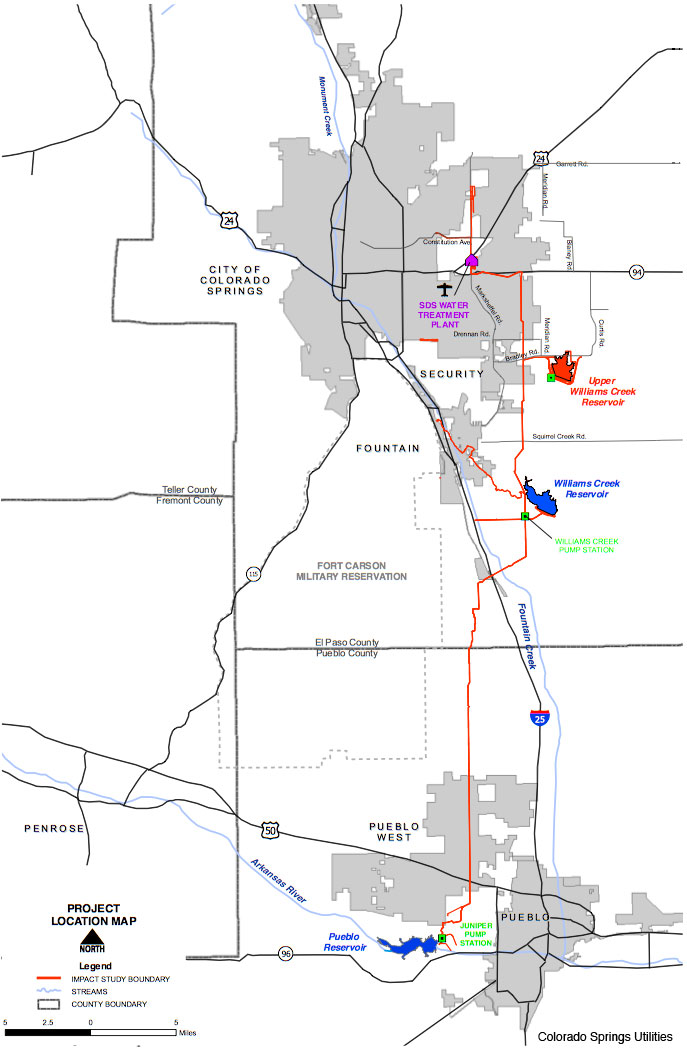
It’s the key to the $829 million SDS, one of the biggest modern-day water projects in the West, geared to deliver up to 50 million gallons of water a day to Pueblo West, Colorado Springs, Fountain and Security.
But Utilities’ massive project and its 1041 permit are not to be confused with the city of Colorado Springs’ beleaguered MS4 permit, SDS Director John Fredell told the Water Works board.
The city’s MS4, or Municipal Separate Storm Sewer System permit, is vulnerable since longtime neglect of critical stormwater controls led the U.S. Environmental Protection Agency to cite the city in October with multiple violations.
For years, Colorado Springs hasn’t properly enforced drainage regulations, conducted adequate inspections, required developers to provide enough infrastructure or maintained and operated its own stormwater controls adequately, EPA inspections in August concluded. [ed. emphasis mine]
Now city officials are negotiating with the EPA and the Department of Justice to maintain the MS4 permit. They don’t deny the EPA’s claims. Indeed, they had discussed the problems and started scrambling for solutions shortly after John Suthers was sworn in as mayor last June, months before the EPA inspections.
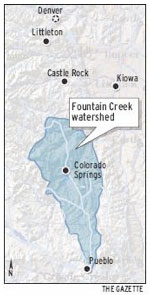
Fountain Creek Watershed
But downstream Pueblo County has been a prime victim of Colorado Springs’ failure to control stormwater surging through Fountain Creek and its tributaries. And the county holds the 1041 permit, which some believe could be used as leverage.
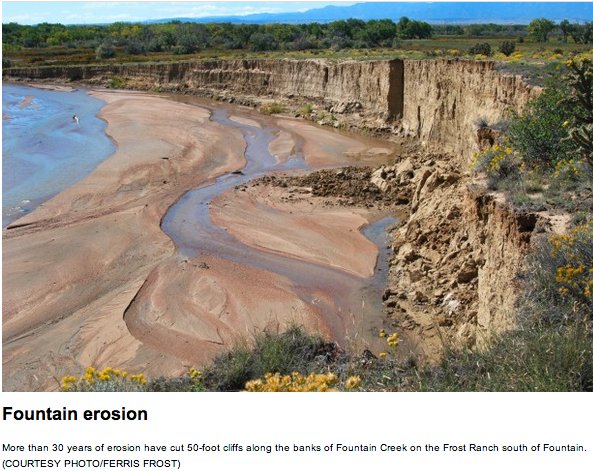
As Colorado Springs development has sprawled farther, more sponge-like land has morphed into impermeable pavement, leaving stormwater roiling across the terrain.
Sediment in Fountain Creek has increased at least 278-fold since the Waldo Canyon fire in 2012, pushing water levels far higher, reported Wright Water Engineers Inc. of Denver, contracted by the county. [ed. emphasis mine]
Sediment grew from 90 to 25,075 tons per year while water yields increased from 2,500 to 4,822 acre-feet, the engineers found. [ed. emphasis mine]
City and Utilities officials have been meeting with those engineers and their own consulting engineering firm, MWH Global, to prioritize projects.
They’ve developed a list of 73, including 58 projects recommended by Wright Water, said city Public Works Director Travis Easton. Work on the first of those commences next week, with detention ponds to be developed along flood-prone Sand Creek near the Colorado Springs Airport.
But skepticism lingers in Pueblo County, despite that effort plus creation of a new Stormwater Division, more than doubling the number of city inspectors and enforcement staff and the vow to dedicate $19 million a year to stormwater solutions.
They’ve heard promises before, Water Works board members noted Tuesday. They want a guaranteed, ironclad source of funding to stanch the stormwater that inundates their communities. And they want it yesterday.
“History’s important,” said Dr. Thomas V. Autobee, a Water Works board member.
Jay Winner, executive director of the Lower Arkansas Valley Water Conservancy District, had threatened in August to file a federal lawsuit against Colorado Springs for violations of the Clean Water Act.
Tuesday, Winner reminded the water board of how the then-Colorado Springs City Council eradicated its stormwater enterprise fund in 2009 – soon after the 1041 permit was issued – “the definition of hoodwink.”
Voters had just passed Issue 300, requiring payments to city-owned enterprises to be phased out. The subsequent council vote still rankles downstream Fountain Creek denizens.
Still, that fund never provided more than $15.8 million, Fredell noted. By contrast, the city and Utilities now are determined to spend more than $19 million a year on stormwater for at least 10 years.
They’re working on an intergovernmental agreement that would provide the guarantees Pueblo County seeks.
“Enforceablity is always an issue,” Mark Pifher, SDS permitting and compliance manager, told the Water Works board. “But we’re in discussion with the EPA and Department of Justice. The handwriting is on the wall. There will be either a consent decree or a federal order, and nothing is more enforceable.”
“If we can work this draft into something sustainable,” Autobee said, “that’s what I’d like to see.”
Board Chairman Nicholas Gradisar said he’s encouraged by the city and Utilities’ concerted efforts and swift action. “What I’m not encouraged by is the inability to come to agreement with Pueblo County.”
Gradisar said the funding must be guaranteed in perpetuity, not only 10 years, with an enforcement mechanism that doesn’t require a federal lawsuit.
Suthers, City Council President Merv Bennett and Utilities officials will meet with the Pueblo County Board of Commissioners at 1:30 p.m. Monday to continue discussions on the fate of the 1041 permit.
That meeting is in commission chambers at the old downtown Pueblo County Courthouse, 215 W. 10th St.
That night, the Pueblo City Council is to decide on a resolution similar to that tabled by the Water Works Board. It would support the county’s efforts to obtain sustained stormwater funding from Colorado Springs.
The council meets at 7 p.m. Monday at City Hall, 1 City Hall Place, in Council Chambers on the third floor.
More coverage from Chris Woodka writing for The Pueblo Chieftain:
The Pueblo Board of Water Works decided to wait a month before dipping its toes into the fray between Colorado Springs and Pueblo County over the Southern Delivery System.
The board tabled a resolution demanding a permanent funding mechanism for stormwater control on Fountain Creek in connection with Pueblo County’s 1041 permit with SDS, after testimony muddied the waters.
After SDS Project Director John Fredell tried to convince the water board that the two issues are not related, Jay Winner, general manager of the Lower Arkansas Valley Water Conservancy District cried foul.
“When you talk about stormwater, it’s not about the law or politics,” Winner said, turning to Colorado Springs ocials and inviting them to look at the damage along Fountain Creek in Pueblo. “The people are the ones getting injured. You need to do something about stormwater. You people are causing the issue.”
Winner said the Lower Ark district has tried for more than a decade to get Colorado Springs to agree to permanent funding.
Colorado Springs City Council President Merv Bennett, under questioning by water board President Nick Gradisar, admitted that Colorado Springs has not been in compliance with its stormwater permit. He, along with Colorado Springs Councilman Andy Pico and Public Works Director Travis Easton, explained in detail how the city would spend $19 million annually to address stormwater control.
About $12 million would go toward capital costs and $7 million to maintenance.
“It’s not only for downstream users, but for the benefit of Colorado Springs,” Bennett said. “We’re not waiting.
We’re moving forward.”
Colorado Springs is trying to negotiate a 10-year agreement with Pueblo County to ensure the funds stay in place.
Part of the water board’s resolution was to support Pueblo County in the bargaining.
Gradisar questioned whether that would go far to cover $500 million in identified stormwater projects, and blamed politics for the failure of past efforts to fund flood control.
“Left to its own devices, Colorado Springs Utilities would have taken care of these problems,” Gradisar said.
Southern Delivery System route map — Graphic / Reclamation
“But your voters . . . they probably wouldn’t have passed SDS.”
Water board member Tom Autobee brought up the issue of the $50 million Colorado Springs Utilities promised to pay to the Fountain Creek Watershed Flood Control and Greenway District when SDS goes on line.
Fredell explained that the SDS pipeline, pumps and treatment plant still are in testing, so Utilities does not believe the payment is due until 2017 under the 1041 agreement. Fountain Creek district Executive Director Larry Small, a former Colorado Springs councilman, said it should have been paid last week.
Fredell argued that stormwater control is not a condition of the 1041 permit, since the permit deals with new growth related to SDS.
Since SDS is not serving customers, it does not apply, he said.
“But the damage is being caused now, what happens with SDS,” Gradisar replied?
That drew a reaction from Pueblo West Metropolitan District board member Mark Carmel, who questioned whether SDS was just a speculative venture for Colorado Springs. He called for reopening the entire 1041 permit to incorporate new concerns.
Water board member Mike Cafasso said the draft resolution presented at Tuesday’s meeting could be improved and moved to table it. Other board members agreed to take it up again at the board’s February meeting.
Channel erosion Colorado Springs July 2012 via The Pueblo Chieftain FromThe Pueblo Chieftain (Chris Woodka):
The Pueblo Board of Water Works Tuesday will consider a resolution that calls for Colorado Springs to find a permanent source of funding for stormwater control of Fountain Creek.
The resolution was provided to The Pueblo Chieftain by board President Nick Gradisar. It ties a recent Environmental Protection Agency audit of stormwater violations to a 2004 intergovernmental agreement among the board, Colorado Springs Utilities and the city of Pueblo as well as the 2009 Pueblo County 1041 permit for Southern Delivery System.
The action would direct Executive Director Terry Book to contact the EPA to relay the community’s concern over the stormwater permit violations, which were revealed in November.
It also supports Pueblo County in its enforcement of the 1041 permit, which could delay the expected operation of the SDS pipeline in April.
The water board resolution also says Utilities, which was the lead agency for obtaining the 1041 permit, should have more of a role in the stormwater negotiations.
“Pueblo Water believes any revised 1041 permit or agreement must provide an adequate enforcement mechanism such that future funding of stormwater infrastructure is no subject future funding of stormwater infrastructure is no subject to the whims of different political leaders in Colorado Springs or the other SDS participants,” the proposed resolution reads in part.
It also suggests the stormwater regulations need to be in place for as long as the SDS pipeline is in operation.
That echoes concerns expressed last year by Jay Winner, general manager of the Lower Arkansas Valley Water Conservancy District, who suggested stormwater should be a fifth utility for Colorado Springs along with water, sanitary sewer, gas and electric service.
Colorado Springs had a stormwater enterprise in place in 2009 when it received federal and Pueblo County approval to build SDS, a 50-mile, $841 million water delivery pipeline from Pueblo Dam to Colorado Springs.
After a vote to sever utility payments from the city’s general fund in November 2009, Colorado Springs City Council chose to abolish the stormwater enterprise, but left other revenuesharing mechanisms in place.
The Lower Ark has placed its proposed federal court action on hold until EPA enforcement of the state stormwater permit under the federal Clean Water Act is complete.
Pueblo County is still contemplating whether Colorado Springs has met its stormwater obligations under the 1041 permit.
Pueblo City Council is scheduled to vote on a resolution requiring Colorado Springs stormwater compliance at its Jan. 25 meeting.
Colorado Springs Mayor John Suthers and City Council have proposed a plan to redirect $19 million annually from other city and Utilities funds.
Meanwhile, here’s the view from upstream via The Colorado Springs Gazette (Billie Stanton Anleu):
Colorado Springs is revving up its stormwater program, more than doubling its staff of inspectors and engineers to deflect lawsuit threats and fix problems cited by Pueblo County and the U.S. Environmental Protection Agency.
Mayor John Suthers vowed from the start of his tenure in June to address the city’s long-neglected stormwater problems, and he soon started carving $16 million from the city’s 2016 budget to add to $3 million from Colorado Springs Utilities.
“I can’t emphasize enough, this money wasn’t easy to come by,” Suthers said. “I’ve got a lot of unhappy police officers and firefighters out there,” because raises and staff additions were frozen for the year.
That $19 million dedicated to stormwater issues this year compares with $5 million from the city’s general fund in 2015, though federal grants bolster expenditures yearly. But Pueblo County officials are lamenting the loss of the Stormwater Enterprise Fund, which the City Council dismantled in 2009. They’re pointing to the eradication of that fund as cause to possibly rescind the 1041 permit they issued to Utilities to build and operate the $829 million Southern Delivery System.
The timing of the threat couldn’t be worse. The enormous project is scheduled to start pumping April 27, delivering up to 50 million gallons of water a day to Pueblo West, Fountain, Security and Colorado Springs.
Meanwhile, the EPA has threatened to sue Colorado Springs for not meeting terms of its Municipal Separate Storm Sewer System permit, better known as the MS4. After inspections in August, the EPA reported that the city didn’t have enough resources, inspections or internal controls to maintain and operate its stormwater infrastructure properly. The city also doled out too many waivers and failed to hold developers’ “feet to the fire,” the inspectors found.
Water, of course, flows downstream. So unrestrained stormwater, excessive sedimentation and degraded water quality become problems for the people in Pueblo County.
Neither Suthers nor the City Council has denied the magnitude of those problems. Indeed, the city and Utilities have proposed an intergovernmental agreement that would guarantee a minimum of $19 million a year in floodwater projects for 10 years. Utilities would be on the hook if the city experienced an economic downturn.
In addition, the city is creating a Stormwater Division to be staffed by 58 full-time employees compared with the current 28, adding inspectors and engineers.
The budget for MS4 compliance alone is increasing from $3 million to about $7.1 million. The total comes to $8.56 million if you include the cost of MS4 responses by street sweepers, firefighters and Utilities.
Arkansas River Basin — Graphic via the Colorado Geological Survey FromThe Pueblo Chieftain (Chris Woodka):
Can a water project be all things to all people?
The Upper Arkansas Water Conservancy District wants to find out.
The Arkansas Basin Roundtable approved a $194,000 grant last week to determine if irrigated agriculture, environmental, recreation, municipal supply, hydropower and aquifer storage can be satisfied in one project.
The Colorado Water Conservation Board will consider final approval of the grant at its March meeting.
The project involves the 200-acre Lake Ranch near Salida, which the district owns.
Right now, the property is irrigated by a center- pivot sprinkler, but the plan is to expand the types of uses to include a hydropower system on the Cameron Ditch above the property, recharge ponds and wetlands on two corners of the field which are not being used and research on another corner. Farm structures occupy the remaining corner of the field.
In addition, a leasefallowing program would provide water to nearby cities, and results would be used in educational programs.
“This is the smaller program, to see if some of these ideas work,” said Terry Scanga, general manager of the Upper Ark district.
If they do, a much larger project on Trout Creek that would cover 1,800 acres and could provide an additional 20,000 acre-feet in storage would be attempted.
That would be a boon to the Upper Ark district, which formed in 1979 to improve water use for numerous smaller entities in Chaffee, Custer and Fremont counties. Past studies have looked at improving how water supply is measured, the availability of underground storage and developing a leasefallowing tool to measure consumptive use when transfers occur.
“Multiple purpose projects are necessary for providing additional needed water supplies in the 21st century,” the district noted in its grant application.
Several ditches along the Purgatoire River are in line to get a much-needed $271,000 makeover through a state grant approved last week by the Arkansas Basin Roundtable.
The roundtable approved a $90,000 grant request to improve structures on six ditch companies that have deteriorated through erosion. The ditches, along with the Purgatoire Conservancy District, will contribute $121,000 and apply for a $60,000 loan from the Colorado Water Conservation Board.
The CWCB still must act on the grant and loan at its March meeting.
“All of the ditches are in the Trinidad Project,” said Jeris Danielson, manager of the Purgatoire district. “We estimated we could lose 10 percent of the water.”
The ditch companies include Picketwire, Enlarged Southside Irrigation, Chilili, Baca, New John Flood and El Moro. All are located in the Trinidad area of Las Animas County.
The project will rebuild headgates, flumes and culverts at various locations. As part of the project, about 1,000 feet of bank along the Purgatoire River will be restored and stabilized.
The Trinidad Project is a federal project that relies on water stored in Trinidad Reservoir. Over the last 20 years, it has averaged only 40 percent of its full supply. The improvements will restore about 5,000 acre-feet (1.6 billion gallons) annually toward basin water needs, according to the application.
Tamarisk
Finally, here’s a report about efforts to mitigate flooding in La Junta from Chris Woodka writing for The Pueblo Chieftain:
An $85,000 plan to remove a “pinch point” in the Arkansas River that has caused flooding in North La Junta got the blessing of the Arkansas Basin Roundtable this week.
The roundtable approved a $25,000 grant toward the project by the North La Junta Water Conservancy District to deal with a problem that has persisted since a flood in the spring of 1999. Other funding is being provided by the Lower Arkansas Valley Water Conservancy District, Otero County and La Junta.
The grant will take out several islands of tamarisk, or saltcedar, using a drag line and reconfigure dikes that apparently only aggravated flooding through the area. Combined, the projects will increase the channel capacity of the Arkansas River through North La Junta.
“This is one of my favorite projects because we did it with one engineer and no lawyers in the room,” quipped Jay Winner, general manager of the Lower Ark district.
The 1999 flood did serious damage to North La Junta, and the district has worked steadily since then to improve channel capacity through the area. Floods in recent years have renewed fears that past efforts were not as effective as hoped.
In another move, the roundtable approved a $48,000 grant toward a $54,800 project to replace a domestic water supply pipeline that serves about 175 families in the McClave area. The grant helps hold down water rates for customers in an area that eventually will be served by the Arkansas Valley Conduit.
The Colorado Water Conservation Board will consider final approval of the grants at its March meeting.
When large tracts of land are disturbed, it takes more than good intentions to return it to something approaching a natural state.
The recipe includes water, seeds, know-how and — most importantly — time.
Those lessons have been learned in the most painful way over time in the Arkansas Valley as farmland has been taken out of production, sacrificed for pipelines, scorched by drought or ravaged by fire.
Fears that those lessons have not been learned well enough have surfaced this month as a patchwork plan for farm dryups was revealed by Arkansas River Farms. The company plans to dry up about 6,700 acres of the 14,400 acres it owns on the Fort Lyon Canal, using it to support wells on farm ground elsewhere.
The most painful lesson came for Ordway in 2008, when a fire ripped through dried-up farms in Crowley County that were no longer the responsibility of those who took the water off the land. The fire, started by a controlled burn fanned by winds, claimed two lives, 16 homes and 9,000 acres of mostly former farmland.
Water was first taken off farms in Crowley County in the 1980s, when water owned by a cattle feeding operation was sold to Colorado Springs, and most remaining Colorado Canal shares were snapped up by Aurora. By that time Colorado Springs and Pueblo had bought Twin Lakes shares that had provided supplemental water for Crowley County farms for decades.
Water courts insisted on revegetation plans when the Colorado Canal shares were converted in the late 1980s, as well as for the dry-up of farms on the Rocky Ford Ditch by Aurora. Those plans appeared to be complete, only to fall apart.
Shortly after the 2008 fire, the Lower Arkansas Valley Water Conservancy District sighted in on the dry-up as an important contributing factor.
Not long after, the district was successful in obtaining tougher court provisions for the Tri-State Generation and Transmission Association purchase of nearly half of the Amity Canal. Annual reports on all dry-ups, temporary or permanent were required in perpetuity. It has been successful in applying it in other water cases since then.
And this year, Aurora returned to lands dried up in its 1999 purchase of Rocky Ford Ditch shares even after revegetation was certified by a panel of experts. The drought had damaged some of the vegetation, so Aurora used some of its water to try to reestablish the grasses.
Aurora in 2000 had to come back to Rocky Ford land that was improperly revegetated from its first purchase.
All of which feeds into continued concern about the announced dry-ups on the Fort Lyon.
“Who’s going to have long-term responsibility to make sure this gets done?” said Jay Winner, general manager of the Lower Ark district. “We are looking at assuring revegetation in perpetuity, and it should be the responsibility of those who are moving the water.”
Winner pointed to contracts when water was sold to the Lower Arkansas Water Management Authority that required landowners who had sold their water to protect the land. That led to large dust storms blowing across the landscape – even across highways — during the recent drought. “When you see that — people have died from that — you realize that it should be the responsibility forever of those who are using the water,” Winner said.
One of the questions posed to Karl Nyquist, a partner in Arkansas River Farms, last week was whether water could return to lands that were dried up. The answer was uncertain.
Two conservation districts in Bent and Prowers counties are proposing a plan to monitor revegetation efforts in the Arkansas River Farms dry-up.
It’s modeled after Aurora’s most recent efforts, trying to incorporate all of the lessons which have been learned so far. They have pitched it to county commissioners before an application to change the use of water has been filed.
“What I told them was to not be in such a hurry,” said Bill Long, Bent County commissioner.
Fort Lyon Canal’s shareholders will have a hearing about the Arkansas River Farms plan on Jan. 28-29. But Long said the issues should be hashed out in water court, rather than predetermined.
On revegetation, Winner agrees.
“I believe the water court needs to be the policeman,” Winner said.
Straight line diagram of the Lower Arkansas Valley ditches via Headwaters
Water once destined to be exported to feed growth on the Front Range could fuel economic growth in the Lower Arkansas Valley, but Bent County officials are wary of unforeseen consequences.
“Where is the water going to move to?” asked Bent County Commissioner Lynden Gill after Monday’s presentation by Arkansas River Farms at the Fort Lyon Canal’s annual meeting. “Are they going to double up water on sprinklers near Las Animas or move it somewhere else? I had assumed the water would be staying in Bent County.”
Arkansas River Farms outlined its plans to dry up 6,700 acres on the Fort Lyon while improving another 5,700 acres with surface-fed sprinklers, rather than flood irrigation. The company owns 18,400 shares of Fort Lyon water, about one-fifth of the total.
The water was purchased by High Plains A& M 15 years ago with grand plans to market it statewide. Those were shot down, first in water court and then by the state Supreme Court.
C&A Companies, one of the Arkansas River Farms partners also unveiled its plan to pipe Lamar Canal water to the Front Range in 2011.
But now, the plan is to use the water to open up new farming opportunities in Bent and Prowers counties, said Karl Nyquist, one of the principals in C&A.
“We could be the biggest job creators in this area,” Nyquist said at Monday’s Fort Lyon meeting.
And what about those pipeline plans?
“You haven’t heard me talk about it lately, have you?” Nyquist answered, adding the company will be more open as plans progress.
Bill Grasmick, the largest farmer on the Lamar Canal and a board member of the Lower Arkansas Water Management Association, said wells that have not been used in several years would be operated thanks to the water taken off the Fort Lyon.
They have talked to Bent and Prowers counties about building dairies, feed lots or vegetable farms that would provide an additional boost to the local agricultural economy. But the plans are not specific.
The water from the Fort Lyon would be used in LAWMA well-augmentation plans, which are not limited to historic boundaries for use. “About 22 percent of our local economy comes from agriculture, so any reduction will have a negative impact,” said Bill Long, another Bent County commissioner.
But looking at map of Arkansas River Farms plans, most of the improved farms are located near Las Animas, while dry-ups largely are further east, where farmers are just as likely to trade in Lamar as Las Animas, he said.
“Ultimately, there’s a chance it could be very beneficial,” Long said.
Of more concern to Long is the upcoming water court change case. That would quantify the consumptive use of the Fort Lyon shares and open them up for other uses.
“That’s one step closer to getting it in a pipeline,” said Long, who is president of the Southeastern Colorado Water Conservancy District, which took the lead role in the legal battle to stop High Plains.
There are too many unanswered questions to pass judgment, Gill said. Tuesday, the commissioners met with conservancy districts that want to supervise revegetation. And the Fort Lyon shareholders have set aside Jan. 28-29 to question the company about its impacts on the canal itself. Primary concerns so far are the revegetation question and the proposal to leave some water behind to cover losses on shared laterals.
Gill, who is also chairman of the Lower Arkansas Valley Water Conservancy District, is alarmed that dry-up could begin next year under a substitute water supply plan concurrent to a water court filing.
Long pointed out that in previous cases where revegetation was insufficient and caused problems later with weeds and blowing dust. If the Fort Lyon water is used outside Bent County, 1041 regulations also could be applied, Long said.
“We’re going to do everything we can to protect the ag economy in Bent County, and make sure if anything is done, it is beneficial to the county,” Long said.
Straight line diagram of the Lower Arkansas Valley ditches via Headwaters
Colorado Springs Utilities wants to be Super Ditch’s “dance partner.”
“For 10 years we’ve talked about how a (water leasing) program would work,” said Pat Wells, water resources supervisor for Utilities. “Super Ditch has always seemed lik e a logical fit. . . . If you’re interested in another dance partner, it’s a natural fit for Colorado Springs.”
A formal letter suggesting a partnership was sent to the Super Ditch and Lower Ark district in October. It outlined the conditions under which Utilities would be willing to participate.
Wells made the offer again to the combined boards of the Arkansas Valley Super Ditch and Lower Arkansas Valley Water Conservancy District last week. They were reviewing the success of the first year of a pilot program that delivered 409 acre-feet of water from farmers on the Catlin Canal to Fountain, Security and Fowler.
While the pilot program aims to provide a sustained yield to the cities under varying hydrological conditions, Colorado Springs is interested mainly in topping off its supplies in drought recovery years.
One of the provisions of the 2013 HB1248 legislation would allow for leasing water from farms in three years out of 10. That scenario is most appealing to Utilities because it usually has enough water from other sources.
The Colorado Springs system can hold 252,000 acre-feet of water in storage, but small amounts are useful.
“In a recovery year, 2,000 acre-feet in the right place would help us,” Wells said. “We’re not looking for a base supply year-in and year-out.”
Colorado Springs does not anticipate needing to establish a program in the next year, but is looking ahead to have a program in place should it be needed.
“Our storage is as full as it has been in several years,” Wells said.
The breathing room will allow Utilities and Super Ditch at least a year to negotiate and the soonest a program would be launched is in 2017, both sides agreed.
Colorado Springs purchased part of the High Line Canal lease from Aurora in 2005. During that year, Utilities also leased water from Pueblo Water to make up for depletions from three drought years prior to that time.
Meanwhile, here’s a report detailing this year’s pilot alternative transfer from Super Ditch to Arkansas Basin municipalities written by Chris Woodka for The Pueblo Chieftain:
A handful of farmers on the Catlin Canal were able to dry up some of their land this year and lease the water to cities in the first demonstration of how the Arkansas Valley Super Ditch would work.
The temporary fallowing of ground was carried out under a program supervised by the Colorado Water Conservation Board under the 2013 HB1248 that allows lease-fallowing project demonstration throughout the state. No more than 30 percent of farm ground can be dried up in any year over a 10-year period, or any parcel more than three years in 10.
“I think it’s calmed down the water community statewide, because it’s not hurting farmers, and the farmers say ‘We’re getting a good deal,’ ” Peter Nichols, told the combined boards of the Lower Arkansas Valley Water Conservancy District and the Super Ditch last week. “We had a good year and learned to build a bigger project.”
There were 60 conditions placed on the project in a rule-making process earlier this year in the third attempt to get a lease program off the ground. The Lower Ark district helped form the Super Ditch in 2008.
About 409 acre-feet (133 million gallons) were leased to Fountain, Security and Fowler, netting $500 per acre-foot for the farmers. They were also paid a $150 per acre readiness to serve fee.
To get to that number, the farmers dried up 235 of the 900 acres — well under the 30 percent annual limit — which translated into 252 shares of the 1,047 Catlin Canal shares enrolled in the program. The yield worked out to about 1.75 acre-feet per acre, so the total payoff was a little more than $1,000 per acre. That was not a bad outcome, considering depressed commodity prices were the norm.
“We put more water into the ground than we would have owed,” said Jack Goble, an engineer with the Lower Ark district. “It’s paid up so we don’t have to release water from Lake Pueblo for the next 20 years.”
The program gave the district and Super Ditch a chance to look at the real-world impacts of weather conditions on a lease-fallowing program. The farmers used one augmentation station to show water was being bypassed and two recharge ponds that replace flows that would have seeped into the ground from fields. Water was transferred to Lake Pueblo, where it could be used directly by Fountain and Security, or for augmentation flows that support Fowler’s wells through the Colorado Water Protective and Development Association.
Ironically, a rainy May and June made it difficult to claim recharge credits because it was too wet to run much water through the canal. But the high water levels made exchanges and trades easier so the program could be a success. The test program provided about 90 percent of the water that would have been available under the best conditions.
Typical Drip Irrigation System via Toro
“As a farmer, I couldn’t have been happier,” said Phillip Chavez, of Diamond A Farms. “We put in drip systems and laser-leveled the (fallowed) fields.”
One of the outcomes of the project was a leasefallowing tool that conforms the engineering of the project to other water models, including those set up for surface sprinklers and wells to comply with the Arkansas River Compact. Still, Kansas looked at each of the farms in the program twice during the irrigation season to make sure the required ground had been fallowed.
With farming, it’s always a wild guess in planning for the year ahead.
Crop prices could be high at the beginning of a season, and plummet by the end. Weather could bring drought, floods or hail — sometimes all of them — in any given year. Or, in that rare year, a bumper crop could bring premium prices as well.
All of which provides the groundwork for the theory of water leasing — providing a stable income with a known price for an expected amount of water.
It could be another crop for farmers, but there are hidden considerations.
“Leasing water depends on conditions. If it’s wet, no one wants it,” Brett Bovee, regional director for WestWater Research said. “It also depends on where you are in the state, and what kind of premium you can get over your baseline crop.”
Bovee was one of the featured speakers at a workshop last week at Pueblo Community College hosted by the Ditch and Reservoir Company Alliance. The workshop studied the economic, legal and political issues surrounding alternative transfer methods in Colorado.
ATMs, as the water community has chosen to shorthand them, have been a big topic in the state over the last decade. The Arkansas Valley Super Ditch is at the forefront, completing the first statesupervised transfer this year. ATMs also are a big piece in Colorado’s Water Plan.
ATM: The acronym conjures an unfortunate analogy, where you put money in and take water out. It’s not as simple as that.
Super Ditch has raised the bar for water prices in Colorado. While the average per-acre yield for the Arkansas Valley’s major crops is at the lower end in the state, it is leasing water to cities at the highest rate.
In other parts of the state, the rates range from $35-$337 per acrefoot, showing a wide disparity.
Farmers have to evaluate whether leases help their bottom line or pull water away from crops that might pay off better, Bovee said.
There are online tools that allow them to work out how much might be made growing a crop versus leasing the water.
Beyond the simple economics, there are multiple considerations to be taken into account.
On the plus side, leasing provides relatively stable prices, a high return, financing for other on-farm improvements and an alternative use for water while retaining a water right.
Drawbacks include impacts to the community, keeping a cover crop growing, keeping weeds down and the headaches of the transfer itself (engineering, legal issues and transaction costs).
“Leases can disrupt farm employment and business relationships,” Bovee said.
Statewide, water leasing has had little impact on the overall economy, but the effects locally can be tragic, as the dry-ups in Crowley County illustrate.
“The harm comes from taking water from one area and moving it out,” he said. “If agriculture makes up most of the economy and you move the water out, the effect is magnified.”
The idea of a statewide water bank is being floated by the Lower Arkansas Valley Water Conservancy District.
Coincidentally, they would be tied to ATMs.
Not automated teller machines, but alternative transfer methods, one of the key elements in the upcoming state water plan.
The state Legislature’s interim water resources committee heard the proposal Thursday from Lower Ark General Manager Jay Winner and attorney Leah Martinsson, who are working with state Rep. Jeni Arndt, D-Fort Collins, to draft a bill for the 2016 session.
“ATMs are in the state water plan, and the district has been a leader in these types of temporary transfers since it was formed in 2002,” Martinsson told the panel. “The district realized the old way of going to court to dry up the land was not going to work.”
Other programs to provide temporary transfers have not worked because they are tied to permanent water rights changes adjudicated in water court, Martinsson said. That includes flex marketing legislation Arndt sponsored in the last session.
“Farmers don’t trust the process,” she said.
The Lower Ark worked to form the Arkansas Valley Super Ditch in 2008. Under the 2013 law, HB1248, the group was able to operate a pilot program this year that leased water from the Catlin Canal to Fowler, Fountain and Security.
The concept of the water bank would build on that, limiting administrative transfers to just three years in 10 under the supervision of the Colorado Water Conservation Board. Transfers from the Rio Grande and Colorado River basins would be prohibited, Martinsson said.
“The banks would be set up on a conservative model, so you don’t argue over 23 gallons of water,” Martinsson said, referring to water accounting challenges that doomed Super Ditch’s early efforts. “We’re proposing leaving 5-10 percent in the river above what was historically left there.”
That would provide environmental benefits, she said.
Winner said the goal is to keep water on the land by providing an option where water is not sold on a permanent basis.
“What we’re trying to do is have another tool for farmers,” Winner said. “I think this would prevent speculation both by water developers and farmers. It helps keep water on the land, but gives the water rights holders the opportunity to use the water.”
Lower Arkansas River near Bent From the La Junta Tribune-Democrat (Bette McFarren):
The Lower Arkansas Valley Water Conservancy District maintains its position on current issues with flood control in Colorado Springs but acknowledges not much storage space available for water.
Roy Vaughan of the Bureau of Reclamation reported as of Aug. 16, 230,980 acre-feet are stored in Pueblo Reservoir. Turquoise, Twin Lakes and Pueblo Reservoir are all fuller than they were last year at this time.
Jack Gobel and Henry Schnable of Lamar reported the Colorado Water Protection and Development Association and possibly other well associations will go together to talk with lobbyist and try to get more water storage, for the benefit of well farmers.
Henry Schnable is interested in creating a role for John Martin Reservoir in the storing of water for areas nearer that reservoir.
State Senator Larry Crowder reported he is withdrawing his support for a dam on Fountain Creek because local constituents oppose it.
he Lower Arkansas Valley Water Conservancy District Wednesday voted to apply to the state for a $2.5 million loan to purchase Colorado Canal shares.
The district purchased 408 shares of Colorado Canal water from Ordway Feedyard in November and was working with the company to finance the deal.
The goals were to keep the financially troubled feedlot in business and to keep the water in the Arkansas Valley.
However, the feedlot continued to fall on hard times and will be auctioned in July, so the Lower Ark district needs to finalize the sale.
The district is seeking the loan from the Colorado Water Conservation Board at a 1 percent interest rate, which is an improvement over a 4 percent bridge loan from an area bank, General Manager Jay Winner explained.
The Colorado Canal once irrigated 50,000 acres in Crowley County, but has largely fallen into the hands of Colorado Springs and Aurora through purchases made in the 1980s.
More Lower Arkansas Water Conservancy District coverage here.
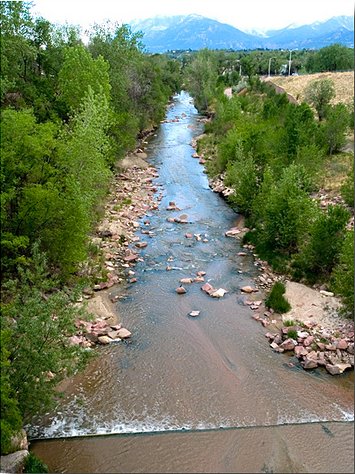
Fountain Creek through Colorado Springs. FromThe Pueblo Chieftain (Chris Woodka):
Pleas to reconsider a federal lawsuit over water quality fell on skeptical ears Wednesday.
The Lower Arkansas Valley Water Conservancy District board listened patiently to Colorado Springs Councilman Merv Bennett’s assessment of stormwater protection progress, but in the end voted to continue to pursue a federal court filing charging that Colorado Springs is violating the Clean Water Act.
The board instructed attorney Peter Nichols to continue building a case.
Bennett urged the Lower Ark board to stay out of court, saying money would be better spent elsewhere. Still the board voted 7-0 to continue the lawsuit.
“Nothing’s binding on this council, the next council or the next mayor,” board member Melissa Esquibel said, clearly frustrated by Bennett’s promises. “It’s the same conversation, the same lack of movement that we’ve had. What’s going to happen?”
Colorado Springs City Council last month commit ted $19 million annually to stormwater projects, shuffling existing funds in the city’s general fund and adding $3 million from Colorado Springs Utilities beginning in 2016.
But Jay Winner, general manager of the Lower Ark, asked Bennett if other funds in the city would be shorted in the process and political pressure would again lower stormwater as a priority.
Bennett countered that the current council is committed to funding stormwater control, as well as the candidates for mayor in the April municipal election. He said the city’s other problems, such as potholes, would be settled in some other way not related to stormwater. He maintained the city currently is spending the required amount on stormwater and council’s action makes the funding permanent.
“I believe in the integrity of the people running,” Bennett said in response to Esquibel’s comments. “I feel we’ve made progress and we’ll continue to make progress.”
But he acknowledged that three to five new members may be elected to the nine-member council, and he could not personally guarantee that the stormwater money would remain in place.
“I can’t solve it by myself and we can’t solve it overnight,” Bennett said.
Winner pressed Bennett on several issues, including the council’s 2009 decision to dissolve its stormwater enterprise, stormwater funding that has been missing in the intervening years and whether the money would go toward projects identified when the enterprise was formed in 2005.
Bennett agreed that council made the wrong decision in response to Doug Bruce’s Issue 300 in 2009. He said Colorado Springs is working on a report that would show its funding level for stormwater projects has been higher than the $17 million the stormwater enterprise would have generated each year.
He pledged to have city staff develop a side-by-side comparison of projects.
The stormwater issue is tied to Pueblo County’s 1041 permit for Southern Delivery System, which was negotiated earlier in 2009, before the stormwater enterprise was abolished. Flood control is needed because growth in Colorado Springs has elevated flows on Fountain Creek, increasing the danger of flooding in Pueblo.
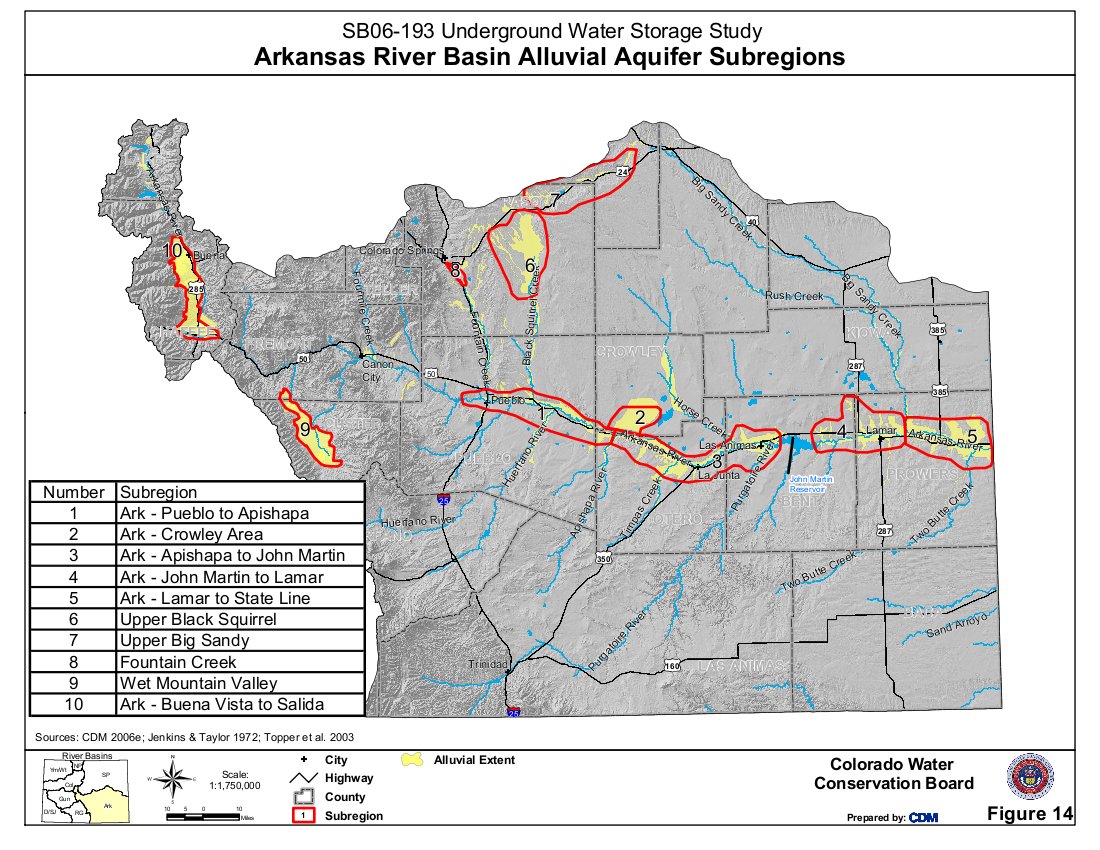
Arkansas River Basin via The Encyclopedia of Earth FromThe Pueblo Chieftain (Chris Woodka):
Water that grows food also protects wildlife and provides fun for humans.
So the district formed to protect water in the Arkansas Valley wants to make agriculture more prominent in the state water plan.
The Lower Arkansas Valley Water Conservancy District will push for a plank in the Arkansas Basin Roundtable implementation plan to strengthen its commitment to farms.
“It’s been a struggle to increase the awareness of the value of water,” said Beulah rancher Reeves Brown, who sits on both the Lower Ark board and the roundtable. “We’re emphasizing that the values of ag water go beyond just the economic value. It’s also water that you can raft, boat and fish on.”
Brown said the roundtable just last week received the long-term plan from the Pikes Peak Regional Water Authority, which includes finding more water from the Arkansas River over the next 50 years.
“The threat is out there,” Brown said.
“There are benefits of ag water to recreation and the community, not just making food,” said Lynden Gill, chairman of the Lower Ark board.
Jay Winner, general manager of the district, said a proposed statement should be accompanied by a way to measure the benefits of ag water to recreational and environmental uses.
“There are a lot of warm and fuzzy statements (in the water plan),” Winner said. “We’re trying to make a statement that’s precise.”
The 11th Annual Arkansas Valley Farm/Ranch/Water Symposium and Trade Show will be held February 5, 2015, in Rocky Ford at the Gobin Community Building. Registration begins at 8:00 am, with programming starting at 8:30 and ending at 4:00 pm. Early registration of $20.00 per person/$30.00 per couple ends January 30, 2015, after that it goes to $25.00 per person/$35.00 per couple.
Topics to be included are: Weather Outlook by Nolan Doesken, Colorado State Climatologist; Pond Seepage Study report by Brian Lauristen, Valley Ag Consulting; Risk Management by Rebecca Davis, RMA Regional Director; USDA update by Chuck Hanagan, CE Crowley and Otero Counties; Farming for the Future by Tyrell Fickenscher, Upward Ag Systems; Grass Growth and Grazing by Arlan (Chip) Hines, rangeland consultant; and A Legislative Outlook by On the Ballot Consulting.
For more information or to register call the CSU Otero County Extension Office at 719.254.7608 or visit the website http://www.farmranchwater.org.
Colorado Springs is trying to talk its way out of its stormwater commitment, and the Lower Arkansas Valley Water Conservancy District is losing its patience.
“You can talk the talk, but you’ve got to walk the walk. That’s not what I’m hearing,” Jay Winner, Lower Ark manager, told his board Wednesday. “When they talk to us about stormwater, all we get is fuzzy math.”
The board will consider whether to proceed with the federal lawsuit next month.
Winner is frustrated because his discussions with Colorado Springs Utilities have been similar to 2005 and 2007, when he was assured by Utilities the city would live up to its commitments to control drainage into Fountain Creek caused by increased runoff from development. When enumerating stormwater projects, Colorado Springs points to street projects that Winner said have nothing to do with controlling the flow into Fountain Creek.
In November, the Lower Ark board voted to prepare a lawsuit under the federal Clean Water Act over violations of its stormwater permit. Since then, the district has hired a firm to sample water quality and has been moving toward a lawsuit.
“Everybody seems to say the right things,” Winner said. “But I keep getting told, ‘Nothing happens until we get a new mayor.’’’ In November, Colorado Springs Councilman Merv Bennett asked the Lower Ark to have patience just days after voters in El Paso County rejected a drainage authority that would have raised nearly $40 million annually to improve Fountain Creek stormwater issues.
Colorado Springs council has made no overtures since then to address Lower Ark’s concerns.
“I’m not hopeful we’ll get anywhere,” Winner said.
Colorado Springs had a stormwater utility in place in 2009, when Pueblo County commissioners approved a 1041 permit for the Southern Delivery System.
The Lower Ark district lobbied Colorado Springs City Council in 2005 for creation of a stormwater utility, specifically to address past stormwater issues on Fountain Creek.
Colorado Springs has a backlog of about $535 million in stormwater projects, according to its most recent accounting.
More Lower Arkansas Water Conservancy District coverage here.
While the decision of how to spend $50 million for flood control on Fountain Creek to benefit Pueblo will be made by the parties directly involved, other input will be needed.
“Anyone who wants to come to the table and says, ‘We want to find out where money for these projects will be available,’ is welcome,” Pueblo County Commissioner Terry Hart said.
Last week, Hart made a pitch to the Fountain Creek Watershed Flood Control and Greenway District to begin planning now for the arrival of $50 million in payments from Colorado Springs Utilities after Southern Delivery System goes online in 2016. That money is seen as seed money for projects that could amount to $150 million or more identified in a corridor master plan. The money was negotiated by Pueblo County under its 1041 agreement with Utilities in 2009 for the construction of the SDS water supply pipeline through the county. It is to be used for flood control projects on Fountain Creek that benefit Pueblo County. When the district was established later in 2009, it became the recipient of the money.
“At a minimum, Pueblo County, CSU and the Fountain Creek district need to be involved, and they will have the final say,” Hart said.
But the city of Pueblo and the Lower Arkansas Valley Water Conservancy District also should have input about how the money will be used, Hart said.
The greatest potential damage from Fountain Creek flooding is within the city of Pueblo and in the communities of the Lower Ark Valley downstream from Fountain Creek.
“The Lower Ark District was instrumental in developing the corridor plan, and we definitely need the technical input from the city of Pueblo,” Hart said.
The corridor plan, a joint effort of Utilities and the Lower Ark district, identifies projects between Fountain and Pueblo that could cost several times the $50 million that was earmarked under the 1041 agreement. Pueblo already has participated in pilot projects to demonstrate flood control techniques.
In addition to technical assistance, Pueblo County’s attorneys will have to be involved to determine whether projects meet the conditions of the 1041 permit. This will be important to avoid the kinds of dispute that developed when the Lower Ark raised objections about how its contributions to the district were being spent.
“I see this new committee working in concert with the steering committee (Utilities, Lower Ark and the Fountain Creek District),” Hart said.
A federal project to map groundwater changes in the Lower Arkansas River was approved by a local board last week. The Lower Arkansas Valley Water Conservancy District voted to spend $45,300 toward a program that will look at changes in groundwater levels during the irrigation season. The project will be conducted by the U.S. Geological Survey, which is contributing $23,260.
“We measure the late fall and early spring water levels,” said Ken Watts, Pueblo scientist for the USGS. “The change in the fall measures the recharge in the system. Groundwater storage is far greater than surface storage.”
The Arkansas River aquifer is about a mile wide, 30 feet deep and 150 miles long, he explained.
The USGS measures eight surface gauges and 144 wells east of Pueblo. Watts proposed eliminating the spring measurement in order to pay for a mapping project under the current funding level of about $52,000. While the USGS has measured the area for years, the data are available only in tables. Mapping would be available online and provide an easier way to compare numbers.
The Lower Ark board voted to add $10,300 of its own money, matched with $5,820 in USGS funds to fund a more complete project.
The data is useful for several reasons, including well pumping regulations, surface irrigation plan and long-term studies.
“Surface supply and groundwater are connected,” Watts said. “If you drop groundwater levels, that will pull water to the aquifer.”
“It’s good data, and ties into the Arkansas River decision support system,” said Bill Tyner, assistant Division 2 engineer. “The data are helpful because of the difference we’ve seen in the last few irrigation seasons.”
The Colorado Water Conservation Board last week approved a pilot project that will provide the town of Fowler water from several farms on the Catlin Canal over the next 10 years. The project is the first to be attempted under 2013 legislation, HB1248, that authorized demonstration projects that determine if lease-fallowing projects are a viable alternative to permanent dry-up of farms. It is also the first test of the viability of the Arkansas Valley Super Ditch.
Participating farms would be dried up no more than three years of the next 10 in order to supply 500 acre-feet (163 million gallons) annually to Fowler. Seven farms with 1,128 acres will be dried up on a rotational basis to provide the water under a plan filed by the Lower Arkansas Valley Water Conservancy District and the Arkansas Valley Super Ditch.
The CWCB reviewed comments on the project expressing concern from Aurora, the Lower Arkansas Water Management Association, Tri-State Generation and Transmission Association, the Southeastern Colorado Water Conservancy District and Colorado Beef, a Lamar feed lot. The comments were similar to filings made in the past in water court cases that sought to permanently change water rights. Most expressed concern that their water rights would not be injured by the program and sought to assure that measurements in the program are accurate. Some were supportive of the program and all wanted to be notified of progress or changes in the program.
“We’re trying to see if a lease-fallowing program is viable,” said Jay Winner, general manager of the Lower Arkansas Valley Water Conservancy District. “We’re trying to keep the water in the Arkansas basin. That’s what it’s all about.”
The state will spend $175,000 to study the amount of water returning to the Arkansas River from fields on the Fort Lyon Canal. That will be matched with $50,000 from the Lower Arkansas Valley Water Conservancy District. The Colorado Water Conservation Board approved the grant last week as a way to address contentions from farmers that the amount of tailwater return to the Arkansas River has been overestimated. The outcome could affect the formulas used by the Colorado Division of Water Resources in administering the Arkansas River Compact and rules that govern wells or surface irrigation. It could also make more water available to farmers to lease under the Super Ditch or other rotational lease-fallow programs.
The grant was approved in July by the Arkansas Basin Roundtable.
The state now recognizes a 10 percent return of water from fields, or tailwater, that are flood irrigated. That water must be replaced under state rules adopted during the 24-year Kansas v. Colorado court case.
The Fort Lyon Canal is 100 miles long and irrigates 94,000 acres, so farmers contend water soaks into the ground and never makes it to the river. It is anticipated that the collection and analysis of data will take about two years to complete, at which time further work could be contemplated.
Leaky ponds are good news for farmers in the Lower Arkansas Valley. The second year of a pond study in a normal water year is showing similar results as last year, when drought gripped the region.
“We’re not seeing a significant difference,” said Brian Lauritsen, a consultant on the study being funded through the Lower Arkansas Valley Water Conservancy District and the Colorado Water Conservation Board.
Water leakage on more than 20 ponds averaged about 20 percent this year, compared with 18 percent last year. Most are on the Fort Lyon Canal. It had been thought the numbers would be higher when the ground was drier.
“Usually, you don’t want to see ponds leaking,” said Jack Goble, engineer for the Lower Ark district.
But in this case, there is a chance the state will adjust its formula used to determine how much water irrigators owe for return flows that are reduced through more efficient irrigation techniques such as sprinklers. More leakage means less water owed to the river.
The Lower Ark also has built two ponds on the Catlin Canal designed specifically to leak. Called recharge ponds, they are designed to return water to the Arkansas River over time, the way that water flows through the aquifer in farming operations. One pond fills part of the need for Rule 10 surface irrigation plans, while the other is credited to Rule 14 well plans. One pond contributed 135 acre-feet (44 million gallons) in a month, while the other leaked 120 acre-feet (40 million gallons) in 21 days.
“I hope we’re able to get more of these ponds, especially in the lower part of the basin,” said Jay Winner, general manager of the Lower Ark District.
More HB13-1248 coverage here. More Lower Arkansas Valley Water Conservancy District coverage here.
The olive branch appears to be bobbing like a log caught in the flow of Fountain Creek on a rainy day. The Fountain Creek Watershed Flood Control and Greenway District Friday agreed to revive its nearly submerged intergovernmental agreement committee with the Lower Arkansas Valley Water Conservancy District and Colorado Springs Utilities after weeks of feuding.
The Lower Ark district has threatened legal action over what it considers to be misspent funds by the Fountain Creek district. Meanwhile, the Fountain Creek district is making the case that all of its actions have been done by the book.
The controversy revolves around $450,000 in expenditures that the Lower Ark says should have been entirely within the corridor, defined in state legislation as the flood plain between Fountain and Pueblo.
Larry Small, executive director of the Fountain Creek district, pointed out Friday that the corridor is defined as the area between Colorado Springs and Pueblo as indicated in the master plan developed by the Lower Ark district and Utilities. Projects funded by the district are, in fact, in the master corridor plan, he said. Small showed photos of progress on the projects, which aim at bank stabilization and erosion control.
Contentious issues should be resolved as the district moves forward, said Pueblo County Commissioner Terry Hart.
A meeting on July 18 among Hart, Pueblo City Councilwoman Eva Montoya (who also chairs the Fountain Creek board), Lower Ark General Manager Jay Winner and Mark Shea of Utilities began to heal the wounds, Hart said.
“We recognize how crucial the Lower Ark is to this district,” Hart said. “If the Lower Ark or anyone else has concerns, we need to take those seriously.”
Montoya said if there are problems with the way money is being spent, they should be brought up as decisions are being made, rather than after the fact in threatening legal letters.
“Raise the issue right away, rather than sit and get PO’d about it,” she said.
At one point in the meeting there was friction between Small and Melissa Esquibel, a member of the Lower Ark board who also sits on the Fountain Creek board.
Hart tried to smooth the waters, saying that the IGA committee should continue to meet and clear up the past issues. He also asked the Fountain Creek district board to look into forming a committee to begin looking at how to spend the $50 million that will be coming to the district after Southern Delivery System goes online in 2016.
Pueblo County’s representatives on a district formed to improve Fountain Creek appear to differ on the need for a dam.
County Commissioner Terry Hart said the district needs to urgently answer questions about water rights and other issues associated with controlling flood water on Fountain Creek.
Meanwhile, Jane Rhodes, who owns property on Fountain Creek and was chosen to represent landowners, questioned whether a dam should or could be built at a meeting Friday.
“We don’t need a dam on the river,” Rhodes said. “Where would you put it anyway?”
Hart took a different view, however.
“We can’t slow down. We have a mission and a need,” he said.
The central issue has become water rights vs. property damage.
Earlier this month, the Arkansas Basin Roundtable bowed to the opinion of downstream farmers that any dam on Fountain Creek would harm junior water rights. Later, Water Division 2 Engineer Steve Witte offered the opinion that the water from page 1A rights question must be answered before any flood control projects are built on Fountain Creek. On Friday, Hart said there could be ways that junior rights could benefit from storage on Fountain Creek, a prospect that Witte also outlined. But ditch companies are unwilling to discuss those possibilities, Hart said.
“It’s emotional for them, so they don’t even want to talk about it,” Hart said.
The issue could threaten any project that attempts to capture floodwaters, said Scott Hobson, Pueblo’s assistant city manager for community investment. He pointed to the difficulty Pueblo had in satisfying the state’s conditions for its 15-acre flood water detention demonstration project near the North Side Walmart.
“Who’s going to pay for the litigation that comes with these projects?” he asked after the meeting.
The Fountain Creek district is continuing to work with Colorado Springs Utilities to find other funding sources for its proposed study of dams.
“I get tired of coming up with an idea, then getting it shot down as weeks and months go by,” Hart said.
A stormwater task force is stepping up efforts in El Paso County to put a measure on the November ballot that would create a regional stormwater authority.
“They’re gearing up for a full-fledged regional campaign,” Executive Director Larry Small told the Fountain Creek Watershed Flood Control and Greenway District Friday.
That includes public meetings, billboards and other methods to promote a stormwater fee for Colorado Springs and other communities in El Paso County.
The task force is proposing a fee structure based on square footage of impervious surface — roofs, driveways and sidewalks — that would cost the average homeowner about $10 monthly. That would raise about $48 million annually to address a $700 million backlog in stormwater projects throughout the region. The proposal would create a 13-member board made up of elected officials and provide services proportionate to population.
Colorado Springs Mayor Steve Bach disagrees with the plan, favoring an approach that takes care of the city’s problems only.
The creation of a stormwater authority would help reduce stormwater runoff — flows from cloudbursts or snowmelt — into Fountain Creek.
As a condition of its 1041 permit for Southern Delivery System with Pueblo County, Colorado Springs indicated it would continue to control stormwater at the same level as in early 2009, and would make certain that future development would not increase Fountain Creek flows. However, Colorado Springs City Council abolished the stormwater enterprise in 2009, touching off a controversy over commitment to controlling floods on Fountain Creek.
More Fountain Creek watershed coverage here and here.
The Arkansas Valley Super Ditch is planning a pilot program next year under a 2013 state law encouraging water sharing programs as an alternative to permanent dry-up of farm ground. The plan, filed with the Colorado Water Conservation Board last week, would lease up to 500 acre-feet (163 million gallons) annually from the Catlin Canal to Fowler, Fountain and Security. About 1,128 acres would be dried up on a rotational basis to deliver the water.
“What we’re trying to do is see if a lease-fallowing program is viable,” said Jay Winner, general manager of the Lower Arkansas Valley Water Conservancy District. “We’re trying to keep the water in the Arkansas basin. That’s what it’s all about.”
The application is the first to be filed under HB1248, passed last year by the state Legislature, which allows the CWCB to look at 10 test projects throughout the state. The projects are supervised by the state water board, with input from the state engineer. It may finally launch Super Ditch pilot projects that have stalled because of drought and second thoughts by farmers.
The Super Ditch submitted a substitute water supply plan with the state Division of Water Resources in 2012 for a lease-fallowing pilot project with Fountain and Security that failed because there was not enough water to move. The state restrictions that were placed on the project, fueled by objections from other water users, made moving any water in that dry year futile, Winner explained.
Last year, the Super Ditch was prepared to move some High Line Canal water to Fowler, but the deal was stopped when farmers pulled out. Fowler leased 125 acre-feet of water for $25,000 from the Pueblo Board of Water Works instead.
Under the plan outlined in the application, Fowler would lease up to 250 acre-feet, while Fountain and Security would lease up to 125 acre-feet each annually.
State law provides that the plan can be operated for 10 years.
“I think we’ll try it for a year or two, just to see if lease-fallowing is feasible,” Winner said. “We have to see if we can move water to Lake Pueblo. One of the drawbacks of HB1248 is that it only allows for municipal leasing, but if this works, there’s the possibility for industrial or agricultural leases as well.”
More Arkansas Valley Super Ditch coverage here and here.
A feud between two water districts over how Fountain Creek grant money is being spent deepened this week. The Lower Arkansas Valley Water Conservancy District Monday mailed letters to state and federal agencies claiming that the Fountain Creek Watershed Flood Control and Greenway District “illegally spent or committed” funds that were used as matching funds for grants.
Fountain Creek District Director Larry Small denied there is any wrongdoing.
“We have a record of all decisions and those making these charges were a part of the decision,” Small said. “Maybe they need their memories refreshed.”
Lower Ark board members said the money from their district and Colorado Springs Utilities, more than $450,000, is supposed to be used in the Fountain Creek corridor — defined in statute as the area in the flood plain south of Fountain and north of Pueblo.
Additionally, any money applied under Pueblo County’s 1041 permit toward Colorado Springs’ $50 million obligation for flood control must benefit Pueblo.
But grants for fire mitigation studies on Upper Fountain Creek and for trails in the Colorado Springs area have been pressed by the Fountain Creek district without proper consultation, the Lower Ark board said.
“It continues to anger me that these people in El Paso County continue to believe that the state line ends at southern El Paso County,” said Anthony Nunez, a former Pueblo County commissioner who represents Pueblo County on the Lower Ark board.
On Wednesday, he and other board members were fuming that Small had canceled a meeting in Rocky Ford to discuss the issues.
Small had notified the Lower Ark and other participants in the district by email that the July 25 meeting would be in Fountain, rather than Rocky Ford as planned at last month’s meeting.
The state statute does not allow meetings outside Fountain Creek district boundaries, which includes Pueblo and El Paso counties, Small explained.
That infuriated Nunez, who complained that the Upper Fountain grant includes Woodland Park, which is in Teller County.
Contacted after the meeting, Small said Woodland Park is paying its own way in that grant, and agreed with the Lower Ark board that no Fountain Creek district money can be spent outside its boundaries.
Overshadowing the need to look at the technical details of a study for a dam or detention ponds on Fountain Creek is how it would be funded. As of this week, the study has been battered about with all the care of an uprooted tree bobbing in the water. Other water issues may be getting snagged on it.
In May, Colorado Springs City Council stonewalled funding the study.
This week, the Arkansas Basin Roundtable couldn’t get past the issue of water rights and shrugged off consideration of a state grant for $135,000 that would have been part of a $220,000, 2-year study to look at the consequences of a dam and the feasibility of building it.
Larry Small, executive director of the Fountain Creek Watershed Flood Control and Greenway District, was frustrated after the meeting. Small walked the roundtable through the years of studies that led up to the conclusion that the best way to protect Pueblo from stormwater runoff in Colorado Springs — much of it made worse by development in the last 40 years — is to stop the water upstream of Pueblo.
“Is there a way to balance the needs of flood control and water rights or do we just throw up our hands?” Small said at one point during the meeting. “It may not be possible, but we need to find out.”
After the meeting, he was clearly frustrated.
“This is such a small part of the overall costs,” he said, slapping his hand against a folder of supporting information for the study.
During the meeting, several roundtable members made the point that junior agricultural water rights could be harmed during a flood.
The Fountain Creek district has attempted to deal with that in the past, including a comprehensive workshop on the topic, attended by some farmers, in December 2011.
Some saw value in looking at the water rights question just to determine if the rest of the study could proceed.
“This at least gets the conversation on the table,” said Jay Winner, general manager of the Lower Arkansas Valley Water Conservancy District.
In the end, the water rights question became a deal stopper.
There also are side issues that play into the question, such as a simmering feud between the Fountain Creek and Lower Ark districts about how matching money for grants has been applied under an intergovernmental agreement among the districts and Colorado Springs.
“I would encourage the IGA partners to come together soon and resolve their differences,” said Alan Hamel, the basin’s representative on the Colorado Water Conservation Board.
Hamel was one of the few roundtable members who spoke in favor of the grant.
“I think this is a wakeup call for the Fountain Creek district,” Winner said. “You don’t just sit up in Fountain and pretend to rule the world. The district needs to realize it’s in the water business.”
More Fountain Creek watershed coverage here and here.
Tunneling under Fountain Creek is proving more difficult than expected for the Southern Delivery System. Some pipeline near Pueblo Dam has been laid in solid rock. And the temporary irrigation system to provide water for native vegetation over the pipeline scar through Pueblo County contains 50 miles of pipe (main line and laterals) and 15,000 sprinkler heads. Those were some of the highlights of a progress report by Mark Pifher, SDS permit manager, to the Lower Arkansas Valley Water Conservancy District Wednesday.
“The tunneling project was more difficult than we thought,” Pifher said. The work was being done just over the El Paso County line from the west side of Interstate 25, with a tunnel-boring machine 85 feet below ground.
Because of the difficulty, a second borer from the east side one mile away is being used.
“They had better meet in the middle,” Pifher joked.
More than 44 miles of the 50 miles of 66-inchdiameter pipeline from Pueblo Dam to Colorado Springs has been installed; a treatment plant and three pump stations are under construction; and a Fountain Creek improvement project has nearly been completed, he said. All of the pipeline in Pueblo County has been installed, and revegetation has begun on 323 acres that were disturbed in Pueblo West and on Walker Ranches. The irrigation system is so large that it has to run in round-the-clock cycles seven days a week, Pifher noted.
“It’s apparently the largest sprinkler system in the state,” he said.
Another 484 acres has been planted with native seed in El Paso County.
As of March, $359 million has been spent on SDS, with $209 million going to El Paso County firms, $65 million to Pueblo County companies, $900,000 to Fremont County contractors and $84 million to businesses in other parts of Colorado.
More than 28,000 acres of Arkansas Valley farm ground — roughly a tenth of all irrigated land — is being covered by group plans that guard against increased consumptive use from surface irrigation improvements.
The state pushed consumptive use rules for irrigation through Division 2 Water Court in 2010. The rules are meant to protect Colorado in its 1949 Arkansas River Compact with Kansas.
Rule 10 allows groups to file plans in order to save on legal, engineering and administrative costs.
The Lower Arkansas Valley Water Conservancy District is administering two Rule 10 plans this year.
One covers farms on the Fort Lyon, which represents 18,000 acres. About 12,000 of those acres are under sprinklers, while the remainder are flood irrigated.
The second plan covers 10,000 acres not on the Fort Lyon Canal, with two-thirds of that under sprinklers and 105 acres using drip irrigation.
“About two-thirds of the farm are in the Fort Lyon plan. The goal is eventually to have them in their own group plan that would be self-sustaining,” said the district’s engineer Jack Goble during a presentation at Wednesday’s board meeting.
This year’s Lower Ark plans cover 235 improvements on 92 farms that should require almost 1,900 acre-feet of replacement water. The amount owed is determined by a mathematical model devised by the Colorado Division of Water Resources that determines how much water would have been used before and after improvements.
“It’s a guess of what we’ll owe,” Goble said. “The model is almost like a parallel universe.”
The more water used in irrigation increases the amount owed to replace depletions in the river.
“The more water that comes through the ditch, the more is owed,” Goble said.
Goble walked the board through the complicated model, which takes irrigation flows, precipitation, seepage and runoff into account.
The Lower Ark district is in the second year of a study on pond leakage, which so far is showing that more water is escaping than accounted for in the state’s model. Data from the study in some cases has been applied to specific ponds.
More Ark Valley Consumptive Use Rules coverage here and here.
From the La Junta Tribune Democrat (Bette McFarren):
On Wednesday, the Lower Arkansas Valley Water Conservancy District entered into an intergovernmental agreement with Otero County for the purpose of creating the Arkansas Valley Rural Water Authority. As Bill Hancock of the LAVWCD explained, this organization has been a long time coming about and is much needed in the valley so that small water companies may deal with new regulations on drinking water.
The organization will help the companies in many ways. First, it will enable them to apply for grants and loans to maintain or replace outdated equipment. More important, they can now speak as a group. They can get together a portfolio that will enable them to connect with the conduit (to receive higher quality water from Pueblo Reservoir). Perhaps the most important point of all, said Hancock, is that they will be able to hire a full-time person to deal with the extremely complex problems involved with water distribution and getting funds for improvement.
After passing the intergovernmental agreement which makes the organization possible, the LAVWCD appointed its two members of the AVRWA board, Wayne Snyder and Jolean Rose. Snyder has been working with the three founding members of the AVRWA for months to find a way to create the organization. Rose’s husband was one of the originators of the idea of the independent water companies joining forces. These companies are Valley Water, represented by Sam Fosdick; Vroman Water, represented by Kenny Wilson; Fayette Water, represented by Alan Franz. Other companies may join the association. The Otero County Commissioners entered into the IGA on Monday at their regular meeting. They will be taking applications for their two spots on the board. The other board member will be selected by the members of the AVRWA.
Terry Dawson, standing in for Roy Vaughan for the U.S. Bureau of Reclamation, gave the group the good news that we may actually be having a wet year. The Pueblo Reservoir is up to average for the first time in many years. As of April 14, 195,543 acre-feet are stored in Pueblo; 129,145 a/f of project water, 35,266 a/f of excess capacity water, 127,804 a/f of Project space in Pueblo, 70,161 a/f of Project space in Twin and Turquoise.
The melting of the snowpack will start early this year, predicts the Bureau. The problem with pumping the water from Turquoise to Twin Lakes has been solved with fixing the troublesome pump. In other words, the water situation looks good for agriculture. Dawson said the wet weather will continue through the spring to early summer, followed by a dry period, then another wet period in the fall, according to best predictions. A cautionary note: weather may be predicted with any degree of accuracy for only a week at a time.
Local officials still are skeptical of pending legislation that would establish a flex marketing water right. The bill, HB1026, as introduced would have allowed agricultural water to be used anywhere, any time and for any purpose, apparently in contradiction of the state’s anti-speculation doctrine.
[…]
It breezed through the state House, but has been snagged for weeks in the Senate agriculture committee.
“In theory, it sounds good, but there are still not enough sideboards on it,” said Jay Winner, general manager of the Lower Arkansas Valley Water Conservancy District.
Winner has been trying to get a provision added to the bill that would limit fallowing of farmland to three years in 10 — a staple of current law regarding temporary transfers. Backers of the bill have pushed for allowing transfers to occur five years in 10, with nearly unlimited dry-up of farm ground during that time.
The bill was supposed to be heard in the Senate ag committee Thursday, but was again delayed. Winner thinks it should be referred to the interim water resources committee to work out differences.
Meanwhile, the Pueblo Board of Water Works also is backing off from supporting the bill. Even though provisions were added that prevent moving water from the water district where it originally was used, farms might be permanently dried up, said Terry Book, executive director of the water board.
“Our question is does it do what it’s intended to do?” Book said. “We would support something that allows farmers to market water, but not this bill.”
The groundwork for a rural water authority in Otero County was put in place Wednesday. The Lower Arkansas Valley Water Conservancy District agreed to partner with Otero County commissioners to sign on three water providers to participate in the authority. The authority will give the water providers, which are small private companies, the ability to apply for government grants in order to bring their water systems into compliance with public health standards. It also will allow them to share operating expenses, deal with issues relating to the upcoming Arkansas Valley Conduit and to speak with one voice. Eventually, it could allow participants to hire staff members to deal with water issues.
“We have a lot of issues with compliance, because 14 out of 28 private water providers in the valley are out of compliance,” said Bill Hancock, conservation manager for the Lower Ark district.
Right now, only three of the districts have signed on, the Fayette, Vroman and Valley districts, all in Otero County. Combined, they serve fewer than 500 people. Other water companies are expected to sign on as the authority develops.
“We have the ability to expand in Otero County, as well as other counties in the valley. This is a good place to start,” said Otero County Commissioner Keith Goodwin.
One of the first projects of the authority will be to apply for a state loan to fund adding membrane filters to the systems, Hancock said. The filters are made by Innovative Water Technologies, a Rocky Ford company.
Otero County commissioners voted Monday to approve the authority, but appointed no board members. The Lower Ark appointed Wayne Snider and Jolean Rose, both of Fowler, to the authority.
“We’re at the point now where we have the vehicle, but we still need to add the engine, steering and wheels,” Snider said.
The Lower Ark board praised the agreement.
“Anyone who has been involved with rural water knows how important this is,” said Lynden Gill, chairman of the board.
“Not only is compliance important, but some of these systems are 40-50 years old and this provides a way to maintain them.”
A flex marketing water right bill that passed the state House earlier this year would, in effect, overturn a state Supreme Court decision that prevented moving water out of the Fort Lyon Canal. That’s the opinion of Peter Nichols, water attorney for the Lower Arkansas Valley Water Conservancy District, who has been working to change the bill, HB1026, to provide more assurances that agriculture would remain the primary use under the new type of water right.
“The way the bill has been amended overturns the High Plains decision,” Nichols said, referring to a 2004 ruling by former water judge Dennis Maes that was upheld by the state Supreme Court.
High Plains claimed multiple uses for unnamed end users in counties throughout Eastern Colorado in its attempt to move water out of the Fort Lyon Canal. Maes rejected the application under the state’s anti-speculation doctrine that requires an end user to be named in a water change case.
“The way it’s written, if you had 1,000 acres, you could dry up 999 acres every year,” Nichols said. “That seems like a Trojan horse for a permanent buy-and-dry.”
The district is working with key lawmakers to try to put better limits on the bill that would make it conform to current laws which limit the frequency of years when water could be put to alternative uses and the amount of land that can be dried up.
The Lower Ark district promotes the Arkansas Valley Super Ditch, but helped create it with the intent that water would be treated as another “crop” and not permanently removed from the land.
Nichols also suggested that removing ag water too often from fields would create environmental consequences for wetlands and return flows to rivers.
“For some reason, the environmental community has not paid attention to this bill,” Nichols said.
he Southern Delivery System is on course to begin operating in 2016.
“It will be complete for testing purposes in 2015,” SDS Permit Manager Mark Pifher told the Lower Arkansas Conservancy District in an impromptu update Wednesday.
SDS is a 50-mile pipeline from Pueblo Dam to Colorado Springs. When completed, it will serve Colorado Springs, Fountain, Security and Pueblo West. Nearly all of the pipeline is in the ground, and construction has begun at three pumping stations, including one near Pueblo Dam, Pifher said. While all parts of SDS will be complete by next year, the system will require months of testing before it is put into use.
“When it’s finished, the water won’t be delivered,” Pifher said. “It won’t be pushing water to customers until 2016.”
The Lower Ark district has been in negotiations for years with Colorado Springs on the impacts of SDS, particularly increased flows on Fountain Creek. Pifher updated the Lower Ark board on the progress of stormwater meetings in Colorado Springs.
A committee of El Paso County citizens is working toward putting a stormwater enterprise proposal on the November ballot. Fees would be about the same as under the former enterprise, which Colorado Springs City Council abolished in 2009, Pifher said.
The Lower Ark board also got a review of the U.S. Geological Survey of dams on Fountain Creek from USGS Pueblo office chief David Mau. Noting the study was funded by Colorado Springs (under its 1041 agreement with Pueblo County), Pifher said an alternative for 10 side detention ponds south of Fountain held the most promise for reducing flood impacts on Pueblo. Pifher also downplayed the immediate impacts of SDS on Fountain Creek.
“When we turn it on, it will carry 5 million-10 million gallons per day,” Pifher said.
Over 50 years, that will increase flows up to 96 million gallons per day.
“It will take some time to grow into demand on that system,” Pifher said.
More Southern Delivery System coverage here and here.
The first pilot program under a new state law that would allow temporary water transfers under the supervision of the Colorado Water Conservation Board has been scuttled. The planned lease of water to Fowler by the Arkansas Valley Super Ditch was pulled from the table last week after farmers who were leasing the water pulled out. It was the first plan introduced under last year’s HB1284, which allows the CWCB to monitor pilot programs that develop alternatives to buy-and-dry water transfers.
“It’s disappointing that we weren’t able to put the program in place,” said Jay Winner, general manager of the Lower Arkansas Valley Water Conservancy District. “We need to make sure Fowler survives. The first job of the Super Ditch is to keep small towns viable. This is really about the Arkansas Valley solving the Arkansas Valley’s problems.”
Fowler uses wells to supply its water, but needs an outside supply to augment those wells, City Manager Dan Hyatt explained. The town has been under water restrictions.
“It appears Fowler will be fine with water this year,” Hyatt said.
Monday, the town council considered its options, which could include leasing water from the Pueblo Board of Water Works. The water board has not taken action on water leases this year.
This is the second pilot program that has fallen through for the Super Ditch. In 2012, the group set up a pilot program with Fountain and Security, but could not pull all of the pieces together in time to execute the lease. Severe drought played a role in that program.
Last year, Aurora made an offer to Super Ditch to lease water, but farmers rejected it because the asking price was too low.
The Super Ditch and Lower Ark district supported HB1248 because of the technical backlash from other water users that surfaced under the existing rules for a substitute water supply plan.
More Arkansas Valley Super Ditch coverage here and here.
THE WATER buffaloes are relentless in their devious pursuit of easier, quicker ways to take Colorado’s irrigated agricultural water and market it to the urban Front Range. If they have their way, these voracious urban-suburban interests would destroy rural communities while fueling lucrative but unwise population growth up north.
The latest wolf at the door is House Bill 1026, which cleared the state House Agriculture Committee on a 10-3 vote Monday. This so-called “flexible water markets” — or flex water rights — bill would turn Colorado’s time-honored anti-speculation doctrine on its head by allowing speculators to convert ag water rights to any use of their choosing — essentially at any time.
“Our big fear is that this could be a Trojan horse for municipalities to come in and take water from farms,” said Jay Winner, general manager of the Lower Arkansas Valley Water Conservancy District.
We share Winner’s alarm at the threat of speculation, which current Colorado water law prohibits.
However, even if speculation somehow was prevented with a bill amendment, [HB14-1026, Water Flexible Markets] still would pose a grave threat to the Arkansas Valley’s rural economy and future viability.
House committee amendments that did make it into the bill were touted as making it more palatable. However, that’s just so much propaganda.
One amendment would allow a change to flexible markets water rights only within the basin of origin. This might prevent Aurora, which is in the South Platte basin, from raiding the Lower Arkansas Valley again. However, it wouldn’t stop the same damage from being inflicted within our basin by, say, Colorado Springs.
Another amendment would allow a water judge to reconsider previous approval of a “flex water right” to “remedy or preclude” injury to other water rights. But it’s stated in such convoluted language that the “big guy’s” high-priced water lawyers and experts would bury the opposition in court.
There’s a lot of other things wrong with HB1026 and absolutely no compelling reason to pass it. The wolf is again at the door and must be stopped before destroying its prey.
A comprehensive study of Arkansas River water use that will aid the Arkansas Valley Super Ditch in temporary water transfers is nearing completion. “The objective is to develop a tool to look at lease-fallowing effects and quantify the amount of water to be exchanged,” Rick Parsons, an engineering consultant, told the Lower Arkansas Valley Water Conservancy District on Wednesday. The district has helped Super Ditch since its formation in 2008 as a way to allow farmers to lease water without selling their underlying water rights, preventing the dry-up of farmland. The district and Super Ditch are working on a pilot program with Fowler this year.
The Super Ditch has contemplated several strategies for moving water, including filing an exchange decree in water court, using existing substitute water supply plans and creating pilot projects under last year’s HB1248. The problem has been getting water users to agree to how those exchanges will avoid damaging other water rights.
Since 2011, Parsons has been compiling information about how water is used in the Arkansas River basin, looking at river operations from 1980-2013. His model should be complete in May. The Super Ditch needs a model that will be generally accepted by other water users, Parsons said. Parsons has met with the state, Colorado Springs Utilities, Aurora and the Pueblo Board of Water Works to glean information. He also has worked with ditch companies to obtain additional data.
The major obstacles at this point are reconciling data from different sources and understanding reservoir operations. Some Lake Pueblo operations related to Southern Delivery System are not clear because of proprietary information held by Colorado Springs Utilities, Parsons said. Reservoirs on the Colorado, Holbrook and Fort Lyon systems are operated by private companies.
“There are a million numbers in this model, and a million in the state database. Some of them are wrong,” Parsons said. “If this is used in a court document, it will be challenged to the nth degree. It has to be as transparent as possible.”
More Arkansas Valley Super Ditch coverage here and here.
During the monthly meeting of the Upper Arkansas Water Conservancy District board of directors, consultant Ken Baker discussed preliminary efforts to develop a bill that would create a “flexible water market,” saying he believes some form of bill will be enacted during the next legislative session.
Baker said the bill would allow the amount of water attributed to historical consumptive use on irrigated land to be put to other uses during temporary fallowing of that land and allow the water to be put to any beneficial use without designating the specific use, as is currently required. Through a flex market, Baker said, agricultural water rights holders could implement rotational fallowing of their farmland and lease a portion of their water for other beneficial uses, while retaining sufficient water to sustain agricultural activities and keep the land in production. A key element of this approach, Baker said, is that the bill would grant the state water engineer the authority to approve flex market filings and agreements, removing Water Court from the process except for appeals.
Baker also noted that nothing proposed in the bill to date addresses storing or transferring water leased through the proposed flex market system. Baker said one concern with the legislation is basin-of-origin protections for water in the Arkansas River Basin because similar bills passed in 2013, HB-1248 and HB-1033, do not protect the Arkansas Basin from transbasin diversions.
In other business, directors:
Learned that a final decree was issued granting absolute storage rights for all district water in O’Haver Reservoir and all but 100 acre-feet of district water in North Fork Reservoir.
Learned that the Colorado Water Conservation Board approved a grant to fund phase 2 of the Helena Ditch project, which will include construction of concrete components to ensure sufficient capacity in the ditch and a bypass to return excess diverted water back to the river.
Learned from hydrologist Jord Gertson that Arkansas River Basin snowpack has reached 139 percent of average and that the district is gaining native and transbasin winter water in Twin Lakes Reservoir.
Heard comments from attorney Kendall Burgemeister indicating U.S. Sen. Mark Udall’s proposed Browns Canyon National Monument legislation “seems favorable to the district.”
Heard from Director Tim Canterbury that preliminary discussions have begun in an effort to craft legislation concerning livestock ponds that have no water rights, some of which the Colorado Division of Water Resources officials have ordered drained.
Discussed the exemption from the priority system of livestock that drink from a free-flowing stream or ditch.
Received a list of projects from the Personnel and Finance Special Committee and were asked to prioritize projects and submit those priorities to the committee prior to the January meeting.
Heard from Cañon City Water Superintendent Bob Hartzman about ongoing efforts to protect the watershed through erosion prevention and revegetation in areas burned by the Royal Gorge Fire.
Heard from Director Frank McMurry that the U.S. Forest Service will no longer pursue its plan of forcing ski resorts to surrender their water rights, a plan that agricultural water rights holders had opposed.
Approved, by an 8-4 vote, dropping opposition to the Lower Arkansas Water Conservancy District’s Super Ditch case if the Lower Ark district agrees to drop its opposition to the Upper Ark district’s 04CW96 case. McMurry, Canterbury, Tom French and Bill Jackson voted against the measure.
Renewed the U.S. Geological Survey contract for the Groundwater Network Study.
Approved stipulations negotiated with St. Charles Mesa in case 04CW96 relating to basin-wide exchanges.
Learned from Burgemeister that the deadline for filing oppositions in the district’s Cottonwood Creek exchange case had been extended into February because the Aspen newspaper failed to post notice of the filing.
Farmers are still not happy with the state’s accounting of the impact of surface irrigation improvements on return flows to the Arkansas River.
“We’ve got to change the formula,” Lamar farmer Dale Mauch told officials Friday after learning of preliminary results from a two-year pond study at a meeting hosted by the Prowers County Soil Conservation District. “We’re getting screwed here. Does Kansas owe me water?”
The pond study is being conducted under a state grant through the Lower Arkansas Valley Water Conservancy District and won’t be finished until next year. But results from 2013 show that ponds leak about twice as much as assumed under a state formula adopted in 2010 surface irrigation rules.
The rules are meant to assure that Colorado does not take more of its share than it is entitled to under the Arkansas River Compact with Kansas, said Assistant Division Engineer Bill Tyner.
The Lower Ark district provided 1,160 acre-feet of replacement water to make up for calculated deficits caused by sprinklers on 107 farms under Rule 10 plans this year. Most of the sprinklers are located on the Fort Lyon Canal. Those included 81 ponds, which were presumed to leak at a rate of about 10 percent under the state formula.
But a study of 20 ponds by engineers Jerry Knudsen and Brian Lauritsen shows they leaked anywhere from 3-45 percent, averaging about 18 percent. Those numbers were used in the state calculations, but only for ponds that were measured.
Ponds with higher leakage tend to crack as they dry up between irrigation runs, Knudsen said. Because of the drought, irrigation runs were less frequent this year, and most of the 50 farmers who attended the meeting expressed doubts that a water-short ditch like the Fort Lyon Canal owed any water to the river under those conditions.
Cutting back the amount of augmentation water needed for the Rule 10 plans is critical to making irrigation affordable. The price of augmentation water is expected to increase, especially in years such as this one when it is not readily available. Water used for this year’s Rule 10 plans ranged in cost from Fry-Ark water, which costs $7.50 per acre-foot, to water leased from the Pueblo Board of Water Works, at a cost of $250 per acre-foot (including storage). Other sources included the Larkspur Ditch and Twin Lakes water owned by the Lower Ark district.
While the cost is going up, water leasing also competes with well groups, said Jay Winner, manager of the Lower Ark district.
“Buying water on the spot market in the future is not promising,” Winner said.
A district committed to keeping water in the Lower Arkansas Valley has joined a network that provides real-time water quality data on the Arkansas River from Leadville to the Kansas state line. The Lower Arkansas Valley Water Conservancy District board Wednesday approved spending $34,000 in the next year to help operate stream gauges and gather information from wells below John Martin Reservoir. The information is widely available on the Internet. The district’s contribution will be matched by $17,000 in federal funds from the U.S. Geological Survey.
“The focus is on the reach from Pueblo to the state line,” said David Mau, head of the Pueblo USGS office.
The Southeastern Colorado Water Conservancy District, Pueblo Board of Water Works and St. Charles Mesa Water District also participate in the program.
Measurements track salinity and temperature of water in the river, as well as groundwater levels. The information provides a baseline that allows water users to track changing water conditions from either natural causes or new uses along the river, Mau said.
Past measurements show salinity increases when water levels are low and as water moves downstream. Crowley County board member Jim Valiant asked if selenium also will be studied. Mau replied that selenium is studied, but not as a part of this project.
Water temperature varies most by the time of year, but can increase when levels are low. Mau said the information is valuable to track fish habitat and to establish the relationship between surface flows and groundwater. Water levels are tracked in 130 wells along the river, some with more than 50 years of data to provide historic comparison.
The board enthusiastically supported the study, and encouraged Mau to provide more frequent updates.
“We need to keep up with the information,” said Leroy Mauch, a board member from Prowers County.
Ponds that feed irrigation systems in the Lower Arkansas Valley are leaking twice as much as farmers are given credit for, a study is showing. But farmers will have to wait another year for the study to be completed before they can even begin to hope for a change in the state’s formula. In the meantime, those who measure the water coming into and leaving the ponds will be able to apply that to state calculations for replacement of water under surface consumption rules.
The Lower Arkansas Valley Water Conservancy District is sponsoring a two-year study of pond leakage for farmers who use the ponds to collect water for use in sprinkler systems. There are 26 ponds in the study, but there have been problems with the timing of measurements and malfunctioning meters on some of the ponds. The amount of leakage is complicated to measure, depending on the size of ponds, soil conditions, how often the ponds are filled and lag time for water to return to the river, said consultant Brian Lauritsen.
This year, the state’s model showed leakage of about 8 percent on the ponds, while measurements averaged about 18 percent, said Bill Tyner, assistant division engineer for the Colorado Division of Water Resources. Individual ponds ranged from 2-40 percent leakage. “We’re giving credit for any pond with a meter,” Tyner said.
Farmers have joined Rule 10 group plans set up by the Lower Ark district that allow them to account for sprinkler systems fed by surface water supplies. The Lower Ark provides replacement water, but farmers must pay to join and use the plan.
They’re not happy.
“It’s ironic that we go through all these numbers and nitpick them,” said Lamar farmer Dale Mauch. “But no one ever looks at flood ground, and the HI model isn’t even close.”
The Hydrologic-Institutional model was adopted as part of the U.S. Supreme Court case Kansas v. Colorado over the Arkansas River Compact.
A conservation easement on the Bessemer Ditch will preserve 105 acres in farmland. The Lower Arkansas Valley Water Conservancy District accepted the easement Wednesday. The board uses such easements as part of its mission to keep water in the Lower Ark Valley. It is the custodian for more than 50 easements. Typically, property owners pay for the easement, which undergoes periodic inspections, and are eligible for state and federal tax benefits.
The Bessemer Ditch farm is owned by the Wild Rose Ranch Inc., which is a company formed by the Wally Stealey family. It is located on 43rd Lane and has about 35 shares of Bessemer Ditch water, explained Bill Hancock, who manages conservation programs for the Lower Ark district.
Each share of the Bessemer Ditch provides enough water to irrigate an acre in an average year.
Most of the land is a reclaimed gravel pit or used for pasture land and has not fared well during the drought. An area beneficial to wildlife, Six Mile Creek, crosses the property, Hancock said.
Stealey has donated other easements on the Wild Rose Ranch in Fremont County to the Lower Ark District in the past.
The board voted unanimously to accept the conservation easement.
More Lower Arkansas Valley Water Conservancy District coverage here.
A federal decision on the Southern Delivery System is headed to court. The Lower Arkansas Valley Water Conservancy District is preparing a complaint to file in federal court over the Bureau of Reclamation’s refusal to reopen its record of decision on SDS. The central issue is the abolishment of the Colorado Springs stormwater enterprise in 2009, which was in place when Reclamation granted approval of a 40-year contract for storage, exchange and connection at Pueblo Dam for SDS.
“I’m asking our board to draft a legal complaint against the Bureau of Reclamation,” said Melissa Esquibel, a Pueblo County board member. “We’ve asked the Bureau of Reclamation to reopen the record of decision, and gotten no action. We need to direct staff to draft a lawsuit.”
Lower Ark board members say SDS should not be allowed to deliver water until the stormwater issue is resolved. “If there had not been a stormwater enterprise, SDS never would have gotten a 1041 permit,” said Anthony Nunez, a Lower Ark board member who was a Pueblo County commissioner in 2009.
Last year, the Lower Ark district sent letters to Reclamation asking to reopen the record of decision on the stormwater issue. Reclamation declined to take any action.
This will be the second lawsuit the Lower Ark district has filed against Reclamation, if the board approves it at its October meeting. In 2007, the Lower Ark sued Reclamation over a 40-year storage and exchange contract with Aurora, claiming it illegally allowed the Fryingpan-Arkansas Project to move water out of the Arkansas River basin. The lawsuit was settled in 2009, after Aurora and the Lower Ark signed an agreement for mitigation of some of the issues surrounding the contract.
Flood protection for the Lower Arkansas Valley should not be an afterthought. That message was delivered to Colorado Springs Wednesday during a presentation about regional stormwater efforts in El Paso County to the Lower Arkansas Valley Water Protection District. “We quibble about data. What I want to see is the problem fixed,” Lower Ark General Manager Jay Winner told Mark Pifher, point man for the Southern Delivery System.
Colorado Springs Utilities disputes the Lower Ark’s interpretation of state and federal data about water quality. The Lower Ark claims it shows higher flows have increased sedimentation and bacteria in Fountain Creek since Colorado Springs got rid of its stormwater enterprise in 2009. Pifher countered that’s just because of higher peak flows in the past three years. Fountain Creek monitoring has begun and safeguards are built into the Bureau of Reclamation’s contract through an adaptive management program if unexpected pollution occurs, he said. A stormwater task force and Mayor Steve Bach are close to coming to consensus and moving a stormwater issue to the 2014 ballot.
All of which served to aggravate Pueblo County members of the Lower Ark board:
“My heartburn is that the discussions center around the Black Forest and Waldo Canyon as far as Fountain Creek is concerned, but nothing for us” said Melissa Esquibel. “I don’t think anything substantive has happened.”
“It’s been a fractured thing up there since I was a commissioner. It almost doesn’t seem real. We’ve heard the same thing over and over and over,” said Anthony Nunez. “I have to say there is a small amount of trust.”
“We have to put limits on SDS until the stormwater issue is taken on,” said Reeves Brown.
Colorado Springs voters defeated a Doug Bruce measure in 2008 to make payment of stormwater fees voluntary by 30,000 votes, but City Council abolished the stormwater enterprise after a second ballot measure that did not even mention it by name passed in 2009, Winner said. While Bruce campaigned against a “rain tax,” the 2009 Proposition specifically tried to sever utility payments from the Colorado Springs general fund. Council has not ended Utilities payment in lieu of taxes, Pifher said in response to a question by Winner.
Pifher said stormwater fees would be collected again beginning as soon as 2015 if voters approve it in 2014. That didn’t do much to allay fears. “You got what you needed and the stormwater enterprise went away,” Winner said. “Do you see the pattern here?”
More Southern Delivery System coverage here and here.
Colorado Springs Utilities disagrees with the Lower Arkansas Valley Water Conservancy District’s interpretation of the city’s stormwater discharge data.
Last month, Lower Ark attorney Peter Nichols said the data showed the volume of discharges had gone up and increased sedimentation and E. coli bacteria in Fountain Creek. Nichols said the data were taken from Colorado Springs state stormwater reports, and his comments were reported in a Chieftain story.
In response to the story, Colorado Springs Utilities looked at the same data and believes there is no correlation of flows or increased contamination due to the dissolution of the stormwater enterprise. Mark Pifher, Southern Delivery System permitting manager for Utilities, made the comments in an Aug. 14 letter to the Lower Ark district. If anything, there is evidence that there is a downward trend of flow, sedimentation and contamination based on reports from a continuous gauge at Security. “Springs Utilities would like to reiterate that it takes stormwater control and water quality within the Fountain Creek basin very seriously,” Pifher wrote in the letter.
He repeated the stance that Colorado Springs officials have taken that a stormwater enterprise or a certain level of funding for stormwater is not required by Pueblo County’s 1041 permit for SDS.
He added that a U.S. Geological Survey study shows there is more benefit to Pueblo from building stormwater retention ponds downstream from Colorado Springs than by building retention ponds within or upstream from Colorado Springs. Pifher said he wants to talk to the district about its conclusions.
Two Rivers Water & Farming Co. not only plans to continue farming, but wants to expand its operations on the Bessemer Ditch. But the company is facing challenges from the Lower Arkansas Valley Water Conservancy District that it violated a conservation easement by not irrigating a property it owns. “We’re here because we want to grow vegetables,” John McKowen, Two Rivers CEO, shot back Wednesday as he surveyed newly planted rows of sorghum on the 15-acre property. “This is a great place to farm and the only people trying to move water out of this valley are the Lower Ark district and (its manager) Jay Winner.” The Lower Ark board last month notified Two Rivers of a potential violation of the easement. Two Rivers answered the complaint, saying it is in compliance with the easement. McKowen has bumped heads with Winner in the past over his plan to build reservoirs on the Excelsior Ditch.
“So far, he’s taken two potshots at us and neither one is true,” McKowen said. “We’re walking our talk. He’s not.” He produced documents filed with the federal Farm Service Agency showing wheat, corn and hay were planted on the ground last year, while there was a failed crop of onions earlier this year.
In fact, the land is getting more water from its 36 shares of the Bessemer Ditch under Two Rivers than it would as a freestanding farm, said Russ Dionisio, who manages Two Rivers’ farms. “The way we combine our water (from Bessemer shares and augmented wells), we’re able to irrigate 15 acres,” Dionisio said. “If all somebody had was this farm, this year it would be about 5 acres.”
Two Rivers, which also has farms in other parts of Pueblo and Huerfano counties, has plans that include lease-fallowing possibilities similar to the Lower Ark district’s Super Ditch in the future. But for now, the company is focused on farming. It’s planning to double vegetable production next year and create opportunities for neighboring farmers in the process. “We’re a private enterprise that wants to improve the value of farming, not a government agency,” McKowen said. “If Jay Winner cared about agriculture, he would be asking us about that story.”
Winner defended the Lower Ark district’s action, saying nothing appeared to be growing on it. If crops are now planted on it, that’s all that the district had asked for, he said.
“We represent the people of the Arkansas Valley, not a Wall Street farmer who lives in Denver,” Winner said. “People receive a huge amount of money for conservation easements, and as a land trust, it’s our duty to see the ones we hold are enforced.”
On the water question, Winner reiterated his past statement: “We have not moved a drop of water out of the valley.”
More about Two Rivers from Chris Woodka writing for The Pueblo Chieftain:
Box upon box of cabbages the size of volleyballs line a refrigerated warehouse at Dionisio Farms near Avondale. “This is our cooling facility,” Two Rivers Water and Farming Co. CEO John McKowen shouted over the hum of a refrigeration unit. “We’re planning on expanding it, doubling the size, next year.”
The cabbages grown in nearby fields have to be cooled to 38-40 degrees before shipment to processing plants in Colorado Springs, Kansas, Oklahoma and Texas. Most of the cabbage will wind up as cole slaw for restaurant chains.
The purchase of Dionisio Farms by Two Rivers last year has allowed nearly full planting of the acres dedicated to vegetables this year, while grain crops have been cut back due to drought, said Russ Dionisio, who oversees all Two Rivers farming operations. “Two Rivers has benefitted us, because we’ve been able to farm 60 percent of our ground this year, while only about 40 percent of the ground is planted on the rest of the ditch,” Dionisio said. Two Rivers made water available from a five-year lease with the Pueblo Board of Water Works this year to its own and other farms in the Arkansas Groundwater Users Association. While many other farmers have had to cut back production, Dionisio will ship more than 10 million pounds of cabbage this season.
In addition, another 100 acres of pumpkins will be harvested, and some corn is being grown for the first time in decades on Two Rivers land in Huerfano County. McKowen said the vegetables are important crops. “The corn will bring about $800 an acre, but the cabbage will be many multiples of that,” McKowen said.
Two Rivers Water & Farming Co. is refuting the Lower Arkansas Valley Water Conservancy District’s claim that the terms of a conservation easement on the Bessemer Ditch were violated. “Water from the 36 Bessemer Ditch shares has been and continues to be used solely on the property to aid in the production of agricultural crops,” Two Rivers attorney John Keilbach of Pueblo wrote last week. His letter was in response to a July 17 letter from the Lower Ark district claiming the property was not in agricultural production, which is a condition of a conservation easement placed on the property by a former owner.
Dionisio Farms, owned by Two Rivers, grew corn on the land last year, planted onions which froze this spring and is now growing 15 acres of sorghum on the farm, according to the letter. “In comparing the general agricultural purposes of the easement, the specifically authorized crops and the fact these crops are commonly found in the community surrounding the property . . . we do not understand your conclusion that no irrigated agriculture is being practiced on the property,” Keilbach’s letter stated. “Nothing that Dionisio Farms or Two Rivers has done would indicate or even imply any interruption of agriculture or any intent to move water rights off the property.”
The letter also says the inspection was made without informing Two Rivers, although the easement has a notice requirement.
Most ponds used by farmers to feed sprinkler systems are losing more than 20 percent of the water stored in them because of leakage.
A preliminary written report was released this week detailing the findings of the study, being conducted by Agritech Consulting and Valley Ag Consulting for the Lower Arkansas Valley Water Conservancy District. The study is being conducted in hopes of altering a state formula that assumes only 3 percent loss. At a meeting earlier this month, the district reported that farmers in the study already are able to claim greater leakage, but officials held out little hope the assumptions of the state formula could be changed. The study found 13 of the 22 ponds in the study had leakage rates higher than 20 percent. Measurements were taken as water flowed into ponds and as it ran through sprinklers. Overall, seepage cost farmers 300 acre-feet of the 1,340 acre-feet that flowed into ponds. The state’s formula would have given them credit for just 40 acre-feet.
Gerald Knudsen of Agritech, who analyzed the results of the study, said drought may have been a factor in the data from the first year of the study. The study will continue next year that will help researchers evaluate the relationship between seepage and physical or environmental conditions. “This further review may be significant since the data collected to date represents drought conditions when there is a longer period of time between runs and more frequent use of the ponds may reduce the seepage rates,” the report stated.
The study is being funded by the Colorado Water Conservation Board.
The state uses pond leakage as one factor in its formula to evaluate consumptive use of surface irrigation improvements under 2010 rules designed to head off future disputes with Kansas. The Lower Ark district offers a group plan that helps farmers repay water the state says is owed to the river.
More coverage from Chris Woodka writing for The Pueblo Chieftain:
A study of leakage in ponds that feed field irrigation systems already is saving some farmers thousands of dollars in water cost.
But a state formula that assumes only 3 percent of the water leaks won’t be changed until the study results are final — and maybe not even then. The formula is used under Rule 10 of the state engineer’s 2010 consumptive use rules to prevent expansion of water rights under surface irrigation rules. The state pushed for the rules to avoid further challenges by Kansas of Arkansas River Compact violations.
Farmers have to pay for replacement water, so if they can show they are losing more than presumed, they spend less.
The Lower Arkansas Valley Water Conservancy District is funding the study by Gerry Knudsen of Agritech and Brian Lauritsen of Valley Ag Consulting to determine how much water leaks out of the ponds.
Seepage varies from 3-5 percent in some ponds to 44 percent at others, depending on how dry the ponds are when they first fill and the type of soil. A total of 26 ponds are in the study, located mostly on the Fort Lyon Canal, where most of the sprinklers are.
The ponds had 1,340 acre-feet of inflow, and lost 300 acre-feet, or 22 percent.
The results from individual ponds already are being used by the Colorado Division of Water Resources to calculate losses on specific farms, but have not altered the presumptive model.
The study, funded by a $60,000 grant from the Colorado Water Conservation Board that was obtained by the Lower Ark district, won’t be complete until 2014. Even then, it might not change the state’s outlook on pond leakage.
“My view is that the ponds will have to be measured forever,” said Jay Winner, manager of the Lower Ark district. “The ponds which have instrumentation will get the credit.”
Knudsen agreed, saying it’s similar to how GPS systems were incorporated into cultivation several years ago because the initial technology soon became essential rather than optional.
Lauritsen added that better meters are needed and must be properly calibrated to get the best results.
More Arkansas Valley consumptive use rules coverage here and here.
Colorado Springs is moving on multiple fronts to address how Fountain Creek will be protected from damaging floods and how water quality will be improved. Some feel more could have been done all along, however.
Mark Pifher, an executive with Colorado Springs Utilities, updated the Lower Arkansas Valley Water Conservancy District last week on the efforts to address stormwater needs. A regional stormwater task force will finish its second phase this fall. The group determined there are $900 million in stormwater needs in El Paso County, with $680 million of that in Colorado Springs. The next phase will determine how much funding is available and what strategies are needed to secure funds for the remainder. “We have been busy in the last few months, looking at Waldo Canyon and now the Black Forest Fire,” Pifher said. “We will be looking at a longterm solution in Phase 2.”
The task force is looking at different structures for funding, including property tax assessments and a regional authority of a fifth utility — on top of gas, electric, water and wastewater — to fund stormwater projects.
There are other efforts:
Colorado Springs Mayor Steve Bach also has hired a consultant to review and prioritize stormwater needs.
El Paso County has adopted its own 1041 regulations that address stormwater control in new development.
Colorado Springs is nearing completion of a drainage criteria manual that regulates new construction.
“Whatever happens, there will be a need for an election, even if there is a fee,” Pifher said.
The Lower Ark District has been critical of Colorado Springs for eliminating its stormwater enterprise in 2009. The enterprise would have provided a steady stream of funding toward stormwater projects that would protect Fountain Creek. “I applaud your efforts, but it’s two or three years too long,” said Reeves Brown, a Pueblo County board member.
Terry Scanga from the Upper Arkansas River Water Conservancy District called the Super Ditch the “Mother of all change cases” a couple of years ago. Here’s an update on a water court filing by objectors from Chris Woodka writing for The Pueblo Chieftain:
Water users on the eastern end of the Lower Arkansas Valley want water judge Larry Schwartz to dismiss a court case that would allow the Arkansas Valley Super Ditch to exchange water upstream. The motion to dismiss was filed last month in Division 2 water court.
The Super Ditch envisions exchanging water upstream under leasefallowing programs that would allow farmers to sell water to cities temporarily while keeping ownership of the water rights.
But several large water interests below John Martin Reservoir say the proposal is speculative and claims too much water — the entire flows of six canal companies that amount to 58,000 acre-feet per year. Tri-State Generation and Transmission Association, the Lower Arkansas Water Management Association, District 67 Ditch Association and the Amity Canal filed the motion to dismiss the application by the Lower Arkansas Valley Water Conservancy District and Super District on May 22. The exchange is being sought before water rights on the canal have been changed to allow other uses, they say.
At the same time, the Lower Ark District and Super Ditch have sidestepped water court by lobbying for changes in state law that allow water to be moved under state water officials without court adjudication, they said. Two bills were passed by the state Legislature this year — HB1130 and HB 1248 — that give the state engineer or the Colorado Water Conservation Board direct authority over water transfers. The Lower Ark District backed HB1248, and Rocky Ford area farmers involved with the Super Ditch testified in favor of HB1130. The bills were actively opposed by Tri-State lobbyists.
“It scares the hell out of us that multiple thousands of acres could be dried up and the state’s the policeman,” said Colin Thompson, who farms near Holly and is a member of the Amity Canal board. “I don’t want to have to run up and down the valley and police 2,000 fields.”
“Super Ditch has no contracts on either side, no end user and no firm supply,” said Terry Nelson, a Tri-State executive. “They’ve taken every effort to sidestep the court process. They’re setting it up to make it easier for the municipalities to take water out of the Arkansas Valley.”
Jay Winner, manager of the Lower Ark District, defended the Super Ditch proposal, saying it protects water in agriculture. “What we’re trying to do is enhance the water options for agriculture,” Winner said. “The state now has a gap in municipal supplies. Super Ditch provides an alternative to permanent transfers.”
More Arkansas Valley Super Ditch coverage here and here.
A conservation easement that will keep water on the land while preserving the ability to lease water was approved last week by the Lower Arkansas Valley Water Conservancy District board. The board voted unanimously to accept a conservation easement donated by Wes and Brenda Herman in exchange for paying about half of the purchase price for a neighboring farm. The Hermans, who already farm in the area, are buying the farm now owned by Ray and Susan Pieper at the end of the High Line Canal. About one third of the 320acre farm is irrigated. The Colorado Water Conservation board is funding up to $270,000 toward the purchase under a program proposed by the Lower Ark District that would allow a municipality to reimburse the state for the cost at a future date. In return, the city would be able to have certainty that the water rights of the farm Jay Winner General manager, Lower Ark District — 12 shares of the High Line Canal — would be available for future leases. A High Line share irrigates 10 acres.
“The goal is to help young farmers while tying water to the land,” said Jay Winner, general manager of the Lower Ark District.
Winner said the Lower Ark’s idea is gaining traction in the South Platte basin, and has been used on at least one farm in the Rio Grande. “What people like about it is that it ties the water to the land in perpetuity, while giving municipalities some certainty of a stable water supply in the future,” Winner said.
Meanwhile, the Lower Arkansas Water Conservancy District has approved their 2013 budget. Here’s a report from Chris Woodka writing for The Pueblo Chieftain:
The Lower Arkansas Valley Water Conservancy District approved a $2.5 million budget for 2013 at its meeting last week. The district, formed in 2002 to protect water in the Arkansas River basin, gets most of its money from a 1.5 mill levy on property in Bent, Crowley, Otero, Prowers and Pueblo counties. Roughly 75 percent comes from Pueblo County.
About $638,000 of the budget goes to administration of the district, half of that for salaries for the five employees of the district. Most of the district’s expenses are for the enterprise fund, with about $962,000 going toward support services for programs such as Super Ditch and group plan that helps farmers comply with state surface irrigation rules. Another $1 million goes toward water rights acquisition, including the purchase of conservation easements, water storage and water assessment fees.
More conservation easements coverage here and here.
A stormwater structure for Colorado Springs and the surrounding communities has to be in place before Southern Delivery System goes online. That’s a must for a downstream water district, and a top priority for Colorado Springs.
Two members of the Lower Arkansas Valley Water Conservancy District board met Tuesday with two Colorado Springs City Council members to begin talks aimed at clearing the air on stormwater issues. The meeting was hosted by Pueblo County Commissioner Anthony Nunez; more meetings are expected.
“I’m cynical. I grew up a block from Fountain Creek,” said Melissa Esquibel, a member of the Lower Ark board. “The creek we used to play in is a filthy mess.”
“Waldo Canyon (Fire) has created a sense of urgency for you,” Nunez added. “We’ve had that sense of urgency for 100 years.”
Colorado Springs council members Merv Bennett and Brandy Williams sat at the other end of the table and said they are diligently working on a regional stormwater solution. Bennett said the collections of $15 million per year that would have occurred under the now defunct stormwater enterprise may not have been enough to fix Fountain Creek. He touted the $28 million for stormwater in next year’s Colorado Springs budget and asked for patience and trust.
“We’ll prove our trust by our behavior,” Bennett said.
Jay Winner, general manager of the Lower Ark district, emphasized that the district met with a different set of council members in 2005, only to start over on the same issues now. He said Colorado Springs will be a regional water provider through SDS, which makes it imperative that Colorado Springs takes the lead in controlling flows into Fountain Creek.
“We’ve set a lofty goal with the stormwater task force,” Williams said. “We have to establish what the region’s needs and expenditures are.”
That was the theme of a far ranging meeting of the Lower Arkansas Valley Water Conservancy District Wednesday. About 40 people from well augmentation groups, ditches and other farm interests attended the meeting. State Engineer Dick Wolfe and John Stulp, water adviser to John Hickenlooper, also attended the meeting.
While the state officials were there to talk about the high level of scrutiny for a Super Ditch pilot program which failed to get off the ground this year, the discussion quickly changed to increased competition for water on the spot market, which is drying up as the drought deepens.
Scott Lorenz, manager of the Arkansas Groundwater Users Association, asked the Lower Ark board to adopt a resolution supporting cooperation and refraining from competing for the same sources of replacement water. The Lower Ark district provides replacement water for farmers under state surface irrigation rules.
“We’re asking the district to refrain from taking water from some farmers and giving it to others,” Lorenz said.
Lower Ark board members said the district’s goal is to help all farmers, and cited instances where the district has assisted well groups.
“The spot market may not even be there in the future,” said Lynden Gill, Lower Ark chairman. “We appreciate your efforts to bring these things to our attention.”
“Why don’t we take a step forward, and put on a positive attitude?” said Reeves Brown, a Pueblo County director.
The well groups first met with the Lower Ark board in February to address the issue, but no followup meetings have occurred. Recently, Lorenz publicly accused the district of trying to undercut its water sources, which the district denied.
A timeout from Arkansas Valley surface irrigation rules is unlikely, even though farmers say they’re paying for water they’re not even using.
At this week’s meeting of the Lower Arkansas Valley Water Conservancy District, Dale Mauch, a Lamar farmer on the Fort Lyon Canal, asked State Engineer Dick Wolfe if the 2010 surface irrigation rules could be suspended until a study of pond leakage is complete.
“Dick, we’d like to have the state help us, because sometimes it seems like you’re the enemy,” Mauch told Wolfe at one point.
Mauch explained that under 2010 surface irrigation rules, he was required to purchase replacement water to augment his pondfed sprinklers, even though he hasn’t been able to irrigate since midJune because of the drought.
Mauch is among farmers trying to loosen up state waterreplacement requirements by trying to prove that irrigation ponds that feed sprinklers leak more than presumed by a state formula.
The state presumes 3 percent leakage, while farmers say it’s closer to 20 to 25 percent.
Wolfe replied that the state’s actions are bound by courtdecreed rules that make it difficult to alter or suspend any of the provisions.
“Dale, the state’s computer model doesn’t agree with you,” another farmer joked. “I live in reality,” Mauch laughed.
Pueblo County farmer Tom Rusler, who farms on the Bessemer Ditch, asked if the accounting for the rules could be done after the irrigation season, rather than in advance.
Wolfe said the rules require a plan prior to the irrigation season and can’t be altered without a change in the court decree. Wolfe said the rules could be amended to reflect the results of the pond study. Additionally, the Lower Ark district, which administers a group plan for water replacement under Rule 10 of the rules, can amend its report.
A well augmentation group thinks the Lower Arkansas Valley Water Conservancy District is “picking winners and losers” in providing supplemental water.
Lower Ark manager Jay Winner says that’s not the case. The district is trying to protect all water rights — surface or groundwater — in the Lower Ark Valley.
“We have to scrape water together wherever we can,” said Scott Lorenz, manager of the Arkansas Groundwater Users Association. “We operate with the other two groundwater groups with mutual respect, and we don’t go after each other’s water.”
AGUA, the Colorado Water Protective and Development Association and the Lower Arkansas Water Management Association provide replacement water for well owners under 1996 rules, called Rule 14 plans.
The Lower Ark district operates a Rule 10 plan under 2010 surface irrigation rules.
AGUA fears the Lower District is attempting through its ongoing negotiations with Colorado Springs to lock up one of its main sources of replacement flows — return flows from the city. The fears stem from last year’s five-year lease from Pueblo Board of Water Works at more than double the going rate for one-year leases.
“We rely on that water,” Lorenz said. “I oppose taxpayer funds being used to pick winners and losers.”
Winner said negotiations with Colorado Springs will not create competition with the well groups for supply.
“My goal is to get the Rule 10 guys on surface water rights . . .
to be able to use their own water for replacement water,” Winner said.
Like the well groups, the surface irrigators have to pay for management of the program and the cost of water. While state grants helped set up the Rule 10 program, local taxes are not being used.
“It’s all pass-through costs,” he said.
The Lower Ark district provided more than 10,000 acrefeet of water to make up stateline deficits for overuse of water by wells in 2005-06. Otherwise, the burden would have been on well users, Winner added.
The Lower Arkansas Valley Water Conservancy District has made a formal request to the Bureau of Reclamation to reopen environmental studies for the Southern Delivery System because the 2008 study assumed a Colorado Springs stormwater enterprise was in place…
“It seems like Colorado Springs Utilities and city officials are doing a lot of talking,” said Jay Winner, general manager of the Lower Ark district Wednesday. Forming a regional task force isn’t enough, he said. “They talk as if this could be done by the end of the year, but that’s not going to happen. While they meet with a task force, we’re the ones who suffer.”
Last week’s letter identified broad concerns about the repeal of the stormwater enterprise, while this week’s letter from Peter Nichols, attorney for the district, deals with more specific points related to SDS documents. The letter points out that the $15 million annually generated by the former stormwater enterprise would have been sufficient to cover the nearly $500 million in backlog of stormwater projects and maintenance identified in Colorado Springs. “Reclamation has a continuing duty to analyze significant changes in conditions that affect the environment and that call into question the original decision,” the letter stated.
More Southern Delivery System coverage here and here.
The project got its start with a visit to Pueblo from President Kennedy back in 1962. Here’s the first installment from Chris Woodka writing for The Pueblo Chieftain. Click through and read the whole article, Woodka is a terrific writer. Here’s an excerpt:
But on that day [August 17, 1962], work began to address the problem. Kennedy came to Pueblo to celebrate the signing of the Fryingpan-Arkansas Act the previous day. Local water leaders will celebrate the 50th anniversary of the Fry-Ark Project Saturday at Lake Pueblo…
The Twin Lakes Tunnel was constructed by the Colorado Canal Co. during the Great Depression, while the old Carlton railroad tunnel was used by the High Line Canal Co. to bring in water. In addition, Colorado Springs and Aurora were already building the Homestake Project, which would be intertwined with the Fry-Ark Project as both were built.
But the government project, a scaled-down version of an earlier, larger plan to bring water from the Gunnison River basin, represented a larger cooperative effort between farmers and municipal leaders in nine counties.
Since the first water was brought over in 1972, about 2.1 million acre-feet of water has been brought into the Arkansas River basin for irrigation and municipal use. The project also generates electric power at the Mount Elbert Power Plant.
Woodka details some of the early water history along the Arkansas River mainstem in this report running in today’s Chieftain. Here’s an excerpt:
The Water Development Association of Southeastern Colorado was incorporated in 1946. Pueblo business leaders worked with valley water interests to investigate a Gunnison-Arkansas Project. By 1953, the project was scaled back to the Fryingpan-Arkansas Project, and the first hearings began in Congress.
During the congressional hearings in subsequent years, the project evolved from one primarily serving agriculture to one that included municipal, hydroelectric power, flood control and recreation as well.
The Southeastern Colorado Water Conservancy District formed in 1958.
The U.S. House passed the Fry-Ark Act on June 13, 1962; the U.S. Senate, Aug. 6, 1962. President John F. Kennedy signed it into law on Aug. 16, 1962.
Here’s a short look at Jay Winner, current general manager of the Lower Arkansas Water Conservancy District, from Chris Woodka Writing for The Pueblo Chieftain. From the article:
Back in the 1960s, his father Ralph Winner was the construction superintendent for Ruedi Reservoir, the first part of the Fry-Ark Project to be constructed and his family lived on the job site. His father came back in the late 1970s to supervise construction of one of the last parts of the collection system to be built, the Carter-Norman siphon. The siphon draws water across a steep canyon.
For three summers, Winner, then a college student, worked on the latter project. “It was the most fun I ever had,” he laughed. “I got to play with dynamite.”
A retired outfitter, [Reed Dils] is now a Southeastern Colorado Water Conservancy District board member and a former representative from the Arkansas River basin on the Colorado Water Conservation Board. “Initially, the flows got worse,” Dils said. “They (the Southeastern district and the Bureau of Reclamation) had chosen to run water in the winter…
“It became apparent to everyone there was another way to run the river,” Dils said. “Why the Fry-Ark act was passed, recreation mainly meant flatwater recreation. Over time, they learned there are other types of recreation.”
Reclamation and the Southeastern Colorado Water Conservancy District invite the public to celebrate the Fryingpan-Arkansas Project’s 50th Anniversary at Lake Pueblo State Park on Sat., Aug. 18. The event is located at Lake Pueblo State Park Visitor’s Center from 9 a.m.to 2 p.m.
Reclamation, the District and Colorado State Parks and Wildlife are offering free pontoon boat tours around Pueblo Reservoir and free tours of the fish hatchery located below Pueblo Dam. There will also be historical displays and several guest speakers.
Signed into law by President John F. Kennedy in 1962, the Fryingpan-Arkansas Project is a multipurpose trans-basin water diversion and delivery project serving southeastern Colorado.
The Fryingpan-Arkansas Project provides:
– Water for more than 720,000 people
– Irrigation for 265,000 acres
– The largest hydro-electric power plant in the state
– World renowned recreation opportunities from the Fryingpan River to the Arkansas River.
For more information the 50th Anniversary Celebration – and to see a teaser of the upcoming film! – visit our website at www.usbr.gov/gp/ecao.
More Fryingpan-Arkansas Project coverage here and here.
Meanwhile, Alan Hamel is retiring from the Pueblo Board of Water Works this month:
“Little did I know how important the Fryingpan-Arkansas Project would be as I was watching the president’s car traveling down Abriendo Avenue that day,” Hamel said. “Look at all that it has done for our basin and what it will do in the future.”
Hamel became executive director of the water board in 1982, and was president of the Southeastern Colorado Water Conservancy District, the local agency that oversees the Fry-Ark Project, from 2002-04. He is currently serving on the Colorado Water Conservation Board.
The Lower Arkansas Valley Water Conservancy District board voted unanimously not to fund the request by Colorado State University-Pueblo scientists, saying it’s time for other agencies to step up on water quality studies. “The biggest problem is that there need to be more funding partners,” said Lynden Gill, acting chairman of the board. “We have limited resources and are in a situation where we feel uncomfortable.”[…]
[Scott Herrmann] said the water in Upper Monument Creek, near Cascade where the fire started, was as black as charcoal, turning grayer downstream. Further analysis also could detect whether there are higher levels of phosphorus in the water, a byproduct of ammonia phosphate and sulfate ions, the chief ingredients of the slurry dumped on wildfires. The researchers previously told the Lower Ark board they would like to expand the Fountain Creek study to the reach of the Arkansas River from Pueblo Dam to Baxter.
However, the Waldo Canyon Fire presented unique opportunities to study Fountain Creek, [Del Nimmo] said. “The fire has already had a profound impact,” Nimmo said. “There have been incredible changes on the Upper Fountain.”
A district formed to protect water in the Lower Arkansas Valley instructed its water attorney to investigate whether Colorado Springs violated a federal permit when it abolished its stormwater enterprise. “This is irresponsible behavior by Colorado Springs. They owe the rest of the area a service,” said Melissa Esquibel, who represents Pueblo County on the Lower Arkansas Valley Water Conservancy District board. “It’s unconscionable.”[…]
The board approved Esquibel’s motion to have Peter Nichols investigate whether Colorado Springs is in violation of a record of decision by the federal Bureau of Reclamation for SDS. The federal permit makes the assumption that Colorado Springs would have a certain level of funding annually under the former enterprise. Instead, Colorado Springs has spent about $1.2 million annually since voters instructed City Council to disband it in 2009. Stormwater funding is listed at $1.9 million this year, according to a budget comparison of Front Range cities distributed at the meeting. Colorado Springs spends $4.63 per capita on stormwater funding, less than 10 percent of the Front Range average. Pueblo is at half the average, at $25.81 per capita…
Last month, Colorado Springs Attorney Chris Melcher said Colorado Springs is obligated to spend $13 million-$15 million annually for stormwater improvements. At a Fountain Creek meeting last month, Councilwoman Brandy Williams said the council is working on a plan of how to come up with the money.
More Southern Delivery System coverage here and here.
Terry Scanga, General Manager of the Upper Arkansas Valley Water Conservancy District is calling the water court filing for the Super Ditch the Mother of all Change Cases. And so it may be. Re-quantification is the name of the game nowadays whenever an entity gets in water court. Objectors hammer applicants on consumptive use calculations, historical use, the reservoir one-fill rule, etc. The Super Ditch plods on however. Here’s a report from Chris Woodka writing for The Pueblo Chieftain:
While the program was set up as a way to allow farmers to retain water rights while selling water through lease programs, it could become a way to meet increasing demands within the basin. The boards of the Super Ditch and Lower Arkansas Valley Water Conservancy District met jointly for the first time Tuesday to brainstorm how water needs throughout the valley could be met through Super Ditch…
The key is to develop enough flexibility in how the water is used to make what is now agricultural water more valuable in the future. A hint of that is seen in the Lower Ark’s exchange application in water court, which lists 85 points of exchange [ed. emphasis mine]. A report accompanying the application explains the needs of augmentation water for sprinklers or wells, as well as a new supply for the Arkansas Valley Conduit that will require more than 50,000 acre-feet annually in the next 50 years…
While the Lower Ark’s goal is to keep water in the valley, those in the Super Ditch are looking to maximize the value of water. Some believe both can be accomplished. “The Super Ditch is about the gap in the Arkansas basin,” said Lower Ark General Manager Jay Winner. “The goal is to make the water so valuable that nobody wants to sell.”
Here’s a report about the Super Ditch pilot project substitute water supply filing from Chris Woodka writing for The Pueblo Chieftain. From the article:
The pilot program would lease 500 acre-feet of water to Fountain, Widefield and Security this year. A substitute water supply plan has been filed with the state engineer’s office, and a comment period will continue through April 9. The price will be $500 per acre-foot…
Opponents have put the program under a microscope, engineer Heath Kuntz told the boards.“We had 20 requests for specific information,” Kuntz said. “One engineer asked for less complicated accounting, and another wanted simpler accounting. They spent an hour arguing about it.”
At one point, he was asked to justify every cell on a spreadsheet. There were more than 10 million cells. The Super Ditch sponsored a meeting in Rocky Ford in January to explain the application to potential opponents. There have been several technical meetings since then to hash out details. Among the chief objections are that the Lower Ark should file a change of use case before seeking a substitute water supply plan for the program. The water for the pilot program would come from nine farms on the Catlin Canal.
More Arkansas Valley Super Ditch coverage here and here.
Here’s the latest installment of the Valley Courier’s Colorado Water 2012 series. Today, Jay Winner, General Manager, Lower Arkansas Valley Water Conservancy District, discusses rotational fallowing. In particular he explains the Arkansas Valley Super Ditch project being spearheaded by the Lower Ark district. Here’s an excerpt:
In 2002, residents of the Lower Valley voted two to one to create the Lower Arkansas Valley Water Conservancy District (“Lower District”) to protect the Valley’s water resources, and with them, their social and economic future.
While the Lower District has aggressively fought additional agricultural to municipal transfers, it has just as steadfastly worked to develop an alternative that will meet inexorable municipal demands while protecting and enhancing the value of remaining irrigation water.
LEASING. Water leasing, pioneered during California’s 1990s drought, emerged as the most promising answer for several reasons.
First, leasing would not require current irrigators to sell their water to realize its current value, preserving the long-term ownership of the water in the Valley.
Second, most irrigated land would remain in production every year.
Third, water leasing would create a “new crop,” one with a predictable cash flow that irrigators could use for on-farm improvements, debt reduction, equipment upgrades and the like.
Fourth, cities could obtain the water supplies they need – an irrigated field is functionally equivalent to a reservoir that can be tapped (dried up) when needed for municipal uses…
Shareholders of the Rocky Ford High Line Canal, Oxford Farmers Ditch, Otero Canal, Catlin Canal, Holbrook Canal, and the Fort Lyon Canal (later joined by the Bessemer Ditch) met in Rocky Ford on May 7, 2008. They incorporated the Lower Arkansas Valley Super Ditch Company, a Colorado for-profit corporation managed by a Board of Directors elected by Valley irrigators. The Super Ditch negotiates on behalf of irrigators to make water available to other water users through long-term leases, interruptible water supply agreements, and water banking.
Meanwhile, Aurora is assuring the Arkansas Basin that their new contract with water bottler Niagara Bottling will be for single-use, non-transbasin water. Here’s a report from Chris Woodka writing for The Pueblo Chieftain. From the article:
“It’s an industrial use in the city of Aurora,” said Greg Baker, spokesman for Aurora Water. He said there are few other industrial users in the Denver suburban community.
Aurora gets about one-quarter of its supply from purchases of water rights it has made in the Arkansas River basin, one-quarter from the Colorado River and half from the South Platte.
“This is single-use water, so the paper accounting for it will be from the South Platte,” Baker said.
Return flows from water brought in from either the Arkansas or Colorado basins can be reused, and Aurora built the $650 million Prairie Waters Project to directly recapture those flows.
A bottled water plant would use all of the water, however, so Aurora will credit supplies to its Platte River water resources.
Last week, the day before the Statewide Roundtable Summit, Western Resource Advocates, et. al., released a report titled, “Meeting Future Water Needs in the Arkansas Basin.” Colorado Springs and Pueblo are taking a hard look at the report, according to this article from Chris Woodka writing for The Pueblo Chieftain. Here’s an excerpt:
There may be a question whether water providers accept the figures used in the reports. “Colorado Springs Utilities was asked to peer review the draft version, and made extensive and substantial comments on it. In looking at the numbers in this executive summary, it does not appear that many of our comments were considered, and many of our suggested changes or corrections were not made,” said Steve Berry, spokesman for Utilities. The largest amounts of water, and presumably the largest conservation and reuse savings, come from Colorado Springs.
The Pueblo Board of Water Works is also reviewing the final report for accuracy, said Alan Ward, water resources manager…
The environmental groups say a combination of projects already on the books — conservation, reuse and temporary ag-urban transfers — could provide as much as 140,000 acre-feet, more than enough to meet the needs. Those numbers are being examined by urban water planners, who say the savings might not be attainable. “In general, we were unable to verify or recreate most of the numbers cited in their report, and their estimates for conservation and reuse are significantly greater than what our water conservation experts have calculated as realistic,” Berry said…
When asked how conservation savings would be applied to new supplies, a practice cities find risky, Jorge Figueroa, water policy analyst for Western Resource Advocates, said they could be put into “savings accounts” for future use. When asked where the water would be stored, he cited the T-Cross reservoir site on Williams Creek in El Paso County that is part of the Southern Delivery System plan…
Drew Peternell, director of Trout Unlimited’s Colorado Water Project, said the group supports [the Southern Delivery System]. Because the project already is under way, the groups look at SDS as a key way to fill the gap. The report also supports programs like Super Ditch as ways to temporarily transfer agricultural water to cities without permanently drying up farmland.
The report, released in January at a Denver water conference, takes a fresh look at the critical importance to the economy of water in West Slope rivers, and why Colorado leaders may want to take careful thought before making future transmountain diversion policy decisions. Visit the NWCCOG website for the full 95-page report.
“This report makes an important contribution to the on-going dialogue about adverse economic impacts associated with losing water by focusing attention on Eagle, Grand, Gunnison, Pitkin, Routt and Summit counties,” said Jean Coley Townsend, the author of the report. “This has never been done before. The report provides an important counterbalance to earlier studies that show economic impacts of losing water from the Eastern Plains.”
Balancing the supply and demand of water could be the State’s most pressing issue. The report does not take issue with Front Range municipal or Eastern Plains agricultural water users — all parties have important and worthy concerns and points of view — but is meant as a thorough review of water as an economic driver of headwaters economic development.
The report provides a balance to the existing solid body of work that measures the potential economic effects of less water on the Front Range and the Eastern Plains and the loss of agriculture in those parts of the state.
“If we … are going to solve our Statewide water supply shortage challenges there must first be statewide mutual respect and true understanding of each other’s water supply challenges,” said Zach Margolis, Town of Silverthorne Utility Manager. “The report is a remarkable compilation of the West Slope’s water obligations and limitations as well as the statewide economic value of water in the headwater counties of Colorado.”
More transmountain/transbasin diversions coverage here.