Fountain Creek: Pueblo County Commissioners direct staff to draft motion to join @EPA, CDPHE lawsuit

Fountain Creek swollen by stormwater November 2011 via The Pueblo Chieftain

From The Colorado Springs Gazette (Billie Stanton Anleu):

Pueblo County – having already received a commitment of $460 million in stormwater projects from Colorado Springs over 20 years – now wants to join in a federal and state lawsuit citing Colorado Springs for violating its federal stormwater permit…

Wednesday, Pueblo County commissioners decided to try to join in the lawsuit, following a December effort by the Lower Arkansas Valley Water Conservancy District to also become a plaintiff. The motion to include the Lower Ark, as it is known, hasn’t been decided.

The Lower Ark, representing Bent, Crowley, Otero, Prowers and Pueblo counties, has seen Colorado Springs break stormwater promises repeatedly, said district Executive Director Jay Winner.

Pueblo County commissioners echoed such complaints, saying the city doesn’t adequately fund its stormwater management program, maintain the infrastructure or reduce discharge of pollutants.

In addition to the $460 million stormwater pact, the city has increased stormwater funding to $19 million a year, including $3 million from Colorado Springs Utilities. That’s up from $5 million in 2015.

Pueblo County and Lower Ark both cite increased E. coli levels, erosion, sedimentation and flooding.

The county’s action was another blow for Mayor John Suthers, who has committed to rectifying the city’s stormwater problems since he took office in June 2015…

Said Pueblo County Commission spokeswoman Paris Carmichael: “This isn’t about picking a fight with Colorado Springs. This is about giving the citizens of Pueblo County a voice.”

The county had threatened last year to withhold a permit essential for completion of the $825 million Southern Delivery System, a massive water project delivering Arkansas River water to Colorado Springs, Security, Fountain and Pueblo West.

So Suthers and other city officials worked with Pueblo city and county officials to hammer out the $460 million intergovernmental agreement, which facilitated release of the permit.

Meanwhile, Suthers also got to work reorganizing the city’s Stormwater Division, bringing in new director Richard Mulledy, who had worked in Pueblo; ratcheting up its staff from 28 to an eventual 66; and releasing an inch-thick new Stormwater Program Implementation Plan on Nov. 2, one week before the EPA filed suit.

The mayor now is asking voters to approve an April 4 ballot measure that would let the city retain $6 million in excess sales tax revenues to further improve the stormwater system. The city’s extra tax money is expected to top out at $9 million or more, with any amount above the $6 million request being refunded to residents if the ballot issue passes.

From The Pueblo Chieftain (Anthony A. Mestas):

The Pueblo County commissioners on Wednesday asked staff to file a motion to intervene in a lawsuit filed Nov. 9 in U.S. District Court in Denver by the Environmental Protection Agency and the Colorado Department of Public Health and Environment against Colorado Springs.

Pueblo County wants to join the case to protect its interest during the litigation.

“We did it primarily to make sure we have a seat at the table,” said Pueblo County Commission Chairman Terry Hart.

“It’s one of those issues that whenever any kind of conversation is going on that concerns Fountain Creek or the water volume or quality that’s in the creek, we feel it affects the citizens in our community.”

[…]

Hart and fellow Commissioners Sal Pace and Garrison Ortiz said although there are pros and cons in entering the lawsuit, representing Pueblo County citizens is the most important issue.

“I feel that we have an obligation as a board, as elected officials and as leaders in Pueblo County to ensure that we are doing absolutely everything we can to protect our infrastructure, quality of water and the health and welfare of our citizens,” Ortiz said.

Pace said he greatly cherishes the relationship the county has developed with Colorado Springs through negotiations over the Southern Delivery System’s 1041 permit agreement and hopes this will not do anything to damage it…

Suthers’ office issued a statement from the mayor when contacted Wednesday.

“In light of the fact that Pueblo County is well aware of the outstanding stormwater program Colorado Springs is putting together and that we are meeting and exceeding our commitments under the intergovernmental agreement between our entities, I am very disappointed in their decision to seek to intervene in the EPA lawsuit. Intervention by parties without regulatory authority will only serve to make the litigation more complex, more lengthy, more expensive for all parties and possibly more unproductive.”

[…]

The Lower Arkansas Valley Water Conservancy District also wants to join the case as an intervenor to protect the district’s interest during the litigation.

The district filed the same motion in November. A federal judge has yet to make a decision on if the district can join the suit…

Pueblo City Council President Steve Nawrocki said the city manager will ask Council on Monday to give him direction on the issue…

WHAT IT MEANS

By intervening in the lawsuit Pueblo County hopes to:

Support the EPA and CDPHE in its regulatory mission.

Ensure that stormwater control infrastructure within Colorado Springs is properly operated and maintained.

Ensure that there are no conflicts or inconsistencies between the stormwater intergovernmental agreement recently entered by the county and Colorado Springs and any remedy, judgment or settlement entered in this case.

Require Colorado Springs to become, and then remain, compliant with the Clean Water Act, the Colorado Water Quality Control Act, stormwater regulations and the conditions of Colorado Springs’ MS4 permit, and protect against future violations.

Work with Colorado Springs to develop, implement and enforce its’ Stormwater Management Program as required by the MS4 permit.

Prohibit Colorado Springs from discharging stormwater that is not in compliance with its MS4 permit or its SMP.

Toxic chemicals tainting Colorado groundwater also found in fast-food packaging

Graphic vis the National Institutes of Health

From The Denver Post (Bruce Finley):

The Environmental Working Group study, peer-reviewed and published Wednesday in the journal Environmental Science and Technology Letters, found the perfluorinated chemicals (PFCs) in grease-resistant wrappers -– including pizza box liners, sandwich and pastry packaging — from chains including Starbucks, Jimmy Johns, Taco Time, Chipotle and Quiznos. The chemicals can leach into food, potentially reaching consumers, the study authors said, urging companies to find safe alternative packaging.

Scientists from California and the Environmental Protection Agency collaborated in the research with final testing done at an EPA lab.

“We don’t have definitive answers for how much harm these chemicals are causing, but there are many reasons to be concerned,” EWG chemist Dave Andrews said.

“These fast food companies need to look at their supply chains. They need to evaluate alternatives and move away from this concerning class of chemicals because of the potential for human health impact and the fact that the chemicals do not break down in the environment,” Andrews said.

CDPHE and @EPA hope the Lower Ark is allowed to join their lawsuit

Report: Remediation Scenarios for Attenuating Peak Flows and Reducing Sediment Transport in Fountain Creek, Colorado, 2013

From The Pueblo Chieftain (Robert Voczkiewicz):

The state and federal agencies told a judge Thursday that they support the Lower Arkansas Valley Water Conservancy District’s request to have a courtroom voice in a clean-water lawsuit against Colorado Springs.

The Colorado Department of Public Health and Environment and the U.S. Environmental Protection Agency are suing the city, which discharges pollutants into Fountain Creek and other tributaries.

The Lower Ark district wants to join the case as an intervenor to protect the district’s interest during the litigation…

Senior Judge Richard Matsch is presiding over the case in U.S. District Court in Denver and will decide whether to grant Lower Ark’s request.

The EPA and the state health-environment department filed the lawsuit Nov. 9. It alleges that Colorado Springs’ storm sewer system is violating federal and state clean water laws.

The city denies it is violating the laws. Mayor John Suthers recently pointed to additional expenditures the city is making as an example of its commitment to correct storm water problems.

The storm water contains pollutants, including E. coli, that flow into the river from creek tributaries.

The district encompasses Bent, Crowley, Otero, Prowers and Pueblo counties, where considerable produce, including Rocky Ford melons, are grown.

In Thursday’s court filing reviewed by The Pueblo Chieftain, the EPA and the department told Matsch they agree with Lower Ark that it should have a voice in court because the district wants the river water to have adequate quality.

To achieve that, the agencies and the district want Colorado Springs to reduce the amount of polluted discharges.

The environmental agencies contend Colorado Springs mischaracterizes the lawsuit as being focused on past issues, but it in fact “seeks to remedy current and ongoing violations.”

The environmental agencies disagree with Colorado Springs’ arguments that the district has no legal right to become an intervenor and that intervention will unduly complicate the litigation.

The lawsuit seeks a court order requiring the city “to develop, implement and enforce” its stormwater management program, as required by permits the government has issued. The lawsuit goes on to ask a judge to impose monetary penalties on Colorado Springs for the violations.

Merino: The trials and tribulations of reverse osmosis

Ashcraft & Brown Building, Merino, Colorado, as it appeared on a 1909 postcard. Image courtesy of Ken Wilson.

From The Sterling Journal-Advocate (Jeff Rice):

The Merino Town Board learned during its regular meeting Monday night that the Colorado Department of Public Health and Environment’s Hazardous Waste Group had some pretty stringent criteria for granting the town a permit to build and operate the “brine pits” needed for the new water treatment system. There was no way, the trustees said, they could afford what the state was proposing.

The reverse osmosis system Merino plans to use results in effluent containing all of the contaminants that have been filtered out of the water. That effluent is pumped into a series of ponds in rotating order. Once one pond is filled, the effluent is directed to another pond while the first pond evaporates out and the dried waste is removed and sent to a landfill. Because the dried waste is considered hazardous, Merino has to be able to remediate the pond site, should it ever be abandoned.

The CDPHE had proposed that the town set aside $10,000 a year for ten years to go toward that eventual reclamation. But even the $100,000 that would result was less than one-third of what Merino’s consulting firm, Rocky Mountain Water Solutions of Broomfield, estimated it would cost to remediate the abandoned brine ponds. Town officials said Monday night they had been told CDPHE thought that estimate was high, but didn’t indicate what they thought a more accurate number might be.

The funds to be set aside would have to come from revenue generated by the town’s water enterprise fund. Water rates were recently increased in anticipation of building the new water treatment facility. And town officials said they have no idea what it’s going to cost to run the new system; they have estimates based on other towns’ experiences, but conditions and estimates vary widely.

The problem is, regardless what the real number is, it’s doubtful Merino can afford it, and the town certainly couldn’t afford the $100,000 over ten years the state agency was suggesting.

Boyd Hanzon, Merino’s contact at RMWS, said Monday night that CDPHE was setting up a conference call for Tuesday morning to discuss the reclamation amount. Hanzon was told, if the state sticks to its $100,000 goal, all bets were off.

“We’d have to start over with engineering fees, consultant fees, the whole thing,” said Trustee Dan Wiebers. “Would they go for, say, $5,000 a year for ten years and then stop? Would they let us just run the things for a year or two until we know how much it’s going to cost?”

Hanzon said those all were questions the trustees needed to ask during the conference call.

“So, basically, the future of this project hinges on this one phone call,” Wiebers said.

“I think they’ll be pretty reasonable,” Hanzon said, “but it could be a very stressful call.”

By Tuesday afternoon, the stress levels has subsided markedly. Reached at his office, Hanzon said the CDPHE officials had tentatively agreed to an amount Merino’s trustees thought they could live with, but he wasn’t prepared to say what that amount is yet.

“I’ll be working on getting that finalized. We should know something in about a week,” he said.

Once this issue is settled, Hanzon said, Merino will be able to move ahead almost immediately in awarding contracts to begin building the system.

Reverse Osmosis Water Plant

Colorado Springs denies Fountain Creek pollution in first salvo against @EPA, CDPHE

Fountain Creek
Fountain Creek

From The Pueblo Chieftain (Robert Boczkiewicz):

The city of Colorado Springs, in response to a lawsuit that seeks court action against the city for discharging pollutants into tributaries of the Arkansas River, denies it is violating clean water laws.

The city’s denial is its first response in court to a lawsuit that claims discharges of pollutants into Fountain Creek and other tributaries violate the laws. The discharges are from Colorado Springs’ stormwater system.

“The City has complied with the law,” states the response filed Monday in U.S. District Court in Denver.

The lawsuit was filed Nov. 9 against Colorado Springs by the U.S. Environmental Protection Agency and the Colorado Department of Health and Environment.

The lawsuit seeks a court order requiring the city “to develop, implement, and enforce” its stormwater management program as specified in permits the government has issued in past years.

Colorado Springs asserted in Monday’s filing that it “has at all times been in compliance” with permits issued by the state agency to govern the discharges and the stormwater system.

The city contends it should not be subjected to court orders or monetary penalties that the environmental agencies want a judge to impose.

Colorado Springs also contends that allegations in the lawsuit misrepresent the facts of issues in dispute.

Colorado Springs hopes to prevent Lower Ark joining EPA and CDPHE lawsuit

Fountain Creek flood debris May 2014 via The Pueblo Chieftain

From The Pueblo Chieftain (Jon Pompia):

Colorado Springs is opposing an Arkansas River water district’s request to join a lawsuit that seeks to stop the city from discharging pollutants into Fountain Creek and other tributaries of the river.

The Lower Arkansas Valley Water Conservancy District wants a voice against Colorado Springs by being allowed to take part in the litigation.

The U.S. Environmental Protection Agency and the Colorado Department of Health jointly filed the lawsuit Nov. 9 in U.S. District Court in Denver against Colorado Springs. The lawsuit claims that the city’s discharges of polluted stormwater into the tributaries violate state and federal clean water laws.

The lawsuit seeks a court order requiring Colorado Springs “to take all steps necessary to redress or mitigate the impact of its violations.”

The lawsuit also seeks a court order to require the city “to develop, implement and enforce” its stormwater management program, as required by permits the government has issued. The lawsuit goes on to ask a judge to impose monetary penalties on Colorado Springs for the violations.

Water runoff from streets, parking lots and other surfaces picks up pollutants that drain into the stormwater sewage system, which discharges it into the creeks.

Pollutants include accumulated debris, chemicals and sediment. They “can adversely affect water quality, erode stream banks, destroy needed habitat for fish and other aquatic life, and make it more difficult and expensive for downstream users to effectively use the water,” the lawsuit states

The water district on Dec. 9 asked Senior Judge Richard Matsch for permission to become an intervenor to protect the district’s interests to have clean and usable water from the river.

The city on Dec. 22 filed arguments opposing the district’s request. The city contends that the district has no legal right to intervene.

The district — as well as Pueblo officials — has long been a critic of Colorado Springs for sending polluted and sediment-filled stormwater, including dangerous E. coli bacteria, into the river and for not controlling flooding the water causes.

The district encompasses Bent, Crowley, Otero, Prowers and Pueblo counties, where considerable produce, including Rocky Ford melons, are grown.

Colorado Springs officials have negotiated a deal with Pueblo County for the city to spend $460 million over 20 years on Fountain Creek flood control.

The Gazette newspaper in Colorado Springs reported last Friday that Mayor John Suthers cited that commitment as an example of how his administration is working to resolve the complaints of its downstream neighbors.

In its court filing opposing allowing the district to become a participant in the litigation, the city said the case will be greatly complicated and costs of litigating it will increase. The city also said that the EPA and state environment department will adequately represent the district’s interests.

Attorney Peter Nichols, representing the district, sees it differently, according to The Gazette: “The question is whether the city is already putting a lot of political pressure on the state and EPA to back off. The district is concerned they might be successful with that pressure, and water quality wouldn’t be improved in Fountain Creek,” Nichols said.

The newspaper reported that district Executive Director Jay Winner said Colorado Springs repeatedly had broken promises about the stormwater problems.

Colorado Springs hopes to keep the Lower Ark out of its legal wrangling with the EPA and CDPHE

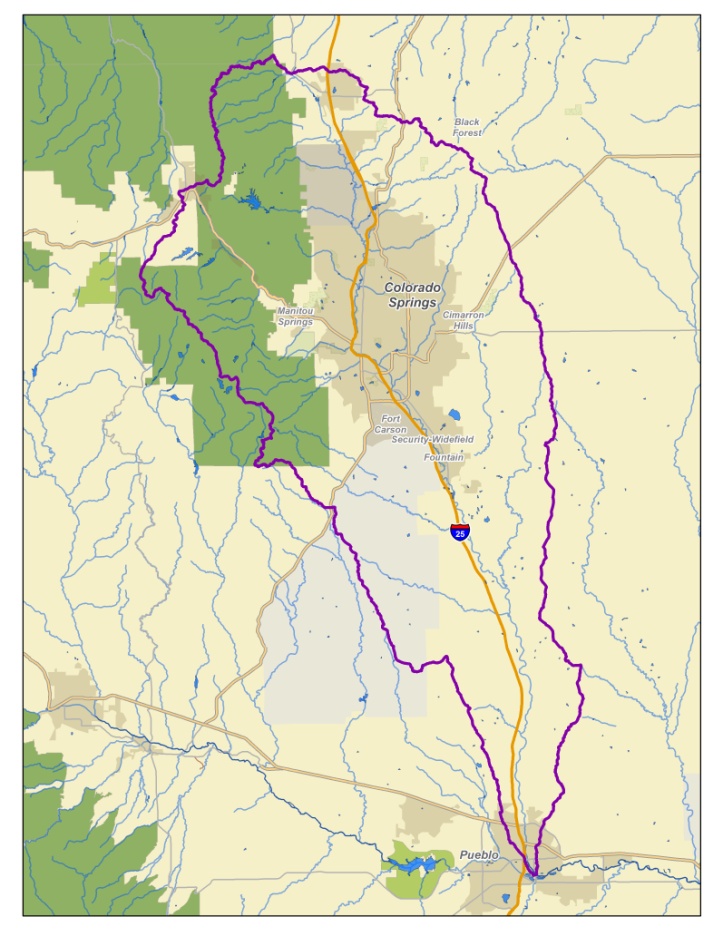
The Fountain Creek Watershed is located along the central front range of Colorado. It is a 927-square mile watershed that drains south into the Arkansas River at Pueblo. The watershed is bordered by the Palmer Divide to the north, Pikes Peak to the west, and a minor divide 20 miles east of Colorado Springs. Map via the Fountain Creek Watershed Flood Control and Greenway District.

From The Colorado Springs Gazette (Billie Stanton Anleu):

Colorado Springs filed arguments last week to keep an Arkansas River water district from joining the federal and state lawsuit that’s demanding cures to city stormwater violations.

But with Rocky Ford melons and other crops at stake, the water district plans to fire back by the Thursday deadline with counterarguments to the U.S. District Court in Denver.

Fountain Creek flows through Colorado Springs and into the Arkansas, bringing excess sedimentation, E. coli contamination and other pollution, the Lower Arkansas Valley Water Conservancy District claims.

The lawsuit it wants to join was filed last month by the U.S. Department of Justice on behalf of the Environmental Protection Agency and by the Colorado Department of Public Health and Environment.

The EPA and Department of Justice negotiated with the city unsuccessfully over the past year to resolve the violations cited in EPA audits in 2013 and in August 2015, two months after Mayor John Suthers took office.

Suthers has made the issue a priority, crafting an agreement with Pueblo County to provide $460 million worth of stormwater projects by 2035, beefing up the city’s stormwater division with a new manager and added engineers and inspectors, and releasing an inch-thick Stormwater Program Implementation Plan on Nov. 2.

The EPA and state nonetheless filed suit one week later, on Nov. 9.

“From my perspective, they’re dwelling in the past,” Suthers said. “We feel very strongly the EPA and state health need to get down to El Paso County and see how many problems we’ve already fixed.”

The Lower Ark, as the district is known, had given notice in November 2014, that it would sue the city for violating its MS4 permit, which allows for the municipal separate storm sewer system.

That’s what the EPA and state now are suing over as well.

“We were precluded from filing our own lawsuit because our claims were essentially the same,” said Peter Nichols, lawyer for the Lower Ark.

“The question is whether the city is already putting a lot of political pressure on the state and EPA to back off. The district is concerned they might be successful with that pressure, and water quality wouldn’t be improved in Fountain Creek,” Nichols said.

The Lower Ark – which represents Bent, Crowley, Otero, Prowers and Pueblo counties – has seen Colorado Springs break stormwater promises repeatedly, said district Executive Director Jay Winner.

The city was collecting about $15 million a year through its Stormwater Enterprise Fund until voters passed ballot Issue 300 in 2009, restricting city enterprise funds. Days later, the City Council voted to phase out the fund by 2011.

Then the Waldo Canyon fire erupted in 2012, creating a burn scar that spawned widespread flooding in 2013, exacerbating problems with Fountain Creek, Monument Creek and other tributaries while spewing sediment and floodwaters downstream.

That year, the EPA audited the city’s stormwater system Feb. 4-7.

Between 2011 and 2014, the city spent $1.6 million a year average on stormwater and had nine full-time employees in that division. Degradation, widening and erosion of streambeds, combined with surface runoff, led to sedimentation and substandard water quality, the EPA and state say.

The next EPA audit, conducted on 14 sections of the city’s system Aug. 18-19, 2015, found “continuous failure” to meet standards or remediate problems highlighted in 2013.

#coleg: @CWCB_DNR hopes to score $25 million for watershed plans @COWaterPlan

Yampa River
Yampa River

From The Denver Post (Bruce Finley):

A Colorado Water Conservation Board proposal, sent to state lawmakers last week, recommends the stream-saving action to meet state environmental and economic goals. It remains unclear who would enforce the community watershed plans.

But there’s little doubt streams statewide are strained by thirsts of a growing population expected to double by 2060, according to state officials. And a Denver Post look at the latest water quality data found that 12,975 miles of streams across Colorado (14 percent of all stream miles) are classified as “impaired” with pollutants exceeding limits set by state regulators.

Creating local watershed plans to save streams is essential, said James Eklund, the CWCB director and architect of the year-old Colorado Water Plan. Eklund pointed to low-snow winters and drought in California’s Sierra Nevada, where 2015 snowpack at 5 percent of average forced a declaration of a state of emergency requiring 25 cuts in urban water use.

“When our Colorado mountain snowpack drops below 60 percent of average, we get nervous. If it happens in the Sierras, it can happen in the Rockies,” he said. “We need to protect certain streams before a crisis. We have got to get on this quickly.”

No single agency oversees waterway health. State natural resources officials monitor flow levels in streams and rivers. They run a program aimed at ensuring sufficient “in-stream flow” so that, even during drought, streams don’t die.

Meanwhile, the Colorado Department of Public Health and Environment sets standards on maximum levels of pollutants that people and companies are allowed to discharge into waterways. In 2015, only 51.6 percent total stream and river miles in Colorado met quality standards, and 30.1 percent of lake surface acres met standards, according to a CDPHE planning document.

“If stream flows are low, there is less dilution in the stream to handle the addition of pollutants through permitted discharges,” CDPHE water quality director Pat Pfaltzgraff said in responses sent by agency spokesman Mark Salley.

Yet CDPHE officials do not make recommendations to natural resources officials about water flows necessary to improve stream health.

The health department has made separate “watershed plans.” CDPHE officials “are considering broadening the division’s watershed plans to include ecosystem health that might be more consistent with stream management plans.”

Pfaltzgraff declined to discuss stream health…

CWCB chairman Russ George supported the push to create local watershed plans, to include detailed maps covering every stream.

“Every stream and tributary needs to be inventoried. … It should have been done a long time ago,” George said in an interview last week.

“We have kind of hit the population and demand place where we have to do it. We didn’t have to do it for the first part of history because the population was small and there wasn’t the impact of all the issues we are getting into now,” he said.

The CWCB voted unanimously last month to ask lawmakers to approve $5 million a year for up to five years to launch local stream planning.

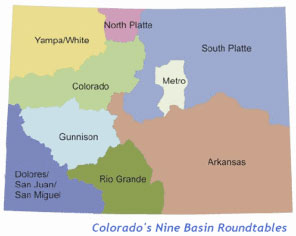
Basin roundtable boundaries

The plans are to be developed within the eight river basin “roundtable” forums that Colorado has relied on for addressing water challenges. These groups draw in residents with interests in stream health who helped hash out the Colorado Water Plan, which was finalized last year and calls for statewide cuts in per person water use by about 1 percent a year.

Conditions along Colorado streams vary, said Bart Miller, healthy rivers program director for Boulder-based Western Resource Advocates. “There are plenty of streams that have problems.”

While state natural resources officials run the program aimed at keeping at least some water in heavily tapped streams, survival in a competitive environment is complex. Leaving water in streams for environmental purposes often depends on timing, when the mountain snowpack that serves as a time-release water tower for the West melts, the amount of snowpack, and needs of cities, pastures and farms.

Collaborative local forums to find flexibility to revive streams “is a great approach.” However, state officials eventually may have to play a central role converting plans into action, Miller said.

“The state should help both in funding the planning but also in implementing the plans,” he said. “We have a lot of work to do. This matters because this is about ‘the Colorado brand.’ Everyone depends on healthy rivers.”

The roundtable forums in communities draw in diverse stakeholders from cattlemen to anglers.

Irrigators and other water users west of Aspen already have created a “stream management plan,” for the Crystal River, seen as a model local effort. Their planning included an assessment of watershed health that found significant degradation above the confluence with the Roaring Fork River. They set a goal of reducing the estimated 433 cubic feet per second of water diverted from the river by adding 10 to 25 cfs during dry times. They’re developing “nondiversion agreements” that would pay irrigators to reduce water use when possible without hurting agriculture, combined with improving ditches and installation of sprinkler systems designed to apply water to crops more efficiently.

Enforcement of plans hasn’t been decided. “We’d like to see more enforcement” of measures to improve stream health, Rocky Mountain Sierra Club director Jim Alexee said. “We definitely think there’s room to do more. We also want to be respectful of the governor’s watershed process.”

Colorado has no history of relying on a central agency to enforce water and land use, CWCB chairman George pointed out.

“When you have a system designed to have everybody at the table, what you’re doing is recognizing there is a finite resource that is shared by everybody. And impacts are shared by everybody statewide. In order to keep from having some force dominate in ways that would not account for all statewide impacts, you need to diffuse the conversation into all areas. That is what roundtables do,” he said.

“When you do that, you’re going to get a better statewide result over time. … It is a process that is designed to get as many interests into the decision-making as you can. … It gets harder, of course, as the supply-demand makes pinches. For the rest of our lives, it is going to be that way.”

Lower Ark district joins federal lawsuit against #Colorado Springs — @ChieftainNews

From The Pueblo Chieftain (Peter Roper):

The Lower Arkansas Valley Water Conservancy District has joined a federal lawsuit against Colorado Springs for not controlling stormwater flooding and discharging pollutants into Fountain Creek and the Arkansas River.

The lawsuit was filed last month in U.S. District Court in Denver by the Environmental Protection Agency and the Colorado Department of Health and Public Environment.

Essentially, the suit argues that Colorado Springs has continued to violate federal clean water standards with discharges into Fountain Creek that sometimes contain high levels of E. coli bacteria and fecal coliform.

The lack of stormwater controls isn’t in question. Colorado Springs officials have negotiated a deal with Pueblo County to spend $460 million over 20 years on flood control.

When the lawsuit was filed, Colorado Springs Mayor John Suthers complained that any money the city spends fighting lawsuits over stormwater flooding would be better spent on fixing the problems.

But the Lower Arkansas board decided last month that too little has been done. Its lawyers urged the board to join the lawsuit to make certain the district participates in any negotiated settlement with Colorado Springs over flooding problems on Fountain Creek.

The Fountain Creek Watershed is located along the central front range of Colorado. It is a 927-square mile watershed that drains south into the Arkansas River at Pueblo. The watershed is bordered by the Palmer Divide to the north, Pikes Peak to the west, and a minor divide 20 miles east of Colorado Springs. Map via the Fountain Creek Watershed Flood Control and Greenway District.