
From The Colorado Springs Gazette (Billie Stanton Anleu):
Colorado Springs filed arguments last week to keep an Arkansas River water district from joining the federal and state lawsuit that’s demanding cures to city stormwater violations.
But with Rocky Ford melons and other crops at stake, the water district plans to fire back by the Thursday deadline with counterarguments to the U.S. District Court in Denver.
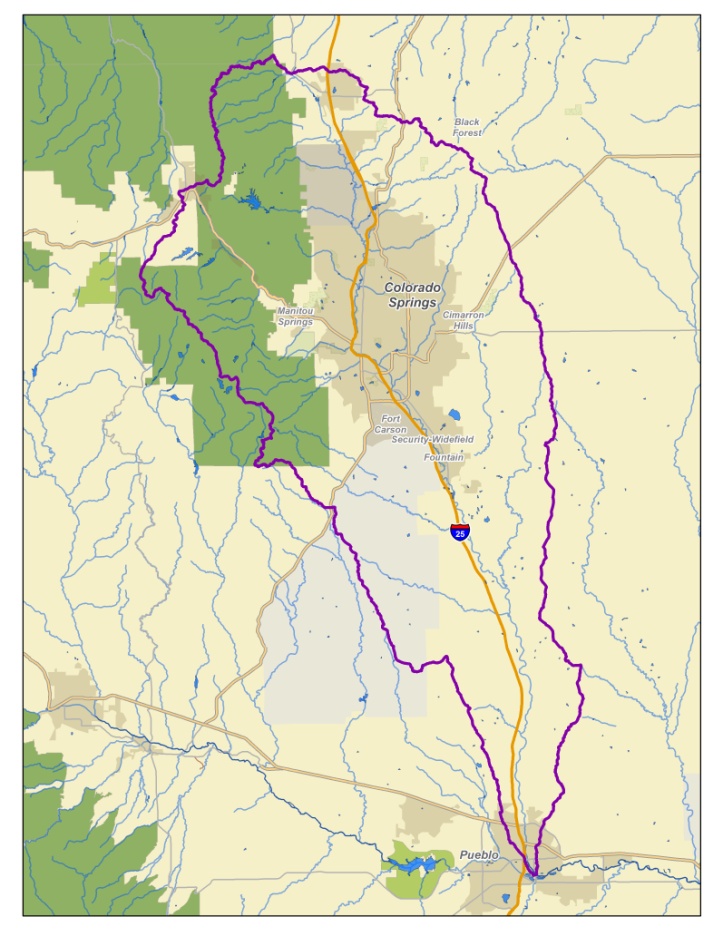
Fountain Creek flows through Colorado Springs and into the Arkansas, bringing excess sedimentation, E. coli contamination and other pollution, the Lower Arkansas Valley Water Conservancy District claims.
The lawsuit it wants to join was filed last month by the U.S. Department of Justice on behalf of the Environmental Protection Agency and by the Colorado Department of Public Health and Environment.
The EPA and Department of Justice negotiated with the city unsuccessfully over the past year to resolve the violations cited in EPA audits in 2013 and in August 2015, two months after Mayor John Suthers took office.
Suthers has made the issue a priority, crafting an agreement with Pueblo County to provide $460 million worth of stormwater projects by 2035, beefing up the city’s stormwater division with a new manager and added engineers and inspectors, and releasing an inch-thick Stormwater Program Implementation Plan on Nov. 2.
The EPA and state nonetheless filed suit one week later, on Nov. 9.
“From my perspective, they’re dwelling in the past,” Suthers said. “We feel very strongly the EPA and state health need to get down to El Paso County and see how many problems we’ve already fixed.”
The Lower Ark, as the district is known, had given notice in November 2014, that it would sue the city for violating its MS4 permit, which allows for the municipal separate storm sewer system.
That’s what the EPA and state now are suing over as well.
“We were precluded from filing our own lawsuit because our claims were essentially the same,” said Peter Nichols, lawyer for the Lower Ark.
“The question is whether the city is already putting a lot of political pressure on the state and EPA to back off. The district is concerned they might be successful with that pressure, and water quality wouldn’t be improved in Fountain Creek,” Nichols said.
The Lower Ark – which represents Bent, Crowley, Otero, Prowers and Pueblo counties – has seen Colorado Springs break stormwater promises repeatedly, said district Executive Director Jay Winner.
The city was collecting about $15 million a year through its Stormwater Enterprise Fund until voters passed ballot Issue 300 in 2009, restricting city enterprise funds. Days later, the City Council voted to phase out the fund by 2011.
Then the Waldo Canyon fire erupted in 2012, creating a burn scar that spawned widespread flooding in 2013, exacerbating problems with Fountain Creek, Monument Creek and other tributaries while spewing sediment and floodwaters downstream.
That year, the EPA audited the city’s stormwater system Feb. 4-7.
Between 2011 and 2014, the city spent $1.6 million a year average on stormwater and had nine full-time employees in that division. Degradation, widening and erosion of streambeds, combined with surface runoff, led to sedimentation and substandard water quality, the EPA and state say.
The next EPA audit, conducted on 14 sections of the city’s system Aug. 18-19, 2015, found “continuous failure” to meet standards or remediate problems highlighted in 2013.