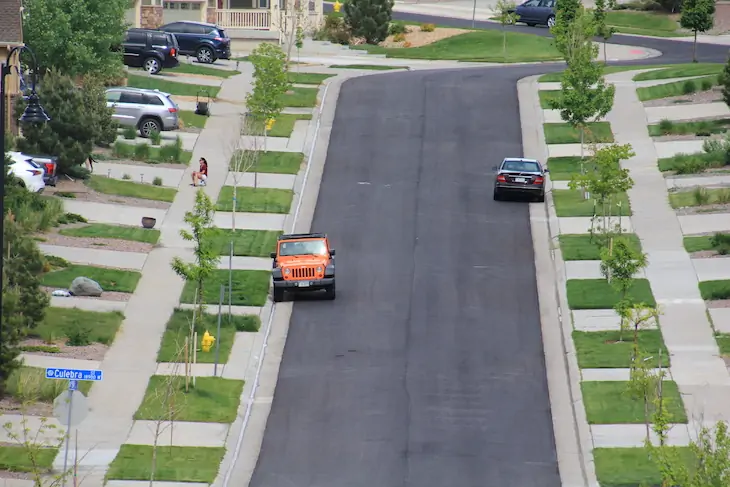
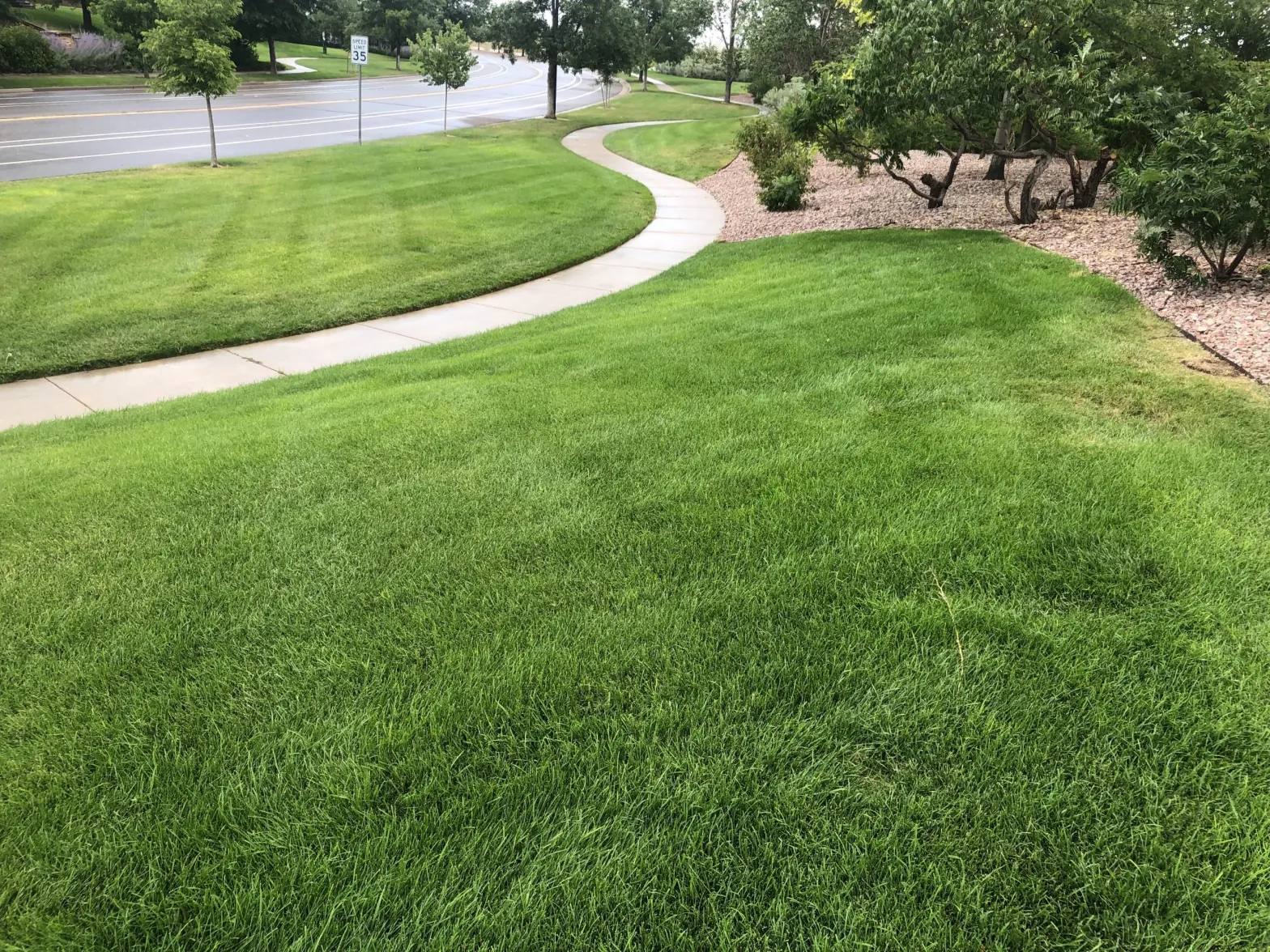
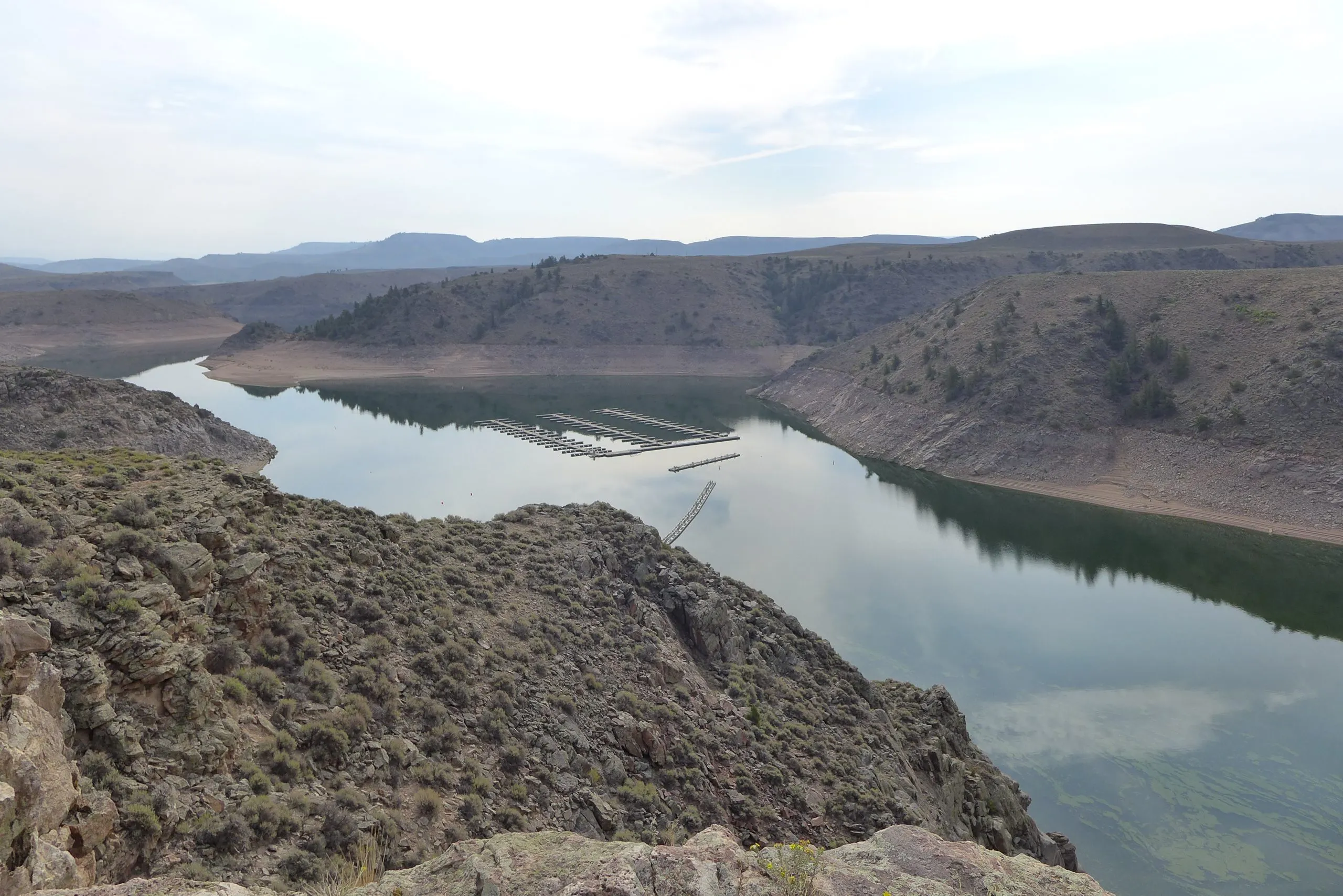
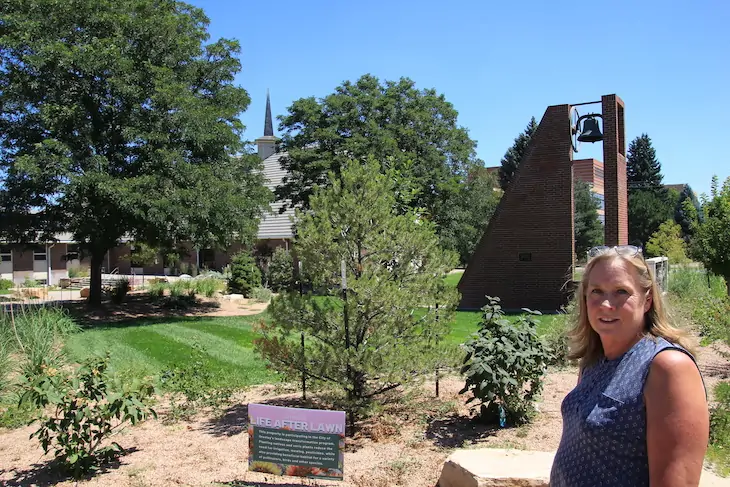
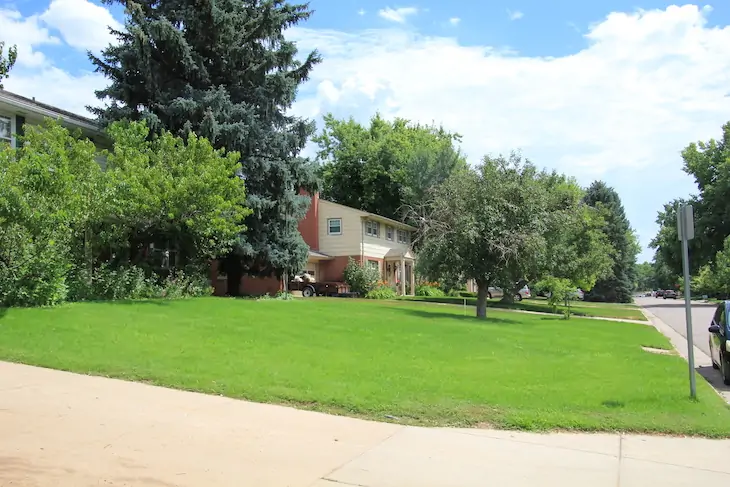
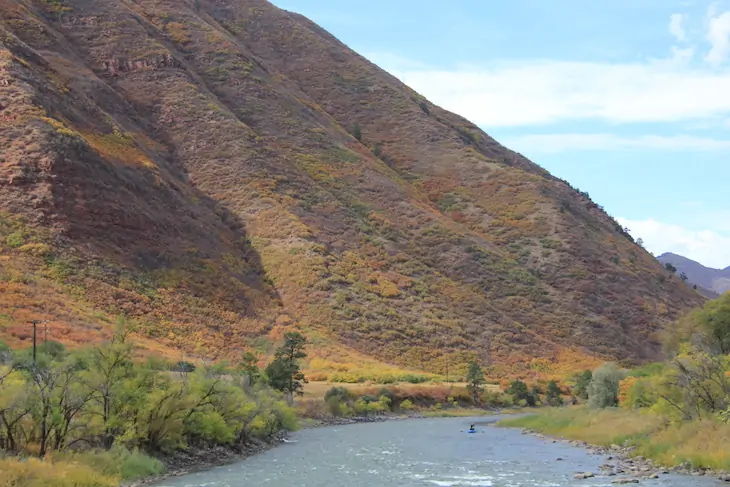
Homes line the foothills outside Colorado Springs on Sept. 11, 2024. The city has doubled down on water conservation to make its recent spike in population growth possible. (Luke Runyon/The Water Desk)
When researcher Brian Richter set out to take a close look at how big cities in the Western U.S. were adapting to water scarcity, he already knew the story’s basic contours.
Previous studies showed the trend clearly for some large utilities. As a megadrought has baked the Southwest since 2000, the region’s biggest cities have reined in their use to keep pace with the declining supply.
But it had been years since someone took a more region-wide look at who was conserving and how much. Richter, a lecturer at the University of Virginia, and president of his own independent research firm, Sustainable Waters, was up to the task.
After gathering data for 28 large and medium-size water utilities dependent on the Colorado River, Richter and his team were able to see the more modern trend lines in sharp detail. The results surprised him. It wasn’t just that cities like Denver, Los Angeles, Tucson and Las Vegas were using less. They were doing it while growing rapidly.
His 2023 study found that collectively the region’s cities had grown by 25% from 2000 to 2020, while their water use dropped by 18%. Per person use rates declined even more sharply, falling by 30%.
“We thought that was nothing short of miraculous, to be honest,” Richter said. “It’s quite a water conservation success story.”
Richter had heard the region’s growth anxieties before. As homes spring up, highways widen and new schools open, conversations about rising populations in the arid West eventually find their way to water. Those new residents mean more green lawns and household faucets, forcing cities to scramble to meet the new demand, or so the thinking goes.
It’s easy to understand why the notion that more people beget more water use jumps to people’s minds, Richter said. All of the on-the-ground impacts of growth are highly visible.
“What you can’t see so easily are the numbers, the water numbers behind that growth,” Richter said. “We felt it was really important to start getting those numbers out there, and to start revealing the fact that it’s not necessarily true any longer, that as a city’s population grows its water use has to increase at the same time.”
Now, as pressure from climate change mounts, the region faces a critical question: Can urban areas keep pace with their past successes in water conservation, or is there a floor to just how much water savings can be wrung from Southwestern cities?
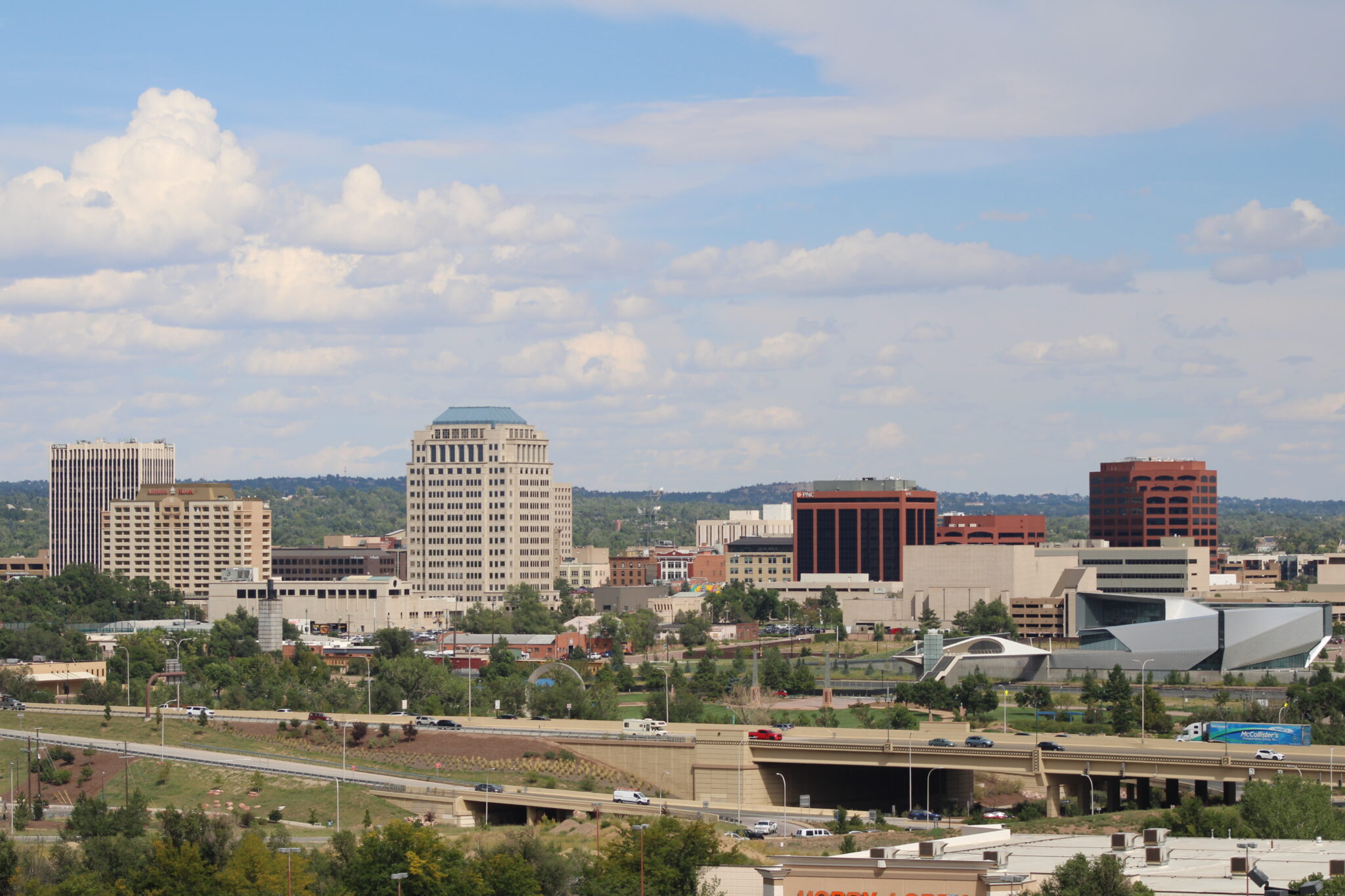
The Colorado Springs skyline rises above Fountain Creek on Sept. 11, 2024. For the past couple decades the city has experienced rapid population growth while ratcheting down its demand for water. (Luke Runyon/The Water Desk)
Using less in Colorado Springs
Until 2002, Colorado Springs was using water like there’s no tomorrow. As the city grew, so did its water demand, hand-in-hand.
“There was a lot of inefficiency out there, a lot of inefficient fixtures, a lot of landscape irrigation, primarily of turf grass,” said Scott Winter, Colorado Springs Utilities water conservation project manager. “A lot of it was, frankly, egregious.”
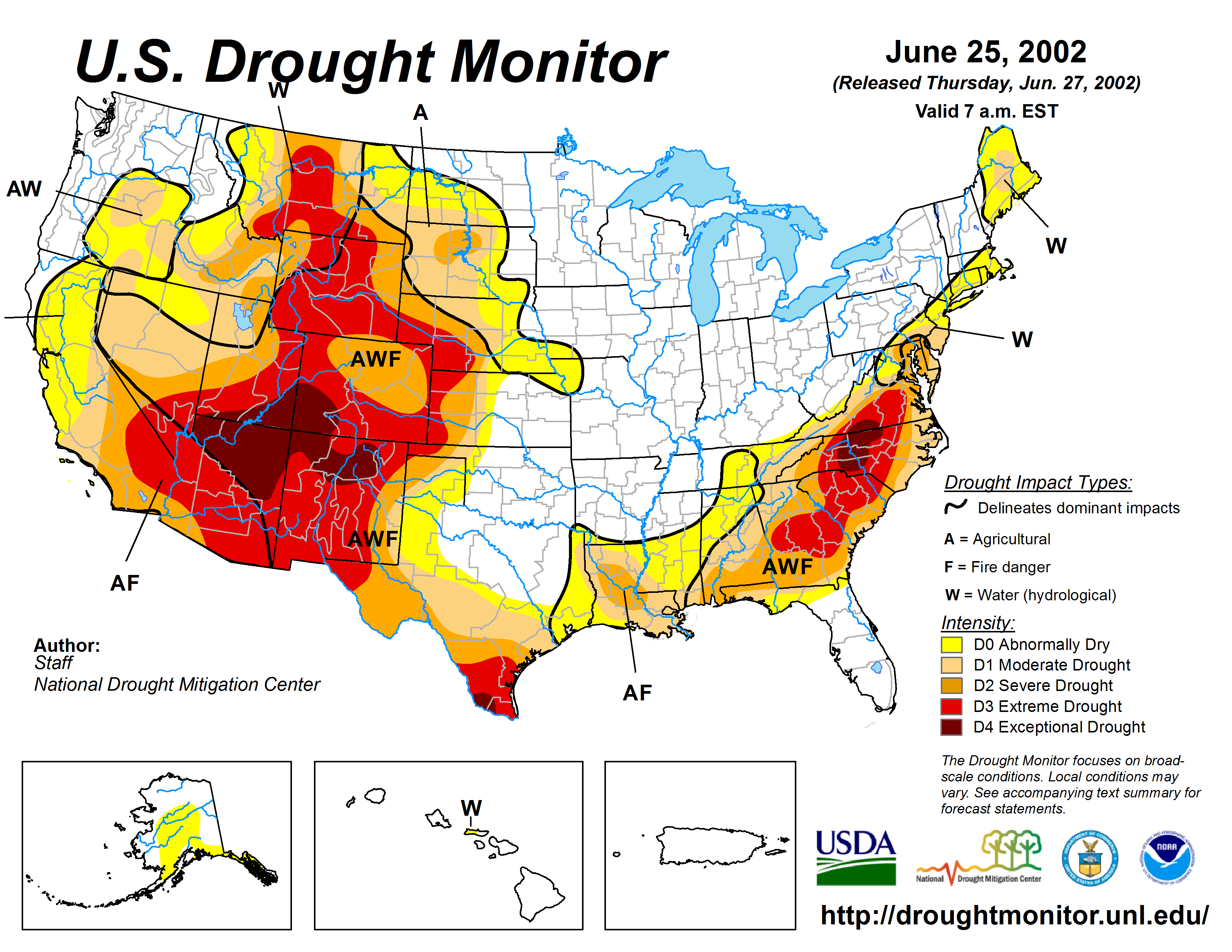
A punishing drought in 2002 provided a shock to the system. While reservoirs declined, the people in charge of Colorado Springs started to realize that unchecked water use would eventually lead to serious shortages. Mandatory restrictions on use at the city level ran from 2002 to 2005.
“I don’t think people thought of the water system, the water supply, as being constrained in any way until we hit 2002 and then our perspective changed on the scarcity of water and how reliable our supply was,” Winter said.
Conservation is now seen as a reliable way to live within their means, he said.
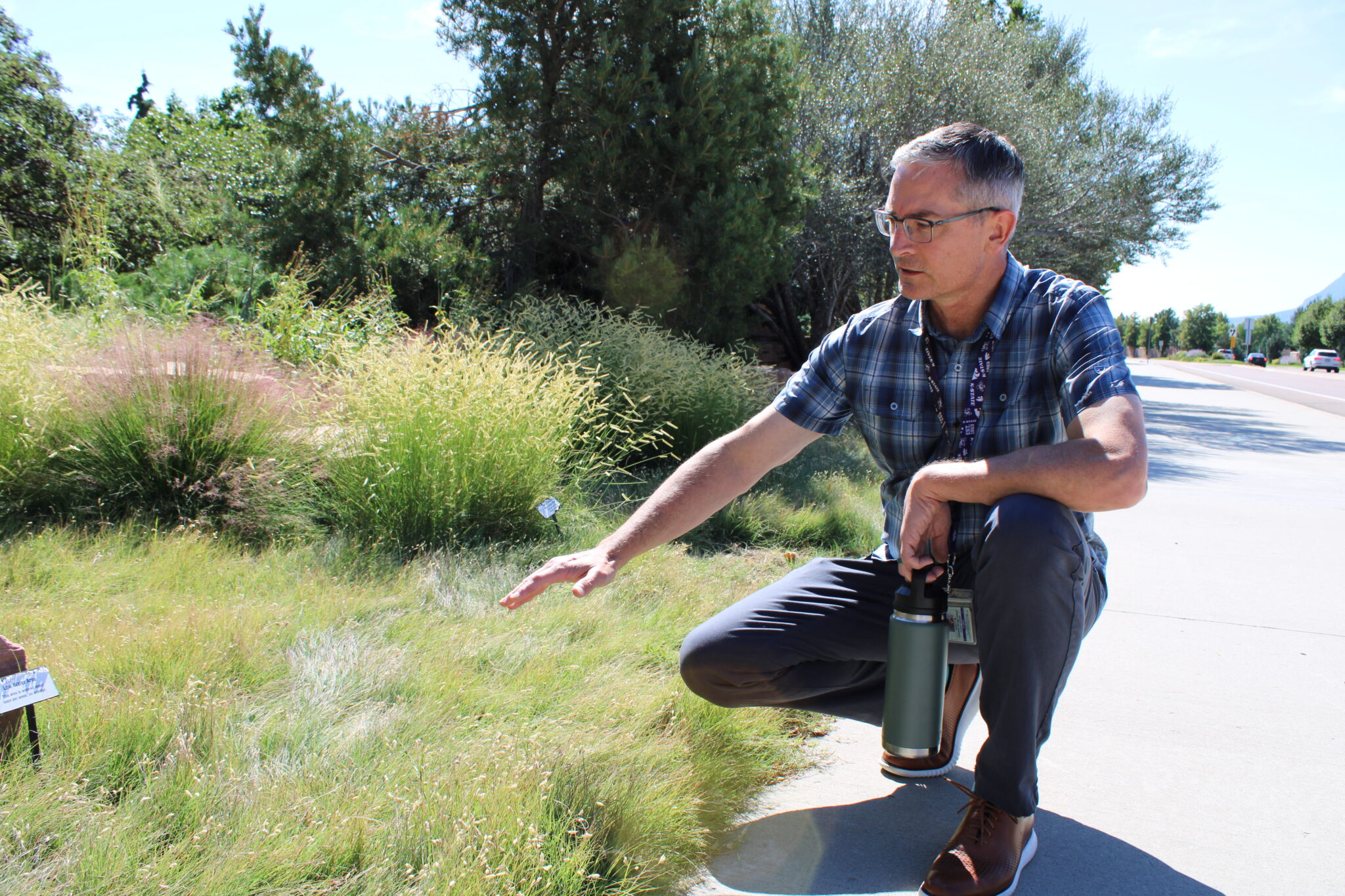
Scott Winter, Colorado Springs Utilities water conservation project manager, points out a turf grass conversion project on Sept. 11, 2024. The utility offers incentives to encourage homeowners and commercial businesses to swap lawns for native grasses. (Luke Runyon/The Water Desk)
Colorado Springs has taken a gradual approach. First came the rate changes. Residents who irrigated more paid more per gallon. Then came the incentives to swap out indoor plumbing fixtures, such as replacing a toilet that uses 5 gallons per flush with a new model that uses less than 1.
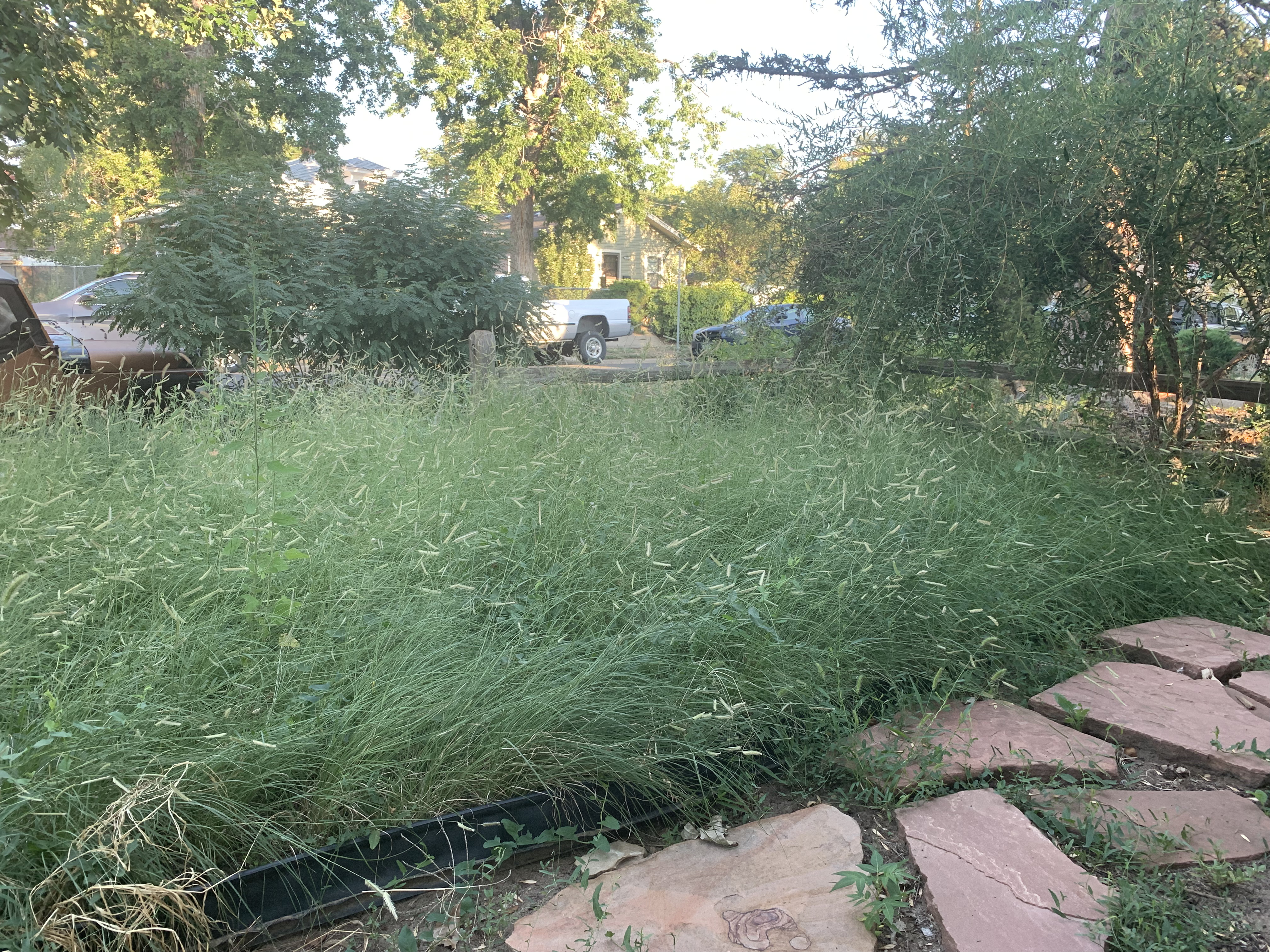
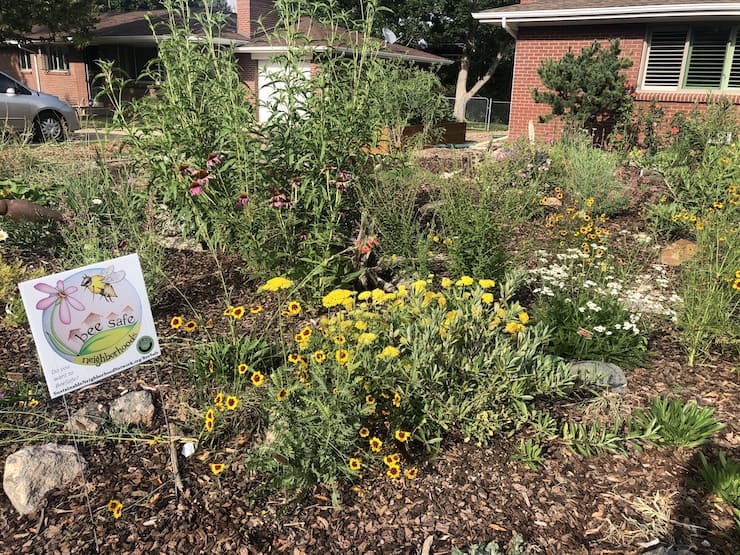
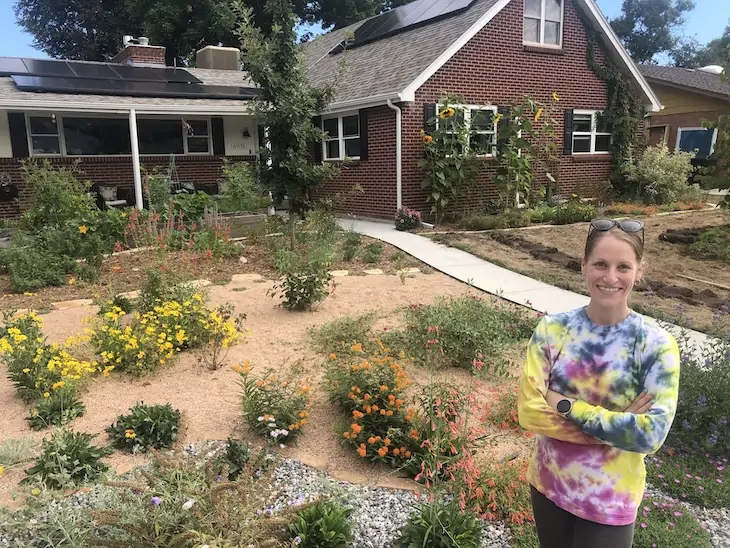
The city has also begun to embrace the loss of its lawns. It ramped up its lawn replacement program, in which thirsty yards are replaced with native grasses, like blue grama or buffalo grass, which use 60%-80% less water. The utility offers 50 cents per square foot of lawn converted.
Since Colorado Springs started those conversions in 2013, the city has swapped in native grass on about 3.1 million square feet, or about 72 acres, mostly on commercial properties like shopping centers, churches and business parks. In 2020 a permanent shift to only allow for three days per week of outside watering on existing grass went into effect as well.
Blue grama grows alongside a Colorado Springs parkway on Sept. 11, 2024. Concerns over dwindling water supplies have sped up the city’s conversions of turf grass to blue grama and other native species. (Luke Runyon/The Water Desk)
All of the focus on conservation is paying off, Winter said. From 2000 to 2023, Colorado Springs has grown by about 40%, while also recording a 39% reduction in average per capita water use and about a 25% drop in total water deliveries. The city’s water use is now about equal to what it was in the late 1980s, despite the rapid growth, he said.
Mandatory conservation measures have started taking hold in some parts of the Colorado River Basin, like a nonfunctional turf ban in Las Vegas, for example. But Winter said the cultural and political contours of Colorado Springs mean water managers have to get creative, relying more on voluntary incentives than strict mandates that could rile its conservative voter base.
When the city decided to overhaul its building code a few years ago, the process brought up the usual tensions over growth. One code change ruffled feathers. A restriction on new developments limited turf to 25% of the total landscape.
“Individual freedom is a core value here,” said Nancy Henjum, a Colorado Springs city council member. Henjum summarized the early complaints of some fellow council members: “What do you mean I wouldn’t be able to have Kentucky bluegrass in my whole yard?”
But after lengthy discussions, plus field trips to the infrastructure that brings Colorado River basin water over the mountains to Colorado Springs, lightbulbs went off for the city council members about the scarce nature of their supply, she said. As of June 2023, the turf restriction is now officially part of the city’s landscape code.
“It was ultimately fascinating to watch people who are policymakers kind of push back initially, and then little by little over time recognize this is the right thing to do,” Henjum said.
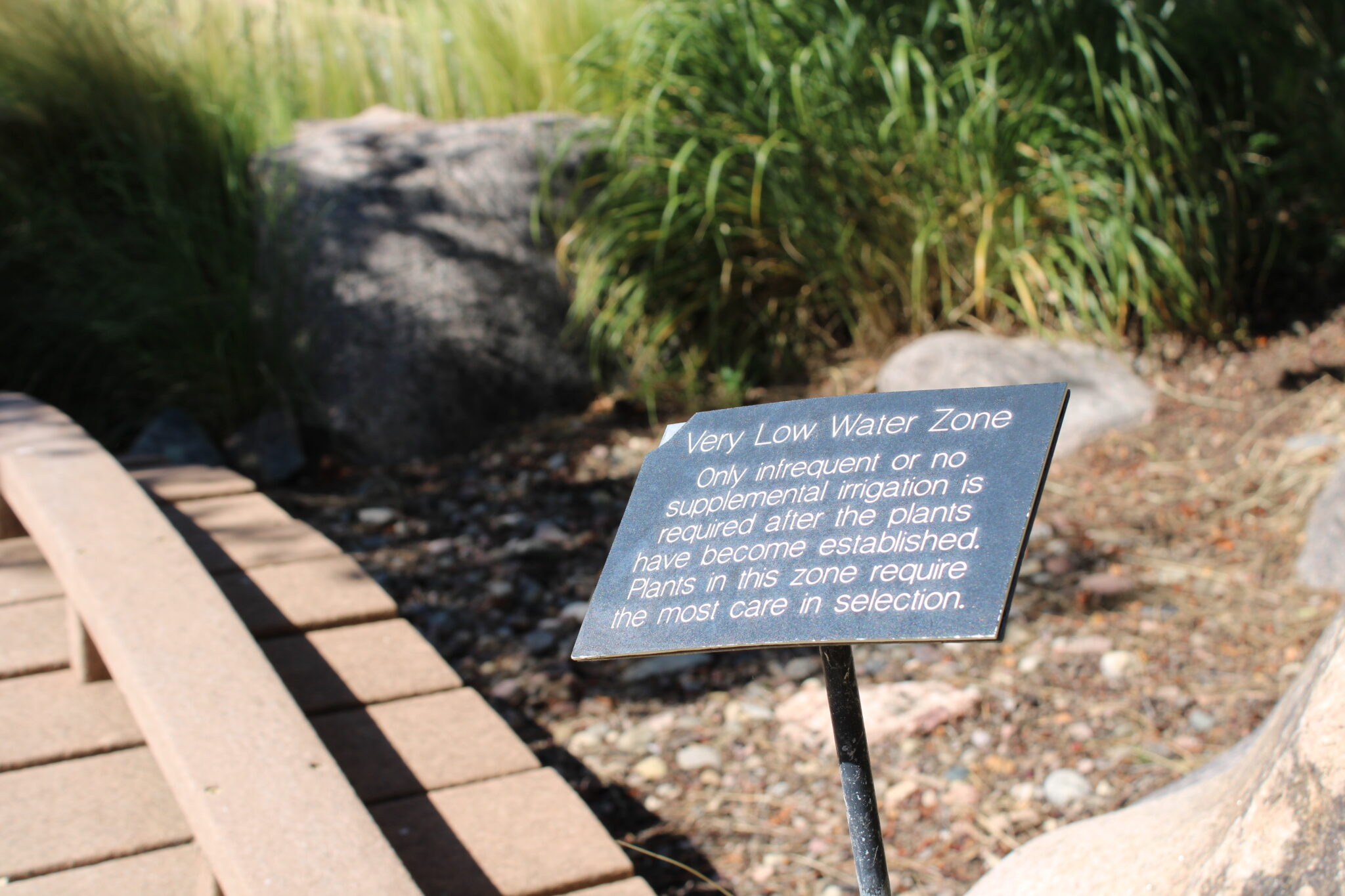
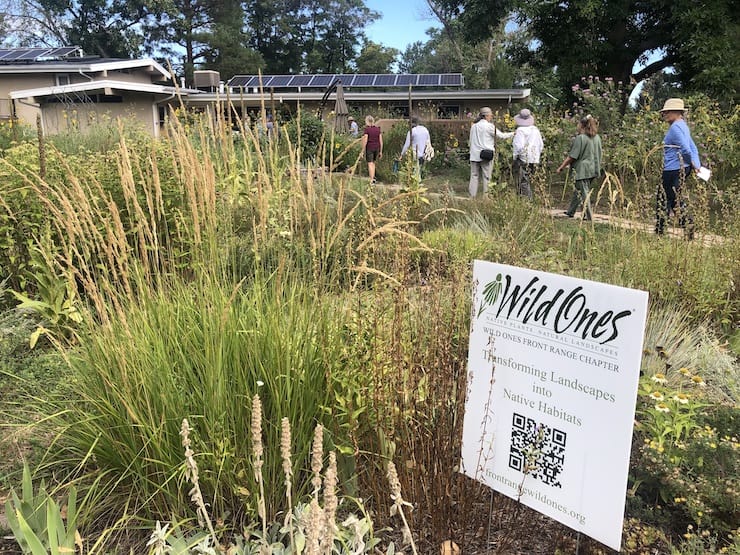
A sign indicates where to find low water use plants in Colorado Springs Utilities demonstration garden on Sept. 11, 2024. A punishing drought in 2002 reframed the way the community saw its reliance on the shrinking Colorado River. (Luke Runyon/The Water Desk)
Conserving the way out
While city leaders are proud of the water conservation success they’ve had over the past two decades, they say that was the easy part. In Colorado Springs, another 40% reduction in use over the next few decades will be tough, if not impossible, Winter said.
“Used to be that we could put a conservation program out there and anyone could participate. Almost everyone was inefficient, and so you could just broadcast a program out there and it worked,” he said. “It’s getting harder, it’s getting more expensive. We’re having to get a lot more strategic and targeted in our approach.”
The same is true just to the north, in Aurora. The city grew by 40% from 2000 to 2020, while lowering both its total water use and per-person use, according to Richter’s study.
“We are the first city (in Colorado) to pass a turf ban,” said Alex Davis, assistant general manager for Aurora Water. “Fifty percent of our use is outdoor water use in the summer, and we’re trying to ratchet that down.”
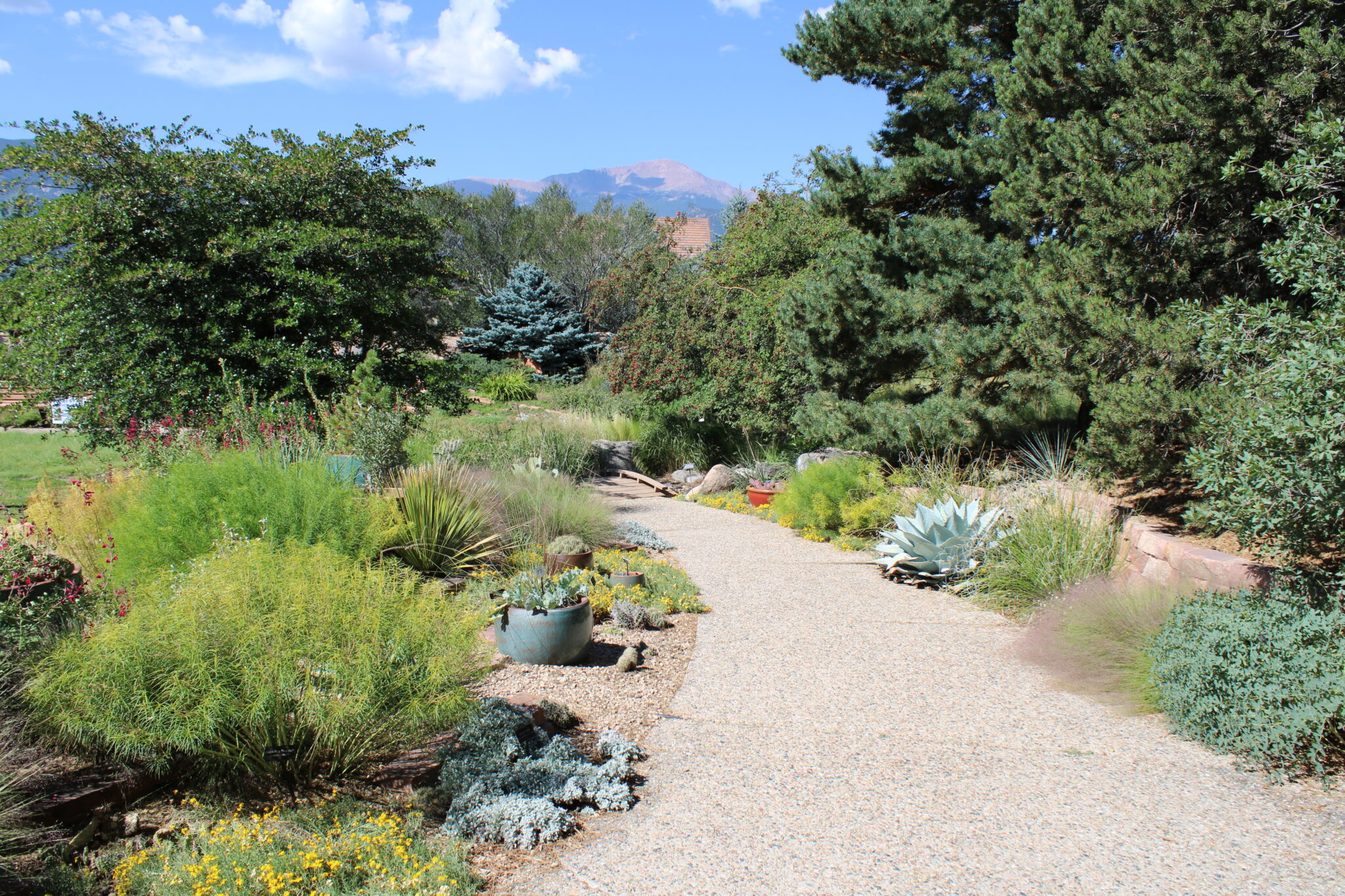
A path winds through the Colorado Springs Utilities demonstration garden on Sept. 11, 2024. Because of gradual water conservation measures the city has been able to add thousands of new residents while using less water from the Colorado River basin. (Luke Runyon/The Water Desk)
But Davis isn’t convinced a city like Aurora, with its steep population curve, can rely solely on conservation to make its way toward a stable water future.
“When we look at our demand projections going forward, we have a gap that we need to fill, right?” she said. “We have a projected need that we can’t meet today for what we expect the population to be in 2060, and so we have to acquire more water resources and do more supply projects in order to meet that gap.”
A big portion of that gap is being driven by climate change, Davis said. Longer, hotter dry spells mean the uncertainty about future water supplies is greater than it was 20 years ago. Her team uses models to game out what kinds of policies the city might need to make it through extreme droughts.
Under those severe scenarios, Aurora’s plans indicate it would first cut down on outdoor watering, then eliminate it all together. That would leave just indoor, household use, but Davis said, “there are projections where we don’t have enough water to meet household use only in these very severe projected scenarios.”
John Fleck, a University of New Mexico water policy professor, said this is the challenging future facing many of the West’s municipal water leaders. Even so, he cautioned against too much hand-wringing over population growth and urban water use. There’s still a lot of slack in the system and a lot more savings to be had, he said.
Because so much water is used outdoors, Western cities face a fundamental question: As the region warms and dries, how much green space are they willing to part with to close the gap between supply and demand? It’ll be a tough call, but not an impossible one, Fleck said.
“When you think deeply about it, it would be weird for people, for communities, not to take the necessary steps to ensure their future existence, right?” he said.
“If you’re facing the choice of getting rid of some swimming pools and lawns, or abandoning your city, it’s a no-brainer. People are going to use less water. And that’s what we see happen over and over again.”
This story is part of a series on water myths and misconceptions, produced by KUNC, The Colorado Sun, Aspen Journalism, Fresh Water News and The Water Desk at the University of Colorado Boulder.
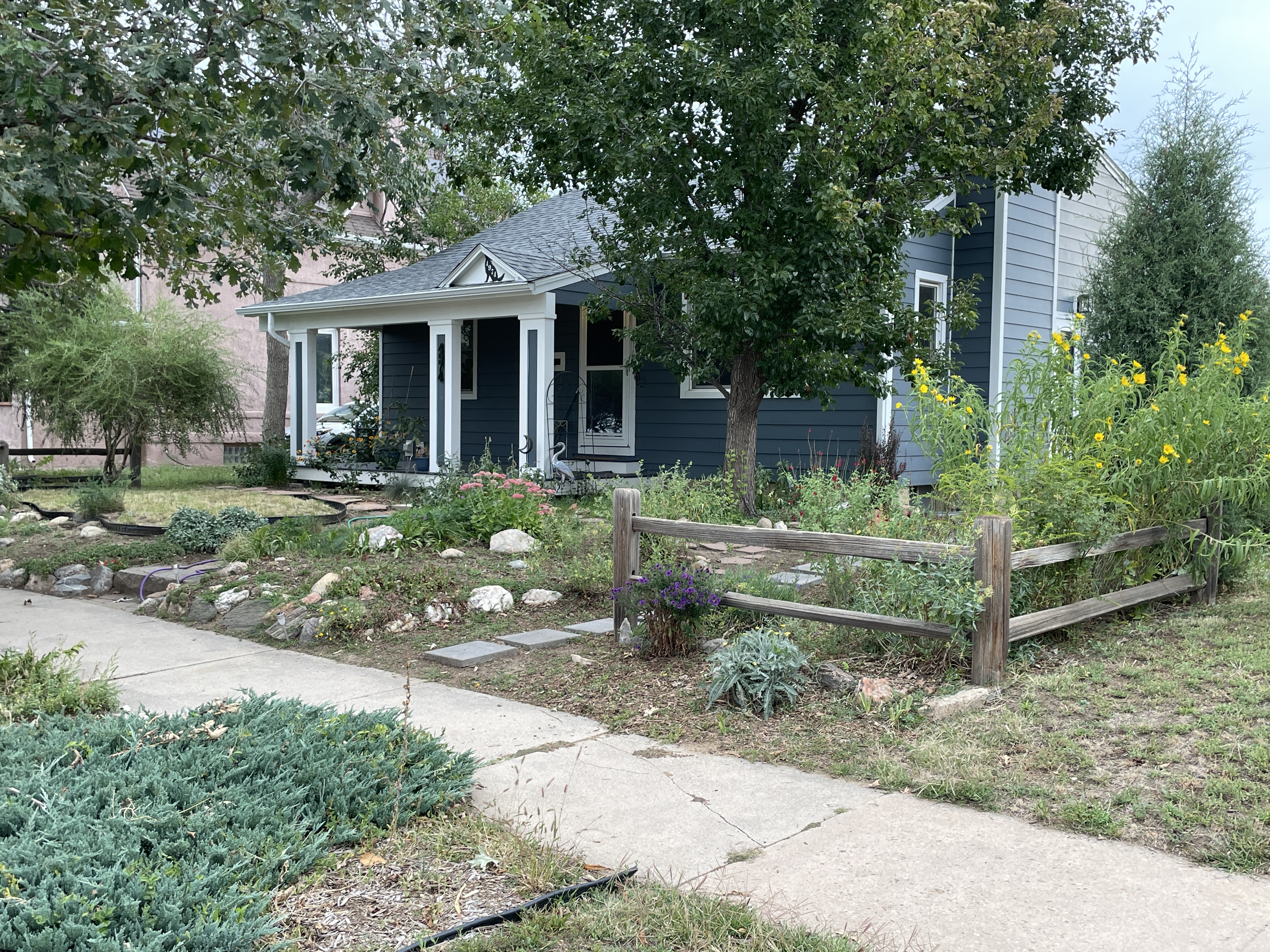
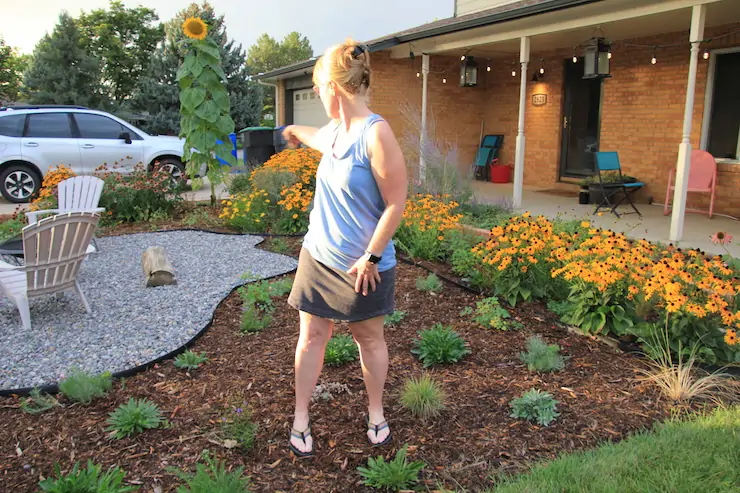
Mrs. Gulch’s landscape September 12, 2024. Blue Gramma in the far left corner of the photo.
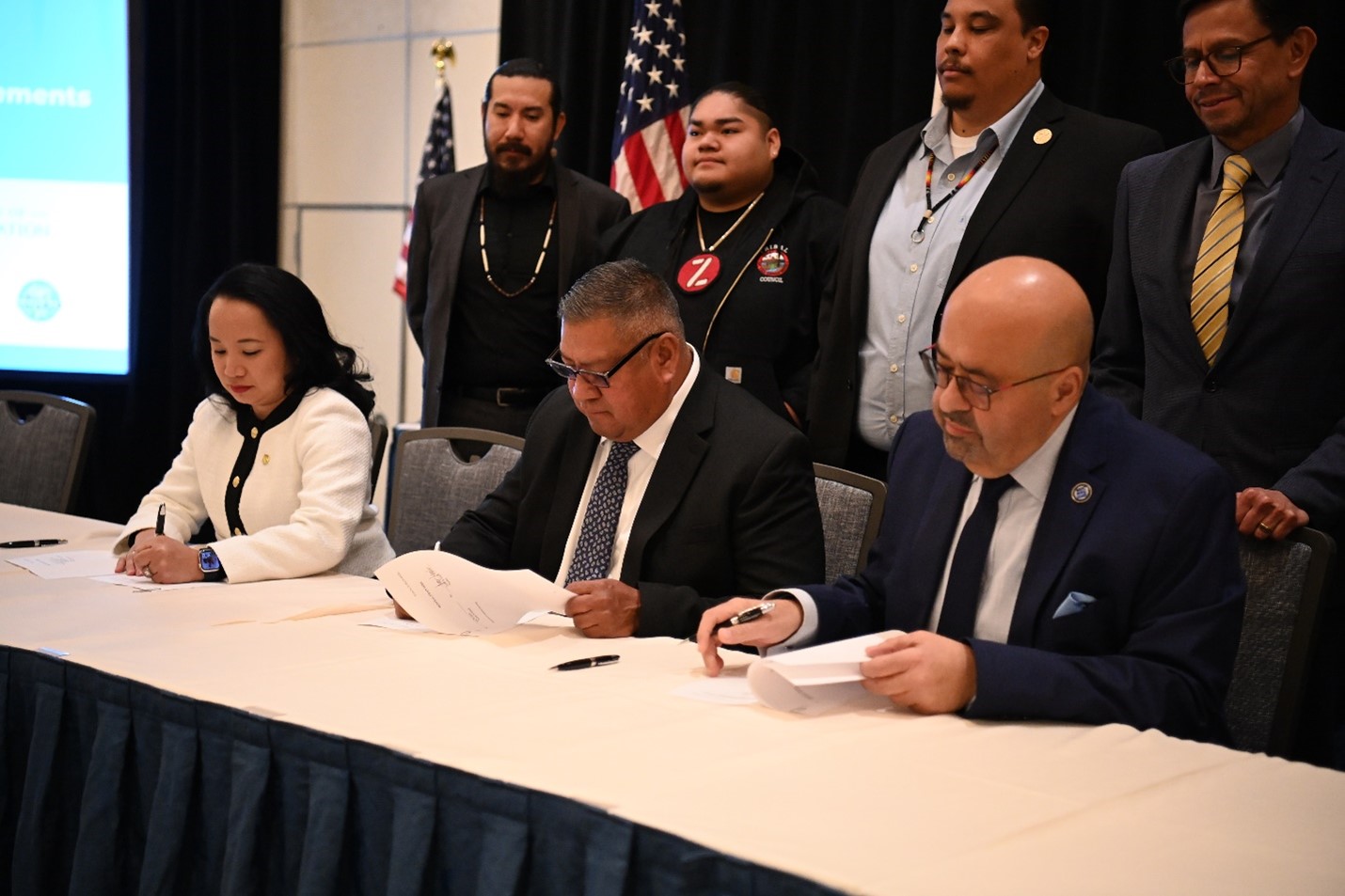
The Department of the Interior today marked major progress for the short and long-term health of the Colorado River System. In Santa Fe, New Mexico, Bureau of Reclamation Commissioner Camille Calimlim Touton joined leaders from the Imperial Irrigation District (California), Bard Water District (California), Metropolitan Water District (California) and Gila River Indian Community (Arizona) to sign five water conservation agreements that will leverage funding from President Biden’s Investing in America agenda to help advance water conservation across the West.
Short-term agreements with the Imperial Irrigation District, Bard Water District and Metropolitan Water District are expected to conserve over 717,000 acre-feet of water by 2026. The agreements with the Gila River Indian Community are the first long-term agreements to be signed and have the potential to create system conservation of over 73,000 acre-feet within the next 10 years.
“The Biden-Harris administration is committed to making western communities more resilient to the impacts of climate change,” said Secretary Deb Haaland. “With transformational resources provided through President Biden’s Investing in America agenda, the Interior Department is collaborating with states, Tribes and partners to make smart investments to strengthen the stability and sustainability of the Colorado River System to support the families, farmers and ecosystems that rely on this vital basin.”
“We are proud to announce these agreements that will support the long-term health of the Colorado River System by shoring up elevations,” said Reclamation Commissioner Camille Calimlim Touton. “The agreements with the Imperial Irrigation District and the Bard Water District in partnership with the Metropolitan Water District will contribute a significant amount of system conservation through 2026 and the new agreements with the Gila River Indian Community are the beginning of our long-term investments that will improve the sustainability of our river for generations to come.”
The lifeblood of the American West, the Colorado River Basin provides water for more than 40 million people and fuels hydropower resources in seven U.S. states. It is a crucial resource for 30 Tribal Nations and two states in Mexico and supports 5.5 million acres of agriculture and agricultural communities across the West, in addition to important ecosystems and endangered species. It is currently experiencing the longest and worst drought on record, driven by hotter temperatures under climate change. The Biden-Harris administration is leading a comprehensive effort to make Western communities more resilient to climate change and address the ongoing megadrought across the region, by harnessing the full resources of President Biden’s historic Investing in America agenda.
Short Term Conservation Agreements
Conservation agreements signed today with the Imperial Irrigation District and Bard Water District in partnership with the Metropolitan Water District signify the final short-term agreements signed under “Bucket 1” of the Lower Basin System Conservation and Efficiency Program with funding from the Inflation Reduction Act. The agreement with the Imperial Irrigation District is the largest from the Bucket 1 effort, expected to provide up to 700,000 acre-feet of system conservation water to Lake Mead between 2024-2026 with a total investment of approximately $589.2 million. The agreement with the Bard Water District in partnership with the Metropolitan Water District conserves up to 17,100 acre-feet of water during the same time period at a cost of about $6.8 million. This water will remain in Lake Mead in an effort to benefit the Colorado River System and its users.
Reclamation has now executed 25 agreements that are projected to conserve more than 2.28 million acre-feet of water. The agreements are part of the three million acre-feet of system conservation commitments made by the Lower Basin states.
Long Term Conservation Agreements
An initial $700 million investment from the Inflation Reduction Act was announced in June to support long-term conservation in the system. Today’s agreements with the Gila River Indian Community represent the first agreements signed under this investment. The agreements invest approximately $107 million into three projects with the potential to create system conservation of over 73,000 acre-feet within the next 10 years. Reclamation is also working with Southern Nevada Water Authority, the Metropolitan Water District of Southern California, Coachella Valley Water District, City of Tucson, San Diego County Water Authority, Town of Gilbert, Salt River Valley Water Users’ Association & Salt River Project Agricultural Improvement and Power District and City of Phoenix in the Lower Colorado Basin to negotiate water conservation contracts for up to 10 additional proposed projects.
Overall, the funding for long-term water conservation initiatives in the Lower Basin is expected to save more than 1 million-acre-feet of water, putting the Colorado River Basin on a path to a more resilient and sustainable water future.
Historic Investments to Address the Drought Crisis
President Biden’s Investing in America agenda represents the largest investment in climate resilience in the nation’s history and is providing much-needed resources to enhance the resilience of the West to drought and climate change, including to protect the short- and long-term sustainability of the Colorado River System. Through the Bipartisan Infrastructure Law, Reclamation is investing $8.3 billion over five years for water infrastructure projects, including water purification and reuse, water storage and conveyance, desalination and dam safety. The Inflation Reduction Act is investing an additional $4.6 billion to address the historic drought.
To date, the Department has announced the following investments for Colorado River Basin states, which will yield hundreds of thousands of acre-feet of water savings each year once these projects are complete:
Aging Infrastructure: More than $1.02 billion for infrastructure repairs on water delivery systems in the Colorado River Basin states from the Bipartisan Infrastructure Law, which will preserve ability to deliver water and power benefits to over 40 million people every year in the Colorado River Basin.
Water Storage and Conveyance: More than $648 million in new water storage and conveyance investments in Colorado River Basin states, which will grow the supply of new water or enhance benefits from existing reservoirs within the Basin states.
Water Recycling: $505 million for 26 water recycling projects in the Colorado Basin that are expected to increase annual water capacity by hundreds of thousands of acre-feet annually
Water Conservation: More than $416 million in WaterSMART grants in Colorado River Basin States, which will conserve tens of thousands of acre-feet of water and make Basin water supplies more resilient.
Milkweed, sweet peas, and a plethora of other flora billow from Farmer’s Ditch in the North Fork Valley of western Colorado. Jonathan P. Thompson photo.
Note to readers: Sorry this piece is late. I injured my hand in a way that makes typing a bit difficult and that has slowed me down a bit. And to non-paid subscribers: Sorry for the paywall and all, but we gotta pay the bills — and give the paid folks their premium content! If you’re interested, consider knocking down that paywall and accessing all the archives by becoming a paid subscriber!
This spring, I had the pleasure to sit on a panel on water in the West with Paolo Bacigalupi and Heather Hansman, two writers I’ve long admired. During the question & answer period, a local woman lamented the fact that some ditches were being piped or lined with concrete, because it would dry out the wetlands and ecosystems that had come to rely on the leaky laterals and ditches. And she was angry because the point, as she understood it, was to save water only to send it downstream to California. Her beloved valley, it seemed, was being dried out to fill up LA pools, which just seems wrong.
Jonathan P. Thompson, Paolo Bacigalupi, and Heather Hansman on a writer’s panel in Paonia in April, 2024.
I’ve thought about this a lot in the months since, because I think it gets down to the big, conceptual tug-of-war that’s happening around the Colorado River. There’s one battle between the different users of the river’s water. And then there’s another in which the values different communities hold are clashing with the “law of the river” and the overwhelming math that is driving the need to make massive changes.
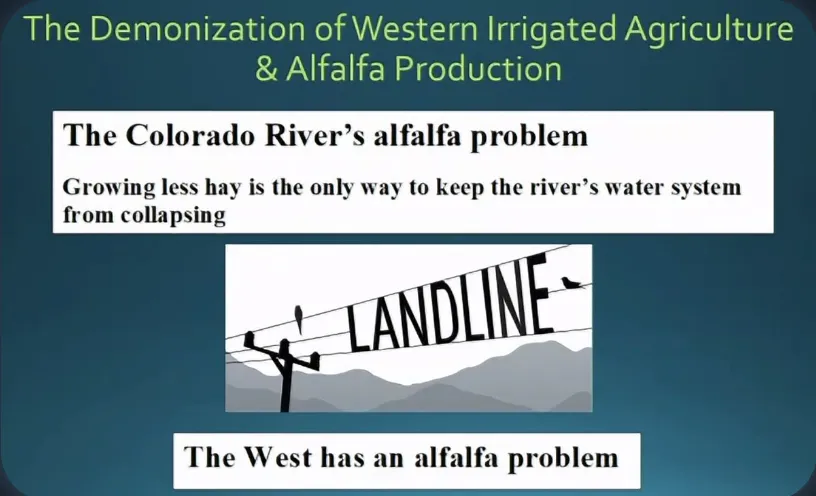
The following meditation on this clash was catalyzed by a slide a friend sent me from a Family Farm Alliance presentation at the Colorado Water Congress’s summer meeting. It accused me — via a piece I wrote for High Country News — of “demonizing” alfalfa.
Well, Family Farm Alliance, this is my response to you:
VALUES
The woman at the panel was referring to the North Fork Valley in western Colorado, a place with an extensive network of open canals, laterals, and ditches that irrigate peach, apple, and pear orchards, small vineyards, organic farms, and alfalfa fields. A handful of center-pivot sprinkler systems reveal themselves in the geometric perfection of their dependent fields, but most of the farms rely on older methods to bring water to the crops, namely by flooding the field or directing water down dirt rows where they soak into the plants’ roots.
Most of the canals and ditches are unlined and uncovered, and have been that way since they were built over a century ago. Many of them leak, some prolifically, their fugitive water blanketing the beige-gray earth with grass and nourishing cottonwoods, feral apricot and plum trees, sunflowers, willows, cosmos, reeds, sweet peas, milkweed, and cattails — along with a host of fauna that depend on those plants.
The intentional and accidental irrigation combine to form an irregular, pastoral patchwork of relative lushness amid the arid landscape of the kind that can be found in northern New Mexico, where a network of acequias irrigate long, rock-lined fields, or McElmo Canyon, where voluptuous pink sandstone rises up from a sea of emerald alfalfa. These places, where the cultivated and feral and wild collide, evoke the Provence of Jean Giono’s novels.
These are artificial landscapes, colonial ones, even, created by damming rivers and diverting their waters away from the fish and aquatic life in the streams and throwing off the natural balance of things. They rely heavily on inefficiencies in the system, from leaky laterals and ditches to flood-irrigation runoff. But they are, to my eye, lovely nonetheless, and contrast favorably with the more efficient farming areas, where high-tech irrigation systems deliver every drop of water to the linearly planted crops in laser-leveled fields.
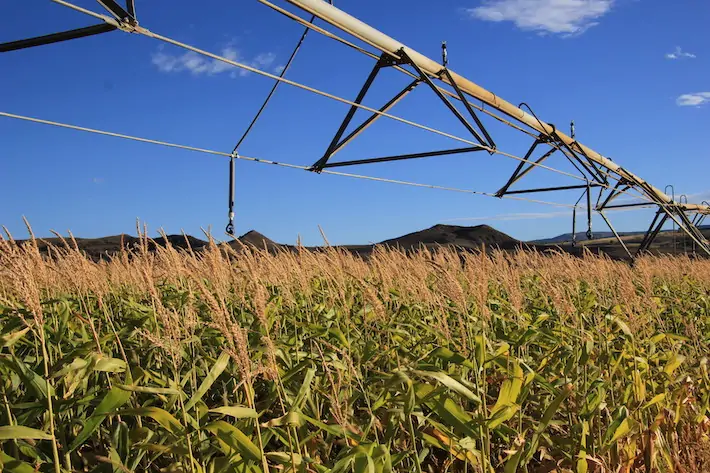
Agricultural productivity has grown 20% in the 21st century. Organic corn in Colorado’s North Fork Valley. Photo credit: Allen Best
And yet, because of math and water laws and compacts and the need to devote every drop of the shrinking Colorado River to “beneficial uses,” the character of these landscapes is likely doomed. It won’t happen next month or even next year, but over time. Nor will the lands be dried up altogether: In places like the North Fork the ditches — at least the ones with senior water rights — will continue to deliver water to the fields.
But more and more, those old leaky ditches will be upgraded, lined with concrete or other impermeable materials, or even put into pipes so that all of the water goes to those who hold the rights to that water, not to evaporation or the accidental ecosystems that have sprung up along the ditches’ banks. The farmers, too, may be forced or incentivized to become more efficient, replacing the flood irrigation with sprinklers or drip lines. Some will be paid to not irrigate at all. Most of the open ditches like the ones my cousins and I held stick-boat races in on my grandparents’ Animas Valley farm will be gone, along with the runoff of the kind that spilled from their corn and alfalfa fields to fill the cattail- and willow-tangled slough down below.
It is this loss that the woman in Paonia is mourning. It is heartbreaking. And it’s something I think about every time I write about the Colorado River and the looming crisis it and the communities and industries that rely on it face in the not-so-distant future.
If the crisis could only be solved — and the needed cuts in consumption made — based on our values alone, things would certainly be a lot easier. There would likely be fairly wide agreement that we should fallow the golf courses and drain the swimming pools before drying up the leaky-ditch wetlands and leaving the red-winged blackbird homeless. Farmers might join me in calling for tearing out thirsty turf lawns from Denver to San Diego, implementing progressive water rates to stem gluttony, and putting hard limits on household water use — if it meant keeping the sprinklers flowing to food crops, including alfalfa and other forage. After all, I value cheese and ice cream and green-chile burgers over the Sultan of Brunei or Miriam Adelson, who guzzled 12 million and 10 million gallons of water, respectively, last year to keep their Las Vegas estates green.
Ah, and yes, if all of this could be solved by prioritizing cuts based on values, alone, the Family Farm Alliance would have no reason to accuse me of “demonizing” alfalfa and other livestock forage crops (though I imagine the golf groupies would get me for vilifying them). But, alas, it’s just not that simple. Why? Because even the most lofty values are trumped by the cold, hard math.
MATH
The pertinent numbers in the equation include:
16.5 million acre-feet: Total human-related consumptive use of Colorado River water in 2020. This means all of the water that was withdrawn from the river and not put back into it, including reservoir evaporation. It does not include the 2.8 million acre-feet consumed via riparian and wetland evapotranspiration, nor does it include the 1.7 million acre-feet of water use from the Gila River, a tributary to the Colorado.
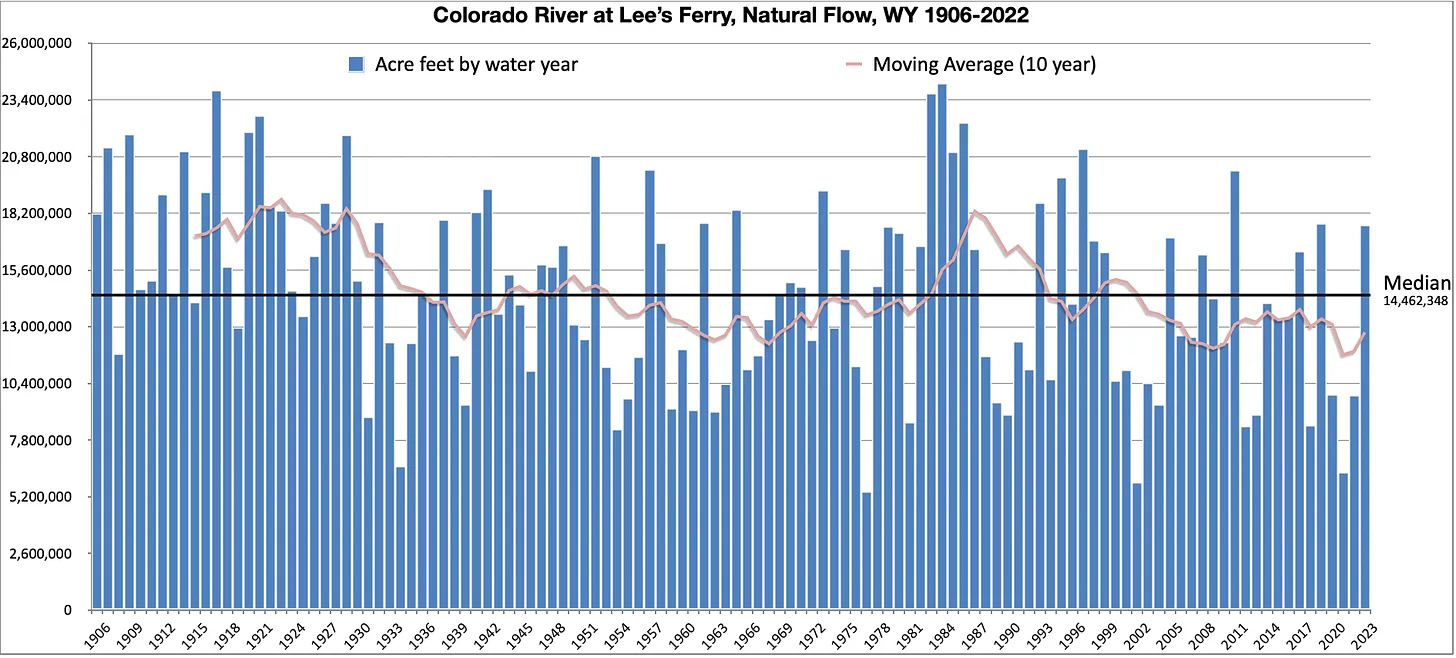
14.5 million acre-feet: The Colorado River’s median “natural flow” at the Lee Ferry stream gage, which is the official dividing line between the Upper Basin and Lower Basin, from 1906 through 2023. This is used as a measure of how much water is in the Colorado River, since downstream tributaries are relatively insignificant.
12.4 million acre-feet: The Colorado River’s average natural flow at Lee Ferry from 2000 through 2023.
This leaves us a few options for the big math problem that needs solving:
The optimistic equation (assumes the last 20 years was an anomaly and the river will go back to its old-normal flow soon, i.e. the median for 1906-2023):
14.5 million – 16.5 million = 2 million acre-feet deficit
The new-normal equation (assumes the next few decades will look like the most recent couple of decades — which is to say a megadrought) :
12.4 million – 16.5 million = 4.1 million acre-feet deficit
The pessimistic (realistic?) equation (assumes human-caused climate change will continue to deplete the river):
10.4 million – 16.5 million = 6.1 million acre-feet deficit
Estimated natural flow of the Colorado River at Lee’s Ferry (the dividing line between the Upper Basin and the Lower Basin). The natural flow is basically the total amount of water the river delivers each year, or the volume that would pass by Lee’s Ferry if there were no upstream diversions. Source: USBR.
Which is to say … we’re screwed no matter how you juggle the numbers! Sorry, that’s not very solution-oriented is it? No matter how you cut it, though, the Colorado River budget is running a massive deficit and has been for a while. That’s why Lake Powell, the Upper Basin’s savings account, has been shrinking and now is less than 40% full — even after a couple of decent winters. A couple of consecutive new-normal winters could bring the reservoir down below minimum power pool, shutting down the hydropower turbines and potentially setting the scene for a mega plumbing disaster.
While it’s highly unlikely that the Colorado River’s flows will increase enough to fill Lakes Powell and Mead to capacity anytime soon, it’s not impossible. During the extraordinarily wet and snowy four years between 1983 and 1986, nearly 80 million acre-feet of water ran into Lake Powell — which should be enough to fill both reservoirs and still deliver adequate flows downstream. If it happens, great! It would be foolish and potentially catastrophic to bet on a repeat, however.
That means the users of the river must erase the deficit by cutting anywhere from 2 million to 6 million acre-feet of consumption annually. The big question, and one that the basins and their member states have been debating, is: Where will those cuts come from? I’m not going to get into the many layers of these negotiations here, as that’s not the purpose of this essay, which is a bit of a thought experiment. Suffice it to say it’s complicated, and made more so by glaring errors and injustices committed when the Colorado River Compact was originally crafted.
Let’s say we’re going to make these cuts based on values. Obviously everyone has different values, so we’ll just go with those expressed at the Q&A session I lead this piece with, which can be summed up as prioritizing rural farmland, food crops, and the artificial wetlands that can be found in the North Fork Valley over urban lawns, golf courses, and billionaires’ estates.
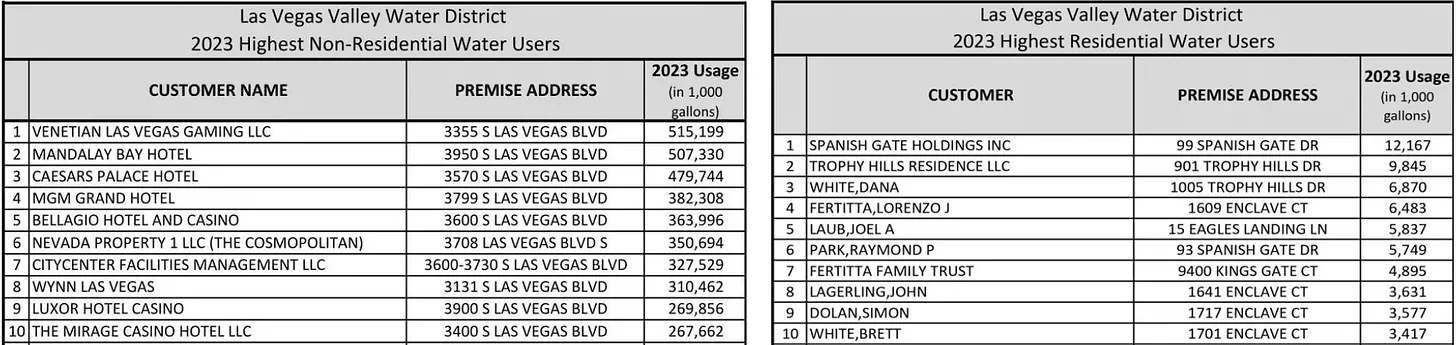
Where better to begin than Las Vegas? Let’s pull up some water user data and, holy cow! Look at those numbers. The Vegas resorts and the rich sure know how to use water:
The Venetian and Mandalay Bay resorts each use more than 500 million gallons of water per year. Meanwhile the top residential water users are mostly billionaires: 99 Spanish Gate Dr. — which goes through 12 million gallons per year — was owned by the Sultan of Brunei until tech-giant Jeff Berns purchased the 37,500 sf mansion for $25 million. Other top water gluttons include Miriam Adelson — a top Trump donor — and UFC CEO Dana White. The average Las Vegas household uses about 120,000 gallons per year, though newer, more efficient homes use far less.
When folks start throwing $25 million around for an unfinished house is when you know it’s time for a wealth tax. And when they use 100 times as much water as the average home, it’s also time for a new, progressive water rate structure, that incentivizes conservation and punishes gluttony. Las Vegas already has something like this, but the rates in the upper tiers are too low to be meaningful; they need to be so high that this kind of profligacy will sting even a billionaire’s pocketbook. Hell, better yet, why not just fallow these properties and xeriscape them?
When the numbers are added up, you’ve got:
227,243,000 gallons Top 100 Las Vegas residential water users’ combined consumption in 2023.
3,774,780,000 gallons Top 10 Las Vegas non-residential water users’ combined consumption in 2023.
Wow, so by shutting down just these folks, we could save 4 billion gallons of water, or … 12,275 acre-feet? Oh, that’s not as much as it seemed.
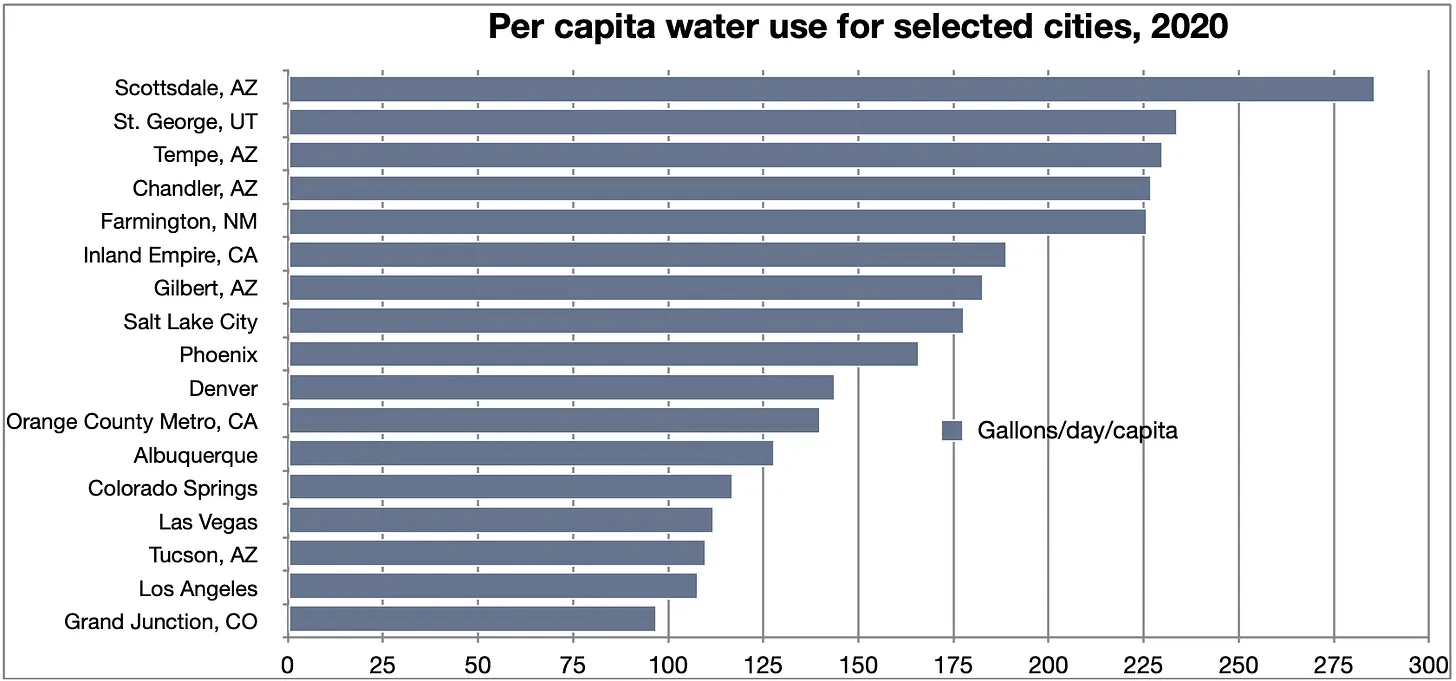
So how about we go to other cities and tear out turf, mandate low-flow appliances, ban lawn watering and swimming pools. I mean, if you could get Scottsdale and St. George residents to cut back to Tucson or Los Angeles per capita water levels, you’d make some more huge cuts.
If Scottsdale’s per-capita consumption were cut to Tucson’s levels it would save about 42 million gallons per year.
You could save millions of gallons through that effort, which is great. The problem is, this problem requires bigger thinking — you’ve got to make multiple cuts in the tens of billions of gallons range for it to make a significant difference. Once again, math, the ultimate buzz killer, raises its ugly head. See, as noble as all of these efforts might be, there just isn’t enough overall water use in the urban sector to come up with all the necessary cuts. You could drain the pools, dry up the lawns, seal up the Bellaggio fountains — hell, even shut off the massive pumps that convey water from Lake Mead to the Las Vegas metro area altogether — and you would still need to come up with at least another 1.6 million acre-feet of cuts. Entirely cutting off all of the Basin’s cities and industrial applications wouldn’t even get you to 4 million acre-feet of cuts. But boy, it sure would be interesting to watch — from afar.
To conclude Part I, some charts that drive the point home:
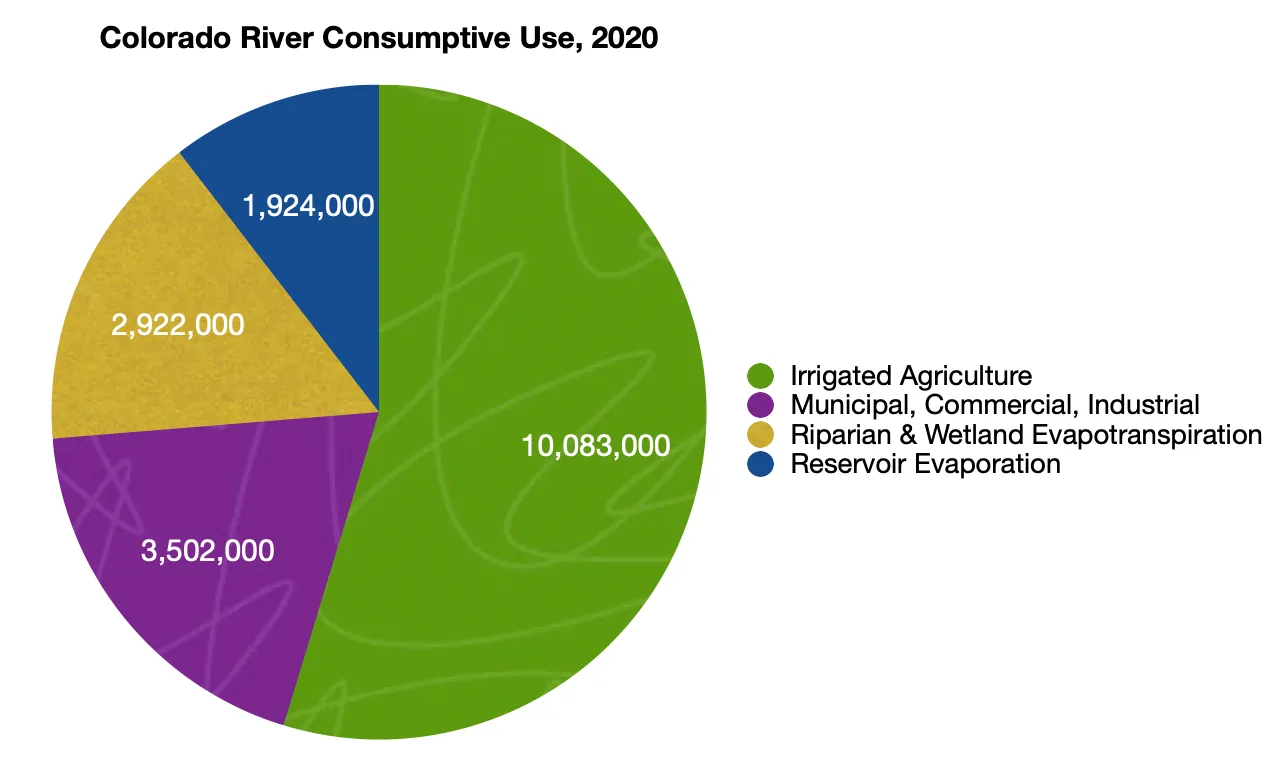
Irrigated agriculture gulps up about 10.1 million acre-feet per year, accounting for about 52% of the total consumptive use on the Colorado River. Meanwhile the municipal, commercial, industrial sector only uses 3.5 million acre-feet, meaning if you cut off all of the water to every Southwestern city, you still might have a water deficit in the Colorado River Basin. Source: New water accounting reveals why the Colorado River no longer reaches the sea, by Brian Richter et al
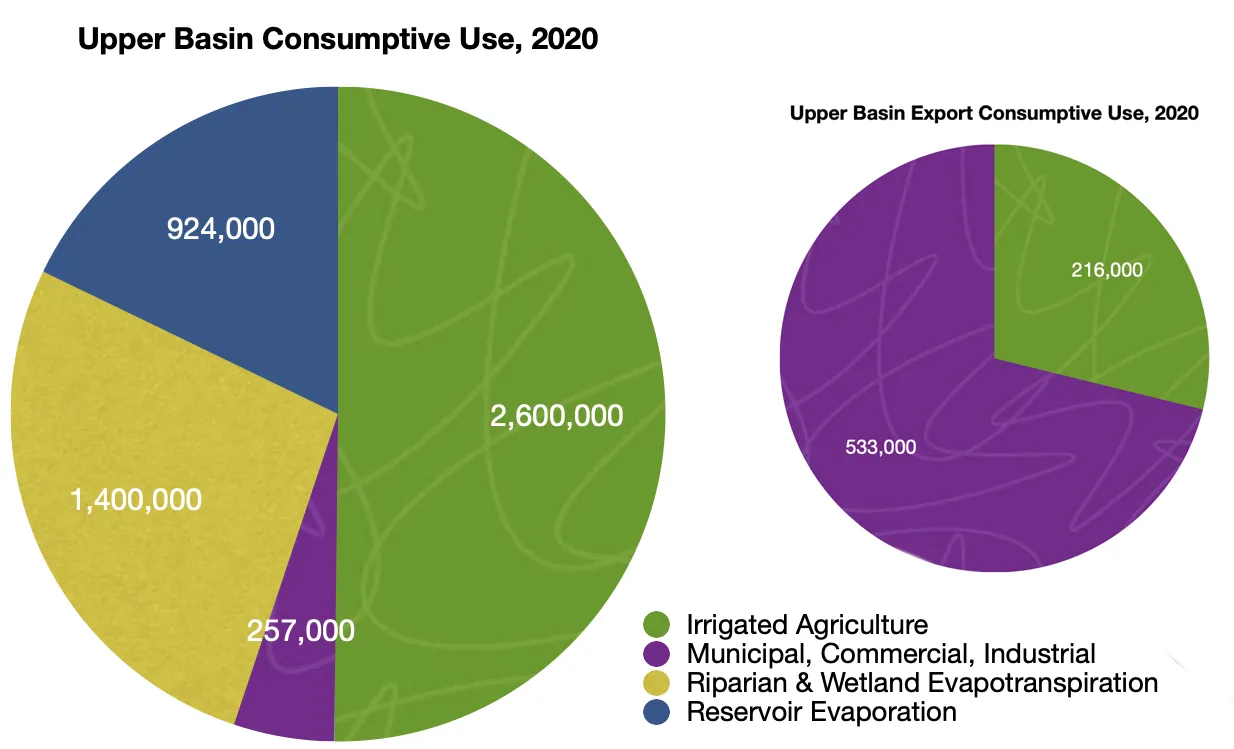
The chart on the left shows consumptive use within the Colorado River watershed only, where irrigated agriculture uses about 50% of the water. By contrast, Colorado River water sent over the Continental Divide to Colorado’s Front Range and New Mexico’s Rio Grande watershed is mostly used by cities, with about one-third going to agriculture.
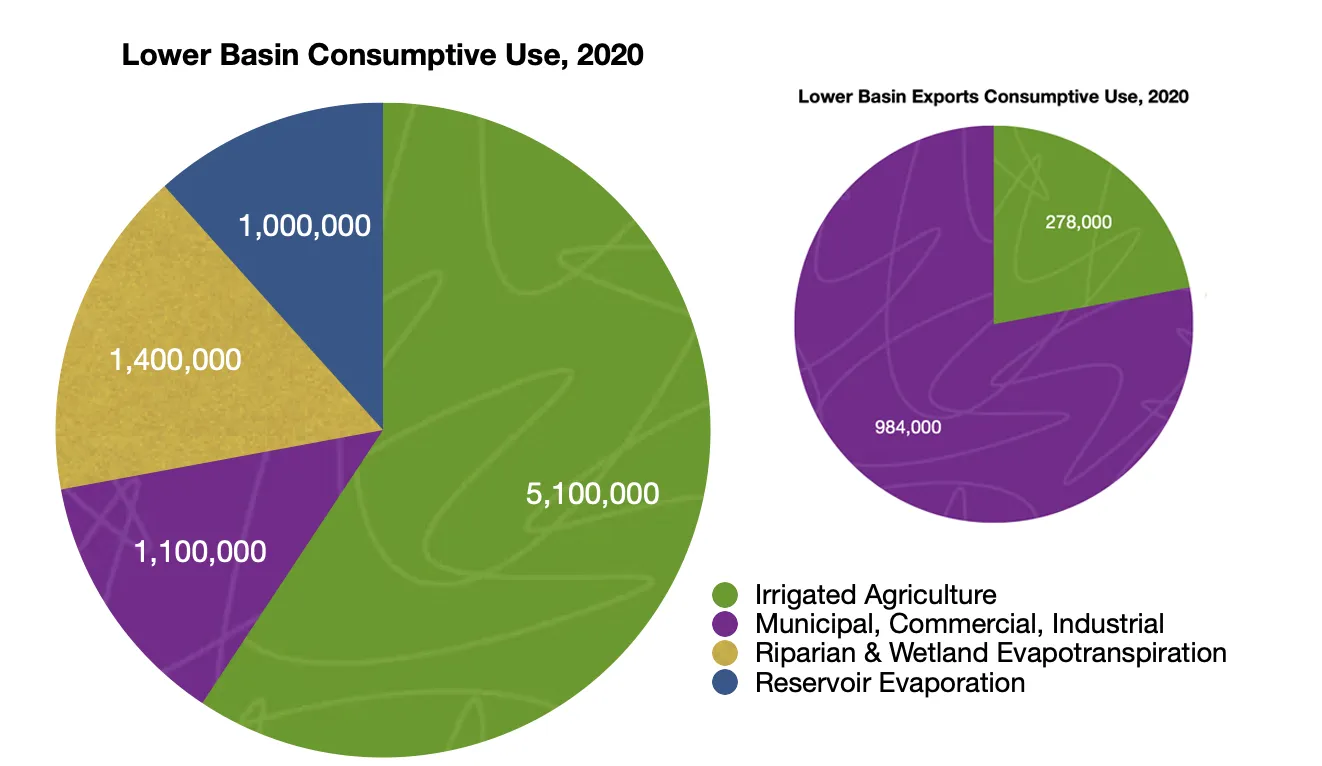
About 59% of the non-exported Lower Basin consumptive use goes to irrigated agriculture. Exports follow the same pattern as in the Upper Basin, with most of the water going to urban use.
SOURCES: New water accounting reveals why the Colorado River no longer reaches the sea, by Brian Richter et al.; Decoupling Urban Water Use from Population Growth in the Colorado River Basin, by Brian Richter; Bureau of Reclamation, Las Vegas Valley Water District, Southern Nevada Water Authority, Zillow.
Currently, Colorado’s hunters and anglers have perhaps a once-in-a-lifetime opportunity to protect a wide swath of public lands habitat in southwest Colorado’s Dolores River Canyons region. In April, we joined hunters, anglers, rafters, business owners, and many others from across the state and region in supporting a proposed Dolores River Canyons National Monument…The Dolores River faces threats from industrial scale mining, habitat fragmentation, and unmanaged recreation. Protecting intact habitat for mule deer, elk, and desert bighorn sheep, particularly winter range and movement corridors, is essential for retaining quality sporting opportunities. Now is the time for action. A national monument designation will help everyone better manage the change that is already occurring while also protecting public lands habitat and ensuring future generations of hunters, anglers, and many others experience the area as we have. For additional information see Sportsmen for the Dolores.
Jasper Reservoir, in the Indian Peaks Wilderness Area in Western Boulder County, has been sold under a set of covenants will ensure it waters are available to Middle Boulder Creek during the fall, when it is driest. Courtesy: The Colorado Water Trust
Ten years ago, an anonymous benefactor approached the Colorado Water Trust intent on providing it with an interesting gift: a reservoir high in the forests of the Indian Peaks Wilderness Area in western Boulder County.
The 23-year-old nonprofit was thrilled, understanding that the ultimate sale of the gift would insure its financial future, and making sure its mission to keep water in rivers continues.
The trust set to work immediately looking for a buyer who would agree to some very tough restrictions: permanent public access for fishing, hunting and camping, keeping the tiny reservoir full during the summer, and releasing the water down through Barker Reservoir in Nederland into Middle Boulder Creek during the fall, when the 37-mile stream segment is driest. Equally important is a conservation easement that prohibits any development of the water and land around the reservoir.
“The covenants are quite strict,” said Kate Ryan, the trust’s executive director. “We’ve taken away the development potential of the reservoir, so we had to have the right person come along.”
The trust’s day job is to connect private water-right owners with threatened streams, helping set up financing and the legal agreements necessary to ensure the water can be transferred to the state, where it becomes part of the state’s environmental program leaving water in streams that would otherwise be diverted.
Jasper Reservoir/Boulder Creek. Credit: Colorado Water Trust
If that sounds like a tall order, it often is. And finding a buyer for this reservoir would prove equally daunting. It turns out there aren’t a lot of people interested in buying covenant-restricted reservoirs, even in a water-short state such as Colorado.
But in August, the trust and Boulder County’s Tiefel family finalized the deal.
“The trust wanted a partner to help manage the reservoir and run the water down Boulder Creek,” said Doug Tiefel, a real estate developer whose family farms in eastern Boulder County and also has a small reservoir of its own. The family uses its reservoir to irrigate its operations and it leases any excess water to other growers in the area when water is available.
Tiefel said the Jasper Reservoir deal fit his family’s water needs, and their environmental ethic.
“For the ecosystem it is critical to keep more water in the river in late summer and early fall, and that’s why we forged this partnership agreement,” Tiefel said.
Prior to the sale, the reservoir’s water was often leased to other entities, such as the City of Boulder, which would in turn lease it to growers east of town. But the reservoir was managed differently every year. Under the Tiefel’s management plan, the water will flow more consistently, providing Middle Boulder Creek more certainty than it has had in the past, and a continuing supply of water for growers, Tiefel said.
Kim Hutton, the City of Boulder’s senior water resources manager, said the sale is a step forward for the entire Boulder Creek watershed, especially as climate change continues to reduce stream flows.
“The benefit of this sale is to release water when stream flow is low, and that is complementary to what we’re doing,” said Hutton, referring to the city’s efforts to keep water in the creek system.
Ryan hopes the deal will be the first of many in Colorado in which permanent protective easements can be placed on water. She said she’s also grateful for the financial security it provides the nonprofit.
“The revenue gives us the certainty for years to come that we will be able to add water back into Colorado’s rivers and streams,” she said.
The U.S. Forest Service has finalized a land exchange with Mt. Emmons Mining Company located in Gunnison and Saguache counties.
Under the agreement, finalized on Aug. 29, the Forest Service exchanged 539 acres of federal land located adjacent to the Keystone Mine for 625 acres of land owned by Mt. Emmons Mining Company located within the Grand Mesa, Uncompahgre and Gunnison National Forests and Rio Grande National Forest.
Iron Fen. Photo credit from report “A Preliminary Evaluation of Seasonal Water Levels Necessary to Sustain Mount Emmons Fen: Grand Mesa, Uncompahgre and Gunnison National Forests,” David J. Cooper, Ph.D, December 2003.
The land exchange allows the Forest Service to improve wildlife habitat and recreation opportunities by reducing private inholdings and creating more contiguous public land. The parcels acquired by the Forest Service include riparian and wet meadow habitats, which are vital to various bird and aquatic species.
Additional benefits of the land exchange include an established Conservation Easement and Mineral Extinguishment Agreement, prohibiting mining and allowing for non-motorized recreation in the future. It allows Mt. Emmons Mining Company to address mining remediation efforts, including water quality and facilitated the transfer of ownership and administration of the Kebler Winter Trailhead to Gunnison County.
“We are pleased to see this momentous exchange finalized,” said Dayle Funka, Gunnison district ranger. “This project was truly a collaborative effort with local non-profits, private landowners and local and federal governments working to benefit future generations. We encountered obstacles throughout the process but found ways to move forward in the spirit of collaboration. As a result of many people’s dedication and perseverance, this land exchange will enhance public access and enable future non-motorized recreational opportunities. I commend the Mt. Emmons Mining Company for their commitment to mining remediation efforts and water quality, while honoring the values of the community.”
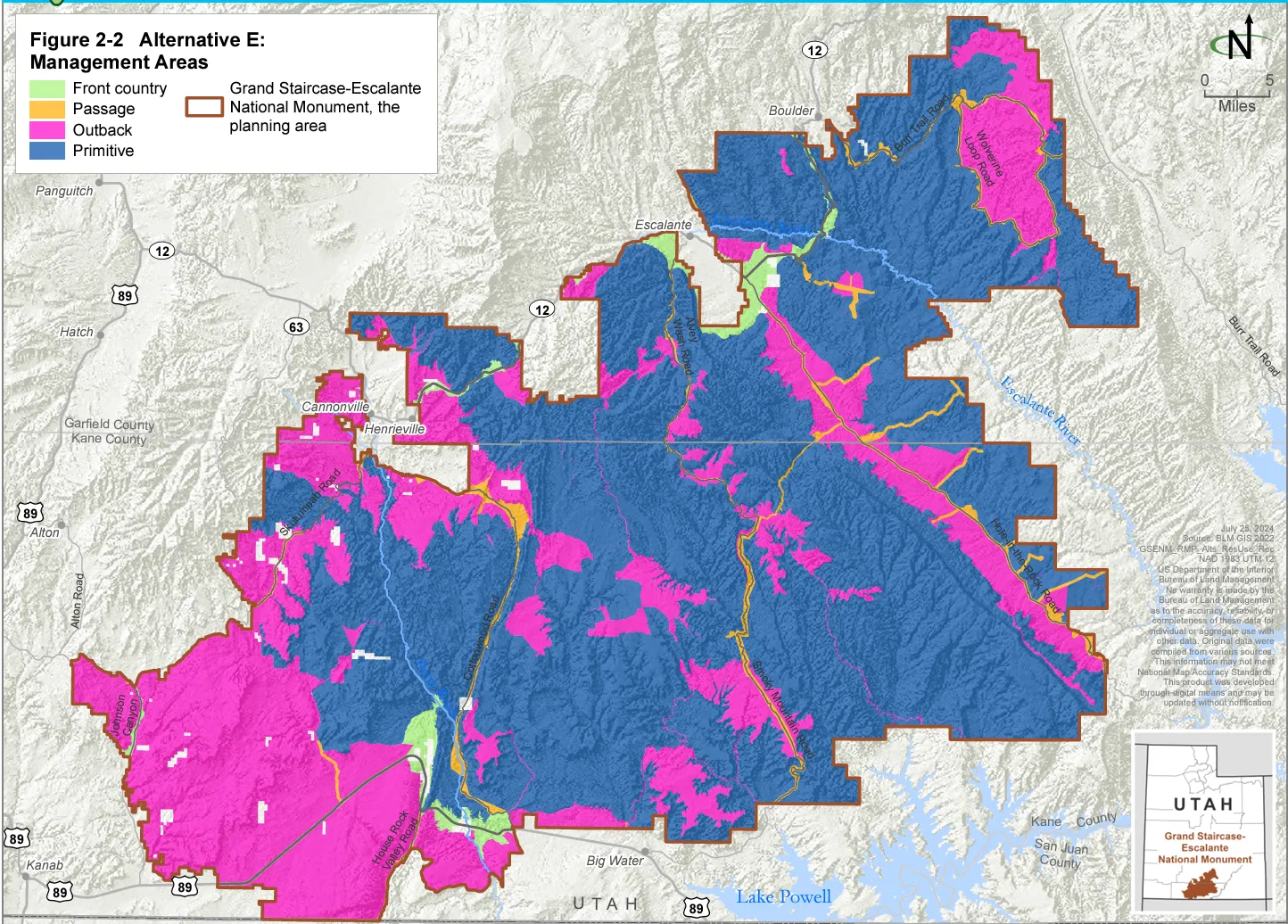
Grand Staircase-Escalante National Monument. Jonathan P. Thompson photo.
Click the link to read the article on the Land Desk website (Jonathan P. Thompson):
September 6, 2024
🌵 Public Lands 🌲
The Bureau of Land Management released the final environmental impact statement and management plan for Grand Staircase-Escalante National Monument last month and I’ve been making my way through it (it’s a voluminous document, to put it mildly). A few things have really struck me:
Crafting a management plan for a 1.8-million-acre landscape that includes deserts, canyons, forests, riparian areas, and much more is a monumental undertaking. There are so many factors to consider, such a diversity of ecosystems to steward, and many competing interests to account for. This one is impressive for its thoroughness and for all of the science and information it contains about the current state of the land.
As is almost always the case with these sorts of things, the preferred alternative is a compromise, offering a lower level of protection than the more purely preservation-oriented alternative. Nonetheless it strives for conservation and is leaps and bounds stronger than the existing Trump-era plan, which will remain in effect if the new plan is not implemented. I took a look at the draft plan and the “preferred” alternative C a year ago, which was the second-most restrictive of the lot. After receiving a boatload of input, the BLM went with a new approach — Alternative E — which is a modified version of Alt. C, and is more restrictive in some cases, less in others.
The preferred alternative would: “Establish a management approach in collaboration with Tribal Nations that ensures continued Tribal Nation stewardship of GSENM resources.”
The plan’s light-handed approach to livestock graving provides yet more evidence that national monument designations pose virtually no threat to ranching, public lands grazing, and the “way of life” they foster. So next time a Utah politician or wannabe sagebrush rebel whines about how the BLM or the Biden administration or national monuments are destroying ranching, show them this plan — and remind them they’re still paying just $1.35 per month for a cow and its calf to roam around public land and chomp up about 1,000 pounds of the taxpayers’ forage.
Now for some of the key elements of the plan (with maps from the preferred Alternative E):
The monument has four management areas: Front Country, Passage, Outback, and Primitive.
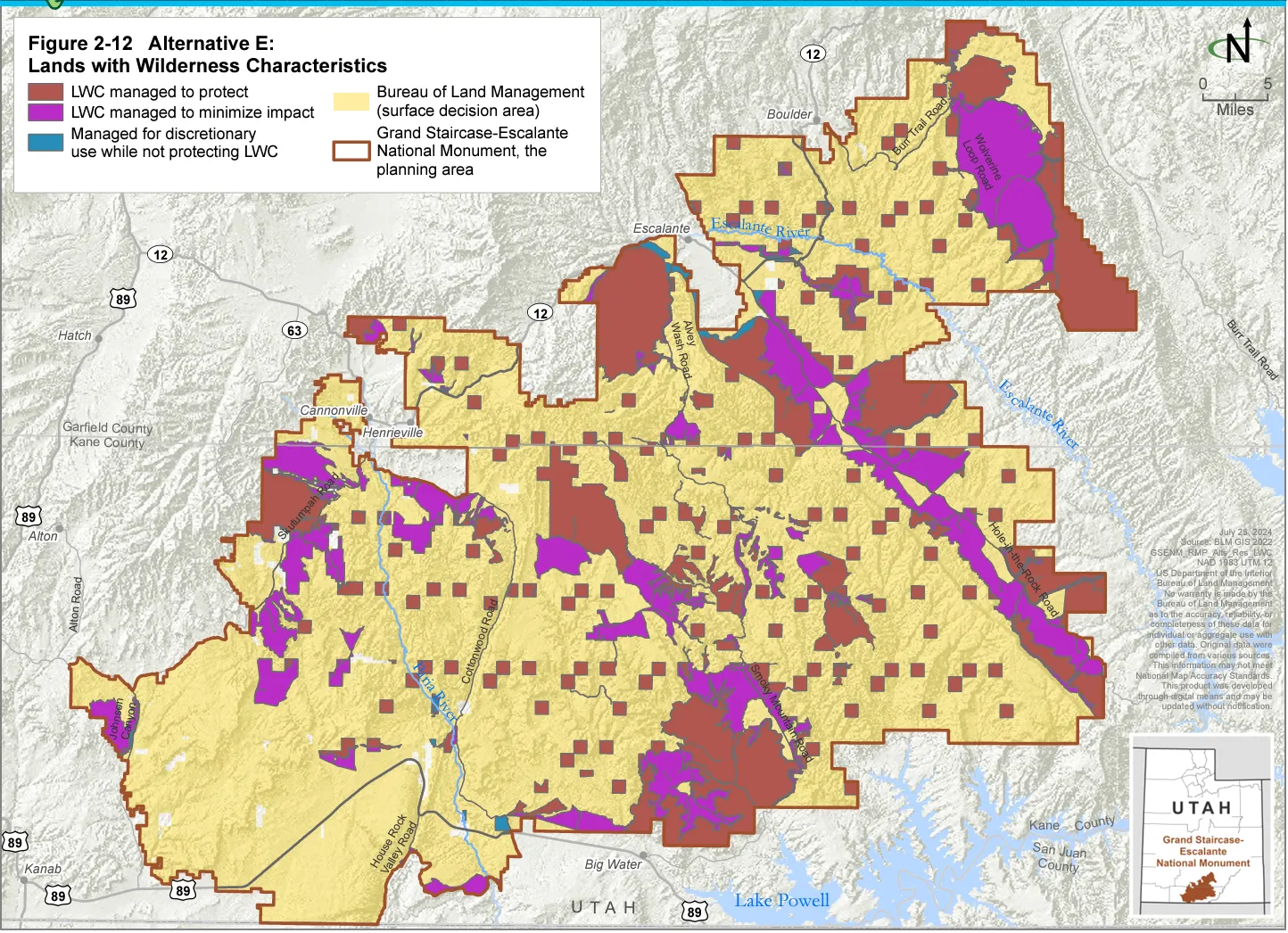
The monument includes 559,600 acres of lands with wilderness characteristics (i.e. lack of roads or development, “untrammeled,” etc.), but that aren’t designated wilderness areas. Alternative E would manage 329,400 acres of those lands for the protection of those characteristics, making them de facto wilderness areas; 224,100 acres would be managed to “minimize impacts”; and 6,100 acres would be managed for other compatible uses. That’s compared to the status quo, which allows for other uses on all of those lands.
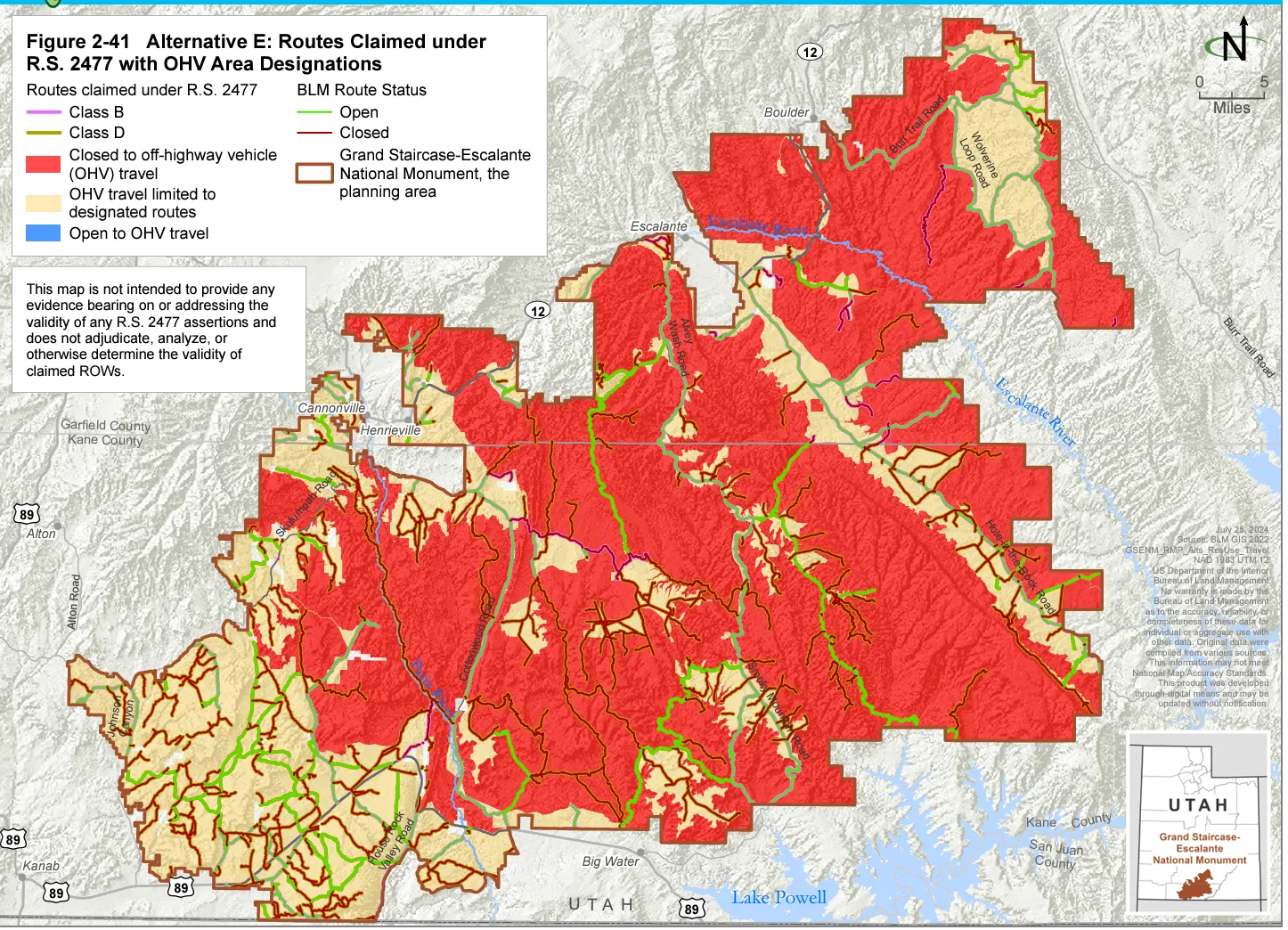
Hundreds of miles of roads, from paved highways to dirt two-tracks, are webbed throughout the national monument. Most have been claimed by the county as RS-2477 routes (which, if upheld by courts, would give the county control over them), and most remain open to motorized travel. Currently about 1,500 acres of the monument are completely closed to OHV travel, and OHV use is limited to designated routes on 1.86 million acres. Under the new plan, 1.25 million acres would be closed to OHVs, with OHVs still allowed only on designated routes on about 620,000 acres.
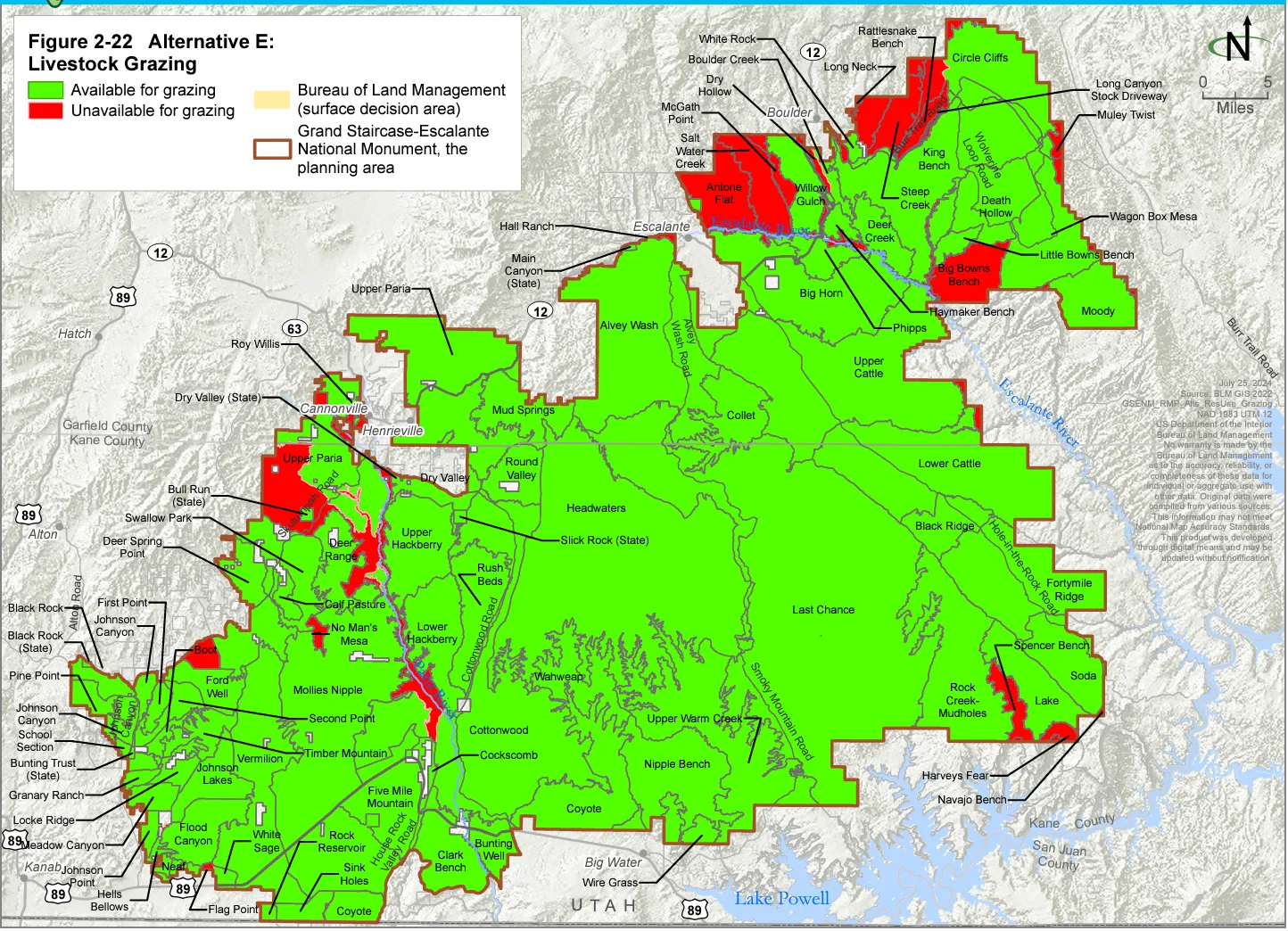
Currently, about 2.1 million acres in the national monument planning area (which extends beyond the boundaries) are available to grazing, un-permitted allotments can be reinstated, and suspended Animal Unit Months, or AUMs, can be reactivated. The new plan would put just 128,300 acres off-limits to grazing — a deep compromise, given that Alternative D would have halted grazing on 1.2 million acres — and will allow cattle, but not sheep and goats, to chomp their way across 1.7 million acres.
There are currently 76 grazing allotments in the monument, 14 of which are partially or completely unavailable to grazing, and 10 of which are vacant and available but are not currently permitted. The existing plan allows those to be re-permitted; the new plan would not.
There are currently 105,452 animal unit months (a cow-calf pair grazing for one month), or AUMs, available in the planning area (76,207 active and 29,245 suspended). The 2020 plan directed the agency to reinstate the suspended AUMs, but it has not done so yet. Of the 76,207 active AUMs, operators only used (or were billed for) about 42,377 AUMs on average between 1996-2020. That suggests it’s the livestock operators themselves, not the land managers or monument protections, that are limiting grazing. There likely will still be a lot of bovines munching on native grasses and trampling the fragile cryptobiotic soils for years to come.
The new plan would allocate 104,980 AUMs. But, when people voluntarily relinquish a grazing permit or lease, the number of allocated AUMs would automatically decrease by that same amount, which theoretically would phase out grazing over time.
The agency estimates the cattle will emit a total of 4,584 metric tons of methane annually under the preferred plan.
And you know those folks screaming and yelling that national monuments will destroy local “heritage” and livelihoods and all of that? Some are well-intentioned but misinformed. Others are intentionally spewing disinformation in order to advance an ideological, sometimes corporate-driven, agenda. The Center for Western Priorities calls the latter the National Monuments Disinformation Brigade, and they just issued a report on these folks. Give it a read. Regular Land Desk readers will see some familiar names.
Speaking of land management plans and giving the livestock industry everything it wants, the BLM’s Rock Springs field office also recently released its final resource management plan for about 3.6 million acres of public land in the southern part of the state, including the Red Desert. The draft plan was unexpectedly strong on the conservation side of things, and I held it up as proof that the BLM was shedding its Bureau of Livestock and Mining label (okay, maybe not the livestock part).
A lot of Wyoming right-wingers weren’t so pleased with it, though, with one wing-nut claiming it would affect more people than “the Civil War, Pearl Harbor, and 9/11 combined.” Except there aren’t even that many people in all of Wyoming!
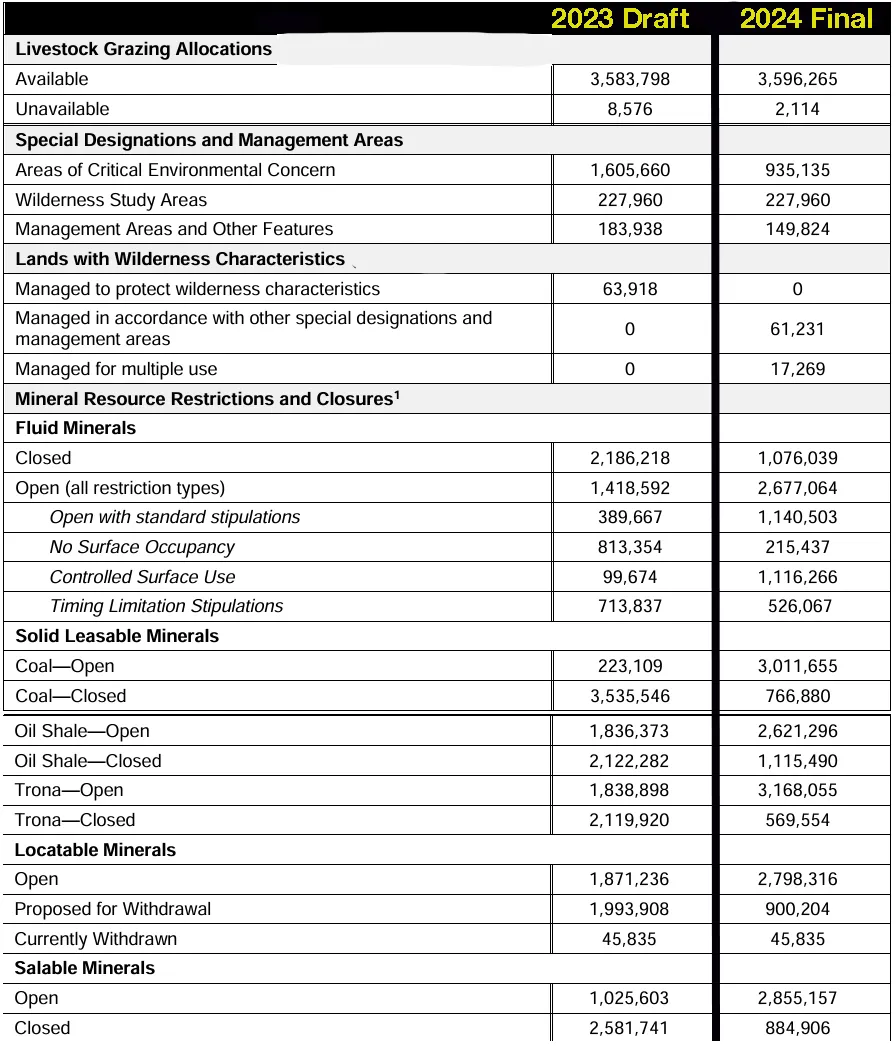
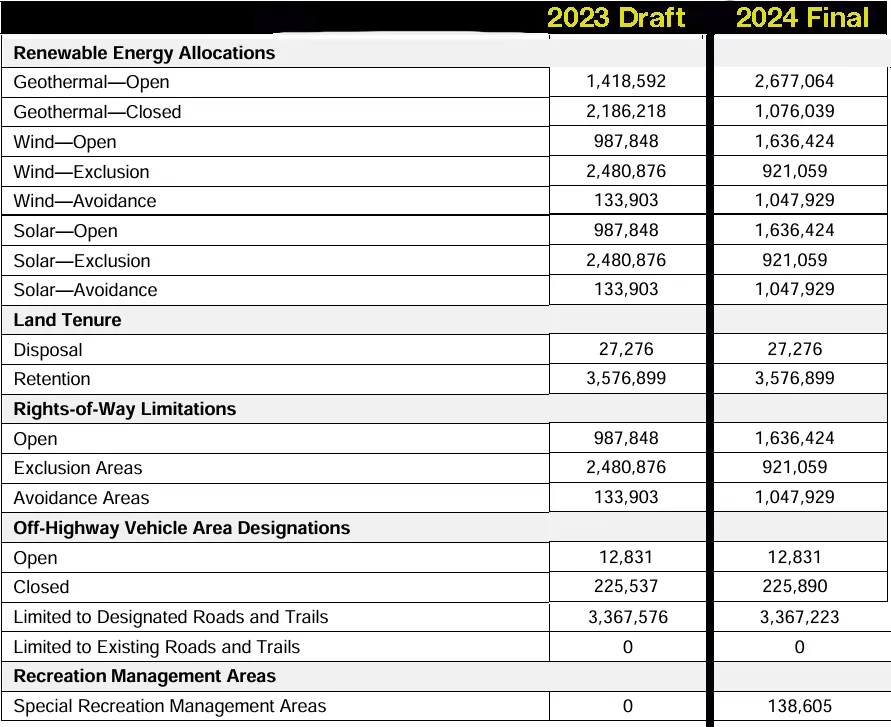
Anyway, rather than sticking to its guns, the BLM went back to the drawing board and did what federal agencies often do, compromised (and bent over backwards to please the noisy minority — and industry). The new plan, in my opinion, overcorrects and leaves 99.95% of the area open to grazing; designates areas of critical environmental concern on some 700,000 fewer acres than the draft plan; opens far more land to coal and trona mining, oil and gas drilling, oil shale extraction, and new mining claims. The new proposed plan also opens up more land than the draft to wind, solar, and geothermal development.
I chopped up the BLM’s chart and pasted it back together to allow for a quick comparison between last year’s draft proposal, and this year’s final preferred alternative plan.
⛈️ Wacky Weather Watch⚡️
Welp, Phoenix went and did it again by setting all sorts of records for armageddon-like heat. For example, it is now on the 107th consecutive day on which maximum temperatures reached 100° F or higher; the previous record was 76 days in a row back in 1993. The mercury has reached 110° on 55 days, matching the record set … last year. The average monthly temperature has exceeded the 1990-2020 normal during six of the last eight months, and this climatological summer (June-August) was the hottest on record. All of that’s crazy, disturbing, and scary — yet not all that surprising, given that we’re clearly in the grips of human-caused climate warming. What is surprising is that when some kind-hearted Phoenician put a cooler full of bottled water in his driveway to offer free relief to passersby, his homeowners association went after him for violating some obscure rule. HOAs, hmmmph!
🦫 Wildlife Watch 🦅
Someone shot a critically endangered California condor this spring near McPhee Reservoir in southwestern Colorado and wildlife officials want your help finding the shooter. Thanks to a tracking device, the dead condor was found and recovered in March within 24 hours of being shot between the small community of Lewis and the reservoir. It is illegal to kill the majestic birds. Folks with information are asked to call Colorado Operation Game Thief (OGT) Hotline: 1-877-COLO-OGT (1-877-265-6648); email game.thief@state.co.us; or report it online at Submit a Tip.
***
Sad news from Silverton, too: A mama bear died after a sheriff’s deputy shot it with a beanbag — that was supposed to be nonfatal — in an attempt to shoo the bruin away from people (who were gathered around gawking at her and her two cubs). The Durango Heraldreports the San Juan County Sheriff’s department is looking into allegations that someone harassed one of the cubs.
😀 Good News Corner 😎
And, finally, some kind of cool news: The Ute Mountain Ute Tribe’s farm in southwestern Colorado has finished integrating a hydropower system into its irrigation network that will harness excess water pressure from pivot-sprinkler pipes. It’s not a huge system, but it demonstrates one way to generate clean energy with minimal impact. Now let’s hope there continues to be enough water running through those pipes.
The paperwork officially putting a close to the Red Lady mining fight on Mt. Emmons was filed the morning of Thursday, August 29, ending a battle that has lasted almost five decades. The documents finalized a so-called Mineral Extinguishment agreement, conservation easements on Mt. Emmons, and a major land exchange agreement between the Mount Emmons Mining Company (MEMC), a subsidiary of global mining giant Freeport McMoRan, and the US Forest Service were all signed, sealed and delivered Thursday…Groups, organizations and government entities including the High Country Conservation Advocates, the town of Crested Butte, the Crested Butte Land Trust, the Red Lady Coalition, Gunnison County, the state of Colorado, US senator Michael Bennet and others, all played a role in the outcome. And so did the mining company that made the collaborative decision to work with the local community to basically walk away from its mining rights and focus on reclamation and maintaining water quality on the site that sits in the town’s watershed. The MEMC water treatment plant is on Red Lady and treats water from the old Keystone mine.
“This victory is an incredible testament to the staying power of the greater Gunnison Valley community. To say that not many mine fights end in a collaborative solution eliminating the potential to mine is an understatement,” said Julie Nania, Red Lady Program Director for HCCA.
Less than 12 hours after the Biden Administration and the Imperial Irrigation District approved an unprecedented deal to conserve 700,000 acre feet of Colorado River water through 2026, the flow of river water to the rural valley three hours south of Los Angeles slowed. District personnel moved out before sunrise to install more than 1,600 locks on gates to canals supplying hundreds of farm fields, cutting off water deliveries for up to 60 days this year. The process will be repeated over the next two summers.
In exchange, the powerful agency and farmers who volunteer to not receive the water and hold off on growing hay in hot summer months will be paid nearly $700 million in federal funds — by far the largest of numerous agreements struck with water agencies and tribes to prop up the overused, drought-ravaged river and its reservoirs. For irrigation district officials, the agreement, which will conserve a huge amount of water, about as much as the state of Nevada uses annually, caps years of arduous negotiations and multiple federal reviews…
But the way the deal was finalized and its potential impacts on the also rapidly dwindling Salton Sea and local public health angered numerous environmental justice and policy groups. They said the U.S. Bureau of Reclamation and the powerful water agency rushed through cursory approvals and ignored much of their lengthy comments, including ideas on how to monitor and reduce air quality and wildlife impacts that they say will occur from holding back such a huge amount of water.
The irrigation district board on Sunday hastily scheduled a special meeting for Monday night to approve the agreement, before reclamation staff had even released their final determination that cutting so much agricultural runoff into the sea would have “no significant environmental impacts.” Five hours before the meeting on Monday afternoon, the feds released their final determination and posted 150 pages of responses to the lenghty comments submitted by more than half a dozen groups and several individuals who have studied the Salton Sea for decades, including a major annual transfer of water to suburban San Diego that is rapidly depleting the water body, California’s largest.
In an email headed “IID’s quickie action,” Joan Taylor, chairperson of the Sierra Club’s California/Nevada Desert Committee wrote, “It’s commendable that IID recognized a responsibility to cut down on water use to help protect the water supply for the West, but what they’re doing is akin to doubling the water transfer to San Diego. We know that already has profound impacts. So this is a very big deal … and will suddenly increase dusty lakebed exposure around the Salton Sea by 13,000 acres.”
These hay bales stand ready to be collected on a ranch outside of Carbondale. Upper Colorado River Basin officials are working on a memorandum of understanding with the U.S. Bureau of Reclamation so water saved as part of conservation programs can be tracked and stored in Lake Powell. Credit: Heather Sackett/Aspen Journalism
Colorado River water managers are moving forward with a plan to track and get credit for conserved water.
The Upper Colorado River Commission on Monday voted unanimously to move ahead with the creation of a memorandum of understanding with the U.S. Bureau of Reclamation that would provide accounting and credit to the Upper Basin states (Colorado, New Mexico, Utah and Wyoming) for water saved through conservation programs. It would also identify qualifying criteria for water conservation projects. A draft of the MOU is expected by the end of September.
The states and the bureau would conduct this provisional accounting of water saved in Lake Powell and other Upper Basin reservoirs through 2026.
“The provisional accounting is exactly that,” said UCRC Executive Director Chuck Cullom. “It is not an operational guide for Reclamation; it is a means for folks to understand how much water would be available in that account upon the implementation of a formal agreement or credit program.”
Credit for the stored water could be formalized in one of two ways: as part of the post-2026 guidelines for reservoir operations, which the seven Colorado River basin states are in the midst of negotiating, or by implementing the demand management storage agreement, which was part of the 2019 Drought Contingency Plan.
For the past two years, some Upper Basin water users have been participating in a federally funded program known as the System Conservation Pilot Program, where they are paid to voluntarily use less water. The program is projected to save about 101,000 acre-feet of water at a cost of $45 million.
Despite one of the stated intentions of SCPP being to protect critical reservoir levels, the program does not track the conserved water to see how much of it ultimately ended up in Lake Powell. This lack of accounting has been one of the criticisms of the program, with some water users saying water conserved in the Upper Basin was simply being sent downstream to enable what they say is overuse by the Lower Basin states (Arizona, California and Nevada). The MOU would be a step toward remedying that.
“If we’re reducing demand and using taxpayer money to do it, then we have to make sure that it’s meaningful,” said Anne Castle, UCRC chair and the body’s federal representative. “It needs to provide benefit to the states that created that conserved water. That’s particularly important right now when the basin states are in difficult discussions about how to allocate the reductions in use that we all know are needed in the future.”
Upper Basin states are interested in “getting credit” for stored water because it could protect them in the event of a compact call. As the effects of demand, drought and climate change push the Upper Basin closer to not being able to deliver the required amount of water to the Lower Basin under the terms of the 1922 Colorado River Compact, water managers have been grappling with the idea of an insurance pool in Lake Powell. From 2019 to 2022, the state of Colorado explored the contentious concept of demand management, which would pay water users to temporarily cut back and store the conserved water in Lake Powell. Water could be released from this pool instead of shutting off cities and irrigators.
There is urgency to figure out how the Upper Basin states can track, measure and get credit for conserved water because there will soon be more opportunities for water conservation programs. This fall, the Bureau of Reclamation plans to announce funding for what officials are calling “Bucket 2 Water Conservation” projects. These are projects that would achieve verifiable, multiyear reductions in use or demand for water supplies.
The Colorado River near the state line in western Colorado. Representatives from the seven basin states that use the river are negotiating how future cuts will be shared in dry years. Credit: Heather Sackett/Aspen Journalism
Seven-state negotiations
Commissioners also gave an update on those difficult discussions with the seven basin states on how the river will be managed after 2026. Representatives from the UCRC, as well as from California, Nevada and Arizona, are in the midst of figuring out how the nation’s two largest reservoirs will be operated after 2026 and which water users will be cut by how much in dry years.
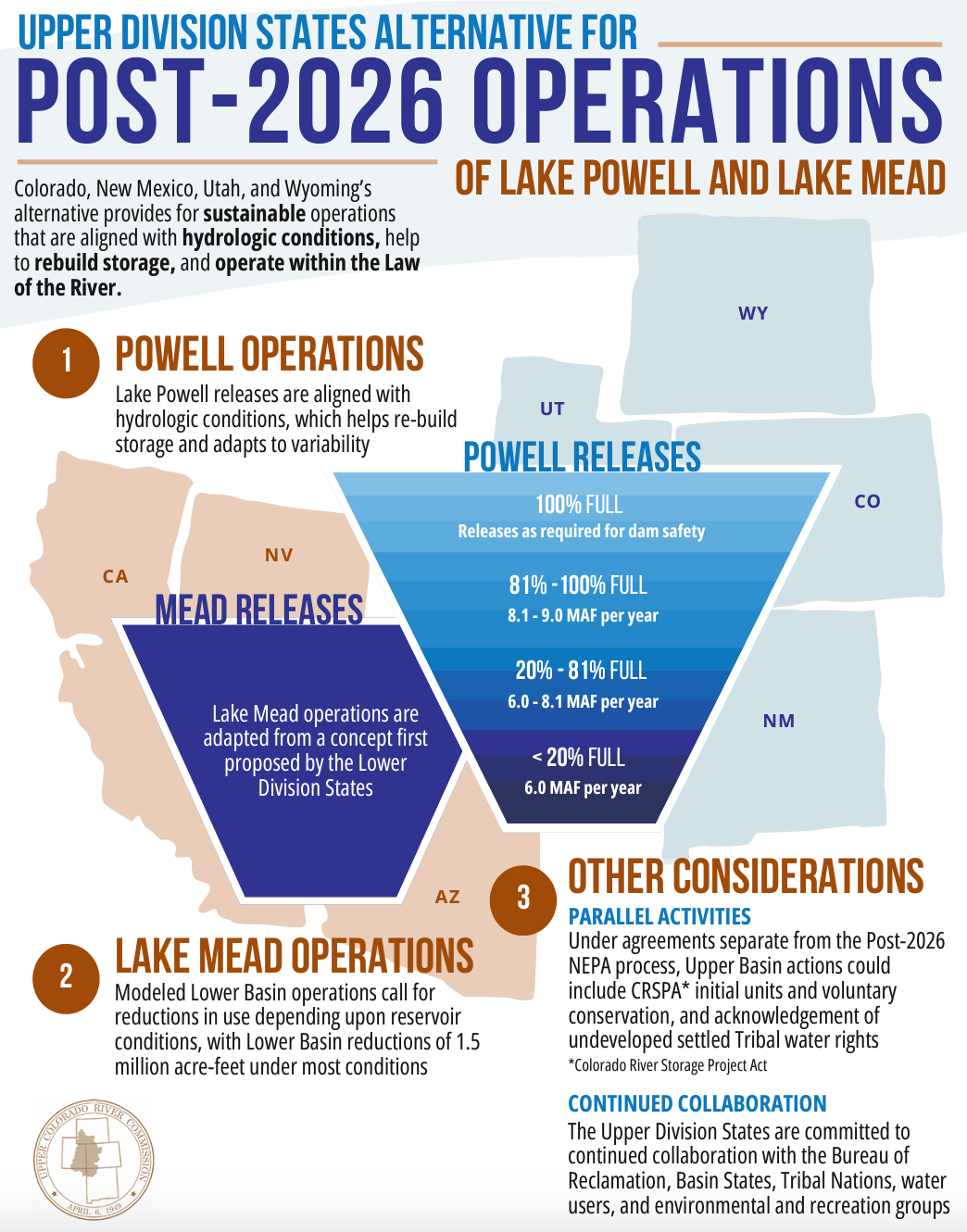
In their proposal to the Bureau of Reclamation, the Lower Basin states demanded that the Upper Basin share in future cuts when reservoir levels dip. But Upper Basin commissioners stood by the counterproposal they offered in March, called the Upper Basin Alternative, which does not include mandatory cuts for Upper Basin water users.
“The upper division states continue to stand behind the alternative that we submitted and know that it provides a reasonable alternative for sustainable operations of Lake Powell and Lake Mead,” said Colorado Commissioner Becky Mitchell.
Although the Upper Basin’s proposal does not commit to sharing in cuts when reservoir levels fall, it does offer “parallel activities,” which would include voluntary, temporary and compensated reductions in use (as the SCPP does), which are separate from the post-2026 guidelines process.
“We’re moving forward with our parallel actions like we have committed to do,” said Utah Commissioner Gene Shawcroft. “I think that’s significant.”
Although the Upper Basin and Lower Basin states have competing proposals, Upper Basin commissioners said Monday they are still committed to finding a consensus with their Lower Basin counterparts.
Colorado River “Beginnings”. Photo: Brent Gardner-Smith/Aspen Journalism
Click the link to read the article on the InkStain website (Kathryn Sorensen, Sarah Porter and John Fleck):
August 16, 2024
Colorado River Basin governance is increasingly struggling with a deep question in water management: When we reduce our use of water, who gets the savings?
If I install more efficient irrigation equipment, should I get credit for the saved water to expand my acreage, or save the water in an upstream reservoir as a hedge against next year’s drought? If I tear out lawns, can I use the saved water to help build the next subdivision, or save the water in an upstream reservoir as a hedge against that next year of drought?
Or should the savings contribute, not to my own resilience and well-being, but to the resilience and the well-being of the system as a whole by simply reducing overall water use?
In a deeply insightful 2013 book, British scholar Bruce Lankford bestowed the unfortunately wonky name of “the paracommons” to this question, and it dogs water policy management around the world.
This issue has been lurking in Colorado River management for a long time. Should we create legal structures that allow users to bank the savings for their own use later? Or should the reductions benefit the health of the system as a whole? There are advantages and disadvantages to both approaches, and we need to design new rules for managing the Colorado River with our eyes open on this question.
Assigned Water
In a new paper, we explore the implications of the two paths for the management of a post-2026 Colorado River.
One is to incentivize conservation by giving water users the chance to bank saved water for later use. Known most commonly as Intentionally Created Surplus (ICS), and more broadly in a series of increasingly creative implementations as “Assigned Water,” this creates short term savings.
The other involves permanent reductions – “System Water.” Water use is reduced for the benefit of the Colorado River as a whole.
In more than a decade of experimentation with these policy tools, we have seen the results. Investment in Assigned Water, attractive to water managers because of the allure of getting their water back, has crowded out investment in the more durable System Water reductions that will be needed to bring the Colorado River into balance.
As we develop new operating rules for the river, we need to be mindful of the differences involved.
Assigned Water does not solve the problem of overallocation because when it is deployed we are borrowing against our own bank. Enduring solutions on the river can only be found by addressing overallocation.
Assigned Water creates critically important operational flexibility; it allows its owner to either forgo water deliveries in one year—or pay someone else to—and take delivery of that water during another potentially desperate time.
Assigned Water is generally insulated from shortage, forfeiture and abandonment.
Protection from shortage and forfeiture has value; Assigned Water creates individual resiliencefor its owner. Because of this, the availability of Assigned Water appears to crowd out investment in collective resilience in the form of System Water.
In conversations about post-2026 operations negotiators are contemplating extending, enlarging and/or enhancing Assigned Water and/or creating an operationally neutral form called Top Water. In any form, Assigned Water lives outside of the existing priority system. In this regard, the conversation involves the reallocation of water in Lakes Powell and Mead.
Critics of the West’s priority system of water delivery can rejoice—nearly 40% of the water in Mead in 2023 was Assigned Water, meaning that Assigned Water is replacing priority to a significant degree. But is the priority system like capitalism in that it has its warts but the alternatives are far worse? As the expansion of the rights of municipal water providers, irrigation districts, foreign nations and tribes to own even more and different kinds of Assigned Water is contemplated for a post-2026 world, consideration should also be given to how these changes may also inure to the benefit of environmental non-governmental organizations, hedge funds and water speculators. Those who share John Wesley Powell’s fears will understand the implications because the expansion of Assigned Water in Lakes Powell and Mead may bring about the ultimate divorce of priority-based water rights from arid lands in the Colorado River Basin.
There are important elements of transparency and fairness at play. The large, powerful players on the River received Assigned Water through negotiations not available to others—meaning, there was no open bidding process or invitation to smaller entities to acquire this valuable water. Apparently, there still isn’t. Thought ought to be given to those other stakeholders—smaller cities, farmers, tribes and others—who have made investments and built economies based on the priority system. Imagine a restaurant that operates on a first-come-first-serve basis and a hungry patron who waits patiently in line for the doors to open only to be told that the rules changed while he was waiting and all of the reservations have been claimed through a process from which he was excluded.
It is helpful to continue to deploy a tool as flexible and alluring as Assigned Water, particularly in the form of operationally neutral Top Storage, so there’s no need to throw the baby out with the bath water. A reasonable path forward may be to allow the creation of Top Storage with appropriate guardrails while including a 50% cut for System Water. Post 2026, Assigned Water will be so valuable that entities likely will be willing to take a big haircut to get it, and such a required contribution solves the problem of developing enduring funding for System Water to a significant degree. Maybe ultimately environmental non-governmental organizations, hedge funds and water speculators get a piece, but if so, it will be at the price of protecting and respecting the priority system upon which so many depend.
Receding waters at Lone Rock in Lake Powell illustrate the impacts of megadrought. Hydroelectric generation will be endangered if the lake continues to shrink. Credit: Colorado State University
Colorado River officials in four states, including Colorado, are negotiating a new agreement with the federal government to conserve water and get credit to protect against possible cutbacks in the future.
Water conservation is a big issue in the Colorado River Basin, where prolonged drought, a changing climate, and overuse have strained the water supply for 40 million people. Currently, water conserved on a farm simply reenters streams and can be used by anyone downstream. The negotiations aim to set up a program to track, count and store that water so it can benefit the four Upper Basin states — Colorado, New Mexico, Utah and Wyoming.
Coloradans have asked for a conservation credit program, and this is a way of addressing that feedback, said Commissioner Becky Mitchell, Colorado’s representative on the Upper Colorado River Commission.
“One of the things that I heard primarily was that we need to be getting credit for the work that we are doing, and we need to be getting credit for it now,” Mitchell said Monday during the commission’s meeting.
Farmers, ranchers and other water users are already being paid to cut back their use of Colorado River water. Last year, taxpayers paid farmers and ranchers $16 million to cut their water use through the System Conservation Pilot Program.
The program led to water savings, but it did not require tracking and storing the water. Theoretically, water conserved in the Upper Basin could simply flow downstream to be used on farms, ranches and cities in the Lower Basin, according to critics of the program.
After years of debating and studying possible water credit programs, the commission ramped up its efforts to set up a program in July.
The commission hasn’t explicitly defined how credits will be used yet beyond saying they will benefit Upper Basin states. One possible use is to save up the credits and use them to fulfill the Upper Basin’s interstate water sharing obligations if river conditions worsen drastically and trigger mandatory cuts in the Upper Basin.
Commissioners and officials from the U.S. Bureau of Reclamation, which manages the basin’s vital storage reservoirs, aim to draft a conservation-for-credit agreement by the end of September.
It will identify general criteria for projects that could potentially conserve water for credit, like where conservation is taking place, who can participate, how the program would be regulated and how they plan to calculate conserved water.
If the commissioners approve the draft agreement, they will also have the option to move forward with accepting project proposals. The goal is to have applications in by October and to launch conservation projects in 2025, said Chuck Cullom, the commission’s executive director.
Establishing a conservation-for-credit program won’t be simple.
Building a long-term program to track and store conserved water raises questions about equity, funding, economic impacts and whether the idea is feasible at all.
The devil is in the details, said Andy Mueller, general manager of the Colorado River Water Conservation District, a public water planning and policy agency that spans over half the Western Slope (which is part of the Colorado River Basin).
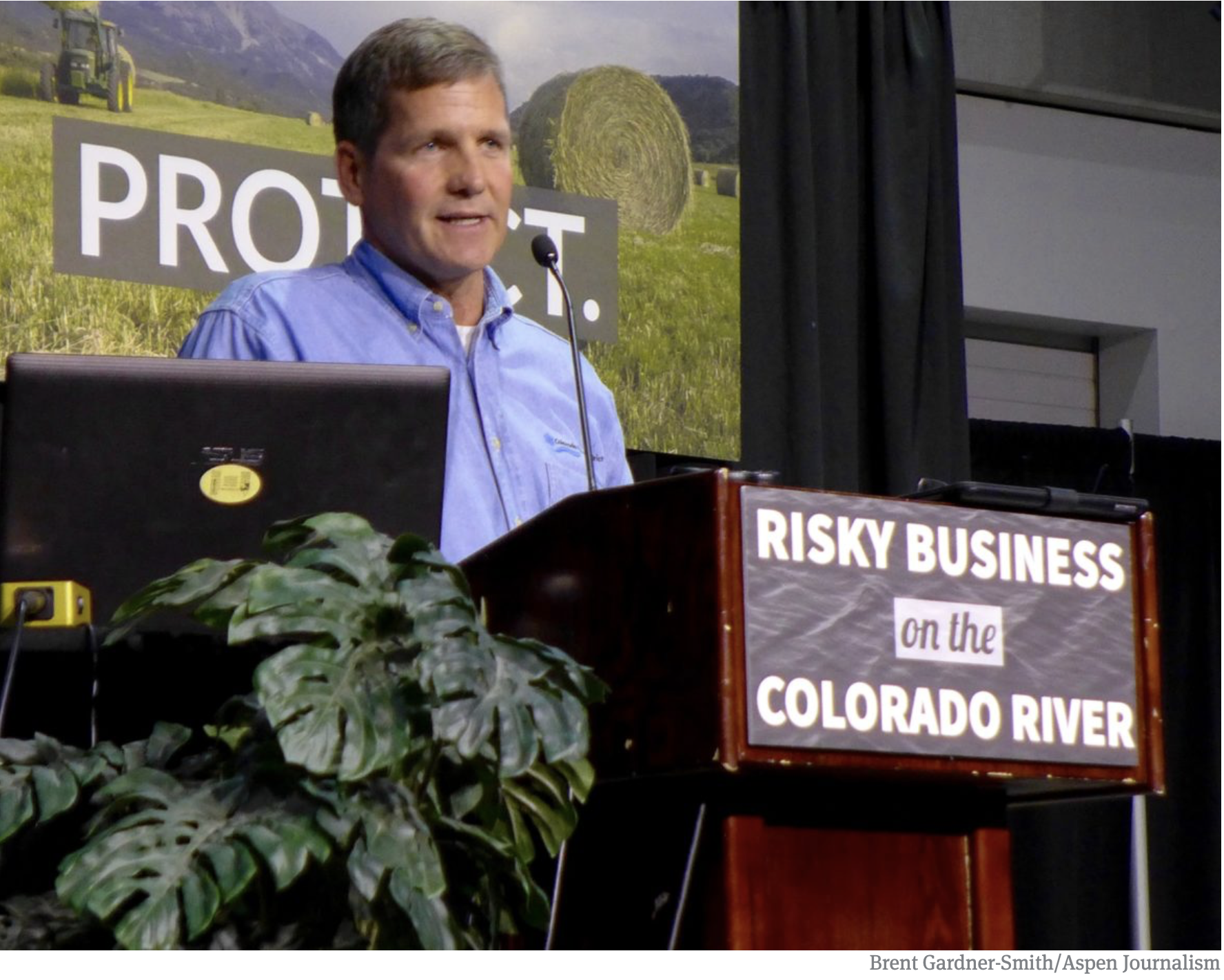
Andy Mueller, the general manager of the Colorado River District, speaking at the district’s annual seminar on the Colorado RIver, on Sept. 14, 2018 in Grand Junction. Muller expressed concerns about how the state of Colorado might deal with falling water levels in Lake Powell and Lake Mead. Photo credit: Brent Gardner-Smith/Aspen Journalism
He wants to make sure a future program will not disproportionately impact one region, like the Western Slope. Farmers and ranchers in western Colorado have made nearly all of the water cuts through the conservation pilot program, even though communities across the state use Colorado River water.
“It’s a complex accounting world, and it takes time,” he said Monday after tuning into the virtual commission meeting along with about 100 other participants. “We do think they’re moving in the right direction.”
The potential program also has to coordinate with a set of high-stakes negotiations among all seven Colorado River states to decide the rules for storing, releasing and cutting back on water in the river’s main reservoirs, like Lake Powell and Lake Mead. These new rules won’t go into effect until after 2026.
Any credits gained before the end of 2026 will be counted but won’t be able to be used by the Upper Basin until after that process is complete, Cullom said.
The Upper Basin promised to conserve water in a proposal outlining how the four states envision future Colorado River management. Setting up a new conservation program shows the entire basin that the Upper Basin is taking action to cut back on water use, the state commissioners said.
The Department of the Interior today announced a nearly $105 million investment as part of the President’s Investing in America agenda for 67 water conservation and efficiency projects that will enhance drought resilience across the nation. The investment comes from the Bipartisan Infrastructure Law and annual appropriations.
President Biden’s Investing in America agenda represents the largest investment in climate resilience in the nation’s history and provides much-needed resources to enhance Western communities’ resilience to drought and the effects of climate change. Through the Bipartisan Infrastructure Law, the Bureau of Reclamation is investing a total of $8.3 billion over five years for water infrastructure projects, including rural water, water storage, conservation and conveyance, nature-based solutions, dam safety, water purification and reuse, and desalination. Since the President signed the Bipartisan Infrastructure Law in November 2021, Reclamation has announced $4.2 billion for 575 projects to date.
“Access to clean, reliable water is essential for feeding families, growing crops, sustaining wildlife, and powering agricultural businesses,” said Acting Deputy Secretary Laura Daniel-Davis. “Enabled by the President’s Investing in America agenda, the Biden-Harris administration is bringing historic resources to bear to ensure the stability and sustainability of the Colorado River Basin in the wake of severe drought and to safeguard communities across the West, by strengthening climate resilience and facilitating water conservation.”
“As we work to counter the impacts of drought and climate change, we must embrace opportunities to increase water and energy efficiency wherever possible,” said Reclamation Commissioner Camille Calimlim Touton. “The President’s Investing in America agenda provides the resources to expand these conservation efforts that include canal lining, meter installation, conservation incentives, and gate automation.”
Reclamation anticipates that the projects, located in Arizona, California, Colorado, Idaho, Kansas, Montana, Nebraska, Nevada, Texas, Utah and Wyoming, will save more than 111,000 acre-feet of water annually. That’s enough water to supply approximately 447,000 people for a year. This builds upon $140 million announced for water and energy efficiency projects last year. The complete list of projects can be found on Reclamation’s website.
Four states in the drought-stricken Colorado River Basin, including Colorado, want credit for conserving water, but water users and officials have big questions about how to make it happen.
Last year, taxpayers paid farmers and ranchers $16 million to cut their water use in the Colorado River Basin, but the water saved on one farm simply reentered streams, where it could be used by anyone downstream. For years, officials in Colorado, New Mexico, Utah and Wyoming have been considering ways to get credit for that conserved water — to track it, store it in a reservoir, and save it to help the states in the future. Representatives from the four states voted in June to develop a proposal exploring the idea by mid-August.
But building a long-term program to track and store conserved water raises questions about equity, funding, economic impacts and whether the idea is feasible at all.
People are concerned about the bigger picture, said Andy Mueller, general manager of the Colorado River District in Colorado.
“If we’re going to conserve water up here, and if the federal government is going to pay for that conservation with taxpayer dollars, it seems to us that storing it and using it for important public purposes makes sense, rather than sending it downstream to just encourage continued consumption of water [by downstream states],” Mueller said.
Cutting back on water use is a big topic of conversation in the Colorado River Basin, which supplies water to 40 million people and is enduring warmer temperatures and a two-decade megadrought.
Officials from each of the seven states in the basin are weighing who might have to cut their use and how to manage the basin’s reservoirs in high-stakes negotiations over the river’s future after the current rules expire in 2026.
The Upper Basin’s alternative, summed up. Source: Upper Colorado River Commission.
The Upper Basin released a proposal in March that outlined its plan to manage the river after 2026 as part of these negotiations. That proposal includes a commitment to pursue voluntary, temporary and compensated conservation programs.
The June vote of the Upper Colorado River Commission aimed to take that commitment one step forward. The state and federal representatives on the commission want to design a conservation-for-credit program in advance so it’s set up and ready to go if needed.
The commission’s plan could help inform the states’ negotiations, said Amy Ostdiek, who is part of Colorado’s negotiating team and works on interstate water issues for the state’s top water policy agency, the Colorado Water Conservation Board.
“We’ve heard this from water users a lot. … If we’re going to continue doing conservation-type activities, can we explore ways to quote-unquote get credit for it?” Ostdiek said. “It’s worth exploring. … There’s a lot we’d need to work out before we get there.”
Grays and Torreys, Dillon Reservoir May 2017. Photo credit Greg Hobbs.
Big questions from water users
Officials and water users have been kicking around the idea of tracking and storing conserved water for credit for years, and the commission’s August proposal will be the latest iteration of those discussions.
One heavily debated program, called demand management, offered a path toward storing conserved water in a reservoir to help Upper Basin states. But Colorado hit pause on analyzing the idea in 2022 as other Upper Basin states slogged through intense feasibility studies.
Taxpayers paid $16 million in 2023 to conserve water through another program, the System Conservation Pilot Program. Because the program does not track conserved water, there is no certainty where it ends up.
“It inherently just flows downstream and continues to be used by the Lower Basin,” Mueller said. “It really doesn’t do anything other than feed the continued use of the water, rather than encourage conservation of the water.”
The commission’s proposal will try to answer key questions for a program that tracks and stores conserved water, said Chuck Cullom, executive director of the Upper Colorado River Commission. But how will water managers track the actual water down streams, through reservoirs and across state lines? What is a “conservation credit” and how can it be earned? What role would location play?
Mueller of the Colorado River District said the location of the projects ties into big potential equity issues.
Most of Colorado’s participants in the system conservation pilot program so far have been farmers and ranchers on the Western Slope, he said. They helped conserve water by fallowing fields and switching to crops that used less water. But if a farmer stops production, or fallows acres of land to conserve water, it can cut jobs on the farm and spending in the community.
A paid conservation program has to be designed to incentivize participation from all regions of Colorado where Colorado River is used, which includes Front Range cities from Fort Collins down to Colorado Springs and beyond, Mueller said.
Joe Bernal, a rancher in Loma who is participating in the System Conservation Pilot Program, said his concern was how a conservation-for-credit program would be administered.
“Would they work with ditch companies, or would they go with individuals? How much would they offer?” he said. “Would they … help ditch companies and communities protect the viability of agriculture?”
Other water users want to know which reservoirs would store conserved water for credit.
Storing conserved water closer to a river’s source — in high-elevation Upper Basin reservoirs rather than farther downstream — would give the four states more say in when, how much and from where water is released.
Plus, local water users want to conserve water in good years and save it in a nearby reservoir to provide a cushion during the next dry year, said Ken Curtis, general manager of the Dolores Water Conservancy District.
Mcphee Reservoir
Farmers and ranchers in his district are already doing just that: This year, they volunteered to be paid to save water through the system conservation program, and they’re storing it in the nearby McPhee Reservoir to boost carryover water supplies for next year, Curtis said.
The commission’s proposal also aims to define the requirements conservation projects would have to meet to qualify and how years of past water use would come into play.
How to factor in past water use is important to two tribes in Colorado, the Ute Mountain Ute and Southern Ute Indian tribes, said Peter Ortego, general counsel for the Ute Mountain Ute Tribe.
Both tribes have water in a southwestern reservoir that they plan to put to use in the future, but haven’t used yet. Their water does not qualify for use in current paid conservation programs, which raises the question of whether it could qualify for a newer, reimagined conservation-for-credit program, Ortego said.
A program to help the Upper Basin
As officials try to tackle big questions, one thing is clear: Upper Basin water watchers do not want to conserve water if it will just flow downstream to support current use in the Lower Basin.
Congress is currently considering a bill to extend the system conservation pilot program, which does not track where conserved water goes. Meanwhile, officials are dusting off years of analyses about the demand management program, which expires in 2026.
The demand management program created an “account” for up to 500,000 acre-feet of conserved water in Lake Powell. One acre-foot roughly equals the annual use of two to three households.
It’s been frustrating to know the demand management account exists in Lake Powell and to see water being conserved through the system conservation pilot program, or SCPP, that just flows through the reservoir, said James Eklund, a former Colorado water official who helped forge the program and owns a ranch in the pilot program.
“All it needed was to be tagged as DM (demand management) water instead of SCPP water — and it would be water we’d have in our account as Upper Basin states. And we’d be able to point to that water in negotiations,” Eklund said.
But that program is very prescriptive, Ostdiek said.
The account could be used for one purpose: fulfilling the Upper Basin’s interstate water sharing obligations outlined in the 1922 Colorado River Compact, even if river conditions worsen drastically and trigger mandatory cuts in the Upper Basin. The shorthand for this worst-case scenario is a “compact call” or “compact compliance.”
The commission’s upcoming proposal could explore more general uses for credits, including or beyond compact compliance, Ostdiek said.
“I think we need to do some more exploring on what the concept of credit actually means to individual states,” she said, “and think about what the goals would be of that type of approach.”
The Salton Sea (pictured above ) straddles the Imperial and Coachella valleys and has long been a sticking point in Colorado River deals. But the federal government recently committed up to $250 million for restoration efforts at the sea. (Source: Water Education Foundation)
Click the link to read the release on the Reclamation website (Mike Boyles):
Jun 28, 2024
BOULDER CITY, Nev. – The Bureau of Reclamation is seeking public comments on a draft environmental assessment analyzing potential impacts of a System Conservation Implementation Agreement between Reclamation and the Imperial Irrigation District. The agreement, administered through the Lower Colorado River Basin System Conservation and Efficiency Program and funded in part by the Inflation Reduction Act, supports voluntary system conservation to protect Colorado River reservoir storage volumes amid persistent drought conditions driven by climate change.
As analyzed in the draft environmental assessment, the Imperial Irrigation District has proposed to conserve a volume up to a maximum of 300,000 acre-feet of Colorado River water each year from 2024 through 2026 which will remain in Lake Mead to benefit the Colorado River System and its users.
The draft environmental assessment considers potential impacts from actions taken to implement water conservation, thereby reducing water diversions from the Colorado River at Imperial Dam.
Comments should be directed to Reclamation via email to prj-lcr-nepa@usbr.gov or to the mailing address below.
Bureau of Reclamation, Lower Colorado Regional Office Attn: Resource Management Office Chief (LC-2000) P.O. Box 61470 Boulder City, NV 89006
Mailed comments on this notice must be postmarked by July 27, 2024. In your response, please refer to the above public notice title and date. Should no response be received by the above expiration date, a “no comment” response will be assumed.
Leslie Hagenstein stands in front of the New Fork River on Mar. 27, 2024. Through the federally-funded System Conservation Pilot Program, she was able to make 13 times more than she would have by leasing her fields out to grow hay. CREDIT: ALEX HAGER/KUNC
Click the link to read the article on the Aspen Journalism website (Heather Sackett and Alex Hager):
May 30, 2024
This story was reported and produced collaboratively with Northern Colorado-based public radio station KUNC, as a part of KUNC’s ongoing coverage of the Colorado River supported by the Walton Family Foundation. Additional editing resources and other support for this story came from The Water Desk, an independent initiative of the University of Colorado Boulder’s Center for Environmental Journalism.
Upper Basin conservation program dogged with concerns over cost and efficacy
Wyoming native Leslie Hagenstein lives on the ranch where she grew up and remembers her grandmother and father delivering milk in glass bottles from the family’s Mount Airy Dairy.
The cottonwood-lined property, at the foot of the Wind River Mountains south of Pinedale, is not only home to Hagenstein, her older sister and their dogs, but to bald eagles and moose. But this summer, for the second year in a row, water from Pine Creek will not turn 600 acres of grass and alfalfa a lush green.
On a blustery day in late March, Hagenstein stood in her fields, now brown and weed-choked, and explained why she cried after she chose to participate in a program that pays ranchers in the Upper Colorado River basin to leave their water in the river.
“You have these very lush grasses, and you have a canal or a ditch that’s full of this beautiful clear, gorgeous water that comes out of these beautiful mountains. It’s nirvana,” Hagenstein said. “And then last year, it looks like Armageddon. I mean, it’s nothing, it’s very sad, there’s just no growth at all. There’s no green.”
Wyoming rancher Leslie Hagenstein’s fields were brown and weed-choked after she didn’t water them in 2023. She made 13 times more by participating in a conservation program that pays her to leave her water in the river than she could have leasing her fields out to grow hay.
CREDIT: HEATHER SACKETT/ASPEN JOURNALISM
The Colorado River basin has endured decades of drier-than-normal conditions, and steady demand. That imbalance is draining its largest reservoirs, and making it nearly impossible for them to recover, putting the region’s water security in jeopardy. Reining in demand throughout the vast western watershed has become a drumbeat among policymakers at both the state and federal level. Hagenstein’s ranch is an example of what that intentional reduction in water use looks like.
“New plot using the nClimGrid data, which is a better source than PRISM for long-term trends. Of course, the combined reservoir contents increase from last year, but the increase is less than 2011 and looks puny compared to the ‘hole’ in the reservoirs. The blue Loess lines subtly change. Last year those lines ended pointing downwards. This year they end flat-ish. 2023 temps were still above the 20th century average, although close. Another interesting aspect is that the 20C Mean and 21C Mean lines on the individual plots really don’t change much. Finally, the 2023 Natural Flows are almost exactly equal to 2019. (17.678 maf vs 17.672 maf). For all the hoopla about how this was record-setting year, the fact is that this year was significantly less than 2011 (20.159 maf) and no different than 2019” — Brad Udall
In Sublette County, Hagenstein said it’s rare for people to make a living solely on raising livestock and growing hay anymore. In addition to ranching, she worked as a nurse practitioner for more than 40 years before retiring. And when she looked at her bank accounts, she realized she needed a better way to meet expenses if she was going to keep the ranch afloat in the future. Hagenstein said it was a no-brainer. She signed up for the System Conservation Pilot Program (SCPP) in 2023. Through the federally funded program, she was able to make 13 times more than she would have by leasing it out to grow hay.
Since its inception as a mass experiment in water use reduction, the program has divided farmers and ranchers. Concerns over the high cost, the limited water savings, the difficulty in measuring and tracking conserved water, and the potential damage to local agricultural economies still linger. But without fully overhauling the West’s water rights system, few tools exist to get farmers and ranchers — the Colorado River’s majority users — to conserve voluntarily.
“I’m a Wyoming native,” Hagenstein said. “I don’t want to push our water downstream. I don’t want to disregard it. But I also have to survive in this landscape. And to survive in this landscape, you have to get creative.”
A ditch runs dry through Leslie Hagenstein’s fields near Pinedale, Wyo. on Mar. 27, 2024. She signed up for a program that pays her to pause irrigation on her land in order to save Colorado River water. Some experts say the System Conservation Pilot Program, or SCPP, is costly and may not be the most effective way to save Colorado River water.
CREDIT: ALEX HAGER/KUNC
SCPP participation doubles in 2024
Driven by overuse, drought and climate change, water levels in Lake Powell fell to their lowest point ever in 2022. The nation’s second-largest reservoir provided a stark visual indicator of the Colorado River’s supply-demand imbalance. Those falling levels also threatened the ability to produce hydroelectric power and prompted officials from the U.S. Bureau of Reclamation to call on states for an unprecedented level of water conservation. The agency gave the seven states that use the Colorado River a tight deadline to save an additional 2 million to 4 million acre-feet of water. (An acre-foot is the amount of water needed to fill 1 acre of land to a height of 1 foot. One acre-foot generally provides enough water for one to two households for a year.)
States gave the federal government no plans to save that much water in one fell swoop, instead proposing a patchwork of smaller conservation measures aimed at boosting the reservoirs and avoiding infrastructural damage.
The Upper Colorado River Commission (UCRC), an agency that brings together water leaders from Colorado, Utah, Wyoming and New Mexico, offered up the “5-Point Plan,” one arm of which was restarting the SCPP.
In 2023, after the federal government announced it would spend $4 billion from the Inflation Reduction Act (IRA) on Colorado River programs, the Upper Colorado River Commission decided to reboot the SCPP, which was first tested from 2015 to 2018. The program pays eligible water users in the four Upper Basin states to leave their fields dry for the irrigation season and let that water flow downstream.
But a hasty rollout to the SCPP in 2023 meant low participation numbers. Only 64 water-saving projects were approved, and about 38,000 acre-feet of water was conserved across the four states, which cost nearly $16 million. Water users complained about not having enough time to plan for the upcoming growing season and said an initial lowball offer from the UCRC of $150 per acre-foot was insulting and came with a complicated haggling process to get a higher payment. UCRC officials said the short notice and challenges with getting the word out about the program contributed to low participation numbers in 2023.
A University of Wyoming study surveyed the region’s growers about water conservation between November 2022 and March 2023. Eighty-eight percent of respondents in the Upper Basin were not even aware that the SCPP existed.
UCRC commissioners voted to run the program again in 2024, but said this time that projects should focus on local drought resiliency on a longer-term basis. UCRC officials tweaked the program based on lessons learned in 2023, and the 2024 program had nearly double the participation, with 109 projects and nearly 64,000 acre-feet of water expected to be conserved.
“I view the doubling of interest and participation from one year to the next as a significant success,” said UCRC Executive Director Chuck Cullom.
What happens to conserved water?
Despite one of its stated intentions — protecting critical reservoir levels — water being left in streams by SCPP-participating irrigators is not tracked to Lake Powell, the storage bucket for the Upper Basin.
In total, across 2023 and 2024, the program spent $45 million to save a little more than 1% of the Colorado River water allocated to Colorado, Utah, Wyoming and New Mexico.
Although engineers have calculated how much water is saved by individual projects, known as conserved consumptive use, officials are not measuring how much of that conserved water ends up in Lake Powell. And the laws that govern water rights allow downstream users to simply take the water that an upstream user participating in the SCPP leaves in the river, potentially canceling out the attempt at banking that water.
These types of temporary, voluntary and compensated conservation programs aren’t new to the Upper Basin. In addition to the pilot program from 2015 to 2018, the state of Colorado undertook a two-year study of the idea of a demand management program by convening nine workgroups to examine the issue.
System conservation and demand management, while conceptually the same, have one big difference: A demand management program would track the water so that downstream users don’t grab it and create a special pool to store the conserved water in Lake Powell. With system conservation, the water simply becomes part of the Colorado River system, with no certainty about where it ends up.
This lack of accounting for the water has some asking whether the SCPP is accomplishing what it set out to do and whether it is worth the high cost to taxpayers.
Even if all the roughly 64,000 acre-feet from the SCPP in 2024 makes it to Lake Powell, it’s still a drop in the bucket for the reservoir; last year, 13.4 million acre-feet flowed into Lake Powell. The reservoir currently holds about 8.2 million acre-feet and has a capacity of about 25 million acre-feet.
“I still haven’t really seen evidence of total water savings or anything like that,” said Elizabeth Koebele, a professor of political science and director of the graduate program of hydrologic sciences at the University of Nevada, Reno. Koebele wrote her doctoral dissertation on the first iteration of the SCPP. “As far as getting water to reservoirs, I’m not sure that we’ve seen a lot of success from the System Conservation Pilot Program so far.”
And the program has been expensive. For the 2024 iteration of the program, UCRC officials offered a fixed price per acre-foot that applicants could take or leave — no haggling this time. Colorado, Utah and Wyoming paid agricultural water users about $500 an acre-foot; the Navajo Agricultural Products Industry, New Mexico’s sole participant in 2023 and 2024, received $300 an acre-foot. Projects that involved municipal or industrial water use were compensated on a case-by-case basis, and those that involved leaving water in reservoirs were paid $150 an acre-foot. The majority of projects in both years involved taking water off fields for the whole season or part of the season, known as fallowing.
The UCRC doled out nearly $29 million in payments to water users in 2024. The program paid about $45 million to participants in 2023 and 2024 combined. Some participants are using these payments to upgrade their irrigation systems, Cullom said, which helps maintain the vitality of local agriculture.
But even with this amount of money spent, Koebele said it may still not cover the costs to participants for things such as long term impacts to soil health that come with taking water off fields for a season or two. After the infusion of IRA money runs out, it’s unclear how such a program would be funded in the future.
“I also worry that we don’t have an endless supply of money to compensate users for conservation in the basin,” Koebele said. “And perhaps we need to be thinking about — rather than doing temporary conservation — investments in longer-term conservation beyond what we’re already doing.”
The New Fork River runs past Leslie Hagenstein’s property south of Pinedale, Wyoming. A program in the Upper Colorado River basin is paying farmers and ranchers like Hagenstein to conserve water. Photo credit: Heather Sackett/Aspen Journalism
Western Slope water managers critical of SCPP
Some groups have concerns with the SCPP beyond its issues with accounting for how much water ends up in Lake Powell.
The Glenwood Springs-based Colorado River Water Conservation District represents 15 counties on Colorado’s Western Slope. Their mission is to protect, conserve, use and develop the water within its boundaries, which has often meant fighting Front Range entities that want to take more from the headwaters of the Colorado River in the form of transmountain diversions. Sometimes, that means voicing concerns about conservation programs that it thinks have the potential to harm Western Slope water users.
River District officials have been vocal critics of the SCPP, pointing out the ways that it could, if not done carefully, harm certain water users and rural agricultural communities. Because of the way water left in the stream by participants in the SCPP can be picked up by the next water user in line, some of which are Front Range cities, at least two of the projects this year could result in less — not more — water in the Colorado River, according to comments that the River District submitted to the state of Colorado. (One of these projects dropped out in 2024.)
“Without significant improvements, it would be hard for the River District to support additional expenditures on system conservation,” said Peter Fleming, the district’s general counsel.
The River District had also wanted a say in the SCPP process in 2023, going as far as creating their own checklist for deciding project approval, but UCRC officials said the commission had sole authority to approve projects.
Water users from all sectors — including agriculture, cities and industry — are allowed to participate in the program, but, in practice, all of the 2023 and 2024 projects in Colorado involve Western Slope agricultural water users. That’s partly because the price that the SCPP offered was less than the market value of water on the Front Range.
“If you’re simply basing it on a set dollar value per acre-foot, you’re going to result in disproportionate impacts to areas of the state where the economic value of water is not as high as others,” Fleming said. “You’re going to end up with all the water coming from the Western Slope. … You shouldn’t create sacrificial lambs.”
This alfalfa field near Carbondale is irrigated with water from the Crystal River. All of the projects in a conservation program that pays water users in the Upper Colorado River basin to cut back involve Western Slope agriculture.
CREDIT: HEATHER SACKETT/ASPEN JOURNALISM
Upper Basin facing increased pressure
The Upper Basin’s conservation program is playing out against the backdrop of watershedwide negotiations with the Lower Basin states (California, Arizona and Nevada) about how to share the river after the current guidelines governing river operations expire in 2026.
After failing to come to an agreement, the Upper and Lower basins submitted competing proposals to the U.S. Bureau of Reclamation. Lower Basin officials committed to a baseline of 1.5 million acre-feet in cuts, plus more when conditions warrant. They also called for the Upper Basin to share in those additional cuts when reservoirs dip below a certain level.
Upper Basin officials have balked at the notion that their water users should share in any cuts, saying they already suffer shortages in dry years. The source of the problem, they say, is overuse by the Lower Basin.
Plus, without ever having violated the 1922 Colorado River Compact by using more than the 7.5 million acre-feet allotted to them, they say there’s no way to enforce mandatory cuts on the Upper Basin.
But under increased pressure from the Lower Basin, and facing a drier future as climate change continues to rob the Colorado River of flows, Upper Basin water managers have made one small concession. In their proposal, they have offered to continue “parallel activities” like the SCPP, but said these programs will be separate from any post-2026 agreement with the Lower Basin. The congressional authorization for the SCPP expires at the end of 2024, and it’s unclear whether water managers will implement a program in 2025 or beyond.
Inherent in the Upper Basin’s stance is a contradiction: Why maintain that both the source of the problem and responsibility for a solution rest with the Lower Basin, but then agree to do the SCPP or a conservation program like it?
“I think that they’re basically saying that the Lower Basin needs to get their act together before we actually really need to come to the table in a realistic way,” said Drew Bennett, a University of Wyoming professor of private-lands stewardship. “I think they feel like, ‘We don’t actually really need to do anything.’ That the SCPP is actually above and beyond what they need to be doing. Is that reality? I don’t know. But I think that’s sort of the message they’re trying to send in negotiations.”
Docks and buoys, once floating atop dozens of feet of water, sit stranded on the sand at Lake Powell’s Bullfrog Marina on April 9, 2023. Record-low levels at the reservoir helped spur water officials to reboot the System Conservation Pilot Program.
CREDIT: ALEX HAGER/KUNC
Grower attitudes key to program success
Some experts say the program’s real value is not getting water into depleted reservoirs. It is testing out a potential tool to help farmers and ranchers adapt to a future with less water. They frame it as an experiment that provides crucial information and lessons on how an Upper Basin conservation program could be scaled up. It also continues to ease water users into the concept of using less should a more permanent water conservation program come to pass.
“This program kind of, I think, helps grease the skids for that process that gets people comfortable for how it operates,” said Alex Funk, who worked for the Colorado Water Conservation Board in 2019 and helped to guide the state’s demand management study with regard to agricultural impacts. “Just seeing the doubling of the amount of acre-feet conserved under the second year and then the interest shows that, yeah, I think there could be some longevity to the program. … I think one has to be optimistic because I don’t see how the Upper Basin navigates a post-2026 future without such a program.”
Funk now works as senior counsel and director of water resources at the nonprofit Theodore Roosevelt Conservation Partnership. The group receives funding from the Walton Family Foundation, which also funds a portion of Colorado River coverage from KUNC and The Water Desk.
Cullom, executive director of the agency that runs the SCPP, pushed back on the idea that it is intended to help correct the supply/demand imbalance on the river, which he said is the fault of the Lower Basin.
“The intent of the program is to develop new tools for the upper division water users to adapt to a drier future,” he said. “We’re trying to develop tools that benefit the local communities and producers and water users in the four upper division states through drought resiliency, new tools, the ability to explore crop switching and irrigation efficiencies.”
Of all the challenges in setting up a program such as this — funding, pricing, calculating water saved, getting the word out — the biggest may be the attitudes of water users themselves, some of whom have a deep-seated mistrust of the federal government. Like Hagenstein, all of the water users that Aspen Journalism and KUNC interviewed for this story said financial reasons were the biggest driver behind their participation in the SCPP.
Bennett’s research also explained some of the reasons why growers may be hesitant to enroll in conservation programs such as the SCPP. It found that farmers and ranchers trusted local organizations to administer conservation programs significantly more than state or federal ones.
If demand management strategies were deployed, 74% of survey respondents said they’d prefer to have a local agency manage the program, as opposed to a state or federal agency. Only about 14% of growers said there is a high level of trust between water users and water management agencies in their states. The same percentage said their state’s planning process was adequate for dealing with water supply issues.
These findings point to a stumbling block that the UCRC and other agencies must overcome if they hope to create a longer-term conservation program.
Hagenstein, the Wyoming rancher, has experienced those attitudes firsthand. She has been on the receiving end of insults and name-calling because of her participation in the SCPP.
But Hagenstein says the SCPP has allowed her to have money in her pocket to continue ranching long term.
“I didn’t anticipate it would be so beneficial,” she said. “It bought us time to stay in ranching is the long and the short of it. So, I’m most grateful for the abundance that the federal government offered us. … You know, some would call it a golden goose.”
The structural deficit refers to the consumption by Lower Basin states of more water than enters Lake Mead each year. The deficit, which includes losses from evaporation, is estimated at 1.2 million acre-feet a year. (Image: Central Arizona Project circa 2019)
Much attention is focused right now on rewriting Colorado River operating rules, to replace the soon-to-expire 2007 reservoir operating guidelines. But there is a growing frustration that the struggle to solve that relatively narrow problem “mass balance” problem (how much water, and where?) leaves out a range of incredibly important issues:
We are mindful that much of what CRRG has been advocating for is directly on the table in the various proposals now being considered for post-2026 river management:
But there are so many other important issues left untouched by the P26 process (sorry, yes, some of us have started shortening it to “P26”) that the list we came up with among CRRG members is too long to blockquote here in a blog post – click through to read the white paper, it’s not too long.
What we advocate for in the paper is that the other issues not be lost in our rush to solve the mass balance problem.
“New plot using the nClimGrid data, which is a better source than PRISM for long-term trends. Of course, the combined reservoir contents increase from last year, but the increase is less than 2011 and looks puny compared to the ‘hole’ in the reservoirs. The blue Loess lines subtly change. Last year those lines ended pointing downwards. This year they end flat-ish. 2023 temps were still above the 20th century average, although close. Another interesting aspect is that the 20C Mean and 21C Mean lines on the individual plots really don’t change much. Finally, the 2023 Natural Flows are almost exactly equal to 2019. (17.678 maf vs 17.672 maf). For all the hoopla about how this was record-setting year, the fact is that this year was significantly less than 2011 (20.159 maf) and no different than 2019” — Brad Udall
(CN) — Conservationists lost an appeal to the Ninth Circuit on Wednesday as they attempted to force the federal government to reconsider climate change studies in managing the Glen Canyon Dam and Colorado River.
Save the Colorado, Living River and the Center for Biological Diversity initially asked the U.S. Department of the Interior to consider emerging climate science and the severe potential of climate change in updating its management plan in 2016 for the Glen Canyon Dam on Lake Powell, which has a water level 3,564 feet above sea level. Experts say the dam will lose hydropower if the water level drops below 3,490 feet.
During the groups’ February appeal hearing, Chief U.S. Circuit Judge Mary Murguia and U.S. Circuit Judge Anthony Johnstone, both Joe Biden appointees, questioned whether the Interior’s absent response violated the National Environmental Policy Act itself and scrutinized the Interior’s historical water flow modeling.
However, neither of the judges’ skepticisms outweighed their conclusion that the Interior did not violate environmental law when developing its 20-year plan for managing water releases from the dam or the plan’s accompanying environmental analysis.
“Appellants contend that Interior impermissibly elevated hydroelectric power generation in its purpose and need statement. We disagree,” the panel wrote in the unpublished memorandum.
The Bureau of Reclamation and the National Park Service, two sub-agencies of the Interior, eventually developed and considered seven alternative plans to manage water releases from Lake Powell through the Glen Canyon Dam. But the agencies ignored alternative proposals that the conservationists say better account for future climate change.
The conservationists sued in 2019, four months after sending the Interior a letter detailing new research, which still hasn’t been answered. In December 2022, a federal judge sided with the Interior in a summary judgment finding the groups didn’t prove the federal agency hadn’t analyzed the effects of climate change.
U.S. Circuit Judge Michael Hawkins, a Bill Clinton appointee, joined Judges Murguia and Johnstone in denying the groups’ appeal.
The panel found that the Interior selected a management plan that adequately juggled its obligations under the Grand Canyon Protect Act of 1992 with other relevant regulations, such as the Colorado River Storage Project Act of 1956.
The judges explained how the groups’ proposals would have either reduced or eliminated hydropower generation at the dam or run afoul of the long-term management plan’s limited purpose: to create monthly, daily and hourly water release schedules.
And since the Interior’s plan controls the timing of water releases from the dam — not the volume of water it must release annually — the panel ruled that the Interior “reasonably focused its climate-change analysis on comparing the performance and effect of each of the seven alternatives under various climate change conditions, rather than providing a full-fledged assessment of water availability in the Colorado River Basin.”
By ignoring the groups’ demand for a supplemental environmental analysis, the panel decided, the Interior made a harmless error.
“Because there is no indication that the studies contain information ‘not already considered’ or that would ‘materially affect the substance of [Interior’s] decision’ regarding the timing of water releases from Glen Canyon Dam, no prejudice resulted from Interior’s failure to respond to appellants’ letter.”
In an email on Wednesday, Center co-founder Robin Silver acknowledged the loss while indicating that the organization’s fight against federally operated dams is far from over.
Silver wrote, “We lost. But operations of Glen Canyon Dam still need to be modified, whether it’s by prevention of the movement of exotic fish (mostly bass) through the dam, and the dam’s dysfunction owing to the river outlet works falling apart resulting in the increasing need to use the penstocks which will further increase movement of exotic fish thus jeopardizing downstream native fish further.”
“Stay tuned,” he added, “there will obviously be more litigation as BuRec continues to ignore River health to provide for subsidized power production.”
Utah News Dispatch is part of States Newsroom, a nonprofit news network supported by grants and a coalition of donors as a 501c(3) public charity. Utah News Dispatch maintains editorial independence. Contact Editor McKenzie Romero for questions: info@utahnewsdispatch.com. Follow Utah News Dispatch on Facebook and Twitter.
Adult Yellow-billed Cuckoo. Photo: Andy Reago and Chrissy McClarren/Flickr (CC-BY-2.0)
Click the link to read the release on the Audubon website (Jennifer Pitt):
March 29, 2024
Audubon has joined partner conservation organizations to propose “Cooperative Conservation” as an alternative for the federal Bureau of Reclamation (Reclamation) to study as they consider how to manage the Colorado River after 2026, when current management rules expire. Reclamation has initiated a process expected to assess multiple alternatives before they establish new operational rules.
In recent weeks the Upper Basin (Colorado, New Mexico, Utah and Wyoming) and Lower Basin (Arizona, California and Nevada) have each submitted proposals of their own. They appear to be in broad agreement that Colorado River water uses need to be reduced, not only because the Colorado River’s water is over-allocated, but also because climate change is shrinking the river. But alignment between the Upper Basin and Lower Basin ends there, with significant dispute over whose water uses should be reduced.
Cooperative Conservation has a different focus. It prioritizes stabilizing the Colorado River water supply, provides opportunities to make management more equitable, and creates mechanisms to improve environmental outcomes [ed. emphasis mine]:
Water supply reliability would be improved by consideration of recent trends as well as assessing the health of the entire system, departing from the current operations that have not kept up with changing conditions such that in 2022 federal managers were worried about the continued ability release water through the dams.
Ecosystem health would be addressed with stewardship and mitigation provisions. Today’s operations are based on a policy framework that has not prioritized Colorado River habitats, leaving many used by birds such as Yuma Ridgeway’s Rails and Yellow-billed cuckoos degraded and vulnerable.
Colorado River Delta habitats and flows have been restored in recent United – States Mexico agreements, and the opportunity for future binational agreements to extend and expand commitments to these resources would be preserved. Most of Colorado’s Delta was desiccated as the river was developed through the 20th century, and these agreements have developed a path towards restoring some of what was lost.
A Conservation Reserve program to incentivize water conservation, that improves on the current system of “Intentionally Created Surplus” by adding to the stability of water supplies, offering an opportunity for state and federal governments to forge an agreement with Colorado River Basin Tribes looking to realize greater benefits from their water rights, and create ecological benefits through flexible management that puts water where it is needed in the Colorado River.
These innovations could help the diversity of birds and wildlife and more than 35 million people who depend on the Colorado River. But Reclamation will not be able to move forward with them if the states cannot answer important questions about who should reduce water uses to bring demands into balance with supplies. Without consensus, Colorado River management could be headed to the courts, and opportunities for improved management will be lost. We remain optimistic that over the coming months the states will negotiate a solution, and urge them to recognize that reaching agreement on how to share water shortages is essential.
In the meantime, Audubon will be promoting Cooperative Conservation and all that it offers. Reclamation is expected to publish their analysis of Colorado River management alternatives by the end of 2024.
A Sublette Herd pronghorn sizes up an intruder in its habitat within the confines of Jonah Energy’s Normally Pressured Lance gas field in August 2023. (Mike Koshmrl/WyoFile)
A federal rule to put conservation on par with extractive industries will not be subject to the Congressional Review Act that could allow it to be easily overturned, a U.S. representative from New Mexico said Monday.
The Bureau of Land Management has drawn criticism from Wyoming’s governor, its D.C. delegation, industrial leaders and agricultural interests after finalizing the Public Lands Rule last week. But a coalition of conservationists defended the BLM in a press call Monday organized by the Conservation Lands Foundation and The Wilderness Society.
The rule will allow the BLM to consider “mitigation restoration leasing” equally with other uses like grazing, mining and oil and gas development.
The rule identifies conservation tools to keep natural landscapes intact and restore them where degraded, a move advocates say marks a shift from what the BLM has considered or ignored when setting frameworks for use of its 18.4 million acres in Wyoming.
Although Republican U.S. Sen. John Barrasso, a staunch advocate for the energy industry, has said he would use the Congressional Review Act to block the rule, U.S. Rep. Melanie Stansbury, a Democrat from New Mexico, said that’s not going to happen.
The review act, successfully employed by former U.S. Rep. Liz Cheney to block another BLM planning effort in 2017, is subject to time limits and deadlines that make its successful use improbable in this instance, Stansbury said. “This rule being finalized now should protect it from a rollback by Congress,” she said. “It should be fine in terms of making it ineligible for Congressional Review Act repeal.”
Wyoming native Jordan Schreiber, a lobbyist for The Wilderness Society, said she was “very confident” about defending the rule. “I’m not losing sleep over it,” she said of congressional discomfort.
A durable measure
To thwart the rule, Barrasso last year introduced a bill that targets the BLM initiative. Nine senators, including U.S. Sen. Cynthia Lummis, another Republican, joined as sponsors. The bill has not advanced.
Industrial users also have challenged the plan, as has Gov. Mark Gordon, who questioned the constitutionality of the BLM action. The Petroleum Association of Wyoming called it “a new, extra-legal, executive branch authority.” That suggests lawsuits will be filed.
BLM supporters said the rule will survive such legal challenges. “We are confident that the rule will prove durable over time and we intend to strongly defend the rule … in the courts,” said Michael Carroll, BLM campaign director with The Wilderness Society.
The Sand Dunes Wilderness Study Area encompasses 27,000 acres of BLM land in the Red Desert. There, people can hike, bird watch and hunt. (Bob Wick/BLM/FlickrCC)
New Mexico’s Stansbury also dismissed misinformation. “This is not a land grab,” she said, blaming Republicans for inaccurate spin.
“This is not an attempt by the federal government to take away activities on public lands,” including utilizing resources “that we use in everyday life,” Stansbury said. “This is really about modernizing the way that we do land management. It’s about putting conservation and cultural uses on par with extractive uses.”
Congress stated that the BLM “should not emphasize the greatest short-term economic element,” when outlining how to manage its 30% of Wyoming’s land and 245 million acres nationwide, said Chris Winter, a professor at the University of Colorado Law School. The U.S. 10th Circuit Court of Appeals has said that “conservation to protect environmental balance” is one of the uses the BLM must weigh along with oil and gas development, grazing and so on, Winter said.
Lander resident Bailey Brennan, an attorney and farmer, said her 3-year-old daughter has been with her on three pronghorn hunts on public lands, all possible because of intact migration corridors. With the rule, restoration leases will allow the National Wildlife Federation she works for to help fight cheatgrass and restore riparian areas along those routes.
That type of work will ensure daughter Frances could have the same pronghorn hunting experience “when she is a grown-up with her children,” Brennan said.
Click the link to read the article on the Sky-Hi News website (Elliot Wenzler). Here’s an excerpt:
April 8, 2024
Conservationists point to graywater uses as a way to cut down on water consumption in the West
A bill that would allow graywater systems to be included in new homes throughout Colorado received rare unanimous approval from the Colorado House on Friday…The bipartisan House Bill 2024-1362 (Measures to Incentivize Graywater Use) is sponsored by Rep. Meghan Lukens, D-Steamboat Springs, and Rep. Marc Catlin, R-Montrose, Sen. Dylan Roberts, D-Frisco, and Sen. Cleave Simpson, R-Alamosa…Currently, local governments are permitted to opt into graywater programs. Under the bill, the whole state would be automatically allowed to include graywater systems in new constructions, but local governments could choose to opt their community out…
Since the state gave initial approval for local governments to opt into graywater programs in 2013, only six jurisdictions have chosen to do so including Pitkin County, Grand Junction, Denver, Castle Rock, Fort Collins, Broomfield and Golden. If approved by the Senate and signed by the governor, the bill would go into effect at the start of 2026.
Graywater is mentioned in the Colorado Water Plan as a possible tool for the state to meet current and future water needs. It notes there are challenges with the technology, including the effort of retrofitting existing buildings with the systems. It also includes a “general lack of interest on the part of local governments to enact local graywater ordinances,” a “lack of interest from developers” and “concerns that property owners could be resistant to operating and maintaining a graywater system within their residences” as challenges.
Stephen Roe Lewis, Governor of the Gila River Indian Community, speaks in Tucson, Ariz. on Mar. 13, 2024. The tribe has been a high-profile partner to federal and state water managers in recent years, but Lewis said it does not support the latest Lower Basin proposal for post-2026 Colorado River management. Credit: Alex Hager/KUNC
Click the link to read the article on the KUNC website (Alex Hager):
March 13, 2024
This story is part of ongoing coverage of the Colorado River, produced by KUNC in northern Colorado, and supported by the Walton Family Foundation.
The Gila River Indian Community says it does not support a three-state proposal for managing the Colorado River’s shrinking supply in the future. The community, which is located in Arizona, is instead working with the federal government to develop its own proposal for water sharing.
The tribe is among the most prominent of the 30 federally-recognized tribes that use the Colorado River. In recent years, it has signed high-profile deals with the federal government to receive big payments in exchange for water conservation. Those deals were celebrated by Arizona’s top water officials. But now, it is diverging from states in the river’s Lower Basin — Arizona, California and Nevada.
Stephen Roe Lewis, The Gila River Indian Community’s Governor, announced his tribe’s disapproval of the Lower Basin proposal at a water conference in Tucson, Ariz., while speaking to a room of policy experts and water scientists.
“This is not the time to be standing on the sidelines,” Lewis said. “We all have a responsibility to do what we can. And that’s why The Community can’t support the current Lower Colorado River approach as it stands now.”
The announcement adds a new wrinkle to an already-complicated process. Last week, the seven states that use the Colorado River unveiled competing plans for managing its water. The Lower Basin states revealed one, and the Upper Basin states – Colorado, Utah, Wyoming and New Mexico – revealed another. The opposing plans represent stark ideological differences between the two groups of states, marking the latest disagreement between rival camps that have argued over water management for decades.
Lewis, who has positioned his tribe as an ally to the federal government in helping save water, outlined a few major sticking points that led Gila River to work on its own proposal.
Water enters an irrigation canal on the Gila River Indian Reservation on May 7, 2021. The Gila River Indian Community is among the most important tribal players in ongoing negotiations about using water from the Colorado River. Photo by Ted Wood/Water Desk
One issue, Lewis said, is that the Lower Basin’s proposal creates an “unfair burden” on the state of Arizona. Under the proposed plan, all seven states would have to cut back on demand for water if levels in the nation’s largest reservoirs — Lake Mead and Lake Powell — drop below a predetermined trigger in the future. Arizona would take the largest of those cutbacks.
Another, he said, is that the Lower Basin’s plan does not explain how it would mitigate the impact of those potential new water cutbacks. Lewis said he would like to see plans to identify new sources of water away from the Colorado River that could replace water lost to cutbacks, or financial compensation.
States are under pressure to agree on plans to manage the river before 2026, when the current guidelines for sharing its water expire. Both of last week’s plans came just ahead of a deadline from the Bureau of Reclamation, the federal agency which manages the West’s dams and reservoirs. The deadline was an effort to get the ball rolling on new river rules with enough time to implement them before a potential change in administration after the upcoming November election.
Reclamation officials said they expect to work with states over the spring and summer and reach a draft for post-2026 river management rules by the end of 2024.
Now, Lewis and his staff are working with Reclamation on what could potentially be a third competing proposal. He said he hopes a proposal will be released in “weeks,” rather than months.
“It’s potentially not just the Gila River, because this will affect other tribes as well,” Lewis said. “I wouldn’t be surprised if other tribes started to register their concerns as well.”
As states and the federal government draw closer to a new set of river management rules, some tribes have repeatedly expressed frustration about being excluded from negotiations. Tribal communities often lack reliable access to clean water due to aging infrastructure and a history of underinvestment, and many are calling for greater inclusion going forward.
Lewis said that was not the issue in this case, and that the Gila River Indian Community was included in talks.
“We were at the table,” Lewis said. “It’s just the proposal, the finished product as it is right now, doesn’t reflect our concerns.” [ed. emphasis mine]
North American Indian regional losses 1850 thru 1890.
Click the link to read the proposed guidelines on the Water for Colorado website. Here’s the introduction:
On behalf of our respective organizations, the undersigned conservation groups (Conservation Groups or Groups) submit the Cooperative Conservation Alternative (Cooperative Conservation) to contribute to the ongoing dialogue shaping the future of the Colorado River through the post-2026 NEPA process for developing Colorado River Guidelines and Strategies.
The Groups request the Bureau of Reclamation include Cooperative Conservation in its analysis of post-2026 Colorado River Guideline Operations and Strategies as a forward-looking, comprehensive approach for addressing the pressing and evolving challenges facing the Colorado River Basin, its ecosystems, and the diverse community of sovereigns and stakeholders who rely upon its resources.
Cooperative Conservation is designed to inform and enhance one or more alternatives for consideration in developing the post-2026 Colorado River Operations and Strategies Environmental Impact Statement (EIS). It emerges from a synthesis of lessons learned, a deep understanding of the Basin’s environmental dynamics, and a commitment to collaborative, equitable water management, and endeavors to introduce innovative strategies that balance the needs of human and natural systems under the shadow of climate change and increasing water scarcity. [ed. emphasis mine]
The urgency to redefine the framework for Colorado River operations cannot be overstated. The Bureau of Reclamation’s (Reclamation) notice of intent to prepare an EIS for the post-2026 Colorado River marks a critical step toward addressing the Basin’s future needs (“Notice of Intent To Prepare an Environmental Impact Statement for Post-2026 Colorado River Operational Guidelines and Strategies for Lake Powell and Lake Mead,” 88 Fed. Reg. 12345 (June 16, 2023)). The existing guidelines, while pioneering at the time of their inception, are now recognized as insufficient to navigate the complexities of prolonged drought, escalating impacts of climate change, and pressing needs of a diverse array of sovereigns and stakeholders. Cooperative Conservation is rooted in the recognition that the Colorado River Basin has entered an era of uncertainty, where traditional management approaches must be reevaluated in light of scientific advancements, changing hydrological patterns, and the imperative of sustainability.
“New plot using the nClimGrid data, which is a better source than PRISM for long-term trends. Of course, the combined reservoir contents increase from last year, but the increase is less than 2011 and looks puny compared to the ‘hole’ in the reservoirs. The blue Loess lines subtly change. Last year those lines ended pointing downwards. This year they end flat-ish. 2023 temps were still above the 20th century average, although close. Another interesting aspect is that the 20C Mean and 21C Mean lines on the individual plots really don’t change much. Finally, the 2023 Natural Flows are almost exactly equal to 2019. (17.678 maf vs 17.672 maf). For all the hoopla about how this was record-setting year, the fact is that this year was significantly less than 2011 (20.159 maf) and no different than 2019” — Brad Udall
The significance of this Alternative lies not only in its aim to expand consideration of ways to address the immediate challenges, but also in its vision for a resilient and adaptive future that honors the interdependence of all who share this vital river. By embracing a holistic perspective that integrates scientific insight, stakeholder inclusivity, and environmental stewardship, our alternative is a framework for optimizing every drop of the Colorado River to better ensure it can remain a life-sustaining resource for future generations.
As the Conservation Groups submit this Alternative, we are mindful of the collective effort required to steward the Colorado River through the challenges ahead. We look forward to engaging in a constructive dialogue with Reclamation, the Basin States and Tribes, and all interested stakeholders involved in this essential process, united by our shared commitment to the River that sustains us all.
Map credit: AGU
Native America in the Colorado River Basin. Credit: USBR
by Jonathan Thompson, High Country News March 28, 2024
This is an installment of the Landline, a monthly newsletter from High Country News about land, water, wildlife, climate and conservation in the Western United States. Sign up to get it in your inbox.
In 2018, Brian Richter, a hydrologist and water sustainability expert, hooked a camper trailer to the car, and he and his wife embarked on a road trip up the spine of the Rocky Mountains. It was one of the driest years in a two-decade-long regional megadrought, and the entire Southwest was parched. Wildfires raged from British Columbia to Colorado, while reservoir levels continued to plummet.
As Richter traveled through the West’s uplands, he saw all the expected signs of drought: Tinder-dry forests, diminished streamflows, stressed vegetation and a ubiquitous pall of smoke that irritated eyes and lungs and blotted out the view. But he also noticed something that struck him: Nearly every valley bottom was still relatively verdant, even lush, despite the desiccating conditions.
The reason, of course, was irrigation. A major part of the settler-colonial project has been a determined effort to harness the West’s rivers and streams to raise crops and support a growing population. This has not only succeeded, it has altered much of the landscape, establishing a stark dividing line between irrigated and non-irrigated lands. “It’s part of our aesthetic as Westerners,” Richter said.
While golf courses, turf and booming desert cities gulp up a lot of water, the lion’s share of the West’s water still goes to growing crops and turning rural valleys green. Richter got to wondering: Precisely where was all that water going, and how were the different uses affecting various ecosystems? So he set out with a team of researchers to deconstruct the drivers of Western water consumption.
Irrigated landscape in McElmo Canyon in the summertime. Jonathan P. Thompson photo.
They found that 86% of the water consumed in the Western U.S. is used to irrigate crops. Everything else — from energy development to swimming pools to Las Vegas’ elaborate casino fountains — gets by on the remaining 14%. In the Colorado River Basin itself, things are marginally more balanced, with agriculture consuming about 79% of the water. Most of that, however, is used to grow food for cattle — alfalfa, hay and grass.
“We were quite surprised to see how large a proportion was going to cattle crops,” Richter told me in a Zoom interview earlier this month. The findings were published in Nature Sustainability in 2020. The article’s title — “Water Scarcity and Fish Imperilment Driven by Beef Production” — grabbed media attention and sparked many a news story that blamed the Colorado River’s demise on our appetite for cheeseburgers and steaks and the hay necessary to create them.
This spring, Richter and his team published an update of sorts, this time focusing entirely on the Colorado River. It’s the first-ever complete accounting of the system, encompassing water use from the Gila River, a tributary in New Mexico and Arizona, and all the consumptive uses[1] of the Colorado’s water, including reservoir evaporation and riparian and wetland evapotranspiration, as well as out-of-basin exports to places like Denver and the Rio Grande watershed, and water use in Mexico.
Sadly, this more complete tabulation exonerates neither bovines or beefeaters. Still, though the percentages going to cows and alfalfa farmers didn’t change significantly, it did provide more detail on those uses. Findings included:
Irrigated agriculture is by far the dominant consumer of Colorado River water, accounting for 52% of overall consumption (which includes reservoir evaporation and riparian and wetland evapotranspiration) and 74% of direct human consumption.
Cattle-feed crops (alfalfa and other hay) consume more Colorado River water than any other crop category, accounting for 32% of all water from the basin; 46% of direct water consumption; and 62% of all agricultural water consumed.
Cattle-feed crops consume 90% of all the agricultural irrigation water in the Upper Basin — three times more than is consumed by municipal, commercial and industrial uses combined.
19% of the water supports the natural environment through riparian and wetland vegetation evapotranspiration along river courses.
This accounting can help guide water managers in making the estimated 2-to-4 million acre-feet of cuts from the total annual consumption necessary to stabilize reservoir levels. Even larger reductions will be required to bring water consumption into balance with availability, as climate change-exacerbated drought and heating continues to further diminish the Colorado River. And yet, so far, the Upper Basin and Lower Basin states aren’t even close to agreeing on how those cuts should be made, or who should bear the burden.
Alfalfa and other cattle-feed crops consume 90% of all the agricultural irrigation water in the Colorado River’s Upper Basin.
The Lower Basin states — California, Nevada and Arizona — use far more water than the Upper Basin states. But when drought years shrink the Colorado River, the Upper Basin is forced to cut consumption under the 1922 Colorado River Compact. Therefore, the Upper Basin’s representatives argue, the Lower Basin should bear the burden of future cuts. The Lower Basin is willing to accept 1.5 million acre-feet of cuts, but beyond that, it wants its upstream counterparts to share the load. That amounts to an 814-billion-gallon gap between the competing proposals.
There’s a tendency to believe that rapidly growing desert cities — and ostentatiously profligate water-users, such as golf courses and lawns and swimming pools — ought to bear the burden of the cuts. But even if you cut off all the pumps in Lake Mead that serve Las Vegas, it wouldn’t make much of a difference. Southern Nevada’s consumptive Colorado River water use is about one-tenth of the Imperial Irrigation District’s in Southern California, where monumental amounts of water go to growing alfalfa and other food crops. And even as its population soars, Las Vegas is using less and less water, a phenomenon Richter terms “decoupling.”
“The only dial we have to work with is irrigated farming,” Richter said. His accounting would seem to offer an easy out: Just stop growing alfalfa and fallow the fields, or shift to less water-intensive crops. But it’s not quite that easy.
Cowgirls lasso calves so they can be branded and vaccinated at Harts Basin Ranch in April. The Delta County ranch, whose owners have been accused of water speculation, raises organic cattle.
CREDIT: HEATHER SACKETT/ASPEN JOURNALISM
Alfalfa is a paradoxical crop: It’s thirstier than other crops, yet also relatively drought-tolerant. It doesn’t need to be replanted every year, meaning that less tilling of the soil is required. It can be harvested by machine, so it doesn’t require a lot of increasingly hard-to-find human labor. And it’s always in demand: Though beef cattle numbers are on the decline in some Western states, the dairy industry is burgeoning — and alfalfa is important for dairy operations.
Rather than reducing alfalfa acreage or production, some Colorado River Basin farmers, especially in Utah and Arizona, have begun growing more since the megadrought began. The federal government has forked out millions of dollars to pay farmers to stop growing alfalfa, or at least to stop irrigating their fields. But that can only achieve a fraction of the needed cuts, and it is hardly sustainable over the long term. And, by reducing overall supply, it drives up prices for hay, incentivizing other farmers to switch to alfalfa rather than away from it.
Besides, shutting down farmers’ ditches and spigots would imperil those emerald ribbons of green that curl through the West’s dry rocky valleys. Agricultural irrigation greens up more than crops: The farm fields’ runoff and leaky canals also nurture willows and wetlands as well as the wildlife that depends on them.
It’s quite the quandary, and it’s hard to see a clear path to sustainability. What is clear is that massive changes are long overdue, and those changes will alter the Western landscape, perhaps returning it to something that resembles the days before industrial-scale irrigation began.
“It’s really intriguing to me to think about how the Western landscape is going to have to change,” Richter said. “What we’re talking about is not unlike the fossil fuel industry, especially coal, as it goes into decline. The ramifications for regional and local economies and the culture and social fabric of communities are even going to be greater, especially for agricultural communities.
“It’s going to be an interesting decade ahead,” he added. “And I sure wouldn’t want to be one of those negotiators on the Colorado River.”
We want to hear from you!
Your news tips, comments, ideas and feedback are appreciated and often shared. Give Jonathan a ring at the Landline, 970-648-4472, or send us an email at landline@hcn.org.
[1] Consumptive use is the amount of water withdrawn from the system and not returned to it. The Southern Nevada Water Authority, for example, withdraws about 450,000 acre-feet from Lake Mead annually — far more than the 300,000 acre-feet it’s entitled to under the Colorado River Compact. But it also returns more than 200,000 acre-feet in the form of treated effluent, giving it a consumptive use of 223,670 acre-feet in 2022.
This article first appeared on High Country News and is republished here under a Creative Commons license.
Click the link to read the article on the Vail Daily website (Scott Miller). Here’s an excerpt:
March 30, 2024
Lawns are nice. But they use a lot of water, can be expensive and often don’t make sense for many of us here in the high desert. The Beyond Lawn program wants to help. The program is a joint effort between the Eagle County Soil Conservation District, the local office of the Colorado State University Cooperative Extension Service and the Eagle River Coalition. The idea is to help residents responsibly replace their lawns with attractive, water-wise landscaping. Cooperative Extension will provide volunteers from the Master Gardener program to help put the right plants into the right soils. The Master Gardeners are also helping create demonstration gardens in Edwards, Eagle and Gypsum this spring.
The program will also offer turf conversion rebates to residents. Denyse Schrenker of the Cooperative Extension noted that the Eagle River Water & Sanitation District has had its own turf conversion program for a while now. The Beyond Lawn program will offer similar services to residents who aren’t customers of the water and sanitation district. To participate, residents can sign up for an evaluation through the Beyond Lawn website. Evaluations cost $100 and provide expert reports specific to a resident’s yard, including soil types and lists of plants that would work to replace turf grass in those yards…
Rose Sandell is the Eagle River Coalition’s Education and Outreach Coordinator. She said part of last year’s efforts included determining how to approach residents with what can be a big request.
“We’re trying to break down the scariness of it all … down to manageable pieces,” Sandell said. She said that a piece of a yard where it’s hard to keep grass growing could be a good place to start turf replacement.
“New plot using the nClimGrid data, which is a better source than PRISM for long-term trends. Of course, the combined reservoir contents increase from last year, but the increase is less than 2011 and looks puny compared to the ‘hole’ in the reservoirs. The blue Loess lines subtly change. Last year those lines ended pointing downwards. This year they end flat-ish. 2023 temps were still above the 20th century average, although close. Another interesting aspect is that the 20C Mean and 21C Mean lines on the individual plots really don’t change much. Finally, the 2023 Natural Flows are almost exactly equal to 2019. (17.678 maf vs 17.672 maf). For all the hoopla about how this was record-setting year, the fact is that this year was significantly less than 2011 (20.159 maf) and no different than 2019” — Brad Udall
On March 4, 2024, the Upper Division States of Colorado, New Mexico, Utah and Wyoming acting through the Upper Colorado River Commission (UCRC) directed implementation of the 2024 System Conservation Pilot Program (SCPP). The 2024 program focuses on projects that support: innovations in water conservation, local drought resiliency and better understanding related to a potential Demand Management program. The 2024 SCPP was developed based on input from water users, water management organizations, and previous SCPP participants. The Commission recommended 115 projects move forward for implementation. These projects will conserve approximately 70,000 acre-feet of Colorado River water across the four Upper Division States, and include participation from Tribal, agricultural, industrial and municipal water users. The SCPP program is funded by the Inflation Reduction Act and is a unique collaboration between the Bureau of Reclamation, the four Upper Division States acting through the UCRC, Upper Basin Tribes, water users, and other stakeholders. The conservation projects are expected to be implemented beginning in April 2024.
Anne Castle – “The SCPP is a tremendous example of federal – state – tribe – water user collaboration resulting in partnerships and water conservation that improve the Colorado River system. This program represents one of the tools in the Upper Basin toolbox that can be used to contribute to a more sustainable river system. Many thanks to the Reclamation, UCRC, Tribes, water users, and State staff for the ongoing efforts that allow us to take this important step together.”
Rebecca Mitchell – “System conservation is challenging, but we have learned a lot and have used our experiences to build a better program this year. Water users in Colorado are using the SCPP to explore and develop innovative ways to prepare for a drier future. I am hopeful that the lessons learned this year will provide new tools that will support Colorado water users in the future.”
Estevan Lopez – “The water conservation actions being implemented in the Upper Division States are significant, especially in light of the uncertainty our water users face every year due to hydrologic shortages. The partnerships and tools being developed through the SCPP will help us manage Colorado River operations as climate change impacts our future water supplies. Some SCPP projects will provide a unique opportunity to explore the feasibility of a potential Demand Manage program. ”
Gene Shawcroft – “Utah water users have stepped up once again in 2024 to support the Colorado River system through robust participation in the System Conservation Pilot Program (SCPP). Through this year’s SCPP projects, the Colorado River Authority of Utah looks forward to learning more about demand management feasibility and innovative water conservation strategies in our state. I am grateful to the UCRC staff and consultants, Authority staff and the Utah Division of Water Rights staff for standing-up this important effort.”
Brandon Gebhart –“Many Wyoming water users are developing new approaches and tools to sustain their operations in the face of a future with additional water supply uncertainty. They recognize SCPP as a tool to provide resources and information to help build innovative and creative solutions to adapt to that uncertain future. I applaud the work and collaboration between Wyoming water users and stakeholders, Wyoming SEO staff, Reclamation, and UCRC staff to improve the program for 2024.”
Today, Governor Polis and the Colorado Water Conservation Board (CWCB) announced the launch of the second year of Transformative Landscape Change (TLC) Challenge program, which challenges local communities to reimagine their public spaces and embrace waterwise landscaping. The effort, a partnership with the nonprofit Resource Central, is designed to convert water-intensive landscapes into climate-appropriate, low-water-use, and attractive spaces.
“Protecting our precious water resources is critical to ensuring a strong future for Colorado and our economic industries like agriculture and outdoor recreation. This challenge will help innovate, conserve water in our communities, and promote stewardship around the state,”said Governor Jared Polis.
“Water conservation continues to be an important and comparatively cost-effective tool for increasing state and local water security and resilience,” says Russ Sands, CWCB Water Supply Planning Section Chief. “The TLC Challenge will help communities replace up to 2,500 square feet of nonfunctional turf with the types of low-water landscape plants that better serve our communities in hopes that it can inspire larger turf replacement efforts.”
The CWCB and Resource Central worked on an earlier TLC Challenge with three communities across Colorado in 2023 to transform public spaces and inspire communities to install low-water plants instead of high-water-use turf. This round will expand the TLC Challenge and increase the number of projects accepted to increase the impact. Eligible entities include local governments and municipal water providers. The funding is not available to residential or commercial property owners.
The effort complements CWCB’s 2023 Turf Replacement Program efforts, which provided funding to 50 eligible entities in Colorado to reduce nonfunctional turf and increase sustainable landscapes.
Eyes across the state are on sustainable landscape development efforts like this. Governor Polis signed Senate Bill 24-005 on Friday, March 15, which limits the installation of nonfunctional turf on commercial, industrial, and institutional properties, state facilities, and spaces, including medians and parking lots.
“But the hard work of removing nonfunctional turf where it’s already been installed also needs to continue,” says Sands.
“Replacing turf with waterwise landscapes helps cities conserve water supplies, meet the vision of the Colorado Water Plan, and maximize the ecosystem benefits of our landscapes,” said Lauren Ris, CWCB Director.
The Colorado Water Plan projects up to 740,000 acre-feet of future municipal water needs per year.
“To reduce our water demands, Colorado needs a suite of conservation tools, including water conservation programs and water pricing structures that help shape what our cities look like and how we develop,” says CWCB expert Jenna Battson. “Having land use codes and ordinances that align with these efforts is critical because the last thing we want is for codes to reinforce installing the same types of high-water vegetation that we are paying to remove.”
Converting water-intensive landscapes to waterwise spaces allows everyone to be part of the solution. CWCB and Resource Central are working together through the TLC Challenge to help inspire responsible landscape development and increase engagement with water-saving practices.
Interested in applying for the TLC Challenge?
The competitive application window is open now and will close on June 1, 2024. Awardees will be evaluated based on the merits of their application. After selected recipients are notified, they will work with Resource Central to implement projects in the late summer of 2024 or early spring of 2025.
Eligible entities include local governments and municipal water providers. The funding is not available to residential or commercial property owners. Resource Central will work with the selected applicants to design the new space, remove and compost the turf, and provide customized Garden In A Box plants as well as irrigation and maintenance planning for the new landscape.
Applications that demonstrate potential water savings, public benefits that include equity, and educational components will be more competitive. By prioritizing project proposals that demonstrate strong community engagement strategies, well-defined goals, and measurable outcomes, CWCB and Resource Central can ensure the biggest impact with the funding. Communities without an existing turf replacement program will be prioritized to help increase local examples of landscape transformations; however, all eligible applicants are encouraged to apply.
Governor Jared Polis signs non-functional turf law. Photo credit: Allen Best
Click the link to read the article on the Big Pivots website (Allen Best):
March 18, 2024
Bill signed into law on Friday makes thirsty imported grasses a no-no in new road medians and other public places that rarely see human feet. Native grasses OK.
The remarks in the office of Colorado Gov. Jared Polis on Friday afternoon were brief, befitting the bill that was soon to be signed into law, the state’s most aggressive effort yet to curb water allocated to urban landscaping.
“We want folks to be part of the solution around water and to reduce the water needs of their non-functional turf, ranging from Colorado-scaping and xeriscaping to lower-water solutions with different types of grasses that may require less water,” said Polis of SB24-005.
Taking the lectern, Sen. Dylan Roberts, a prime sponsor and a Democrat who represents much of northwestern Colorado, noted an irony. It had snowed hard the previous day along the northern Front Range, where about 75% of Coloradans live, and the snow was extremely wet, even for March.
“It’s funny, with all the snow right now, you might not think that we have to deal with a lot of water scarcity, but we do,” said Roberts, a Frisco resident.
“We know that in Colorado we face a historic drought and we need to put in place every single common-sense tool to save water that we can. And this is one of those.”
Colorado in 2022 began incentivizing removal of what is commonly called non-functional turf. The phrase means imported grass species with high water requirements that typically get almost no use. A legislative allocation of $2 million resulted in grants to about three-dozen communities across Colorado but especially in Front Range cities where 85% of the state’s residents live.
In September 2023, the Colorado Water Conservation Board awarded a $1.5 million grant to Boulder-based Resource Central. The nonprofit was formed in 1976 to encourage conservation. In 2023, it completed 604 lawn-replacement projects along the Front Range. Its marquee program, Garden In A Box, provides low-water plants and has partnerships with several dozen municipalities along the Front Range. The state grant will allow Resource Central to expand its programming to the Western Slope.
In October 2023 a year-round legislative water committee that is chaired by Roberts heard a proposal from Denver Water, Western Resource Advocates and others. That proposal was the basis for the new law.
Instead of incentives to change, the new law draws lines of restraint. Beginning in 2026, local governments can no longer allow the installation, planting or placement of non-functional turf, artificial turf, or invasive plant species. This applies to commercial, institutional, and industrial properties, but also common-interest community property. Read that as HOAs.
Also verboten will be planting of non-functional turf in street rights-of-way, parking lots, median or transportation corridors.
Non-functional turf planted with thirsty imported species will be banned from new road medians and other public and commercial places in Colordo that see few human feet beginning in 2026, a year earlier in projects of state government. Photo/Allen Best
The law applies to new or redeveloped state facilities beginning in 2025.
Imported species such as Kentucky bluegrass can use twice as much water as native grass. Native species such as buffalo and blue gamma or species hybridized for arid conditions will be allowed.
Several Colorado jurisdictions have gone further. Aurora and Castle Rock in 2022 both adopted limits to residential water use for landscaping. The state law does not touch water use at individual homes. The two municipalities both expect substantial population growth but have limited water portfolios for meeting new demand.
Other municipalities and water providers from Broomfield to Grand Junction have also adopted laws crowding out water-thirsty vegetation. Their motives vary but all are premised on Colorado’s tightening water supplies. Cities use only 7% of the state’s water, and roughly half of that goes to landscaping.
Yet developing new sources of water requires going farther afield, usually converting water from agriculture, and can become very expensive. Consider plans by Parker Water and Sanitation District and Castle Rock. They are planning a pipeline to the Sterling area in coming years with a new if smallish reservoir near Akron. In this case, the project has support from an irrigation district in the Sterling area, but all this new infrastructure comes at a great expense.
The bill faced no major opposition in the Legislature, although most House Republicans — nearly all from rural areas — voted against it.
During her time at the microphone, Rep. Karen McCormick, a Democrat from Longmont, emphasized the need to define what constitutes non-functional turf.
“Coming up with those terms of functional versus non-functional turf was really important so that the people of Colorado understand that the choices that we have in these spaces (can result in) beautiful, Western drought-tolerant grasses and bushes and flowers.” she said.
State Rep. Barbara McLachlan, a Democrat from Durango, emphasized cost savings as well as water savings. “If you’re not having a picnic on that little piece of turf or having a soccer game, you probably don’t need to be spending the water and money it takes to keep that alive.”
Sen. Cleave Simpson, a Republican from Alamosa who represents much of southwestern Colorado and the fourth prime sponsor, was not present for the bill-signing.
Rep. Karen McCormick of Longmont said that urban landscapes of great beauty can be created that need less water. Photo/Allen Best
Those present for the bill signing included Denver Water’s Alan Salazar, the chief executive, and Greg Fisher, the manager of demand planning.
A Denver Water staff member decades ago had invented the word “xeriscaping” but the agency had never put much muscle into curbing water use. After all, it had a flush water portfolio. The thinking as explained in Patty Limerick’s book about Denver Water, “A Ditch in Time,” was that if drought got bad enough, the agency could always squeeze residential use for water, as it did in the severe drought summer of 2002.
With new leadership and a worsening story in the Colorado River Basin, Denver had altered its thinking. The city – which provides water for about 1.6 million people, including many of the city’s suburbs – gets roughly half of its water from transmountain diversions. That statistic holds true for the Front Range altogether. Denver’s water rights are relatively senior, but they’re junior to the Colorado River Compact of 1922.
That compact assumed far more water in the river than occurred in most of the 20th century. Flows during the 21st century have diminished, at least in part due to intensifying heat. That heating – and drying – will very likely worsen in coming decades. While Colorado accurately claims that it has not used its full allocations under river compacts, there’s the underlying and shifting hydrology that argues against any certainty.
The city this year will partner with Resource Central, a first, to encourage transformation of front yards with high water demands into less-needy landscapes.
Lindsay Rogers, a water policy advisor for Western Resource Advocates, said the key work during the next couple of years will be to work with local jurisdictions to implement the new law.
“Not only that, they’ll need to figure out how they’re going to enforce their new landscaping standards. And if they do that well, this bill will be hugely impactful.”
She said this bill should be understood as being part of a “growing understanding that everyone needs to do their part to conserve. There are lots and lots of opportunities across the land-use development spectrum.”
At least some of those ideas can be found in a report by a state task force issued in late January. Polis had appointed the 21-member group a year before and gave it the job of examining what steps Colorado could take to reduce water devoted to urban landscaping.
After seven meetings, the task force issued a report in late January that concluded that “the time to rethink our landscapes is now.” It provided 10 recommendations.
Topping the recommendations was a statement in accord with the new law. The task force also called for continued support of turf replacement in existing development, promotion of irrigation efficiency and encouragement of pricing mechanism that steer decisions that promote water conservation.
Considering that it took well more than a century to install the existing urban landscapes, this shift will not be accomplished in a few short years. The climate could shift to produce more water for Colorado, but the warming atmosphere would almost certainly steal those gains.
In short, the water scarcity driving this new law is not going away.
See also this five-part series in 2023 published in collaboration with Aspen Journalism:
The two groups of Colorado River watershed states — the Upper Basin and the Lower Basin — have each come up with a respective preliminary plan for how to deal with a shrinking supply of water in the river and its tributaries. And, surprise surprise, they don’t agree: They both want the other team to take a bigger hit.
Way back in early 1900s, the question facing these seven states was how to divide up the waters of the Colorado River, first between the two basins, then between the states within each basin. The 1922 Colorado River Compact answered that question. Sort of. The Compact is flawed in many ways, including that the folks who signed onto it thought there was a bunch more water than actually flowed in the river — even back then.
I like to run this one again from time to time, just to remind folks how much the population of the West has grown over the last century. This is what the signers of the Colorado River Compact were dealing with as far as water users go — compared to some 40 million users now. Source: USGS.
Now there’s even less water and higher consumption. If the river users don’t make some major cuts and soon, the reservoirs will dry up and leave the Southwest’s cities, towns, and farms to fight over the diminishing scraps.
“We can no longer accept the status quo of the Colorado River operations,” said Becky Mitchell, Colorado’s representative on the Upper Colorado River Commission, in a press release. “If we want to protect the system and ensure certainty for the 40 million people who rely on this water source, then we need to address the existing imbalance between supply and demand.”
Map of the Colorado River drainage basin, created using USGS data. By Shannon1 Creative Commons Attribution-Share Alike 4.0
So now the question facing the states is similar to the one they asked 102 years ago, but with a twist: How should those deep cuts be divided up now that global heating is depleting the river’s flow?
It’s a tough question with no easy answers. And it’s all made more difficult by a lack of clarity regarding the definition of terms in the original Compact such as “beneficial consumptive use” and “surplus,” and how to measure those things. Where does use of tributaries that run into the Colorado below Lee Ferry, such as the Gila River, the Little Colorado, and the Virgin River fit into all of this?
The “natural flow” is the estimated amount of water that would flow past Lee Ferry (below Glen Canyon Dam) if there were no upstream dams, diversions, or withdrawals. The Colorado River Compact was based on the assumption that about 16 million acre-feet flowed past Lee Ferry per year (which is not unreasonable given the abnormally high flows between 1906 and the late 1920s). In fact, the 1906-1923 median is about 14.5 MAF (with an average of about 14.7 MAF). And the 1991-2023 average is 13.2 MAF. Yikes! Source: Bureau of Reclamation.
Until those definitions are agreed upon, we won’t really know whether the Lower Basin is using the amount of water allocated to it in the Compact (8.5 million acre-feet), or significantly more than that (10.1 million acre-feet). Until we know what “surplus” means, we won’t know who is responsible for ensuring Mexico gets its allocated share. So far there is no agreement on those definitions. (For a detailed and intelligent take on this, please see Eric Kuhn’s and John Fleck’s piece on Fleck’s Inkstain blog).
The good news is that the current proposals aren’t final; there is still time for the basins to negotiate. And the two basins’ representatives are inching closer to accord, finding harmony where it previously eluded them. The two alternatives agree:
That consumption cuts should be triggered not by forecasted water levels in Lake Mead, but by current hydrologic conditions throughout the entire system. However, they differ on how to measure those conditions.
And that the Lower Basin should include evaporation and seepage — totaling an estimated 1.3 million acre-feet per year — in its consumptive use, as the Upper Basin has always done. They plan to offset this loss by cutting consumption by 1.5 million acre-feet per year.
Total losses (evaporation and riparian ET) from Reach 1 through Reach 5. Credit: USBR
The main sticking point comes when reservoirs shrink to critically low levels:
Under the Upper Basin’s plan, as storage levels drop, they would release progressively less water from Lake Powell. So if water storage is 81% to 100% full, then they’d release 8.1 to 9 MAF from Glen Canyon Dam, giving the Lower Basin their full allocation. But if storage is less than 20% full, it would release just 6 MAF per year, giving the Lower Basin 2.5 MAF less than their allocation that year — presumably forcing them to cut that same amount of consumption. Whether and how much consumption the Upper Basin would have to cut under this scenario would depend on how much water is actually in the river. It’s important to note that the Upper Basin does not and has never used its full allocation of 7.5 MAF per year.
Under the Lower Basin’s plan, when the system is between 38% and 70% full, the Lower Basin would cut its consumption by 1.5 MAF per year. When system water levels drop below that, then the Lower Basin would continue its 1.5 MAF per year cuts, and the two basins would share any cuts above that up to a maximum of 3.9 MAF per year. So under the maximum cuts, the Lower Basin would reduce usage by 2.7 MAF while the Upper Basin would cut use by 1.2 MAF.
The Upper Basin’s alternative, summed up. Source: Upper Colorado River Commission.
The Lower Basin’s proposed framework for reductions. The Lower Basin would make all of the cuts (1.5 MAF per year) down to 38%, after which the two basins would evenly split any reductions beyond 1.5 MAF. Source: Lower Basin states.
Both basins’ alternatives mention and acknowledge that many tribal nations’ water rights remain unfulfilled, and yet say little about how the situation might be rectified. And each Basin says its respective plan is the most sustainable, is most likely to keep Hoover and Glen Canyon dams from being compromised, and complies with the Law of the River — or the set of treaties, compacts, and court cases that govern how the river is used.
Yet the sustainability or health of the Colorado River as an entity — a breathing, flowing, living being — is barely mentioned. Little thought is given to the ecosystems, cultures, and creatures the river sustains. I realize that’s not the point of this exercise. And yet, ultimately, it will be the River itself that lays down the law, not century-old compacts or legal precedents or antiquated water rights. Perhaps we ought to pay it a little more respect.
“New plot using the nClimGrid data, which is a better source than PRISM for long-term trends. Of course, the combined reservoir contents increase from last year, but the increase is less than 2011 and looks puny compared to the ‘hole’ in the reservoirs. The blue Loess lines subtly change. Last year those lines ended pointing downwards. This year they end flat-ish. 2023 temps were still above the 20th century average, although close. Another interesting aspect is that the 20C Mean and 21C Mean lines on the individual plots really don’t change much. Finally, the 2023 Natural Flows are almost exactly equal to 2019. (17.678 maf vs 17.672 maf). For all the hoopla about how this was record-setting year, the fact is that this year was significantly less than 2011 (20.159 maf) and no different than 2019” — Brad Udall
Click the link to read the article on the Colorado Politics website (Marianne Goodland). Here’s an excerpt:
The U.S. Bureau of Reclamation set a deadline of Monday for the seven states to come up with plans, but a hoped-for joint plan was not in the cards. By the end of 2024, the Bureau of Reclamation anticipates having what’s called a draft “environmental impact statement” that will present alternatives for how the Colorado River will operate in the decades to come. Those new guidelines will also determine the management and facilities of the two reservoirs, as well the Hoover and Glen Canyon dams…
Upper Basin plan
The plan submitted by the Upper Basin states calls for the following:
• A commitment from the Upper Basin states to help preserve the ability to make releases from Lake Powell, the nation’s second-largest reservoir that provides power through the Glen Canyon dam
• For Lake Powell: Modeled releases from Lake Powell that are based on hydrologic conditions and designed to rebuild storage to protect Lake Powell’s ability to make releases consistent with the Law of the River, as dictated by the 1922 Colorado River compact
• Lake Mead: Modeled Lower Basin operations adapted from a concept first provided by the Lower Basin States based on the combined storage of Lake Powell and Lake Mead…
The Lower Basin plan
Tom Buschatzke, the director of the Arizona Department of Water Resources and the state’s principal negotiator on matters relating to the Colorado River, said while he has not yet fully examined the upper division states’ alternative plan, he told Colorado Politics he is disappointed by what he’s seen so far.
• Addresses the structural deficit in the Lower Basin
• Operates the reservoirs based on system contents, rather than elevations at Lake Powell and Lake Mead
• Shared water use reductions broadly
• Creates provisions for the storage and delivery of stored water
• Releases from Lake Powell that are adaptable to a broad range of hydrology and “hydrologic shortages”
The alternative dictates cuts calculated by state — every state, not just those in the Lower Basin — depending on how much the levels drop at Lake Mead.
Water feature along Pueblo’s River Walk. Photo/Allen Best
Click the link to read the article on the Big Pivots website (Shannon Mullane):
February 18, 2024
Coloradans gunning to join this year’s effort to save water in the Colorado River Basin could help conserve up to 17,000 acre-feet of water — much more than the 2,500 acre-feet saved in 2023 — and receive about $8.7 million in return.
The voluntary, multistate program pays water users to temporarily use less water. State and federal officials relaunched the effort, called the System Conservation Pilot Program, in 2023 in response to federal calls to cut back on water use in the drought-stressed river basin. After a stumbling relaunch in 2023, this year’s program is moving forward with more applications, more potential water savings and more money for participants.
“The changes this year — it was just much more transparent,” said Greg Vlaming, a consultant who helped nine growers apply to the program. “The application process was simple and easy. It took me less than 15 minutes per application.”
The conservation program was initially piloted from 2015 to 2018. In 2023, officials relaunched it with $125 million in federal funding as a way to cut back on water use in response to a looming water supply crisis in the Colorado River Basin. The basin supplies water for 40 million people across the western U.S., 30 Native American tribes and northern Mexico.
Interest in the program has grown steadily. During the four-year pilot, about 15 to 45 people applied each year. In 2023, the program received more than 80 applicants.
But program costs have grown as well, in part because the program’s managers have boosted reimbursement rates to keep up with rising crop prices, according to the Upper Colorado River Commission, which oversees the program.
Last year, the four Upper Basin states — Colorado, New Mexico, Utah and Wyoming — spent nearly $16.1 million in federal funding to conserve about 37,810 acre-feet of water. During the four-year pilot, the program spent half that amount, about $8.5 million, to conserve more water, about 47,000 acre-feet.
One acre-foot supports about two families of four to five people for one year.
This year’s application period closed in December with 124 applications, according to the Upper Colorado River Commission. Of those, Colorado water users submitted 56; Utah, 32; New Mexico, one; and Wyoming, 35.
The river commission, which includes representatives from the federal government and each of the Upper Basin states, is scheduled to consider the applications March 4.
Then, once a federal review is complete and all project details are finalized, applicants have the final say about whether they will participate. The commission aims to launch the conservation projects in April, said Executive Director Chuck Cullom.
In Colorado, most of the applications come from farmers and ranchers who proposed cutting their water use by temporarily fallowing fields, or by switching to crops that use less water or can better withstand drought. About 20 proposals aim to save enough water to warrant $100,000 or more in compensation per project.
The Ute Mountain Ute tribe of southwestern Colorado has offered to use crops that require less water and will, if the tribe’s offer is accepted, get $1.1 million in return. Photo credit: Allen Best/Big Pivots
The Ute Mountain Ute Farm and Ranch in southwestern Colorado proposed the state’s biggest project this year. If approved, the enterprise will use crops that require less water and will fallow nearly 900 acres of land for an estimated 2,172 acre-feet of water savings. It would receive $1.1 million in return.
David Harold, owner of the Tuxedo Corn Company in Olathe, proposed saving 600 acre-feet of water. In return, he’d get about $305,000, roughly equivalent to the cost of a nice tractor, he said.
The program asks farmers to cut down their water use — buy-and-dry under a different name — but it’s also a way to experiment, he said. How can he respond to an uncertain water supply with as little impact to the local economy as possible and still survive as a farmer?
Sainfoin (Onobrychis viciifolia) has amazing properties and was largely ignored during the post war years of industrial agriculture. Not surprisingly, it’s making a bit of a comeback. Photo credit: Soil Association
Harold chose not to fallow — not growing crops means fewer hands to help with production and that impacts the local economy. Instead, he decided to turn off irrigation when it was hottest and least efficient, and to grow more drought resistant crops, like Kernza and sainfoin.
The payment was enticing, but in the long term not enough to offset all of the uncertainties that farmers face, he said. The conservation program’s reimbursement rate could change, or the program could end. There was a disaster with corn earworm in the sweet corn industry last season. State regulations, water supplies and labor costs change.
“The list goes on and on and on of why I should be doing everything I can to diversify or maneuver. Be agile. Be thoughtful,” Harold said. “The past will not be the future; what my dad did is not likely what’s going to work for me. It’s kind of daunting out there.”
Alan Ward stands at the Ewing Ditch headgate.
Pueblo Water was the only municipal water provider to apply. The Front Range utility normally takes about 943 acre-feet of water from the Ewing Placer Ditch in the Colorado River Basin and diverts it into the Arkansas River Basin for homes and gardens around Pueblo. If accepted, it will leave all of that water in the Colorado River Basin in return for up to $479,987.
“The primary purpose we’re doing it is just because we think, for this particular year, the water’s going to be more valuable in the System Conservation Pilot Project than it’s going to be on the Arkansas River,” said Alan Ward, division manager of water resources for Pueblo Water. “I don’t think we have plans to dedicate it (the funding) to any specific purpose. Essentially what it does is it subsidizes the cost of water for our customers.”
In 2023, when participants negotiated their own reimbursement rates, compensation for the top five applicants ranged from about $70,000 to $195,000 per project, according to the Colorado Water Conservation Board.
In response to participant feedback, officials this year switched to a fixed-rate structure based on a market analysis by the federal and state governments.
Corn harvest was underway on this farm between Montrose and Delta in September 2019. Photo/Allen Best
Colorado participants will receive $509 per acre-foot of saved water, the highest compensation rate of the four Upper Basin states. New Mexico producers will receive $300, while those in Utah and Wyoming will receive $506 and $492, respectively. Reimbursement rates will vary for other projects, like leaving water storage in reservoirs, or municipal and industrial water savings.
“I’m not complaining about it,” Vlaming said. “But when I say $509 per acre-foot to guys, they’re like, ‘Where do I sign?’ Some of these guys are going to get paid quite well.”
For water users, negotiating their own rates was one of several problems with last year’s program, alongside a short application period and unclear communication about how to apply and how water savings were calculated.
The application process was much more streamlined this year because officials learned from the process in 2023, said Cullom, the Upper Colorado River Commission executive director.
“The process — which included pre-application interviews and discussions between the applicant and the states and the consultants — helped strengthen all the applications,” he said. “I think we improved the process. That’s some feedback we’ve heard.”
[…]
This story was published by Fresh Water News, a service of Water Education Colorado.
Upper Colorado River Basin map via the Upper Colorado River Commission.
A bill moving through the Colorado General Assembly would require local jurisdictions to amend their landscaping codes to eliminate use of thirsty species of grasses from alongside roads such as this streetscape in Arvada. CREDIT: ALLEN BEST/BIG PIVOTS
Click the link to read the article on the Big Pivots website (Allen Best):
January 30, 2024
Minor pushback to proposed limits on new water-thirsty grasses in areas that get little or no foot traffic
This story was produced as a collaboration between Big Pivots and Aspen Journalism — two nonprofit news organizations covering Colorado’s water. It follows a five-part series that examined the intersection of water and urban landscapes in Colorado.
Colorado legislators in 2022 passed a bill that delivered $2 million to programs across the state for removal of turf in urban areas classified as nonfunctional. By that, legislators mean Kentucky bluegrass and other thirsty-grass species that were meant to be seen but rarely, if ever, otherwise used.
Now, they are taking the next step. The Colorado Senate on Tuesday voted in favor of a bill, Senate Bill 24-005, that would prevent thirsty turf species from being planted in certain places that rarely, if ever, get foot traffic, except perhaps to be mowed.
Those places include alongside roads and streets or in medians, as well as in the expansive areas surrounding offices or other commercial buildings, in front of government buildings, and in entryways and common areas managed by homeowners associations.
The bill also bars use of plastic turf in lieu of organic vegetation for landscaping.
“If we don’t have to start watering that turf in the first place, we never have to replace it in the future,” state Sen. Dylan Roberts, D-Frisco, a co-sponsor, said in making the case for the proposed new state standard.
Roberts stressed that the prohibition would not apply to individual homes or retroactively to established turf. “It applies to new development or redevelopment. It does not apply to residential homes,” he said. “This is about industrial, commercial and government property across the state.”
Kentucky bluegrass and other grass species imported from wetter climatic zones typically use far more water than buffalo grass and other species indigenous to Colorado’s more arid climate. The bill, however, does allow hybrids that use less water as well as the indigenous grass species.
Originally reviewed by an interim legislative committee in October, the bill was subsequently modified to provide greater clarity about what constitutes functional versus nonfunctional turf, while giving towns, cities and counties greater flexibility in deciding which is which within their jurisdictions. If the bill becomes law, local jurisdictions will have until Jan. 1, 2026, to incorporate the new statewide standard into their landscaping code and development review processes.
After being approved on a third reading by the Senate by a 28-5 vote on Wednesday morning, the measure now moves to the House.
Advocates do not argue that limits on expansion of what the bill calls nonfunctional turf will solve Colorado’s water problems. Municipalities use only 7% of the state’s water, and outdoor use constitutes roughly half of municipal use.
“One more tool in the toolbox,” Roberts said.
State Sen. Cleave Simpson, R-Alamosa, said if the standard had been adopted 20 to 30 years ago, perhaps 10,000 acre-feet of water could have been saved annually.
“As a percentage, it is minimal,” he conceded. “It’s closing the gaps in small increments as best you can as opposed to large sweeping change.”
The backdrop for this is more frequent drought and rising temperatures since 2002, what Simpson called the aridification of the West. The climatic shift is forcing harder choices.
“We are all trying to figure out how to live and work in this space,” Simpson said.
In a Senate Agriculture and Natural Resources Committee meeting Jan. 25, Simpson also said he was motivated to help prevent water grabs by Front Range cities from the San Luis Valley, what locals sometimes call Colorado’s south slope. Three separate attempts have been made in the past 35 years to divert water from the San Luis Valley, a place already being forced to trim irrigated agriculture to meet requirements of the Rio Grande Compact.
“That’s largely my motivation to be part of this conversation and do everything I can to reduce that pressure on my rural constituents and our way of life,” Simpson said in the committee hearing. The bill passed the committee on a 4-1 vote.
Developing water for growing cities — particularly along the Front Range but even in headwaters communities — has become problematic as the climate has veered hotter and, in most years of the 21st century, drier.
The result, as was detailed in a five-part collaboration in 2023 between Big Pivots and Aspen Journalism, has been a growing consensus about the need to be more strategic and sparing about use of water in urban landscapes.
Agriculture uses nearly 90% of the state’s water, as was noted by state Sen. Chris Hansen, D-Denver. At Tuesday’s Senate hearing, he chided Roberts, Simpson and other legislative sponsors for not addressing efficiency in agriculture.
Hansen, who grew up in a farm town in Kansas near the Colorado border, applauded the bill but questioned why the interim committee hadn’t come up with legislation to improve efficiency of agricultural water use. He cited the use-it-or-lose-it provision of Colorado water law that he suggested discouraged farmers and ranchers from innovating to conserve water.
“I feel the interim water committee let us down by not bringing forth anything that advances conservation on what is by far the largest category of use, almost 90%,” he said. “I want to know what is next on that front.”
The San Luis Valley is one of several areas of Colorado where irrigated agriculture must be curbed in order to meet interstate river compacts. Top: Grassy areas along a street in Arvada. Photos/Allen Best
Hansen got strong pushback. Simpson responded that agriculture in the San Luis Valley has already been forced to change. To comply with the Rio Grande Compact, his district is trying to figure out how to take 10,000 to 20,000 acres out of agricultural production. On his own farm, he said, water deliveries that traditionally lasted until mid-July have ended as early as May 20. “I have to figure out a way to grow crops that are less water-consumptive, more efficient and ultimately take irrigated acreage out of production,” Simpson said.
State Sen. Byron Pelton, R-Sterling, also took the occasion to cite incremental gains in irrigation efficiency and the loss of production in the Republican River basin. There, roughly 25,000 acres need to be taken out of production for Colorado to meet interstate compact requirements.
As had been the case several days before at the bill’s legislative committee hearing, most of the limited opposition in the Senate was against the notion that cutting water used for landscaping is a statewide concern. It’s a familiar argument — a preference for local control — used in many contexts.
A representative of the Colorado Municipal League (CML), a consortium of 270 towns and cities, told the Senate committee that the proposal constituted state overreach in a one-size-fits-all approach.
Heather Stauffer, CML’s legislative advocacy manager, cited the regulations of Aurora, Greeley and Aspen as examples of approaches created to meet specific and local needs. “We would advocate that the state put more money into funds that address turf removal programs that have been very successful among municipalities across the state,” Stauffer said.
In 2023, Boulder-based Resource Central completed 604 lawn-replacement projects along the Front Range. With aid of state funding, it plans to expand its turf-removal and popular Garden In A Box programs to the Western Slope this year.
No representatives from any towns or cities showed up to oppose the bill. But representatives of three local jurisdictions, including Vail-based Eagle River Water and Sanitation District and the water provider for unincorporated Pueblo West, testified that the bill filled a need.
Denver is behind the bill. Denver Water, which provides water to 1.6 million people, including the city’s 720,000 residents as well as many suburban jurisdictions, has committed to reducing the water devoted to urban turf in coming years by 30%, or roughly the turf covering 6,000 acres. Utility representatives have said they don’t want to become frugal with water devoted to existing landscapes only to see water used lavishly in new development.
Andrew Hill, government affairs manager for Denver Water, called the bill a “moderate approach” in creating a new waterwise landscaping standard, one in which imported grasses are not the default.
“It makes real changes statewide, but it’s narrow enough to only apply to areas [where] I think a consensus exists,” Hill said at the committee hearing.
Sod last autumn was removed from this library in Lafayette. Many local jurisdictions in Colorado have participated in sod-removal programs. Photo/Allen Best
Local governments can go further, and many have already. Thirty-eight local governments and water providers in Colorado offer turf-replacement programs. Western Resource Advocates found last fall that 17 of the jurisdictions already limit new turf while another nine plan to do so.
Aurora and Castle Rock, late-blooming municipalities in the metropolitan area, have adopted among the most muscular regulations in Colorado, taking aim at water devoted to new homes’ front yards. Both expect to continue growing in population, and together they plan to pursue importations of water currently used for farming along the South Platte River in northeastern Colorado. Aurora also still owns water rights in the Eagle River basin that it has been trying to develop for the past 40 years.
In the full Senate debate, Republican leaders argued for incentives, such as the expanded buy-back program for turf removal, instead of a statewide thou-shalt-not approach.
The Colorado River Drought Task Force recommended legislators allocate $5 million annually for turf-removal programs. Key legislators have already indicated they plan to introduce legislation to do just that.
But is this the answer? Such programs are “inefficient and not cost-effective” if water-thirsty grass species continue to be planted in questionable places, the policy manager for municipal conservation at Western Resource Advocates said in the committee hearing last week.
The policy manager, Lindsay Rogers, said passing the bill would build the momentum to “help ensure that Coloradans live within our water means and particularly in the context of a growing state and worsening drought conditions.”
The Associated Landscape Contractors of Colorado, which represents 400 Colorado landscape and supplier companies, testified in support of the bill but hinted at future discussions as the bill goes through legislative sausage-making. Along with sod growers, they quibble over the dichotomous phrasing of nonfunctional versus functional turf. They prefer the words recreational and utility.
On the flip side of these changes, some home gardeners might find buffalo grass and other indigenous grasses more conserving of water but less appealing. Buffalo grass, for example, greens up a month or so later in spring and browns up a month earlier in fall.
Water in urban landscapes is also on the agenda for three programs this week at the annual meeting of the Colorado Water Congress, the state’s preeminent organization for water providers. Included may be a report from a task force appointed by Gov. Jared Polis last February that met repeatedly through 2023 to talk about ways to reduce expansion of water to urban landscapes.
Wide green median in Erie. Photo credit: Allen Best/Big Pivots
Click the link to read the article on the Big Pivots website (Allen Best):
January 30, 2024
Relatively minor pushback in Colorado Senate to proposed limits to new water-thirsty grasses in urban areas that get little or no foot traffic
Colorado legislators in 2022 passed a bill that delivered $2 million for programs across the state for removal of thirsty turf classified as non-functional, meaning that the grass is mainly ornamental, to be seen but not otherwise used.
This morning [January 30, 2024] the Colorado Senate will review a bill that, if approved, will extend the concept.
“This bill is about not putting (in) that non-functional turf in the first place,” explained Sen. Dylan Roberts, D-Frisco, in introducing SB24-005 to the Senate Agriculture and Water Committee last Thursday. “If you don’t put it in the first place, you don’t have to replace it.”
The committee approved the bill, titled “Prohibit Landscaping Practices for Water Conservation,” in a 4-1 vote.
The Colorado Municipal League registered opposition, but tellingly, no representatives of towns or cities showed up to argue against the bill. Instead, support was expressed by representatives of several local jurisdictions, including the Eagle River Water and Sanitation District, the second largest water provider on the Western Slope, as well as the special district that provides water for Pueblo West.
The bill takes aim at Kentucky bluegrass and other species imported from wetter climatic zones that are planted along streets and in medians, amid parking lots, in front of government buildings as well as the expanses you often see around office parks and many business and industrial areas. The imported species can use far more water than buffalo grass and other species indigenous to Colorado’s more arid climate.
Residential property is unaffected. Worried about a public backlash, legislators amended the bill to make that exemption doubly clear.
The bill also bars use of plastic turf in lieu of organic vegetation for landscaping.
Originally reviewed by an interim legislative committee in October, the bill was subsequently modified based on input of stakeholders. Functional and non-functional turf were clarified. The bill was also modified to give cities and counties flexibility to determine areas of “community, civic and recreational” turf grasses, in effect letting them decide what is functional in some instances. The revised bill language also made it clear that installing native species of grass or those hybridized species that use less water would be OK. The revised bill also give municipalities and counties until Jan. 1, 2026, to review and revise their landscaping code and development review processes.
Part of the impetus to reduce water devoted to urban landscapes is a desire to protect water for agriculture in the San Luis Valley and other farm areas of Colorado. Photo/Allen Best
Sen. Cleave Simpson, R-Alamosa, a co-sponsor, called the bill a “natural extension” of the turf-buy-back bill from 2022. He said he was surprised at the reaction in Alamosa to that funding. The water district he manages began getting inquiries about how to participate. “It kind of inspired me that there’s more room for improvement here in this space,” he told committee members.
Simpson also said he was motivated to help prevent water grabs by Front Range cities from the San Luis Valley, what locals sometimes call Colorado’s South Slope. Three separate attempts have been made in the last 35 years to divert water from the San Luis Valley, a place already being forced to trim irrigated agriculture as necessary to meet requirements of the Rio Grande Compact.
“That’s largely my motivation to be part of this conversation and doing everything we can to reduce that pressure on my rural constituents and our way of life,” said Simpson.
Nobody argues that the limits on expansion of what the bill calls non-functional turf will solve Colorado’s water problems. Municipalities use only 7% of the state’s water, and outdoor use constitutes roughly half of municipal use. Agriculture uses nearly 90% of the state’s water.
But developing water for growing cities, particularly along the Front Range but even in the headwaters’ communities, has become problematic as the climate has veered hotter and, in most years of the 21stcentury, drier.
The result, as was detailed in a five-part collaboration during 2023 between Big Pivots and Aspen Journalism, has been a growing consensus about the need to be more strategic and sparing about use of water in urban landscapes.
Disagreements remain about whether the state should create a state-wide standard, as is proposed in this legislation, or whether local governments should figure out their own solutions.
It’s a familiar arguing point in Colorado, but rarely are the divisions neat and simple. That’s also true in this case. Colorado Springs, the state’s second largest city, has a robust program for urban landscape transformation but was hesitant about the bill’s approach, wanting to ensure local flexibility.
Denver is fully behind the bill. Denver Water, which provides water to 1.6 million people, including the city’s 720,000 residents as well as many suburban jurisdictions, has committed to reducing the water devoted to urban turf in coming years by 30%, or roughly 6,000 acres. It says it doesn’t want to become parsimonious with its water only to see water used lavishly in new settlements.
Andrew Hill, the government affairs manager for Denver Water, called the bill a “moderate approach” in creating a new waterwise landscaping standard, one in which imported grasses are not the default.
“It makes real changes statewide, but it’s narrow enough to only apply to areas (where) I think a consensus exists,” said Hill at the committee hearing.
Local governments can go further, and many have already. Colorado has 38 turf replacement programs, and Western Resource Advocates found last fall that 17 of the jurisdictions already limit new turf and another 9 plan to do so.
Aurora and Castle Rock, late-blooming municipalities in the metropolitan areas, have adopted among the most muscular regulations in Colorado, even taking aim at water devoted to front yards. Both expect to continue growing in population, and together they plan to pursue importations of water currently used for farming along the South Platte River in northeastern Colorado. Aurora also still owns water rights in the Eagle River that it has been trying to develop for the last 40 years.
The Colorado Municipal League, a consortium of 270 towns and cities, insists that the proposal represents state overreach of one-size-fits-all policies for local landscapes. Heather Stauffer, CML’s legislative advocacy manager, cited the regulations of Aurora, Greeley, and Aspen as examples of approaches created to meet specific and local needs.
“We would advocate that the state put more money into funds that address turf removal programs that have been very successful among municipalities across the state,” Stauffer said. In 2023, Boulder-based Resource Central completed 604 lawn-replacement projects along the Front Range. With aid of state funding, it plans to expand its turf-removal and popular Garden In A Box programs to the Western Slope this year.
The Colorado River Drought Task Force recommended legislators allocate $5 million annually for turf removal programs. Some legislators have indicated they plan to introduce legislation to do just that.
Removal of turf, such as at this library in Lafayette, has become more common in Colorado. Photo/Allen Best
Witnesses at the committee hearing repeatedly echoed what Roberts said in introducing the bill. Paying for turf removal is “inefficient and not cost-effective” if water-thirsty grass species continue to be planted in questionable places said Lindsay Rogers, policy manager for municipal conservation at Western Resource Advocates, which helped shape the bill.
Rogers said passing the bill would build the momentum to “help ensure that Coloradans live within our water means and particularly in the context of a growing state and worsening drought conditions.”
The Associated Landscape Contractors of Colorado, which represents 400 Colorado landscape and supplier companies, testified in support of the bill but hinted at future discussions as the bill goes through legislative sausage-making. Along with sod growers, they quibble over the dichotomous phrasing of “non-functional vs functional turf. They prefer the words recreational and utility.
On the flip side of these changes, some home gardeners might well find buffalo and other indigenous grasses, if more conserving of water, less appealing. Buffalo grass, for example, greens up a month or so later in spring and browns up a month earlier in autumn.
Water in urban landscapes is also on the agenda for three programs this week at the annual meeting of the Colorado Water Congress, the state’s preeminent organization for water providers. Included may be a report from a task force appointed by Gov. Jared Polis last February that met repeatedly through 2023 to talk about ways to reduce expansion of water to urban landscapes.
The city of Greeley launched a multi-language survey to gather thoughts on designing a new water conservation program to fit everyone’s needs, according to a city news release. City officials will also host a pair of community workshops to engage with residents and bridge the gap between the city and its water users.
“We want our conservation programs to serve all water users in our growing and diverse community,” Water Conservation Specialist Rita Jokerst said in the release. “And we’re excited to use this survey to hear from as many residents as possible.”
Residents can enter to win one of three $100 gift cards by filling out the survey at greeleygov.com/LILAC or by attending one of the two come-and-go community workshops. The first will be hosted from 4-7 p.m. Jan. 23 at the Greeley Recreation Center, 651 10th Ave. The second will take place from 5:30-7:30 p.m.Feb. 21 at the LINC Library, 501 8th Ave. Greeley Water Efficiency Resource Coordinator Margarita Padilla said she is excited about the survey and looks forward to engaging with the community…
For more information on the survey or workshop details, go to greeleygov.com/LILAC.
California’s Colorado River Board said Wednesday [December 13, 2023] that several water agencies and one tribal nation signed the first in a series of agreements that will conserve up to 1.6 million acre-feet of water. The agreements build on previous commitments by California, Arizona and Nevada to reduce water use by 3 million acre-feet over three years, cutting usage by about 14% across the Southwest. Much of the reductions are occurring in exchange for payments funded through the Inflation Reduction Act. The deals to reduce water use are aimed at boosting the levels of Lake Mead, the nation’s largest reservoir near Las Vegas, which now stands at 34% of capacity.
The latest agreements “represent another critical step in our collective efforts to address the water management challenges the Colorado River Basin faces due to drought and climate change,” said federal Reclamation Commissioner Camille Calimlim Touton. “Addressing the drought crisis requires an all-hands-on-deck approach, and close collaboration.”
[…]
A boat is shown on the Colorado River near Willow Beach Saturday, April 15, 2023. Willow Beach is located approximately 20 miles south of the Hoover Dam. Photo by Ronda Churchill/The Nevada Independent
Scientists have found that roughly half the decline in the river’s flow this century has been caused by rising temperatures, and that for each additional 1.8 degrees of warming, the river’s average flow is likely to decrease about 9%…Interior Department officials said the newly signed agreements secure conservation pledges of up to 643,000 acre-feet of water through 2025. The agreements, which were announced in Las Vegas, include $295 million in federal funds for conservation, water efficiency and protection of environmental resources. An acre-foot of water is enough to supply about three average homes for a year. The Coachella Valley Water District has agreed to save up to 105,000 acre-feet of water through 2025, roughly 10% of its supply from the river. The district’s proposal was approved earlier this year, and involves curtailing the use of Colorado River water for replenishing groundwater. In exchange, the federal government is paying $400 per acre-foot of water…
Coachella Valley. Graphic credit USGS.
In another agreement, the Quechan Tribe of the Fort Yuma Indian Reservation agreed to save up to 39,000 acre-feet of water in the next two years…Leaders of California’s Imperial Irrigation District, which delivers the single largest share of Colorado River water to farmland in the Imperial Valley, this month approved another agreement to conserve up to 100,000 acre-feet of water…That deal secured reductions in water use through an existing agricultural conservation program in the Imperial Valley and negotiations among several agencies. About half of the water had previously been earmarked to be sent to the San Diego County Water Authority under a water transfer agreement, but will instead remain in Lake Mead. The conserved water is enough to raise the reservoir’s level 1.5 feet…
The All American Canal diverts water from the Lower Colorado River to irrigate crops in California’s Imperial Valley and supply 9 cities. Graphic credit: USGS
Jack Schmidt, a professor who leads Utah State University’s Center for Colorado River Studies, recently analyzed reservoir levels and said in a blog post that “the rate of loss this year is much lower” than in all but one of the previous 10 years, “suggesting that current policies of reducing consumptive use may be working.”
Figure 4. Graph showing reservoir storage in the 21st century in three parts of the watershed, as well as the total storage. Note that conditions on 30 November 2023, at the far right hand side of the graph, are similar to conditions in early May 2021 and less than during most of the 21st century. Credit: Jack Schmidt
He noted that while this year’s ample snowpack in the Rocky Mountains brought an increase in reservoir levels, a portion of those gains have been used. He said the amount stored in the river’s reservoirs is now the same as it was in May 2021.
“New plot using the nClimGrid data, which is a better source than PRISM for long-term trends. Of course, the combined reservoir contents increase from last year, but the increase is less than 2011 and looks puny compared to the ‘hole’ in the reservoirs. The blue Loess lines subtly change. Last year those lines ended pointing downwards. This year they end flat-ish. 2023 temps were still above the 20th century average, although close. Another interesting aspect is that the 20C Mean and 21C Mean lines on the individual plots really don’t change much. Finally, the 2023 Natural Flows are almost exactly equal to 2019. (17.678 maf vs 17.672 maf). For all the hoopla about how this was record-setting year, the fact is that this year was significantly less than 2011 (20.159 maf) and no different than 2019” — Brad Udall
A proposed state law would take aim at thirsty turf varieties planted along streets and roads in new developments. This housing project, Leyden Rock in Arvada, has less space devoted to front-yard turf than many older subdivisions. CREDIT: ALLEN BEST/BIG PIVOTS
The deepening troubles of the Colorado River, a significant source of water for most of Colorado’s 5.9 million residents, has implications for the types of grasses we grow in our yards and in street medians.
Speaking in Las Vegas recently, former Arizona Gov. and former U.S. Interior Secretary Bruce Babbitt recalled warnings of worsening drought and imbalances between supplies and demand. “There’s going to be a day of reckoning,” Babbitt, 85, told Politico’s E&E News, referring to the warnings of scientists during past decades. “Here we are. The crisis has arrived.”
Colorado’s mounting efforts to limit new expanses of thirsty turf won’t solve the Colorado River problems. Colorado is just one of seven states in the basin. And even within Colorado, agriculture consumes roughly 90% of Colorado’s water and cities about 7%. Exterior use, such as for watering thirsty Kentucky bluegrass yards, consumes 40% to 60% of municipal water.
But if this water use is on the margins, it’s one that many water managers believe must be addressed. A bill that originated in the Water Resources and Agriculture Review Committee in October has the support of two of the state’s largest cities and has sponsors from both political parties from across Colorado.
This proposal would preclude the installation of nonfunctional turf as well as artificial turf in commercial, institutional or industrial properties or in transportation corridors, such as along streets or in road medians. Nonfunctional turf is defined as grasses that are predominantly ornamental — and that few will ever walk on unless to mow, yet still require heavy watering. Think, for example, of those giant carpets of green grass that commonly surround business parks such as the Denver Tech Center or Broomfield’s Inverness business park.
The bill, however, does not address residential water use.
Many urban landscapes in Colorado are planted in Kentucky bluegrass and other thirsty species that require close to double what the semiarid climate delivers. Native grasses such as blue gramma and even some imported species can survive with far less or even no supplemental water.
Continued population growth also adds pressure to city water utilities. The Colorado Water Plan projects growth of the state’s current population to at least 7.7 million by 2050, mostly along the Front Range.
Legislators have been advised by the state’s Colorado River Drought Task Force to bump funding to $5 million per year for turf removal. In 2022, they allocated $2 million, which has now been exhausted in grants to local jurisdictions.
Also informing Colorado’s path forward will be recommendations from another task force, appointed by Gov. Jared Polis last January, to investigate opportunities for an accelerated transformation in use of water in urban landscapes. The 21 committee members were drawn from the ranks of local governments, academia, environmental advocacy groups and developers.
At their eight meetings, committee members wrestled with what should be the proper mix of incentives and mandates and ultimately just how far the state should push into matters of local land use. One member suggested that banning new turf in road medians was a no-brainer. Another member urged flexibility for local jurisdictions to achieve state goals. “We’re going to be on this journey for a long time,” said Catherine Moravec of Colorado Springs Utilities. “Less controversy will help keep us together.”
In final meetings, now concluded, members agreed on the need to support state legislation. The Colorado Water Conservation Board, which oversaw the process, emphasizes that the task force’s report will have no direct connection to legislation. The task force’s pending report “may be used by decision-makers at state, local or even neighborhood scales,” said Jenna Battson, the agency’s outdoor water conservation coordinator. “It’s a resource.” The task force recommendations are expected to be released in late January after review – and perhaps tweaking – by Polis.
Northern Water maintains a demonstration garden at its headquarters in Berthoud that illustrates various landscaping alternatives.
CREDIT: ALLEN BEST/BIG PIVOTS
Changing the status quo
Water scarcity underlies all these discussions. Specific circumstances vary. Some jurisdictions, most notably those between Denver and Colorado Springs, depend upon receding underground aquifers for most of their water. They get very little or no Colorado River water.
Most other jurisdictions do rely upon the Colorado River. Ambiguity has long dogged the Colorado River Compact, the agreement reached by delegates from the seven basin states in 1922. What if runoff declined substantially? The river since 2000 has delivered an average 12.3 million acre-feet per year, far short of the 20 million acre-feet that delegates had assumed.
Must Colorado and the three other upper-basin states — New Mexico, Utah and Wyoming — leave more water to flow downstream if runoff declines even more? That would cause curtailment of diversions with water rights after 1922. A study commissioned by the Glenwood Springs-based Colorado River Water Conservation District found that 96% of Front Range water use could be subject to curtailment.
That includes diversions by Denver Water. “It is possible that Denver Water’s deliveries of Colorado River basin supplies could be curtailed for a period of time,” advised a statement from Denver Water issued in August 2022 when the utility was issuing new water bonds.
That statement was issued the same month that Denver Water and 30 other utilities from Colorado to California that rely upon Colorado River Basin water committed to removing urban turf, with a goal of 75 million square feet in the case of Denver Water. That’s an area roughly equivalent in size to 1,800 football fields. At the current rate, that will be achieved in 100 years, according to Denver Water.
Even so, that was a sharp reversal for Denver Water, a utility that delivers water to 1.5 million people in Denver and 17 other municipalities in the metro area. Even after severe drought 20 years before, Denver made no move to remove turf. If drought got bad enough, the agency reasoned, it could ask customers to stop watering their yards. The utility now plans a pilot program in 2024 in conjunction with Resource Central to cost-share lawn removal with customers.
Greg Fisher, Denver Water’s manager of demand planning and efficiency, told legislators in October that spending money to help remove turf makes no sense if thirsty nonnative turf species are simultaneously being planted elsewhere.
“Ultimately, success for us is changing the status quo, creating a new cultural landscape that will benefit Colorado’s environment and save water at the same time,” he said. Fisher cited the ancillary benefit of providing habitat for pollinators, which is not provided by imported grasses. Denver supports the bill.
The proposed state law up for consideration in the 2024 session would also preclude artificial turf in lieu of grass. The bill says artificial turf releases harmful chemicals into watersheds and exacerbates the heat island effect compounded by rising temperatures in coming decades.
Colorado is famously a local-control state. Its towns and cities, many of them operating under home-rule charters, jealously guard local prerogatives. They, not the state, decide the speed limits on their streets and don’t like the state telling them what to do, particularly in land use. Always, there is tension.
But in water, the state has already adopted efficiency requirements. Any toilet sold in Colorado must consume no more than 1.2 gallons per flush. Colorado law also requires the most efficient pop-up sprinklers.
Should state law also override local authority in deciding landscaping choices? If still a sensitive area, even cities normally inclined to tell legislators to butt out are now more inviting of state engagement or at least inclined to remain neutral.
“Aurora will typically be one of the communities that shows up and says don’t do anything at the state level that impedes our local control,” Marshall Brown, general manager of Aurora Water, told the legislative committee in October in support of the ban on planting new vegetation with high water needs. This proposal, he added, retains local control while providing strong guidance from the state.
Real estate developers in Aurora typically created lavish areas devoted to turf along streets, including this one, but a 2022 law dramatically reduced what is permitted in future developments.
CREDIT: ALLEN BEST/BIG PIVOTS
When Aurora changed its mind
For many years, Aurora tried voluntary programs for turf removal, in order to stretch its water. It made no sense if others then planted large amounts of grass. “We didn’t have success until we mandated a ban on nonfunctional turf,” Brown said.
In September 2022, Aurora City Council adopted a wide-ranging ordinance that is among the most aggressive in Colorado. It bans Kentucky bluegrass and other thirsty cool-weather grass in front yards of new residential developments. New golf courses are allowed, but not with thirsty grasses. They must have grasses that use less water. New ornamental water features, such as fountains, are also banned.
Several decades ago, Aurora had gained a reputation for lacking greenery due to the mostly treeless landscape of newer subdivisions.
“I would ask those people to go east of Aurora and see what they see,” said Tim York, water conservation manager for Aurora. “They won’t see turf and they won’t see very many trees. Although we aren’t against trees. We definitely need trees. Just be sure to put them in the right places.”
Aurora, now with a population of 400,000, for many decades believed it needed well-watered turf in its urban landscapes. Even in the late 1980s, the city water department had just one employee devoted to conservation.
“In retrospect, installing landscapes for aesthetic purposes that require over 2 feet of water per year was probably not the right way to do it,” said York.
US Drought Monitor June 25, 2002.
The 2002 drought forced a new reckoning. That hot, dry, windy year revealed the inadequacy of Aurora’s portfolio of water rights and storage, both for that intense drought but also in regard to projected population growth. The city’s utility manager warned of dire reductions if snow didn’t arrive. It did the next spring, on St. Patrick’s Day of 2003, but the episode revealed the city’s vulnerabilities.
Both reuse and conservation became an active part of the municipal agenda. Since then, per-capita water use has declined by 36%. The population during that time has grown by 30%. The city offered rebates to residents willing to replace their thirsty turf.
In 2022, though, the city recognized the fallacy of creating a bigger problem that would have to be addressed later.
York, a landscape architect by training with experience in Las Vegas, contends that pleasant urban landscapes can be created with lesser volumes of water. It just takes more thoughtfulness about the function.
“That function should not be that ‘It looks pretty’ and that is all that it does,” York said. “A water-wise landscape, done correctly with species variation, can be far more attractive than the monotonous green carpet turf found in most places.”
Aurora Mayor Mike Coffman said homeowners resisted the ban at first, as did some members of the City Council, who saw it as going too far. They were convinced by Coffman that taking action now may prevent more dramatic actions in the future if the Colorado River situation deteriorates further. Aurora gets 25% of its water from multiple sources in the Colorado River basin.
There were also arguments that water-wise landscaping is ugly.
“I don’t think it’s ugly,” Coffman said in an interview. “What is ugly is when homeowners, because of the cost of water, give up on their yards. That’s ugly. But anyway, it’s the new reality we live in, and people have to get used to it.”
Native grasses use far less water than Kentucky bluegrass and other imported species but can look bedraggled, as was evident in September at this site near the Colorado State University Spur Campus in Denver.
CREDIT: ALLEN BEST/BIG PIVOTS
Down the Colorado River
Nevada and California have adopted far more significant restrictions.
A century ago, when the Colorado River Compact was crafted, Las Vegas had a population of little more than 2,000. The compact allocated only 300,000 acre-feet to Nevada, compared with 4.4 million acre-feet for California.
By 1996, Las Vegas was becoming a metropolitan area, and lawns replicating those found in Midwestern towns were still being planted in an environment of soaring summer heat and only 4 inches of average precipitation. The Southern Nevada Water Authority began offering incentives for turf removal. That program has since then cost $285 million, according to a January 2023 report prepared for the Colorado Water Conservation Board.
In 2021, with the notion of an empty Lake Mead becoming an all-too-real possibility, Nevada banned all ornamental turf dependent upon Colorado River water. Ornamental in this case applies to grass used in street medians, entrances to developments and office parks — in general, places where people rarely set foot except to mow. This covers about 31% of all the grass in the Las Vegas area.
California also took a very aggressive step in 2023. The law, Assembly Bill 1572, prohibits using drinking water for purely decorative grass in medians and outside business and in common areas of homeowner association neighborhoods, the Los Angeles Times reported in September. The ban will take effect in phases between 2027 and 2031. It exempts sports fields, parks, cemeteries and residences.
Metropolitan Water, the agency that supplies wholesale water to most of Southern California, estimates that the bill will save 300,000 acre-feet. That’s equal to Nevada’s Colorado River allocation.
Sterling Ranch may be Colorado’s best example of judicious water use. The development of more than 3,000 houses lies in the southwest corner of metropolitan Denver. The developer set out to do better than 0.75 acre-feet annually per single-family residence, which is Douglas County’s requirement. It aimed for 0.4 acre-feet but has come in at 0.2 acre-feet. The developer expects an apartment complex will yield even less consumption, at 0.14 acre-feet per unit.
Andrea Cole, general manager of Dominion Water & Sanitation District, the water provider at Sterling Ranch, said “conservation” is not used in messaging “because it implies that it was yours to use and we are asking you to please use less.” At Sterling Ranch, she said, developers combined demand-management techniques — including higher rates for outdoor water use — with land-use planning to dial down water use.
Several Colorado jurisdictions have taken more-limited action in the past several years. In August, for example, Broomfield adopted a code limiting new turf grass to 30% of front and side yards of detached single-family homes and commercial properties. Turfgrass must primarily consist of low-water grasses. Both a city and a county, Broomfield has 77,000 people but with expectations of growing to 125,000 as land is developed.
In Edgewater, a municipality of moderately dense neighborhoods west of downtown Denver, redevelopment will be the primary target of regulations adopted in November. The regulations limit Kentucky and other cool-weather grasses to 25% of residential areas. It also has limitations in commercial and other areas similar to what is proposed in the proposed state law.
Paige Johnson, sustainability director for Edgewater, said the primary goals are saving water and creating and sustaining robust and diverse natural ecosystems.
In Castle Rock, areas surrounding a football field are planted with native grasses that use less water. Waterwise regulations typically exempt athletic fields, parks and other common and higher-use areas from prohibitions against imported grasses.
CREDIT: ALLEN BEST/BIG PIVOTS
And in Castle Rock
Castle Rock gets virtually no water from the Colorado River except for a tiny bit of reused water. It was a late bloomer among cities of metro Denver with fewer than 4,000 residents in 1980. The limited water from Plum Creek combined with wells drilled into aquifers of the underling Denver Basin were just fine.
It now has 80,000 residents but plans for 142,000 in decades ahead. In anticipation of that much larger population, it has been offering rebates of $1.50 per square foot for replacement of water-thirsty grasses with native species that use less water. Those who replace grass with concrete or artificial turf can get only $1. Both exacerbate heat-island effects of high temperatures and create more runoff problems during rains.
Castle Rock calls these less-thirsty yards “ColoradoScapes.” Such areas must have 75% vegetation to qualify.
In October 2022, after several years of outreach, Castle Rock adopted regulations that lifted the bar several notches higher. No thirsty grasses can be planted in front yards. Backyards, where families tend to gather, can have a maximum of 500 square feet. Castle Rock also banned new ornamental turf — grass that no one actually walks on — in road medians and at entrances to housing projects.
Mark Marlowe, director of Castle Rock Water, emphasizes cost in justifying the restrictions. Building water-treatment plants and distribution to meet peak demand during the hot days of summer bears a large price tag. Getting additional water from more distant places is also expensive.
Castle Rock residents today use 118 gallons per capita on average daily. “If we can get our community below 100 gallons per capita a day, we can save upward of $70 million in long-term water rights and infrastructure,” Marlowe said.
Similar to other Colorado cities, 50% of Castle Rock’s water was devoted to outdoor landscaping. That has declined to 42%. Marlowe projects it will continue to drop as Castle Rock Water has set a goal of removing 30% of the current non-functional grass turf in the municipality and replacing it with Coloradoscape by approximately 2050.
Limiting water devoted to outdoor landscaping helps Castle Rock in another way. Water applied to outdoor landscapes mostly disappears into the atmosphere, while about 90% of water used indoors gets treated. In many places in Colorado, this treated water is released into streams and rivers to satisfy those with water rights downstream.
Because it draws the water from the aquifers, Colorado water law allows Castle Rock to reuse that water repeatedly, to “extinction.” Overall, the city hopes to achieve 75% renewable water by midcentury, reserving use of the Denver Basin aquifers to droughts.
Denver has a very different situation. A century ago, when Castle Rock was a small ranch town of fewer than 500 residents, Denver already had 256,000 people. Envisioning a far larger city, civic leaders had laid plans for Colorado’s first major transmountain diversion to take water from the Fraser River via the Moffat Tunnel.
Now, the city is landlocked, able to grow upward but not outward. Water use has leveled off. The city has a strong water portfolio but wants to help residents learn how to use less water for landscaping.
“You don’t have to have wall-to-wall grass to have an inviting city,” said Denver Water’s Fisher. He cautioned against pointing fingers at those with cool-weather turf. “I do think we’re trying to slowly change how people approach their landscapes and make that connection back to water,” he said.
Only trees get watered at the Hugo Golf Club, located in Lincoln County in eastern Colorado. The fairways consist of buffalo grass, cactus and sand.
CREDIT: COURTESY PHOTO/LINCOLN COUNTY ECONOMIC DEVELOPMENT CORPORATION
A golf course without water hazards
In Colorado Springs, the state’s second-largest city, overall water demand has remained relatively flat since the mid-1980s. During that time, the city’s population has nearly doubled. Most of that 40% decline in per-capita water use has occurred since 2001. Other Front Range cities similarly report substantial declines of 35% to 40%.
Colorado Springs Utilities has championed the use of native grasses in urban landscaping but also paid careful attention to the efficiency of preinstalled irrigation systems as it plans for a population of 800,000 in coming decades. It’s now at 500,000.
The city also wants to help residents maintain their yards using water-wise techniques. Between 25% and 30% have stopped irrigating their yards. That neglect “has a significant, negative impact on our collective quality of life and economic vitality,” said Colorado Springs Utility in a statement. “Our work is to reach those customers as well.”
The changing climate also poses challenges. Julia Galluci, supervisor of water conservation for Colorado Springs, said the city expects to have water resources available for outdoor watering about one day a week by 2050. “We are trying to implement the kinds of landscapes that can survive in that kind of climate and environment,” she said.
Colorado Springs has been moving slowly, only this year moving into its messaging of the more general population. “It’s not a quick fix,” said Galluci.
Of course, if the Colorado River situation deteriorates rapidly, city and state policies may accelerate. After last winter’s strong snowpack, the big reservoirs— Mead and Powell — rebounded slightly after dropping to perilously low levels. In April 2022, railroad tracks on a ledge of the canyon wall that had been abandoned upon completion of the Glen Canyon Dam re-emerged after being underwater since soon after the dam was completed in 1966. Those artifacts are underwater again, but no one knows for how long.
As for new golf courses, they may look different in the future. Aurora’s recent commitment to restrictions was triggered by a golf course approved long before. The golf course has been granted authority to move ahead after agreeing to use a grass variety that will cause it to use 250 acre-feet annually instead of the 400 acre-feet that would be needed by more conventional grass.
Developers of the golf course will tap an aquifer with a projected 50-year supply. When that aquifer goes dry, they will not seek to use city water, Other golf course developers may also want to study new hybrid species of grass. A new type of Bermuda grass, for example, uses 50% to 75% less water.
Colorado has two golf courses that use no more water than comes from the sky. One is a nine-hole municipal course at Springfield, in southeast Colorado. The other lies 100 miles east of Aurora, near Hugo. The Hugo Golf Club falls under the heading of “pasture golf.” It has 300 trees that get watered, but the fairways where bison once grazed now consist of native buffalo grass, cactus and sagebrush. For greens, it has sand. Naturally, it has no water hazards.
Of course, if the Colorado River situation deteriorates rapidly, city and state policies may accelerate. After last winter’s strong snowpack, the big reservoirs— Mead and Powell — rebounded slightly after dropping to perilously low levels. In April 2022, railroad tracks on a ledge of the canyon wall that had been abandoned upon completion of the Glen Canyon Dam re-emerged after being underwater since soon after the dam was completed in 1966. Those artifacts are underwater again, but no one knows for how long.
As for new golf courses, they may look different in the future. Aurora’s recent commitment to restrictions was triggered by a golf course approved long before. The golf course has been granted authority to move ahead after agreeing to use a grass variety that will cause it to use 250 acre-feet annually instead of the 400 acre-feet that would be needed by more conventional grass.
Developers of the golf course will tap an aquifer with a projected 50-year supply. When that aquifer goes dry, they will not seek to use city water, Other golf course developers may also want to study new hybrid species of grass. A new type of Bermuda grass, for example, uses 50% to 75% less water.
Colorado has two golf courses that use no more water than comes from the sky. One is a nine-hole municipal course at Springfield, in southeast Colorado. The other lies 100 miles east of Aurora, near Hugo. The Hugo Golf Club falls under the heading of “pasture golf.” It has 300 trees that get watered, but the fairways where bison once grazed now consist of native buffalo grass, cactus and sagebrush. For greens, it has sand. Naturally, it has no water hazards.
Elk Creek Marina at Blue Mesa Reservoir on the Gunnison River was temporarily closed so the docks could be moved out into deeper water in 2021 after federal officials made emergency releases from the reservoir to prop up a declining Lake Powell. A state drought task force did not make recommendations regarding an interstate conservation program. CREDIT: HEATHER SACKETT/ASPEN JOURNALISM
Programs that would pay water users to conserve and send that water downstream for the benefit of the Colorado River system remain too controversial for Colorado water managers to agree on.
A statewide task force has failed to make recommendations to lawmakers about the primary issue they were supposed to tackle: how to address drought in the Colorado River basin and respond to a downstream call through water conservation programs.
Senate Bill 295 created the 17-member Colorado River Drought Task Force this year, with representatives from Western Slope water users, Front Range water providers, local governments, the state Department of Natural Resources, environmental groups and tribal leaders. The group met 10 times between July and December at locations across the state and remotely.
According to SB 295, the purpose of the task force was to provide recommendations for state legislation “to develop programs that address drought in the Colorado River basin and interstate commitments related to the Colorado River and its tributaries through the implementation of demand reduction projects and the voluntary and compensated conservation of the waters of the Colorado River and its tributaries.”
But a draft recommendation about what a conservation program should look like lost on a 9-7 vote, meaning task force members did not advance it as a recommendation to legislators. A narrative about the issue was still included in the report.
“I was personally disappointed that some of the larger topics that are out there in the water world or brought up at the task force did not get support from the task force,” said state Sen. Dylan Roberts, a Democrat who represents District 8 and was a sponsor of SB 295. “They either didn’t have time or shied away from those conversations about longer-term solutions.”
The losing recommendation contained many of the state’s same long-discussed themes surrounding demand management: Any potential program should be temporary, voluntary and compensated, should avoid disproportionate impacts to any one region, and must not injure other nonparticipating water rights holders; and Western Slope conservation districts should be involved with projects within their boundaries.
Task force members could not agree on whether the timing was right for such a program, with some saying it’s “premature.” The “no” votes came from those representing Front Range water providers, the Department of Natural Resources, the Department of Agriculture, the Southwestern Water Conservation District and Colorado’s two tribes, the Ute Mountain Ute Tribe and Southern Ute Indian Tribe.
“I think there is a lot of institutional pressure that keeps us tethered to the status quo in water policy in Colorado,” said Roberts, who represents Clear Creek, Eagle, Garfield, Gilpin, Grand, Jackson, Moffat, Rio Blanco, Routt and Summit counties. “We owe it to Coloradans and the people in the West to grapple with the reality of what faces us in the decades ahead. … There’s no time like the present to prepare for a bad situation.”
The lack of recommendations about conservation programs highlights the complicated nature of water in Colorado and the difficulty of achieving consensus among competing interests. A 2021 work group that had been created to tackle speculation also failed to make recommendations to lawmakers.
Water managers say any program designed to conserve water to send downstream to help boost the Colorado River system will likely involve mostly Western Slope agriculture. Members of a state drought task force could not agree on whether the timing was right for a conservation program, with some saying such a program is “premature.” CREDIT: BRENT GARDNER-SMITH/ASPEN JOURNALILSM
Conservation controversy continues
Demand management, water banking, system conservation, a strategic water reserve — the names and details are different, but the basic concept is the same: paying water users to use less on a temporary and voluntary basis. They have been controversial in Colorado, with skeptics saying these types of programs could strip rural agricultural communities of their water.
The Colorado Water Conservation Board undertook its own demand management feasibility investigation in 2019 with eight work groups devoted to exploring different aspects of a potential program. The CWCB shelved the investigation last year without implementing a program.
Some have argued that implementing a state conservation program now would weaken or constrain Colorado’s negotiating position among the six other Colorado River basin states as they hammer out new reservoir operating guidelines. The concern is that implementing a program now would remove the focus from where some say it belongs — that the crisis is driven by overuse in the lower basin. Some task force members said they simply didn’t have enough time to thoroughly discuss conserved consumptive use (CCU) programs.
“Unfortunately, the task force spent very little time discussing this recommendation,” Southwestern Water Conservation District General Manager Steve Wolff wrote in the report. “If we had, we may have been able to develop language that we all could have agreed to and moved a recommendation forward. As written, there are aspects that could not be supported by Southwestern.”
Alexandra Davis, Aurora Water’s deputy director of water resources, served on the task force and voted “no” on the recommendation on conservation programs.
“It’s been contentious,” Davis said. “The CWCB has had a difficult time coming to some sort of idea of what kind of program would benefit the state as a whole and to create sideboards for something that we haven’t been able to agree on yet just seemed premature.”
The Glenwood Springs-based Colorado River Water Conservation District, which recognizes that any CCU program is likely to heavily involve water users within its 15-county Western Slope area, has taken the lead on demand management and system conservation discussions and has commissioned its own studies on the topic in recent years. River District General Manager Andy Mueller wrote the minority report on the task force’s failed recommendation.
“Unfortunately, the task force was unable to provide clear guidance to the members of the General Assembly with respect to how our state should be prepared to move forward should the pressure to participate in an interstate conserved consumptive use program increase in the future,” Mueller wrote. “We respectfully disagree that the CCU proposal is premature, and that this conversation should wait until a specific program is implemented.”
Although the River District does not necessarily endorse a CCU program, officials have repeatedly said they should be prepared with guidelines that protect water users if the state decides to go forward with one and that the River District should be involved to ensure a measure of local control.
“If there are programs that are designed incorrectly, …you will destroy the future of our communities,” Mueller said at the Dec. 7 task force meeting in Denver. “We have seen an interstate water conservation program roll out without any approval by our state legislature or our government and we could see another one come out. … The West Slope will be the target of that produced water.”
Mueller was referring to the Upper Colorado River Commission’s System Conservation Program, which pays water users in the upper basin states — Colorado, New Mexico, Wyoming, Utah — to conserve. The program was rolled out in 2022 without evaluation or approval by the River District.
The Lake Fork Marina boat ramp at Blue Mesa Reservoir on the Gunnison River closed early for the season in 2021 after U.S. Bureau of Reclamation officials made emergency releases from the reservoir to prop up a declining Powell. Members of a statewide drought task force could not agree to advance a recommendation regarding conservation programs to help aid the Colorado River system. CREDIT: HEATHER SACKETT/ASPEN JOURNALISM
12 recommendations
The task force still came up with eight recommendations to legislators, most of which are expansions of or increased funding for existing programs: Continue funding of a technical assistance grant program; increase funding for aging water-related infrastructure; prioritize forest health and wildfire-ready watersheds; expand a temporary loan program to include storage rights; expand agricultural water rights protections beyond divisions 1 and 2 (the South Platte and Arkansas river basins); continue state funding of measurement tools; remove invasive species; and increase funding for municipal turf removal.
A sub-task force on tribal matters made four recommendations: fund a study of a potential pilot program to compensate tribes to not develop their water; have state officials write a letter requesting the U.S. Congress fully fund the Indian Irrigation Fund; waive a requirement for matching funds for state grant programs; and provide cultural protection of instream flows.
Task force Chair Kathy Chandler-Henry — a nonvoting member of the group, the president of the River District board and an Eagle County commissioner — said the time constraints were challenging. Coming up with recommendations in just five months for a field that normally moves at a snail’s pace was hard.
“I think the work that was done in that concentrated period of time is going to bear fruit in ways we don’t know about yet,” she said. “I think that, in itself, is the real value of the task force.”
“New plot using the nClimGrid data, which is a better source than PRISM for long-term trends. Of course, the combined reservoir contents increase from last year, but the increase is less than 2011 and looks puny compared to the ‘hole’ in the reservoirs. The blue Loess lines subtly change. Last year those lines ended pointing downwards. This year they end flat-ish. 2023 temps were still above the 20th century average, although close. Another interesting aspect is that the 20C Mean and 21C Mean lines on the individual plots really don’t change much. Finally, the 2023 Natural Flows are almost exactly equal to 2019. (17.678 maf vs 17.672 maf). For all the hoopla about how this was record-setting year, the fact is that this year was significantly less than 2011 (20.159 maf) and no different than 2019” — Brad Udall
Click the link to read the article on The Denver Post website (Elise Schmelzer). Here’s an excerpt:
The final recommendations from a statewide task force charged with finding water-saving solutions for the drying Colorado River focus largely on expanding and tweaking existing programs…Delivered after four months of hours-long meetings, all but one of the eight recommendations would expand or change current programs, including initiatives aimed at continuing the measurement of snowpack, improving water infrastructure and boosting a program to replace thirsty grasses with native plants…
State lawmakers formed the 17-member Colorado River Drought Task Force in May, charging it with drafting recommendations for legislation to address drought and overuse in the Colorado River Basin. Members of the task force spanned a wide range of water interests, including representatives from environmental nonprofits, utility companies, the agricultural sector, state and local government, the Ute Mountain Ute and Southern Ute tribes…
The task force’s eight recommendations to the legislature are to:
Expand a program that helps local entities apply for federal grant money for water projects
Direct more money to state programs that pay for improving and repairing aging water infrastructure, like ditches and headgates. The improvements will help water systems be more efficient and lose less water to leakage or transit.
Expand a program that allows some water rights holders to loan their water to the Colorado Water Conservation Board to preserve and improve the environment
Expand statewide a program that allows agricultural water rights holders to lease, loan or trade part of their allotment
Continue funding improvements to technology to measure stream flows and snowpack statewide
Pay for a statewide assessment of changes in riparian plant communities and fund a statewide program to control and remove invasive plant species that hurt waterways, such as tamarisk and Russian olives
Increase funding from $2 million to $5 million for an already established program that incentivizes the replacement of water-sucking turf with native grasses and plants
[…]
The task force’s recommendations might do some good but they only “scratch the surface of the problem,” Mark Squillace, a water law professor at the University of Colorado, wrote in an email. The inherent problem is that people who use Colorado River water are using more than the river produces in an average year, he said. Solutions must involve permanent reduction of consumption, he said, such as paying farmers to switch to plants that consume less water or limiting water rights so that farmers have a slightly shorter growing season. More broadly, the seven Colorado River states should consider creating a new compact with a promise to modernize their water laws, he said.
Western states are on a collision course as they scramble to cut a deal to dramatically shrink their use of the drought-stricken Colorado River ahead of a March deadline from the Biden administration. The brawl unfolding among the states that rely on the West’s most important waterway will shape the economies for cities from Denver to Los Angeles as well as some of the nation’s most productive agricultural areas. And it poses a political dilemma for President Joe Biden, who could see the problem complicate his political calculations in a trio of swing states — Arizona, Nevada and Colorado — along with California, home to many of his most deep-pocketed donors…The tensions were apparent this week as negotiators here exchanged heated words from the podium in front of the hundreds of technocrats, tribes, and farmers who manage the river’s water and were gathered at a Las Vegas casino for their annual conference.
Colorado River “Beginnings”. Photo: Brent Gardner-Smith/Aspen Journalism
“Ideally this is something that all seven basin states can come up with together. But I want to be real clear that we can’t accept something that continues to drain the system, that puts 40 million people at risk,” said Becky Mitchell, the fiery lead negotiator for the state of Colorado who has objected to her state accepting reductions to its water use…
Much of the tension now centers on whether the Upper Basin states should share in the cuts needed to bring water use in line with the shrinking supply. Arizona, Nevada and California’s negotiators say they are close to a long-term deal that would stanch their use to bring it in line with the water that the river has delivered historically — a gap known as the “structural deficit.” But that just deals with the century-old over-allocation problem. Those reductions will almost certainly fall short of what will be needed to deal with the pain Mother Nature is inflicting, and those Lower Basin states argue that burden should be shared by Wyoming, Colorado, Utah and New Mexico, as well as Mexico, which gets a slice of the river, too…
The structural deficit refers to the consumption by Lower Basin states of more water than enters Lake Mead each year. The deficit, which includes losses from evaporation, is estimated at 1.2 million acre-feet a year. (Image: Central Arizona Project circa 2019)
“The structural deficit — we’re going to own that,” said Tom Buschatzke, Arizona’s lead negotiator. But what it takes after that to stabilize the river “will be a shared responsibility. A shared responsibility for everybody in the basin — all seven states and Mexico.”
USBR Commissioner Camille Calimlim Touton announced several new water conservation agreements to address challenges the Colorado River Basin faces due to drought and climate change. Photo credit: USBR
Click the link to read the release on the USBR website (Doug Hendrix and Michelle Helms):
Nearly $295 million from President Biden’s Investing in America agenda will conserve up to 643,000 acre-feet of water through 2025
December 13, 2023
The Biden-Harris administration today announced agreements with several California water agencies to conserve up to 643,000 acre-feet of water in Lake Mead through 2025. The agreements include approximately $295 million in new investments from President Biden’s Investing in America agenda, a key pillar of Bidenomics, which will fund projects for water conservation, water efficiency, and protection of critical environmental resources in the Colorado River System.
Bureau of Reclamation Commissioner Camille Calimlim Touton joined federal, Tribal and state leaders in Nevada today to announce the execution of new water conservation agreements, including an agreement with the Coachella Valley Water District to save up to 105,000 acre-feet of water through 2025 and an agreement with the Quechan Indian Tribe to save up to 39,000 acre-feet through 2025. The event also commemorated a recently signed agreement with the Imperial Irrigation District to conserve approximately 100,000 acre-feet of water in 2023. The leaders also announced that additional system conservation agreements with the Palo Verde Irrigation District, Bard Water District – in cooperation with the Metropolitan Water District of Southern California – and a second agreement with the Coachella Valley Water District are expected to be finalized in the coming weeks.
The investments are part of the Biden-Harris administration’s all-of-government approach to improve and protect the stability and sustainability of the Colorado River System now and into the future. They are administered through the Lower Colorado River Basin System Conservation and Efficiency Program and funded by the Inflation Reduction Act, the largest climate investment in history.
“Thanks to President Biden’s Investing in America agenda, the Interior Department is working collaboratively with states, Tribes, farmers, and water districts across the West to help address, improve and protect the long-term stability of the Colorado River System,” said Secretary Deb Haaland. “The Biden-Harris administration is using every tool and resource at our disposal to continue our sustained, collaborative progress in increasing water conservation across the West.”
“These agreements represent another critical step in our collective efforts to address the water management challenges the Colorado River Basin faces due to drought and climate change,” said Reclamation Commissioner Camille Calimlim Touton. “Addressing the drought crisis requires an all-hands-on-deck approach, and close collaboration among federal, state, Tribal and local communities. When we work together, we can find solutions to meet the challenges of these unprecedented drought conditions.”
President Biden’s Investing in America agenda is integral to these efforts to increase near-term water conservation, build long term system efficiency, and prevent the Colorado River System’s reservoirs from falling to critically low elevations that would threaten water deliveries and power production.
Conservation efforts made possible by this funding have already benefited the system this year. The California conservation agreements announced today join 18 water conservation implementation agreements with critical partners in Arizona, including state agencies, Tribes, and agricultural and municipal water users, which commits water entities to conserve up to 348,680-acre feet of water in Lake Mead in 2023, and up to 984,429-acre feet through 2026. The agreements are part of the 3 million acre-feet of system conservation commitments made by the Lower Basin states, 2.3 million acre-feet of which will be compensated through funding from the Inflation Reduction Act.
As a result of the commitment to record volumes of conservation in the Basin, as well as recent hydrology, Interior Department announced in October 2023 that the chance of falling below critical elevations has been reduced to eight percent at Lake Powell and four percent at Lake Mead through 2026. Lake Mead is currently about 40 feet higher than it was projected to be at this time last year.
To date, the Department has announced the following investments for Colorado River Basin states through the Bipartisan Infrastructure Law and Inflation Reduction Act, which will yield hundreds of thousands of acre-feet of water savings each year once these projects are complete:
$281 million for 21 water recycling projects that are expected to increase annual water capacity by 127,000 acre-feet annually;
Up to $233 million in water conservation funding for the Gila River Indian Community, including $83 million for a water pipeline project;
$71 million for 32 drought resiliency projects to expand access to water through groundwater storage, rainwater harvesting, aquifer recharge and water treatment;
$50 million over the next five years to improve key water infrastructure and enhance drought-related data collection across the Upper Colorado River Basin; and
“New plot using the nClimGrid data, which is a better source than PRISM for long-term trends. Of course, the combined reservoir contents increase from last year, but the increase is less than 2011 and looks puny compared to the ‘hole’ in the reservoirs. The blue Loess lines subtly change. Last year those lines ended pointing downwards. This year they end flat-ish. 2023 temps were still above the 20th century average, although close. Another interesting aspect is that the 20C Mean and 21C Mean lines on the individual plots really don’t change much. Finally, the 2023 Natural Flows are almost exactly equal to 2019. (17.678 maf vs 17.672 maf). For all the hoopla about how this was record-setting year, the fact is that this year was significantly less than 2011 (20.159 maf) and no different than 2019” — Brad Udall
Early morning fog hangs in the valleys above this irrigated field outside of Kremmling in July 2021. The pasture is part of a study that aims to learn about the impacts of using less water on high-elevation fields. CREDIT: HEATHER SACKETT/ASPEN JOURNALISM
The results of a recent economic study of Grand County irrigators show that certain water conservation programs may be worth it for irrigators who grow hay but not for those who grow cows.
In 2020, a group of nine flood irrigators in the Kremmling area, scientists and conservation groups began a multiyear research project to find out what happens when irrigation water is withheld from high-elevation fields for a full season and a half-season. The project, officially called “Evaluating Conserved Consumptive Use in the Upper Colorado,” is ongoing through 2023, but preliminary results from 2020-22 show that the effects of taking water off a field linger beyond one season and that these types of programs may not make financial sense for irrigators who raise livestock.
In 2020, control fields were irrigated normally; some fields received no irrigation water and some received irrigation water only through June 15. Normal irrigation practices were resumed in 2021, 2022 and 2023. But the fields with no or less water in 2020 did not fully bounce back and produce the same crop yield as the control fields in subsequent years. The amount of water used by the plants, known as consumptive use, as well as the amount of forage crop production, lagged behind the control fields even two years after resuming normal irrigation, something maybe partly due to the extreme drought in the summers of 2020 and 2021.
Perry Cabot, a researcher with Colorado State University, and Hannah Holm, associate director for policy with environmental group American Rivers, worked on the project and presented their findings to the Colorado Basin Roundtable last month.
“2020 was such an awful, horrible drought year, especially late in the season,” Holm said. “We are wondering if the fact that there was basically no precipitation falling from the sky, and that summer of 2021 [was also dry], might have knocked back the treatment fields that much harder. … We do see substantial recovery when returned to full irrigation, but it’s not uniform across the fields and it seems to not be 100% a couple of years later.”
Where water was removed for half of the irrigation season, irrigators received $281 per acre, and those with full irrigation withdrawal received $621 per acre in 2020.
The study was funded by the Colorado Water Conservation Board, with support from the Colorado Basin Roundtable, The Nature Conservancy, Trout Unlimited and American Rivers.
The 2020 Economics and Enterprise Budgeting Report, released in August as part of the preliminary project report, found that these amounts need to be increased for irrigators who also raise livestock to make participation in the program worth it for them. The report, which is based on interviews, financial data and budgets from six of the participating irrigators, said agricultural producers who relied on their hayfields to feed cattle experience a net loss of profit, despite the payments.
Producers with livestock would have needed an average payment of at least $971 per acre to fully compensate them for the additional costs of not irrigating their fields. This was mostly due to the high cost of having to buy hay in a drought year to replace the hay they didn’t grow.
Those just growing hay saw an average of a $197 increase in income per acre on the full-season treatment fields; those growing hay saw an average $46 loss per acre on the half-season treatment fields. Those who also had a herd of cows to manage in addition to growing hay lost an average of $350 of income per acre on the treatment fields.
Paul Bruchez, a Kremmling rancher and CWCB member, is one of the project’s leaders.
“We were part of creating a deficit in our local hay market,” he said. “That was compounded by what was a natural drought. And then the end result was that hay was off-the-charts expensive.”
Many ranchers continue irrigating late into the season after their last cutting of hay so that they can grow back a little bit of grass, alfalfa or other forage crop on which their cattle can graze for several weeks in the fall before they start feeding them hay. Ranchers who participated in the project also lost this bit of fall grazing because they didn’t irrigate.
“They had a loss of production initially for the harvesting of the hay to feed them through the winter, but then they also lost fall grazing,” said Jenny Beiermann, an agriculture and business management specialist with Colorado State University, who co-authored the economics study. “They incurred a lot of additional expenses compared to those who were just harvesting hay, and that’s why they needed a higher rate of payment for their fields.”
These cows live on the Fetcher ranch in Clark, north of Steamboat Springs. The results of a recent economics study found that certain types of water conservation programs may be worth it for irrigators who grow hay, but not for those who raise livestock.
CREDIT: HEATHER SACKETT/ASPEN JOURNALISM
System conservation
These findings could have basinwide implications for the Upper Colorado River Commission’s System Conservation Program, which in September water managers voted to continue in 2024. The federally funded program pays irrigators to forgo watering their fields for a season with the goal of protecting critical elevations in the nation’s two largest reservoirs, Lake Powell and Lake Mead. The 2024 program will have a narrower scope that explores demand-management concepts and supports innovation and local drought resiliency on a longer-term basis.
For the 2023 System Conservation Program, water managers set the opening payment to producers at $150 per acre-foot conserved, a number that some producers told Aspen Journalism was insultingly low. Producers could then negotiate up from there. SCP project participants in Colorado were paid an average of about $394 for every acre-foot conserved. The average price per acre-foot across the four upper basin states — Colorado, Utah, Wyoming and New Mexico — was $422.
For 2024, the program will offer Colorado irrigators a fixed price of $509 per acre-foot conserved.
UCRC Executive Director Chuck Cullom said the agency used projected commodity prices and crop budgets from CSU to arrive at the amount of compensation offered to producers for 2024 and did not take into account whether an irrigator had a cow/calf operation.
Another thing the project is studying is how birds use irrigated agricultural lands. But the results through 2022 of an avian monitoring project by Audubon Rockies were inconclusive. Researchers expected that when irrigation was resumed in the years after 2020, there would be more water-associated birds. The number of bird species counted did increase in 2021 — the first year irrigation water returned — but not in 2022.
“In some regard, the results from 2022 were diminished from those in 2020 (treatment year), which further opposed our expectations,” the report reads. “Birds are highly diverse, mobile creatures that use a wide array of habitats for many different seasonal purposes, often making it challenging to interpret the outcomes of avian monitoring efforts.”
The thing to keep in mind about the economics study, Beiermann said, is that it was small and that conditions in high-elevation Grand County can be particularly brutal, with long winters. Drought and water availability can vary widely across the upper Colorado River basin and from year to year. Still, a key takeaway is that these types of water conservation programs may be better suited for irrigators who grow only hay.
“Agriculture is a really risky business and being profitable is really tough,” she said. “There are too many variables (for livestock producers). Generally speaking, they are going to have a lot higher costs.”
Romancing the River – I am aware, as you are probably aware, that when I title these posts ‘Romancing the River,’ I am talking about the life work of the kinds of people who do not usually think of themselves as ‘romantics,’ or of their water-related work as ‘romancing the river.’
Engineers, lawyers, politicians, managers, career bureaucrats, scientists – they all see themselves as rational beings just doing what must be done to rationalize a random force of nature, to put the river to beneficial use feeding, watering, powering and even entertaining us. That’s‘romancing the river’? It’s almost an insult to call these serious public servantsromantics, a term which resonates with most people today as not really very serious, just ‘love stories’ – so unserious it’s hardly worth them answering me when I call them romantics (which they don’t); easier for them to just dismiss me as some kind of nut (which they might).
“New plot using the nClimGrid data, which is a better source than PRISM for long-term trends. Of course, the combined reservoir contents increase from last year, but the increase is less than 2011 and looks puny compared to the ‘hole’ in the reservoirs. The blue Loess lines subtly change. Last year those lines ended pointing downwards. This year they end flat-ish. 2023 temps were still above the 20th century average, although close. Another interesting aspect is that the 20C Mean and 21C Mean lines on the individual plots really don’t change much. Finally, the 2023 Natural Flows are almost exactly equal to 2019. (17.678 maf vs 17.672 maf). For all the hoopla about how this was record-setting year, the fact is that this year was significantly less than 2011 (20.159 maf) and no different than 2019” — Brad Udall
So let me try again to explain myself – and why I believe it is neither criticism nor praise to suggest that the army of engineers, lawyers, politicians, career bureaucrats, scientists who have remade the Colorado River have been ‘romancing the river.’ It is a perspective to get up on the table and think about, as we find ourselves at a kind of still point: trying to figure out how to go forward from a century of river development that has ended uncomfortably close to a systemic collapse. It is hard to see 2022-23 as anything other than that, and we’ve only been temporarily reprieved with a wet winter and Biden’s infrastructure bucks giving us time to figure out how to do better for the future.
A stopover during Powell’s second expedition down the Colorado River. Note Powell’s chair at top center boat. Image: USGS
My thinking on this started with the book, mentioned here in posts more than a year ago, by Frederick Dellenbaugh, who came right out and said it in his title: The Romance of the Colorado River. Dellenbaugh, remember, first encountered the Colorado River as seventeen-year-old, in a boat with Major John Wesley Powell, on the scientist’s second trip down the canyons of the river in 1871-2.
Major Powell was better prepared and more experienced on that second trip, and actually able to accomplish some scientific work rather than just trying to survive. But for young Dellenbaugh, it was a big eye-opening experience – life-shaping, really: he spent the rest of his life exploring other unknown parts of the still-wild West, and collecting the stories of other adventurers.
He published The Romance of the Colorado River in 1902, thirty years after his formative trip with Powell – and the year the federal Reclamation Service was created as a branch of the U.S. Geological Survey, within 20 years the organization orchestrating the river’s development.
Dellenbaugh pulled no punches in describing his sense of the river and the challenge it represented. After noting in his introduction that ‘in every country, the great rivers have presented attractive pathways for interior exploration—gateways for settlement,’ serving as ‘friends and allies’ – he launches into his impression of the Colorado River:
THE GRAND CANON,
LOOKING EAST FROM TO-RO-WEAP
From “Exploration of the Colorado River of the West and Its Tributaries” By J. W . Powell, 1875
‘By contrast, it is all the more remarkable to meet with one great river which is none of these helpful things, but which, on the contrary, is a veritable dragon, loud in its dangerous lair, defiant, fierce, opposing utility everywhere, refusing absolutely to be bridled by Commerce, perpetuating a wilderness, prohibiting mankind’s encroachments, and in its immediate tide presenting a formidable host of snarling waters whose angry roar, reverberating wildly league after league between giant rock-walls carved through the bowels of the earth, heralds the impossibility of human conquest and smothers hope.’
There’s Dellenbaugh’s ‘romance of the river’ – an adventure story of rising to meet a challenge, a call to action to overcome obstacles. A veritable dragon refusing to be bridled? Impossible? Prohibiting encroachment? Smothering hope? We would see about that!
And while it’s not a conventional love story, passion is involved, the kind that can turn on a dime between love and hate. We loved the presence of water in a dry land – but the water was fickle at best, destructive at worst. Every farmer trying to irrigate from its two-month flood that turned into a trickle when they most needed it knew that love-hate relationship; it became the century-long (thus far) story of a strong and ornery people testing some new-found technological strength through picking a fight with a strong and ornery protagonist: we would teach the river to stand in and push rather than cutting and running.
Dellenbaugh was not the only one turning it into a romantic adventure. When the Colorado River Compact had been hammered out in 1922, the Commission Chair and Commerce Secretary Herbert Hoover announced that ‘the foundation has been laid for a great American conquest.’ In a 1946 report cataloging all the possible developments for the Colorado river’s upper tributaries, the Bureau of Reclamation carried forward Dellenbaugh’s assessment in its subtitle: ‘A Natural Menace Becomes a National Resource.’ These were the official public perceptions guiding our relationship with the Colorado River.
For three-quarters of the century that followed publication of Dellenbaugh’s Romance, America embraced that romantic challenge, answering the call to conquest, taking on those obstacles, not just individually but as a national project, a big last step in the ‘Winning of the West.’ And fueled by the power unleashed by buried carbon fuels, we were ready for the fight; it was the Early Anthropocene, and it was our planet to reform.
Graphic via Holly McClelland/High Country News.
Remarkable things were done to the river as a result. The ‘veritable dragon’ has been broken and bridled for commerce and ‘utility everywhere.’ Its breaking and taming for commerce and utility is so massive that it practically requires the satellite view to take it in – the vast new ‘desert delta’ where the waters of the former desert river are spread from Phoenix and Tucson on the east, around through large squared-off green agricultural developments spotted with towns and cities, through the Imperial and Coachella valleys to Los Angeles and San Diego on the west…. And that’s just downriver; upriver are the tunnels through the mountains, taking water from the headwaters into the Platte, Arkansas, Rio Grande Basins, and into the Great Basin itself – how long will it be before Anthropocene math calculates that there might be enough water left in the Green River to move some through the Central Utah Project workings to help recharge the Not-So-Great Salt Lake?
For me, the ‘utility’ that cements the idea that this has been a big romantic adventure is the way we have kept significant reaches of river ‘wild’ enough for industries replicating Dellenbaugh’s formative adventure. Slipping onto the tongue and into the thrashing maw of Lava Falls, it is still easy to imagine a ‘veritable dragon,’ and millions of people from all over the planet come out of the Grand Canyon having relived Dellenbaugh’s romantic adventure.
But at the same time…. We also have to face some things that are less to be celebrated. Which brings me to Mary Austin again, another writer of the southwestern deserts mentioned here before, and her skeptical observation on Arizona’s ‘fabled Hassayampa,’ an intermittent tributary of the Gila River west of Phoenix, ‘of whose waters, if any drink, they can no more see fact as naked fact, but all radiant with the color of romance.’ Phoenicians have been drinking from the Hassayampa for a century now, wrapped up in the romance of the happy golden years in green and sunny places – and the underlying standard American romance of great wealth to be harvested fulfilling such romantic dreams.
But the ‘naked facts’ don’t go away just because we don’t want to see them, and there’s a kind of cosmic irony in the fact that, right where the Hassayampa flows into the Gila (when it’s actually flowing), two big developments, Buckeye and Teravalis, have been shut down at least temporarily on further development because they can’t present evidence of a hundred-year water supply. (See this post last spring.)
The mayor of Buckeye, Eric Orsborn, who also owns a construction business, is not discouraged by this. ‘My view is that we’re still full steam ahead,’ he said in an article in The Guardian. ‘We don’t have to have all that water solved today…. What we need to figure out is what’s that next crazy idea out there’ for bringing in a new water supply. An idea under consideration currently is a desalinization plant down in Mexico on the Gulf of California, and a pipeline to bring the desalted water a couple hundred miles uphill to central Arizona. Crazy, and very expensive – but we’ve been saying in Colorado for decades now, as though it were a mother truth, ‘Water flows uphill toward money.’
But other naked facts have also been dimming the radiance of the Anthropocene conquest of the Colorado River. Water users have been coping for half a century with water quality issues stemming from using water over and over to irrigate alkaline soils. We also didn’t really know – and some states continue to refuse to acknowledge – how much water would be lost to evaporation from big reservoirs, hundreds of miles of open and unlined canals, and flood or furrow irrigation on subtropical desert lands. About a sixth of the river is vaporized annually.
The basic explanation for why CO2 and other greenhouse gases warm the planet is so simple and has been known science for more than a century. Our atmosphere is transparent to visible light — the rainbow of colors from red to violet that make up natural sunlight. When the sun shines, its light passes right through the atmosphere to warm the Earth.
The warm Earth then radiates some of its energy back upward in the form of infrared radiation — the “color” of light that lies just beyond red that our eyes can’t see (unless we’re wearing infrared-sensitive night-vision goggles). If all of that infrared radiation escaped back into space, the Earth would be frozen solid. However, naturally occurring greenhouse gas molecules, including not just CO2 but also methane and water vapor, intercept some of it — re-emitting the infrared radiation in all directions, including back to Earth. That keeps us warm.
When we add extra greenhouse gases to the atmosphere, though, we increase the atmosphere’s heat-trapping capacity. Less heat escapes to space, more returns to Earth, and the planet warms.
But the biggest, most unforeseen collateral fact diminishing our conquest of the river is the turbulence we’ve wrought in the climate – increasingly an unignorable ‘naked fact.’ All the heavy technology and concrete we’ve invested in controlling the river, as well as all the technology of daily living that depends on burning carbon fuels, not to mention the methane from livestock and human waste – all our gaseous carbon emissions have increased the heat-holding capacity of the atmosphere, which in turn increases the heat energy driving our weather systems. We’ve seen this just this past year: how that changing balance can result in ‘atmospheric rivers’ of vapor forming over the ocean and dumping huge snowpacks when it condenses over the mountains – but then being back on the ‘abnormally dry’ edge of drought within a few months of the day-to-day water-sucking aridification that is the shape of the future.
So we Anthropocenes have conquered the river, bridled the dragon – but as we saw in the previous post here, we lost a full third of the river as the collateral consequences, unforeseen or just ignored, of the conquest. And all responsible prognosticators project that we will lose maybe another sixth of the river by mid-century to our drying out of the planet.
There are a number of ways to look at this. One would be to say, like Eric Orsborn, okay, there have been setbacks, but we can’t stop now; we need to finish the job. And he is far from the only Phoenician saying that. The state has a governor now and a Water Resources Department who know when it’s time to call a halt, but the state also has a Water Infrastructure Finance Authority charged with creating new water supplies for the state. The Mexican desal plant and megamile pipeline is just one idea in WIFA’s portfolio of possibilities; the old unkillable idea of bringing water over from the Missouri or Mississippi Rivers is still on their list.
‘Those are big, audacious ideas, but I don’t think any are off the table,’ WIFA director Chuck Podolak told The Guardian. ‘We’re going to seek the wild ideas and fund the good ones.’ The romance of conquest throbs on; Hoover Dam was a wild idea a century ago, so why stop now?
A water policy analyst at Arizona State University, Kathryn Sorensen, toldThe Guardian that ‘the degree of [Buckeye’s] success will depend on the degree to which people are willing to pay for those more expensive solutions. But it’s absolutely feasible. We pave over rivers, we build sea walls, we drain swamps, we destroy wetlands, we import water supplies where they never would have otherwise gone. Humans always do outlandish things, it’s what we do.”
There is diminishing enthusiasm today, however, for the romance of conquest; dwellers in the megacities are increasingly reluctant to embrace higher water bills in order to finance more growth, more people, more traffic, longer lines everywhere – San Diego is an example today. The same is true for urban/suburban water conservation; there is a romantic appeal to helping one’s city by conserving in an emergency situation, a drought period or a maintenance shutdown; but conservation-in-perpetuity just to make more water available for growth lacks that romantic appeal.
For many of us, the ‘romance of the river’ has probably shifted 180 degrees over the past half century to a belated appreciation for the ‘natural river’: the Colorado River that once flowed to the ocean in a two-month flood and watered a beautiful wild delta, the river that would flow through a resurrected Glen Canyon if the dam were taken down, et cetera. This eco-rec perspective nurtures the belief that the world would be a better place if we would ‘just stop digging’ and leave it to nature to heal itself from our efforts. This idea has the ‘radiant color of romance’ for many of us, but it also has its underlying naked facts – not least of which are nature’s extreme remedies for a swarming species overpopulating its resource base.
I tend to think, myself, that, yes, we can’t stop now with our tinkering and meddling; we are all too deeply into this love-hate relationship with nature. Just as we will continue to thwart nature with vaccines against its leveling pandemics, we will continue to try to keep passable water in the pipes and faucets, on the fields, and in the recreational reaches for an ever-growing population because that is who we are; it’s what we do.
For many of us, the ‘romance of the river’ has probably shifted 180 degrees over the past half century to a belated appreciation for the ‘natural river’: the Colorado River that once flowed to the ocean in a two-month flood and watered a beautiful wild delta, the river that would flow through a resurrected Glen Canyon if the dam were taken down, et cetera. This eco-rec perspective nurtures the belief that the world would be a better place if we would ‘just stop digging’ and leave it to nature to heal itself from our efforts. This idea has the ‘radiant color of romance’ for many of us, but it also has its underlying naked facts – not least of which are nature’s extreme remedies for a swarming species overpopulating its resource base.
I tend to think, myself, that, yes, we can’t stop now with our tinkering and meddling; we are all too deeply into this love-hate relationship with nature. Just as we will continue to thwart nature with vaccines against its leveling pandemics, we will continue to try to keep passable water in the pipes and faucets, on the fields, and in the recreational reaches for an ever-growing population because that is who we are; it’s what we do.
Heather Brubaker has used Resource Central services as she nibbles at her large yard in Longmont. PhotosAllen Best
Click the link to read the article on the Big Pivots website (Allen Best):
This story, a collaboration of Big Pivots and Aspen Journalism, is part of a series that examines the intersection of water and urban landscapes in Colorado.
by Allen Best
Heather Brubaker had a sprawling yard of Kentucky bluegrass at her home in Longmont. Mowing the turf took her more than two hours. During summer, her monthly water bill jumped to $400.
To what good purpose, she asked herself. “It’s not really doing anything for anybody. And the grass is not native to Colorado,” she said.
Three years later, the lot at the corner of a cul-de-sac has not shrunk. Most of it remains in grass. But in increments, Brubaker has started replacing the thirsty turf with waterwise landscaping, also called xeriscaping or Coloradoscaping.
Cactuses and rocks do not define this new front yard. Colorado’s Front Range has a semiarid climate, but it’s not in the Mojave Desert. The result has spurred Brubaker’s neighbors to inquire as to her landscaper. “I tell them that my children and I have done most of the work,” she said.
Brubaker’s front yard is part of a broad and accelerating shift in Colorado’s towns and cities. Many homeowners and some businesses have started replacing lawns of Kentucky bluegrass and other varieties of thirsty cool-weather turf with vegetation that needs less water.
Mrs. Gulch’s landscape September 14, 2023.
Outdoor water use constitutes roughly half of the water used in Colorado’s towns and cities. Many water utilities have offered rebates for these water-saving landscape shifts, reasoning that more-efficient use of existing water supplies will be far cheaper than development of new sources to meet growing populations. This reduced demand can also insulate them from the extremes posed by a changing climate.
Kentucky bluegrass and other cool-weather grasses are imports from wetter climates. Philadelphia, for example, gets 44 inches of annual precipitation. Even Oklahoma City gets 36 inches. Denver averages 15.6 inches. Bluegrass requires between 24 and 29 inches of water in the metropolitan area. Waterwise landscapes can reduce outdoor water use by half and, depending upon choices, even more.
Change, however, can be hard. There’s the sod itself. Once established, it is very difficult to remove. For most homeowners, that’s the most arduous task in a landscape conversion. Deciding what to plant in place of the thirsty grass can also be perplexing.
Brubaker started in 2021 with a narrow 100-square-foot strip along her front porch. She had volunteered for research being conducted by a team from Colorado State University that wanted to see how well pollinator-attracting plants would grow along the dripline of her front porch without supplemental irrigation. She now has many more buzzing visitors.
Emboldened by that success, Brubaker then applied for grants offered through Longmont’s municipal water provider. In two sequences, each involving sod removal and then plantings, she replaced other and larger portions of her front yard. The new section will need only half the water of before. She also created a place for whiling away languid summer evenings around a fire pit.
After rebates, she has spent $1,500, which will be recouped in time with reduced water bills.
Crucial to the success of Brubaker’s transformation was Boulder-based Resource Central. Spawned by the 2002 drought, the nonprofit’s first and still most popular program is called Garden In A Box. Designed with the aid of landscape architects, these do-it-yourself kits include quart-size perennial plants, plant-by-number maps, suggestions for seasonal maintenance and recommendations for water.
You want variety? This program has it. Consumers have at least six choices based on preferences for colors, full sun or shade, and whether attracting pollinators is a goal. Each box also delivers instructions about spacing and soils. Too sandy? Too much clay? How can it best be amended? Orders are made in March for May and June plantings, and again in June for August and September plantings.
“Everything a person needs to get started is included in their packaging, and it’s laid out very simply about what plants to put together and how to maintain them,” said Brubaker. “If you’re a novice, you can still do it easily with all the education that they put into the Garden In A Box program. It really made me want to try it.”
Resource Central volunteers Josh Kingen loads a tray of plants while volunteer Ellen Olson and event staff member Jeff Jordan await their turns during a Resource Central distribution in Westminster. Photo credit: Allen Best/Big Pivots
Making it easy to conserve
Neal Lurie, executive director of Resource Central, said the nonprofit seeks to meet people where they are. Often, they are pressed for time and not fully knowledgeable. Learning about how to transform landscapes can be overwhelming.
“If you make it easy to conserve water, they will do it,” he said. “If you make it really difficult, then they will come back to it when they have time. That is the reason that so many people continue with their current landscaping year after year. It takes time to make changes.”
Resource Central this year expanded Garden in a Box offerings by 30% — and still sold out in just four weeks. This year, the nonprofit distributed 13,000 boxes while working with 47 municipal and other partners for its various programs from Fort Collins to Pueblo. It secures its plants from local nurseries who agree to grow the sets without aid of chemicals that will harm pollinators.
Those ordering can pick up their choices at central distribution locations. For example, volunteers and staff quickly delivered the boxes to cars and pickups that made their way through a queue in the parking lot of the Westminster Municipal Building on a Saturday in August. Customers arrived when they wished. Waits at fast-food restaurants are often longer.
Turf removal is among Resource Central’s newer programs, a result of focus-group research that in 2019 found it was a key reason that even more people didn’t convert their lawns. Sod can be removed in several ways. All have challenges or difficult choices.
Convinced this was a needed service, Resource Central reached out to more than 30 landscape firms but found no potential partner. “The reason is that landscape service companies are in the business of mowing lawns, not removing lawns,” said Lurie.
Undeterred, Resource Central launched the service and this year removed 600 lawns, among them the plot at Brubaker’s house. This relieves homeowners of the hard part, leaving them with the fun of planting and creating. The removed turf is composted by A1 Organics and other companies.
The Colorado Water Conservation Board in September awarded Resource Central $1.6 million for turf replacement and removal. The two overlapping grants were the largest for water conservation ever awarded by the state agency. The terms require Resource Central to expand its water-conservation programs to new participants and communities. The Western Slope is one of the targeted regions.
“Our vision is to help make beautiful waterwise yards the new norm in Colorado,” said Lurie.
In many ways, Brubaker is typical of those wanting to shift their landscapes in that she hopes to be part of the answer to the West’s water limits. “I know we have a water crisis, and we have to conserve water,” Brubaker said.
She also wanted to provide “places for the bees.” In that, she has much company. Concern about pollinators ranks third among motivations for Resource Central customers, up from seventh a few years ago. Native vegetation does that.
Once established, maintenance of native grasses can be far easier. Other low-water landscapes, though, can still require considerable work.
There’s also this: The goal of a lawn is to grow something that, once harvested, is promptly thrown away. To some, that amounts to silly.
Retired and with her children grown, Lois Witte decided it was time to save water and help out pollinators by replacing the front-yard turf at her Lakewood home. Photo/Allen Best.
Attracting pollinators and reducing water use motivated Lois Witte. A retired water attorney, she decided last year that with her kids on their own, it was time to replace plants in her front yard with plants mostly native to the region.
Plant species with flowers from elsewhere, such as the East Coast or Europe, may attract bees and insects, said Witte. But plants native to the region will attract far more insects. After all, they evolved together.
To kill the grass, she and her husband, Scot Kersgaard, began in the late summer of 2022 using what is called a lasagna method. First came cardboard, then wood chips, followed by horse manure that a friend with a barn full of it was only too happy to share. On top of that were more wood chips, then dirt and pea-size gravel, called squeegee. Nine months of this method killed the grass — but not the bindweed.
By late this past summer, Witte’s work was enough to spur praise from neighbors out for evening walks. Little water will be needed once the new plants are established. Until then, however, they can take more water.
So, what spurred Witte and her husband? “In general, it’s a good idea, living in a semiarid environment,” she said of low-water landscapes. “We shouldn’t just be throwing water on the ground.”
When chaos can be good
In south Denver during August, a street corner proved to be an ideal place to meet women — and a few men, too — who loved talking about birds and bees. They were on a tour organized by the Front Range chapter of the Wild Ones, a national organization devoted to the transformation of outdoor places to habitats for native species.
“We’re not going to save the world, but we’re going to do our part,” said Vicki Saragoussi Phillips. After she and her husband, Rick Phillips, began converting their Kentucky bluegrass lawn, water use dropped from 45,000 gallons a month to 15,000. They expect even less water use once the garden becomes fully established.
Vicki described her yard as a place of chaos. Vegetative chaos, she believes, is good. Most front yards in their upper middle-class neighborhood, near South Colorado Boulevard and Interstate 25, suggested a different aesthetic. They were deep green, possibly the result of chemical treatments. They were also mowed with the care that a shirt might be pressed to eliminate wrinkles.
Owners of this house in southeast Denver describe their front yard as a place of chaos. They belong to the Front Range chapter of a national group called Wild Ones. Photo/Allen Best
A young woman from the neighborhood, pushing her baby in a stroller, confided to the couple that when she rounded the corner to see their yard, she felt liberated.
Resource Central classifies most of its customers as early adopters. The nonprofit hopes to see their enthusiasm for alternative landscapes expand to create a paradigm shift. And if that helps save water — well, so much the better.
“Just say no to lawns and exotics,” Leslie Klusmire said in response to a Facebook post. She lives in Monte Vista, where she now has a yard in its third year of restoration to native plants. If some neighbors were skeptical about the weeds of spring, later they were admiring her wildflowers.
“If you look at my meadow now, it’s alive,” she said in early October. “It’s full of butterflies and bees and everything. That’s the point, to create an environment for everything.”
This is not new for Klusmire. Her father, a landscaper for Caltrans, the transportation agency in California, talked frequently about how imported grasses wasted water. Studying landscape architecture at Cal Poly Pomona in the 1970s, Klusmire got the same message.
For many homeowners, finding a contractor can be a challenge. It was for Lakewood resident Rebecca Cantwell.
Cantwell grew up in Denver during the 1950s, a time of drought that resulted in Denver Water going forward with its boring of the Roberts Tunnel and the damming of the Blue River, creating Lake Dillon. Denver supplies water to Lakewood, a city of 157,000, and about half of that water comes from the Blue and other Colorado River tributaries.
“The crisis in the Colorado River is waking up a lot of people, but our long-held assumption that everyone deserves a bluegrass lawn is just not really OK anymore,” she said.
Cantwell knew she didn’t want rock and juniper bushes to replace the grass. “That’s a false choice,” she said. “I wanted something beautiful.”
She finally found a landscape contractor to execute her vision, but it took awhile.
With rebates from municipal water providers, consumers can choose from a great variety of plants through Resource Central’s popular Garden In A Box program. The program will be expanded next year to the Western Slope. Photo by Allen Best
In another part of the metropolitan area, professional landscaper Kevin Cox has been eager to help homeowners and businesses shift to what he calls “sustainable landscaping.” That generally involves eliminating all cool-weather, high-water turfs except in areas where specifically needed.
His company, Centennial-based Professional Landscape Services, has a dozen large commercial clients, a few dozen medium to smaller commercial accounts, and 80 to 90 residential homes across the metro area, including Castle Rock, Aurora and Denver.
Mowing bluegrass is part of what Cox’s company does. But he also suggests landscape alternatives. When he does, he sometimes gets pushback.
“Everyone still wants their green grass. They say, ‘I don’t want it to look like Arizona.’ I’ve heard that a thousand times,” said Cox. “The other thing I hear is the amount of money it costs to rip out grass. They say, ‘That buys a lot of water.’”
Pay now or pay later, Cox tells them. Water will only get more expensive over time.
Beyond money, Cox sees what he calls low-water landscapes being the moral high road. “It just starts with ethics. Water is a finite resource,” he said.
Although a good case can be made for keeping some cool-weather grasses, such as for ball fields and places where toddlers play, Cox finds much of it wasteful.
“I mean, some of this grass nobody even looks at. We’re the only ones that look at it. It’s just there for us to mow, especially in some of these people’s backyards. They’re not even there half the year.”
The best way for Front Range cities such as those where his customers live, Cox said, is to do it right the first time. When new homes and business parks are developed, they should create landscapes that use less water. Led by Aurora and Castle Rock, more jurisdictions are deciding that it’s better to get it right first instead of correcting later. And in early 2024, legislators are almost certain to hear a bill that would make that state policy.
Next in this series: Aurora, Castle Rock and other municipalities in Colorado have aggressively limited new water-thirsty turf. Should the state have a broader role? Legislators in January will take up a bill that would impose restrictions on new water-thirsty turf everywhere. Expect a lively debate about state vs. local control.
ColoradoScaping helps improve the biodiversity of the city. Adding new habitats in the Quebec Street medians provides “fuel stops” for birds and bees as they move around the city. Photo credit: Denver Water.
Top: Ron Mettle, left, and Sandy Bertch replaced thirsty turf with low-water native species at the edge of their HOA’s property in Greeley but hope to now expand replacements into other parts of the commons area. Photo credit: Allen Best/Big Pivots
Click the link to read the article on the Big Pivots website (Allen Best):
Nov 22, 2023
This story, a collaboration of Big Pivots and Aspen Journalism, is part of a series that examines the intersection of water and urban landscapes in Colorado.
Between 50% and 60% of Coloradans live in housing governed by homeowners associations, commonly called HOAs. Squeezing water devoted to urban landscapes must necessarily involve these neighborhoods.
It’s already happening but, so far, mostly on the edges. A case in point: a small HOA in Greeley called Bittersweet Pointe.
“We keep saying that all the other HOAs are pointless,” Sandy Bertch, president of the board of directors, joked as he led visitors to a hillside on the edge of the HOA’s commons area.
There, three-fourths of an acre of Kentucky bluegrass had been replaced this year by a mixture of blue grama and buffalo grass. With a summer of watering bills now in hand, Bertch estimates that the HOA needs 60% less water to irrigate that section. More turf replacement will occur on the HOA’s 2.5 acres of common ground, Bertsch promised, now that the efficacy of the native grasses has been demonstrated.
The HOA is among the smallest you’re likely to find. It has 11 duplexes, or 22 units altogether, all of whose residents are retired. It is self-managed, unlike most HOAs, which employ property management firms.
Ron Mettler, a retired electrical engineer, was president of the board when he brought up the subject of turf conversion. He got immediate pushback. “Don’t you touch that green grass. That’s why I am here,” said a resident, who has since died.
Finally, last year, consensus was achieved. Costs were crucial. The retirees will save money in reduced water bills and won’t need to mow the difficult hillside as frequently.
Making the decision easier was the city of Greeley’s incentive: $1 a square foot for removal of Kentucky bluegrass in addition to rebates for water efficiency.
Clinching the deal was the shared perception of growing water scarcity. Homeowners agreed that they needed to do their part in lessening demands.
“These two are poster children,” Ruth Quade, Greeley’s water conservation administrator, said of Mettler and Bertsch. “The key to a successful project is having one or two champions, and that is what these two are.”
Every turf conversion project needs a champion, says Ruth Quade, water conservation administrator for Greeley. This lawn of this Presbyterian church has been partially replaced with pollinator-friendly vegetation. Photo/Allen Best
Replacing Kentucky bluegrass and other cool-weather grasses with native grasses and other less-thirsty species will not solve all of Colorado’s water problems. Nearly 90% of water in Colorado goes to agriculture. Only 7% of the state’s water gets used within towns and cities, and roughly half of that goes to outdoor use for lawns, gardens and other urban landscaping.
So, why does it matter? For one thing, it’s very expensive, and politically fraught, for cities to develop new water sources, usually from distant locations. Treating that water to potable standards is expensive, too. Water used indoors, which is largely contained in pipes, can be recycled. Water engineers calculate that 85% of water used for outdoor landscapes is lost because of evaporation and other causes.
All of this has water providers looking to focus on water devoted to discretionary outdoor use in road medians, business parks, homes and common areas. Experts say this transition to less water-demanding landscapes in urban areas will take many years.
Clearings around castles
How did thirsty bluegrass become the landscaping default, the cultural norm in Colorado and elsewhere?
“Nowhere in the world are lawns as prized as in America,” Michael Pollan wrote in an essay published in The New York Times Magazine in 1989. “In little more than a century, we’ve rolled a green mantle of grass across the continent, with scarcely a thought to the local conditions or expense.”
In his essay, “Why Mow? The Case Against Lawns,” Pollan shared that when he was a child growing up on New York’s Long Island, his father defied convention and refused to mow the turf at the family’s tract house. The turf grew tall enough to flower and seed, something impossible with mowed lawns. “The lawn rippled in the breeze like a flag,” wrote Pollan.
Neighbors saw something else. Some instructed their children not to play with the young Pollan. Later, when he got a lawn himself, Pollan began mulling the purpose of lawns. In this suburban paradise, he concluded, such individuality was unacceptable.
Pollan and other writers have traced our modern idea of a lawn to the early 17th century. In at least one telling, aristocrats wanted clearings around their castles for defensive purposes. They either had animals graze it or dispatched servants with scythes to keep the grasses low.
The idea of grassy lawns around homes was transferred to the United States in the mid-19th century. At first, it was limited to the American aristocracy. Thomas Jefferson put in a lawn at Monticello. So did other wealthy landowners. But for Americans of lesser means, yards were devoted to more functional pursuits, such as the growing of vegetables or the keeping of pigs and other animals. Photo credit: Allen Best/Big Pivots
“Turf War,” a 2008 essay by Elizabeth Kolbert published in The New Yorker, identifies Andrew Jackson Downing as a seminal influencer as the masses began to embrace lawns. In his 1841 book, “A Treatise on the Theory and Practice of Landscape Gardening,” Downing, based in New York, took aim at the dowdy rural landscapes of his familiarity. He equated personal self-improvement with gussied-up front yards.
“In the landscape garden, we appeal to that sense of the Beautiful and the Perfect, which is one of the highest attributes of our nature,” Downing wrote. Essential to that perfect garden, Downing wrote, was an expanse of “grass mown into a softness like velvet.”
Others spread the gospel. Frank J. Scott, in an 1870 book titled “The Art Of Beautifying Suburban Home Grounds of Small Extent,” wrote that “a smooth, closely shaven surface of grass is by far the most essential element of beauty on the grounds of a suburban house.” Frederick Law Olmsted deployed the broad lawns of Central Park and also planted grass in some of our first suburbs.
Technology also played a role. In 1830, a textile engineer in England adapted a carpet cutter to create the world’s first reel lawn mower. After an improved design in 1870, hand-pushed lawn mowers were produced by the tens of thousands annually. In 1893 came a patent for the first steam-powered mower. We were well on our way to the Saturday ritual many people know so well. “Over time,” wrote Kolbert, “the fact that anyone could keep up a lawn was successfully, though not altogether logically, translated into the notion that everyone ought to.”
Kolbert further identified the role of what farmers call inputs. To get potassium and other essential elements to spur growth, farmers over the ages had used everything from human dung to ground-up bones. In Europe, some robbed human graves for the skeletons. On the American Great Plains, bison were shot, their bones piled high and shipped to the East Coast.
Costs of waging war on weeds
In 1909 came an invention in Germany with profound but conflicting implications. Fritz Haber, a chemist who later won the Nobel Prize, figured out an economical way to synthesize ammonia from atmospheric nitrogen.
One result: explosives and gasses used to help run up the death toll in World War I to 20 million. Another: the ability to create fertilizer that, when applied to fields, enabled the world’s population to expand by several billion more than it probably would have otherwise.
This synthesized fertilizer could also be applied to turfgrass to counteract the seasonal cycle. By tricking the plants into putting out new growth, wrote Kolbert, fertilized grass could become ever-green. Other chemicals could quell the yellow blemishes of dandelions and every other shade of plant deemed a weed. That includes clover, which otherwise has value for fixing nitrogen in the soil. Such is the cost of having unadulterated grass.
By the time baby boomers were mostly toddlers, the idea of a perfect lawn had swept the country, even to the smallest of Colorado towns and cities. Along the shores of the Atlantic Ocean, Abraham Levitt, the namesake for the Long Island town, declared that “no single feature of a suburban residential community contributes as much to the charm and beauty of the individual home and locality as well-kept lawns.”
In “The Lawn: A History of an American Obsession,” Virginia Scott Jenkins pointed to the export of this idea to deserts of the Southwest and also to the Middle East. “Even the American community in Saudi Arabia has front lawns in the middle of the desert,” she wrote.
“Don’t crush me,” says this sign at a housing development in Timnath. Native grasses take several years to get established, but then require far less maintenance and water. Photo/Allen Best
Perfection was possible — but at a well-known cost. Rachel Carson, in her 1962 book, “Silent Spring,” described the risk to human health posed by indiscriminate pesticide use. This, wrote Kolbert, inverted the calculation about the meaning of a well-tended, unblemished lawn. “Instead of demonstrating that a homeowner cared about his neighbors, a trim and tidy stretch of turf showed that he didn’t,” Kolbert wrote.
What then? If shaved lawns of green no longer represent civic virtue, what should take their place? That’s the question now being addressed in Colorado and many other places.
Perfect lawns also bump up against a hard hydrologic reality in Colorado. It is the nation’s seventh-most-arid state, and the story of the 21st century has been of a warming, drying climate.
Cities with growing populations exist in this shifting axis between supply and demand. They’re looking to conserve water in the most-cost-effective ways. To succeed, some of this must necessarily involve homeowners associations.
Private governments
Homeowners associations have been described as private governments enforcing covenants among homeowners. Colorado as of 2022 had 10,510 HOAs with 2.4 million residents, according to the Community Associations Institute, a national organization. Most are managed by private companies. And, according to detractors, they tend to be stuck in their ways.
Perfection was possible — but at a well-known cost. Rachel Carson, in her 1962 book, “Silent Spring,” described the risk to human health posed by indiscriminate pesticide use. This, wrote Kolbert, inverted the calculation about the meaning of a well-tended, unblemished lawn. “Instead of demonstrating that a homeowner cared about his neighbors, a trim and tidy stretch of turf showed that he didn’t,” Kolbert wrote.
What then? If shaved lawns of green no longer represent civic virtue, what should take their place? That’s the question now being addressed in Colorado and many other places.
Perfect lawns also bump up against a hard hydrologic reality in Colorado. It is the nation’s seventh-most-arid state, and the story of the 21st century has been of a warming, drying climate.
Cities with growing populations exist in this shifting axis between supply and demand. They’re looking to conserve water in the most-cost-effective ways. To succeed, some of this must necessarily involve homeowners associations.
Private governments
Homeowners associations have been described as private governments enforcing covenants among homeowners. Colorado as of 2022 had 10,510 HOAs with 2.4 million residents, according to the Community Associations Institute, a national organization. Most are managed by private companies. And, according to detractors, they tend to be stuck in their ways.
Before George Teal became a Douglas County commissioner, he was a member of the Castle Rock City Council for 6½ years. Because the city was heavily reliant on a large but unrenewable underground aquifer, it wanted to encourage low-water landscapes — what it calls ColoradoScapes.
Homeowners associations resisted, said Teal. He cited “just numerous examples” given to the City Council members each year of homeowners being told by their HOAs that they could not rip out their turf. That included his own neighborhood and HOA, Crystal Valley Ranch, one that he describes as consisting of mostly working middle-class people. A change would have required a 65% vote. He similarly cites another HOA, Woodland, which consists of more-affluent residents.
“It became kind of a rallying cry on the council,” Teal said in a recent interview. “What could we do to get HOAs to accept the more water-smart landscape methodologies that were being advocated by our water utility?”
The answer was nothing. Local governments did not have the power to curb HOA powers. It had to be done at the state level.
Colorado legislators have nudged HOAs toward less water-consumptive landscapes several times in the last few years. Photo/Allen Best
In 2019, Colorado legislators passed the first of four laws that do so. House Bill 19-1050stipulates that it is contrary to public policy for common-interest communities, such as HOAs, to “prohibit or limit installation or use of drought-tolerant vegetative landscapes, or require cultivated vegetation to consist wholly or partially of turf grass.”
The law did allow HOAs to adopt aesthetic guidelines.
In 2021 came another law, HB21-1229. It required HOAs to allow artificial turf in backyards and also solar panels, once again subject to “reasonable aesthetic guidelines.”
These steps were applauded by Jody Beck, an associate professor in the College of Architecture and Planning at the University of Colorado Denver. “Extensive green lawns are almost never an appropriate expression of responsible citizenship in the arid West, if by responsible citizenship we mean the conscientious use of limited shared resources,” he said.
In 2022, legislators did not specifically target HOAs and water. Instead, HB 22-1151 instructed the state’s chief water agency, the Colorado Water Conservation Board, to develop a program for the voluntary replacement of turf in cooperation with local governments and appropriated $2 million for that work. After administrative expenses, $1.5 million has been awarded to more than two dozen local jurisdictions in Colorado.
Later that same year, legislators were advised that another law was needed to close a loophole in the 2019 law. At least some HOAs had used the clause that gave them aesthetic discretion in reviewing plans to effectively stall or even block turf-replacement projects proposed by owners of single-family homes.
Proponents have cited abundant anecdotal evidence. The most-direct evidence came from a survey conducted in 2021 by Western Resource Advocates in cooperation with the city of Greeley. The survey was intended to reveal the primary barriers keeping residents from replacing some or all of their grass with water-wise landscaping. Cost? Expertise? Aesthetics?
Nothing was asked by the survey about HOAs, but when allowed the opportunity to describe the challenges, 41 of the 720 who completed the survey cited their HOAs.
A step in the right direction
This year’s bill had bipartisan support. “In practice, we see barriers to people who want to replant their front yards with more water-conserving plants,” said state Sen. Sonya Jaquez Lewis, a Democrat from Longmont, when introducing the bill, HB23-178, at a legislative committee hearing.
Another bill sponsor, Sen. Perry Will, a Republican from New Castle, who represents seven Western Slope counties, cited demands on the Colorado River. “This will not save all of Colorado’s water, but it is a step in the right direction.”
The bill requires that HOAs must select at least three preapproved water-saving landscaping templates that residents can follow. Residents and HOAs can choose to go for other designs, but at least three options must be preapproved. There’s no real excuse for saying no.
Part III. How bluegrass lawns became the default for urban landscapes Some Colorado HOAs have started moving the needle, while state legislators prod others into water-wise landscapes; plus, a history of how we arrived at a certain idea of landscape perfection.
Part IV coming. The outliers of the native grass movement. Some Coloradans have taken it upon themselves to remove their thirsty turf, and a non-profit is helping them do it.
Part V coming. Do we really need bluegrass in road medians? And Aurora, Castle Rock and Denver push for sharper limits on what can be installed in the first place.
The state’s most significant organization representing HOAs didn’t bother to show up to testify one way or another. The bill passed with minor opposition grounded in questions of local control.
Teal, who testified in both legislative committee hearings, said he would have preferred local control. But, given the sweeping powers of HOAs, he believed the state had to step in order to aid municipalities. “Water conservation and water reuse have become primary goals of the town of Castle Rock and, I think, soon will become one of our primary policy goals here in (Douglas) County as well,” he said.
Robert Greer, a Denver attorney, helped draft the bill that he says closed the loophole in the 2019 law that was big enough to “drive a solar system through.”
He was driven, he said, most powerfully by a desire to create urban landscapes that accommodate pollinators of the natural ecosystem. His sentiment is part of a broad and powerful undercurrent in Colorado’s push to replace Kentucky bluegrass, perennial ryegrass and other imported cool-season varieties. It’s not all about saving water.
Also testifying was Chris Marion, who began work in 2017 as a water conservation specialist. After getting a master’s degree in sustainability planning from the University of Colorado Boulder, he founded a company called 3.0 Management. It provides management for about 40 HOAs in metropolitan Denver.
Marion sees an opportunity for HOAs and other places with large expanses of turf to rethink their landscapes. Irrigation systems installed 40 to 50 years ago need replacement or updating, Some HOAs are poorly funded for replacement of leaking pipes and so forth.
“It’s not only the cost of water, but the associated maintenance costs of older grass,” he said.
Something else is going on, a shifting cultural norm. The impetus for expanses of Kentucky bluegrass that we see today was “simple, cost-effective landscaping, which was primarily bluegrass.” Now, said Marion, younger generations in particular have become at least aware of “the concept of personal ecological footprints.”
That shift in attitudes is now being integrated into governance of HOAs.
A sidewalk divides Kentucky bluegrass on the left from the native grasses at the Oak Ridge commons area in Fort Collins. Photo/Allen Best
Lessons from Fort Collins
In Fort Collins, Colorado’s fourth-largest city, with a population of 170,000, residents of the Oak Ridge VII homeowners association were informed in 2018 that they would have to pay $18,000 more annually for water.
When the tap fee for the commons area owned by the 52 members of Oak Ridge VII and two other HOAs had been assessed several decades ago, it assumed a maximum volume of water. Water use for that commons area had been rising, exceeding the maximum. Homeowners had to figure out how to use less water or pay the greater fee.
The 10.1-acre commons area consists of expansive lawns interspersed with trees that turn bright with warm colors during the fall. It also has a soccer field and a 1.4-acre detention area designed to hold stormwater. Water can get 1 foot deep when it rains, as it did prodigiously this year. In previous drier years, though, Kentucky bluegrass required irrigation to maintain its well-coiffed look.
In 2019, HOA directors approved conversion of the bluegrass to buffalo and blue grama grasses. A survey of homeowners found that 80% supported the shift. Later, another problem area — a small south-facing hill that was difficult to irrigate and mow — was also replaced. Water use for the park has declined to 3.1 million gallons per year — the original projected need when the subdivision was created 30 years ago — from 4 million to 5 million gallons per year.
The full cost of the landscaping work of $86,000 was defrayed by $57,000 in grants from Northern Water, the bulk water provider, and the city of Fort Collins. “We never could have done it without the grants,” said Susan Gilbert, a homeowner who championed the shift.
“People have loved it,” said Gilbert during a walk through the park. A pollinator park along the concrete pathway, buzzing with bumblebees, has been particularly popular.
Weeds can be a problem in conversions, and this was no exception. The HOA had its landscaper apply herbicides in some spots.
“Everybody gets a little jittery when we do spraying,” said Milan Hanson, president of the HOA’s board of directors.
“During the first year or two, I think every native grass conversion looks pretty bad,” he added.
Tony Koski, a professor of turfgrass sciences at Colorado State University and described by many as the guru of water-wise landscaping in Colorado, condones the use of herbicides as essential in landscape conversions, but he counsels care and transparency.
Native turf grasses green up more slowly in spring and turn brown more rapidly in autumn, as was evident at this commons area of a homeowners association in Fort Collins in mid-October. Kentucky bluegrass and other imported grasses have a longer season of green. Photo/Allen Best
The need for herbicides diminishes as the native grasses become dominant over the course of about three years. But homeowners planting native grasses should expect to see the new turf brown more quickly in the fall and green up more slowly in the spring.
Still, Oakridge residents have seen enough to think about converting other places to native grasses.
What caused the increased water use? It’s not uncommon, said Frank Kinder, water-efficiency manager for Northern Water. The agency distributes Colorado River water to providers along the northern Front Range.
“People are watering earlier and watering more during a year to keep up the appearance,” said Kinder. “The landscape may take up to 120% of the previous amount in order to keep looking like what people want it to look like.”
HOAs undertaking conversions can have different motivations: costs, concerns about climate change, a desire for landscape diversity or easier maintenance. “Bluegrass takes a lot of work to meet certain expectations,” said Kinder.
Key lessons from Fort Collins and Greeley HOAs are that turf replacements take time and are most easily accomplished with partnerships. Key in both cases, too, were grassroots champions.
Very likely, you will also begin to see more and more cool-weather turf converted to low-water landscapes in Colorado’s HOAs. That’s exactly what some of those who helped draft some of Colorado’s recent laws intended. Call it a grassroots movement.
Next: Colorado allows sales of only low-flush toilets to better conserve limited water. What role should the state have in reducing water use allocated to urban landscapes? A task force has been studying the state’s options and opportunities.
Allen Best, a longtime Colorado journalist, publishes Big Pivots, which tracks the energy and water transitions in Colorado and beyond. Aspen Journalism is a nonprofit, investigative news organization covering water, environment and community. This story is part of a five-part series produced in a collaboration between Big Pivots and Aspen Journalism. Find more at https://bigpivots.com and at https://aspenjournalism.org
Eagle River Water & Sanitation District General Manager Siri Roman. Photo credit: Allen Best/Big Pivots
Click the link to read the article on the Big Pivots website (Allen Best):
The Western Slope delivers 70% of the Colorado River water. So why do Aspen, Vail and other places want to replace thirsty turf?
This story, a collaboration of Big Pivots and Aspen Journalism, is part of a series that examines the intersection of water and urban landscapes in Colorado.
If you’ve ever slipped and spun your way across Vail Pass through a wet, heavy snowstorm, you can be excused for wondering how Eagle River Valley communities could ever have too little water.
Vail and its neighbors do have that problem, though. It has become evident in the growing frequency of drought years in the 21st century.
U.S. Drought Monitor July 23, 2002.
First came 2002. Water officials, verging on panic, restricted outdoor water use. The drought was believed to be the most severe in 500 years. Fine, thought water officials as rain and snow resumed, we’re off the hook for at least our lifetimes.
West Drought Monitor map October 12, 2021.
In 2012 came another drought, one nearly identical in severity. More bad years followed in 2018 and 2021. The Eagle River normally chatters its way down the valley through Avon and to a confluence with the Colorado River near Glenwood Canyon. In those bad, bad drought years, it sulked. The shallow water was hot enough to endanger fish.
“New plot using the nClimGrid data, which is a better source than PRISM for long-term trends. Of course, the combined reservoir contents increase from last year, but the increase is less than 2011 and looks puny compared to the ‘hole’ in the reservoirs. The blue Loess lines subtly change. Last year those lines ended pointing downwards. This year they end flat-ish. 2023 temps were still above the 20th century average, although close. Another interesting aspect is that the 20C Mean and 21C Mean lines on the individual plots really don’t change much. Finally, the 2023 Natural Flows are almost exactly equal to 2019. (17.678 maf vs 17.672 maf). For all the hoopla about how this was record-setting year, the fact is that this year was significantly less than 2011 (20.159 maf) and no different than 2019” — Brad Udall
Colorado River flows have declined 20% since 2000. Having water rights is not enough. And the future looks even hotter and, because of that heat, drier. Brad Udall, a senior scientist and scholar at Colorado State University, warns of up to 20% additional flow loss by midcentury.
Average temperatures in the Colorado River Basin are projected by the U.S. Bureau of Reclamation to rise 5 to 6 degrees Fahrenheit during the 21st century. The agency projects slightly greater increases in Colorado and other upper basin states.
Average temperatures in the Colorado River Basin are projected significantly, even in headwaters areas such as in Glewnood Springs, where this photo was taken after a rainstorm in September 2023. Photo/Allen Best Top photo: Siri Roman of Eagle River Water and Sanitation District. Courtesy photo.
In Vail, managers of the Eagle River Water and Sanitation District have decided they need more storage. They plan a 1,200-acre-foot reservoir near Minturn called Bolts Lake. That compares with the 257,034-acre-foot storage of Dillon Reservoir. At that capacity, this new reservoir will be the most cost-effective way to ensure resilience as the climate becomes more variable. With the reservoir, they hope to capture water during high-runoff years for use in the district’s service territory from Vail through Edwards.
Demand reduction will be another tool of growing importance in a hotter, sometimes drier climate. Managers hope to reduce water demand in the district 5% by 2026 even as new housing, especially more affordable units, gets built. That’s 400 acre-feet per year.
The most productive place to wring these savings will be in water used for outdoor landscapes. Only 25% — or even less — of water applied to lawns returns to streams and rivers compared with 95% of water used indoors.
Siri Roman, the district’s general manager, said short-term change, such as restricted lawn watering in drought years, can be a strategy. But her district wants to effect permanent change.
“It’s not about drought years,” she said. “It’s about a drying climate. We have to get people to shift their attitudes, to know that water is getting to be more scarce.”
Roman’s district, like other water utilities in Colorado, is targeting nonfunctional turf. Precise definitions vary, but nonfunctional generally refers to grasses that require large volumes of water to irrigate but rarely see human feet except when mowed. It is also described as aesthetic turf.
Three years ago, Eagle River Water began offering rebates of $1 per square foot to customers willing to replace thirsty lawns with landscapes that use less water. Using state aid, the district this year bumped up the incentive to $2.
“We are not saying it needs to be stone and look like Arizona,” Roman said.
Directors of the district in October also agreed to new tiered rates that will discourage high-volume consumption.
Other Western Slope communities have also set out to discourage thirsty landscape choices. Motivations vary, but for many, there is also acknowledgement of the need to walk the talk of water conservation expected of Front Range communities. “That is something I hear a lot from communities I am working with,” said Marjo Curgus, a consultant.
‘Lawn Begone’ in Durango
Almost a decade ago, Steve Harris, a water engineer in Durango, summoned the local news media to his house to watch him remove sod from his front yard. He also had bumper stickers produced: “Lawn Gone.” In an editorial, the Durango Herald offered an alternative: “Lawn Begone.”
Harris believed that Colorado needed to make clear that decorative lawns had less value than agriculture. He worked with his state legislators to draft a bill that would have limited transfers of agricultural water to cities if that water went to lawns. As for his own lawn, Harris thought that he and others on the Western Slope couldn’t just pay lip service to this idea.
At the Colorado Capitol, the bill introduced in 2014 by then-Sen. Ellen Roberts and then-Rep. Don Coram was quickly shelved. Local governments objected. So did ag producers who thought state legislators had no business blocking their abilities to sell water rights.
Instead, the idea was directed to an interim committee for further study. Bills sometimes get sent there to die. In this case, the conversation continued, as Roberts had intended.
Since then, legislators have adopted several laws. A bill that passed in 2022, House Bill 22-1151, does not institute a prohibition but instead allocated $2 million to the Colorado Water Conservation Board, $1.5 million of which went to local jurisdictions to spur voluntary replacement of irrigated turf.
The law asserts that for every 100 acres of turf converted to water-wise landscaping, up to 200 acre-feet of water can be conserved. The act defines water-wise landscaping as a water- and plant-management practice that emphasizes using plants with lower water needs.
Whether that much water gets saved also depends upon whether irrigation systems are changed to match the lesser water needs of the new landscapes. Grass that needs 12 inches of supplemental water per year need not continue to get 25.
All that funding has now been allocated. On the Western Slope, the municipalities of Cortez, Glenwood Springs and Frisco were awarded funds as was the Eagle County Conservation District. The state agency said 25% of turf-replacement funds were for Western Slope entities.
Rep. Marc Catlin of Montrose and then-Rep. Dylan Roberts of Frisco, two of the four prime sponsors, are from the Western Slope. Another prime sponsor, Sen. Cleave Simpson of Alamosa, now has a district that encompasses southwest Colorado, while Roberts has become a senator.
Without state funding, Montrose County approved grants for seven turf-replacement projects.
“From the start, I thought this initial effort might have more value from an education and outreach perspective than actual water savings,” said Justin Musser, the county’s natural resources manager.
Projects were chosen based on various objectives. For example, do the new landscapes provide energy savings or wildlife benefits? “We are not overly prescriptive,” said Musser. “If you have a good plan that references standards from the Colorado State University Extension or another reputable source, the application gets a higher ranking.”
Why would Montrose County be interested in yanking sod to save water?
“It’s important that we look at these types of things across the Colorado River basin,” Musser said. “We would want people in California and Arizona and Nevada to be looking at these types of programs, too. I think it makes sense for a place like Montrose County to be conserving water as much as we can, too.”
But, he added, this is “one part of a very complex issue.”
As this diagram (Snake Diagram) shows, native flows in the Arkansas River Basin are dwarfed by the amount of water in West Slope basins (created by the Colorado Water Conservation Board).
Droughts versus aridification
The Western Slope of Colorado produces 70% of the water in the Colorado River, according to the Colorado River Water Conservation District. Some of that water stays in Colorado. About half of the water for Front Range cities comes from the Western Slope. Yet more of the Colorado River gets diverted to farms in the South Platte and Arkansas river valleys.
And, of course, water from the Western Slope flows downstream to farms and cities in Arizona, California and Nevada.
The Colorado River has infamously been falling short of meeting all demands. The river first failed to reach the Sea of Cortez in the 1960s and, as diversions in Arizona and elsewhere expanded, has ceased to reach the sea altogether since the 1990s — save for an especially engineered pulse in 2014.
In 1922, when delegates of the seven states met to negotiate the Colorado River Compact, they assumed that flows of the early 20th century would be the norm, delivering more than 20 million acre-feet. As Eric Kuhn and John Fleck explain in their book, “Science Be Dammed: How Ignoring Inconvenient Science Drained the Colorado River,” it had been a wet period.
It didn’t stay that wet, and in the 21st century it has been delivering far less water, an average 13.2 million acre-feet through 2022. Andy Mueller, general manager of the Glenwood Springs-based Colorado River District, and others have warned that continued warming could depress flows to 9 million acre-feet during coming decades. Or even less.
Grand Junction has a maze of irrigation canals but the municipal water utility gets water from a creek that flows from the Grand Mesa. Photo/Allen Best
Grand Junction more recently adopted regulations curbing water needed for urban landscaping. The city has adopted sustainability goals, “and water plays a big part of that,” said Randi Kim, utilities director for the city of 69,000 people.
Cost savings enter into the city’s calculation as it prepares for a projected 91,000 residents by 2040. The municipal utility taps high-quality water from Kannah Creek, which originates on Grand Mesa. When that is insufficient to meet demands, as the city utility projects will be the case by 2040, the city will tap the Gunnison River but will need to pay more to treat the dirtier water.
Rising heat can also drive higher demand. Grand Junction in July reached 107 degrees, tying the record that had been set just two years before. The city’s 13 highest temperatures have occurred this century.
This is but one aspect of the changing and drying climate, a process that many — including Kim — describe as aridification. “I think people realize that we have to change the way we use and manage water, and it really affects every aspect of our lives,” she said.
Grand Junction’s new regulations apply to new developments. Turf that does not meet the city’s definition of “functional” cannot exceed 15% of landscaping. The new regulations also require low-water vegetation in traffic medians and some other common areas.
Steamboat Springs, although cooler and wetter than Grand Junction, faces similar challenges. It gets 24 inches of precipitation a year, compared with 10 inches for Grand Junction. Some years, the snow along streets of Steamboat gets piled higher than the head of a rim-rattling professional basketball player.
These prodigious snowfalls have not been yielding equally impressive runoffs in the Yampa River. Several times during the longer, hotter summers of the 21st century, the river slunk to such shallow depths that water officials decreed a temporary end to fishing. It almost happened again in July before temperatures cooled and rain arrived.
“We were one day from the river being shut down again,” said Madison Muxworthy of the Yampa Valley Sustainability Council, a nonprofit. “It was crazy.”
The Yampa River at Deerlodge Park July 24, 2021 downstream from the confluence with the Little Snake River. There was a ditch running in Maybell above this location. Irrigated hay looked good. Dryland hay not so much.
Muxworthy calls the Yampa River the “life beat of our community.” The description is apt. Kayakers paddle amid the waves during runoff months, and anglers drop lines every season. There are always people along the river banks.
In 2021, heeding local sentiment, the sustainability council launched a water-conservation program focused on outdoor use. Working with the city government and Mount Werner Water and Sanitation District, the group created a guidance document for landscapes called “Yampascaping.” Four educational workshops this year were well attended.
“Citizens are really interested in this because they see the impacts from climate change that we’re already having,” said Muxworthy, her organization’s soil moisture, water and snow program manager. “It’s really easy for them to make the connection and want to do something about it.”
The Mount Werner district, which serves the base of the city’s bigger ski area, offers rebates of $1 per square foot for turf removal.
Eighty miles south of Steamboat, at a 131-unit multifamily project along the Eagle River called The Reserve, turf-removal incentives of $2 per square foot have also helped the homeowners association replace a half-acre of thirsty grasses with native vegetation. The homeowners hope to replace another 60% of the more than 4 acres of common area.
Saving water is paramount in the mind of Deb Forsline, a director of the homeowners association. She sometimes lulls her grandchildren to sleep with the soothing sound at river’s edge and, at other times, accompanies her husband on fishing expeditions, knitting while he dangles lines. “It’s about saving water for the river, not the money,” she said of the efforts to reduce water for landscaping.
It’s all about saving water, says Deb Forsline, explaining the native grasses installed at The Reserve, a housing project at Edwards where she lives. Photo/Allen Best
Diane Johnson, communications and public affairs manager at Eagle River Water and Sanitation District, concurs. The $2 per square foot “helps move the thinking of people who have already been thinking about it,” she said.
Roman, the district’s general manager, points to the innate connection that most of her district’s 31,000 consumers have with the outdoors. “A lot of people who live here year-round know that it is irresponsible to overuse.”
A steeper staircase of water rates
After the 2002 drought, the Eagle River district adopted an inclining block rate structure. The more you use, the more you pay. The district got inconsistent results. Larger homes and those with more expansive and water-intense landscaping dropped their use in smaller percentages than smaller homes. The rate structure had been flawed, allowing larger homes to pay less per 1,000 gallons than smaller homes for the same volume of water. Different rates were needed to snag the attention of high-volume consumers.
Aspen had the same problem. It adopted tiered water rates in 2005. Managers thought the rates would discourage high volumes of consumption. But even in drought years, some properties continued stubbornly high volumes.
In 2017, Aspen adopted a new approach. The regulations require reduced water use in the landscape and irrigation plans for new and redeveloped projects. Such caps are called budgets. Like Denver and Boulder, Aspen has almost no new development of raw land. The law imposes a hard cap of 7.5 gallons per square foot of landscape. That’s about a foot of water, or roughly half of the supplemental water required in Colorado for Kentucky bluegrass. The law also requires so-called “smart” irrigation systems and alternative plants but leaves some flexibility in how developers and their consultants stay within the water budgets.
So far, 110 to 120 projects in Aspen have been reviewed, but only 15 to 20 have been executed – still too soon to discern clear results in water savings for the city, said Rob Gregor, utilities permit coordinator. Still, the city has leveled its water use and hopes to achieve even greater efficiencies in water devoted to residential and commercial landscapes. That could leave more water in Castle Creek and the Roaring Fork River, one of the goals of the program.
Durango, with 19,000 people and a projected population of 25,000 by 2035, has considered using rates to nudge high-volume users to less demanding landscapes. Justin Elkins, utilities manager, said the city hopes to encourage voluntary reductions in water use by allowing water users to monitor the volume of their use and compare it to consumption by their neighbors.
The Ute Water Conservancy District has successfully used rates to encourage water conservation. The Grand Junction-based district delivers water to rural and exurban areas of the Grand Valley from Cameo to the Utah border. Customers tend to be more responsive “when it hits them in the pocketbook,” said Andrea Lopez, the district’s external affairs manager. “As they use more water and enter into tiers that become steeper with the more they use, we usually see a reduction in use.”
That’s what Eagle River Water has done. Like Aspen, the Vail Valley has some wealthy homeowners. Under the old tier system, somebody in a smaller home paid more per gallon than somebody in a larger home, if they both used the same large volume.
Beginning in January, Roman was on the agenda of everybody from Rotary clubs to Eagle County commissioners. “Really, this is targeting our excessive users,” she told the Vail Town Council at a June meeting. “They’re the ones that are going to feel this.”
District directors in October approved the new tiered rates that intend to discourage high-volume consumption.
Linn Brooks uses about 7,000 gallons of water a month at her house in Avon after transitioning the yard to water-wise principles. Before, it used 15,000 to 25,000 gallons. Courtesy photo
In Wildridge, a neighborhood on the south-facing slopes of Avon, Linn Brooks has shown what is possible in landscape conversions. Fifteen years ago, before she started transitioning her landscape, her home used 15,000 to 25,000 gallons a month. Now, it uses, at most, 7,000 gallons a month and her landscape is commanding.
The takeaway, she said, is that communities can have vibrant landscapes and protect property values – and still use less water.
Next: How did bluegrass lawns in Colorado become the default? Some trace it to the castles of Europe. Half or more of Coloradans live in neighborhoods governed by homeowners associations. Some have started to curb thirsty bluegrass, but others needed a firm nudge this year from state legislators.
Allen Best, a longtime Colorado journalist, publishes Big Pivots, which tracks the energy and water transitions in Colorado and beyond. Aspen Journalism is a nonprofit, investigative news organization covering water, environment and community. This story is part of a five-part series produced in a collaboration between Big Pivots and Aspen Journalism. Find more at https://bigpivots.com and at https://aspenjournalism.org
Meredith Slater, S. Denver. Photo credit: Allen Best/Big Pivots
Click the link to read the article on the Big Pivots website (Allen Best):
Pace of transition has accelerated, deepened and broadened as headwaters state struggles to embrace limits of water supply in a warming, likely drying climate
This story, a collaboration of Big Pivots and Aspen Journalism, is the first of a five-part series that examines the intersection of water and urban landscapes in Colorado.
Like weekly haircuts for men, a regularly mowed lawn of Kentucky bluegrass was long a prerequisite for civic respectability in Colorado’s towns and cities. That expectation has begun shifting.
A growing cultural norm blesses a broader range of respectable landscapes, which require not much more water than what occurs naturally across most of Colorado. Denver, for example, averages 15.6 inches annually.
Native grasses, most prominently buffalo and blue grama, need half to one-third as much of the supplemental water a year required to keep Kentucky bluegrass — a species native to Europe — bright green. In metro Denver, for example, Westminster and Broomfield estimate that these cool-season grasses require 24 to 29 inches of supplemental water annually in addition to the 15 to 16 inches of average precipitation. Other water-wise landscape choices can also ratchet down water requirements by at least half.
Many homeowners have the additional goal of installing shrubs, flowers and other plants that attract pollinators.
The shift can be traced back to at least 1981, when Denver Water coined the term “xeriscape” to reflect landscaping choices that use less water. The drive to cut excessive water use for landscapes picked up significantly during and after the searing drought of 2002. When that drought ended, many consumers retained their new, more judicious habits of irrigation.
Now, say water providers and others, the pace of transition has accelerated, deepened and broadened. If still far from universal, Coloradans have started developing a new aesthetic around urban landscapes. What is required to be a responsible homeowner and property manager is being redefined.
With Colorado River water woes still unresolved and depletion of aquifers in the Denver Basin and elsewhere continuing, Big Pivots in collaboration with Aspen Journalism set out to understand water devoted to urban landscapes in Colorado. This is the first of five stories about this giant and probably long-term shift in how we use water in urban landscapes.
Nobody argues that this shift alone will solve Colorado’s water challenges. Water devoted to lawns and other urban landscapes constitutes just 3% to 4% of Colorado’s total water consumption. Nonetheless, that use is being questioned as never before.
Western Slope residents have long objected to dewatering of rivers and streams for lawns along the Front Range. Now, water utilities on both sides of the Continental Divide see more-judicious use of water as being the most cost-effective strategy in serving larger populations in a hotter and possibly drier climate. And many homeowners have decided that by replacing imported varieties of turf with native plants, they can be part of the solution to declining populations of pollinating insects.
Colorado legislators have passed several laws in recent years to curb standard turf-growing practices. In January, they will be asked to approve a bill that would require local governments and homeowners associations to ban the installation, the planting or the placement of new nonfunctional turf, artificial turf or invasive plant species in commercial, institutional or industrial properties. The bill takes aim at purely aesthetic non-functional turf along roads and in medians. Residential homes would be exempted from the prohibition.
At Interlochen, a business park in Broomfield, an expanse of grass lies behind a fence at a corporate headquarters. Photo by Allen Best
Nonfunctional turf generally means grass intended to be seen but rarely, if ever, touched by human feet. For example, the Flatirons Mall in Broomfield, a hospital in Fort Collins and a warehouse complex in Aurora have broad swathes of green grass surrounding them. Another example is along the drive-up lane to an ATM at a bank on East Colfax Avenue in Denver. Cosmetic or aesthetic turf is universal.
The bill has the backing of both Denver and Aurora. They argue that replacing existing turf, a costly task, is negated if the saved water is then used for new development that hews to the old habits of landscape. Aurora, in particular, has made clear that voluntary approaches have had only marginal success.
Colorado Springs, although equally committed to reducing water use, believes that a harder but better approach will be more effective in the long term. The Colorado Municipal League, representing 270 of the state’s 272 towns and cities, has concerns. At issue is a familiar one in Colorado: state mandate vs. local prerogative.
Voluntary approaches, though, have been impressive. For example, thoughtful design can be found in abundance at Centerra, a commercial and housing complex in Loveland. There’s still bluegrass, but it tends to be minimized.
In Boulder, Resource Central began offering water-conservation services to Front Range communities during the severe drought of 2002. The nonprofit reports a rapid uptick in its lawn replacement and other programs. It now has relationships with 47 water providers who help support the nonprofit’s Garden In A Box and other programs.
“This is the first year that we have seen more than 10,000 people participating in our various water-conservation programs, which tells us that this is rapidly becoming the new norm in Colorado,” said Resource Central CEO Neal Lurie, referring to lower-water landscapes. “What happens is one person makes a change in their yard and their neighbors come over and ask, ‘What are you doing?’”
It is that neighbor-to-neighbor conversation that is driving the urban landscape changes evident to anyone moving about most Colorado towns and cities.
Centerra, a business and residential complex in Loveland, blends traditional and new landscaping in ways that lessen water requirements and heighten visual interest. Photo by Allen Best
Growing awareness of water scarcity also drives these altered sensibilities as well as new government regulations limiting outdoor water use. Declined flows in the Colorado River figure prominently in the thinking of many individuals but also public officials.
Aurora adopted bold restrictions on water use for outdoor landscapes in 2022. No use of Kentucky bluegrass or other so-called cool-weather varieties that use higher volumes of water will be allowed at new golf courses. The same applies to new front yards, although 500 square feet or 45% of backyards, whichever is less, will be permitted. The regulations also take aim at water for road medians and curbside landscapes. Fountains, waterfalls and other ornamental water features will also be banned in new development.
Aurora Mayor Mike Coffman — whose city has the state’s third-highest population, at 400,000 — cites worries about potential diminishment of water imported from the Colorado River basin as one of several reasons for taking action. “The longer you wait, the more dramatic your decisions have to be,” he said. “I think we’re on the right path.”
At least 38 utilities and other water providers have instituted turf-replacement programs, offering incentives that in some places can reach $3 per square foot of turf removed. That’s almost double the number of jurisdictions of just a few years ago. Like Aurora, many local governments have also adopted limitations on outdoor landscaping. Broomfield adopted regulations in late August.
Doing their small parts
In southeast Denver, Meredith Slater took a break on an August morning to explain why she and her husband, Jake Hyman, earlier this year had replaced the lawn of their brick home with plants native to Colorado and nearby areas. The yellow, red and orange flowers were thick with bees and other pollinators.
“Over the last few years, I’ve come to recognize that native bees, birds and insects don’t have a place to call home in much of Denver because of all the grass and nonnatives,” Slater said as her husband used a tiller to rip out the remaining Kentucky bluegrass on the other half of the front yard. “That was part of the impetus for this.”
Slater works for a global organization called ActionAid. It operates in 40 countries, many of them in Africa and Asia, to assist farmers faced with the challenges of a warming climate. That work has made her particularly attentive to the challenge of protecting adequate water for agriculture. In Denver, she sees water devoted to lush green lawns as wasteful.
“I’m just trying to do my little part with my front yard,” she said.
Her thought was echoed by dozens of homeowners from Colorado Springs to Fort Collins to Durango who were interviewed for this series of stories. “We’re not going to save the world, but we’re doing what we can,” said a Denver homeowner.
Colorado gets 83% of its water from rivers, streams and other surface sources, while the other 17% comes from groundwater, according to the 2023 Colorado Water Plan. Agriculture uses about 90% of Colorado’s water, towns and cities 7%, and industry 3%.
Within urban areas, outdoor irrigation consumes roughly 50% of water.
Why would cities want to cut outdoor use? Motivations vary.
For most jurisdictions, conserving water through reduced outdoor use represents the cheapest way to serve larger populations. Colorado Springs Utilities, for example, serves a population of 500,000 but has expectations of serving 800,000 at buildout.
Population growth along the Front Range during the past century has been primarily satisfied by transmountain diversions. Half of the water for Front Range cities comes from the Western Slope. In theory, Colorado has undeveloped water in the Colorado River. New transmountain diversions, though, can be very expensive and problematic. Aurora and Colorado Springs, for example, completed their Homestake diversion project in 1967. Since the early 1980s, they have been seeking additional diversions from Homestake Creek, an Eagle River tributary. Conservation has been more easily accomplished.
Easier in most cases than transmountain diversions — but still difficult — has been converting agriculture water to municipal use. That’s true even in the South Platte River Basin. As The New York Times reported in a September story, the Denver suburb of Thornton began acquiring water rights near Fort Collins in 1985. Construction of a 72-mile pipeline to bring that water to Thornton residents and businesses has barely started.
A pipeline almost to Nebraska
Several of Denver’s south-metro-area cities have been unsustainably drafting the Denver Basin aquifers. Parker gets nearly 60% of its water from the aquifers; Castle Rock attributes “most” of its water from the aquifers.
Parker Water and Sanitation District, working with farmers in the Sterling area, plans to pump water roughly 125 miles across eastern Colorado. It estimates the cost at $800 million. Castle Rock may participate in that project and also has a project called Box Elder that would draw water from 60 miles away in northeastern Colorado.
Lessened demand from landscaping means less need for costly new infrastructure. It also makes water utilities more resilient in the face of drought. Landscapes can sparkle with little water. Actually, they can be even brighter at times. After all, the “perfect” lawn is a monotone, unblemished by yellow dandelions or anything else.
Still other water providers have been motivated simply by a desire to leave water in streams and rivers. That’s the case in Vail, which is landlocked with no expectations of significant expansion. There, the town has been replacing water-consumptive Kentucky bluegrass in town parks since 2019 with less-thirsty native species. This year’s projects also include removal of grass from an on-ramp to Interstate 70.
Vail’s motivation is simple: to preserve flows in Gore Creek and protect the aquatic environment, said Todd Oppenheimer, the town’s capital projects manager.
Boulder has a robust portfolio of water rights and self-imposed growth limitations. Unlike neighboring jurisdictions along the Front Range, It has no practical considerations driving landscape changes. But for 20 years, it has been participating in Resource Central’s water-saving programs. This year, the city provided each customer $500 that can be applied toward either turf removal or Garden In A Box programs.
Turf removal reflects community values, said Laurel Olsen, Boulder’s utilities engagement and outreach senior program manager. “We have decided as a community that wise use of our resources is a high priority.”
Turf grown to be seen but rarely, if ever, used, can be found across Colorado, including along roads and parking lots surrounding a shopping complex in Broomfield. Photo/Allen Best
In theory, this should result in Boulder’s leaving more water in creeks. The city, however, does not have a tabulation of that.
Colorado’s state government has also been delivering nudges. State legislators in 2022 directed the state’s leading water agency, the Colorado Water Conservation Board, to develop a statewide program that would use financial incentives to encourage the voluntary replacement of irrigated turf with water-wise landscaping. That law allocated $2 million for the programs. Through early September, funding had been awarded to 25 jurisdictions with 13 others considered “eligible.” A deadline to apply for a second round of grants was in late August.
In February, Gov. Jared Polis appointed 21 members to a new Urban Landscape Conservation Task Force. He asked them to identify practical ways to advance outdoor water-conservation through state policy and local initiatives. Members must report their findings in January.
Several of the major water providers in the Colorado River basin have also agreed to reduce water for urban landscapes.
In August 2022, water providers from Denver, Aurora and Pueblo, along with those from Los Angeles and other southwestern cities, announced a memorandum of understanding. The MOU commits participating water utilities to “reduce the quantity of nonfunctional turf grass by 30% through replacement with drought- and climate-resilient landscaping, while maintaining vital urban landscapes and tree canopies that benefit our communities, wildlife and the environment.”
The MOU does not specify water savings, only the reduction in turf.
Shifting attitudes
Driven, at least in part, by the Colorado River troubles, public perceptions have been shifting rapidly.
Denver Water has conducted surveys since 2016 that ask respondents how scarce they think water is now, and how scarce they think it will be in 10 years. Survey results show a sharp uptick in concern.
“Two-thirds of people think water is scarce now, and 90% of people think water is going to become more scarce in the future,” said Greg Fisher, manager of demand planning for Denver Water.
Fisher sees a link to the “innumerable Colorado River stories” that have been published and broadcast in recent years. “We’re attaching that to climate change. And I think from what I read, it’s a lot of people asking, ‘What can I do? I now understand there’s this problem in the Colorado River. What can I do to help that?’ And I think we’re starting to show them a way that they can help.”
Denver Water in 1981 coined the term “xeriscape,” combining the Greek prefix “xero,” which means dry, with landscape. Water conservation advocates now rarely use it. They say too many people take it to mean zero-landscape, and for many, that means rocks and cactus. Yards of gravel are anathema to landscape architects. Not only are gravel yards boring, but they contribute to the heat-island effect of urban areas.
Colorado Springs-based landscape architect Carla Anderson said she constantly stresses the alternatives to turf grasses imported from other parts of the world to Colorado’s semi-arid climate.
“I have been advocating for years – not saying that grass is bad but to put it in places that make sense. A little bit of turf can go an awful long way in creating a feeling of an oasis,” she said. “The good thing is we’re getting some wonderful options to bluegrass.”
Gravel spread across lawns, such as this one in Denver, may seem like an easy replacement for turf, but landscape architects roll their eyes, as do others. Also, gravel yards contribute to the heat-island effect of urban areas. Photo by Allen Best
In her work, she sees a generational shift. Older people, generally 70-plus, tend to insist on bluegrass lawns because they see it as a status symbol. “If you have this big, sweeping front lawn, you have made it,” she said.
Younger generations, even including those in their 60s, have a broader perspective. They are less likely to assign status to a lawn.
But conversions to water-wise landscapes do take time and energy. “That is a stumbling block for a lot of lower-income people,” said Anderson.
Riding on a bus in Colorado Springs, her attention was directed toward a weedy front yard. “What would you call that?” she was asked. “An unkempt yard.”
Colorado Springs officials estimate that 30% of homes in the city are unkempt. The challenge they see is to ease the conversion to low-water yards. They hope to help foster native grasses, which use little water and, once installed, demand less maintenance.
The process of changing attitudes will take time, said Anderson. “It won’t happen overnight. We have this long affair with the bluegrass lawn in all corners of our country, and so the process of changing people’s perception of what is right and looks good, what is aesthetically pleasing, is a significant process. It is just going to take time. Unfortunately, we don’t have that much time. We need to crack down and save water in a hurry.”
A new word
As the word “xeriscape” falls out of favor, it is being replaced with new words: water-wise, water-efficient and Coloradoscape.
“There is no agreement yet” on which should be the commonly accepted phrase, said Lindsay Rogers of Western Resource Advocates, a group that has devoted substantial resources to the shift.
“We want climate-appropriate landscapes in Colorado that are verdant and beautiful and use native plants but also use less water than Kentucky bluegrass,” she said.
Westminster is unusual among Front Range cities in its small reliance on the Colorado River. The city’s water utility located midway between Denver and Boulder serves 135,000 people. Most of the water comes from Clear Creek. And it has no expectations of rapid growth, unlike Aurora, which envisions a near doubling of population in the next 50 years.
More than 80% of Westminster residents live in single-family homes and have above-average affluence. Converting lawns into water-efficient landscapes, which saves both time and money in the long term, has high up-front costs that rebates by utilities only partially cover.
From his perspective as Westminster’s senior water resource analyst, Drew Beckwith sees a broad social transformation beginning.
“We are in the midst of seeing this social change in how people view a green lawn along the Front Range of Colorado,” he said.
Beckwith perceives a challenge to prevailing notions. Bright-green lawns require not only regular irrigation in most years, but frequent fertilization. They must be mowed regularly, at least to conform to cultural expectations.
“My customers are saying, ’I don’t want to do that anymore,’ and I don’t think it’s only because of the cost of water,” Beckwith said. “I think there is a new social idea, that a green-grass lawn is not a very responsible thing to do in a water-short and dry area like Colorado.”
Westminster, like dozens of other municipalities along the Front Range, has been paying homeowners to replace thirsty turf. The city shares the costs of landscape transformation with homeowners by providing a rebate on physical turf removal, providing new plants to take its place, or a mix of the two. From 11,000 square feet, when the program began in 2020, the program expanded last year to 107,000 square feet in 191 separate projects. On average, customers paid $560 for each project, and the city paid $650.
“We have taken out 4 acres of turf grass in residential properties in Westminster over the last three years,” Beckwith said. That’s enough water for 20 single-family homes.
In these numbers, Beckwith sees just the earliest stage of a transformation.
“You will have the bleeding edge of folks who pick it up because they are super trend-setters. They were doing this over a decade ago,” he said. “I think we are past the bleeding edge, and we are now into the early adopters. These are normal people who are saying, ’Yeah, this is probably something we should do.’”
Beckwith expects to see, during the next three to five years, many more of the early adopters wanting to replace their turf.
”And then we are going to be in the meat of that general population that is going to start changing their landscapes,” he said. “Beyond will be some people who will never want to change. And that’s OK.”
Nothing to the contrary
By Beckwith’s classification, Don and Jill Brown would be classified as being on the bleeding edge. They live in a red-brick house in Colorado Springs with a large lot. He’s a counselor, of marriages among other things, and she is an author.
In 2017, they decided to do something with a weedy 30-foot-by-80-foot section of their large lot. But instead of Kentucky bluegrass, said Don Brown, they wanted vegetation more natural to Colorado. They chose blue grama.
After planting buffalo grass in their yard in Colorado Springs, Don and Jill Brown rarely need to mow it and give it little water. Once established, it outcompetes weeds. Photo by Allen Best
The grass can go brown in a drought but does not die. “In a dry year, we might water it once or twice. This year, not at all,” he said.
It grows to be about knee-high, but that’s it. Once established, it leaves no room for weeds. He rarely mows.
“We really love it,” he said. “We like the look of it. We like the low maintenance. And we especially like the sense of being responsible stewards of this property.”
A native grass, blue grama evolved in the context of Colorado’s arid environment, the nation’s seventh driest, with an average 18.1 inches of precipitation annually. Colorado Springs gets a little less: 15 to 16 inches.
“In this fairly arid state, we learned that if you use native plants, you will do a lot better,” Don Brown said.
As for the aesthetics, it hasn’t provoked any contrary comments from passersby. “It looks like a meadow,” he said.
Next in the series: The Western Slope delivers 70% of the Colorado River water. So why do Aspen, Vail and Grand Junction, too, want to crimp thirsty turf?
Allen Best, a longtime Colorado journalist, publishes Big Pivots, which tracks the energy and water transitions in Colorado and beyond. Aspen Journalism is a nonprofit, investigative news organization covering water, environment and community. This story is part of a five-part series produced in a collaboration between Big Pivots and Aspen Journalism. Find more at https://bigpivots.com and at https://aspenjournalism.org
Maybe by now you’ve heard that the collective users of the Colorado River have come together in harmony and agreed to cut water consumption significantly to avoid further depletion of Lakes Powell and Mead. Well it’s true! And the feds even seem ready to sign onto the plan. Maybe you’ve also heard this means the crisis is over and we can all relax and go home now.
I don’t think so.
A refresher: The 1922 Colorado River Compact divvied up the river between the Upper and Lower Basin states (Mexico was added later). They assumed at least 16.5 million acre-feet ran down the river each year, when in fact it was more like 14 million acre-feet. This discrepancy became clear over the last two decades as the water users’ giant savings accounts — Lakes Mead and Powell — were depleted to critically low levels.
The “Natural Flow” is an estimate of how much water would flow past Lees Ferry if there were no diversions or dams upstream. Basically it’s the amount of water available for all of the river’s consumers. Source: USBR
That prompted federal water officials to call on the states to cut consumption by 2 million to 4 million acre-feet per year, or else they would implement the cuts themselves. After a lot of wrangling, the Lower Basin states (Arizona, California, and Nevada) finally relented and proposed 3 million acre-feet of cuts. Perfect, right?
Wrong. Their cuts would be spread out over three years, meaning their reductions only amounted to 1 million acre-feet per year, which is far less than needed. The deal seemed to many of us like a non-starter — or at least like very faulty math.
But it so happens that the proposal came on the heels of an extraordinarily wet winter in the Colorado River Basin, giving a bit of a boost not only to the reservoirs, but also to forecasters’ optimism regarding river flows over the next few years. Also, water users have responded to mandated cuts and done some voluntary cuts of their own, and the wet year meant they had to irrigate less, bringing Lower Basin water consumption to its lowest point in decades.
“New plot using the nClimGrid data, which is a better source than PRISM for long-term trends. Of course, the combined reservoir contents increase from last year, but the increase is less than 2011 and looks puny compared to the ‘hole’ in the reservoirs. The blue Loess lines subtly change. Last year those lines ended pointing downwards. This year they end flat-ish. 2023 temps were still above the 20th century average, although close. Another interesting aspect is that the 20C Mean and 21C Mean lines on the individual plots really don’t change much. Finally, the 2023 Natural Flows are almost exactly equal to 2019. (17.678 maf vs 17.672 maf). For all the hoopla about how this was record-setting year, the fact is that this year was significantly less than 2011 (20.159 maf) and no different than 2019” — Brad Udall
All of that was enough to prompt the feds to include the proposed Lower Basin cuts in an updated environmental impact statement and to make it the preferred alternative. They seem to think it will be enough to fend off the crisis, for now. And maybe it will be. But here are some numbers to consider:
Lake Powell currently holds about 8.7 million acre-feet of water, which is higher than the last two years, but 2.2 million AF less than on this date in 2020.
Lake Mead currently holds about 8.8 million acre-feet, which is less even than in 2021.
Lake Powell, alone, lost 136,550 acre-feet — or about 44.5 billion gallons — to evaporation between July 1 and Nov. 1 of this year.
The combined storage of Lake Meads and Powell is currently at about 17.5 million acre feet, which is less than a third of the total capacity. In other words, the reservoirs are still two-thirds empty — even after the big winter.
Crisis averted? Probably, at least for now. And with an El Niño pattern likely in coming months, we might get another big winter. Still, it seems somewhat imprudent to relax efforts to cut consumption — and to discount more drastic plans for dealing with the diminishing Colorado River.
New plot using the nClimGrid data, which is a better source than PRISM for long-term trends. Of course, the combined reservoir contents increase from last year, but the increase is less than 2011 and looks puny compared to the ‘hole’ in the reservoirs. The blue Loess lines subtly change. Last year those lines ended pointing downwards. This year they end flat-ish. 2023 temps were still above the 20th century average, although close. Another interesting aspect is that the 20C Mean and 21C Mean lines on the individual plots really don’t change much. Finally, the 2023 Natural Flows are almost exactly equal to 2019. (17.678 maf vs 17.672 maf). For all the hoopla about how this was record-setting year, the fact is that this year was significantly less than 2011 (20.159 maf) and no different than 2019.
Click the link to read the article on The Denver Post website (Elise Schmelzer). Here’s an excerpt:
The chances that water levels will fall below critical elevations before 2027 are now 8% at Lake Powell and 4% at Lake Mead, according to the new analysis. Previous estimates, based on September 2022 data and an assumption that nothing would change in the management of the reservoirs, had found a 57% chance of critically low elevations at Lake Powell and 52% at Lake Mead. With the improved forecasts, the federal government appears poised to move forward with a plan by the seven states in the Colorado River Basin to reduce use for the next three years. Earlier this year, federal officials proposed forcibly cutting the amount of water sent downstream to the Lower Basin if the states could not find a compromise on reducing use. On Wednesday, the officials said they had ruled out those forced cuts…
The Bureau of Reclamation now will undertake a more thorough analysis of the states’ plan. The plan, created by the three Lower Basin states — California, Arizona and Nevada — would reduce water use by those states by 3 million acre-feet over the next three years. Most of that reduced use would be achieved through projects paid for by federal money from the Inflation Reduction Act, including conservation projects in Tucson and Phoenix. The four Upper Basin states — Colorado, New Mexico, Wyoming and Utah — signed onto the plan this spring.
Colorado’s top negotiator for the river said in a news release Wednesday that she and her team were reviewing the revised federal analysis and considering whether the analysis can “provide meaningful and enforceable reductions in use to address near-term challenges facing the Colorado River System.”
“If there’s a lesson to be learned from the last few years, it is that we must live within the means of the river if we hope to sustain it,” said Becky Mitchell, the state’s Colorado River commissioner.
Colorado River “Beginnings”. Photo: Brent Gardner-Smith/Aspen Journalism