Three years after it started, Denver Water’s Lead Reduction Program is getting a big boost from more than $76 million in federal funding.
The funding will help fast-track the program, replacing thousands more old, customer-owned lead service lines in the next few years than had been originally anticipated.
The state approved allocation of funds to Denver Water in October, and the Denver Board of Water Commissioners formally accepted the funds Dec. 7.
The money will be spent in 2023 through 2025 and is expected to replace up to 7,600 lead service lines, shortening the 15-year program by 1.5 years. Thanks to the new funding, between 3,000 and 5,000 additional lines will be replaced in 2023 — on top of the nearly 5,000 lines already planned for replacement next year.
Since the program started in January 2020, Denver Water has replaced more than 15,000 lead service lines. The lead lines are replaced with lead-free, copper lines at no direct cost to the customer.
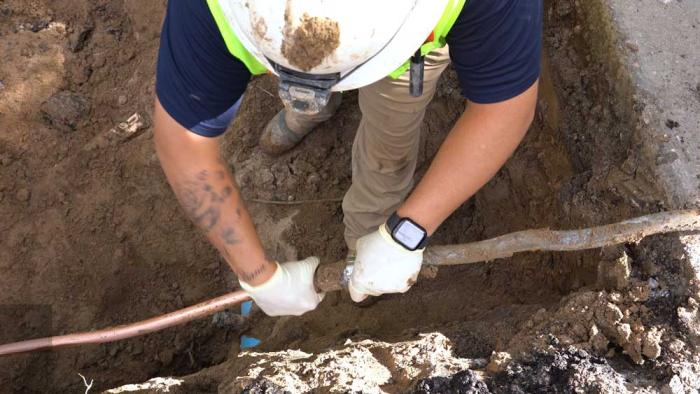
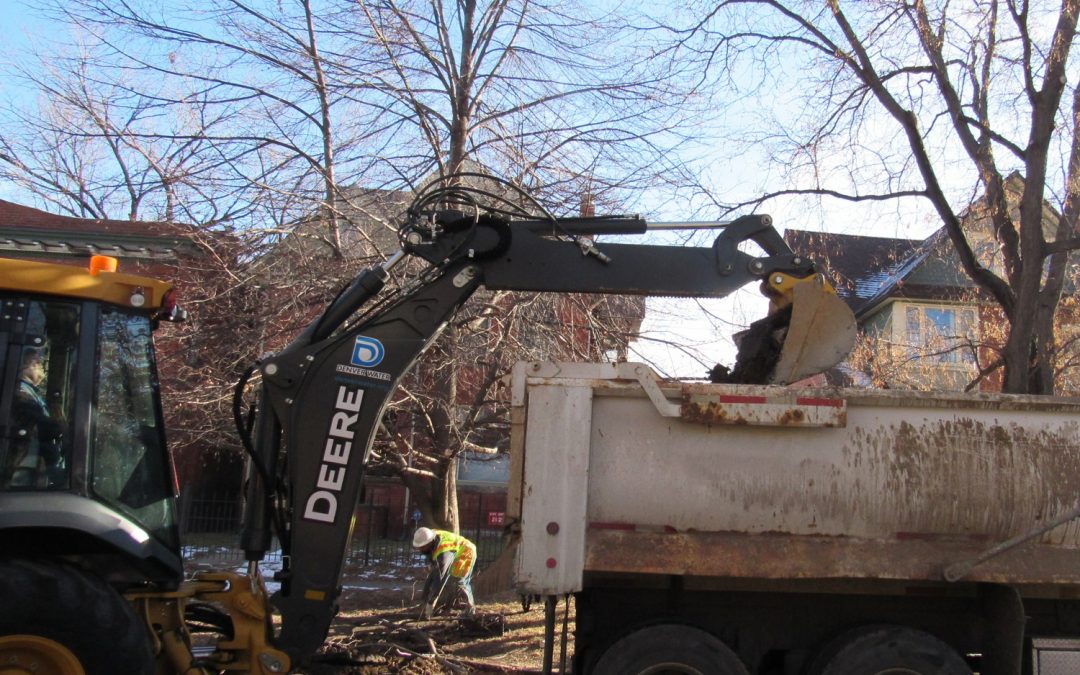
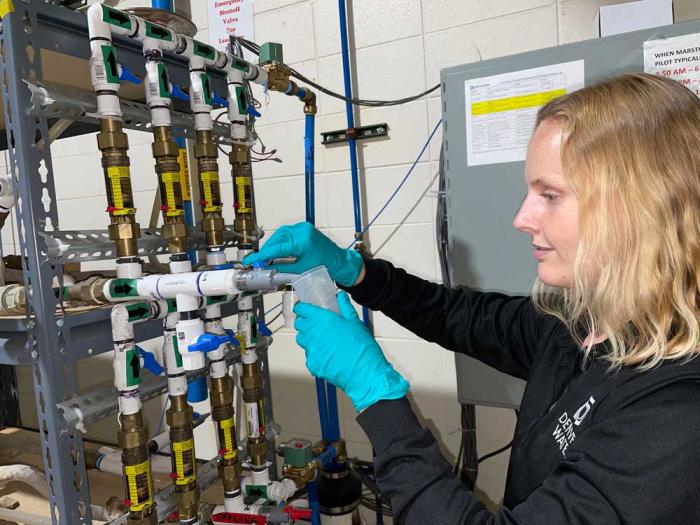
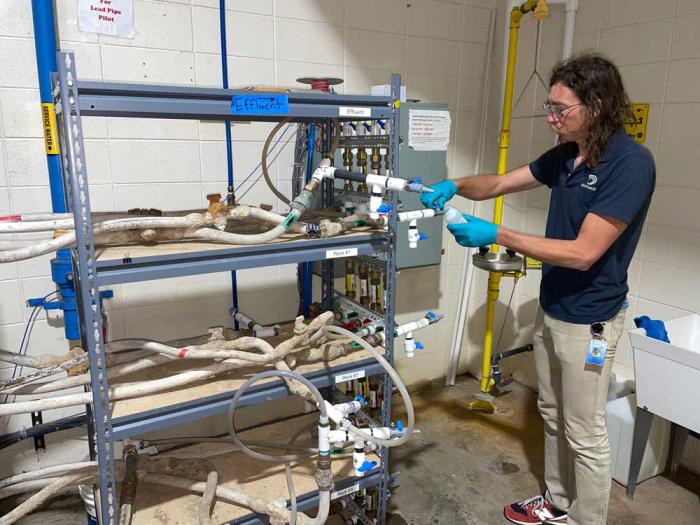
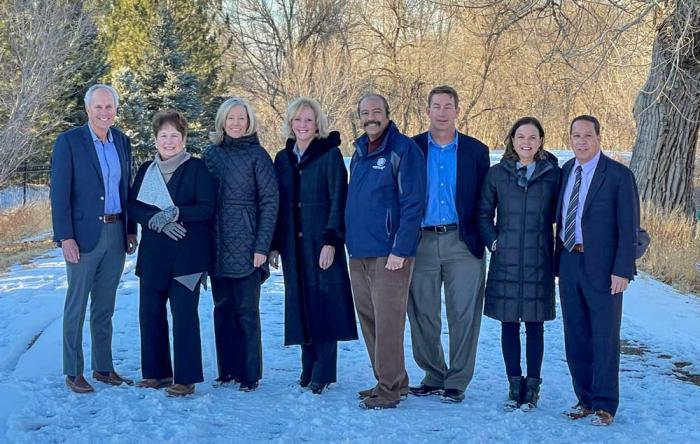
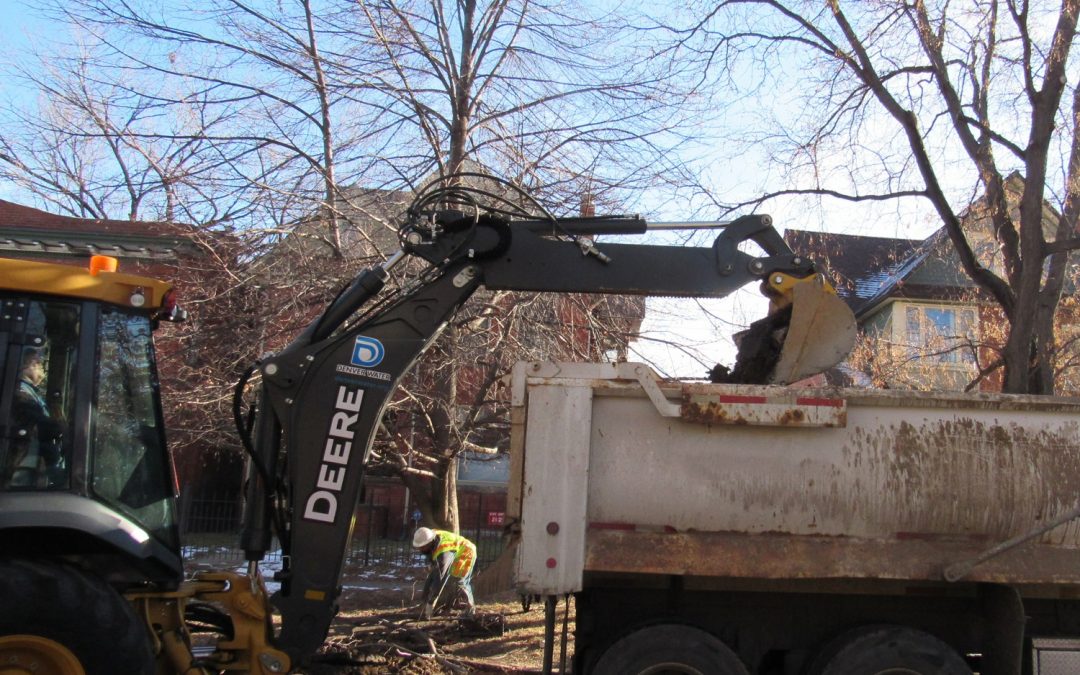
The addition of $76 million in federal funding for the Lead Reduction Program will fast-track the replacement of up to 7,600 old lead service lines. Photo credit: Denver Water.
“This infusion of federal money means we will be able to replace thousands more customer-owned lead service lines at a faster pace than we had originally planned, and ultimately shorten the length of the biggest public health initiative in Denver Water’s history. This groundbreaking program is supported by all our customers across our service area,” said Jim Lochhead, Denver Water’s CEO/Manager.
“Removing these lines is the most effective way to eliminate this source of lead exposure, and we are committed to this program until every lead service line has been removed. We’re grateful for the opportunity provided by this funding.”
The water Denver Water delivers to customers is lead-free, but lead can get into the water as it passes through a customer’s internal plumbing or water service line that contains lead. The service line is the small pipe that connects to Denver Water’s pipe in the street and carries water to the customer’s home. Lead can cause serious health problems if too much enters the body, whether from drinking water or other sources.
Denver Water’s groundbreaking Lead Reduction Program aims to replace nearly 5,000 customer-owned lead service lines every year. When the program started, Denver Water estimated there were between 64,000 and 84,000 lead service lines in its service area and expected it would take 15 years to remove them all.
The addition of federal money will help Denver Water exceed its annual target in 2023 by an extra 3,000 to 5,000 lines. For every 4,500 additional lead service lines replaced using the federal funding, the overall length of the program will be one year shorter.
Replacement work will take place in parts of many neighborhoods across Denver in 2023, including Baker, Globeville, Sunnyside, Barnum West, Athmar Park and Capitol Hill.
An initial map of the 2023 replacement work areas is available at denverwater.org/Pipes. The replacement work prioritizes areas with vulnerable, at-risk populations and disproportionately impacted communities while also taking into account planned construction activities, schools and child care centers.
Lead was a commonly used material for water service lines across the U.S. through the mid-1900s and is frequently found in Denver homes built before 1951.
The replacement work is done by contractors through the Lead Reduction Program and by Denver Water crews, who replace any lead service line found during scheduled pipe replacements or during repair work on a broken water main.
In total, Denver Water was approved for $76,123,628 from the Colorado Drinking Water State Revolving Fund, which will receive money from the federal bipartisan Infrastructure Investment and Jobs Act signed into law by President Joe Biden in November 2021. The funding Denver Water received is a low-interest loan that the utility will repay, with $40 million of the loan’s principle forgiven immediately as allowed by the legislation.
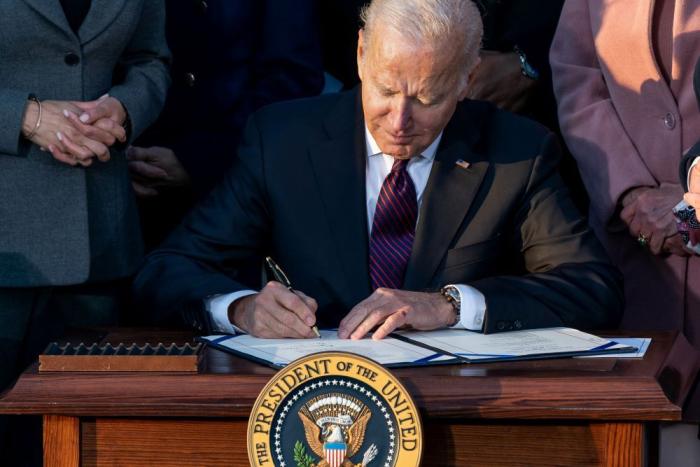
The $76 million in federal funding Denver Water’s Lead Reduction Program received comes from the federal bipartisan Infrastructure Investment and Jobs Act signed by President Joe Biden signed in November 2021. Photo credit: White House.
The state will receive federal funding from the Environmental Protection Agency to address lead in drinking water every year for five years, beginning in 2022. Denver Water intends to apply for funds in the future and, if approved, will be able to accelerate the replacement program even more.
The EPA also has approved a continuation of the Lead Reduction Program, via a variance from the federal Safe Drinking Water Act, following a review of the progress made in its first three years.
“Denver Water’s approach to tackling lead in drinking water has been remarkable and an example for other communities across the country,” said EPA Regional Administrator KC Becker, in an announcement.
“Thanks to new funding from the Bipartisan Infrastructure Law the utility’s customers can expect an even faster lead service line replacement schedule delivering health protections for children and adults across the Denver area.”
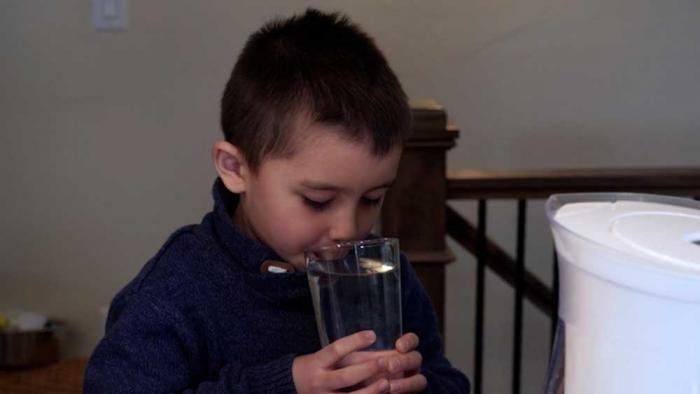
Customers enrolled in the Lead Reduction Program receive water pitchers and filters to use for cooking, drinking and preparing infant formula until six months after their lead service line is replaced. Photo credit: Denver Water.
Lochhead thanked EPA and Denver Water’s community partners for working with the utility to ensure the successful implementation of the program.
“Denver Water’s first priority is sustaining our communities by protecting the health of our customers,” Lochhead said.
In addition to the installation of a new, lead-free, copper water service line at no direct cost, customers enrolled in the program also receive water pitchers and filters certified to remove lead.
Filtered water should be used for cooking, drinking and preparing infant formula until six months after the lead service line is replaced. The utility also has changed the water chemistry, raising the pH of the water it delivers, to better protect customers from the risk of lead.
This has been a huge effort involving many areas of Denver Water, and we couldn’t have done it without the support we’ve received from our customers,” said Alexis Woodrow, who manages the Lead Reduction Program for Denver Water.
“Our customers enrolled in the program allow us into their homes to replace their old lead service lines, and they are patient with all the construction work that accompanies the replacement process. We’re also excited that in a recent survey, 83% of customers said that they use the filters we provide to filter water for cooking, drinking and preparing infant formula.”
With the federal funding, the work surrounding the replacement process will touch more homes and neighborhoods in 2023.
“We’re grateful for all the support we’ve received for this program, from our customers to our community partners and our elected officials,” Woodrow said.
“We’re all working to protect our customers now and for generations to come.”
Water Year 2022 started slow, lit up at wintertime, dried up in early spring, leaped back into action in late summer, then got lazy in early fall before one last hurrah.
The erratic spurts over the just-completed “water year,” the 12-month span between Oct. 1 and Sept. 30 that hydrologists use to track water trends, added up to a not-terrible-but-not-great-either result for Denver Water.
The Blue River, which flows into Dillon Reservoir, Denver Water’s largest reservoir, in April 2022. Photo credit: Denver Water.
The most noticeable events included a very slow start to mountain snowfall through the first three months (bad), a second straight year of healthy summer monsoons in the mountains (good) and a sizable split between the water fortunes of Denver Water’s collection area (the high country and foothills) versus its service area (Denver and parts of five surrounding counties).
In short, it translated into a reasonably good water year in higher elevations and a far drier one for the 1.5 million people the utility serves in Denver and nearby suburbs.
One memorable result? Denver’s first snowfall came Dec. 10 — the latest first snow on record for Denver.
“Every water year is different, and Mother Nature throws new challenges at us almost every time,” said Nathan Elder, Denver Water’s manager of water supply. “But timely rains and good customer practices helped us keep reservoir levels in solid shape and we soldiered through an up-and-down year.”
The very best news appears to be the way a second consecutive year of strong monsoon rains and higher humidity replenished dry soils in the mountains.
Should Colorado enjoy a deeper winter snowpack this year, it would mean more melting snow in the spring could find its way to streams and reservoirs in 2023, rather than vanishing into parched soils as has been the case in recent cycles.
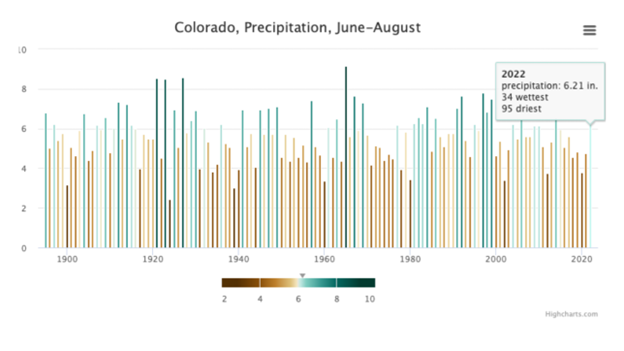
Dice up the numbers in a different way and zoom out from Denver Water and the picture looked better from a statewide perspective, with summer precipitation levels the best since 2015.
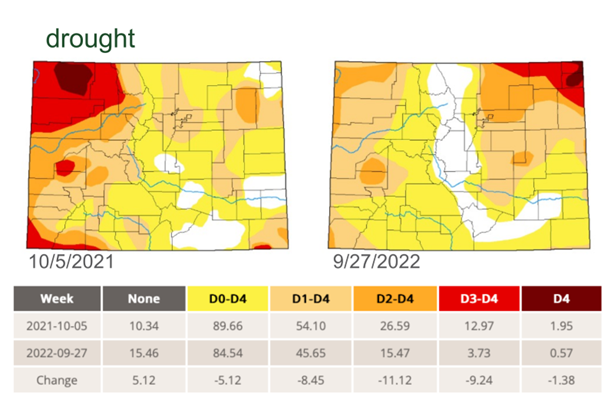
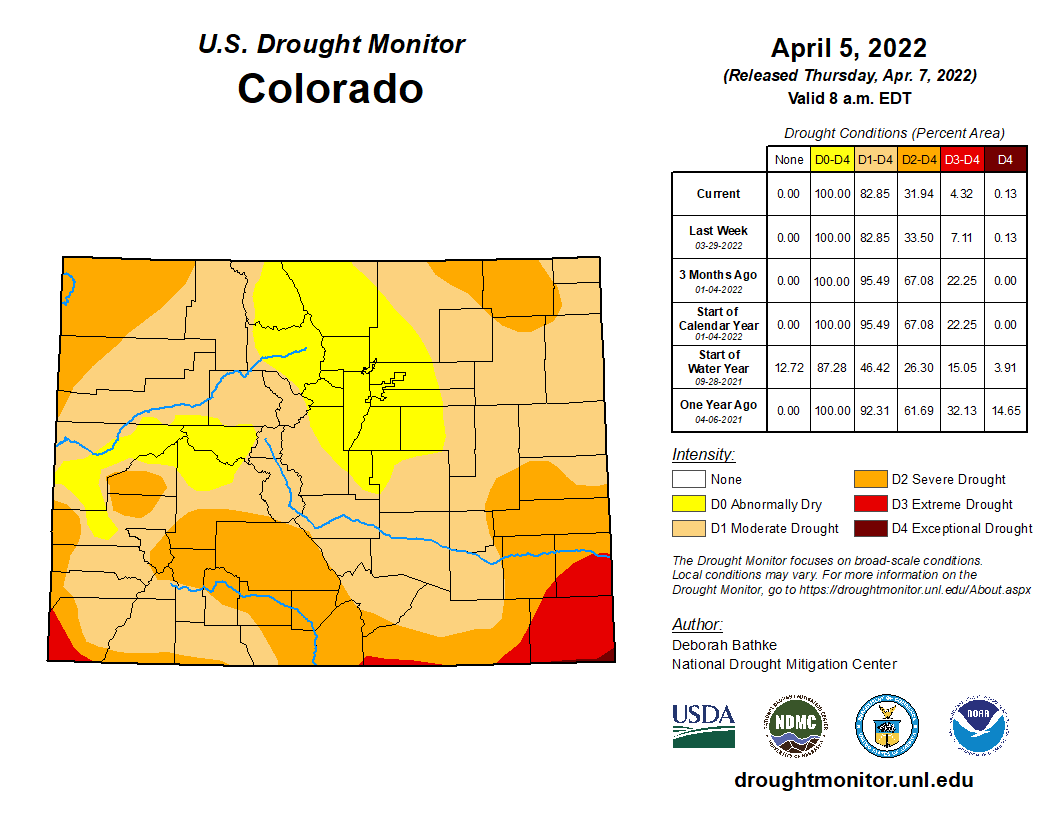
Precipitation statewide left much of Colorado in less severe categories of drought than the end of the 2022 water year. Most of Denver Water’s collection system finished the water year out of drought or classified as “abnormally dry,” the lowest classification. Image credit: U.S. Drought Monitor; Colorado Climate Center.
Additionally, soil moisture is at its highest levels in three years, according to climate trackers at Colorado State University and the U.S. Department of Agriculture’s Natural Resources Conservation Service via recent reporting from Marianne Goodland in the Denver Gazette.
While those are positive developments, experts across various agencies agree that Colorado and its water utilities need a string of strong winters, and preferably some wetter/cooler years overall if we’re ever to see longer-term improvements in hydrology.
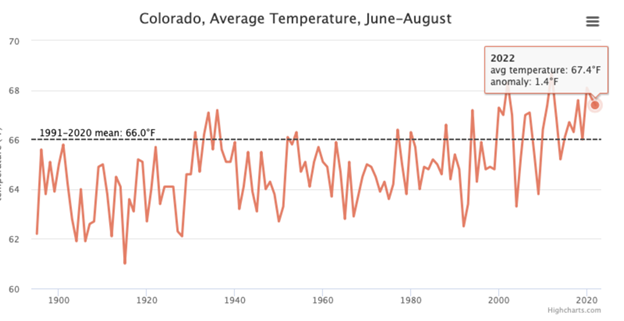
But in an era of steady climate change that appears to be unlikely. Colorado’s summer of 2022 was the sixth warmest in the 128-year record maintained by state climatologists.
Denver Water’s supply managers faced some tough conditions in the 2022 water year.
Colorado’s summer of 2022 was the sixth warmest in the 128-year record. It was also the second warmest for minimum temperatures, just behind the summer of 2012. Image credit: Colorado Climate Center.
Ongoing work to expand capacity at Gross Reservoir has limited storage in the facility west of Boulder. At the same time, unusually dry conditions on the South Platte River downstream of Denver left farmers calling on water rights dating all the way back to 1871 (just a decade shy of the oldest water rights on the river).
These rights are senior to all of Denver Water’s South Platte River reservoirs and made it difficult to fill those reservoirs. Cheesman Reservoir’s 1889 right is the most senior storage right in Denver Water’s portfolio.
All of that meant more water bypassed Denver Water’s reservoirs to meet those agricultural calls and there was less ability to make up that water by pulling from Gross Reservoir on the north side of the utility’s system. It also meant higher-than-average flows through the Roberts Tunnel to help supplement South Platte supplies.
Colorado’s summer of 2022 was the 34th-wettest summer in the 127-year record, and 0.56 above average. It was the first above-average summer for rainfall since 2015. Image credit: Colorado Climate Center.
But, in a hat tip to customers and Mother Nature, smart irrigation techniques (like turning off systems in rainy periods) and solid summer precipitation in the higher country (and, at times, in metro Denver) helped keep Denver Water’s reservoirs at just below average levels.
In fact, all that combined to close a storage gap. Reservoirs were 5% below average in July. But by the end of September that deficit fell to just 1% below average.
And there was more good news. Another good summer of monsoons kept wildfires at bay, which was a big relief after the devastating water year of 2020, when record-setting late-season fires extended the burn season into October.
The last month of summer keeps getting warmer. This one set a new record for 90-degree days (10), which — along with other factors — make it the fastest-warming month in the Denver area when compared to the previous 30-year block of records that spans 1981 to 2010.
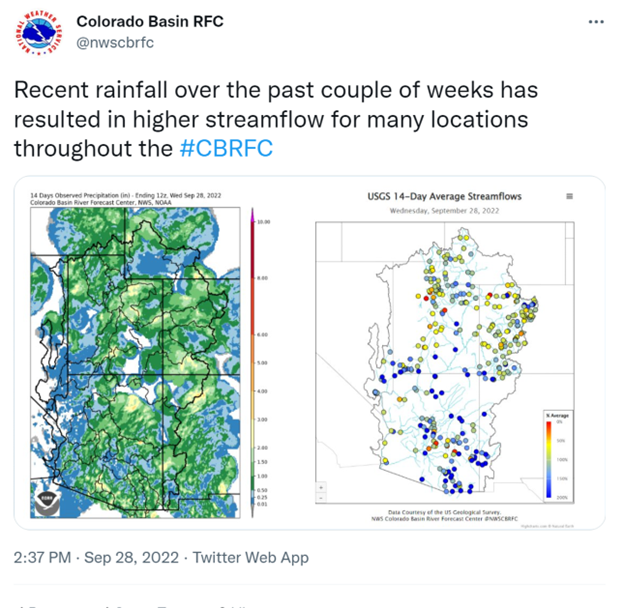
Conditions improved in late September, when late-season moisture boosted streamflows and dampened soils, especially in the high country, bringing a happy ending to the water year.
After another hot start to September, the unseasonably dry and hot weather gave way to helpful rainfall in Colorado and across the Colorado River Basin, seen in these maps from the National Weather Service’s Colorado Basin River Forecast Center. Tweet credit: Colorado Basin RFC.
Some broader context also is in order.
The 2022 Water Year for the wider Colorado River Basin was another poor one. One simple metric captures the status of the basin: The amount of water in the two major reservoirs on the river dropped dramatically, with Lake Mead falling 1.8 million acre-feet from a year ago and Lake Powell falling 1.5 million acre-feet in the same time frame.
Trends in the Colorado River Basin matter a great deal to Denver Water, as the utility gets about 50% of its supplies from the headwaters of the basin.
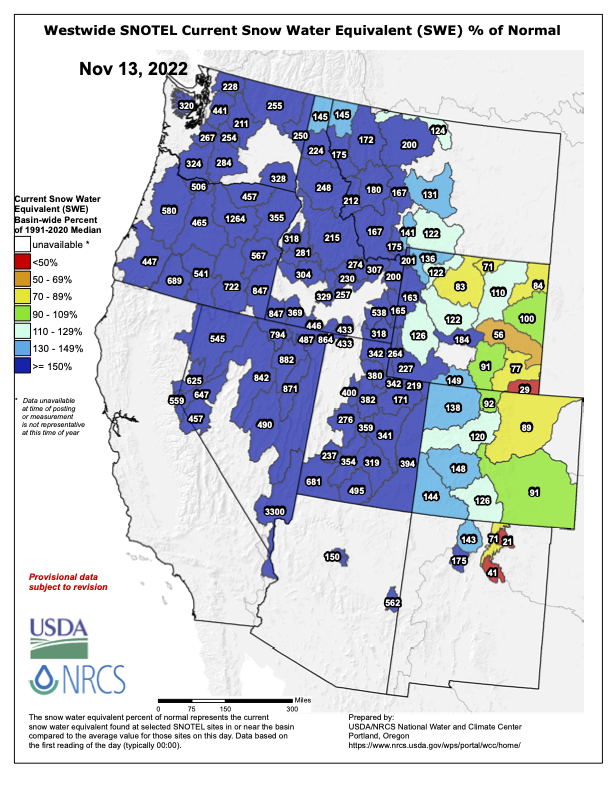
Westwide SNOTEL basin-filled map November 13, 2022 via the NRCS.
The new 2023 Water Year that began Oct. 1 is off to a good start for Denver Water.
After the nip-and-tuck of the summer months, the utility’s reservoir levels have hit their average mark heading into late fall and winter, just where water managers want to be at the beginning of the snow-accumulation season.
“We hope Mother Nature makes a New Water Year Resolution to provide ample snow and rain fall in the water year of 2023,” said Elder.
It’s he and his team who must now begin planning for the various scenarios winter and spring might bring.
You, too, can make a resolution for the New Water Year: to reduce your water use. Check out Denver Water’s website for rebates and ways to use water efficiently.
Hundreds of thousands of Coloradans exposed to drinking water tainted by lead from aging, corroded city pipes or so-called “forever chemicals,” will see clean water faster thanks to a historic infusion of $500 million from the federal government.
The money, largely from the new Bipartisan Infrastructure Law, is being funneled through the Colorado Department of Public Health and Environment over a five-year period and will allow miles of lead water delivery pipes to be replaced in towns across the state much faster than cities with little access to cash could achieve.
It will also be used to remove a set of chemicals known as PFAS, or poly and perfluoroalkyl substances, that are present in household and industrial products, such as Teflon and fire-fighting foam. The substances have been unregulated to date, although states and the federal government are writing new regulations to address the contaminants.
CDPHE officials said the money will double the agency’s capacity to fund its water quality safety work.
“The federal money is big,” said Nicole Rowan, director of the CDPHE’s Water Quality Control Division. “It’s a once in a generation opportunity to improve our infrastructure here in Colorado.”
To date, 67 Colorado water districts and communities, including the Academy Water and Sanitation District north of Colorado Springs, Limon, Louisville and Grand Junction, have expressed an interest in and are eligible for the funds, according to documents on file at the CDPHE.
Denver Water has been awarded $76 million to fast-track its lead pipe replacement program. The infusion will allow Denver to shave 1.5 years off the 15-year program, according to spokesman Jose Salas.
The City of Englewood also plans to apply, and will ask for $79 million to replace 8,000 lead service lines, according to Sarah Stone, deputy director of business solutions for Englewood Utilities.
Stone said the federal infrastructure funding will provide a critical boost to its efforts to remove lead from Englewood’s drinking water delivery system, if the city’s application is approved.
“We were extremely worried,” Stone said. “This means we can fund the program.”
Cities across the country, including Denver, Flint, Mich., Pittsburgh, Penn., Newark, N.J., and Washington, D.C., have been dogged by an increase in lead contamination as service lines age and corrode, allowing the lead to comingle with drinking water supplies, eventually reaching taps.
Denver Water, which is Colorado’s largest municipal water utility, has known lead was present at the tap in some of its customers’ homes since it appeared in routine sampling in 2013. The levels exceeded the benchmarks set under the Safe Drinking Water Act.
For several years, the utility ran pilot tests and negotiated with CDPHE and EPA over how best to eradicate the harmful metal. Though the amounts of lead found in Denver’s tap water samples varied, no amount of lead is considered safe to ingest, especially for young children.
The CDPHE issued an order in 2018 requiring Denver to begin adding phosphorous to its water, one of the most effective ways to reduce corrosion in pipes. But phosphorous is also a pollutant and causes problematic algae blooms in lakes and rivers. Adding it to the municipal drinking water supply would also make it harder for wastewater treatment operators to meet their own obligations to keep phosphorous out of rivers and streams.
Due to those concerns, Aurora, Metro Water Recovery, The Greenway Foundation, and eventually Denver, sued the CDPHE in 2018 to stop the order from taking effect.
The dispute was settled after Denver was able to obtain a rare variance under the Safe Drinking Water Act in exchange for agreeing to invest some $68 million over 15 years to replace lead service lines, offer free water filters to residents as they wait for the new lines to be installed, conduct community education programs, and increase the pH of the water supply to also help reduce corrosion in pipes.
Several cities and water districts are hoping the federal funding will allow them to mitigate their ongoing issues with PFAS contamination.
Roy Heald manages the Town of Security’s water utility. The town has been hard-hit by PFAS contamination attributed to Peterson Air Force Base. The PFAS chemicals from fire-fighting foam contaminated its groundwater.
Though the military facility has built a remediation plant for Security, it is considered a temporary facility, Heald said. With $450,000 in federal money from the American Rescue Plan Act approved earlier this year, Security is converting the plant to a permanent facility, one capable of operating for the decades it will likely take to clean up the groundwater.
“We’re happy to get it,” Heald said. “This work has to be done, and it’s $450,000 our ratepayers won’t have to pay.”
Jerd Smith is editor of Fresh Water News. She can be reached at 720-398-6474, via email at jerd@wateredco.org or @jerd_smith.
Nestled against the foothills of the Rocky Mountains west of Denver sits an old concrete canal that’s been delivering water to the metro area since the 1930s.
Fast forward to 2022, and the South Boulder Canal is still performing its regular job for Denver Water.
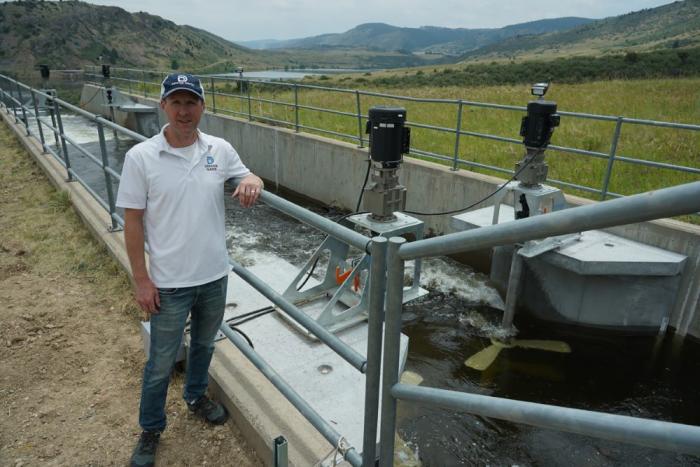
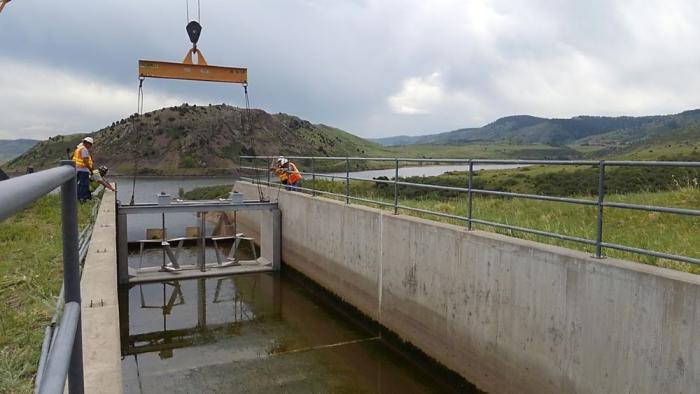
But the canal has now taken on the added role of generating hydropower, with four small turbines spinning inside the concrete waterway and producing electricity. The turbines were connected to the local energy grid in mid-July.
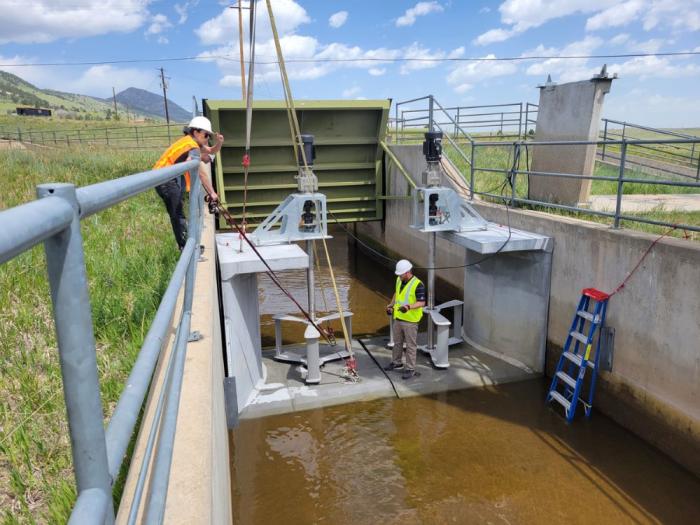
Emrgy crews installed new turbines in the South Boulder Canal in June. Photo credit: Emrgy Inc.
“Denver Water has been producing hydropower at our dams for decades, but this is the first time we’ve generated power from one of our canals,” said Ian Oliver, source of supply director at Denver Water whose team operates the utility’s dams, reservoirs and canals.
The innovative hydropower project began in 2017 when Denver Water teamed up with Emrgy Inc., an Atlanta-based company that specializes in creating clean, sustainable energy using the flow of water through existing infrastructure.
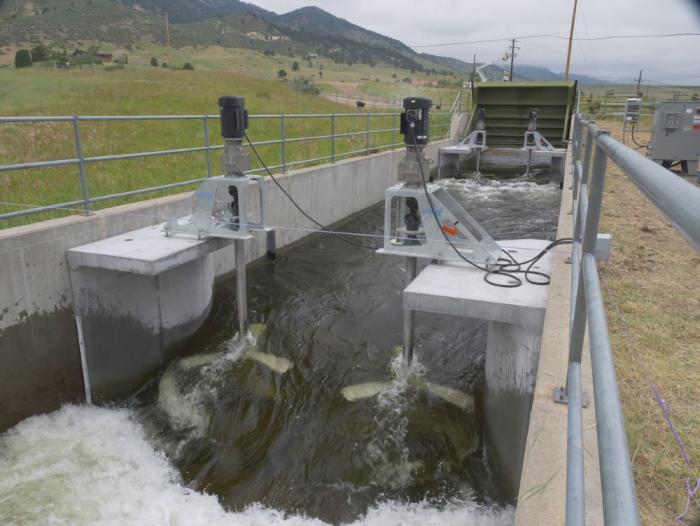
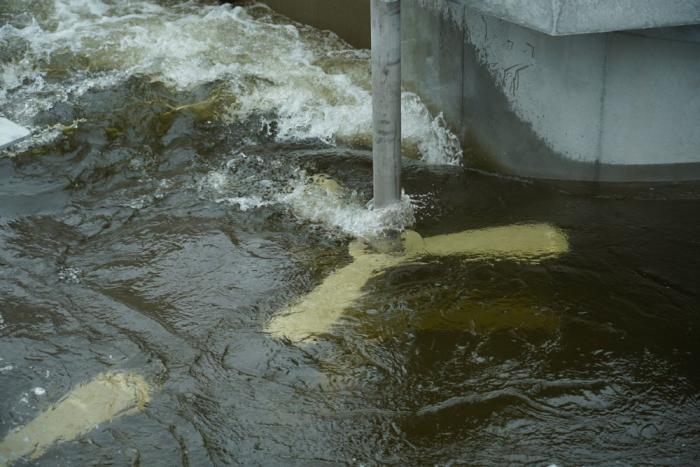
Water flows past four new hydropower turbines on Denver Water’s South Boulder Canal. Four units were installed in June and were connected to the local power grid in July. Photo credit: Denver Water.
The South Boulder Canal is part of Denver Water’s northern delivery system, which brings water from Colorado’s West Slope to the Front Range. The 8-mile canal starts near Eldorado Canyon and ends at Ralston Reservoir north of Golden.
Ian Oliver, Denver Water’s source of supply director, has been involved with Emrgy on the South Boulder Canal hydropower project since 2017. Photo credit: Denver Water.
Denver Water typically runs water through the canal about nine months a year, with flows ranging between 50 and 300 cubic feet per second depending on time of the year and water demands in the city.
“Sustainability is part of our mission at Denver Water, so when we met the team at Emrgy and they told us about their turbines for low head applications, we knew it was something we wanted to pursue further,” Oliver said.
In 2017, Emrgy placed an initial array of turbines in the canal as part of a pilot project.
Since that time, the company has continued to innovate its design and installed four new turbines in June. The new turbines are easier to lift, handle and connect to the utility grid through the same inverters used in the solar power industry. The turbines are located at the end of the canal just before it reaches Ralston Reservoir.
The original Emrgy turbines were placed in the South Boulder Canal just before Ralston Reservoir in 2017 as part of a pilot program. Photo credit: Denver Water.
The turbines look somewhat like mixers you’d see in the kitchen to stir cake batter — just a lot bigger, stronger and more advanced.
As the moving water in the canal flows past the turbines, the blades spin and produce mechanical energy, which is then converted into electrical energy. The electrical energy is then fed to a power conversion system next to the canal and delivered to the local power company’s energy grid.
“The process is unique in that it uses the kinetic energy of the flowing water and doesn’t require a large dam to build up pressure to create hydropower,” said Emily Morris, Emrgy’s CEO. “These turbines will work in any channel with moving water where energy can be extracted.”
From the original pilot study, Emrgy refined the hydro system and made the assemblies more modular, so they are easier to deliver and install. The new design also made the turbines easier to remove for maintenance, according to Morris.
Another enhancement focused on the design of the concrete flume box assembly. The flumes include curves in the concrete structure that direct moving water to pass by the rotors more efficiently.
The new turbine system is also more “plug and play,” using the same onshore power electronics equipment used by the solar industry so it’s easier to connect to the power grid, according to Morris.
Emrgy’s new turbines use the kinetic energy of the water to generate electricity. Photo credit: Denver Water.
Morris said each turbine can produce anywhere from five to 25 kilowatts of instantaneous power depending on the speed and depth of the water in the canal. If running 365 days a year, that would be roughly enough to power around eight U.S. homes each year.
Denver Water’s role in letting Emrgy use the canal to refine the technology has been a win-win for both organizations. For Emrgy, the pilot program helped them develop their turbines and expand them to three other states in the U.S. and into three other countries.
For Denver Water, Oliver says putting water to work to generate electricity is part of the utility’s annual goal of being a “net-zero” organization in terms of the utility’s overall energy consumption. “Net-zero” status is when the utility produces as much electricity through its hydro and solar power units as it consumes through traditional forms of energy.
With the addition of the South Boulder turbines, Denver Water now has 13 hydropower units at its facilities. The hydro program generates an average of 61,000 megawatts of electricity annually.
“Denver Water’s interest in hydropower is really multifaceted,” Oliver said. “We generate hydropower to sell to the local power grid, which helps offset the consumption of electricity at our facilities, and, by doing so, we’re also helping to meet our own sustainability goals.”
Power generated by Emrgy’s South Boulder Canal turbines is distributed to the local power grid. Denver Water receives a credit for the hydropower on its utility bill, which helps offset energy consumption at the utility’s Northwater Treatment Plant and Ralston Reservoir.
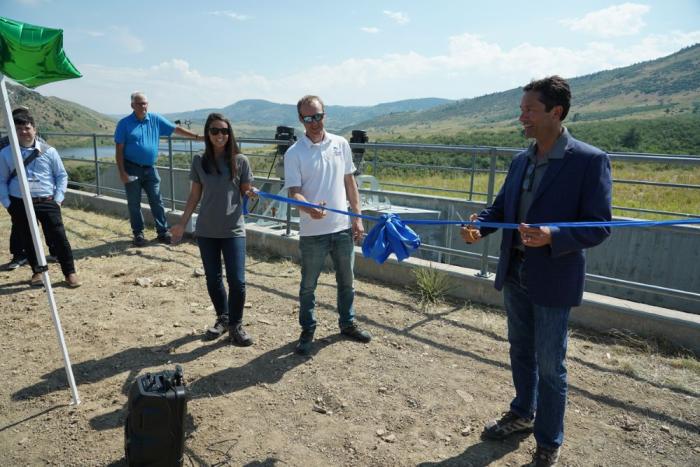
Denver Water and Emrgy held a ribbon-cutting ceremony in June to celebrate the installation of new turbines in the canal and their connection to the power grid. Photo credit: Denver Water.
Denver Water and Emrgy are now studying the feasibility of adding six more turbines to the canal in the future to create a larger array of power generation, similar to installing a series of solar panels.
Morris said small turbines in canals help produce clean energy at the local level.
“In order to achieve a truly carbon-free future, we’re going to have to harness the power of the sun, the wind and the power of water,” Morris said. [ed. emphasis mine]
“Water is one of the only controllable natural resources that we have, and I’m excited about the ability to harvest the natural energy here to improve our environment.”
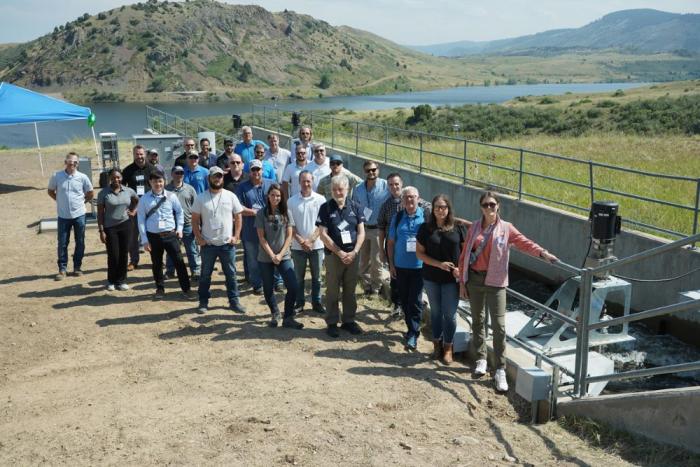
Participants of the annual Hydrovision International convention toured the South Boulder Canal project in June. Photo credit: Denver Water.
After multiple water treatment plant mishaps over the past year, Arvada’s City Council unanimously approved a 12.3% water rate increase to fund improvements for the city’s aging infrastructure on Oct. 17. The rate hike will increase single-family water bills by roughly $19 per bi-monthly billing cycle on average for single-family homes. The increase will see water and wastewater usage rates increase by an average of $13 per bi-monthly billing cycle for single-family homes. It also includes a $4 bi-monthly water service fee increase and a $2 bi-monthly wastewater service fee increase. Primary cost drivers of the rate hike are a 15% price hike for raw water from Denver Water, the recommended issuance of a $50 million bond later this year that will fund infrastructure upgrades and an expected overall operation cost increase of $4.2 million in 2023. Over the past five years, the average in-city water rate has increased by about 3.55% annually, Gillis said. The bi-monthly service fee was last adjusted in 2022 for the first time since 2009.
Credit: The City of Arvada
At the heart of Arvada’s decision to invest in aging infrastructure are two water treatment plants: the Ralston Water Treatment Plant, built in the 1960s; and the Arvada Water Treatment Plant, built in the 1980s. The RWTP is rated at 36 million gallons per day, while the AWTP is rated at 16 million gallons per day. 75% of Arvada’s raw water comes from Denver Water, while the remainder is provided by Clear Creek. Two recent water line breaks and leaks through an exterior wall at the RWTP over the summer have threatened the city’s water supply, as Arvada Director of Utilities Sharon Israel recounted during a tour of the RWTP with the Arvada Press…
At the Oct. 17 city council meeting, Arvada Mayor Marc Williams summed up the position of many council members, all of whom voted for the rate increase.
“We had two major water line breaks in the last two weeks that cost us well over a million gallons of water, I believe,” Williams said. “We’ve got to take lasting care of our community and this is an appropriate step that we’re taking…That passes 7-0; reluctantly, but necessarily.”
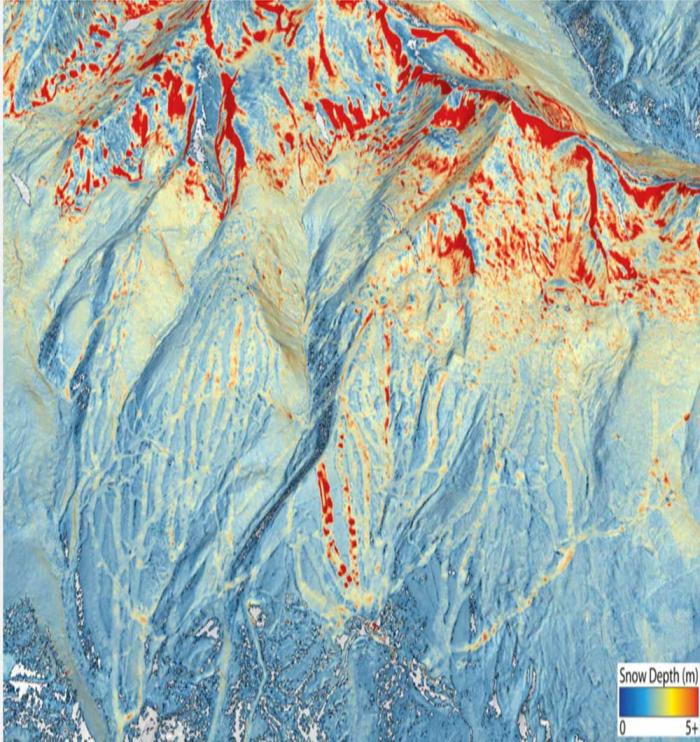
This map shows the snowpack depth of the Maroon Bells in spring 2019. The map was created with information from NASA’s Airborne Snow Observatory, which will help water managers make more accurate streamflow predictions. Jeffrey Deems/ASO, National Snow and Ice Data Center
The Colorado River District this week agreed to contribute $75,000 toward a proposed $255,123 project to more accurately assess snowpack in the upper Roaring Fork River Basin next year to improve the ability to forecast streamflow runoff volumes. The district’s board agreed to help fund the work by Airborne Snow Observatories, Inc., a Colorado public benefit corporation that was initially a program in NASA. The company “combines state-of-the-art remote sensing tools with snowpack modeling and fast data processing to deliver snow measurements of high accuracy, high resolution, and full-watershed coverage,” a river district staff memo to the board says…
The river district has agreed to contribute to the Roaring Fork basin project through Community Funding Partnership funding made possible by voter approval of a 2020 tax measure. The city of Aspen has verbally committed $50,000 for the project, Pitkin County is considering a request for a $77,000 contribution, the Twin Lakes Reservoir and Canal Co. has committed $12,500, and funding is being pursued from other Front Range water entities…
Snow-free data for comparison purposes is required for the airborne approach, and was collected this summer from the targeted region, which includes the headwaters of the Roaring Fork River and one of its tributaries, the Fryingpan River. The plan is for Airborne Snow Observatories to conduct an aerial survey around April 1, near the seasonal peak for snowpack accumulation, with a second survey following around mid-May to early June, potentially coinciding with when snow already has melted at NRCS sites. The collected data would be available for free to any interested stakeholder, according to the river district memo.
“The proposed project, through an accurate and comprehensive accounting of snowpack water resources in the Roaring Fork and Fryingpan watersheds, will provide a novel and unparalleled monitoring capacity for these snowmelt-dependent river systems,” the river district staff memo says. “This new capacity, and the runoff forecasts based on it, will provide an additional decision-support resource for water managers in the basins.”
Weather forecasters consider September the start of “meteorological fall.” And even without the fancy term, most of us think of the month as the unofficial kickoff to autumn.
School starts, football season is underway, and temperatures begin a welcome cool down.
Well, about that last part: September is not as cool as it used to be.
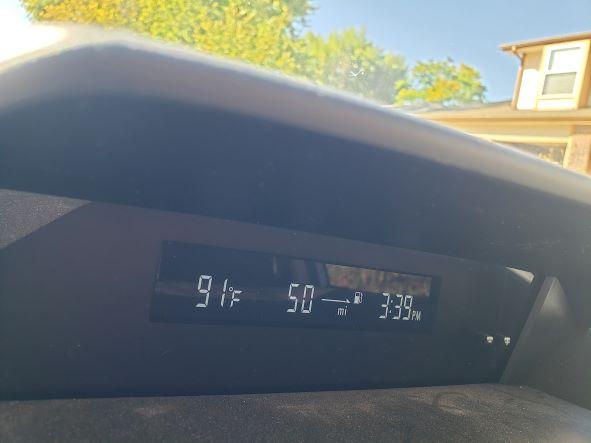
A car thermometer registers another hot September day. Photo credit: Denver Water.
And that means customers are watering their yards later into the year, creating more demand for water and making things trickier for Denver Water’s water supply managers.
Just recall the way September started this year, with a string of days in the mid-to-upper 90s, including back-to-back 99-degree days in the Denver area. (Denver Water’s downtown weather station hit 100.)
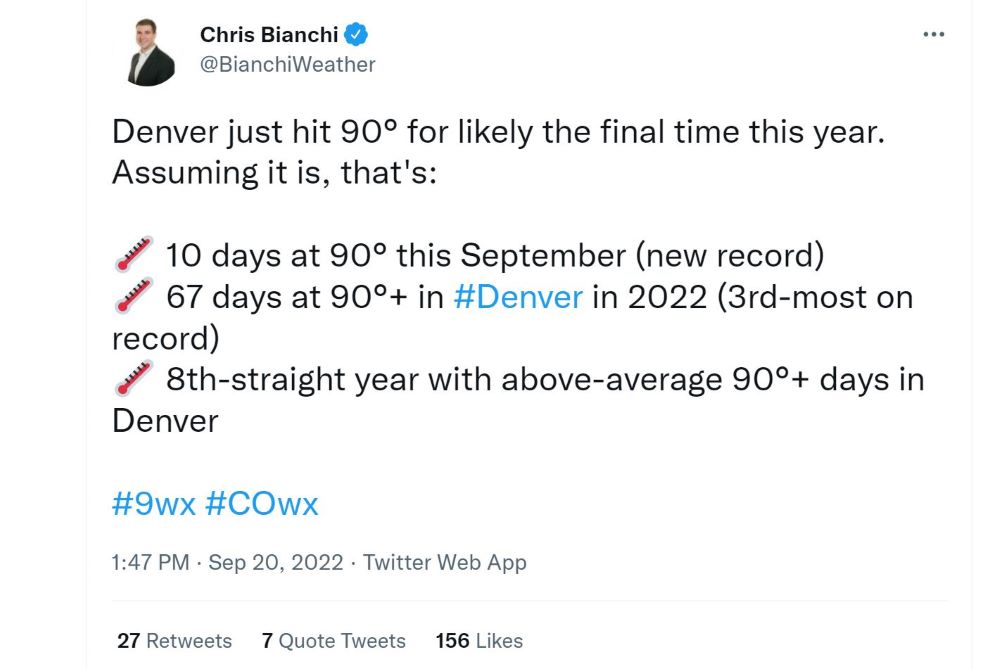
In fact, as 9News meteorologist Chris Bianchi reported on Twitter, Denver broke a record for number of 90-degree days (10) in a single September this year.
A wave of heat-related records were broken across the West this year, including here in the Denver metro area. Image credit: Chris Bianchi via Twitter.
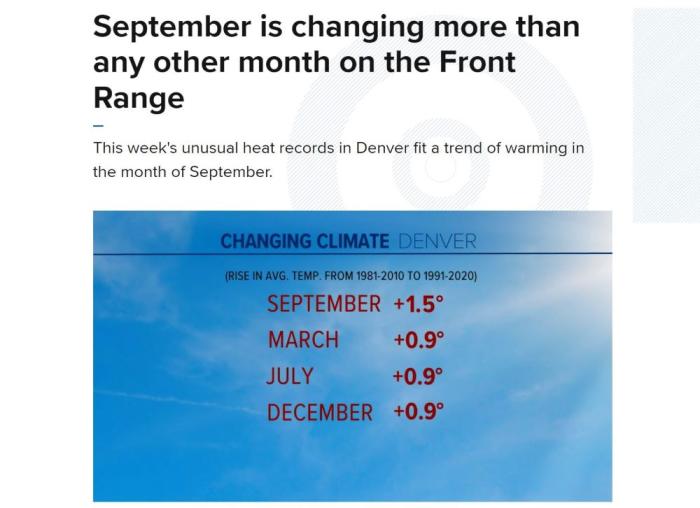
The phenomenon was also well-documented by 9News meteorologist Cory Reppenhagen in his Sept. 5 report on how unusual heat records in Denver notched during September’s first week are part of the metro area’s rising September heat trend.
All told, toasty Septembers appear to be one more element of a changing and warming climate.
A screenshot from a Sept. 5, 2022, report by 9News meteorologist Cory Reppenhagen about September’s changing weather patterns in the Denver metro area. Image credit: 9News meteorologist Cory Reppenhagen.
“We have a pretty good idea of what water demand in the summer months will look like, but September is becoming a wild card,” said Nathan Elder, the utility’s water supply manager.
“We have seen higher demand and increased reservoir releases in recent Septembers,” he added. “But we also know we can see snow during the month, which makes planning for the month and setting up winter operations difficult.”
Additionally, Elder said, warmer fall temperatures can dry soil in the collection system, which means more snow is needed the following winter to fill reservoirs.
“This is a trend we are really keeping our eye on because it can have significant impacts on water supply late in the season and going into the next spring,” Elder said.
One other challenge tied to warmer Septembers: a longer fire season, such as in 2020, when the state’s two largest-ever fires exploded late in the year, including the East Troublesome Fire that roared through Grand Lake in mid-October.
Dillon Reservoir is Denver Water’s largest reservoir. It sends water to the Front Range via the 23-mile-long Roberts Tunnel under the Continental Divide. Photo credit: Denver Water.
Some numbers that tell the story:
– Denver Water is seeing more demand for water in September. Last year, demand was about 30 million gallons per day above the 30-year average. In 2022, the volume was 15 million gallons over the same average. The difference between the two years can be attributed to the fact that precipitation in 2022 was closer to normal and 2021 was drier.
– September 2022 was Denver’s third-warmest on record, at an average of 69 degrees, surpassed only by 2015 and 2019, according to National Weather Service data highlighted by Bianchi, the 9News meteorologist.
– Flows in the Roberts Tunnel, which delivers water from Dillon Reservoir to the Front Range, are rising in September, with 260 cubic feet per second seen in recent years versus the long-term average of 160 cfs. That’s a sign Denver Water needs to send more water to the metro area to meet the higher September demand.
That doesn’t mean, however, that Denver Water is pulling more water from its West Slope reservoirs. In fact, overall water movement through the Roberts Tunnel over the course of a year is flat, as lower winter demand and tunnel shutoffs have helped balance out that September bump.
Warmer-than-normal temperatures during the day and at night raise the overall average temperature of the month. Image credit: Chris Bianchi via Twitter.
Overall, September reservoir releases across the system have been higher than average in recent years, a sign that Denver Water must rely more on storage to meet higher late-summer demand.
Cheesman Reservoir on the South Platte River system serves as one example, with average September releases during the last five years of 286 cfs versus the longer-term average of 211 cfs.
Denver Water’s records show September is warming at a higher rate than any other month during the watering season. And Reppenhagen’s reporting found that “September (weather) is changing the most out of all the months, warming by 1.5 degrees compared to the previous 30-year period of record.”
As Reppenhagen points out, warmer Septembers are extending the summer growing season, a development that he notes was predicted by some of the earliest computer modeling examining the effect of rising carbon dioxide in the atmosphere.
Denver Water customers are using more water later in the year as Septembers warm. Photo credit: Denver Water.
That is borne out by water use.
Outdoor demand in September has grown about 23% when comparing the recent-five year stretch of 2017-2021 to the period between 2000 and 2016. In the same five-year span, September use has only been 3% below June levels.
From a practical standpoint, warmer Septembers make work tougher for Denver Water’s planners.
When that extra pull on reservoirs in September is combined with lower soil moisture, it means the utility has to lean even harder on the winter months to provide enough snowpack to fill reservoirs the following spring.
The shift also means planners are relying less on historical water demand models and focusing far more on data from more recent years to get a better idea of how much water Denver Water customers will need in September.
Overall, Denver Water customers have been good at conserving. Demand is generally flat or even declining during most months of the year. September is an outlier: as noted above, the five-year average for the month is actually on the rise.
Adjusting your sprinkler control system to account for weather and the time of year can save water. Cooler nights send a signal to your landscape that it’s time to wrap things up for the winter and it doesn’t need as much water. Photo credit: Denver Water.
But a reminder to customers: Even with a warmer September, the need for outdoor watering declines because nighttime is cooler, and grass can get by with less water.
As Denver Water takes many steps to adapt to a warming climate, it will incorporate these late-summer temperature increases into its many-faceted approach to ensure it can supply the Denver region with water.
In the shorter term, Elder has a more visceral suggestion: “September should be kicked out of fall,” he said. “Move it permanently to summer.”
Ensuring a system that is providing clean, safe water to 25% of the state’s population will continue delivering requires taking the long view when it comes to maintenance and upgrades.
At Denver Water, projects from replacing water mains to building a new treatment plant are carefully vetted to ensure they will bolster the system as it exists today and for the decades ahead.
“Our mission is to deliver a clean, safe, reliable water supply to 1.5 million people, and also to sustain our vibrant communities for years to come,” said Jim Lochhead, the CEO/Manager of Denver Water.
To do that, the utility expects to invest about $2.3 billion into the system during the next 10 years, from large projects to regular inspection and maintenance programs designed to ensure the system is flexible, resilient and efficient.
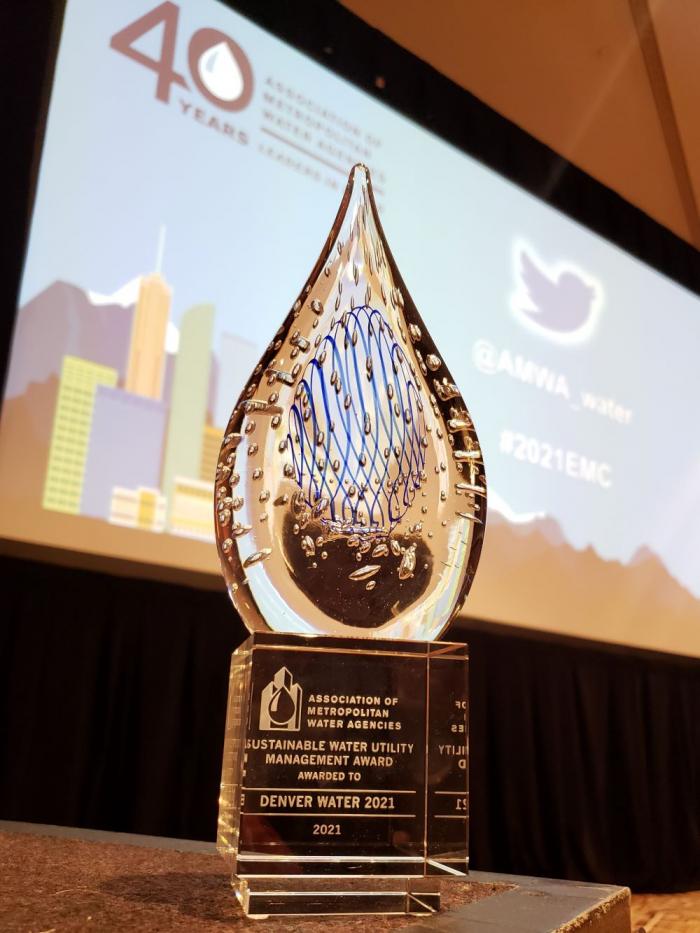
Denver Water’s approach has been recognized repeatedly by its peers in the water industry and others.
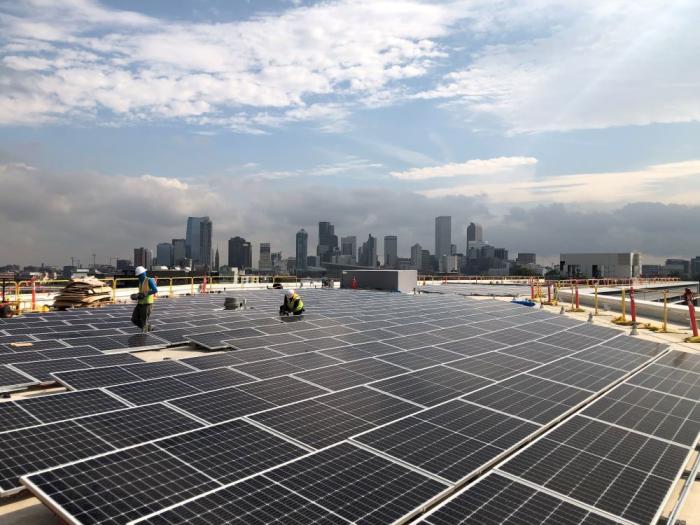
Denver Water’s administration building is powered by solar panels. Photo credit: Denver Water.
The awards committee specifically called out the utility’s sustainable, scalable and streamlined design approach to the project, which leaves room at the site for future expansions as needed.
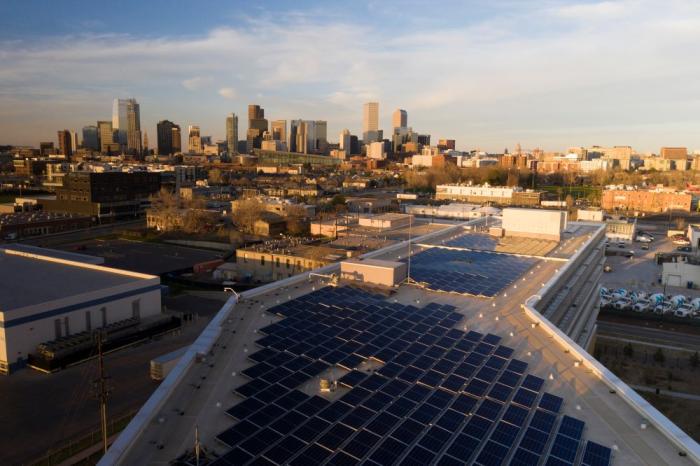
The redevelopment of its Operations Complex near downtown has won several awards since its completion a few years ago, including a LEED Platinum certification for the utility’s Administration Building, just one of many the project received for its sustainable aspects. The building includes solar power panels on its roof and parking structures, a highly efficient radiant heating and cooling system and an on-site wastewater recycling system that treats water for reuse flushing toilets and irrigation.
Here’s an overview of some of Denver Water’s work:
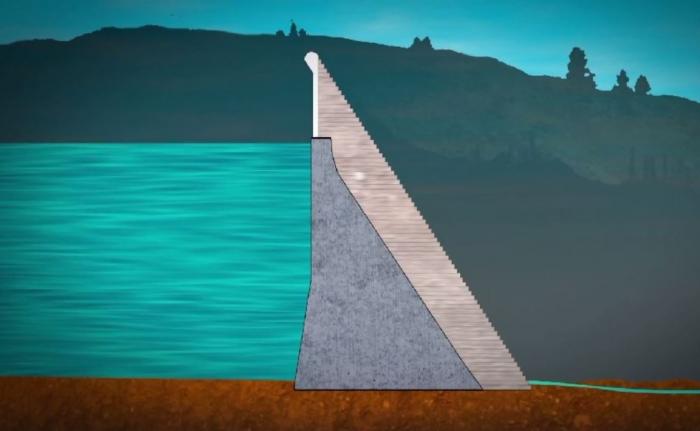
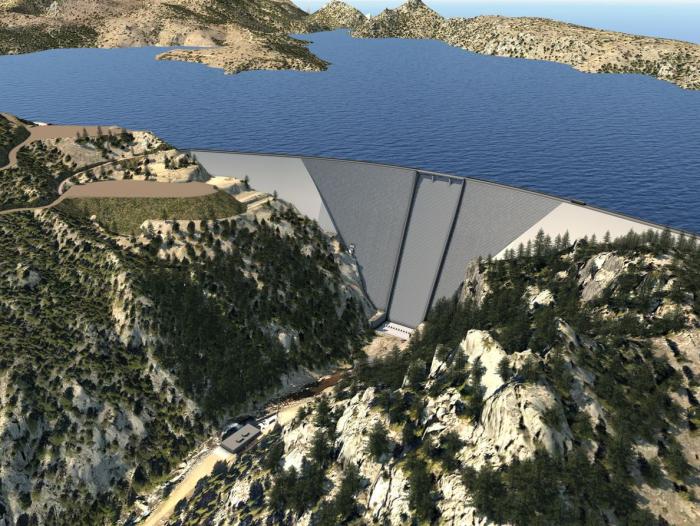
The graphic shows the existing dam and water level and how high the new dam will rise above the current water level. Image credit: Denver Water.
Water storage
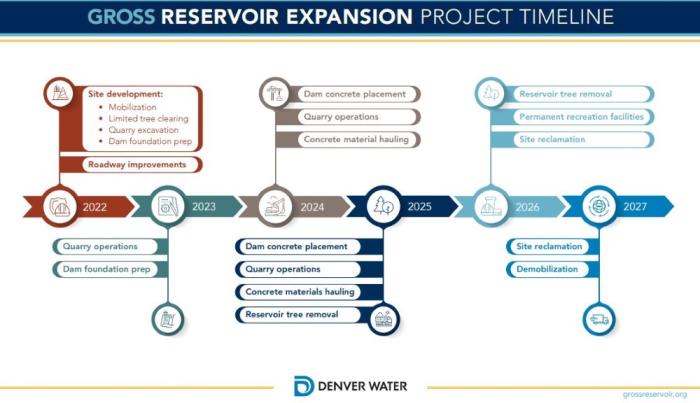
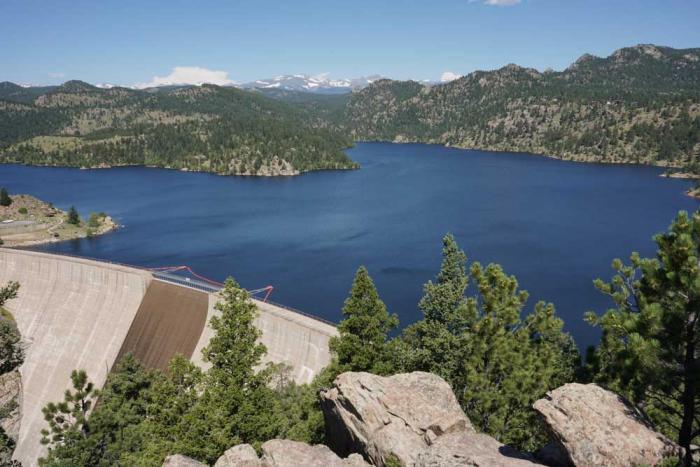
Work on the Gross Reservoir Expansion Project, the subject of more than 20 years of planning, got underway in April. Expected to be complete in 2027, the project will raise the height of the existing dam by 131 feet.
The higher dam will nearly triple the amount of water that can be stored in Gross Reservoir, providing Denver Water with more flexibility to manage its water supply in the face of increasingly variable weather and snowpack patterns.
The additional storage capacity also will provide a greater balance between Denver Water’s separate north and south water collection areas.
Much of the work done on the expansion during 2022 and 2023 will be site preparation for the on-site quarry and concrete production plant and removing rock from the sides and bottom of the existing dam to make room for the new concrete. Workers also have been hydroblasting the face of the dam, removing a few inches of concrete, to leave a rougher surface for the new concrete to adhere to.
At the height of construction, there will be as many as 400 workers on-site and when complete, the dam will be the tallest in Colorado.
A major part of Denver Water’s investment forecast is the Lead Reduction Program, which launched in January 2020.
The water Denver Water delivers to customers is lead-free, but lead can get into drinking water as the water passes through old lead service lines that carry water from the water main in the street into the home.
The program reduces the risk of lead getting into drinking water by replacing the estimated 64,000 to 84,000 old, customer-owned lead service lines at no direct cost to the customer. Households enrolled in the program are provided with water pitchers and filters certified to remove lead to use for cooking, drinking and preparing infant formula until six months after their lead service line is replaced.
It’s the biggest public health campaign in the utility’s history and through the end of September, more than 14,000 lead service lines have been replaced.
The program aims to replace about 4,500 lead service lines every year, and the utility is working through final approvals to accept federal funding. The money will allow the utility to replace an additional number of lead service lines (at no direct cost to the customer) above the 4,500 currently slated for replacement in 2023. This additional funding will help speed up the replacement program while keeping rates as low as possible for customers.
In March 2020, Denver Water also raised the pH of the water it delivers to customers to help reduce the risk of lead getting into water as it passes through customers’ internal plumbing that may contain lead.
Northwater Treatment Plant
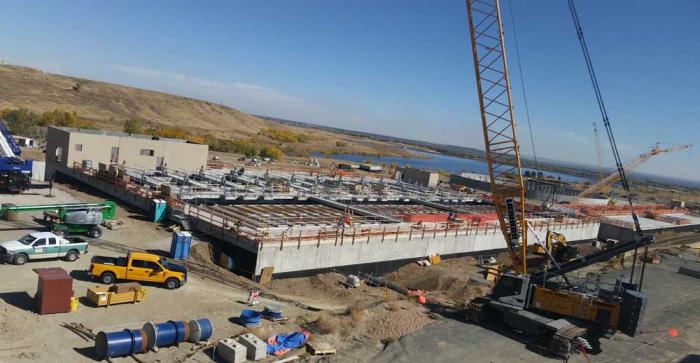
Work on Denver Water’s new, state-of-the-art Northwater Treatment Plant next to Ralston Reservoir north of Golden this year passed a milestone, with 2.5 million hours of work poured into its design and construction since 2016.
The treatment plant, scheduled for completion in 2024, will include 14 buildings and be able to clean 75 million gallons of water per day. Its design left room for the plant to be expanded to clean up to 150 million gallons of water per day in the future as needed.
During this last year, roofs have been placed on buildings, allowing workers to start installing electrical lines and HVAC equipment.
Construction also has continued on the two giant water storage tanks, which will be mostly buried underground when complete. Each tank is capable of holding 10 million gallons of clean, safe drinking water.
It will house Denver Water’s new water quality laboratory, expected to become fully operational during 2023, and replaces a facility that has been tucked into the Marston Treatment Plant south of U.S. Highway 285 and South Wadsworth Boulevard, on the south side of Denver Water’s service area.
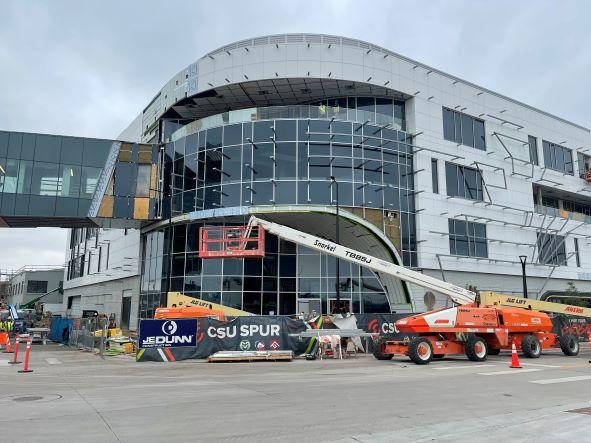
Denver Water’s new water quality laboratory, expected to be operational in 2023, is inside the Hydro building at the CSU Spur campus at the National Western Center north of downtown. Photo credit: Denver Water.
Locating Denver Water’s water quality laboratory in the midst of CSU’s new Spur campus ensures the utility’s water experts will be working near researchers, scientists and others tackling issues surrounding water, agriculture and public health that are important to the metro area, state and region.
Two other buildings are at the CSU Spur campus, Vida, which opened in January 2022 and focuses on life and public health, and Terra, which opened earlier this year and focuses on land and food.
With the completion of the Hydro building, the campus will house experts dedicated to exploring how the three disciplines intersect — and interact — with each other.
Ongoing investments
As the metro area grows and changes, its often an opportunity for Denver Water to upgrade older elements of its system — before new development takes place.
That was exactly the situation at Loretto Heights in the southwest part of Denver.
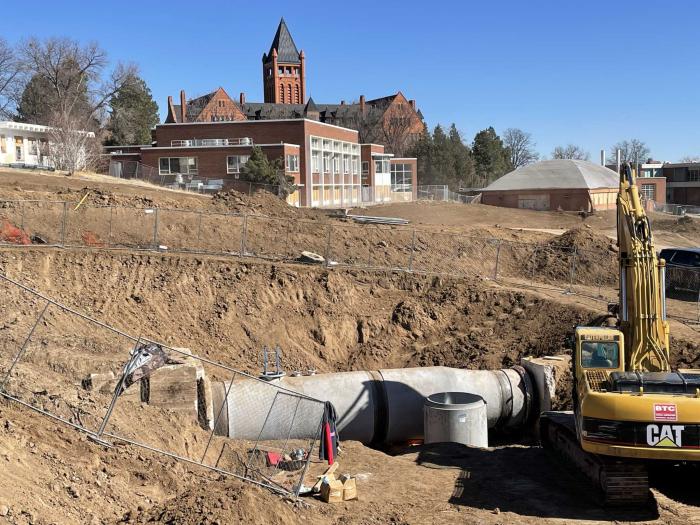
Upgrades to infrastructure that delivers water to downtown Denver took place before development of a new neighborhood at Loretto Heights. Photo credit: Denver Water.
The site is best known for the historic tower built in the 1890s as part of a boarding school and college. But buried under that same hill is a 575-foot-long concrete tunnel, 7 feet in diameter, used to deliver water from the Marston Treatment Plant in southwest Denver to the downtown area.
Before construction on a new residential development at Loretto Heights began, Denver Water worked with the developer to do needed upgrades and repairs at the site before homes were built — and to avoid disrupting the new neighborhood later.
Earlier this year, crews dug down to uncover pipes and valves installed a century ago, removed the four original valves, placed new pipes, installed a single new valve and repaired cracks inside the tunnel.
Watch a video of the Loretto Heights project.
Denver Water also is continuing its investment in replacing its water mains under streets and installing new ones where needed. The utility has more than 3,000 miles of pipe in its system, enough to stretch from Seattle to Orlando.
The utility is working toward a goal of replacing 1% of its installed water mains every year, or more than 145,000 feet of pipe.
And in recognition that the drought in the Colorado River Basin affects us all, Denver Water and several large water providers from across the basin have committed to substantially expanding existing efforts to conserve water.
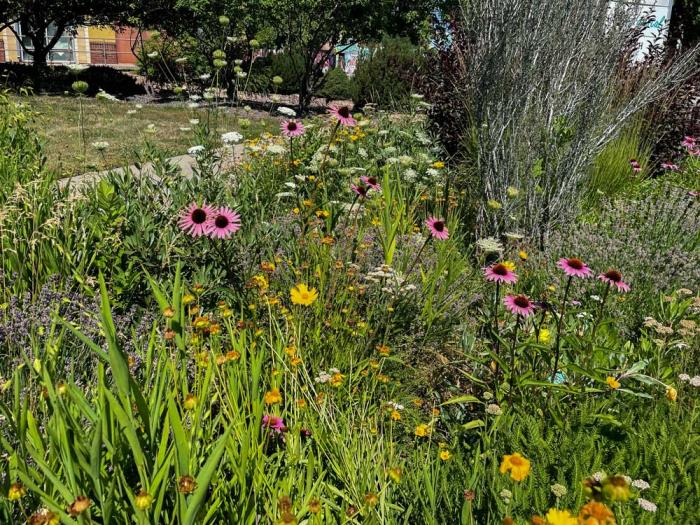
Parking lot medians are no place for grass. Water-wise landscaping can offer beauty and save water. Photo credit: Denver Water.
Denver Water is working with partners — including local governments, fellow water providers, and experts in water use and landscapes — to develop programs that will help transform our landscapes and expand our indoor and outdoor conservation efforts.
Being financially responsible
Denver Water has a long been proactive with maintaining and improving its vast network of dams, pipes, canals and treatment plants — and planning ahead for the future.
And that work extends to the financial side of the utility.
Denver Water doesn’t receive tax dollars or make a profit. Its infrastructure projects, day-to-day operations and emergency expenses, like water main breaks, are funded by a mixture of water rates, bond sales, cash reserves, hydropower sales and fees for new service (called System Development Charges).
And in this area too, Denver Water has received high marks.
For a recent bond sale, which brought in about $200 million to invest into the system, rating agencies extended Denver Water’s existing triple-A credit rating, the highest available. The agencies cited multiple factors, including the utility’s strong financial management for the rating.
The rating was just another example of how at Denver Water, sustainability isn’t just a word, it’s embedded throughout the organization, from its long-range planning for a warmer future to the training it provides to inspire its employees to go the extra mile for customers.
Denver Water crews dug up old lead service lines from customers’ homes for years of study that led to the utility’s Lead Reduction Program. Photo credit: Denver Water.
Click the link to read the article on The Denver Post website (Conrad Swanson). Here’s an excerpt:
The Environmental Protection Agency said the utility has succeeded in its three-year trial program and should be allowed to finish its 15-year program
Denver Water’s plan to replace tens of thousands of lead pipes connecting homes to the city’s water supply is working well enough to move past the trial phase, federal officials said. Environmental Protection Agency officials gave the utility three years in late 2019 to try its unique approach of replacing lead service lines, home by home, while changing the chemistry of its water supply to keep lead levels low. In that time, Denver Water has replaced thousands of lead service lines and kept levels of the toxic, heavy metal in its water supply at a fraction of the allowable federal limits, Sarah Bahrman, chief of the EPA’s Safe Drinking Water Branch, said. Bahrman said EPA officials are recommending that Denver Water be allowed to finish the remaining 12 years of its replacement plan, a decision that EPA Region 8 Administrator KC Becker is expected to make in the coming weeks.
Denver Water officials originally estimated that between 64,000 and 84,000 homes received water through lead service lines and that replacing them would cost about $500 million and take 15 years. Considering inflation, supply chain shortages and more, Alexis Woodrow, the utility’s lead reduction program manager, said the new cost estimate for the life of the program is more likely to be $681 million…
Denver Water needed approval from the EPA because CEO and Manager Jim Lochhead pushed back on a mandate from the Colorado Department of Public Health and Environment, which originally ordered the utility to inject a nutrient – orthophosphate – into its water system. Lochhead argued that orthophosphate could pose a health risk for metro residents and downstream communities. Instead he proposed to send water filters to homes that might have lead service lines, replace the service lines themselves and to slightly boost the water’s alkalinity to stop the heavy metal from breaking off into the water supply.
On a day in late May [2022] when wildfire smoke obscured the throat of an ancient volcano called Shiprock in the distance, I visited the Ute Mountain Ute farming and ranching operation in the southwestern corner of Colorado. Photo credit: Allen Best/Big Pivots
Click the link to read the article on the Big Pivots website (Allen Best):
The river is in deep doo-doo, and worse may very well come. So why such a sluggish reaction?
On a day in late May when wildfire smoke obscured the throat of an ancient volcano called Shiprock in the distance, I visited the Ute Mountain Ute farming and ranching operation in the southwestern corner of Colorado. It was my first visit.
Turning off the paved highway, I drove about 10 miles around the toe of Sleeping Ute Mountain, past a few irrigation ditches, one carrying water, and a lot of fields and center-pivot sprinklers. I knew the runoff the San Juan Mountains, the source of water for the 7,700-acre farming operations by the Utes, was bad. I didn’t realize just how bad it was.
Unlike many tribal rights in the Colorado River Basin, the water rights of the two Ute tribes in Colorado were negotiated in 1986. The agreement resulted in delivery of water to Towaoc, where I ate at the casino restaurant twice on that trip. Before, potable water had to be trucked in.
Mike Preston, filling in for a Ute leader at the Colorado Water Center conference this week, remembers a time before that delivery of water. “There were stock tanks sitting in people’s yards, and a water truck would back up and fill those tanks, and people would go out with buckets to get their potable water.”
The Utes got other infrastructure, too, including water from the Dolores River stored in the new McPhee Reservoir that allows the Utes to create a profitable farm enterprise. But to get the use of McPhee water, the Utes conceded the seniority of their water rights. It worked well for a lot of years, but now in a warmer, drier climate, it leaves the Utes in a hard, dry place: They got 10% of their full allocation in 2021 and 40% this year.
They have been forced to adapt. Instead of planting alfalfa, they planted corn and other crops that use less water and can be fed to cattle. They culled cattle from their herd of 650. The tribe – as are others in Colorado – is exploring the viability of kernza, a new perennial grain created at The Land Institute in Kansas.
Still, some adaptation is impossible. The agricultural enterprise has laid off about half of its employees. And last year, despite securing all available government grants created to allow farmers to make it through hard times, the operation lost $2 million.
On a day in late May when wildfire smoke obscured the throat of an ancient volcano called Shiprock in the distance, I visited the Ute Mountain Ute farming and ranching operation in the southwestern corner of Colorado. Photo credit: Allen Best/Big Pivots
Listening to that story related by Preston in a video feed to the conference on the campus of Colorado State University, I wondered whether this was a metaphor for what faces the 40 million people who, in one way or another, depend upon water from the Colorado River.
During this same conference, “Living with the Colorado River Compact: Past, Present and Future,” I heard allusions to hospital emergency wards and over-drafted bank accounts. The latter came from Jim Lochhead, who had several decades of Colorado River experience before arriving at Denver Water as chief executive in 2010.
“No wonder Lakes Powell and Mead are in the condition that they are in today,” he said after accounting the over-drafting of the two big reservoirs, now down to 24% and 26% of storage respectively. “The bank account has been drawn down,” he said, “and we’re looking at a zero balance with no line of credit.”
By now, the 21st century story of the Colorado River has become familiar in its broadest outlines, part of the national narrative of despair. The pivoting reality came on hard in 2002, when the Colorado River carried just 4.5 million acre-feet of water.
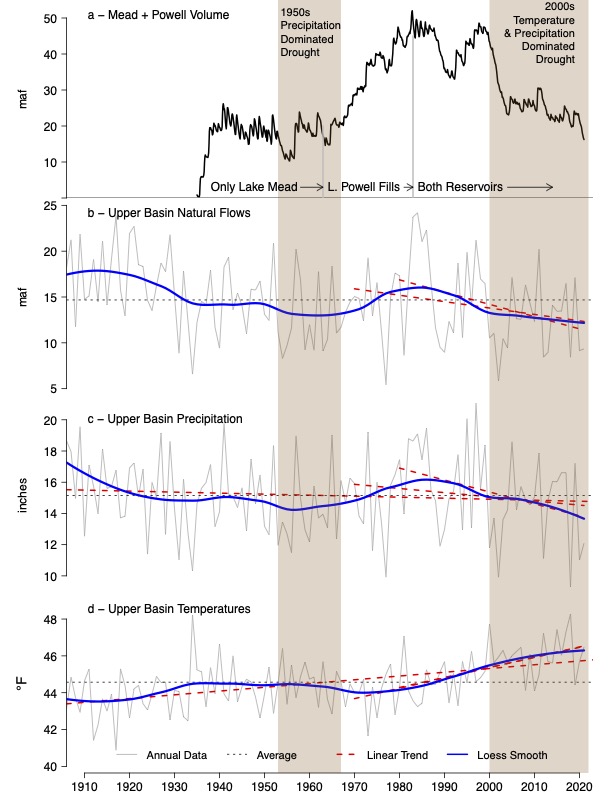
Brad Udall: Here’s the latest version of my 4-Panel plot thru Water Year (Oct-Sep) of 2021 of the Colorado River big reservoirs, natural flows, precipitation, and temperature. Data (PRISM) goes back or 1906 (or 1935 for reservoirs.) This updates previous work with @GreatLakesPeck. Credit: Brad Udall via Twitter
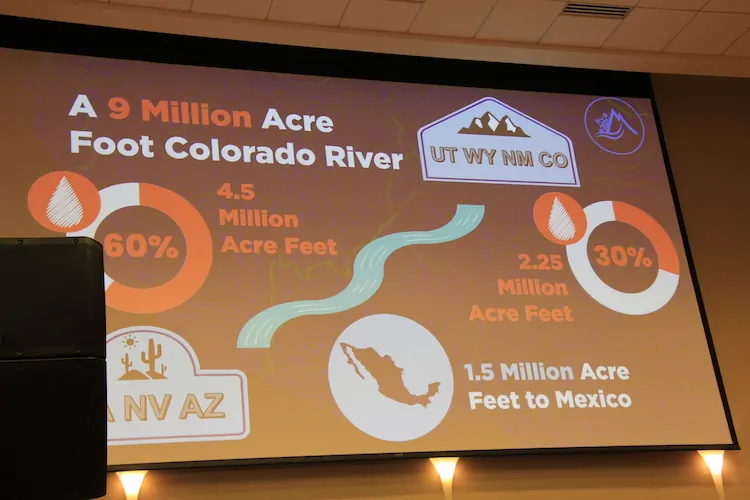
To put that into perspective, as Eric Kuhn, co-author of “Science Be Dammed,” did at this conference, those who framed the Colorado River Compact in 1922 assumed 20.5 million acre-feet as they went about apportioning the river’s flows. In the 21st century, the river has averaged 13 million acre-feet.
Alarm has been sounded but…
Now, scientists are warning that river managers should plan for no more than 11 million acre-feet, a reflection of the new hotter, and in some places, drier climate. Some think that figure is overly optimistic.
The seven basin states – particularly the thirsty states of California and Arizona – have cinched their belts with various agreements. But they have not responded in ways proportionate to the risk they now face. There is a very real danger of the reservoirs dropping to just puddles of dead pool, too little to be released downstream. Imagine the Grand Canyon without water. Imagine no water below Hoover Dam. Do these images leave you dumbstruck?
A public official on the Western Slope recently confided to me that he and others had grown weary of what they called “drought, dust and dystopia” stories. That troubled me, leaving me to wonder how my own stories are being received.
At the conference this week on the campus of Colorado State University in Fort Collins, I heard something of the same self-doubt.
“With all due respect to my fellow panelists, I live in an area where some of the topics that are mentioned, we’re not uniformly and broadly received,” said Perry Cabot, the lead researcher at Colorado’s State University’s Western Colorado Research Center near Grand Junction. “I think as researchers, we tend to believe that just more educating is going to change the dynamics of the narrative.”
Other panelists agreed with Cabot’s observation that new narratives, not just information, would better convey the gravity of the situation.
“I think the scientific community has gotten its head handed to itself,” said Brad Udall, who has dome some of the pioneering research that shows that “aridification” – as much or more than drought itself – is driving the reduced flows. Drought ends, but aridification resulting from atmospheric greenhouse gases? Not any time soon.
That has gone against the grain of water managers. A decade ago, there was still skepticism about climate change, and water always has been variable. Surely, good winters would return in the mountains of Colorado and other upper basin states that produce 90% of the river’s flows. Colorado alone is responsible for 60%.
After all, every batter goes through slumps, every best-selling author can tell of rejection slips.
By now, however, a clear trend has become evident. Even in good snow years, the runoff lags.
Andy Mueller, general manager of the Colorado River Water Conservation District, described various outcomes of a river with continued declines in flows. Photo/Allen Best
At the Colorado River Water Conservation District’s annual seminar in Grand Junction, Brendon Langenhuizen offered no hope for refilling the glass that is now far less than half-full in the coming year. It will be the third La Nina in a row, he pointed out, likely producing above-average temperatures and hence below-average precipitation.
Even so-so precipitation has been coming up as something worse. For example, the snowpack in the Gunnison River watershed last year was 87% of average, but the runoff was only 64%.
Dry soils have sopped up moisture, and then there is the heat. The last year has been among the six warmest in the last century in Colorado, said Langenhuizen, a water resources engineer for the River District. Summer rains the last two years have helped. Still, the reservoir levels drop, the seven basin states so far unable to apportion demand to match supply. After all, there’s money in the bank, and for probably a year more, enough water in the reservoirs to generate electricity.
At water meetings, an element of collegiality has remained, at least until recently. Testiness has crept in, an element of what Andy Mueller, the general manager of the Glenwood Springs-based River District, calls finger-pointing.
Colorado water officials, Mueller included, are doing some of that themselves.
They point out that Colorado and the other upper-basin states get nicked for 1.2 million acre-feet in evaporative losses in their delivery of water to Lake Mead, outside of Las Vegas. California, Arizona, and Nevada do not. “It’s like running two sets of books,” said Mueller.
Mueller was negotiating with the U.S. Bureau of Reclamation on the day of the conference in Fort Collins. His stand-in, Dave Kanzer, explained that the Law of the River —the Colorado River Compact and other agreements – don’t necessarily apply anymore. It is “based on long-term stable water supply, and we no longer have that,” he said.
Herbert Hoover presides over the signing of the Colorado River Compact in November 1922. Members of the Colorado River Commission stood together at the signing of the Colorado River Compact on November 24, 1922. The signing took place at the Palace of the Governors in Santa Fe, New Mexico, with Secretary of Commerce Herbert Hoover presiding (seated). (Courtesy U.S. Department of Interior, Bureau of Reclamation)
Renegotiate the compact?
The Colorado River Compact assumed too much water and also used precise numbers when ratios would have been better, Mueller has observed. Instead, those who gathered in Santa Fe in November 1922 apportioned
7.5 million acre-feet to each of the two basins, upper and lower. In practice, the lower-basin states have been using twice as much water as Colorado and other upper-basin states.
Colorado’s average annual consumption from the Colorado River and its tributaries is 2.5 million acre-feet. In terms of the compact, what mattes entirely is when the diversion began, before or after the compact.
About 1.6 million-acre feet- mostly older agriculture rights – are pre-compact, but 900,000 acre-feet came later. This includes water for Western Slopes cities and the nearly all of the 500,000 acre-feet diverted across the Continental Divide to cities along the Front Range and farms in the South Platte and Arkansas River valleys. This water is most imperiled.
Kuhn, the former general manager of the Colorado River District, said he does not believe it’s practical to attempt to amend or renegotiate the Colorado River Compact.
“But within a few years, maybe after we have figured out how to get out of the current crisis, we’re going to essentially ignore all of the provisions of the compact except perhaps article one, which defines the purpose and the signatures page.”
Lochhead has much the same opinion about the much-disputed element of the compact about the obligations of Colorado and other upper basin states to deliver water. It really won’t matter, he said. The real problem is that the basin states need to align demand with supply that, during the last few years, has been close to 11 million acre-feet. (Keep in mind, the compact assumed more than 20 million acre-feet).
“We’re literally in a situation of triage,” said Lochhead. “Something needs to be done in the very near term to lay a foundation for actions that can be taken in the medium and longer term to manage the river to a sustainable condition.”
The feds need to step up
Lochhead outlined three possibly overlapping alternatives.
First: involuntary regulations and restrictions. The federal government – although it has been using it with restraint – does indeed have authority to regulate use of water that enters into Mead. The U.S. Supreme Court has characterized its power as such. The Bureau of Reclamation must be seen as delivering a coherent threat.
“That gives the U.S. government enormous authority over what happens in the lower basin,” Lochhead said. This is unlikely to happen until after the November election, he said, but it absolutely must happen.
Voluntary agreements must also occur. The Bureau of Reclamation imposed an August 2022 deadline for agreements. If the deadline had been a hard one, the states would have failed. Lochhead said it came down to finger pointing. Arizona and California “stared across the river at each other, seeing who’s going to blink first.”
The federal government has now put $4 billion on the table – through the Inflation Reduction Act —to “grease” the skids in terms of voluntary agreements. (Think, perhaps voluntary retirement of water rights). “They’re going to have to buy down demands in the lower basin,” said Lochhead, conjecturing on deals involving the Imperial Irrigation District, the giant ag producer just north of the border with Mexico.
We will need to sort through what grasses we want and can afford, both in residential settings and in pubic areas, such as Colorado Mesa University, above. That will extend to grasses grown to feed livestock. Top, the Colorado River at Silt, Colo. on Sept. 17. Photo/Allen Best
Lochhead also described the need for reductions in water use in the municipal sectors. Denver Water and several other water agencies in Colorado – but also in Nevada and California and Arizona—announced an agreement in August in which they will try to pare their consumption. For example, Denver wants to end irrigation of medians along roads and highways and crimp the amount of water used for turf. But Denver and other cities need to continue to have trees, said Lochhead.
More cities will join this pact to reduce water use for residential consumption in coming weeks and months, Lochhead said.
But he said Colorado may need state legislation to ensure that real-estate developers can’t create landscaping in the future that requires lots of water, offsetting these gains.
That brings me back to the Ute Mountain Ute lands that I visited in May. By virtue of their 1986 agreement, reality has smacked them hard. There is pain, but there is also adjustment. They have had to adjust.
Something of the same thing must occur in the broader Colorado River Basin. So far, it’s easier to postpone action. But another so-so year – or worse? While the states are trying to make the cuts necessary for a river that is delivering 12 million acre-feet per year, Mueller warns that the plans must contemplate a 9 million acre-foot river, as some scientists have said may come to pass.
But in Grand Junction, one of the scientists pointed out to me that it’s just possible the river may deliver 7 million acre-feet – and that could be next year and the year after.
Then, we may need a new metaphor, something worse than an empty bank account.
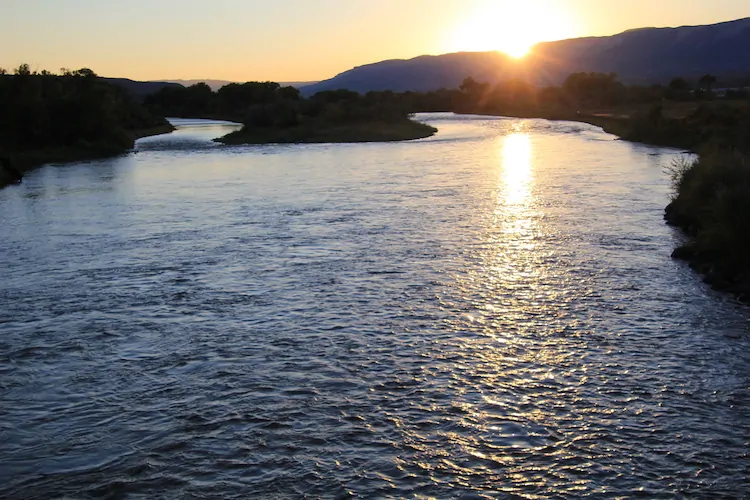
Sunset on the Colorado River at Silt September 2022. Photo credit: Allen Best/Big Pivots
Click the link to read the article on the Big Pivots website (Allen Best):
We really would rather be getting news about another Super Bowl triumph or the end of the 55-year drought in Denver Nuggets championships. But the Colorado River is rapidly nearing total disfunction. It is the story du jour.
Rivers and streams on Colorado’s Western Slope chattered excitedly with runoff during mid-September after several days of rain, softening landscapes that had turned sullen after another hot summer.
The water was a blink of good news for a Colorado River that needs something more. It needs a long, sloppy kiss of wetness.
Hard, difficult decisions have almost entirely lagged what has been needed during the last 20 years of declining reservoir levels and rapidly rising temperatures. Hope has lingered stubbornly. After all, every batter has slumps. And maybe next winter and spring it will snow hard and long in Colorado, source of 60% of the river’s water, instead of getting unseemly warm come April and May, as has mostly been the case.
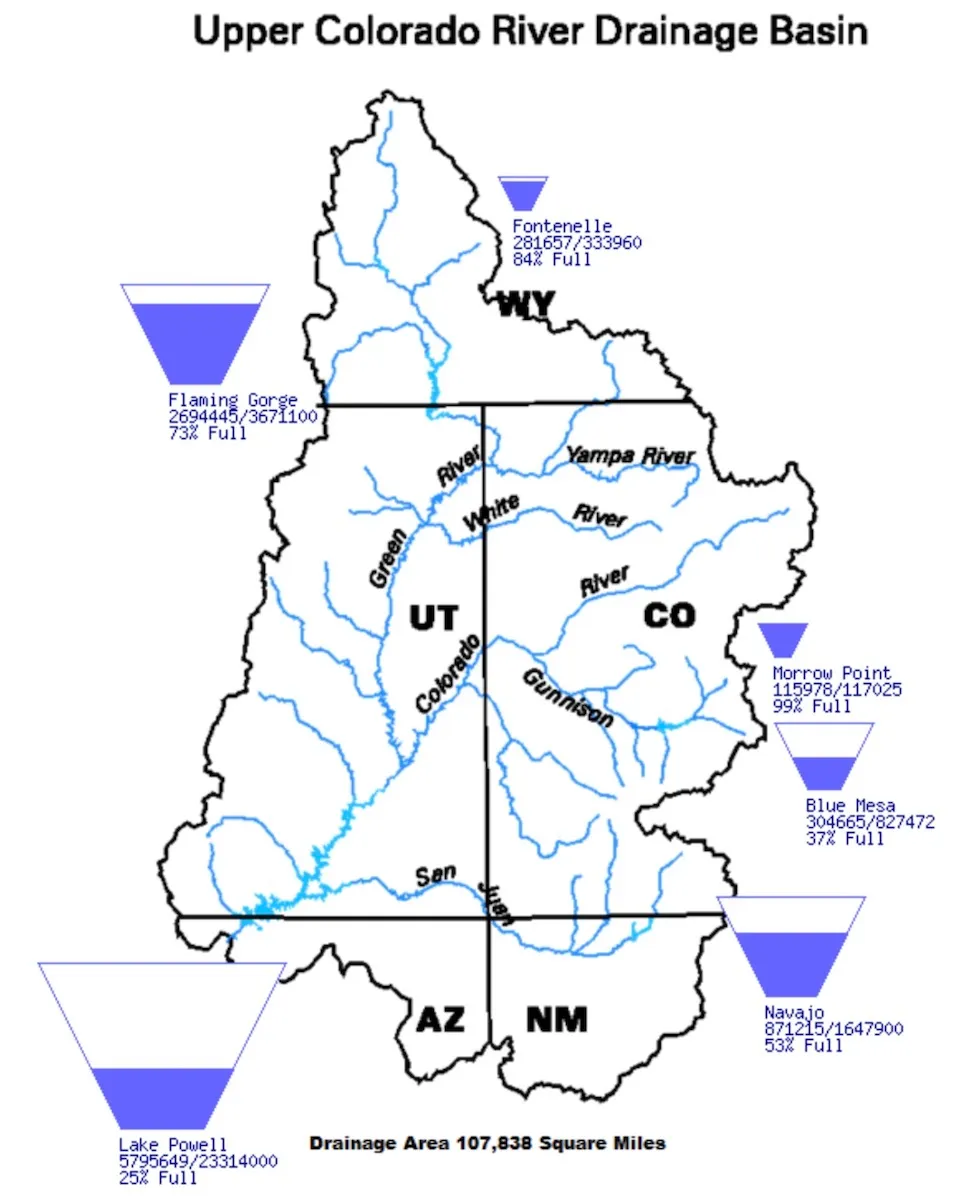
This glass half-full hopefulness has left the two big reservoirs, Mead and Powell, at roughly 25% of capacity. To prevent worse, the smaller savings accounts near the headwaters – Navajo Reservoir in New Mexico, Blue Mesa in Colorado, and Flaming Gorge on the Utah-Wyoming border – have been pilfered. Little remains to be tapped.
Even threats from the Bureau of Reclamation this year failed to spur definitive action. “We can’t keep doing this,” said Andy Mueller, general manager of the Glenwood Springs-based Colorado River Water Conservation District, a major water policy agency for the Western Slope.
Difference from average temperature in the top 300 meters (~984 feet) of the tropical Pacific between June 7 and August 1, 2022. A deep pool of cooler-than-average water (blue) spread eastward and will continue rising to the surface in coming months, feeding the current La Niña. Animation by NOAA Climate.gov, based on data from NOAA Climate Prediction Center.
Recently at the River District’s annual seminar in Grand Junction, Brendon Langenhuizen offered no hope for recovery this coming year. It will be the third La Nina in a row, he pointed out, likely producing above-average temperatures and hence below-average precipitation.
Even so-so precipitation comes up as something less. Yampa River Valley snowpack last winter was 84% of average; runoff lagged at 76%. The Gunnison River watershed figures were even worse; snowpack of 87% yielding runoff of 64%.
Dry soils have sopped up moisture, and then there is the heat. The last 12 months have been among the six warmest years in the last century in Colorado, said Langenhuisen, a water rights engineer. Summer rains the last two years have helped. Still, the reservoir levels drop, the seven basin states so far unable to agree on cuts that would match demand with supply.
It’s tempting to accuse the states of being caught up in century-old thinking. After all, they nominally operate under provisions of the 1922 Colorado River Compact. They have taken steps but they insufficiently acknowledge the shifting hydrologic reality. Instead of delivering an average 20.5 million acre-feet, as the compact assumed, the river has delivered 13 million acre-feet in the 21st century. In the last few years, it’s been worse yet, about 12 million acre-feet.
How low can it go? Mueller talked about learning to live within 9 million acre-feet, as some climate scientists have warned may be necessary. Climate scientists have built up some credibility as their forecasts have been, if anything, a tad conservative.
A scientist I talked with in Grand Junction suggested potential for an even starker future. What if the river delivers just 7 million acre-feet a year for the next two or three years?
One of my acquaintances, a county official on the Western Slope, recently confided weariness with the now familiar narrative of “drought, dust, and dystopia” on the Colorado River. Understood. We all want to see the Broncos and Avs win. More instructive may be the Denver Nuggets, who are now in a 55-year championship drought.
We will need to sort through what grasses we want and can afford, both in residential settings and in pubic areas, such as Colorado Mesa University, above. That will extend to grasses grown to feed livestock. Top, the Colorado River at Silt, Colo. on Sept. 17. Photo/Allen Best
Jim Lochhead, chief executive of Denver Water, likens the situation on the Colorado River to a bank account that has been drawn down. “And we’re looking at a zero balance with no line of credit,” he said this week at the Colorado Water Center conference in Fort Collins.
What is needed? From a perspective in Colorado, Lochhead argues for a stronger, more assertive federal role. Lochhead was for many years a lawyer based in Glenwood Springs who represented Colorado in river issues.
Map credit: AGU
Everybody that depends upon Colorado River water from northeastern Colorado to Los Angeles and San Diego will have a role, he says. Denver for example, wants to crowd out grass from medians and incentivize turf removal.
Lower-basin states use about twice as much as the upper basin states, and there the cuts must be more radical. Lochhead wants to see the federal government, through the Bureau of Reclamation, more assertively force the lower-basin states to make those hard decisions. Federal authority over water entering Lake Mead has been upheld by the U.S. Supreme Court, he points out, and he suggests the agency may use that power after the November election.
The broad theme will be reducing water used for low-value grasses. That takes in suburban lawns but also the water-greedy grasses grown for livestock, including corn and alfalfa. Hard choices, but they must be made. What more warning do we need?
Brad Udall: Here’s the latest version of my 4-Panel plot thru Water Year (Oct-Sep) of 2021 of the Colorado River big reservoirs, natural flows, precipitation, and temperature. Data (PRISM) goes back or 1906 (or 1935 for reservoirs.) This updates previous work with @GreatLakesPeck. Credit: Brad Udall via Twitter
Colorado and San Juan River Endangered Species Program: Julie Stahli, U.S. Fish and Wildlife Service
This map shows the snowpack depth of Castle and Maroon valleys in spring 2019. The map was created with information from NASA’s Airborne Snow Observatory, which will help water managers make more accurate streamflow predictions. Jeffrey Deems/ASO, National Snow and Ice Data Center
Colorado Airborne Snow Measurement Group: Taylor Winchell, Denver Water
Water ‘22: Jayla Poppleton, Water Education Colorado
Denver Water crews dug up old lead service lines from customers’ homes for years of study that led to the utility’s Lead Reduction Program. Photo credit: Denver Water.
Eliminating Lead in School Drinking Water Facilities: Mike Beck, CO Water Quality Control Division
Winchell told the attendees that, “ASO is an extremely powerful #climate adaption tool.”
He’s right, stationarity is dead so Colorado needs to incorporate new strategies for measurement of snowpack and that is exactly what the ASO technology provides.
Large water providers from across the Colorado River Basin announced today a commitment to substantially expand existing efforts to conserve water, reduce demands and expand reuse and recycling of water supplies.
The agreement includes water providers in both the upper and lower basins of the Colorado River, stretching from Colorado’s Front Range to Las Vegas and Los Angeles. The providers invite other utilities in the basin to join in the commitment to increasing water-use efficiency and reducing the demand for water.
The agreement comes amid a two-decade drought on the river that affects 40 million people who rely on it for drinking water, agriculture, power production, landscape irrigation, recreation and more. Demands for water in the basin have exceeded available supply, reducing storage levels in lakes Mead and Powell to critically low levels.
The water providers are outlining their commitments in a Memorandum of Understanding that was delivered to Bureau of Reclamation Commissioner Camille Touton today. Some providers have committed to pursuing the MOU’s intent while awaiting final approval through their various governing boards.
“We are developing prudent municipal water conservation actions that every community that relies on the Colorado River should be using,” water providers said in the letter to Touton. Moving forward, “We will describe the steps our organizations will take now and codify our commitment to continued effort as we work to ensure our river and the communities it serves continue to thrive. We sincerely hope our commitment to action inspires other stakeholders that share the river to do the same.”
Specifically, the agreement will focus on several key areas as pathways to cutting water use, including:
Develop programs to replace non-functional or passive cool weather turf grass (grass that serves primarily a decorative role and is otherwise unused) with drought- and climate-resistant landscaping, while maintaining vital urban landscapes and tree canopies where appropriate.
Increase water reuse and recycling programs where feasible.
Continue and expand conservation and efficiency programs to accelerate water savings.
“Achieving the protection storage volumes needed to preserve water and hydropower operations within the Colorado River basin cannot be met by a singular country, basin, state, or water use sector,” continued the letter to BOR. “While municipal water use represents only a small fraction of total Colorado River water use, progress begins with one and then many until we are all moving in the same direction.”
While not all the conservation strategies under consideration may make sense for each community, utilities say the agreement demonstrates the commitment that municipal water providers have not only to coordinating and collaborating on strategies to conserve and manage water demands, but to also help protect the Colorado River system.
“The water supply challenges we are facing on the Colorado River are accelerating at an alarming pace. Everyone who relies on the Colorado River must take bold and immediate action to reduce their use on this vital water source,” said Adel Hagekhalil, general manager of the Metropolitan Water District of Southern California. “This agreement represents our commitment to working with our municipal partners on the river to come up with innovative, collaborative approaches to better manage our Colorado River supplies and promote a more sustainable future for our communities.”
“With climate change and aridification affecting the entire Basin, improving the health of the Colorado River system requires a swift and collective effort of all water users — in all sectors — to reduce water use and implement actionable strategies, policies and programs to protect this vital resource and balance water supplies with demands,” said John Entsminger, Southern Nevada Water Authority general manager.
“Climate change and overuse of the Colorado River have put us squarely within the crisis we long saw coming. The bottom line now: We all need to work on solutions, no matter our individual impacts on river flows,” said Jim Lochhead, CEO of Denver Water. “While we have long been a conservation leader, Denver Water has consistently said it is prepared to do even more, and the commitments contained in this agreement reflect our readiness to take further important steps to keep more water in the Colorado River Basin.”
“Water issues in the arid west are accelerating,” stated Aurora Water General Manager Marshall Brown. “Aurora is embracing these conservation pathways through Colorado’s largest potable reuse system, an aggressive turf replacement rebate program and a new ordinance that prohibits nonfunctional turf in new developments. We’re doing what needs to be done to ensure a reliable water supply for our community in unpredictable times and we challenge other municipalities to do the same.”
“Colorado Springs Utilities is committed to conservation programming that ensures a clean, reliable water supply for years to come. Building on our customers’ successful 41% reduction in per capita use since 2001, we continue to pursue and implement water efficiency and reuse initiatives that support our vibrant community and make wise use of this valuable resource,” said Colorado Springs Utilities CEO Aram Benyamin.
“The Southeastern Colorado Water Conservancy District supports the efforts of the Upper Colorado River Commission (UCRC), the State of Colorado, and municipal and agricultural water providers in the basin, to collaborate in bringing the system into balance,” said Jim Broderick, executive director of the district.
Click the link to read the article on the Denver Water website (Cathy Proctor and Jay Adams):
Protecting people from hazards that can lurk in their drinking water is the day-in, day-out job for water industry engineers, utilities and regulators.
And at Denver Water, efforts to protect people from the health risks posed by lead from old, lead service lines getting into drinking water, has been part of the job for decades.
There is no lead in the water Denver Water delivers to customers, but the utility regularly tests for lead in the drinking water of homes that are known to have lead water service lines, the primary source of lead in drinking water.
Rachel Himyak, water treatment lead, collects a sample of water that’s been run through old lead service lines as part of ongoing studies at Denver Water of pH adjustment. Photo credit: Denver Water.
In the first half of the 20th century, lead was a common, cheap and easy-to-work-with material to use when forming small pipelines that carry drinking water from utility pipelines in the street into customers’ homes. But these old lead service lines, which in Denver Water’s experience are more often found in homes built before 1951, pose a threat in the community, particularly to children, infants and pregnant women.
Denver Water has tested for lead in customers’ drinking water for decades under the Environmental Protection Agency’s Lead and Copper Rule. In 2012, the routine monitoring indicated the utility needed to investigate whether it could adjust the chemistry of the water it delivered to customers to better protect them from the risk of lead getting into drinking water.
Read this 2019 story to learn about Denver Water’s efforts over the years to combat lead in drinking water, which culminated in the 2020 launch of its groundbreaking Lead Reduction Program.
In short, the results of tests on customers’ drinking water launched Denver Water into years of study centered on one question: What more could it do to better protect at-risk customers?
The first step was more testing.
“For a utility of our size and the number of lead service lines we have, you can’t just test something by putting it into the distribution system that’s delivering water to 1.5 million people every day. That’s not acceptable to us,” said Ryan Walsh, manager of the water treatment engineering section at Denver Water.
“We had to test things at a pilot scale, by doing the pipe loop study, before we could move forward.”
Walsh’s team was in charge of testing various treatment options via the pipe loop study and later planned, designed and executed the treatment plant systems involved in increasing the pH level.
Denver Water crews dug up old lead service lines from customers’ homes for years of study that led to the utility’s Lead Reduction Program. Photo credit: Denver Water.
To build the pipe loop study, Denver Water used old lead service lines its crews removed from customers’ homes (replacing them with lead-free lines) as the crews found the old lines during their regular work on water mains across the utility’s service area.
Denver Water plumbers connected the decades-old pipes together on racks and its treatment engineers ran water through them for hours, days and years. They tested different treatment methods to find out which worked best to reduce the risk of lead from the old pipes getting into the water passing through them.
Watch this video to see Denver Water’s pipe loop study, which is still underway today.
“That testing was so critical because we used the water that had been treated by our treatment plants, Moffat and Marston, the water that was going into our system to customers. The pipe loop study allowed us to test the adjustments we might do to the water to keep people safe,” said Patty Brubaker, a water treatment plant manager.
Aaron Benko, water treatment lead, pulls a sample of water from the rack of old customer-owned lead service lines that Denver Water crews dug up from customers’ homes and researchers continue to study. Photo credit: Denver Water.
“We tried different pH levels, we tried different phosphate levels, and we tried all of them on the actual lead pipes that had been taken from our system,” Brubaker said.
“There were so many people involved in putting this together. We had the crews who went out and pulled those lines, the plumbers that put them together on the racks, the people who made the adjustments and tested the water as it ran through the pipes.
All of us were studying the impacts to figure out which would be the best method to use to protect our customers from those old lead pipes.”
Decision time
In March 2018, based on Denver Water’s studies, state health officials told Denver Water it had two years — until March 2020 — to get ready to start using a food additive called orthophosphate to tamp down the potential for lead to get into customers’ drinking water.
The decision worried many people inside and outside of Denver Water.
The concern wasn’t whether orthophosphate would reduce the potential for lead to get into drinking water. They knew it would.
Denver Water treatment engineers and operators (from left) Ryan Walsh, Aaron Benko, and Rachel Himyak at the pipe loop rack, which continues to have water running through the old lead service lines for ongoing studies. Photo credit: Denver Water.
Denver Water’s years of tests on the old pipes had shown orthophosphate would work, and other water utilities use orthophosphate to reduce the risk of lead getting into their drinking water.
But Denver Water, environmental groups and other water and wastewater utilities downstream of Colorado’s capital city worried about the widespread, long term — and expensive — consequences of adding orthophosphate to such a large system, including the increased potential for environmental impacts in and downstream of the Denver metro area.
Nicole Poncelet-Johnson, director of Denver Water’s water quality and treatment section, had been hired at the utility few months before the state’s 2018 decision on orthophosphate. From previous jobs involving water and wastewater treatment plants, she’d seen what orthophosphate could do at the plants and in the environment.
Hector Castaneda, a water treatment technician, and Nicole Poncelet-Johnson, director of Denver Water’s water quality and treatment section, at the Marston Treatment Plant filter beds, where water is filtered through tiny pieces of sand and anthracite coal as part of the treatment process. Photo credit: Denver Water.
“I’d seen the algae, which can grow faster when there are higher levels of phosphate in the water. I’d seen it coating the valves coming into the treatment plant so we couldn’t bring water in. I’ve seen how the taste and odor problems with the water were so bad that people bought and used bottled water instead of tap water,” Poncelet-Johnson said.
“And in Colorado’s dry, arid environment, with our long, sunny days and the UV light, adding orthophosphate to our system would have created a primordial soup. Plus, after the expense of adding it to the water at the drinking water treatment plant, it’s hard, expensively hard, to get phosphorous out of the water when it arrives at the downstream wastewater plants,” she said.
About half of Denver Water’s residential water use is outdoor water use used on lawns and gardens. Photo credit: Denver Water.
On top of the expensive work that would be required at wastewater treatment plants, there simply was no way to recapture all the orthophosphate that would be added to Denver’s drinking water due to the way water is used in the metro area, she said.
About half of Denver Water’s residential water use is outdoor water use, tied to the irrigation of lawns and gardens. That means some of the orthophosphate-treated drinking water was bound to run off of lawns, down the gutter and end up in the metro area’s urban creeks, streams and rivers.
Water used for irrigation of lawns and gardens often ends up in urban creeks and streams that flow throughout the Denver metro area. Photo credit: Denver Water.
The groups worried that under the right conditions, that additional phosphate could accelerate the growth of algae not only downstream of the city, but also in the metro area’s urban creeks, streams and reservoirs.
There had to be another way, they said.
Alternative path
“We went back to the data from the years of tests we’d run. We saw that if we raised the pH level of the water, instead of adding orthophosphate, we could protect people from the lead service lines,” Poncelet-Johnson said.
“And if we combined a higher pH with replacing those lead service lines with new, lead-free copper lines, then the lead levels would drop to the point where the tests couldn’t detect anything.”
In 2019, Denver Water formally proposed an alternative approach to state and federal regulators.
Denver Water’s proposal, at its core, called for raising the pH of the water delivered to customers from 7.8 to 8.8 on the pH scale, and keeping it there with relatively little variance as it flowed from the treatment plant to the customers’ homes and businesses.
Raising the pH of the water delivered to customers strengthens an existing protective coating inside lead service lines, which reduces the risk of lead getting into drinking water. Image credit: Denver Water.
The higher pH level would strengthen an existing protective coating inside the lead service lines, reducing the risk of lead getting into the drinking water as it passed through the lead pipes.
And that — combined with significantly accelerating the replacement of the old lead services lines — would 1) lower the risk faster than relying on orthophosphate alone, and 2) do so without the cost and environmental concerns posed by adding the phosphate.
This graphic (not to scale) portrays how a higher pH level creates a stronger protective coating (shown in white and brown on the left) inside a lead service line (shown in grey), separating the water (blue) from the lead pipe and reducing the risk of lead getting into the drinking water. Image credit: Denver Water.
“It was a better solution, a permanent solution to the problem of old lead service lines, which are the primary source of lead in drinking water,” Poncelet-Johnson said.
“Because instead of a Band-Aid approach, instead of just adding chemicals to the system and then dealing with the widespread economic and environmental consequences of that decision for decades, we went the other way and proposed permanently removing the problem by raising the pH of the water and replacing the lead service lines,” she said.
Listen to Nicole Poncelet-Johnson, director of Denver Water’s water quality and treatment section, discuss Denver Water’s Lead Reduction Program:
Denver Water’s alternative proposal focused on five areas:
Raising the pH of the water it delivers to 1.5 million people to 8.8, and keep it fairly constant, with very little variance, as the water flowed from treatment plant, through the distribution system, to customers’ homes and businesses.
Mapping the location of the customer-owned lead service lines in its service area and sharing that map with customers.
Replacing the estimated 64,000 to 84,000 customer-owned lead service lines in its service area with new lead-free copper lines at no direct cost to the customer.
Providing customers enrolled in the program with water pitchers and filters certified to remove lead to use until six months after their lead line was replaced.
Launching the largest public health communication effort Denver Water had ever done to educate its customers about the risks of lead, the importance of using filtered water until the old lead service lines could be replaced, and the process for replacing those lead pipes.
Watch this video to learn more about lead service lines.
Breaking new ground
The proposal broke new ground in the water industry in two main ways.
It attacked the legacy issue posed old lead service lines from all sides — by raising the pH level, replacing customers’ old lead service lines, providing water filters to customers enrolled in the program to use until six months after their line was replaced, and educating those customers about the program.
And Denver Water said it would tackle all those steps on a scale and at a speed never before seen in the water industry.
Communicating with customers enrolled in the Lead Reduction Program is one of five elements of the biggest public health initiative in Denver Water’s history. Image credit: Denver Water.
Other cities had aimed to replace a few thousand lead service lines.
But Denver Water proposed replacing up to 84,000 customer-owned lead service lines estimated to be in Denver Water’s service area, doing it at no direct cost to the customer, and doing it in 15 years.
And, the utility proposed sending water pitchers and filters to more than 100,000 households enrolled in the program to use for cooking, drinking and preparing infant formula until six months after their lead line was replaced.
More than 100,000 households enrolled in the Lead Reduction Program were supplied with water pitchers and filters certified to remove lead to use for cooking, drinking and preparing infant formula until six months after their lead line is replaced. Photo credit: Denver Water.
In December 2019, health officials at the EPA and the Colorado Department of Public Health and Environment agreed to Denver Water’s alternative proposal.
Weeks later, in January 2020, Denver Water launched its Lead Reduction Program — and immediately faced a crucial deadline.
The utility’s engineers, treatment plant operators and monitoring teams now had to implement the systems and processes that would raise the pH level of the water and maintain that level as the water flowed across more than 3,000 miles of pipe to 1.5 million people. And they had less than 90 days to do it.
The seven Colorado River states – Arizona, California, Colorado, New Mexico, Nevada, Utah and Wyoming – face a daunting mid-August deadline. The federal government has asked them to come up with a plan to reduce their combined water usage from the Colorado River by up to 4 million acre-feet in 2023.
That is a massive reduction for a river system that currently produces about 12.4 million acre-feet. The Bureau of Reclamation, which manages the Colorado River, warned that it will “act unilaterally to protect the system” if the states cannot come up with an adequate plan on their own.
The seven states have worked cooperatively over the past two decades to identify solutions to a shrinking river. But their response now, much like the global response to climate change, seems far from adequate to the enormous challenge.
In a recent letter to BuRec, the Upper Colorado River Commission, speaking for the four Upper Basin states, proposed a plan that adopts a business-as-usual, “drought-reduction” approach. They argue that their options are limited because “previous drought response actions are depleting upstream storage by 661,000 feet.”
The Commission complains that water users “already suffer chronic shortages under current conditions resulting in uncompensated priority administration, which includes cuts to numerous present perfected rights in each of our states.”
This leads the Commission to conclude that any future reductions must come largely from Mexico and the Lower Basin states of Arizona, California and Nevada, because they use most of the water.
But the Lower Basin states have already taken a significant hit to their “present perfected rights,” and if BuRec makes good on its promise to act unilaterally, they will face another big reduction. The cooperative relationship among the Basin states will not endure if the Upper Basin refuses to share the burden by reducing its consumption.
The Gross Reservoir Expansion Project involves raising the height of the existing dam by 131 feet. The dam will be built out and will have “steps” made of roller-compacted concrete to reach the new height. Image credit: Denver Water
A good place to start might lie with two Colorado projects to divert water from the Colorado River basin to the Front Range. Both began construction this summer. The Gross Reservoir Expansion Project will triple the size of one of Denver Water’s major storage units. Denver Water’s original justification for this project – to serve Denver’s growing urban population – seems odd given that water demand in their service area over the past two decades has shrunk, even as its population rose by nearly 300,000.
Outflow from the dam across the Colorado River that forms Windy Gap Reservoir. Taken during a field trip the reservoir in September, 2017.
Similar questions have been raised with the Northern Colorado Water Conservancy District’s Windy Gap Firming Project, which plans to store Colorado River water to support population growth in Front Range cities.
These two projects suggest that Colorado is prepared to exacerbate the current crisis when the opposite response is so desperately needed.
Abandoning these two projects would signal that Colorado is serious about giving the Colorado River a fighting chance at survival. It might also jump-start good-faith negotiations over how Mexico, the states, and tribes might work to achieve a long-term solution to this crisis.
The homestead laws of the 19th century attracted a resilient group of farmers to the West who cleverly designed water laws to secure their water rights against all future water users. “First in time, first in right” became the governing mantra of water allocation, because, except for Tribal Nations, the farmers were first.
That system worked well for many years. As communities grew, cities and water districts built reservoirs to store the spring runoff, ensuring that water was available throughout the irrigation season.
Climate change and mega-droughts have upended that system. Nowhere have the consequences been as dire as in the Colorado River Basin. America’s two largest reservoirs, Lake Powell and Lake Mead – key components of the Colorado River’s water storage system – have not filled for more than two decades. They now sit well below 30% of their capacity.
Hotter temperatures, less mountain snowpack, and dry soils that soak up runoff like a sponge have brought us to this seven-state crisis. All seven states must now share the pain of addressing this crisis.
The Upper Basin Commission’s anemic response to BuRec’s plea is not a serious plan. We can do better and we must.
Mark Squillace and Quinn Harper are contributors to Writers on the Range, writersontherange.org, an independent nonprofit dedicated to spurring lively conversation about the West. Mark Squillace is the Raphael J. Moses professor of natural resources law at the University of Colorado Law School. Quinn Harper is a graduate student pursuing a master’s degree in natural resource policy at the University of Colorado, Boulder.
If yes, then you’re familiar with Denver Water’s decadelong campaign, launched a few years after the 2002 drought, that urged customers to reduce the amount of water they used in their everyday lives.
Denver Water’s decadelong Use Only What You Need campaign found humor in conservation. Photo credit: Denver Water.
The occasionally cheeky campaign showcased images like a park bench with only room for one person, water from a broken sprinkler head cascading onto a giant billboard and suggestions for using less water — like showering with a friend.
And it worked. By the time the campaign — created by Denver’s Sukle Advertising & Design — ended in 2015, water use by Denver Water’s customers had dropped 22% compared to usage before the drought.
The “Use Only What You Need” campaign has been recognized repeatedly over the years for its effectiveness and memorability, and on May 17 the Out of Home Advertising Association of America inducted it into the OBIE Hall of Fame, a group dominated by advertising campaigns backed by national and international brand names.
“Denver Water’s signature orange box asking customers to ‘Use Only What You Need’ became advertising legend in the Denver metro area,” said Jim Lochhead, Denver Water CEO/Manager.
“In a light-hearted and at times outrageous way, the campaign led the charge for our conservation programing where we had a critical call to action: Reduce water use by 22%. Eight years after achieving that goal, Use Only What You Need has remained a one-of-a-kind catchphrase that has continued to help Coloradans embrace a culture of conservation, which is so vital in the arid West where water is such a precious resource.”
Tip for using less water? Showering with a friend was part of a conservation campaign that reduced water use among Denver Water customers by 22% compared to usage before 2002. Photo credit: Denver Water.
Out-of-home advertising is visual advertising outside of the home, such as billboards, indoor and outdoor signs, ads on bus shelters or benches, in airports or train stations, and in a stadium or movie theater.
Previous OBIE Hall of Fame winners include the insurance company Geico (2021), entertainment giants The Walt Disney Co. (2007) and Universal Studios (2019), brewer MillerCoors (2018) and technology company Apple Inc. (2005).
Competition for the 2022 Hall of Fame award put Denver Water up against international heavyweights — and household names — Google, Netflix, Procter & Gamble Co., Pepsi and Samsung.
In the 30-year history of the OBIE Hall of Fame awards, Denver Water’s award is only the second time a regional brand has won the judges’ nod. The first was the San Diego Zoo in 1995.
“This is one of the highest creative honors in our industry, and we are immensely proud to be recognized by OAAA and our peers,” said Mike Sukle, owner of Sukle Advertising & Design.
“Creating and managing the campaign for a decade shaped how we approach every campaign we create. It cemented our philosophy that work must be both smart and creative to generate exceptional results. And while mass media including out of home was critical, the campaign spread almost as much through word-of-mouth. Our audience became our media. That’s an important lesson for all brands. And if you can make people like you, they may also listen to you,” he said.
The campaign encouraged customers to take a hard look at how much water they — and their lawns — truly needed. Photo credit: Denver Water.
Anna Bager, president and CEO of the association, called Denver Water’s campaign “truly brilliant and entertaining.”
“Denver Water has achieved legendary out-of-home status with a sustained level of creative excellence over many years. Their commitment to the ‘Use Only What You Need’ headline came to life in a seemingly endless number of creative solutions,” she said.
And while Denver Water’s message that water is precious and should be used wisely hasn’t changed, the utility’s campaign around water has evolved into a simple main message: Water is everything.
Denver Water’s latest campaign focuses on what water brings to our lives under the tagline “Life Is Better With Water.” Image credit: Denver Water.
Using the tagline “Life Is Better With Water,” the utility’s current campaign with Denver advertising agency Pure Brand celebrates the importance of water as a precious resource in our everyday lives and one that plays a vital role in Colorado’s unique lifestyle.
“It’s about elevating the value of water in our daily lives. Together, we all can help create a ripple effect that ensures our Colorado lifestyle continues for generations to come,” said Kathie Dudas, manager of brand and marketing at Denver Water.
Denver Water sits on the front lines of climate change.
Rising temperatures, long-term drought and less dependable snowpack are all making the job of providing water to 1.5 million people tougher.
Denver Water’s administration building is powered by solar panels. Photo credit: Denver Water.
In response, the utility is preparing for a future with a less consistent water supply for its customers, through innovations including greater efficiency, One Water and new storage projects such as the Gross Reservoir expansion.
The utility also is moving aggressively to cut its own carbon footprint, striving to meet goals for producing renewable energy and reducing dependence on energy sources tied directly to warming temperatures.
In 2020, Denver Water met an organizational goal for “net zero” annual energy consumption. That’s a fancy way of saying it produced as much or more energy than it consumed, and that its energy was generated using carbon-free sources: hydropower and solar power.
To be precise, the utility produced roughly 1.5 million more “kilowatt-hour equivalents” than it used in 2020.
The utility’s solar power panels and hydropower generators produced enough clean energy to account for not only its electricity use but also the natural gas it uses for heat. Natural gas burned to supply heat is an energy category that’s not always factored into “net zero” calculations, but Denver Water made a point of including it to create a stretch goal for its effort.
Denver Water’s solar panels generated more than 1 million kilowatt hours of electricity in 2020. Photo credit: Denver Water
“Several years earlier, we had set a goal to hit ‘net-zero’ as a benchmark for our sustainability efforts,” said Kate Taft, Denver Water’s sustainability manager. “Hitting that in 2020 was the result of a lot of focused, dedicated work across the organization and represents an important milestone in the utility’s long history of environmental progress.”
Net-zero is a big deal in the era of climate change.
Many major corporations are striving to attain the status, including companies such as Coca-Cola and General Motors. Many companies and governments have set net-zero goals for 2030 and 2040, for example.
Denver Water got there sooner. Though, to be sure, Denver Water benefits from — wait for it — water in this endeavor.
Water spills from Williams Fork Reservoir in 2019. The power of moving water is a major source of emission-free electricity for Denver Water. Photo credit: Denver Water
Hydroelectric power is generated at seven locations in Denver Water’s 4,000-square-mile collection area. That includes power generated at reservoirs but also at places like Roberts Tunnel, where the energy of water moving downhill through a tunnel that traverses the Continental Divide creates electricity.
All told, Denver Water’s hydropower operations generate about 65 million emission-free kilowatt-hours per year. That translates to about the amount of electricity consumed by 6,000 homes for a year.
While Denver Water generated hydropower for decades and is continuing to look for additional opportunities to generate power from moving water, including at its Northwater Treatment Plant currently under construction near Golden, the addition of solar power to its renewable energy portfolio is more recent.
At the utility’s newly redeveloped Operations Complex, completed in 2019, solar power panels on the roof of the Administration Building and atop parking structures generated more than 1 million kilowatt hours of electricity in 2020. That offset the Administration Building’s use with more than 300,000 kilowatt-hours to spare.
Crews install solar panels on top of Denver Water’s administration building in 2019. Photo credit: Denver Water
That’s extra clean electricity that can go back into the grid for use by others.
And in Denver Water’s new sustainability goals issued in 2021, the utility set a new target for itself: to increase its capacity to generate renewable energy by 1 megawatt and to reduce its greenhouse gas emissions by 50% from a 2015 baseline.
How much is that 1 megawatt? Roughly, it would be like adding another solar array about the size of the one at the Operations Complex. Or, like adding the hydropower capacity that now exists at Strontia Springs Reservoir, situated 6 miles up Waterton Canyon southwest of Denver.
Even as it works to add more green power, Denver Water may not always be able to meet its net-zero goal, at least in the short term.
That’s because maintenance projects at times take hydroelectric facilities off-line or reduce their capacity. For example, for the next five years, Gross Reservoir will generate less power because its storage space for water will be cut by about one-third while a dam-raising project proceeds.
Students learn about the hydroelectric plant at Hillcrest water storage facility in southeast Denver. Hydroelectricity at Hillcrest and six other sites is key to the utility’s ability to meet its net zero energy goals. Photo credit: Denver Water
However once that project is completed, and the capacity of the reservoir is tripled, the location is expected to be a greater source of clean energy, increasing its production capacity by nearly 15% compared to its capacity before the project.
In 2021, too, Denver Water fell short of its goal due in part to work on the hydroelectric facility at Roberts Tunnel. Work to upgrade the hydro facility at the tunnel kicked off in 2019.
Finally, while Denver Water focuses on offsetting electricity and heat generated by fossil fuels such as coal and natural gas, its net-zero calculations don’t currently count gasoline burned by its fleet vehicles or propane needed at some remote sites.
“As we make a long-term shift to cleaner energy sources, there will be bumps in the road,” Taft said. “We still, inevitably, will depend on more traditional sources at times and in certain locations. But we are relentlessly pushing to generate more of our own green energy and cut emissions associated with natural gas, coal and vehicles.”
As part of its effort to cut emissions, Denver Water is beginning the long transition to electric fleet vehicles.
The utility already has six Ford F-150 hybrid trucks and hopes to test the use of some all-electric pickups in 2023, pending supply chain challenges.
And as the utility continues to look at other electric vehicle options, it is partnering with analysts at Drive Clean Colorado and Xcel Energy’s Fleet Electrification Advisory Program to help guide the process.
“Getting this right will take time and a constant push forward,” said Brian Good, Denver Water’s chief administrative officer. “But it is the right thing to do. We are a water utility, and providing reliable, safe, clean water isn’t possible without protecting the natural environment from which it flows.”
Do you recognize these plant names? Moonbeam coreopsis. Autumn joy stonecrop. Blonde ambition.
They may not be well known among most homeowners, but they are examples of water-wise plants gaining popularity in Colorado every year.
Water-wise plants mostly rely on what Mother Nature provides, requiring either no additional water or only a few inches during the growing season.
Plant Select, which promotes low-water plants that thrive in Colorado’s climate, describes this plant as an “impressive, highly ornamental form of Western native grass with tall, upright stems.” We think it lives up to its name: Blonde Ambition. Photo credit: Denver Water
The plants are an alternative to thirsty Kentucky bluegrass and thrive in Colorado’s semi-arid climate. Water-wise plants also offer additional benefits such as low maintenance and added color. Many also attract birds, bees and butterflies.
Check out stories and advice from Denver Water customers who have added Garden In A Box kits to their landscapes.
Good sources of information include Resource Central, which offers the popular Garden In A Box program, and Plant Select, which promotes plants that need less water and thrive in the high plains and Rocky Mountain regions.
Elie Zwiebel and his partner, Laura, stand in front of their home in Denver’s Athmar Park neighborhood showing off results of their Garden In A Box. Photo credit: Denver Water
Resource Central
Since 2012, Denver Water has regularly supported Resource Central, a nonprofit organization based in Boulder that promotes water conservation programs.
One of its programs, Garden In A Box, offers a variety of water-wise plants along with plant-by-number garden designs from landscape professionals. The kits also come with information about the care and maintenance needs of the plants.
A Garden In A Box, after a few years, will delight homeowners and those who pass by. Photo credit: Denver Water
Customers can choose from gardens with names like “Naturally Native” and “Painted Shade,” indicating the kind of plants in each garden and the type of conditions they thrive in.
Programs like Garden In A Box are important to Denver Water because among its customers, outdoor water use accounts for about 50% of single-family residential water use. Converting a section of lawn into a water-wise garden is one way to reduce a home’s outdoor water footprint.
“Garden In A Box started in 2003 and we’ve sold more than 41,000 kits through fall 2021,” said Elisabeth Bowman, conservation engagement manager at Resource Central.
“Interest in the gardens has grown every year in the metro area so we’re happy to see so many people looking for water-wise landscapes.”
Between 2003 through 2021, Resource Central estimates it’s helped plant 3.1 million square feet of low-water landscapes, saving 228.6 million gallons of water over the lifetime of the gardens sold to customers across the Front Range.
A homeowner near Denver’s City Park removed grass from his front yard and planted a Garden In A Box. Photo credit: Denver Water
Denver Water pays Resource Central more than $15,000 a year to set up four garden pickup events in Denver every spring, so customers who live in and near Denver Water’s service area don’t have to go far to get their gardens.
More than 10,000 gardens have been sold to Denver-area residents since 2014.
Garden In A Box offers water-wise plants and professional designs in each kit. Image credit: Resource Central
“Denver Water is a huge partner for us, the support they provide makes it easy for Denver residents to pick up their kits. Over 1,000 of our gardens go to Denver residents every year,” said Melanie Stolp, manager of Resource Central’s Garden In A Box and its water efficiency Slow the Flow programs.
And the results of the customers’ purchases are amazing.
Just take a look at Resource Central’s 2021 numbers for Denver Water:
1,834 Garden In A Box kits sold to customers who live in Denver and the surrounding suburbs of Centennial, Edgewater, Greenwood Village, Lakewood, Littleton and Wheat Ridge.
100,000 square feet of low-water gardens planted, according to Resource Central’s estimates.
9.5 million gallons of water saved over the lifetime of those new gardens, according to Resource Central’s estimates.
A Resource Central employee loads a Garden In A Box kit during the spring 2021 pickup event. Photo Credit: Denver Water
“The Garden In A Box program helps people start small, converting a section of the lawn from turf to low-water plants,” said Jeff Tejral, Denver Water’s former water efficiency manager who guided the partnership with Resource Central.
“It helps people learn about these plants, how to care for them and the beauty they can bring to their home. From there, they often convert more sections of grass to water-wise landscapes.”
Customer surveys indicate about two-thirds of Garden In A Box buyers have little or no experience with water-wise plants, according to Tejral.
The Garden In A Box kit comes with a plant-by-number guide for a landscape designed by professionals using water-wise plants. Photo credit: Denver Water
That’s why each garden comes with a guide that helps customers through the planting and early years of the garden’s life.
Gardens have been sold in the spring and typically sell out quickly. Resource Central continues to increase the number of kits available each year to meet the growing demand. The organization has also conducted a fall sale for about four years and in 2021 increased its offerings by 35%.
Plant Select helps gardeners find water-wise plants that thrive in Colorado and the retailers that sell them. See their Top 10 plants from 2020.
The fall 2021 sale sold out. Another fall is planned for 2022.
Bowman encourages anyone interested in purchasing a Garden In A Box to check out Resource Central’s website and sign up for their newsletter.
A Garden In A Box kit planted in southeast Denver’s Hampden neighborhood. Photo credit: Denver Water
In addition to Garden In A Box, Resource Central also offers other water conservation programs through its water utility partners, including:
As summer is typically a time of higher water use (and higher monthly bills), Denver Water wants to remind customers that making changes to indoor and outdoor water use can help save water and save money.
“The best way to save money on your water bill is to become more efficient at using water,” said Jeff Tejral, a former water efficiency manager at Denver Water.
Denver Water and the Environmental Protection Agency’s WaterSense program have several resources available to help save water and money.
From fixing leaks inside and outside to turning off the water when brushing your teeth, some of the following water-saving ideas are free or inexpensive and can be done quickly. Others, like revamping your landscape or replacing appliances, may require a more long-term approach.
A constantly dripping faucet won’t only drive you crazy but it will freak Mother Nature out, too. Even a small faucet leak can waste up to three gallons of water each day. Photo credit: Delta Faucet
Fixing leaks indoors
Across the U.S., Americans waste about 1 trillion gallons of water every year through water leaks and spend about 10% of their water bill on wasted water, according to the EPA.
“If you’ve got a leak, you are spending money on water that you’re not even using,” Tejral said. “Leaking toilets are often the biggest culprits for water waste. Some leaks are almost undetectable, while others are easy to spot.”
The biggest cause of toilet leaks are worn-out flappers. These are the rubber parts that seal off the tank from the bowl. Over time, the flappers decay and allow water to slowly leak into the bowl.
This toilet has a small, almost undetectable leak through its pink, circular flapper on the bottom of the tank. Some leaks can be detected by listening to hear if water is coming into the tank after it’s done filling. Photo credit: Denver Water.
Another common cause of leaks is a float arm that is not set properly, causing water to constantly flow down the overflow/refill tube.
The EPA reports that an average leaking toilet can waste about 200 gallons of water every day.
For Denver Water customers, a leak of 200 gallons per day can add around $415 per year on your water bill.
Listen to hear if the toilet continues to run after a flush. Or, drop dye tabs or a few drops of food coloring into the toilet tank. If there is a leak, color will show up in the bowl after a few minutes depending on the size of the leak. Just make sure to flush after the test to prevent stains.
Fixing flappers and float arms are relatively simple and inexpensive repairs. Replacement parts can be found at hardware and home improvement stores and there are many resources online to help guide you through the fix.
Placing a few drops of food coloring in a toilet’s tank will leak into the bowl if there is a leak in the flapper. Photo credit: Denver Water.
In addition to checking toilets for leaks, Tejral also suggests inspecting all water sources in your home, including faucets, showers, and water supply lines for dishwashers, washing machines, swamp coolers and ice machines.
Denver Water has tips for conducting a self-audit of your home’s plumbing on its website.
And remember, small leaks can add up over time. A leak of 10 drops per minute can waste 300 gallons of water per year.
Not only can these leaks again add to your water bill, they can damage your home.
Fixing leaks outdoors
Spring is a great time to inspect your irrigation system and outdoor hoses for leaks as you turn the system on in preparation for the summer irrigation season. Be sure to wait until it warms up to turn on the system, the last freeze in the metro area is typically around May 4, according to the National Weather Service.
Inspecting your sprinkler throughout the watering season is a good way to spot problems. Photo credit: Denver Water.
Outdoor water leaks can be found in sprinkler heads, pvc pipes, backflow preventers, irrigation system valves, sprinkler heads and drip systems. Not only do leaks raise your water bill, they lower the performance of your entire sprinkler system.
Let’s run the math on how leaks can hit you in the wallet.
Irrigation system experts say it’s not uncommon for a sprinkler zone to leak one gallon per minute. If you run that zone for 18 minutes, three times per week, that’s 216 wasted gallons of water per month and roughly an additional $1.22 on your Denver Water bill.
If there are similar leaks on multiple sprinkler zones in your yard, and those leaks continue all summer and over many years, that’s a lot of wasted water that adds onto your utility bill.
And if you use a manual sprinkler, remember to check your hose connections for leaks too.
Wet areas around sprinklers can be a sign of a leak in a supply line or connection underground. Photo credit: Denver Water.
Watering rules can save you money
The EPA reports that 50% of water put on lawns nationwide is lost due to wind, evaporation and runoff caused by inefficient irrigation methods.
“The summer watering rules are in effect from May 1 through Oct. 1. They can really help customers save money by encouraging them to water efficiently,” Tejral said. “We see a lot of inefficiencies with sprinkler systems and small problems that can add up.”
One basic rule is to water between 6 p.m. and 10 a.m. This avoids watering in the heat of the day when water can be lost to evaporation before it ever lands on the grass.
It is also best to avoid watering when it’s windy, so water doesn’t blow off your yard.
Also, check to make sure sprinklers are not aiming onto the street, driveway or sidewalk.
Homeowners should also check the weather forecast and look for rainy days when they can skip irrigating and let your lawn soak up Mother Nature’s rain.
Check to make sure your sprinklers aren’t accidentally watering the sidewalk or street. Photo credit: Denver Water.
Setting the control clock
The watering rules can help your lawn by providing guidelines for how long to run sprinkler zones based on various types of sprinklers. Denver Water recommends watering only two or three days per week.
Tejral reminds homeowners to check their irrigation system’s control clock throughout the watering season, avoiding the “set it and forget it” approach.
Common problems with control clocks include sprinklers going off in the middle of the day, zones not running for an appropriate length of time and run times that are not adjusted during the watering season as weather conditions change.
roperly programming your irrigation control system will improve the efficiency of your sprinklers and improve the health of your yard. Photo credit: Denver Water.
“Understanding your control system is one of the most important things you can do to make sure you are watering efficiently and not wasting water,” Tejral said.
Tejral also recommends setting controllers to “cycle and soak.”
This means splitting the total run time for each sprinkler zone in half. For example, instead of running each zone for 18 minutes all at once, run each zone for nine minutes and then wait a bit before running the same zone for another nine minutes.
“Cycle and soak practices give the ground more time to absorb water like a sponge,” Tejral said. “If the sponge is full, it can’t absorb any more water. The ground works the same way.”
When customers do not follow these guidelines, they often think using more water is the best way to get a greener yard. But that often adds to the bill and does not help the grass.
“Cycle and soak” is a watering technique used to break up sprinkler run times to give water time to soak into the ground. Photo credit: Denver Water.
Another tip is to monitor each sprinkler zone because some zones need less water than others.
For example, grass in a backyard that has several trees will need less water than grass in a front yard with no trees that is in the full sun all day.
The watering rules also provide guidance for adjusting sprinkler zone run times throughout the watering season. Less water is needed in May and September, when the weather is cooler, than in June, July and August, when the weather is warmer.
Avoid overwatering
A common mistake that leads to higher water bills is overwatering the yard when brown spots or dry areas appear.
“Often, homeowners see brown spots and immediately think they need to run their sprinklers longer, when in fact the brown spots could be due to a variety of problems,” Tejral said.
Sprinkler-related reasons for brown spots include heads that have sunk into the ground, broken heads, sprinklers that are not aimed properly, water pressure issues and poor coverage. Doing a visual inspection when the sprinklers are running is a good way to spot problems.
Some problems can be easily fixed.
Note the leak on the sprinkler after it’s hit by a lawnmower. Photo credit: Denver Water.
“Plastic sprinklers can crack in the winter and break easily in the summer if they’re hit by lawnmowers or stepped on, so it’s important to check them throughout the summer,” Tejral said.
A comprehensive approach to checking how much area your sprinklers are reaching is to do a catch can test.
This involves spreading cups across each sprinkler zone to see if water from the sprinklers is dispersing evenly and reaching target areas.
Tejral says if you are a customer with a water bill that is over $200 per month during the irrigation season or if you are considering installing or retrofitting your irrigation system, you may benefit from hiring a professional who has earned their Qualified Water Efficient Landscaper certification.
Landscape and irrigation professionals take part in Qualified Water Efficiency Landscape certification training at Castle Rock Water in February 2020. Photo credit: South Metro Water Supply Authority.
A list of certified landscape and irrigation experts can be found on the QWEL website. The experts provide a number of services including sprinkler system audits, water efficient irrigation system designs, water-saving landscape designs and installation. Services are provided for residential and commercial customers.
“A QWEL certified professional may cost money up front, but the savings will add up over time,” Tejral said. “A water efficient landscape will also hold up better in times of drought.”
WaterSense also provides links to qualified professionals.
Landscape change
Changing the kind of lawn and landscape you have in your yard also can reduce water use.
If you want a different look for your yard, consider different types of turf grass or other landscape changes.
Mrs. Gulch’s Blue gramma “Eyelash” patch August 28, 2021.
“Kentucky bluegrass requires more water,” Tejral said. “Homeowners who like the look of grass but are open to something different can look at buffalo grass, blue gramma and fescue.”
Tejral said it is a good idea to evaluate your outdoor living needs every year and determine if grass is the best fit.
Hardscapes, patios, vegetable gardens and shrubs may be more practical and require less water than grass.
The owners of this home in Denver created a diverse backyard with with a mixture of grass, shrubs and patio space. Photo credit: Denver Water.
Rebates
Denver Water offers rebates for customers interested in reducing water use indoors and out.
Rebates are available for some high-efficiency toilets, smart irrigation controllers and high-efficiency sprinkler heads. Be sure to check the Denver Water website for details about which models qualify for rebates.
High-efficiency rotary spray heads deliver water at a slower rate to give water more time to soak into the ground. They also provide a stream of water that is more likely to fall to the ground compared to a spray head that sends out a mist of water that can be swept away by the slightest wind.
High-efficiency sprinklers deliver water in streams and at a slower rate than fixed-spray head nozzles. Photo credit: Denver Water.
Replace old fixtures and appliances
While many water-saving fixes are free or relatively inexpensive to do, the EPA says the average family can save 13,000 gallons of water annually by investing a bit more to save money down the road.
When buying new appliances and fixtures, purchase products that carry an Energy Star or WaterSense label, an indication that the product uses less energy or water compared to products that don’t carry those labels.
This includes washing machines, dishwashers, showerheads, faucets, toilets, irrigation controllers, sprinkler parts and more.
Installing WaterSense fixtures reduces water consumption and saves money on water bills. Photo credit: Denver Water.
High-efficiency shower heads use about 1.75 gallons per minute compared to older ones that use 2.5 gallons per minute.
Replacing an older washing machine with an Energy Star model can save 30 gallons to 40 gallons per load.
Newer dishwashers can save 3,870 gallons of water annually.
Replacing faucet aerators is an easy way to save water at home. Photo credit: Denver Water.
Replacing faucet aerators is another way to save money and water.
New aerators for bathroom sinks dispense just half a gallon of water per minute compared to older ones that use around 1 gallon to 1.5 gallons per minute.
The TAVA Waters community in southeast Denver shows how advancements in technology allow water efficiency products to save money and water without loss of performance.
Crews from Ecosystems install 2,500 high-efficiency toilets at the Tava Waters community in Denver in 2017. Photo credit: Denver Water.
Other easy changes
There are other simple actions that don’t cost anything to do but will save money on your water bill.
These include taking shorter showers and turning off the water when brushing teeth.
Running dishwashers and washing machines when they are full is another way to save water.
You can also use a spray nozzle with a shut-off handle when washing the car or cleaning windows and patios.
Directing downspouts to landscapes is another way to help plants without increasing water consumption.
Even small amounts of extra rainwater add up over a season and can help keep trees and shrubs healthy. Just make sure the water drains toward the landscape and not toward the home’s foundation.
Aiming downspouts away from the house and onto landscapes is a good way to take advantage of rain and snowmelt. Photo credit: Denver Water.
Another free tip to improve your lawn’s health is to make sure you don’t mow the grass too low.
Lawn experts at Colorado State University’s Extension office recommend keeping your grass height at 2.5 to 3 inches to make it more resistant to heat, drought and insects.
And remember to cover up your pool or spa when not in use, this prevents water loss due to evaporation.
Billing
Denver Water encourages customers to review their monthly water bills. Unusually high bills could indicate a leak.
Customers should also watch their email for Denver Water’s summer watering efficiency reports.
The monthly report, sent June through October, shows if you are using water efficiently. If you want this report, make sure your Denver Water account is updated with your email or call Customer Care at 303-893-2444 to sign up.
Denver Water sends out water efficiency reports to customers during the summer watering season. Image credit: Denver Water.
Develop a plan
While there are a wide range of ideas, Tejral said it’s perfectly OK to start small, or to make a plan that takes on manageable changes that will help save water in your home and landscape.
The key to saving money, watering efficiently and having a healthy landscape is to develop a plan either by yourself or with a professional. Photo credit: Denver Water.
“Many of these ideas save small amounts of water, but when you combine them, it can add up and result in significant savings,” Tejral said. “The good news is that saving water at home not only helps lower water bills, it also creates healthier lawns while reducing the impact on rivers and streams in the mountains where we collect our water.”
For this story, the cost of water lost through leaks is based on $5.69 per 1,000 gallons, the average cost of water for Denver Water residential customers, both those inside and outside the city. The amount of money saved by changes suggested in this story are general amounts, as individual monthly bills include a range of factors that were not part of the calculations in this story.
The piles of snow left by last weekend’s storm have melted away, but lawns and landscapes are benefiting from the free water the storm brought to the metro area.
That means lawns won’t need extra water, in the form of sprinklers and irrigation systems, for days, even a week as more rain is in the forecast.
Denver Water saw customer demand drop by about half over the weekend as its customers did a great job responding to Mother Nature’s free water by turning off their sprinklers.
Let all that water soak in! And challenge yourself: Don’t water your lawn until it needs it. (Take the screwdriver test.) Photo credit: Denver Water.
In fact, you’re doing your lawn a favor by turning off the sprinklers and keeping them off for several days after the weekend storm — or any upcoming rain. Babied lawns that get too much water too often can have trouble with Colorado’s hotter summer months.
(And watering too much too often will drive up your monthly water bill to boot!)
“Your lawn can last longer than you think,” said Austin Krcmarik, a water efficiency expert at Denver Water. “Challenge yourself, see how long you can keep your sprinklers off.”
An easy way to test for soil moisture is to probe your lawn with a screwdriver. If it goes into the soil easily, that indicates sufficient moisture. Watch the video below to see how quick and easy this test is to perform.
While the storm dumped up to 2 feet of snow in Colorado’s mountains, it wasn’t a drought buster. (And other parts of the state didn’t see much from the storm.) Denver Water’s planners do not expect the utility’s reservoirs to completely fill this season.
“We hope to fill our reservoirs after every runoff season to help supply us through the hot summer months and into next year,” said Krcmark. “We already know that isn’t going to happen this season, but you can help keep water in our reservoirs by keeping those sprinklers off after storms.”
A general rule of thumb is that you can skip a watering day when we receive ¼ inch within 24 hours.
Weather watchers estimate the storm delivered 1 to 1.5 inches of water to the metro area. And, with the potential for more rain in Denver’s forecast, you may not need to water at all this week.
For now, Denver Water’s regular summer watering rules remain in effect, but additional restrictions could be needed if conditions warrant this summer.
Arapahoe Basin Ski Area, which is in Denver Water’s watershed where the utility collects water, reported receiving 19 inches of snow from the weekend storm. Lots of snow, though unfortunately it wasn’t a drought buster. Photo credit: Arapahoe Basin Ski Area.
Construction began April 1 on Denver Water’s five-year project to expand Gross Reservoir by raising the height of the dam.
The reservoir and dam, located in the foothills west of Boulder, were named after former Denver Water Chief Engineer Dwight Gross. The dam was completed in 1954 to store water from the West Slope for Denver’s growing population.
The dam was originally designed to be raised in the future when needed.
Now, Denver Water is raising the height of the dam by 131 feet to help ease a storage imbalance in the utilities’ water collection system. Once completed, Gross will be the tallest dam in Colorado.
The dam was originally designed to be raised in the future when needed. Now, Denver Water is raising the height of the dam by 131 feet to help ease a storage imbalance in the utilities’ water collection system. Once completed, Gross will be the tallest dam in Colorado.
“We’ve been busy bringing trucks, cranes and other heavy equipment to the site to prepare for construction,” said Doug Raitt, construction manager of the Gross Reservoir Expansion Project for Denver Water. “A lot has to be done just to prepare the site for all the work that has to happen.”
Crews navigate a winding road near the dam to bring a large crane to the construction site. Photo credit: Denver Water.
Early work involves blasting rock on the sides of the canyon to make way for the additional concrete that will be placed over the downstream face and above the existing dam.
A machine drills holes into the rock above the dam to place explosives for blasting operations. Photo credit: Denver Water.
Crews also are building a walkway on the upstream side, or reservoir side, of the dam to provide access for workers to walk from one side of the dam to the other.
Upcoming work includes hydroblasting 2 to 3 inches of concrete from the face of the dam so the new concrete will adhere to it. Part of the dam’s spillway will also be removed to prepare for the addition.
Early work involves installing walkways on the upstream side, or reservoir side, of the dam. The walkways are needed because the top of the dam will be removed to make way for the addition. Photo credit: Denver Water.
To raise the dam, crews will start at the bottom and extend the base of the dam out. Then they will build a series of steps up to the dam’s new height — similar to what you see on the sides of an Egyptian pyramid.
The Gross Reservoir Expansion Project involves raising the height of the existing dam by 131 feet. The dam will be built out and will have “steps” made of roller-compacted concrete to reach the new height. Image credit: Denver Water
“When it’s done, it will be the largest dam in Colorado and nearly triple the storage capacity of the existing reservoir,” said Jeff Martin, manager of the Gross Reservoir Expansion Project for Denver Water. “We’re really excited to begin construction on this important project.”
Doug Raitt, construction project manager for Denver Water, stands next to a 60-ton dump truck at the construction site on April 20, 2022. Photo credit: Denver Water.
Martin said that work conducted during 2022 and 2023 will be mostly site preparation for the on-site concrete production and foundation work on the rock on the sides of the dam and around the bottom.
At the height of construction there may be as many as 400 workers on site at a time, Raitt said.
“Raising a dam is often trickier than simply building a new one,” Raitt said. “We have to continue sending water through the dam during construction while transforming the dam into a new structure.”
Crews remove rock that has been blasted away on the north side of the dam. The area near the red machine at the top of the picture will be the new crest of the dam. Photo credit: Denver Water.
Throughout the project, safety will be the No. 1 priority at the site.
“Denver Water and our construction partners have an emphasis on safety for the public and our workers every day,” Raitt said. “We all go through safety training and will continue to evaluate our operations throughout the project.”
Workers take part in safety training with Kiewit-Barnard, the general contractor for the expansion project in April. At the peak of construction, up to 400 workers will be on-site at the dam during the day. Photo credit: Denver Water.
Protecting the environment and wildlife is another important part of the project. Denver Water worked with biologists to make sure there were no bird nests in the area before the start of construction and will continue to do so throughout the project.
Additional environmental mitigation efforts were put in place to protect South Boulder Creek and the reservoir from sediment and erosion washing in during the work. These efforts will continue throughout the project.
Erosion control measures are put up around construction areas to protect dirt and rocks from falling or washing into South Boulder Creek and Gross Reservoir. Photo credit: Denver Water.
Denver Water also is spending time updating community members around the reservoir.
“It’s important that we let them know what’s happening with the project,” Raitt said.
“For months, we’ve been doing outreach to the community with public meetings, newsletters and emails. We’ve received a lot of feedback from our neighbors letting us know what’s important to them and we’ll continue to work with them and update them throughout the project.”
Denver Water is hosting community meetings with residents who live around Gross Reservoir to update them on the project and answer questions. Photo credit: Denver Water.
The amount of information Colorado water managers have about the state’s crucial snowpack is poised to swell exponentially over the next two years.
In mid-March, the Colorado Water Conservation Board, which aims to help water managers conserve, develop, protect and manage Colorado’s water, approved a $1.9 million grant to help pay for a plane stuffed with high-tech equipment to fly over Colorado’s mountains and measure the snowpack below.
Denver Water used Airborne Snow Observatory, or ASO, flights in 2019 and 2021 to gather data on the snowpack above Dillon Reservoir, the utility’s largest reservoir.
The information helps forecast how much water is expected to come tumbling down the mountain during the spring runoff — a critical time for collecting and storing water for the utility’s 1.5 million water users across metro Denver.
“Getting more and better information about the snowpack improves the accuracy of our spring runoff forecasts, and that helps us in many ways,” said Nathan Elder, water supply manager for Denver Water.
“With better information, we have a better idea of how the spring runoff could impact the environment and recreation, and whether we might have to go on watering restrictions during the summer. It also helps inform us on how we should manage all of water resources,” he said.
This year, in addition to getting ASO data about the snow in the Blue River Basin above Dillon, Denver Water also will get information about the snowpack in the Fraser, Granby and Willow Creek watersheds. Flights are scheduled for April and May, weather permitting.
The blue areas in the map above are where the Airborne Snow Observatory flights are scheduled to collect information about the snowpack in 2022. The light tan areas will be flown this summer and fall to collect baseline information about the ground when it is free of snow. Image credit: Lynker.
Based on NASA-developed technology, LiDAR equipment carried by the ASO planes use beams of light to measure the depth of the snow across entire watersheds and capture reflections from the frozen surface. Data from the flights over the snow-covered watersheds is compared to data collected when the same watershed is free of snow.
The resulting information from comparing the two sets of data tells water managers how much snow is on the ground and how much water it holds, augmenting data collected from SNOTEL sites, which also measure snowpack at selected sites, and decades of historical statistics.
The path of an ASO flight over the Blue River Basin, which flows into Dillon Reservoir, on Monday, April 18, 2022. Image credit: FlightAware.
“We see these ASO flights as a climate adaptation strategy,” said Taylor Winchell, a water resource engineer at Denver Water who works on climate change adaptation and water supply planning issues.
“As our snowpack changes with the changing climate, being better able to measure that snowpack becomes more important as more snow falls as rain, as the timing of the spring melt changes and as snow falls at ever-higher elevations because of warming. We can’t rely as much on historical snowpack datasets to understand the new snowpack reality.”
Winchell worked with water managers throughout Colorado to develop support for the state grant and create a collective known as CASM, short for the Colorado Airborne Snow Measurement group, that grew to include members from federal, state and local government levels, academia, the recreation industry and agriculture industries, as well as local nonprofits and environmental advocacy organizations.
The ASO flight path over the Fraser River, Willow Creek and Granby watersheds on Tuesday, April 19, 2022. Due to a state grant, this is the first year that airborne data from these watersheds will be available for water managers to study. Image credit: FlightAware.
“We had 37 letters of support for the initiative. To have that many groups supporting a water project, that’s unprecedented for a water project in Colorado. It’s rare to see so many people agree on something — but more accurate data helps everyone,” Winchell said.
In addition to flights over snow-covered mountain watersheds, the grant also will help pay for flights over snow-free ground — collecting essential baseline information that can be used to expand the snow-on flight areas even more next year and beyond, Winchell said.
In this digitized image of the April 2021 snowpack above Dillon Reservoir, red splashes of color show where the snow was the deepest. The line of dots down the mountain is a ski run at Breckenridge Ski Resort where snow-making machines have added snow to the ground. Image credit: Airborne Snow Observatory Inc.
Work also will be underway this year to figure out how to continue the CASM program in the future, as the state’s grant is a one-year grant, Winchell said.
Denver Water managers are looking forward to seeing more ASO information about its watersheds, and also those throughout the state.
“How much snow falls outside our watersheds can affect Denver Water’s supply and operations just like the amount of snow that falls inside our watersheds,” Elder said.
“With this starting to become a statewide program, with data collected from more areas and that data being shared among the partners, it will help everyone better manage Colorado’s water supply.”
Click the link to read the article on the News on Tap website (Todd Hartman):
With the 2021-22 snow season winding down, Denver Water is getting a clearer look at water supplies approaching the irrigation, gardening and summer recreation season.
In fact, as 9News meteorologist Cory Reppenhagen has pointed out, much of Colorado likely hit its peak snowpack in late March, meaning we’ve started the process of spring runoff, when the snowpack begins to melt and flow into streams, rivers and reservoirs.
(Caption: Watch Denver Water crews weigh the snow to find out how much water it contains.)
In Denver Water’s collection system, which includes parts of the South Platte River and Colorado River basins, it’s not fully certain we’ve hit our peak — the point when snowpack reaches its highest point before melting off.
But we’re surely close, as snowpack in Denver Water’s collection system typically peaks around April 20.
What’s it all mean for our water supply? It’s a mixed picture.
Snowpack is a bit below average, but soil moisture has improved compared to last year, meaning more melting snow will find its way to reservoirs and less will disappear into thirsty ground.
Denver Water’s reservoirs are 79% full, on average, which is normal for this period. And runoff is likely to push that number north of 90% when storage peaks midsummer.
A mid-April snowstorm delivered several inches of snow to Colorado’s high country. Photo credit: Denver Water.
“Overall, we’d like the numbers to be higher, but with better soil moisture we expect better runoff than in recent years with similar snowpack,” said Nathan Elder, manager of water supply for Denver Water.
“We have good carry-over storage going into the runoff season because of low winter water use,” he added. “That’s a reflection of good work from our customers in continuing to improve indoor efficiency and water use habits.”
It’s important those good habits extend into the watering season; customers with spring fever should try not to get ahead of things with outdoor irrigation.
Warning! April is too early to turn on hoses, sprinklers and irrigation systems.
A string of snowstorms this year has improved soil moisture in the Denver region. And more storms could still head our way in late April and early May. This time of year, the weather can be unpredictable, and you might think spring has sprung — only to have winter sweep back in for a last goodbye.
And planting ahead of Mother’s Day (May 8 this year) is always a gamble, as the potential overnight freezes still lurk into the early days of the month. Cold temperatures can put an early end to spring seedlings and damage irrigation systems if water inside the piping freezes.
As it stands in mid-April, snowpack is at 88% of average in Denver Water’s Colorado River collection system, and at 74% of average in its South Platte system, though that South Platte figure is affected by a single tracking location with poor snow that has pulled down the broader average; in the wider South Platte River basin, snowpack is currently 90% of normal.
Don’t turn on your sprinklers yet. Late spring snowstorms can easily damage irrigation systems. Photo credit: Denver Water.
And a big wet storm or two, still possible this time of year, would improve the outlook.
Additionally, planned Airborne Snow Observatories (ASO) flights, which measure high elevation snowpack with great precision, will bring additional insight into the snowpack, as well as adjustment to the runoff outlook.
In 2019, flights in the Blue River Basin above Dillon Reservoir revealed more snow than expected at elevations above traditional snow telemetry sites that provide most snowpack data.
“The ASO data gives us the most detailed and accurate insight into snowpack,” said Taylor Winchell, a climate change specialist at Denver Water. “We look forward to seeing what new information that tells us this spring and how it narrows the uncertainty of water supply forecasts.”
Denver Water field crews measure how much water is frozen in the snow near Winter Park on March 29. The utility’s teams take these kind of measurements at 13 sites every month during the winter and early spring. Photo credit: Denver Water.
Water news seems dreadful these days, with a megadrought in the Colorado River Basin, hydropower at risk in a fast-draining Lake Powell and a warming climate assuring these issues will only get worse.
So, amid these calamities, Denver Water wants to cite a small measure of good news: Soil moisture levels in parts of Colorado have improved.
Yes, this may only be a temporary blip on a downhill slide, but let’s celebrate what we can.
Soil moisture is a key indicator of drought conditions and has a big impact on water supplies. That’s because dry, thirsty soils can drink up a lot of the snowmelt that otherwise would flow into rivers and reservoirs.
Here’s an example from Denver Water’s own system: In 2021, snowpack above Dillon Reservoir peaked at 88% of normal. It wasn’t a banner year for snowpack, but it wasn’t terrible either. But dry soils made the lower snowpack levels far worse — runoff was only 57% of normal.
“The low soil moisture soaked up a lot of the melting snow before it reached rivers and reservoirs,” explained Nathan Elder, water supply manager for Denver Water.
The 2019-20 water year told a similar story, when snowpack peaked at 124% in the South Platte Basin but runoff came in at just 54% of average at one key measuring point.
Low soil moisture can soak up snow runoff, leaving less for rivers and reservoirs. Image credit: Denver Water.
This year, water forecasters expect a better scenario. That’s because a big monsoon season on the West Slope and in the mountains last summer brought soil moisture levels up. Snowstorms on the Front Range throughout the winter helped soils here, too.
“This year, with soil moisture better, we are expecting more runoff from the snowpack,” Elder said.
Nathan Elder, water supply manager for Denver Water, in April 2019, standing in a snowpit dug to gauge the snow’s temperature, depth,
Currently, snowpack above Dillon is 87% of normal and, because of greater moisture within the soil, streamflow forecasts are higher too — 82% of normal, a big improvement from last year.
Evidence of the improvement in soil moisture comes thanks to data from NOAA, the National Oceanic and Atmospheric Administration, a federal agency that closely tracks such matters.
The numbers can be complicated, but one way to understand the impact of the soil moisture is in what Denver Water’s water supply managers call “runoff efficiency.”
In a year when soil moisture numbers are just slightly below normal — such as this year — you can expect runoff volumes to be 10% to 15% less than the peak snowpack number.
In a year when soil moisture conditions are worse, as we’ve seen in several recent cases, the dry soils can reduce runoff efficiency by 15% to 20%. That can translate to a big cut in water supply.
Colorado Drought Monitor map April 5, 2022.
Another key measure comes from the U.S. Drought Monitor map. That map shows the Denver metro area — as well as much of Denver Water’s collection area — in “abnormally dry” conditions. That may sound bad, but it is actually a marked improvement from recent months when much of the state was in various stages of drought.
A year ago, the region’s drought levels ranged from “moderate” to “extreme” drought.
Things can still change, of course.
Should we get a long spell of warm, dry weather this spring, the situation could become worse. But, at this point in early spring, things look a bit better than in recent years.
“We’ll obviously be watching our watersheds and the weather closely,” Elder said. “But we take the good news where we can get it and, at least for the moment, we’re happy to see these conditions.”
Click the link to read the article on the News on Tap website (Steve Snyder):
The construction of Denver Water’s new Northwater Treatment Plant is on budget and on track to open in 2024, having overcome challenges during 2021 stemming from the COVID-19 pandemic that affected everything from staffing to the supply chain.
This aerial photo from late 2021 shows construction progress on several buildings at the Northwater Treatment Plant. Photo credit: Denver Water.
The Northwater plant, on Highway 93 north of Golden, will be the fourth drinking water treatment plant in Denver Water’s system.
When finished, the new plant will be capable of producing up to 75 million gallons of clean drinking water per day using state-of-the-art technology. The new plant, part of Denver Water’s North System Renewal work, supplements the utility’s aging Moffat Treatment Plant on West 20th Avenue in Lakewood, which was built in the 1930s.
The new plant is being built on 100 acres of Denver Water land next to the utility’s Ralston Reservoir. The site will include seven primary buildings and multiple auxiliary facilities including tanks, clearwells, pump stations and vaults.
Here are some of the highlights from the work done during 2021:
Passed 50% construction completion.
Passed 1 million hours worked.
Completed all the remaining excavation needed to build the structures that will be part of the plant.
Placed concrete base slabs for the two underground storage tanks. Called “clearwells,” these 10-million-gallon storage tanks will hold clean, treated drinking water from the plant until it is released into Denver Water’s distribution system.
The concrete base of a large, treated water storage tank, or “clearwell,” was placed during one night in June 2021, marking a major milestone for the project. Photo credit: Denver Water.
Dried in” the first building on-site, meaning the work was done to make the exterior surfaces of the Clearwell Influent Valve Vault building impermeable to rain and weather.
Installed the roof and windows and applied a stone veneer on the plant’s Operations Building and started installation of mechanical, electrical and plumbing works.
Completed most of the necessary connections with the Moffat Treatment Plant to enable Moffat to eventually store treated water piped from the Northwater Treatment Plant once the new facility is operational.
Earned the Envision Gold Award from the Institute for Sustainable Infrastructure. Envision Awards recognize leadership in building sustainable infrastructure around the world and encourage those involved to consider sustainable choices throughout the life of the project.
An artist’s rendering of what the site of the Northwater Treatment Plant will look like when completed in 2024, along with locations of the buildings on-site. Photo credit: Denver Water.
Kyle Roerink’s recent “Writers on the Range” opinion (“A dangerous game of chicken on the Colorado River”) reminds one of Sen. Daniel Patrick Moynihan’s 1983 caution in a Washington Post op-ed: “Everyone is entitled to his own opinion, but not his own facts.”
Roerink, who heads the Great Basin Water Network, claims that the Upper Colorado River Basin states are shirking their responsibilities while the Lower Basin states valiantly work to grapple with the ongoing basin-wide drought. “With (reservoir) water savings gone,” he says, “the Lower Basin has been trying to cope, though the Upper Basin carries on business as usual.”
Brad Udall: Here’s the latest version of my 4-Panel plot thru Water Year (Oct-Sep) of 2021 of the Colorado River big reservoirs, natural flows, precipitation, and temperature. Data (PRISM) goes back or 1906 (or 1935 for reservoirs.) This updates previous work with @GreatLakesPeck.
“Business as usual” in the Upper Basin has always been dealing with the realities of an erratic river, the annual flows of which can go from 5.8 million acre-feet in 1977 to 24.8 million acre-feet in 1984. The Upper Basin lives with that reality, dry years and wet. [ed. emphasis mine]
But the Bureau of Reclamation has regularly and faithfully released to the Lower Basin, from Powell Reservoir, the Colorado River Compact and Mexican Treaty allotments –- 8.23 million acre-feet only dropping a little below those allotments half a dozen times since Powell began to fill in the 1960s. Dry year or wet, the Lower Basin always gets its full allotment.
Usually, more than that designated quantity is sent to the Lower Basin (as much as 12 million acre-feet above in 1984). The Compact and Mexican Treaty require that the Upper Basin send downriver 82.5 million acre-feet over a 10-year period; as of 2020, the 10-year running total was 92.5 million acre-feet.
So the Lower Basin never bears the brunt of low flows, as Roerink claims; it has always received its Compact and Treaty allocations since Powell Reservoir filled, usually with some extra, regardless of what was happening in the “real river” the Upper Basin states live with.
It is true that the Lower Basin states are currently “’trying to cope” with river shortages by making some difficult cutbacks in their uses. But what they are trying to cope with is their own excessive use of the water stored in Mead Reservoir.
For decades the three downstream states –- primarily California –- have been using considerably more than their Compact allotment of 7.5 million acre-feet; they have also not been subtracting from their allotment the significant losses to evaporation in desert storage and transit (automatically figured into Upper Basin use through the Powell releases).
The structural deficit refers to the consumption by Lower Basin states of more water than enters Lake Mead each year. The deficit, which includes losses from evaporation, is estimated at 1.2 million acre-feet a year. (Image: Central Arizona Project)
This has resulted in what is euphemistically called a “structural deficit,” but is just the Lower Basin using more water than its entitlement. That was more or less okay before the Upper Basin use was fully developed, and before the Central Arizona Project came online; the Bureau’s extra releases, above Compact requirements, covered the overuse. No more.
So now the Lower Basin states, which have been drawing an annual average of 1.2 million acre-feet more out of Mead Reservoir than has flowed into it, are trying to bring their usage down to the actual Compact allotment. Drought might exacerbate that challenge, but it doesn’t cause it, nor does Upper Basin lollygagging.
The Upper Basin has not even used its full Compact allocation because it became obvious that the river could not supply that on a dependable basis. The Upper Colorado River Compact divides the Upper Basin states’ permissible consumptive uses by percentages rather than a set amount like the Lower Basin gets, but exactly what that allows each state is obviously ambiguous, depending on what “average flow” is used.
Are the Upper Basin states doing their part to ensure prudent uses of the river? They are developing “demand management” programs to pay farmers and ranchers to fallow some of their land to increase flows to Powell Reservoir. Last summer, Blue Mesa Reservoir’s recreation season was cut short to send most of the Reservoir’s water down to bolster Powell.
Denver Water is also working hard to re-plumb its city for reuse, as well as running an ongoing conservation program that has reduced their deliveries to a 1970 level with half a million more people.
Could the Upper Basin states be doing more? Probably, and they probably will be. But they are less to blame for the Lower Basin state’s dilemmas than are the Lower Basin states themselves.
George Sibley
George Sibley is a contributor to Writers on the Range, writersontherange.org, a nonprofit dedicated to spurring lively discussion about Western issues. He has written extensively about the Colorado River.
Colorado and othehr Western states are hoping to increase the use of Aerial Snowborne Observatories to better measure the water content in moutain snowpacks. Credit: NASA Hydrological Services
Colorado has approved a $1.9 million snow measuring initiative based on NASA technology that will help communities across the state better measure and forecast how much water each winter’s mountain snowpack is likely to generate, using planes equipped with sophisticated measuring devices.
The Colorado Water Conservation Board (CWCB) has been testing the accuracy of the flight-based data measuring work since 2015, according to Erik Skeie, who oversees the program for the CWCB. The board approved funding for the new $1.9 million initiative at its March 16 board meeting.
The new collective, known as Colorado Airborne Snow Measurement group, includes utilities, irrigation districts and environmental groups, including Northern Water, Denver Water and the Dolores Water Conservancy District, among others. In all, 37 water-related groups wrote letters in support of the grant and the measuring program, Skeie said.
Northern Water, which supplies more than 1 million residential, commercial and farm customers on the Northern Front Range, is hopeful the grant will help create an annual monitoring and measurement effort.
”I think it’s a really good program if we can make it sustainable into the future,” said Emily Carbone, water resources specialist at Northern Water.
This map shows the snowpack depth of the Maroon Bells in spring 2019. The map was created with information from NASA’s Airborne Snow Observatory, which will help water managers make more accurate streamflow predictions. Jeffrey Deems/ASO, National Snow and Ice Data Center
Airborne Snow Observatory technology uses planes equipped with LiDAR, a pulsing radar, to develop a grid that contains a deeply detailed picture of the ground when it isn’t covered by snow. Then, during the winter months, those planes fly the same terrain once or more each month when it is covered with snow. In this way, the instruments are able to measure snow depth and snow reflectivity. These data, combined with computer-based models, allow the ASO to generate precise readings on when the snow will actually melt and how much water the snowpack in different regions actually contains.
Traditional forecasts can be off by as much as 40%, and sometimes more. But ASO forecasts have been shown to have accuracy rates of 98%.
As the megadrought in the Colorado River Basin has intensified, and climate change has altered snowfall and traditional patterns of snowmelt, finding better ways to measure the water content of snow has become critical, said Taylor Winchell, a climate adaptation specialist at Denver Water who is overseeing the utility’s flight data program.
A flight from NASA’s Airborne Snow Observatory gathers data about the snowpack above Dillon Reservoir on a flight. Information gathered from the flight helped Denver Water manage reservoir operations. Photo courtesy of Quantum Spatial
Denver Water began using the technology in 2019.
“As the snowpack is changing, the more accurate measurements that we can have help us adapt our operations to a new water future and it helps us make the most of every drop in the system,” Winchell said.
Since the early 1930s, snowpacks have been measured manually and via remote ground-sensing by the federal Natural Resources Conservation Service. Colorado and other Western states use a network of dozens of snotel sites to collect on-the-ground data, but forecasts can change dramatically if the weather becomes volatile, as has been the case more often in recent years.
That volatility and the ongoing drought have made water forecasting even more critical for water agencies. If water supplies come in lower than forecasts indicated, cities and irrigation districts can come up short of water, causing disruptions in deliveries, among other problems.
But ASO technology is expensive. Denver Water spends about $145,000 for two flights, a cost that includes subsequent modeling as well. But the forecasts have proved to be so accurate that the utility is committed to its ongoing use.
California is spending roughly $7 million annually and that cost could grow to more than $20 million if the golden state opts to expand the geographic reach of its ASO program, according to Tom Painter, a former NASA scientist who helped develop the ASO technology and who is now the CEO of Airborne Snow Observatories Inc., the NASA spinoff that is commercializing the technology.
A similar program in Colorado, one expansive enough to cover all the critical mountain watersheds, could cost as much as $15 million annually, Painter said.
The work would include flying some 10 flights per year per river basin during January, February, March and April, with additional flights in late spring as the snow begins to melt. Then flight data would be incorporated into forecast models.
Predicting snowmelt and its water content as warm weather arrives has been a tricky issue for researchers and water utilities because it becomes highly variable.
“That’s when traditional models start to fall apart,” Painter said. “They can’t hold onto the snowpack well enough. So having the data from ASO is nice to keep the forecast accurate. It’s like looking at your checking account balance a couple of times a month.”
Skeie, of the CWCB, said the new approach to measuring what’s known as snow water equivalent, or the amount of water contained in the snow, will take much of the guess work out of annual water forecasts.
And he’s hopeful that the multi-million price tag can be covered by an array of agencies, including the water utilities, the U.S. Bureau of Reclamation and state governments, among others.
“It’s going to take all of that to make it sustainable,” Skeie said. And with the backing of the Colorado Airborne Snow Measurement group, it’s more likely to occur than it has been before.
Using ASO, in combination with snotel data, “is the difference between having someone describe a picture to you, and being able to see it in 4D,” he said. “It’s incredibly useful.”
Jerd Smith is editor of Fresh Water News. She can be reached at 720-398-6474, via email at jerd@wateredco.org or @jerd_smith.
Expanding the reservoir requires raising the dam 131 feet by placing new concrete on the existing structure. Image credit: Denver Water.
Click the link to read the article from Denver Water (Todd Hartman):
After nearly two decades of planning and permitting, Denver Water’s work to expand Gross Reservoir northwest of Denver is set to kick off.
Over the coming weeks, residents living near the reservoir may notice early signs of construction activity, including limited tree removal, more heavy equipment on roadways and shifts in recreation access to the reservoir.
“We want residents and visitors to the area to be aware and informed; we are taking the initial steps on the project, including mobilization of equipment, in the weeks to come,” said Jeff Martin, the program manager for the expansion project.
“We want to be transparent about the work underway and we want to share information proactively while continuing to address questions and respond to concerns our neighbors have shared. Most importantly, we want to ensure everyone’s safety on the roadways.”
A consistent place to get up-to-date information on the expansion project will be through the project website http://grossreservoir.org as well as via a Google My Map.
The public also can contact Denver Water through email, a phone hotline and virtual office hours, as well as by signing up for email updates and following the utility’s social media channels. Those contact details also are available on the project website and at http://denverwater.org.
Denver Water also held public outreach sessions in February for residents living in the vicinity of the project. About 80 neighbors attended to learn more about what to expect as construction ramps up.
Raising the existing Gross Dam and expanding the reservoir will improve water reliability for more than 1.5 million people. Image credit: Denver Water.
Here are some key things to expect in the coming weeks and months. In many cases, specific start dates for work are still being developed. Those will be shared at http://grossreservoir.org as details are finalized.
Improvements to Gross Dam Road. To protect the safety of all drivers, Denver Water is widening the road in various sections to address tight curves as well as improving the intersection at State Highway 72 and Gross Dam Road. Signage and traffic control will be in place to help drivers safely navigate the affected areas.
Improving the intersection of State Highway 72 and Gross Dam Road will improve safety for all drivers. Image credit: Denver Water.
Limited tree removal. Some trees will be removed in areas planned for site development on the south side of the dam, at the future quarry location, in areas along Gross Dam Road and other areas where various construction activities are planned.
Equipment mobilization. Trucks and other heavy equipment will be spotted more frequently on Highway 72 and nearby roads as contractors position materials for upcoming work on roads and near the base of the dam.
Denver Water is committed to ensuring materials are delivered safely to the project site. Image credit: Denver Water.
Recreation changes. Access to recreation areas on the south side of the dam, including Windy Point, Osprey Point and Miramonte Picnic Area, will be closed in mid-March. Public boat launch access will be relocated from Osprey Point to the North Shore peninsula. This Google My Map is a good place to check for up-to-date information on recreation and access.
Access to the North Shore of the reservoir will also be limited temporarily this spring for construction of a temporary parking lot to help accommodate recreation shifts during the expansion project.
Recreation access will change during the expansion project, this Google My Map is a good place to check for up-to-date information. Image credit: Denver Water.
Construction activities will increase as the weather warms.
By this summer, truck trips in the canyon are expected to increase to nearly 20 trips per day and the workforce will grow to roughly 300 people, though a ridesharing program will help reduce traffic impacts. That intensity will drop off again as the weather cools.
“We recognize this project will have disruptions to the community near the project and within Coal Creek Canyon,” Martin said. “We are committed to clear, two-way communication with the public and keeping people fully informed as we move forward on this critical project.”
Highline Canal trail map. Credit: Google maps via Water Education Colorado
Click the link to read the article from Denver Water (Jay Adams and Steve Snyder):
The High Line Canal Conservancy has formalized a public-private partnership with Denver Water and 11 jurisdictions to preserve, protect and enhance the 71-mile High Line Canal.
Members of the new Canal Collaborative will work together to support the canal corridor as it evolves from its role as an irrigation channel owned by Denver Water and expands into a new linear park and emerging stormwater management system.
enver Water CEO/Manager Jim Lochhead takes part in a signing ceremony held Jan. 26 to officially launch the Canal Collaborative, a public-private partnership aimed at guiding the future of the High Line Canal. Photo credit: Denver Water.
The agreement creating the collaborative formalizes roles and responsibilities for the long-term management, funding and governance of the canal.
“This partnership was built on the premise that together we can do more for the canal than any one entity can do alone. The deep respect for varied local perspectives, combined with the power of the community’s vision and commitment has been a winning strategy that has resulted in a common vision and new governance structure to ensure the canal is cared for as a vital backbone of our region’s open space system for generations to come,” said Harriet Crittenden LaMair, executive director of the High Line Canal Conservancy.
“Denver Water has a century-old canal that has outlived its usefulness,” said Jim Lochhead, CEO/Manager at Denver Water. “We wanted to transform the canal into a recreational and environmental crown jewel for the region and with the help of a dozen partners who shared the vision, we have come together to realize that vision through the Canal Collaborative.”
Watch the High Line Canal Conservancy’s State of the Canal news conference and learn about new projects along the canal in this TAP story.
Several members of the newly formed Canal Collaborative gathered along the High Line Canal on Jan. 26, to celebrate the signing of the landmark partnership. Left to right in the picture above are: Jim Lochhead, Denver Water CEO/Manager; Paula Herzmark, HLCC board chair; Harriet Crittenden LaMair, HLCC executive director; Nancy Sharpe, Arapahoe County Commissioner; Shannon Carter, Arapahoe County Open Spaces director; Tom Roode, head of Denver Water operations and maintenance; Kendra Black, Denver City Councilwoman; Scott Gilmore, deputy executive director of Denver Parks and Recreation. Photo credit: Denver Water. Photo credit: Denver Water.
Mrs. Gulch’s Blue gramma “Eyelash” patch August 28, 2021.
Click the link to read the article from Denver Water:
Arapahoe County is embarking on a water conservation project this winter at its Administration Building in Littleton to improve the county’s water efficiency.
The project will transform a 3-acre field of Kentucky bluegrass into a native, prairie grass field capable of surviving on the water Mother Nature provides in the semi-arid climate of Colorado’s eastern plains. The change will save the county 1.5 million gallons of water each year.
A 3-acre expanse of Kentucky bluegrass on the west side of the Arapahoe County Administration Building in Littleton will be converted into a field of prairie grass in 2022. Photo credit: Arapahoe County.
Denver Water’s new, state-of-the-art drinking water facility is rapidly taking shape on a 183-acre site next to Ralston Reservoir north of Golden in Jefferson County.
Watch this video to catch up on the progress of one of Denver Water’s largest construction projects.
When complete and operational in 2024, the new Northwater Treatment Plant will be capable of cleaning up to 75 million gallons of water a day. Construction of the plant remains on time and on budget.
The new plant is part of Denver Water’s North System Renewal effort, which includes the construction of a new pipeline (completed in September 2021) to carry water from the new plant and upgrades at the old Moffat Treatment Plant built in Lakewood in the 1930s.
Learn about new case studies in water utility greenhouse gas mitigation from the Water Utility Climate Alliance, including Denver Water’s sustainable Northwater Treatment Plant. Decreasing greenhouse gas emissions is a priority for Denver Water, and projects like these help get us to our goal of reducing emissions 50% from a 2015 baseline by 2025.
The North System Renewal work brings critical updates to an aging 80-year-old system that was reaching the end of its lifespan.
A rendering of what the Northwater Treatment Plant site will look like when complete and operational in 2024. Most of the two round storage tanks will be buried underground. Image credit: Denver Water.
The advanced new technology that is part of new Northwater Treatment Plant will provide:
Sustainability: Hydropower generation equipment at site of the Northwater plant will produce enough energy to operate the treatment plant, significantly reducing carbon dioxide emissions.
Reliability: Advanced treatment processes will improve resiliency in times of potentially challenging treatment issues, such as those created by drought or wildfires.
Flexibility: The Northwater plant was designed to be expanded if needed to meet future water demands and changing regulatory standards.
When Denver Water is finished building the new water treatment plant, redeveloping the Moffat Treatment Plant, and installing a new pipeline, the utility’s northern system will be more resilient and adaptable to changing demands for water now and into the future.
From email from the High Line Canal Conservancy (Suzanna Fry Jones):
The Canal Collaborative officially launches to formalize the new governance model, making permanent the powerful public-private partnership between 13 regional partners, including the High Line Canal Conservancy and Denver Water
Denver, CO (January 26, 2022) – The High Line Canal Conservancy today announces the public-private partnership known as the Canal Collaborative that formalizes a new partnership between 13 regional entities to preserve, protect and enhance the 71-mile High Line Canal. This powerful collaborative brings partners together in a collective impact model – working together to support the Canal’s transition from a part of Denver Water’s historic irrigation system to its new role as a 71-mile linear park and emerging stormwater management system. The newly formed Canal Collaborative formalizes roles and responsibilities for the long-term management, funding and governance of the Canal
“This Partnership was built on the premise that together we can do more for the Canal than any one entity can do alone. The deep respect for varied local perspectives, combined with the power of the community’s vision and commitment has been a winning strategy that has resulted in a common vision and new governance structure to ensure the Canal is cared for as a vital backbone of our region’s open space system for generations to come,” said Harriet Crittenden LaMair, High Line Canal Conservancy Executive Director.
To formalize the launch of the Canal Collaborative, key leaders from across the region, joined together to witness Jim Lochhead, CEO and Manager of Denver Water, owner of the Canal, sign the long-awaited Memorandum of Understanding at the first annual State of the Canal. To a virtual audience of nearly 100, key leaders presented on Canal preservation and enhancement progress achieved to date and what’s to come in the next phase of improvements and implementation of The Plan for the High Line Canal (The Plan), including $130M dedicated for improvements over the next 15 years.
“Denver Water had a century old canal that had outlived its usefulness” said Jim Lochhead, Denver Water CEO. “We wanted to transform the canal into a recreational and environmental crown jewel for the region. And with the help of a dozen partners who shared the vision, we have come together to realize that vision through the Canal Collaborative.”
This model of regional collaboration started to take shape in 2010 when, for the first time in the 140-year history of the Canal, governments, agencies and a nonprofit partner from across the region stepped forward, committing to deep collaboration that resulted in a powerful regional community driven vision plan, a framework plan and new governance structure to guide the future of our regional legacy. These successful collaborations culminated in agreements to create the Canal Collaborative, memorializing collaboration in a collective impact model for long-term sustainability ensuring The Plan becomes a reality for the people of the region to enjoy for generations to come.
“Arapahoe County has committed tremendous resources to the Canal since 2010. We’re thrilled that this new entity will bring together the various jurisdictions so we can hear from each partner and the public about the best ways to preserve and protect the High Line Canal for the future,” said Arapahoe County Commissioner Nancy Sharpe.
Over the next 15 years, the collaborative will work together to implement over $130 million of trail improvements, including improved access and safety, enhanced environmental health for the region and improved quality of experience.
Canal leaders (left to right): Chief Executive Officer Jim Lochhead, Denver Water; Board Chair Paula Herzmark, High Line Canal Conservancy; Executive Director Harriet Crittenden LaMair, High Line Canal Conservancy; Commissioner Nancy Sharpe, Arapahoe County; Open Spaces Director Shannon Carter, Arapahoe County; Chief Operations and Maintenance Officer Tom Roode, Denver Water; Council Member Kendra Black, City and County of Denver; and Deputy Executive Director of Parks & Recreation Scott Gilmore, City and County of Denver. Photos by Evan Semón Photography 720-620-6767
CEO Jim Lochhead of Denver Water signing the Memorandum of Understanding to officially launch the Canal Collaborative. Photos by Evan Semón Photography 720-620-6767
Canal Collaborative Memorandum of Understanding. Photos by Evan Semón Photography 720-620-6767
When the snowflakes begin to fall, we’re guessing the last thing on your mind is moisture content.
Isn’t all snow created equal? Turns out, there is a big difference between the type of snowflake and how much moisture it will produce — which makes a difference in filling our mountain reservoirs.
Check out our infographic to see why juicy flakes are best.
Hundreds of Denver property owners have failed to respond to requests or have directly refused to allow Denver Water to replace lead service lines leading to homes and businesses, a situation that jeopardizes the city’s efforts to keep lead out of drinking water.
The pipe replacement program, one of the largest in the country, is being done to help the agency comply with the federal Safe Drinking Water Act, which sharply limits lead in drinking water.
Since the program’s approval by the U.S. Environmental Protection Agency and the Colorado Department of Public Health and Environment in 2020, Denver Water has replaced some 10,000 service lines out of 68,000 targeted in the program.
But the agency has yet to decide how to bring reluctant property owners into the fold, according to Alexis Woodrow, Denver Water’s lead reduction program manager.
“Of course we would like to get 100% consent or compliance and we’re continuing to come up with communications to make sure homeowners understand the why behind this work,” Woodrow said.
According to data obtained by Fresh Water News through an Open Records Act request, 534 property owners, roughly 5% of those targeted by the program to date, have either failed to respond to the agency’s request to replace the service lines or have specifically refused to allow the work to be done.
Top reasons for refusing, according to Woodrow, are that homeowners don’t want their landscapes disturbed or they believe their lead service lines have already been replaced.
Denver, which is Colorado’s largest municipal water utility, has known lead was present at the tap in some of its customers’ homes since it appeared in routine sampling in 2013. The levels exceeded the benchmarks set under the Safe Drinking Water Act.
For several years, the utility ran pilot tests and negotiated with CDPHE and EPA over how best to eradicate the harmful metal. Though the amounts of lead found in Denver’s tap water samples varied, no amount of lead is considered safe to ingest, especially for young children.
Though lead isn’t present in the city’s treated water, it shows up at customers’ taps if it is delivered through aging lead service lines, where corrosion allows it to seep into the supply.
Cities across the country, including Pittsburgh, Penn., Newark, N.J., and Washington, D.C., have been dogged by an increase in lead contamination as service lines age and corrode, allowing the lead to comingle with water supplies, eventually reaching taps.
The CDPHE issued an order in 2018 requiring Denver to begin adding phosphorous to its water, one of the most effective ways to reduce corrosion in pipes. But phosphorous is also a pollutant and causes problematic algae blooms in lakes and rivers. Adding it to the municipal drinking water supply would also make it harder for wastewater treatment operators to meet their own obligations to keep phosphorous out of rivers and streams.
Due to those concerns, Aurora, Metro Water Recovery, The Greenway Foundation, and eventually Denver, sued the CDPHE in 2018 to stop the order from taking effect.
The dispute was settled after Denver was able to obtain a rare variance under the Safe Drinking Water Act in exchange for agreeing to invest some $68 million over 15 years to replace lead service lines, offer free water filters to residents as they wait for the new lines to be installed, conduct community education programs, and increase the pH of the water supply to also help reduce corrosion in pipes.
In earlier negotiations the utility had proposed replacing the lines at a much slower rate that would have taken decades to complete.
MaryAnn Nason, CDPHE spokesperson, said the agency is happy that Denver Water has been able to replace so many lines so quickly.
“While we are pleased, our goal is to have everyone participate or use a filter to keep themselves safe,” Nason said via email.
“When Denver Water’s program was approved, a strong outreach component was included. We wanted Denver Water to reach out to the community and provide educational materials about why this is important to do and how it protects public health. We understand the disruption to their lives is significant, but the outreach program is intended to help customers understand the safety and health benefits of replacing their service line,” she said.
Citing state privacy laws, Denver Water declined to identify addresses of properties that had not complied with the replacement requests. But an analysis of the zip codes where the agency has been shut out shows that the largest number, 124, are in 80205, which encompasses an area north and west of City Park and which includes Five Points and the Whittier neighborhoods.
The zip code with the second largest number of non-compliant property owners, 72, is 80220, an area that includes South Park Hill, Montclair and Hilltop.
Though no large apartment complexes have refused to replace lead lines, according to Denver Water, dozens of small multi-family units have yet to agree to have the work done, according to Fresh Water News’ analysis.
Tom Romero, an associate professor of law at the University of Denver and an expert on water equity issues, said the replacement program is critical to providing safe drinking water to everyone in the city.
“I definitely am concerned for all of those residents where you have recalcitrant property owners that are refusing to have these lead pipes replaced,” Romero said.
“This is definitely a public health issue,” he said. “It’s pretty remarkable that they have been able to get a 95% response, but any lead level is putting people at risk. It goes to the duty of Denver Water to provide safe drinking water to us all.”
This year is the third year of program, and is a critical benchmark with the EPA, which will decide later this year whether to allow Denver to continue the work, or use a different strategy.
Denver Water’s Woodrow said the agency is still trying to decide how aggressive to be with reluctant property owners because legally it could access the properties without the owner’s consent.
“We have discussed internally if we could compel the customer,” she said. “But we haven’t gotten there yet in terms of making a decision.”
But that may change.
“When you’re looking at the long-term strategy, we’re going to have to come up with additional tactics to get these lines replaced,” she said.
Jerd Smith is editor of Fresh Water News. She can be reached at 720-398-6474, via email at jerd@wateredco.org or @jerd_smith.
Since its formation more than 100 years ago, Denver Water has always planned ahead when investing in the system that today supplies clean, safe drinking water every day to a quarter of Colorado’s population.
And with a variety of changes — from regulations to weather patterns — expected in the future, the utility and its 1,000 employees are continuing the work needed to maintain, repair, protect and upgrade its 4,000 square miles of watershed and 3,000 miles of pipe, plus its dams, pump stations and underground storage tanks and more.
Denver Water delivers safe, clean water to 1.5 million people every day, 25% of Colorado’s population. Photo credit: Denver Water.
While the global COVID-19 pandemic has added another layer of complexity, Denver Water has worked to keep rate increases for customers as small as possible.
On Oct. 27, the Denver Board of Water Commissioners adopted new water rates that will effective Jan. 1, 2022, to help pay for critical upgrades and projects to keep this system operating efficiently. How that rate increase will affect individual customer bills will vary depending on where the customer lives in Denver Water’s service area and how much water they use.
For typical single-family residential customers who receive a bill from Denver Water, if they use 104,000 gallons of water in 2022 as they did in 2021, the new rates will increase their monthly bill by a range of about 47 cents to $1.34 depending on where they live.
“Denver Water’s mission is to ensure that we deliver safe, clean water to the people who rely on us every day,” said CEO/Manager Jim Lochhead. “Over the next 10 years, we are forecasting an estimated investment of $2.6 billion into our system to increase its resiliency, reliability and sustainability in the face of changes we are anticipating. From more frequent droughts and wildfires to additional regulations we expect we will be asked to meet — we will be prepared.”
A helicopter collects water from Dillon Reservoir during efforts to contain the Ptarmigan Fire near Silverthorne, Colorado, in late September. Photo credit: John Baker, safety specialist at Denver Water.
A customer’s monthly bill is comprised of a fixed charge, which helps ensure Denver Water has a more stable revenue stream to continue the necessary water system upgrades to ensure reliable water service, and a volume rate for the amount of water used.
The fixed monthly charge — which is tied to the size of the meter — is increasing by 74 cents in 2022 for most single-family residential customers to ensure Denver Water is recovering 20% of its needed revenue from fixed charges.
After the fixed monthly charge, Denver Water’s rate structure has three tiers based on the amount of water used.
“Even with such large efforts in our future, it’s our goal to have slow and steady rate increases with even, annual adjustments that allow our customers to plan ahead and avoid rate shocks,” said Fletcher Davis, rates manager for Denver Water.
To keep water affordable, the first tier, which covers essential indoor water use for bathing, cooking and flushing toilets, is charged at the lowest rate.
The amount of water in this first tier is determined for each customer by averaging their monthly water use as listed on bills dated January through March each year. This is called their average winter consumption.
Water use above the average winter consumption — typically used for outdoor watering — is charged at a higher price. Efficient outdoor water use is charged in the second tier (middle rate), followed by additional outdoor water use in the third tier (highest rate).
Meet customers who used Garden In A Box, a Resource Central program supported by Denver Water, to beautify their landscapes with water-wise plants.
The difference in volume rates for customers who live inside Denver compared to those who live in the suburbs is due to the Denver City Charter, which was changed in 1959 to allow permanent leases of water to suburban water districts based on two conditions: 1) there always would be an adequate supply for the citizens of Denver, and 2) suburban customers pay the full cost of service, plus an additional amount.
Denver Water encourages customers to be efficient with their water use.
Using less water means more water can be kept in the mountain reservoirs, rivers and streams that fish live in, and Coloradans enjoy. And using less water also can lower your monthly water bills, saving money.
“We are continuing our work maintaining and replacing water mains in the street, building a new state-of-the-art treatment plant and water quality laboratory, preparing for the needed expansion of Gross Reservoir and replacing old, customer-owned lead service lines to protect our customers from the risk of lead in drinking water,” Lochhead said.
“At the same time, we use the tools available to us to help pay for the necessary investment in our system and keep our rates as low as possible.”
In addition to rates paid by customers, Denver Water relies on bond sales, cash reserves, hydropower sales and the fees paid when new homes and buildings are connected to the system.
The utility does not make a profit or receive tax dollars. It reinvests money from customer water bills to maintain and upgrade the water system.
Managing water collected from the mountain snow’s spring runoff has plenty of challenges — and will become more complex in the future due to climate change.
“As water planners, we prefer to see predictable weather patterns,” said Nathan Elder, water supply manager at Denver Water. “Unfortunately, every year is different and with climate change we’re seeing more variability and that makes it tougher to manage our water supply.”
That challenge may be most acute during runoff season, that critical — and brief — window of time when snow melts, flows into streams and fills reservoirs. Climate change may lead to changes in runoff timing that, in turn, require more nimble reservoir operations.
What’s happening?
Since the 1960s, average temperatures in Colorado have increased 2.5 degrees, according to the Colorado Water Conservation Board. That change is manifesting in significant ways.
“We’re seeing more swings between wet and dry years, more variation in year-to-year stream runoff and earlier runoff,” said Laurna Kaatz, climate program manager at Denver Water. “We’re also expecting to see more extreme weather events like extreme heat and enhanced drought, but we could also see more intense rainstorms and flooding especially if heavy rain falls on top of a lot of snow.”
Timing is everything
The timing of the snow runoff in Summit County, which is home to Dillon Reservoir, provides an example of how climate change impacts not only water collection but also recreation and flooding.
Rapid snowmelts caused by rain falling on snow could lead to a greater risk of flooding below Dillon Dam.
During a gradual runoff, Denver Water can take steps to minimize the risk of flooding below the dam, however, if there are more instances of warm weather combined with rain falling on snow, large amounts of water can fill Dillon quickly and send water through the dam’s overflow spillway. This scenario can lead to high water levels on the Blue River through Silverthorne.
“We do our best to minimize high flows out of our reservoirs, but if there is a fast runoff, we can only do so much and there’s a greater chance for flooding downstream if there’s a major rain-on-snow event,” Elder said.
Changes in runoff and precipitation also impact when Dillon Reservoir fills — or doesn’t fill — which plays a role in boating season and water levels for the Dillon and Frisco marinas.
The timing of the runoff also impacts Denver Water’s ability to make the most of its water rights.
“Later runoff allows us to use our water rights to match higher customer demand during the summer watering season,” Elder said. “Early runoff means we have to let some water go downstream before we can put it to use on the Front Range. This also impacts how much water we can store for times of drought.”
When Dillon Reservoir is full, water flows down its overflow spillway into the Blue River. Photo credit: Denver Water.
Extreme weather events
Colorado has seen several big swings in weather over the last 20 years, suggesting the kind of uncertainty that may be more pronounced as climate change intensifies and the resulting complexity in managing the snow runoff.
Most recently, the winter of 2017-2018 was exceptionally dry across the state but was followed by above average snow in 2018-2019.
The years 2012 through mid-2013 were another period of drought, followed by record flooding in September 2013. Two wet years followed in 2014 and 2015.
The dramatic weather turnaround in 2002 and 2003 is another example of how extreme weather impacts Denver Water’s water supply and planning.
Those years marked a major period of drought. In 2003, Denver Water was preparing to have water restrictions and Dillon Reservoir was more than half empty and critically low. But in March 2003, the Front Range and central mountains got hit with a major snowstorm that filled Denver Water’s reservoirs.
“A drought could last one year or several and then be followed by big snow years,” Elder said.
“We could get most of our water for the year from one or two big storms, so we have to be prepared for these situations.”
Swings in weather patterns and extreme events could have Denver Water planning for drought conditions with watering restrictions for customers and end up with a surplus of water after a big storm.
Cheesman Reservoir during the 2002 drought. Photo credit: Denver Water.
Planning for climate uncertainty
Denver Water has relied primarily on historical weather patterns and data to plan for how much water it will collect from mountain streams. Now the utility is incorporating climate change into its long-range preparation through scenario planning.
“One component of scenario planning involves creating a variety of potential climate scenarios instead of simply assuming patterns will stay the same over the next 50 to 100 years,” said Jeff Bandy, a water resource manager at Denver Water. “This approach helps us plan for potential changes in climate and evaluate our system’s reliability.”
Denver Water takes data from global climate models and uses the information to create various outcomes on streamflow and precipitation in its water collection system.
The planning team develops scenarios that include variables such as warmer temperatures, more precipitation and shifts in timing of precipitation, all of which result in changes to volume and timing of runoff in Denver Water’s watersheds.
“We evaluate the scenarios and determine if future infrastructure projects or operational changes are needed,” Bandy said.
Denver Water collects water from 4,000 square miles in Colorado’s central mountains and foothills. With such a large area, getting accurate and timely information about weather and streamflow conditions is critical to water supply management.
“We use a lot of different data sources to manage and forecast water supply and a lot of these data sources are based off historical climate data,” Elder said. “With a changing climate, the current data sources are no longer as reliable as they used to be. This makes it more difficult to manage our reservoirs.”
In preparation for more weather extremes and variability, Denver Water has begun investing in new technology to get a more accurate picture of the snowpack above Dillon.
Looking to the south from a plane above Dillon Reservoir in June 2019, during an Airborne Snow Observatory flight to gather data on the snowpack above the reservoir for Denver Water. Photo credit: Quantum Spatial.
“In April 2019 we used NASA’s Airborne Snow Observatory, which uses a plane, to measure snowpack over the mountains in our watershed,” Elder said. “The more we know about the snow, water content and runoff, the better decisions we can make when it comes to managing our water supply for our customers and the communities where our reservoirs are located.”
Nathan Elder, Denver Water’s manager of water supply, tracks a variety of factors to keep tabs on the snowpack and water supply. Photo credit: Denver Water.
What can customers do?
The best way communities can be prepared for the impacts of climate change is to use water wisely.
“Our water supply is vulnerable to climate and our customers play a major role in how we manage our system,” Elder said. “That’s why we always ask our customers to be efficient with their water all year long and even in wet years.”
Water is a limited resource in Colorado so climate change will impact communities on both sides of the Continental Divide.
“Climate change means water change and that’s important to us all,” Kaatz said. “So, it’s our goal at Denver Water to make sure we’re thinking about it and actively preparing for the changes we’re going to experience.”
When Denver’s early settlers built the High Line Canal back in the 1880s, little did they know what the future would hold for the 71-mile man-made waterway that stretches from Waterton Canyon southwest of Littleton all the way to Aurora.
The High Line Canal was originally designed to deliver irrigation water to farmers on the dry plains of Denver. While Denver Water still owns and uses the canal to deliver irrigation water to customers, the canal corridor also has grown into a recreational asset and an ecological resource for the metro area.
On the recreational side, each year around 500,000 people walk, run and ride the canal’s 71-mile maintenance road that also serves as a popular trail. As an ecological resource, some sections of the canal structure itself are now being used for stormwater management.
The High Line Canal is an irrigation ditch built in the 1880s. Denver Water still uses the canal to deliver irrigation water to customers when conditions allow. Photo credit: Denver Water.
The evolution of the public’s use of the canal for recreation and stormwater management, along with its original role as a water delivery method, is one of the reasons why Denver Water and regional partners, including cities, counties, park and flood districts and stormwater management entities, have partnered with the High Line Canal Conservancy. The nonprofit organization’s mission is to preserve, protect and enhance the 71-mile canal in partnership with the public.
Denver Water plays an active role in the ongoing discussions about the canal’s future as it continues to serve its High Line customers. Because the canal has a junior water right and experiences high seepage and evaporation losses over large distances, Denver Water is looking for more reliable and efficient ways to deliver water to some of the High Line customers.
The High Line Canal in operation in May 2021. The canal is an inefficient means of delivering water long distances. It can get clogged with debris and loses 60% to 80% of its water to the ground due to seepage. Photo credit: Denver Water.
“As the canal’s role in the metro area evolves, Denver Water is committed to making sure it remains a beneficial asset to the community,” said Jeannine Shaw, government relations manager at Denver Water. “That’s why in 2020, the Denver Water Board of Commissioners approved a historic $10 million pledge to the High Line Canal Conservancy to invest in the long-term care and maintenance of the canal corridor.”
Included in the pledge is a piece of property and an office building located adjacent to the canal in Centennial for the Conservancy to use as its new headquarters.
The High Line Canal Conservancy’s new headquarters is located along the canal in Centennial. Denver Water provided the building to the nonprofit as part of a financial pledge in 2021. Photo credit: Denver Water.
As part of this evolution, the Conservancy, Denver Water and canal stakeholders are creating a new management structure called the Canal Collaborative to formally connect the regional partners as they guide the future of the canal.
Representatives from the Canal Collaborative pose with supporters for a picture to celebrate their work. Photo credit: High Line Canal Conservancy.
“The collaborative helps us do more together than any one entity can do alone,” said Suzanna Fry Jones, senior director of programs and partnerships for the High Line Canal Conservancy. “The collaborative management structure will ensure this treasured resource is preserved, protected and enhanced as a regional legacy for future generations.”
The formalized structure will benefit citizens and the environment along all 71 miles of the canal as it winds its way through Denver as well as Adams, Arapahoe and Douglas counties.
The Canal Collaborative includes the High Line Canal Conservancy, Denver Water, Arapahoe and Douglas counties, the cities of Aurora, Denver, Cherry Hills Village, Greenwood Village and Littleton, the Highlands Ranch Metro District, the Mile High Flood District, the Southeast Metro Stormwater Authority and South Suburban Parks and Recreation.
“The collaborative is important because we need to have a group that brings together all of the jurisdictions so we can hear from each one of those entities and their communities about what’s most important to them,” said Nancy Sharpe, Arapahoe County Commissioner for District 2, which includes Centennial, Greenwood Village, a portion of Aurora and unincorporated central Arapahoe County.
The Conservancy was formed in 2014 and has developed “The Plan for the High Line Canal,” which lays out guidance for repurposing the corridor along with over 100 recommendations for new projects.
Here’s a look at some of the developments along the canal in recent years.
Ecological resource
Under the new Stormwater Transformation and Enhancement Program, High Line Canal partners are looking at ways to allow and move stormwater through areas of the canal to improve water quality and manage local flooding in the South Platte River Basin. This is in addition to the canal’s existing irrigation delivery purposes.
Stormwater is any rain and snow that eventually flows off any impervious surface and into the canal.
Several structures have been built in or on the side of the canal to help manage the flow of stormwater through the channel.
The new structures that are located on the side of the canal help improve drainage on city streets and collect debris and trash before water enters the canal.
The structures being built inside the canal also help catch and stop debris and trash from flowing down the channel. They also temporarily slow down and detain water to filter out sediment.
These structures are designed to improve water quality before the water reaches receiving streams. Moving stormwater through the canal could provide an additional 100 days that the canal could be wet in some parts of the channel, which would benefit vegetation along the corridor while also enhancing the recreational user experience.
“Often times across the country, old utility and railroad corridors become degraded once their primary uses have been reduced, so we’re happy to see areas of the High Line Canal being maximized and transformed into green infrastructure,” Shaw said.
The City of Littleton built a stormwater management system on Windemere Street. Snow and rain drain through a grate on the street and into a pipe that flows into the High Line Canal. Photo credit: Denver Water.
The City and County of Denver built four “drive-through forebays” at the end of several streets next to the High Line Canal across from Eisenhower Park. Before the structures were built, stormwater would flow uncontrolled and unfiltered into the canal. The forebays act as pre-treatment structures that will slow water down and allow sediment and trash to settle onto the street before entering the canal. Photo credit: Denver Water.
The City and County of Denver built three concrete structures called water quality berms in the canal. This structure in the canal at Wellshire Golf Course will control the flow of water and catch trash and debris, making it easier to remove while providing cleaner water. Photo credit: Denver Water.
A new water quality berm with a headgate in the High Line Canal at Eisenhower Park in Denver. The berm temporarily detains stormwater to promote filtration of sediment before water passes through to improve water quality in the canal’s receiving streams. Photo credit: High Line Canal Conservancy.
When the High Line Canal is not in operation, gates are fully opened at stream crossings. This allows stormwater that’s been filtered in the canal to go into receiving streams such as Big Dry Creek at deKoevend Park in Centennial. Big Dry Creek eventually flows into the South Platte River. Photo credit: Denver Water.
Along with Littleton and Denver, stormwater projects are also being implemented in Centennial, Douglas County and Greenwood Village with additional projects in progress. Learn more about the Stormwater Transformation and Enhancement Program in this video.
Denver Water and its regional partners also are exploring other opportunities to allow the canal structure to be used. In areas where it has adequate stormwater capacity the canal could provide additional benefits to the neighboring communities and their surrounding environment to improve water quality in the South Platte River basin.
“As we navigate the evolving future for the lands the High Line Canal irrigates, Denver Water is excited to further the work with our regional partners to find additional utility for this cherished resource,” Shaw said.
The High Line Canal in September 2021, near the South Quebec Way trailhead in southeast Denver. The canal is dry most of the year when not in operation for irrigation deliveries. Moving stormwater through the channel improves water quality and could add an additional 100 days when the canal could be wet in some parts of the canal. Photo credit: Denver Water.
Tree canopy health
There are more than 23,000 mature trees along the High Line Canal, but many are at the end of their life span. The Conservancy is working with Denver Water and regional partners to remove dead trees and trim others to improve overall tree health and safety along the canal’s recreational trail.
To maintain the canal’s urban forest, the Conservancy’s Plan recommends planting 3,500 new trees by 2030. The species of trees being planted will be more drought tolerant than many of the old cottonwood trees currently along the canal.
In the fall of 2021, the Conservancy, along with the support of local volunteers and The Park People, planted 175 new, drought-tolerant trees. Photo credit: High Line Canal Conservancy.
Trail improvements
A major goal of the Conservancy and the Canal Collaborative is to make it easier, safer and more fun to walk or ride on the canal’s recreational trail. The Conservancy is working with local jurisdictions to add new pedestrian bridges, trailheads, underpasses, mile markers and wayfinding signs.
A biker rides through the new underpass that goes under South Colorado Boulevard and East Hampden Avenue next to Wellshire Golf Course in south Denver. The project provides a critical connection to allow safe passage under two busy streets, resulting in easier trail access and encouraging more users. The collaborative project was funded by the City and County of Denver, Cherry Hills Village and Arapahoe County along with funds from the federal government. Photo credit: Denver Water.
A new sign along the High Line Canal trail in Aurora installed in 2021 provides a map to help trail users navigate the corridor. Photo credit: Denver Water.
Arapahoe County Open Spaces opened a new trailhead on South Quebec Way in southeast Denver. The site includes parking, a bathroom, a trash can and a trail map. Adding new trailheads is major goal of the High Line Canal Conservancy to improve access and facilities for the public. Photo credit: Denver Water.
Canal Improvement Zones
Under The Plan, the Conservancy has worked with the community and jurisdictional partners to identify nine Canal Improvement Zones. These are locations where residents asked for trail enhancements to increase physical activity, foster community connections and create access points to nature.
Many of the sites are in diverse neighborhoods where the canal corridor has been historically under-utilized and lacked investment.
Enhancements may include pedestrian bridges, improved trail access, benches, signs, gathering spots and play areas.
The first location to see new projects is the Laredo Highline neighborhood in Aurora, thanks to a $180,000 grant from the Colorado Health Foundation and an additional $180,000 from Arapahoe County.
A rendering of enhancements to the High Line Canal trail in Aurora’s Laredo Highline neighborhood. The enhancements include a new pedestrian bridge to improve trail access and new play and seating areas. Image credit: High Line Canal Conservancy.
“I grew up in the Laredo Highline neighborhood and the canal has always helped bring the community together,” said Aurora resident Janak Garg. “We’re really looking forward to the new bridge and other improvements coming to the neighborhood.”
Janak Garg and his family stand at the spot where a new pedestrian bridge will be built across the canal in Aurora’s Laredo Highline neighborhood. Photo credit: Denver Water.
New mile markers
A very noticeable and welcome improvement to the trail is the addition of new mile markers. In the past, there were a variety of mile markers with different mileage from each jurisdiction, which made it confusing for hikers and bikers.
Now there are new Colorado red sandstone mile markers that line the trail from start to finish, paid for through donations by the Conservancy’s founding partners.
Most of the markers have a quote or message from the founding partners, like Al Galperin who lives near the South Quebec Way Trailhead, whose message reads: “Be the reason someone smiles today.”
“I hope it brings a little bit of extra joy to people on the trail,” Galperin said. “It’s nice to be able to help out and see all the new features coming to the canal.”
Al Galperin and his dog Brody stand next to one of the new mile markers along the High Line Canal trail. Galperin is one of the High Line Canal Conservancy’s Founding Partners who made a donation to help fund the mile marker project. Photo caption: Denver Water.
“It’s inspiring to see all these improvements and we’re excited for the future of the canal,” Shaw said. “The Conservancy and all of the partners are doing a great job leading the way and working with Denver Water and the community.”
Denver Water crews participate with volunteers to help clean up the canal in Aurora in April 2021. Photo credit: Denver Water.
Visit highlinecanal.org to sign up for monthly emails for information on events throughout the year. The website also provides information about history of the canal, new projects and volunteer opportunities.
The utility will pay millions to mitigate environmental concerns for Boulder County residents
The county received assurances Denver Water would pay to mitigate environmental damages expected from the work, but the deal still left Commissioner Matt Jones “heartsick.” He said commissioners fought for the best deal possible but he’s still concerned about the damage the project could do locally and for the millions of people who depend on the Colorado River…
Climate scientists and legal experts said they’re skeptical the parched Colorado River will provide enough water for Denver Water to fill an expanded Gross Reservoir. And even if the water’s there, the expansion and other projects like it will inevitably worsen water shortages on Colorado’s Western Slope and downstream, they said.
Utility officials, however, hailed the settlement and said that while they won’t be able to fill the reservoir every year — which they’ve known all along — years with above-average precipitation will provide more than enough water.
“We’re gonna fill the reservoir,” Denver Water Project Manager Jeff Martin said.
Climate change is trending in the wrong direction for such strong confidence, cautioned Mark Squillace, the Raphael J. Moses Professor of Natural Resource Law at the University of Colorado Law School.
“This just seems a bit insane to me that Denver Water is unwilling to acknowledge” that climate change is only likely to worsen water shortages on the Western Slope, Squillace said.
Martin said he still expects to break ground on the five-year, $464 million project by April…
Denver Water will pay $5 million to residents most impacted by the work and agreed to reduce noise and dust from the project using electric rather than diesel generators.
Denver Water’s drivers must complete bicycle awareness training, provide “truck free” days for cyclists and “leave Gross Dam Road in a better condition than before the project.”
Denver Water will pay $5.1 million to replace open space lands that would be flooded by the reservoir expansion and transfer 70 acres near Walker Ranch Open Space to Boulder County.
Denver Water will pay $1.5 million to reduce greenhouse gas emissions from the project and another $1 million to restore a stretch along South St. Vrain Creek.
Squillace said while those terms might benefit county residents, it’s still not enough and he was disappointed to hear commissioners agreed to settle.
“We were between a rock and a hard place,” Jones said. “We were pushed into this corner of knowing that and trying to figure out what we could get for Boulder County residents…
Martin said he and others at Denver Water expect to be able to fill the expanded reservoir in average and above-average years. South Boulder Creek, which is not part of the Colorado River system, also feeds into the reservoir and could supplement water in dry years on the Western Slope, he noted…
[David] Bahr suggested Denver Water could instead pipe in water from the Missouri River or other places in the Midwest that are expected to see more water in the coming years. While Martin said those types of ideas could be explored for the more distant future, Denver Water officials maintain that an expanded Gross Reservoir is the best course of action for now.
The project could still come to a halt, Squillace said. The more delays the work faces, the more climate data will be available, increasing political pressure for Denver Water to seek another way to secure its water supply.
“I’m still not so convinced that the project’s ever going to actually be built,” he said.
Brad Udall: Here’s the latest version of my 4-Panel plot thru Water Year (Oct-Sep) of 2021 of the Colorado River big reservoirs, natural flows, precipitation, and temperature. Data (PRISM) goes back or 1906 (or 1935 for reservoirs.) This updates previous work with @GreatLakesPeck.
After nearly 20 years of preparations, the expansion of Gross Reservoir in Boulder County is moving ahead.
Last week, Denver Water took the final step necessary to proceed with the project after striking an agreement with Boulder County to take additional actions to offset impacts of the project.
The accord with Boulder County means Denver Water can proceed with the long-awaited project that will raise the dam, triple the reservoir capacity and mean far more water security for 1.5 million people in an era of more intense droughts, heavier rain events and earlier snowmelt – all driven by climate change.
“Today is an historic occasion for Denver Water,” CEO/Manager Jim Lochhead told Denver’s Board of Water Commissioners on Nov. 3, upon acceptance of the Boulder County agreement.
“We bring to a conclusion the federal, state and local review processes that will allow us to begin construction of the expansion of Gross Reservoir.”
Expanding the reservoir requires raising the dam 131 feet by placing new concrete on the existing structure. Image credit: Denver Water.
Denver Water personnel will begin close coordination with Boulder County and others to prepare the area and local roadways for construction. Denver Water will continue to engage and communicate with project neighbors to ease impacts of the work.
“In the two decades Denver Water has spent preparing for the project, we have been driven by a singular value: the need to do this expansion the right way, by involving the community, by upholding the highest environmental standards and by protecting and managing the water and landscapes that define Colorado,” Lochhead said.
“Boulder County and its residents share these perspectives, and we look forward to continuing to work with them as the project moves ahead.”
Building the Gross Reservoir Dam in the 1950s. Photo credit: Denver Water.
Gross Dam was built in the 1950s and named after Dwight D. Gross, a former chief engineer at Denver Water. It was built to store water from the West Slope that travels through the Moffat Tunnel, as well as water from South Boulder Creek.
“The original engineers designed the dam so that it could be raised twice, if needed,” said Jeff Martin, Gross Reservoir project manager. “Based on our water supply projections and current system shortfalls, that need is here.”
Denver Water began the permitting process to raise the dam in 2003 and received approvals from the Colorado Department of Public Health and Environment in 2016 and the U.S. Army Corps of Engineers in 2017.
The plan cleared its final federal hurdle on July 16, 2020, when the Federal Energy Regulatory Commission gave its approval for the project and ordered Denver Water to proceed with design and construction.
The project has earned support from major environmental groups, business interests, water users on both sides of the Continental Divide and elected officials on both sides of the aisle, including the state’s last five governors.
Raising the dam will increase the reservoir’s storage capacity by 77,000 acre-feet of water and make Gross Reservoir the second-largest in Denver Water’s system. When complete, Gross Reservoir will be able to hold 119,000 acre-feet, second only to Dillon Reservoir in Summit County, which is capable of holding just north of 257,000 acre-feet.
The graphic shows the existing dam and water level and how high the new dam will rise above the current water level. Image credit: Denver Water.
Expanding Gross Reservoir is a major part of Denver Water’s long-term, multipronged approach to deliver safe, reliable water to more than 1.5 million people today and those who will call the Front Range home in the future. That approach includes increased water efficiency, recycling water and responsibly sourcing new storage.
The additional reservoir capacity will enable increased water capture in wet years to help avoid shortages during droughts. It will also help offset a current imbalance in Denver Water’s collection system that is a significant risk.
Denver Water has a water storage imbalance between its two collection systems with 90% of its reservoir storage located in the utility’s South System compared to 10% in its North System. This storage imbalance creates vulnerability if there is a drought, mechanical issue or emergency that affects the South System. The storage imbalance is one of the reasons Denver Water is expanding Gross Reservoir. Image credit: Denver Water.
“Right now, 90% of our water storage is on the south end of our water collection system, but just 10% of our storage is on the north end,” Martin said.
“By enlarging Gross Dam, we’ll be able to store more water in the north, which will improve our flexibility in the event there’s a problem on the south side that could come from any number of operational issues or threats, like wildfires.”
Once filled, the expansion at Gross will provide an additional 72,000 acre-feet of water storage, which is roughly the amount 288,000 residential households would use for one year.
In addition, 5,000 acre-feet of storage space in the expanded reservoir — known as the environmental pool — is reserved to support environmental needs as part of an agreement with the cities of Boulder and Lafayette. Water from the environmental pool will be used to provide beneficial stream flows along a 17-mile stretch of South Boulder Creek below the dam during dry periods to protect fish and aquatic insects.
Denver Water also has committed over $20 million to more than 60 environmental mitigation and enhancement projects on both sides of the Continental Divide as a result of the project. According to Colorado officials, those commitments will provide a net environmental benefit for the state’s water quality.
Denver Water will use its existing water rights to fill the reservoir when it is complete. Engineers expect it will take around five years to fill the newly expanded portion of the reservoir, depending on precipitation and water use from customers.
“In the end, this project won’t be judged by whether we raised the dam, but rather how we went about expanding the reservoir,” Lochhead said. “We will continue to seek community input and look forward to working with Boulder County as the project moves ahead.”
From protecting customers from the risk posed by old lead service lines to preparing to meet the challenges of the future, Denver Water takes a long-term view when planning for the future.
And the utility has been recognized nationally for its work, by peer utilities as well as by federal officials.
Denver Water in early October was recognized — for the second time — by the Association of Metropolitan Water Agencies, a group representing the largest publicly owned drinking water suppliers in the United States.
At the association’s annual meeting, held in Denver this year, Denver Water received the group’s 2021 AMWA Sustainable Water Utility Management Award for its work to curb carbon emissions, increase its use of renewable energy and protect the environment and its communities.
Denver Water crews install a new culvert over Cabin Creek in Grand County in partnership with the U.S. Forest Service and Grand County Learning By Doing. The new culvert will improve habitat for native cutthroat trout in the stream. Photo credit: Denver Water.
Denver Water’s groundbreaking Lead Reduction Program was recognized by the national utility association and also was highlighted by leaders at the Environmental Protection Agency earlier this year for the jobs it created and its unique approach to diverse communities.
Replacing all the old, customer-owned lead service lines in Denver Water’s service area at no direct cost to the customer will take 15 years to complete, and it’s just one of the major undertakings that make up the utility’s 10-year forecast for an estimated $2.6 billion investment into the system that supports about 25% of the state’s population, including Colorado’s capital city.
About 90% of the forecast investment over the next decade is dedicated to large projects and regular annual inspection and maintenance programs that protect customers, position Denver Water for the future and continue regular monitoring programs for infrastructure already in place. The remaining investment focuses on maintenance and improving the resiliency of the system.
Gross Reservoir — The Gross Reservoir Expansion Project will raise the height of the existing dam by 131 feet, which will allow the capacity of the reservoir, pictured, to increase by 77,000 acre-feet. The additional water storage will help prevent future shortfalls during droughts and helps offset an imbalance in Denver Water’s collection system. With this project, Denver Water will provide water to current and future customers while providing environmental benefits to Colorado’s rivers and streams. Photo credit: Denver Water
Commissioners say they hate the project, but the odds of winning a lawsuit were poor. Denver Water upped the offer to help mitigate impacts of construction to $12.5 million.
The Boulder County Commissioners on Tuesday unanimously approved a settlement allowing Denver Water to expand the dam and pool at Gross Reservoir, despite vocal opposition from some residents, after a $10 million mitigation deal was sweetened by $2.5 million to soften construction impacts for neighbors.
Denver Water is likely to vote Wednesday to approve a total of $12.5 million in mitigation and open space donations for Boulder County, after last-minute talks raised the sum.
The commissioners said they were heartsick at the destruction the dam expansion will cause for neighbors and for revered county open lands. But, they added, county attorneys advised them that federal laws preempt their planning process because the existing dam includes a hydroelectric generator and is therefore controlled by federal laws.
The attorneys said Boulder County would lose a federal suit filed by Denver Water and that the agency would withdraw its mitigation offer if they delayed a vote.
Denver Water already has the federal approval it needs to raise the dam on South Boulder Creek by 131 feet, and inundate the surrounding forest for 77,000 more acre-feet of storage, nearly tripling capacity…
The commissioners wanted Denver Water to go through the county’s existing “1041” land use process, allowed under state law, before construction on the Gross Reservoir expansion begins. But in July, Denver Water sued, saying federal laws superseded Boulder County’s process and that its federal permit required the utility to begin construction by 2022. Boulder County was intentionally slowing down the project, Denver Water argued…
Denver Water Manager Jim Lochhead said in a statement after the vote, “I appreciate that this was a hard and emotional decision for the Boulder County Commissioners.
“We have tried for the last year to go through the County’s 1041 land use process, and only after delays were we forced to file litigation to prevent violation of the order by FERC for us to commence construction of the project. Denver Water continues to be committed to do everything in our power to mitigate local impacts of construction,” Lochhead said.
Construction would impact surrounding forests, trails, roads and neighbors, and also temporarily cut off access to popular open spaces in parts of the area. Commissioner Marta Loachamin said she toured areas around Gross Reservoir for the first time in June, and was struck by markings in the forest showing how many trees will have to be removed and how high the new water pool will rise in the canyon.
Conservation groups who have sued to stop the dam expansion can continue to negotiate with Denver Water for additional mitigation, deputy county attorney David Hughes told the commissioners. Denver Water has indicated they would continue to talk with the groups, he said…
The conservation groups are adamant Boulder County could have negotiated for more mitigation. Save the Colorado and PLAN-Boulder County said they had proposed $70 million in mitigation as a settlement, and that Boulder County stopped including them in talks last week.
Gross Dam enlargement concept graphic via Denver Water
The agreement with Denver Water now includes:
$5 million for the construction impacts on immediate neighbors of the reservoir.
$5.1 million to Boulder County open space funding to acquire new land or repair and maintain trails and facilities under extra strain from visitors who can’t use Gross Reservoir spaces.
$1.5 million to mitigate greenhouse gas emissions from construction.
$1 million for South St. Vrain Creek restoration.
A transfer of 70 acres of Denver Water land near Gross Reservoir to Boulder County to expand Walker Ranch Open Space.
Moving water from mountain reservoirs to household taps is never easy. For the next several months, Denver Water will be doing it with the equivalent of one hand tied behind its back.
A series of major maintenance and construction projects will require Denver Water to, essentially, shut down the entire north side of its collection, delivery and treatment system, and rely wholly on the southern end to supply 1.5 million people with water as the utility heads into the colder seasons.
The work has required a Colorado Ballet level of choreography to move water around the system months in advance in preparation for a rare set of circumstances.
This summer, divers spent several weeks installing a new, massive grate at the bottom of Gross Dam. The grate protects the outlet works from potential damage from large debris. Photo credit: Black & Veatch
“Shifting all that water here and there, it’s a lot to keep straight, a lot to think about, a lot to juggle,” said Nathan Elder, manager of water supply for Denver Water. “And it all comes on top of watching the weather to see what it might — or might not — bring us as far as precipitation.”
Rivers and creeks in Grand County are part of Denver Water’s North Collection System. Water flows through the Moffat Tunnel, under the Continental Divide, to Gross and Ralston reservoirs. Image credit: Denver Water.
Denver Water is conducting several projects that required the utility to turn off the spigot on its north side supply system late this summer. Those include:
Replacing a massive grate at the bottom of Gross Dam that prevents heavy debris from finding its way into the pipes and valves that calibrate water releases at the base of the dam. The project is so complex it requires specially trained diving crews working hundreds of feet under the reservoir surface.
Replacing concrete at the Moffat Canal near the east portal of the Moffat Tunnel. The freeze-thaw cycle at 9,200 feet has taken a toll and allowed for water to seep underneath concrete and create the potential for damaging erosion.
Repairing deteriorated concrete within the Moffat Tunnel caused by years of scour within the tunnel.
Replacing key structures at Ralston Reservoir along Highway 93 near Golden. The work to replace equipment that regulates the way water is carried through the dam will allow for safer operation of reservoir releases. Replacing that equipment requires draining the reservoir.
A project to connect the emerging Northwater Treatment Plant to Denver Water’s distribution system. This work, the overarching reason for shutting down north side flows, also requires taking the existing Moffat Treatment Plant offline for modifications related to the Northwater connections.
Ralston Reservoir, a key water supply bucket near Golden, has been drained to allow Denver Water to construct a new outlet works to release water from the base of the dam. Photo credit: Denver Water.
All that north side work means Denver Water will have to rely almost fully on supplies from its southern end that gather water from the South Platte River as well as from Dillon Reservoir in Summit County.
This north side shutdown is even more complicated than the maneuverings required in the summer of 2020, when Denver Water had to undertake big shifts in how it moved water through its system due to repair work that closed the Roberts Tunnel for two months, closing off access to water from Dillon Reservoir.
That orchestration was hard enough. Planning for the current shutdown began months ago when engineers decided to coordinate several projects to contain the treatment and delivery disruptions to a single fall and winter cycle.
“Doing it this way made the most sense,” explained Jennifer Gelmini, a senior engineer at Denver Water who is coordinating the projects. “We realized we were going to have a long outage for the work needed for the Northwater plant connections and Moffat modifications and looked at how we could take advantage of this big shutdown and what other projects could fit into that timeframe.”
Work started in August to replace concrete at the East Portal of the Moffat Tunnel near Rollinsville. Repairs were required on both the inside and outside of the portal area. Photo credit: Denver Water.
That plan made it critical to maintain as much water as possible in Dillon Reservoir to help with supplies in the late summer and fall, while also keeping levels high at Cheesman and Marston reservoirs so they can be relied on over the upcoming winter months.
Anglers and Sunday drivers may have noticed big flows in the North Fork of the South Platte River, too, in late summer, as the utility moved more water than usual from Dillon, through the Roberts Tunnel under the Continental Divide and into the North Fork. At times, late summer flows reached 450 cubic feet per second, compared to a more typical September flow of one-third that volume.
“We’ve been setting the stage on this for months,” Elder said. “Taking the north end out of the equation means we have to set up our southern end for all the heavy lifting for nearly an eight-month span. It’s a highly unusual and tricky undertaking.”
Ralston Reservoir near Golden must be drained completely to replace the outlet works at the base of the earthen dam. That reservoir holds nearly 11,000 acre-feet and will be out of commission until the beginning of runoff season in April 2022, creating a dramatic gap in Denver Water’s typical water delivery and treatment pattern.
Because the 84-year-old Moffat Treatment Plant also will be offline for that period, all the water treatment needs are pushed to the utility’s Marston and Foothills plants in the southwest side of the region.
Construction continues at the emerging Northwater Treatment Plant below Ralston Reservoir. Work this fall and winter will connect the facility to Denver Water’s distribution system. The plant is expected to be complete in 2024. Photo credit: Denver Water.
Further complicating such an extended dance: Denver Water this summer had to release large volumes of water from two West Slope reservoirs (Williams Fork and Wolford Mountain) to make up for a water debt it owed on the other side of the Continental Divide.
While those releases weren’t tied to the projects on the north end, it was another factor water managers had to keep in mind as they ensured Denver Water met all its many obligations, both to its customers and to agreements related to Colorado River flows.
“This year has been unusual,” Elder said. “No year is ever the same in water supply, but between a pretty dry winter, then a wet spring and early summer, followed by another dry stretch as we try to set the system up for these construction projects, there were a lot of details to sweat.”
The good news: Come spring, a lot of key projects will be wrapped up, and water managers will once again have more flexibility to manage water between its north and south systems.
Denver Water is planning to expand Gross Reservoir in Boulder County. The additional storage capacity will create more balance in the utility’s storage and give water planners more flexibility in their operational strategy. Photo credit: Denver Water.
Boulder County and Denver Water could be nearing a settlement to resolve a simmering dispute over plans to expand the Gross Reservoir.
Denver Water in July sued Boulder County in federal court, claiming commissioners were taking too long to consider the utility’s request to expand the reservoir.
“The proposed settlement would require Denver Water to pay more than $10 million to mitigate the impacts of the project in Boulder County,” Boulder officials said in a Friday news release. “In exchange, Boulder County would not dispute Denver Water’s claim that the project is exempt from review.”
Boulder County’s Board of Commissioners will meet Tuesday to discuss the proposed settlement, while Denver Water’s board will meet the following day. A federal judge had set oral arguments in the lawsuit for Nov. 4, but those would be canceled if the agency and county government approve the settlement…
The proposed expansion would raise the existing Gross Dam by 131 feet and widen it by 800 feet, increasing the reservoir’s capacity from nearly 42,000 acre-feet to nearly 120,000 acre-feet.
But Denver Water can’t just do it on its own — it needs a permit from Boulder County, which will receive none of the water security and all of the construction, traffic and ecosystem effects. Those who live near the reservoir complain that the five years of construction would bring pollution, lights and noise, while environmental advocates say tens of thousands of trees would have to be cut down to complete the project…
Some of the money ($2.5 million) would be allocated to assist Boulder County residents directly impacted by the project, while $5.1 million would go to open space funding to replace land consumed by the larger reservoir, Boulder officials said. Other funds would address greenhouse gas emissions from the project and restoration efforts of the South Saint Vrain Creek.
Denver Water would also agree under the proposed settlement to transfer 70 acres of land near Walker Ranch Open Space to Boulder County, which would be added to the recreational land…
In its lawsuit this summer, Denver Water alleged that Boulder County was overstepping its authority and jeopardizing the water project.
A federal judge dismissed a separate lawsuit in March from a coalition of environmental organizations, which sued the U.S. Army Corps of Engineers in 2018 to block the project.
Denver Water relies on a network of reservoirs to collect and store water. The large collection area provides flexibility for collecting water as some areas receive different amounts of precipitation throughout the year. Image credit: Denver Water.
The Denver Board of Water Commissioners agreed on Wednesday to raise water rates and fixed monthly charges, which will all go into effect Jan. 1, 2022.
For typical single-family residences using the same amount of water each year, this would shake out to an increase of 47 cents to $1.34 per month, or about $5.64 to $16.08 per year. However, these rates are also dependent on where in the Denver metro a customer lives, since rates are higher in the suburbs due to the rules of the Denver City Charter.
There are also multiple charging tiers at Denver Water, beginning with the lowest rates for water used for essential things like bathing and cooking, calculated by assessing water consumption during the winter. Other water usage, mainly for outdoor watering in the summer, is charged at higher tiers.
Denver Water is funding upgrades through these extra charges. These projects include expanding the Gross Reservoir near Boulder to increase storage capacity during wet years and boosting the entire system’s resilience as climate change leads to more unpredictable weather patterns. Other projects include the city’s efforts to replace old lead-containing pipes… as well as the city’s creation of new water quality laboratories and treatment centers.
The importance of protecting water, the communities that rely on it and the ecosystems that supply it, is embedded in Denver Water’s mission.
And the utility’s efforts toward sustainability were recognized in early October by the Association of Metropolitan Water Agencies, a group representing the largest publicly owned drinking water suppliers in the United States.
At the association’s annual meeting, held in Denver this year, Denver Water received the group’s 2021 AMWA Sustainable Water Utility Management Award. It was the second time Denver Water’s efforts were recognized. The utility also won the award in 2018.
Denver Water was among four utilities recognized by their peer utilities for innovative and successful efforts in economic, social and environmental endeavors.
Denver Water was honored with the 2021 AMWA Sustainable Water Utility Management Award by the Association of Metropolitan Water Agencies for its multiple efforts around an ethic of sustainability. It’s the second time Denver Water has won this national award. Photo credit: Denver Water.
“AMWA’s 2021 award winners are innovative water systems helmed by visionary executives and committed workforces who create sustainable utilities. In addition to delivering affordable and high-quality water and top-notch customer service, the systems provide exceptional environmental protection and resource management,” said AMWA President Angela Licata, who also is the deputy commissioner for sustainability in the New York City Department of Environmental Protection.
Solar power panels being installed during the construction of Denver Water’s new Administration Building, part of the utility’s sustainability efforts. Photo credit: Denver Water.
“We are always making improvements to how we operate because working in a sustainable manner ensures we will continue to deliver clean, safe water to the 1.5 million people who rely on us every day,” said Kate Taft, Denver Water’s manager of sustainability.
“We are honored that our efforts were recognized by AMWA, as so many of our peers across the nation share our focus on sustainability.”
AMWA recognized Denver Water for its efforts to improve operations and protect its surrounding ecosystem and communities. Among that work, AMWA noted that Denver Water has set formal goals to reduce carbon emissions, maintain a net-energy neutral operations, expand the use of renewable energy in its day-to-day work, and improve green infrastructure.
The group also highlighted Denver Water’s work through the Lead Reduction Program to protect customers from the risk of lead from customer-owned pipes and plumbing getting into their drinking water. The program, launched in 2020, will replace the estimated 64,000 to 84,000 customer-owned lead service lines over the course of 15 years.
Denver Water CEO/Manager Jim Lochhead accepts the 2021 AMWA Sustainable Water Utility Management Award from AMWA President Angela Licata and AMWA Vice President John Entsminger, at the group’s annual meeting in early October in Denver. Photo credit: Denver Water.
The group also focused on another aspect of Denver Water’s award-winning efforts, its From Forests to Faucets partnership with other government agencies to support work that reduces the risk of damage in the watershed from wildfires, including the planting of more than 1 million new trees.
Along with Denver Water, the group honored three other utilities for their management efforts:
Knoxville Utilities Board also was named for its sustainable management efforts.
Oklahoma City Water Utilities Trust received the 2021 AMWA Platinum Award for Utility Excellent.
Cobb County-Marietta Water Authority received the 2021 Gold Award for Exceptional Utility Performance.
Denver Water’s sustainability efforts include:
LEED certification for the buildings involved in the overhaul of Denver Water’s Operations Campus, a 34.6-acre complex on West 12th Avenue near downtown that has been the site of different Denver Water operations since 1881.
Creating a sustainability guide that outlined goals for Denver Water from 2018 through 2020, and updating that guide to set down new goals to guide the organization from 2021 through 2025.
Starting a waste diversion program that, since its beginning in 2018, has diverted nearly 94,000 pounds of waste from the landfill by composting. That’s nearly 47 tons.
Supporting efforts, such as Resource Central’s Garden In A Box program, that have helped Denver-area customers plant more than 100,000 square feet of low-water gardens — instead of turf — to save water and create beauty around their homes.
American Whitewater floated a plan last year to expand protections for recreational river flows in Colorado. Maybe, the nonprofit protector of rivers thought, communities should not need to build whitewater parks to secure rights for recreational flows.
“It definitely, you know, got some ears perked,” said Hattie Johnson, American Whitewater’s southern Rockies stewardship director.
Colorado officially recognized recreation in a river as a beneficial use of water in 2001, enabling riverside communities to file for water rights to support whitewater parks. Those recreational in-channel diversion water rights, or RICDs, set a minimal stream flow between structures to support “a reasonable recreation experience.”
This map shows a stretch of the upper Colorado River, between Kremmling and Glenwood Springs, that is subject to a new framework designed to protect ecological and recreational values, in balance with the needs of water users on the Western Slope and Front Range. Graphic credit: Upper Colorado River Wild and Scenic Stakeholder Group
In the 20 years since the creation of RICDs and further legislation in 2006, Colorado communities have built dozens of whitewater parks, with 13 of them using RICD water rights. Some parks have delivered lasting economic benefits to riverside communities. But there hasn’t been a new RICD filing since 2013, when Glenwood Springs proposed three whitewater parks and found itself locked in Colorado water court for more than a year…
The nonprofit river conservation group American Whitewater is advancing a plan that structures in the river are not necessary for river recreation and communities should be able to file for RICD water rights without expensively engineered features that create waves and holes for kayaking, rafting and stand-up paddling. While there are 13 official RICD water rights in the state, there are more than 130 stretches of whitewater that can be rafted, kayaked and stand-up paddled in the state…
Early talks with Colorado’s sharp-elbowed water community have not gone well. No lawmaker took up American Whitewater’s proposed legislation, which has been scrapped. And opposition to a plan that expands recreational protection of water is stiff.
Montrose Water Sports Park. Photo credit: Google
The gist of opposition, which was voiced earlier this month at the meeting of the statehouse Water Resources Review Committee, is this: If any community can file for RICD water rights without actually building anything in the river, the expansion of those recreational rights could muddy Colorado’s already complicated water dealing.
Denver Water met with American Whitewater, where the powerful water utility expressed concerns over how changes to the RICD statute might “impact previous, hard-won agreements” that allowed recreational water rights, Hartman said. There is a lot of water trading that goes on in Colorado as the state’s water users navigate senior and junior water rights while meeting regional requirements to deliver Colorado River water to downstream users in Arizona, Nevada, California and Mexico.
“Reopening the statute to loosen it would probably make for a significant undertaking,” Hartman said.
The red dots show communities who have applied for Recreational In-Channel Diversion water rights in Colorado. The green, blue, black and red lines indicate stretches of whitewater paddled by rafters, kayakers and stand-up paddlers. The nonprofit American Whitewater group is exploring a possible amendment to the state’s water laws that would allow communities to more easily protect recreational water rights. (Provided by American Whitewater)
American Whitewater is adjusting its plan to accommodate flexible exchanges of water and what Johnson called “creative water management we are going to need in a hotter, drier future.”
“Having larger decrees for in-stream flows for recreation would make that really difficult and prevent it when it would be needed to deliver water to people’s homes and fields,” she said. “That is understandable.”
While old-guard water users may be chafing at a plan to expand recreational water rights, they are not dismissing recreation as an invalid use of Colorado’s water.
“Recreational water use and recreational enjoyment of the state’s waters are integral to Western Colorado’s lifestyle and economy,” said Zane Kessler, the head of government relations for the Colorado River Water Conservation District, adding that the current RICD water laws in Colorado “provide a good amount of flexibility.”
Kessler said the 15-county Western Slope river district “is sympathetic to the goals of American Whitewater,” but he wonders about the necessity of amending Colorado water law to allow communities like Craig and Sterling and Del Norte to increase the recreational appeal of their riverfront land.
The river district’s policy, he said, says that a RICD should not be granted if it would “materially impair” Colorado’s ability to meet its water delivery obligations under the Colorado River Compact agreements of 1922 and 1948. Colorado is part of a coalition of upper basin states — with New Mexico, Wyoming and Utah — who must deliver 7.5 million acre feet of Colorado River water to lower basin states as part of a nearly century-old agreement allocating river water that now supports some 40 million users…
Johnson said American Whitewater will continue talks with Colorado water users about how communities can protect recreational flows without having to build whitewater features. The group hopes to craft an amendment to the state’s recreational water rights rules that will both protect recreational use of river water while preventing a flood of applications for RICD water rights.
Moving into the month of September, rainfall in Summit County is starting to slow down and temperatures have remained high, meaning the Dillon Reservoir is starting to look a little dryer.
The reservoir is currently 91% full after reaching full capacity earlier this summer.
Nathan Elder, manager of water supply for Denver Water, said this is typical of the reservoir’s fill and drawdown cycle but added that the water level took a slightly sharper decline at the start of the month due to increased water needs, as well…
Compared to recent years, Elder said the reservoir has stayed full longer because of above-average precipitation in the Blue River watershed and less demand in the area the reservoir serves. He said the levels did not set any records, though…
Elder said the drawdown of the reservoir typically starts in early to mid-July, but this year’s July was very wet in the Blue River watershed. Dillon Reservoir started to slightly lose storage in mid-July, but in late July and early August, precipitation brought the reservoir back up, keeping it full longer than normal…
Elder also said the Roberts Tunnel, which moves water from the Western Slope to the Front Range, was turned off for a part of August when it would typically be running at 215 cubic feet per second. He said Denver water has not started releasing more water down the Blue River but has been consistently releasing 105 cubic feet per second for the past month…
[Treste] Huse said streamflows were generally above normal throughout the summer, but they have started to come back down again. She said at least half of the streams in Summit County are running normally, but six of them have now dipped below normal.
Looking at the whole summer, Huse said Dillon had more rainfall than it typically does. From May through August, Dillon received 9.08 inches of rainfall, which is 145% of the average amount of 6.25 inches.
The Colorado River at Kremmling in Grand County will enjoy a big bump in flows from August into October as Denver Water pays off a hefty water debt.
The Colorado River meanders through ranch land near Kremmling on Aug. 17, 2021. The river will see additional flows in late summer and fall as Denver Water sends additional water downstream. Photo credit: Denver Water.
The rising flows — an addition of more than 300 cubic feet per second (more on that later) sent from Wolford Mountain and Williams Fork reservoirs — serve as a good example of how Colorado’s intricate system of water rights can drive river flows higher when they might typically be lower as autumn settles in.
In this case, it works like this: A dry year created conditions that now require Denver Water to “pay back” water to the West Slope.
Why? Let’s stick with the easy version.
An agreement that emerged over 50 years of Byzantine legal fights allows Denver to move water from Dillon Reservoir in Summit County to the Front Range when it needs the water for its customers.
Dillon Reservoir stores water from the Blue River Basin in Summit County for Denver Water customers on the Front Range. Photo credit: Denver Water.
But — and this is a big “But” — if another big reservoir called Green Mountain (that’s the very long reservoir you drive past as you cruise Highway 9 between Silverthorne and Kremmling) — doesn’t fill up in the spring and summer, Denver Water has to make up the difference later in the year.
Green Mountain Reservoir is owned by the U.S. Bureau of Reclamation and located in Summit County north of Silverthorne along the Blue River. Photo credit: Denver Water.
Stay with us here. Take a look at the map that accompanies this story to help.
Dillon and Green Mountain Reservoirs are located along the Blue River, which is a tributary of the Colorado River. Water from Wolford Mountain and Williams Fork reservoirs eventually flows into the Colorado River via Muddy Creek and the Williams Fork River respectively. Image credit: Denver Water.
Years like this, when Denver Water has to refund water, are called “substitution” years. There have been big substitution years, when a lot of water is involved in the refund, in dry years such as 2002, 2004, 2012 and 2013.
This year is shaping up as a big one, too; one of the largest. In all, the utility expects to release about 37,600 acre-feet from Williams Fork and Wolford to make up what Green Mountain, a reservoir operated by federal Bureau of Reclamation, lacked this year.
That’s a lot of water — close to the capacity of Gross Reservoir, the big Denver Water reservoir in the foothills northwest of Denver. An acre-foot is roughly enough water to serve three or four households for a year.
Denver Water owns Williams Fork Reservoir (left) and stores water in Wolford Mountain Reservoir (right.) Denver Water uses the reservoirs to fulfill downstream water rights obligation. The water stored in these two reservoirs is not used for drinking water supplies in the Front Range. Photo credit: Denver Water and Colorado River Water Conservation District.
But wait, you say. Water from Williams Fork and Wolford won’t find its way to Green Mountain, since the Green Mountain Reservoir is on the Blue River and those two reservoirs send their water into the Colorado River, not the Blue.
(Also, water can’t flow upstream from the Colorado River into Green Mountain Reservoir. Take another look at the map in this story.)
That’s OK, as the point is to make up for flows in the Colorado River that would otherwise be augmented by releases from Green Mountain. In short, the releases keep the flows moving on the West Slope.
Now, back to those flows. Releases are expected to add an additional 400 cubic feet per second to the Colorado River in August, 320 cfs in September, and then decrease somewhat to an extra 200 cfs in the first two weeks of October.
The confluence of the Blue River (left) with the Colorado River (right), southwest of Kremmling. Muddy Creek, which carries water from Wolford Mountain Reservoir, flows into the Colorado River at this location as well. Photo credit: Denver Water.
How much water is that?
Quite a bit. If you think in terms of gallons (think of the gallon of milk at the grocery story), a cubic foot contains about 7.5 gallons. So 300 cubic feet per second means about 2,250 gallons of water per second added to the river flows. (Think about that many milk jugs floating by each second).
While it’s a lot of water to pay back — and it means Denver Water will need to draw down its supplies in Wolford and Williams Fork quite a bit — it could have been even more.
But a wet spring on the Front Range kept sprinklers off and demand low. Monsoons returned this year as well, boosting flows on both sides of the Continental Divide. All of that allowed Denver Water to reduce what it moved from Dillon Reservoir, through the Roberts Tunnel, to the Front Range.
Which, in turn, allowed a bit more water down the Blue River and into Green Mountain and reduced the “substitution” amount to be repaid.
The Blue River below Dillon Dam in Summit County on Aug. 16, 2021. Denver Water uses the dam to store and release water from the Blue River. Photo credit: Denver Water.
If you’ve stuck with us until now, we raise a toast to you, salute your interest in a puzzling topic, and hope that this boost in late season flows in the Colorado River brings a smile to all of us inspired by the beauty of a moving stream.
On July 1, the Blue River below Dillon was flowing at 221 cubic feet per second. On Aug. 5, it jumped up to 455 cfs. Nathan Elder, manager of water supply for Denver Water, explained that in the first week of August, the Blue River’s flow reached the 450 mark and has slowly declined since. On Tuesday, Aug. 10, it was 340 cfs, which he said is slightly above normal for this time of year.
Denver Water manages Dillon Reservoir, which the Blue River flows into and out of.
“We’re trying to match outflow with inflow and send that water downstream to Green Mountain Reservoir,” Elder said…
The increase in water to Green Mountain Reservoir is welcome, as the reservoir was over 50,000 acre-feet below normal in late July, and a downstream call for irrigation rights was placed on the reservoir. As of Aug. 11, the reservoir, which is full at about 154,000 acre-feet of water, was holding 100,243 acre-feet of water.
Summit County saw its wettest July in 10 years, which is what has contributed to the increase in outflow, Elder said. He noted that not only has the rain on the Western Slope helped, but rain on the Front Range has lowered water demands on that side of the Continental Divide. That has reduced the need to send water through Roberts Tunnel, which has kept more water in Dillon Reservoir and made way for the release of more water down the Blue River and into Green Mountain Reservoir…
Dillon Reservoir started out the year lower than normal, and less water flowed in from the melting snowpack. In late June, Elder reported that the reservoir was full but only because much less water was released from the reservoir to the Blue River than in an average year. The lack of water flowing into the Blue River meant two things: Less water went to Green Mountain Reservoir, and commercial rafting couldn’t happen on the river this year…
Goose Pasture Tarn. Photo credit: City of Breckenridge
As for the Goose Pasture Tarn, which is currently lowered due to the rehabilitation of the dam, Elder said the tarn’s water that is being stored in Dillon Reservoir has a “very small impact.” For context, the tarn is 771 acre-feet, whereas Dillon Reservoir is over 257,000. Once it’s time for the tarn to be refilled, it will be given priority for water rights.
Denver Water relies on a network of reservoirs to collect and store water. The large collection area provides flexibility for collecting water as some areas receive different amounts of precipitation throughout the year. Image credit: Denver Water.