Why don’t we just fix the #ColoradoRiver crisis by piping in water from the East? — Alex Hager (KUNC) #COriver #aridification

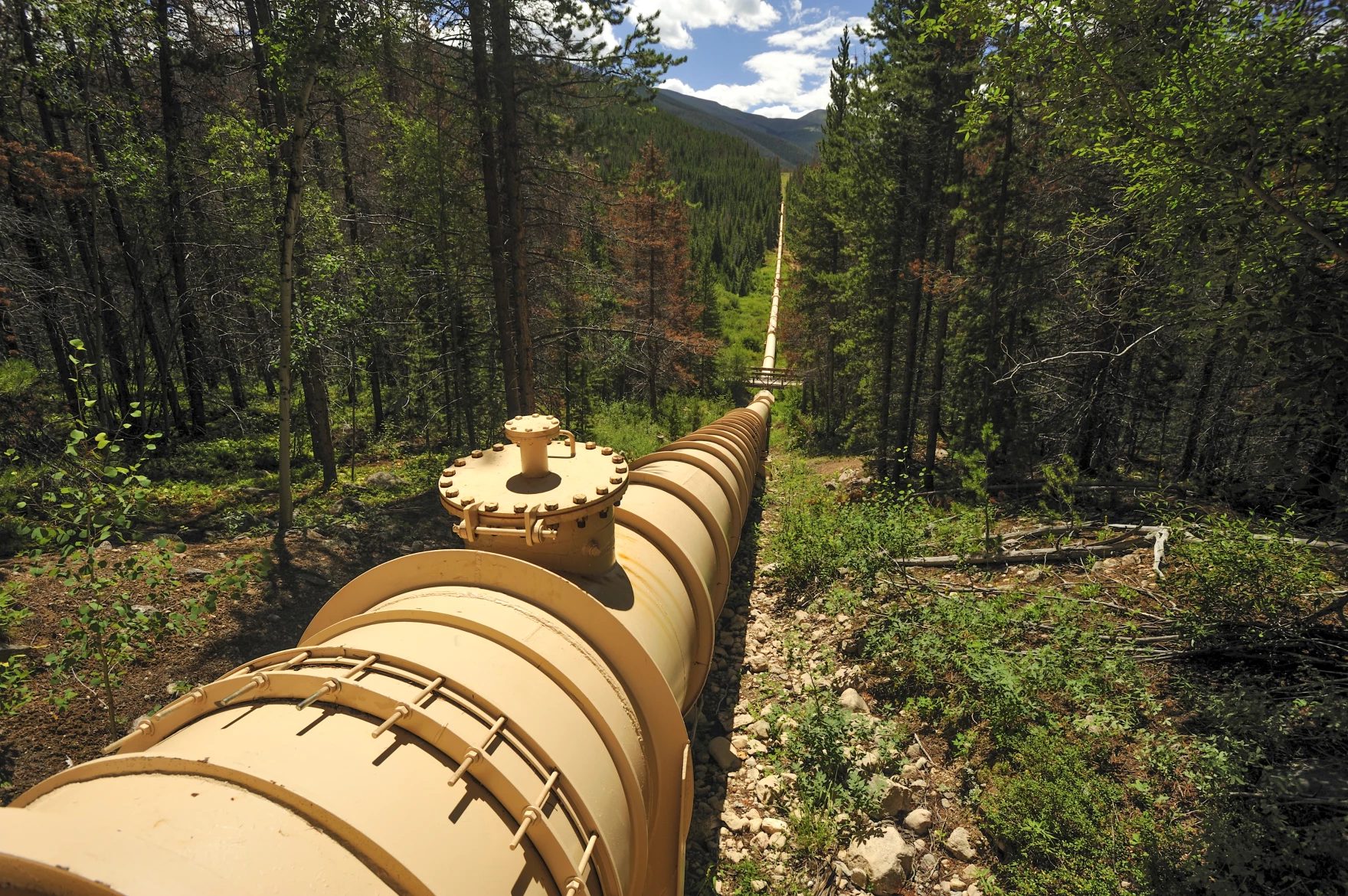
A complex system of pipes, tunnels and canals carries water around the Western U.S., like this one in Colorado’s Fraser Valley. However, policy experts say a cross-country pipeline wouldn’t make sense for political, financial and engineering reasons. Ted Wood/The Water Desk

Click the link to read the article on the KUNC website (Alex Hager):

September 30, 2024

This story is part of a series on water myths and misconceptions in the West, produced by KUNC, The Colorado Sun, Aspen Journalism, Fresh Water News and The Water Desk at the University of Colorado Boulder. KUNC’s coverage of the Colorado River is supported by the Walton Family Foundation.

The Colorado River is a lifeline for about 40 million people across the Southwest. It supplies major cities like Los Angeles, Phoenix, and Denver and a multibillion-dollar agriculture industry that puts food on tables across the nation. But it doesn’t have enough water to meet current demands.

Policymakers are struggling to rein in demand on the river, which has been shrinking at the hands of climate change. The region needs to fix that gap between supply and demand, and there’s no obvious way to do it quickly.

But one tantalizingly simple solution keeps coming up. The West doesn’t have enough water, but the East has it in abundance. So, why don’t we just fix the Colorado River crisis by piping in water from the East?
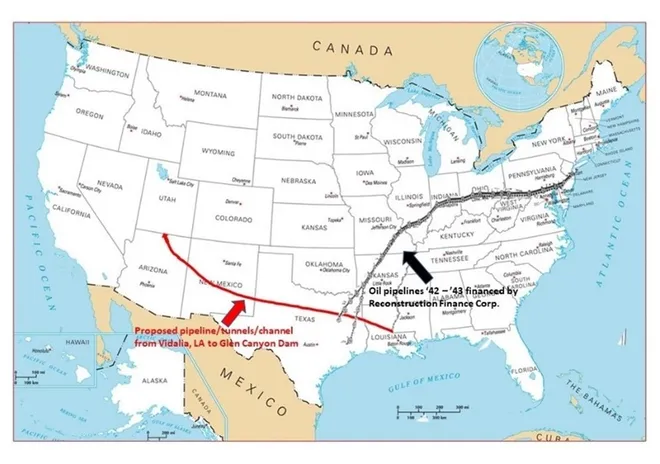
This proposed pipeline divert water from the Atchafalaya River in Louisiana through Louisiana, Texas, New Mexico, Arizona and up to the Glen Canyon Dam. Credit: Don Siefkes

The answer is complicated, but experts say it boils down to this: It doesn’t make sense to build a giant East-to-West water pipeline anytime soon for three reasons — politics, engineering, and money.

Political headwinds

If the West’s leaders wanted to take some water from the East, who would they even ask? Right now, there’s no national water agency that could oversee that kind of deal.

“I would argue that there aren’t many entities with the authority across the country to do this,” said Beaux Jones, president and CEO of The Water Institute in New Orleans. “I don’t know that the regulatory framework currently exists.”

Water is often managed using a messy patchwork of different government agencies and laws. The Colorado River is managed through a fragile web of agreements between cities, states, farm districts, native tribes and the federal government. Even though they’re all pulling from the same water supply, there’s no central Colorado River government agency.

A similarly complex system applies to many watersheds in the East. Even if a single city or state in the Western U.S. seriously wanted to build a pipeline from the East, it’s not even clear who they’d meet with to ask for water from a different area. And there’s no single federal agency that could sign off on such a deal and make sure it doesn’t harm people or the environment.

Colorado Water Conservation Board Executive Director and commissioner to the Upper Colorado River Commission Becky Mitchell, center, speaks on a panel with representatives of each of the seven basin states at the annual Colorado River Water Users Association conference in Las Vegas Thursday, December 15, 2022. The UCRC released additional details of a water conservation program this week. CREDIT: HEATHER SACKETT/ASPEN JOURNALISM

Any serious effort to pull new water in from the East to the Southwest would likely touch some part of the Mississippi River basin. It’s a sprawling network of smaller rivers that covers 31 different states, from Montana to Pennsylvania.

It’s a busy river with a lot of uses. And while its shortages aren’t as severe as dry times in the West, the Mississippi River basin goes through its own droughts. So even if, someday, the governments of the East and West set up a formal way to negotiate a water transfer, the cities, farms, boaters and wildlife advocates to the east might not be willing to share.

“The very nature of there being sufficient availability of water in the Mississippi River Basin to, in a large scale way, export that water,” Jones said. “I think there are many people on the ground within the Mississippi River basin that would fundamentally disagree with that.”

Engineering limits

There are countless examples of large pipelines and canals moving liquids around the U.S. at this very moment. The longest existing today is the Colonial Pipeline, which carries gasoline from Houston to northern New Jersey through 5,500 miles of pipe.

So if we have the engineering capacity to do that, could we build similar infrastructure for water? In theory, yes. But it would have to be much larger than existing pipes for oil and gas.

“It takes so much more water to supply a city than it takes gasoline,” said John Fleck, a water policy professor at the University of New Mexico. “So the size of the pipe or the canal has to be a lot bigger, has to be much wider, has to cover a lot more ground.”

Because that pipeline or canal would be so big, it is more likely to ruffle some feathers along the way. Fleck suggested that landowners in its path, including local governments, could push back on a giant new piece of infrastructure running through their properties and mire any pipeline project in regulatory red tape.
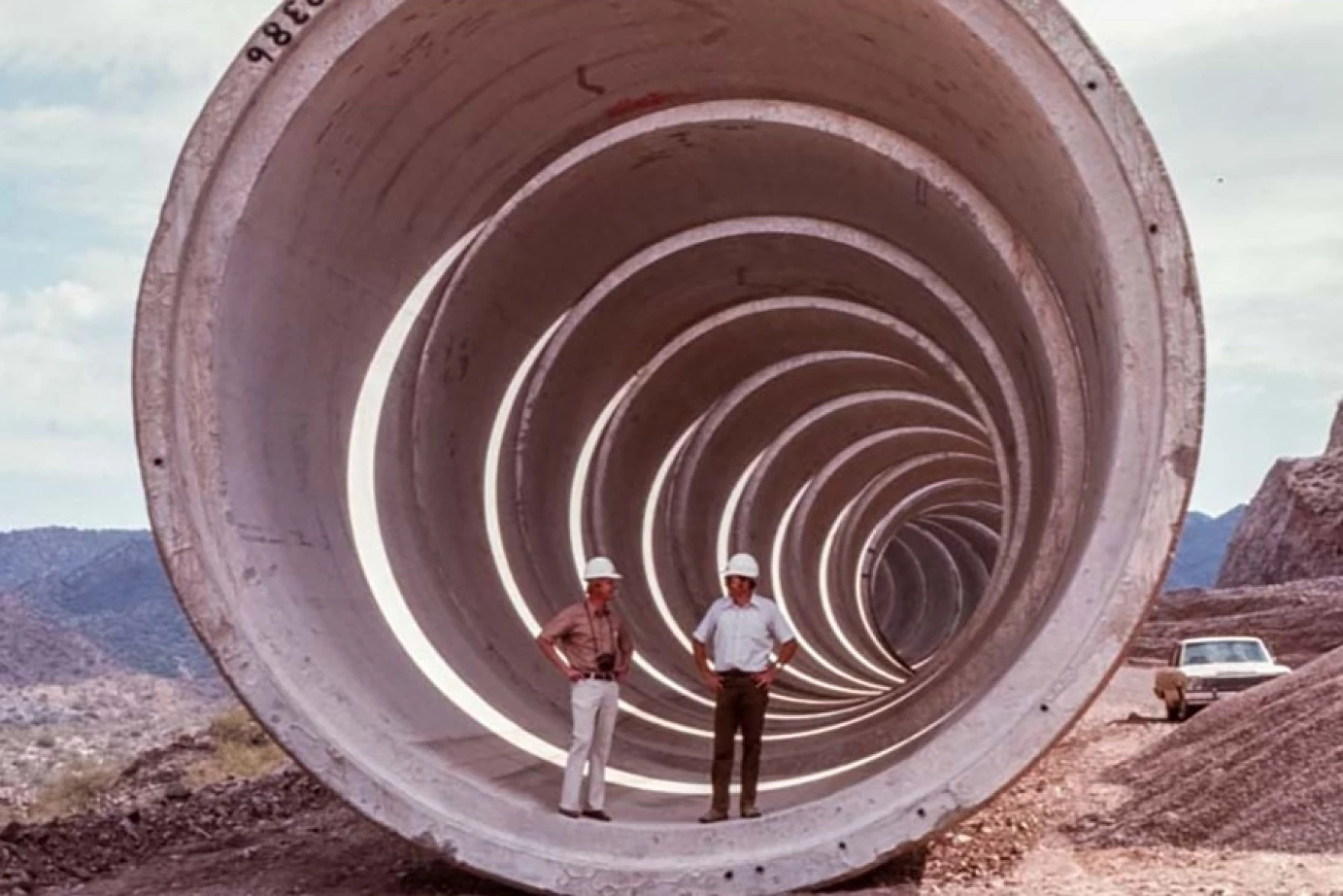
Phoenix, Los Angeles, Denver and Salt Lake City wouldn’t look like they do today without giant water-moving systems, like this pipe that is part of the Central Arizona Project. Experts say all of the feasible water pipelines have already been built, and a system to carry water in from the East is too difficult to be worth building. Photo credit: Central Arizona Project

All that said, a pipeline is still physically possible. There is perhaps no better argument for an East-West water transfer than the fact that the Western U.S. is already crisscrossed by multiple huge pipes and canals that carry water across long distances.

The West as we know it today wouldn’t exist without that kind of infrastructure. Much of Colorado’s population only has water due to a series of underground tunnels that bring water across the Rocky Mountains. Phoenix and Tucson have been able to welcome new residents in the middle of the desert with the help of a 336-mile canal that carries water from the Colorado River. Los Angeles, Albuquerque and Salt Lake City would not be the cities they are today without similarly ambitious water delivery systems built decades ago.

The existence of those water-moving projects isn’t proof that we should build a new, even bigger water pipeline from the East, Fleck said. In fact, he pointed to those systems as proof that we shouldn’t.

“All the feasible ones have largely been done, and the ones that are left are the ones that weren’t done because they just turned out not to be feasible,” he said.

Money problems

Even in a world where the West’s leaders could find a willing water seller, get the right permits and put shovels in dirt, experts say an East-to-West water pipeline would simply be too expensive.

Any solution to the Colorado River crisis will require massive amounts of public spending. The federal government alone has thrown billions of dollars at the problem in just the past few years. But water economists and other policy experts say a cross-country pipeline isn’t the most efficient use of taxpayer dollars.
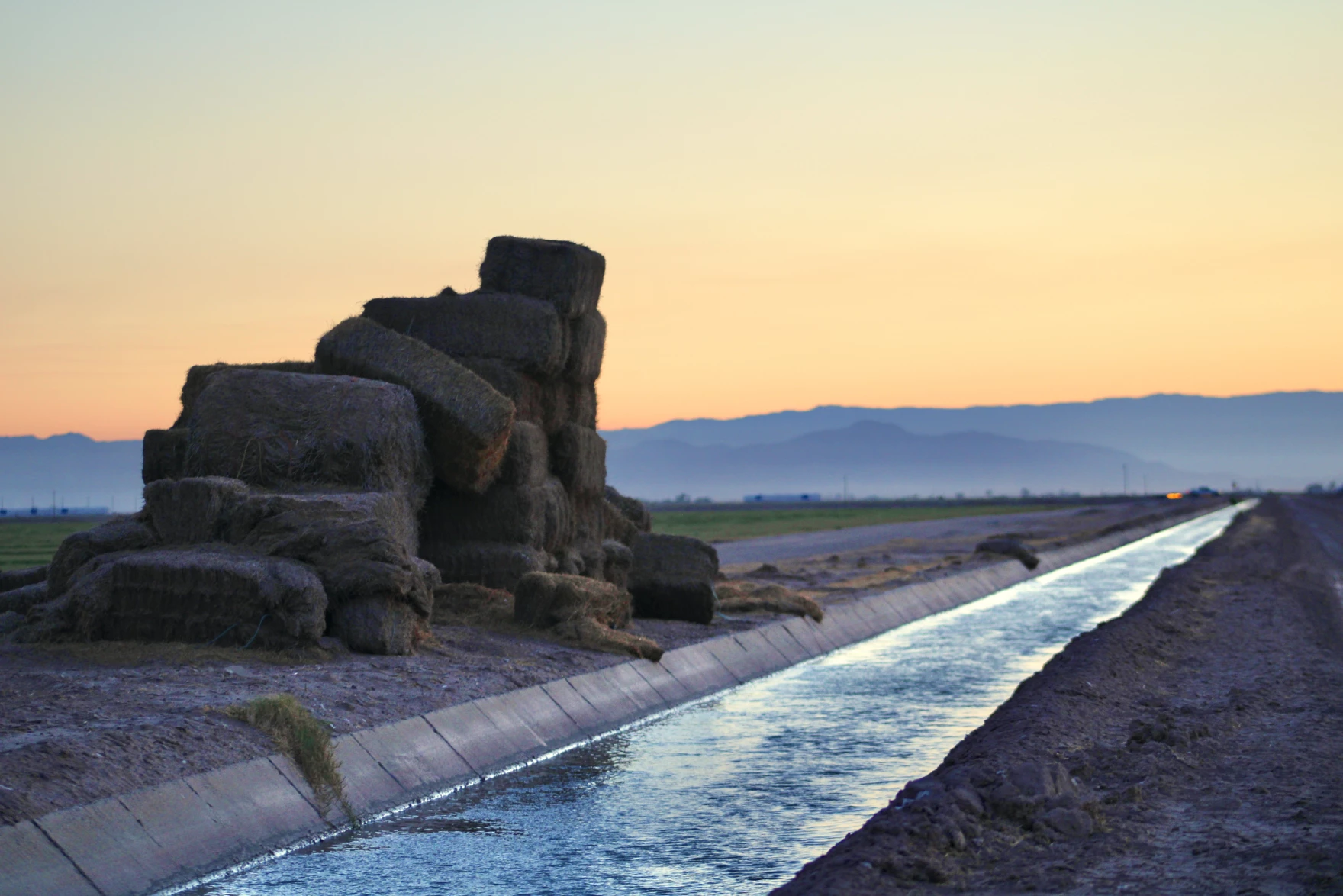
Stacks of hay bales sit beside an irrigation canal in California’s Imperial Valley on June 20, 2023. Experts say there are more cost-effective ways to fix the Colorado River crisis than building a cross-country canal, like paying farmers to pause growing thirsty crops such as alfalfa. Alex Hager/KUNC

Kathleen Ferris, former director of the Arizona Department of Water resources, pointed to two ongoing efforts that might be a more cost-effective way to help correct the region’s supply-demand imbalance. One involves paying farmers to pause growing on their fields, freeing up water to bolster the region’s beleaguered reservoirs. Another uses expensive, high-tech filtration systems to turn wastewater directly back into drinking water.

“Sometimes I feel like people don’t want to do the heavy lifting,” said Ferris, who is now a water policy researcher at Arizona State University. “Instead, they want to just find the next water supply and be done with it and have somebody else pay for it.”

Ultimately, she said, those kinds of programs already have momentum and cost less money than an East-to-West water pipeline.

“Why don’t we do the things that we know are possible and that are within our jurisdiction first,” Ferris said, “Before we go looking for some kind of a grand proposal that we don’t have any reason to believe at the moment could succeed.”

Pipe dreams becoming reality

Piping in water from outside of the Colorado River basin, for all of its challenges, is a tempting enough idea that the federal government has given it a serious look.

In 2012, a Bureau of Reclamation report analyzed ways to bring new water into the Colorado River Basin, including importing piped water from adjacent states.

The study concluded that strategy was not worth the money and effort.

“It just isn’t the time yet,” said Terry Fulp, a retired Reclamation official who helped write the study. “We felt that there were other things we could be doing in the basin, particularly in the Lower Basin, that would relieve the pressure.”

This map from the Bureau of Reclamation’s 2012 “Colorado River Basin Water Supply and Demand Study” shows places where water could theoretically be imported. One of the report’s authors said now “isn’t the time” to pipe water in from the East. Credit: U.S. Bureau of Reclamation

Fulp said the study was a worthwhile endeavor, and that the idea of importing water from the East might make sense down the road. The scale of the challenge posed by the Colorado River crisis, he said, will take some big thinking, “on the order of the thinking when we built the Hoover Dam.”

“It’s one of those possible solutions that should always stay, if not forefront on the table, somewhere on the table, so that you don’t lose sight of it,” Fulp said.

Despite the fact that many Colorado River experts have cast doubt on the feasibility of a cross-country water pipeline, even some sitting state officials say it deserves more research. Chuck Podolak, director of the Water Infrastructure Finance Authority of Arizona said the idea deserves “serious attention.”

“We understand that every option is hard, every option is expensive, every option has political hurdles, every option is a daunting engineering task,” he said. “Right now, we’re in a let’s-look-at-everything mode with eyes wide open.”

Arizona and other states around the region, with their eyes on continued growth, are already looking at ways to stretch out the water they already have using technology. Terry Fulp said those efforts may need to expend past the spendy and ambitious engineering projects that are already helping facilitate that growth.

“It’ll be the time someday, if we want the Southwest to continue to grow the way it’s been growing,” he said. “There’s only so much water in the basin.”

Map credit: AGU

#Missouri could crack down on water exports to drought-weary West — The Washington Post

Map of the Missouri River drainage basin in the US and Canada. made using USGS and Natural Earth data. By Shannon1 – Own work, CC BY-SA 4.0, https://commons.wikimedia.org/w/index.php?curid=67852261

Click the link to read the article on The Washington Post website (Scott Dance). Here’s an excerpt:

Missouri lawmakers say water has almost always been plentiful in their state, giving no reason to think twice about a concept known as riparian rights — the idea that, if you own the land, you have broad freedoms to use its water. But that could change under a bill advancing quickly in a state legislature that is normally sharply divided. The measure would largely forbid the export of water across state lines without a permit, even though there is no evidence that is happening on any large scale.

Just the specter of water scarcity is inspiring bipartisan support. Besides persistent drought in parts of the state and plummeting Mississippi River levels in recent months and years, lawmakers are wary of the West, and the chance that thirsty communities facing dwindling water supplies will look east for lakes and rivers to tap…

“They’re not being real responsible,” state Rep. Jamie Burger (R), one of the bill’s lead sponsors, said of states like California and Arizona. “We feel like we need to be responsible in Missouri and protect what we have.”

If passed, the new limits would be the latest domino to fall as climate change makes droughts more frequent and intense across huge swaths of the United States, and threatens to exhaust water supplies in some parts of the West within the foreseeable future. States including Oklahoma, Iowa and Nebraska already have similar safeguards on water exports in place, while a compact among Great Lakes states has largely banned exports beyond the limits of their watershed since 2008.

Meanwhile, California has struggled to capture vast amounts of rain water, Arizona faces booming growth and depleting aquifers, and states across the Colorado River basin are at odds over solutions to keep that vital waterway flowing.

Kansas Aqueduct route via Circle of Blue

Romancing the River: What Am I Talking About? — George Sibley (Sibley’s Rivers) #ColoradoRiver #COriver #aridification

Colorado River “Beginnings”. Photo: Brent Gardner-Smith/Aspen Journalism

Click the link to read the article the Sibley’s Rivers website (George Sibley):

Romancing the River – I am aware, as you are probably aware, that when I title these posts ‘Romancing the River,’ I am talking about the life work of the kinds of people who do not usually think of themselves as ‘romantics,’ or of their water-related work as ‘romancing the river.’

Engineers, lawyers, politicians, managers, career bureaucrats, scientists – they all see themselves as rational beings just doing what must be done to rationalize a random force of nature, to put the river to beneficial use feeding, watering, powering and even entertaining us. That’s ‘romancing the river’? It’s almost an insult to call these serious public servantsromantics, a term which resonates with most people today as not really very serious, just ‘love stories’ – so unserious it’s hardly worth them answering me when I call them romantics (which they don’t); easier for them to just dismiss me as some kind of nut (which they might).

“New plot using the nClimGrid data, which is a better source than PRISM for long-term trends. Of course, the combined reservoir contents increase from last year, but the increase is less than 2011 and looks puny compared to the ‘hole’ in the reservoirs. The blue Loess lines subtly change. Last year those lines ended pointing downwards. This year they end flat-ish. 2023 temps were still above the 20th century average, although close. Another interesting aspect is that the 20C Mean and 21C Mean lines on the individual plots really don’t change much. Finally, the 2023 Natural Flows are almost exactly equal to 2019. (17.678 maf vs 17.672 maf). For all the hoopla about how this was record-setting year, the fact is that this year was significantly less than 2011 (20.159 maf) and no different than 2019” — Brad Udall

So let me try again to explain myself – and why I believe it is neither criticism nor praise to suggest that the army of engineers, lawyers, politicians, career bureaucrats, scientists who have remade the Colorado River have been ‘romancing the river.’ It is a perspective to get up on the table and think about, as we find ourselves at a kind of still point: trying to figure out how to go forward from a century of river development that has ended uncomfortably close to a systemic collapse. It is hard to see 2022-23 as anything other than that, and we’ve only been temporarily reprieved with a wet winter and Biden’s infrastructure bucks giving us time to figure out how to do better for the future.

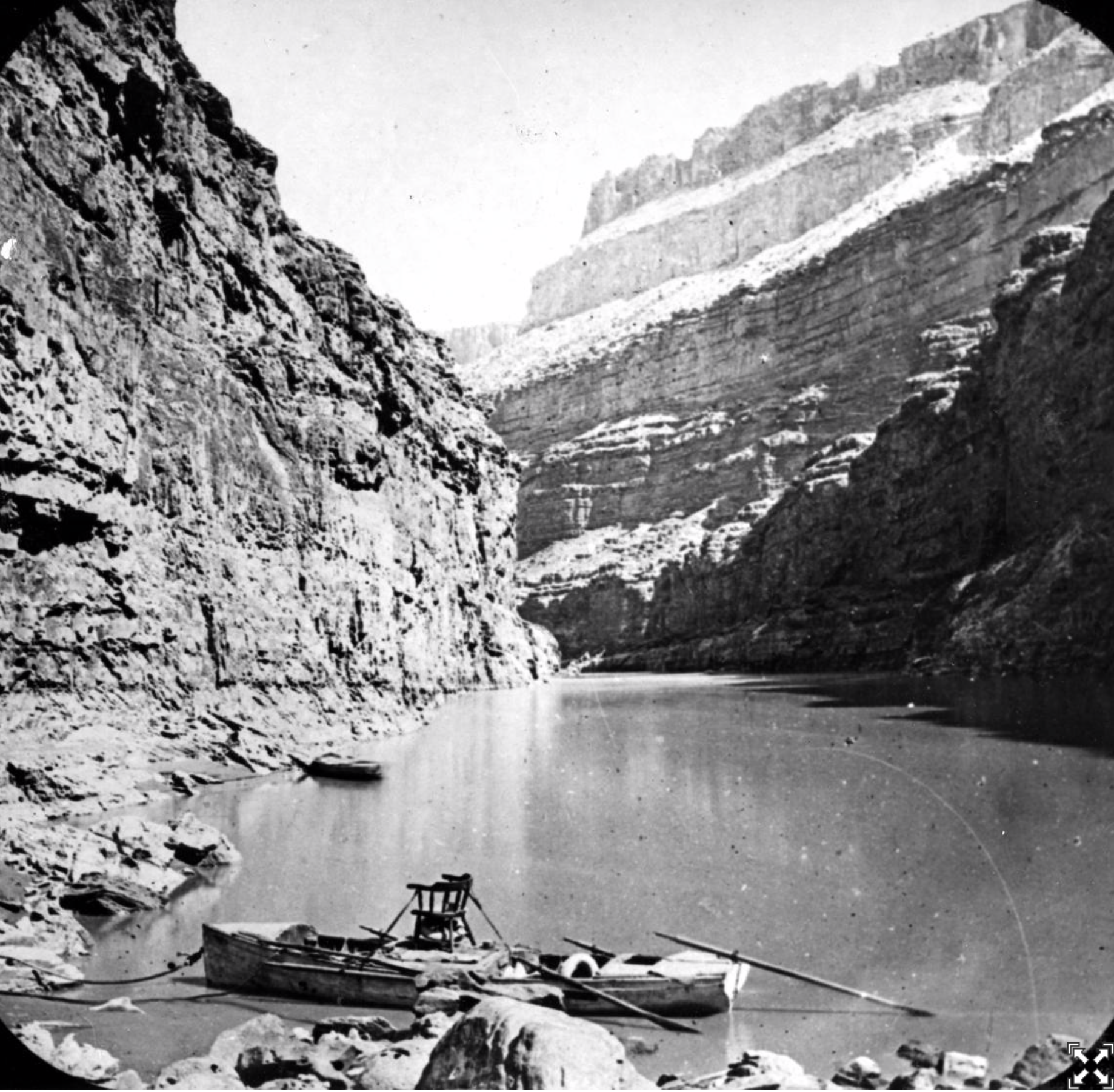
A stopover during Powell’s second expedition down the Colorado River. Note Powell’s chair at top center boat. Image: USGS

My thinking on this started with the book, mentioned here in posts more than a year ago, by Frederick Dellenbaugh, who came right out and said it in his title: The Romance of the Colorado River. Dellenbaugh, remember, first encountered the Colorado River as seventeen-year-old, in a boat with Major John Wesley Powell, on the scientist’s second trip down the canyons of the river in 1871-2.

Major Powell was better prepared and more experienced on that second trip, and actually able to accomplish some scientific work rather than just trying to survive. But for young Dellenbaugh, it was a big eye-opening experience – life-shaping, really: he spent the rest of his life exploring other unknown parts of the still-wild West, and collecting the stories of other adventurers.

He published The Romance of the Colorado River in 1902, thirty years after his formative trip with Powell – and the year the federal Reclamation Service was created as a branch of the U.S. Geological Survey, within 20 years the organization orchestrating the river’s development.

Dellenbaugh pulled no punches in describing his sense of the river and the challenge it represented. After noting in his introduction that ‘in every country, the great rivers have presented attractive pathways for interior exploration—gateways for settlement,’ serving as ‘friends and allies’ – he launches into his impression of the Colorado River:

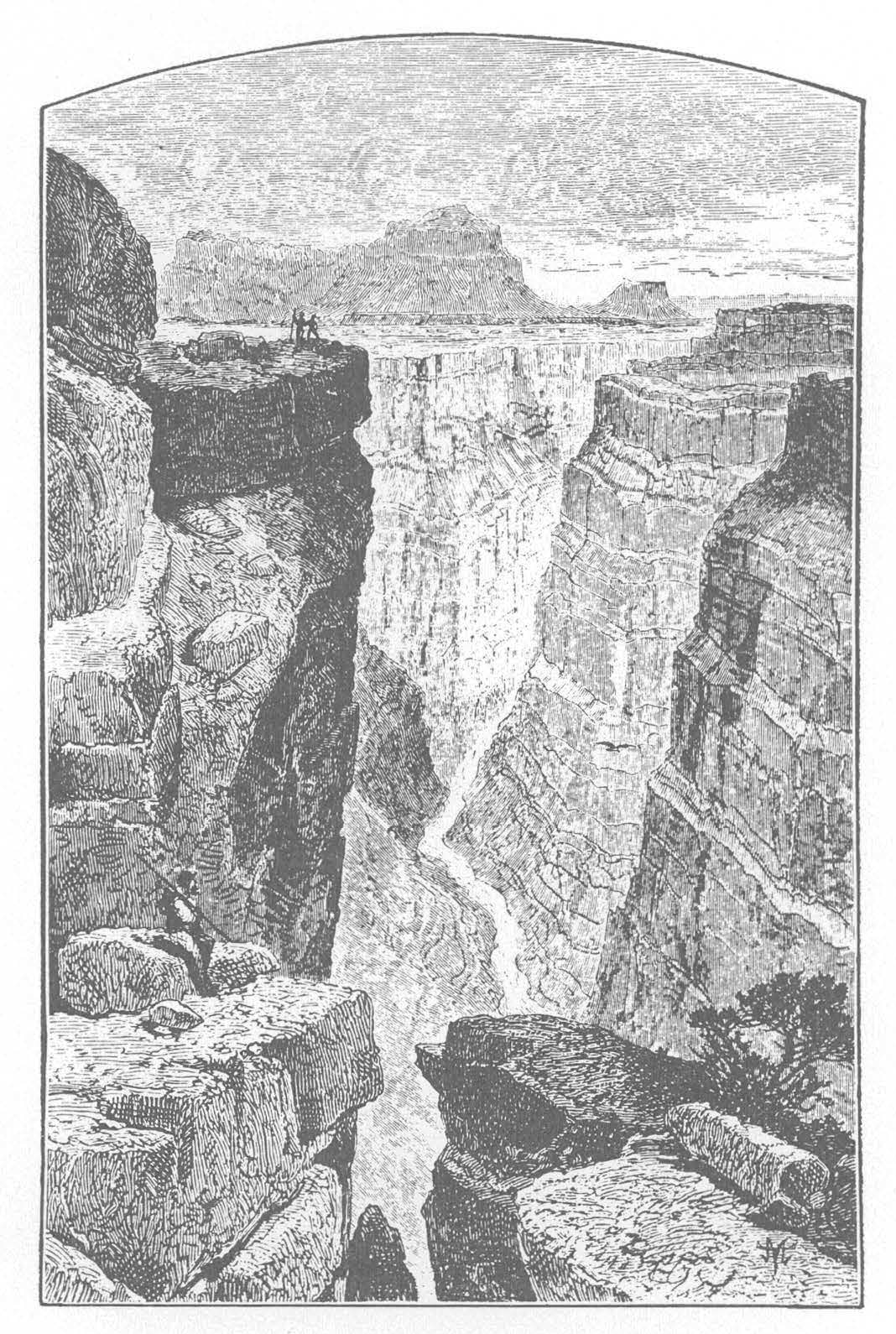
THE GRAND CANON, ​​​​​​​LOOKING EAST FROM TO-RO-WEAP From “Exploration of the Colorado River of the West and Its Tributaries” By J. W . Powell, 1875

‘By contrast, it is all the more remarkable to meet with one great river which is none of these helpful things, but which, on the contrary, is a veritable dragon, loud in its dangerous lair, defiant, fierce, opposing utility everywhere, refusing absolutely to be bridled by Commerce, perpetuating a wilderness, prohibiting mankind’s encroachments, and in its immediate tide presenting a formidable host of snarling waters whose angry roar, reverberating wildly league after league between giant rock-walls carved through the bowels of the earth, heralds the impossibility of human conquest and smothers hope.’

There’s Dellenbaugh’s ‘romance of the river’ – an adventure story of rising to meet a challenge, a call to action to overcome obstacles. A veritable dragon refusing to be bridled? Impossible? Prohibiting encroachment? Smothering hope? We would see about that!

And while it’s not a conventional love story, passion is involved, the kind that can turn on a dime between love and hate. We loved the presence of water in a dry land – but the water was fickle at best, destructive at worst. Every farmer trying to irrigate from its two-month flood that turned into a trickle when they most needed it knew that love-hate relationship; it became the century-long (thus far) story of a strong and ornery people testing some new-found technological strength through picking a fight with a strong and ornery protagonist: we would teach the river to stand in and push rather than cutting and running.

Dellenbaugh was not the only one turning it into a romantic adventure. When the Colorado River Compact had been hammered out in 1922, the Commission Chair and Commerce Secretary Herbert Hoover announced that ‘the foundation has been laid for a great American conquest.’  In a 1946 report cataloging all the possible developments for the Colorado river’s upper tributaries, the Bureau of Reclamation carried forward Dellenbaugh’s assessment in its subtitle: ‘A Natural Menace Becomes a National Resource.’ These were the official public perceptions guiding our relationship with the Colorado River.

For three-quarters of the century that followed publication of Dellenbaugh’s Romance, America embraced that romantic challenge, answering the call to conquest, taking on those obstacles, not just individually but as a national project, a big last step in the ‘Winning of the West.’ And fueled by the power unleashed by buried carbon fuels, we were ready for the fight; it was the Early Anthropocene, and it was our planet to reform.

Graphic via Holly McClelland/High Country News.

Remarkable things were done to the river as a result. The ‘veritable dragon’ has been broken and bridled for commerce and ‘utility everywhere.’ Its breaking and taming for commerce and utility is so massive that it practically requires the satellite view to take it in – the vast new ‘desert delta’ where the waters of the former desert river are spread from Phoenix and Tucson on the east, around through large squared-off green agricultural developments spotted with towns and cities, through the Imperial and Coachella valleys to Los Angeles and San Diego on the west…. And that’s just downriver; upriver are the tunnels through the mountains, taking water from the headwaters into the Platte, Arkansas, Rio Grande Basins, and into the Great Basin itself – how long will it be before Anthropocene math calculates that there might be enough water left in the Green River to move some through the Central Utah Project workings to help recharge the Not-So-Great Salt Lake?

For me, the ‘utility’ that cements the idea that this has been a big romantic adventure is the way we have kept significant reaches of river ‘wild’ enough for industries replicating Dellenbaugh’s formative adventure. Slipping onto the tongue and into the thrashing maw of Lava Falls, it is still easy to imagine a ‘veritable dragon,’ and millions of people from all over the planet come out of the Grand Canyon having relived Dellenbaugh’s romantic adventure.

But at the same time…. We also have to face some things that are less to be celebrated. Which brings me to Mary Austin again, another writer of the southwestern deserts mentioned here before, and her skeptical observation on Arizona’s ‘fabled Hassayampa,’ an intermittent tributary of the Gila River west of Phoenix, ‘of whose waters, if any drink, they can no more see fact as naked fact, but all radiant with the color of romance.’ Phoenicians have been drinking from the Hassayampa for a century now, wrapped up in the romance of the happy golden years in green and sunny places – and the underlying standard American romance of great wealth to be harvested fulfilling such romantic dreams.

But the ‘naked facts’ don’t go away just because we don’t want to see them, and there’s a kind of cosmic irony in the fact that, right where the Hassayampa flows into the Gila (when it’s actually flowing), two big developments, Buckeye and Teravalis, have been shut down at least temporarily on further development because they can’t present evidence of a hundred-year water supply. (See this post last spring.) 

The mayor of Buckeye, Eric Orsborn, who also owns a construction business, is not discouraged by this. ‘My view is that we’re still full steam ahead,’ he said in an article in The Guardian. ‘We don’t have to have all that water solved today…. What we need to figure out is what’s that next crazy idea out there’ for bringing in a new water supply. An idea under consideration currently is a desalinization plant down in Mexico on the Gulf of California, and a pipeline to bring the desalted water a couple hundred miles uphill to central Arizona. Crazy, and very expensive – but we’ve been saying in Colorado for decades now, as though it were a mother truth, ‘Water flows uphill toward money.’

But other naked facts have also been dimming the radiance of the Anthropocene conquest of the Colorado River. Water users have been coping for half a century with water quality issues stemming from using water over and over to irrigate alkaline soils. We also didn’t really know – and some states continue to refuse to acknowledge – how much water would be lost to evaporation from big reservoirs, hundreds of miles of open and unlined canals, and flood or furrow irrigation on subtropical desert lands. About a sixth of the river is vaporized annually.

The basic explanation for why CO2 and other greenhouse gases warm the planet is so simple and has been known science for more than a century. Our atmosphere is transparent to visible light — the rainbow of colors from red to violet that make up natural sunlight. When the sun shines, its light passes right through the atmosphere to warm the Earth. The warm Earth then radiates some of its energy back upward in the form of infrared radiation — the “color” of light that lies just beyond red that our eyes can’t see (unless we’re wearing infrared-sensitive night-vision goggles). If all of that infrared radiation escaped back into space, the Earth would be frozen solid. However, naturally occurring greenhouse gas molecules, including not just CO2 but also methane and water vapor, intercept some of it — re-emitting the infrared radiation in all directions, including back to Earth. That keeps us warm. When we add extra greenhouse gases to the atmosphere, though, we increase the atmosphere’s heat-trapping capacity. Less heat escapes to space, more returns to Earth, and the planet warms.

But the biggest, most unforeseen collateral fact diminishing our conquest of the river is the turbulence we’ve wrought in the climate – increasingly an unignorable ‘naked fact.’ All the heavy technology and concrete we’ve invested in controlling the river, as well as all the technology of daily living that depends on burning carbon fuels, not to mention the methane from livestock and human waste – all our gaseous carbon emissions have increased the heat-holding capacity of the atmosphere, which in turn increases the heat energy driving our weather systems. We’ve seen this just this past year: how that changing balance can result in ‘atmospheric rivers’ of vapor forming over the ocean and dumping huge snowpacks when it condenses over the mountains – but then being back on the ‘abnormally dry’ edge of drought within a few months of the day-to-day water-sucking aridification that is the shape of the future.

So we Anthropocenes have conquered the river, bridled the dragon – but as we saw in the previous post here, we lost a full third of the river as the collateral consequences, unforeseen or just ignored, of the conquest. And all responsible prognosticators project that we will lose maybe another sixth of the river by mid-century to our drying out of the planet.

There are a number of ways to look at this. One would be to say, like Eric Orsborn, okay, there have been setbacks, but we can’t stop now; we need to finish the job. And he is far from the only Phoenician saying that. The state has a governor now and a Water Resources Department who know when it’s time to call a halt, but the state also has a Water Infrastructure Finance Authority charged with creating new water supplies for the state. The Mexican desal plant and megamile pipeline is just one idea in WIFA’s portfolio of possibilities; the old unkillable idea of bringing water over from the Missouri or Mississippi Rivers is still on their list.

‘Those are big, audacious ideas, but I don’t think any are off the table,’ WIFA director Chuck Podolak told The Guardian. ‘We’re going to seek the wild ideas and fund the good ones.’ The romance of conquest throbs on; Hoover Dam was a wild idea a century ago, so why stop now?

A water policy analyst at Arizona State University, Kathryn Sorensen, toldThe Guardian that ‘the degree of [Buckeye’s] success will depend on the degree to which people are willing to pay for those more expensive solutions. But it’s absolutely feasible. We pave over rivers, we build sea walls, we drain swamps, we destroy wetlands, we import water supplies where they never would have otherwise gone. Humans always do outlandish things, it’s what we do.”

There is diminishing enthusiasm today, however, for the romance of conquest; dwellers in the megacities are increasingly reluctant to embrace higher water bills in order to finance more growth, more people, more traffic, longer lines everywhere – San Diego is an example today. The same is true for urban/suburban water conservation; there is a romantic appeal to helping one’s city by conserving in an emergency situation, a drought period or a maintenance shutdown; but conservation-in-perpetuity just to make more water available for growth lacks that romantic appeal.

For many of us, the ‘romance of the river’ has probably shifted 180 degrees over the past half century to a belated appreciation for the ‘natural river’: the Colorado River that once flowed to the ocean in a two-month flood and watered a beautiful wild delta, the river that would flow through a resurrected Glen Canyon if the dam were taken down, et cetera. This eco-rec perspective nurtures the belief that the world would be a better place if we would ‘just stop digging’ and leave it to nature to heal itself from our efforts. This idea has the ‘radiant color of romance’ for many of us, but it also has its underlying naked facts – not least of which are nature’s extreme remedies for a swarming species overpopulating its resource base.

I tend to think, myself, that, yes, we can’t stop now with our tinkering and meddling; we are all too deeply into this love-hate relationship with nature. Just as we will continue to thwart nature with vaccines against its leveling pandemics, we will continue to try to keep passable water in the pipes and faucets, on the fields, and in the recreational reaches for an ever-growing population because that is who we are; it’s what we do.

For many of us, the ‘romance of the river’ has probably shifted 180 degrees over the past half century to a belated appreciation for the ‘natural river’: the Colorado River that once flowed to the ocean in a two-month flood and watered a beautiful wild delta, the river that would flow through a resurrected Glen Canyon if the dam were taken down, et cetera. This eco-rec perspective nurtures the belief that the world would be a better place if we would ‘just stop digging’ and leave it to nature to heal itself from our efforts. This idea has the ‘radiant color of romance’ for many of us, but it also has its underlying naked facts – not least of which are nature’s extreme remedies for a swarming species overpopulating its resource base.

I tend to think, myself, that, yes, we can’t stop now with our tinkering and meddling; we are all too deeply into this love-hate relationship with nature. Just as we will continue to thwart nature with vaccines against its leveling pandemics, we will continue to try to keep passable water in the pipes and faucets, on the fields, and in the recreational reaches for an ever-growing population because that is who we are; it’s what we do.

Map credit: AGU

Here are 5 things the #drought-parched West could do before taking Midwestern #water — The Desert Sun

Missouri River Reuse Project via The New York Times

Click the link to read the article on the Palm Springs Desert Sun website. Here’s an excerpt:

Hmmm. I found a recent letter to Midwesterners published rather insulting. I think the West needs to solve its own problems without making problems for other regions at a huge cost. Who is going to pay for the water transfer anyway? Certainly, Midwesterners don’t want to. A few suggestions for Western states:

  • Stop building golf courses that use tons of water and get rid of most of them.
  • Stop planting grass and plants that don’t belong in a desert and watering them day and night to grow
  • Replace water parks with something that fits into a desert area
  • Stop developers from building more homes and promising 100 years of water usage. Obviously, you are running out much sooner. City planners are not doing a good job about growth and water management in a region that was way overbuilt 20 years ago.
  • Reduce the asphalt and concrete poured to make roads and parking lots. No trees or greenery certainly doesn’t keep things cooler.
  • Big #Water Pipelines, an Old Pursuit, Still Alluring in Drying West — Circle of Blue

    The Second Los Angeles Aqueduct Cascades, located in Sylmar, just east of the I-5 Freeway near Newhall Pass, in the San Gabriel Mountains foothills of the northeastern San Fernando Valley. The Cascades are the terminus of the Los Angeles Aqueduct, which brings water 338 miles (544 km) from the Owens Valley to Los Angeles. Construction of the aqueduct began in 1908 and completed in 1913. The cascades are a Los Angeles Historic-Cultural Monument (HCM #742), a California Historical Landmark (#653), and a Historic Civil Engineering Landmark. By Los Angeles (talk · contribs) – Own work, CC BY-SA 3.0, https://commons.wikimedia.org/w/index.php?curid=4882240

    Click the link to read the article on the Circle of Blue website (Brett Walton):

  • As the region’s climate becomes drier, more pipelines are being proposed despite the economic and climate risks.
  • Pipelines that are advancing the fastest are rural and tribal projects backed by federal funding.
  • The proposals echo a century of large-scale water engineering that ushered in the modern era in the American West.
  • Across the country’s western drylands, a motley group of actors is responding to the region’s intensifying water crisis by reviving a well-worn but risky tactic: building water pipelines to tap remote groundwater basins and reservoirs to feed fast-growing metropolitan areas, or to supply rural towns that lack a reliable source.

    Government agencies, wildcat entrepreneurs, and city utilities are among those vying to pump and pipe water across vast distances — potentially at great economic and environmental cost. Even as critics question the suitability of the water transfers in a new climate era, supporters in California, Colorado, New Mexico, Utah, the federal government, Indian tribes, and other states are prepared to spend billions on water-supply pipelines.

    Lake Powell Pipeline map via the Washington County Water Conservancy District, October 25, 2020.

    The pipelines range in length from several dozen miles to several hundred and the largest are intended to transport tens of millions of gallons per day. Among these is the 140-mile Lake Powell Pipeline, a roughly $2 billion project that aims to deliver 86,000 acre-feet (28 billion gallons) each year to Washington County, in Utah’s southwest corner.

    Not all the projects are cut from the same cloth. Because of the daunting expense, lengthy permitting process, and legal battles, projects with federal backing have a leg up. The infrastructure bill signed by President Joe Biden last November includes $1 billion for rural water supply projects in the western states. Many of these projects, including one in progress in eastern New Mexico, were authorized more than a decade ago.

    The infrastructure bill also includes $2.5 billion for tribal water rights settlements, which typically include a water-supply component. The Navajo-Gallup water pipeline, now under construction in northwest New Mexico to supply the Navajo Nation, Jicarilla Apache Tribe, and the city of Gallup, is part of the San Juan River water rights settlement.

    Owens Valley

    The current batch of pipeline proposals traces its lineage to a century of engineering and building mammoth water supply projects that ushered in the modern era of the American West. State and federal canals snake the length of California. Los Angeles bullied its way into the Owens Valley in the 1910s, eventually siphoning the valley’s water through an aqueduct. A few years later, San Francisco reached into Hetch Hetchy Valley for a reservoir and pipeline. The Central Arizona Project, which broke ground in the 1970s, was built to lift 1.5 million acre-feet of water — almost 500 billion gallons a year — more than a half mile in elevation along its 336-mile course to supply Phoenix and Tucson. In Colorado, at least 11 major projects pierce the Rockies, transferring water to the high-growth Front Range. States west of the 100th meridian would not have been able to attract millions of residents or develop their commercial and agricultural sectors without these water projects.

    As the region’s climate becomes drier, more diversions are being proposed despite the economic and climate risks. Large-scale engineering retains its appeal and pipeline options are doggedly pursued by state and local agencies, and a band of self-styled water entrepreneurs.

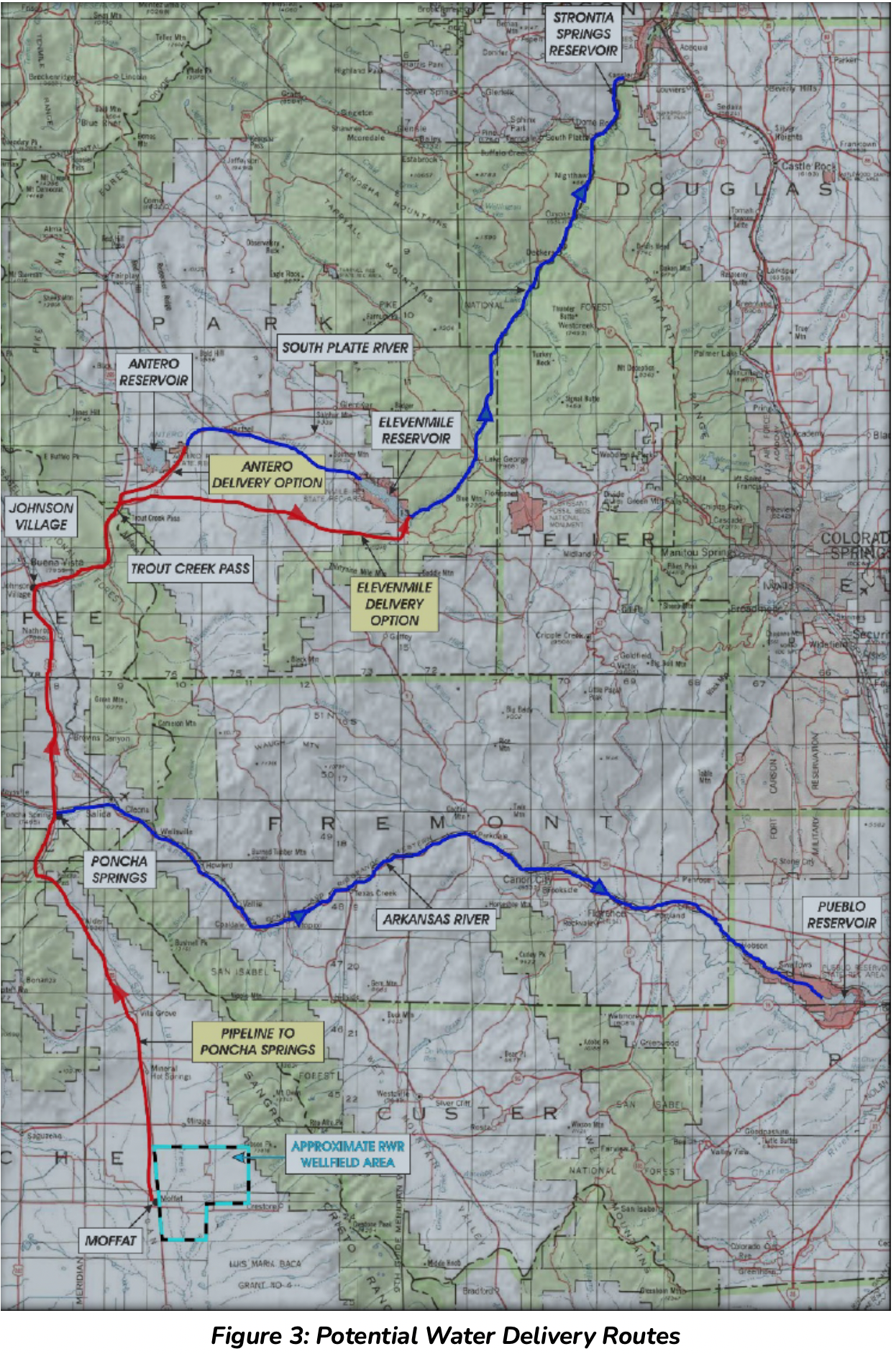
    Potential Water Delivery Routes. Since this water will be exported from the San Luis Valley, the water will be fully reusable. In addition to being a renewable water supply, this is an important component of the RWR water supply and delivery plan. Reuse allows first-use water to be used to extinction, which means that this water, after first use, can be reused multiple times. Graphic credit: Renewable Water Resources

    Renewable Resources, a firm backed by former Colorado Gov. Bill Owens, wants to pump groundwater from the San Luis Valley to Front Range cities that are mushrooming with new subdivisions. A competing outfit, Water Horse Resources, is led by Aaron Million, who has dreamed for more than a decade of piping more Colorado River water to the Front Range. The potential water source for Water Horse is some 500 miles away: Flaming Gorge Reservoir, which straddles Wyoming and Utah. Another Front Range project in the Fort Collins area envisions a pair of new reservoirs and an 80-mile pipe network that extends to 15 communities. Called the Northern Integrated Supply Project, it is still waiting on an key federal permit.

    In New Mexico, meanwhile, supporters of the Agustin Plains scheme wish to export 54,000 acre-feet of groundwater per year from a high desert basin to communities along the Rio Grande, some 60 miles to the east. The state engineer rejected the permit in 2018, but the applicant is appealing.

    Southwest Utah is another epicenter of contested water diversions. The most recent came to light in April, when Escalante Valley Partners filed an application with the state Division of Water Rights for more than 50,000 acre-feet of groundwater per year for export. The water, more than 44 million gallons a day, would come from 115 wells drilled between 1,000 and 5,000 feet deep in Beryl-Enterprise, a basin where the state has restricted use of shallow groundwater due to over-extraction.

    In the same area, the Central Iron County Water Conservancy District is championing the $260 million Pine Valley Water Supply project, currently being reviewed by the Bureau of Land Management for a right-of-way permit. If approved, the district would construct 66 miles of pipeline to access groundwater in neighboring Beaver County.

    The most expensive water project in southwest Utah is a proposed 140-mile pipeline to Lake Powell. Critics contend that Lake Powell and the Colorado River that flows into it cannot handle any more diversions. The Bureau of Reclamation, which manages Powell and is reviewing the pipeline application, is already taking emergency action to augment the shrinking reservoir, holding back more water than usual and releasing extra supplies from reservoirs higher in the watershed.

    Zach Renstrom is the general manager of the Washington County Water Conservancy District, the pipeline project’s chief beneficiary. The basic logic of today’s water manager is not so different from an investment adviser: manage risk through a portfolio of investments. Critics assert that Washington County residents, though use has declined from its very high early 2000s peak, still consume more water than almost any community in the U.S. and that water conservation practices should be sufficient. But Renstrom defends the need for another water source — even a very expensive one, with an overall price tag of about $2 billion — because Washington County’s single source right now is the Virgin River.

    “Especially as someone who looks at climate change very seriously and believes in climate change and knows we need to account for that, to make sure the next generation has the tools that it needs to deal with those issues, I think we need to build these large water infrastructure projects,” Renstrom told Circle of Blue.

    Utah officials are also pursuing a project in the state’s northern reaches to send water from the Bear River, the main tributary of the shrinking Great Salt Lake, to communities some 90 miles distant along the Wasatch Front. The state does not anticipate needing the project for several decades.

    Map of the Mississippi River Basin. Made using USGS data. By Shannon1 – Own work, CC BY-SA 4.0, https://commons.wikimedia.org/w/index.php?curid=47308146

    Those projects are miniscule compared to calls to divert eastern rivers like the Mississippi. An undertaking like that — which has legal, technical, environmental, and economic hurdles so enormous as to be implausible today, water experts say — echo even more grandiose and farfetched schemes that were proposed in the 1960s: engineering fantasies like the North American Water and Power Alliance, a continental-scale replumbing of North America’s watersheds, which never advanced much farther than the Parsons Company’s drafting board.

    Few of these projects have secured all required permits and fewer still have broken ground. But it is often the case that designs that look appealing in sketches fold when they collide with real world obstacles.

    One of the biggest obstacles is supply, says Denise Fort, a professor emerita at the University of New Mexico. Do these areas hold enough water to support more diversions?

    Nearly a decade ago, Fort co-authored a report with the Natural Resources Defense Council on the proliferation of pipeline proposals in the western states. In reviewing that report today, Fort told Circle of Blue that the findings still hold true.

    “Many of the pipeline projects under consideration today are dramatically different from those constructed in the past, in terms of sustainability of water supplies, available alternatives, costs, environmental impacts and energy use,” the report concluded. “The communities and agencies that are considering these projects would be well served by a careful analysis of the implications of these important choices.”

    Construction of the Monument Valley waterline extension, which was funded by The Indian Health Service and the U.S. Department of Housing and Urban Development. The pipeline provided 128 homes with water. Another water project, the Western Navajo Pipeline, has been on hold for at least 10 years.
    Photo credit: U.S. Environmental Protection Agency

    Fort said that, in many cases, pursuit of these pipelines is an attempt to continue a water-consuming lifestyle in a region that can no longer support the burden of that demand. Scientists expect the flow of the Colorado River to decline by 9 percent with each degree Celsius that the planet warms.

    “We know what the future is, it’s coming,” Fort said. “And so we can’t continue to act as though it’s just a cyclical thing, and the water will reappear. We know that it will not.”

    Fort believes that instead of sticking more straws into a shrinking pool, municipalities should seriously consider reallocating water from agriculture, which uses the lion’s share of the region’s supply. Instead of growing alfalfa for export, that water could be directed to cities. This approach is not without controversy and requires careful crafting — rural communities, in some cases, have resisted “buy and dry,” preferring leases that do not permanently sever water from land.

    But such a move is what El Paso is banking on. The largest city in West Texas has spent $220 million since 2016 to purchase 70,000 acres of ranch land about 90 miles east, in Dell City. Crucially, the land comes with water rights. Today, El Paso leases the land for farming. But in several decades the city plans to pipe the water beneath those fields to its residents.

    At the foundation of these debates about pipelines are competing views of the American West.

    One school of thought is that water follows growth. “I think it’s much cheaper to take the water to the people than move people to the water. You disrupt a lot less lives that way,” Todd Adams, deputy director of the Utah Department of Natural Resources, told the Utah Water Summit last October.

    Great Basin wetland. Photo credit: The Great Basin Water Network

    The other view is one of conservation and restraint, championed by people like Kyle Roerink, the executive director of the Great Basin Water Network, a group that advocates against transferring water out of its natural basin.

    “There is a suburban Manifest Destiny mindset throughout the region that I think is antithetical as it relates to the amount of resources that are available,” Roerink told Circle of Blue.

    Looking at the history of pipeline projects and water transfers in the West, Roerink worries about unintended financial and environmental consequences if the current contenders move ahead. In the arid Great Basin, which covers much of Nevada and Utah, he is particularly attuned to dry soils if groundwater-dependent basins are depleted. It’s not an unheard of risk. To offset environmental damage in the Owens Valley from its aqueduct, the Los Angeles Department of Water and Power has spent $2.5 billion in ratepayer funds to suppress dust storms.

    Many of the biggest projects were built in an era of minimal environmental review and major government subsidy. Those conditions have changed, one of many reasons why mega-projects like diverting the Mississippi River westward are implausible, even fanciful.

    Of the pipeline projects currently under construction, most are not fanciful. Most are like the Eastern New Mexico Rural Water System — smaller in scale and federally supported.

    Congress authorized the 140-mile project in 2009 and is contributing 75 percent of the cost. The rest is coming from local partners, which include four communities in Curry and Roosevelt counties.

    The project received $177.4 million from the federal government this year and $30 million from the state government. If funding in future years comes in as expected, construction should be completed in six to eight years, Orlando Ortega, the administrator of the Eastern New Mexico Water Utility Authority, told Circle of Blue.

    Ogallala Aquifer. Credit: Big Pivots

    The project is a federal priority because the partner communities are all served by groundwater from the depleting Ogallala aquifer. At some point, the water will run out. The pipeline is designed to bring surface water from the state-owned Ute Lake.

    Like all western water supply projects, there are questions about the long-term availability of Ute Lake as the region dries.

    “We are very sensitive to drought conditions, and would certainly be cutting back on our reservation, if needed,” Ortega said.

    Brett Walton

    Brett writes about agriculture, energy, infrastructure, and the politics and economics of water in the United States. He also writes the Federal Water Tap, Circle of Blue’s weekly digest of U.S. government water news. He is the winner of two Society of Environmental Journalists reporting awards, one of the top honors in American environmental journalism: first place for explanatory reporting for a series on septic system pollution in the United States(2016) and third place for beat reporting in a small market (2014). He received the Sierra Club’s Distinguished Service Award in 2018. Brett lives in Seattle, where he hikes the mountains and bakes pies.

    There are a lot of solutions to #drought. Some may work better than others — #Wyoming Public Media

    Lake Mead low elevation. Photo credit: Department of Interior via ensia

    From Wyoming Public Media (Ivy Engel):

    Drought isn’t a new thing in the West, but right now, much of the region is gripped in a historic drought. An unusually dry year coupled with record-breaking heat waves has strained water resources in the West this year. In fact, water levels are so low that the Bureau of Reclamation declared a water shortage on the Colorado River basin for the first time ever in mid-August. There are a lot of ideas for how to relieve the drought and ease its impacts—some more feasible than others. But when you think about water in the West, you have to think about scarcity too.

    “You’re really thinking about, well, why is it scarce? Is it too little supply? Or is it too much demand? And in the case of water, it’s both, right?” said Jason Shogren, an economist at the University of Wyoming (UW). “You have a drought, and that is going to restrict the supply of water. And you have an increase in demand because people are moving more and more to the Rocky Mountain region, moving more and more to the west coast.”

    And as Shogren pointed out, a lot of people move to the West and expect to keep parts of their lifestyles from where they came from, like lawns of lush green grass. But those require a lot of water. And Shogren said we have to think about all the different demands.

    “And since we have a lot of demand for water in Southern California, Phoenix, Las Vegas. We have a lot of demand for water in agriculture production, whether it’s crops, or whether it’s nuts, or whether it’s wine,” he said. “And on the supply side, the question is, ‘Who gets what water? And why?'”

    He added property rights over water are different by state and deciding how water rights are allocated and how they can be used gets tricky fast…

    And with climate change intensifying extreme weather like droughts and flooding, there’s one potential solution that would help solve both problems. Dr. Tom Minckley said it involves moving water.

    Missouri River Reuse Project via The New York Times

    “We could say, ‘Oh, well, the western states are in drought. So we could take water from, say, the Mississippi or the Missouri River, and when it floods, we could capture that floodwater, and then basically return it to the head of the watershed,'” he said.

    Dr. Minckley is a Professor in the Department of Geology and Geophysics at the University of Wyoming. He studies water in the West and how it’s managed. He said piping water from a flooded place to a place in drought is an idea that’s becoming much more popular. State governments already transfer water between some states in the west…

    But because of Wyoming’s high elevation, moving water here from almost anywhere else would mean fighting gravity. It would require a lot of energy because water is actually quite heavy. Not to mention the logistics of where a pipeline would even go and how much it would cost – water is valued by the acre-foot.

    “On average, it’s about $2,000 per acre-foot. And some of the Colorado River water in the state of Colorado is running for $85,000 an acre-foot. So, like, there’s these crazy, really big numbers out there,” said Minckley. “And the question is if we start moving water from where it is to where we want it to be, how do we pay for it?”

    Graphic credit: USBR Colorado River Basin Supply and Demand Study

    The idea has been researched and despite its growing popularity, the Bureau of Reclamation found its implementation highly unlikely because of the cost and logistics.

    Cloud-seeding graphic via Science Matters

    Another idea that’s been floated is cloud seeding…

    [Bart] Geerts said farming communities in the High Plains have financially supported seeding operations in thunderstorms for decades, but it can be really hard to prove that kind of seeding actually worked. But, he said it is a lot easier to demonstrate that it worked when they seed winter clouds. Which can be more useful in the High Plains anyway.

    Because there’s natural variability between the years, you can’t pinpoint exactly how much more snowfall there was due to seeding and they work with averages. Geerts said a common belief is that cloud seeding keeps moisture from falling in other places where it’s needed.

    “It’s really not understood. There is that possibility but in general, these wintertime clouds are not very efficient,” he said. “Essentially water vapor condenses, you extract it, make it into snow, and thereby you reduce the downstream amount of water vapor to some extent. But that amount is so, so small, so insignificant compared to the total water vapor content.”

    But Geerts added on the flip side of that, some of the seeding materials may float downwind and increase snowfall on the next mountain range.

    “So it can work either way. We don’t really have an answer,” he said.

    It seems like a lot of ideas and conversations about this topic end with that – “we don’t really have an answer.” But as droughts intensify, driven by climate change, those conversations continue to happen. And some may lead to more viable solutions.

    #Arizona Legislature wants feasibility study for long-distance pipeline to replenish #ColoradoRiver supply: “One promising possibility involves piping water that is harvested from #MississippiRiver floodwaters” — The Mohave Valley News #COriver #aridification

    From The Mohave Valley News:

    The Arizona Legislature on Tuesday made a formal request asking Congress to fund a study to determine the feasibility of pipelining Mississippi River floodwater to the Colorado River.

    House Concurrent Memorial 2004 passed the Arizona Senate by a 23-7 vote and the Arizona House by a 54-6 margin. A memorial is not a law, but a legislative measure containing a request or proposal, asking other parties outside the Arizona Legislature’s jurisdiction to take action. HCMs have no official standing or effect, but serve as a public record of the request presented for consideration.

    The memorial was introduced by Rep. Tim Dunn, R-Yuma. Rep. Leo Biasiucci, R-Lake Havasu City, is among co-sponsors.

    It asks that “the United States Congress fund a technological and feasibility study of developing a diversion dam and pipeline to harvest floodwater from the Mississippi River to replenish the Colorado River and prevent flood damage along the Mississippi River.”

    It also states that “If shown to be feasible, the United States Congress implement the diversion dam and pipeline as a partial solution to the water supply shortage in Lake Powell and Lake Mead and the flood damage that occurs along the Mississippi River.”

    Lake Powell and Lake Mead are the two major reservoirs on the Colorado River. Both are at historically low levels and likely will trigger a Tier 1 water emergency in Arizona later this year or in 2022.

    The memorial notes the low water levels of both reservoirs and the “historic flooding in 2011 and 2019 along the Mississippi River” that caused 11 deaths and more than $9.5 billion in damage.

    It asks that the request be sent to the President of the U.S. Senate, the Speaker of the U.S. House of Representatives and the governors of states on the Mississippi River — Arkansas, Illinois, Iowa, Kentucky, Louisiana, Minnesota, Mississippi, Missouri, Tennessee and Wisconsin — as well as Arizona’s 11 members of Congress.

    “Arizona has long been at the forefront among Western states in supporting the development and implementation of pioneering, well-reasoned water management policies,” Dunn said, a line straight out of the HCM he crafted. “Arizona and the other six Colorado Basin states are in the 20th year of severe drought and experiencing a severe water shortage. Water levels are at critical levels, jeopardizing the water delivery and power generation. A new water source could help augment Colorado River supplies.

    “One promising possibility involves piping water that is harvested from Mississippi River floodwaters. Diverting this water, which is otherwise lost into the Gulf of Mexico, would also help prevent the loss of human life and billions in economic damages when such flooding occurs. This concept is already being proven in Denver, where floodwater is being successfully harvested from the Missouri River to help alleviate its water shortage.”

    Mountain Town News: Water, water, water on the brains everywhere — Allen Best

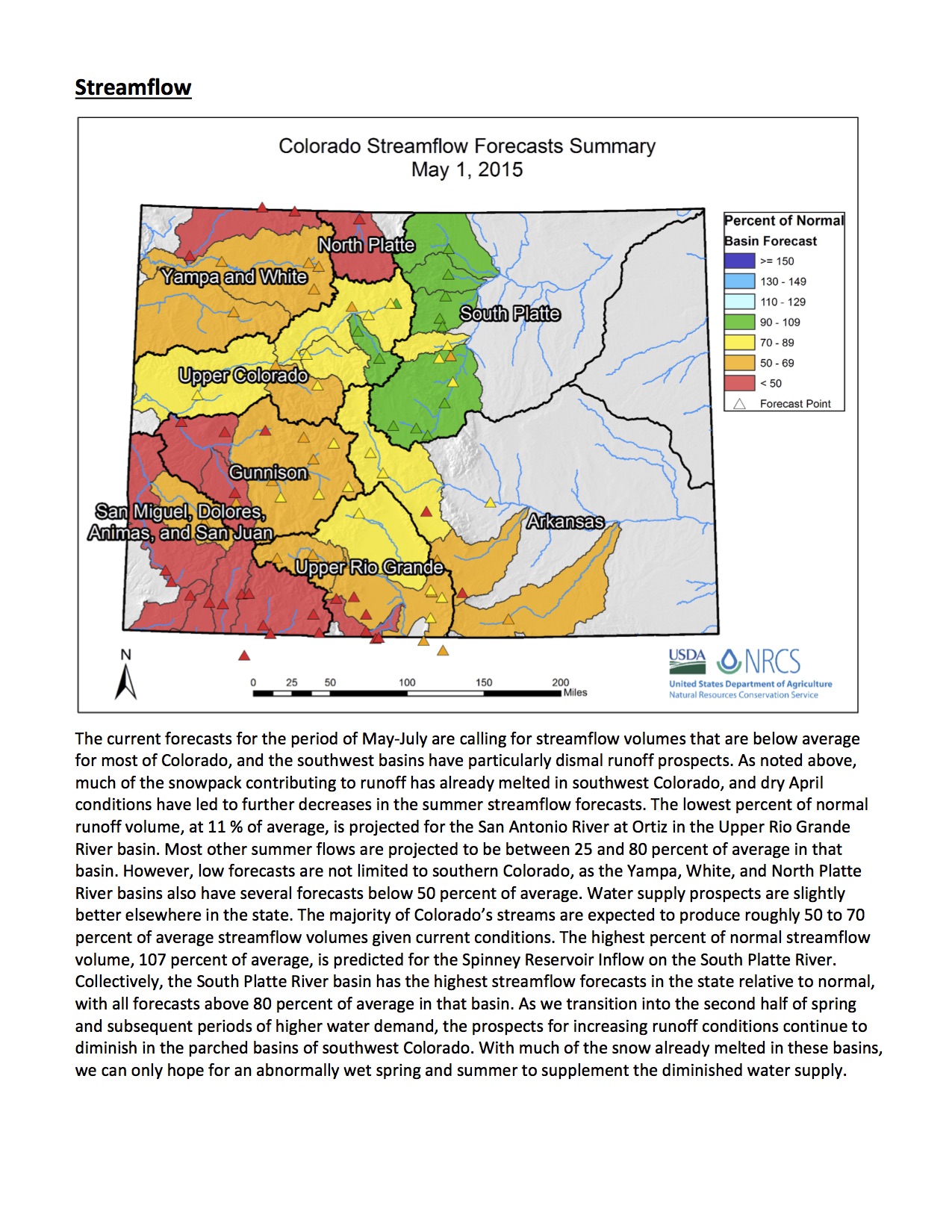
    May 1, 2015 Colorado streamflow forecast map via the NRCS
    May 1, 2015 Colorado streamflow forecast map via the NRCS

    From The Mountain Town News (Allen Best) via the Summit Daily News:

    In Colorado, snowpack this winter was about average in the Blue River Basin, which is where Breckenridge, Keystone, and several other ski areas are located. “Everybody has Blue River envy,” said Eric Kuhn, general manager of the Colorado River Water Conservation District, at a recent meeting covered by the Summit Daily News.

    Blue River’s snowpack will soon fill Dillon Reservoir, one of the main reservoirs for metropolitan Denver. However, endangered fish in the Colorado River downstream near the Utah border won’t fare so well, because of less snowpack in the other tributary basins. Peak flows must be at least 12,900 cubic feet per second; they’re expected to peak at 9,600 cfs.

    Taking a broader view, Kuhn sees this time in the 21st century as one of transition. “After 100 years of develop more, develop more, develop more, we’re going to have to cut back our uses.”

    Kuhn pointed to the declining water levels in both Lake Powell and Lake Mead, the two giant “buckets” on the Colorado River. “Bad things happen when Lake Mead and Lake Powell get drained,” he said, a distinct possibility in the next few years, particularly at Lake Mead.

    What about building a pipeline to the Mississippi River or some other water-rich location? “To expect that we can export our problems to somebody else, I just don’t see that somebody else will willingly accept them,” he said.

    More Colorado River Basin coverage here.

    Statewide water plan: ‘I want to hear what pieces are important to you’ — Gail Schwartz

    newsupplydevelopmentconceptcwcb2013.jpg

    Here’s a guest column about Colorado’s water plan, written by State Senator Gail Schwartz running in the Glenwood Springs Post Independent. Senator Schwartz has been in the middle of water legislation for most of her time in the state legislature. Here’s an excerpt:

    The state water plan will pave the way for water decisions that responsibly and predictably address future challenges. The governor’s executive order detailed that the plan must promote a productive economy that supports vibrant and sustainable cities, viable and productive agriculture, and a robust skiing, recreation and tourism industry. It must also incorporate efficient and effective water infrastructure planning while promoting smart land use and strong environmental protections that include healthy watersheds, rivers and streams, and wildlife.

    The Colorado Water Conservation Board (CWCB) has been tasked with creating the Colorado Water Plan. The board must submit a draft of the plan to the governor’s office by Dec. 10, 2014, and a final plan by Dec. 10, 2015. The CWCB will incorporate the state’s Interbasin Compact Committee (IBCC) and nine Basin Roundtables recommendations to address regional long-term water needs.

    As chair of the interim Water Resources Review Committee (WRRC), I will help ensure that the diverse voices of Colorado’s water community are heard during the development of this plan. The 10-member WRRC comprises legislators representing districts in each of the state’s major river basins. The committee has a full agenda as we are charged to review water issues and propose legislation. The WRRC will also remain actively engaged with the CWCB in development of the State Water Plan…

    As charged, the water plan has a broad scope and will inevitably need to address difficult and contentious issues. I believe that we should first focus on conservation and efficiency both at the municipal/industrial level and in agriculture. Water conservation is an area with broad consensus. A recent public opinion study of Coloradans identified conservation as the most important water-related issue. Other studies have strikingly demonstrated that 80 percent of Coloradans favored conservation over new construction projects. In 2013, I sponsored SB13-19 which gives landowners a new tool to conserve water without injuring their water rights. New conservation and efficiency tools are needed in the State Water Plan as they stress wise use of our precious water resource.

    Conservation may be just one piece of this larger puzzle, and I want to hear what pieces are important to you.

    More statewide water plan coverage here.

    Statewide water plan: ‘We need to find outside water. Actually, we do not. They do’ — Max Schmidt

    newsupplydevelopmentconceptcwcb2013.jpg

    State Water Plan, meet the “not-one-more-drop-club” from the Grand Valley. Here’s a report from Gary Harmon, writing for The Grand Junction Daily Sentinel:

    Colorado should import water to meet burgeoning Front Range demands — and lessen the pressure on the Western Slope to slake that thirst, Grand Valley water officials suggest.

    Managers of 10 Grand Valley water agencies and municipalities are preparing to ask their bosses to insist that bringing water into the state [ed. emphasis mine] — which would be known as augmentation — is a needed step in the development of a statewide water plan.

    The problem, the water managers have concluded, is that there simply isn’t enough water in the state to meet the demands of growth, particularly on the Front Range, and the demands of millions of downstream Colorado River water users in Arizona, California and Nevada.

    “Reallocation of state water resources is not going to do the job,” Larry Clever, general manager of Ute Water Conservancy District, said.

    Managers of the agencies sat down together to draft a Grand Valley response to Gov. John Hickenlooper’s call for a statewide water plan, and they began the process as a “not-one-more-drop club,” Clever said, in reference to any further diversion of water from the Western Slope over the mountains to the east. So any additional drops will have to come from elsewhere, Max Schmidt, general manager of the Orchard Mesa Irrigation District, said.

    “Our problem is that we’re the cheapest source of good clean water to the Eastern Slope, and there’s no other way around it,” Schmidt said. “We need to find outside water. Actually, we do not. They do.”

    The concerns by Grand Valley water managers center on the possibility that the lower basin states will place a call on the Colorado River under the 1922 compact governing the river. “Every time that (the East Slope) takes water from the West Slope, that enhances the chance of a compact call,” that in theory would hit hardest on the Eastern Slope, Schmidt said.

    Hickenlooper in May directed the drafting of a statewide water plan, to be complete by December 2014.

    The proposed position acknowledges that the Colorado Water Conservation Board estimates that there could be as many as 800,000 acre feet of water available for diversion and storage, but notes there is “considerable doubt” that additional development won’t result in a compact call.

    The Grand Valley response would set out nine goals that such a plan would have to include, one of them being “implementation of a long-term, regional water-augmentation plan.” Other goals include protecting the “cornerstones of our economy,” agriculture, resource extraction, recreation and tourism; preparation for the possibility of a compact call; protecting the health and quality of the state’s river basins; and preparing for the effects of climate change.

    Other goals include protecting and promoting the area’s agricultural heritage; preserving local control of planning for development; ensuring federal agencies operate within state water law; and ensuring that upstream diversions protect and maintain water quality for downstream users.

    Ultimately, “it is imperative for state officials to engage officials from the federal government and other basin states in developing, implementing and paying for an augmentation plan” that will benefit all the states dependent on the Colorado River, the proposed position says.

    The proposed position will go before the governing boards of Fruita, Grand Junction and Palisade, as well as Clifton Water District, Grand Valley Irrigation Co., Grand Valley Water Users Association, Mesa County Irrigation District, Orchard Mesa Irrigation District, Palisade Irrigation District and Ute Water.

    Statewide Water Plan coverage here.

    Colorado River Basin: Recent study by the Bureau of Reclamation highlights future supply problems #coriver

    coloradoriverbasin2012doiviatheaspentimes.jpg

    Here’s a guest column running in The Denver Post, written by Allen Best, that gives an overview of the current state of the Colorado River. Click through and read the whole article. Here’s an excerpt:

    Tow icebergs from Alaska? Pilfer from a tributary of the Yellowstone River in Wyoming? Or, even sneak water from the Snake, boring a 6-mile tunnel from a reservoir near Jackson Hole to the Green River? While it’s sure to make Idaho’s spud farmers cranky, it would help Tucson, Los Angeles and that parched paradigm of calculated risk, Las Vegas.

    Interior Secretary Ken Salazar and everybody else with a megaphone has carefully branded these ideas as improbable or worse. Only slightly more credible is the idea of a pipeline from the Mississippi River. It could originate near Memphis, traverse 1,040 miles and, if reaching Castle Rock, rise 6,000 feet in elevation. Pumping would require a steady 800 megawatts of electricity, or a little more than what the Comanche 3 power plant in Pueblo produces.

    In theory, this 600,000-acre feet of muddy Mississippi would replace diversions from the Colorado River headwaters between Grand Lake and Aspen. Those diversions range between 450,000 and 600,000 acre-feet annually. That would leave the creeks and rivers to the whims of gravity and geography, at least until arriving at Las Vegas and other places with growing thirst.
    Cheap water? Not exactly: It would cost $2,400 per acre-foot for this Memphis-flavored sludge, assuming the idea isn’t grounded by protests from barge and riverboat operators. (Sometimes they, too, say they need more water.)

    More Colorado River Basin coverage here and here.

    Peter Gleick: ‘Zombie water projects (Just when you thought they were dead)’

    torontozombiewalktopleftpixel.jpg

    From Forbes (Peter Gleick):

    Water transfers from the Great Lakes or the Mississippi River or Alaska and Canada to the arid southwestern U.S.

    These are perennial favorites: people look at the vast amount of water in the Great Lakes, or flowing down the Mississippi River, or flowing north to the Arctic Ocean and think, gee, what could make more sense than to take that water and move it to where we really need it, like California or Arizona or Las Vegas. After all, we’ve been moving water around since the beautifully designed Roman aqueducts, and even earlier. But most of these mega-projects are zombies – killed off years ago, only to linger, undead.

    Patricia Mulroy, who runs the Southern Nevada Water Authority, recently revived the idea of moving floodwaters from the Mississippi River all the way to Colorado, New Mexico, and Arizona to free up Colorado River water that could then be given to feed Las Vegas. Fear that similar projects would take water out of the Great Lakes led to a provision in the new international agreement signed by the U.S. and Canada that effectively prohibits transfers of water out of the basin because of fear that such diversions would lower the Great Lakes levels and threaten the health of fragile natural ecosystems. And of course there is the granddaddy of all water diversion proposals – called NAWAPA (the North American Water and Power Alliance) – proposed in the late 1950s and early 1960s by a consulting/construction company to divert around 150 million acre-feet of water annually (ten times the flow of the Colorado River) from the Yukon, Copper, Kootenay, Fraser, Peace, and other Alaskan/Canadian rivers all the way east to the Great Lakes and south to the southwestern U.S. and even Mexico. And a smaller version of this zombie is the Million Conservation Research Group proposal (named after Aaron Million – if it had anything to do with the cost, it would be the Billion Conservation Research Group) to build a pipeline from Wyoming to eastern Colorado to take 250,000 acre-feet of public water to sell for private gain. Professor Robert Glennon from the University of Arizona quipped that he sees many obstacles to the project, “not the least of which is the Rocky Mountains.”

    These mega-projects are certainly technically feasible: there’s no mystery to building dams, aqueducts, pumping plants, and pipelines. What kills these projects is their massive political, environmental, and economic cost. They would cost tens or even hundreds of billions of dollars and lead to vast environmental destruction and devastation. Half a century ago, we didn’t know about the ecological consequences of massive water diversions, or we didn’t care, but those days are over. On top of this, any such project would require unprecedented political and legal water sharing agreements and anyone who believes such agreements can be reached is living in a fantasyland. But that doesn’t stop these zombies from periodically coming back to life.

    More pipeline projects coverage here.

    IBCC: The Pueblo Board of Water Works hopes to sustain agriculture on the Bessemer ditch after converting shares to municipal use

    bessemerditch1.jpg

    From The Pueblo Chieftain (Chris Woodka):

    “We included a 20-year lease-back so we could work on other options to sustain agriculture,” Alan Hamel, executive director of the Pueblo water board, told a state Interbasin Compact Committee group earlier this week…

    The IBCC subcommittee is looking at alternative agriculture transfers. The group met in Denver with the Front Range Water Council, which includes the state’s largest municipal water providers, and the Colorado Agricultural Water Alliance, which encompasses the state’s major agricultural associations.

    The Pueblo water board now owns 28 percent of the Bessemer Ditch, about 5,400 shares. The ditch is the largest in Pueblo County, and a major factor in the local economy. Other cities also are looking at maintaining the viability of agriculture in their neighboring communities.
    “People in the cities are figuring out that they also need to eat,” said Jay Winner, general manager of the Lower Arkansas Valley Water Conservancy District…

    “We have to make sure that agriculture doesn’t become a sharecropper,” said T. Wright Dickinson, a Moffat County rancher. “We could be entering a time where agriculture could out-compete the cities in terms of the economic value of water.”

    Cities also have concerns about sharing the water. “I can’t make any long-term decision and a big investment up-front knowing that all I’ve got is a five-year water supply,” said Mark Pifher, director of Aurora Water.

    Meanwhile the Two Rivers Water Co. is busy buying up agricultural land and shares in the Arkansas River basin. Here’s a report from the Associated Press via The Columbus Republic:

    Two Rivers Water Co. says it has finished raising $5.25 million, allowing it to close on its purchase of 2,500 acres of irrigated farmland in Huerfano and Pueblo counties…

    Two Rivers bought 91 percent of the Huerfano Cucharas Irrigation Co. last year and added the Orlando Reservoir to its water rights portfolio in February. It says will be able to store more than 70,000 acre-feet of water when its reservoirs and canals systems are fully restored.

    More IBCC — basin roundtables coverage here. More Front Range Water Council coverage here.

    Colorado Water Congress summer meeting: Deputy State Engineer Mike Sullivan — ‘The state engineer cannot curtail diversions from another state’

    coloradoriverbasin.jpg

    I’ve thought for a long time that Aaron Million’s proposal is akin to him driving a tanker truck across the Colorado/Wyoming border — not subject to Colorado water law — and that any water moved would count against the Upper Colorado River Compact. That’s the way the deputy state engineer sees it as well. Here’s a report from Chris Woodka writing for The Pueblo Chieftain. From the article:

    “The state engineer cannot curtail diversions from another state,” Deputy State Engineer Mike Sullivan told the Legislature’s water resources review committee Tuesday. “We can’t go into Wyoming and padlock a headgate.” Sullivan and State Engineer Dick Wolfe told the committee they have concerns about proposals to take water from Flaming Gorge Reservoir and the Green River in Wyoming and send it through a pipeline to Colorado’s Front Range.

    Wolfe explained that such plans could interfere with water rights administration in Colorado, particularly if lower basin states in the Colorado River Compact were to put a call on the river. Flaming Gorge Reservoir and the Green River are both part of the Colorado River basin, which supplies 80 percent of Colorado’s water. Under the compact, Colorado, New Mexico, Wyoming and Utah are required to deliver 75 million acre-feet of water over a 10-year period at Lake Powell. If they fail to do so, Arizona, California and Nevada could demand water, calling out junior rights in Colorado [ed. the compact has a 1922 priority, senior, for example, to the Colorado-Big Thompson Project]…

    Fort Collins entrepreneur Aaron Million is claiming a Wyoming water right as the basis for his Flaming Gorge project, which would make enforcing it difficult under Colorado’s priority system. The Colorado-Wyoming coalition, led by Frank Jaeger of Parker Water and Sanitation, plans to work with the Bureau of Reclamation, and could claim the Flaming Gorge priority date. “There’s no authority in place for dealing with Flaming Gorge,” Wolfe told the committee.

    Meanwhile, meeting attendees were treated to a discussion of population estimates yesterday. Here’s a report from Chris Woodka writing for The Pueblo Chieftain. From the article:

    The state population grew to more than 5 million in 2010, from 4.3 million in 2000. Colorado grew at a 17 percent rate over the decade, compared with 9 percent for the nation as a whole…

    [Elizabeth Garner, state demographer] gave a detailed analysis of counties, showing that the Eastern Plains and San Luis Valley were flat or lost population in the past decade, while the Front Range and Western Slope were the fastest growing parts of the state…

    But the picture gets more complicated because baby boomers are getting older. Colorado’s population over age 65 is expected to grow by 150 percent in the next 20 years, which could also contribute to smaller household sizes, changes in water consumption patterns and the tax base. “We are becoming very different,” Garner said. “For the last decade, the largest part of our population has been the most productive . . . In the next 10 years, 1 million people will be leaving the labor force.”

    More Colorado water coverage here.

    Reeves Brown: Why should agriculture, which is already short on water, be the reservoir for the state?

    irrigatedagriculture.jpg

    From The Pueblo Chieftain (Chris Woodka):

    “Why should agriculture, which is already short on water, be the reservoir for the state?” Brown asked. “We need to go forward with a better analysis of the shortage and what is needed to support agriculture.” Brown also is a member of the Lower Arkansas Valley Water Conservancy District and Arkansas Basin Roundtable, and has often tried to keep the issue in front of those groups…

    Earlier this month, the [Arkansas Basin] roundtable formed a committee to address Brown’s concerns. In the process, he hopes to guide the state to a new way of thinking about its water needs. At last week’s Lower Ark meeting, Brown expanded on the need for the committee, which is closely aligned with the district’s goals. “The agriculture industry deserves to be more than the stepchild for water supply in the future,” Brown said…

    Water users in El Paso County — Fountain, Widefield, Woodmoor and Donala — have been buying farms and ranches for water in recent years. Large blocks of water have been purchased on the Fort Lyon and Bessemer canals for future municipal use. Half of the Amity Canal was sold to Tri-State Generation & Transmission Association for a future power plant. And there are agricultural operations that easily could turn into municipal supply projects throughout the valley, potentially catching the valley off-guard as GP’s plan did. Large blocks of agricultural water have been consolidated in Pueblo and Otero counties, causing public officials to worry about where the water could be headed…

    The Lower Ark board is one of few water agencies in the state that firmly supports a Flaming Gorge pipeline. Last year, it supported Aaron Million’s idea for the 560-mile line from the Green River in Wyoming to Colorado’s Front Range because it would develop unused state entitlement in the Colorado River basin and take pressure off Arkansas Valley farms. Million has always insisted that some water from the pipeline be set aside for agricultural and environmental uses. The state’s roundtables have committed to investigating Million’s plan, along with a similar proposal by the Colorado-Wyoming Coalition, as a way of filling the water supply gap…

    At a roundtable meeting earlier this month, Fremont County rancher Tom Young asked whether the state should seriously consider importing water from the Missouri River basin in South Dakota, rather than looking for more out of the Colorado River basin from Flaming Gorge Reservoir.

    More Arkansas River basin coverage here.

    Pipeline from the Mississippi: Pat Mulroy (Southern Nevada Water Authority) would drop the instate project from Nevada’s Snake Valley if the U.S. were to build a Missouri-Mississippi flood project

    mississippibasin

    From Vegas, Inc (Richard N. Velotta):

    If innovative thinking is the key to solving Southern Nevada’s complex water puzzle, then Mulroy has a doozy of an idea. She suggests a massive public works project that not only could help relieve Colorado River Basin users but help solve the recurring problem of flooding in the Midwest.

    “To me, it’s just counterintuitive,” she says. “One man’s flood-control project is another man’s water supply. You’ve got to remember that Hoover Dam was built as a flood-control project. That was its fundamental purpose: To prevent further flooding of the Imperial Valley down in Southern California.”

    The idea is to build diversion dams for flood control and move the water to aquifers beneath the farmlands of Iowa, Nebraska, Kansas and Colorado. If Colorado farmers don’t have to use Colorado River Basin water for their crops, it makes more water available to downstream users, like us.

    “It makes no difference to the corn and the alfalfa whether it gets Colorado River water or Mississippi water or Missouri water,” she says.

    “You could improve the transportation and cargo transports on the Mississippi River, which have been severely impaired this year by flood conditions, and at the same time provide some security for those communities that have lost everything by pulling some of that water off and moving it. My friends in New Orleans say, ‘Take it tomorrow, please!’ Their wetlands are being destroyed. It’s more water than the system down there can handle. Let’s use it. Let’s recharge the Ogalala aquifer, let’s replace some Colorado River users. Let them use some of this and leave the other water in the Colorado River for those states that are west of the Colorado. Let’s start thinking about this the way we thought about our national highway system.”

    If a Missouri-Mississippi flood control project were implemented, Mulroy says she’d stop pressing the Snake Valley project. After this year’s floods in North Dakota, she says, people are starting to talk about it again.

    “Every flood makes people start thinking about it,” she says. “And from an economic standpoint… building the national highway network was an enormous economic boon to the country, post-Depression. You build this kind of network and you could effectuate a number of jobs in the short term and provide economic opportunities.

    “The instate project wouldn’t be needed because at that point what you’ve done is securitize the Colorado River. You’ve made the Colorado River much more resilient and you’ve augmented the entire river system to the benefit of seven states and two countries.”

    Here’s a short Q&A with Ms. Mulroy from Richard N. Velott writing for Vegas, Inc..

    More pipeline from the Mississippi River coverage here and here.

    Mississippi River basin: Pat Mulroy (Southern Nevada Water Authority) pushes pipeline from the river to points west at National Conference of Chambers of Commerce

    mississippibasin.jpg

    From the Las Vegas Review-Journal (Henry Brean):

    Mulroy was one of the featured speakers during the organization’s conference at Mandalay Bay. She told attendees that the nation will need to pursue large, cooperative solutions to the problems posed by population growth and climate change…

    Under Mulroy’s vision, floodwaters from the Mississippi and its western tributaries would be captured and diverted to irrigate crops as far away as Colorado, New Mexico and Arizona. Those agricultural areas could then be taken off the Colorado River system, leaving enough water for Las Vegas and other growing Western cities well into the future.

    About 350 million acre-feet of water a year runs down the main stem of the Mississippi River when it isn’t flooding. That’s roughly 25 times more water than the Colorado River carries in an average year.

    Mississippi floodwater also could be diverted to the Central Plains to recharge the massive Ogallala Aquifer, which covers about 174,000 square miles from Texas to South Dakota…

    Las Vegas-based consultant Tom Skancke said water is a national issue that requires a national solution. “We’ve got to start breaking down these walls that are keeping us from protecting our country and our children’s future,” he said.

    As it stands now, the United States has no cohesive water policy. Water issues are managed by a patchwork of disparate federal agencies and fought over by state and local entities in disputes as old as the Wild West, Mulroy said. If the nation’s interstate highway system were built the same way as its water infrastructure, “you couldn’t leave one state and travel to another state. It would stop at the border,” she said.

    Wednesday’s panel discussion was held as part of the U.S. Chamber of Commerce’s “Invest in Water” initiative. The event and others like it will be used to help the organization develop a policy position on water and urge lawmakers to act on it.

    More pipeline from the Mississippi coverage here.

    Flaming Gorge Task Force: There are a lot of questions around Colorado’s role in building the project

    A picture named flaminggorgepipelinemillion.jpg

    From The Pueblo Chieftain (Chris Woodka):

    On a 14-member committee that this week recommended forming a task force to look at a potential statewide project — a 570-mile pipeline from Flaming Gorge Reservoir in Wyoming to Colorado’s Front Range — half were members of the Interbasin Compact Committee. Still, the group favored a bottom-up approach to look at the problem, rather than a top-down method — acknowledging that a familiar cast of characters might ultimately be named to the task force…

    The Arkansas Basin Roundtable became alarmed in 2009 when Eric Kuhn, general manager of the Colorado River District, pointed out that if things got tough, energy companies have better water rights than the Fryingpan-Arkansas Project and other transmountain diversions, Barber explained. That paints a big target on irrigated agriculture in the Arkansas Valley, [Gary Barber, chairman of the Arkansas Basin Roundtable] said…

    In the last decade or so, Aurora completed its purchase of nearly all of the Rocky Ford Ditch, speculators bought one-fourth of the Fort Lyon Canal, the Pueblo Board of Water Works bought one-fourth of the Bessemer Ditch and Woodmoor Water and Sanitation is attempting to take water from several agricultural enterprises. “Our agriculture is on the chopping block,” Barber said. “It’s too easy to dry up the valley’s agriculture than to look at projects like (Flaming Gorge).”

    Western Slope interests still are trying to steer the Front Range away from any trans-Continental Divide project, even if the water comes from Wyoming. Kai Turner, a Rio Blanco County Commissioner, reminded the group that Western Slope participants on a task force in no way meant an endorsement of the Flaming Gorge plan. “It feels like this is premature and there’s a big push to steamroll us,” Turner said. Later in the meeting, Turner asked the group to consider looking at a bigger project that would bring water into the state from the east, presumably a pipeline from the Missouri River or Mississippi River — far more expensive and politically complicated options that have yet to gain traction. “Any transmountain diversion is a short-term solution to a long-range problem,” Turner said. “We need a federal project that solves all the problems.”[…]

    Aurora Water Director Mark Pifher, another familiar face at state water meetings and an IBCC member, summed up the process of forming a task force as another unavoidable battle in the water wars. “I’m not sure we’ll avoid people coming to this table without some baggage,” Pifher said.

    More Flaming Gorge pipeline coverage from Chris Woodka writing for The Pueblo Chieftain. From the article:

    Million is taking a new tack with the project, looking to permit it under the Federal Energy Regulatory Commission rather than the U.S. Army Corps of Engineers. The Corps process originally was to take 33 months, but that stretched into more than five years after a scoping process. Million estimates about $5 million has been spent on studies of the project so far, and $8 million to $12 million more could be needed to complete the Corps study of what would be a multibillion-dollar project…

    There are still legal water rights issues, environmental objections and worries that other state allocations under the 1922 Colorado River Compact would be affected. Million’s position is complicated because a Colorado-Wyoming Coalition of water users also is studying its own version of a Flaming Gorge pipeline. The coalition is working the Bureau of Reclamation, which has recently modeled climate change in the Colorado River basin, to see how a pipeline would affect water levels in Flaming Gorge Reservoir…

    “I have high hopes for a Flaming Gorge task force,” Million said. “We’ll share information. We’ve tried to look at everything we could over the last five years.”

    More Flaming Gorge Task Force coverage here.

    Pipeline from the Mississippi River to Colorado?

    Mississippi River Basin

    From The Pueblo Chieftain (Chris Woodka):

    Hausler’s idea is to bring water from the Mississippi just below its confluence with the Ohio River across Missouri and Kansas into Colorado. The 800-mile system of pipelines, ditches and reservoirs would cost an estimated $23 billion and could provide 1 million acre-feet of water a year to Colorado. That’s just a little less than the total amount used by cities and more than enough to meet the projected municipal gap for the next 50 years.

    He’s presented the idea to the Arkansas Basin Roundtable, state officials (including former Gov. Bill Ritter) and anyone else who will listen. And there’s the problem. They just listen. And maybe snicker a little. “The project is pretty dead right now,” said Hausler, a Gunnison rancher and mining engineer, in a telephone interview Monday. “I’ve gotten tired of beating my head against the wall. I think it’s silly and short-sighted, certainly parochial. Nobody in this state is really looking forward.” Hausler said the cost of construction and operation of a Mississippi River pipeline would be in line with the cost per acre-foot of proposed projects from the Colorado River…

    The Mississippi River passes more than 240 million acre-feet annually at the proposed point of diversion, 30 miles south of Cairo, Ill. During the current flooding, more than 4 million acre-feet per day are flowing at that spot…

    Hausler insisted the Mississippi River pipeline is a true regional solution that would not dry up any farmland or put any further stress on the Colorado River. “We need to ignore the arbitrary state lines drawn on a map in 1860s Washington and come up with a regional solution to water needs that will benefit the entire West including several Plains states,” Hausler said.

    More pipeline from the Mississippi River coverage here.

    South Platte, Metro, Arkansas Roundtables: Looking for solutions to the Front Range water supply gap

    A picture named ibccroundtable.jpg

    Here’s a recap of Wednesday’s combined meeting of the South Platte, Metro and Arkansas roundtables, from Chris Woodka writing for the Pueblo Chieftain. From the article:

    “We’re looking at different scenarios, not just one water future for Colorado,” said Eric Hecox, Interbasin Compact Committee coordinator for the Colorado Water Conservation Board…

    Comments to staff from Wednesday’s meeting will help shape the final plan, which will be discussed by the CWCB at a workshop Monday in Pueblo. The meeting will be from 1 to 3 p.m. at the Pueblo Convention Center. The CWCB will have its bi-monthly meeting at the Convention Center Tuesday and Wednesday…

    Colorado now is looking at urban conservation strategies like turf replacement, rate structures, leak detection, landscape audits and appliance efficiency as a way to reduce per capita use. The CWCB also is looking at new ways of making agricultural water transfers less damaging to rural economies through grants to water lease-fallowing efforts such as the Super Ditch in the Arkansas Valley. The final leg of the program is to identify how much water Colorado could claim from the Colorado River. The state launched a basin-by-basin study on the Western Slope to determine how much water could be taken while still meeting Colorado’s obligation to downstream states under the 1922 Colorado River Compact. The state also is working to identify which project or projects should be built if the water is moved to the Front Range. There is no consensus among the state’s nine basin roundtables about which project would best fill the need.

    Pipeline from the Mississippi River to eastern Colorado?

    Mississippi River Basin

    Here’s a look at hay farmer Gary Hausler’s idea to build a pumpback pipeline from the Mississippi River to Colorado’s eastern plains, from Joe Hanel writing for the Durango Herald. From the article:

    The Gunnison rancher wants to build an 18-foot-wide water pipeline from the Mississippi River to a hill south of Denver and bring in enough water for millions more people. But it’s no joke. Some state lawmakers are intrigued by the idea. “Why go to the Mississippi? Because that’s where the water is,” Hausler told the Legislature’s agriculture committees Wednesday. Hausler has a lot of water in mind – 1 million acre-feet a year, about twice the annual flow of the Dolores River at the Utah border. He has been working on his plan for eight years, but in the last six months or so, people have started listening…

    “When I started out, people laughed in my face a lot. That doesn’t happen near as much now,” Hausler said. No one was laughing Wednesday morning when Hausler made his pitch to legislators.

    “I think we have to look at everything at this point,” said Rep. Kathleen Curry, D-Gunnison. As chairwoman of the House Agriculture Committee, Curry is one of the most influential lawmakers when it comes to water. Her Senate counterpart, Hesperus Democrat Jim Isgar, also thinks Hausler is on to something. “I actually started raising this a few years ago myself when we were talking about pump-backs from the Western Slope,” Isgar said. Physically, it would be easier to pump Mississippi water west across the gently sloping plains than east from Western Slope water through the Rocky Mountains, Isgar said. “I really think it’s something worth looking at,” Isgar said.

    Hausler’s pipeline would provide enough water for 1 million to 2 million households if it were used exclusively by cities. 30-year projectHis numbers are staggering: a 1,200-mile-long system with a 7,000-foot vertical lift; numerous reservoirs and canals; an 18-foot-diameter pipeline; and the equivalent of three new power plants to run the pumps. Hausler thinks it would take 30 years to permit and build, and he admits it wouldn’t do anything to solve short-term water troubles. He envisions a Central Plains Compact among Colorado, Kansas, Nebraska and Missouri to set the legal framework for the project.

    Water law works differently on the Mississippi, Hausler said Wednesday. It’s based not on Colorado’s prior appropriation system, but on the Law of Riparian Rights. Basically, he said, anyone is allowed to take water out of the Mississippi as long as people downstream can’t prove injury.

    Hausler’s idea is hardly new. He got the idea, he said, from Exxon engineers in the 1980s, who proposed diverting the Missouri River to Western Colorado for oil-shale production. Hausler doesn’t envision using his pipeline for oil shale, he said. However, the Department of Energy’s 2004 Oil Shale Development Roadmap discusses the possible need to import water to Western Colorado to run a future shale industry. Despite the massive engineering required, Hausler thinks the project could be built with no federal funding because urban water customers would pick up the bill, he said. He predicted a cost of $22,500 per acre-foot.

    That’s in line with the cost of new water-storage projects on the Front Range today, said Chips Berry, head of the Denver Water Department. But Berry hasn’t seen a formal analysis of Hausler’s idea, so he’s not sure if the $22,500 cost takes into account everything involved. In particular, water treatment costs would be high because there’s a significant difference between Colorado’s high-altitude, snow-fed rivers and the Mississippi meandering through fertilizer-laden farm country.

    Nevada eyes Mississippi, tooBerry has heard similar ideas before, including from Pat Mulroy, head of the Southern Nevada Water Authority.

    He respects Mulroy as one of the nation’s best minds on water. While she’s never made a formal proposal, she has, at times, approached Berry and said:”Have I got a deal for you. I’m going to bring you all the Mississippi River water you need, and you’re going to give me your Colorado River water,” Berry said. “The answer is, ‘The hell I am.'”

    More Coyote Gulch coverage here and here.

    Pipeline from the Mississippi river to eastern Colorado?

    A picture named mississippibasin.jpg

    The Denver Post (John Ingold) caught up with hay farmer Gary Hausler to talk over the practicality of building a pipeline from the Kentucky side of the Mississippi River to Colorado, with stops in all the states in between. I like this idea since it’s doesn’t require moving out of basin water. I don’t like the idea because of the costs and energy requirements. Could some of the water be use to recharge the Ogallala aquifer? Still it’s interesting. From the article:

    His plan: Build a two-story-tall, 1,200-mile-long pipeline from the Mississippi River to Colorado’s Front Range to slake the state’s thirst…

    “It’s completely different than anyone’s ever talked about before,” Hausler, a rancher and former mining engineer from Gunnison, said. “It’s traditional in Colorado when you need water on the eastern slope, you go to the Western Slope.” Hausler is pushing this pipeline idea on his own, traveling to water roundtables, river districts and other members of the state’s water establishment to make presentations on his idea. He gave a presentation to a state legislative committee and to staffers at Denver Water on Wednesday.

    Lawmakers were, uh, intrigued. “I appreciate your thinking outside the box,” said Rep. Jerry Sonnenberg, R-Sterling. “I don’t know if we can get it done, but if I can help . . .” Hausler said that’s the way a lot of responses have gone lately as more people seem open to new ideas when confronting the coming water shortfall.

    More Coyote Gulch coverage here.