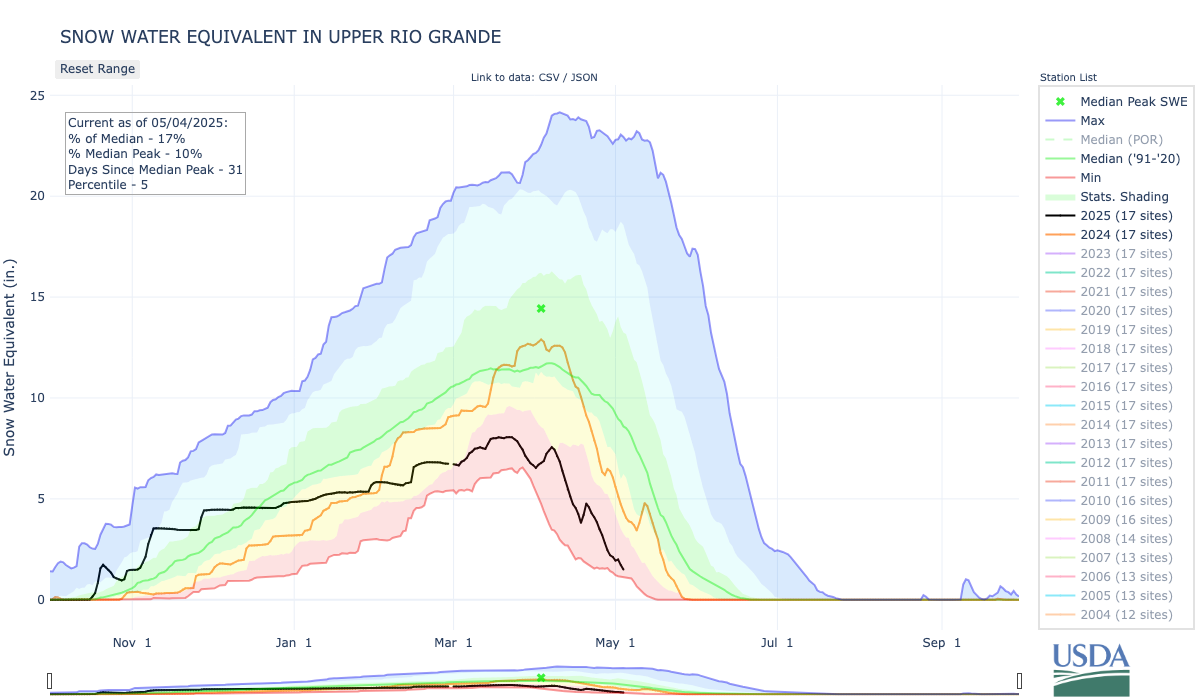
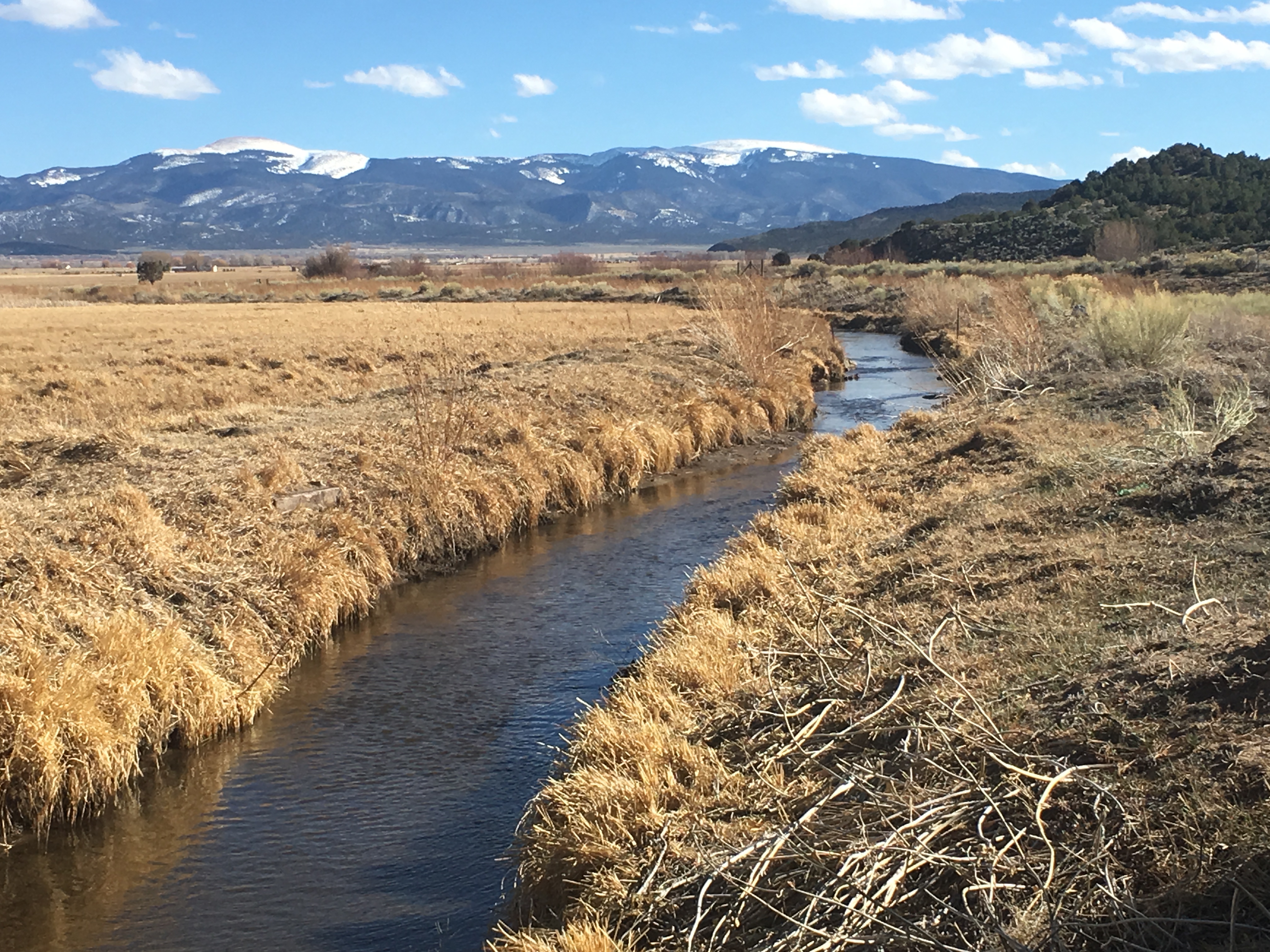
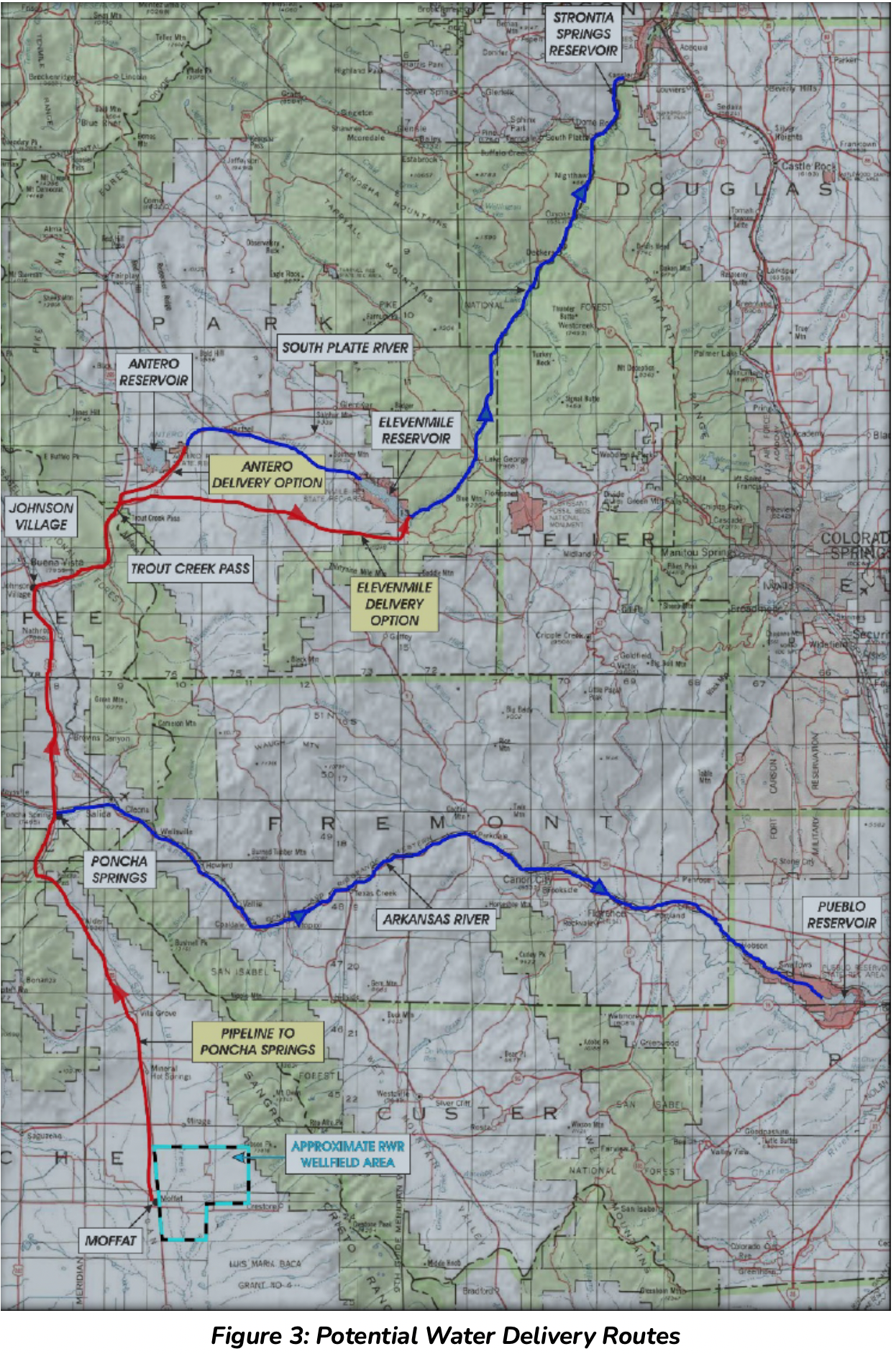
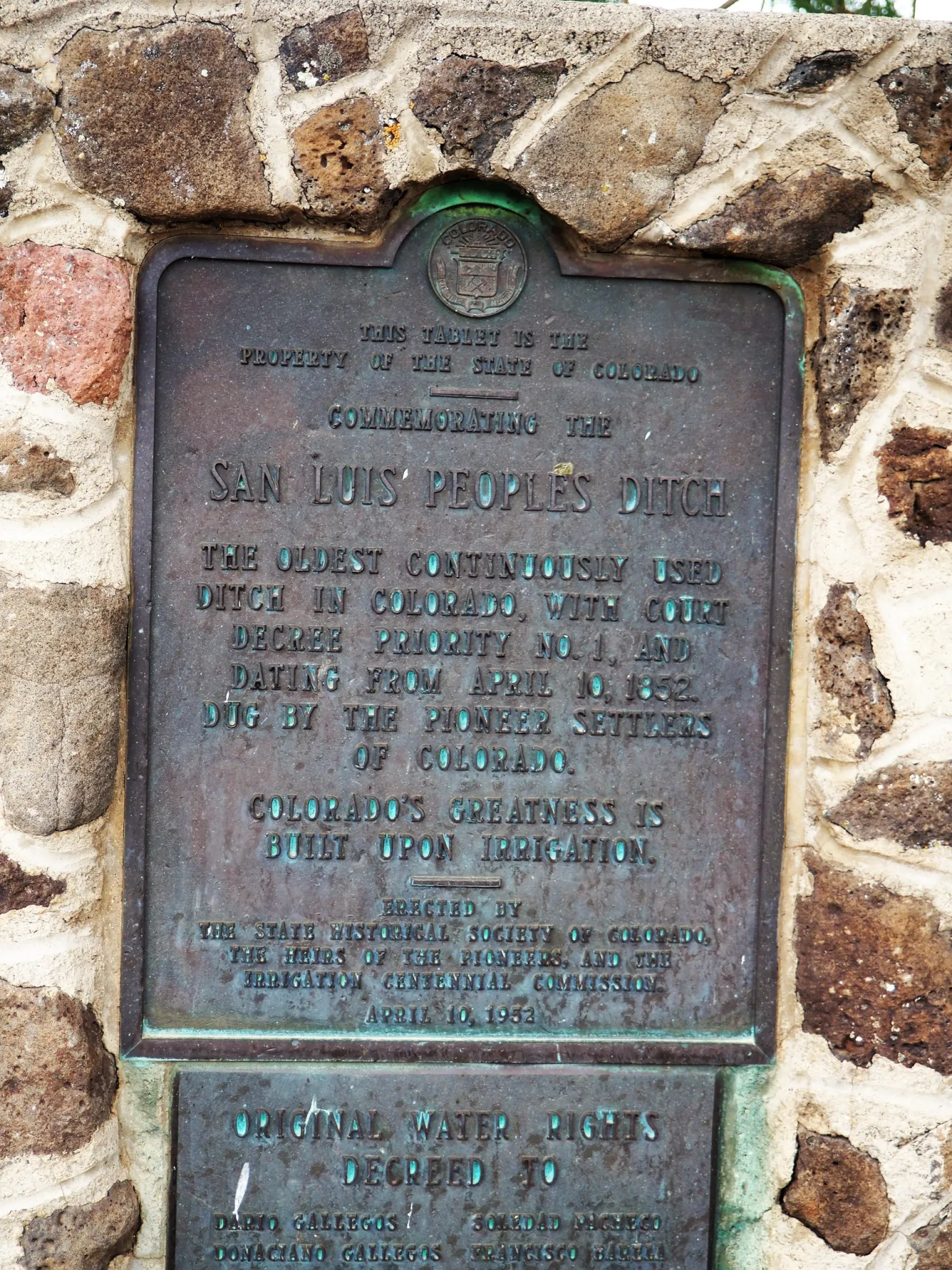
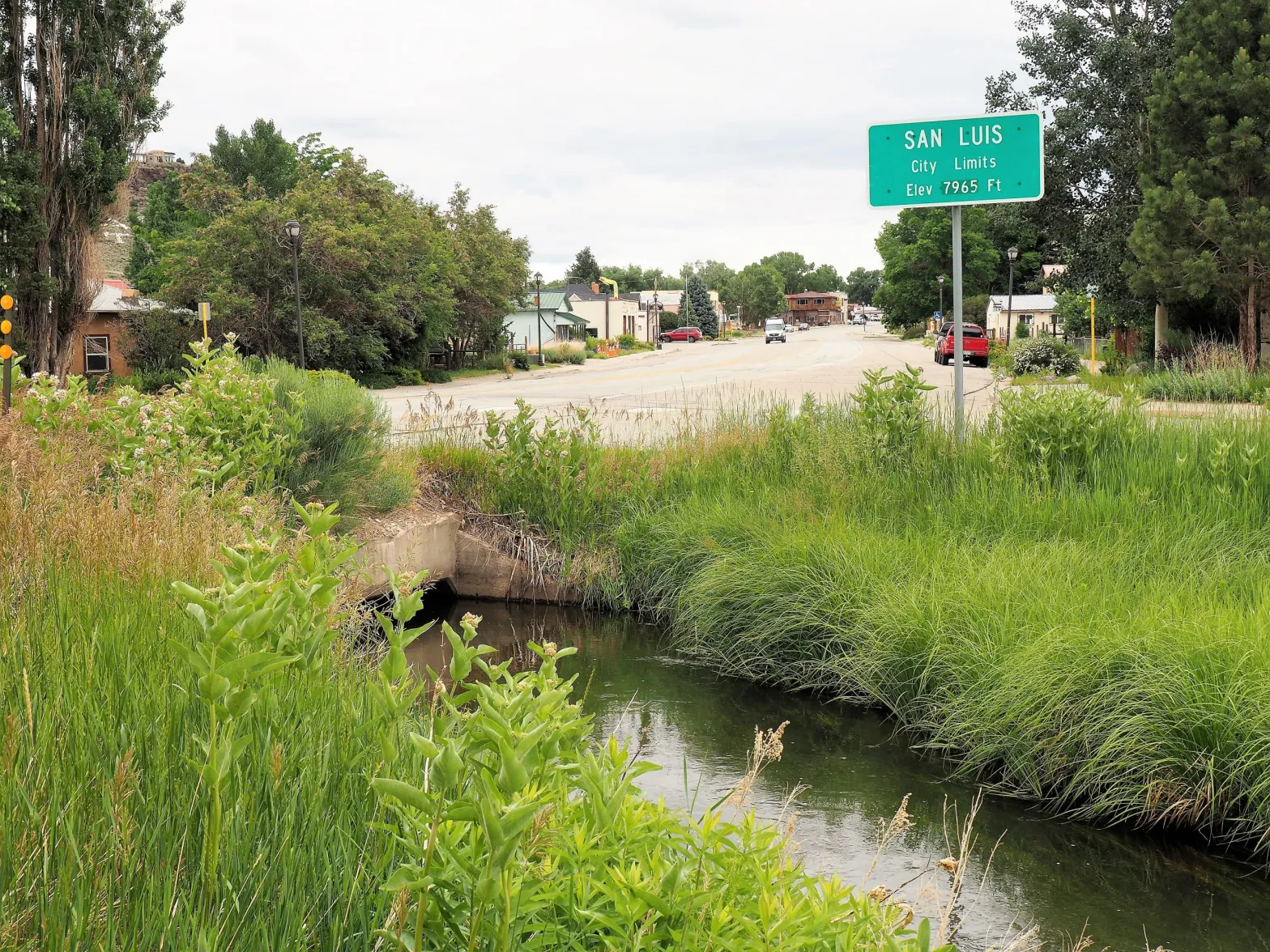
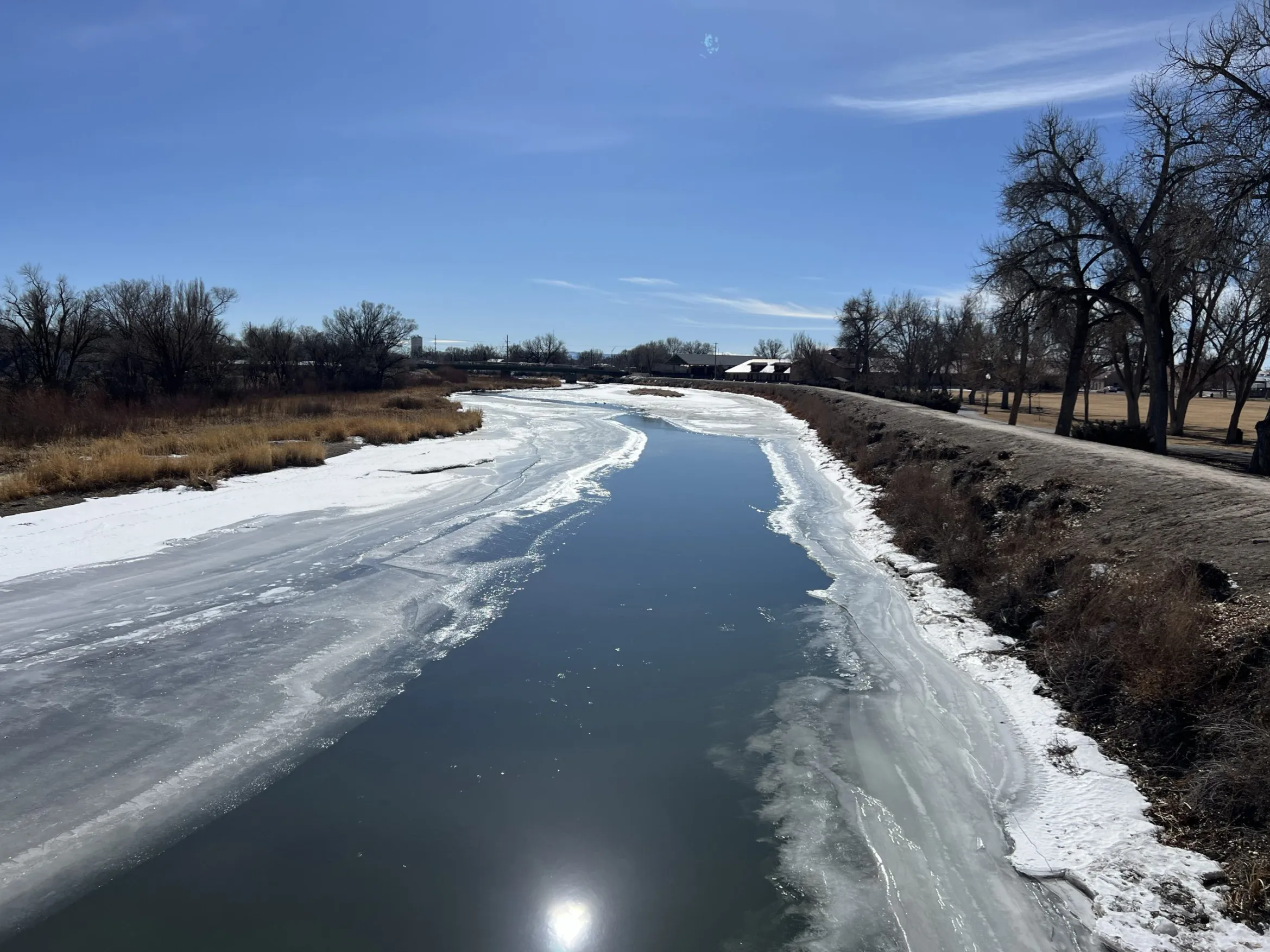
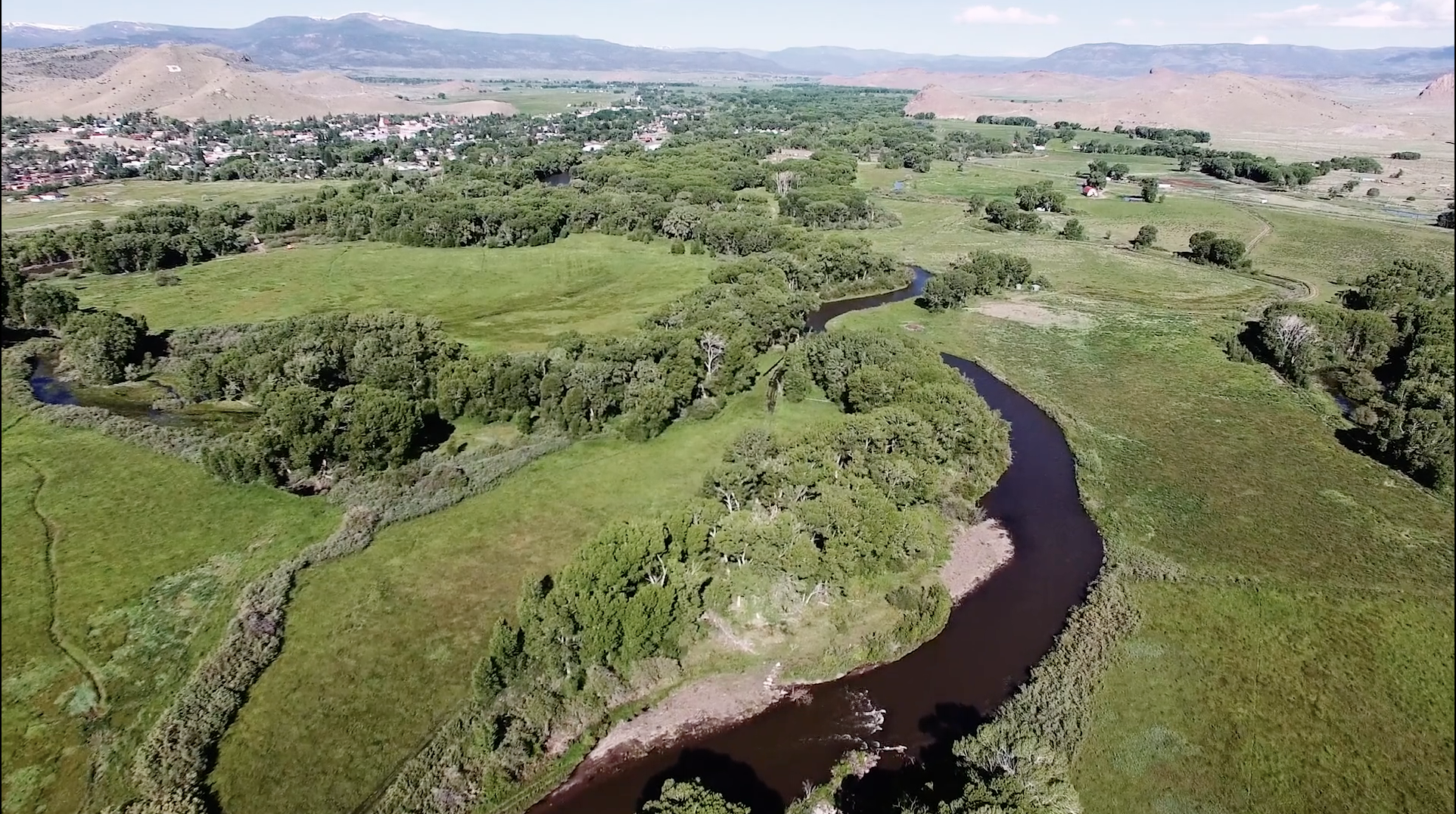
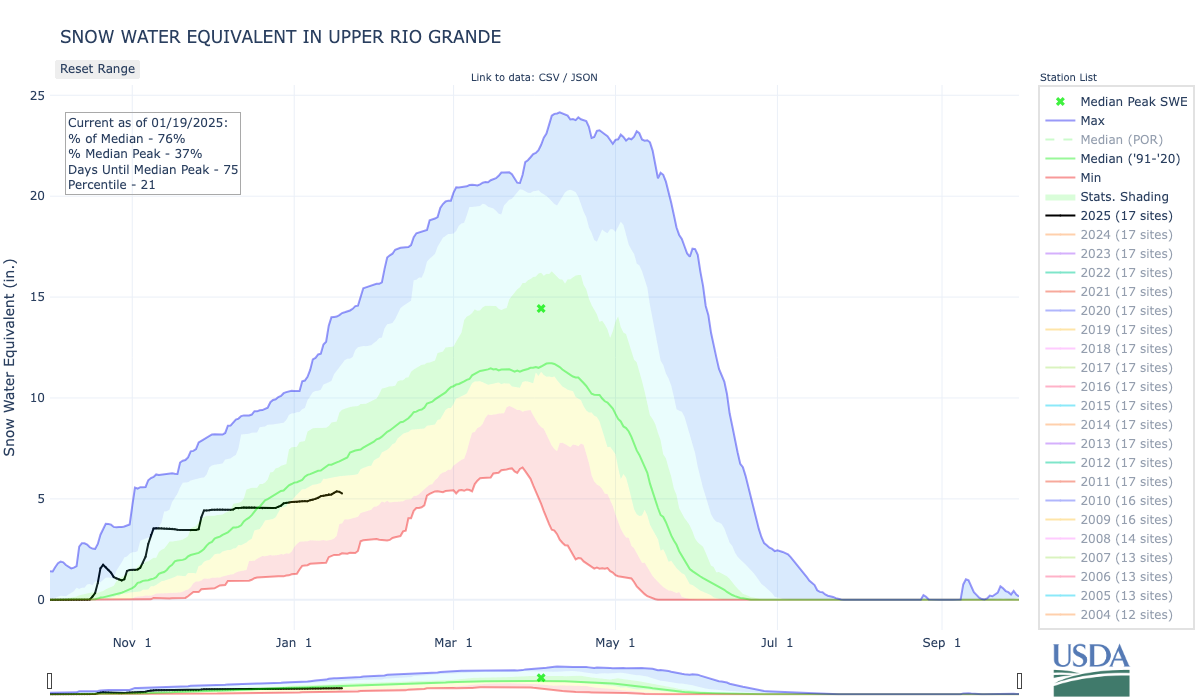
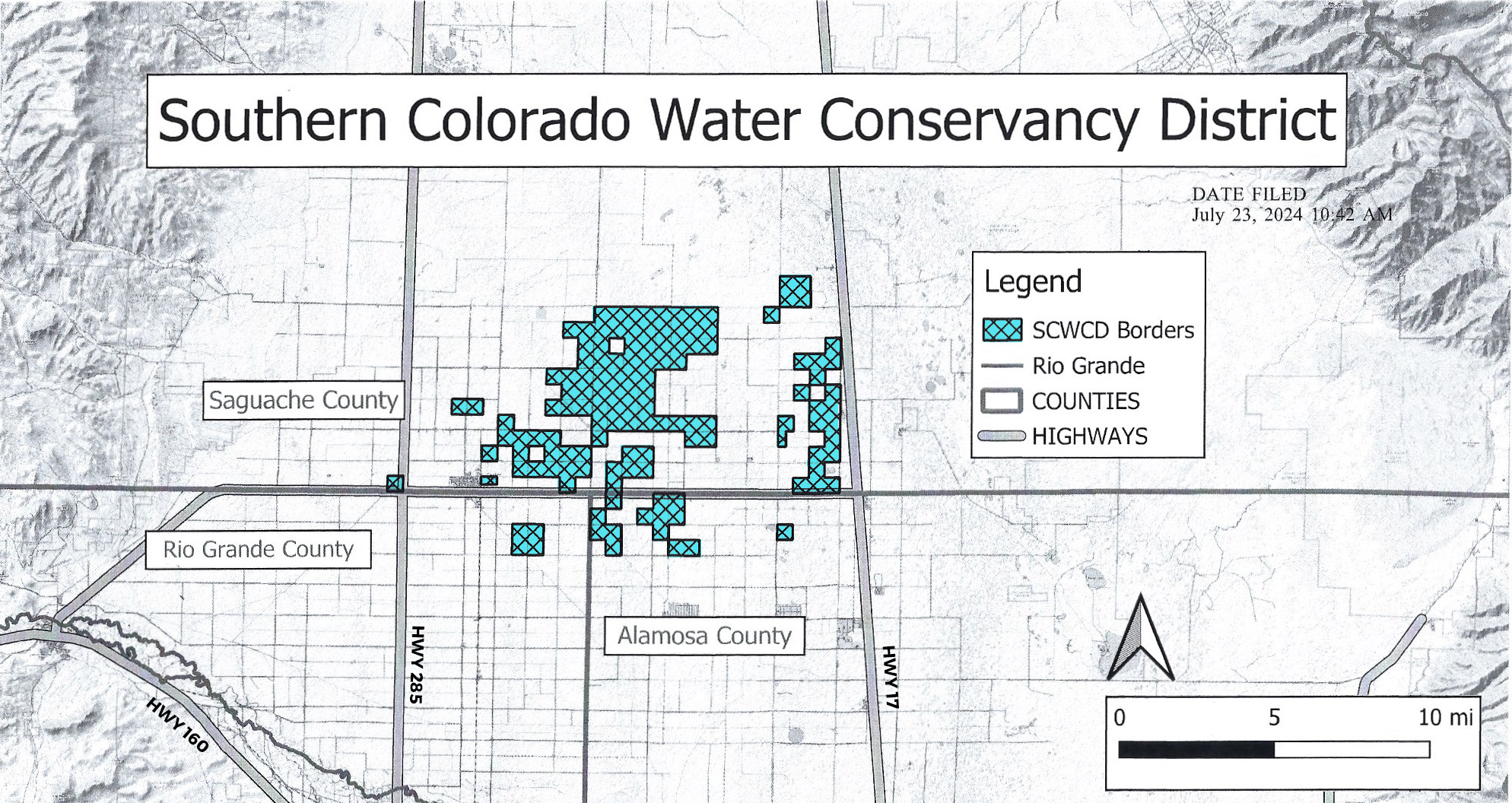
Snow Water Equivalent measurements as determined by ASO flights over the Upper Rio Grande (March 23), left, and Conejos River (April 28). Credit: Airborne Snow Observatory
There’s more snowmelt to come. At least from the eyes of ASO surveys and those measurements across the Upper Rio Grande Basin.
ASO flights – Airborne Snow Observatory – that were conducted in May show a higher level of snow runoff and corresponding water than earlier spring forecasts from the Natural Resources Conservation Service (NRCS) and National Weather Service. The surveys were conducted by Airborne Snow Observatories, Inc., and along with forecasts from NRCS and NWS, are used by the state to forecast a water season for local irrigators and to help Colorado determine the amount of water to deliver downstream for Rio Grande Compact purposes.
“This year it appears that between the pattern of snow accumulation and the early start to the melt season, the runoff forecasts reliant only on the SNOTEL observations have been lower than our snow and runoff estimates that incorporate the full-basin observations of the snowpack,” said Jeffrey Deems, co-founder and chief technology officer of Airborne Snow Observatories, in an email this week to Alamosa Citizen.
“There is of course plenty of runoff season left,” he said, “and always the potential for spring and summer rain (or snow), so how the season unfolds remains to be seen.”
The company was just completing its second flight over the Rio Grande at Del Norte the week of May 12 and had conducted two flights over the Conejos. Its turnaround time on measurements is about 72 hours, and Deems is confident the latest surveys will confirm earlier ones – that there’s more runoff in the high country than the SNOTEL sites could determine.
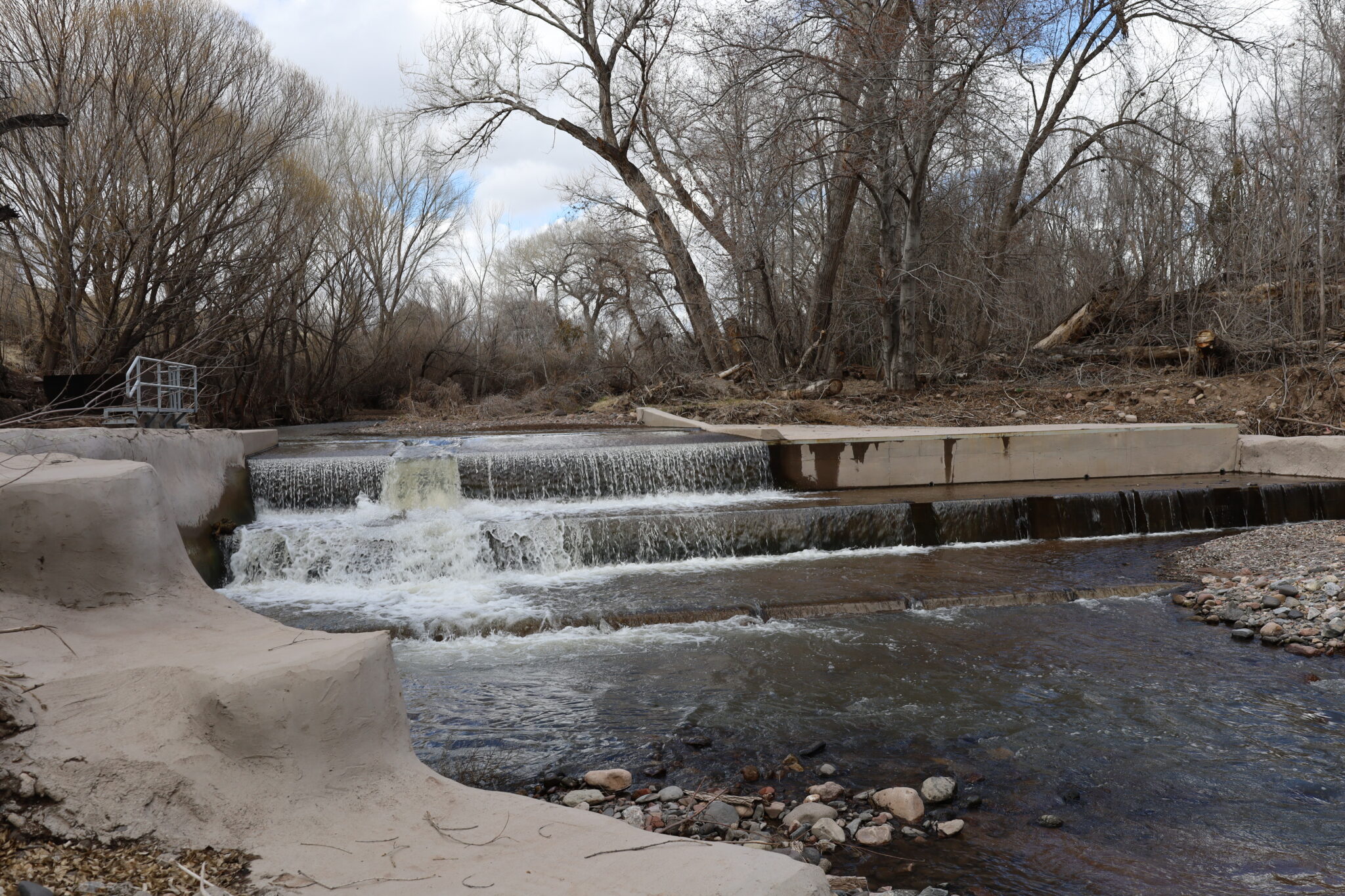
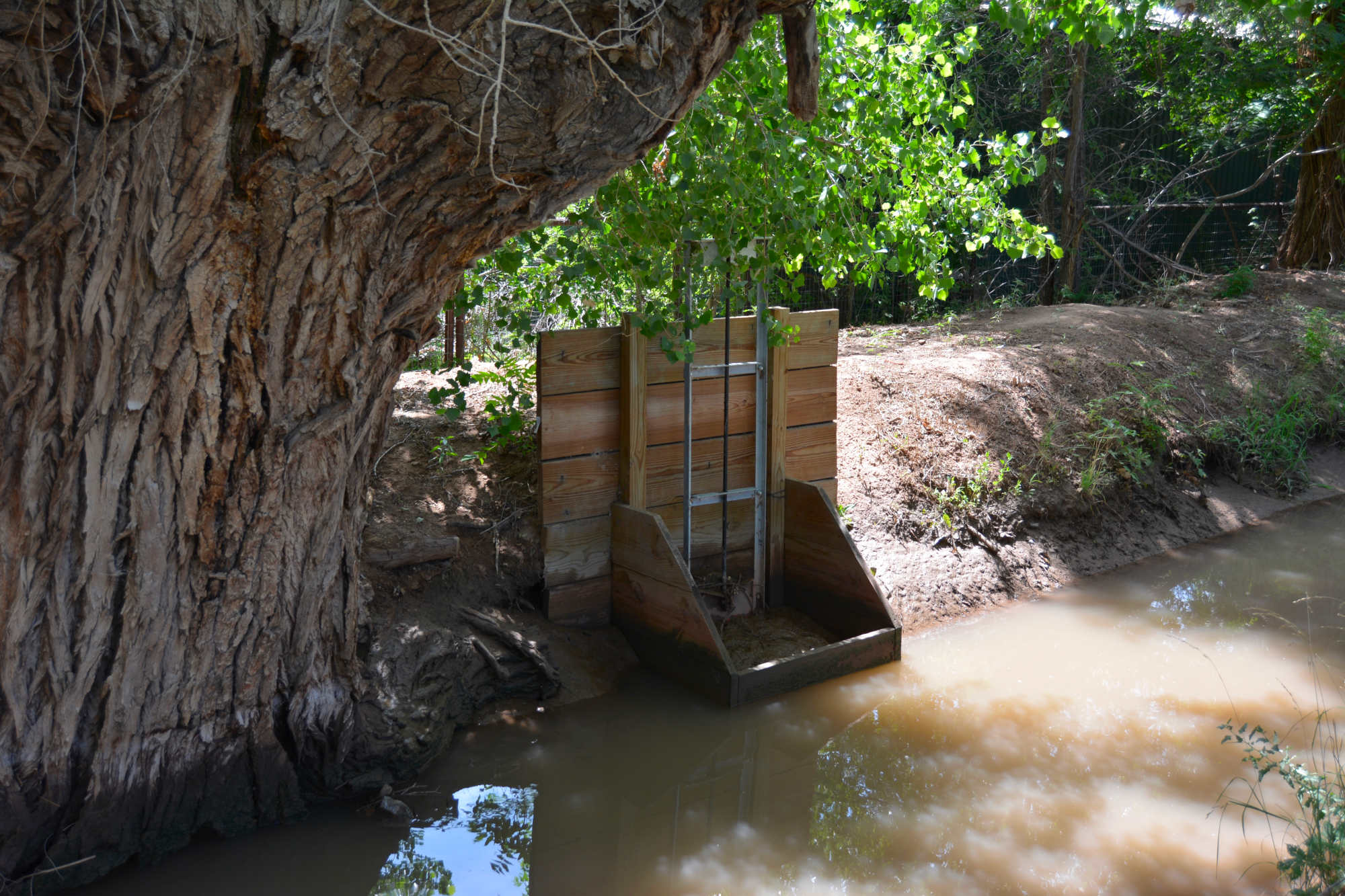
Gauging station near Mogote on the Conejos River. Credit: The Citizen
“In the Rio Grande basin, and especially in the Conejos watershed, the sparse SNOTEL network does not reflect the diversity of terrain and snow environments, and therefore can miss important changes in snowpack volume,” Deems said.
“This year it appears that between the pattern of snow accumulation and the early start to the melt season, the runoff forecasts reliant only on the SNOTEL observations have been lower than our snow and runoff estimates that incorporate the full-basin observations of the snowpack.”
State water division engineer Craig Cotten noted the differences in the ASO measurements compared to the NRCS and NWS when briefing members of the Rio Grande Basin Roundtable at their May meeting. The ASO flights were showing “significantly higher” levels of moisture than the other two sources and the state was “trying to figure out what’s going on with that and why their forecasts are so much higher.”
“We have been discussing our forecasts with the DNR and local water district folks in the Rio Grande and Conejos basins,” Deems said. “In contrast to the NRCS and NWS, our forecast model is informed by our airborne snow surveys which measure the snow water volume over the entire watershed(s), as opposed to only relying on the sparse network of SNOTEL stations that provide an index of snow conditions.”
Water managers through the years have complained of inaccurate readings of snow and there has been a push by the San Luis Valley Conservancy District and Rio Grande Water Conservation District to add more SNOTEL stations to fill in particular areas around Creede and Conejos County.
“Our forecasts start from an accurate snow water volume, and then forecast melt and runoff based on forecasts of future weather, “ Deems said of ASO data. “The NWS forecasts do something similar, but start from a simplified snowpack estimate derived from SNOTEL station measurements of precipitation. The NRCS forecasts use the SNOTEL snow measurements in comparison to a 30-year record as a statistical predictor of dry-season runoff volume.”
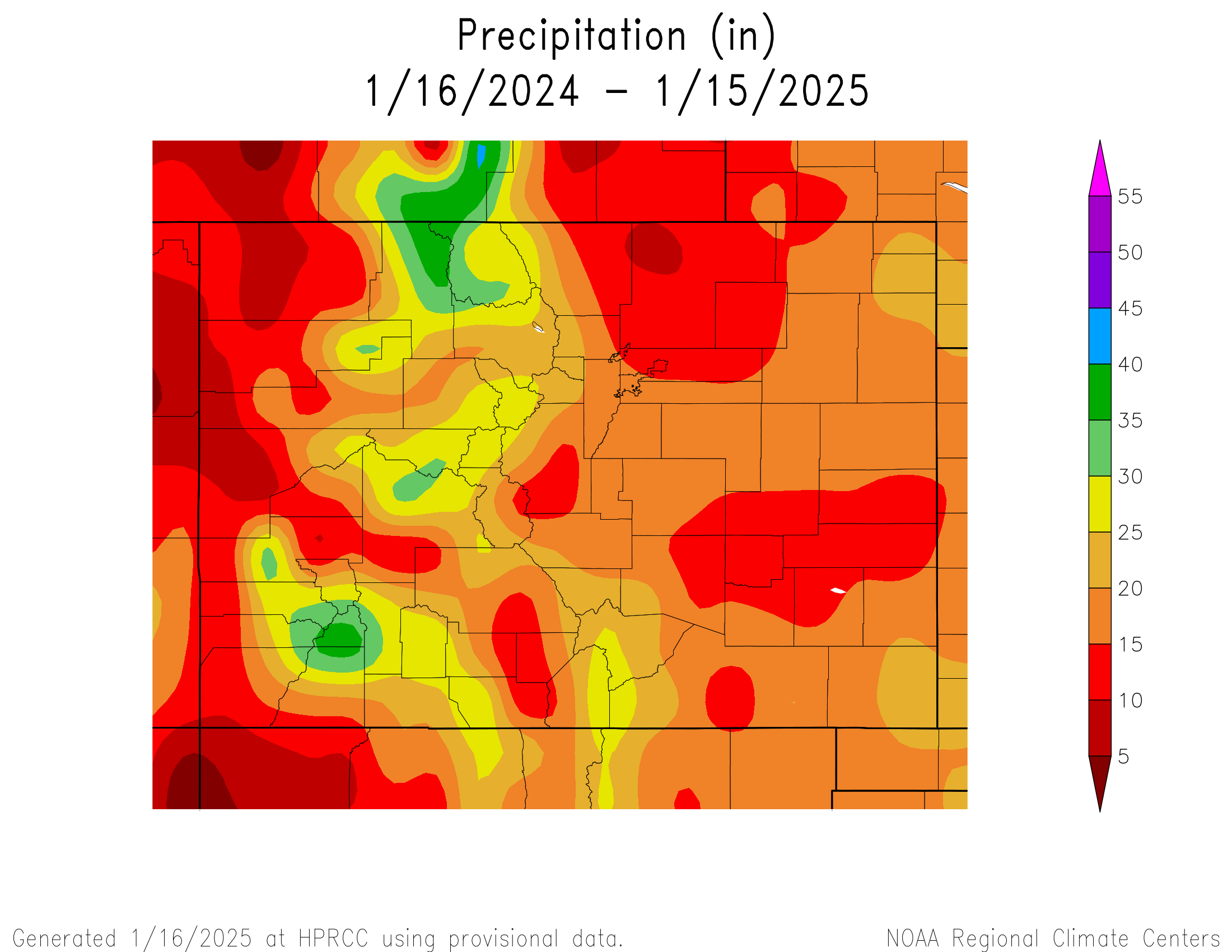
In a year when the month of February brought record high temperatures that caused an early melt to a light snow season, and then above-normal precipitation in April and snow in the high country and 1.5 inches of rain in early May, and the early spring predictions of a “dry year” look premature from the air.
“As it stands now, our forecasts are in line with the amount of snow water volume we have measured over our two flights in the Conejos,” Deems said. The next forecast updates from the ASO flight will be available in the coming week, data the state and local manager will be anxious to review.
Rio Grande and Pecos River basins. Map credit: By Kmusser – Own work, Elevation data from SRTM, drainage basin from GTOPO [1], U.S. stream from the National Atlas [2], all other features from Vector Map., CC BY-SA 3.0, https://commons.wikimedia.org/w/index.php?curid=11218868
Click the link to read the article on the Alamosa Citizen website:
May 14, 2025
OUTDOOR CONDITIONS
The early May rain delivered a recharge to the Upper Rio Grande Basin, and perhaps there’s more snowmelt coming from the higher elevations that forecasters haven’t yet figured out?
Craig Cotten of the Colorado Division of Water Resources, in speaking at this week’s May 13 meeting of the Rio Grande Basin Roundtable, said airborne snow forecasts are predicting “much higher” streamflows on the Rio Grande and Conejos than the other two sources the state relies on to make its predictions – U.S. Natural Resources Conservation Service (NRCS) and National Weather Service.
Cotten explained the state division of water resources uses all three sources to help it forecast the depths and the amount of water in the rivers. Colorado is forecasting 390,000 acre-feet this water year on the Rio Grande and 180,000 acre-feet on the Conejos – both measurements at around 60 percent of the long-term averages for the river system.
While NRCS and National Weather Service have been predicting low river flows from a light snow year, the Colorado Airborne Snow Measurement Program and its ASO Snow Survey has data that suggests “much higher” streamflows and is a source of information that the state is “trying to figure out what’s going on,” Cotten said.
“We still think it’s not going to be a great year on any of our stream systems,” he said.
(They do one of these every month, I always find them interesting, and I always forget to post them.)
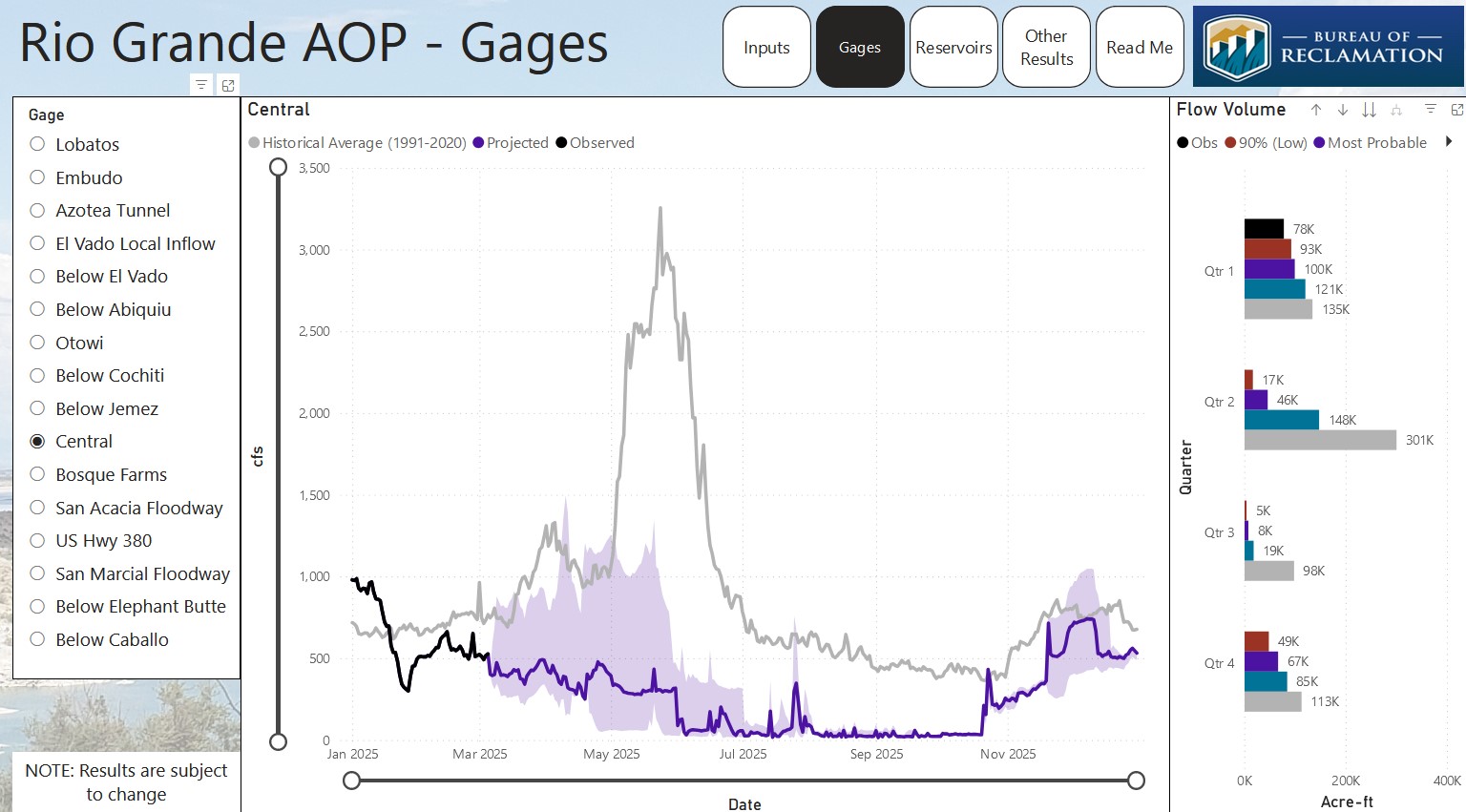
26.5 miles are currently dry in the lower stretch of New Mexico’s Middle Rio Grande, in the stretch between Socorro and Elephant Butte Reservoir, though the Low Flow Conveyance Channel (a big canal next to the river’s main channel through this lower reach – it’s an engineered system, what counts as “river” is semantics at this point) is flowing, and water is still flowing through the Elephant Butte Narrows.
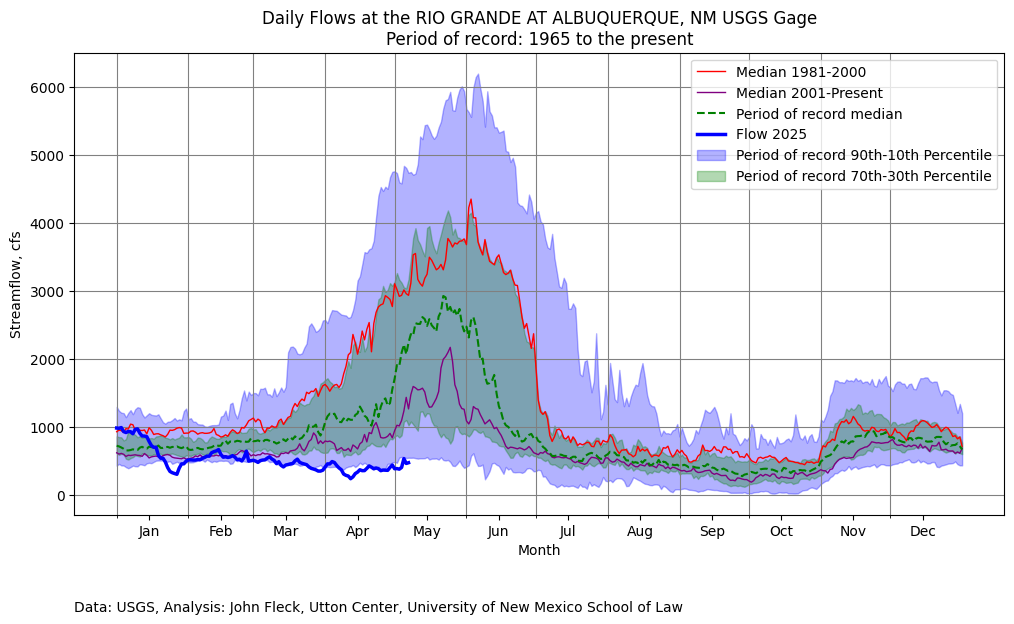
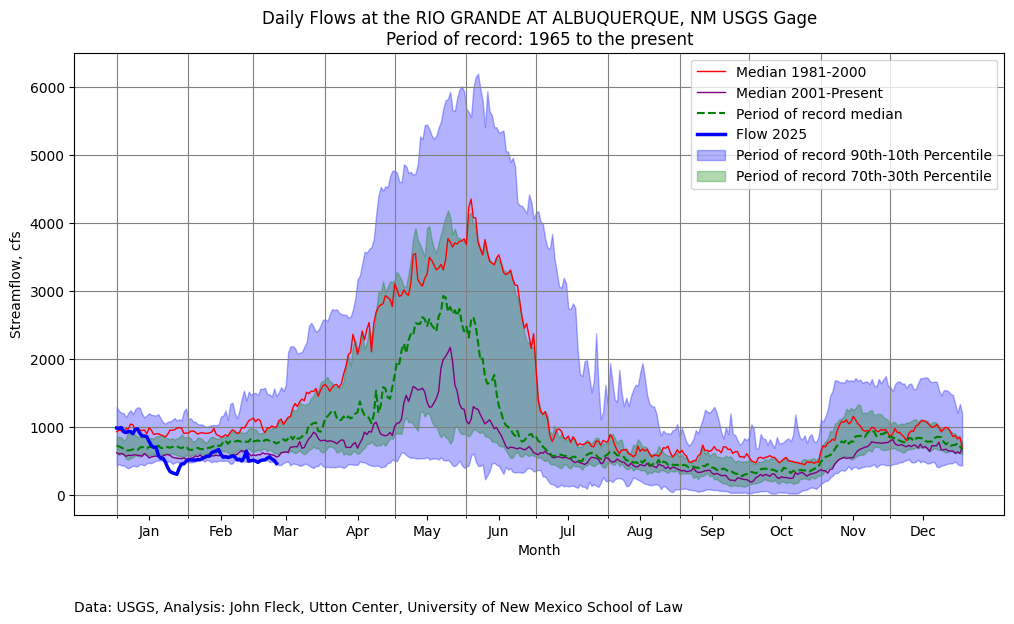
The river’s actually up right now through Albuquerque thanks to last week’s rain and the warmup melting off some last bits of snow. But this is likely the peak.
Rio Grande and Pecos River basins. Map credit: By Kmusser – Own work, Elevation data from SRTM, drainage basin from GTOPO [1], U.S. stream from the National Atlas [2], all other features from Vector Map., CC BY-SA 3.0, https://commons.wikimedia.org/w/index.php?curid=11218868
Click the link to read the article on the InkStain website (John Fleck):
May 8, 2025
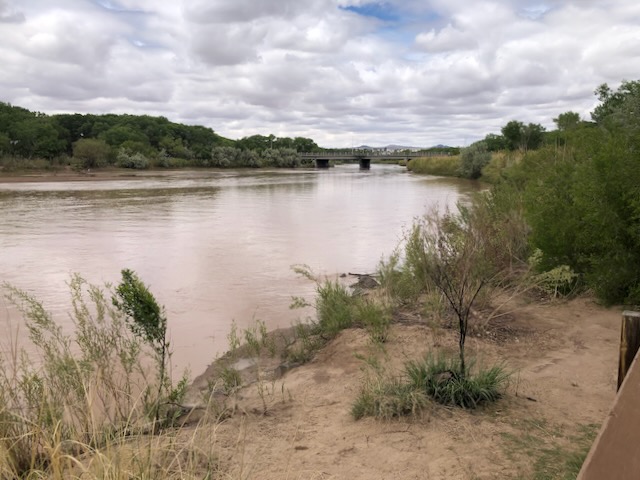
A week of rain (I exaggerate, six days) has lifted our spirits after one of the driest starts to a calendar year on record in Albuquerque. The river was muddy yesterday on the family Wednesday lunch outing, and the cottonwoods looked so happy. The wild roses were blooming, we stuck our noses in them to smell.
And yet….
Lowest on this date since 1996.
Percentile ranking of yesterday’s flow: 7 (record goes back to 1965)
Click the link to read the article on the Alamosa Citizen website (Heather Dutton and Daniel Boyes):
May 2, 2025
San Luis Valley water managers have reviewed streamflow forecasts, available water stored in reservoirs, and anticipated reservoir operations for the 2025 spring, summer, and fall seasons, and determined that 2025 will likely be a year with early runoff, low flows in streams and rivers, and a short boating season.
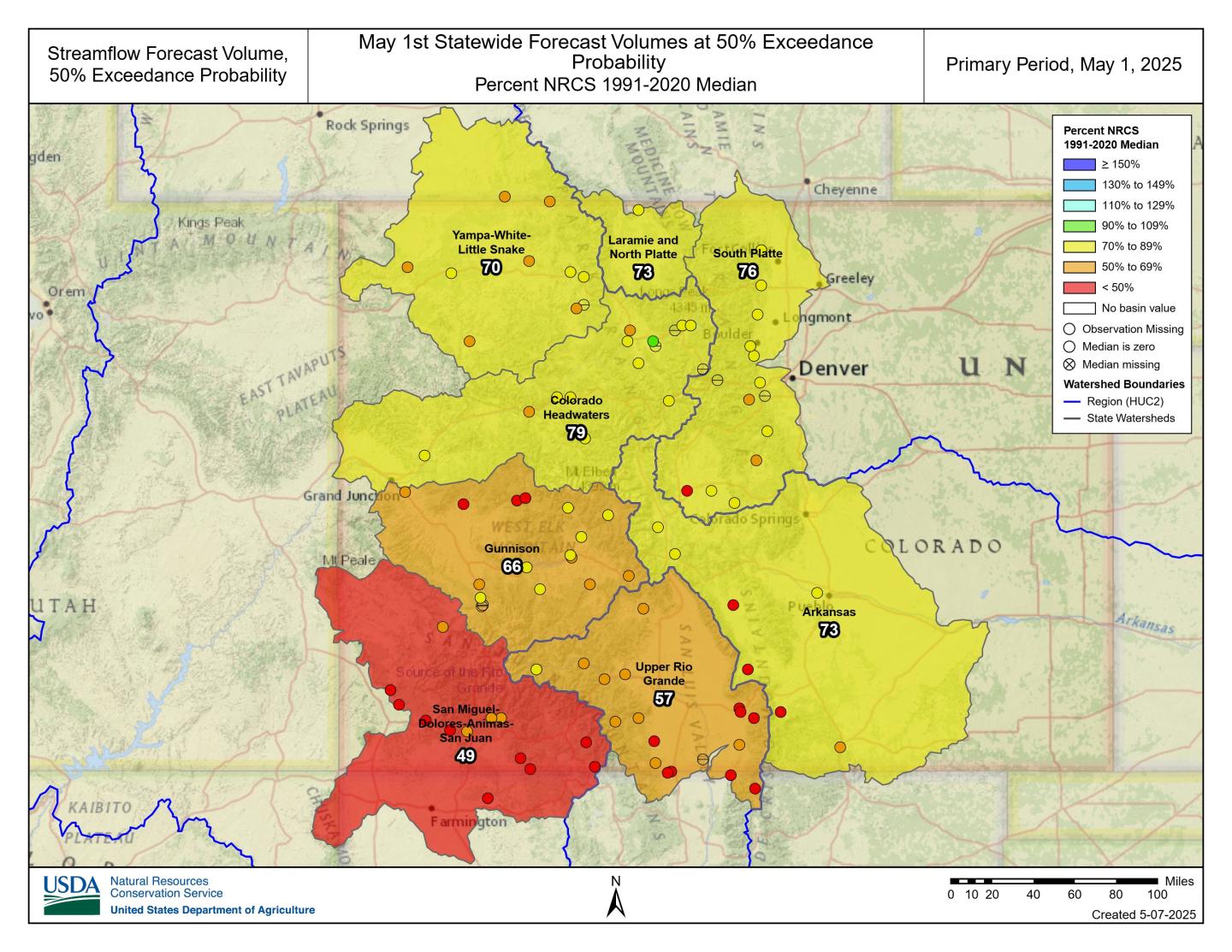
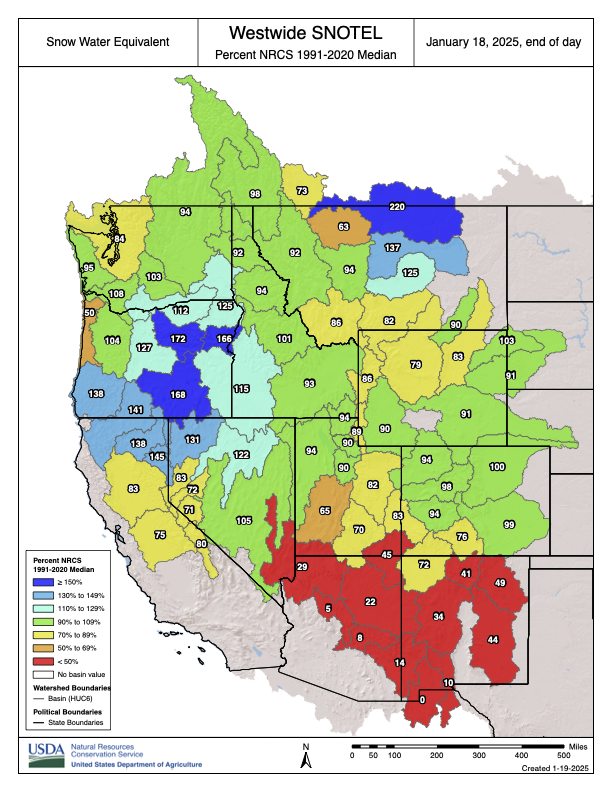
The Colorado Division of Water Resources Division 3 Engineer’s March 31 10-day report forecasted the total annual flow at the Del Norte gage will be 390,000 acre-feet. For reference, the flows in 2020 totaled 377,000 acre-feet. The National Weather Service is forecasting hot and dry conditions into July, with chances of a normal monsoon season in late summer. The snow water equivalent for the Upper Rio Grande Basin was 25 percent of the median for the 1991-2020 time period on April 28, 2025. The irrigation season began on April 1 on the Rio Grande. As such, on-stream reservoirs are required to pass all inflows to satisfy the needs of downstream senior water rights holders.
Given the low amount of snow remaining in the mountains and the anticipated summer drought conditions, it is likely that local rivers and streams will reach their peak runoff in May. The reservoir operators at Rio Grande, Santa Maria, and Continental Reservoirs will begin releasing stored irrigation water to downstream farmers after the river peaks. The San Luis Valley Irrigation District (SLVID) will release water from Rio Grande Reservoir to the Farmers Union Canal as soon as their first direct flow priorities come into priority on the Rio Grande at anticipated rates of 150-400 cubic feet per second for up to 15 days.
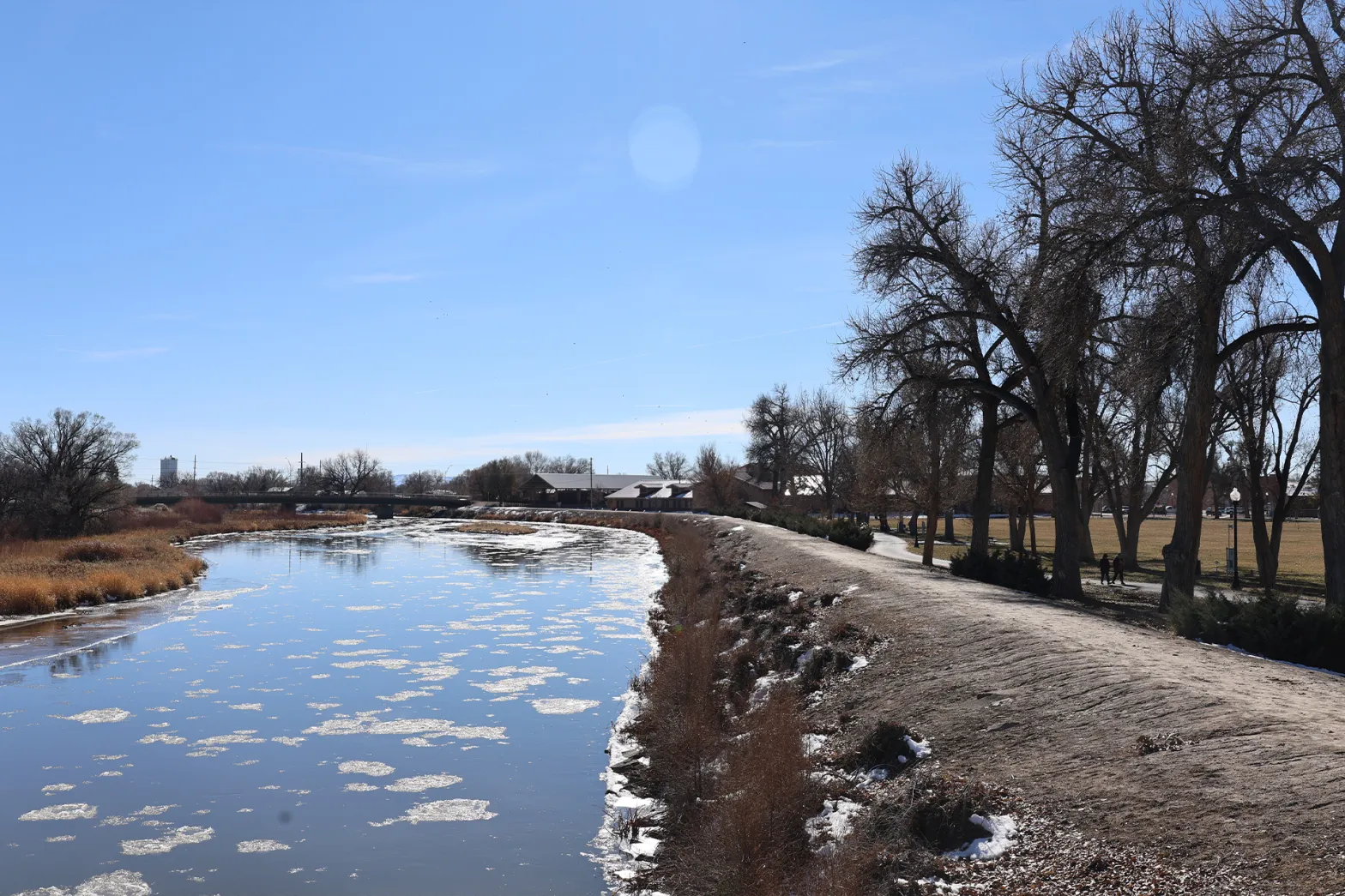
Rio Grande. Photo Credit: The Citizen
This schedule will be updated through May as river conditions change.
The Santa Maria Reservoir Company anticipates beginning releases from Santa Maria and Continental Reservoirs to the Rio Grande Canal and Monte Vista Canal in late May or early June. The timing of the releases of water will depend on flow rates in the canals and when farmers order water. The natural river flows and releases of irrigation water will provide the highest rates of flow during the summer season. As such, boatable flows on the Rio Grande may diminish as early as mid to late June.
Entities including Colorado Parks and Wildlife (CPW), the San Luis Valley Water Conservancy District (SLVWCD), and the Rio Grande Water Conservation District (RGWCD) store water in reservoirs in the Upper Rio Grande Basin and call for releases for their operations in accordance with their water rights decrees. Where possible, releases by these organizations will be prioritized during hot periods to supplement the natural flow of the Rio Grande helping to reduce high water temperatures and low river flows, thereby protecting the health of fish. Generally, when water temperatures reach 68 degrees, fish become very stressed and voluntary fishing restrictions are enacted at 72 degrees. Stakeholders will watch temperatures on the Rio Grande and the South Fork of the Rio Grande carefully and take action to release water where possible.
The water managers and reservoir operators in the Rio Grande Basin are working in partnership to manage water in order to meet multiple needs. These efforts build off of many years of collaboration amongst water users on the Rio Grande. In order to better inform the local communities of water management operations, additional information will be compiled and shared via news outlets, social media, and email as reservoir releases are planned and executed.
Rio Grande and Pecos River basins. Map credit: By Kmusser – Own work, Elevation data from SRTM, drainage basin from GTOPO [1], U.S. stream from the National Atlas [2], all other features from Vector Map., CC BY-SA 3.0, https://commons.wikimedia.org/w/index.php?curid=11218868
Mexico and the United States said Monday they had reached an agreement that involves Mexico immediately sending more water from their shared Rio Grande basin to Texas farmers after U.S. President Donald Trump threatened tariffs and sanctions earlier this month.
“Mexico has committed to make an immediate transfer of water from international reservoirs and increase the U.S. share of the flow in six of Mexico’s Rio Grande tributaries through the end of the current five-year water cycle,” U.S. State Department spokesperson Tammy Bruce said in a statement.
Bruce thanked Mexico President Claudia Sheinbaum for her involvement in facilitating cross-border cooperation…The countries’ joint statement Monday, while lacking specific details of the agreement, said both countries had agreed that the 1944 treaty regulating how the water is shared was still beneficial for both countries and not in need of renegotiation. Under the treaty, Mexico must deliver 1,750,000 acre-feet of water to the U.S. from six tributaries every five years, or an average of 350,000 every year. An acre-foot is the amount of water needed to cover 1 acre of land to a depth of 1 foot.
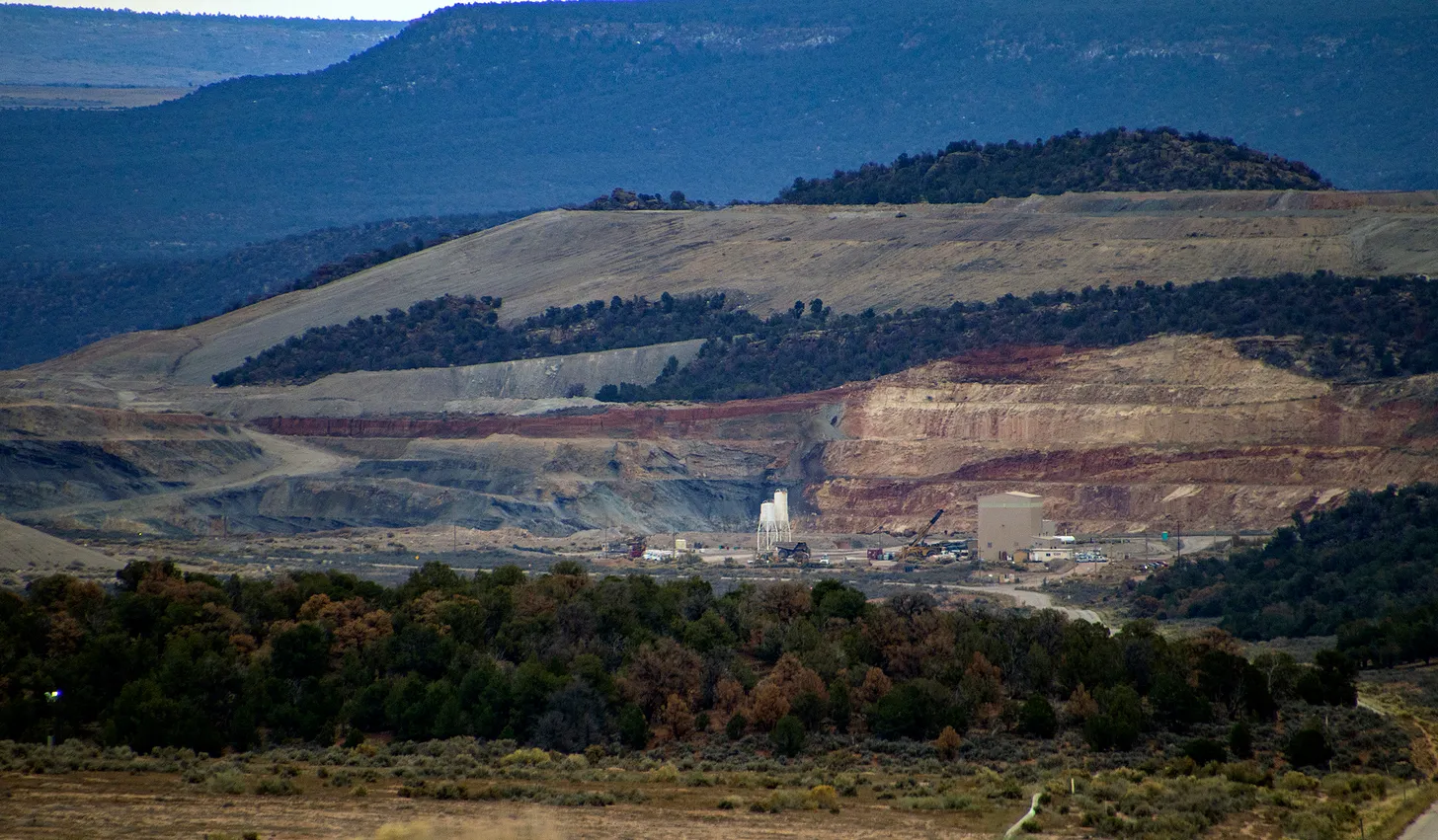
The Lisbon Valley copper mine in southeastern Utah is looking to expand, and now the Trump administration has moved to expedite its permits. Jonathan P. Thompson photo.
A little while back I wrote about Trump’s executive order aimed at making it easier to mine on federal lands. Now it’s becoming a little clearer how that might play out on the ground. The U.S. Permitting Council last week released a list of the first wave of mining projects the administration plans to fast track through the permitting process.
The projects include a few that the Land Desk has covered or mentioned in the past, such as:
The announcement promised there are “many more projects on the way” to the expedited list, though it does not elaborate on what fast-tracking might look like, exactly. The council says it will publish permitting timetables for the projects by May 2. Stay tuned to the Land Desk for updates.
😀 Good News Corner 😎
Prizes, folks. There are prizes for the winners of the Land Desk’s Predict the (spring) Peak Super Contest! Why super? Because it’s not just for one stream, but for five. And that means there could be five winners, and each gets to choose one of these prizes from our merch selection.
Is that enticing, or what? But there is a bit of a catch: Only paid Land Desk subscribers will be eligible to enter the contest, meaning only they can win the prizes. But don’t fear: Sign up now and get 20% off the regular annual subscription price, and get the privilege of entering the Predict the Peak contest.
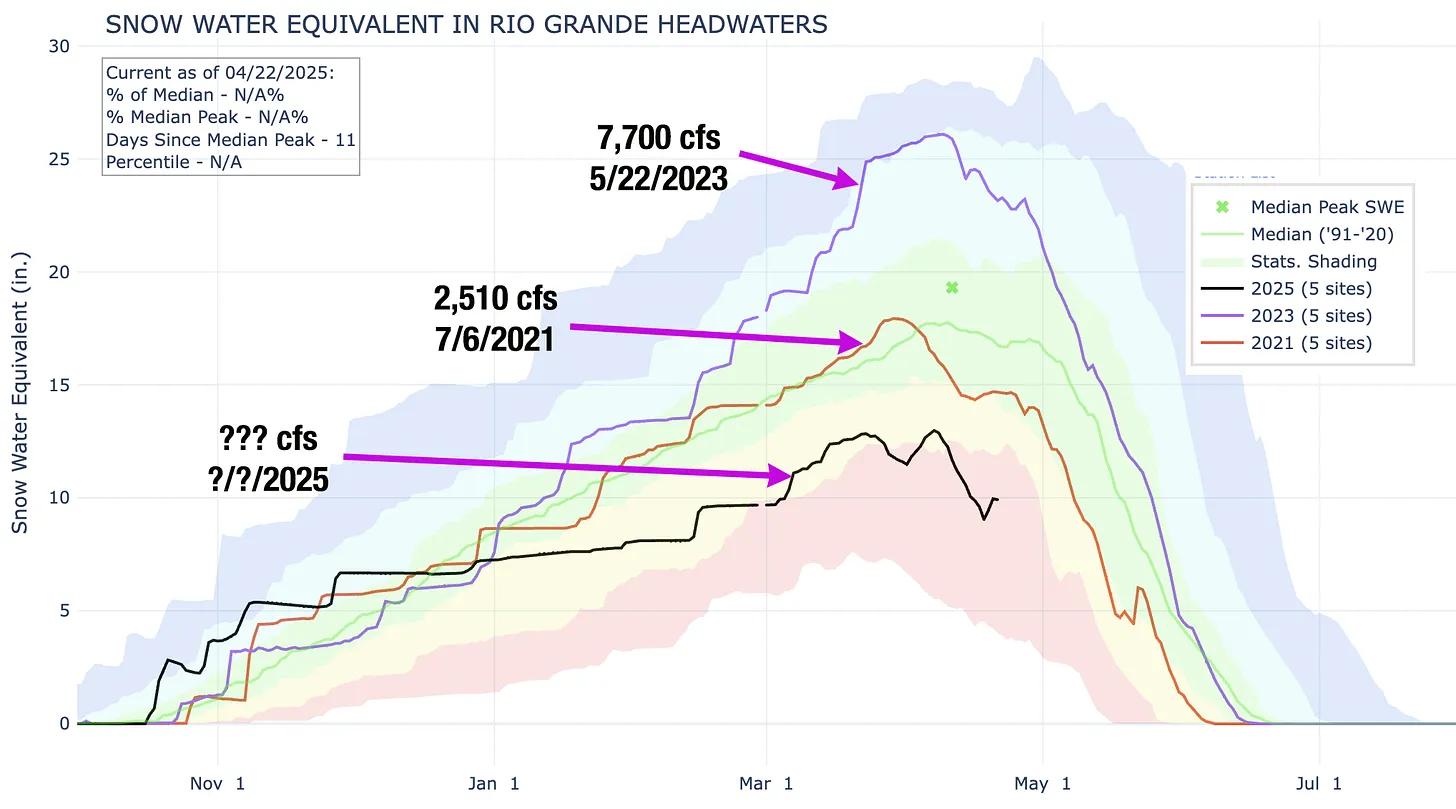
The idea is to accurately predict the spring runoff peak streamflow (in cubic feet per second) and the date of the peak for any or all of these five stream gages:
So an entry for the Animas might look like this: Animas River, May 17, 2,950 cubic-feet per-second. The winning entry would be the closest streamflow reading to the actual peak, with the date being a tie-breaker if needed. So if someone gets the cfs right, but the date wrong, they would beat out someone with the right date but wrong flow.
Entries will only be eligible if they are entered into the comment section below this post. Don’t email me your entries! They won’t count! (If you are a paid subscriber but are having problems commenting, let me know at landdesk@substack.com). And they must be entered before Friday, May 16, to be eligible. Winners will be determined after spring runoff has peaked on all of the rivers, which will likely be in late June or early July (or perhaps earlier if spring remains warm).
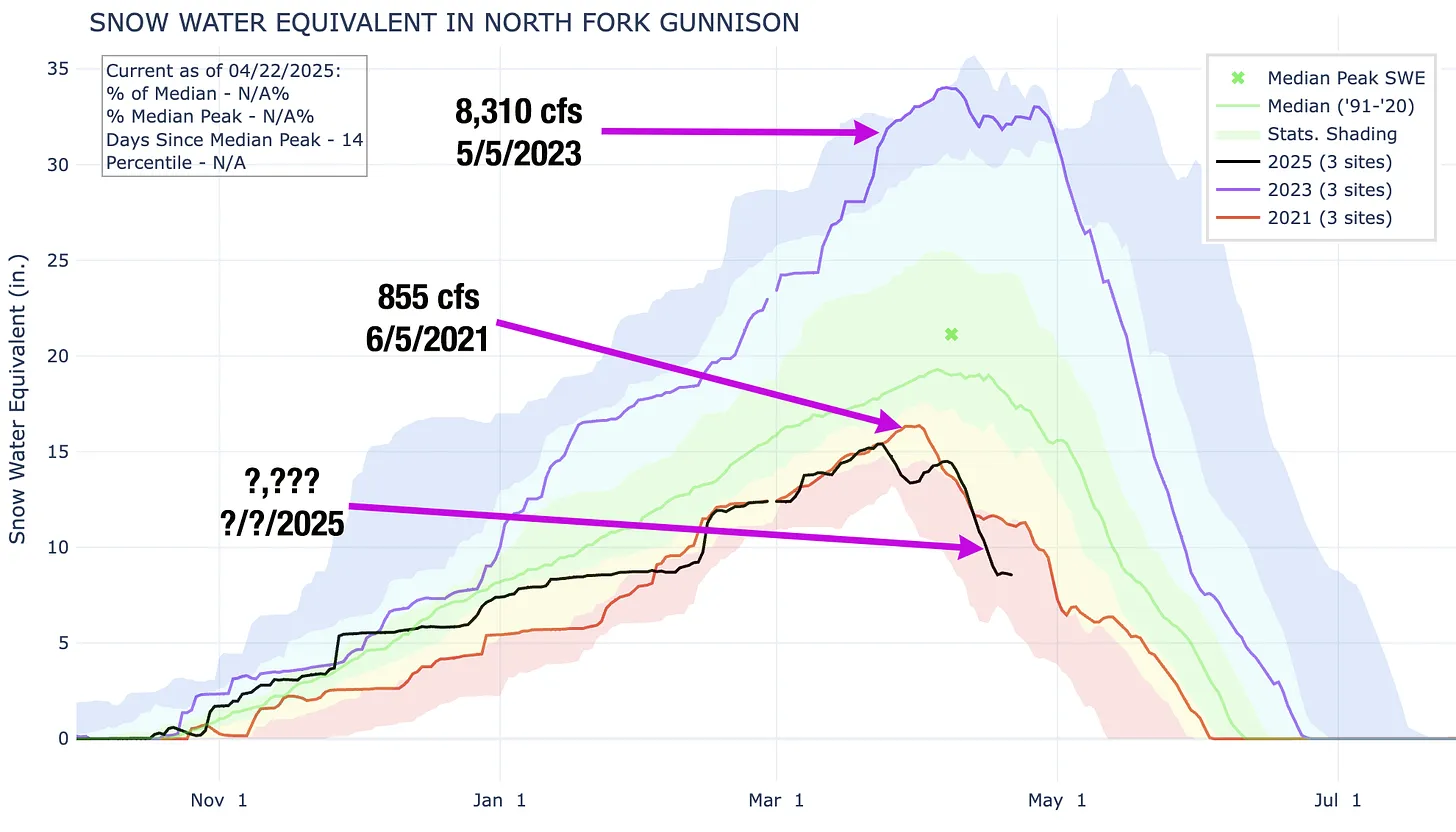
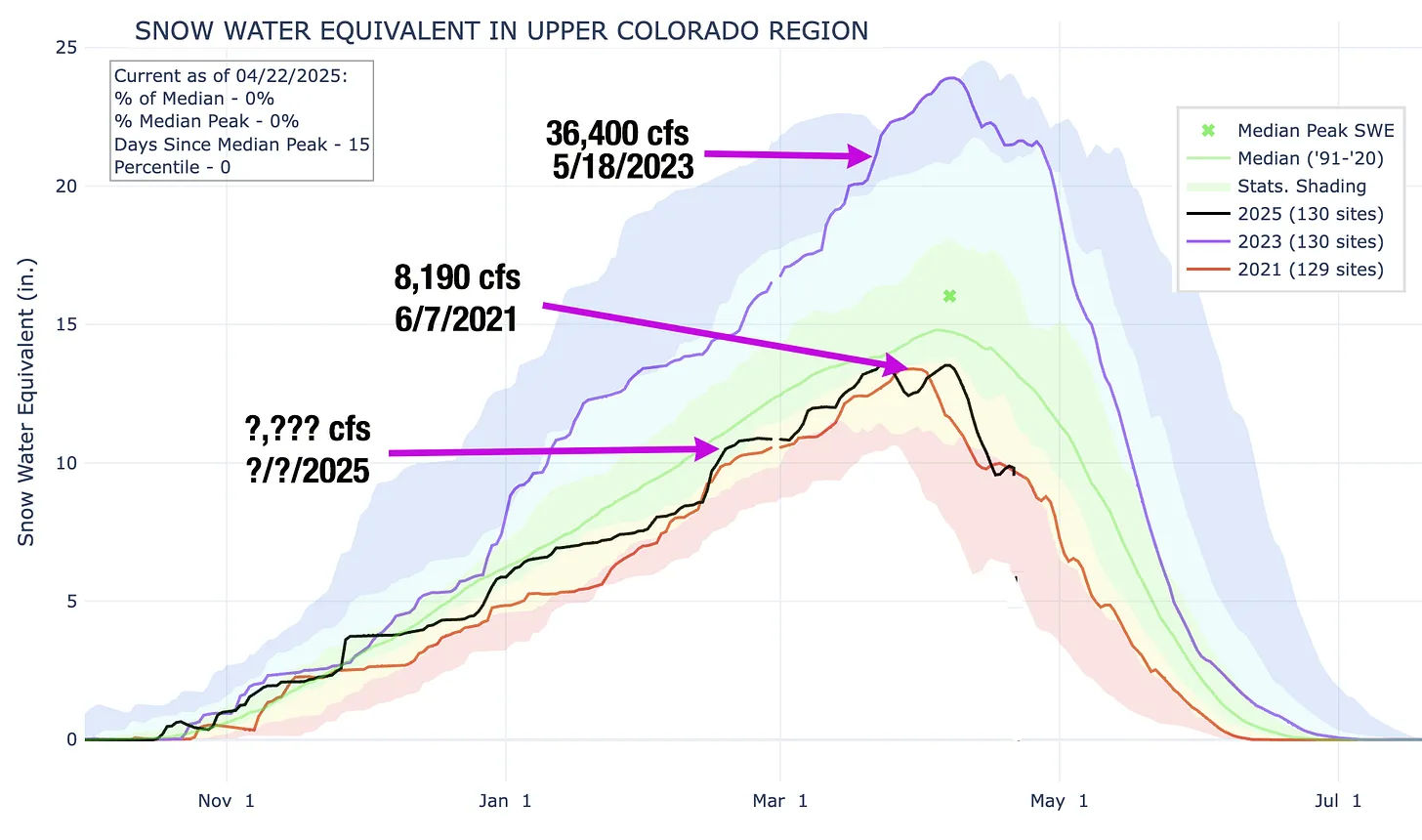
I’ve prepared the following graphs to help you out. They show this year’s April 22 snowpack level, along with the snowpack curve and peak flows and dates for 2021 and 2023. Good luck!
Streamflow readings are for the Animas River gage in Durango. Source: NRCS, USGS.
Streamflow readings are for the North Fork gage in Lazear. Source: NRCS, USGS.
Streamflow readings are for the Rio Grande gage at Otowi Bridge. Source: NRCS, USGS.
Streamflow readings are for the San Miguel River gage at Uravan. Source: NRCS, USGS.
Streamflow readings are for the Colorado River gage at the Utah-Colorado state line. Source: NRCS, USGS.
Streamflow readings are for the Colorado River gage at the Utah-Colorado state line. Source: NRCS, USGS.
From email from the Salazar Rio Grande del Norte Center (Paul Formisano):
Join Colorado attorneys Bill Paddock and David Robbins as they present “Elephant Butte Reservoir, the Rio Grande Compact, and Water Administration in the San Luis Valley” on Thursday, April 24, 2025, from 3:00 p.m. to 5:00 p.m. in McDaniel Hall 101 at Adams State University.
Paddock and Robbins have worked for many decades protecting water interests in the San Luis Valley and throughout Colorado. Their perspectives will provide timely insights into the 1938 Rio Grande Compact, how it shapes current river management in the San Luis Valley and the broader river basin, and last year’s Supreme Court ruling on Texas v. New Mexico and Colorado.
These events will be held in conjunction with the Rio Grande Compact Commission meeting on Friday, April 25, 2025 starting at 9:00 a.m. at the Rio Grande Water Conservation District office in Alamosa. This annual meeting brings together officials from Colorado, New Mexico, and Texas to discuss river policy and management. The meeting is free and open to the public.
For more information about the April 24th events, please contact Salazar Center director Paul Formisano, Ph.D., at pformisano@adams.edu.
Rio Grande and Pecos River basins. Map credit: By Kmusser – Own work, Elevation data from SRTM, drainage basin from GTOPO [1], U.S. stream from the National Atlas [2], all other features from Vector Map., CC BY-SA 3.0, https://commons.wikimedia.org/w/index.php?curid=11218868
The Rio Grande at Isleta Blvd. and Interstate 25 on Sept. 7, 2023. (Photo by Anna Padilla for Source New Mexico)
Click the link to read the article on the Source NM website (Danielle Prokop):
April 16, 2025
The federal judge overseeing the lawsuit between New Mexico, Texas and Colorado over Rio Grande water has ordered a 10-day trial in Philadelphia starting June 9 at the request of all the parties, who are also pursuing mediation talks to resolve the lawsuit in the meantime.
The case, officially called Original No. 141 Texas v. New Mexico and Colorado, began more than a decade ago, sparked by escalating legal disputes around Rio Grande water below Elephant Butte between Texas and New Mexico.
The U.S. Supreme Court allowed the federal government — which operates a network of dams, and nearly 140 miles of irrigation canals to deliver water to two irrigation districts in the region and Mexico — to enter as a party to the case in 2018.
In the February status hearings, the federal mediator and attorneys for all three parties told United States Court of Appeals for the Third Circuit Chief Judge D. Brooke Smith, who is overseeing the case, that they were still seeking a resolution to the 12-year old case.
Jeffrey Wechsler, the lead attorney representing New Mexico, said setting a trial date would help mediation talks.
“Deadlines help negotiations rather than hinder them,” Wechsler said, according to transcripts of the hearing.
The New Mexico Department of Justice and other parties’ attorneys confirmed to Source NM that mediation talks are ongoing as of April, with another mediation session scheduled for April 22, according to NMDOJ Chief of Staff Lauren Rodriguez. “Meanwhile, the trial—focused on determining liability and establishing a baseline for apportionment under the compact—remains on schedule,” she wrote in a statement, “if an agreement is not reached by then.”
Any potential settlement or recommendation from Smith based on a trial would still need approval from the U.S. Supreme Court, the only court that handles interstate waters disputes.
Last year, U.S. Supreme Court justices struck down a deal proposed by New Mexico, Colorado and Texas to end the litigation in a close 5-4 decision. They sided with objections from the federal government that the states’ deal unfairly excluded the “unique federal interests,” and sent the case back to the negotiation table and potentially trial.
The alliances between the state and federal government in the case have dramatically shifted since 2022 as the nature of the dispute changed. Initially, Texas and the federal government agreed that New Mexico pumping below Elephant Butte threatened Rio Grande water for both Texas irrigation and treaty obligations to Mexico.
However, since Colorado, New Mexico and Texas proposed a deal to measure Texas’ water at the state line and include transfers of water between New Mexico and Texas irrigation districts to balance out shortfalls, the federal government is going to have to build its own case.
“Texas and the United States are no longer aligned,” federal attorney Thomas Snodgrass told Smith in February. He said the federal government was still preparing a case that New Mexico should be held liable for groundwater pumping impacts on the Rio Grande since 1938.
The court already held one part of a two-part trial in October 2021, but the proposed settlement delayed the second part indefinitely.
Weschler told Smith in February that if the case does proceed to trial in June, it will be shorter than the three-months set aside for trial in 2021.
“The case is prepared for trial. In fact, it’s halfway through trial,” Weschler said. “We’ve completed our discovery, we’ve completed disclosures — there’s really not much more to do other than to begin.”
Rio Grande and Pecos River basins. Map credit: By Kmusser – Own work, Elevation data from SRTM, drainage basin from GTOPO [1], U.S. stream from the National Atlas [2], all other features from Vector Map., CC BY-SA 3.0, https://commons.wikimedia.org/w/index.php?curid=11218868
Army Corps expedites permit process for Line 5 oil tunnel that crosses beneath the Great Lakes.
White House fast-tracks 10 mining projects in its quest for domestically produced minerals.
FEMA cancels grant program meant to prepare communities for weather hazards, while USDA overhauls climate-smart agriculture grant program.
Federal agencies intend to shrink wildlife habitat protections under the Endangered Species Act.
Judge sets a trial date for Rio Grande lawsuit between New Mexico and Texas.
EPA extends public comment period for health risk assessment of PFAS in sewage sludge.
And lastly, the Justice Department seeks to end an agreement to improve sewage infrastructure in Alabama.
“The DOJ will no longer push ‘environmental justice’ as viewed through a distorting, DEI lens. President Trump made it clear: Americans deserve a government committed to serving every individual with dignity and respect, and to expending taxpayer resources in accordance with the national interest, not arbitrary criteria.” – Assistant Attorney General Harmeet K. Dhillon of the Justice Department’s Civil Rights Division, as reported by Inside Climate News.
Dhillon is referring to a Biden-era civil rights agreement with the state of Alabama that sought to improve sewage infrastructure in the state’s poorest counties, which are also majority Black. The Justice Department is trying to end that agreement.
The agreement directed Alabama agencies to take a number of actions, such as halting referral of home wastewater violations to law enforcement and expanding a public health campaign about the dangers of raw sewage. It included a sewage system assessment and an infrastructure plan for at-risk areas.
By the Numbers
$882 Million: Funding that FEMA is rescinding from the Building Resilient Infrastructure and Communities program, which was meant to prepare towns for floods, sea level rise, hurricanes, and heat. FEMA is canceling the grant program, Engineering News Record reports.
$3 Billion: Biden-era funding for the Partnership for Climate-Smart Commodities that is being retooled by the Trump administration. The U.S. Department of Agriculture said it will reevaluate the program it has rebranded as Advancing Markets for Producers to ensure that less money is spent on administrative costs. Expenditures under the previous grants that were incurred through April 13 will be paid out.
Great Lakes satellite photo via Wikipedia.
News Briefs
Line 5 Tunnel Expedited The Army Corps of Engineers determined that the Line 5 tunnel, a proposal to drill an oil pipeline tunnel beneath the strait that separates lakes Michigan and Huron, is being put on the permitting fast track.
The determination is in response to President Donald Trump’s declaration of a national energy emergency in order to speed up the permitting and construction of fossil fuel infrastructure.
Carrie Fox, an Army Corps spokesperson, told Circle of Blue that the new permit review procedures and timeline are not known right now.
“We are coordinating with the applicant, who is Enbridge, and also coordinating with the Council on Environmental Quality, who will assist in establishing the review timeline,” Fox said. “So until those steps take place, we don’t have a timeline. And so we won’t know how exactly it’ll change yet. We just know right now that the permit has been placed under emergency procedures, but the timeline is to be determined.”
Enbridge proposes drilling a 3.6-mile tunnel beneath the Straits of Mackinac. The existing seven-decade-old pipeline sits exposed on the lakebed. It has been hit by ship anchors and a rupture would be calamitous for Great Lakes ecology, tourism, and water supplies.
Six Great Lakes tribes, after learning in March that the project permitting would likely be expedited, withdrew from the federal review process in protest, the Milwaukee Journal Sentinel reports.
Mining Projects Fast-Tracked The White House put 10 mining projects on the fast-track for regulatory approval, continuing the administration’s desire for more domestically produced minerals.
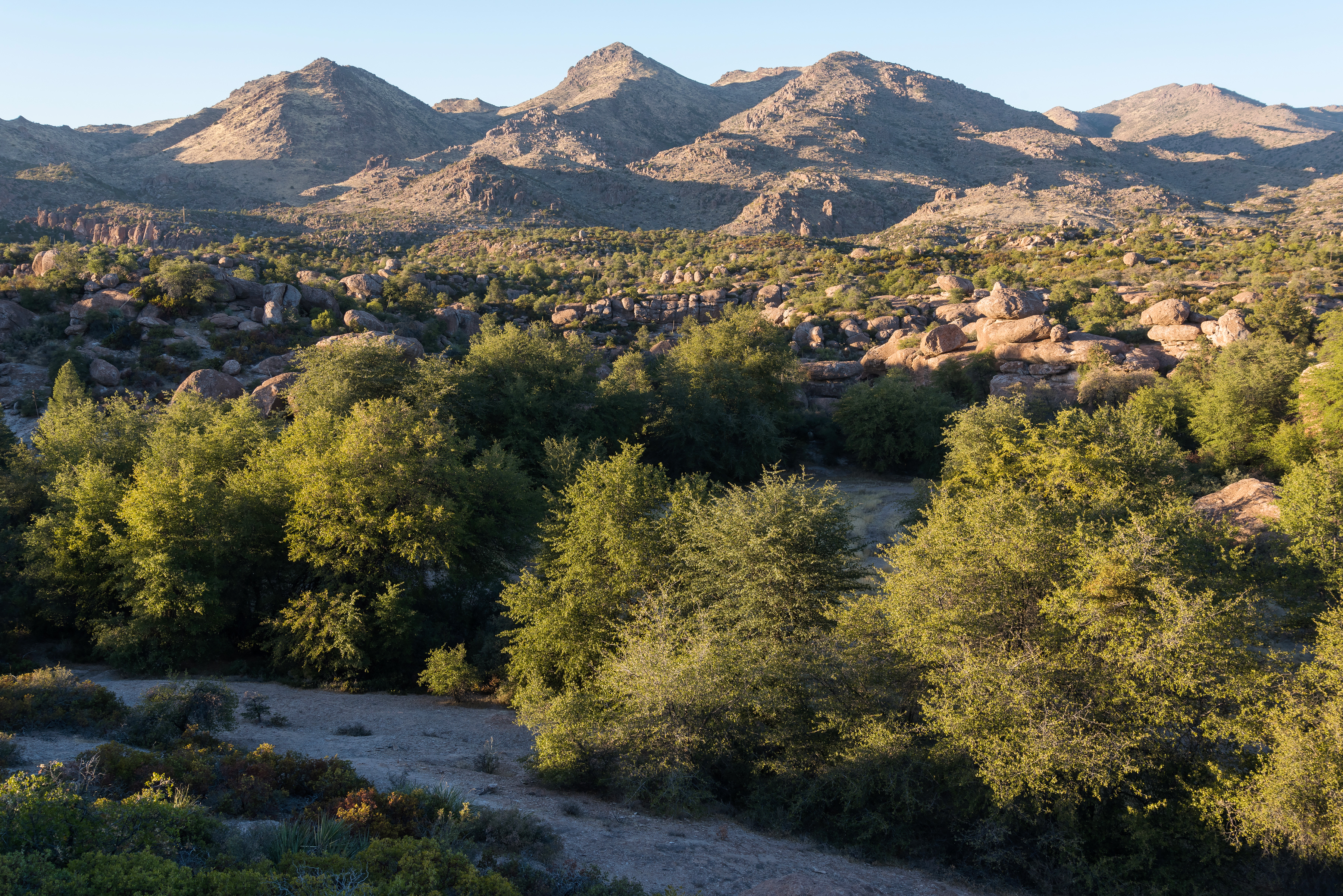
Oak Flat, Arizona features groves of Emory oak trees, canyons, and springs. This is sacred land for the San Carlos Apache tribe. Resolution Copper (Rio Tinto subsidiary) lobbied politicians to deliver this National Forest land to the company with the intent to build a destructive copper mine. By SinaguaWiki – Own work, CC BY-SA 4.0, https://commons.wikimedia.org/w/index.php?curid=98967960
The list includes the Resolution Copper mine, in Arizona, which would be located on land that is sacred to the Apache people. Tribe members have petitioned the U.S. Supreme Court to halt the project, the Arizona Republic reports.
The U.S. Department of Agriculture, the lead permitting agency for the Resolution project, will update the timeline by May 2.
The other mining projects would produce gold, phosphate, copper, lithium, and other critical minerals.
Redefining the Endangered Species Act Two federal agencies that oversee the Endangered Species Act intend to eliminate the definition of “harm” because it does not fit with the new administration’s interpretation of a recent Supreme Court ruling.
The National Marine Fisheries Service and the U.S. Fish and Wildlife Service had considered harm to mean habitat destruction. No longer, after the Loper Bright decision that the administration reads as curtailing agency authority in this matter.
The only wrongful actions under the ESA would be those that “take” an animal, meaning to capture, injure, or kill it.
The proposed change would apply only to new permits and would not affect existing actions. Public comments are being accepted through May 19 via www.regulations.gov using docket number FWS-HQ-ES-2025-0034.
Studies and Reports
Army Corps Water Storage Agreements The Army Corps could improve its communication with utilities about the fees it charges them for water storage space in its reservoirs, according to a Government Accountability Office report.
The fees are a portion of the cost to operate and maintain the reservoirs. The Corps had 438 water storage agreements nationwide, as of 2023.
Tile Drainage and Transportation The U.S. Geological Survey published a report describing how drainage from farm fields affects downstream flows.
The only wrongful actions under the ESA would be those that “take” an animal, meaning to capture, injure, or kill it.
The proposed change would apply only to new permits and would not affect existing actions. Public comments are being accepted through May 19 via www.regulations.gov using docket number FWS-HQ-ES-2025-0034.
Studies and Reports
Army Corps Water Storage Agreements The Army Corps could improve its communication with utilities about the fees it charges them for water storage space in its reservoirs, according to a Government Accountability Office report.
The fees are a portion of the cost to operate and maintain the reservoirs. The Corps had 438 water storage agreements nationwide, as of 2023.
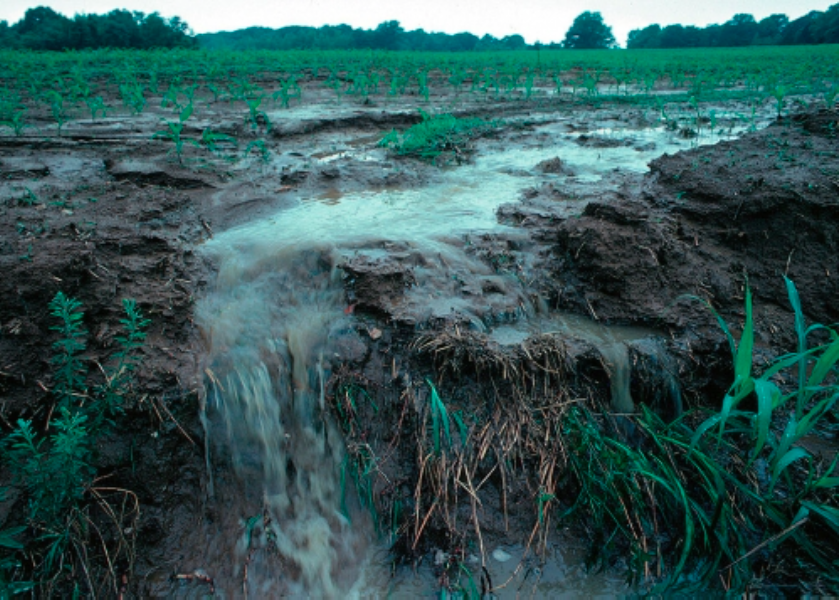
View of runoff, also called nonpoint source pollution, from a farm field in Iowa during a rain storm. Topsoil as well as farm fertilizers and other potential pollutants run off unprotected farm fields when heavy rains occur. (Credit: Lynn Betts/U.S. Department of Agriculture, Natural Resources Conservation Service/Wikimedia Commons)
Tile Drainage and Transportation The U.S. Geological Survey published a report describing how drainage from farm fields affects downstream flows.
Tile drains, common in the Midwest, move water from beneath fields into ditches.
The report was supported by state transportation departments, which want to build roads, bridges, and culverts that can withstand high water flows.
On the Radar
Future Army Corps Projects The Army Corps is seeking proposals from states, tribes, and regional bodies for projects to be considered for future feasibility studies or improvements.
Proposals are due August 15.
PFAS in Sewage Sludge The EPA is extending the public comment period for its draft risk assessment of two PFAS in sewage sludge, also known as biosolids.
Comments are now due August 14. Submit them via http://www.regulations.gov using docket number EPA-HQ-OW-2024-0504.
In the assessment, the agency evaluated risks to people living on or near lands where these biosolids are applied. The analysis, which looked at PFOA and PFOS, also considered risks for people whose primary consumption of water and food comes from these lands. It is not intended to assess risk for the general public.
Rio Grande and Pecos River basins. Map credit: By Kmusser – Own work, Elevation data from SRTM, drainage basin from GTOPO [1], U.S. stream from the National Atlas [2], all other features from Vector Map., CC BY-SA 3.0, https://commons.wikimedia.org/w/index.php?curid=11218868
Rio Grande Lawsuit The lawsuit between Texas and New Mexico over water supply from the Rio Grande will have a 10-day trial starting June 9, Source NM reports.
The parties to the case, which include Colorado and the federal government, are continuing to seek a mediated solution before the trial begins.
Federal Water Tap is a weekly digest spotting trends in U.S. government water policy. To get more water news, follow Circle of Blue on Twitter and sign up for our newsletter.
Click the link to read the article on the InkStain website (John Fleck):
April 12, 2025
My Utton Center colleague Rin Tara and I spent the day out in the field yesterday, a visit to River Mile 60 at the bottom end of New Mexico’s Middle Rio Grande.
(Disclosure: We took bikes, but “out in the field” sounds fancier than “on a bike ride.”)
The trip was fodder for a piece I’m working on looking at the US Bureau of Reclamation’s Middle Rio Grande river maintenance program carried out under the Flood Control Acts of 1948 and ‘50. Or possibly it’s a piece about the flooding in the 1920s that doomed the community of San Marcial. Or maybe its a piece about the remarkable geomorphology of a high sediment load river doing river things.
Or maybe it’s just a piece about a breathtaking expanse of desert with a struggling river valley flowing through its heart. Probably all of those things, which is why, dear readers, that you may not see the piece for a while.
The river, as defined by the presence of water, was barely there. It’s a weird stretch where sediment built up when it was the delta for the high stands of Elephant Butte Reservoir, a quaint reminder of when we had a lot of water. The river is now cutting back down through the debris, and the whole area is a mess from a human water management perspective.
From the river’s perspective? Meh, it’s just a river doing river things.
At a time when flows should be rising as a result of melting snow, they are declining as a result of the absence of melting snow. We cut the bike ride shorter than I had planned, because it was hot and I am old. But I’ll be back. It’s a lovely spot, and I have to figure out what to write.
White House moves to cut funding for keystone federal climate change report and targets “unlawful” regulations.
President Trump signs an order to relax showerhead water efficiency standards.
Another order opposes state laws that impede his “energy dominance” vision and seeks to invalidate them.
Yet another order requires agencies to put maximum 5-year expiration dates into existing energy and environmental laws.
EPA says it will review new studies of health outcomes from fluoridated drinking water.
Mexico says it will immediately release some water in the Rio Grande basin.
April 1, 2025 seasonal water supply forecast summary. Credit: Colorado Basin River Forecast Center
And lastly, federal forecasts indicate a down year for Colorado River runoff and the river’s already depleted reservoirs.
“These State laws and policies are fundamentally irreconcilable with my Administration’s objective to unleash American energy. They should not stand.” – Executive order from President Donald Trump that takes aim at state climate change laws that limit carbon-emitting energy production. The order instructs the attorney general to identify state laws and policies that the Justice Department believes illegally impede energy projects, and then attempt to halt implementation of the laws. The order mentions nearly every type of energy source except solar and wind.
“The attorney general will prioritize investigating state laws that mention one of the administration’s many ideological bugbears: climate change; environmental, social, and governance initiatives; environmental justice; greenhouse gas emissions; and carbon taxes.:
Any merit to all this? No, says Ted Lamm of UC Berkeley School of Law. Accusations of state overreach in this arena are a “mirage.”
By the Numbers
67 Percent of Average: Most probable runoff into Lake Powell this year from the Colorado River, according to a federal forecast. The report covers the April-July period. The down year is not good news for Lake Powell (33 percent full) or Lake Mead (34 percent).
4.1 Million Barrels Per Day: U.S. crude oil exports in 2024, a new annual record. Europe is now the biggest export market, after its decision in 2022 to ban Russian imports.
News Briefs
Rio Grande Water Negotiations President Claudia Sheinbaum said Mexico would carry out “immediate delivery” of some water to the Rio Grande basin, an instance of trade politics influencing water policy, The Hill reports.
Under a 1944 treaty, Mexico is required over five years to deliver 1.75 million acre-feet from its side of the basin. It is far behind in the current cycle, even as deliveries have picked up this year in response to political pressure.
As of April 5, Mexico had delivered 512,604 acre-feet in this cycle.
Eliminating “Unlawful” Regulations Recent Supreme Court decisions – Sackett (wetlands), Ohio (air emissions), Loper Bright Enterprises (deference to agency expertise), among others – have curtailed the executive branch’s regulatory powers. The White House now wants to institutionalize those rulings.
It will be action by subtraction, quickly.
Trump signed an executive order giving agencies 60 days to draw up a list of current “unlawful and potentially unlawful” regulations and devise a plan to repeal them.
The order directs agencies to repeal these rules without public notice and comment periods, which are generally required by law. The order claims that because these unnamed rules are unlawful, getting rid of them merits an exemption from notice and comment.
Pressure Politics Ticking a favored topic, Trump also signed an order to rescind Biden-era water conservation regulations for certain high-end showerheads.
The rule restricted multi-nozzle showerheads to a total flow rate of 2.5 gallons per minute, which has been the federal standard for showerheads since 1992. The flow rate could not apply to each nozzle individually, which would multiply water use.
The Trump administration’s previous attempt to allow multi-nozzle showerheads to flow at higher rates was criticized by the plumbing industry. IAPMO, a trade group, argued that plumbing systems in new buildings, which are built for conservation, could be undersized if higher water volumes are allowed.
Sunset Provisions Another order seeks to cut existing and future regulations in a different way: by adding “sunset provisions” that set an expiration date.
The order directs agencies to insert sunset provisions into bedrock environmental and energy laws such as the Energy Policy Act, Mining Act, Federal Power Act, and Endangered Species Act. The sunset dates are to be between one and five years after the provision is finalized. Regulations can be renewed “as many times as is appropriate, but never to a date more than 5 years in the future” if they are deemed worthy.
Studies and Reports
Cutting Climate Research Funding The Trump administration is cutting funding for the federal government’s keystone report on climate change in the United States and its impacts, Politico reports.
The White House is cancelling a contract with the firm that oversees the U.S. Global Change Research Program, which conducts the National Climate Assessment. Ending the contract “forever severed” interagency climate change work, one senior official told Politico.
The National Climate Assessment is mandated by Congress, written by hundreds of academic and federal researchers, and summarizes the most recent science on climate change and its consequences for the country.
Coal Executive Order To assist the dying U.S. coal industry, Trump signed a proclamation that gives coal-fired power plants a two-year reprieve from stricter air pollution standards.
U.S. coal production has fallen off a cliff, down more than half from its peak in 2008, according to government data. The reasons are structural and interrelated: higher production costs, stricter environmental controls, and cheaper competitors.
On the Radar
Fluoride Lee Zeldin, the EPA administrator, said the agency will review scientific information about the health effects of fluoride as it considers potential regulatory action under the Safe Drinking Water Act.
The agency will produce “an updated health effects assessment for fluoride.”
A federal judge ruled last year that the agency must update its fluoride regulations due to new research into health risks.
Cybersecurity Drill The EPA will host a nationwide drill next month to prepare drinking water utilities for a cyberattack.
Federal Water Tap is a weekly digest spotting trends in U.S. government water policy. To get more water news, follow Circle of Blue on Twitter and sign up for our newsletter.
The next time a water exportation project is pitched to move water from the San Luis Valley – and there will be a next time – the speculator will learn the value of that water to the six-county region measures into the billions of dollars.
A new report by American Rivers and senior economist Claire Sheridan of One Water Econ captures for the first time the economic value of the water that runs through the San Luis Valley. It was a study prompted in 2022 by the threat of water exportation from the Upper Rio Grande Basin by Renewable Water Resources.
As part of its proposal to export and sell 20,000 acre-feet of water every year from the Valley, RWR offered to establish a $50 million community fund that it argued would fairly compensate the Valley for its water. The study, “The Economic Value of Water Resources in Colorado’s San Luis Valley,” pegs fair compensation of the RWR proposal at around $1.3 billion per year. (More on that figure below)
“It’s a really complex question to answer. What is the value of water in the San Luis Valley?” said Heather Dutton, manager of the San Luis Valley Water Conservancy District. “The value of water in the San Luis Valley is so much greater than a one-time payment of $50 million.”
Dutton, Sheridan from One Water Econ, and American Rivers’ Emily Wolf presented the findings of the report at the annual Rio Grande State of the Basin Symposium held March 29 at Adams State.
The study goes beyond putting a dollar value to water for the Valley’s agricultural purposes. It also examines the value of water as it relates to the Valley’s outdoor recreation industry and wildlife and natural habitat surroundings.
Boat ramp on the Rio Grande. Credit: The City of Alamosa
And it looks at “water-dependent” industries that are key to the Valley’s economy and their reliance on water for their customers and sanitation services. Those “water-dependent” industries like San Luis Valley Regional Medical Center and Adams State University account for approximately 21 percent of total direct economic output and 23 percent of employment in the Valley, according to the study.
“Capturing the value of water as it is used in homes, businesses, and for environmental purposes can add important information to conversations about the future of the Valley and its water resources,” noted the study’s authors.
The study puts into perspective how valuable water in the Upper Rio Grande Basin is when you apply it to the Valley’s economy and livelihood. According to the report, the San Luis Valley economy generates $4.5 billion in total annual economic output, largely driven by hospitals, electric power companies, insurance, crop farming and cattle ranching. Alamosa and Rio Grande Counties account for 60 percent of the population and 67 percent of total economic output in the region.
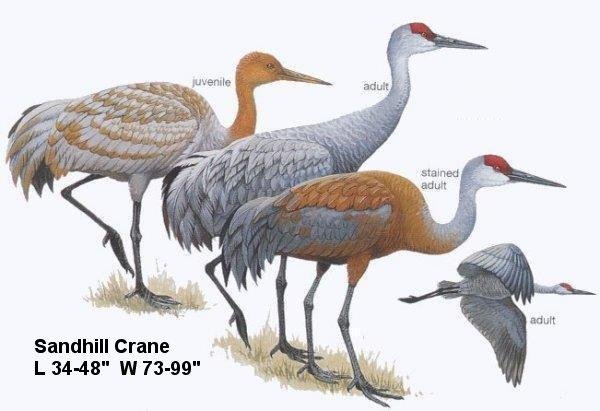
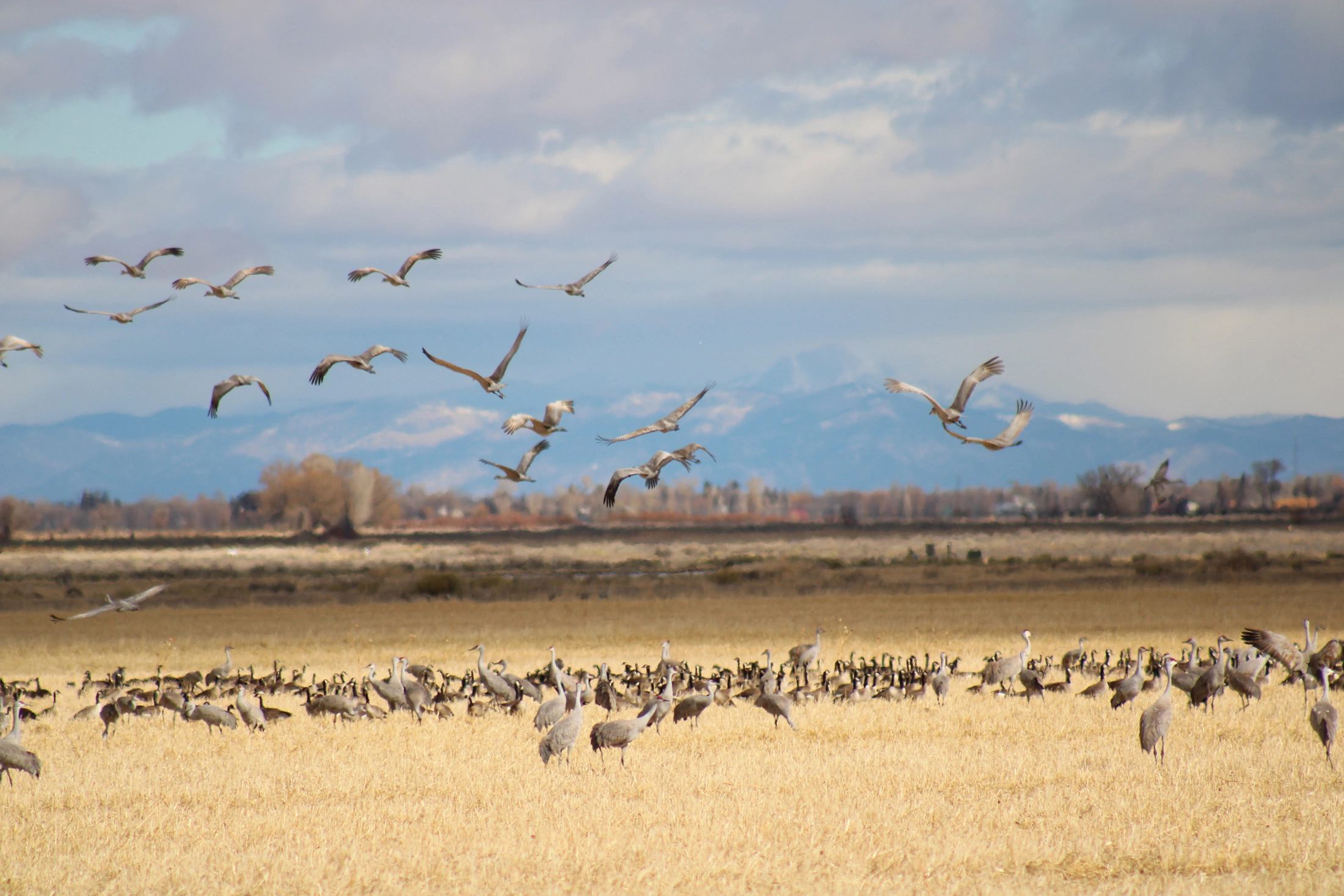
Sandhill Cranes
Other insights from the report:
Agriculture in the San Luis Valley, including cattle ranching, generates 10 percent of all output in the region (although this varies significantly by county) and makes up 39 percent of Colorado’s total agricultural output.
Agriculture is the single largest private employer in the SLV, and irrigated agriculture employs 8 percent of the total workforce (an estimated 2,322 jobs per year). Approximately 64 percent of these jobs are in the category of all other crop farming (which represents alfalfa and grass hay) and 34 percent are in vegetable farming (mostly potatoes).
The agriculture, forestry, fishing, and hunting sector generate over 4,000 jobs each year. This sector also leads in economic output, generating $566 million annually.
The value of clean drinking water in the San Luis Valley is estimated to be over $3,600,000 per day.
The analysis also found that water-related habitat in the Valley is valued at more than $49 million annually and the annual Crane Festival generates $4 million in direct revenue from visitor spending.
“It’s just apparent that just as water flows through this community, so do the dollars that are generated from that water,” said economist Claire Sheridan.
Sheridan did the math for the audience at the Rio Grande Symposium in explaining how far under value RWR’s $50 million community fund pitch was when considering the value of water to residents of the Valley.
She used a model FEMA goes by in its emergency management work that factors in two components in creating a value for water to a community: One component is a willingness to pay for clean and safe drinking water. “If you go to your tap and turn on your water, what are you willing to pay to make sure that you can drink that water? What is that worth to you?” The other component is “avoided replacement cost” that factors in costs if a resident has to go buy water.
For the San Luis Valley and its estimated population of 46,600, those two components combined come out to about $77.23 per person, per day, said Sheridan. When you apply $77.23 to the Valley’s population, the value for clean drinking water in the San Luis Valley is about $3.6 million per day or $1.3 billion annually.
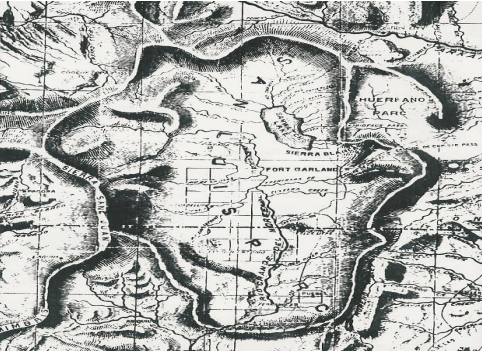
1869 Map of San Luis Parc of Colorado and Northern New Mexico. “Sawatch Lake” at the east of the San Luis Valley is in the closed basin. The Blanca Wetlands are at the south end of the lake.
Click the link to read the article on the InkStain website (John Fleck):
April 4, 2025
We are heading into a remarkable year on New Mexico’s Middle Rio Grande. Here are some critical factors:
The preliminary April 1 forecast from the NRCS is for 27 percent of median April – July runoff at Otowi, the key measurement gage for New Mexico’s Middle Rio Grande.
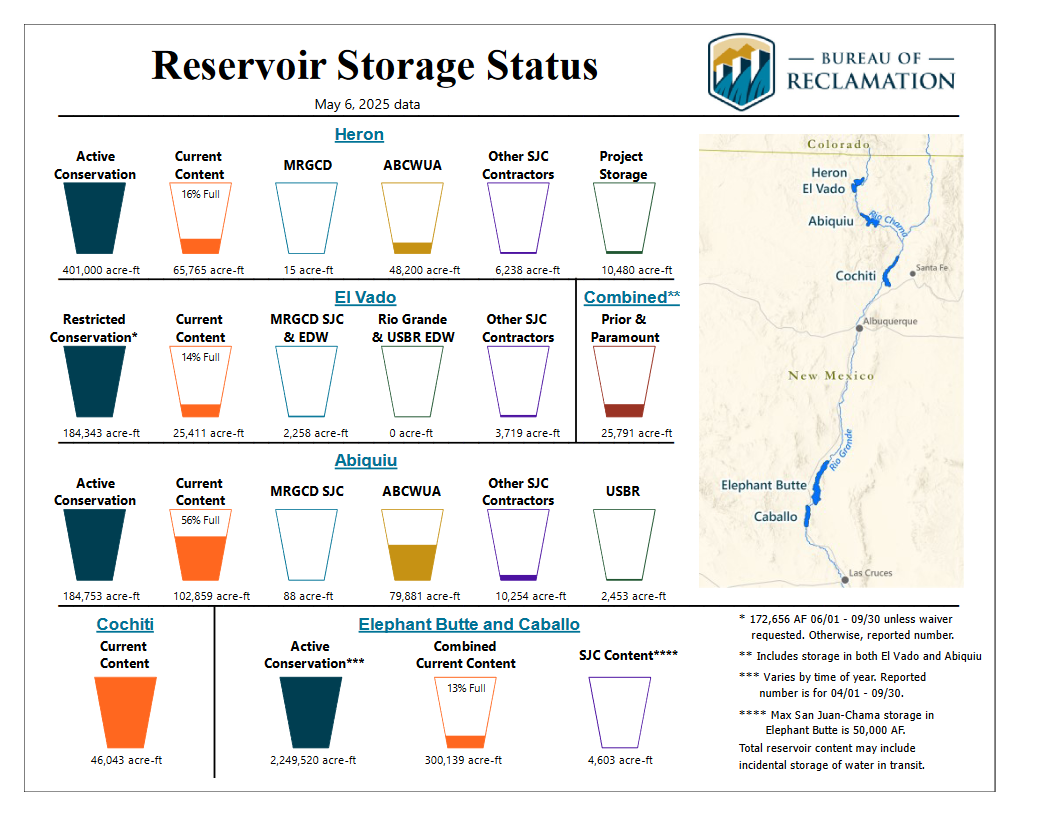
Current reservoir storage above us is basically nothing.
Reclamation’s most recent forecast model runs suggest flow through Albuquerque peaked in February. It usually peaks in May.
We will learn a great deal this year.
What I’m Watching
New Mexico water projects map via Reclamation
City Water
At last night’s meeting of the Albuquerque Bernalillo County Water Utility Authority’s Technical Customer Advisory Committee, water rights manager Diane Agnew said the utility is planning to shut down its river diversions, shifting system operations to groundwater, by the end of April. Albuquerque invested ~half a billion dollars in its river diversion system, in order to make direct use of our San Juan-Chama Project water, to relieve pressure on the aquifer. This will be the fifth year in a row that Rio Grande flows have been so low that we can’t use the new system for a substantial part of the year.
(For the nerds, Diane’s incredibly useful slides from last night’s TCAC meeting are here, the 4/3/2025 agenda packet.)
We have groundwater. My taps will still run, and I’ll be able to water my yard. But we’ll once again be putting stress on the aquifer that we’ve been trying to rest, to set aside as a safety reserve for the future. Is that future already here?
Reclamation operates pumps to move water from the Low Flow Conveyance Channel into the Rio Grande. The LFCC acts as a drain for the lower part of the Middle Rio Grande.
Irrigation
Middle Rio Grande Conservancy District irrigators who depend on ditch water are going to have a tough year, with supplies running short very early. The impacts here are a little weird.
Most of the relatively small number of the non-Indian full-on commercial farmers have supplemental wells. Smaller operators, who farm as a second income, will have to rely on their first income, whatever that is, and hope for some monsoon rains to get more cuttings of hay. Lots of hobby farmers will just run their domestic wells, or buy hay for their horses from out of state.
Native American farming is a more complicated story that I don’t fully understand. State and federal law recognize the fact that they were here first – we really do kinda comply with the doctrine of prior appropriation here. Their priority rights – “prior and paramount” – were enshrined in federal law in the 1928 act of Congress that kicked in federal money through the predecessor of the Bureau of Indian Affairs – crucial money to get construction of the Middle Rio Grande Conservancy District started when no one else – neither the rest of the federal government, nor the bond market – was willing to pony up the money. (Buy our new book Ribbons of Green, as soon as UNM Press publishes it! It includes a deep dive into the critical role of the Pueblos in supporting the formation and early funding of the MRGCD, without which there likely would be no MRGCD.)
Is there a way to set aside some prior and paramount water for Pueblo farmers this year to keep their fields green?
Side channels were excavated by the Bureau of Reclamation along the Rio Grande where it passes through the Rhodes’ property to provide habitat for the endangered silvery minnow. (Dustin Armstrong/U.S. Bureau Of Reclamation)
River Drying
The Rio Grande through Albuquerque will go dry, or nearly so, in a way we haven’t seen since the early 1980s. That means a very tough year for the endangered Rio Grande silvery minnow. We’re testing the boundaries of the definition of “extinction”. (To understand the minnow story, I again commend you to my Utton Center colleague Rin Tara’s terrific look at the minnow past and future.)
Do people care, either about the minnow or the river itself? We’ll find out!
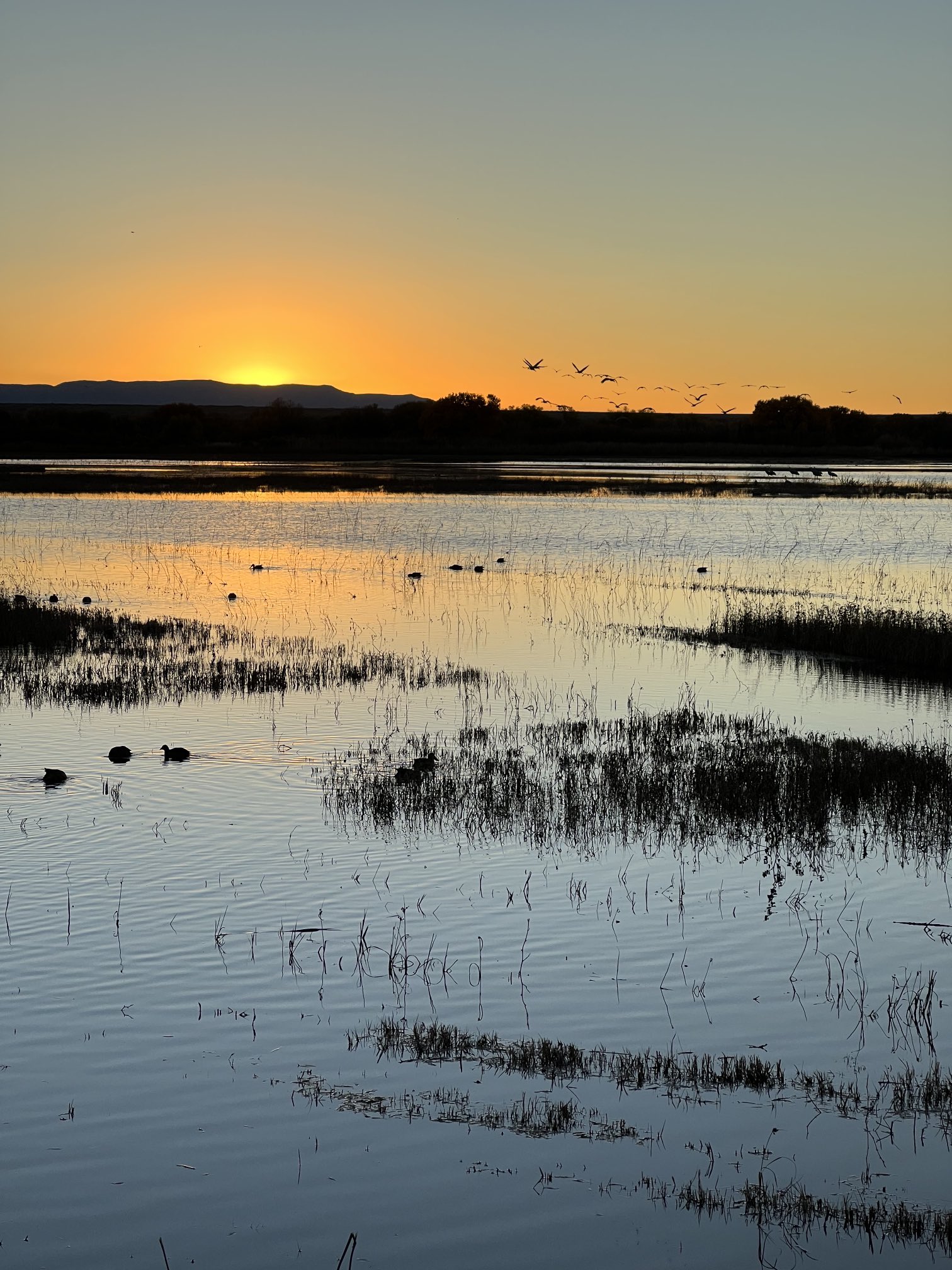
Birds and water at Bosque de Apache New Mexico November 9, 2022. Photo credit: Abby Burk
Bosque
Our riverside woods, a ribbon of cottonwood gallery forest that took root in the mid-20th century between the levees built by the Bureau of Reclamation, will likely stay relatively green. The trees dip their roots into the shallow aquifer. As we’ve seen with the more routine river drying that happens every year to the south, the bosque muddles through.
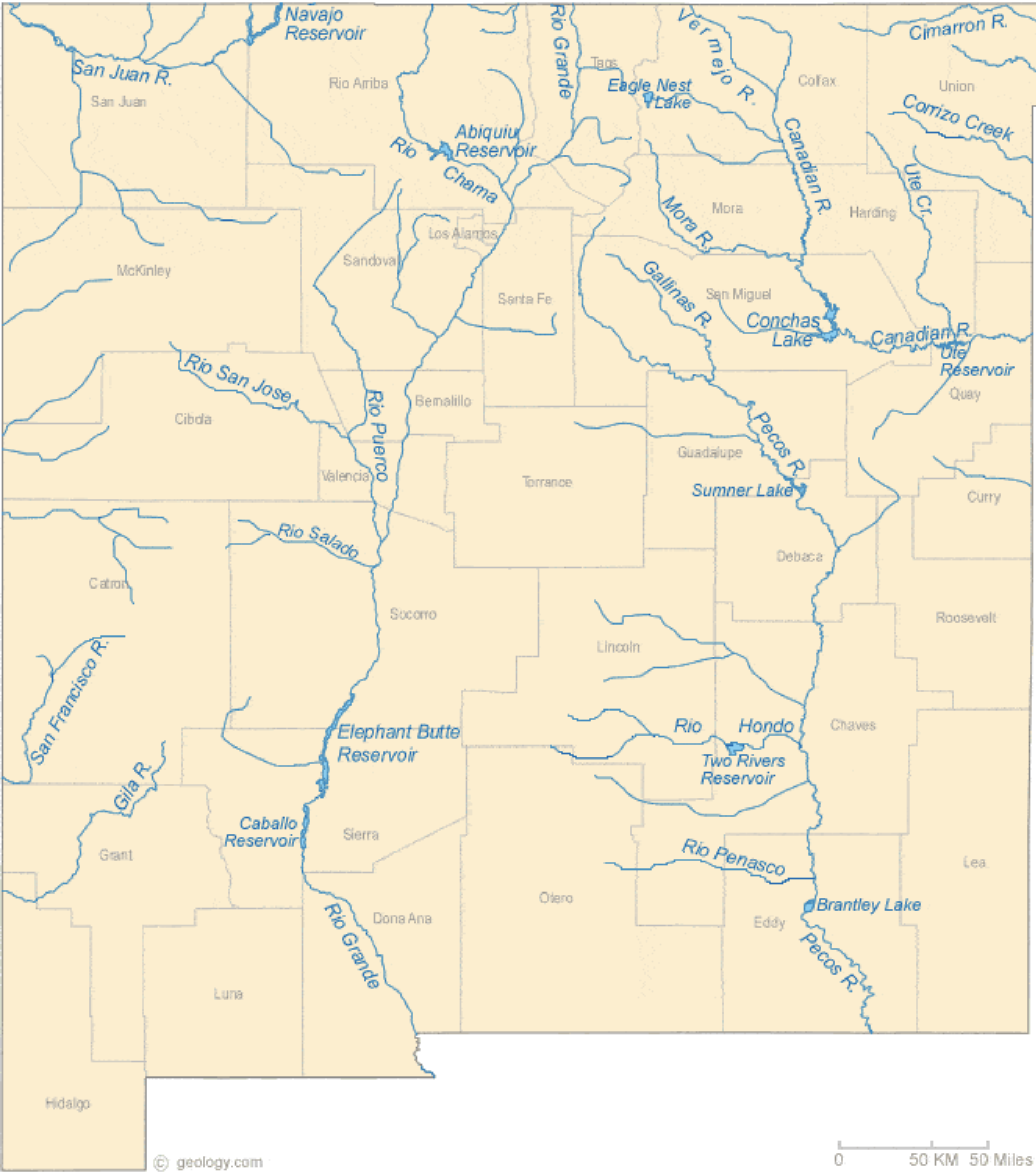
New Mexico Lakes, Rivers and Water Resources via Geology.com.
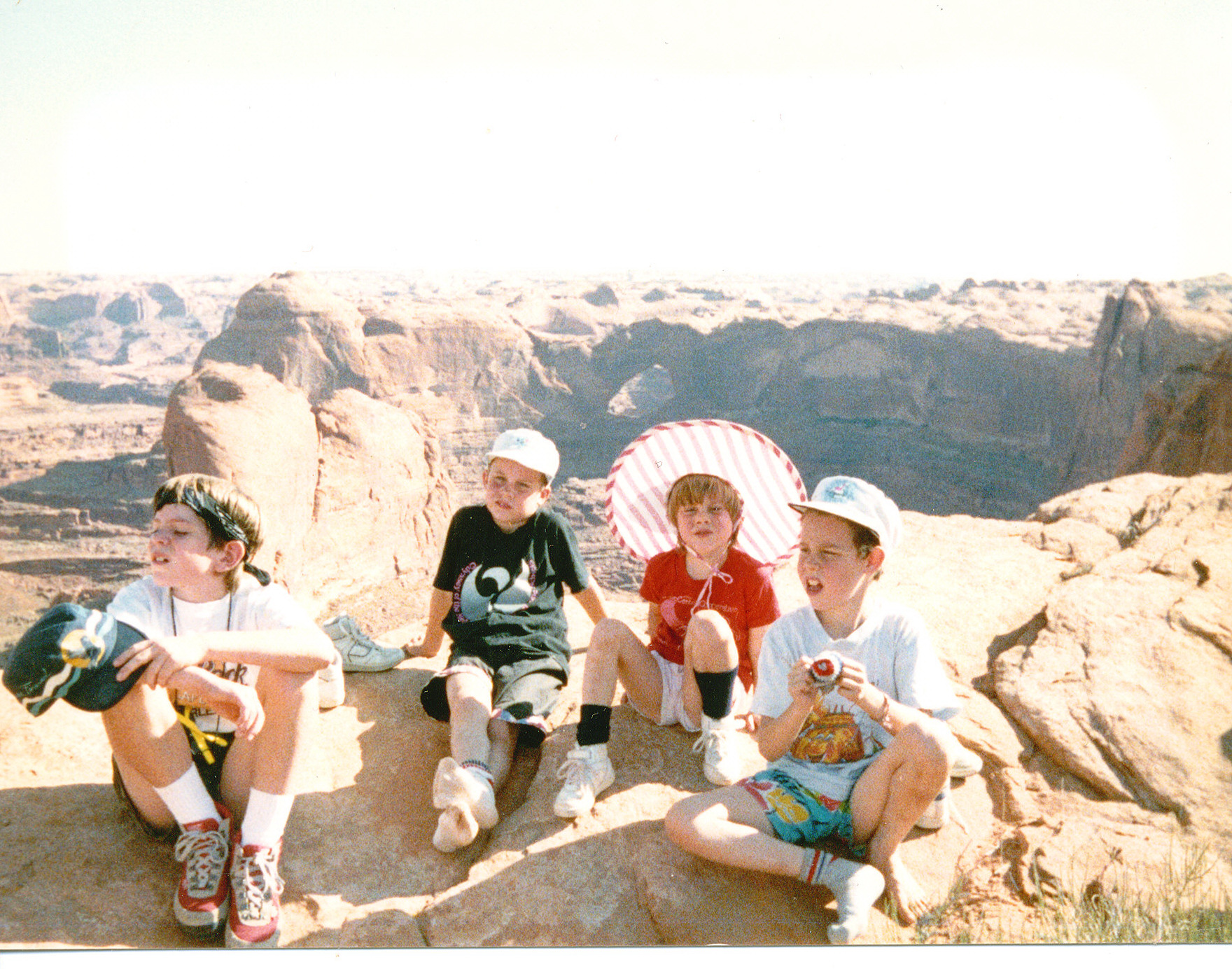
My friend Joe’s son and the Orr kids at the top of the Crack in the Wall trail to Coyote Gulch with Stevens Arch in the Background. Photo credit: Joe Ruffert
Kevin Fedarko was the keynote speaker at the symposium and he is as inspirational a speaker as you could ask for. It doesn’t hurt that the landscape that he spoke about is the Grand Canyon. He urged the attendees to, “Take your children out into these landscapes so that they can learn to love them.” He is advocating for the protection of the Grand Canyon in particular but really he is advocating for the protection all public lands.
Kevin Fedarko and Coyote Gulch at the Rio Grande State of the Basin Symposium hosted by the Salazar Rio Grande del Norte Center at Adams State University in Alamosa March 29, 2024.
What an inspirational talk from Kevin. I know what he is saying when he speaks about the time after dinner on the trail where the sunset lights up the canyon in different hues and where, he and Pete McBride, his partner on the Grand Canyon through hike, could hear the Colorado River hundreds of feet below them, continuing its work cutting and molding the rocks, because the silence in that landscape is so complete. He and I share the allure of the Colorado Plateau. Kevin was introduced to it through Collin Flectcher’s book The Man Who Walked Through Time, after he received a dog-eared copy from his father. They lived in Pittsburgh in a landscape that was industrialized but the book enabled Kevin to imagine places that were unspoiled.
My introduction to the Colorado Plateau came from an article in Outside magazine that included a panoramic photo of the Escalante River taken from the ledges above the river. Readers in the know can put 2 and 2 together from the name of this blog — Coyote Gulch — my homage to the canyons tributary to Glen Canyon and Lake Foul.
Stevens Arch viewed from Coyote Gulch. Photo via Joe Ruffert
Kevin’s keynote came at the end of the day on March 29th after a jam-packed schedule.
Early in the day Ken Salazar spoke about the future of the San Luis Valley saying, “Where is the sustainability of the valley going to come from.” Without agriculture this place would wither and die.” He is right, American Rivers and other organizations introduced a paper, The Economic Value of Water Resources in the San Luis Valley which was a response to yet another plan to export water out of the valley to the Front Range. (Currently on hold as Renewable Water Resources does not have a willing buyer. Thank you Colorado water law.)
Claire Sheridan informed attendees that their report sought to quantify all the economic benefits from each drop of water in the valley. “When you buy a bottle of water you know exactly what it costs. But what is the value of having the Sandhill cranes come here every year?”
Sandhill Cranes Dancing. Photo by: Arrow Myers courtesy Monte Vista Crane Festival
Russ Schumacher detailed the current state of the climate (snowpack at 63%) and folks from the Division of Water Resources expounded on the current state of aquifer recovery and obligations under the Rio Grande Compact.
The session about the Colorado Airborne Snow Measurement Program was fascinating. Nathan Coombs talked about the combination of SNOTEL, manual snow courses, Lidar, radar, and machine learning used to articulate a more complete picture of snowpack. “You can’t have enough tools in your toolbox,” he said.
Coombs detailed the difficulty of meeting the obligations under the Rio Grande Compact with insufficient knowledge of snowpack and therefore runoff volumes. Inaccurate information can lead to operational decisions that overestimate those volumes and then require severe curtailments in July and August just when farmers are finishing their crops. “When you make an error the correction is what kills you,” he said.
If you are going to learn about agriculture in the valley it is informative to understand the advances in soil health knowledge and the current state of adoption. That was the theme of the session “Building Healthy Soils”. John Rizza’s enthusiasm for the subject was obvious and had me thinking about what I can do for my city landscape.
Amber Pacheco described how the Rio Grande Basin Roundtable and other organizations reach out to as many folks in the valley as possible. Inclusivity is the engine driving collaboration.
I’m in Alamosa to attend the symposium. There is a great program planned for today chock full of information about Colorado’s “South Slope”. Click the link to view the agenda. Of course snowpack will be a large part of the discussion today, as it is every April 1st in Colorado. Also, I’m looking forward to the session featuring a new study from American Rivers with Heather Dutton and Emily Wolf.
Russ Schumacher will be discussing snowpack and precipitation.
layer cakes over the Sangre de Cristos (which could really use some more snow) #cowx
A view of one of the Valley’s major agriculture resources, cattle. Credit: Owen Woods
Click the link to read the article on the Alamosa Citizen website (Heather Dutton and Emily Wolf):
March 27, 2025
Here in the San Luis Valley, water is deeply connected to our way of life. The Rio Grande, its tributaries and connected groundwater support local heritage, agriculture, recreation and the natural environment. Like all of the region’s streams and rivers, the Rio Grande is critical to the livelihood and economies of the communities of the SLV and is a growing recreational and economic asset to communities outside of the Valley as well.
Photo credit: Sinjin Eberle/American Rivers
To help illustrate the critical value water plays across all sectors in the Valley, American Rivers and One Water Econ released a new study this week, The Economic Value of Water Resources in Colorado’s San Luis Valley, which presents the economic benefits of key sectors and services that depend on water in the Valley. The analysis looks at irrigated agriculture, municipal and industrial uses, tourism and recreation, and environmental values like wildlife habitat.
While we all know and understand the intrinsic value of water in the Valley, economic data will further elevate not only the social importance of water, but also the economic contributions the Rio Grande and Conejos River, other streams, and connected groundwater provide to the San Luis Valley. Our community can use this economic data to tell the story of ongoing collaborative water management projects, help fight future threats, including groundwater export schemes, and make the case for multi-benefit river restoration efforts that are a win-win-win for agriculture, communities, and the environment.
San Luis People’s Ditch March 17, 2018. Photo credit: Greg Hobbs
Irrigated agriculture, a key economic driver in the SLV, is reliant on the surface water flowing through the Valley along with the vast number of groundwater wells and is deeply connected to the history of the Valley. The study found that crops supported by surface and groundwater make up 39 percent of Colorado’s total agricultural output, despite the population of the Valley being less than 1 percent of Colorado’s population. Additionally, irrigated agriculture was found to contribute more than $480 million annually in economic output. For every $1 that is spent on local inputs for agriculture production, an additional $1.56 is generated in the regional economy. Potatoes and vegetables are the largest economic generators in the agricultural space, with an annual economic output of $184 million. Not only does irrigated agriculture provide critical economic benefits, but the irrigated fields and wet meadows also support critical migratory bird habitat.
Sandhill cranes stop and gather in a field near the Monte Vista National Wildlife Refuge during their yearly trek.
Recreation, a growing economic sector for the Valley, is heavily reliant on water flowing from the surrounding mountains into the Valley and provides significant economic value. The Great Sand Dunes National Park and Preserve attracts national and international travelers, as do the world-class birding and wildlife viewing opportunities at the nine state and national wildlife refuges that are made up of wetland, riparian, and open water ecosystems, and support numerous species of resident and migratory birds, including sandhill cranes. Additionally, the Rio Grande and Conejos River draw many visitors for both whitewater boating and world class fishing. The recent economic analysis found water-related recreation provides $213.7 million in benefits annually in the San Luis Valley, and for every $1 spent on recreation, $1.91 is generated through ripple effects within the local economy. The Valley’s riverside lands, wetlands, and wet meadows are a critical part of the natural infrastructure supporting recreation and many species of wildlife. The analysis found that water-related habitat in the Valley is valued at more than $49 million annually and the annual Crane Festival generates $4 million in direct revenue from visitor spending.
Many other industries beyond recreation and agriculture also rely on water – local breweries, distilleries, bakeries, greenhouses, hospitals, and hotels among others – all rely on water. These “water-dependent” industries (WDIs) generally rely on the services of water utilities to support and grow their businesses. Water-dependent industries in the Valley support nearly $1.3 billion annually in total economic output. Water is undeniably a critical resource for the Valley, providing not only economic benefits but other ecosystem services, and intrinsic and cultural values. The economic data from this new analysis provides San Luis Valley communities with information to help protect the Valley from export schemes, further support water projects that conserve the Valley’s precious resources, and illustrate to those outside the Valley why water is so critical to the livelihoods of every person in the SLV.
Partners involved in the creation of the study from American Rivers, One Water Econ, and the San Luis Valley Water Conservancy District will present information about the study at the Rio Grande State of the Basin Symposium at Adams State University on March 29. The event is open to the public and all are encouraged to attend. The analysis is also available on American River’s website at www.americanrivers.org/SLVEconomicReport.
Created by Imgur user Fejetlenfej , a geographer and GIS analyst with a ‘lifelong passion for beautiful maps.’ It highlights the massive expanse of river basins across the country – in particular, those which feed the Mississippi River, in pink.
In a historic and consequential move, the United States has officially denied Mexico’s request for a special water delivery from the Colorado River to Tijuana. The Bureau of Western Hemisphere Affairs, a U.S. Department of State division, addressed this matter on March 20, 2025, via their official social media channels. It marks the first time since the signing of the 1944 Water Treaty that such a request has been rejected — signaling deepening tensions over water management and compliance between the neighboring nations. The 1944 treaty, a longstanding bilateral agreement, regulates water distribution between the U.S. and Mexico between the Rio Grande and Colorado Rivers. According to the treaty, Mexico must deliver 1.75 million acre-feet of water to the U.S. over five-year cycles, averaging 350,000 acre-feet annually. However, by late 2024, Mexico had fallen over one million acre-feet behind its commitments. Officials attribute this shortfall to a combination of prolonged drought, increased agricultural demands, and aging infrastructure on the Mexican side of the border. The U.S. Department of State defended its decision by citing the severe impact that Mexico’s ongoing shortfalls have had on American agriculture — particularly in the Rio Grande Valley of Texas, where water scarcity is crippling the livelihoods of thousands of farmers. Crops such as citrus, cotton, and vegetables have suffered from reduced irrigation, leading to lower yields and economic instability in the region…
Tijuana, which sources approximately 90% of its water from the Colorado River, faces intensifying shortages. The city’s aging infrastructure, combined with the broader regional drought, means the denial of emergency water deliveries from the U.S. could further strain Baja California’s already fragile water supply systems. The water crisis is also reshaping the agricultural landscape in South Texas — most notably in Santa Rosa. The Rio Grande Valley Sugar Growers, Inc. (RGVSG), a cooperative of over 100 family-owned farms and the last remaining sugar mill in Texas, was forced to shut its doors after over five decades of operation. The closure followed a dramatic decline in sugarcane acreage, which dropped from 34,000 acres in early 2023 to just 10,000 by early 2024. Without reliable irrigation water — much of it linked to Mexico’s unmet deliveries — sugarcane farming became economically unsustainable.
The Vinton stretch of the Rio Grande just north of El Paso at Vinton Road and Doniphan Drive on May 23, 2022. The river below Elephant Butte Reservoir in Southern New Mexico through Far West Texas is dry most months of the year, only running during irrigation season. (Photo by Diana Cervantes for Source NM)
Click the link to read the article on the USDA website:
McALLEN, Texas, March 19, 2025 – U.S. Secretary of Agriculture Brooke Rollins today announced a $280 million grant agreement between the U.S. Department of Agriculture (USDA) and the Texas Department of Agriculture (TDA) to provide critical economic relief to eligible Rio Grande Valley farmers and producers suffering from Mexico’s ongoing failure to meet its water delivery obligations under the 1944 Water Treaty. Secretary Rollins announced this grant agreement today in McAllen, Texas alongside U.S. Senator Ted Cruz and U.S. Representative Monica De La Cruz (TX-15).
“Farmers and ranchers in the Rio Grande Valley have worked for generations to feed communities across Texas, the U.S., and beyond,” said Secretary Rollins. “A lack of water has already ended sugarcane production in the Valley and is putting the future of citrus, cotton, and other crops at risk. Through this grant, USDA is expediting much-needed economic relief while we continue working with federal, state, and local leadership to push for long-term solutions that protect Texas producers.”
“The Texas agriculture community helps feed, clothe, and fuel our entire country, and it is critical that they have the help and resources they need to keep their industry thriving,” said Senator Cornyn. “Today’s announcement of more than $280 million in emergency assistance is great news for South Texans, many of whom have been greatly impacted by Mexico’s failure to deliver water under the 1944 Water Treaty. I was proud to help lead the fight to secure this important funding alongside Senator Cruz, Congresswoman De La Cruz, and Senate Ag Committee Chairman Boozman, who joined me in the Rio Grande Valley last year to hear firsthand from farmers about the challenges they are facing. I will continue advocating for the needs of Texas farmers and ranchers in Washington, and with the help of the Trump administration, I look forward to seeing this industry continue to grow.”
“I was proud to lead the effort in the U.S. Senate to secure this $280 million block grant, which is critical for Texas producers in the Rio Grande Valley, and to work with Secretary Rollins and President Trump in getting it across the finish line. Secretary Rollins is a champion of agriculture, and we are working together on the crisis facing Texas agriculture across the board, including holding Mexico accountable for its obligations under the 1944 Water Treaty,” said Senator Cruz.
“Farmers and ranchers are the backbone of our South Texas communities and economy. The funding deployment announced by Secretary Rollins today will provide critical relief for the South Texas agricultural industry after suffering tremendous losses due to drought conditions and the Government of Mexico’s refusal to comply with the 1944 Water Treaty. I am proud to work alongside the Administration to deploy this critical aid and deliver solutions for the families, businesses, and communities across the nation that rely on Texas agriculture to thrive,” said Representative De La Cruz.
“I’m proud to partner with the Trump administration and USDA to get this critical funding out the door and into the hands of our South Texas farmers and ranchers,” said Texas Agriculture Commissioner Sid Miller. “The rollout of the 1944 Water Treaty Grant Agreement is exactly the kind of action we need to help our agriculture producers in the valley weather this prolonged drought.”
Under the 1944 Water Treaty, Mexico is obligated to deliver an annual minimum of 350,000 acre-feet of water measured in five-year cycles or 1.75 acre-feet over five years to the United States from the Rio Grande River. The United States in turn delivers 1.5 million acre-feet of water to Mexico from the Colorado River. Mexico’s persistent noncompliance with this treaty agreement has led to severe water shortages for Rio Grande Valley farmers and ranchers, devastating crops, costing jobs and threatening the local economy.
As outlined in the grant agreement, TDA will oversee the implementation of these grant funds, including managing the sign-up process and distributing payments. Payments through this grant agreement will be issued to eligible producers who suffered eligible loss of water deliveries in calendar years 2023 and 2024.
An eligible producer is one who was in the business of production agriculture and had a Texas Commission of Environmental Quality Division certificate authorizing the diversion of water in calendar years 2023 and/or 2024 in the Lower Rio Grande River Valley Water District in Texas.
Producers who are likely to benefit from this grant funding will receive additional details through TDA.
The United States on Thursday said it denied an urgent request made by Mexico for water to be delivered to Tijuana under a 1944 water-sharing treaty between the two nations, with the United States blaming Mexico for “decimating American agriculture – particularly in the Rio Grande Valley.”
The move highlights the complicated and stressful relationship the two nations have through water-sharing agreements with the Colorado River and Rio Grande Basin, and how the effects of climate change are playing into water disputes.
Mexico made a request for a special delivery of water from the Colorado River to be delivered to Tijuana, the U.S. State Department’s Bureau of Western Hemisphere Affairs said in a post on X. The Treaty of February 3, 1944 calls for Mexico to deliver water from rivers that form the Rio Grande Basin to the United States, which in turn sends Mexico water from the Colorado River.
In recent years as surface and groundwater supplies shrink from warming southern regions, Mexico has fallen behind in its water obligations under the treaty. Last year the Rio Grande Valley Sugar Growers, Texas’s only sugar mill, closed and blamed a lack of water that came through Mexico’s compliance with the 1944 water treaty for halting operations after 51 years.
“Mexico’s continued shortfalls in its water deliveries under the 1944 water-sharing treaty are decimating American agriculture – particularly farmers in the Rio Grande Valley,” the State Department’s Bureau of Western Hemisphere Affairs said in its X post. “As a result, today for the first, the U.S. will deny Mexico’s non-treaty request.”
Mexican President Claudia Sheinbaum told reporters in Mexico, “there’s been less water. That’s part of the problem.”
Water Commission. The little-known agency handles any disputes involving the water compacts and controls the flow of water through the management of water gates.
In November of 2024, the United States and Mexico reached an agreement on how to improve delivery of water under the 1944 water treaty to address Mexico’s problems. It took 18 months of negotiations to reach a deal.
Talk Given to Business for Water Stewardship on March 10, 2025
In Colorado, we confront challenges as opportunities. As Wallace Stegner, the famed Western writer, once put it—it’s impossible to be pessimistic in the West; it’s the native land of hope. How we manage our water is a test of that ethos.
There are no two ways to put this: we face significant water scarcity challenges in Colorado and the West. That scarcity is driven, in part, by increasing demands as population booms. And it’s also driven by our changing climate, which is reducing snowpack, changing runoff patterns, increasing evaporation, and drying soils.
While we know that climate change significantly impacts Colorado’s water, its extent and exact impact is presently unknown. That uncertainty, coupled with the unpredictability in rainfall and snowpack, is destabilizing—making it difficult for farmers, ranchers, and even cities to know what to expect each year or how to plan for the future. Unfortunately, the variable weather patterns we are seeing are very likely to be our new normal, creating considerable pressure for us to create more adaptive and resilient systems for water management.
Increased uncertainty and unpredictability in water make planning more important than ever, with an imperative of developing new and innovative strategies for water management. It is no exaggeration to say that the future success of Colorado will depend, in considerable part, on our ability to adapt to scarcity and reduce the uncertainty and unpredictability that come with it. The best and most durable solutions will go beyond individual success and will collaborate with other interests to find win-win solutions.
I know this is important to Business for Water Stewardship, and I’m excited to talk with you about it today. I also want to speak about how our management of water must remain intertwined with respect for the rule of law, as the solutions we craft are only as good as the laws they are built upon and the institutions charged with implementing and upholding them.
I. Moving Toward a Resilient and Adaptive System of Water Management
Adapting to scarcity and creating more certainty will require us to develop innovative and collaborative strategies for water management. It will also require collective action. We cannot focus on individual successes and ignore the community in which these projects occur. I appreciate how you captured this point on your website:
We believe businesses have an opportunity—and a responsibility— to ensure that their operations and investments improve communities and ecosystems where they do business. And in water-stressed regions, that responsibility is deeply rooted in how we value, use, and protect water. That’s why we help businesses work collaboratively with community and policy stakeholders to advance solutions that ensure people, economies, and ecosystems have enough clean water to flourish.[1]
I couldn’t agree more. Each of us, whether as businesses or individuals, has a responsibility to ensure that, wherever we can, we work to improve communities and ecosystems where we live and work. Let me begin by focusing on a few projects that have done that. And I want to contrast those with projects that do not.
The Maybell Diversion Project is a wonderful example of a project that has multiple benefits. Updating and modernizing the Maybell Diversion Project improved efficiency for irrigation, increases resiliency to drought, and benefitted threatened and endangered species.[2]
Before the project was completed in 2024, irrigators from Maybell Irrigation District had to trudge two hours through steep, rugged sagebrush country to manually open and close the rusted and broken metal headgate.[3] It was an arduous, yet crucial task because Maybell is one of the largest irrigation diversions on the Yampa.[4]
The Nature Conservancy worked with numerous partners to help fund the $6.8M project. Funding partners include: the Bureau of Reclamation’s WaterSMART program; the National Fish and Wildlife Foundation; the Upper Colorado River Endangered Fish Recovery Program,[5] and the Colorado Water Conservation Board.[6]
Today, the opening and closing of the Maybell headgate can be controlled remotely and is determined by a combination of water user needs and available flows into the Maybell Ditch. The Maybell Irrigation District also coordinates with the Upper Colorado River Endangered Fish Recovery Program and the Division of Water Resources to guide water use in the Lower Yampa.[7]
As I said previously, this project promises mutual benefits. It allows continued irrigation of historical lands, which supports local farmers and the economy. At the same time, it also improves fish habitat and removes barriers to boat passage, supporting the environment and secondary economic benefits like river recreation.
In 2021, I spoke to the Colorado Water Congress about “The Imperative of Investing in Water Infrastructure.”[8] In that speech, I highlighted important water infrastructure projects around the state, including a plan to replace the aging Grand Valley Hydroelectric facility with a new more efficient plant capable of producing 1.5 times as much power. Like the Maybell Diversion Project, that plan brought multiple benefits. In addition to producing more clean electricity, their continued use of the water right will ensure that water flows into the 15-mile Reach, a critical stretch of river for four species of endangered fish. Many local irrigators will also benefit from increased diversions at an upstream diversion point supplying the plant.
In that speech, I also emphasized the importance of developing funding sources and investment opportunities in water infrastructure. I mentioned a few success stories, like Proposition DD, HB 21-1260, which provides $20 million in funding for implementation of the Colorado Water Plan, and HB 21-240, which provides $30 million for watershed restoration in response to wildfires, including funding for flood prevention and mitigation. But those are not enough. With continued growth on the horizon, our commitment to fund projects laid out in the Colorado Water Plan is imperative. That plan is the roadmap for investing in our future and fulfilling the Plan’s vision will take billions of dollars.
Photo credit: Rye Resurgence Project
B. Rye Resurgence Project
The Rye Resurgence Project in the San Luis Valley supports continued farming, while reducing water use, improving soil health, and helping the community flourish.
During this time of drought, it is critical that we find ways to use less water without sacrificing economic opportunities. This can help build resilience in the face of shrinking water supplies. Crops, like rye, can use far less water—up to 40%—than other similar crops like barley or oats.[9] This difference is huge in a region that is trying to conserve water in order to balance Rio Grande water use with supply. Data in 2024 shows the San Luis aquifer at its lowest recorded level in history.[10]
An important element of the Rye Resurgence Project is that it recognizes that switching to crops that require less water will only succeed if there is a market where farmers can sell those new crops at a profit. The project helps build a market for Colorado rye by investing significant effort and resources in marketing, branding materials, and personnel to develop relationships between the growers and the end users of rye such as brewers, distillers, millers, bakers, and consumers.[11] Building the market for San Luis Valley Resurgence Rye gives farmers an option to reduce their impact, earn a living wage, and support the local community. By keeping farmers farming, the future health of the community will be sustained.
II. Two Cautionary Tales to Avoid in the Future
The above two projects reflect effective strategies for managing water during this challenging time. There are, however, examples that have proven to be ineffective that are important to learn from. I will discuss two such cautionary case studies, highlighting some pitfalls of mismanaging water.
A. Alfalfa for Saudia Arabia
The growing of alfalfa in Arizona to ship to Saudi Arabia is perhaps the most glaring example of a project whose success comes at the expense of the community in which it occurs.[12] The short story of this project is that Saudi firms bought up 9 square miles of land in Arizona for irrigating and growing alfalfa grass.[13] The firms grew alfalfa in Arizona to export to Saudi Arabia and the United Arab Emirates because they had already drained their own aquifers.[14]
Alfalfa is an incredibly water-intensive crop. Growing it in a desert climate drastically impacts the surrounding communities. The Saudis were using the same amount of water to grow hay just for export as what a million people in the state use for water every year.[15] The Saudis invested a huge amount of water into the crop which they couldn’t grow at home because they don’t have the water. Essentially, this is exporting Arizona’s water.
By transporting the alfalfa overseas instead of selling it domestically, this also eliminated all future economic returns on that water. If that alfalfa stayed in Arizona, for example, it could have been sold to domestic cattle producers and benefited local communities and businesses. None of those domestic gains were achieved once the alfalfa left our shores.
Potential Water Delivery Routes. Since this water will be exported from the San Luis Valley, the water will be fully reusable. In addition to being a renewable water supply, this is an important component of the RWR water supply and delivery plan. Reuse allows first-use water to be used to extinction, which means that this water, after first use, can be reused multiple times. Graphic credit: Renewable Water Resources
B. Buy and Dry Schemes
In Colorado, we have seen before what is now labelled a “buy and dry” scheme. This scheme involves the sale of relatively all the water from a community, shipping it to a thirsty urban community and destroying a local agricultural economy. That is, in short, the tale of what happened in Crowley County.[16] As captured in Colorado’s Water Plan, it is an approach that we are committed to avoiding in the future.[17]
For an example of a buy and dry project now on the table, consider the case of the (improperly named) Renewable Water Resources. That project would buy out wells that are currently used to irrigate lands in the San Luis Valley and, rather than using that water for irrigation and farming, it would be piped to the front range for new suburban houses.[18] This has several direct and indirect negative economic impacts as well as cultural impacts on the San Luis Valley. This project makes one rural community suffer while a suburban community prospers.
In contrast to the Rye Resurgence Project, which invests in farmers to help them adapt to new markets, this project disregards farmers and eliminates the economic driver for their community. Proponents say the water is necessary to ensure other communities have enough water supply to secure their future. But we can’t let ourselves be tricked into believing that economic prosperity or managing our water resources is a zero-sum game.
Perkins County Canal Project Area. Credit: Nebraska Department of Natural Resources
C. Perkins County Canal
For another example of approaching our water management challenges as a zero-sum game, take the case of Nebraska’s proposed Perkins County Canal project. In a zero-sum game, there can be some winners, but at a high cost to others. In this case in particular, there will be many more losers and lots of wasted time and money. Rather than pursue such a costly path, we can find shared goals and interests and build solutions to help achieve those.
Under Nebraska’s plans, it will invest the time, money, and effort to build a canal to divert water in Colorado for use in Nebraska under the 1923 South Platte River Compact. If Nebraska does that, then Colorado water users will likely build countermeasures to offset impacts of the canal. Under this scenario, both Nebraska and Colorado would end up investing hundreds of millions of dollars, but almost all water users in each state would end up in a position that is no better than they were before Nebraska proposed the canal.
A better approach to the issue is one that recognizes that the agricultural economy and the communities it supports doesn’t observe state boundaries. The economy is regional. Farmers own land in both states. An individual farmer might buy supplies in Nebraska and farm in Colorado. And the reverse is likely true. Durable solutions need to benefit the region and not make the success contingent on the failure of the other. I will continue to do all I can to work towards such a solution.
See Article 7.
III. The Importance of the Rule of Law in Water Management
As we adapt to changing hydrology and look for flexible and collaborative solutions, it will also be important to stand firm on certain principles. Our success not only relies on our adaptability, but also on a solid foundation of laws that are consistently enforced with predictable results.
Colorado’s framework for managing water is based on state-level oversight and ultimate responsibility. This is bolstered by significant reliance on regional and local partnerships to facilitate solutions that are tailored to the water supply needs of local communities. The Colorado model prioritizes respect for and collaboration with regional bodies, such as water conservancy and conservation districts, with a norm of deferring to local expertise and solutions whenever possible. Nonetheless, the ultimate responsibility of managing Colorado’s water and ensuring compliance with compacts, laws, and regulations falls to the State. This is especially true when we talk about compliance with interstate water compacts.
Governor Clarence J. Morley signing Colorado River compact and South Platte River compact bills, Delph Carpenter standing center. Unidentified photographer. Date 1925. Print from Denver Post. From the CSU Water Archives
A. Interstate Compact Compliance
Compliance with Colorado’s nine interstate water compacts, two international treaties, and three equitable apportionment decrees is exclusively the responsibility of the State. This authority is established by the compact clause of the U.S Constitution that allows States, as sovereigns, to enter into agreements to apportion water between them to avoid conflicts over water.
Once ratified by Congress, interstate compacts become federal law. That does not mean, however, that the federal government controls state water resources. The power to control uses of water is an essential attribute of State sovereignty.[19] When states compact with each other to apportion the waters of interstate streams, those compacts also bind the federal government.[20] As we negotiate or litigate over our interstate compacts, I am dedicated to defending Colorado from federal overreach and protecting Colorado’s compact apportionments.
To the extent a state fails to comply with its interstate compact obligations, the State—and not individual water users, conservation or conservancy districts, or local governments—is held solely liable and responsible for complying or possibly paying damages out of the State’s General Fund.[21] In 2006, for example, the State was required to pay nearly $35 million in damages and legal costs to Kansas for violating the Arkansas River Compact.[22] When there is a challenge to State actions under the terms of these agreements, it is the State that is on the hook and local and regional entities are precluded from participating as parties to help defend the State in such litigation.[23] That is because interstate water disputes, reserved to the “original and exclusive jurisdiction” of the Supreme Court,[24] necessarily invoke States’ sovereignty, with each representing “the interests and rights of all of her people in a controversy with the other.”[25]
Elected officials in charge of managing Colorado’s water are accountable to taxpayers who, as noted above, will ultimately bear the cost of any failure to comply with interstate compacts. If the State manages water in a way in which constituents do not approve, they are able express their views directly to their elected officials or engage in the election process to have their voices heard. It is critical for the State to retain full authority to administer and distribute the waters of the State arising there to comply with interstate compacts as the sovereign with the exclusive authority to do so.
For a cautionary tale of how a state mismanaged its water consider what happened in Nebraska, when it faced an issue of how to manage its groundwater. In short, Nebraska delegated its regulatory authority over groundwater to local Natural Resource Districts instead of the state’s Department of Natural Resources.[26] Those local districts represented only the interests of their own water users, and they faced no direct liability for falling out of compact compliance. As a result, the districts failed to make the difficult policy and enforcement decisions necessary for Nebraska to comply with the compact, and Nebraska was forced to pay nearly $6 million in damages to Kansas after the U.S. Supreme Court found that Nebraska had violated the Republican River Compact.[27]
B. Developing Adaptable and Resilient Strategies for Colorado
Projects like the Maybell Diversion and Rye Resurgence are important to help individuals and communities adapt to variable water supplies. We will also need statewide strategies—and legal institutions—to allow those types of water users to occur while ensuring compliance with our interstate compact obligations. Together, we are well positioned to start a broader conversation on what adaptability and resilient strategies—and what legal tools—can help us achieve this critical goal.
Stakeholders have started to suggest different possible tools that can enable Colorado to better manage our water in an adaptive and resilient manner. One suggested strategy is to create a statewide conservation program that compensates people who forego use of their water rights, particularly at times of great demands on a particular system. The Rio Grande Conservation District is implementing such a system to protect its groundwater resources, for example.[28]
A second concept that some have suggested is to create a strategic reserve of water that Colorado could release to protect its water users from mandatory curtailments that might otherwise result from a shortage of water to downstream states. Under this model, the state would acquire and manage “slack capacity,” putting the state in position to navigate shortages and times when there is more demand for water than available.
Whatever strategies are ultimately developed, they are sure to be more successful if they can be built and tested before we need them. Given the pressures we are seeing on multiple fronts, the time to develop and test such ideas is now. As we know from lessons from other countries, the stakes are high and adopting an imperfect system can give rise to most unfortunate consequences.[29]
* * *
Our ability to adapt to the scarcity of water in Colorado and reduce uncertainty and unpredictability is critical to ensuring a promising future for our state. As I have explained, the best and most durable solutions will go beyond individual success and will collaborate with other interests to find win-win solutions like the Maybell Diversion and Rye Resurgence Projects. As we adapt to changing hydrology and look for flexible and collaborative solutions, it is also imperative to ground solutions in the rule of law and an admirable system. This is a formidable challenge, but one we can undoubtedly meet in the native land of hope.
[19] Tarrant Regional Water Dist. v. Herrmann, 569 U.S. 614, 631 (2013).
[20] Texas v. New Mexico, 602 U.S. 943, 962 (2024).
[21] Kansas v. Nebraska, 574 U.S. 445, 459 (2015) (finding local district boards bore no responsibility for complying with compact and assumed no share of the penalties Nebraska would pay for violations).
[22] Kansas v. Colorado, 533 U.S. 1, 20 (2001) (remanding the case to the Special Master for a determination of damages); Fifth and Final Report of Arthur L. Littleworth, Special Master, at 3, Kansas v. Colorado, No. 105 Orig., vol. II (Jan. 31, 2008).
[23] Texas v. New Mexico, 583 U.S. 913 (2017) (denying motions to intervene by local water districts in compact dispute between states).
[25] Wyoming v. Colorado, 286 U.S. 494, 508-09 (1932); New Jersey v. New York, 345 U.S. 369, 372 (1953); see also South Carolina v. North Carolina, 558 U.S. 256, 267 (1953) (“In its sovereign capacity, a State represents the interests of its citizens in an original action, the disposition of which binds the citizens.”); Nebraska v. Wyoming, 515 U.S. 1, 21 (1995) (“A State is presumed to speak in the best interests of [its] citizens. . . .”).
[26] Neb. Rev. Stat. Ann. § 46-702 (“The Legislature also finds that natural resources districts have the legal authority to regulate certain activities and, except as otherwise specifically provided by statute, as local entities are the preferred regulators of activities which may contribute to ground water depletion.”).
Early March is usually when I emerge from my wintry water nerd slumber and begin tracking the rise in my beloved hometown river, Albuquerque’s Rio Grande.
Yesterday morning the core family unit packed sandwiches and went down to the Rio Bravo Bridge, on Albuquerque’s south side. It’s a favorite spot because of the graffiti – the engineers built a lot of canvas for the artists to work with.
Bridge, with art. Photo credit: John Fleck/Inkstain.net
The county crews had recently painted over the graffiti on the bridge abutments, which always means a fun new canvas and a bunch of new art.
The river’s low – at around the 10th percentile on the dry side at the Central Avenue gage, the nearest measurement point upstream of here. I dashed off Tuesday’s post in a hurry because news, but what’s about to happen deserves more attention.
One of the deep/fierce discussion underway I’m having with some smart colleagues is the question of how much our community values a flowing river. One of the reasons we’re arguing, umm, I mean discussing, is that evidence about public attitudes is thin.
We’re about to have a Rio Grande through Albuquerque substantially drier than we’ve seen since the early 1980s. Before that time, summer drying was common because of community water management choices: larger supplies were diverted into irrigation ditches, leaving the Rio Grande to go dry. The river essentially dried through Albuquerque in eight out of ten years during the 1970s. That began shifting in the 1980s because of wetter climate, but more importantly because of water management choices that reflected a shift in community values.
Rio Grande Silvery Minnow via Wikipedia
Beginning in the 1990s, the federal Endangered Species Act became the water policy driver, keeping water in the river’s main channel to keep the Rio Grande silvery minnow alive. “This little fish, that human efforts keep alive,” my Utton Center colleague Rin Tara has written, “is a powerhouse for dictating river flows in the Middle Rio Grande.”
For those who care about the Rio Grande (you wouldn’t have read this far if that didn’t include you), the whole paper is worth a read. It is the first time anyone has pulled together in a single narrative the history of the role of the silvery minnow in the last three decades of water management on New Mexico’s Middle Rio Grande. Rin’s legal scholarship also sheds new light on the way the Endangered Species act functions in practice in a situation like ours – an effort to keep a species alive in a river far removed from the ecosystem in which the species evolved. This disconnect is at the heart of the challenge posted by the ESA in the third decade of the 21st century. As I said, terrific new paper.
Given the current context – a river at risk of drying in 2025 – the challenge to community values around the Rio Grande is something I’ll be watching closely. Here’s Rin (“2028 BiOp” is a new minnow management plan now in development – read the whole paper, Rin explains):
Rio Grande, March 12, 2025. Photo credit: John Fleck/InkStain.net
Big Dog
I rode back out to the river for this morning’s bike ride.(I am trying to ride and picnic more and work less, with mixed results.) The ride took me through downtown and across what used to be swampland to the Rio Grande. What we think of today as “the river,” the narrow channel snaking through the valley between levees, is a tiny fraction of what the Rio Grande used to be before we decided to build a city here. Even as I acknowledge the loss of the expansive wetlands that used to spread across the valley floor, I also love my city. Both of those things can be true, as is often the case with the most interesting moral tensions.
I stopped at one of my favorite river views to snap a picture for a friend I’d been texting with who loves the Rio Grande, but has moved to a city on a different (also beloved!) river.
It’s just above Central Avenue/Route 66. There’s a bike trail bridge over the Middle Rio Grande Conservancy District’s Central Avenue Wasteway, and when there’s water you feel like you’re out in the river. The wasteway delivers water from the irrigation system back to the main river channel, and when I was riding by this morning it was flowing at ~40 cubic feet per second. It’s a popular fishing spot, for both humans and cormorants, though I saw neither this morning taking advantage of the flows.
The journalist in me can’t resist small talk in a place like that. A woman was walking by with a big, beefy, happy dog. I asked if it was OK to pet, and did, though she had to restrain the friendly animal from jumping up on me with his wet, muddy paws. They’d walked down from their neighborhood just up the valley, so the pooch could play in the river. One of the weird things about low flow is that it actually makes the river more accessible for picnics and dog play. As it drops, you’ll see people out on the sandbars.
Until, of course, there’s no water left for frolicking. I assume there were silvery minnows out there in the channel. They cannot know what is coming, nor, frankly, can we.
Rio Grande and Pecos River basins. Map credit: By Kmusser – Own work, Elevation data from SRTM, drainage basin from GTOPO [1], U.S. stream from the National Atlas [2], all other features from Vector Map., CC BY-SA 3.0, https://commons.wikimedia.org/w/index.php?curid=11218868
This week’s newest U.S. Bureau of Reclamation’s Rio Grande runoff model runs have triggered a string of “wait, what?” conversations this afternoon at the Utton Center.
possible drying through Albuquerque as early as June, with a good chance of drying even earlier
we may already have passed the spring runoff peak
irrigation supplies, already short for Middle Rio Grande Conservancy District farmers, will be even shorter
The early March simulations, which are based on the latest snowpack and runoff forecasts, are ratcheting up the anxiety among water managers as they scramble to manage conditions unprecedented in modern Rio Grande management. Looking at the graph above, you can see what a typical year looks like, with flows rising through late may. That black-to-purple line is the most likely flow this year
Even before the new model runs, the Middle Rio Grande Conservancy District was warning valley irrigators that, with little water in storage to supplement dwindling river flows, irrigation supplies would be unreliable by summer. Based on my analysis of the new numbers (danger, Fleck doing math!) that could come a lot sooner. According to Reclamation’s median forecast, we have already seen the runoff peak on the Rio Grande through Albuquerque. (Our 2025 peak so far technically was around 1,000 cfs Jan. 1, but that’s just moving last year’s water, rhetoric rather than hydrology.)
We could still have some monsoon rains that temporarily push the river up past the March 8 spring runoff peak of 600 cubic feet per second. But monsoon bursts aren’t enough, in terms of volume of water, to make up for the pitiful snowpack, made more pitiful by the hot dry spring winds that have been eating it away.
The Albuquerque Bernalillo County Water Utility Authority had already been projecting that it would need to shift away from surface water, using groundwater pumps to meet municipal needs, sometime this summer. The Inkstain News Gloom Team will keep an eye on that for y’all.
Westwide SNOTEL basin-filled map March 16, 2025 via the NRCS.
Here in New Mexico, our growing season has lengthened since the 1970s, even as stream flows have decreased. Fire season starts earlier, lasts longer, and in some years, ignites the forests into record-breaking blazes, like the gargantuan Hermits Peak-Calf Canyon and Black fires in 2022.
If you look at the last century in New Mexico, stretches of higher temperatures have lengthened; heat waves are hotter and nights, consistently warmer.
Rising heat and expanding aridity harm ecosystems and wildlife and hotter days are dangerous for anyone outside, especially people without housing or access to cool spaces. Extreme heat even interacts with certain medications people need for their physical and mental health.
It should be no surprise that we’re facing another crackly-dry spring, summer, and fall. Fans watching the March 2 Oscars on Albuquerque TV saw flashing red-flag fire warnings. The next day, high winds and dust storms blasted the state; near Deming, a haboob of fast-moving dust shut down highways.
West Drought Monitor map March 11, 2025.
As of early March, 92 percent of New Mexico was experiencing drought, with almost 30 percent of the state in severe to extreme drought, according to the U.S. Drought Monitor.
Arizona is in even worse shape: 100 percent of the state is in drought, with 87 percent in severe to exceptional drought. And the interior West’s three-month outlook is for warm, dry conditions — especially in Arizona and New Mexico.
Here in New Mexico, the Middle Rio Grande Conservancy District—which supplies water for farms—is warning runoff season will be short and river flows, low. The district’s leaders are urging farmers to plan for extended periods between irrigation deliveries and say that without summertime monsoons, they will not meet everyone’s needs this year.
During the 1900s—including during the infamous 1950s drought and earlier in this century—armers could often still expect full water allocations in a dry year.
Now, when farmers don’t receive water—and the Rio Grande dries for long stretches—it’s not only because there isn’t enough snow melting off the mountains. It’s also because consistently dry soils suck up any moisture, making both forests and croplands thirstier.
Not only that, but decades of persistent drought and warming temperatures have desiccated reservoirs along the Rio Grande and its tributary, the Chama River.
On the Chama River, Heron Reservoir is 14 percent full; its neighbors, El Vado and Abiquiu, are at 14 percent and 51 percent respectively. Further down the watershed, on the Rio Grande in southern New Mexico, Elephant Butte Reservoir is only 13 percent full, and its neighbor, Caballo, nine percent full.
In New Mexico, some water users, including the irrigation district, rely on water piped from the Colorado River watershed into the Chama and then the Rio Grande. This year, most of that supplemental water won’t be there.
The view upstream on both watersheds is also troubling, especially in Arizona, New Mexico and southern Utah where the snowpack is “below to well-below median.” Last month, the Colorado River’s two largest reservoirs, Lake Powell and Lake Mead, were 34 percent full, the lowest they’d been in early February for the last 30 years of records.
I’m alarmed by many things happening right now, including the disappearance of climate data from federal websites and the gutting of federal workforces and budgets. We need wildland firefighters, scientists, and the staffers who kept our parks and public lands functioning.
But as a reporter who has covered climate change and its impacts in my state for more than two decades, I take the long view along with a local view.
We have known for decades that the planet is steadily warming and that the impacts of climate change would intensify. And we must resist focusing solely on the current chaos of the federal government. [ed. emphasis mine]
Laura Paskus. Photo credit: Writers on the Range
There’s never been a better time to become immersed in local politics or organizing, and to hold state and local leaders accountable for action on climate.
We can collaborate on local solutions and work together to better deal with the crises we face. Really, we have no choice.
Laura Paskus is a contributor to Writers on the Range, writersontherange.org, an independent nonprofit dedicated to spurring lively conversation about Western issues She is longtime reporter based in Albuquerque and the author of At the Precipice: New Mexico’s Changing Climate and Water Bodies.
Ryan Bundy speaks at the 2014 Recapture rally to protest federal land management, which took place just days after armed insurrectionists threatened federal officers who had tried to detain Cliven Bundy’s cattle, which had long been grazing on public lands illegally. Karen Budd-Falen — reportedly appointed to be the number three at Interior — represented Bundy years before the standoff, but later condemned his response. Nevertheless, her writings and court cases provided an ideological underpinning for the Bundys and their fellow insurrectionists. Jonathan P. Thompson photo.
Interior Secretary Doug Burgum has given another indication of how he plans to oversee public lands with the reported appointment of Karen Budd-Falen, a Wyoming property rights lawyer and rancher, as associate deputy Interior secretary, the department’s third in command. This will be Budd-Falen’s third stint at Interior: She worked under James Watt, Ronald Reagan’s notorious Interior secretary, and served as deputy Interior solicitor for wildlife and parks under the first Trump administration. Budd-Falen revealed the appointment to Cowboy State Dailythis week, though the administration has yet to announce it.
Budd-Falen has spent much of her five-decade-long career fighting against federal oversight and environmental protections — she has been called an “architect of the modern Sagebrush Rebellion” — and is a private property rights extremist (except when they get in the way of public lands grazing).
In 2011, Budd-Falen divulged her core philosophy — and her distorted view of the U.S. Constitution — in a keynote speech to a meeting of Oregon and California county sheriffs, many of who adhered to the “constitutional sheriff” creed. She told them that “the foundation for every single right in this country, our freedom of speech, our freedom to vote, our freedom to petition, is all based on the right of ownership of private property.”
While this is obviously a messed up interpretation, it is an honest reflection of her worldview, and she has often stuck with it even if it meant going after extractive interests. In the 1990s, for example, Budd-Falen represented the legendary, stalwart Republican-turned-anti-oil-and-gas activist Tweeti Blancett in her attempt to get the Bureau of Land Management to clean up the mess its industry-friendly ways had facilitated on and around her northwest New Mexico ranch. And Budd-Falen’s law firm often worked with landowners to get the best possible deal from energy companies that developed their property.
But more often than not, Budd-Falen’s vision of private property rights extends beyond a landowner’s property lines and onto the public lands and resources — at the expense of the land itself, the wildlife that live there, and the people who rely upon it for other uses.
In a telling article in the Idaho Law Review in 1993, Budd-Falen and her husband, Frank Falen, argued that grazing livestock on public lands was actually a “private property right” protected by the Constitution. If you were to extend this flawed logic to oil and gas and other energy leases and unpatented mining claims, then corporations and individuals would have private property rights on hundreds of millions of acres of public lands. This may sound alarmist, but the fact is, the federal land management agencies often adhere to this belief. Once an oil and gas lease is issued, for example, a BLM field office is unlikely to deny a drilling permit for the lease, since doing so would be violating the company’s private property rights. Who needs public land transfers when this sort of de facto privatization is commonplace?
Many of Budd-Falen’s cases relied on a similar argument: That private property rights can apply to public resources. She defended Andrew VanDenBerg, for example, who bulldozed a road across the Whitehead Gulch Wilderness Study Area in Colorado’s San Juan Mountains to access his mining claim — just one of many times she wielded RS-2477, the 160-year-old statute, to try to keep roads across public lands open to motorized travel and bulldozers. She represented big landowners who felt that they had the right to kill more big game — a public resource — than the law allowed, because they owned more acreage.
Budd-Falen was instrumental in crafting a slew of ordinances for Catron County, New Mexico, declaring county authority over federally managed lands and, specifically, grazing allotments. While the ordinances and resolutions focused on land use, they also contained language influenced by the teachings of W. Cleon Skousen, an extreme right-wing author, Mormon theologian, and founder of the National Center for Constitutional Studies, née the Freeman Institute, known for its bestselling pocket-size versions of the US Constitution.
The ordinances were “about the legal authority of county governments and the legal rights of local citizens as regards the use of federal and state lands.” They were intended to preserve the “customs and culture” of the rural West, which apparently included livestock operations, mining, logging, and riding motorized vehicles across public lands. And the Catron County commissioners were ready to turn to violence and even civil war to stop, in the words of the ordinance, “federal and state agents” that “threaten the life, liberty, and happiness of the people of Catron County … and present danger to the land and livelihood of every man, woman, and child.” The National Federal Lands Conference, a Utah-based organization launched in the late 1980s by Sagebrush Rebel Bert Smith, a contemporary and philosophical collaborator of Skousen’s, peddled similar ordinances to other counties around the West.
Budd-Falen has been especially antagonistic toward the Endangered Species Act, often representing clients hoping to reduce the law’s scope or to water down its enforcement or applicability. In 2013, for instance, she filed an amicus brief in support of People for the Ethical Treatment of Property Owners’ claim that the ESA should not apply to Utah prairie dogs because the species’ range was confined to one state. The property owners lost and the U.S. Supreme Court declined to hear the case.
Occasionally Budd-Falen has veered away from defending property rights, however, if it means keeping cows on public lands. After Bill Clinton designated Grand Staircase-Escalante National Monument in 1996, the Grand Canyon Trust bought out grazing allotments in the monument from willing sellers with the intention of retiring the permits for good. It was a win-win situation, one that allowed ranchers to bring in a pile of cash and maybe retire or move operations to a more cattle-appropriate area, and it protected sensitive areas from the ravages of grazing.
Nevertheless, Kane and Garfield County commissioners didn’t like the deal, mostly because they didn’t like the monument. So they sued to block the permit retirements, in an attempt to undercut the transactions, and Budd-Falen stepped in to represent them. She said she was trying to ensure the survival of the “cowboy’s Western way of life,” apparently even if it was against the cowboys’ own wishes. “I think it’s important to keep ranchers on the land,” she told the Deseret News. She definitely will not do anything to reform public lands grazing during her tenure, but then that’s no different from any other administration so far, Republican or Democrat.
In the early 1990s Budd-Falen represented a number of southern Nevada ranchers —including Cliven Bundy — in their beef with the feds over grazing in endangered desert tortoise habitat. Budd-Falen was quick to condemn the Bundys’ armed insurrection against the federal government when BLM rangers tried to remove their cows from public lands, where they had been grazing illegally for years. And she also spoke out against the Bundy-led armed takeover of the Malheur National Wildlife Refuge.
Still, one can’t deny that her work and words — often hostile and aimed at environmentalists and federal land agencies — provide an intellectual underpinning for the Bundy worldview. She is an alumni of the Mountain West Legal Foundation, the breeding ground for the Sagebrush Rebellion and Wise Use movement that helped launch the careers of Watt and Gale Norton, the Interior secretary under W. Bush. And in 2007 Budd-Falen toldHigh Country News’s Ray Ring that her most important case was when she used RICO, and anti-racketeering law, to go after BLM agents who had cited her client for violating grazing regulations.
Her rhetoric outside the courtroom not only inflames, but also provides justification for those who may be inclined to take up arms against their purported oppressors. She has referred to federal land management agencies as “a dictatorship” wielding its “bureaucratic power … to take private property and private property rights.” She once made the spurious claim that “the federal government pays environmental groups to sue the federal government to stop your use of your property.”
Seems pretty crazy to put someone like that near the top of a federal land management agency, but then, that’s par for the course for Trump and company.
The tally at Interior now includes, in addition to Budd-Falen:
Deputy Interior Secretary Katharine McGregor, who served the same position during the final year of Trump’s first term, and was most recently the VP of Environmental Services at NextEra Energy in Florida.
⛏️Mining Monitor ⛏️
It appears that Trump’s executive orders are beginning to change the way regional public lands offices operate. Patrick Lohmann with Source NMreports, for example, that Cibola National Forest Service employees — at least the ones that weren’t fired by DOGE — were ordered to prioritize “mission critical” activities, including reviews of proposed uranium mines, to comply with Trump’s energy orders.
There are currently two proposed uranium mines on the forest, which includes Mount Taylor and surrounding areas near Grants, New Mexico. Energy Fuels — the owner of the Pinyon Plain uranium mine and the White Mesa uranium mill — is looking to develop the Roca Honda mine on about 183 acres. And Laramide Resources wants to build the La Jara Mesa mine. Both projects would be underground, not surface mines, and were originally proposed over a decade ago, but stalled out when uranium prices crashed. Now that prices have increased, the firms have expressed renewed interest.
The dots show abandoned uranium mining and milling sites.
The Grants and Mount Taylor area was ravaged by Cold War-era uranium mining and the wounds from the previous boom continue to fester. That include the remnants of Anaconda Minerals Company’s Jackpile-Paguate Mine on Laguna Pueblo land, which was once the world’s largest open-pit uranium mine, producing some 24 million tons of ore.
Miners were exposed to radioactive and toxic heavy metals daily, even spending their lunch breaks sitting on piles of uranium ore. Blasting sent tremors through the pueblo’s adobe homes, and a cloud of poisonous dust drifted into the village of Paguate, just 2,000 feet from the mine, coating fruit trees, gardens, corn, and meat that was set out to dry. A toxic plume continued to spread through groundwater aquifers, and the Rio Paguate, a Rio Grande tributary, remains contaminated more than a decade after the facility became a Superfund site, despite millions of dollars in cleanup work. Laguna residents and former mine workers still suffer lingering health problems — cancer, respiratory illnesses and kidney disease — from the mine and its pollution.
Now the feds are saying approving new uranium mines in the same area is “mission critical.”
***
In December, the Biden administration began the process of halting new mining claims and mineral leasing for the next 20 years on 165,000 acres in the upper Pecos River watershed west of Santa Fe, New Mexico. This included holding meetings to gather public input on the plan. But the BLM canceled the first such meeting, scheduled for late February, and has not announced a new date, sparking fears that the new administration may be withdrawing plans for a mineral withdrawal.
Rio Grande and Pecos River basins. Map credit: By Kmusser – Own work, Elevation data from SRTM, drainage basin from GTOPO [1], U.S. stream from the National Atlas [2], all other features from Vector Map., CC BY-SA 3.0, https://commons.wikimedia.org/w/index.php?curid=11218868
Included within the acreage are more than 200 active mining claims held by Comexico LLC, a subsidiary of Australia-based New World Resources. For the past several years, Comexico has been working its way through the permitting process to do exploratory drilling at what it calls its Tererro mining project. It has met with stiff resistance from locals and regional advocacy groups, partly because mining has a dark history in the Pecos River watershed. In 1991, a big spring runoff washed contaminated mine and mill waste from a long-defunct mine into the upper Pecos River, killing as many as 100,000 trout. That prompted a multi-year cleanup of various mining sites.
***
📸 Parting Shot 🎞️
And now for a special treat, or maybe torture, but either way it might help take your mind off the dismantling of Democracy for a few moments. It’s my blow-by-blow analysis of the 1978 movie Avalanche, starring Rock Hudson and Mia Farrow. Normally this would be behind a paywall, like all of the other Land Desk archives. But I’m opening up to everyone for a limited time only in honor of the snowslide-triggering storm that is pounding the San Juans as I write. Enjoy. And, while you’re at it, check out our interactive map of long-lost ski hills in southwest Colorado.
AVALANCHE: A blow-by-blow analysis of the 1978 disaster flick — Jonathan P. Thompson, February 9, 2022
Short video from near Road 8S and CO-15 during the Monte Vista Crane Festival March 7, 2025.Short video from near Road 8S during the Monte Vista Crane Festival March 7, 2025.
ebruary delivered a series of 60-degree weather days – seven in all, or a quarter of the month in temperatures more common in May and early June. As such, winter never really took hold.
Now with March in sight, the San Luis Valley and its Rio Grande and Conejos River systems need a bounce in precipitation to avoid heavy curtailment this summer in its agricultural fields and to keep the dust down in general. The Rio Grande at Del Norte was measuring 44 percent of what’s normal for the end of February, while the Conejos was in better shape at 84 percent of normal flows, according to the latest measurements at Del Norte and Mogote.
The high of 67 on Feb. 3 was the warmest winter day on record at Alamosa, and records were broken throughout western and southern Colorado during that time period, said Russ Schumacher, director of the Colorado Climate Center at CSU-Fort Collins.
Alamosa also has never had a February with as many 60 degree days as 2025. Feb. 2, Feb. 3, Feb. 4, Feb. 6, Feb. 7, Feb. 24 and Feb. 25 all reached 60 or above. New record high temperatures were established for Feb. 2 (63 degrees), Feb. 3 (67 degrees), Feb. 4 (64 degrees) and Feb. 25 (64 degrees). The high of 59 on Feb. 24 also established a new record high, giving the month five days with new daily high temperatures.
“When there’s no snow on the ground like this month, then it gets (and stays) much warmer. This effect is true everywhere, but it is especially important in the Valley because of the high elevation and generally cooler air overall,” Schumacher said.
The warm February lent itself to an early arrival of sandhill cranes and a month of bicycle riding rather than snowboarding. March arrives similar to February, with unseasonably warm temperatures and low odds for moisture.
Even should snow materialize, February was too warm with its 60 degree days for any snowpack conditions to exist. Instead, whatever falls from the skies in March will get soaked up by the thirsty ground and work only to give a brief recharge to the rivers and the natural surface water that flows from the mountains into the Valley floor.
“When there’s no snow on the ground like this month, then it gets (and stays) much warmer. This effect is true everywhere, but it is especially important in the Valley because of the high elevation and generally cooler air overall,” Schumacher said.
The warm February lent itself to an early arrival of sandhill cranes and a month of bicycle riding rather than snowboarding. March arrives similar to February, with unseasonably warm temperatures and low odds for moisture.
Even should snow materialize, February was too warm with its 60 degree days for any snowpack conditions to exist. Instead, whatever falls from the skies in March will get soaked up by the thirsty ground and work only to give a brief recharge to the rivers and the natural surface water that flows from the mountains into the Valley floor.
Outlet flow at Cochiti Dam in 2002. By U.S. Army Corps of Engineers, Douglas Bailey – U.S. Army Corp of Engineers Digital Visual Library[1]Image description pageDigital Visual Library home page, Public Domain, https://commons.wikimedia.org/w/index.php?curid=1813624
I got a text message yesterday afternoon about this, which is nuts:
Accidentally dumping 8,000 cubic feet per second into a river channel that hasn’t seen that much water since 1985 is a big deal. The gage data suggests the river level rose four feet basically instantaneously.
I’ve been thinking a lot lately about the stuff the federal government does in water management in the United States that we used to be able to take for granted, like, for example safely operate the dams.
We all love to complain about the federal government’s water management work, but the complaints are based on narrow questions and presume a broad societal consensus that there’s a bunch of stuff the federal government can be reliably counted on to do while we argue over details. Reclamation and the Corps are gonna operate the dams, for example. The details we argue about are at important margins, but they’re at the margins, based on the presumption that the basic stuff will get done.
Like, for example, spending the money that Congress approved to help us manage shortages in the Colorado River Basin. Which money has now been yanked out from under us by the autocrats who think they know better, as Alex Hager reported yesterday.
I have no idea what happened at Cochiti Dam yesterday, whether the person who made the “procedural error” was new because the old timer who knows how to run the dam took the early buyout and bailed. But I do know that is exactly the “what if” scenario I was gonna lay out in a blog post that’s been percolating in my head about this question of how we in the West go forward in water management when the federal government suddenly becomes an unreliable partner.
I am not saying this because complaining about the stunningly arrogant idiots crashing through the federal government right now is great clickbait. I’m tired of all the angry clickbait, frankly, which is why I hadn’t written the blog post until today.
My point here is a serious question, not a rhetorical one: What would it mean for us in Western water management if the federal government becomes an unreliable partner? What must we do to prepare? What does that even look like?
New Mexico Lakes, Rivers and Water Resources via Geology.com.
Erosion and years of freezing and thawing after more than six decades of use have left the San Luis Peoples’ Ditch with large cracks in multiple places along the channel. Credit: Mark Obmaskic
The San Luis Peoples’ Ditch, an acequia that holds the first adjudicated water rights in the region, granted in 1852, is the oldest continuously used community irrigation ditch in Colorado. The ditch has significant ties to local cultural heritage and a storied past connected to traditional water management practices. It’s also in desperate need of repairs.
Years of wear and tear on the channel have resulted in a cracked concrete infrastructure that reduces the efficiency of water transport and harms irrigators. The San Luis Peoples’ Ditch Rehabilitation Project is working to solve this problem.
At last week’s Rio Grande Basin Roundtable meeting, funding for Phase I of the project was approved. Now, sponsors will work to get final approval from the Colorado Water Conservation Board and figure out contracts. If everything goes to plan, all three tasks in Phase I, expected to cost a combined $45,000, will begin in the fall of 2025.
A marker commemorating The San Luis Peoples’ Ditch as the oldest continuously used community irrigation ditch in Colorado. Credit: Mark Obmaskic
Originally a shallow hand-dug acequia, the San Luis Peoples’ Ditch was lined with concrete in the early 1960s to maximize water delivery to the area. It was incorporated in 1967, and currently serves 16 parciantes, affiliated water-users, irrigating more than 2,000 acres of crops like hay and alfalfa.
Having already lasted more than 60 years, this concrete addition has long outlived the usual expected lifespan of 25 years. Now, erosion from more than six decades of use has left it in urgent need of attention. Years of freezing and thawing has caused large cracks in multiple places along the channel, significantly reducing the amount of water delivered to irrigators.
Acequias – gravity-fed, community-managed irrigation systems – distribute water and snowmelt through hand-dug channels to agricultural fields for both crops and livestock. The acequia system was brought to the southwest United States by farmers emigrating to the San Luis Valley from Mexico. Used in arid landscapes around the world, the practice originated in North Africa to distribute water from rivers to desert valleys. It was brought to Spain by the Moors, and brought to Mexico by the Spaniards during the colonial period.
Traditionally, acequias function on the idea of communal maintenance and equal water sharing during times of abundance and shortage, overseen by a mayordomo or ditch manager. This structure instills important cultural values centered around collective responsibility and respect for community and the environment.
The unique, longstanding cultural practices as well as the physical structures of the nearly 1,000 acequias that exist in Colorado and New Mexico today are facing a multitude of threats, including modernization, socio-economic, political, and environmental pressures.
While just one of many factors impacting acequias and agricultural communities in the San Luis Valley, drought and environmental changes that impact water availability are a serious concern. Demand for water already exceeds supply in the region, and drought conditions like increased temperatures continue to intensify such processes as evapotranspiration that decrease accessible irrigation water. The drought that the southwest has experienced in the last two decades is severe, with 2002 being the worst drought on record. Identified by climate scientists and the USDA Climate Hub as a potentially emerging megadrought, it’s been the driest 22-year period in over a thousand years.
Changing precipitation patterns, even with potential increases in the form of intense rainstorms, put acequia systems at risk due to a lack of major water storage capabilities. Adapting to these changes could mean shifting growing seasons and irrigation schedules. Ultimately, compounding impacts of climate change make maximizing available water even more crucial for irrigators and farmers in the Valley.
“Every drop counts as we face these dry times,” said Amber Pacheco, deputy general manager of the Rio Grande Water Conservation District, emphasizing the importance of improving aging infrastructure to lessen water loss.
Credit: Mark Obmaskic
Phase I of the Rehabilitation Project will get these improvements started. With three main tasks, this phase is focused on surveying and assessing the current conditions of the ditch infrastructure in order to recommend repairs and improvements.
The first task will encompass a GPS and aerial drone survey, and a component survey of the 3.5 mile ditch. The surveys will check structures, turnouts, piped road crossings, and more, taking note of sections that need to be repaired or upgraded.
The second task will involve an engineer analyzing the structural integrity of the concrete infrastructure, identifying weak spots and areas most at risk of failure. An evaluation of the hydraulic efficiency will also take place, modeling how the water is moving through the channel to find obstructions or specific structures that are problematic.
The third task is a comprehensive final report detailing all of the findings, recommending locations for repairs and improvements, and estimating costs for the next phase of the project. It will be used to determine an actionable plan and request funding for the actual concrete replacement.
The existence of the Peoples’ Ditch acts as the physical legacy of those who built it hundreds of years ago. Many current users of the ditch are descendants of the original builders, marking generations of connection and rich heritage embedded in the land and acequia system. The San Luis Peoples’ Ditch Rehabilitation Project aims to enhance the performance and longevity of the ditch while preserving the existing infrastructure and its deep-rooted cultural significance.
Evan Arvizu is an intern with the Rural Journalism Institute of the San Luis Valley. She’s a senior at Colorado College majoring in Environmental Anthropology and minoring in Journalism. More by Evan Arvizu
San Luis People’s Ditch March 17, 2018. Photo credit: Greg Hobbs
Rio Grande, looking south near Cole Park. The Alamosa Riverfront Project is among several that received funding last week under the 2022 Inflation Reduction Act. Credit: The Citizen
Conservationists focused on the Rio Grande Basin signal it as an initial win in a battle for federal dollars to address the impacts of drought and the need for a sustainable water supply.
They’ve seen how the federal government has kicked into gear to address the same issues on the Colorado River Basin, and have wondered why the Rio Grande Basin largely has been ignored.
Until now.
The U.S. Department of Interior and Bureau of Reclamation announced last week in the final days of the Biden Administration a $24.97 million award to support water conservation and habitat restoration efforts in the headwaters of the Rio Grande.
It’s a drop in the bucket compared to the billions that have been awarded to projects on the Colorado River, but it’s a start.
“Today’s announcement provides a critical down payment that will make the headwaters of the Rio Grande better prepared to handle the ongoing impacts of drought, while supporting state and local efforts to sustainably manage water supplies for future generations,” said Alexander Funk, Director of Water Resources, Theodore Roosevelt Conservation Partnership.
The money came through the 2022 Inflation Reduction Act (IRA) and was among the final announcements by the Biden Administration of funding awarded through the federal legislation.
The significance of that is nobody in the agriculture, conservation, and water world knows if the incoming Trump Administration will carry on with the Inflation Reduction Act, or if that particular federal legislation and the $369 billion approved by Congress falls to the wayside.
“We’re shocked we got anything,” said Amber Pacheco of the Rio Grande Water Conservation District and member of the Rio Grande Basin Roundtable. She described a rush at the end to send to the Bureau of Reclamation “shovel-ready” projects that could earn IRA funding.
“It was a ‘quick overnight, send some projects that we can fund,’” said Pacheco.
Rio Grande and Pecos River basins. Map credit: By Kmusser – Own work, Elevation data from SRTM, drainage basin from GTOPO [1], U.S. stream from the National Atlas [2], all other features from Vector Map., CC BY-SA 3.0, https://commons.wikimedia.org/w/index.php?curid=11218868
Out of the award comes funding for a variety of projects in the San Luis Valley as well projects for the middle Rio Grande in New Mexico. Overall, $18 million will go toward Rio Grande Basin projects in Colorado and $7 million for Rio Grande restoration efforts in New Mexico.
The San Luis Valley and Conejos Water Conservancy Districts, the Rio Grande Water Conservation District and the Rio Grande National Forest in southern Colorado are among the eight recipients selected under one cooperative agreement to receive $24.9 million for several drought resiliency activities in the Upper Rio Grande Basin, the Bureau of Reclamation said in announcing the money.
For the Valley, those projects will include the Alamosa Riverfront Restoration project; Rio Grande Reservoir Low Flow Valve; Pine River Weminuche Pass Ditch Turnback Structure; Lower Conejos River Restoration Project; Platoro Reservoir Restoration and Wildfire Risk Mitigation Project – Phase 1; Saguache Creek Multi-benefit Restoration at Upper Crossing Station; and Rio Grande Confluence Restoration Project, among others.
“This announcement shows that when Colorado and New Mexico work together, big things can help that benefit fish and wildlife, support local economies, and tackle some of the region’s most pressing water challenges,” said Funk.
“The Rio Grande is the underpinning that supports the economic and ecological health of the region. This funding allows conservation partners to critically address and relieve the challenges this habitat and community have experienced from long-term drought and sustainability insecurity,” said Tracy Stephens, senior specialist for riparian connectivity at The National Wildlife Federation. “We applaud the Bureau of Reclamation’s investment and recognition of the importance of riparian health and habitat connectivity. This funding is an important step forward in a collective effort to achieve well-connected and functional riparian corridors to protect the wellbeing of people, plants, and wildlife in the Upper Rio Grande.”
Screen shot from the Vimeo film, “Rio Grande Headwaters Restoration Project: Five Ditches,” https://vimeo.com/364411112
The January NRCS Rio Grande runoff forecast is lousy: a mid-point forecast of 65 percent of average at Otowi (upstream of Albuquerque) and 37 percent of average at San Marcial (downstream of Albuquerque). Based on the current snowpack, I expected worse. Forecaster Karl Wetlaufer, in the email distributing the numbers, explains:
Wetlaufer also reminds us that there’s a lot of snowpack season ahead of us. The numbers above are the median forecast. The one-in-ten wettest side (10 percent exceedence) is ~115% of average at Otowi, and the one-in-ten dry (90 percent exceedence) is less than 20% of average.
View of Shoshone Hydroelectric Plant construction in Glenwood Canyon (Garfield County) Colorado; shows the Colorado River, the dam, sheds, a footbridge, and the workmen’s camp. Creator: McClure, Louis Charles, 1867-1957. Credit: Denver Public Library Digital Collections
January 17, 2025—The Bureau of Reclamation announced this week nearly $177 million in funding for water projects in the Upper Rio Grande and Upper Colorado River basins in Colorado. These funds—awarded from Bucket 2 Environmental Drought Mitigation (B2E) and Inflation Reduction Act programs—will help Colorado better address the impacts to our water supplies and aquatic ecosystems from a hotter, drier future. The Colorado Water Conservation Board (CWCB) shares the excitement of all the organizations receiving funding—the awards are a testament to their hard work. The CWCB is proud to have supported several of the awardees with matching funds and technical assistance while developing their applications.
“We are thrilled to see this funding go towards these critical projects in Colorado. We are particularly proud to have played a role in assisting these projects in securing funding through CWCB’s grant programs including our Federal Technical Assistance Grant Program, Projects Bill Grants Program and Wildfire Ready Watershed Grants Program,” said Lauren Ris, CWCB Director. “By building upon the capacity of our local partners, we provide resources and guidance to navigate complex federal funding processes.”
The funded projects span a diverse range of initiatives that deliver impactful outcomes for Colorado communities. CWCB funding supported applications for:
Upper Rio Grande Basin Drought Resiliency Activities: CWCB provided a $195,000 Local Capacity Grant to the Rio Grande Headwaters Restoration Foundation, which helped secure a $24.9 million IRA award through the Bureau of Reclamation’s “Other Basins” Program. These projects are essential to addressing the long-term drought and water security in the basin.
Addressing Drought Mitigation in Southwest Colorado: CWCB provided a $156,706 Local Capacity Grant to the San Juan Resource Conservation and Development Council (in partnership with Southwestern Water Conservation District) which helped secure up to $25.6 million in B2E funding to enhance drought resilience and habitat restoration efforts in southwest Colorado.
Orchard Mesa Irrigation District Conveyance Upgrades for 15-Mile Reach Flow Enhancement: CWCB provided a $73,250 Local Capacity Grant to Farmers Conservation Alliance (in partnership with Orchard Mesa Irrigation District) which helped secure up to $10.5 million in B2E funding to modernize irrigation systems and improve water efficiency.
Shoshone Water Rights Preservation Project: CWCB provided a $20 million Projects Bill Grant to the Colorado River Water Conservation District which helped secure up to $40 million in B2E funding to acquire the Shoshone water right.
Drought Resiliency on Western Colorado Conserved Lands: CWCB provided a $434,130 Local Capacity Grant to the Colorado River Water Conservation District (in partnership with Shavano Conservation District) which helped secure up to $4.6 million in B2E funding to address drought challenges in western Colorado.
Forest Resiliency in the Headwaters of the Colorado: CWCB provided a $93,850 Wildfire Ready Watersheds Grant to Grand County which supported the development of the “Grand County Wildfire Ready Action Plan,” which helped secure up to $32.6 million in multistate B2E funding for wildfire mitigation efforts.
CWCB is committed to continuing to be a partner of communities statewide so that they are best positioned to secure federal funding and implement lasting solutions for Colorado water challenges. The 2024 Federal Technical Assistance Grant cycle is completed, and more information about 2025 applications will be announced this Spring.
Alamosa never gets 16 inches of total precipitation in a year. Never. Ever. Except that it did in 2024.
Turns out, 2024 was among the wettest on record across the San Luis Valley going back to 1895, with all six counties registering historic levels of precipitation. Here are the precipitation totals by county, according to data from the NOAA National Centers for Environmental Information:
Alamosa County, 16.75 inches
Conejos County, 24.29 inches
Costilla County, 22.53 inches
Mineral County, 32.60 inches
Rio Grande County, 19.66 inches
Saguache County, 21.86 inches
The headscratching is how so much moisture was realized in a year when the unconfined aquifer of the Upper Rio Grande Basin dropped to near its lowest level, which became problematic for irrigators who are under orders by the state of Colorado to reduce their groundwater pumping to help recover the ailing aquifer.
“Two things,” said Cleave Simpson, general manager of the Rio Grande Water Conservation District and local hay grower. “We didn’t have continuous steady snowpack in the winter months that put us in a good position, and then the volume of snow we got was on top of drier conditions last fall where moisture, instead of showing up in a stream, ends up in the ground in soil conditions.
“So to that end, this year at my farm in October, I get an inch and a half of rain, in October. That never, ever happens. So the hope is then, that nice soil moisture that we got in October will set us up for success.”
Craig Cotten, division engineer for the Colorado Division of Water Resources, said the wet 2024 was a boon to local farmers and their efforts to recover the Valley’s aquifers. What it didn’t do was increase the amount of water stored in reservoirs.
“The reservoirs in the Rio Grande Basin in Colorado typically store water in winter when the senior priority ditches are shut off. The reservoirs can also store during the irrigation season, but only if there is a significant amount of water in the rivers to serve not only the irrigation ditches but the reservoirs as well,” said Cotten.
“This typically requires very high river flows, which did not occur in 2024 even with the rain events that were the primary reason for the high precipitation total in 2024. The significant rains in the Rio Grande Basin did increase the river flows, but not enough to get the reservoirs into priority. The increase in reservoir storage in 2024 was about typical of what occurs in an average year.”
Without the high levels of precipitation in 2024, the critical unconfined aquifer was in danger of falling to a level of storage nobody was expecting to see after years of irrigators working to reduce their groundwater pumping.
Colorado precipitation for the 12 months ending January 15, 2024. Credit: High Plains Regional Climate Center.
“The large amount of precipitation in the Rio Grande Basin during the summer of 2024 helped the unconfined aquifer in multiple ways,” said Cotten. “This precipitation increased the streamflow in the Rio Grande throughout the summer, allowing the ditches and canals to divert more water than they otherwise would have.
“This increased diversion in turn allowed delivery of a higher amount of water into recharge pits and the aquifer. The precipitation also helped to meet the irrigation needs of the crops, allowing the farmers to not pump their wells as much as they would otherwise.”
The hope among local farmers is that the wet fall months of 2024, when October and November delivered more than 11 inches of snow, will translate into an above-average spring runoff and give a boost to surface water coming into the Valley in 2025.
Rio Grande and Pecos River basins. Map credit: By Kmusser – Own work, Elevation data from SRTM, drainage basin from GTOPO [1], U.S. stream from the National Atlas [2], all other features from Vector Map., CC BY-SA 3.0, https://commons.wikimedia.org/w/index.php?curid=11218868
Click the link to read the article on the Pagosa Springs Sun website (Garrett Fevinger). Here’s an excerpt:
January 9, 2025
As of Jan. 8, the statewide snowpack pack stood at 95 percent of the 30-year median, according to data from the Natural Resources Conservation Service (NRCS) — an improvement from weeks earlier when those levels tracked significant lower.
The San Miguel, Dolores, Animas, and San Juan basins measured to be at 84 percent of its 30-year median snowpack as Individual local levels were slightly lower, with the Upper San Juan area at 73 percent of its median snowpack, the Piedra area at 79 percent, and the Conejos area at 60 percent of its median. As of Jan. 8, 45 inches of snow were measured atop the Wolf Creek summit, which sits at 68 percent of its median snowpack, according to the NRCS.
River flows
The San Juan River was flowing at a rate of 42.9 cubic feet per second (cfs) through Pagosa Springs as of 9 a.m. Wednesday, according to the U.S. Geological Survey. Based on 89 years of water records, the median flow for the same date is 54 cfs, with a record high flow of 112 cfs in 1987. The lowest recorded flow for the date is 28 cfs in 1990.
Rio Grande Reservoir release. Photo credit: Rio Grande Basin Roundtable
Click the link to read the article on The Denver Post website (Elise Schmelzer). Here’s an excerpt:
January 5, 2025
The mighty and fabled Rio Grande dwindles to barely a trickle in the winter west of Creede, exposing nearly a mile of rocky riverbed to dry under the weak sun. This section of the river near its headwaters wasn’t supposed to be left dry in the winter, according to environmental groups. A rehabilitation project on the dam that creates the Rio Grande Reservoir was billed as an upgrade that would make the river healthier and improve recreation throughout the year. But even four years after the construction project concluded, those promises haven’t materialized. That’s because the dam’s new valves cannot safely release water during the winter, according to the Committee for a Healthy Rio Grande, a group formed to push for more water releases from the reservoir for fishing, rafting and environmental health. The irrigation district that operates the dam closes the valves from November through March. The lack of water in the winter kills off aquatic insects and vegetation — the base of the river ecosystem’s food cycle…
A solution may be in the works. After four years, the San Luis Valley Irrigation District — which owns and operates the reservoir — on Dec. 1 applied for state grant money to study how the dam’s valves could be modified to work in the winter, said Cole Bedford, the chief operating officer of the Colorado Water Conservation Board
“We are developing a solution that will safely provide low-flow releases during the winter,” San Luis Valley Irrigation District Superintendent Rob Phillips said in an emailed statement. “And, we look forward to continuing our work with those water users and organizations in the San Luis Valley who have a unique and valued history of working together to find constructive solutions.”
The issue is part of a larger challenge: How should Colorado balance the different uses of its water as climate change shrinks supplies and adds volatility to decades-old climate patterns?
It’s a native species endangered (in the colloquial sense, not the legal sense) by both anthropogenic habitat changes (warm temperatures, less water, dams and stuff) and non-native immigrant species.
USFWS identified non-native hybridization and competition as the most significant threat, and concluded that collective action by a collaborative effort including federal, state, and tribal governments, along with NGOs, has successfully stabilized the fish’s population since discussion about possible listing first began a quarter century ago.
“The 119 populations are distributed across a wide geographic area, providing sufficient redundancy to reduce the likelihood of large-scale extirpation due to a single catastrophic event. Furthermore, the Rio Grande cutthroat trout Conservation Team has a demonstrated track record of responding to negative events to protect and even expand populations in the aftermath of large-scale changes to streams. Populations cover the breadth of the historical range, ensuring retention of adaptive capacity (i.e., representation) to promote short-term adaption to environmental change. The SSA report describes the uncertainties associated with potential threats and the subspecies’ response to these potential threats, but the best available information indicates the risk of extinction is low. Therefore, we conclude that the Rio Grande cutthroat trout is not in danger of extinction throughout all of its range and does not meet the definition of an endangered species.”
ESA questions
I’ve not followed the Rio Grande cutthroat trout saga closely. My primary interest is in its value in highlighting broader issues around the ESA that my Utton Center colleagues and I have been discussing of late.
Collective action
Collective action by a broad coalition of stakeholders before ESA listing seems to have been key in protecting what’s left of the species and avoiding listing.
Question: Is this driven by a societal environmental value (We love this fish and the ecosystems on which it depends, and want to protect them!) or a desire to avoid the messiness of ESA listing and the resulting land and water management craziness that would result therefrom?
In the new book, we note a clear distinction between these two types of cases in the history of Albuquerque’s relationship with the Rio Grande: environmental actions growing out of collective community values, and environmental actions driven by statutory (in this case ESA) mandates.
Charisma
Charismatic?
We know that charismatic species get more societal love. (Woe is our diminutive Rio Grande silvery minnow.) The Rio Grande cutthroat trout is charismatically beloved. Does this help explain the energetic collective action we’ve seen?
Loper Bright for the “foreseeable future”
Reading the USFW federal register notice in light of the Supreme Court’s Loper Bright decision, is interesting. IANAL, but my shorthand for the decision is that the courts no longer must defer to an implementing agency’s interpretation of ambiguous statutory provisions. Here’s USFWS in the cutthroat trout decision:
Maybe language like that was always included in USFW Federal register notices? I expect a lot more post-Loper Bright debates about what Congress intended.
October snows above Ouray, Colorado. The Red Mountain Pass SNOTEL showed the snowpack to be 103% of normal as of Jan. 2, 2025. Jonathan P. Thompson photo.
Click the link to read the article on the Land Desk website (Jonatan P. Thompson):
January 3, 2025
🥵 Aridification Watch 🐫
Happy New Year! The Land Desk had a very mellow and relaxing couple of weeks off, and I must admit that I’m struggling to get back into the old routine. And I sure as heck haven’t gotten used to writing “2025” yet. Oy.
But no matter what the calendar may say, we’re one-fourth of the way through the 2025 water year, and one-third of the way through meteorological winter. That means it’s time for a little snowpack update.
Snowpack levels in the watersheds that feed Lake Powell are just about normal for this time of year, thanks to some late-December storms across the region. But as you can see from 2023 (the purple line), there’s plenty of time left for it to be a huge snow year — or a downright crappy one if the precipitation suddenly stops. Source: NRCS.
This snow season got off to a rip-roaring start in much of the West, with some substantial high-country snowfall back in October and November. Then, as is often the case, someone turned off the big sky spigot, the clouds cleared, temperatures warmed, and the early season bounty became mid-winter middling to meager. Meanwhile, the high-mountain snow, while not necessarily melting, began “rotting.” That is, it embarked on the metamorphosis from strong, well-bonded snow, to weak, faceted, depth hoar1.
That’s a problem, because when another layer of snow falls on top of it, the weak layer is prone to failure, resulting in an avalanche. Sadly, avalanches have taken the lives of four people so far this season, all during the last couple of weeks in December. Two of the fatalities occurred in Utah and one in Nevada, all following a late December storm atop a deep, weak layer. The other one was in Idaho on Dec. 15. Two of the victims were on motorized snowbikes, one was a solo split-boarder, and another was on foot or snowshoes. Last season there were 16 avalanche-related fatalities across the West, all occurring after the first of the year.
Southwestern Colorado got some good dumps in October and November, pushing the snowpack far above average and into the 90th percentile. But a dry December brought snowpack levels down below “normal” for the 1991-2020 period. Still, this year’s levels almost mirror 2023’s, when snow season didn’t get going until January. Source: NRCS.
Meanwhile, further south, the Sonoran Avalanche Center hasn’t had much action this season, at least not of the snowy kind. Most of the Southwest has been plagued by a dearth of snowfall — and precipitation in general — following a couple good storms in October and November. Temperatures have also been well above average in the southern lowlands. Phoenix set four daily high-temperature records in December, and the average for the month was a whopping seven degrees above normal; Flagstaff was also far warmer than normal and received nary a drop of rain or snow during all of December. And Las Vegas hasn’t received measurable rainfall since it got a bit damp (.08 inches) in mid-July.
The Salt River watershed in central Arizona has received hardly any snow so far this year and continues to lag far behind the 2023 and 2024 water years. The lack of moisture and unusually high temperatures in December don’t bode well for the region’s runoff. Source: NRCS.
The Rio Grande’s headwaters also started out strong, but have dropped below normal.
Things were looking pretty grim in western Wyoming’s Upper Green River watershed until December snows pushed the snowpack almost up to normal for this time of year. The entire state was quite dry last year and it’s looking like the drought will persist there.
This does not bode well for spring streamflows, particularly in the Salt and Gila Rivers. The mountains feeding the Rio Grande also are in need of some good storms to keep that river from going dry this summer.
We can take comfort in the fact that in many places in the West, snow-season doesn’t really arrive until February or March. So this could turn out to be a whopper of a winter yet.
The drought situation a year ago (left) and now (right). While drought has subsided in New Mexico and the Four Corners area, it has intensified dramatically in Wyoming, Montana, parts of Idaho and a swath that follows the lower Colorado River and includes Las Vegas, which has only received .08” of precipitation since April of last year. Source: U.S. Drought Monitor.
For now it looks like there’s no relief in sight for the Southwest or the Northern Rockies.
🌵 Public Lands 🌲
Biden’s getting busy as he prepares to vacate the White House. The Los Angeles Times reports that he plans to designate the Chuckwalla National Monument on 644,000 acres of federal land in southern California, and the Sáttítla National Monument on 200,000 acres in the northern part of the state near the Oregon border. That’s what I’m talkin’ about, Joe! Now do the lower Dolores!
🦫 Wildlife Watch 🦅
The soon-to-be Chuckwalla National Monument lies south of and adjacent to Joshua Tree National Park, an area often targeted by utility-scale solar developers. That’s the sort of development that will now be banned there. Not only will cultural sites be protected, but also wildlife. A new study found that some of the Southwest’s best sites for solar overlap critical habitat for vulnerable species, including in most of southern California.
***
The U.S. Fish and Wildlife Service is seeking any information on the killing of a gray wolf in Grand County, Colorado, in summer of 2024. The wolf, 2309-OR, was part of the Copper Creek pack that was captured by wildlife officials in August, after members of the pack had made a meal out of local ranchers’ livestock. 2309-OR was in bad condition and perished in captivity; a subsequent investigation found that he died of a gunshot wound. It’s illegal to kill wolves in Colorado, not to mention immoral and just a horrible thing to do. The Center for Biological Diversity and other conservation organizations are offering a $65,000 reward for information leading to the arrest and conviction of the shooter.
📸 Parting Shot 🎞️
San Francisco Peaks near Flagstaff, Arizona, in mid-November. They had a bit of snow from earlier storms, but haven’t received much since. The Snowslide Canyon SNOTEL site at 9,744 feet in elevation is recording 65% of normal snow water equivalent. Jonathan P. Thompson photo.
1 Andy Gleason, snow nerd extraordinaire, explained it like this after record-high avalanche fatalities during the relatively scant 2021 snow year :
On Sunday, Dec. 29, the daytime high of 57 degrees in Alamosa established a new record for the date, making December 2024 one of the warmest Decembers this century. | Credit: The Citizen
A mild December caps a year of unusual weather for Alamosa and the greater San Luis Valley. Or maybe it’s just the new normal in a century of changing climates and chaotic weather patterns.
The month of December brought 10 different 50-degree weather days, and an average temperature of 45 degrees – or 10 degrees above what’s been historically normal, according to figures from the National Weather Service.
On Sunday, Dec. 29, the daytime high of 57 degrees in Alamosa established a new record for the date, making December 2024 one of the warmest Decembers this century.
The summer and late fall were strange as well this year. Between May and August, the Valley floor received 6.14 inches of rain, making it one of the wettest four-month periods on record this century.
For perspective, the San Luis Valley typically experiences 7 inches of total precipitation and around 30 inches of measurable snow each year. In 2024, Alamosa experienced 11.36 inches of precipitation and 37 inches of snow.
Those late spring and summer rains came off a record amount of total snow in March when 14.5 inches fell, way above the 4 inches of snow that is typical for the month. Indeed, 2024 was a strange, wet weather year.
Yet, the Upper Rio Grande Basin continues to struggle and local irrigators remain under state pressure to reduce their groundwater pumping and retire more fields. In August alarm bells went off for water managers when readings of the unconfined aquifer storage levels shockingly showed the critical aquifer near its lowest measurable point.
“You’re always under pressure and the sense of urgency is always there,” said Cleave Simpson of the stress farmers and ranchers in the San Luis Valley face to recover the ailing aquifers of the Rio Grande. He works as general manager for the Rio Grande Water Conservation District and represents the Valley and most of southwestern Colorado as a state senator.
In his role as state legislator, Simpson sponsored legislation that resulted in $30 million committed to pay Valley irrigators to retire more groundwater wells to reduce their groundwater pumping. Over the past dozen years, payments made to either temporarily or permanently fallow agricultural fields and reduce the amount of groundwater pumped in the Valley have totaled $100 million, according to figures Simpson cited on this episode of The Valley Pod.
The podcast episode with Simpson looks back on the century and how the new millennium, now 25 years in, has been dominated by the effects of climate change.
U.S. Drought Monitor July 23, 2002.
“From climate, in particular, 2002 was this critical moment in time for us. That’s when the whole paradigm shifted for the San Luis Valley and Colorado and really the western U.S.,” said Simpson. “That was the worst drought in our recorded history. The Rio Grande had never seen those kinds of diminished flows, ever, since we started recording it.
“It’s basically since 2002 till today, that’s 22 years of this drying, this no snow pack, this change in how runoff occurs, and the timing and the volumes.”
Simpson and others who closely follow the weather patterns of the San Luis Valley say it’s no longer drought but aridification settling into the soil that the Valley will wrestle with as the 21st century proceeds.
We’ll see now what 2025 has in store.
Rio Grande and Pecos River basins. Map credit: By Kmusser – Own work, Elevation data from SRTM, drainage basin from GTOPO [1], U.S. stream from the National Atlas [2], all other features from Vector Map., CC BY-SA 3.0, https://commons.wikimedia.org/w/index.php?curid=11218868
he Rio Grande cutthroat trout, icon of Southern Colorado and New Mexico, after years of fighting for survival with the help of countless human hours, will not find itself on the endangered species list. The U.S. Fish and Wildlife Service recently announced the trout is not in danger of extinction or likely to become so in the foreseeable future, after two and half decades of review and conservation work.
After completing a final review, the Service concluded that the Rio Grande Cutthroat trout’s current status in the mostly remote water ways of Colorado and New Mexico doesn’t meet the definition of a threatened or endangered species, and won’t be listed under the Endangered Species Act.
“CPW staff have worked tirelessly for decades to ensure Rio Grande cutthroat trout continue to persist,” said Matt Nicholl, Colorado Parks and Wildlife’s assistant director of aquatic wildlife. “The responsibility of successfully managing this species deeply aligns with our mission, and we are thankful for the continued support and collaboration with all of the partners who have made this announcement possible.”
Photo credit: Colorado Parks & Wildlife
Over the course of the past three decades, biologists from Colorado have added 94 populations of pure Rio Grande cutthroats to 239 miles of stream, through chemical reclamations and habitat and connectivity enhancements related to these species.
The Rio Grande cutthroat trout is one of 14 subspecies of cutthroat trout. It lives in mostly remote, mountainous streams in New Mexico and southern Colorado. The fish is a colorful red, orange and yellow, peppered with dark spots.
Cutthroat trout historic range via Western Trout
Rio Grande cutthroat trout can be found in high-elevation streams and lakes of the Rio Grande, Canadian and Pecos River drainages in Colorado and New Mexico, making it the southern-most cutthroat trout. Currently, the fish only occupies 12 percent of its historic habitat in about 800 miles of streams. Biologists estimate that 127 conservation populations now exist in the two states, and 57 of those populations are considered to be secure.
“The Rio Grande cutthroat trout has been New Mexico’s state fish since 1955,” said Amy Lueders, the Service’s southwest regional director. “This fish is extremely important for recreational angling in New Mexico and Colorado and management efforts have focused on population restoration, habitat improvement and research. We are thankful to the Rio Grande Cutthroat Trout Conservation Team because their continued work, along with efforts by other partners, will support the health of both the subspecies and its habitat into the future.”
To complete its life cycle, the cutthroat trout needs a network of slow and fast streams with clear, cold, and highly oxygenated water and highly biodiverse streambeds.
Since 2003, Colorado Parks and Wildlife and multiple partners, including federal agencies, states, tribes, municipalities, non-government organizations and private landowners, have worked to conserve the species and implement long-term management actions to ensure its persistence and survival.
A series of collaborative frameworks of this group was updated in 2013 and again in 2023 with a conservation agreement and conservation strategy that aimed for long-term conservation.
“This decision is in response to all of our hard work between all of our partners,” said CPW aquatic biologist Estevan Vigil. “The whole Rio Grande Cutthroat Conservation Team, this is a win for all of us and shows we’re working hard to conserve the species without making that federal protection necessary and that we are making gains for the species. The decision to not list the Rio Grande cutthroat doesn’t mean we can stop. It just means we are on the right track.”
The past, present and future threats to the Rio Grande cutthroat trout have been monitored and evaluated closely. The primary factor impacting the survival of the subspecies is the presence of nonnative species of trout, including rainbow trout, brook trout and brown trout. The conservation populations of Rio Grande cutthroat trout, or populations with less than 10 percent genetic introgression from nonnative trout, occupy approximately 12 percent of the species’ historical range. Additional threats include habitat loss, reduced habitat connectivity and whirling disease.
Those other fish will outcompete, prey upon and hybridize with Rio Grande cutthroats. As a result, pure populations of Rio Grande cutthroat trout are restricted primarily to headwater streams to avoid an overbearing mix of disease and genetics.
View the U.S. Fish and Wildlife Service’s findings here.
Credit: Colorado Parks & Wildlife
The trout has had a specialized team focusing on its survival throughout the restoration effort. The Rio Grande Cutthroat Trout Conservation Team is made up of state agencies in New Mexico and Colorado, as well as federal agencies, tribes, and non-government organizations.
In the past 10 years, the conservation team has conducted 13 population restorations by removing nonnative trout and reintroducing Rio Grande cutthroat trout.
The Rio Grande Cutthroat Trout Conservation Team meets in January each year to coordinate rangewide goals and objectives. Vigil said the team serves to provide checks and balances to each other to make sure holistic goals are met.
“Following that meeting, we all go back to the areas we manage and divide and conquer all summer to meet the goals set of conserving this species,” Vigil said. “Through this shared commitment to collaborate and take actions, the future for this native species is bright throughout the Rio Grande Basin.”
The conservation team has conducted 13 reclamation projects to restore the fish to its native streams in the past decade, and additional projects in Colorado will soon lead to further conservation populations.
Recognizing declines, CPW began conservation efforts for this species in the early 1980s. Work included genetic testing, invasive species removal, habitat protection and enhancement, and broodstock development.
In Colorado, Rio Grande cutthroats are spawned in the wild by CPW biologists and eggs are raised at the Monte Vista Hatchery. Since 2020, CPW has stocked 24 waters with Rio Grande cutthroats raised at the hatchery.
A new conservation population of Rio Grande cutthroat trout was designated in 2023 when a survey revealed multiple age classes of the species following a successful 2015 restoration project on the Roaring Fork drainage upstream of Goose Creek in the Weminuche Wilderness.
Recent reclamation projects also have been conducted on the North Fork and South Fork of Trinchera Creek, Sand Creek, and Rito Hondo Reservoir, but those populations won’t count as conservation populations until future surveys reveal multiple age classes of Rio Grande cutthroats.
“We are continuing to reclaim waters for native cutthroat trout by removing non-native fish and restocking with natives,” Vigil said. “We have a lot of projects and some in the process of being rebuilt. We know we are making good progress on the conservation of the species, and this is confirmation we are doing our jobs correctly and making progress.”
Over the past two years, species experts from CPW have served on the Technical Advisory Team to support USFWS in developing a Species Status Assessment. This included thorough input on early drafts of the assessment and enhancing scientific accuracy and defensibility of this document to support the final decision.
“CPW biologists played a significant role in the writing of this strategy, which details specific conservation actions and collaborative approaches that will reduce and/or eliminate threats to the long-term viability of the species,” said CPW senior aquatic biologist Jim White. “Following this announcement from the USFWS, we look forward to continued partnership with the conservation team as we continue to advance conservation goals for these unique species.”
Rio Grande cutthroat trout via Colorado Parks and Wildlife
Kevin Terry, a project coordinator for Colorado Trout Unlimited, holds up a Rio Grande cutthroat trout at Upper Sand Creek Lake.Workers administer the plant-based chemical compound rotenone at Upper Sand Creek Lake in the Sangre de Cristo range. The chemical kills all fish in the waterway so that Rio Grande cutthroat trout, a native species, had be restored to the habitat. (Provided by Colorado Fish and Wildlife)The Rio Grande cutthroat trout has dwindled in its native habitat. A multi-agency effort to restore it still can inspire anger and concern. (Provided by Colorado Fish and Wildlife)A Rio Grande cutthroat trout is pictured in 2014. Photo courtesy of U.S. Fish & Wildlife ServicePhoto credit: Colorado Parks & Wildlife
Call it a meeting of the minds – Willem A. Schreüder, the CU computer scientist behind the groundwater modeling of the Upper Rio Grande Basin, and a group of San Luis Valley irrigators who are racing against time to reduce groundwater pumping in what state water engineers call “one of the most productive irrigated farming areas in the state.”
Schreüder spent more than an hour at a Dec. 4 meeting with farmers who form the governing board of Subdistrict 1 of the Rio Grande Water Conservation District. They wanted to know if the subdistrict’s upcoming Fourth Plan of Water Management, which calls for irrigators to limit their groundwater pumping to the amount of surface water that naturally flows in, is going to work.
It’s called one-for-one pumping, and while the plan has been approved by the Subdistrict 1 board, the Rio Grande Water Conservation District board and the state engineer, it still needs sign off from the state water court, which likely won’t happen until 2026.
While all the Valley’s farmers face pressure to reduce groundwater pumping in the face of a changing climate, it’s the crop producers in Subdistrict 1 who are on the clock and under state orders to recover groundwater levels of the unconfined aquifer and maintain a sustainable irrigation water supply by 2031.
It’s Schreüder’s mathematics’ modeling that clues in the Colorado Division of Water Resources to the response the river system and aquifers are having through a steady reduction of groundwater pumping over the past two decades.
Schreüder’s expert witness testimony explaining the Rio Grande Decision Support System (RGDSS) model has been the subject of state water court proceedings and undoubtedly will be again in upcoming cases.
His session with Subdistrict 1 managers yielded a few insights, notably:
The recharge of streams should occur as close to the point of where the groundwater pumping occurred, a problem that has particularly come to light around Saguache Creek and the groundwater pumping that occurs in that area of the Valley.
As much as the RGDSS model can be useful in showing the response of the river to less groundwater pumping, there is always an imbalance even if irrigators are perfectly recharging the same amount as they’ve pumped out.
What follows is a partial, edited transcript of the conversation to get at some of the more pertinent questions. Jake Burris, president of the Subdistrict 1 board of managers, opened the discussion:
Burris: The first question I would throw at you is, the anchor of the amended plan, should we be successful, is that we would only pump imported water as it’s brought in. Live within our means, sort of speak. If that is the case, is it unreasonable to assume that we would not be generating any new depletions at that point?
Schreüder: New depletions anywhere, or a particular stream?
Burris: Anywhere, any stream.
Schreüder: So the short answer is ‘No’ in the sense that yes, we probably still will have the depletions, and what it comes down to is that the one-for-one plan essentially is one that deals with an average. So we’re looking at a districtwide or subdistrict-wide average balance, whereas when we talk about stream depletions, we’re talking about time, place, amount. And so it’s very easy to construct a hypothetical situation where if you look at where the pumping occurs and where the recharge occurs, that those recharges in pumping are not exactly coincident and as a result, the distance between where you recharge and where you are pumping basically directs depletions to a particular direction. And so what could very likely occur is that on one stream you actually have an accretion and on another stream you have depletion. So on average you tend to be sort of in balance with the surface network, but the people on the stream that is depleted, are not going to be happy. . .So unless the way that the one-for-one works is that the recharge occurs in exactly the place where the pumping occurs, you likely will have depletions to some streams.”
Burris: So it’s not just simply an issue from an administrative standpoint of us utilizing our recharge on an average. That’s irrelevant. It is a logistics and timing problem, regardless?
Schreüder: There’s both a temporal and spatial component to that. Think about for example, the depletions to the Rio Grande and I’m making up numbers here, but just to make the argument easier, let’s say 50 percent of your depletions occur in year one and then 30 percent in year two and 10 percent in years three and four. So it’s front-loaded as far as when the depletions occur, and you’re working on a five-year average and let’s say for those first five years, or first four of the five years, let’s say there’s negative 25,000 acre-feet of pumping to managed recharge. . .and then in the last year, year five, we basically have a 100,000 acre-feet of pumping in excess of recharge. So because half of that occurs in year one, and the offsets from two years and three years and four years and five years ago are lesser amounts, even though on the five-year average you are in balance, you could have a situation that on the Rio Grande in that first year after the big pumping you do not have an impact. So it’s both the temporal scale at which things happen, as well as the spatial scale. It’s also a reflection of where did that recharge occur and where did the pumping occur. If you average it out, they don’t fall right on top of each other.
Burris: The way the model then is I guess essentially looking at it for lack of a better way, but from a temporal and spatial standpoint, Sub 1’s aquifer itself is irrelevant. It’s not looking at it from a form of recharging an aquifer as a whole and recharging for all the wells as a conglomerate. It’s looking at the individual wells and the areas around each well?
Schreüder: As far as the model is concerned, yes.
Burris: I think that’s our big disconnect, or at least I should speak for myself there. The way Sub 1’s structured is with the way the aquifer system is and the way we treat the wells and recharges, it’s in totality. It’s as a conglomerate, and so you can’t take that perspective in any way to the model?
Schreüder: That’sright? And so there’s actually three parts to this. The first is as far as Subdistrict 1’s one-for-one is concerned, to a large part that’s going to address sustainability because what you put in and what you take out balances, that should be sustainable. So that’s the one part. The other part then, of course, is the groundwater modeling, which tries to figure out just exactly where the spring depletions occur. And then the third part to that is well, we need to calculate these response functions and the response function needs to capture the essential behavior of the model so that we have a simpler way of actually applying the inputs and predict what the depletions are. The problem that we are going to face in the future is that so far the response function approach has actually worked pretty well because what we found is that if you simply look at what the imbalance between pumping and recharge is in the ’90s and early 2000s, it did a pretty good job of predicting where the stream depletions would be if all you do is to calculate the net consumptive use and you run it through that function, and then you get the stream depletion prediction. But what if we go one-for-one and the next CU (consumptive use) is zero a lot of time, how are we going to figure out a response function that we can then use to predict what the stream depletion is?
Burris: It is a possibility to reconsider conceptually how the model is I guess, the framework of the model? Or are we pretty much stuck with how the system is now, if that makes sense?
Schreüder: I think we are fairly confident in the framework of the model because it is able to reproduce what has happened historically pretty well. The question that we’re struggling with is ‘How do we ask the what-if question?’ Had there not been wells or had the wells only operated in a way where the pumping matched the recharge, what would the stream depletions have been? And that’s a little bit more tricky question that we need to answer now. In the past, because there was always an imbalance between pumping and recharge, it sort of worked out. But if we are actually finding that we are leaving the response function zeros a lot, and if the model does all of the superimposition of individual wells in terms of one answer, and then we average things and we run that sort of the response function, we don’t come up with that same answer, that’s the problem, right? That’s the definition of non-linear. Linear means if you have a function that translates an input to an output, all you have to do is average the inputs and the function will give you the same average on the outputs. Whereas in the non-linear system, if you run the individual items through the function and you then average the results, you don’t get the same answer. And that’s what we are struggling with. Will we be able to properly linearize that?
Burris: I’ll throw one more question at you and then I’ll let somebody else talk. What is the difference in impacts specifically, I’ll say, to Saguache Creek as far as the model sees them between unconfined wells and confined wells? Is the classification different in the model? Is the impact different, or are those treated the same sort of like we treat them the same in Sub 1?
Schreüder: They’re different in the sense that, because in the confined aquifer you typically have lower storage co-efficients, the columns of depression that accumulate for those tend to spread out wider and faster than they do in the unconfined aquifer. And so since the model basically just stacks all of those on top of each other and then calculates the total, it takes into consideration the fact that confined and unconfined wells behave differently. But as far as, can you tell me exactly how confined wells are, what the total is from confined wells and what’s the total from the unconfined wells? I’ve not tried to make that separation. We always just consider it in total because again, this is a non-linear system. So how you evaluate individual wells versus all of the wells in the subdistrict as a whole, if you add up all the individual wells, it doesn’t add up to the total for the subdistrict as a whole. So it’s a little difficult to make that clear distinction between the two.
Credit: Rio Grande Water Conservation District
The seventh iteration of the RGDSS model is being finalized by Schreüder, which led to this exchange with another of the Subdistrict 1 managers. The conversation also then delved into the new Southern Colorado Water Conservancy District.
Sub1 Board: When will we have, ‘This is the final seven version?’ Do we need to take action soon or can we wait a month or two for you to finalize it?
Schreüder: So I am hoping, we have a meeting on Dec. 17, I think is the date, and I’m hoping to finalize the model for that, or at least get people’s agreement that this is good enough that we should be moving on to the application of the model. So now we start asking the model questions, and it’ll probably be several months if not a year before we go from OK, we now have a model’ translating that into, do we ask the right question for each zone and then what are the response functions that are coming out of that? So it’s probably going to be at least a year before we have the answer that will apply for the next five or 10 years.
Sub 1 board member, on the Sustainable Water Augmentation Group known as SWAG: SWAG forming their own subdistrict and I guess trying to do it alone, how would you see that changing those fields and their new conservation district now outside of our subdistrict. Would that impact this data set?
Schreüder: Well, I guess to the extent that they do their own thing, they give us more site-specific information, we’ll try to incorporate that into the model. The difficult thing that we need to figure out is, ‘How do we deal with it separate from the rest of Sub 1?’ And that’s not going to be easy.
Sub 1 board member: Just clipping those wells out of our dataset, you’re saying it’s not just as straightforward as, ‘Hey, these ones are closer to Saguache and they’re no longer in the map.’ Does that help the math?
Schreüder: Well, and I mean that’s part of the problem, right, is it’s sort of obvious that yeah, those guys are probably having a bigger impact on Saguache Creek than the rest, but how do we actually run the model in such a way that we can actually quantify that? And that’s one of the problems that you have an nonlinear system, is if you start breaking it up into lots of little parts, the answer doesn’t sum up to the total and that becomes problematic in terms of how do you figure out what the total impact on the stream is and how to distribute that back to individual people? And it’s something that we’ve worked very hard to avoid, but they’re sort of forcing our hand and I don’t know exactly what the answers can be.
Sub 1 board member: You mentioned the substantial decrease in pumping over the last 10, 15 years in Subdistrict 1. Is there a scenario where if that were to continue or if wells were continuing to be retired in Sub 1, that that cone of depression would no longer reach Saguache Creek or we would no longer have applications in any scenario?
Schreüder: It’s that balance, right, between where the recharge occurs and where the pumping is. So if we basically do one-for-one and we can put the recharge exactly where we’ve pumped, then there should be no net cone of depression. And so that’s the problem, right? There’s always an imbalance, and so even if you are perfectly recharging the same amount as you are pumping, it’s always going to push the cone of depression in one direction.
Jake Burris: I once again will reiterate how appreciative I, and we are, that you’re willing to make the trip down here and talk to us. It was hugely helpful, at least for me, just the general perspective o,f it’s drastically different how we treat Sub 1 and administer it versus how the model sees it, I guess is how I’ll put it. But we do appreciate you taking the time.
Schreüder: Well, and again, let me just reiterate. The sustainability requirement, there’s the model’s predictions of impact, and then the response functions themselves, and the way that the response functions work right now, by definition, if you had no net CU (consumptive use), there would be no depletion. But that’s the existing response functions, and that’s one of the things that we need to figure out at the end of phase seven is, OK that particular model of response function is probably not going to work again. So what are we going to do to fix that?
New Mexico’s Don Bustos has passed on his organic farming knowledge to more than 225 farmers around the state. (Photo courtesy FarmersMarketInstitute.org)
A 4.5 acre farm surrounded by New Mexico’s Sangre de Cristo Mountains is where owner Don Bustos fuses centuries of tradition with modern advances to feed local communities. The Santa Cruz Farm has been in the hands of Bustos’ family for more than 400 years. Working with experts at New Mexico State University, the owner said he gravitated to organic farming long before others adopted such practices. The 68-year-old Bustos said he hasn’t used any major chemicals or pesticides in more than 20 years.
“We do 72 different varieties of produce 12 months a year using nothing but solar energy,” said Bustos. “I grow a lot of the traditional corn, the green chili. We still have our same seed, we still have our same corn seeds, the same melons – and then we got a lot into the specialty crops.”
Bustos said he believes much of his success is due to taking risks, leaning on scientific advances while also adhering to sacred family traditions and ancestral farming practices. In addition to solar power, the farm relies on water from a New Mexico acequia – an ancient irrigation ditch – that flows north through the state.
In addition to farming his land, Bustos spent more than a decade working for the American Friends Service Committee – training other New Mexico farmers how to successfully grow organic produce in the middle of winter. Now, he’s well-known for squash, asparagus, leafy greens and other fresh foods.
A diversion on the Mimbres River in southern New Mexico in February 2023. (Photo by Megan Gleason / Source NM)
Click the link to read the article on the SourcNM website (Austin Fisher):
November 29, 2024
After unprecedented disasters, local governments in charge of centuries-old community ditches in New Mexico are asking state lawmakers for tens of millions of dollars more than usual to maintain and rebuild acequias.
The New Mexico Acequia Commission and the New Mexico Acequia Association outlined their joint legislative priorities for the upcoming session last week.
There are more than 700 acequias across New Mexico, and these irrigation ditches support communities and families rooted in the practice. Some of the ditches are decades, if not hundreds of years old, and the practices are ancient – as Pueblo peoples used irrigation methods before Spanish colonization. Acequias are often loosely and locally governed, often by volunteers.
But a rapidly changing climate making water more scarce and disasters like fires and flood increasingly devastating is putting the traditional practices at risk.
Lawmakers in 2003 empowered acequias to approve or deny water transfers without having to go through state officials first, and in 2019 set aside $2.5 million per year to build and maintain irrigation infrastructure.
However, that is not enough, acequia advocates say. According to a rough estimate, in the coming decades, acequias will need about $68 million to maintain or improve their irrigation infrastructure, said Paula Garcia, the executive director for the grassroots Acequia Association.
“We don’t have complete data on all the infrastructure needs across the state but with that snapshot, I’m confident the need is in the tens of millions every year,” she said.
There is no one state agency devoted to acequias, instead, there’s responsibility held across multiple state departments – including the New Mexico Office of the State Engineer or the New Department of Agriculture.
Acequias will likely face challenges in getting the funding they need from the Legislature’s budget hawk, Sen. George Muñoz, who chairs the powerful Senate Finance Committee. In September, as state agencies were preparing their budget requests for next year, he called for “a disciplined approach” to spending public money.
Cost sharing for infrastructure, disaster assistance
The acequias are urging lawmakers to give $10 million to the Interstate Stream Commission to help pay for infrastructure repairs, which require local governments to pay a 25% cost-share, Garcia said. Acequias need the state to step in because they do not have the power to tax.
Acequias’ inability to pay for debris removal has become more urgent since 2022, and resulted in “astonishing” delays in rebuilding acequias destroyed by wildfires, Garcia said. She called for debris removal after flooding to be more institutionalized and not just a reaction to emergencies.
For example, Garcia’s own acequia in Mora County is in its third year without water and won’t be rebuilt until 2026.
“It seems like every time we have a disaster, we’re reinventing the wheel,” Garcia said. “It’s not good for our state.”
Paula Garcia, director of the New Mexico Acequia Association, drives through the Hermits Peak-Calf Canyon burn scar Sept. 13, 2022. (Photo by Patrick Lohmann / Source NM)
After the Hermits Peak-Calf Canyon fire, the state Department of Transportation quickly hired contractors to remove debris, Garcia. But the debris removal process is uncertain, she said, and not easy to stand up in real time when disaster strikes.
“Unless we figure this out as a state, there are going to be communities that are left behind because they can’t do that cost-share,” Garcia said.
Acequias are supporting the Interstate Stream Commission’s request to double the Acequia and Community Ditch Infrastructure Fund from $2.5 million per year to $5 million. The fund is used to pay for planning, designing and building irrigation systems or matching funds for other state and federal programs.
The current $2.5 million alloted is only meeting about half of the requests coming through the program, Garcia said.
While there are state funds for tribal infrastructure and colonias, there is no comparable fund for acequias, said Rep. Susan Herrera (D-Embudo).
These water systems which allow small farming and ranching operations to exist almost entirely rely on volunteers, and they can’t be maintained or fixed using only one-time money, Herrera said. Those volunteers are also getting older and the number of people who can work on a ditch is getting smaller, she said.
“I’ve told my volunteers: if you want to shut down the state, everybody can go on strike in the north and not do water systems for a year. See what happens,” Herrera said.
Settling water rights disputes
The acequias are supporting the New Mexico Department of Agriculture’s request to increase its Acequia and Community Ditch Fund from about $830,000 per year to $1.5 million.
The fund is used to pay for attorneys and experts in determining who has the right to what water. There were a total of $1.3 million in requests for help in the previous fiscal year, according to the acequias’ presentation.
The acequias are also supporting the State Engineer’s $40 million request to help pay costs resulting from court settlements over water rights, which finalize the oldest water rights in the state held by the Pueblos and also acequias’ water rights, Garcia said.
Water rights agreements between sovereign nations and American governments must be approved by Congress.
Congress has approved final settlements in four separate cases involving Native nations in New Mexico, and there are still four where Congressional approval is pending but federal legislation has been introduced, according to the acequias’ presentation.
Other acequia priorities
Amend the Community Governance Attorney Act so the state Department of Justice and acequia-serving nonprofits can hire attorneys specializing in land grants, acequias and colonias.
Boost funding for community and youth education programming about acequias from $492,000 to $750,000, and codify it into state law.
Increase the Acequia Commission’s annual budget from $88,000 per year to $160,000, which would allow them to hire a full-time worker.
Set aside $500,000 for the State Auditor’s Office so they can hire accountants to help acequias audit their finances, rather than requiring the acequias to hire the accountants themselves.
Alamosa is continuing to piece together its Rio Grande recreation puzzle. With support from the city of Alamosa to pull back the levee to make way for a beach, the Alamosa Riverfront Project is taking a different shape. Support from the city will aid in helping bring the project to completion.
During a city council meeting earlier in November, councilors recognized that the project aids in the city’s “Activating the Rio Grande Corridor,” a top priority for the Parks and Recreation Department.
As the river’s oxbow loops lazily trickle ever southward to the Gulf of Mexico, deciphering how to ensure people can access the river, how the river can maintain its natural biodiversity, and how to prevent thousands from losing their homes in a “100-year” flood make it a daunting and sharp puzzle.
Proposed changes to levee location and riverfront access Credit: JUB Engineering
The Alamosa Riverfront Project is looking to expand recreation access and improve river restoration from the State Avenue Bridge, upstream of Alamosa’s Cole Park, to the West Side Ditch, downstream of Cole Park. It’s a multi-million dollar project that, so far, has received overwhelming support from the community, according to project planners and members of the community who showed up at a series of summer community meetings.
You may be able to take the town from the river, but the river will continue to flow through town.
The project is looking to connect people back to the Rio Grande, not through adrenaline-pumping white water, but instead by leveraging its natural geographic limitations.
Brian Puccerella, San Luis Valley Great Outdoor’s outdoor recreation manager, has been involved in this project since about 2016. That’s when the conversation about expanding access to paddlers, maybe adding a play wave, and just expanding recreation generally started making the rounds.
The conversation was about “what was possible in our stretch of river in town,” Puccerella said. “We didn’t know the answer to that.”
An engineering study was funded in 2017 to look at what was possible.
“The conclusion,” he laughed, “was not much. It’s pretty flat and we don’t have a lot of flow. That doesn’t mean there isn’t going to be recreational improvement.”
The study equates Alamosa’s stretch of low-flowing river, less than one mile per foot downhill through town, to a “skinny lake.”
Puccerella explained that Alamosa’s portion of the river doesn’t have the flows or drops to ever get whitewater, even in a good year. A lot of the water that flows from the mountains into the river is diverted to different systems throughout the San Luis Valley. By the time the river reaches Alamosa, its flows are quite slow.
What we do have, he said, is flatwater.
That’s not a negative, though. “It creates opportunity for family-friendly recreation.”
Construction is still a ways out. Alamosans can expect construction to begin sometime around fall 2026. A lot of money still needs to be raised, and a lot can happen between now and then. What planners won’t have to worry about is the Army Corps of Engineers’ levee recertification.
Credit: The Alamosa Riverfront Project
BEACHFRONT PROPERTY
When construction is finished, the western levee, the side of the river adjacent to Cole Park, will be pulled back and a highly accessible riverfront beach will be added. Right now there’s a fairly steep, unfriendly drop to the water. In the future, there will be easy access for everyone.
The Rio Grande Headwaters Restoration Project is heading up the funding and providing the support to engineers throughout the project’s timeframe. During the summer, the group held two community feedback meetings to both inform and learn. From those meetings, project planners were able to adjust the plans.
Final plans will be revealed to the public in early 2025. These preliminary renderings can give us a hint, however.
“We’re doing this because this is what the community wanted,” said Cassandra McCuen, program manager for the Rio Grande Headwaters Restoration Project. She called the project “amazing and transformative.”
McCuen and Puccerella joined Outdoor Citizen podcast host Marty Jones to talk more about the project and provide updates. You can listen to that episode here, or wherever you get your podcasts.
From those community meetings, project planners were able to incorporate community feedback. Two of the most important pieces of feedback for engineers and designers: ensuring as much of the project is ADA accessible as possible, and making sure the river and beachfront are safe.
Access from Cole Park will be a priority, as it will serve as a kind of hub. The project calls for a few more boat ramps, adding to the two Alamosa currently has. These boat ramps won’t be for motorboats, but personal watercraft such as paddle boards, tubes, kayaks, and canoes.
Increasing recreational potential increases recreational safety. Currently, Puccerella and McCuen said, floating south of Cole Park isn’t advised. The West Side Ditch Diversion and the railroad bridge are a bit of a snag of willows, rusty metal, and splintered wood.
Rio Grande at location of Alamosa Riverfront Project. Photo credit: Owen Woods
INSIDE THE LEVEE
“Inside the levee it’s more complicated,” McCuen said.
When it comes to changing the levee or potentially changing how water flows through town, you answer to the Army Corps of Engineers.
The Corps is responsible for ensuring that levees don’t fail during a proverbial “hundred-year flood.” Alamosa has a history of regular and devastating flooding. The levee system protects Alamosa proper and East Alamosa. Without a certified levee system, property owners are required to pay for flood insurance.
The recertification process is still many years out. The riverfront project is just a few years out. McCuen said the city has been an amazing partner in supporting the project.
With that in mind, project planners were able to meet with the Army Corps of Engineers and provide them with a full rundown of the project, plus the support of the city of Alamosa, and their proposal to pull the levee back.
McCuen said it was a real point of concern, because the project planners were unsure of how the Corps would react to the project’s proposal of pulling the levee back and the inner-levee restoration work.
McCuen said they were finally able to meet with the Army Corps in August. During that meeting, the Corps told the project planners they would be willing to work with them, “as long as you do not impact the flows through Alamosa negatively.”
Pulling the levee back to make way for a beach won’t impact flows in a noticeable way.
“Our project has worked seamlessly with the work that’s gone into levee recertification,” she said.
Fish species thought to be present at Cole Park, based on CPW fish surveys. Credit: The Alamosa Riverfront Project
FISH PASSAGE
People are not only getting an upgrade, but so are the wildlife. This project is unique and special to Alamosa through both its recreation and restoration efforts. McCuen said the attempt is to improve the natural condition of the Rio Grande through town alongside increasing its recreational value. From the planning phase onward, restoration has been at the forefront of the project.
In-town restoration work can be complicated due to the levee recertification, but also due to the geographical limitations Puccerella mentioned. The river is extremely confined, McCuen explained.
Part of that confinement is because the Rio Grande is a very developed river. For example, diverting the Rio Grande’s flow before it reaches Alamosa creates that low flow prime for paddling and floating, but it also makes the water warm.
Warm water is bad for the Rio Grande’s fish. “Super-duper low flows make the area hot,” McCuen said. So one of the major aspects of the restoration portion is creating a safe, cool fish passage.
“We want fish to be able to flow upstream and downstream.”
The fish passage would simply be deeper channels that fish would use as aquatic highways. Also needed are fish refuges, or backwater habitats that exist along the river to serve as places where native fish can take refuge from non-native carp and pike.
Restoring the Rio Grande will take time and effort, but connecting the people back to the river is a start.
“We really wanted to create a project that spoke to the culture of Alamosa, spoke to the community, is something the community wanted, and I think we’re gonna get there because people took time out of their day to be involved in all this,” McCuen said.
“Not a great year,” is how Colorado Division of Water Resources Division 3 Engineer Craig Cotten summed up the flows on Rio Grande and Conejos River systems this water year which ended Nov. 1.
The Rio Grande had an estimated annual flow of 485,000 acre-feet or 78 percent of the long-term average, while the Conejos River had 238,000 acre-feet or 79 percent of the long-term average, according to figures Cotten presented this week to Rio Grande Basin Roundtable members.
Under the Rio Grande Compact with New Mexico and Texas, Colorado will be obligated to deliver an estimated 122,500 acre-feet from the Rio Grande and 67,800 acre-feet from Conejos River downstream into New Mexico and its storage at Elephant Butte Reservoir.
“We are delivering all the water we have in the system to the state line,” Cotten said, noting that with the water year now ended there is 100 percent curtailment on the Rio Grande and Conejos River systems.
Platoro Reservoir. Photo credit: Rio de la Vista
Getting into the fine details of the Rio Grande Compact, Cotten said Colorado is not storing any water from this year at Platoro Reservoir in Conejos County due to Article 7 of the compact. Platoro Reservoir is a post-compact storage reservoir which Colorado can’t utilize this year because storage of a usable water supply at Elephant Butte and Caballo Reservoir in New Mexico has potentially dropped below 400,000 acre-feet.
“Article 7 of the Compact is in effect and that restricts our ability to store in post-compact reservoirs. So we are not currently storing additional water in Platoro Reservoir,” he said.
The irrigation or water season in the Valley typically runs from April 1 to Nov. 1 and is primarily reliant on snow runoffs in the springtime from the surrounding San Juan and Sangre de Cristo ranges. The runoffs feed into the creeks and streams that come together to form the Rio Grande.
A lack of consistency in snowfalls over the past two decades and the warming of the southern end of Colorado compared to the state’s northern frontiers has San Luis Valley irrigators constantly working to figure out how to farm and ranch in a climate of aridification.
“The forecast is for the northern areas to get more snow than the southern areas,” Cotten said in looking at the outlook for 2024-25 winter.
Old rope swings hang from even older cottonwoods along the Middle Rio Grande in Albuquerque, New Mexico. The riverside forest, known as the bosque, has long been a shady oasis in the arid valley. “It’s where everyone would go,” said Shelby Bazan, who describes herself as a “born and raised Burqueña,” or native of Albuquerque. Her father grew up along the river in the ’70s, and both her parents remember summers when the river was alive with water and people.
Myron Armijo, the governor of Santa Ana Pueblo, shares those memories. “The Rio Grande was our playground,” he said. “Once we got our chores done, then we would get out there and play, a lot of the time pretty much all day long.” Now, water diversions, development and climate change leave more sections of the river dry each year. “If you jump, you’re just going to hit the dirt,” said Bazan. Nobody has bothered to replace the old swings.
Over the past two decades, restoration efforts large and small have removed introduced plants such as tamarisk and Russian olive, which can form impenetrable thickets, replacing them with native cottonwoods, willows and shrubs that support wildlife and are significant to the people with the deepest roots in the valley. “It means a lot to us, both traditionally, culturally,” Armijo said of the bosque.
But as the region warms — average temperatures since 2000 have been 1.8 to 2 degrees Fahrenheit higher than they were over the previous century — and the once-high water table drops, those who love the bosque have been forced to reconsider what can be realistically restored.
OVER MILLENNIA, the bosque’s mosaic of plant communities was maintained by a high water table, seasonal flooding and a meandering river channel. “You’d have grassy meadows, wetlands and understory shrubs over here; young cottonwoods over there; older cottonwoods over here,” said ecologist Kim Eichhorst, director of the community-science-based Bosque Ecosystem Monitoring Program (BEMP).
By the 1990s, 150 years of water- and land-use decisions had destroyed or degraded much of this historic mosaic. “Channelization, levees to protect communities, impoundments to store water for irrigation purposes — that all changed the river,” said Glenn Harper, who’s worked for Santa Ana Pueblo for over 25 years and oversees its 142,000 acres of grassland, shrubland and woodland habitat.
A cottonwood forest in Bosque del Apache National Wildlife Refuge. Credit: Matthew Schmader/Open Space Division
Cottonwoods that germinated in the 1930s and 1940s are now separated from the river and nearing the end of their lifespan. Without the seasonal floods that distributed seeds and nutrient-rich sediment, there are few young cottonwoods to replace them. At the same time, drier, hotter conditions have encouraged introduced plants, not only tamarisk and Russian olive but Siberian elm, Ravenna grass and many others.
In response, many Middle Rio Grande communities — at Santa Ana and Sandia pueblos, in Albuquerque and elsewhere — began restoration efforts along the river to bring back the bosque. Though much of the initial work was spearheaded and funded by local communities, many of the projects now have government agency support. For example, Albuquerque’s industrialized South Valley is now home to Valle del Oro National Wildlife Refuge, thanks to a collaboration between the local community and the U.S. Fish and Wildlife Service. Though bosque restoration isn’t the refuge’s sole purpose, it is a part of its plans for the land.
When Santa Ana Pueblo embarked on its ambitious bosque restoration plan, said Armijo, the tamarisk and Russian olive thickets under the mature cottonwoods were so dense that getting through them on horseback was impossible. After the pueblo’s Bosque Restoration Division cleared about 1,500 acres, the bosque began to resemble the open cottonwood forest that pueblo elders remembered from their youth.
Since then, though, falling groundwater levels have stressed the aging cottonwoods, and many are dying or dead. “Climate change,” said Nathan Schroeder, Santa Ana Pueblo’s Restoration Division manager. “That’s where I feel like the deck keeps getting shuffled.” And because the roots of young trees can no longer reach the water table, the pueblo’s original plan for planting new cottonwoods among the old is no longer tenable.
AS CONVENTIONAL restoration approaches become less reliable, advocates are asking how to move forward. “What we really need is to recognize what the system can support,” said Eichhorst. Instead of trying to restore the bosque to what it was, she envisions a mix of dryland plants and smaller pockets of “wet-loving” plants, cottonwoods or otherwise, wherever water is sufficient.
At the pueblo, the Restoration Division may plant some native drought-tolerant shrubs where it had planned to grow cottonwoods. Farther downstream in Albuquerque, said geographer and herbalist Dara Saville, some of these species are showing up on their own: “Now that the bosque is largely dry … you see the creeping in of plants from the mesa, from the foothills, from these higher, drier areas.”
Saville, the founder of the nonprofit Yerba Mansa Project (YMP), doesn’t mind shrubs. “They’re key components of my concept of restoration, resiliency and ongoingness.” The bosque will continue, she said, but as it changes to adapt to new conditions, tenacious, shrubby plant species will likely become more common. And while shrubs can’t provide a shady refuge for people, they do offer food and shelter to wildlife, and some are sources of traditional foods and medicines. Along the Middle Rio Grande, project staff and volunteers have planted native species, such as yerba mansa, pale wolfberry, golden currantand willow baccharis, all of which have medicinal uses.
Bazan, who works as a BEMP educator, said nonnative trees are another option: “If we don’t have the cottonwoods, would you rather have an exotic bosque that has Siberian elm that still provides shade — or would you rather have a native bosque, but of shrubs and dry grassland areas?” Though Siberian elms are classified as “noxious weeds” in New Mexico, their tolerance for a lower water table and their ability to provide habitat for local species such as porcupine have led restorationists to consider leaving them in place in some areas.
While the restoration projects are ecologically and culturally important, there are many competing uses for the Rio Grande’s water, including irrigation and the demands of an expanding urban population. Although riverside vegetation also uses river water, a new bosque mosaic is expected to use less water than extensive thickets of nonnative trees and shrubs.
In the pueblo, however, the focus remains on native plants and wildlife. To support young cottonwoods and willows, the restoration division, in partnership with federal agencies, used excavators to lower sections of the riverbank and bring back some limited flooding. The bosque planted in this new floodplain over the past 15-plus years is luring endangered southwestern willow flycatchers, threatened western yellow-billed cuckoos and, according to this year’s survey, yellow warblers, Harper said.
No matter its makeup, restoring and maintaining a more resilient bosque ecosystem will require cooperation and long-term maintenance. “It never ends,” said Harper. Eichhorst is encouraged by the region’s shared love of the bosque. “It isn’t something that’s just an older generation, but it’s something that younger students are actively participating in,” she said. “It’s not hopeless.”
Lake Powell has been about a quarter-full. The snowpack looks strong now, but it’s anybody’s guess whether there will be enough runoff come April and May to substantially augment the reservoir. May 2022 photo/Allen Best
Click the link to read the article on the Big Pivots website (Allen Best):
October 24, 2024
Colorado River Basin states have scaled back their demands on the river. But agreement about solutions proportionate to the challenge remains distant as the 2025 deadline nears.
The story so far: Andy Mueller, the manager of the Colorado River District, the lead water policy body for 15 counties on the Western Slope of Colorado, used his organization’s annual seminar this year to call for the state to begin planning for potential curtailments of diversions. The river has delivered far less water in the 21st century than was assumed by delegates of the seven basin states when they drew up the Colorado River Compact in 1922. Might higher flows resume? Very unlikely, given what we know about climate change. See Part Iof the series and Part II.
“Having a state plan for compact curtailment has been on the table for what seems like forever, likely 2005 to 2007,” said Ken Neubecker. Now semi-retired, he has been carefully watching Colorado River affairs for several decades and has represented several organizations at different times.
Why hasn’t Colorado moved forward with this planning? When I called him to glean his insights, Neubecker shared that he believes it’s because such planning encounters a legal and political minefield.
“It’s not as simple as pre-1922 rights are protected and post-1922 rights are going to be subject to curtailment based on the existing prior appropriation system.”
Denver Water’s Moffat Tunnel diversion from the Fraser River to Boulder Creek. Most of water diverted to Colorado’s Front Range cities from Western Slope rivers and creeks have legal rights junior to the Colorado River compact. Photo/Allen Best
Front Range municipal water providers and many of Colorado’s agriculture diversions are post-1922 compact. And so are some agricultural rights on the Western Slope.
“I think everybody thinks that well, we’re on the slow-moving train and the cliff is getting closer but it’s not close enough – and there are other things that we can do to slow the train down.”
Taylor Hawes, Colorado River Program director for the Nature Conservancy via Water Education Colorado.
Taylor Hawes, who has been monitoring Colorado River affairs for 27 years, now on behalf of The Nature Conservancy, suspects that Colorado doesn’t want to show its legal hand or even admit the potential need to curtail water use in Colorado. She contends that planning will ultimately provide far more value.
“The first rule you learn in working with water is that users want certainty. Planning is something we do in every aspect of our lives, and planning is typically considered smart. It need not be scary,” she told Big Pivots. “We have all learned to plan for the worst and hope for the best.”
Colorado can start by creating a task force or some other extension of the state engineer’s office to begin exploring the mechanisms and pathways that will deliver the certainty.
“We don’t have to have all the answers now,” Hawes said. “And just because you start the process for exploring the mechanism to administer compact compliance rules doesn’t mean you implement them. It will give people an understanding of what to expect, how the state is thinking about it.”
Rio Grande near Monte Vista. Meeting Colorado’s commitments that are specified in the compact governing the Rio Grande requires constant juggling of diversions. Photo/Allen Best
Compacts have forced Colorado to curtail diversions in three other river basins: the Arkansas, Republican and Rio Grande. The Rio Grande offers a graphic example of curtailment of water use as necessary to meet compact obligations on a week-by-week basis.
The Republican River case is a more drawn-out process with a longer timeline and a 2030 deadline. In both places, farmers are being paid to remove their land from irrigation. The Colorado General Assembly this year awarded $30 million each to the two basins to bolster funding for compensation.
A study commissioned by the Nature Conservancy that involved interviews with water managers and others in those river basins had this takeaway message: “the longer (that) actions are delayed to address compact compliance, the less ability local water users have to tailor compliance-related measures to local conditions and needs and reduce their adverse impacts.”
In the Arkansas Basin, Colorado had to pay $30 million and water available to irrigators was reduced by one third.
“That’s the first lesson in how not to do compact compliance: do not wait to be sued because (then you lose) the flexibility to do stuff the right way,” said one unidentified water manager along the Arkansas River.
Neubecker points to another basin, the South Platte. Even in 1967, Colorado legislation recognized a connection between water drawn from wells along the river and flows within the river. The 2002 drought forced the issue, causing Hal Simpson, then the state engineer, to curtail well pumping, creating much anguish.
Ken Neubecker via LinkedIn
Creating a curtailment plan won’t be easy, Neubecker warns. “It could easily take 10 years. ’Look how long it took to create the Colorado Water Plan. It took a couple years and then we had an update five years later. And that was easy compared to this.”
All available evidence suggests the Colorado River Basin states are nowhere near agreement.
In August, Tom Wilmoth provided a perspective from Arizona in a guest opinion published by The Hill under the title of “Time is running out to solve the Colorado River crisis.” As an attorney he has worked for both the Arizona water agency and the Bureau of Reclamation before helping form a law firm in 2008.
“It has taken 24 years for the problem to crystalize, but less than 24 months remain to develop a solution,” he wrote. “Yet there appears to be little urgency in today’s discussion among the Colorado River Basin’s key players.”
Wilmoth said ”Deferring hard conversations today increases the risk of litigation later.” He, like all others, sees a reasonable chance it would end up before the Supreme Court – with the risk of the justices appointing a special master to adjudicate the conflict. “Its recent tendency has been to appoint individuals lacking in subject matter expertise, a troubling prospect given the complex issues at play.”
The area around Yuma, Ariz., and California’s Imperial Valley provide roughly 95% of the vegetables available at grocery stores in the United States during winter months. February 2017 photo/Allen Best
Monitoring the conversations from Southwest Colorado, Rod Proffitt sees Mueller trying to prepare people in the River District for the challenges ahead.
“I think he has tried to scare people. He is trying to get them prepared to make some sacrifices, and limiting growth is a sacrifice.”
A semi-retired water attorney, Proffitt is also a director of Big Pivots, a 501-c-3 non-profit.
Make no mistake, says Proffitt, more cuts in use must be made – and they need to be shared, both in the lower basin and in the upper basin. What those cuts need to be, he isn’t sure. Nor do they necessarily need to be the same.
For example, he can imagine cuts that are triggered by lowering reservoir levels. At a certain point, lower basins must reduce their use by X amount and upper basin states by Y amount.
The federal government has mostly offered carrots to the states to reduce consumption, a recognition of the river’s average 12.4 million acre-feet flows, far short of the flows assumed by the compact. It also has sticks, particularly regarding lower-basin use, but has mostly avoided using its authority. Instead, the lower-basin has reduced use voluntarily, if aided by the federal subsidies.
The Inflation Reduction Act and the Bipartisan Infrastructure Act, have yielded a river of money for projects in the West that broadly seek to improve resiliency in the face of drought and climate change. The seeds have been planted in many places. For example, a recent round of funding produced up to $233 million for the Gila River Indian Community in Arizona for water conservation efforts.
The federal government has also offered incentives to reduce consumption in the upper basin. The System Conservation Pilot Program ran from 2015 to 2018. The 2024 program was funded with $30 million through the Inflation Reduction Act and had hopes for conserving about 66,400 acre-feet.
The federal government, through the Bureau of Reclamation, has clear authority to declared water shortages in the lower basin. It has warned that three million acre-feet less water must be used. The lower-basin argues that the upper basin should share in some of this burden.
Grand Junction has a maze of irrigation canals but the municipal water utility gets water from a creek that flows from the Grand Mesa. Some diversions in Colordo are pre-compact, but many others occurred after 1922. This is a scene from Grand Junction. Photo/Allen Best
Should the federal government get out the stick?
“Nobody wants to apply vinegar this close to the November election,” said James Eklund when we talked in late September about the stalemate on the river.
Eklund has had a long association with the Colorado River. His own family homesteaded on the Western Slope near Colbran in the 1880s and the ranch is still in the family. He lives in Denver, though, and was an assistant attorney in the state attorney general’s office in 2009, when I wrote my first story. He later directed the Colorado Water Conservation Board, the lead agency for state policy.
For the last few years Eklund has been on his own, more or less, a water attorney now working for Sherman and Howard, a leading Denver firm, while trying to represent clients with diverse agriculture water rights.
“Litigation is a failure,” he said when I asked him about Mueller’s remarks in Grand Junction. He contends the upper basin must come to the table with more ideas about how to solve the structural imbalance between supplies and demands than it has so far. And this, he said, will involves some pain.
Creating compact curtailment will involve rule-making, though, and that will take time and effort. Echoing Denver Water’s position, he says it will divert Colorado from the more important and immediate work of helping negotiate solutions.
Eklund suspects an ulterior motive of the River District: to get the state to play its cards on what curtailment could look like so that it can begin jockeying for position.
On the other hand, he believes cutbacks should be premised on two bedrock principles: voluntary and compensated. But Eklund also says that if the situation becomes desperate enough, water will continue to find its way to cities. “The Front Range is not going to bend its knee to alfalfa plants. It’s not going to do it.”
And then, Colorado’s Constitution allows municipalities to take water. It requires compensation.
The Bureau of Reclamation has said the same thing in the lower basin. Las Vegas and other cities will not be allowed to dry up.
The Bureau of Reclamation has said that Las Vegas and other cities will not be cut off from water in the Colordo River. . Photo/Allen Best
But what if compact curtailment means making the hard decision about who doesn’t get water and does not get compensated – people like the farmers near Fort Morgan who, in 2002, had to cease pumping water?
Neubecker characterizes the position of Colorado as one of conflict avoidance. Look at where it got Neville Chamberlain, the British prime minster, in his negotiations with Hitler.
What Colorado must do is prepare for the worst-case scenario. “It’s a doomsday plan,” Neubecker says of compact curtailment. “Make the plan, involve all the people who are going to be effected by the plan, and put it on the shelf – but not too far back on the shelf, just in case you need it”
For now, water levels in the two big reservoirs are holding more or less steady.
Another winter like 2002 could trigger renewed clanging of alarm bells.
John Fleck at Morelos Dam, at start of pulse flow, used 4/4/14 as my new twitter avatar
In New Mexico, Fleck, the author, who also monitors Colorado River matters at his Inkstain blog, rejects the metaphor of the Titanic or the idea that conflict is inevitable. In 2002, California was still using 5.1 million acre-feet from the Colorado River, both for agriculture and to supply the metropolitan areas of Southern California. This was well above the state’s apportionment of 4.4 million acre-feet. “The rhetoric was that it will be a disaster to California’s economy” to return to the allocated flows.
California eventually did cut back and it has done just fine. “Everybody would prefer not to do the adaptation, but they have done it just fine. We see that over and over again in community responses to drought in the Western United States,” he said.
Lake Powell currently has filled to 40% of capacity, a marked improvement from February 2023, when the reservoir had fallen to 22% of capacity. Mead is at 36% of capacity. The situation is not as tense as it was two years ago. That could change in the blink of another hot, dry runoff like that in 2002.
Figure 2. Graph showing reservoir storage between 1 January 2023 and 15 October 2024, highlighting the amount of reservoir recovery during each snowmelt season and the amount of reservoir drawdown during intervening periods. Credit: Jack Schmidt/Center for Colorado River Studies
A new water conservancy district is taking shape on the western end of the San Luis Valley that will compete for groundwater purchases to keep farms in operation and add to the complicated efforts to restore the underground aquifers of the Upper Rio Grande Basin.
Winding its ways through Colorado Division 3 Water Court is an application from a group of Valley irrigators to form the Southern Colorado Water Conservancy District and Groundwater Management Subdistrict.
The farming operations that would belong to the new conservancy district would include 77 parcels of irrigated lands with an assessed valuation of $13.3 million, according to documents filed with the application. The parcels show up in Saguache, Rio Grande and Alamosa counties.
The application to form a new conservancy district comes from the same farm operators who formed the Sustainable Water Augmentation Group. Last year, SWAG filed for an alternative augmentation plan in state district water court in effort to avert a groundwater management plan approved by the Rio Grande Water Conservation District and its Subdistrict 1.
In essence, SCWCD has replaced SWAG in the fight for sustainability of farming and ranching in the western end of the Valley. The formation of a new conservancy district also signals a push away for these farm operations from the Rio Grande Water Conservation District and its strategies.
Once operational, Southern Colorado Water Conservancy District will find itself working with the Colorado Division of Water Resources to get its water management plans approved just as the Rio Grande Water Conservation District does for its members.
“Again, the primary objective of the SCWCD will be to obtain and operate a decreed plan or plans for augmentation, and/or a groundwater management plan, to allow landowners in the District to continue to operate their groundwater wells in accordance with Colorado law,” the group said in its application filed with Division 3 water court.
The next district water court hearing on the application is scheduled in November.
Asier Artaechevarria, Willie Myers and Les Alderete – all three of whom formed the SWAG board of directors – would be the initial board of directors steering the Southern Colorado Water Conservancy District, according to court filings.
SCWCD would impose a mill levy tax upon the farms operating within its boundaries to pay for operations and strategy to adhere to the state’s groundwater pumping rules. The conservancy district would include approximately 250 wells, and the group said it plans to invest another $40 million to obtain approximately another 6,000 acre-feet of water to “achieve and maintain a sustainable water supply.”
Santiago Maestas, president of the South Valley Regional Association of Acequias, stands next to the Pajarito acequia in Albuquerque, New Mexico. Visual: Lourdes Medrano for Undark
Santiago Maestas has grown apples, peaches, and apricots on his New Mexico property for more than five decades. He still cherishes the network of ancient gravity-fed irrigation ditches that deliver the water that keeps his orchard thriving.
Those irrigation ditches, scattered across the state and known as acequias (pronounced ah-SEH-kee-ahs), have endured for hundreds of years. For Maestas and other residents in Albuquerque’s South Valley, the communal irrigation system is an integral part of life in one of the country’s most arid regions.
“It’s what makes the valley green,” said Maestas, walking along a narrow, meandering acequia near his house on a summer morning. “It provides us with a canopy. It provides us with the ability to continue to grow crops in our backyards.”
The water that day flowed through the canal, flirting with the roots of lush, towering trees lining the dirt banks that Maestas strolled. In a small ditch, the gravel bed was dry and covered in weeds, a sight emblematic of dwindling water. Scientists say a lingering drought, warmer springs, and reduced water flow in the Rio Grande will intensify and further test the ancient irrigation systems.
Acequia users like Maestas are part of a collaboratively managed irrigation system that delivers water from ditches to crops and gardens. To cope with an increasingly dry environment, irrigators are already making some adjustments to the waterflow. “We’re now on a three-week rotation,” he said. “One day every three weeks, we can deliver water. Earlier in the spring, when the river was full, we could deliver water every two weeks.”
Acequia users say the treatment of water as a commodity that can be sold and traded, like gold and silver, goes against the traditional system, which emphasizes shared resources.
As water becomes increasingly scarce in the drought-stricken Southwest, so does competition for the resource. This worries users of New Mexico’s acequias, which research shows could help offset some effects of climate change as water seeps into the soil, replenishing groundwater that helps balance the water supply during scant rainfall. To safeguard their unique system, irrigators like Maestas are working on adapting to volatile weather, boosting acequias as a sustainable resource, and strengthening legal protections around water rights in a changing environment.
Acequia users say the ever-increasing treatment of water as a commodity that can be sold and traded, like gold and silver, goes against the traditional system, which emphasizes shared resources. The canals that have long sustained people still exist because of their communal bonds and deep connection to land and water, said Jorge Garcia, a South Valley resident. Acequias are a “system that carries not only our history, but also our spiritual values.”
In a water-stressed place like New Mexico, Garcia said, preserving acequias can ensure a continued supply of clean water for those who depend on it to grow food for their families and for the local community: “We have to protect the water that we have for future generations.”
The use of shared canals and ditches to irrigate New Mexico date to before the arrival of Spanish explorers in late 1500s. When Spanish explorers arrived and expanded their occupation from Mexico into what is now the American Southwest, they built the system of acequias that could deliver water to their established settlements.
“There’s a distinction between an acequia and a canal and a ditch,” said José Rivera, a research scholar who has long studied acequia culture. “Acequia has a connotation about it that it’s both a physical system, just like a canal or just like a ditch. But acequia also means it’s a social organization of irrigators. It’s a community of irrigators.”
In other words, acequias refer both to the physical structure and the social institution that governs its use. The irrigation system relies on a network of canals that deliver water from rivers, streams, and springs. Gates open and close so the water can flow into smaller ditches that allow irrigators, also known as parciantes, to flood their land during the growing season. Each acequia functions as a democratic institution that shares water fairly during shortages. A mayordomo, or ditch boss, handles various tasks, including organizing the people, to keep the acequia running smoothly. Three commissioners, or comisionados, provide oversight.
Acequias are a “system that carries not only our history, but also our spiritual values.”
Rivera calls acequias in New Mexico “an amalgamation of all of these practices and all of these traditions and they came together here.” ( Spaniards inherited the practice, which has Middle Eastern roots, during the Moorish rule in Spain.) According to the New Mexico Acequia Association, today the state has about 700 acequias considered political subdivisions subject to state laws. Meanwhile, neighboring Colorado has around 70 along its southernmost region. Acequias built in other Southwest regions, such as Arizona, before the United States became a nation have long disappeared.
Acequias in New Mexico for the most part still adhere to traditions stemming from old Spanish and Mexican legal systems that emphasize shared benefits and responsibilities, as well as unique Spanish terminology, said Rivera, professor emeritus of community and regional planning at the University of New Mexico.
The historic waterways crisscross urban and rural land, distributing water to thirsty orchards, gardens, and small fields. “Ultimately, the way that we use these resources is what has allowed our communities to survive for all these generations,” said Patrick Jaramillo, co-director of the New Mexico Program of the American Friends Service Committee in Albuquerque.
His nonprofit collaborates with those working to protect acequia traditions. “The acequieros, or the stewards here know that if we keep these practices, our communities will continue,” said Jaramillo, who grew up on an acequia property.
Gates control the flow of water into smaller ditches, providing irrigators with water to flood their land during the growing season. Visual: Lourdes Medrano for Undark
Although the antiquity of acequias affords them certain legal protections, their endurance has not been without struggle. The growth of water users and changing laws that champion water rights as individual property have meant frequent clashes with the communal concept of acequias.
In the early days of modern southwestern settlement, acequia water could not be legally diverted from ditches. Now, parciantes can sell their rights to their share of water even if they keep their land.
“In the past, water rights could not be transferred outside of the community,” Rivera said. “Now they can. They’re bought and sold, like any kind of property. So that’s a major threat.”
Acequias increasingly defend their way of life through political activism. They’ve adopted bylaws as acequia associations to restore governance abilities as owners of some of the state’s oldest water rights. Although parciantes have individual water rights, the irrigation system itself is owned and managed collectively as a common property, Rivera said.
Acequia communities have the right to protest proposed water transfers they deem could be detrimental to the function of their system. According to the Acequia Governance Handbook, acequia associations that have not adopted transfer bylaws that give them rights can express concerns in public hearings, but the New Mexico Office of the State Engineer, which regulates water rights, has the final word.
“We have to protect the water that we have for future generations.”
A water transfer diverts water destined for an acequia to a new location, for example. The practice sometimes pits parciantes against parciantes. In the South Valley, people seek water transfers for economic reasons, because they’re moving, or simply because they have no need to irrigate, Garcia said.
One of the South Valley acequias is now protesting a parciante’s plan to sell and transfer water rights to a cannabis farm. Protesters argue that the sell-off of too many water rights from an acequia could eventually lead to its collapse. Parciantes also have opposed proposed high-density development they say would impair water resources, including acequias.
Garcia adamantly opposes any development that could jeopardize water rights in acequias. He feels the same about water transfers from parciantes that could deplete water flows in acequias and hurt other irrigators. “The individual right is conditioned and dependent on the collective right,” he said. “Why? Because the system is designed to function with gravity. So the more water you take, the less pressure there is, the more difficult it gets to distribute water.”
Maestas put it this way: “There’s not enough water for the city of Albuquerque and the acequias and the farmers.”
The surface water that keeps acequias flowing in the South Valley and other traditional irrigation systems across the state originates as winter snowpacks in the Rocky Mountains of southern Colorado. During spring, the snowmelt runoff from the mountainous headwaters of the Rio Grande travels south through New Mexico and then becomes the international boundary between Texas and Mexico.
The water channeled from the river into acequias has kept sustenance farming alive for generations and, over the years, allowed some growers to expand food production in their communities. But decreases in snowpacks causing diminished and variable stream flows are projected to worsen with the higher temperatures of global warming.
“The acequia communities, they’re right on the frontline of these changes,” said Caitriana Steele, an associate professor in the department of plant and environmental sciences at New Mexico State University. “They’ve got no way to store water, really. The snowpack is their storage.”
“There’s not enough water for the city of Albuquerque and the acequias and the farmers.”
There’s already evidence that the changes in temperatures are causing the snowmelt that fills acequias to happen earlier in the spring, which complicates irrigation, said Alexander “Sam” Fernald, director of the New Mexico State University’s New Mexico Water Resources Research Institute. This means depleted flows in the summer, when the demand for water soars.
“We’re already seeing reduced runoff, and we’re expecting in the near future to have up to 25 percent less runoff,” Fernald said. “We’re not there yet, but we’re already seeing less runoff for a given snowpack.”
Severe weather, including drought and wildfires, and how it could affect the ability of acequias to continue providing water for communities worries many. In 2022, flash flooding damaged several acequias in various parts of the state.
“The current drought affecting the Southwest United States is probably the worst drought in 1,200 years,” said Tom Swetnam, professor emeritus of dendrochronology at the University of Arizona in Tucson. Tree ring data shows that acequias have withstood similar dry conditions for up to 150 years.
The scientist, who now lives in the New Mexico mountains, said he’s seen firsthand the damage that wildfires can do to the traditional irrigation systems. “The acequias and the places where they’re catching the water from the rivers get filled up with sediment from post-fire erosion,” he said.
Fernald, who has long studied acequias, said their collaborative nature has factored into their survival during tough weather events over the years. Their water-sharing principles, he said, could continue to help them withstand precarious times to keep irrigating their crops.
Tree ring data shows that acequias have withstood dry conditions similar to today’s drought for up to 150 years.
Although acequias lose a good amount of water to evaporation when they soak crops and gardens through flood irrigation, studies show that their hydrology provides benefits to the environment that may actually help counter the loss. For example, Fernald’s research found that seepage — which can range from about 7 to more than 50 percent of the flow — recharges the aquifer and eventually returns to the river. “Acequias also provide many benefits for riparian habitats,” he said.
He likened acequias to beaver dams that keep the water in the upper watershed, by spreading it out over fields, and soaking it back into the groundwater. “It delays its flow downstream, so that’s actually really good for the downstream because there’s water in the river later in the summer,” Fernald said.
For Santiago Maestas, keeping the water flowing to all acequias in the South Valley and across New Mexico is paramount. He cannot fathom a day when the water won’t run down a ditch to quell the thirst of his orchard, or a neighbor’s garden, or a farmer in the northernmost reaches of the state, he said: “The acequias are the lifeblood of this area.”
The 29 square miles that make up the unincorporated South Valley community are home to about 37,600 residents, 82 percent of them Hispanic. Families who have lived on land-grant acequia properties for generations mingle with neighbors who have moved in throughout the years and adopted their communal irrigation traditions that emphasize sharing water when it’s plentiful and rationing it when it’s meager.
In 1973, Maestas moved into his South Valley half-acre property, which included an acequia that carried water to the alfalfa he grew. But the death of the mayordomo left the ditch unattended. It later fell into disrepair, which left Maestas without access to water. Looking for a way to irrigate again, Maestas went on a mission to unlock the time-honored intricacies of the acequia system.
After attending workshops and poring over books on water laws and policy, Maestas discovered that his property came with pre-1907 water rights. That year produced the water code that gives the state the power to control water use and protects water rights established before the date. Such rights are the only ones that can be used without state approval.
Lush greenery surrounds an acequia in the South Valley. Research has shown that acequias can help recharge aquifers, and they also provide many benefits for riparian habitats. “The acequias are the lifeblood of this area,” said Santiago Maestas. Visual: Lourdes Medrano for Undark
Maestas set out to regain water access and inform longstanding acequia users that claiming pre-1907 water rights leaves no doubt of legal standing as competition for water intensifies. Many South Valley residents were, and still are, unfamiliar with a benefit they may have, he said. That’s something Maestas, now as president of the South Valley Regional Association of Acequias, works to change.
Acequias in the South Valley dealt with significant disruption when the Middle Rio Grande Conservancy District created in the 1920s eventually took charge of surface water in the region. Unable to pay the quasi-public agency’s required taxes for new drains, canals, and other infrastructure, acequia associations faltered amid the changes.
Nonetheless, they never ceased to function as a group of parciantes working for the common good, said Garcia, who also is the executive director of the nonprofit Center for Social Sustainable Systems. He and Maestas have worked for years to revitalize acequias and promote understanding in the values and practices of the longstanding institutions.
The two men and other acequia advocates gather once a month at a local waterway with area residents interested in learning about the agricultural tradition and ongoing efforts to preserve them. In July, a group listened to Maestas talk about the history of the five ancient acequias that run through the South Valley.
“The whole irrigation system in the South Valley starts here,” Maestas told a circle of people standing in the shade of two imposing cottonwoods on a late morning. In the distance, a thicket of trees tinted the landscape yellow green.
In the past, Maestas said, the spring runoff that feeds the Rio Grande would wash out the earthen ditches and irrigators had to rebuild them every year. “In many parts of the valley here, the river is actually higher than the valley.”
These days, levees built by the conservancy district keep the river from overflowing into the valley. “So they’re critical and they require federal money because it takes millions of dollars to construct these — more than whatever we could pay with our property tax fees and our water service fees,” Maestas said.
“Without water, we’re not going to be here. And that is something that we’re going to have to reckon with very, very soon.”
Among those listening were about a dozen kids who arrived on bikes. They were part of Story Riders, a bicycling program that offers cultural and environmental education for youth. The group was riding along the acequias daily, documenting the status of South Valley ditches in a report they planned to share with the conservancy district, said program manager Marco Sandoval.
The program works to connect youths with New Mexican culture and acequias are a significant part of it, Sandoval said. “Water is an important issue here,” he added. “Without water, we’re not going to be here. And that is something that we’re going to have to reckon with very, very soon.” Today’s youths could one day help preserve acequias as a sustainable system that can still grow crops and help improve food security in a harsher environment, Garcia said, and with the effects of climate change expected to worsen, “the right thing to do is to get closer to natural systems and acequias give us that opportunity.”
In the meantime, Maestas expects to keep doing his part to protect acequias. “Basically, this is our legacy,” he said. “It’s our role now to be the stewards of the acequias.”
This story was supported in part by The Water Desk at the University of Colorado Boulder’s Center for Environmental Journalism.
Colorado River headwaters-marker. Photo credit: Allen Best/Big Pivots
Click the link to read the article on the Big Pivots website (Allen Best):
October 20, 2024
Andy Mueller, the general manager of the Colorado River District, delivered a strong message at the organization’s annual seminar in September. It was time, he declared, for Colorado to plan for potential curtailment of Colorado River diversions as necessary to comply with the compact governing the river among the seven basin states.
Colorado transmountain diversions via the State Engineer’s office
Compact curtailment, sometimes described as a compact call, means that those with water rights junior to or filed since the Colorado River Compact of 1922 would be vulnerable to having no water. That could potentially include most of Colorado’s Front Range cities, which get roughly half of their water from the Colorado River and its tributaries. It could also include some towns and cities on the Western Slope and even some farmers and ranchers on the Western Slope as well as some ag users reliant upon transmountain diversions.
The precise trigger for such a call, reduced flows to lower-basin states, is open to argument. An ambiguous clause in the compact could be hotly debated, and likely will be, if river flows continue to decline. Mueller spoke of legal saber rattling by lower basin states.
This is not entirely a new subject. Colorado has been talking about the potential for compact curtailment for about 20 years but has not pursued it. The state government disputes the immediate need. What almost everyone can agree upon, however, is that it will be foolish to assume that the near-average or better river flows of the last two years will prevail.
Reservoir levels in the basin have been sagging for most of the 21st century. Most dramatic was the runoff in 2002 when the river yielded only 3.8 million acre-feet. Delegates of the seven basin states who had gathered near Santa Fe in 1922 to apportion the river assumed average flows of at least five times that much.
“New plot using the nClimGrid data, which is a better source than PRISM for long-term trends. Of course, the combined reservoir contents increase from last year, but the increase is less than 2011 and looks puny compared to the ‘hole’ in the reservoirs. The blue Loess lines subtly change. Last year those lines ended pointing downwards. This year they end flat-ish. 2023 temps were still above the 20th century average, although close. Another interesting aspect is that the 20C Mean and 21C Mean lines on the individual plots really don’t change much. Finally, the 2023 Natural Flows are almost exactly equal to 2019. (17.678 maf vs 17.672 maf). For all the hoopla about how this was record-setting year, the fact is that this year was significantly less than 2011 (20.159 maf) and no different than 2019” — Brad Udall
Flows in 2003 and 2004 were only marginally better. Slowly, there was acceptance of extended drought unknown in the 20th century. In 2017, a study by Brad Udall and Jonathon Overpeck identified warming temperatures as just as important as drought in explaining the declines. They called it aridification.
By May 2022, the situation looked grim at Powell, the reservoir that the upper basin uses to fulfill its commitment to lower basin states as specified by the compact to the lower-basin states. Water levels had receded so much that tracks laid into the canyon wall to construct Glen Canyon Dam emerged. They had been underwater since the reservoir began filling in the mid-1960s.
It might have worsened. Modeling evaluated the risk of Powell having too little water to generate electricity by the next year. Some talked about potential for the reservoir to have too little water to pass any downstream, what is called dead storage.
Snow fell in prodigious quantities in the winter of 2022-2023 in Steamboat Springs and some other locations along the headwaters of the Colorado River and its tributaries, temporarily averting crisis on the Colorado River. Photo/Allen Best
Instead of further decline, snow fell in prodigious quantities during the next winter of 2022-2023 across parts of Colorado, which is responsible for 55% of total flows in the river, as well as in Wyoming and other upstream locations. Stock fences were entirely buried in some places of the Yampa Valley.
The runoff that resulted was the third-best in the Colorado River in the 21st century. Five more consecutive runoffs of the same magnitude would fill Powell and all the other reservoirs in the Colorado River Basin, according to Utah State University’s Jack Schmidt.
What if, instead of epochal snows in the Rockies, pitiful runoffs parallel to those of 2002 to 2004 return?
“Let’s hope for the best and plan for the worst,” Mueller said at the seminar in Grand Junction held by the River District. The Glenwood Springs-based district — its official title is the Colorado River Water Conservation District — was created in 1938 to represent the interests of 15 of the 20 counties on the Colorado River drainage.
Several people who heard Mueller’s remarks applauded them. Colorado, they say, should not wait until the very last minute before devising a strategy. Curtailing water use will be a very difficult and lengthy process. Better to get on it now.
But there is also another level to the discussion, one of moral and ethical questions, according to one long-time Colorado Rive observer
“How do we, as a community of two nations, seven states and Mexico, and 30 sovereigns (Native American tribes) — how do we come together to recognize that this is a shared resource, and climate change is changing the resource. We need to understand how to collaboratively share the resource in a way that will be necessary to live in a climate-altered world,” says John Fleck, an Albuquerque-based author of several books, including “Water is for Fighting Over: And Other Myths about Water in the West.”
Colorado and other upper basin states, he observes, are saying it’s not their problem because they have met their commitments.
”That is morally wrong to me,” he said in an interview. As a practical matter, it’s also “seems really dumb” because in the political and legal system the upper basin states are unlikely to win that argument in a drier 21st century. “That just ain’t gonna work.”
The Colorado River Compact of 1922 apportions waters between the upper and lower basins. Lee Ferry, just a few miles below Glen Canyon, along the Utah-Arizona border, divides the two. Water from the river is also exported outside the basin to agricultureal areas of eastern Colorado and cities of the Front Range as well as southern California, Albuquerque and other places. Map credit: AGU
The 1922 compact apportioned 7.5 million acre-feet for the upper basin states – Colorado as well as New Mexico, Utah and Wyoming — and 7.5 million acre-feet for the three lower basin states of Arizona, California and Nevada. The compact assumed deliveries to Mexico would be required by a future compact, and they also realized significant evaporation. Altogether, they assumed more than 20 million acre-feet flows in the river. That has rarely happened.
The debated clause is called the “non-depletion obligation.” It says the upper basin states must allow river flows of 75 million acre-feet over a rolling 10-year average at Lee Ferry. Lee Ferry is in Arizona, just below Glen Canyon and a few miles above the Grand Canyon.
Colorado’s position is two-fold. It argues that the lower basin overuse remains the primary problem coupled with climate change. And Colorado and its siblings in the upper basin didn’t create either.
“We take the position that we are not the cause of trending lower flows over the past 20 years,” said Jason Ullman, the state water engineer in a statement from the Colorado Department of Water Resources in response to a query by Big Pivots. “Climate change and aridification impact snowpack and soil moisture, which in turn reduce flows into the Colorado.”
Colorado and other upper-basin states altogether use between 3.5 and 4.5 million acre-feet annually compared to roughly 10 million acre-feet by the lower-basin states.
Denver Water, which provides water for the city and many of its suburbs, warns that compact curtailment planning might distract Colorado from negotiations with other states. Photo/Allen Best
“This is why Colorado believes that the responsibility to bring the river back into balance primarily lies with the lower basin and the need to bring uses within their compact apportionment with a plan to use less during times of shortage,” Ullman said.
Mueller, in his remarks at Grand Junction, didn’t disagree with that stance. But he insisted that Colorado needs to prepare a backup plan if the state must releases more water downstream, forcing the curtailment of its diversions.
“I think the best thing our state can do is, while continuing to make a very good case that we’re not the cause of this and that climate change is causing it, we need to be prepared in the event it occurs,” said Mueller
River District directors had recently asked Ullmann to “please get moving with compact curtailment rules,” he said.
The state needs to come up with the “right funds, have the right personnel, and get moving with our compact curtailment rules,” said Mueller.
This, he added, should not be seen as a sign of weakness by Colorado in the interstate negotiations, but rather as a sign “that we’re smart, that we’re helping our water users and our communities plan for the future.”
Colorado and other basin states are in the midst of negotiating new guidelines that govern operation of the two big reservoirs, Mead and Powell. The first set of guidelines were adopted by the states and the Bureau of Reclamation in 2007.
The regulations were abetted by the drought contingency plan, which brought cuts in water use to the lower basin and new water management tools to the upper basin.
The 2007 guidelines expire at the end of 2026. The states must come up with a new agreement that recognizes the shifted realities by the end of 2025.
Lake Powell was at 22% of capacity in May 2022 when this photograph was taken, revealing a ledge near the dam that had been used to construct Glen Canyon Dam. Photo/Allen Best
Lake Powell was at 22% of capacity in May 2022 a few weeks prior, a track used in that construction emerged from the receding waters, the first time it had been above water since Powell filled in the 1960s. Photo/Allen Best
State government does not absolutely reject the need for compact compliance rules, but the statement attributed to Ullman cites these negotiations.
“It would be imprudent to undertake any rule-making for compact compliance without knowing the terms of any seven-state consensus regarding operating guidelines that includes releases from Powell. Therefore, it is the position of the state engineer that undertaking compact compliance rule-making now would be premature.”
That sounds like no. But there’s more.
The state engineer has the exclusive authority to make and enforce regulations that enable Colorado to meet its compact commitments.
“Colorado recognizes that the first critical step in being able to administer to the compact, if necessary, is the ability to accurately measure diversions,” said Ullman in the written statement. “The state engineer is pursuing measurement rules for diversions to establish accuracy standards and better define where measurement is necessary. The goals of this effort include increasing the consistency of water right measurement so that Colorado sends only what is required to maintain compact compliance and not more.”
How much Colorado might have to curtail would depend upon findings of the Upper Colorado River Commission, which is governed by a 1948 compact.
The state engineer has adopted rules for one of the four water divisions on the Western Slope, and work is progressing in a second district. The engineer plans to also adopt measurement rules in the other two districts.
What do the big Front Range diverters with post-compact water rights have to say?
Denver Water falls in line behind the state position. It has major diversions from the Colorado River tributaries in Grand and Summit counties.
“We recognize interest from some in rules for compact administration, but it’s very important that this effort be undertaken at the right time, with thoughtful collaboration among water interests statewide. We know that the State Engineer laid out a potential process a few years ago, with the first step being a focus on measurement rules. If and when it becomes necessary to take further action, we trust the State Engineer to so do. In the meantime, we think it’s critical that states, including Colorado, should keep their focus on the post-2026 guidelines being negotiated now, and not be distracted during a process of the greatest importance to Colorado’s future.”
Northern Water, operator of the Colorado Big-Thompson diversions from the Colorado River headwaters in Grand County, says it will defer to the state. “Northern Water looks to the State of Colorado as the leader on matters related to interstate water agreements,” said public information officer Jeff Stahla.