
We missed it but Governor Ritter signed H.B. 09-1174 (pdf) which would let groundwater irrigators off the hook for pre-1974 well depletions on March 25, 2009. Here’s a report from the Associated Press (Steven K. Paulson) via Forbes.

We missed it but Governor Ritter signed H.B. 09-1174 (pdf) which would let groundwater irrigators off the hook for pre-1974 well depletions on March 25, 2009. Here’s a report from the Associated Press (Steven K. Paulson) via Forbes.

Here’s a primer of sorts dealing with municipal water supplies for Front Range cities, from Doug Nichols writing for the Berthoud Recorder. From the article:
Here in Berthoud, our municipal water supply comes from the Western Slope (where at least the snowfall was consistently good). It is piped to Carter Lake, and from there to a reservoir where it is treated before heading to our homes.
Denver also gets its water from mountain snows, but some metro suburbs are facing a great dilemma as their supplies, which come not from the mountains but from groundwater pumped from wells, are becoming increasingly scarce. People sometimes visualize groundwater as existing in underground pools or lakes, which deep wells can tap. That is not at all the real situation. Groundwater is present in buried layers of rock called aquifers, where it exists in a manner similar to what it would be like if you filled a bucket with sand and then added water to it. Furthermore, the aquifers beneath Denver and its suburbs are not great tabular bodies of rock extending throughout the region, as once thought. Recent research is showing that some of Denver’s aquifers are essentially buried alluvial fans with limited geographic extents. An alluvial fan is like a river delta on dry land and formed at the base of the mountains that existed to the west of the present-day Denver metro area millions of years ago. The aquifers are now buried as much as 760 m (2,500 ft) below the present land surface. They contain finite amounts of water, which have been there for tens of thousands of years. These supplies are rapidly diminishing as municipal pumps work to provide water to homes and lawns.

From the Berthoud Recorder (Sandy Barnes): “Hibbard officially began his new position at the water district office Monday, April 6. ‘The first couple of days have been exciting,’ he said. ‘There is an excellent staff here. My hope is to contribute to the success of the organization.’ After an extended search for a new district manager, the Little Thompson Water District Board of Directors selected Hibbard, who has extensive experience with water treatment and distribution systems and a professional background in engineering.”

Here’s an update on Aaron Million’s Flaming Gorge pipeline (Regional Watershed Supply Project), from Kevin Duggan writing for the Fort Collins Coloradoan. From the article:
The EIS process includes a series of “scoping” meetings during which members of the public may ask questions of the project’s proponents and Corps officials and submit comments on environmental issues that should considered during the study, said Monique Farmer, spokeswoman for Corps. Meetings are scheduled in six communities that would be affected by the project, including Vernal, Utah; Green River, Wyo.; and Pueblo. The Fort Collins meeting is scheduled April 20 at Fossil Ridge High School. An EIS is required for the project under the National Environmental Policy Act for it to receive federal permits…
The pipeline could fit in with several communities’ efforts to secure water for future growth, including the Northern Integrated Supply Project, or NISP, proposed by the Northern Colorado Water Conservancy District, Million said. The pipeline could be used to fill Glade Reservoir, which would be built near Ted’s Place as part of NISP, or the Cactus Hill Reservoir proposed east of Fort Collins that would be an alternative to Glade…
Northern Water officials have spoken with Million but have not taken a position on the project, said district spokesman Brian Werner. The proposal “has a lot of hurdles to clear” before it could be built, he said…
Northern Water wants to learn the results of a state survey on the availability of water before weighing in on Million’s project as well as other pipeline proposals, Werner said. “We would agree there is need for additional water supplies for the Front Range of Colorado,” he said. “We’re a long way from endorsing any of those projects.”

From the Loveland Reporter Herald: “Eleven of the 12 [Northern Colorado Water Conservancy District Board] members voted for the 80 percent quota — a number recommended to the staff by agricultural users and about 10 percent higher than the amount recommended by several area cities. That means the cities, towns and other project participants can draw from the system 0.8 acre-feet of water for every share of Colorado-Big Thompson water they own.”
More coverage from the Northern Colorado Business Report: “At its meeting Friday, April 10, the Northern Water Board set the C-BT Project quota at 80 percent, a 20 percent increase from the initial quota of 60 percent set in October. The board reassesses the initial quota each April, based on updated data and information, including snowpack, water available in local storage, soil moisture conditions, runoff and estimated diversions, as well as the need to maintain C-BT Project storage reserves. The project’s reserves, as measured on April 1 of each year, have been below average every year since 2000. Although the reserves are recovering, they are again below average this year, but farmers are facing low soil moisture conditions and the Board hoped that the 80-percent quota would help.”

From the Valley Courier (Ruth Heide): “[Colorado Division of Water Resources Acting Division Engineer for Division III Craig Cotten] told water groups this week that the basin is doing fairly well with snowpack although recent winds had diminished the snowpack from 101 to 97 percent in a short time. He said most of the snow measurement sites around the basin are reading 90-100 percent with the highest readings in the Conejos River area which is tallying 103-104 percent. Cotten said the Natural Resources Conservation Services forecast for the Rio Grande is 91 percent of average at this point with an approximate projected annual index of 600,000 acre feet. About 500,000 acre feet of that total for the Rio Grande is forecast to occur during the irrigation season between April and September.
“The Rio Grande will owe about 162,000 acre feet of its total flow to downstream states through the Rio Grande Compact. Although about 100,000 acre feet of that obligation comes from flows during non-irrigation months, from Closed Basin Project contributions or from carry-over credits from last year, the Rio Grande will still have to run 61,800 acre feet of water downstream during the irrigation season to meet the compact. Cotten said that would translate to about a 12-percent curtailment on irrigators on the Rio Grande to make sure the state delivers its water obligation to New Mexico and Texas…
“The annual forecast for the Conejos River systems is 330,000 acre feet, Cotten said. With the system owing 80,000 acre feet of that during the irrigation season alone, irrigators will face curtailments of about 29 percent, he added.”
From the Loveland Reporter Herald (Pamela Dickman):
On April 1, the water content in the mountain snowpack was just below 100 percent of average in the Big Thompson and Colorado River basins, according to the Northern Colorado Water Conservancy District…As of April 1, the amount of water in that snow for the Big Thompson River was 98 percent of average…For the Big Thompson River, they estimate streamflow will drop to 75 percent of average for April through July. At that level, the city should be able to pull 8,000 to 9,000 acre-feet of water from the Big Thompson, [Larry Howard, senior civil engineer for city of Loveland water resources] said…The forecast from Northern Water for streamflow in the Colorado River from April through July is 95 percent.

Over 400 groundwater irrigators in the South Platte River Basin have been shutdown in recent years following shutdowns and curtailments in the Arkansas River Basin after Kansas sued Colorado. The state is trying to convince Nebraska that a proposed pipeline releasing into the Republican River at the border will meet Colorado’s requirements under the Republican River Compact. The nexus between groundwater and surface water is becoming well known if not entirely understood.
In an attempt to avoid heavy-handed top-down regulation of groundwater pumping in the San Luis Valley, State Engineer Dick Wolfe, has formed a committee to come up with inclusive rules for pumping that are acceptable to everyone in the valley. The new rules — it is hoped — will satisfy senior surface rights holders, compensate them for past injury, allow most groundwater irrigators to stay in business and keep Colorado on the positive side of the Rio Grande Compact ledger. The state engineer’s office unveiled the first draft of the new rules this week. Here’s a report from Matt Hildner writing for the Pueblo Chieftain. From the article:
“You’ll see throughout this document there’s a number of places where we’ve put question marks,” Wolfe said. “We thought we need to address those but we weren’t quite sure how we should actually articulate that in these rules.” Wolfe expects a final draft of the rules to be submitted for water court approval by the end of the year, which would most likely come after the court has completed its review of a voluntary plan to limit groundwater pumping in the north-central part of the valley. Should the court approve the plan for Subdistrict No. 1, the engineer’s rules will include a way to accommodate operation of the subdistrict. Subdistrict membership would allow for pumping under the rules as would a court-decreed plan for augmentation.
But the framework regarding the timing of compliance with the rules included a host of questions: How long after approval of the rules will curtailment take effect? What if the court were to remand a subdistrict plan? The framework also raised questions about whether some geographic areas should be phased in, citing, for example, how little information the state had on the aquifer beneath southern Costilla County. “I think we all recognize we don’t want to inadvertently take too much of an extreme one way or another of either not handling them or restricting them too much when we don’t know enough about them,” Wolfe said.
A key component of both the rules and the operation of subdistricts will be the state’s Rio Grande Decision Support System, a computer model planners will use to predict when and where future groundwater use might harm senior surface water users or compact obligations. Kelly Sowards, one of the objectors to the subdistrict plan now under review by the court, raised the question of how the computer model’s results would be released in relation to the start of irrigation season. “It’s important for us to know quickly,” he said. Tim Buchanan, an attorney who represents Sowards and other objectors in the subdistrict trial, urged the engineer to write a procedure into the rules on when modeling would occur and how the public would be notified.
“We know a lot today compared to what we knew 30 years ago,” he said. Wolfe’s office hopes to gather all of the committee’s comments on the framework by April 24. The advisory committee will meet again May 13.
More coverage from Ruth Heide writing for the Valley Courier:
Wolfe hopes to get to a final draft by the end of the year and told the advisory committee that by working through questions and objections upfront he hoped to avoid objections to the final rules when they are submitted to the water judge later this year. “I come today with not being biased by the past,” Wolfe said. He was not involved in attempts years ago to develop groundwater rules, he said, and believed the state and water users have more information now than was available then. He stressed it was important to him that these rules be developed with input from those who would be affected by them. “Progress is going to be slow,” he said. The complex issues involved in this basin will take several months to work through, he said. “I know this process will be successful,” he added…
He asked the numerous members of the advisory committee to begin sending comments to the state regarding the initial draft in the next couple of weeks so the next draft version may be sent out to the committee before its next meeting in Alamosa on Wednesday, May 13. The committee will meet from 10 a.m. to 3 p.m. with educational items presented in the morning and the afternoon focusing on the rules themselves…
Wolfe reminded those present that all well owners would have to comply with the state’s rules governing groundwater withdrawal in Division 3 (the Valley) unless they are exempt. Exempt wells might be domestic wells, for example, or wells already under an augmentation plan, Wolfe explained. Otherwise, well owners will have to obtain an augmentation plan or substitute water supply plan, be part of a water management sub-district or face curtailed pumping…
The San Luis Valley has about 3,000 wells that would potentially fall under these rules…
The rough draft Wolfe presented this week is somewhat of an outline of the various topics that must be addressed in the rules. The draft includes 14 sections from the title (“Rules Governing the Withdrawal of Ground Water in Water Division No. 3”) and authority (state statutes) to the effective date (60 days after publication, if there are no objections.) In between are sections regarding the purpose of the rules, definitions, requirements, standards for review of applications (namely the Rio Grande Decision Support System groundwater model), compliance plans and timing for compliance, geographic scope (nearly the entire Valley) and irrigation season. The determination on when the irrigation season will begin and end according to the rules is one of the items Wolfe said would require much discussion and probably the establishment of a sub-committee. In addition to the sections Wolfe included in his first draft, he questioned whether the rules should also include sections for variances and appeals. Wolfe said the section in the rules defining their scope and purpose was one of the most important. That was the portion most fleshed out in his initial draft. He said he incorporated comments from the advisory group’s first meeting.
Objectives he included in the initial draft included: optimally use water “consistent with preservation of the priority system of water rights and protection of Colorado’s ability to meet its interstate compact obligations;” regulate aquifers to maintain a sustainable water supply; recognize the aquifers as underground storage reservoirs; maintaining artesian water pressures consistent with those experienced in the years 1978-2000; and recognize the obligations to replace injurious stream depletions and fulfill obligations under the Rio Grande Compact.
Here’s a look at the technical challenges for modeling the hydrogeology of the valley, from Ruth Heide writing for the Valley Courier:
Before presenting the first draft of the proposed well regulations this week, the state engineer’s office provided background on subjects such as the Valley’s hydrogeology and the Rio Grande Decision Support System. All of these subjects play a part in the well regulations. Geologist Eric Harmon described the Valley’s hydrogeology as a 100×40-mile three-dimensional, multi-layered jigsaw puzzle with no picture on the puzzle box to guide those trying to put it together. The fact that changing one puzzle piece can affect many more or even the entire picture is one of the challenges of those trying to put together well regulations that are equitable. Folks have been studying the Valley’s hydrogeology since the 1890’s, and although the tools to study it are more advanced now than then, the experts still do not have it all figured out, Harmon explained. In the last decade the state spent about $8 million developing the Rio Grande Decision Support System (RGDSS), a model of the Valley’s hydrology…
Harmon said the Valley consists of very different and complex geological regions that make efforts to define it difficult. He said underneath the Valley’s seemingly uneventful surface lie faults, inter-bedded layers of clay and sand, gravel, basalt, rocks and water flowing among all of that. Harmon said the RGDSS computer model has five layers and 51,000 cells, but “even that model cannot show all the geological complexities of the Valley.” He said in certain areas the model still requires refinements to reflect the realities of the Valley’s hydrology. He added that in some areas the model works very well and other areas it does not accurately reflect what is happening in the real world.

Last year a subcommittee of the Arkansas Basin Roundtable presented a report detailing a blueprint for transfers of agricultural water to urban use. Chris Woodka (Pueblo Chieftain) has written a detailed analysis of the model’s application to current projects in the basin, well actually, the non-application of the model to current projects in the basin. From the article:
The model, Considerations for Agriculture to Urban Transfers (pdf), was developed by a committee of the Arkansas Basin Roundtable over two years of meetings…
The roundtable, in its review of the report, was divided on whether it should have “teeth” or remain a voluntary document. Whether the teeth should be the sharp fangs of state enforcement or the grinding molars of county review was also debated. If the document remains voluntary, it could just be a set of quaint dentures on the shelf. At the Colorado Water Congress meeting in January a water project developer – Aaron Million, who wants to bring water from Flaming Gorge Reservoir in Wyoming to the Front Range – asked a water provider who served on the roundtable committee – Wayne Vanderschuere of Colorado Springs Utilities – why the Front Range Water Council had not adopted the document. The council comprises the major importers of Western Slope water, including Denver, Aurora, Colorado Springs, Pueblo, Twin Lakes and the Northern and Southeastern water conservancy districts. Vanderschuere said the report was too preliminary to actually be used…
[Last Wednesday the Arkansas Basin Roundtable]…talked about how to get more water from the Western Slope, how to increase municipal water conservation; how to protect the investment value of ag water rights; how to meet environmental, wildlife and recreation needs; and even why the impacts of SDS on agriculture were not more fully discussed. “We need to put in projects to give alternatives to water rights owners besides a sale,” said Beulah rancher Reeves Brown. All of those questions are addressed in the water transfers document, which was virtually ignored in the discussion…
Gary Barber, chairman of the roundtable and an agent for El Paso County water interests, said the way deals are going forward is like the situation described in the Tragedy of the Commons, a 1968 scientific paper by Garrett Hardin that dealt with population problems. Hardin basically described how unbridled self-interest could destroy a shared resource. “I think what’s happened is that the environmental and recreation communities have entered the conversation, and we have to find an equitable way to satisfy that interest,” Barber said. There are other efforts to incorporate outside interests, even those who may not know they have a stake in the decisions being made today.

Here’s an update on the new FEMA floodplain map for Pueblo, from Chris Woodka writing for the Pueblo Chieftain. From the article:
“We’re in the business of assessing risk and formulating maps that reflect that,” said Ryan Pietramali, FEMA regional risk analysis chief.
Pueblo City Council, in a workshop this week, learned that the new maps could widen the 100-year-flood plain shown on current maps, which date from 1986, primarily because of conditions on Wild Horse Dry Creek. The creek has levees built 80 years ago, but the problem may be deeper than that, since the levees don’t cover the length of the creek, which drains a wide area northwest of Pueblo, including parts of Pueblo West and a corner of Fort Carson. Levees also are on the Arkansas River and Fountain Creek. The levees must be certified in order to be included on FEMA maps, but FEMA does not do the certification. That responsibility rests with the Army Corps of Engineers, at the expense of local agencies. Engineers are assessing the hydrology, or volume of water, and hydraulics, or structures in the flood plain, to determine the probability of future floods…
By fall, FEMA hopes to have a preliminary map, which could be changed with scientific evidence. “These are preliminary maps,” Pietramali said, saying FEMA would use whatever engineering data is available from the city of Pueblo, Fountain Creek study groups or the Pueblo Conservancy District, which operates the Arkansas River levees. “One of the things we want to do is accurately convey the risk.” Pietramali said the intent of the newest effort, launched by Congress in the wake of Hurricane Katrina in 2005, is to digitalize FEMA maps. The digitalization will allow FEMA to reflect future changes, meaning Pueblo would not be stuck with outdated information even after maps are finalized. After the preliminary maps are presented, there will be several opportunities for more public input, he added. There also is a formal appeals process that has been used sparingly, so far – one appeal out of 180 current projects, Pietramali said.

From the Pueblo Chieftain (Chris Woodka): “The special meeting of shareholders of the ditch will be at 5 p.m. May 11 at the Pueblo Convention Center, board member Leonard DiTomaso said Friday. DiTomaso, who was elected to the board in January, said he is gathering support to fight changes that would allow water to be used outside the ditch’s boundaries. He farms on the Bessemer and wants water to stay in the ditch for future generations. ‘People on the mesa are on a rampage,’ DiTomaso said. ‘In Colorado, people do have a right to sell water, but we’ll be damaged if they transfer it out.’
“The proposed changes in the bylaws have been substantially altered, mainly at the request of the Bessemer board, said Executive Director Alan Hamel. The meeting was delayed in order to provide shareholders more time to consider the changes, as well as allowing the water board and the St. Charles Mesa Water District board an opportunity to review them. Those boards entered an agreement last month that would allow certain changes in the bylaws…
“The Pueblo water board is looking to buy at least 5,000 shares of the Bessemer Ditch, about 25 percent, at $10,150 per share, but contracts are contingent on obtaining a change of bylaws.”

Reflecting the fact that Pueblo County and Colorado Springs Utilities’ planners had been meeting for months to work out and understand concerns over the proposed Southern Delivery System, there was little opposition to the additional $125 million added to the project by Pueblo County. Here’s a report from R. Scott Rappold writing for the Colorado Springs Gazette. From the article:
About 90 people showed up. Of 11 who spoke, all but three praised the conditions, and several touted the pipeline as an economic – and even recreational – benefit for the reservoir on Upper Williams Creek…
“We believe they are reasonable and they are appropriate,” said Utilities CEO Jerry Forte. “We believe these conditions give us an opportunity to be responsible to our customers, our environment and our neighbors.”[…]
The City Council will vote on the conditions Tuesday. The Pueblo County commissioners will then vote to issue a permit. Under the conditions, Utilities officials would have to begin construction within three years.
More coverage from the Pueblo Chieftain (Chris Woodka):
The permit would be a “green light” to build a pipeline from Pueblo Dam to meet needs up north, Colorado Springs Utilities Chief Executive Officer Jerry Forte told Council. “Your approval would be a green light to come from Pueblo Dam. . . . Coming from the reservoir is like having a giant bucket of water,” Forte said. “It’s the least expensive place for us to build, operate and maintain the pipeline.” Forte asked council to approve the conditions, which he said are acceptable to Utilities…
Pueblo County’s conditions include $75 million for ongoing sewage system upgrades and $50 million for Fountain Creek improvements. They also include agreements that protect flows in the Arkansas River below Pueblo, an agreement with the Pueblo Board of Water Works on a new North Outlet Works at Pueblo Dam and a program to maintain levels at Lake Pueblo. Colorado Springs also has committed to creating new wetlands and erosion control at Clear Springs Ranch, property it owns south of Fountain. The conditions allow future partners to be added to SDS, as long as water is not taken out of the Arkansas River basin. There are also conditions that regulate construction activities, provide for repair of roads damaged during construction and for revegetation of land. Colorado Springs has also committed to using eminent domain only as a last resort to acquire property and easements for the project…
Alan Hamel, executive director of the Pueblo Board of Water Works, asked Council to approve Pueblo County conditions and build the pipeline through Pueblo, rather than Fremont County, because of the superiority of a connection to the dam. Hamel also spoke in favor of the river flow and outlet agreements…
Don Schley, a Colorado Springs development consultant, said the cost of SDS has not been fully revealed. He said the city has spent money on parts of the project that were later changed and criticized how the city has handle its water rights portfolio. “The need alone to pump water uphill 1,700 feet is an unbearable cost for ratepayers,” Schley said. “The community cannot bear this cost when there are other alternatives that are more feasible.”
Dave Miller, of Palmer Lake, told council it should consider his Central Colorado Project, a plan to build a reservoir at Union Park in Gunnison County, and called SDS an “interim project” until his project could be built. Miller has promoted other versions of the project without success for more than 20 years.

It’s been a long time coming — basically since Richard Nixon prowled the Oval Office — but many of Colorado’s current congressional delegation, Wayne Allard and Secretary of Interior Ken Salazar were howling with the park staff yesterday to celebrate the inclusion of wilderness status yesterday, according to a report from Douglas Crowl writing for the Fort Collins Coloradoan: Loveland Connection. From the article:
Federal laws mandated staff to manage the park as a wilderness area since it was first proposed in 1974. The wilderness designation for the park, which sees 3 million visitors each year, adds one final layer of land protection ensuring that no legislative action can reverse management of the area. Motorized equipment, logging, mining, development and other activities are indefinitely outlawed in wilderness areas. “It’s been a 35-year journey to get that,” RMNP Superintendent Vaughn Baker said before the ceremony. “We see it as a completion of that journey and now it clearly states that that’s how the backcountry should be managed.”
The journey to this point wasn’t smooth, as several legislators throughout the years tried to push bills through the U.S. Congress to no avail. The latest effort came when Salazar and Udall, both Democrats, sponsored a bill beginning in 2006 to enact the wilderness nomination for the park. That legislation hit a road block when Allard and former Rep. Marilyn Musgrave introduced competing legislation.
A split among the lawmakers centered on the liability of the Water Supply and Storage Company, which owns the Grand River Ditch running through park. The ditch breached in 2003 and resulted in a $9 million settlement last year from the company to pay the park for resource damages. The politicians worked out their differences and met publicly in the park in May 2007 to agree on new legislation, the basis of which ended up in the bill Obama signed last month, Baker said.
More coverage from the Greeley Tribune (Rebecca Boyle):
The designation means nearly 250,000 acres within the park will be permanently protected from human impacts. President Richard Nixon first suggested doing it in 1974. The bill also protects the Grand Ditch, which irrigates thousands of acres of farmland in eastern Colorado. Disagreements over that delivery system almost ditched the bill earlier this year, however, while threatening a two-year-old bipartisan hug-fest that was itself the result of months of wrangling. Two versions of a Rocky wilderness bill were introduced in January; after a series of maneuvers, the bill that emerged satisfied water users and conservationists alike.
Udall, an accomplished mountaineer, recalled hiking along the Continental Divide some time ago and stopping to look east, then turning to look west. He wasn’t thinking about Western Slope interests versus Front Range interests; he wasn’t even thinking about Colorado interests versus national interests, he said. That wasn’t what he saw. “I just saw this great country we call the United States of America,” he said. “This park, I think, helps us in this process to understand how we breach the divide, when we remind ourselves that we all have a common interest and a common spirit.”
More Coyote Gulch coverage here.

From the Pagosa Sun (Sheila Berger): “The Pagosa Area Water and Sanitation District’s water conservation efforts surge forward today as the district launches its ‘Catch the Wave and Save!‘ project. PAWSD has had a water conservation program in place since 1995, but today, based on a new Water Conservation Plan adopted late last year, the program formally makes a splash with an exciting combination of public education programs and resources. Over the next two months, the community is challenged to ‘Catch the Wave and Save!’ by plunging into the following educational opportunities.”

Here’s an update on restoration efforts along the Lower Rio Blanco River, from Jim McQuiggin writing for the Pagosa Sun. From the article:
At a meeting scheduled April 28 from 7-9 p.m. in the south conference room of the Pagosa Springs Community Center, project supporters will present plans for further restoration of the river. According to Dave McDonough of the Lower Blanco Property Owners Association (LBPOA), there are 26 property owners who would be affected by the project. “Raising the money is not an issue,” McDonough said. “We’ve done that. We need the property owners to engage with us. Ultimately, we need their permission to work in their back yards.”
When the Chama river diversion was opened in 1971, removing about 70 percent of the Blanco’s water to be sent to New Mexico, portions of the Lower Blanco were impacted, with diminished fish and wildlife habitats as well as changing the overall dynamics of the river.
With the third phase of the project completed last year, about five miles of the total nine miles of the project have been finished. Reaction to improvements on the river so far completed have been unanimously positive…
Although expanded fish habitat is a primary goal of the project, the restoration boasts several other merits from slowing down the river through the narrowing and deepening of channels, essentially making the most of available water resources that were depleted by the Chama diversion. The project also includes the construction of flood plains that can protect the integrity of river banks as well as mitigate flood issues with private properties. “The flood plains will help keep the water off of pastures and properties and put it back into the river,” said McDonough. “Ultimately, what this project does is keep more water in the river. It creates a healthier watershed, healthier riparian environments, vegetation, and fish habitats.”
The LBPOA also reports that improvements on the river have not only provided safer environments for fish — along with increased numbers of fish — but also increased numbers of turtles, crayfish and birds. Furthermore, wells monitored along improved portions of the river have not only shown increased levels but water collected from those wells has been reported to be clearer and cleaner.
With permitting from the Colorado Department of Wildlife and the Army Corps of Engineers contingent on the project securing easements, McDonough hopes to contact property owners as soon as possible, either by meeting with them at the scheduled April 24 meeting or through phone or e-mail…
According to project engineer Chris Phillips of Riverbend Engineering, crews “Should start construction in late August, early September,” with the project taking about six weeks. Should construction be completed this summer, the LBPOA will begin the process of securing funding to begin the fifth and final phase of the project. That phase would include about 2.5 miles of the river.
Lower Blanco residents interested in the Lower Blanco river restoration project should contact Dave McDonough at 264-0596 for more information.

From the Greeley Tribune: “Eric W. Wilkinson of Greeley was re-appointed to a term expiring Feb. 12, 2012. He is the general manager of the Northern Colorado Water Conservancy District. John H. McClow of Gunnison was appointed to a term expiring in 2012, and Carl Trick II of Cowdrey was re-appointed to a term expiring on the same date.”
From the Grand Junction Daily Sentinel (Dennis Webb): “The treatment plant is costing the city more than $20 million and forced it to raise sewer rates by 105 percent, and now it’s staring at an estimated $44 million price tag for a new water plant. Without outside financial help, that could require raising water rates to $75 a month, city utilities director Charles Stevens said. Both projects were made necessary by city growth that’s been driven largely by natural gas development in the Rifle area. Mayor Keith Lambert said he expects the current drilling slowdown to be temporary. Meanwhile, the city worries about the growth implications if commercial oil shale development fires up on federal land in Rifle’s backyard. ‘We feel like we’re trying to plan for something we have no control over,’ said the city’s attorney, James Neu. The city had hoped it might tap some federal stimulus bill funding for its water plant. But the bill provides only $32 million statewide for water projects, and with 35 other projects ahead of Rifle’s in line, city officials aren’t optimistic.”

Here’s an update on Kremmling’s project to upgrade and replace their water supply system, from Drew Munro writing for the Sky-Hi Daily News. From the article:
[Mayor Tom Clark and Town Manager Ted Soltis] said the state agency is scheduled to make a decision in mid-June. In the meantime, the town is spending about $130,000 on engineering and other expenses so that, if the money comes through, work can begin immediately. “Ideally, this year we’re going to do about 10,000 feet of line,” he said. Next year, the town would like to replace the remaining 10,000 feet of line. “Of course, both those projects are contingent on funding,” Soltis said.
Last year, the town replaced much of the main water transmission line from the treatment plant to town, plus about 300 feet of the worst distribution lines, which cut losses from about 67 percent of the town’s treated water to about 50 percent, Soltis said. Those projects were funded in part with a $478,500 DOLA grant.
Soltis told town board members on Monday that he is in the process of applying for $2 million in federal stimulus money to fund the project. That request, however, faces long odds. He noted that only about $32 million is available in Colorado for such projects, that Kremmling’s water line project is behind about $90 million worth of other requests, and that some $335 million in requests have been made in the state.

After the recent meeting of Chaffee Citizens for Sustainability, Chaffee County Times reporter Kathy Davis got in touch with Nestlé resource manager Bruce Lauerman to discuss the project and the permitting process. From the article:
“Piping the water to Johnson Village keeps truck traffic off the county roads,” Lauerman said. The five-mile pipeline would cost $4 million, he said. Colorado Department of Transportation issued an access permit and indicated all the CDOT concerns were addressed,” Lauerman said.
Regarding the concern about taking water out of Chaffee County and the impact on neighboring wells and water supply, Lauerman said, “The 1041 application reviewers look at the impacts and plan for mitigation … Nestlé is doing what they can for safe retraction and replacement of water.” Nestlé can take only 200 acre-feet annually and that is 10 percent of the average flow of the springs, he said. Local, state and federal authorities heavily regulate the process, according to Lauerman. “Additionally, Colorado water law requires that Nestlé Waters has an augmentation plan to protect local and regional water rights owners,” he said.
Nestlé’s flyer with questions and answers for the project says, “In most cases, state authorities determine how much water we (Nestle) can safely and sustainably withdraw.” Nestlé plans on collection of 200 acre-feet of groundwater annually or in discharge terms, approximately 0.3 cubic feet per second (cfs), Lauerman said. “Our reduction of the flow in the river is not measurable,” he said. Nestlé would use augmentation to replace any depletion. The company would lease with the city of Aurora to release water from Twin Lakes Reservoir to match Nestlé withdrawals.” If Nestlé wants to take more, the company has to go through the process again. “Neighboring well will not be affected by the project,” Lauerman said…
Regarding CCFS plans to request a 60-day delay for approvals of the applications in order to get more information, Lauerman said he came here two years ago and began communication on the project. Information about the project has been communicated on site, at public presentations, information flyers have been distributed and information has been provided for Chaffee County Board of County Commissioners and Planning and Zoning Commissioners. Throughout 2008, 150 people visited the spring water site, he said. Flyers on the Chaffee County Springs Water Project were at both public libraries, Lauerman said. The application was posted at both libraries and the county courthouse. To get more information on Nestlé and the project, Nestlé is setting up a new information Web site at http://www.nestlewaterco.com/chaffeecty…
Planning commissioners can only make comments on the 1041 application, according to county engineer/planner Don Reimer. The BOCC met March 18 and tabled both applications to April 21 for more information. The April 21 BOCC meeting to continue the discussion on the Nestlé applications starts at 1 p.m. at the American Legion Hall in Buena Vista. The BOCC makes the final decisions on both applications, Reimer said. The county commissioners can continue, approve or deny the applications, he said. “There is a tremendous amount of information available and enough for a sufficient amount of time for the BOCC to make a decision. I think it is not reasonable to delay. “[…]
Another public question was on Nestlé’s alleged bad relations in other communities. Lauerman said that it was “unfair to characterize Nestlé” by looking at two to three communities out of dozens around the country. People need to dig deeper than the rhetoric that was showcased, he said. A list of contacts was given to BOCC, he said. The decision makers can have one-on-one contact, he said. “The company is working hard on giving back to the community. This type of project is a low-impact, sustainable project with significant benefits to Chaffee County. The project preserves open space and protects natural resources,” Lauerman said. According to Lauerman, the benefits include that the company would be required to invest $1 million in wildlife habitat and the restoration of the hatchery is also part of the re-investment. The tax benefits for Chaffee County would be $60,000 to $80,000 a year, according to Lauerman. One-third of the company’s fueling will be done in Chaffee County, Lauerman said. One condition of Nestlé’s permit would be an endowment to Chaffee County, he said.
From the Denver Post (Mike McPhee): “…instead of ending at the end of August, the rules will now be in effect until Oct. 1. They’re all part of Denver Water’s efforts to reduce total usage 22 percent by 2016. The rules state that lawns may not be watered between 10 a.m. and 6 p.m. And although there are no assigned watering days this year, no lawn may be watered more than three times a week. The snowpack should fill Denver Water’s reservoirs this spring, but Denver Water still urges conservation of water.”
Here’s the release from Denver Water:
April 8, 2009: Denver Water’s annual summer watering rules take effect May 1, and this year the utility has extended the rules beyond August, through September. At its meeting today, the Board of Water Commissioners decided to extend the utility’s watering rules until Oct. 1. “September is part of irrigation season and outdoor watering is half of all residential use,” said Greg Fisher, manager of demand planning. “Because of Colorado’s semi-arid climate, we need to use water efficiently throughout the entire season.”
Similar to last year, Denver Water will enforce its rules with roving water monitors. The watering rules are:
– No lawn watering between 10 a.m. and 6 p.m.
– Do not water more than three days per week (there are no assigned days for watering).
– Do not waste water by allowing it to pool in gutters, streets and alleys.
– Do not waste water by letting it spray on concrete and asphalt.
– Repair leaking sprinkler systems within 10 days.
– Do not use spray irrigation while it is raining or during high winds.Recent snowpack readings show that it is likely that all of Denver Water’s reservoirs will fill this year.
“We want customers to water efficiently regardless of snowpack,” said Fisher. “They have been doing a great job of that, and we need to maintain and improve upon that track record.”
Denver Water customers have been making good progress toward reaching the utility’s goal to reduce overall water use to 22 percent below 2001 water use levels by the year 2016. Last year’s savings was 18 percent. The utility’s goal is to make these savings and changes in water use habits a permanent way of life.
By using only the water they need, Denver Water customers can maximize supply during the hottest months of summer. A long-term commitment to efficient water use will also help postpone or avoid spending more money on other supply options and support the preservation of Colorado’s natural environment.

From the Gunnison Country Times “The vast swaths of desert landscape to the west and southwest of here provides plenty of surface area for a low pressure system to pick up tiny dust particles, suspend them into the atmosphere and transport them to the Colorado high country, Crowley explained. Friday’s event — which turned skies an eerie shade of red, reduced visibility in some towns to next to nothing and, combined with moisture, in some cases made it literally ‘raining mud,’ according to Crowley — wasn’t the first dust storm of the year. But it definitely was the biggest. Some longtime weather watchers called Friday’s dust storm ‘the worst they’d ever witnessed,’ according to Chris Landry, who closely monitors ‘dust on snow’ events for the Center for Snow and Avalanche Studies in Silverton…
“Pure white snow reflects the sun to a much greater extent than dirty snow does. The less reflection, the more solar radiation the snowpack absorbs; thus, the faster it melts. In 2006, snow melt timing was advanced anywhere from four to six weeks due to large dust storm events then, according to Landry. This year is shaping up to be even dustier.”
More Coyote Gulch coverage here.
From the Fort Collins Coloradoan (Kevin Duggan): “The overall water-content level of snow in the high country feeding the upper Colorado River was above average as of April 1, said Karen Rademacher, senior water resources engineer with the Northern Colorado Water Conser-vancy District. The farther west in the Colorado’s drainage basin, the more snow there is, she said. ‘Our neck of the woods in the far eastern edge of the basin is not quite as good, but no complaints,’ she said.
“The water level in snowpack that feeds the Poudre River was about average, Rademacher said, and likely improved with the storms that hit the state during the last couple of weeks. More storms are forecast for the coming week. Flows on the Poudre River and other tributaries to the South Platte River are forecast to be somewhat below average this year, she said. Flows on the Poudre are expected to be about 86 percent of average.
From the Greeley Tribune (Bill Jackson): “Reservoirs on the eastern plains are full, which eases some concerns, said Dave Nettles, assistant engineer with the Colorado Division of Water Resources office in Greeley. Those closer to the Front Range, including Barr Lake, Lake Loveland and Fossil Creek, are about 75 percent full, he said, adding the late March and early April snowstorms helped the situation.
“The board of directors of the Northern Colorado Water Conservancy District will set this year’s quota from the Colorado-Big Thompson Project at its Friday meeting. If discussions of Wednesday’s meeting in Fort Collins are any indication, the board is going to have a reservoir full of suggestions and information. Some of that information is good, some of it isn’t so good. Spring moisture also will play a part in determining the quota for the Colorado-Big Thompson, which is a supplemental water supply for eight counties in northern and northeast Colorado, said Eric Wilkinson, Northern’s general manager. ‘Spring rains are almost as important as the snowpack. A 1-inch rain on irrigated land in the spring is equal to 60,000 acre-feet of water, or about 20 percent of the C-BT quota,’ Wilkinson said.”
From the Northern Colorado Business Report: “As of April 1, snowpack in the high country and expected stream flows for Northern Colorado are giving some cause for optimism with content in the Poudre River watershed at 100 percent of average and the Big Thompson watershed at 98 percent of average…
“While snowpack looks good, a lack of moisture in Northern Colorado through the fall and winter still has some concerned. Projections of stream flows for the April-through-July period indicate the Poudre River will be running about 86 percent of average while the Big Thompson will run about 75 percent of average, barring precipitation during those months. The South Platte River tributaries are expected to run at about 81 percent of average during the time period…
“But Karen Rademacher, senior water resources engineer with the water district, said things are looking good for the moment and the district’s board of directors could issue a 100 percent quota to help farmers planting their spring crops. ‘A 100 percent quota is possible this year — we have the water to do that,’ Rademacher said.”
Here’s an update on the revision of the proposed rules for groundwater sub-district #1, from Ruth Heide writing for the Valley Courier. From the article:
The board of managers met on Tuesday to review some of the changes to its plan as directed by District/Water Judge O. John Kuenhold in his February decision to send the plan back to the board for revision.
The group also heard a presentation from Dr. Willem Schreüder who helped design and perfect the Rio Grande Decision Support System groundwater model that will assist the sub-district in determining how much water it must conserve and replace. Schreüder discussed data included in the model and described some of the ways the sub-district could use the model. “In the end what we have to do in the model is balance the budget,” he said…
In addition to Schreüder’s presentation during its Tuesday meeting the sub-district board received an offer from objectors’ legal counsel to help the board develop a plan that would be more acceptable to the objectors. Attorney Tim Buchanan, representing a group of senior water rights, told the sub-district board he and his clients were willing to work with the board to address the issues the judge raised in his direction to the sub-district to modify its plan. Buchanan said his clients were particularly willing to work with the sub-district board to develop methodology that would protect senior water rights. The sub-district board and legal counsel thanked Buchanan for his willingness to work with them and encouraged other objectors to do the same.
Kuenhold has scheduled another status conference for April 27 and a trial for August 3.
During the sub-district board’s meeting on Tuesday attorney Ingrid Barrier, who has been working closely with this sub-district board to develop its plan of management, reviewed some of the “red line” changes and additions she has made to the plan to comply with the judge’s February ruling. In fact, she said she incorporated some of the judge’s language into the plan itself. For example, the judge stated that if the sub-district plan conflicted with state rules/regulations, the state’s rules superseded the sub-district plan. The judge also emphasized in his February ruling that protection of senior water rights must be paramount, and Barrier included the judge’s language emphasizing that point. Another phrase lifted from the judge’s ruling, Barrier explained, was that if the plan did not replace injurious depletions, it failed…
Engineer Allen Davey also reviewed some of the details of the plan with the board of managers on Tuesday. He specifically reviewed the method for calculating surface water credits for those well owners who might also own shares on a ditch or canal for example. Many factors are weighed into the equation but ultimately if the surface credit does not entirely make up for the well usage, the property owner has to pay…
[David Robbins, attorney for the sub-district’s sponsoring district the Rio Grande Water Conservation District] said he did not expect every issue to be resolved short of the August 3 trial. He said he knew of at least one issue that the judge would have to decide, namely how far back the sub-district must go in replacing injurious depletions to senior surface water users. Robbins said he saw about three options: 1) all depletions from all wells have to be put into the model and calculated through 2009, and all of those depletions must be replaced; 2) injurious depletions must be calculated and replaced from this time forward because well users have been pumping their wells legally, were never told they had to shut off their water and were abiding by the “60/40” agreement in which groundwater depletions were supposed to be covered by the Closed Basin Project; or 3) take depletions back to 1988 because the years of 1985-1987 were so wet “there was no place for depletions to reside in the Valley aquifers.”
Buchanan told the board that while the argument had been made that the district should not have to replace all the depletions, “those depletions are significant and those depletions go on a long time … Our concern is that all of the depletions are replaced.” He added that instead of trying to find ways of getting out of replacing the depletions, the sub-district should be finding ways to replace those depletions and protect senior water rights as required by the statutes. “What we are interested in doing is finding methods and procedures to ensure that those depletions are replaced so that senior water rights are not shorted,” Buchanan said, “and senior water rights do not bear all the brunt of the [Rio Grande] Compact compliance. That’s really the driving concern that we have.”
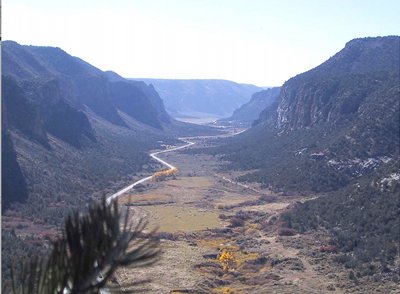
From the Grand Junction Daily Sentinel (Dennis Webb): “A report the BLM announced Tuesday said a 19-mile stretch of the Colorado River in McInnis Canyons National Conservation Area west of Grand Junction is eligible for the designation, as is a 7.3-mile portion in De Beque Canyon and a 1.3-mile portion downstream of the Grand Valley Diversion Dam. Some other segments identified as candidates for designation are parts of the Gunnison River upstream and downstream of Whitewater, portions of the Dolores and Little Dolores rivers, more than 16 miles of Big Dominguez Creek, and 15 miles of Little Dominguez Creek…
“The BLM’s new eligibility report, available at http://www.blm.gov/co/st/en/fo/gjfo/rmp.html, looked at 117 river and stream segments. It is the first step in an evaluation being conducted by the agency’s Grand Junction Field Office, which oversees 1.2 million acres…
“Other eligible stretches are found on North Fork Mesa and Blue creeks in the Dolores River watershed; Roan and Carr creeks outside De Beque; Rough Canyon Creek south of Grand Junction; and East Creek, West Creek, Ute Creek and the North Fork of West Creek in Unaweep Canyon.”
More Coyote Gulch coverage here.

From the Pueblo Chieftain (Chris Woodka): “‘We have high hopes that the county will come to their senses,’ said Steve Harrison, utilities director for the Pueblo West Metro District. ‘We don’t want to slow down SDS, and we understand their concerns. But if we can’t do exchanges, we can’t use all of our water.'”
[More…]
Without the ability to exchange, Pueblo West eventually could lose up to 3,200 acre-feet of water, about one-third of the community’s water supply, Harrison said. Others dispute the number. Pueblo, Colorado Springs and Aurora, the largest participants in the program, were able to recover 71 percent of curtailed or foregone exchanges, according to Alan Ward, water resources administrator for the Pueblo Board of Water Works. Ward estimated only about 92 acre-feet would be lost.
An exchange is a diversion out of priority while an equivalent amount of water is released downstream. Pueblo West last year exchanged 776 acre-feet against its flows in Wild Horse Dry Creek, Harrison said. If the district used all of its exchange capacity, it could eventually exchange 1,500 acre-feet through this method.
Pueblo West relies heavily on transmountain water that can be reused to extinction, but loses about two-thirds of the flows before the water reaches the Arkansas River. The district eventually could operate a pump-back exchange that would increase the yield of its current rights. The district could exchange against return flows from each successive use of water. Pueblo, Colorado Springs and Aurora all have higher priorities for physical exchanges at Pueblo Dam, so there’s no guarantee Pueblo West could make its exchanges down the line, Harrison said. “Up until March 5, we understood we would not be part of the flow program,” Harrison said…
“We have a disagreement with the county and Colorado Springs and nothing is resolved yet,” Harrison said. “We want to solve it without embarrassing the county or losing water.”
Here’s the lowdown on planning for upgrades and certification of the levee system in Pueblo, from Chris Woodka writing for the Pueblo Chieftain. From the article:
After Hurricane Katrina in 2005, FEMA began a nationwide effort to reassess the effectiveness of levees. In Pueblo, levees were built on the Arkansas River and Wild Horse Dry Creek in 1926, while the Fountain Creek levees were built in the 1980s. While the Fountain Creek levees might be more susceptible to actual flooding, it has been more difficult to certify the Arkansas River system because it is more than 80 years old and much of the original engineering data is missing.
There’s also a communication problem. “Our big concern is that they are so determined to meet their deadline rather than be accurate,” said Gus Sandstrom, president of the Pueblo Conservancy District that owns and manages the Arkansas River levees. “Three months ago, we were told there would be only one national standard.” Sandstrom explained that the district has tried, with little success, to convince FEMA that the standards for levees on Western rivers that are prone to flash flooding should be different from those for levees in hurricane zones. In addition, the district and FEMA disagree on the potential high-water mark and effectiveness of some of the levees…
The problems on Fountain Creek have been addressed in an Army Corps of Engineers study completed last year, which found that levees are not sufficient to contain the freeboard – basically, waves above the high-water mark – in a 100-year flood. A combination of capping an existing levee, removal of obstructive vegetation, proposed dredging and stabilization projects are being used to address the problem.
The Arkansas River is largely protected by Pueblo Dam, which holds back flood water and has operating criteria that call for shutting down release gates if flows on the river reach a certain point – 6,000 cubic feet per second or greater at Avondale. The levees along the river that have become a canvas for local artists are designed to contain far greater floods of up to 120,000 cfs. FEMA’s position is that the dam might not be closed in time during 100-year floods. “They use a very conservative approach,” [Dennis Maroney, Pueblo stormwater director] said.
The concern for the city, at least in terms of what shows up on future FEMA maps, is the earthen levee on Wild Horse Dry Creek north of 11th Street, Maroney said. The levee is badly eroded, yet well above the base elevation of the creek. However, if it is not certified, FEMA’s maps would omit it. In addition, FEMA wants guarantees that culverts on the 18th Street bridge will be maintained, and its maps do not include railroad beds that channel water as physical structures.
The result of all those factors could be that the historic flood plain that includes much of Downtown Pueblo could be listed as unprotected by levees. That could mean that Downtown property owners could be required to obtain flood insurance, but it would not mean an end to future development or the city’s ability to finance projects, city attorneys said. City ordinances were rewritten in 2005 to restrict development in flood plains and areas of special flood hazard, said Tom Florczak, assistant city attorney. The city allows development that does not restrict flows or encroach on floodways and that is constructed so that buildings would not suffer flood damage, Florczak said.
Here’s an update on Florence’s planned water infrastructure improvements, from Charlotte Burrous writing for the Cañon City Daily Record. From the article:
This Monday, K.R. Swerdfeger Construction, of Pueblo, will begin to replace the old water pipes with 16-inch ductile iron pipes on the Main Street water line improvements for Florence. The new line will be installed along several blocks on Main Street, said Florence City Manager Tom Piltingsrud. “We’re starting at Pikes Peak and working west,” he said. “That’s estimated to be a three-week leg.”
The next segment will be from Santa Fe to the railroad tracks, which will take five weeks. During the project, Swerdfeger Construction will install the water line on the south side of Main Street and then tear out the existing pipe on the north side…
The project, which is estimated to cost $551,161, should be finished within eight weeks, depending on weather, Piltingsrud said.
From the American Surveyor: “Barney Fix PE, C.C.E., vice president, and manager of the civil infrastructure business unit operations for Merrick & Company, was recognized by Bear Creek Water and Sanitation District for his 20 years of service to the District as District Engineer. Fix started his work with Bear Creek in 1988, while working for Greiner Engineering. Following his move to Merrick in 1992, the district engineering contract moved with him and he continued his work with Bear Creek in reviewing development plans, observing construction of public water and sanitary sewer in developments, and providing planning, engineering, and surveying for capital improvements for the district over the years.”
The Colorado Springs City Council plans to review Pueblo County’s permitting conditions for the proposed Southern Delivery System on Thursday night, according to a report from R. Scott Rappold writing for the Colorado Springs Gazette. From the article:
Utilities officials and city council members will hold a 7 p.m. public hearing at City Hall. In the works for more than a decade, the $1.1 billion pipeline is designed to meet water demands here through 2046 and provide redundancy in the water system, in case of drought or failure in the city’s other lines that carry water across hundreds of miles of mountain terrain…
To view a complete list of the conditions, visit http://www.co.pueblo.co.us. The conditions are designed to minimize the impact of pipeline construction and to mitigate the effect of sending more treated effluent down Fountain Creek. City council will vote on the conditions April 14. Pueblo County commissioners must then vote to issue the permit.
More coverage from Chris Woodka writing for the Pueblo Chieftain:
The public hearing will be at 7 p.m. Thursday at Colorado Springs City Hall, 107 N. Nevada Ave.
If the pipeline comes from Pueblo Dam, as the partners propose, Pueblo West would be able to tap into it to increase its water supply by up to 18 million gallons per day.
Council is scheduled to vote on the conditions at its April 14 meeting. Pueblo County Commissioners approved the conditions last month after a public hearing concluded. The hearing actually began in December and was continued over four months because of the complexity of the conditions…
…Colorado Springs Utilities filed for a permit last year. At March’s public hearing, Colorado Springs attorney David Robbins indicated the conditions for the permit were legally acceptable with modifications in language to include all SDS partners rather than just Colorado Springs as applicants. The SDS pipeline would cross 14 miles of Pueblo County and generate increased flows through exchanges, development and wastewater along Fountain Creek. The permit requires Colorado Springs to fund $50 million of projects for Fountain Creek through a newly created district, and to make $75 million in improvements to its sewer system by 2024. A total of $300,000 is set aside for a study of dams on Fountain Creek, and Colorado Springs is committed to several other projects regarding the Fountain under the proposed conditions. It also sets up a 3,000-acre-foot pool of water in Lake Pueblo to augment the Arkansas River below Pueblo Dam in extremely dry times. The Pueblo Board of Water Works and Colorado Springs jointly will provide water for that pool. There are numerous other conditions dealing with construction, roads and easement acquisition in the Pueblo County 1041 permit.
Formal acceptance of the terms and conditions by the Colorado Springs City Council is required for final approval of the 1041 permit by Pueblo County. Written comments will be accepted at the Colorado Springs City Clerk’s office until 5 p.m. April 9.
The Grand Junction Daily Sentinel editorial staff weighs in on the U.S. Army Corps of Engineers plans for scoping sessions for the Flaming Gorge pipeline (Regional Watershed Supply Project). From the article:
Now that the U.S. Army Corps of Engineers is evaluating a grandiose proposal to pump water from Flaming Gorge Reservoir in southern Wyoming to Colorado’s Front Range, one might think that the federal agency would schedule hearings in the region that stands to lose the most if the plan proceeds: Colorado’s Western Slope. Not so. In fact, two public meetings set for next week will both be held in Wyoming, one in Green River and one in Laramie…
“We know how it will be allocated,” said Chris Treese, with the Colorado River Water Conservation District in Glenwood Springs. “If it’s all being consumed in Colorado, then it will all come from Colorado’s entitlement” under the Colorado River Basin Compact. And Colorado’s entitlement under that compact all comes from the Western Slope — from the Colorado River and its tributaries. The estimated 250,000 acre feet of water a year that the Flaming Gorge pipeline project is to use would supposedly come out of the unused portion of Colorado’s entitlement. The problem is, “We don’t really know what Colorado’s remaining entitlement is,” Treese said. That’s why the state allocated $1 million two years ago to study how much water is currently being consumed from the Colorado River and its tributaries…
Furthermore, [Aaron Million’s] project isn’t the only one seeking to use potentially hundreds of thousands of acre feet of water from what remains of this state’s Colorado River entitlement. A northeastern Colorado water group has proposed a project to pump water from the Yampa River to the Front Range. And the demands that a commercial oil shale industry could place on Western Slope water remain uncertain, but substantial. “With all of these we have the same concern,” Treese said. “That they are going to take us to the edge of the cliff and perhaps push us over with them.”
The water availability question is one that needs to be answered before the Army Corps of Engineers proceeds much further with its examination of the Flaming Gorge pipeline project.

From Reuters (Steve Gorman): “Arctic sea ice, a key component of Earth’s natural thermostat, has thinned sharply in recent years with the northern polar ice cap shrinking steadily in surface area, government scientists said on Monday. Thinner seasonal sea ice, which melts in summer and freezes again every year, now accounts for about 70 percent of the Arctic total, up from 40 to 50 percent in the 1980s and ’90s, the researchers said, citing new satellite data. At the same time thicker ice, which lasts two summers or more without melting, now comprises less than 10 percent of the northern polar ice cap in winter, down from 30 to 40 percent. Just two years ago, the thicker so-called perennial sea ice made up 20 percent or more of the winter cap. Scientists have voiced concerns for years about an alarming decline in the size of the Arctic ice cap, which functions as a giant air conditioner for the planet’s climate system as it reflects sunlight into space. As a greater portion of the ice melts, it is replaced by darker sea water that absorbs much more sunlight, thus adding to the warming of the planet attributed to rising levels of heat-trapping greenhouse gases emitted into the atmosphere by human activity.”
From the Pueblo Chieftain (Peter Roper): “Officials from the Federal Emergency Management Agency told council the new digital flood maps ordered by Congress could very well put Pueblo’s Downtown within the 100-year flood plain – a decision that will force property owners to purchase flood insurance and could impact the city’s ability to borrow money. The preliminary maps are scheduled to be finished later this year with a final version completed in 2010. ‘We’re still looking at the hydrology,’ consultant Dave Jula told council, ‘but if you can’t certify (the levees), you’ll see water Downtown.’
“The levees in question are on Wild Horse/ Dry Creek west of the city, the massive concrete barrier along the Arkansas River, and the levees on Fountain Creek. The new FEMA map will spell out what areas are likely to be underwater in the event of a major, 100-year-flood. Because such floods are often catastrophic, the FEMA map will determine which properties must carry federal flood insurance. To date, Pueblo’s Downtown has not been marked inside the Arkansas River flood plain. ‘We realize the effect this could have on our Downtown,’ Council- woman Judy Weaver somberly acknowledged to FEMA officials during the 45-minute briefing at the council work session.”

Here’s a look at House Bill 09-1303 (Admin Mineral Development Water Wells) (pdf) from Joe Hanel writing for the Cortez Journal. From the article:
William and Elizabeth Vance and James and Mary Fitzgerald sued the state engineer’s office in 2005, claiming that coalbed methane wells were depleting their water wells. They won in a La Plata court in 2007. The case, Vance v. Simpson, is on appeal to the state Supreme Court. A ruling is expected any time. Sen. Jim Isgar and others worry the court could require every one of Colorado’s 38,000 gas wells to get a water well permit, which would overwhelm the state engineer’s office. So Isgar, D-Hesperus, and Rep. Kathleen Curry, D-Gunnison, drafted House Bill 1303, which brings coalbed methane wells into Colorado’s water rights system. Without the bill, the court decision could force the state engineer to roll all coalbed methane wells into the legal water system in two months. Other observers have said the court decision could apply to every gas or oil well in the state. “We aren’t in session until next January, and if this ruling comes out the day after we adjourn, we leave the state engineer in the position of having to approve 3,000, 4,000 wells in 60 days,” Curry said.
The House Agriculture Committee passed the bill on a 13-0 vote Wednesday, sending it to the full House…
The bill allows the state engineer to make rules for when a gas well should be treated as tapping “nontributary” water – that is, deep water that will not harm nearby water rights. For tributary wells, it allows time for gas drillers to prepare a substitute water supply plan, just like farmers use when they’re using well water for irrigation. HB 1303 puts a three-year moratorium on integrating gas wells into the water system, to give the state engineer and the gas companies time to adjust.
Coalbed methane wells pump out water before they start producing gas. The wells are especially plentiful – and rich – in La Plata and Archuleta counties. The Raton Basin near Trinidad also has many coalbed methane wells.

Here’s part V of Chris Woodka’s series “Taming the Land” which is running in the Pueblo Chieftain.

Here’s an update on the fight to contain invasive mussels in Colorado waters, from Chris Woodka writing for the Pueblo Chieftain. From the article:
Last year, evidence of mussels was found in seven Colorado reservoirs and lakes after they were first detected in Lake Pueblo in January 2008. A total of 102 bodies of water were tested, which means that boat inspection programs or closures of some lakes were successful in stopping mussels from spreading further than they have, Brown said. “The mussels move from body to body of water primarily by boats,” she said. Making sure boats are clean also deters the spread of other invasive plants or animals, as well as diseases that can kill fish, Brown added. Sampling will begin again this month as water temperatures begin to warm up enough to allow breeding to resume, she said. Brown speculated that more adults have not been found because the zebra and quagga mussels are mainly populating the sediments at the bottom of lakes.
More coverage from the Fort Collins Coloradoan (Mile Blumhardt):
Starting April 15, Horsetooth Reservoir and Carter Lake will implement boating hours and all boats at those Larimer County parks will be inspected for exotic zebra and quagga mussels. Those inspections to try and quell the spread of the invasive mussels started in June at Boyd Lake and went through November. The inspections started up again March 19, according to Tim Walsh, Boyd Lake ranger. Walsh said no quagga or zebra mussels had been found as of Tuesday. Boating hours at Horsetooth and Carter will be in place 6 a.m. to 10 p.m. daily April 15 through Sept. 30 with reduced inspection hours thereafter. Boat launching will not be allowed outside of those hours…
In October, boating at Horsetooth and Carter will be allowed from 7 a.m. to 5 p.m. Fridays, Saturdays and Sundays. In November through February, hours and days are even more restrictive…
Mark Caughlin, Horsetooth’s district manager, expects inspection times to be similar to Boyd’s. He said Larimer County Natural Resources will train 17 employees to perform the inspections. “We understand there will be an inconvenience,” Caughlin said. “We’re in the business of keeping our reservoirs open to boating and we’re trying everything within our power to keep open as many hours of boating as we can.” To reduce the inconvenience, Caughlin said boaters can have their boats inspected when they come off the water. If the boat and trailer are found to be clean, they will be tagged so that boaters can bypass having the boat and trailer inspected on the next outing. Caughlin said the county also is planning off-site inspections by Memorial Day.
Update: From the Loveland Reporter Herald:
All boats will be inspected for invasive mussels before they can launch on Carter Lake or Horsetooth Reservoir starting April 15.
Larimer County will inspect all boats to comply with state regulations designed to curb the spread of zebra and quagga mussels. The mussels, not native to Colorado, plug pipes and motors and leach nutrients from the water, depriving native species and plants.
To ensure that all boats are inspected, officials set specific hours for boats to launch on Carter Lake and Horsetooth Reservoir. Boaters can remain on the lake longer than those hours but cannot launch outside the set times, which are:
April 15-Sept. 30 — 6 a.m. to 10 p.m. daily.
Oct. 1-31 — 7 a.m.-5 p.m. Fridays, Saturdays, Sundays.
Nov. 1-Feb. 28 — 8 a.m.-9 a.m. and noon-1 p.m. Saturdays and Sundays as weather and ice conditions allow.
More information is available online at http://www.larimer.org/naturalresources/boating_inspections.htm.

Here’s a look at mercury pollution in Colorado, from Mark Jaffe writing for the Denver Post. From the article:
The heavy metal, however, isn’t found in fish in all lakes or all species in tainted lakes — a phenomenon in Colorado and in other parts of the country. So scientists are now trying to unravel the mystery of why it pops up in Carter Lake walleye, but not those in Chatfield Reservoir. “We’ve got some very hot fish in some, but not in all our reservoirs,” said Nicole Vieira, a state Division of Wildlife aquatic toxicologist. “If we can figure out what is at work, we might be able to manage the fish stocks to reduce mercury,” she said. At the same time, Colorado has issued regulations requiring mercury air emissions from power plants — a prime source of the pollutant — be cut 90 percent by 2018…
A dusting of mercury is falling into lakes and rivers all across the country — the Environmental Protection Agency estimates more than 112 tons of mercury emissions was generated in 2005. Among the largest sources are power plants, cement kilns, refineries and commercial boilers, according to the EPA. But the inorganic mercury coming out of those smokestacks would just sit on a lake bottom if not for bacteria that turn it into methylmercury — which animals along the food chain can absorb. Every state has issued mercury health advisories on eating fish, according to the EPA. Methylmercury poisoning can impair vision, walking, speech and hearing. Children suffer neurological damage with just a tenth of the exposure it takes to harm adults. A pregnant woman eating tainted fish can also can hurt her baby’s growing brain and nervous system. Women of child-rearing age are also advised to limit consumption of mercury-tainted fish because it takes eight to nine months for the body to purge the toxic. Colorado advisories to limit consumption are triggered when 0.5 parts per million of mercury or more is found in fish tissue. “The more we learn, the more damaging mercury turns out to be to a child’s brain,” said Gina Solomon, a senior scientist with the Natural Resources Defense Council…
“It is a complicated process, and we are trying to break it down,” said Steven Gunderson, director of water quality for the Colorado Department of Public Health and Environment. Lake Pueblo, for example, is not far from a steel mill but has no fish advisories, Gunderson said. Brush Hollow Reservoir, 30 miles away in Penrose, has a mercury problem.
In 2004, the state health department and the Division of Wildlife drew up a list of the 120 most-fished bodies of water and began testing their fish. About 112 have now been tested, and 23 have fish with elevated mercury levels — from Totten Reservoir west of Durango to Horsetooth Reservoir near Fort Collins. The “hot” fish species have varied from lake to lake and include walleye, lake trout, northern pike, largemouth and smallmouth bass, yellow perch, saugeye and wiper. “These are all predators, top-of-the-food-chain fish, where the mercury gets concentrated,” said Alisa Mast, a hydrologist with the U.S. Geological Survey.
More Coyote Gulch coverage here.

Here’s a primer of sorts on Colorado Springs’ water supply system, from R. Scott Rappold writing for the Colorado Springs Gazette. Click through and read the whole article. Rappold covers much of Colorado Springs’ water supply history. Here’s an excerpt:
To keep up with population growth, Colorado Springs has extended straws in practically every direction, from the high peaks of the Sawatch Mountains to the arid southeastern plains, a water system spread out across hundreds of miles. The Southern Delivery System may be the last straw. The exact route of the $1.1 billion pipeline – from either Pueblo Reservoir or the Arkansas River in Fremont County – is undecided, but it seems likely the Department of Public Utilities will begin construction this year. It will bring 78 million gallons of water a day to a new reservoir east of Colorado Springs, which officials say will provide enough to meet demand here through 2046. It will be the most expensive project Utilities has ever done.
Here’s an update on Aaron Million’s proposed pipeline from the Green River (Flaming Gorge) to Colorado’s Front Range and points south, from JoAn Bjarko writing for the North Forty News. The Corps of Engineers is calling the project the “Regional Wateshed Supply Project.” From the article:
Million is hopeful that the Army Corps will issue a final decision by fall 2011. The Fort Collins scoping meeting will be held April 20 at Fossil Ridge High School, 5400 Ziegler Road, from 6:30 to 9 p.m. Other meetings will be held in Green River, Wyo.; Vernal, Utah; Laramie, Wyo.; Denver and Pueblo. The Corps will accept written comments for scoping until May 19.
At this stage, the Corps is preparing an environmental impact statement to analyze the direct, indirect and cumulative effects of the proposed water supply project in Wyoming and Colorado. The project proposes to provide about 250,000 acre-feet per year of new annual firm yield to meet a portion of the projected water supply needs of southeastern Wyoming and the Front Range of Colorado…
Million said he has had recent discussions with major municipalities to purchase water delivered through the pipeline. Agriculture could also benefit, he said. In particular, Million sees the opportunity for the pipeline to deliver water to the proposed Glade Reservoir near the mouth of Poudre Canyon so that no water would be diverted from the Poudre River. “It would be a win for the entire region,” he said. “We could fill the reservoir consistently.”[…]
Water storage is currently anticipated at Lake Hattie Reservoir, located west of Laramie; the proposed Cactus Hill Reservoir site, located northeast of Fort Collins; and the proposed T-Cross Reservoir site, located north of Pueblo. A new regulating reservoir would be located near the Green River end of the pipeline system. Water treatment facilities would be a part of the intake system and water storage reservoirs.
More information about the project is available on the Corps web site at https://www.nwo.usace.army.mil/html/od-tl/eis-info.htm
More coverage from the Colorado Springs Gazette (R. Scott Rappold):
Water suppliers here aren’t banking on the $2 billion to $3 billion pipeline being built. “Physically, it’s feasible. Politically, that is a whole different question,” said Kip Petersen, general manager of Cherokee Metropolitan District…
“I think there are political issues. There are legal issues. There are technical issues to move water that far. Clearly Mr. Million has hurdles to clear,” said Gary Bostrom, water resources manager for Colorado Springs Utilities. Utilities officials did not embrace the idea after meeting with Million in recent years…
“We just think it’s a scam. The water is not there,” said Eric Kuhn, manager of the Colorado River Conservation District, a consortium of 15 Western Slope counties.
“It’s going to foreclose other water users,” said Drew Peternell, with Trout Unlimited. The group is also worried how taking the water would impact endangered fish in the Green River…
Million says critics won’t halt the project. And while some question his ability to pull together private funding, he said if the corps issues a favorable record of decision, he’ll get the funding. “Absolutely it’s going to happen. It’s really just an issue of timing at this point. Someone would have to come up with a reason why it’s not realistic. To date we’ve heard nothing,” he said. He likened his effort to Colorado’s early water pioneers, who trudged into the hills to find water for burgeoning settlements. “The difference between what we’re doing versus what they did in the 1890s is we’ve just got a little bigger mule team and sled than they did,” Million said.
But there are a host of regulations and agencies that weren’t in place then, and getting approval for a major water project can be long and difficult. Colorado Springs Utilities’ proposed $1.1 billion Southern Delivery System pipeline is one-tenth of the distance of Million’s plan, and it took five years and a $17 million environmental study to get a record of decision from the U.S. Bureau of Reclamation.
PUBLIC MEETINGS
The U.S. Army Corps of Engineers will hold public meetings on the proposed pipeline April 21 at West High School, 951 Elati St., Denver, and April 22 at Risle Middle School, 625 N. Monument Ave. in Pueblo. Both will be 6:30 to 9 p.m.

The debate over the water requirements for oil shale development would seem to be a waste of time since no one really knows how much water it is going to take or the effects on groundwater. Shell spokesman Tracy Boyd told the Colorado Independent a couple of weeks ago that the company feels that the ratio of water to liquid hydrocarbons will be about 3 to 1. Is that an estimate or a calculation based on Shell’s pilot data? That’s why Secretary Salazar is taking it slow and cautiously with regard to leasing.
Here’s a report from Dennis Webb writing for the Grand Junction Daily Sentinel:
Recent studies have created unnecessary hysteria by overstating likely water use associated with potential oil shale development, an energy company official says. Tracy Boyd, a spokesman for Shell, told a Club 20 audience Saturday at Two Rivers Convention Center that water consumption is a serious issue that requires planning. But he said studies such as one released earlier this year by Western Resource Advocates “do a pretty significant job of heightening anxiety for oil shale development,” rather than help provide rational evaluation and planning…
Rob Harris of Western Resource Advocates, a Boulder-based environmental group, defended the conclusions of his group’s research, saying the amount of water rights acquired by energy companies can’t be ignored. “When we see a huge number of decreed water rights that are out there in the world, it makes us think, ‘Well, gee, we have to plan for that,’ ” Harris said…
Dave Merritt, former chief engineer of the Colorado River Water Conservation District, said the study includes in its estimates past district rights that have been abandoned.
Harris acknowledged the report contains some errors but said the river district still has a lot of water rights that haven’t been abandoned. While the water rights could be used for other reasons, it’s reasonable to expect energy companies would be interested in them if full-scale oil shale development occurred, he said.
From the Durango Herald (Garrett Andrews):
Craig Cooper carries a small piece of sedimentary rock in his bag next to his MacBook Pro when he travels on speaking engagements. Friday it was the Southwestern Water Conservation District’s 27th annual Water Seminar, where the Idaho National Laboratory energy specialist held up the innocuous chunk of oil shale and told the audience it’s time to think hard about developing the fossil fuel wisely because, he said, development will happen one way or another. As a scientist focused on energy production, Cooper is passionate in his objectivity. He works at the intersection of water and carbon management, leading research in oil shale development, working both with environmental groups and multinational oil corporations. But for all his enthusiasm, his message is simple:”Policymakers need answers to questions. “The bottom line is that there’s a lot of energy here and people are going to come and get it and that’s going to create problems,” he said.
With this conclusion foregone, Cooper said he works to create transparency in energy development. Some of his ideas sound disconsonant to environmental groups, which he said are often right to criticize certain methods of oil-shale extraction but should know that the function of business is not to perform virtuous, costly acts for free.
From the Aspen Times: “According to data from the latest snowpack measurements, the state’s snowpack decreased in terms of percent of average in all basins of the state last month. The decreases were enough to lower snowpack percentages to below average totals for this date across most of the state, with the only exception being the northwestern portion of Colorado. The statewide snowpack decreased to 96 percent of average on April 1, said the National Resources Conservation Service, which conducted the snowpack measurements…While summer runoff may be below average for much of the state this summer, reservoir storage remains just slightly above average statewide. All basins are toring at least near average volumes for this time of year, with the exception of the Rio Grande basin.”
From the Telluride Daily Planet (Reilly Capps):
In the southwestern part of the state, however, the snowpack, in terms of water content, is 86 percent of average. Statewide, the snowpack was 96 percent of average. The numbers come from the Department of Agriculture’s Natural Resources Conservation Service, and measured the snow as of April 1. The numbers continue a trend of dryer winters. In 10 of the last 12 years in Colorado, the service has measured below average snowpack readings on April 1. Colorado, even the dry southwest part, still has lots of water in its reservoirs. The reservoirs in our area are above average storage, sitting at 107 percent of average, thanks to last year’s snow…
Telluride’s rafters and kayakers — a happy group, by and large — saw the bright side. “I think it’s still gonna be awesome,” said Emily Wilbert, a kayaker and rafter who last year worked as a rafting guide in Durango. “Any boating season is a good season. Nothing’s going to compare to last year, but 86 percent of normal is great compared to when we were in a drought.”[…]
“Junior water rights may be curtailed later in the summer if streamflows drop off,” Gillespie said. So, for the sake of farmers, Coloradans have to hope that their late-summer picnics get ruined. “If we get a good monsoon,” Gillespie said, “that could eliminate a lot of the problems that could occur. We could hold out hope for that.”

The settlement over managing the streams around Long Draw Reservoir sets the stage for the largest native fish restoration in the United States, according to this comment from the Greg Evans published by the Fort Collins Coloradoan. He writes:
What the judge remanded was absolutely remarkable and a victory for the people of Colorado. He said put the water back in the stream or mitigate – make up for your sins. Winter water flow to La Poudre Pass Creek was impossible because of a dam enlargement, so it forced an historic compromise. The USFS, Trout Unlimited and the Water Conservation District had to sit down and hammer out a compromise to please the judge. Amazingly, that is what they did.
Now, partially funded by the Water Conservancy District and in coordination with the USFS and Rocky Mountain National Park, the largest native fish restoration in the United States will occur in our backyard. The watershed above Long Draw will be repopulated with Greenback Cutthroat Trout. TU volunteers will help. This historic victory proves something. Solutions do exist when organizations sit down to talk. I applaud the courageous individuals who helped it happen: Doc Sheets, Paul Fromme, Dave Piske, Ken Eis and other local heroes who care!

From the Durango Herald (Garrett Andrews): “Kroeger, a third-generation Durangoan, is preparing to step down from the board of the Southwestern Water Conservation District after 55 years, 33 of which he served as board president. Friends and colleagues described a man driven to protect agricultural interests in the area and oblivious to party identifications…
“As an attorney in the Colorado Office of the Attorney General in the 1970s, Colorado Supreme Court Justice Greg Hobbs remembers Kroeger regularly traveling to Denver for short meetings. Later, as counsel for the Northern Colorado Water Conservancy District, Hobbs said he was inspired by the efforts of his southern Colorado counterparts. ‘What more can I say; he’s one of the great figures in Colorado water history,’ said Hobbs.”

From the Valley Courier (Ruth Heide): “The fee increase will occur over the next three years beginning this year with the flat rate for residential users going from $3.50 to $5 a month and the cost per 1,000 gallons of water going from $1 to $1.50. In 2010 the flat rate will increase by 25 cents more per month and the cost per 1,000 gallons will increase by 50 cents per month. In 2011 the flat rate will increase another nickel per month and the cost per 1,000 gallons will increase by another 50 cents per month, to $2.50. For an average household the rate will increase a little more than $5 a month this year, another $4 or so per month the next year and another $4 per month the third year, 2011.”

From the Pueblo Chieftain (Chris Woodka): “Three members of the Southeastern Colorado Conservancy District board were reappointed and two new members named Thursday. Pueblo District Court Judge Dennis Maes announced the appointments. Terms are for four years. The new members are Gary Bostrom, general manager for planning, engineering and resources for Colorado Springs Utilities and David Simpson, general manager of the St. Charles Mesa Water District…Reappointed were Reed Dils, Chaffee County; Carl McClure, Crowley County; and Howard ‘Bub’ Miller, Otero County.”

From the Pueblo Chieftain (Chris Woodka): “Carl Genova, 77, who was a board member of the Bessemer Ditch for 38 years and the Southeastern Colorado Water Conservancy District for 20 years, was given the Bob Appel Friend of the Arkansas Award at the forum. The award is named for longtime Southeast Colorado Resource Conservation and Development District coordinator Bob Appel, who was instrumental in organizing the forum from its inception 15 years ago until his death in 2003. It’s given in recognition of those who have worked to improve the Arkansas River…
“Genova was tricked into attending the April 1 meeting in a plot hatched by several Bessemer Ditch board members and Dan Henrichs, a former superintendent of the ditch. Henrichs persuaded Genova to attend the meeting, saying there was an Arkansas Valley Ditch Association problem that required Genova’s experience and expertise to solve. Henrichs even presented some documents to Genova and told him other AVDA members would be on hand after lunch to discuss them. Genova served on the AVDA from 1970-90. “There’s not a person in the Arkansas Valley who knows the river better than Carl,” said Joe Pisciotta, a Bessemer board member after Genova received the award. ‘A successful farmer for more than 50 years, he learned quickly the value of protecting water rights in the valley and seeing that all water users get a fair shake,’ said Phil Reynolds, Southeastern projects manager, in presenting the award to Genova…
“‘Thank you all. I’m overwhelmed by all of this,’ Genova said. ‘I have served on a number of organizations and it’s always been an honor and a privilege.’ Genova always was appointed by Gov. Roy Romer to the Arkansas Valley Compact Administration from 1993-97; president of the Pueblo County Farm Bureau, 1969-70; a member of the Colorado Cattle Feeders Association; and a member of Colorado Water Congress. He and his wife, Ruth, have three children and numerous grandchildren.
“Genova was also recognized by the forum for his work on the winter water program, which allows farmers to store water in winter months for use during planting or harvest season, when irrigation flows can be scarce. When he retired from the Southeastern board last year, he said winter water was his most significant accomplishment. ‘The best thing we did was the winter water program,’ Genova said. ‘The district was able to get all those people together.'”
Meanwhile, here’s an update on tamarisk removal in the Arkansas Basin from Chris Woodka writing for the Pueblo Chieftain. From the article:
[Rick] Enstrom has removed 160 acres of tamarisk along 2.25 miles of river bottom in the last five years, with the help of the Natural Resources Conservation Service. In the last two years, he’s released 13 batches of beetles on his property. The beetles are the only natural limit on the spread of tamarisk, also called salt cedar, in climates like Southern Colorado’s. In fact, they have been so successful in central Asia that in some areas, it is hard to find tamarisk, which is still prized as an ornamental, Enstrom said…
The Arkansas River basin has about 67,000 acres infested with tamarisk, or 69 percent of the state’s total, said Jean Van Pelt, conservation programs coordinator with the Southeastern Colorado Water Conservancy District. It’s estimated that those trees annually suck up 76,600 acre-feet of water – 25 billion gallons – more than native vegetation. The trees grow in upland areas, as well as in the flood plain of rivers and streams. As areas now infested fill in, the water loss could grow to 198,000 acre-feet – 64.5 billion gallons – per year. To eradicate tamarisk would cost $70 million. “We have a choice,” Van Pelt said. “We can take action and do something, or most likely it’s going to get worse.” Van Pelt has led efforts in recent years to organize groups fighting tamarisk up and down the Arkansas River, which culminated in the Arkansas River Watershed Invasive Plant Plan, a strategic plan that links efforts in the valley. A Web site providing information about tamarisk, maps, research, area control programs, education and events concerning tamarisk was established as part of the task force’s work. In addition, the task force was able to define goals for the valley and put it in a better position to receive state or federal grants aimed at tamarisk control, Van Pelt said.
The strategy is to control the sources of tamarisk in the upper basin, above Lake Pueblo, while dealing with the areas of heavy infestation in the lower basin that already pose flooding and fire dangers. This year, a demonstration project on Four Mile Creek in Fremont County will attempt to eradicate tamarisk on an entire tributary. Meanwhile, there are projects on Fountain Creek, North La Junta, Las Animas, the Purgatoire River and in Prowers County, Van Pelt said.
The state is providing $4 million over four years, and federal demonstration projects are being sought as well.

Local residents crowded a recent meeting of the Prowers County Commissioners where conservation easements were being discussed. Here’s a report from Aaron Burnett writing for the Lamar Ledger. From the article:
[Roxy Huber, executive director of the Colorado Department of Revenue], who was accompanied by Commissioner of Agriculture John Stulp was on hand to address issues surrounding conservation easements. Easements across the state have come under scrutiny in recent years as tax values assigned to many easements have been called into question by the Internal Revenue Service and the state’s department of revenue…
There are several types of easements including ones that restrict gravel or other mineral mining as well as easements that restrict construction or development on property. The current audits being performed on existing easements call into question the amount of tax credit that should be awarded for each individual easement. As the audit process has progressed, some appraisals have been deemed fraudulent even though they were performed by state licensed appraisers. Locally, some land owners have been dealing with easements under audit for close to five years. Some landowners have been told by tax officials that their easements have no value.
“Part of the reason we’re here today is rumor control,” said Commissioner Gene Millbrand about the meeting. He noted that several county landowners have been affected by the issue and have raised concerns to all three members of the board…
Huber told the commissioners that even though there appears to be a disproportionate number of easements in the area being examined, the state is more interested in broad trends than individual regions. “We’re not targeting any particular part of the state. We are targeting systems of corruption,” Huber said. “We understand people feel like they’ve been defrauded,” Huber said. She added that actions of several appraisers have been called into question, but that ultimately the responsibility for an easement’s accuracy in its valuation falls to the individual landowner who places the easement. “While they’re licensed through the state, we can’t stop them from doing shenanigans,” Huber said concerning the auditors whose work has been called into question…
Huber said the state is attempting to resolve issues surrounding easements, but until recently hadn’t all the necessary tools at its disposal. She added that with the passage in 2008 of House Bill 1353 the department of revenue was finally able to discuss easement issues with other state agencies, a practice which has allowed the department of revenue to draw on the expertise of other state departments for such things as valuation of property. Huber noted that prior to the bill’s passage, her department was not able to discuss the easement issue with individuals not directly employed by the department.
Huber said the best option for landowners to take if they have received notification from the state concerning an audit of their easement is to file an objection within the alloted time period. She said this is an important step because it ensures due process for the landowner concerning any issues in question.
The revenue department head said the common timeline for easement reviews begins at the federal level, then is reviewed at the state level following the completion of the federal audit. She added that the state is currently suspending any audits that are currently under federal review pending that outcome. “If you’ve protested, you’re just sitting in the queue,” Huber said.
More Coyote Gulch coverage here.

From The Mountain Mail (Paul Goetz): “Working strictly as a referral agency, Chaffee County planning commissioners will meet at 3 p.m. April 14 to develop possible comment or referrals to county commissioners regarding the Nestlé Waters 1041 permit. Planners agreed to continue the process Tuesday night during their regular meeting. Planner Fred Rasmussen recused himself from that portion of the meeting. Bruce Lauerman, Nestlé western division natural resources manager, said Nestlé supports the decision. ‘We recognize the process should proceed in a fashion that allows proper time to review and analyze,’ Lauerman said.”
Meanwhile, Chaffee Citizens for Sustainability are requesting information from the county commissioners, according to a report from Kathy Davis writing for The Chaffee County Times. From the article:
The goal of the CCFS meeting March 30 was to collect information on feelings of people in Buena Vista and then to get the BOCC to postpone decisions on the Nestlé applications for 60 days in order collect more information and to digest it all, said CCFS member Carlo Boyd. According to the meeting notice distributed by CCFS, the Nestlé permit application is to harvest spring water from Chaffee County for bottling in Denver.
About 35 people attended the meeting at the community center. They wanted more information about:
• impacts of the Nestlé truck traffic on Trout Creek Pass;
• impacts on water and the aquifer;
• making sure “all the bases are covered for water and traffic” (in BOCC approvals);
• Nestlé being a “good neighbor” and Nestlé’s history with other communities across the country in terms of how Nestlé treats the communities;
• impacts on bio-region “all the way to the Gulf of Mexico;”
• impacts on neighboring wells;
• impacts on water needed for agriculture;
• impacts on tourism and the possibility that tourists who encounter “unbearable” traffic on Trout Creek Pass won’t come to the county; and
• re-measurements of the amount of the spring water available during a dry year rather than a wet year.

From the Canyon Courier (Vicky Gits): “The Evergreen Metro District stands to gain a possible bonus from the federal government’s economic stimulus program. The Colorado Water Resources and Power Development Authority has notified the district that it qualifies for a possible zero percent interest rate on $2 million the district is borrowing to build a new roof on the water treatment plant in Evergreen…
“The project is competing with dozens of other project for $40 million in state money, so it is not a done deal. But officials are hopeful because work on the roof is ready to go forward. A zero-percent loan translates into savings of $40,000 a year, Gerry Schulte, executive director of the metro district, told a meeting of the district board on March 25. The federal stimulus package includes federal tax cuts, expansion of unemployment benefits, and domestic spending in education, health care and infrastructure, including the energy sector. The district may also qualify for a 50 percent reduction in the capital expense, or a grant of $1 million, to pay for the roof, which is 35 years old and deemed to be structurally unsound. The money comes from a total of $51.2 billion in federal money designated for investing in infrastructure, including $6 billion for wastewater and drinking-water infrastructure. The district began construction in March on installing a replacement tank in the Yellow Zone Tank and Pump Station off Evergreen Parkway south of the Evergreen North shopping center. The underground tank project is expected to cost $2.5 million and improve the delivery process.”

From the Loveland Reporter Herald: “The amount of water in snow that supplies the Big Thompson River — and the city of Loveland — is below average at three of four measurement sites. Measurements taken Monday, after a recent snowstorm, recorded the snow water equivalent as: 105 percent of average at Bear Lake; 97 percent of average at Willow Park; 79 percent at Hidden Valley; 45 percent at Deer Ridge.”
From the Sky-Hi Daily News:
…snowpack in the high-elevation mountains above Middle Park now ranges from 88 to 127 percent of the 30-year average, down sharply since March 1…
“This resumes the pattern of weak spring snows observed during 2005 to 2007, despite the fact that March is historically the snowiest month,” said Mark “Doctor” Volt, District Conservationist. “The April 1 readings are the most critical for predicting runoff and summer water supplies, as most of our high country snowpack peaks during April.” The highest local readings are in the Blue River sub-basin (average 115 percent), and the lowest readings are in the northern drainages…
Snow density is averaging 31 percent, which means that for a foot of snow there are 3.8 inches of water.
In Colorado, only the northwestern river basins are above average. The highest snowpack, relative to normal, is in the Little Snake sub-basin of the Yampa River, and the Blue River and Roaring Fork sub-basins of the Colorado River. Reported readings for the major river basins in Colorado are as follows: The upper Colorado River Basin averages 108 percent; Gunnison River Basin, 92 percent; South Platte River Basin, 89 percent; Yampa River Basin, 104 percent; White River Basin, 101 percent; Arkansas River Basin, 96 percent; Upper Rio Grande Basin, 92 percent; San Miguel, Dolores, Animas, and San Juan River Basins 88 percent; and the Laramie and North Platte River Basins, 96 percent of average for this time of year.
From Fort Collins Now:
The water content of the snowpack on top of Cameron Pass, for example, was 29.4 inches, or 108 percent of the 30-year average for that site. There was an average of 83 inches of snow atop Cameron Pass. At one other site in the Poudre Canyon, Joe Wright Reservoir, which is just east of Cameron Pass off of Colo. 14, the water content is 112 percent of average.
From the Glenwood Springs Post Independent:
Statewide snowpack was down to 96 percent of average as of April 1, according to an (NRCS) report. It’s the first statewide reading to be below average this season. On Jan. 1, statewide snowpack was 120 percent of average.
One exception to the trend is the Upper Colorado River Basin. It’s snowpack was 109 percent of a 29-year average Friday morning. The Roaring Fork River Basin had more snow at 118 percent of average. A monitoring site on Independence Pass had 119 percent of its average snowpack…
This year’s below average statewide snowpack on April 1 adds to a series of drier than average years. Below average statewide snowpack readings have been measured that day in 10 of the last 12 years in Colorado, the NRCS report says. “In addition, the April first snowpack reading is the most critical for the state’s water managers. With snowpack totals nearing their seasonal maximum accumulations on this date, these readings are the best indication of what the state can expect for most of its yearly runoff and water supplies,” the report says. However, Western Slope areas served by the Colorado River will probably have plenty of water this year. The basin’s water supply forecasts for April through July are mostly average or slightly above average, Gillespie said.
From the Denver Post (Michael Booth):
Snowpack in the state’s major river basins was at 120 percent of the historical average on Jan. 1. But that key number dropped to 96 percent of the average recorded in past years on April 1, said Mike Gillespie of the federal Natural Resources Conservation Service in Lakewood…
The South Platte River basin, where Denver draws a good portion of its water, was at 86 percent of normal snowpack on Wednesday. Only the Colorado and Yampa/White systems in northwest Colorado stayed above average. Denver Water officials aren’t pessimistic about the upcoming watering season, saying their reservoirs are in good shape and the river-basin snowpack is enough to keep lakes high. The department draws another major portion of its water from the Colorado River system. “We’re optimistic about the water-supply situation, but we’re monitoring it closely,” said Denver Water spokeswoman Stacy Chesney. “The recent moisture we’ve had has been very helpful. Systemwide, we’re at 97 percent of normal snowpack.”

From the Associated Press (Judith Kohler) via the Aspen Times: “The rules kicked in on private land Wednesday. The roughly 100 new and revised oil and gas rules carry out laws requiring regulators to give more weight to the environment, public health and safety, and wildlife when they approve oil and gas development. Changes include new standards for oil and gas waste pits, protection of drinking water supplies and more input from landowners and state health and wildlife experts. Still unresolved is a handful of issues that task forces are expected to tackle soon. They include how far drilling rigs must be from occupied buildings, buffers around waterways, reclamation of well sites, guidelines for minimizing impacts on wildlife and coordinating with counties that have their own rules. The state and U.S. Bureau of Land Management will also address enforcement of the state regulations on federal land. They’re expected to update a long-standing agreement on oil and gas development. Regulators will rewrite one of the new rules to eliminate state wildlife and health agencies’ ability to appeal drilling permits. The industry protested the provision, noting that the agencies’ directors sit on the commission that would decide the appeals.”

Communities hoping to build the Arkansas Valley Conduit project is closer to turning dirt with President Obama signing the authorizing legislation last week. Here’s a report from Chris Woodka writing for the Pueblo Chieftain. From the article:
Sponsors hope that contracts will be in place within five years to build the $300 million conduit from Pueblo Dam to Lamar…
…water quality issues made the conduit more attractive. Las Animas and La Junta added reverse osmosis systems to deal with hard water. The drought of 2002 emphasized the weaknesses of existing water systems. This year, communities learned it could cost millions of dollars to deal with radionuclides in their well systems. “Based on what these communities have been told by the Colorado Department of Health, we’re certainly trying to get this started within the next four to five years,” said Bill Long, president of the Southeastern Colorado Water Conservancy District. The tone of meetings since 2002 has changed from a lot of “what if?” to a big dose of “how?”[…]
The funding solution wasn’t found until recently, when Southeastern Executive Director Jim Broderick proposed using revenues from excess-capacity contracts in the Fryingpan-Arkansas Project to repay the costs of the project over time. This week, President Barack Obama signed the public lands bill that included approval of the Arkansas Valley Conduit, with a 65 percent federal share and the Southeastern plan to use project revenues for repayment. Over the next two years, the district will be looking at the route of the pipeline and determining rights of way. The pipeline will begin at the South Outlet Works at Pueblo Dam, also called the Joint Use Manifold, where Pueblo, Pueblo West and the Fountain Valley Conduit all connect now…
The district will be spending $600,000 obtained from an Environmental Protection Agency grant last year, matched by a like amount from project sponsors, to pay for the studies, Long said. “At the same time, we have to begin working on a memorandum of understanding with the participants to pay for the project,” Long said. “We have to get the repayment costs closer, so everyone will have an idea of what their costs will be.”
The conduit has always been a one for all and all for one approach. It would be sized to the projected needs of the communities along the way, which have varying estimates of what percentage of their water would come through the pipeline. There are estimates now about how much water would be needed in the pipeline, but determining that engineering question most closely will lead to what size the pipes should be. There would be spurs along the line, as well. After the route is identified, an environment impact statement would be likely. Southern Delivery System and Aurora’s exchange contract took 4 to 5 years to complete, but Long is hoping the information gleaned from those reports could cut down the time. Southeastern is looking for up to $10 million in stimulus funds to begin some of the environmental and engineering studies that will be needed. “We’re cautiously optimistic that ours will happen more quickly,” Long said.
