Arkansas Basin roundtable recap

A picture named rockyfordditch.jpg

Here’s a recap of last week’s Arkansas Basin roundtable meeting, from Chris Woodka writing for The Pueblo Chieftain. From the article:

“Recreation and tourism are our economy,” Lake County Commissioner Ken Olsen told the roundtable. “Recreation is what we have. We haven’t sat around for the last 20 years waiting for the mines to reopen and we won’t now.” Olsen, along with fellow Commissioner Mike Bordogna, told the roundtable about the importance of flatwater fishing to Lake County. Turquoise, Twin Lakes and the Mount Elbert Forebay are all popular destinations, but could be enhanced with improved campgrounds, more active management and better understanding of their role to boaters, not just as water storage vessels, Olsen said. “One of the challenges in Lake County is that someone else owns the water,” Olsen said. “We want to move forward to increase the use and look at the potential to change (management of the lakes) to state parks.”[…]

The roundtable also heard a report on nonconsumptive – uses that rely on water in the stream rather than applying it to plants or subdivisions – priorities in the Arkansas River basin. SeEtta Moss, chairman of the nonconsumptive needs committee and the environmental representative to the roundtable, said the priorities are based on environmental need for water and the availability of resources to meet those needs. Two areas, wetlands near John Martin and Neenoshe reservoirs, are being studied under a Colorado Water Board grant. Other areas include Blue Lake, Ramah Reservoir, Karval Reservoir, Two Buttes Reservoir and Carrizo Canyon in the Comanche National Grasslands. There are also numerous streams now being considered for instream flow rights by the Colorado Water Conservation Board, Moss said. A common problem with the reservoirs are widely fluctuating water levels. Too little water and creatures like mud toads lose their homes. Too much can disturb nesting shore birds.

From The Pueblo Chieftain (Chris Woodka):

A water transfers report more than two years in the making was adopted this week by the Arkansas Basin Roundtable. The group, which represents water interests throughout the Arkansas River basin, adopted the report at the urging of President Gary Barber, who told the roundtable it needed to decide what to do with it in finalizing a report of its activities to the state Legislature, Interbasin Compact Committee and other roundtables…

The roundtable has batted the report around since it was completed last year. Work started after Las Animas Mayor Lawrence Sena told the roundtable in 2006 that more needed to be done for communities where water is taken from, rather than simply making sure the needs of growing cities are met. The report does not provide answers for mitigation of water transfers, but lists the types of considerations that should be taken into account, said Wayne Vanderschuere, a Colorado Springs Utilities executive who served on the committee that drafted the report. “It looks at the issues faced by the buyers, sellers and those on the sidelines,” Vanderschuere said. “The issues are not going to go away. The report is not going to go away. There’s no way to require it, but how do you use it?” That question has confounded the roundtable for months, because some members have said it should be required either by county commissioners or state laws, while the majority of the roundtable believes it should simply be made available as a tool. In theory, the report is already serving a useful purpose. It sparked a lively debate over the demise of rural Colorado earlier this year at the annual meeting of the Colorado Water Congress, and has gotten attention at water conferences across the Western United States. It has been widely hailed as a tool to address often elusive third-party interests in water sales.

In practice, no one has pulled it off the shelf and attempted to actually use it as a checklist or even as a way to evaluate ongoing water projects…

“It’s one of the things this roundtable has done that can be used by the other roundtables or any other entity,” said Reed Dils, the basin’s representative on the Colorado Water Conservation Board. The report was adopted as “Considerations for Agriculture to Urban Water Transfers,” and removed a subtitle, “If you’re going to do it, how to do it right,” which was criticized for implying that transfers were inevitable.

More Coyote Gulch coverage here and here.

Colorado Springs: Revamped stormwater plan in the offing

A picture named stormwateroutlet.jpg

Colorado Springs is hoping to develop a sustainable stormwater plan and is contemplating revisions of the current plan. Here’s a report from Chris Woodka writing for The Pueblo Chieftain. From the article:

Colorado Springs wants to develop strategies that are sustainable and cost-effective. Many of the current policies and practices were developed 20 years ago, although water quality criteria were updated in 2002. Another goal of the process is to create an open, responsive process that allows more participation in developing the standards, Bare said. “We’re really just getting started at this point,” Bare said, adding that Manitou Springs is already a partner in the project, while Fountain and Pueblo have been approached. A consultant has been hired for $250,000 to complete the study, which is expected to take 18 months to complete. A Web site has been set up to serve as an introduction to the project, Bare said.

More Coyote Gulch coverage here and here.

Florence: Stimulus dough to help replace well

A picture named florenceco.jpg

From The Pueblo Chieftain (Tracy Harmon):

The well, which was built in the early 1990s, consists of a square concrete vessel designed to hold a water and chlorine mixture before it is sent to water users in the regional water district encompassing Florence, Coal Creek, Rockvale and Williamsburg. “It is cracking and there are some significant cracks on two of the exterior walls,” said Tom Piltingsrud, Florence city manager.

Enter the American Recovery and Reinvestment Act funds at just the right time to help this small town get the problem fixed without again having to raise water rates. “We applied for a stimulus grant through the recovery act dollars the state health department got for drinking water projects. In the priority ranking we got a three with one being the most important and five being less,” Piltingsrud said. That put Florence out of the running for a grant that would not have to be repaid. “They got flooded with requests and we fell just below the line of those who got $2 million grants. We were offered a zero-interest loan for 20 years,” Piltingsrud said. “As I understand it, if one project ahead of us can’t meet the time lines, we might jump above that line and get a $2 million grant,” Piltingsrud said. Still, if that does not happen, the no-interest loan will make the project possible without having to raise water rates, thanks to some smart thinking on the part of Florence city officials.

More Coyote Gulch coverage here.

Southern Delivery System: Fremont County route on life support

A picture named sdspreferredalternative.jpg

Here’s an update on Colorado Springs Utilities’ proposed Southern Delivery System, from Chris Woodka writing for The Pueblo Chieftain. From the article:

“I don’t see anything in our analysis that changes our preferred alternative,” SDS Project Director John Fredell said Thursday. “Pueblo County has been our preferred alternative all along, while Fremont County is our secondary alternative. I don’t see any change in that approach.”[…]

County commissioners in both counties have given their blessing to SDS, with conditions attached. One of those conditions, requiring Pueblo West to participate in the Pueblo Arkansas River flow program, has created a snag in the permitting process, however. This week, Pueblo West sent a letter to the Army Corps of Engineers asking them not to issue a permit until the flow program issue is resolved, ratcheting up a fight over the flow program. In April, the Pueblo County commissioners required all SDS partners present and future to participate in the flow program set up under 2004 intergovernmental agreements among Aurora, Colorado Springs, Pueblo, the Pueblo Board of Water Works, Fountain and the Southeastern Colorado Water Conservancy District. Pueblo West objected to the requirement at a hearing in March and later filed a lawsuit against Pueblo County claiming exemption because the metro district has never agreed to participate. “We do support SDS and Colorado Springs,” said Steve Harrison, Pueblo West utilities director. “But we can’t give up the water to this extreme demand of Pueblo County. We do not have any water to provide for recreation.”[…]

Fredell said Colorado Springs still considers Pueblo West a full partner in the project, but supports Pueblo County in requiring participation in the flow program. “We signed up a long time ago to protect the flows through Pueblo, and we’re committed to that,” Fredell said. “This issue needs to be worked out. We’re trying to work through this issue and help the other parties work things through.” Fredell said Pueblo West’s action does not change Colorado Springs’ acceptance of Pueblo County conditions. “We believe compliance with this condition is reasonable,” Fredell said. “We hope to continue the partnership with Pueblo West since there are benefits to both of our communities by their participation.”[…]

The current analysis by Colorado Springs Utilities is looking at updating the numbers in the EIS, using value engineering Ñ or adjusting the cost of the project as details are firmed up, Fredell said. The study also is updating scenarios for supply and demand of water in future years and making recommendations to council about financing the project. Once the project route is finalized, Reclamation will schedule contract negotiations for storage, conveyance and exchange at Lake Pueblo, which are needed to complete SDS.

More coverage from the Colorado Springs Gazette (R. Scott Rappold):

The Pueblo West Metropolitan District board voted Tuesday to send a letter to the U.S. Army Corps of Engineers asking them agency not to issue a permit under Section 404 of the Clean Water Act, the last major pipeline approval needed…

Utilities needs a 404 permit because pipeline construction will impact 14.2 acres of streams and wetlands…

Pueblo West’s opposition is not based on the Clean Water Act, but a desire to slow the pipeline approval process until the flow guarantee dispute with Pueblo County is resolved. “It’s kind of interesting to me and I think unclear in terms of how this would be a 404 issue,” Utilities Project Manager John Fredell said Wednesday of the Pueblo West decision. “We weren’t informed ahead of time because I would have clearly provided the same feedback, in terms of it’s confusing to me and I don’t see how it’s a 404 issue, and I was disappointed they chose that approach.”

Pueblo West is not talking about backing out of the project, but that city’s opposition could complicate what looked to be a quick and uncontroversial Corps of Engineers permitting process for the long-planned pipeline. “This is unfortunately one avenue we feel is necessary to force the issue that we don’t have the water available to lose for recreation when we need it for our people,” said Steve Harrison, Pueblo West director of utilities. “We have not done this to create a problem. We have done this to underscore the fact we don’t have water to participate.”[…]

It is unclear how Pueblo West’s letter will impact the Corps of Engineers permit. As of last week, the agency had received one comment, a request by The Rocky Mountain Environmental Labor Coalition, to extend the deadline for public comments. The Corps did so and is accepting feedback through June 19. Pueblo West’s opposition letter will be another public comment. A news release from the agency says, “Any comments received will be considered by the Corps of Engineers to determine whether to issue, modify, condition or deny a permit for this proposal.” The agency can also decide to hold a hearing on the permit based on comments received…

Harrison noted the irony of Pueblo West opposing a permit for a project it is a partner in, but said the city doesn’t want the pipeline approval to go further with the issue unresolved. He also reiterated Pueblo West’s intention of staying with the project.

More Coyote Gulch coverage here and here.

Flaming Gorge pipeline (Regional Watershed Supply Project): Wyoming commenters still overwhelmingly against the project

A picture named flaminggorgepipelinemillion.jpg

From KRDO.com:

Sweetwater County residents and local municipal officials emphasized once again to the U.S. Army Corps of Engineers that they believe the privately funded water diversion project will have no real benefits for southwest Wyoming. About 80 area residents attended the second, added Army Corps scoping meeting on the proposed pipeline project Tuesday night in Rock Springs. That was less than the 300 who showed up for the first meeting in April in the county, but their opposition was just as strident. Residents said diverting the water could hurt local industry, could curtail future growth and could threaten a world-class fishery.

More Coyote Gulch coverage here and here.

Custer County: Augmentation plan public hearings

A picture named wetmountainvalley.jpg

From the Wet Mountain Tribune (Nora Drenner):

All interested persons are invited to provide input during two upcoming public hearings regarding a water augmentation plan that the Upper Arkansas Water Conservancy District is proposing to bring to the county. Both public hearings will take place Wednesday, June 17. The first one is slated for 1 p.m. in the Custer County courthouse. A second public hearing will be held at 6 p.m. in the Wetmore fire station…

Local UAWCD board members Bob Senderhauf and Bill Donley have also been invited to address the group and will be prepared to answer questions. The purpose of the public hearings is to seek input from the community. UAWCD officials gave an overview of the proposed water augmentation plan late last month. At that time, UAWCD manager Terry Scanga and UAWCD engineer Ivan Walters indicated the plan would be submitted to water court by June 30. New Colorado regulations regarding the filing of water cases goes into effect July 1.

Precipitation (runoff) news

A picture named agwaterusesjuly2004.jpg

From the Loveland Reporter-Herald (Pamel Dickman):

National Weather Service spotter Chris Knoetgen has recorded 9.94 inches of precipitation at his Loveland home so far this year — only 1.51 inches less than he recorded in all of 2008. At the Northern Colorado Water Conservancy District’s Loveland station, 7 inches have fallen so far — half of the average for the year…

On Tuesday, Boyd Lake was 53.2 feet at its deepest — 3.6 feet away from being full — and still filling, said Ron Brinkman, general manager of the Greeley-Loveland Irrigation Co. His company manages the water in Boyd and Lake Loveland, which also is within inches of being full…

As of Wednesday, Carter had reached 92 percent of capacity, and Horsetooth was sitting at 83 percent, higher than in recent years, according to [Brian Werner, spokesman for the Northern Colorado Water Conservancy District]. The high levels are mostly because of rains, and there is still plenty of snow in the mountains to melt and run down the rivers, Werner pointed out.

Steve Glazer: ‘There are a plethora of poison pills here’

A picture named cotransmountaindiversions.jpg

Here’s a nice roundup of the current state of Front Range supply plans, from the Durango Telegraph. From the article:

Mountain towns in the Rockies have a symbiotic relationship with Denver and other cities along Colorado’s urbanized, Front Range corridor. It is typically also one of ambivalence. But the need of Front Range cities for water causes continuing tension, with reverberations as far away as Jackson, Wyo.

Native water supplies were proving inadequate even 125 years ago, when farmers discovered they had insufficient water during late summer to finish their crops. To accommodate their needs, creeks from the western side off the Continental Divide, in the area of Rocky Mountain National Park, were diverted eastward. Since then, the headwaters areas from Granby southward to Winter Park, Breckenridge, Vail and Aspen, have become configured with an intricate labyrinth of ditches, reservoirs, canals and tunnels, all with the intent of achieving what historian (and Telluride native) David Lavender described as a “massive violation of geography.”

The drought of 2002 provoked an even greater intensity of focus. So do projections that show the state’s population doubling by the year 2050, with four-fifths of that growth occurring along the Front Range.

One idea still being studied calls for pumping water from Green Mountain Reservoir, located on the Blue River, about 20 miles away to Dillon Reservoir for diversion to Denver. A compensatory dam on the Eagle River west of Vail might be the quid pro quo to the Western Slope.

Other ideas look at more distant sources. Aaron Million proposes to withdraw water from the Green River, which starts in Wyoming’s Wind River Range, an hour or two south of Jackson. The river briefly enters Colorado before continuing down to a confluence with the Colorado River near Moab. As such, Million says, Colorado is entitled to the water from the Green as per river compacts reached in 1922 and 1948. But Wyoming isn’t so sure. Even people in Jackson, who would be unaffected, have been testy about the idea.

Another idea calls for a diversion from the Yampa River, about 65 miles west of Steamboat Springs. The Yampa is tributary to the Green.

Still another thought sees a potential water source in Blue Mesa Reservoir, west of Gunnison. The water, some 200,000 acre-feet annually, might not actually be withdrawn from the reservoir; but the water stored within the reservoir might be appropriated for diversion to the Front Range.

Recently, reports theCrested Butte News, state representatives visited water district officials in the Gunnison area to talk about the long-term big picture. Harris Sherman, the executive director of the state’s Department of Natural Resources, said the state needed to be looking “20, 30, 40 years out.”

Complicating the picture is the likelihood of reduced water supplies because of warming temperatures and changed precipitation patterns. While scientists remain uncertain, one study at Colorado State University sees a 2 to 20 percent reduction in flows of the upper Colorado River, Sherman noted.

None of the world’s problems were solved at the meeting. But, from the report in theNews, it was an uncommonly good one for quotes. Consider the remarks of Steve Glazer, a long-time water activist from Crested Butte. “There are a plethora of poison pills here,” he said.

More Coyote Gulch coverage here and here.

Runoff (snowpack) news: Record snowmelt?

A picture named bacanationalwildliferefuge.jpg

From the Telluride Daily Planet (Reilly Capps):

“I think it’s safe to say it’s one of the fastest” melts ever, said Mike Gillespie, snow survey supervisor for the Natural Resources Conservation Service. “I don’t know if it’s a record.” At least one measuring station, at the headwaters of the Rio Grande, lost all its snow at the earliest date in the history of the site, said Chris Landry of the Center for Snow and Avalanche Studies in Silverton. On Red Mountain Pass, it disappeared like a magic trick. After the snow there reached its highest point of the season, 83 inches on April 18, the snow dropped an average of 2.3 inches a day until it was all gone by May 23. “Two inch melts rates — that’s nearly double what we would typically see,” Gillespie said. “Normally you would expect about an inch a day.” At Lizard Head Pass, it was gone by May 9, having lost its last eight inches in two days. More than 75 percent of the time, some snow sticks around longer than that. And this was a year in which the snowpack was above average. Statewide, a snowpack that was above the 30-year average on April 19 has now fallen to 29 percent of average.

From email from Reclamation (Dan Crabtree):

Inflow to Blue Mesa Reservoir continues to decline. In order to continue to fill the reservoir, Reclamation will reduce releases from Crystal Reservoir by 800 cfs over the next two days. Flows will be reduced by 400 cfs in two 200 cfs reductions today (morning and evening), Wednesday June 10th, and another 400 cfs likewise on Thursday June 11th. After the reductions, flows in the Black Canyon and Gunnison Gorge should be about 2,200 cfs on June 12th. Further changes may be necessary in response to changing hydrologic conditions.

From email from Reclamation (Kara Lamb):

Around 7:30 this morning, Monday June 8, we increased releases from Green Mountain to the Lower Blue by about 300 cfs. Currently, there is about 1475 cfs in the Lower Blue. Inflow to Dillon and Green Mountain Reservoirs has increased again due to run-off. Because the weather has been alternating between warm and cool, we do not have a projection how long these releases from Green Mountain will continue. We are also still filling the reservoir. Currently, the water elevation of Green Mountain is just under 7944–a little more than six feet below full.

Energy policy — oil and gas: S. 1215, Fracturing Responsibility and Awareness of Chemicals (FRAC) Act

A picture named derrick.jpg

From the Glenwood Springs Post Independent (John Colson):

Two Colorado representatives, Diana DeGette, D-Denver, and Jared Polis, D-Boulder, joined with two East Coast lawmakers on Tuesday in a move to repeal a Bush administration exemption of the industry from following the federal Safe Drinking Water Act. The group, which included two other Democratic representatives — Bob Casey of Pennsylvania and Maurice Hinchey of New York — introduced legislation that would require oil and gas companies to disclose what chemicals are used in the controversial process. The two eastern lawmakers said they signed on to the bill because increased oil and gas exploration is taking place in their states. Known as the FRAC Act — short for Fracturing Responsibility and Awareness of Chemicals Act — the measure would be an amendment to the Safe Drinking Water Act, according to a message from Kristofer Eisenla of DeGette’s Washington, D.C., office.

More Coyote Gulch coverage here and here.

Energy policy — oil shale: Center of the American West — ‘What Every Westerner Should Know About Oil Shale’

A picture named oilshaledepositsutwyco.jpg

The University of Colorado Center for the New American West has just published a new online book titled What Every Westerner Should Know About Oil Shale. I personally can’t wait to curl up with my laptop and a good book. Here’s the release.

More Coyote Gulch coverage here and here.

Littleton: Rate payers can expect their sewer bills soon

A picture named sewerusa.jpg

From the Littleton Independent:

The City of Littleton will send out the annual sewer and storm drainage utility bills in mid-June. Payment is due to the City of Littleton by Aug. 17. If full payment is not received by this date, a 25 percent penalty will be added to the remaining balance and a past-due bill will be mailed in September. The city will accept online credit card payments for the first time this year.

More Coyote Gulch coverage here.

Southern Delivery System: Pueblo West Metropolitan District raising ruckus over Corps permit

A picture named sdspreferredalternative.jpg

From The Pueblo Chieftain (James Amos):

Pueblo West board members voted Tuesday night to send a letter to the U.S. Army Corps of Engineers opposing a wetlands permit needed for a large water pipeline to Colorado Springs. Pueblo West was set to participate in the pipeline but balked when Pueblo County demanded that it [participate in the Arkansas Flow Program].

More coverage from KOAA.com (David Ortiviz):

Pueblo West says it may take drastic measures, if the county wins a dispute over water. They’re at odds over a stipulation in the Southern Delivery System pipeline, that would cost Pueblo West water. Pueblo West has about 32,000 residents. But if the town is required to return some of its water to Pueblo, leaders say the community may not be able to get any bigger. “We really have a desire to get along with our neighbors but its important people understand that we don’t have water to be able to do this,” said Steve Harrison, Director of Utilities for Pueblo West Metro District.

More coverage from KKTV.com (Jason Aubry):

According to a Bureau of Reclamation study and recommended plan, the first 800 feet of pipeline would be used by Pueblo West to get their share of the water. Pueblo West officials say, it also recommends they should not have to take part in a Pueblo County program to put water back into the Arkansas River for a downtown water park. However, the county is insisting they do participate in the program. “We don’t understand why Pueblo County has imposed this unnecessary burden on us, because we don’t have water to be able to supply for other uses, other than ours. We should be able to have the right to say we can’t participate. And i believe we’ve proven that through some of the science,” says Stephen Harrison, Director of Utilities for the Pueablo West Metropolitan District. Pueblo West also argues their share of the water comes from west of the great divide, and they should not be required to put water into the Arkansas River because their water rights were never part of the rivers original flows.

More Coyote Gulch coverage here and here.

Energy policy — nuclear: Cotter cleanup

A picture named groundwater.jpg

Here’s a recap of the recent public meeting about the Lincoln Park superfund cleanup, from Tracy Harmon writing for The Pueblo Chieftain. From the article:

The Monday meeting focused on five-year review results at the Lincoln Park Superfund site which has been the target of cleanup efforts since 1984. The site en- compasses Cotter Corp’s uranium mill and a portion of the surrounding Lincoln Park neighborhood. Contamination from old unlined tailings ponds seeped into the groundwater during the early days of the mill operation which geared up in 1958. Some soils also were contaminated by tailings that escaped the mill site in the 1960s during a flood.

Although there have been massive efforts to clean up contaminated soils, Pat Smith, a remedial manager with the federal Environmental Protection Agency, said she is unwilling to have only the soils removed from the Superfund designation “due to new standards for the groundwater.” Much attention focused on the groundwater contamination and potential use of wells by residents who move into the area and are not notified of the uranium and molybdenum levels in their wells…

State health official Edgar Ethington said a major source of groundwater contamination, if not the main source – the old tailings ponds area – was cleaned up last year by Cotter workers. Some of the digging went down almost 30 feet to ground water in some areas…

Health officials said the newer lined tailings ponds, which are in the process of being dewatered and capped should help prevent future contamination. Phil Egidi of the state health department said as the newer tailings ponds are dewatered, Cotter will be required to “put a big, robust cap on it.”[…]

Discussion also focused on a “northwest plume” of contaminated groundwater located underneath the Shadow Hills Golf Course which is right next to the Cotter mill site. Cotter has hired a geologist to investigate the plume. “There is only uranium contamination, no molybdenum like the rest of the groundwater, so the simplest explanation is that it has a different source,” Ethington said. Ethington said investigation so far has ruled out an obvious possible source, an old, buried water channel. “Cotter still has work to do to see where the water is moving. They will install wells and test the water,” Ethington said.

More Coyote Gulch coverage here and here.

Parker: Searching for dough to complete Rueter-Hess

A picture named rueter-hessplans.jpg

The collapse in real estate in Parker has had a negative impact on funds for Parker Water and Sanitation’s Rueter-Hess Reservoir. Here’s a report from Chris Michlewicz writing for the Parker Chronicle. From the article:

When the housing market began its long slide into the abyss in 2006, district officials immediately began to notice the impact. The number of tap fees collected went from 1,700 in 2005 to suddenly 600 the following year. Last year, just more than 300 taps were connected. This year, as of June 4, only 18 taps have been sold. “All of our planning was based on a worst-case scenario of 600 taps per year,” [Frank Jaeger Parker Water and Sanitation District’s longtime manager] said during an interview in late April. “This thing has escalated on us.”[…]

Unfortunately for the district — and for its customers, it turns out — the end came into sight much quicker than ever thought possible. Between 2005 and 2008, Parker water collected $65.9 million in taps fees. The money funded capital projects, built up reserve funds, and was also used to pay debt service on the $105 million in revenue bonds issued in 2004. (Money for the expansion was paid up front by Castle Rock, Castle Pines North and Stonegate, who entered into a partnership to buy water storage in Rueter-Hess, which is still under construction just southwest of Parker’s town boundary). Counting the 5.118 percent interest rate on the bonds, Parker water is responsible for paying $12 million per year on its debt. To date, according to its finance director, the Parker Water and Sanitation District has paid only $4.1 million of the loan principal. That means the outstanding principal for Rueter-Hess alone stands at $101.3 million. And there is little in the way of revenue coming in right now. Enter last December’s proposed rate and fee increase of 28 percent on the water district’s 12,900 customers…

Conversely, prospective residents have a new quandary to consider. They, along with the existing population, will be responsible for covering the remaining costs for Rueter-Hess Reservoir, plus another $80 million in outstanding district debt, unless development picks up soon. Those who eventually move into The Canyons, a massive planned residential development just north of Castle Rock that will also be served by the Parker water district, will pay the high cost of water and eat the tap fee expense that is passed on from the developer. “People moving into Parker who haven’t got their homes built right now are in for that same surprise,” Jaeger said. “There’s no getting away from the cost of developing water.” One study conducted by a district consultant showed that the Parker area will need roughly 31,000 acre-feet of water as an indefinite supply. Jaeger is still exploring options — some very promising — for obtaining water for the future. “I’m looking 100 years down the road,” he said. “This community is not going to go away, and it’s going to need a water supply.”

More Coyote Gulch coverage here and here.

Southern Colorado water projects stand to benefit from stimulus dough

A picture named waterfromtap.jpg

Here’s a look at the possible effects of President Obama’s stimulus package on water projects in southern Colorado, from Chris Woodka writing for The Pueblo Chieftain. From the article:

Drinking water supply systems in Rocky Ford, La Junta, Florence, Salida, Blanca and Baca Grande could benefit. Wastewater improvements in Canon City and Rye also made the cut. Major improvements for the Pueblo sewer plant are among projects on a waiting list if other projects fail to meet deadlines or criteria. All of the projects were rated for the impact to water quality and a community’s ability to fund projects. Final approval of more than $65 million for water and wastewater projects still rests with the Environmental Protection Agency, which has developed guidelines for how the money will be spent under the American Recovery and Reinvestment Act. The state also requires engineering plans by the end of this month and construction starting by Sept. 30…

Colorado expects to receive $34.4 million for drinking water projects and $31.3 million in wastewater funds…

The state has listed 87 projects eligible for almost $300 million under the stimulus program. If any of the top-tier projects fail to meet stringent time guidelines or fail to gain EPA approval, others will move up to take their place, explained Carolyn Schachterle, head of the financial unit of the Water Quality Control Commission. If a project is not funded, it still could be funded through other state loan programs offered by the Colorado Water Resources Power and Development Authority. The Recovery Act is designed to stimulate jobs, however, and offers either grants – actually loans with forgiveness of principal repayment in order to streamline paperwork – zero-interest loans for small disadvantaged communities and low-interest loans, Schachterle said. Additionally, 20 percent of the money must be spent on “green” projects – generally those using alternative energy or that reduce power use – meaning some projects could move up on the list if a credible business plan to reduce energy demands is not shown. Finally, Colorado could collect additional money if other states fail to meet federal criteria to begin construction within a year of the signing of the act by President Barack Obama…

High on the list is a $2 million grant to connect 176 homes in North Canon City to the regional sewer system. The project already had been approved for a state loan and a $1.3 million state grant from the Department of Local Affairs…

Rye would receive nearly $2 million in funds to tie its sewer system into Colorado City’s wastewater treatment plant through a two-mile pipeline. Rye currently uses a lagoon system. The town also is working to improve sewer lines that were put in during the 1930s. Colorado City completed the sewer plant about three years ago and built it with enough capacity to accommodate Rye’s tie-in, explained Rye Mayor Tom Holgerson…

Pueblo is looking at $5.5 million to replace its chlorine disinfection system with ultraviolet treatment. This would eliminate the need to store toxic chlorine and sulfur dioxide, but would increase energy costs. Solar power would be used as a “green” component to offset the increase in power use, said Gene Michael, wastewater supervisor. About $1.5 million of the total cost would go toward the photovoltaic array, which could bump the project up on the state’s priority list. Pueblo also is looking at a $26.5 million project to remove ammonia in order to meet future environmental compliance rules…

Saguache is seeking $437,500 for collection lines and plant upgrades, while Lamar is looking for $2.4 million to replace a lift station…

In the San Luis Valley, Blanca is seeking $50,000 to replace water meters, while Baca Grande wants $1.4 million to upgrade lines and consolidate two water systems. In the Arkansas Valley, Florence wants $3 million to replace its chlorine mixing facility, called a clear well. Salida has asked for $325,000 to rehabilitate its water tank. Rocky Ford has requested $945,000 to extend water lines 3,000 feet to the Hancock Water System west of the city. The small water district has 46 taps and is facing expensive upgrades to deal with radionuclides in its well water. The connection would allow the district to blend water or tap into Rocky Ford’s system, said Dan Hyatt, Rocky Ford city manager…

La Junta wants $1.8 million to replace two storage tanks, one in town that is nearly a century old and the other a 60-year-old tank at the airport.

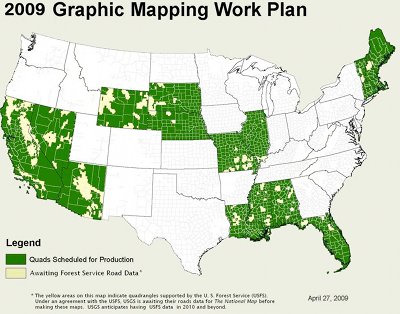
USGS: ‘Digital Map – Beta’

A picture named digitalmapbeta.jpg

Say hello to the USGS’s shiny new Digital Map – Beta website. From the website:

About the USGS’s New “Digital Map – Beta”

The USGS’s new “Digital Map – Beta” is an implementation and derivative of The National Map, celebrating 125 years of USGS topographic mapping. The “Digital Map – Beta” is the quadrangle map of the future. Although it is not a Geographic Information System (GIS), it is a new kind of georeferenced map that is a synthesis and evolution of USGS’s legacy digital map data files, the Digital Raster Graphics (DRG). These maps are different from other available imagery or maps. They are a first step toward a comprehensive portrayal of the Nation’s landscape. The initial version of “Digital Maps – Beta” includes orthoimagery plus roads and geographic names in the traditional 7.5 minute quadrangle format. The “Digital Map – Beta” is easily accessible, has reasonable file sizes and a common format with embedded tools, and theme-based layers.

Ultimately, in addition to a scale-corrected image base, the “Digital Map” will include layers for contours; water, transportation, boundaries, and structure features; geographic names; and vegetative surface cover or land cover in USGS’s customary 7.5-minute by 7.5-minute quadrangle format. When contours are added, the “Beta” designation will be dropped. Accompanying each “Digital Map” will be scanned files of previous editions of that topographic map. The quality and accuracy of the map depends on The National Map data that was used to make it. The file format is a georereferenced GeoPDF. The user can interact with the features on the map using free PC-compatible software. The map files will be available, at no cost, for digital download from the USGS Store.

Release Time Line

This new topographic map series will be released formally this fall. The USGS is making these maps from The National Map and plans to make an updated version of each map every 3 years. As other data layers are integrated, they will be added to the maps, so that after 3 or 4 years all of the data within The National Map will be shown. In 2010, the USGS plans to add integrated hydrography (water features) and hypsography (contours) to the maps. The USGS will follow the U.S. Department of Agriculture’s National Agriculture Imagery Program (NAIP) 3-year cycle to make these maps, thus covering the lower 48-States once every 3 years using the latest NAIP imagery as the base layer. In the near future, high-resolution scanned files of all historical versions of the new topographic maps also will be available for free download.

“Digital Maps – Beta” made in 2009 do not include the 7.5-minute quadrangles containing U. S. Forest Service (USFS) lands. These maps are provided by USFS and can be obtained for free as downloads at the USGS Store, or as paper copies for a fee by using the USGS-Store-Map-Locator and selecting USDA Forest Service Products.

Thanks to beSpacific for the link.

El Niño over the horizon?

A picture named elninolanina.jpg

From Minnesota Public Radio (Paul Huttner):

For the first time ever, the Climate Prediction Center (CPC) has issued an El Nino Watch. CPC’s new advisory system is designed to give states and communities advance warning months in advance for seasonal weather changes and potential effects. Tropical Pacific SST’s have warmed to about 0.5 degrees above average. El Nino is defined when Pacific SST’s remain at or above the +0.5 degree threshold for 3 consecutive months and 5 overlapping seasons. Various CPC computer models indicate Pacific SST’s could warm to 1 to 2 degrees above average by next January. This would make for a moderately strong El Nino event.

Pre-1922 water bank

A picture named coloradoriverbasinrivers.jpg

Here’s a look at the pre-1922 water bank proposed by the Southwestern Colorado Water Conservancy District and the Colorado River District, from Dale Rodebaugh writing for The Durango Herald. From the article:

A call on the river – as it’s known – has never occurred. But board members of the Southwestern Water Conservation District and the Colorado River Water Association are interested enough in the consequences that they took up the matter last week at a meeting in Durango. A presentation by Tom Iseman of The Nature Conservancy, who spent six months researching issues, served mainly as a primer for future debate. The two water groups, which together represent all counties on the Western Slope, commissioned the study.

On the Western Slope, agricultural interests whose claims predate 1922 hold the rights to about 1 million acre-feet. An acre-foot of water covers a football field to the depth of 1 foot. But under what Iseman calls a water bank, early right-holders on the Western Slope would be compensated financially for putting their allotment temporarily at the disposal of junior users, who could lose their total allotments if there were a call by downstream consumers. Senior right-holders would receive further compensation if their water was actually used. Junior right-holders could use loaned water only in the case of an actual or imminent downstream call and then only for critical purposes.

State agencies – the Colorado Water Conservation Board and the Division of Water Resources – have been briefed on issues Western Slope water suppliers are discussing, Whitehead said. Also, the boards have presented their plan to most water districts on the Front Range.

More Coyote Gulch coverage here and here.

Energy policy — nuclear: Cotter update

A picture named uranuim.jpg

Here’s a recap of a recent meeting between the Colorado Department of Health and Environment and concerned citizens down in Cañon City regarding Cotter’s plans for the superfund site and reopening the mill there, from Rachel Alexander writing for the Cañon City Daily Record. From the article:

Officials from the Colorado Department of Public Health and Environment and the federal Environmental Protection Agency spoke to a crowd of 165 at Harrison School…

Edgar Ethington, of CDPHE, discussed the excavation of the old pond area, which is a source of ongoing contamination. Additional excavation was implemented in 2008 to remove enough contaminated soil to allow ground water to meet state standards. Ethington said he emphasized dust suppression and air monitoring throughout the excavation process. The company removed 5,400 cubic yards of radium-contaminated soil, 221,800 cubic yards of uranium and molybdenum contaminated soils and analyzed 6,095 soil samples. He said there were no air contamination violations and no lost-time accidents. “I think operationally, they did a good job,” he said. “The contaminated soil has been removed to levels specified. Our role is to look over (Cotter’s) shoulder and make sure they’re doing it correctly.”[…]

Some citizens were concerned that direct health concerns were not addressed during Monday’s meeting and requested an epidemiological study. “When do we start talking about the health risk,” said Gloria Stultz. “We haven’t talked about the diseases (caused by contamination).”

“We are always conscious of what the health issue is,” Tarlton said.

More Coyote Gulch coverage here and here.

Southern Delivery System: Colorado Springs Utilities only has eyes for the preferred alternative (Lake Pueblo)

A picture named sdspreferredalternative.jpg

Here’s an update on Colorado Springs Utilities’ proposed Southern Delivery System, from Charlotte Burrous writing for the Cañon City Daily Record. From the article:

“We’re going to outline the advantages for the preferred alternative” before the Pueblo Board on July 22, he said. “There are several factors. The first one is the difference in cost. In terms of engineering, it looks like about $209 million difference between the two alternatives.”

More Coyote Gulch coverage here and here.

Donala Water District applies to change ag shares

A picture named irrigation.jpg

From The Pueblo Chieftain (Chris Woodka):

Donala Water District in El Paso County has filed an application in Division 2 Water Court that would allow it to use agricultural water it purchased in Lake County. The application leaves open a wide variety of ways to deliver the water, including the proposed Southern Delivery System. It would change the use of water from agricultural to municipal and other uses. Pueblo District Court Chief Judge Dennis Maes is the water judge for Division 2, which covers the entire Arkansas River basin. Donala, which serves about 2,700 homes north of Colorado Springs, bought the Mount Massive Ranch for $4.7 million in November. The district expects the ranch to yield about 300 acre-feet of water, or one-fifth of its annual supply.

The problem is moving the water to the district, Dana Duthie, Donala general manager, told the Arkansas Basin Roundtable earlier this year. The district lies 50 miles north of the Arkansas River and has no way, right now, of bringing the water into its system. The application gives no clue about how that will be done, reflecting the fact that the district has made no final decision for using the water. Storage in reservoirs from Turquoise Lake in Lake County to Holbrook Reservoir in Otero County is included in the application, including a reservoir yet to be built in Pueblo County at Stonewall Springs near the Pueblo Chemical Depot. Clear Creek Reservoir in Chaffee County, owned by the Pueblo Board of Water Works, is also included as a potential storage point. The district wants to use SDS, a water delivery pipeline proposed by Colorado Springs, Security, Fountain and Pueblo West, but would still need to get approval from Colorado Springs Utilities to use the project to move water through the project.

Runoff news

A picture named raftingarkriver.jpg

From The Pueblo Chieftain (Chris Woodka):

As of Monday, the [Fryingpan-Arkansas Project] had brought more than 43,200 acre-feet from the Fryingpan River collection system into the Arkansas River basin. More than 1,000 acre-feet a day are coming through the Boustead Tunnel into Turquoise Lake for eventual use by cities and farms on the eastern side of the Continental Divide. However the rate of flows has been dropping and could be further curtailed to meet obligations to stream flows on the Western Slope.Vaughan is confident the Fry-Ark’s yield will reach projections of an average year Ñ around 52,400 acre-feet. “Hopefully, the tunnel will keep flowing until the end of the month,” Vaughan said…

The Southeastern Colorado Water Conservancy District, which controls allocations from the project, took a conservative approach in mid-May, when it was already apparent the runoff was coming hard and early. The board chose to allocate only 80 percent of the anticipated water, because projections came up 10 percent short in 2008. On top of that, the first 5,000 acre-feet of water this year paid off the Pueblo Board of Water Works, which loaned water to meet the 2008 shortfall. The water generally sells for $7 an acre-foot, plus surcharges, most of which goes toward repayment and operation of the Fry-Ark Project. Factor in the annual 3,000 acre-feet payment to Twin Lakes Canal and Reservoir Co. under an exchange agreement, 10 percent transit loss and 5 percent evaporation charge, and the amount of water available for allocation this year will be 29,500 acre-feet. That’s about three-quarters of what the district was planning for one month ago, said Bob Hamilton, engineering director. Of that, almost 55 percent will go to towns and cities, while farms will get a bit more than 45 percent. Water users have been notified about what they will receive. That’s only about 36 percent of what was allocated last year – one of the highest import years in history, despite the shortfall – and the lowest amount of allocations since 2004. In fact, since 1981, only 2002 and 2004 were lower.

Wyoming: Cowboy State look at the Flaming Gorge pipeline (Regional Watershed Supply Project)

A picture named flaminggorgepipelinemillion.jpg

Here’s a long report about the pipeline project, from Derek Farr writing for the Sublette Examiner. From the article:

In a house editorial by the Denver Post, the newspaper concluded RWSP was “an innovative notion that might bring a cease-fire in our water wars.” In other words, under the RWSP Colorado’s east slope can develop west-slope water without rankling western water users. For Colorado, that’s due to some fortuitous geography.

The Green River starts deep in Wyoming’s Wind River Mountains before meandering 180 miles south and entering Utah at Flaming Gorge Reservoir. Below the Flaming Gorge dam, the river takes a left turn and loops through Colorado for 41 miles. Because the Green eventually flows into the Colorado River, the state of Colorado has a right to its water no matter how briefly the two coalesce. And because the Green’s sojourn into Colorado takes it through the remote regions of Browns Park and Dinosaur National Monument, few western Colorado water users are directly affected by a diversion. As western Colorado resistance has cooled, RWSP is garnering support in parts of eastern Wyoming. That’s because RWSP promises the City of Laramie 25,000 af of water. That’s not the state’s only internal division over the project. Gov. Freudenthal’s brother Steve Freudenthal, a Cheyenne lawyer, is helping develop the RWSP.

The prospect of being isolated between pro-RWSP Wyoming communities and impassive western Colorado water users has Sweetwater County Commissioner Paula Wonnacott concerned. She worries that the state’s voice will fracture over 25,000 af of water.
“They may see it as a boon for them,” she said. “But at the same time in southwest Wyoming were we have industry and create tax revenue for the state, we want to make sure that we have access to our water resources and we don’t want to do something to hinder those opportunities in the future.”

Accordingly, officials from Sweetwater County, Green River and Rock Springs are building a coalition against RWSP and opening dialog with the rest of the state. “I would really hate to not be able to engage the other elected groups in the eastern part of the state,” Wonnacott said. “We want to make sure we’re working with one voice.”

More Coyote Gulch coverage here and here.

Increase in organics in wastewater

A picture named wastewatertreatmentwtext.jpg

From Water Technology Online:

Households are flushing more organic material — including medicines and cleaning and personal care products — down the drain compared with historic data, according to researchers at the University of Minnesota’s Water Resources Center (WRC), a June 3 university press release states.

The yearlong pilot study, completed by the university’s Water Resources Center Onsite Sewage Treatment Program team and the Colorado School of Mines, sampled the wastewater of 16 households in three states — Minnesota, Florida and Colorado — beginning in fall 2006. By adding mechanical diverters to the homes’ sewers, researchers were able to sample water seasonally and around the clock during a seven-day period for each home.

In addition to an increase in medicines and organic chemicals in the wastewater, researchers found caffeine in all samples that were tested; salicylic acid (the active compound in aspirin) was in about three-quarters of samples; ibuprofen in half; and detergent additives and plasticizers in more than three quarters. Researchers also found that water use did not vary from season to season, but was affected by the household’s age, with younger households using nearly twice the amount of water per person than households with occupants 55 and older.

More Coyote Gulch coverage here.

Colorado River District: Pre-1922 water bank

A picture named coloradoriverbasincgs.jpg

Here’s a look at the plan to bank water rights in priority before the Colorado River Compact, from Bob Berwyn writing for the Summit Daily News. From the article:

The Colorado River Water Conservation District and the Southwest District met in Durango last week to discuss details of the plan, which would put senior water rights into a bank where they could be tapped in case of such a compact call.

Water users with pre-1922 rights (those senior rights are not affected by a downstream call) would be compensated for offering their senior water rights to junior users for temporary critical uses like drinking water and firefighting. The temporary use would only be permitted if a compact call were in effect or imminent.

Under the 1922 interstate contract, Colorado is obligated to deliver an average of 7.5 million acre feet of Colorado River water downstream annually. In a worst-case scenario, Colorado water users could be forced to cut some of their existing uses if the downstream states demand their full allotment. Water rights established before the compact was signed are not subject to the agreement.

Most of the water rights available for such a bank are held by ranchers and farmers.

More Coyote Gulch coverage here and here.

Southern Delivery System: Pueblo West public meeting tomorrow

A picture named sdspreferredalternative.jpg

From The Pueblo Chieftain (James Amos):

The Pueblo West Metropolitan District is scheduled to hear public comments Tuesday about the large water pipeline planned between Pueblo Reservoir and Colorado Springs. The meeting is scheduled to begin at 6:30 p.m. at the district’s offices at 109 E. Industrial Blvd. Pueblo West plans to receive water from the pipeline, which is known as the Southern Delivery System. However, the district has balked at demands that it supply some replacement water to the Arkansas River to make up for what the pipeline will divert.

More Coyote Gulch coverage here and here.

Energy policy — nuclear: NRC to require more thorough environmental reviews for in-situ mining

A picture named uraniuminsitu.jpg

From the Greeley Tribune:

The Nuclear Regulatory Commission will require more detailed environmental studies of proposed new in-situ uranium mines in the western United States. The in-situ technique involves pumping chemicals into groundwater to free uranium from the surrounding ore so it can be pumped to the surface and refined. The agency announced this week that it has released its final environmental study of the mining method after conducting public meetings in Wyoming, Nebraska, South Dakota and New Mexico.

More Coyote Gulch coverage here and here.

Energy policy — oil shale: H.R. 2540, Protecting Investment in Oil shale the Next generation of Environmental, Energy and Resource Security (PIONEERS) Act

A picture named tarsandstrucks.jpg

U.S. Representative Doug Lamborn has just introduced some dumb legislation. Here’s a report from David O. Williams writing for the Colorado Independent. From the article:

Besides winning the award for the most convoluted legislative acronym, Lamborn’s Protecting Investment in Oil shale the Next generation of Environment, Energy, and Resource security (PIONEER) Act, H.R. 2540, comes at a time when Colorado officials are skeptically asking for more accountability from current oil shale leases. Five research and development leases were issued for federal lands in Colorado in 2005 (and one in Utah), but now state officials want to see what kind of results oil and gas companies are getting on those parcels before recommending another round of research and development leases as laid out in the Bush administration regulations.

More Coyote Gulch coverage here and here.

Colorado River District: Pre-1922 rights water bank in the works

A picture named ibccroundtable.jpg

From a release from the Colorado River District:

The boards of the Colorado River District and its sister water conservation district, the Southwest District, met in Durango yesterday in a rare joint meeting to review progress on a planned water bank designed to address the potential impacts of an interstate compact call on Colorado River water users. Together both districts cover the entire Colorado River watershed in Colorado.

Tom Iseman reviewed work he and The Nature Conservancy conducted for the two districts on a conceptual plan for a “Compact Water Bank.” This concept is intended to minimize the risk and impacts of an interstate curtailment of water use if the four upper states of the Colorado River basin fail to meet the water deliver requirements of the 1922 Colorado River Compact. The Colorado River has never experienced an interstate compact call; however, mindful of development of new water uses, potential for climate change, and inevitable drought cycles, the two boards consider planning for a possible curtailment critical.

Still in its formative stages, the two districts explored establishment of a water bank specifically to address the impacts of an interstate compact call. The two boards discussed the opportunities and benefits, as well as costs, of operating such a program and resolved to continue working toward creation of a water bank for this purpose.

The 1922 Colorado River Compact grandfathers all water uses in existence at the time of the interstate agreement, protecting them from interruption or curtailment. Rather than experience an uncontrolled rush to purchase these senior rights, the two water districts are exploring establishment of a “water bank” into which senior water rights could be placed for temporary use by critical (e.g., drinking water and fire fighting) junior water uses that would be called out by an interstate compact call.

In this unique type of water bank, water users with pre-1922 rights would be compensated for entering into an agreement to offer their senior water rights that are exempt from compact administration to junior users who would otherwise be called out by compact delivery requirements. Junior water users, in turn, could “subscribe” to the bank as a sort of insurance policy in the event of a compact call on their water rights. The bank would serve as the administrator and clearing house for those with senior, pre-1992 water rights and those with junior rights needing an alternative source of water. Temporary use of senior rights by juniors would only be permitted if a compact call were in effect or imminent. Interviews with potential “customers” of the bank indicate that those with water rights junior to 1922, especially municipalities on both sides of the Continental Divide would be interested in participating.

The Colorado River basin is the primary source of water not just for those within the basin but also for a majority of Colorado’s Front Range that divert water from the headwaters across the Continental Divide to the East Slope, primarily for municipal use. The Colorado River provides between 25 and 75% of the total water supply for cities ranging from Fort Collins to Pueblo.

Roughly one million acre feet of senior pre-1922 water rights exist on the West Slope, mostly agricultural rights. Not all, however, can be safely or economically interrupted by the bank for one or more years and then be returned to their historical use. Irrigation water for fruit trees, for instance, would not be appropriate for participation in this sort of water bank.

Iseman stressed the considerable benefits of such a program, including possible delay or prevention of a compact call or mitigation of impacts for an interstate call. He told both boards that more input from potential participants, both senior and junior water rights owners, is needed.

Bruce Whitehead, general manager of the Southwest District, told Iseman, “We really appreciate your efforts and the direction it provides us for our next steps. Western Colorado has an obvious interest in addressing this issue proactively. We don’t want to see an uncontrolled market in buy up and dry up of western Colorado’s senior water rights.”

To learn more about the Colorado River District and its work, visit http://www.ColoradoRiverDistrict.org.

For additional information contact: Chris Treese: 970 945 8522.

More Coyote Gulch coverage here and here.

Jennifer Gimbel: ‘We need to take care of those settlements. We need to have the certainty, and we need to be fair to the tribes’

A picture named ridgesbasindam.jpg

From The Durango Herald:

Once known for a single-minded focus on building dams, Reclamation now has to start paying attention to climate change, American Indian water rights and a secure food supply, said Michael Connor, who was sworn in Monday as the agency’s commissioner. Connor, a graduate of the University of Colorado law school, spoke Thursday at a Western water conference at his alma mater…

The effect of the Indian settlements on Western water is unknown, but it could be profound, said Jennifer Gimbel, director of the Colorado Water Conservation Board, who spoke on the panel with Connor.

More Coyote Gulch coverage here and here.

Runoff news

A picture named sosidepikespeak.jpg

From The Colorado Springs Gazette (R. Scott Rappold):

The reservoirs on Pikes Peak, one-fifth of the city’s water supply, are 84 percent full, which is 20 percent greater than normal for early June, he said…The weather gauge at the Colorado Springs Airport has recorded 5.94 inches of precipitation this year, which is 0.90 inches below normal.

From the Aspen Times:

The Colorado Department of Transportation announced Friday it had closed the bike path, which parallels Interstate 70 in the canyon, from the Bair Ranch Rest Area to the east end of the canyon because of high and standing water from the swollen river. On Wednesday, CDOT noted the path was closed between the Shoshone Power Plant and the Hanging Lake Tunnel — a distance of about two miles in the middle of the canyon — because of high water. At that time, both ends of the path remained open. The eastern end is now off-limits as well, with Friday’s closure.

Arkansas Valley: Tamarisk leaf beetle release today

A picture named tamariskleafbeetle.jpg

From The Pueblo Chieftain (Peter Roper):

Pueblo city officials and Colorado State University scientists are unleashing an insect war against the tamarisk trees that are flourishing along the Arkansas River, Fountain Creek and Lake Minnequa. Anthony Norton, an entomologist at the Fort Collins campus, will release about 7,000 Asian beetles Friday morning near the confluence of the Arkansas River and Fountain Creek and a similar number of beetles at Lake Minnequa later in the day.

I hope the critters are hungry, reproduce like crazy and kill off a bunch of the invasive species.

More Coyote Gulch coverage here and here.

Creede: EPA may finish cleanup on Commodore waste rock pile by December

A picture named commodorewasterockcreede.jpg

The EPA has a plan to channel Willow Creek on bedrock which will remove the threat of the rock pile washing downstream at the Nelson Tunnel/Commodore Waste Rock superfund site. Here’s a report from Matt Hildner writing for The Pueblo Chieftain. From the article:

Hays Griswold, who’s overseeing the stabilization of the pile for the EPA, said the original plan to build a ramp up the channel for West Willow Creek that would serve as the stream bed was abandoned after this year’s runoff threatened to wash away part of the two-acre pile…

High runoff in 2005 did wash away large portions of the pile and sent debris streaming down the canyon where it threatened to block the flume that funnels the creek through town. That event highlighted the instability of the pile, which also contains contaminants such as arsenic, cadmium, lead, manganese and zinc, among others.

The new design for the project, once the channel is established in bedrock, would line grouted boulders four-to-six feet up the side of the bed. From there, the pile would be benched and pushed back further. “If we can make it as wide as we can, I don’t foresee anybody having to fight with it again like the county has and the city has every year,” he said. In the meantime, the EPA’s contractors are digging through various cribbing in the pile in an effort to reach the remaining third of the bedrock they believe is needed for the stream bed. Griswold estimated the stabilization of the waste rock pile would cost between $2 million to $3 million.

While the end of work is near on the rock pile, the EPA is still doing testing inside the Nelson Tunnel to determine the type and number of water sources entering the 8,000-foot adit that drains five mines before dumping into West Willow Creek. The agency did the first round of testing on the site in November and plans another round next week. After the data is gathered, the agency will do a feasibility study on the best cleanup solution for the tunnel, which is the watershed’s biggest contributor of cadmium, lead and zinc.

More Coyote Gulch coverage here.

Montrose: City to crack down on stormwater violations

A picture named stormwateroutlet.jpg

From the Montrose Daily Press (Kati O’Hare and Dick Kamp):

The city of Montrose is cracking down on violations of the Colorado Department of Public Health and Environment Stormwater Discharge Permit after the state found the city’s current enforcement “inadequate.” “The state came out and inspected subdivisions … they said we better start enforcing. They were not pleased,” said Jennifer Powell, the city’s environmental compliance technician. Powell said that Montrose is Colorado’s third worst urbanized area for stormwater permit violations. Since 2007, the Colorado Department of Public Health & Environment’s Water Quality Control Division has issued civil penalties exceeding $150,000 to local developers.

More Coyote Gulch coverage here and here.

Flaming Gorge pipeline: Wyoming Water Development director says many opposed to the project do not understand that it will be Colorado water under the Colorado River Compact

A picture named flaminggorgepipelinemillion.jpg

From the Wyoming Tribune-Eagle (Bill McCarthy):

“There was a lot of hysteria and bad information,” Mike Purcell told a joint meeting of the Water Development Commission and the Legislature’s Select Committee on Water Development…

Purcell told the two boards that there likely will be people at today’s meeting who want to be heard on the issue. The Water Development Commission and the Legislature’s Select Committee on Water Development meet again at 8:30 a.m. today. “We like Colorado water flowing through our state” because it adds to things such as recreational activities and wildlife habitat, he said. But Colorado could call for the water it is entitled to under the seven-state compact.

The Army Corps of Engineers will host a public meeting Tuesday in Rock Springs about the proposal…Army Corps officials also extended the written public comment period for an environmental impact statement through July 27. The environmental study is expected to take at least three years.

More Coyote Gulch coverage here and here.

Wet Mountain Valley: First look at Custer County augmentation plan

A picture named wetmountainvalley.jpg

From the Wet Mountain Tribune:

Last week, Terry Scanga and others with the UAWCD met with the county commissioners and other interested persons to give an update on that proposed plan. Some 60 persons, comprised mostly of Valley residents, gathered in the community room at Cliff Lanes bowling center on Thursday, May 28, to hear what UAWCD officials had to say. Scanga, who serves as manager for UAWCD, told the group the augmentation plan would likely be filed in water court by June 30. Estimated time frame for state approval is three to five years. When asked how the timeframe for filing was established, Scanga said new regulations regarding the filing of cases in water court go into effect July 1.

A water augmentation plan is described as a way for junior appropriators to obtain a legal source of water for beneficial use. Common uses are for households, irrigation, municipal, recreation and watering livestock…

UAWCD engineer Ivan Walters gave a brief outline of the proposed plan.

—Texas Creek and Grape Creek drainages would be used to bring a water augmentation in plan to Custer County by way of water exchanges.

—The plan also provides for the building of reservoirs in Custer County to store water. In the works is the building of two reservoirs along Texas Creek and three in the Grape Creek area. Possible sites only have been established, said UAWCD officials, and they will be built only as they are needed.

—The UAWCD currently has 1,000-acre-feet of water storage in Pueblo Reservoir and 60-acre-feet of water storage in Lake
DeWeese.

—The UAWCD has also acquired local water rights for the augmentation plan. UAWCD has purchased 70 acre-feet of water from Hermit Basin Lodge. UAWCD is also negotiating with the RMW district to lease water RMW owns on the Johnson Place Ranch south of Westcliffe. Also in the works, said Walters, is the leasing of water from the H2O Ranch. The H2O ranch is owned by the cities of Fountain and Widefield near Colorado Springs, which purchased the ranch for its water rights last year.

H.B. 09-1067, Instream Flow Tax Incentives

A picture named saguachecreek.jpg

From PRNewswire via the Denver Post:

Passed by the legislature during the 2009 session, House Bill 1067 creates a new incentive for individuals to contribute to the long-term health of important stretches of stream in all of Colorado’s river basins. Under current law, the Colorado Water Conservation Board (CWCB) can receive donations of water rights to protect stream flows and benefit the environment. The legislation authorizes the Colorado Water Conservation Board to award tax credit certificates to donors of water rights that the Board deems worthy of such consideration. The Board negotiates the tax credit values with the water right donor.

“Giving Colorado’s family farmers more options in deciding how to benefit from their property will help our agricultural communities,” said Kent Peppler, President of the Rocky Mountain Farmers Union. “As good land stewards, family farmers will look favorably upon this program as an alternative to selling their rights to water developers who often export the water to urban and suburban parts of the state.”

More Coyote Gulch coverage <a href="

Runoff (snowpack) news

A picture named blueriver.jpg

From the Summit Daily News (Bob Berwyn):

Flows in the Blue River were very near 1,800 cubic feet per second the past few days. The level prompted a small stream flood advisory, specifically for the Blue River through Silverthorne and northward. Fewer showers are expected today, so flows could moderate slightly. Water commissioner Scott Hummer said the levels aren’t unusual. He said runoff from high elevations, rain and lack of diversions to the Front Range combined to send flows upward during the past week. Denver Water’s East Slope reservoirs are full, so no water is flowing out through Dillon Reservoir’s Roberts Tunnel, which can take as much as 800 cubic feet per second. In the Upper Blue, Colorado Springs has cut diversions through a tunnel under Hoosier Pass “I’m surprised at the flow that’s moving through the reservoir. I didn’t think we’d see those types of flows,” Hummer said.

From The Mountain Mail (Christopher Kolomitz):

In the Arkansas River basin, snowpack was 52 percent of average. Only the North Platte, 55 percent of average and the South Platte, 52 percent, were higher. Colorado River basin was 31 percent of average and the Gunnison River basin was 7 percent of average…

In most Colorado basins, snowmelt is ranging from about two to three weeks earlier than typically expected. For most of the state, summer water supplies are expected to be near average. However, there are several areas which failed to receive enough moisture during the winter and spring to assure near average runoff volume. Those include the San Juan, Animas, Dolores and San Miguel basins of southwestern Colorado.

In the Arkansas River basin, reservoir storage was 99 percent of average and 123 percent of last year. With statewide storage volume at 116 percent of average, these are the best storage statistics since 1999.

Teva Games: Kiwi Mike Dawson wins men’s steep-creek crown

A picture named kayaker.jpg

From the Vail Daily:

[New Zealand’s Mike Dawson] deftly avoided the aforementioned rocks and other impediments which can bang up bare arms on his way to the men’s steep-creek crown in a combined time of 3 minutes, 41.63 seconds, out-pacing Washington’s Tao Berman (3:42.67) and North Carolina’s Pat Keller (3:44.29).

Click through and check out the photo gallery.

More Coyote Gulch coverage here.

Larimer County: Septic fees going up

A picture named septictankbasics.jpg

From the Fort Collins Coloradoan:

Larimer County will raise the cost of septic permit fees as of Monday, according to the Larimer County Department of Health and Environment. The new fees were approved by the Board of Health at its May meeting. These increases comply with the board’s direction that user fees, rather than taxpayer dollars, should cover most of the costs of services that benefit individual households and businesses. The new rates are: new residential, $873; vaults, $375; minor repair, $298; major repair, $548; remodel, $400; mortgage loan inspections, $265. Unchanged rates: new commercial, $1,023; commercial repair, $1,023.

More Coyote Gulch coverage here.

H.B. 09-1308, Funding for Div Of Water Resources

A picture named groundwater.jpg

From the Telluride Watch (K.C. Mason):

House Bill 1308 (pdf), introduced by Rep. Kathleen Curry, D-Gunnison, sets new ground rules for water produced from the development of coal bed methane gas wells. “It probably was one of the most important bills of the whole session because it really is a new section in Colorado water law,” [State Senator Jim Isgar] said. “We’ve been working on it for several months with the State Engineer’s office, the Water Congress, the oil and gas industry, and senior water rights holders.” The new law, presuming the bill is signed by Gov. Bill Ritter, creates a process for determining whether produced water has a beneficial use and whether shallow wells that are used in energy production are on tributaries that can cause injury to senior water users.

More Coyote Gulch coverage here.

Arkansas Valley: NRCS signs first watershed contract in nation for stimulus dough

A picture named arkansasriverbasin.jpg

From The Pueblo Chieftain (Anthony A. Mestas):

Members of the Natural Resources Conservation Service on Wednesday signed the first contract of four watershed projects aimed at erosion control or habitat preservation in Southeastern Colorado. The projects, which are part of President Barack Obama’s economic stimulus package, total about $1 million. The money will go toward more than 50 projects in four areas that have existing watershed projects covering about 288,000 acres in Otero, Bent, Prowers and Las Animas counties. Work is sponsored in partnerships between the conservation service and landowners…

Allen Green, state conservationist, said the contract was the first signed in the nation as part of Obama’s $85 million watershed program. The Highline project, which began in 1998 and is the largest of the four in Southeastern Colorado, will eventually produce 28 land treatment contracts with producers. There will be at least 3,000 acres of conservation improvements in the area, Knapp said. The project includes water quality improvement, conservation of appropriated water supply and the enhancement of scarce wildlife habitat. Specifically, the project will improve both surface and groundwater quality and reduce irrigation-induced erosion to acceptable levels. It also will more effectively conserve and use available water supplies by improving on-farm irrigation water management which may reduce deep percolation. Padilla, whose farm is in the West Otero County Water District, will use the funding to improve his irrigation system to make more efficient use of water and to improve his farming and ranching operation in Rocky Ford…

Other projects will reduce erosion and sediment deposits into Lake Trinidad and the Arkansas River. Some have been in the planning process for a decade, but never started because of a lack of funding, Green said. Other watershed projects approved for funding included Limestone-Graveyard creeks, Holbrook Lake Ditch and the Trinidad Lake north watershed. The project at Trinidad Lake, which started in 1992, will create 10 land treatment contracts with mostly family-owned farms. Officials said the project will result in significant environmental improvements by reducing contaminant and sediment-loading to the lake which will prolong the waters and improve the water quality delivered to the lake. The Limestone-Graveyard Creek Watershed project begun in Bent and Prowers counties in 1996 will create five land treatment contracts with producers. The 2001 Holbrook Lake Ditch Watershed project will create eight land treatment contracts with farmers. The projects aim to improve water quality, conserve an over-appropriated water supply and enhance wildlife habitat.

Runoff (snowpack) news

A picture named collerswariogrande.jpg

From The Pueblo Chieftian (Matt Hildner):

The end result of the lingering pattern has been above-normal precipitation for Alamosa. The town saw 1.17 inches of precipitation in May compared with its normal total of 0.7 inches. In the northwestern corner of the valley near La Garita, volunteer spotters recorded rainfall 16 days in a row, according to the Community Collaborative Rain, Hail and Snow Network. Although three of those days registered only trace amounts of precipitation, the period saw more than 2 inches of precipitation in the area…

Craig Cotten, division engineer for the valley, said the rains combined with the early runoff has allowed Platoro Reservoir to spill for the first time in a few years. Downstream, all of the decreed ditches on the Conejos River have been served.

Cotten noted that a potential downside to continued rain might be a revision of the delivery schedule for the Rio Grande Compact, which forces the state to send larger amounts of water downstream in wet years. Cotten said he still was waiting on the June forecast from the Natural Resources Conservation Service before he could make any determination on whether the delivery requirements would change.

For potato growers, who contribute nearly $200 million annually to the valley’s economy, the steady rains have been a mixed blessing. Jim Ehrlich, director of the Colorado Potato Administrative Committee in Monte Vista, said the rains may keep farmers from doing weed control, although he added it was too early to tell how weeds might affect crop yields. The cooler temperatures that have come with the rains also may slow the crop’s development.

From the Greeley Tribune:

May’s weather was slightly warmer and drier than average which, coupled with numerous layers of dust on the snowpack, has led to a rapid depletion of higher-elevation snowpack statewide, according to the Natural Resource Conservation Service. The statewide snowpack dipped to only 32 percent of average on June 1, after recording 90 percent of average on May 1. The state’s maximum snowpack was reached on April 19, and was 109 percent of the average maximum snowpack…

For most of the state, this summer’s water supplies are expected to be near average. However, there are several areas of the state which failed to receive enough moisture during the winter and spring to assure near average runoff volumes, particularly in southwestern Colorado. In addition, a number of other smaller basins across southern Colorado in the Rio Grande and Arkansas basins, as well as the headwaters of the South Platte River, are expected to produce below average runoff volumes this summer.

From the Summit Daily News (Bob Berwyn):

In Dillon, where Denver Water tracks precipitation and temperatures, May brought 2.12 inches of precipitation, compared to the historic average of 1.44 inches…

In Breckenridge, weather-watcher Rick Bly maintains weather records that date back more than 100 years. For May, Bly measured 2.63 inches of precipitation — 52 percent more than the historic average 1.72 inches. But snowfall for the month was below average. Normally, Breckenridge sees 10.9 inches of the white stuff, this year, only 6.2 inches fell in May. For the weather year, beginning Oct. 1, both snowfall and precipitation are very close to the historic average. “That doesn’t happen very often,” Bly said. “We’ve had 162.26 inches of snow. The average from Oct. 1 through May 31 is 162.67.” Water-wise, that historic average equals 14.3 inches. Bly has measured 14.39 inches at his backyard weather gauge for this current water year…

For most of the state, this summer’s water supplies are expected to be near average. Reservoir storage increased significantly during May as the early snowmelt boosted inflows. Storage has improved to above-average levels nearly statewide and is ahead of last year’s totals on this date in all basins. With statewide storage volumes at 116 percent of average, these are the best storage statistics since 1999. For the Colorado River Basin, the June 1 snowpack was only at 31 percent of average for the date because of the early snowmelt. But reservoir storage was at 112 percent of average. The Front Range also experienced a wet month, bringing moisture totals to near average after a dry winter. Denver Water’s reservoirs east of the Continental Divide are currently full, so no water is currently being diverted from Dillon Reservoir to the Front Range.

Dolores River: ‘It’s a complicated river’ — Amber Kelley

A picture named doloresriver.jpg

From The Durango Telegraph (Missy Votel):

If ever there was an enigma wrapped in a riddle, it would be the Dolores River. Not only does the “River of Sorrows” take an abrupt northward about-face on its 250-mile journey to the Colorado River, but the origins of the name itself (“El Rio de Nuestra Senora de las Dolores,” possibly bestowed by a Spanish explorer in the mid 1700s) are shrouded in mystery. However, more than 250 years after the first white settlers laid eyes on it, the Dolores continues to confound those looking to protect the increasingly precious resource. “It’s a complicated river,” said Amber Kelley, a Cortez native who now lives in Dolores and works as the Dolores River Campaign Coordinator for the San Juan Citizens Alliance. In her role, Kelley helps head up the Dolores River Coalition, a group conservation and recreation organizations that “care about the fate of the Dolores River.” The coalition, in turn, gives input to the Dolores River Dialogue, a broader group made up of stakeholders from farmers to federal agencies. That group formed in 2004 with the goal of balancing ecological conditions of the stretch of river below McPhee Reservoir with water rights, and recreational interests. To make things more complex, that Dolores River Dialogue, or DRD, dovetailed in 2008 to help form the Lower Dolores Management Plan Working Group. Also made up of a broad cross section of interests, the work group is preparing recommendations for an update to the San Juan Public Lands Center’s 1990 Dolores River Management Plan, slated for later this fall. Throw in the Bureau of Reclamation and Dolores Water Conservancy, which oversee operation of McPhee Dam, the Bureau of Land Management, which is responsible for management of much of the river’s surrounding public lands, as well as a Wilderness Study Area, Wild and Scenic River suitability and increasing pressures from the mining and oil and gas industry, and the scenario has more twists and turns than the meandering river itself.

Nevertheless, there is an overriding theme to it all: protection of the Dolores and its myriad uses. It is this common thread that has been guiding the work group’s attempt to reconcile the different uses with preserving the river, or in some cases, bringing it back to life…

The work group has divided the river into eight distinct sections, but the bulk of concern is over the first five, from the dam to the confluence with the San Miguel River. [Mike Preston, manager of the Dolores Water Conservancy] said the four major areas of concern include: the health of the cold-water fishery, including non-native trout; the warm-water fishery, which includes native species such as suckers, chubs and minnows; the riparian zone, which includes eradication of tamarisk and re-establishment of native cottonwoods and willows; as well as the geomorphology, including sediment build up and flow. “The opportunities to do something positive for the river vary from reach to reach,” said Preston. “The original flow from McPhee was designed with the sport fishery in mind, but the objective now has grown much broader.”[…]

the Lower Dolores is also home to the eastwood monkeyflower and the kachina daisy, both found in only a few dozen sites throughout the Four Corners. Aside from the stresses low flows put on the downstream ecology, [Ann Oliver, the South San Juan Mountains Project Director for the Nature Conservancy] sees the biggest threats to the Lower Dolores as invasive species, such as tamarisk and Russian knapweed, and the extractive industry. In addition to past and possible future uranium mining in the area, natural gas drilling could also have impacts. Recently, the Denver-based Bill Barrett Corp. began conducting natural gas exploration in Paradox Valley using Dolores River Project water in the hydraulic frac-ing process.

More Coyote Gulch coverage here and here.

Natural Resource Conservation Service: ‘Colorado’s Snowpack Melts Quickly’

Photo via Snowflakes Bentley (Wilson A. Bentley)

Here’s a release from the NRCS:

After reaching an above average maximum seasonal accumulation in April, Colorado’s mountain snowpack proceeded to rapidly melt across the state during May. According to data collected through the SNOTEL (SNOwpack TELemetry) network, only remnants of this winter’s snowpack remain in many of the state’s major river basins on June 1. May’s weather was slightly warmer and drier than average which, coupled with numerous layers of dust on the snowpack, has lead to a rapid depletion of the higher elevation snowpack statewide according to the USDA-Natural Resources Conservation Service (NRCS). The statewide snowpack dipped to only 32 percent of average on June 1, after recording 90 percent of average on May 1. The state’s maximum snowpack was reached on April 19th, and was 109 percent of the average maximum snowpack.

With the slightly above average snowpack during April, runoff volumes in the higher elevation streams and rivers are expected to produce near average volumes this year across much of the state. However, the impacts of the earlier than normal meltout can potentially have impacts to some water users. These impacts may be greatest during the mid to late summer demand season as streamflows recede sooner than in a typical year. In addition, those water users who are unable to rely upon upstream reservoir storage will see greater impacts from the early melt, according to Allen Green, State Conservationist, with the NRCS. In most basins across the state, snowmelt is currently ranging from about 2 to 3 weeks earlier than is typically expected for this date.

For most of the state, this summer’s water supplies are expected to be near average. However, there are several areas of the state which failed to receive enough moisture during the winter and spring to assure near average runoff volumes. Those basins include the San Juan, Animas, Dolores and San Miguel basins in southwestern Colorado. In addition, a number of other smaller basins across southern Colorado in the Rio Grande and Arkansas basins, as well as the headwaters of the South Platte River, are expected to produce below average runoff volumes this summer. For the most part, these streams are expected to flow with volumes ranging from 70 to 90 percent of average for the remainder of the summer. “For most of the state’s water users, this summer’s water supplies should be adequate, especially for those with access to upstream reservoir storage”, said Green.

Reservoir storage has increased significantly during May as the early snowmelt boosted inflows. Storage has improved to above average levels nearly statewide and is ahead of last year’s totals on this date in all basins. With statewide storage volumes at 116 percent of average, these are the best storage statistics since 1999.

Energy policy — oil shale: Anadarko and General Synfuels kick off pilot project near Rock Springs, Wyoming

A picture named oilshaledepositsutwyco.jpg

From the Casper Star-Tribune:

…it’s going to require new, environmentally friendly technology to make it commercially viable to develop all that oil shale, they say. Some of that technology could come out of an oil shale research and development pilot project slated for Sweetwater County, officials involved in the effort said. Anadarko Petroleum Corp. — under an agreement with General Synfuels International — is launching Wyoming’s first oil shale research program in nearly three decades to determine the economic and environmental feasibility of developing oil shale in southwest Wyoming. General Synfuels, a wholly owned subsidiary of Earth Search Sciences Inc., secured the exploration agreement last month for a small parcel of private land south of Rock Springs, according to Anadarko spokesman Rick Robitaille…

The exploration agreement in Wyoming covers a 160-acre site about 35 miles south of Rock Springs on a Union Pacific Railroad section, said John Christiansen, a spokesman for Anadarko’s mineral programs, in a phone interview from Houston. The agreement will allow General Synfuels to test and develop the company’s patented technology to recover hydrocarbons from oil shale using a process that prioritizes “environmental sensitivity,” said Luis Lugo, CEO of Earth Sciences…

The Wyoming Wildlife Federation and other conservation groups are wary, however, of industry’s motives in oil shale development and how companies might actually use federal lands. WWF Executive Director Walt Gasson said many people hunt and fish on public lands in southwest Wyoming, and those recreational opportunities could be affected by any oil shale development. He said the pilot oil shale research projects could possibly result in hundreds of thousands of acres of vital wildlife habitat for big game and sage grouse being occupied by machinery at the exclusion of all other uses. “I realize we need some energy development, but they’ve already blanketed western Wyoming with roads and wells,” Gasson said. “Are we so desperate that we’ll sacrifice the places we’ve hunted for generations for something as uncertain as oil shale?” Steve Torbit, Rocky Mountain regional executive director of the National Wildlife Federation, predicted the entire oil shale experiment will be “a colossal waste of water” for the region. He said extracting and producing oil from shale will require tremendous quantities of water that may not be readily available.

More Coyote Gulch coverage here and here.

Colorado to pony up $4.5 million to Lend Lease

A picture named prairiewaterstreatment.jpg

The editors of the Aurora Sentinel believe that Lend Lease’s project could have been save with some state dough and participation in the Prairie Waters Project. Here’s an editorial. They write:

Two things should have happened. Either the project should never have been allowed to get as far as it did, or the state should have intervened to help produce needed water. Even before Lend Lease was chosen as the developer in 2006, state officials were well aware of the lack of available water for the project. In this part of the state, there are two possible sources of water for development of any significance: Aurora and Colorado Springs. The project is really too far from Colorado Springs to be financially feasible. That leaves Aurora.

Aurora is in the process of building its massive Prairie Waters Project, bringing water from downstream of the South Platte River. Part of that plan calls for a future reservoir in the vicinity of the existing Aurora Reservoir, just north of the defunct Lowry Bombing Range project. The state could easily have ponied up in some fashion to share in the expense of Prairie Waters and the new reservoir, but didn’t. Such a partnership could have provided the sustainable water supply that any significant development on this land will require.

Instead, the state allowed the deal to die and now must pay Lend Lease millions for its trouble. What a waste. State land board officials say the work completed by Lend Lease could be helpful for a future project, but there clearly will never be one without a water deal.

More Coyote Gulch coverage here and here.

Precipitation: Northeastern Colorado officially out of drought

A picture named usdroughtmonitor052609.jpg

From the Fort Collins Coloradoan (Trevor Hughes):

As the year began, state and regional climatologists were worried about the lack of moisture in Colorado, particularly east of the Continental Divide and on the Eastern Plains. Those fears have been eased by consistent rain over the past few weeks, and now the area is officially out of “moderate drought” status according to the weekly U.S. Drought Monitor published by the National Drought Mitigation Center…

Farmer Troy Seaworth is perfectly happy to see the rain keep falling. In March, the Wellington-area farmer was worrying about the dry soil and lack of rain. He’s feeling more optimistic now. “It’s a lot better — the rains, the timeliness, have been really good,” Seaworth said. Seaworth said his winter wheat is doing well, as are his pinto beans and corn. He estimated the rains have already saved him as much as $3,000 in irrigation water.

Fountain Creek Flood Control and Greenway District: 11 applicants seek to represent Pueblo on board

A picture named fountaincreek.jpg

From The Pueblo Chieftain (Chris Woodka):

Commissioners are scheduled to vote June 15 on the appointment. Council has not yet scheduled a vote. Applicants are: William E. Alt, Greg Bowman, Ronald A. Leyba, John J. Mihelich, Thomas W. Ready, Jane Rhodes, Steven Rodriguez, Jack A. Seilheimer, Lawrence J. Simons, Armando Stanley Vigil and Jim Warren.

Alt is a resident of Fountain Creek and resident of the Turkey Creek Conservation District. Bowman is a Pueblo heart surgeon. Leyba has been employed by the Colorado Department of Corrections for more than 20 years. Mihelich is a retired stormwater inspector for the city of Pueblo. Ready is a local dentist and as former chairman of the Colorado State Parks board, which advocated a state heritage park on Fountain Creek. Rhodes is a Fountain Creek landowner and a member of the Turkey Creek Conservation District. Rodriguez is a Pueblo businessman who chairs the Community Services Block Grant Committee. Seilheimer is a retired biology professor at Colorado State University- Pueblo. Simons is a local attorney. Vigil is an employee at the Bechtel project at Pueblo Chemical Depot. Warren is a local businessman.

More Coyote Gulch coverage here and here.