The United States and Canada decided Saturday to update a key agreement that protects the Great Lakes from invasive species, climate change and other threats to the fresh water system, Associated Press reported. In a ceremony marking the 100th anniversary of the Boundary Waters Treaty of 1909, Secretary of State Hillary Rodham Clinton, together with Canadian Foreign Affairs Minister Lawrence Cannon, said the Great Lakes Water Quality Agreement, which was last amended in 1987, was no longer adequate. “[The treaty] is a living instrument of our cooperation and partnership,” Clinton said during a press conference. “It has provided an effective framework for the last 100 years, but now we have to take stock of where we are and how we’re going to be proceeding with confidence and effectiveness into the future.” The agreement pledges the United States and Canada to restore and maintain the chemical, physical and biological integrity of the Great Lakes Basin ecosystem. Since its signing in 1972, levels of pollutants have dropped, and species like the bald eagle have made a comeback.
Month: June 2009
Circle of Blue: Google Brings Water Data to Life
With all the power of 21st century collaboration technology, nothing to date has tamed the massive amounts of disparate water information locked away in diverse database systems. But that may have changed last week when Google Labs launched Fusion Tables, a powerful new online research and data organizing tool that makes it much easier to share and navigate the world’s digital science and technical archives.
Fusion Tables, which was developed by Google engineers using sample research data about the global fresh water crisis provided by the Pacific Institute and Circle of Blue, is specifically designed to unlock a treasure trove of facts, trends, and scientific findings that until now have been sequestered in databases and spreadsheets not easily shared.
The new Google technology provides users a rare opportunity to share critical data, probe them, organize pertinent information and generate design elements — charts and graphs — that translate complex information into much more digestible trends. The intent is to enable online collaborators to study and understand in new dimensions the world’s complex problems — the fresh water crisis among them — discern the salient details and organize those scientifically confirmed facts. They can be used to tell stories, offer insights, and propose solutions that heretofore were largely the purview of scholars and scientific experts.
Thanks to Loretta Lohman for the link.
Aspen to collect pharmaceuticals
From the Aspen Times:
The city is organizing its first Pharmaceutical Take-Back, offering an environmentally conscious way for residents to dispose of unwanted prescription and over-the-counter medications. The event will take place Thursday, June 25 at Connor Park, behind Aspen City Hall, from 3 to 7 p.m. It’s free and open to Aspen residents.
S. 787: Clean Water Restoration Act
Here’s a release from Trout Unlimited:
For immediate release
June 18, 2009For more information:
Melinda Kassen, (303) 440-2937, x 100, mkassen@tu.org
Bruce Farling, (406) 543-0054, bruce@montanatu.org
Steve Moyer, (703) 284-9406, smoyer@tu.org
Clean Water Restoration Act moves forward
The Senate Environment and Public Works Committee on Thursday approved the Clean Water Restoration Act, a move hailed by conservation and sportsmen groups.
“This is a great step forward in restoring common sense protection to our nation’s waterways and wildlife habitat,” said Trout Unlimited Chief Operating Officer Chris Wood.
The bill now goes to the full Senate for consideration.
CWRA would restore the original intent of the Clean Water Act, which in recent years has been weakened by Supreme Court rulings that distorted the language of the law and drastically reduced its scope. The resulting legal confusion has stripped Clean Water Act protections from some 20 million acres of wetlands and millions of miles of streams.
A number of the bill’s critics claim that it overreaches and vastly expands federal jurisdiction. Ranking Committee Member Sen. James Inhofe, R-OK, declared that rural America should “watch out” for the Clean Water Restoration Act, and called it “the biggest bureaucratic power grab in a generation.”
Critics’ sensationalist claims bear little relation to reality. When given the facts about CWRA, farmers, ranchers, sportsmen and others who care about stewardship of rural America’s land and water are supporting this responsible legislation.
Fact: Senate Environment and Public Works committee members, including Sen. Max Baucus of Montana, Senator Amy Klobuchar of Minnesota, and Chairwoman Barbara Boxer of California, have worked hard in recent weeks to meet the concerns of rural stakeholders about the CWRA. The resulting compromise language has cleared up confusion about the CWRA’s impact on rural areas.
As a statement by the Montana Grain Growers Association puts it, “Senator Baucus’ substitute amendment addresses several concerns of production agriculture and makes it explicitly clear that this bill will not expand the scope of jurisdiction of the Clean Water Act beyond the original intent of Congress.”
Fact: Critics portray CWRA as a federal power grab, but the bill merely restores the protections that our nation’s waterways enjoyed for more than a quarter century, before recent misguided Supreme Court rulings stripped protections from millions of miles of streams. A key clarification at the heart of the bill—changing the phrase “navigable waters” to “waters of the United States”—follows the interpretation long used by the Army Corps of Engineers and Environmental Protection Agency for decades.
Fact: The Clean Water Restoration Act would not apply to any water body that was not historically covered under the Clean Water Act for more than 25 years, prior to the 2001 Supreme Court SWAANC decision. The Clean Water Act did not apply to gutters, puddles or other insignificant accumulations of water—and neither would the Clean Water Restoration Act.
Moreover, the Clean Water Restoration Act preserves all existing agricultural exemptions under the law, such as for return flows and construction and maintenance of irrigation ditches and farm ponds.
“Rural America can live with the Clean Water Restoration Act – because rural America already has lived with and benefited from these protections for decades,” said Melinda Kassen, director of TU’s Western Water Project.
Fact: About 60 percent of America’s streams are intermittent and could lose protection without the CWRA—these same streams are a drinking water source for more than 110 million Americans, in rural and urban areas alike.
Hunters, anglers and other outdoors enthusiasts have lined up to support CWRA. Field and Stream magazine recently called CWRA passage a top legislative priority for sportsmen, citing its protection of “temporary and isolated wetlands, among the most important habitats for waterfowl and a host of other wildlife.”
“The CWRA compromise bill approved Thursday is pragmatic, balanced legislation that protects America’s rivers and streams while preserving existing farm and ranch operations,” said Steve Moyer, vice president of government affairs at Trout Unlimited. “This is a bill that rural America can support.”
A majority of Americans surveyed in a recent Gallup poll indicated that they worry “a great deal” about the water quality of our nation’s streams and rivers. They don’t want to go back to a past when our country’s rivers and streams were dumping grounds for pollution.
The CWRA will help ensure that our nation’s rivers and streams remain clean, swimmable and fishable.

More Coyote Gulch coverage here.
Tom Tidwell named to lead U.S. Forest Service
From the Denver Post:
Montana forester Tom Tidwell is the new head of the U.S. Forest Service. Agriculture Secretary Tom Vilsack said Wednesday that Tidwell will replace Gail Kimbell, who had led the Forest Service since 2007. Tidwell is a 32-year Forest Service employee and now supervises national forests through northern Idaho, Montana and the Dakotas.
Montezuma County: Goodman point residents approve new water district
Some Colorado residents still have to haul water. Here’s a report on efforts to end the need down in Montezuma County from Kristen Plank writing for the Cortez Journal. From the article:
An election was held Tuesday at the Montezuma County Courthouse. Property owners and residents of the Goodman Point area voted whether or not to form their own district. People who live in the Goodman Point area have to haul water from a water filling station beside Cortez City Park and back home again, a distance that can reach 15 miles one way. Residents hope to have their own water system installed. Roughly 70 percent of the area’s residents showed up for the special election. Every single resident voted “yes” to forming their own water district, Goodman Point Water Association President J.R. Berry said. “It was fantastic,” he said. “It was the next big step for us. We’re 90 percent of the way there.”
Voters also elected the water district’s board of directors, which includes Berry, Rodney L. Evans, Wanda Shorelene Oliver, Linda Carter and Teri Chappell.
The total cost of the project is estimated to be $1.1 million, but approximately $300,000 of that has already been funded through grants, Berry said. The next step is to get a bond written and find a purchaser to fund the construction. The bond issue or mill levy, which will generate the rest of the construction money, will come up in front of the Goodman Point residents in the November election. Montezuma Water Co. is beginning to look into construction plans for the project. Plans include connecting 11 miles of water line, with hydrants, to Montezuma Water Co.’s 4-inch pipeline on the eastern portion of Goodman Point. A 50,000-gallon water storage tank and a pump station also would be installed. Water would be pumped to 35 residences, and the system could service up to 200 homes, but additional residences would have to go through a separate permitting process…
Should the process move along without any kinks, construction will begin in spring 2010, Berry said.
More Coyote Gulch coverage here.
Northern Colorado Integrated Supply Project: New Colorado reservoir storage
Here’s a look at the need for new storage to capture runoff in years like 2009, from Rebecca Boyle writing in the Greeley Tribune. From the article:
While NISP is not nearly as complex as the [Colorado-Big Thompson], it, too, involves two rivers, multiple pipelines and new reservoirs located along the Great Hogback and on the Great Plains.
In the NISP version of this story, our drops of water fall as snow at Cameron Pass, later melting into a tributary of the main Poudre River. Along the way, they would avoid being caught in Long Draw, Halligan and Seaman reservoirs, and they would help buoy kayakers and trout making their way through the Poudre River Canyon. The drops of water would travel along the state’s only federally designated Wild and Scenic river, all the way to the canyon mouth. There, they would enter the North Poudre Supply Canal, an existing structure that would be augmented to fill a brand-new reservoir north of Ted’s Place, near the intersection of U.S. 287 and Colo. 14 northwest of Fort Collins. The new reservoir, called Glade, would require the relocation of U.S. 287 and would be slightly bigger than Horsetooth Reservoir to the south. Only when the Poudre carries extra water — like it is right now — could our drops make their way into Glade Reservoir.
Glade’s companion, Galeton Reservoir, built near the town that shares its name, would allow that to happen. The Larimer & Weld Canal and the New Cache Canal both take water off the Poudre near Fort Collins — the latter south of the town, close to Windsor, and the former north of the city, near Laporte. But Glade would take about one-fourth of that water before the canals’ headgates, so the canal owners would have to be reimbursed somehow. Galeton would fill with extra South Platte River water, to which the Northern Colorado Water Conservancy District owns a very junior water right. It would fill in the winter, perhaps, or during very wet years. Two pipelines, called the South Platte Water Conservation Project, would be built to bring water from Galeton back to those two canals. The pipeline would meet the Larimer & Weld Canal near Ault, and the New Cache Canal would fill up in an area between Greeley and Eaton. “We will deliver the remaining one-fourth back to (the canal owners) from Galeton,” said Brian Werner, spokesman for Northern Colorado Water Conservancy District. “Everybody else has to get satisfied before we take the water.”
He noted that during a wet spring like this past one, everybody is already satisfied and there’s plenty of extra water in the Poudre. “None of the ditch companies are taking water right now. It’s going past us; no farmers are taking it,” Werner said. Last week, 3,000 cubic feet of water per second crossed the Colorado-Nebraska state line in the South Platte River. The state is only required to send over 200 cubic feet per second. “This is water that we’re losing to Nebraska right now that the state has rights to,” Werner said. “There is nowhere else to put it. This is a good year to illustrate why we want to have the storage.”
More coverage from the Greeley Tribune (Rebecca Boyle):
Without the Colorado-Big Thompson Project, “Big Tom,” debates about the proposed Glade Reservoir project northwest of Fort Collins would be moot — there probably wouldn’t be anyone demanding that extra water, because there would never have been enough to stay here in the first place. The C-BT cost $164 million in the 1950s, when a new home cost less than $4,000. The water it carries would be worth more than $3 billion on today’s market, according to one estimate from the Northern Colorado Water Conservancy District. “It wouldn’t be built today,” said Neil Grigg, a longtime water resources professor at Colorado State University and the rivermaster of the Pecos River. The sheer magnitude would render it nearly impossible, both financially and politically, he said.
New reservoirs east of Pueblo?
Here’s a look at new proposed water storage east of Pueblo, from Chris Woodka writing for The Pueblo Chieftain. From the article:
John Sliman, owner of Southwest Farms, and Bob Beltramo, who operates the Blue Grass gravel pits just going in on the property, want to develop 13,000 acre-feet of storage on the property, located near 39th Lane and U.S. 50…
The proposed reservoirs are in the same area as Stonewall Springs, a project by Colorado Springs developers Mark and Jim Morley that would also provide storage. Both projects are similar in concept because they could be gravity-fed from the Excelsior Ditch and would involve storage of water from rights owned by third parties, rather than direct purchase of water rights. The Arkansas Valley Groundwater Users Association, a well-augmentation group, owns about 54 percent of the ditch, while the Morleys have 46 percent.
The area has long been eyed by the partners in the Recovery of Yield program set up under the 2004 intergovernmental agreement among Pueblo, the Pueblo Board of Water Works, Colorado Springs, Fountain, Aurora and the Southeastern Colorado Water Conservancy District. The group needs storage downstream of Pueblo Reservoir to capture flows that are released from Pueblo Dam to maintain flows in the Arkansas River through Pueblo. Currently water is recaptured at Lake Meredith, largely owned by Colorado Springs and Aurora, and Holbrook Lake in Otero County. In 2005, the ROY partners considered buying the Stonewall Springs site near the Pueblo Chemical Depot from Dick Evans, but pulled out of the deal after an appraisal showed the asking price was too high. The Morleys bought it soon afterward. Others who would be interested in water storage in the area include the Arkansas Valley Super Ditch and some electric power generation start-up companies, Sliman and Beltramo said. They have had preliminary discussions with some of those who might be interested in using the site.
The Blue Grass sites – two 180-acre gravel licenses just south of U.S. 50 near 39th Lane – could begin their transformation into water storage reservoirs immediately if needed, Sliman said. “We have the ability to fast-track the project and for cell sizing,” Sliman said. Eventually, there is the possibility of developing up to 20,000 acre-feet of storage on the site, and Sliman thinks there would be enough demand to move forward with both the Blue Grass and Stonewall proposals.
More Coyote Gulch coverage here.
Runoff news (snowpack news)
From The Pueblo Chieftain (Chris Woodka):
The Boustead Tunnel, which brings Fry-Ark water into the valley, was still flowing heavily Thursday but starting to slow down. The melting snowpack was augmented by a week of rain showers in the mountains, [Roy Vaughan, Bureau of Reclamation manager for the Fryingpan-Arkansas Project] said. That means the rivers on the Western Slope are flowing at levels high enough to satisfy local demands and diversions into the Arkansas River basin can continue.
To date, more than 56,000 acre-feet of water have come into the tunnel through Boustead into Turquoise Lake. Storage in all three project reservoirs – Pueblo, Turquoise and Twin Lakes – is well above normal, but there is still room for nearly 20,000 acre-feet in the upper reservoirs. The imports are about 4,000 acre-feet higher than average and nearly to the level projected in early May. Projections have shifted after alternating wet and dry stretches this winter and spring, an early spring runoff and heavy late spring precipitation.
Wary of running into another shortfall like the one that occurred in 2008, the Southeastern district last month trimmed allocations of project water to about 29,500 acre-feet. The district had to repay the Pueblo Board of Water Works 5,000 acre-feet loaned last year to meet the district’s obligations.
From The Fairplay Flume (Debra Orecchio):
Five locations within [Park] county posted snowfalls last winter that ranged from 16 percent below average in Fairplay to 36 percent below average in Lake George. Lake George, in southeastern Park County, was also the only location of the five to have below-average snowfall in the winter of 2007-2008…
According to data on the National Weather Service Web site, the Bailey snowfall for this past winter of 2008-2009 year was 62.5 inches, which is 14.12 inches, or about 19 percent below average…
Snowfall in Antero, near Antero Reservoir in southwest Park County, was also below average. Only 38.5 inches of snow fell this past winter, which was 8.3 inches, or about 18 percent, below the 48-winter average of 46.83…
The Flume obtained data for Fairplay, in northwest Park County, that goes back only 21 winters. This past winter’s snowfall of 75.8 inches was 14 inches, or about 16 percent, below the 89.83-inch average over 21 winters…
The snowfall in Grant, which is 10 miles northwest of Bailey in northeast Park County, was 79.8 inches in the winter of 2008-2009, which was 15.5 inches, or 16 percent, below the 46-winter average of 95.3 inches per winter…
The Lake George area fared the worst this past winter for snowfall, getting 36 inches of snow. That was 36 percent below the 49-winter average of 56.28 inches.
FIBArk festival: Hooligan Race recap
From The Pueblo Chieftain (Tom Purfield):
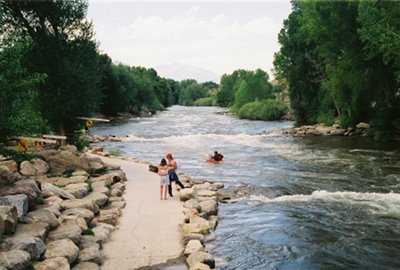
The Hooligan Race, which features any type non-boating craft that daredevils attempt to float through the Salida Whitewater Park, is one of the premier events of the festival that’s in its 61st year. It’s popularity was surely evident, as an estimated 10,000 people lined the banks of the Arkansas River and the F Street Bridge on Saturday to witness the carnage and comedy that the Hooligan offers. “It’s really cool. The whole day is a fun time. I can’t think of anything I would have rather done with my Saturday,” Scott Taylor said. “All your fellow boaters, everybody who’s down here is wonderful people. It’s a great, positive experience and it makes me glad to be alive.”[…]
Jackson Kayak sponsored the Foam Boat World Championships on Saturday, and J.P. Griffith took the title. Kids crafted their own mini boats and kayakers out of foam and floated them down a creek that led to the Arkansas. There were downriver, freestyle and best of show categories. “It feels cool, I guess,” Griffith said. “I formed my foamie after the Jackson kayak, so that did well. I just got really big air.”
Southern Delivery System: Pueblo County D.A. opposes Corps permit over Fountain Creek concerns
From The Pueblo Chieftain (Chris Woodka):
“Instead of prioritizing maintenance and repair of its existing infrastructure, Colorado Springs Utilities now wants to build a similar pipeline and infrastructure that will be vulnerable to the same problems that exist with its current infrastructure,” Thiebaut wrote in comments submitted to the Corps on Friday. “CSU should not be able to expand its water system until it has eliminated spills from its current system.”[…]
Thiebaut also is concerned about the additional volume of water that SDS would contribute to Fountain Creek, saying it would exacerbate existing water quality problems both for potential wastewater spills and through increased stormwater runoff. Along with the Sierra Club, Thiebaut sued Colorado Springs over sewer spills into Fountain Creek in 2005. Although a federal judge removed him from the case in 2007, Thiebaut has continued to challenge Colorado Springs during the Bureau of Reclamation’s environmental review and Pueblo County’s 1041 permit hearings…
In his statement to the Corps, Thiebaut contends Colorado Springs has not addressed concerns raised by environmental groups, the Colorado Water Quality Control Division and the Environmental Protection Agency during Reclamation’s review.
Meanwhile the Colorado Springs Stormwater Utility, Gold Hill Mesa and Department of Transportation are kicking off a $2.7 million effort along Fountain Creek, according to Danielle Leigh writing for the Colorado Connection. From the article:
They hope to reduce flooding and erosion, improve water quality by reducing pollution, and stabilize the overall condition of the creek and surrounding area. Through the mud, water, and plants, these volunteers fished out all the trash they could find during Saturday’s groundbreaking event…
In addition to picking up the junk, the storm water enterprise will be stabilizing the river bank. “There is so much damage through there. There is a lot of flooding and they are trying to minimize that,” Besse said. “We’re using some concrete rubble so we can bury it underneath, and put dirt above it so we can actually grow vegetation on top of it, and stabilize the bank,” Sampley said. The end goal is to give back to the environment…
There are actually 56 drainage basins and waterways you can sign up to adopt. To get involved you can call Jeff Besse at (719) 385-5566, or visit http://www.springsgov.com/stormwater.
Meanwhile, the Pueblo West Metro Board has decided to oppose the Corps permit unless Pueblo County drops the requirement for Pueblo West to join the Pueblo flow program, according to Mike Spence writing for the Pueblo West View. From the article:
Metro board members voted on June 9 to send a letter to the U.S. Army Corps of Engineers opposing the wetlands permit (known as a 404 permit) needed to build the Southern Delivery System pipeline from Pueblo Dam to Colorado Springs…
In the letter, the metro district says the permit should not be issued until Pueblo County withdraws its flow management program requirements on Pueblo West. The letter outlines why the county’s requirements for Pueblo West’s participation in the flow management program are not in the public interest for several reasons:
– It does not protect, and in fact removes the utility of, Pueblo West’s water rights.
– It destroys the balance between the costs and benefits of SDS for Pueblo West.
– The portion of the project intended for use by Pueblo West is entirely on federal property over which Pueblo County has no authority to impose an exaction of water rights.
– The flow management program discourages investment in water efficiency and reuse. Pueblo West’s reuse and pump-back project are harmed by the county’s open-ended flow requirements in the county’s 1041 permit.
– Pueblo County’s claims that the final environmental impact statement requires Pueblo West to be a part of the flow management program is inaccurate, based on pages 65 and 618 of the report.
– If Pueblo West is unable to participate in the project because of the flow management program, it will still need to construct pipelines of its won to move its water from the foot of Pueblo Reservoir to its water treatment plant causing environmental impacts in addition those of the SDS.
More Coyote Gulch coverage here.
Lower Arkansas Water Conservancy District meeting recap
Here’s a recap of last week’s meeting of the Lower Ark, from Chris Woodka writing for The Pueblo Chieftain. From the article:
“Our research shows some major downstream impacts relative to the Fountain Creek drainage and the Lower Arkansas River,” Colorado State University-Pueblo biology professor Scott Herrmann told the Lower Arkansas Valley Water Conservancy District last week. Herrmann thanked the Lower Ark board for its support of the studies over the last three years in purchasing equipment and supporting research on Fountain Creek. The board has provided $375,000 for the Fountain Creek studies. The Lower Ark board helped to purchase an inductively coupled mass spectrometer for the university. The equipment is critical to timely measurement of trace metals in water, plants, animals, insects and other life on the creek…
“They came back for $100,000 this year, and we’re hoping they can find more funding,” said Jay Winner, Lower Ark general manager. “We just don’t have the money.”
The work includes five projects on Fountain Creek that look at levels of metals, bacteria and other contaminants both in the water and in aquatic life along the creek. During the studies, a sewer line leak was found and corrected in Manitou Springs. Most recently, traces of mercury were found in Fountain Creek water where none had been previously been detected. The CSU-Pueblo team plans to begin a sixth project to analyze municipal, industrial and agricultural releases of organic compounds in Fountain Creek and downstream.
More coverage from The Pueblo Chieftain (Chris Woodka):
Earlier this month, a three-judge panel of the 11th U.S. Circuit Court of Appeals in Atlanta decided that the Environmental Protection Agency’s interpretation of the Clean Water Act is correct and no permit is required to transfer water from one area to another. The decision, which is likely to face appeal to the U.S. Supreme Court, overturned a Miami federal judge’s ruling in a case where environmental groups Miccosukee Indian tribe had sued the South Florida Water Management District for its practice of pumping contaminated farm water into Lake Okeechobee. Nichols and other lawyers in the case were surprised that all three judges supported the decision in the case, which has already moved to the Supreme Court and back on some points. “This is important to the Western United States, but it’s not over yet,” [Water attorney Peter] Nichols said.
Subjecting transfers of water, including transmountain diversions, to water quality permits could end up costing Colorado water suppliers millions of dollars. Water providers could be required to build treatment plants if the Miami ruling were upheld. “The Colorado-Big Thompson Project has 17 diversions and plants would cost $3 million each,” Nichols said. “Colorado has 105,000 miles of mountain streams and not one foot is affected by this issue.” Nichols said the issues in the Eastern United States are different than in Colorado and other Western States. “In the Eastern states, they are concerned about flooding, while the West moves water to where it is needed,” Nichols said. “There is no evidence that transfers cause the same sorts of problems in the Western United States.”
More coverage from The Pueblo Chieftain (Chris Woodka):
This spring, the city of Pueblo removed about 30 acres of tamarisk and Russian olive trees that were blocking access to the lake, said Scott Hobson, city planner. “The lake has nice shoreline areas that were being blocked by about 16 acres of tamarisk and 17 acres of Russian olive,” Hobson told the Lower Arkansas Valley Water Conservancy District board at its monthly meeting this week. “A year ago you could not see the lake. The lake area has opened up.”
City crews cut out the trees – invasive species which use large amounts of water – at a cost of about $90,000, Hobson said. The city has followed up with the release of beetles last week in an effort to knock back tamarisks, or salt cedars, not only at Lake Minnequa, but along the Arkansas River and Fountain Creek. The $5.2 million park project is being funded by a combination of Great Outdoors Colorado and federal grants, as well as from collections of the stormwater utility fee. Bids were opened Thursday for the next phase of projects to improve wetlands, extend a road into the park, build basketball courts, create a playground area and build a trail around the lake. Council is expected to act on the bids at its meeting Monday. The next phase will cost $3.5 million, mostly for earth-moving and restoration projects, and must be completed by the end of the year to meet the conditions of the state grant, Hobson said…
The city already has spent $1.5 million for land acquisition and water piping needed to channel stormwater into the lake and connect it with existing stormwater lines. The 100-acre lake will have a base pool of about 600 acre-feet, which will be supplied by the Lower Ark and supplemented by the Pueblo Board of Water Works under an agreement reached last year. It also will have the capacity to detain up to a 100-year flood and release that volume of water back into the Arkansas River over a 96-hour period, Hobson said.
More Coyote Gulch coverage here.
Brush: Groundwater level causing concern
From the Fort Morgan Times (Jesse Chaney):
The Brush City Council on Monday will hear the concerns of landowners about water issues related to the Prairie Ponds and Bolinger and Henry Discharge. In a letter to the city, Arla, Herman and Jeff Cook said the water table at the northwest corner of their family farm has risen considerably. The water table is now six feet below ground, they said, and they are concerned that their profitable land is being threatened.
Red Cliff: Where’s the stimulus dough?
From the Vail Daily:
Tom Johnson, Eagle County’s facilities director, said he’s 98 percent sure Red Cliff is going to get $2 million in federal stimulus to help fix its wastewater treatment plant. “It looks pretty positive, there’s just a couple of small hurdles,” Johnson said.
Southern Delivery System: Sierra Club asks for more time to comment along with a public hearing
From The Pueblo Chieftain (Chris Woodka):
“There is no doubt that construction and operation of the proposed Southern Delivery System project, as proposed, will have significant impact on water quality and quantity in Fountain Creek and its tributaries, as well as the Lower Arkansas River,” Ross Vincent, chairman of the Sangre de Cristo group wrote in comments delivered to the Army Corps of Engineers this week.
United States Global Climate Research Program: Global Climate Change Impacts in the United States
Conservation: Water budget in the offing for Castle Rock?
Here’s a release from the Town of Castle Rock via YourHub.com:
Town Council approved June 16 the proposed residential water budget, putting it on schedule to come back to Town Council for second and final reading July 7.
To encourage conservation and enable the Town to provide water at a reasonable rate, Town staff is proposing a water budget for residents. Conserving water is an important element in the Town’s Water Resources Strategic Master Plan, which was approved in 2006 and calls for the community to reduce water consumption by 18 percent. The less water used, the less the Town must acquire through purchasing from renewable water sources or pulling more out of the ground. The proposal calls for each resident to receive a personalized monthly water budget, based primarily on indoor water use, the square footage of irrigated property and each month’s historical evapotransporation rate. The budget is personalized for residents with up to 7,000 square feet of irrigated land. The average Castle Rock customer has an irrigated area of 2,700 square feet, and 96 percent of customers fall within the 7,000 cap. Those with more irrigated space will need to use stronger conservation techniques, such as xeriscaping, to hit their budget targets. Utilities staff will contact these larger property owners to work with them on what they can do to remain within their budgets. The proposal increases the threshold of when a customer is charged a conservation surcharge from 30,000 to 40,000 gallons per month, which will be of particular assistance to those with larger irrigated areas. “For the average customer, there will be no increase in their water bill,assuming usage within their water budget,” said Assistant Utilities Director Rick Wilkey.
The average residential customer – with the 2,700 square feet of irrigated space – use about 13,000 gallons of water each month during the irrigation season, and 5,000 gallons in off-season months. The plan also calls for an easier-to-read water bill, which will feature a 13-month historical graph showing water consumption at your address. The water budget is divided into four blocks. Block No. 1 is a single-family residential customer’s average consumption for December through March. Each April, the customer’s average consumption will be reset to reflect most recent consumption. The water budget allocated to Block No. 2 during irrigation season will be 80 percent of the amount of water required to maintain a maximum 7,000 square feet of irrigated area. Block No. 3 is consumption over water budget until reaching the 40,000-gallon threshold for the Block No. 4 surcharge. The water budget concept and how it is calculated can seem confusing, and staff is working to educate residents about the proposal. All Town residents should have received a large postcard inviting them to workshops designed to show residents how the water budget affects them and their water bills. The next workshop is scheduled for 1:30 p.m., Saturday, June 27, in Council Chambers at Town Hall, 100 N. Wilcox St.
Should Town Council give final approval to the budget, numerous water budget workshops will be held at multiple locations inviting residents to a more detailed meeting on what the new water budget rate structure means to them. Attendees will be provided an annual bill comparison for typical small, medium and large irrigated areas. This comparison will show typical usage and monthly costs for the 2008 rate structure as compared to the 2009 water budget rate structure. A limited number of residential audits also will be offered at no charge through Slow the Flow Colorado.
Town Council is scheduled to consider the water budget during its July 7 meeting, which begins at 6 p.m. in Council Chambers at Town Hall, 100 N. Wilcox St. The public is encouraged to attend to provide input.
If you have questions about the proposed water budget, call 720-733-6091 or e-mail waterbudget@CRgov.com.
More Coyote Gulch coverage here.
Runoff news: FIBArk events
Here’s an update on streamflow in the Arkansas River for the annual FIBArk festival, from Christopher Kolomitz writing for The Mountain Mail. From the article:
Arkansas River flow is about 1,700 cubic feet per second at Salida and with warm weather forecast, runoff may approach 2,000 cfs in time for key FIBArk events. Dramatically higher water levels may lead to faster times in the downriver race or a wave that becomes more difficult in which to score points during freestyle kayak competitions. During the previous two years flow was about 2,800 cfs and 2,000 cfs during FIBArk event…
Because of early warm-up and snow melt, the river peaked May 23 at more than 2,700 cfs in Salida. Cooler weather arrived and river flow fell to about 1,600 cfs May 29. It rallied, reaching 2,300 cfs about June 4, but remains below the 100-year average of about 2,000 cfs since. Flow reached a spring low of about 1,400 cfs June 11-12 and has since been on gentle, steady rise. The rise may be attributed to factors including warmer high altitude weather and the Colorado Springs Utilities decision to move 190 cfs from Turquoise Reservoir to Pueblo Reservoir. Utilities officials said if warmer weather arrives today and Friday, they may increase the amount of water they move by 100 cfs.
Colorado Springs Utilities is looking for partners for the north outlet works at Pueblo Dam
From The Pueblo Chieftain (Chris Woodka):
he North Outlet Works, added to SDS as a primary feature last fall, would give redundancy to those water users who now use the Joint Use Manifold on the south side of Pueblo Dam. Colorado Springs Utilities, the major partner in SDS, is trying to find out who else might be interested in using the new connection in order to design it to the right size now, Dan Higgins, project construction manager, told the Southeastern Colorado Water Conservancy District board Thursday…
“This is a great opportunity for everyone to get on board,” said Roy Vaughan, manager of the Fryingpan-Arkansas Project for Reclamation. “There are costs associated with this, but there would be greater costs later on.” The North Outlet Works would back up existing deliveries from the dam at the Joint Use Manifold should it be necessary to shut down the south outlet because of zebra mussels, or any other reason. Repairs for such a shutdown could take months, Vaughan pointed out. The Joint Use Manifold is shared by the Pueblo Board of Water Works, Fountain Valley Authority, Pueblo West and the Arkansas Valley Conduit, a proposed project by the Southeastern district…
The project has several components, including a large concrete platform that would tow into the base of the dam, a pipeline that would connect to two gates within the dam and a junction box that would send water either into the Arkansas River or toward the proposed SDS pumping station north of the river, Higgins said. Tests by Reclamation showed the new equipment would have to be able to meet the full rate of evacuation from the outlet for the dam – 1,100 cubic feet per second – making the engineering specifications critical to the evaluation, Higgins added. The cost for the project, as designed so far by Colorado Springs, would be about $14 million. It would cost about $1 million for others to hook on, Higgins said.
Republican River Water Conservation District $49.1 million purchase of groundwater rights may close soon
The RRWCD is trying to save a little groundwater pumping by buying up wells and pumping their output to the Nebraska border. Nebraska and Kansas so far haven’t agreed that the pipeline will make the river whole. Here’s a report from Tony Rayl writing for the Yuma Pioneer. From the article:
The groundwater, representing about 50 wells, will be used for the proposed compact compliance pipeline, if Colorado can get approval from Kansas and Nebraska through the Republican River Compact Administration (RRCA).
Meanwhile, State Engineer Dick Wolfe has stated the continuation of the Special RRCA Meeting that began in May has not been scheduled yet as the three states are continuing settlement negotiations in regards to Colorado’s proposed compact compliance pipeline. Wolfe, in an e-mail to the Pioneer, reported the hope is to set the date soon. However, he added Colorado did not want to set the continuation until the state knows it has a deal with Nebraska and Kansas, or that it is determined the states definitely are at an impasse. At that point, a final vote would be needed to initiate the arbitration process.
Precipitation news
From the Yuma Pioneer:
Yuma itself has mostly experienced relatively gentle rainfall, though it did come down hard and heavy late Sunday afternoon when Yuma officially received .55 of an inch. Once again, the real “gully-washers” occurred elsewhere, such as the Wiggins area reportedly receiving 6 inches of rain Sunday. Total rainfall in Yuma was up to 3.47 inches after Monday’s light rain, according to the official weather station at the W-Y Combined Communications Center. The most that has come down in any one day was 1.10 inches on June 2, when it rained most of the day. Yuma now has received 5.84 inches of precipitation since May 1, most of that falling since May 21, which marked the beginning of a prolonged wet, cool and cloudy period that lasted more than three weeks…
Total precipitation in Yuma now is up to 8.83 inches to date in 2009.
Colorado-Big Thompson Project: Reservoir status
From email from Reclamation (Michael Odle):
– Estes Powerplant will have 250 acre-feet of water available for power generation on Friday. That is an increase of 50 acre-feet from previous days.
– The Adams Tunnel diversion od 200 cfs will continue until tomorrow night. That means that the Marys Powerplant will have water available for power generation the entire day tomorrow.
– Olympus Tunnel flow will continue set at 500 cfs tomorrow.
– The Dille Tunnel flow will be adjusted to 68 cfs tomorrow morning.
– The Big Thompson Powerplant flow will be increased to 394 cfs tomorrow morning.
Northern Integrated Supply Project: Rally to show support June 30
Water authority for the lower Arkansas Valley?
Small water districts are feeling the crush of dealing with tighter federal and state standards along with the cost to replace or rehabilitate older systems. Regional water authorities where they can pool their infrastructure resources are one answer. Here’s a report from Chris Woodka writing for The Pueblo Chieftain. From the article:
The Lower Arkansas Valley Water Conservancy District voted unanimously Wednesday to provide up to $14,000 to look at the possibility of forming a water authority for small districts in the valley. There are 26 small water companies or districts in Otero County, some that serve only a few families, and a preliminary meeting last week with some of the water providers indicated some interest in an umbrella organization. Half of the districts serve less than 200 people. “These are run by people who have full-time jobs who are struggling just to keep the leaks fixed and generating enough money to pay the electric bill to keep water coming out of the tap,” said Bill Hancock, conservation director for the Lower Ark. Hancock’s family runs one of the small districts as well. An authority was brought up following a meeting with the Colorado Water Quality Division two months ago, where many of the water companies experienced sticker shock over the cost of recommended upgrades to their systems…
The water providers are facing new water quality regulations on radionuclides in well water that could require millions of dollars to meet. At the same time, they are working with the Southeastern Colorado Water Conservancy District on the $300 million Arkansas Valley Conduit, a water supply line that would solve many of their problems. However, since many are private companies, they are not eligible for public funding, and connecting to a public source can be expensive.
More Coyote Gulch coverage here.
Larimer County: Historic preservation vs. new Greeley pipeline
Here’s a look at the historic preservation side of the argument against Greeley’s new supply pipeline through Larimer County, from Monte Whaley writing for the Denver Post. From the article:
Brinks and Humstone bristle at the thought that a survey crew dared to show up on their land two years ago without permission. That was their first clue of Greeley’s intentions, and since then, they have allowed walking tours and nothing else. That has led Greeley to file for condemnation proceedings against Brinks, Humstone and one other property owner. The city wants a Larimer County judge to seize the properties to allow crews to do exploratory drilling, seismic surveys and other field work on what’s left of the grade, including 100 yards of track. This would lead to laying in a pipe of 5 feet diameter, 10 feet deep along a nearly 200-foot-wide right of way.
The women say the work would destroy the last remnants of northern Colorado’s railroad history. The grade, which dates to 1881, is on the National Register of Historic Places and was on Colorado Preservation Inc.’s 2009 list of endangered places.
Update: Here’s a look at the project through the eyes of Greeley’s Director of Water and Sewer, Jon Monson writing in the Fort Collins Coloradoan:
The Northern Segment is between northern Fort Collins and the Bellvue filter plant. The route that ranked best in minimizing cost, environmental impact and land use disruption bypasses much of LaPorte to the south. The other routes examined would have impacted up to 150 residences and businesses. Unfortunately, the best route we found could impact structures now on the National Historic Register. We are working with property owners and state and federal agencies to assess any potential impacts. If there are any adverse impacts to the structures, Greeley will seek ways to avoid, minimize or mitigate the impacts in accordance with federal law.
Roaring Fork River restoration project
From The Aspen Times (Janet Urquhart):
Commissioners, county staffers and a couple of neighboring residents tromped through the grass and mud along about a half-mile stretch of the river to see, first hand, the condition of the river where four property owners — including the Aspen Center for Environmental Studies and Aspen Valley Land Trust — are seeking approval to alter the streambed and shore up eroding areas of the bank. “This is a stretch of river that has been degraded,” said Tom Cardamone, ACES executive director. One long, straight stretch in particular, where the river is a uniform depth and quite shallow in late summer, would gain riffles and pools to improve the trout habitat, explained Mike Claffey of Fruita-based Claffey Ecological Consulting Inc. An island formed by the buildup of sediment would be reshaped to match what can be seen in a 1968 aerial photo, he said.
More Coyote Gulch coverage here.
Flaming Gorge pipeline: Parker and the Colorado-Wyoming Coalition
Here’s an update on Parker’s Rueter-Hess Reservoir — currently under construction — and the water they hope to store there, from Chris Michlewicz writing for the Parker Chronicle. From the article:
District officials have secured water in the South Platte River and Cherry Creek and remain active in pursuing new resources to wean themselves off deep underground aquifers that are being depleted at a mind-numbing pace. New water resources will eventually help fill the 72,000-acre-foot Rueter-Hess Reservoir, which is being built in Newlin Gulch southwest of Parker. It is scheduled to be completed in less than three years, and decision-makers are grappling with the immense task and astronomical cost of piping the water back to Parker…
Instead of throwing money at high-dollar water rights, officials purchased more moderately priced farms near Sterling that came with certain rights to South Platte water. Now the district owns 9,000 acre-feet of consumptive-use water that could be moved back through the water courts. “We’re looking at that water as a relatively inexpensive insurance policy,” Jaeger said. “If everything else goes sideways, that’s our least favorite alternative, but that’s an alternative we own.”
Because of heavy industrial uses along the South Platte, the water must be treated with a costly process called reverse osmosis, which strips the water of all pollutants and minerals. The treated water would then be sent through a pump station and piped back to Parker. It would take several partners to pay for a pipeline, and Parker water would be forced to raise rates or ask customers to approve a major bond issue to fund such an intensive project. If all options were exhausted, customers essentially would not have a choice but to go along with the “last resort” project, Jaeger said…
Parker Water and Sanitation hopes it will never reach a critical stage that would require it to make those tough decisions. Leaders are heading efforts to explore some promising new resources, including a new project that has created a buzz in both Colorado and its neighbor to the north. A coalition of Front Range water entities has opened a dialogue with Wyoming’s top brass to find out how much water is is Flaming Gorge National Recreation Area, an expanse of wilderness on the Wyoming-Utah border. Preliminary estimates put Colorado’s portion alone at 165,000 acre-feet…
Water providers, including members of the South Metro Water Supply Authority, have high hopes for Flaming Gorge because Wyoming would share the costs to build a pipeline to distribute the water and because the clean resource would not require reverse osmosis. Additionally, there would be no need to establish a massive evaporative pond to remove the brine left by lawn fertilizers and other pollutants in the South Platte. Although Flaming Gorge would require more miles of pipeline, the large number of partners sharing the cost would lower the price tag for end users, or customers. One considerable obstacle for Flaming Gorge is the need for local, state and federal dollars to back the project. However, a tentative cooperative agreement is already in place to conduct due diligence in determining the possible benefits to both states. Agreements are in draft form, and the Parker water district is a founding member of the Colorado-Wyoming Water Coalition. A meeting with representatives from Wyoming’s western slope in late April went “better than expected,” Jaeger said…
Parker water approached Wyoming’s leadership, including the division of natural resources, with a suggestion that the water authorities and conservation districts dictate where the water ends up instead of allowing private companies and speculators to get there first and set a price. Depending on how much Parker would get from the deal, water from the multi-billion dollar project could essentially become an infinite resource for Parker because the water can be reclaimed at the district’s water treatment plants, which remove waste and other pollutants before the water is dumped back into Cherry Creek, as required by the Endangered Species Act. A study showed that Parker needs roughly 31,000 acre-feet of water to sustain all homes and businesses at full build-out, Jaeger said. The Statewide Water Initiative Study from 2007 identified a need for 600,000 acre-feet of water for long term municipal and industrial uses across Colorado.
More Coyote Gulch coverage here.
Runoff news
From the Denver Post (Colleen O’Connor):
Colorado’s peak flow from snowmelt hit a few weeks earlier than normal, causing problems for some recreational users of the state’s rivers and complicating downstream irrigation strategies. A dozen late-winter windstorms coated high mountain snow with dust, causing the snow to melt earlier than usual. Bureau of Land Management spokeswoman Erin Curtis said the peak occurred in late May. BLM is especially worried about flows on the Colorado River in the western part of the state, where the so-called flat water is running especially cold and fast, at a flow now about five times what it will be later this summer…
Data from the Natural Resources Conservation Service shows that reservoir storage statewide is at 116 percent of average, the best since 1999. “But the earlier the runoff comes, the sooner the water runs out for certain irrigation systems that depend on streams, not water in reservoirs,” said Jim Pokrandt, a spokesman for the Colorado River Water Conservation District…
But the early snowmelt, combined with recent weeks of heavy rain, is good news for quenching thirsty lawns right now, and maintaining municipal water supplies for the summer. “Everyone’s drinking water will be fine,” Pokrandt said.
New real estate group to focus on public land and water quality issues
From the Greeley Tribune:
A group of real estate agents have organized a group in northern Colorado with a goal of bringing attention to the connection between the quality of life that attracts employers and the conservation of public lands and water. The primary focus of the Northern Colorado Home Ownership Alliance is a concern for the long-term impacts on Colorado’s clean water and public land because of the hardrock mining of uranium and other minerals. The group also hopes to focus on the need for clean energy and climate protection legislation that leads to the creation of new markets for renewable energy producers, local green collar job growth, and economic opportunity for families.
Western Governors Association Annual Meeting
Here’s a recap of the final day of the Western Governors Association Annual Meeting, from Charles Ashby writing for The Pueblo Chieftain. From the article:
On the final day of a Western Governor’s Association conference in Park City, Utah, the Colorado governor told the state’s media that talks over Western water issues should focus on desalination plants and conservation measures rather than trying to squeeze more water from the upper basin states of the Colorado River. The governor said he and others heard from water experts in similar dry regions of the world, and walked away “with great optimism” that there are other ways that growing, dry regions of the Southwest can get the water they need…
Ritter said technologies have improved in desalinization and conservation that make it less likely such lower Colorado River states as California, Nevada and Arizona will have to look upstream for additional water, supplies that the upper states of Colorado, Utah, Wyoming and New Mexico can ill afford to provide. The question, however, is whether they will. Ritter said the governors of those three lower states didn’t attend the conference, but did send representatives to it. “It was still an optimistic conversation,” Ritter said. “The optimism flows from the ability for those lower basin states to address some of those challenges in a manner other than looking for Colorado to provide more (water). We’re just not going to be able to provide more to the (Colorado River) compact, we’re just not.”
Nestlé Waters Chaffee County Project: Commissioners delay deliberations awaiting $122,890 in fees
From The Pueblo Chieftain (Tracy Harmon):
Chaffee County Attorney Jennifer Davis told the commission that county code indicates that when fees exceed a deposit, the applicant has 10 days to submit certified funds which are the full difference between the deposit and the balance. According to a seven-page spreadsheet obtained by The Pueblo Chieftain, Nestle made $33,320 in deposits and still owes $122,890 of the total $156,210 application fee bill. The spreadsheet, which was submitted to Nestle on May 21, gives a detailed description of the date and types of charges ranging from postage fees to legal ad costs.
It also includes billings for the time county staff have spent working on the proposal and consultant fees. Chaffee County Planning Engineer Don Reimer, for example, spent 640 hours on the proposal through April 30 at a cost of $28,800 to the county. However, Nestle Waters North America representative Bruce Lauerman said, “The spreadsheet was not very clear – this is just poor accounting and I cannot express it any other way.” At his request, county representatives sent another invoice June 2. Lauerman said that invoice also was inadequate. Lauerman said he did not find out until Monday that failure to pay all the expenses incurred by the county could stall a decision. “We would like to pay our bill but this (invoice) will not get past Kentucky (Nestle officials),” Lauerman said. “I don’t think the county followed their own code here.”
Senator Udall proposes legislation to fund upgrade for Pine River Project
From The Durango Herald (Jason Gonzales):
On Monday, [U.S. Senator Mark Udall] proposed a bill that, if passed, will repair the decrepit system that pumps irrigation water from Vallecito Dam to serve a 13,000-acre tribal and nontribal area. The irrigation system funded by the federal government has been neglected and meets only about 60 percent of the acreage it is intended to serve, Tara Trujillo, Sen. Udall’s communication director, said in an e-mail. “Currently, people who live farthest away from the project seldom get the water allocated to them, even though they pay operating and maintenance fees (to the Bureau of Indian Affairs for Native American tribes),” she said.
Colorado State University: ‘Bridging the Gap: Collaborative Conservation from the Ground Up’
From a CSU release:
Colorado State University is hosting a public conference, “Bridging the Gap: Collaborative Conservation from the Ground Up,” Sept. 8-11, 2009 on the CSU campus in Fort Collins. Co-hosts for the conference are the Center for Collaborative Conservation, Colorado Forest Restoration Institute, Colorado State Forest Service and Colorado State University Extension.
The first generation of collaborative conservation initiatives forged new ways to bring together diverse stakeholders to achieve joint conservation and livelihood goals. The second generation challenges entail strategically sustaining and expanding collaborative conservation to new levels and this is what will be discussed at the conference.
Gallup: Water pollution tops list of American’s environmental concerns
The four water-related issues on the poll fill the top four spots in this year’s ranking. In addition to worrying about pollution of drinking water, roughly half of Americans also express a high degree of worry about pollution of rivers, lakes, and reservoirs (52% worry a great deal about this), and water and soil contamination from toxic waste (52%). About half worry about the maintenance of the nation’s supply of fresh water for household needs (49%).
More Coyote Gulch coverage here.
Colorado Conservation Voters: 2009 scorecard
Energy policy — geothermal: Secretary Salazar is banging the renewable energy drum
From the Associated Press via the New York Times:
Interior Secretary Ken Salazar said the West has vast untapped potential for harnessing wind, the sun and geothermal energy to create electricity. But ”it doesn’t do any good to generate energy if you can’t get it to market,” Salazar said during the annual meeting of the Western Governors’ Association. That’s long been the concern of Western governors eager to develop renewable energy projects but frustrated by limitations in the transmission system and sluggish bureaucracies…
Salazar said four Western states — Arizona, California, Nevada and Wyoming — will get federal renewable energy planning offices to help make sure projects don’t get stalled.
More coverage of the Western Governors Association Annual Meeting from Mike Stark writing for the Denver Post. From the article:
Sunday’s main discussion, which included Canadian officials and experts from the Middle East and Australia, focused on managing water amid changing climate conditions…Peter Gleick, president of the Pacific Institute, an environmental think tank based in Oakland, Calif., was one of four panelists who spoke Sunday. He said there’s evidence of intensified water disputes, ecosystem collapse in some places and a population growth that’s driving a sometimes-fractured water management system.
Upper Arkansas Water Conservancy District welcomes new commissioners
From The Mountain Mail (Ron Sering):
Three returning directors and a new one were sworn in Thursday during the regular Upper Arkansas Water Conservancy District meeting in Salida. Taking the oath of office for four year terms were returning directors Jeff Ollinger of Chaffee County and Tom French and William McGuire, both of Fremont County. Tom Goodwin of Fremont County, appointed by a panel of three district judges, was sworn to the at-large seat vacated by Pat Alderton of Poncha Springs. Goodwin is former Bureau of Land Management field office manager and U.S. Forest Service district ranger for the Saguache district field office. He retired from the Forest Service in 2007. Goodwin is the son of former UAWCD member and long-time board chairman Denzel Goodwin.
More Coyote Gulch coverage here.
Pueblo: Drinking water passes state tests
From The Pueblo Chieftain:
Pueblo’s drinking water surpassed all federal and state standards for water quality, according to a new report by the Pueblo Board of Water Works. A synopsis of the report is available on the Web site and will be mailed to all customers in this month’s bill. The report describes efforts by the Pueblo water board to monitor for a broad range of potential contaminants, including water quality data, sources of water supply and steps taken to treat the water. The report looks at drinking water testing in 2008, listing tests for bacteria, arsenic, barium, chromium, fluoride, nitrates and selenium. In a press release, the water board noted the level for selenium should have been reported as 5 parts per billion, not million, which is well below the standard of 50 ppb.
More Coyote Gulch coverage here.
Colorado City: Metro District in line for $1.78 million of stimulus dough
From The Pueblo Chieftain (Chris Woodka):
Colorado City wants to add a membrane filtration system to its Cold Springs supply, groundwater which is currently simply chlorinated, said District Manager David Valdez. The district is under a state compliance order to install filtration by Jan. 31, to use the well, which supplies water to about 120 of the 900 taps on the system. Most of the supply for Colorado City comes from Greenhorn Creek and Lake Beckwith. Since the stimulus funds are designed for “shovel-ready” projects, Colorado City is scrambling to meet deadlines. The grant will mainly pay for the filtration system hardware, while Colorado City will pick up engineering and installation costs, Valdez said. “We were fortunate enough to have started the project before we even knew about the stimulus money,” Valdez said.
Colorado City also would participate in a separate grant to the town of Rye. Rye is seeking $1.97 million to tie into the Colorado City sewer system, rather than continue using a lagoon system.
More Coyote Gulch coverage here.
Fort Morgan Water Advisory Board recommends single rate
From The Fort Morgan Times:
City officials asked the water board for opinions and feedback on several water-related issues Thursday.
Among the topics discussed were commercial/industrial water rates, improvements to the city water system, options for an emergency backup water source and long-term debt in the city water fund.
City officials also presented the water board with information on the cost to the city of the Northern Integrated Supply Project, including scenarios outlining the annual debt payments for that project if paid off over 20 years and over 30 years.
City Manager Pat Merrill told the board he was looking for input, opinions and suggestions regarding each of the issues on the agenda. The discussion of commercial/industrial water rates took up about half of the nearly two-hour session.
More Coyote Gulch coverage here.
Montezuma County: Dolores River Festival
Here’s a recap of the Dolores River Festival, from TJ Holmes writing for the Dolores Star via the Cortez Journal. From the article:
The free raft rides proved a popular offering again, with high demand. More than 200 groups went down the river from Riverside Park to Joe Rowell Park with some 25 volunteers acting as guides, helping with put-in and take-out and driving shuttles. “It went really smoothly, and we had a lot of dedicated volunteers helping with the raft ride activities,” Gans said. “It’s a really intensive activity to offer, but we are committed to offering that as a river festival. I think the families really enjoyed the rides this year.”
The fun and wild water competitive kayak races had about 10 participants with prizes awarded to the top three finishers in each category.
More Coyote Gulch coverage here.
Western Colorado Congress looking for road home
From the Grand Junction Daily Sentinel (Le Roy Standish):
The WCC is reeling from financial cutbacks, has seen several changes in directors in the last couple years, is having its tactics questioned by many in the community, and in December was tossed from the Grand Junction Area Chamber of Commerce. The circumstances have combined to cause some members to question whether the organization should continue in its current format.
Western Governors Association Annual Meeting recap
Here’s a recap of yesterday’s sessions at the Western Governors Association Annual Meeting, from Mike Stark writing for the Associated Press. From the article:
Sunday’s main discussion, which included Canadian officials and experts from the Middle East and Australia, focused on managing water amid changing climate conditions. Although many of the controversies in the West center around urbanization, natural resources and energy development, water — and often the lack of it — comes up again and again. “Water is connected to all those things,” said panelist Peter Gleick, president of the Pacific Institute, an environmental think tank based in Oakland, Calif. Gleick said there’s evidence of intensified water disputes, ecosystem collapse in some places and a population growth that’s driving a sometimes-fractured water management system. States can no longer rely on simply building more storage capacity, which can be expensive and “politically challenging,” he said. The West needs to consider other supply options such as rainwater, use of treated wastewater and desalination plants, Gleick said. Climate change — which will alter precipitation and the timing of mountain snow melt — also needs to be incorporated into all water management decisions, he said.
Colorado Gov. Bill Ritter said the region needs to do more to protect the water that’s already available.
“Conservation has to become an ethic in the West,” he said.
Precipitation news
From the Denver Post:
Northwest of Brush, 2 1/2 inches of rain fell within an hour, triggering a flash-flood warning for several Morgan County towns. “Heavy rain fell in the area near Weldona, and there were county roads and low-lying areas under several feet of water,” said Kyle Fredin, a meteorologist with the National Weather Service in Boulder.
H.B. 09-1303: Admin Mineral Development Water Wells
Governor Ritter signed H.B. 09-1303 (pdf) on June 2. Here’s a report from Randy Woock writing for The Trinidad Times Independent. From the article:
HB 1303 allows the state engineer to approve alternates to augmentation plans for CBM wells that withdraw waters considered tributary and that impact an “over-appropriated” stream for a period extending from March 31, 2010 to Dec. 31, 2012 in order to, “…provide sufficient time to integrate (CBM) wells into the water court adjudication process.”
The state engineer is allowed to approve the “temporary operation of a (CBM) well that withdraws tributary ground water” if several conditions are met that include providing written notification of the request for the approval of the substitute water plan to all parties on the substitute water supply plan notification list, after which the parties have 30 days to file comments with the state engineer.
Custer County: Round Mountain looking at a lease to Upper Ark
From the Wet Mountain Tribune (Nora Drenner):
The Round Mountain Water and Sanitation District continues negotiations with the Upper Arkansas Water Conservancy District regarding leasing some 20 acre feet of water from the RMW-owned Johnson Ranch to the UAWCD. A brief discussion regarding the matter took place during RMW’s regular board of directors’ meeting on June 4. At that time, chairman Darrell Niles said 20-acre-feet is an insignificant amount of water. Vice-chair Chris Haga agreed and he compared 20-acre-feet of water on the Johnson Ranch to one cup of water. Additionally, Haga estimated there was some 490-acre-feet of consumptive use water on the Johnson Ranch. RMW purchased the 320-acre ranch located south of Westcliffe in 2000 for the purpose of acquiring its water rights.
Energy policy — nuclear: Montrose County Planning Commission weighing permit for Piñon Ridge uranium mill
From the Cortez Journal (Joe Hanel):
The Montrose County Planning Commission delayed its decision on a special use permit for Energy Fuels Inc., which wants to build the Piñon Ridge uranium mill 12 miles west of Naturita in the Paradox Valley. Commissioners favored the mill, but they needed more time to craft language for the permit. The commission will make its decision July 1…
The mill would have effects far beyond the remote valley. It would be the first new American uranium mill in decades, and it would offer a convenient place to process ore from Colorado’s shuttered uranium mines. “The advantage of having this mill in this area is, because there are a lot of uranium mines around us, it’s a relatively short haul to the mill,” said Frank Filas, environmental manager for Energy Fuels. However, Filas also said Energy Fuels wants to process waste from other facilities, like water treatment plants, in addition to uranium ore. Most of Colorado’s uranium mines have shut down, and the mill’s local proponents hope it would lead to a new mining era.
Novel desalination process eliminates brine disposal problem
From The International Desalination & Water Reuse Quarterly:
[Western Municipal Water District, Riverside, California] completed extensive facility testing of the fixed-bed biological treatment (FXB) process in late 2008. The district and Carollo have received provisional approval from the California Department of Public Health to use FXB to remove nitrate from drinking water.
A key benefit discovered during testing is the ability to remove multiple contaminants from the water supply. In addition to removing nitrate, the FXB process destroys perchlorate and volatile organic compounds (VOC).
While existing nitrate treatment processes such as ion-exchange, reverse-osmosis and electrodialysis-reversal remove nitrate effectively, each creates a nitrate-laden concentrate waste requiring treatment and disposal. The FXB process converts nitrate to harmless byproducts such as nitrogen gas, thereby also eliminating the need for nitrate-waste handling, making this technology sustainable.
Other benefits include competitive operating cost and highly efficient water recovery.
More Coyote Gulch coverage here.
EPA moves another $25 million to Colorado water projects
Here’s a release from the Environmental Protection Agency:
Release date: 06/12/2009
Contact Information: Diane Sanelli, 303-312-7822; Laura Niles, 303-312-6281
(Denver, Colo. – June 12, 2009) In a move that stands to create jobs, boost local economies, improve aging water infrastructure and protect human health and the environment for the people in the State of Colorado, the U.S. Environmental Protection Agency (EPA) has awarded more than $25 million, part of a planned $31 million total, to the Colorado Water Resources and Power Development Authority. This new infusion of money provided by the American Recovery and Reinvestment Act of 2009 will help the state and local governments finance many of the overdue improvements to wastewater projects that are essential to protecting public health and the environment across the state.
“EPA is pleased to provide $25 million in Recovery Act funds for much needed improvements to Colorado’s water infrastructure that will benefit the state for decades to come,” said Carol Rushin, Acting Regional Administrator. “This funding will protect public health and improve water quality while creating hundreds of jobs in Colorado.”
The Recovery Act funds will go to the state’s Clean Water State Revolving Fund program. The Clean Water State Revolving Fund program provides low interest loans for water quality protection projects for wastewater treatment, non-point source pollution control, and watershed and estuary management. An unprecedented $4 billion dollars will be awarded to fund wastewater infrastructure projects across the country under the Recovery Act in the form of low interest loans, principal forgiveness and grants. At least 20% of the funds provided under the Recovery Act are to be used for green infrastructure, water and energy efficiency improvements and other environmentally innovative projects.
Since the Clean Water State Revolving Fund program began in 1987, EPA has awarded more than $26 billion in grants, which states have turned into $69 billion of financial assistance for water quality projects. The revolving nature of the program ensures water quality projects will be funded for generations to come. President Obama signed the American Recovery and Reinvestment Act of 2009 (ARRA) on February 17, 2009 and has directed that the Recovery Act be implemented with unprecedented transparency and accountability. To that end, the American people can see how every dollar is being invested at Recovery.gov.
Information on EPA’s implementation of the American Recovery and Reinvestment Act of 2009 in Colorado, visit http://www.epa.gov/region8/eparecovery/.
Information on the Clean Water State Revolving Fund program, visit http://www.epa.gov/owm/cwfinance/cwsrf/
Rio Grande Basin: No curtailments on the ditches
From the Valley Courier (Ruth Heide):
…[The] San Luis Valley’s summer rains have created a rare occurrence – zero curtailment on irrigators along the Rio Grande and Conejos River systems. Division of Water Resources Division Engineer for Division 3 Craig Cotten explained on Thursday that the division is currently not cutting irrigators short because sufficient water is flowing downstream to meet the Rio Grande Compact obligations to New Mexico and Texas.
He said the June forecast from the Natural Resources Conservation Service (NRCS) actually rose 5,000 acre feet from May. NRCS is now predicting 590,000 acre feet on the Rio Grande this year. That is slightly below average which is about 650,000 acre feet.
Of that amount, the Valley will be obligated to send downstream 158,400 acre feet of water, or 27 percent. “That’s what we have to deliver to the state line from the Rio Grande portion,” Cotten explained during a well rules advisory meeting in Alamosa on Thursday.“That’s what we have to deliver to the state line from the Rio Grande portion,” Cotten explained during a well rules advisory meeting in Alamosa on Thursday. The Rio Grande does not have to send 27 percent downstream right now, however, because the Rio Grande delivered 100 percent through the winter, sent more water downstream during the runoff period and is experiencing good return flows all the way through the system. Cotten said the Rio Grande would only need to send 8 percent downstream currently to meet its Rio Grande Compact obligation. “Our current curtailment on the Rio Grande is effectively zero. We do have a curtailment on our daily sheet but we add back some water, make some adjustments, so it is effectively zero on the curtailment.”
The same is true on the Conejos River system, Cotten said. The NRCS forecast for the Conejos system is 345,000 acre feet, up 15,000 acre feet from last month. The obligation to downstream states from that total is 143,200 acre feet or 42 percent. The current delivery target is 16 percent but because of the amount of water in the system the water division is not curtailing irrigators on the Conejos system “which is kind of an unusual situation that we don’t have curtailment actually occurring on either one of the rivers right now,” Cotten said.
The Conejos system peaked the first part of May, and the Rio Grande peaked around May 8, about three weeks earlier than normal.
“We are significantly lower right now at this time of year than we usually are,” Cotten said. Saguache Creek peaked the end of May which is about normal, Cotten added. He said that might indicate the northern part of the Valley had less dust on the snow. Kerber Creek near Villa Grove peaked almost exactly on target the end of May, Cotten said. “We are dropping off that peak pretty hard,” he added.
More Coyote Gulch coverage here.