Agriculture Secretary Vilsack announces $11 million in water resource projects

A picture named fountainpavementdrawing.jpg

Here’s the release from the USDA (Jennifer Martin):

Agriculture Secretary Tom Vilsack today announced that the United States Department of Agriculture’s (USDA) National Institute of Food and Agriculture (NIFA) has awarded more than $11 million through the National Integrated Water Quality Program (NIWQP) to address critical water resource issues including water quality protection and water conservation.

“Cities, communities and rural areas across the nation depend on a safe and abundant supply of water for drinking and cooking,” Vilsack said. “This research will play a vital role in our understanding of the part water plays in the ecosystem and developing tools and strategies to effectively manage our water resources.”

The NIWQP supports research, education and extension projects and programs that address critical water resource issues in agricultural, rural and urban watersheds. These projects reflect the growing need to combine knowledge from biological and physical sciences with social and economic sciences to address complex water issues. The NIWQP focuses on addressing water issues at the watershed scale. Projects funded by the NIWQP are outcome-oriented, aiming to increase awareness and change behaviors related to water resource management.

Funded projects in Fiscal Year 2009 include a project that evaluates the impacts of bioenergy development on water resources, four projects that develop tools to improve the effectiveness of conservation practices to achieve water quality goals by targeting critical areas and key individuals that offer the greatest opportunity to improve water quality, and efforts to develop a framework to revamp youth education about water issues. The current focus on education is part of a 2-year effort to launch a Coordinated Agricultural Project to create an innovative, holistic educational environment to transform youth consciousness about water and water issues.

Fiscal Year 2009 NIWQP national and watershed scale grants were awarded to:

– Colorado State University, Fort Collins, Colo., $615,000, A Multi-Criteria Decision Tool for the Assessment and Planning of Watershed Management Practices [ed. emphasis mine]

– University of Connecticut, Storrs, Conn., $385,000, Support of NIWQP Research, Education and Extension Outreach through Geospatial Technology Training

– University of Illinois, Urbana, Ill., $660,000, Reducing Nitrate Losses in Tile-Drained Agricultural Watersheds: Integration of Biophysical and Social Sciences with Extension and Education

– Purdue University, West Lafayette, Ind., $300,000, Impact of Bio-feedstock Production on Hydrology/Water Quality in Midwest and Southeast United States

-Kansas State University, Manhattan, Kan., $114,000, Environmental Leadership Interdisciplinary Curriculum to Address Water Resources

-University of Nebraska, Lincoln, Neb., $544,500, Improving and Conserving Water Resources through Stormwater Management Education for Community Decisionmakers of Today and Tomorrow

-North Carolina State University, Raleigh, N.C., $228,000, Robeson Creek Water Quality Outreach Initiative

-Pennsylvania State University, State College, Pa., $240,000, Innovation in Youth Water Education in Pennsylvania Priority Watersheds

-University of Tennessee, Knoxville, Tenn., $652,000, Enhancing Water Quality in Oostanuala Watershed: An Integrated Approach Toward Understanding Adoption and Efficacy of Best Management Practices

-Washington State University, Pullman, Wash., $566,610, Protecting Water Resources by Engaging Stakeholders in Targeted Implementation of Filter Strips

-University of Wisconsin, Madison, Wisc., $143,000, Mapping the Future: Youth-Water Programming for the 21st Century

-University of Wisconsin, Madison, Wisc., $649,000, Tools for Integrating Land-user Management Decisions with Watershed Processes to Achieve Water Quality Goals

In 2009, NIFA also funded a project in support of USDA’s Conservation Effects Assessment Project (CEAP). The CEAP project was part of an initiative to evaluate the effects of grazing practices on watershed health. The FY 2009 CEAP grazing land project was awarded to:

-South Dakota State University, Brookings, S.D., $645,788, Conservation Practices Assessment of the Lower Bad River Basin

The 2009 awards also include regional water resource projects that continue funding for a national network of outcome-focused projects addressing state and local water resource issues. The FY 2009 NIWQP regional water resource grants were awarded to:

-University of Arizona, Tucson, Ariz., $550,000, Southwest States and Pacific Islands (Region 9) Water Resources Program

-Colorado State University, Fort Collins, Colo., $667,000, Coordinated Regional Water Resources Programming for the Northern Plains and Mountains Region [ed. emphasis mine]

-Iowa State University, Ames, Iowa, $575,000, Heartland Regional Water Coordination Initiative

-University of Idaho, Moscow, Idaho, $595,000, Coordination, Development and Delivery of Water Resource Programs in the Pacific Northwest

-University of Maryland, College Park, Md., $600,000, Mid-Atlantic Water Program

-University of Rhode Island, Kingston, R.I., $1,090,000, The Northeast States and Caribbean Islands Regional Water Resource Program

-Texas A&M University, College Station, Texas, $1,270,000, The Southern Region Water Resource Project

-University of Wisconsin, Madison, Wisc., $610,000, Continuing Support for the Great Lakes Region: A Regional Water Resource Project for North Central States in USEPA Region 5

Through federal funding and leadership for research, education and extension programs, NIFA focuses on investing in science and solving critical issues impacting people’s daily lives and the nation’s future. For more information, visit http://www.nifa.usda.gov.

More infrastructure coverage here.

State Representative Sal Pace plans to introduce legislation to reduce impacts of out of basin water transfers

A picture named rockyfordditch.jpg

From The Pueblo Chieftain (Chris Woodka):

Pace described his legislation as a carrot-and-stick approach that allows those who are transferring water to reach agreements with conservancy districts prior to going to water court in transfers between water divisions only. If no agreements can be reached, the legislation would give judges more latitude in attaching mitigation requirements to transfers. “The ultimate goal is to build a statute that leaves rural communities in existence long after we’ve gone and the water has been moved,” Pace said…

The legislation would not spell out mitigation, but would use language already existing in the 1937 law that established conservancy districts in Colorado, Pace explained. In the Aurora purchase of most of the Rocky Ford Ditch, for instance, contributions were made to the local school district to help offset the economic impacts. An area on the Upper Arkansas River or the West Slope might want compensatory storage to make up for reduced flows, Pace said.

More transmountain/transbasin diversion coverage here.

South Fork Arkansas River/Fooses Creek restoration update

A picture named southarkansasriverfoosecreek.jpg

From The Mountain Mail (Audrey Gilpin):

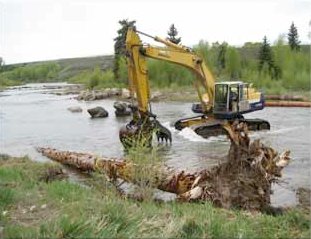
Habitat restoration was completed in August at Fooses Creek and the South Fork of the Arkansas River, which feed two antique hydroelectric plants operated by Xcel Energy. During a tour of the restored sites last week, U.S. Forest Service fisheries biologist Phillip Gaines said the project began after studies found the sites east of Garfield and below Maysville had insufficient fishery habitat. Constructed in 1906, the plants are capable of producing 1.4 megawatts of electricity, which flows to the service grid. Gaines said, “Historically, Xcel de-watered this area.”[…]

Collegiate Peaks Anglers and Cheyenne Mountain chapters of Trout Unlimited donated $5,000, Xcel Energy contributed $50,000 and the Colorado Division of Wildlife made in-kind donations to the project.

With the Trout Unlimited donation, the forest service hired Peter Gallager with Fin-Up Habitat Consultants of Manitou Springs. In nine days, 116 sites along a mile and a quarter of river were restored, Gaines said. “Within an hour of creating pools about three feet deep and dipping out sections of river, we saw fish. In three to four years, we hope to see more and bigger fish.” Gaines and other forest service personnel, Gallager and employees of Hartland Construction of Colorado Springs rearranged and added rocks to the river, moved aspen to attract beaver, created ponds and defined camp sites with rock.

More restoration coverage here.

Energy policy — oil shale: Secretary of Interior Salazar requests probe of 11th hour oil shale leases

A picture named oilshaledepositsutwyco.jpg

From the Houston Chronicle (Jennifer A. Dlouhy):

Salazar, a former Democratic senator from Colorado, said there were “serious questions” surrounding the abrupt changes made to six oil shale research, demonstration and development leases on Jan. 15, five days before former President George W. Bush left office. The changes governed the terms of any future commercial oil shale production on six leased tracts of federal land. Salazar said the questionable changes included the locking in of a potentially “lucrative” 5 percent royalty rate that energy companies pay to the federal government. That rate is well below the double-digit percentage commanded on other public lands. Salazar formally asked Mary Kendall, the Interior Department’s inspector general, to launch an investigation.

The six existing leases that Salazar wants scrutinized include three held by Shell Oil Co. that are already being reviewed as part of a Justice Department probe of former Interior Secretary Gale Norton. Investigators are examining whether Norton illegally steered the oil shale leases to Shell while negotiating with the company for her current job there.

The secretary made his call for a probe public even as he moved to open up new public lands in the West for new oil shale development. Companies will have 60 days to apply for the second round of oil shale research, development and demonstration projects on new tracts in Colorado, Utah and Wyoming. These projects will be limited initially to 160 acres. If energy companies prove they can commercially produce shale oil from the lands, the leases could eventually be expanded to 660 acres — a fraction of the 5,120 acres that would be allowed for commercial production under the initial six contracts.

More coverage from the Colorado Independent (David O. Williams):

But the process remains highly speculative, and environmentalists who have legally challenged the Bush rules say the current technology requires far too much water for arid western lands to support, too much electricity that would further exacerbate global warming and that the process degrades sensitive Rocky Mountain landscapes with adverse impacts on wildlife and tourism. “We want to avoid the booms and busts of the past,” said Salazar, a former U.S. senator from Colorado, referring to a devastating oil shale bust on the Western Slope in the 1980s. “We want to ensure the potential development is done in a way that is environmentally appropriate, and we want to assure that the American taxpayers get a fair return for the potential development of America’s public lands.” The Bush rules called for a royalty rate starting at 5 percent to be paid by oil and gas companies to the federal government for the use of public lands. Critics claim that rate is far too low. “There is a question about how those royalty rates could actually be set when these very important fundamental questions [about technology, water and power] have not been answered,” Salazar said, adding the 11th-hour process was done without public scrutiny and was too favorable to a handful of companies currently holding leases.

From the Colorado Independent (David O. Williams):

The opposition has politicized the debate, Jeremy Boak, head of the Center for Oil Shale Technology and Research at the Colorado School of Mines, told the AP. Boak said Salazar’s decision to limit new RD&D leases and more closely monitor their progress will inhibit research. “I feel like the arguments are highly political arguments, not technical ones,” Boak said.

But Gov. Bill Ritter Tuesday issued a statement supporting Salazar’s new rules for the next round of RD&D leases, as well as his decision to pursue an Interior Department investigation of amendments made to previous leases during the waning days of the Bush administration.

More oil shale coverage here and here.

Pueblo Board of Water Works to raise water rates?

A picture named waterfromtap.jpg

From The Pueblo Chieftain (Chris Woodka):

The Pueblo Board of Water Works is looking at a 5 percent increase in water rates in its 2010 budget, and Tuesday set dates for a workshop and public hearing. The increase in the $32.5 million budget includes a 3.2 percent increase approved in August in relation to the $23.37 million bond issue for purchase of shares of the Bessemer Ditch. The increase is about half of projections as high as 10 percent which were foreseen last summer. A workshop will be at noon Nov. 5, and the public hearing at 2 p.m. Nov. 17 at the water board offices, 319 W. Fourth St.

More PBOWW coverage here and here.

Aspinall Unit update

A picture named bluemesa

From email from Reclamation (Dan Crabtree):

The Uncompahgre Valley Water Users will be discontinuing their diversions through the Gunnison Tunnel within the next two weeks. Those of you who monitor the gage below the Tunnel via the Internet will be seeing some fluctuations as Reclamation reduces releases from Crystal in response. However flows in the Canyon and Gorge will generally remain in the 500 cfs range for the remainder of October and November. (Currently, the release from Crystal Reservoir is 1,300 cfs.) The latest model runs show that December flows are anticipated to be in the 1,400 cfs range in response to higher power demands and to meet the winter elevation target at Blue Mesa. As always, these flows are subject to change as a result of variable hydrologic conditions. Please contact Dan Crabtree at 970-248-0652.

More Aspinall unit coverage here.

Energy policy — oil shale: Colorado School of Mines 29th oil shale symposium recap

A picture named shelloilshaleprocess2

From the Associated Press (Judith Kohler) via CBS4Denver.com:

Exxon Mobil’s projections suggest that all forms of energy, including oil shale, will be required to meet the demands, company executive Richard Lowe said during an oil shale symposium at the Colorado School of Mines. Mining the oil shale underlying eastern Utah is an important part of the state’s focus on the economy and energy, said Alan Walker, with the governor’s economic development office and the Utah Science Technology and Research Initiative. He repeated former Gov. Jon Huntsman’s declaration made last year at the same symposium that Utah is open to commercial oil shale development. “I want to let you know that you’re very welcome in Utah,” Walker told the crowd, which included industry and government representatives.

A Colorado official took a more cautious approach, saying the state supports oil shale development. “We think everybody agrees that all options need to be on the table” in energy development, said Bob Randall of the Colorado Department of Natural Resources. But Randall said the state wants more information about the technology, still in the experimental stages, as well as the costs and potential impacts on water supply and quality, environment, public health and communities…

…companies, including Exxon Mobil and Shell Oil, are still testing ways to squeeze the oil out of the rock. Federal and industry officials have said it likely will be at least a decade before commercial development starts. Five leases of 160 acres each were issued on federal land in Colorado and Utah in 2006 and 2007 for research, development and demonstration projects. Randall said nothing has happened on the parcels and Colorado wants the Interior Department to assess those leases before issuing a second round…

The 29th oil shale symposium, hosted by the Colorado School of Mines and the Center for Oil Shale Technology and Research, runs through Wednesday.

More oil shale coverage here.

Steamboat Springs: Funding for water projects

A picture named waterfromtap.jpg

From the Steamboat Pilot & Today (Mike Lawrence):

Local staff of U.S. Sen. Michael Bennet, D-CO, will join representatives from the Colorado Rural Water Association, the Rural Com munity Assistance Corpor­ation and the U.S. Department of Agriculture from 9 a.m. to noon Wednesday, at Centennial Hall on 10th Street, to provide information about funding and technical assistance for water systems…

“Our water and wastewater program has significant funding,” said Pattie Snidow, Northwest Colorado’s area director for the USDA’s rural development programs. “I think the effort is to get the word out and let people know there is funding available to them.” Snidow said programs she will discuss at Wednesday’s workshop benefit domestic water providers serving populations of 10,000 or less. She said her office is working with the town of Oak Creek, for example, on improvements to its wastewater system.

More infrastructure coverage here.

Colorado Water Trust

A picture named saguachecreek.jpg

Here’s a shout out for Amy Beatie and the Colorado Water Trust, from Chris Woodka writing for The Pueblo Chieftain. From the article:

Since state laws differ, trusts in other states operate under slightly different rules. In Colorado, a 1973 change in water law made the CWCB the only agency that could hold an in-stream water right or a right solely to maintain lake levels. Other water rights must be put to a beneficial use like municipal, industrial or agricultural rights. The state can do that by appropriating water, acquiring existing water rights or adopting policies that protect flows. New rights appropriated by the state are junior to most other rights on a stream. Flow protection usually requires court decrees to prevent injury to other rights.

Acquiring rights would yield the best results, but the problem in the past is that valuable senior water rights had to be donated to the state, without compensation, [Colorado Water Trust Director Amy Beattie] said. The trust acquires some rights, although its revenue sources are limited to grants or donations. It also works with land trusts or other conservation agencies to incorporate water rights into planning, Beattie said. “The Colorado Water Trust acts as a broker. It pays for rights to be donated,” she said Last year, the state Legislature set up two CWCB funds as a way to acquire senior rights. One is a $1 million appropriation for general water rights. Another $500,000 was set aside specially in a species conservation trust fund. “We collaborate with the CWCB,” Beattie said. “We pull from a whole menu of approaches to fix critically water-short stream reaches.”

More conservation easement coverage here.

Redstone hopes to build new wastewater treatment plant if stimulus dough becomes available

A picture named wastewatertreatmentwtext.jpg

From the Aspen Daily News (Troy Hooper):

[The Redstone Water and Sanitation District is] asking voters permission to increase district debt to replace Redstone’s 35-year-old sewage treatment plant should $1 million of federal stimulus money ever be available. The district already spent close to $200,000 to plan for the plant’s replacement. The plant serves about 140 users.

More wastewater coverage here.

Southeastern board scrutinizes new consumptive use rules for Arkansas Valley

A picture named dripirrigation.jpg

The board of the Southeastern Colorado Water Conservancy District was briefed on the new consumptive use rules that were filed by the State Engineer’s office in Division 2 Water Court last month. Here’s a report from Chris Woodka writing for The Pueblo Chieftain. From the article:

The rules are meant to protect Colorado under the 1948 Arkansas River Compact with Kansas, Division 2 Engineer Steve Witte explained. They apply to improvements such as lining canals, putting pipe in off-farm laterals or using chemicals like PAM to reduce leakage. The most controversial part of the rules, however, applies to sprinklers fed by surface ponds. The rules apply only to 1999 improvements made after 1999, the last reckoning of water use by the two states. Witte has made a pitch for the possibility of depleting flows through the river with such improvements since 1996…

The difference is between ditches with adequate water supplies, like the Bessemer Ditch, and water-short ditches, like the Fort Lyon Canal. Improvements like sprinklers might result in more irrigated acreage or higher yields, hence more consumptive use, Witte said. “When we talk about senior rights with full supply, they may increase the flow to the river,” Witte said…

Witte said farmers are still welcome to use their own engineering to prove there is no harm to the river from improvements…

The rules also provide for compliance plans – the Lower Arkansas Valley Water Conservancy District and Arkansas Valley Ditch Association are looking at possible versions – as a way to meet state requirements. There also are general permits for areas outside of the zone covered by a model developed for the Kansas v. Colorado U.S. Supreme Court case. That includes many tributaries and all pre-1884 water rights upstream of Lake Pueblo.

More Arkansas Valley consumptive use rules here and here.

Split Estate

A picture named splitestate.jpg

Here’s the link to the website for the new documentary, Split Estate dealing with oil and gas development and production. The film chronicles the effect on groundwater and suface water quality along with diminished air quality.

More oil and gas coverage here.

Energy policy — nuclear: Powertech may get to jump through some new hoops regarding water quality

A picture named uraniuminsituleaching.jpg

From the Fort Collins Coloradoan (Bobby Magill):

If approved, the proposed rules will implement a 2008 law, House Bill 1161, which regulates in situ uranium mines across the state, requiring mining companies to return the groundwater around an in situ leach mine to the same quality it was prior to mining. Before the state can issue an in situ leach mining permit, the law requires mining companies to cite five examples of other similar mining operations that did not harm groundwater.

On Friday, the draft rules were still being revised, and changes were still being made throughout the document based on public comments the state Office of Mined Land Reclamation had received, office director David Berry said.

The rules and the law will “provide a minimum level of protection for groundwater from in situ uranium mining,” said Jeff Parsons of the Western Mining Action Project in Boulder. “Powertech’s proposal is in an inappropriate place surrounded by water wells on all sides.”

More nuclear coverage here and here.

Pueblo West is applying to water court to move discharge point in order to store effluent in Lake Pueblo

A picture named puebloreservoir.jpg

From The Pueblo Chieftain (James Amos):

Pueblo West wants to change how its wastewater is released so that it can claim more return-flow credit for it. That would allow the district to reuse the water by collecting it again at Pueblo Dam. The water rights that supply Pueblo West come from the Western Slope, so the water can be used over and over, either physically or through exchanges of return-flow credits. Right now, Pueblo West releases treated water from its sewage-treatment plant through Pesthouse Gulch and Wildhorse Creek to the Arkansas River. That journey uses up a lot of the return-flow water by evaporation and feeding plants that grow along the gulches. Pueblo West gets return-flow credit for only 31 percent of the water that leaves the wastewater plant, Harrison said. If Pueblo West can pipe that water four miles west and release it down Golf Course Wash to Pueblo Reservoir, it can claim return-flow credit for as much as 98 percent of the water. Water rights are getting scarce in the Arkansas Valley, and Harrison said it may not be possible to buy the 3,400 acre-feet of water the “Pumpback Project” is expected to save the district. It’s enough water to supply thousands of new homes, he said.

More Pueblo West coverage here.

Rio Grande roundtable meeting recap

A picture named riograndebasin.jpg

From The Pueblo Chieftain (Matt Hildner):

The basin’s projected water demand is expected to rise from 19,900 acre-feet in 2008 to between 28,450 and 34,000 by 2050…

The [draft state report on future statewide water needs] calculates that population would grow in the basin from 49,000 now to 88,000 in 2050, based on formulas used by the Colorado State Demography Office. The draft said the Rio Grande basin may see increased demand from industry for water in the future because of oil and gas and solar energy development, although it did not quantify the demand as it did for other industries in other parts of the state. Mike Gibson, the roundtable’s chairman, said the demands of solar power on the valley’s water supply would be minimal compared with agriculture. He cited a proposal from Tessera Solar, which is one of a number under review by Xcel Energy, that would consume 10 acre-feet per year to run a 200 megawatt concentrated solar plant near Moffat. He noted that a 120-acre field of potatoes would consume 164 acre-feet annually while a similarly sized field of alfalfa that sees two cuttings would consume 310 acre-feet in a year.

More Rio Grande Basin coverage here.

101st Rocky Mountain Farmers Union Convention will be held November 19-21 in Lakewood

A picture named irrigation.jpg

From the Steamboat Pilot & Today (Marsha Daughenbaugh):

The 101st annual Rocky Mountain Farmers Union convention will be hosted by Colorado from Nov. 19 to 21 in Lakewood. The three-day event includes workshops, election of officers and board of directors, policy discussions and networking. Delegates from all areas of Colorado, Wyoming and New Mexico will join for discussions and decision-making efforts to help preserve family farming and ranching operations that are important to the economy and heritage of the United States. All RMFU members are invited and encouraged to attend and participate.

The agenda and registration information is at http://www.rmfu.org

Estes Park: Students learn about water quality while participating in ‘River Watch’ program

A picture named studentslesherjhsamples.jpg

From the Estes Park Trail Gazette (Juley Harvey):

The students became involved after participating with Merrill in the CloudSat program last year, where they collected data on clouds and precipitation. Merrill found the River Watch program and asked the trio to participate this summer. In the River Watch program, they analyzed samples and stored data on the Internet, to be reviewed and evaluated by the Department of Wildlife. They performed tests for pH levels, alkalinity, hardness, temperature, dissolved oxygen, metals and nutrients. Next, they will train their peers. They hope to test more rivers and headwater streams. They started out monitoring Fish Creek, but the project ended quickly, because “the water was like THAT wide. There was not good data.” “The cool parts,” they said, “were learning about and working with chemicals, collecting stuff and knowing we`re collecting our own data. We feel like we definitely made a difference. We learned how to test…and how rivers interact with the ecosystem and how important they are, and how streams are important to the ecosystem. There is only a little bit of streams left. We need to do what we can to keep them clean and healthy.”

More education coverage here.

CSU: How long will Colorado’s water last?

A picture named riogranderiver.jpg

Here’s the release from Colorado State University:

Colorado State University will host a panel of water experts to discuss the current state of Colorado’s water supply from 5:30-7:30 p.m. on Tuesday, Oct. 20 at the Cool River Café, 8000 East Belleview Ave. in Greenwood Village. The panel of renowned CSU water experts will report on the state’s current water supply and what it means for our economy and quality of life. The panel will explain the many ways – including a unique student effort that is having a global impact – CSU is working to manage Colorado’s water supply for the future.

Panelists will include: Reagan Waskom, director of the Colorado Water Institute; Larry Roesner, professor, CSU College of Engineering; Dick Wolfe, state engineer, Colorado; and CSU students from Running Water International in CSU’s College of Business.

The event is free and open to the public. To register go to http://www.alumni.colostate.edu or call (303) 376-2613.

Wiggins: New supply pipeline design underway

A picture named pipeline.jpg

From The Fort Morgan Times (Dan Barker):

The idea at this point is to build a pipeline following mostly state and county rights of way from a well site eight miles northwest of Wiggins, take it along the west side of town and just south of the Wiggins School District’s football field and then east to connect with the current water system, said engineer Tim Holbrook of Industrial Facilities Engineering Inc. as he gave the Wiggins Town Council a preliminary engineering report. However, some of the details must await design testing, he said. Currently, the plan is to treat the water at the well site, softening it and taking out sulfates before sending it to Wiggins, Holbrook said. That would mean the water would not have to go to the existing water plant and could go directly into the water main. This would be the least expensive and least difficult route to follow, he said. Only a little over a mile of pipeline would need to be on private land with this plan, according to the map of the pipeline. The treatment plant would be about 300 feet by 700 feet at the Smith-Jones farm site and include a 50,000-gallon water storage tank, Holbrook said. With this design, the town could use the existing water system to irrigate the city park through another water line, although planning is necessary to make sure some households can have access to drinking water, Holbrook said.

More Wiggins coverage here.

Hayden: Town Council raises rates

A picture named fountainpavementdrawing.jpg

From the Steamboat Pilot & Today (Jack Weinstein):

Monthly residential rates will increase by $3.05 to $19. Monthly senior rates will increase by $1.83 to $11.40. The ordinance was approved, 5-0. Council members Bill Hayden and Jim Haskins did not attend the meeting. Town Manager Russ Martin said the increase would generate an additional $25,000 to $30,000 to help close the gap in a fund that doesn’t make enough money to cover costs. The ordinance also increased tap fees to $4,800 from $3,800 for water, and to $2,400 from $1,900 for sewer. The ordinance will go into effect 15 days after being published. Martin said the rate and tap fee increases would help eliminate a $75,000 annual deficit in the town’s water fund.

More infrastructure coverage here.

Bayfield: Town trustees raise water tap fees

A picture named waterfromtap.jpg

From the Pine River Times (Carole McWilliams):

Bayfield town trustees have raised water tap fees to $6,600, up from $4,334 for a basic three-quarter inch tap and a similar percentage increase for larger taps. They approved the increase on Oct. 6, effective immediately. It applies to anyone who hadn’t already submitted construction paperwork to the town by that day. There was concern about builders loading up on cheaper taps if there was a time lag…

Clifton said water tap fees will bring in around $100,000 this year, and he’s projecting $86,000 in 2010. The water capital fund is paying $97,000 a year in debt, he said. “If the money isn’t available through tap fees, we have no choice but to take it from rates,” he advised. We have $215,000 in capital expenses, and we are bringing in $87,000.” The water treatment plant is at 80 percent of capacity and needs to be expanded in the next few years, and a system pump needs to be upgraded, he said. He is budgeting $100,000 a year to save up for plant expansion. He is expecting an average $218,000 in new water capital expenses in each of the next four years. Clifton then presented options for higher water tap fees, ranging from $5,500 to $6,600. The current fee is $4,334. Raising the fee to $6,271 would bring in around $188,000 a year, he said.

More infrastructure coverage here.

Land Owners United conservation easements meeting October 20

A picture named purgatoireriver.jpg

From the La Junta Tribune Democrat:

Land Owners United LLC has been diligently working for resolutions, regarding the assault on conservation easement valuations and will conduct an informative meeting on current status and action plans. The meeting is Tuesday, Oct. 20 at 5 p.m. at Las Animas Elementary School in the cafeteria, 530 Poplar Avenue (Hwy 50 and Poplar Ave), Las Animas. Guest speakers will include Mack Louden, Not 1 More Acre; Mortgage Brokers Coalition, DORA Law Suit; and Mark MacDonnell, Atty (LOU), DORA Open Records Request – Status. For more information, contact J.D. Wright (719)263-5449.

More conservation easement coverage here.

Summit Ridge Water District to consolidate with Montezuma Water District?

A picture named mcpheespillway.jpg

From the Cortez Journal (Kimberly Benedict):

The Summit Ridge Water District board of directors will hold a public meeting on Tuesday, Oct. 20, to discuss a proposed consolidation with Montezuma Water Company. The possible consolidation comes at a point when the Summit board believes the two organizations have become redundant. “The board feels as though the district has outlived its usefulness,” said board member Mark Tuttle. “We’ve accomplished what was necessary in the beginning.” The water district, created about twenty years ago, currently serves 540 active taps and has roughly 630 members, according to Tuttle. The district’s original purpose was to provide water to the Summit Ridge area, a task larger companies did not find appealing.

More Montezuma County coverage here.

Lake Pueblo winter storage program update

A picture named puebloreservoir

From The Pueblo Chieftain (Chris Woodka):

“What we’re trying to do is look at the reservoir operations before we’re at the point where we’re making decisions,” said Jim Broderick, executive director of the Southeastern Colorado Water Conservancy District, which administers the program. “We’re trying to manage it so it does not spill.” There is little danger that winter water would spill in most years. It is far down the ladder of priorities used by the Bureau of Reclamation to determine which accounts would be released as the reservoir fills. “If winter water were to spill, there would be so much water no one would know what to do with it,” Broderick said. Water stored in most excess capacity accounts would spill first. Right now, that totals more than 36,000 acre-feet and an average winter would result in a spill of about 14,000 acre-feet under current conditions if no changes are made…

A snag could come in late April because federal rules require a maximum level on April 15 for Lake Pueblo to accommodate flood waters. The court decree that set up the winter water program gives ditch companies until May 1 to move their winter water from the previous year out of storage. Meanwhile, Reclamation is clearing out space in Turquoise and Twin Lakes to make room for next year’s imports. At the same time, Lake Pueblo will fill even more as it stores river flows in the winter water program, which allows storage rather than the former practice of flooding fields in winter months. For years, the Southeastern District routinely approved requests to store carryover water more than one year. That’s not likely now, Broderick said…

Last year, about 140,000 acre-feet of water were stored in the winter water program, but only about 48,000 acre-feet in Lake Pueblo. Water also is stored in John Martin, Lake Meredith and other downstream reservoirs. There are still 15,000 acre-feet in Lake Pueblo, primarily in accounts for the Bessemer, Catlin and High Line canals, which cannot use downstream storage. “If you can help us get the water out by April 15, that will help us manage everyone’s water a little more easily,” said Roy Vaughan, Fryingpan-Arkansas Project director for Reclamation.

“We can get it out by April 15 if the weather is good and the ground is ready,” replied Dan Henrichs, superintendent of the High Line Canal. “But if it’s not and the wind blows, it’s gone.”

Update: Here’s a look at the model being developed to measure transit loss in the Arkansas River from Pueblo Dam to John Martin Reservoir, from Chris Woodka writing for The Pueblo Chieftain. From the article:

[Engineer Russ Livingston] is developing a transit loss model for the Arkansas River from Pueblo Dam to John Martin Reservoir.

The reach is the most complicated along the river because of tributaries, diversions and natural features. Water is lost as it splashes on the banks, soaks into the aquifer or becomes mired in riverbed ponds and evaporates. The rate of evaporation is also influenced by whether there is a lot of water in the river or just a little. The rate is factored in when a large block of water is released from Pueblo Dam to a headgate miles away or moved into John Martin. The trouble is, the current rate being used is 0.07 percent per mile, a figure based on a court case from the 1940s and applied since the 1970s…

More data is being included in the new study – $120,000 is being provided by the Colorado Water Conservation Board, Lower Arkansas Valley Water Conservancy District, Southeastern Water Conservancy District and other partners. Information from 58 gauges at four-hour intervals from several events in carefully chosen conditions are being used, Livingston said. The model can also be calibrated and verified against historic events. “We can segment out natural flows versus reservoir releases,” Livingston said. “At the end, you have a tool that can show you how well your model works.” The information can be useful both for ditch companies trying to account for their own water deliveries, as well as for the state in making sure other water rights aren’t injured.

More Arkansas Basin coverage here.

Snowpack: El Niño building in the Pacific Ocean

A picture named elninolanina

From 9News.com via the Fort Collins Coloradoan:

The Climate Prediction Center issued its Winter Outlook for temperatures and precipitation Thursday and it is calling for the El Nino pattern. El Nino comes when there are unusually warm waters in tropic sections of the Pacific Ocean. This warmer than average condition of the sea surface changes rainfall patterns in the tropics and the jet stream pattern over North America. The Climate Prediction Center believes El Nino conditions should strengthen over the winter months. Scientists there believe that could bring warmer than average temperatures over the high plains and Rocky Mountain Region, including Colorado. But it will be cooler than average from Texas east along the Gulf Coast. As for precipitation, it will be wetter than average for the California and Gulf Coasts. It will be drier than average for the Ohio Valley and the northwestern Corner of the United States.

IBCC: Transmountain water tranfers

A picture named cotransmountaindiversions.jpg

From The Pueblo Chieftain (Chris Woodka):

“I’m starting to feel that on the West Slope, a bit of reality is breaking through,” Jeris Danielson told the Arkansas Basin Roundtable this week. “They’re beginning to accept the fact, and the task will be how to make it as palatable as possible.” Danielson, a former state engineer who is now general manager of the Purgatoire River Conservancy District, represents the Roundtable on the Interbasin Compact Committee, which last month looked at a tool developed by the Colorado Water Conservation Board that simulates various mixes of conservation, new supply and agricultural dry-up under varying growth scenarios…

The basin’s other representative on the IBCC was not convinced. “I don’t see any movement from the West Slope,” said Jay Winner, general manager of the Lower Arkansas Valley Water Conservancy District. “I see them drawing a line on the top of the mountains.”

Wayne Vanderschuere, a Colorado Springs Utilities executive and governor’s appointee to the IBCC, agreed with Winner, but said the state model may change minds, by showing the scope of how much agriculture is at risk without a new water project.

“I think the state and (CWCB director) Jennifer Gimbel have reached out to both sides of the mountains to identify what’s realistically possible,” Vanderschuere said…

Everyone agreed there is a renewed interest in at least having the conversation about whether it’s desirable to move more water across the mountains. The roundtable’s letter to the IBCC asking for analysis of a Blue Mesa alternative and consideration of Western Slope agricultural dry-up as part of the overall strategy was given consideration, Danielson said.

More IBCC coverage here.

Twin Lakes, Turquoise and Lake Pueblo are in good shape heading into winter

A picture named arkbasinditchsystem.jpg

From The Pueblo Chieftain (Chris Woodka):

The Bureau of Reclamation already is clearing space in mountain reservoirs – Turquoise and Twin lakes – by flowing water to Lake Pueblo, said Roy Vaughan, manager of the Fryingpan-Arkansas Project. Reclamation is expecting to clear out 65,000 acre-feet of space in anticipation of making room for 2010 imports from the Fryingpan River through the Boustead Tunnel. If snowpack and runoff were average this year, and no other adjustments made, about 14,000 acre-feet of water in some accounts would spill next spring, Vaughan said. The first 10,000 acre-feet is in a controversial account in Lake Pueblo under a long-term contract to Aurora. Other accounts holding non-project water within the basin also could be at risk as well.

However, as in the past two years, water planners are figuring out ways to use the water rather than lose it, Vaughan said. “The entities that know this is coming are finding a way out of it,” Vaughan said, noting that he is on the phone weekly to most of them as projections and water levels change. Water can be moved downstream to other reservoirs, which are far from full, either as part of water management plans or under low-rate sales to the Division of Wildlife. “Leasing water gets cheap when things get full,” Vaughan said.

More Arkansas Basin coverage here.

Energy policy — oil shale: Department of Justice is investigating Gale Norton’s role in 11th hour Bush administration rules

A picture named tarsandstrucks.jpg

From the Colorado Independent (David O. Williams):

On its way out the door last fall, the Bush Interior Department tried to lock in rules that would require oil shale royalty rates for production on public lands starting at about 5 percent – far below traditional oil and gas royalty rates because of the speculative nature of the resource.

In its ongoing investigation of former Bush Interior Secretary Gale Norton, who later signed on as an attorney with Dutch Royal Shell – one of the leading researchers of oil shale production in Colorado – the Times turned up e-mails where Norton tips her hand on the strategy she suggested for locking in royalty rates despite changing administrations…

Oil shale production involves either mining shale and super-heating it to force out the kerogen, or organic matter, in order to refine it into petroleum; or heating the shale underground in what’s known as in-situ production. Both methods require huge amounts of water and electricity, and environmentalists argue research and development funds would be better spent on renewables.

More oil shale coverage here and here.

Snowpack: El Niño building in Pacific

A picture named elninolanina.jpg

From the Steamboat Pilot & Today (Tom Ross):

The National Oceanic and Atmospheric Administration issued a winter forecast Thursday that rates the chances of average, below average and above average precipitation in the Inter-Mountain West through February as a toss-up. Mike Halpert, deputy director of NOAA’s Climate Pre diction Center, said the warm water phenomenon in the Pacific Ocean known as El Niño will be a driving factor in winter weather December through February in the United States.

Michelle Shaughnessy named to lead Colorado River Fishery Project

A picture named coloradopikeminnow.jpg

From the Grand Junction Daily Sentinel:

The new leader of the Colorado River Fishery Project in Grand Junction has worked previously with private interests to preserve habitat. Michelle Shaughnessy most recently was the chief for the Branch of Recovery and Delisting in the U.S. Fish & Wildlife Service’s office in Washington, D.C. While there she was involved in controversial issues related to many species, including the gray wolf and the Preble’s Meadow jumping mouse…“After working on recovery of listed species at the national level for the past several years, I am excited to get back into the field and apply my endangered species knowledge to implementing recovery on-the-ground for the endangered fishes in the Upper Colorado and San Juan rivers,” Shaughnessy said in a statement.

More restoration coverage here.

Arkansas Valley Conduit: U.S. Senate approves $5 million in funding

A picture named pipeline.jpg

From The Pueblo Chieftain (Chris Woodka):

The prospect of an infusion of federal funds is also a call to action for the district. “Our planning processes will be accelerated when we take a strong look at our cash flow,” said Jim Broderick, executive director. Broderick developed an idea that would use revenues from the Fryingpan-Arkansas Project to repay federal costs for the conduit. The bill includes a 65 percent federal match, which makes the project more affordable for Arkansas Valley communities.

On Thursday, the Senate approved a funding bill that includes the $5 million for the conduit. It will be added to a $1 million project already under way, which is funded in part by an Environmental Protection Agency grant. That work was scheduled to take more than two years, but would be completed much sooner in order to begin work on new phases of the project, Broderick said.

Other sources of money also must be lined up, including a loan from the Colorado Water Conservation board and commitments from local sponsors – the Southeastern district, the Lower Arkansas Valley Water Conservancy District and up to 42 communities from St. Charles Mesa to Lamar that would benefit from the conduit. “We need to tell communities we’ll need money sooner rather than later,” Long said.

The money from this round of appropriations will go for planning and to begin work on the environmental impact statement the conduit will require. The Bureau of Reclamation already is putting a team together to complete the EIS, Broderick said.

More coverage from the La Junta Tribune Democrat. From the article:

“The people of southeastern Colorado have fought long and hard to make the vision of the Arkansas Valley Conduit a reality. Today, we are closer than ever to honoring a promise made to them nearly half-a-century ago,” [Colorado U.S. Senator Michael] Bennet said. “Forty-seven years ago, President Kennedy proclaimed this project ‘an investment in the future of this country.’ Finally, we can begin making that investment in earnest.” “Thanks to the strong support and leadership of Representatives John Salazar, Betsy Markey and Senator Mark Udall, we can begin work on the Arkansas Valley Conduit,” Bennet continued. “This is a significant step forward but we also remain committed to making sure funding for the conduit continues to flow in the years to come.” Earlier this year, Congress passed legislation authorizing the construction of the conduit that was signed into law by President Barack Obama. Bennet, Markey, Salazar and Udall requested funding for the project earlier this year.

More Arkansas Valley Conduit coverage here.

Republican River Basin compliance pipeline update

A picture named republicanriverbasin.jpg

From the Yuma Pioneer (Tonay Rayl):

The proposed pipeline, and several issues surrounding it, were addressed during the Republican River Water Conservation District Board of Directors’ regular quarterly meeting, last Thursday in Wray.

Attorney Dennis Montgomery gave an update on the arbitration process. He noted the selection of an arbitrator already is several weeks behind schedule but still expected the process to be completed by spring 2010.

The initial time frame was for Colorado, Nebraska and Kansas to have an arbitrator selected by September 16. However, it has not been done yet. Montgomery said five potential arbitrators are being interviewed by a mediator.

He noted Nebraska also is requesting arbitration on an issue it has with credits, arguing that paying for a shortage to Kansas should be wiped clean from the rolling average. He said this issue could be combined with the pipeline to go before the arbitrator.

Montgomery was asked what could happen if arbitration fails. The pipeline approval could be taken back before the Republican River Compact Administration again. If denied again, he was asked what Colorado would do. It could file a lawsuit or push it forward before the U.S. Supreme Court…

Nate Midcap spoke to the board about concerns in regards to what credit Colorado will receive for the water delivered by the proposed pipeline.

Midcap is the manager for four local ground water management districts, including the Sand Hills District, where the pipeline would be located. It is the Sand Hills board of directors that will have to have a hearing on whether to allow the exporting of water for the pipeline.

He said the state engineer said in a recent meeting that the pipeline water might receive only 80 percent credit for beneficial use. He noted the Sand Hills is a small board, and he did not want it burdened with the decision without a clear statement of beneficial use from the RRWCD. He said he wanted the RRWCD to push for 100-percent credit, and that the state engineer said he would push for 100-percent credit.

Midcap noted the more beneficial use credited to Colorado, the easier the board’s decision will be.

Montgomery said the district also would like to have a beneficial use statement, but probably will not have it until the end of arbitration.

“Our goal was to receive 100 percent credit minus the depletion factor, (which makes for a net of around 97 percent),” Board President Dennis Coryell said, adding the district’s goal still is 100 percent. “How it’s computed in the model is going to be the struggle for the states.”

More Republican River Basin coverage here and here.

S.B. 1777: Good Samaritan Cleanup of Abandoned Hardrock Mines Act of 2009

A picture named big5tunnel.jpg

From The Pueblo Chieftain (Matt Hildner):

“What my proposal has this time is the advantage of simplicity,” Udall said during a Wednesday press call. The bill would deal only with water pollution, unlike past measures that included waivers to other environmental laws, he said…

The measure would amend the Clean Water Act and create a permitting program for groups that can produce a cleanup plan.

Any mine owners responsible for polluting sites would not be eligible to apply for a permit. Nor would sites currently involved in Superfund cleanup be eligible.

More coverage from the Colorado Independent (Katie Redding). From the article:

This will be the 11th piece of Good Samaritan legislation introduced in Congress in the last 15 years. Despite the support of many of those living near the mines, cleanup groups, as well as the Western Governors’ Association, all previous bills have been defeated. The most vocal opponents of the legislation have often been major environmental groups, who worry that such bills weaken environmental legislation…

The Good Samaritan Cleanup of Abandoned Hardrock Mines Act of 2009 would introduce a “Good Samaritan permit” for those cleaning up abandoned mines they had no part in creating. The Good Samaritan permit would protect such groups from Clean Water Act liability.

“This is an elegant and common sense solution to one of the biggest obstacles Good Samaritans face when they want to get these abandoned mines cleaned up,” Udall said. “There are several groups in Colorado who care about their communities and want to protect them and who are ready to go as soon as we have legislation to help them get started. I’m dying to turn them loose so they can get to work.”

To apply for the permit, applicants would submit a clean-up plan to the U.S. Environmental Protection Agency. If their application is approved, Good Samaritans could then clean up waterways without incurring liability under the Clean Water Act.

More coverage from the Cortez Journal (Joe Hanel):

Colorado has 23,000 abandoned mines – far more than the state government can afford to clean up. But private organizations like the Animas River Stakeholders Group can do little to help, because under the current law, they would take all legal liability for the abandoned mine. “Any time you get your hands wet, you’ve triggered the Clean Water Act and Clean Water Act liability issues,” said Udall, D-Colo. His solution is Senate Bill 1777, which he introduced Tuesday. It would shield “Good Samaritans” from lawsuits under the Clean Water Act…

Elizabeth Russell of Trout Unlimited agreed. Her group reluctantly supported earlier Good Samaritan bills, but it is firmly behind Udall’s latest bill. “It would make a big, big difference in our state,” said Russell, manager for Trout Unlimited’s abandoned mine project in Colorado…

Groups in Durango, Leadville and Keystone have been blocked from cleaning up mines because of their fear of legal liability, Udall said. “I have a great deal of trust in these citizens who have seen the damage done to water quality and fisheries,” Udall said. “I’m dying to turn these groups lose.”

S. 1777 has been assigned to the Senate Committee on Environment and Public Works.

More good samaritan coverage here.

Arkansas Basin Roundtable recap

A picture named arkansasriverbasin.jpg

From The Pueblo Chieftain (Chris Woodka):

The CWCB plans to complete a feasibility study – actually an outline of new studies Arkansas Valley water users think they need – by the end of next year. Working with the engineering firm of Brown and Caldwell, the CWCB will inventory existing studies and interview various water users to find gaps in the data. The process was explained at Wednesday’s meeting of the Arkansas Basin Roundtable. Decision support systems provide a complete picture of water resources and stresses put on them by projects and activities. Such studies were completed for the Colorado River and Rio Grande basins in the mid-1990s and have played a role in developing fish recovery programs, reservoir level maintenance strategies and groundwater use rules. The Colorado River Basin study is playing a part in current evaluations of how much water remains to be developed in Colorado…

The South Platte River basin study began in 2001, and is about two-thirds complete, Moore said. It has not solved problems of meeting future water demands and could not avert a crisis in farm wells that were shut off last year because of over appropriation. “The purpose is to provide better tools for the state and water users to make better decisions,” Moore said…

The H-I model is an assumption of the consumptive use of water by agriculture on the main stem of the Arkansas River east of Pueblo Dam based on theory rather than actual measurements. It affects groundwater rights administration in the Arkansas Valley and is woven into the new surface rules as well.

While the state is spending millions to refine the model, any changes would have to be negotiated with Kansas and would be subject to a dispute resolution process under the U.S. Supreme Court ruling in the case.

More IBCC and basin roundtable coverage here.

Upper Eagle Regional Water Authority looking for rate hike

A picture named waterfromtap.jpg

From the Vail Daily (Sarah Mausolf):

The hike would amount to an extra $3.91 per month in the water bill for a home 3,000 square feet or smaller, and more for bigger homes, said Becky Bultemeier, customer and financial services manager for the Eagle River Water and Sanitation District. Avon isn’t the only place facing the proposed water bill increases. It would apply to all areas the water authority serves, including the Arrowhead, Eagle-Vail, Edwards, Berry Creek and Beaver Creek metropolitan districts, Bultemeier said. The water authority had been hoping to get consent from those areas before formally voting on the change Oct. 22, she said.

More infrastructure coverage here.

PBOW halfway through Bessemer Ditch water rights acquisition

A picture named measuringwithweir.gif

From The Pueblo Chieftain (Chris Woodka):

The water board has closed 33 of 66 contracts for 5,330 shares, about one-quarter of the Bessemer Ditch. It will spend about $60 million in the purchases. The closings do not represent half of the water, since some of the larger blocks will be closed later Hamel said. All of the closings are expected to be completed by the end of the month.

More Bessemer Ditch coverage here and here.

Sue Harrison appointed to Northern Colorado Water Conservancy District board of directors

A picture named coloradobigthompson.jpg

From The Fort Morgan Times:

[Harrison] will serve out the remaining year of Wright’s term as one of three Boulder County representatives on the board…

Harrison has 30 years of experience as an environmental attorney, including 25 years as a Boulder assistant city attorney. She recently retired from that position and is in private practice. Her extensive background includes serving as chair of the Colorado Water Quality Commission and as an attorney with the Environmental Protection Agency and the Colorado Attorney General’s Office. “I’m excited to be involved with the water issues facing Northern Water,” Harrison said. “There are many challenges facing the Front Range, including the provision of water for cities and agriculture in a responsible, environmentally sensitive manner.”

In addition to Harrison, three current board members were reappointed to four-year terms. Les Williams, who is retiring as the executive director of the St. Vrain and Left Hand Water Conservancy District, will begin his sixth term representing Boulder County on the board. Bill Emslie, an engineer with the Platte River Power Authority, will begin his second term representing Larimer County. John Rusch represents Morgan and Washington counties and will begin his second term.

Here’s the release. More NCWCD coverage here.

Estes Park: Alpine Anglers meeting October 15 to feature impacts of transmountain diversions

A picture named eisenhowerfishing.jpg

From the Estes Park Trail Gazette:

Ken Neubecker, president of Colorado Trout Unlimited, will speak Thursday on the impact of water diversions from the upper Colorado River. “More than half of the water of the upper Colorado is already diverted to the Front Range for agricultural and municipal use,” said Neubecker. “Now two new projects could take almost half of what remains.” But as conservation, government and business interests in Grand County geared up for a protracted fight, water developers Denver Water and Northern Colorado Water Conservancy District agreed to work with local agencies to find ways to meet the water needs of the Front Range while minimizing the impact on wildlife and recreation on the Colorado and Fraser Rivers. Neubecker will speak about the situation at the Alpine Anglers` monthly meeting at 7 p.m. Thursday, Oct. 15 in the Hondius Room of the Estes Park Public Library. The public is invited.

More transmountain/transbasin diversions coverage here.

Peak Oil conference recap

A picture named derrick.jpg

From the Cortez Journal (Joe Hanel):

The Potential Gas Committee at the Colorado School of Mines made national news this summer when it announced that, largely because of shale gas, the United States has a 100-year supply of domestic natural gas. Shale gas deposits lie under parts of Southwest Colorado that have never been drilled, including Montezuma, Dolores and Western La Plata counties.

More oil and gas coverage here and here.

Colorado Springs Utilities to hike water rates

A picture named sdspreferredalternative.jpg

From The Colorado Springs Gazette (R. Scott Rappold):

for the first time Utilities officials are aware of, the utility will ask for approval of a multi-year schedule of water rate hikes, 12 percent a year from 2011 through 2017, to pay for the $1.4 billion Southern Delivery System water pipeline, which would double water rates in Colorado Springs. Construction is expected to begin in 2010. Officials said the future water rate hikes would kick in automatically unless city council takes action to stop them.

More Southern Delivery System coverage here and here.

South Platte River cleanup recap

A picture named southplattedenvermetro.jpg

From CBS4Denver.com (Ericka Lewis):

“Is there trash that continues to happen in the river? Yes, there is just like there is everywhere and anywhere but that amount has reduced to where we can bring in more volunteers and do more things than just pick up trash,” said Jeff Shoemaker, Greenway Foundation. Volunteers also painted the barrier walls of the Platte River and fences along the bike path and over bridges. The River Sweep is held the last Saturday in September every year.

More South Platte River basin coverage here.

Good Samaritan legislation talk fuels Clean Water Act compromise fears

A picture named summitvillemine.jpg

Cleaning up old mines is causing a split amongst conservationists. Some want to do the cleanup without assuming the risk of owning the pollution. Others are wary of granting exemptions to the Clean Water Act. Here’s a report from Katie Redding writing for the Colorado Independent. From the article:

“The environmental groups in Washington, D.C, surprisingly enough, are the biggest impediment to passing this legislation,” explained Jeff Crane, executive director of the Colorado Watershed Assembly. “It completely baffles my mind. I just don’t get it.”

For their part, environmental groups like the Washington, D.C.-based Clean Water Network and Oakland, Calif.-based Earthjustice, argue that waiving compliance with the Clean Water Act, for any reason, is a dangerous precedent. “Waiving environmental laws that are meant to protect people’s health defeats the purpose of having environmental laws to begin with,” said Jessica Ennis, spokeswoman for Earthjustice, a prior opponent.

More water pollution coverage here.

Aurora: Sewer rate hike in offing?

A picture named wastewatertreatmentwtext.jpg

From the Aurora Sentinel (Adam Goldstein):

Residents may face a 6-percent increase in the city’s sewer and storm drainage rates in 2010, a spike that would result in an increase of about $1 a month for the average residential water customer. The Aurora City Council is set to vote on the proposed increase, as well as suggested changes to the city’s water service connection fees, during its meeting on Oct. 12. According to staff from Aurora Water, the suggested changes to the sewer and storm drainage rates stem from rate increases from the Metro Wastewater Reclamation District, which conveys the city’s wastewater to treatment plants outside Aurora. “If we elect not to choose the 6-percent (increase) in 2010, we’ll erode our financial strength,” said Greg Baird, deputy director of business services for Aurora Water, during a council meeting in September. “Whatever we don’t do in 2010, we’ll have to make up for in ’11, ’12, ’13 and ’14. We could eat into our reserves and whatever financial strength we have, but that potentially increases our revenue requirement in future years.” If approved by the council, the recommended water-rate increases would go into effect at the beginning of 2010.

More infrastructure coverage here.

NOAA: Warming west could deplete Colorado River reservoirs by mid-century

A picture named coloradoriverbasinrivers.jpg

Here’s a release from the National Oceanic and Atmospheric Administration via EnvironmentalExpert.com:

As the West warms, a drier Colorado River system could see as much as a 1-in-2 chance of fully depleting all of its reservoir storage by mid-century, assuming current management practices continue. That’s grim news for the roughly 30 million people who depend on the Colorado for drinking and irrigation water.

A research team—including PSD’s Marty Hoerling, Andrea Ray, Joseph Barsugli (CIRES), and Bradley Udall (CIRES), and led by CIRES’ Balaji Rajagopalan— examined how vulnerable the Colorado River system is to water supply variability and to projected changes in water demand. The scientists found that through 2026, the risk of fully depleting reservoir storage in any given year remains less than 10 percent under any scenario of climate fluctuation or management alternative. During this period, reservoir storage could even recover from its current low level (about 65 percent of capacity.)
But if climate change results in a 10-percent reduction in the Colorado River’s average streamflow, the chances of fully depleting reservoir storage will exceed 25 percent by 2057. If climate change results in a 20-percent reduction, the chances of fully depleting reservoir storage will exceed 50 percent by 2057, Rajagopalan said.

“On average, drying caused by climate change would increase the risk of fully depleting reservoir storage nearly ten times more than the risk we expect from population pressures alone,” said Rajagopalan. “A 50-percent chance in any given year is an enormous risk and huge water management challenge,” he said.

The results were published in the American Geophysical Union journal Water Resources Research.

Even under the most extensive drying scenario, threats to water supplies won’t be felt immediately, the researchers found. Total storage capacity of reservoirs on the Colorado (including lakes Mead and Powell) exceeds 60 million acre feet, almost four times the longterm average annual flow of about 16 million acre feet. As a result, the risk of reservoir depletion will remain low through 2026, even if climate change induces a 20-percent reduction in streamflow. However, after 2026, the risk of drying increases to 26-51 percent, depending on the effects of climate change and management, with lower risk associated with aggressive management to reduce demand.

The Colorado’s flow has been very low in the last 10 years, Hoerling said, averaging only about 10 million acre feet. Reservoirs have dropped to a little more than half capacity, but managers still delivered water where it needed to go. “So the system is working, from a gross point of view,” Hoerling said. But climate models and modelers are still struggling to understand the future of the system in a warmer world; some models don’t include the high-elevation snowpack critical to the Colorado River System, for example.

“Our models are not yet good enough to inform, with the accuracy desired by most decision makers,” Hoerling said.

More Colorado River Basin coverage here.

Snowpack

A picture named measuringsnowpack.jpg

From the Steamboat Pilot & Today (Tom Ross):

Remote snow-sensing devices show that the depth at the Zirkel Snotel site on the east side of the Continental Divide increased from 1 inch on Oct. 8 to 20 inches as of mid-morning Monday. Closer to Steamboat, at the Tower Snotel site on Buffalo Pass, snow depth increased from 7 inches on Oct. 8 to 16 inches early Monday…Snow accumulation on Rabbit Ears Pass is less dramatic, with 3 inches at the West Summit and 1 inch at the Columbine site on the east side of the pass.

Upper Ark gets first look at budget

A picture named upperarkansasvalley.jpg

From The Mountain Mail (Ron Sering):

Cost-cutting in several areas totaling about $79,000 is part of the preliminary 2010 budget presented to Upper Arkansas Water Conservancy District directors Thursday. District general manager Terry Scanga presented the initial budget draft, proposing cost reduction in key areas, including legal and engineering. “I have told our engineering people and our attorneys to prioritize our projects a little better, to focus their activities and get our expenditures down,” Scanga said. “If this all works with our income numbers we have here, we should have about $30,000 in actual surplus revenue.” Included in district plans is money to hire a staff engineer. “I think we need to look in earnest to get somebody hired.” Scanga said. A public hearing regarding the final budget is tentatively set for the November board meeting.

More Upper Arkansas Valley Water Conservancy District coverage here.

Littleton: Operation Medicine Cabinet

A picture named genderbendingpollution.jpg

From the Littleton Independent (Holly Cook):

Operation Medicine Cabinet, in partnership with the Arapahoe County Sheriff’s Office Community Resource Unit, Home Instead Senior Care, Brookdale Senior Living and the Arapahoe Library District, will be joining efforts Oct. 17 to help keep families safe while caring for the environment, by properly disposing of out dated and unused medication and keeping it out of landfills and water supplies. “The first event was a great success, not only did we collect loads of supplies for Project Cure, but we also collected over 125 pounds of loose, expired medications that were later destroyed by the Littleton Police Department,” said Kim Dahlquist, who leads the project in the area. Starting at 9 a.m. and lasting until 1 p.m., Operation Medicine Cabinet will host a drive-up, drop-off site for old medicines, thermometers, or used syringes at Koelbel Library, 5955 Sout Holly Street and Smoky Hill Library, 5430 South Biscay Drive.

More water pollution coverage here and here.

Black Canyon of the Gunnison National Park turns ten

A picture named blackcanyoninnercanyonnps.jpg

From the Montrose Daily Press (Kati O’Hare):

“The national park status is very special,” current park Superintendent Connie Rudd said. “What’s important is that the canyon is still the same and that means we’ve done our job.”[…]

Former legislators, along with Bureau of Land Management and Forest Service leaders, discussed their decades-long endeavor involving perseverance and public involvement that gave the canyon its new name.

More Gunnison River Basin coverage here.

Colorado Tourism Office: Three ‘snow virgins’ to win expenses-paid trip to Colorado

A picture named snowflakesbentley.jpg

If you have never seen snow you’re eligible to enter the contest at http://www.snowatfirstsight.com/. The website lauches a video so turn your speakers down at work.

Here’s a report from The Durango Herald (Catherine Tsai).

CWCB: Lower Blanco restoration update

A picture named placingrocks.jpg

From the Pagosa Sun (Randi Pierce):

The Lower Blanco Property Owners Association, working with Riverbend Engineering, was awarded $150,000 from the Colorado Water Conservation Board to move forward with the 2010 phase of the restoration…

The current phase, the fifth, according to Chris Pitcher of Riverbend Engineering, is slated to be complete by the end of October. The project focuses on habitat enhancement through the use of habitat rocks and rock structures in a 1.6-mile section of the river. LBPOA President Bob Hemenger said the group hopes to accomplish more in the current phase than originally planned, extending it past the current proposed completion date since the funding is available. Also planned during the current phase is the planting of native woody, riparian vegetation in flood plain areas. “This phase will improve river morphology by creating flood plain benches and adjusting the channel width,” Pitcher said. The rock formations and flood plain area work will also serve to slow down the river through narrowing and deepening of channels to alleviate possible flood issues on adjacent properties, while protecting the integrity of the river’s banks. “The purpose of the project is to restore aquatic life function that was lost,” Pitcher said…

Diminished fish and wildlife habitat, as well as changing overall dynamics of the river, affected portions of the Lower Blanco starting in 1971, when the Chama River diversion was opened, removing about 70 percent of the Blanco’s water to be sent to New Mexico. The restoration project began in 1997 and, after a hiatus, picked up again two years ago with the hiring of Riverbend. It aims to ultimately restore a nine-mile section of the Lower Blanco. The previous four phases combined have completed about five miles.

More restoration coverage here.